




Abstract
This article studies the tripartite relationship between the economy, economic news, and public economic perceptions. Our analysis is twofold: We investigate the impact of the real economy on economic news in Dutch newspapers (2002-2015, N = 127,120); second, we analyze the impact of economic news on public economic perceptions. Our empirical approach builds on and contributes to the literature by making nuanced distinctions between (a) economic levels and changes (positive/negative), (b) volume and tone of coverage (positive/negative), and, most importantly, (c) people’s retrospective and prospective economic judgments. Our analyses show that the public is presented a version of economic reality that is skewed to the negative, which strongly affects people’s economic expectations but not evaluations. Extending media-dependency theory, these results demonstrate the necessity to both conceptually and empirically distinguish between people’s retrospective and prospective judgments.
Keywords
The relationship between the state of the real economy and economic news coverage on the one hand, and people’s economic perceptions on the other is a topic that repeatedly received scholarly attention. Summarizing existing work, research demonstrates how economic journalism does not simply follow real-world economic developments (e.g., Goidel & Langley, 1995; Lamla & Lein, 2014; Soroka, Stecula, & Wlezien, 2015) but, instead, is characterized by a set of persistent biases. Another strand of studies shows how such economic coverage subsequently influences public opinion (e.g., De Boef & Kellstedt, 2004; Nadeau, Niemi, Fan, & Amato, 1999) thereby demonstrating the relevance of economic news as a research topic from both an academic and a societal point of view. The crisis of the financial sector (2007-2009), followed by the outburst of the Great Recession that lasted until 2010, catapulted the topic into the center of heated public debates, making its relevance tangible for a much broader public.
Extending and replicating existing work, this study investigates the dual role of economic news coverage (a) as a dependent variable of journalistic routines in covering the economy and (b) as a predictor of economic perceptions among the public. For that twofold purpose, we combine theoretical insights from journalism studies with the literature on media effects. Concretely, we contribute to the literature by distinguishing between citizens’ evaluations over the economic past and their expectations regarding the economic future.
Whereas previous research mostly investigated general perceptions of the economy, media-dependency theory would suggest that strongest effects occur for relatively uncertain situations (Ball-Rokeach & DeFleur, 1976). Using a unique longitudinal Dutch data set (2002-2015, N = 127,120) in which both concepts can be disentangled, we show how asymmetric responses to economic information play a different role in the formation of people’s retrospective judgments vis-à-vis their prospective ones. Whereas the former are only shaped by economic developments, expectations of the future are largely the result of negative economic news reports, which, as we show, are disproportionately provided by economic journalists. Our findings, thus, theoretically urge scholars to differentiate between media effects on perceptions regarding the past and the future. Combining an (automated) content analysis of Dutch news with longitudinal public opinion data and real-world statistics from a period witnessing strong economic growth as well as exceptional downturns, we have a unique possibility to investigate relationships that are of high theoretical relevance for scholars interested in journalistic processes (i.e., negativity bias) as well as in media effects (i.e., media dependency).
Economic News Coverage
Extant research finds that journalists are asymmetrically responsive to economic conditions: They overemphasize negative stories, whereas positive developments are often neglected. Negativity biases have been found in newspaper reporting on a range of economic issues: recession news (Wu, Stevenson, Chen, & Güner, 2002), employment and inflation (Soroka, 2006, 2012), and macroeconomic news generally (Goidel & Langley, 1995; Hagen, 2005; Hester & Gibson, 2003; Soroka et al., 2015; van Dalen, de Vreese, & Albæk, 2015). This is the case for both print media as well as television news broadcasts (Hester & Gibson, 2003) and for economic news generally as well as for specific subthemes such as unemployment, inflation, and growth rates (Harrington, 1989).
There are various explanations for this negativity bias. First, as the “fourth estate,” free media perform a crucial role in modern democracies by holding government accountable. They act as watchdogs, control the government, and thereby render government more responsible and responsive (Whitten-Woodring, 2009). Hence, negative trends receive more attention than positive ones. Negative coverage serves to control government as it makes policy failures public while the coverage of positive developments does not meet such a need.
Second, negativity is a well-documented news value. In the process of judging the newsworthiness of real-world events and developments, journalists are guided by an understanding of news values. These work as “a system of criteria which are used to make decisions about the inclusion and exclusion of material” (Palmer, 2000, p. 45). Originally proposed by Galtung and Ruge (1965), references to something negative are broadly perceived to make a news story more likely to be selected by journalists (e.g., Golding & Elliott, 1979; Harcup & O’Neill, 2001). Bad news tends to be consensual and unambiguous, meaning that “there will be agreement about the interpretation of the event as negative,” as well as it tends to be more unexpected, which “presupposes a culture in which progress is somehow regarded as the normal and trivial thing that can pass unreported” (Galtung & Ruge, 1965, pp. 69-70). Together, these features make negative phenomena more newsworthy (Boukes & Vliegenthart, 2017).
Third, people respond more strongly to negative information than to positive information (e.g., Holbrook, Krosnick, Visser, Gardner, & Cacioppo, 2001; Soroka, 2006). The psychological process behind this asymmetry is described as the negativity effect: The greater weighing of negative as compared with equally positive information in the formation of evaluative judgments (Ahluwalia, 2002; Tversky & Kahneman, 1975). As journalists have their audience in mind but simultaneously are individuals themselves, this asymmetry leads to emphasis on negative news at the expense of positive coverage: “Journalists regard negative information as more important, not just based on their own (asymmetric) interests, but also on the (asymmetric) interests of their news-consuming audience” (Soroka, 2006, p. 374). Hence, we expect the volume of economic news coverage to be negatively associated with the state of the economy. Negative economic conditions trigger journalists to write about the economy, whereas equally positive conditions do not have the same effect:
Even more than to absolute levels of economic performance, journalists have been found to be responsive to changes (van Dalen et al., 2015). The state of the economy at moment t0 becomes especially newsworthy once it differs from the previous state of the economy (t-1). As a defining feature of newsworthiness, change, more than absolute levels of the economy, triggers journalists to write about it (Soroka et al., 2015). Changes come with a certain level of newness or unexpectedness, which make phenomena more likely to be selected as news (Galtung & Ruge, 1965). Therefore, we expect economic changes to be positively associated with the amount of economic news coverage.
However, the same asymmetry as described above is expected to also apply here. While positive changes in the state of the economy might appeal to journalists because of their newness, economic downturn is even more newsworthy as it at the same time also meets the criterion of “bad news.” This is empirically confirmed by van Dalen et al. (2015) who found that negative changes in economic developments are associated with increases in the volume of news, whereas economic recovery or growth does not evoke a similar strong effect (van Dalen et al., 2015). Therefore, we hypothesize
The Media as Mediator
To learn about the national state of the economy, the media are an indispensable source of information for citizens (Ball-Rokeach & DeFleur, 1976; Hagen, 2005). Many economic developments are not observable directly, at least not on a collective level. One might know someone who has lost his or her job in the previous year; however, national unemployment rates are not visible directly. While information about the noncollective economy can reach citizens through personal experience or interpersonal communication (Mutz, 1992), the media function as a crucial mediator for information about the national state of the economy. We build on previous research by actually distinguishing between the volume of coverage and the tone of its content (e.g., Doms & Morin, 2004; Soroka et al., 2015). Both may be an important determinant of the public perception regarding the economy.
The (first-level) agenda-setting hypothesis postulates that the media influence public opinion by emphasizing certain issues over others (McCombs & Shaw, 1972). Central to this theory is a memory-based model of information processing: The more attention the media devote to an issue, the more accessible the issue becomes in the minds of people. Accessibility refers to the ease with which an issue or association can be brought to mind (Tversky & Kahneman, 1973). As “availability heuristic,” the degree of accessibility is essential to the formation of people’s perceptions (Scheufele & Tewksbury, 2007). So, the more the media report about the state of the economy, the more accessible the economy as an issue becomes in the minds of people, leading them to perceive it as an important issue (McCombs & Shaw, 1972).
Yet, the question remains how the volume of economic news coverage affects citizens’ evaluations and expectations of the economy. On the one hand, journalists are traditionally perceived to fulfill a watchdog role (Siebert, Peterson, & Schramm, 1956). This may lead to the perception among the audience that increased coverage would indicate negative developments in society, which in turn may lead to higher levels of public concern. Therefore, citizens might perceive increases in the number of economic news items as an alarming signal regarding the actual state of the national economy. On the other hand, in times of economic distress, one may expect positive developments to spark a lot of media coverage too, being a newsworthy deviation from a dominant negative trend. As people associate coverage with newness, one could argue that higher volumes in gloomy times might imply a tendency toward positive developments.
The fundamental question underlying these considerations is whether the volume of news has an effect on perceptions irrespective of the tone of the content. Are people able to associate frequency with real-world economic conditions, negative or positive, without being affected by the content? To explore the impact of volume, the following research question is formulated.
While the amount of media attention tells people “what to think about,” the evaluative tone of a news item potentially influences how people perceive an issue. The literature on economic news effects overwhelmingly shows that increases in negative news cause more pessimistic economic perceptions (Blood & Phillips, 1995; Boomgaarden, van Spanje, Vliegenthart, & de Vreese, 2011; De Boef & Kellstedt, 2004; Doms & Morin, 2004; Goidel, Procopio, Terrell, & Wu, 2010; Hollanders & Vliegenthart, 2011; Soroka et al., 2015) above and beyond the impact of real-world economic indicators and the volume of economic news. However, this is not accompanied by the equivalent effect for positive news: Similar to the response of journalists toward economic conditions, research suggests a significant asymmetry in public responsiveness to economic news: While negative messages lead to more pessimism, positive stories do not cause the same degree of optimistic views (Hester & Gibson, 2003; Soroka, 2006).
The literature offers two explanations for this asymmetry. First, and in line with the above-discussed negativity effect, information about negative developments captures individuals’ attention more than information about positive developments (Tversky & Kahneman, 1975). People want to avoid loss more than they want to pursue gain, and this preoccupation with loss aversion renders negative messages more important.
Second, Sheafer (2006) suggests that scholarly findings of negativity bias among the public could be the result of a methodological artifact. Many studies measure public agenda by means of the “most important national problem” survey question (e.g., Krosnick & Kinder, 1990). The inherent negative connotation of “problem” could explain part of the negative news effect, as much as it might explain the absence of a positive news impact. As our dependent variables—economic evaluations and economic expectations—do not include any inherent negative connotations, the impact of tone—both negative and positive—should be well analyzable in this study.
Thus, we expect the tone of economic news coverage to matter for public economic perceptions. Positive economic news leads to more optimistic perceptions regarding the economy, while negative economic news most likely results in more pessimistic perceptions. Due to a negativity bias among the audience (Hester & Gibson, 2003; Soroka, 2006), the negative effect of negative news is expected to be stronger than the positive effect of positive news. Formalized into the third hypothesis, we expect the following:
Assessing the Past and the Future: Economic Evaluations Versus Expectations
Previous research mostly has investigated the impact of economic news using a general measure of economic sentiments, most often operationalized as consumer confidence (e.g., De Boef & Kellstedt, 2004; Hollanders & Vliegenthart, 2011; Svensson, Albæk, van Dalen, & de Vreese, 2016). However, consumer confidence is an aggregated concept consisting of several elements that all measure a specific sentiment. While partly replicating existing research (e.g., Soroka, 2006, 2015), the original contribution of this study is found in the disentanglement of different economic perceptions. Theory predicts that in the absence of alternative information citizens depend more on the media to shape their perceptions (Ball-Rokeach & DeFleur, 1976; Boomgaarden et al., 2011); hence, items tapping retrospective compared with prospective economic judgments will arguably not be affected uniformly.
Consumer confidence relies on diverse indicators such as people’s evaluations of their own financial household situation, as well as their expectations regarding the national economy. We disentangle the concept on a different dimension and distinguish retrospective and prospective elements while focusing specifically on people’s perceptions of the national economy. This allows us to test whether news is most crucial to the way in which people assess the past or the future state of the economy. Perceptions of the national economy are particularly relevant as existing research shows that these are central to the formation of other attitudes, such as support for the incumbent president or government (e.g., MacKuen, Erikson, & Stimson, 1992; Nadeau et al., 1999).
Theory posits that the impact of media messages is contingent upon the level of audience dependency on media information resources: The higher this dependency, the greater is the likelihood that media information will influence people’s cognitions, feelings, or behaviors (Ball-Rokeach & DeFleur, 1976). Regarding people’s evaluations of the national economy over the past year, people are influenced by firsthand experiences with consequences of national economic conditions. During the previous year, one might have lost his or her job, received a higher income, learned about the financial performance of the company he or she works for, or knows someone who has faced the consequences of certain economic developments. The media, therefore, potentially only serve as a complementary source of information, besides the information already gained from one’s direct environment.
By contrast, such firsthand experiences and alternative sources of information are less available and therefore less likely to influence the formation of people’s expectations regarding future economic conditions. It is precisely in such a context that audiences are particularly sensitive to mediated messages because no social reality yet exists that can provide an adequate framework for understanding (see, for example, Ball-Rokeach & DeFleur, 1976; Loges & Ball-Rokeach, 1993): This makes people dependent on the media to shape their expectations. The news media play into this uncertainty as they are mostly future-oriented and tend to focus on (changes in) present and upcoming economic conditions rather than those of the past (Soroka et al., 2015). The well-documented impact of economic news on public opinion might, thus, be not so much about what has happened in the current or past economy but more about what is likely to happen next.
Based on these considerations, from the perspective of both the public (media dependency) and the media (future-oriented), we expect the impact of economic news to be stronger for the formation of people’s expectations than for their evaluations of the past:
Following the above rationale, we do not expect the news media to be the only source of information, but also anticipate and control for a direct effect of the real economy on people’s economic perceptions. After all, citizens will be confronted with the state of the economy in both their personal and professional life, which may translate into their evaluations and expectations of the economy. Therefore, our fifth and last hypothesis is:
Data and Method
Media Data
We use media data from the Netherlands, covering the years 2002 to 2015. This time frame generates a unique data set in which the economy, the media, and public opinion show considerable variation due to the major economic crisis in the midst of this period. Media data are derived from LexisNexis, and include seven of the Dutch newspapers with the highest circulation: De Telegraaf, Algemeen Dagblad (both popular newspapers), de Volkskrant, NRC Handelsblad, Trouw (all quality newspapers), Het Financieele Dagblad (financial outlet), and the free daily newspaper Metro (see Boukes & Vliegenthart, 2017). Written media as these are best suited for an automated content analysis approach. Being a typical example of a Western democracy with an open economy in which printed media are an important source of news to citizens (Reuters Institute, 2016), the Dutch media environment serves as an excellent case to study.
This wide range of newspapers functions as a proxy for the overall media landscape in the Netherlands. Previous research demonstrated that different types of media outlets closely monitor each other and reflect changes in issue attention of other outlet types. As a result, intermedia correlations of issue attention are typically rather high (e.g., Vliegenthart & Walgrave, 2008). In this interaction, Dutch quality newspapers often act as agenda setters for the other media (Kleinnijenhuis, 2003). Furthermore, although the online news media have become increasingly popular, public opinion data show that newspapers were still a dominant source of information throughout the period under study. 1 Together with the limited availability of older news items from websites or television, newspaper data provide the best available measurement for the general media landscape on the aggregate level.
Economic news was selected on the basis of a list of search strings that represent the broad array of topics related to the economy. The aim of this list was to cover economic news as complete as possible, including socioeconomic items about the labor market and unemployment, as well as, for example, coverage about the stock market. All such topics potentially affect people’s perceptions of the economy, which is the reason to employ a broad operationalization of economic news.
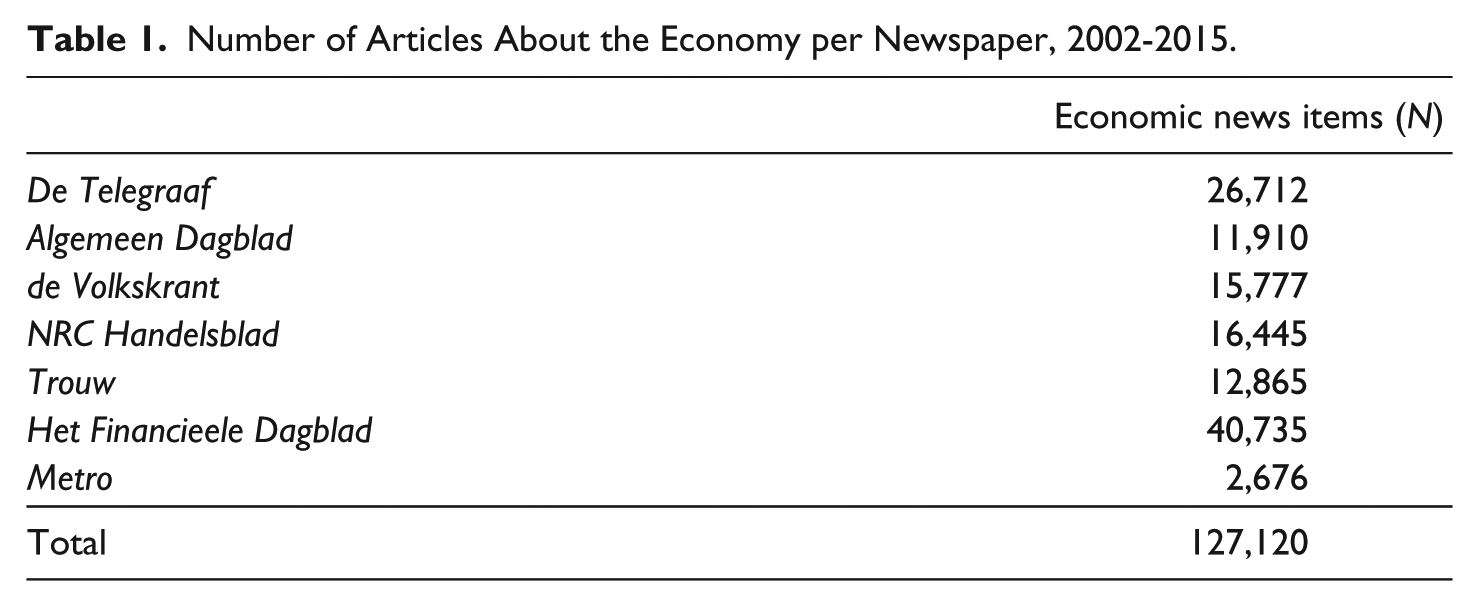
Following several rounds of testing and adjusting, the final version of our list of search strings could be formulated. 2 This generated a data set of 138,054 articles. After scrutinizing a random sample of 200 articles, we maintained a list of keywords indicating noneconomic news (e.g., sports news, cultural events items). Cleaning the noneconomic items resulted in a final set of 127,120 economic news articles (Table 1). Testing several random samples of 50 articles demonstrated that the final data set consists almost entirely of economic news reports and, thus, is suitable for this study’s purpose.
Number of Articles About the Economy per Newspaper, 2002-2015.
The volume of economic news, hence, is measured straightforwardly by calculating the total number of economic articles published per month in all newspapers. To measure the tone of economic news, we follow the list of search terms developed by Kleinnijenhuis, Schultz, Oegema, and van Atteveldt (2013). While many studies use specific economic aspects to capture (mostly negative) sentiment in economic news items, such as the monthly number of references to a recession or crisis (e.g., Hollanders & Vliegenthart, 2011), our aim was to capture the tone of a news item more generally.
We do not define a priori negative (or positive) economic phenomena (e.g., crisis, recession, unemployment), but focus on the presence of sentiment at the article level. The tone in economic news is often expressed with certain bipolar concepts, such as uncertainty versus certitude (Kleinnijenhuis, Schultz, & Oegema, 2015). Applied to their study of financial news, Kleinnijenhuis et al. operationalize tone by counting the references to hope(-related) and fear(-related) words. 3 We follow their operationalization, and added a number of search terms to make the measurement of sentiment appropriate for economic news more generally.
Positive tone has been measured by counting the number of references to hope, confidence, enthusiasm, inspiration, relief, grip, rescue, and recovery(-related) words. Negative tone has been measured by counting the references to fear, shock, panic, danger, worry, disturbance, stress, tension, and anxiety(-related) words. Following cognitive appraisal theory, these search terms measure sentiment in a complete way, covering the retrospective, more certain dimension (“relief,” “distress”), as well as the prospective, more uncertain dimension (“hope,” “fear”; Roseman, 1991). Again, several random samples of 50 articles were analyzed manually to verify this measurement’s validity. Because some of these words may be more common in everyday language use than others, this measurement should be understood as a relative indicator of tone. An article with more negative words will be more negative than an article with fewer of these words, but an article that has more negative than positive words is not by definition a negative article—one needs to compare it with the proportion of negativity in other news articles to determine its tone.
For each article, a total score of positive words and a total score of negative words are calculated. As a next step, the monthly scores are construed as the mean number of references (positive or negative) per article for that month. Positive sentiment ranges from a score of 0.33 to a score of 1.21 (the average number in an article). Negative sentiment ranges from a score of 0.28 to a score of 1.15 (see Table 2 for all descriptive statistics).
Descriptive Statistics.
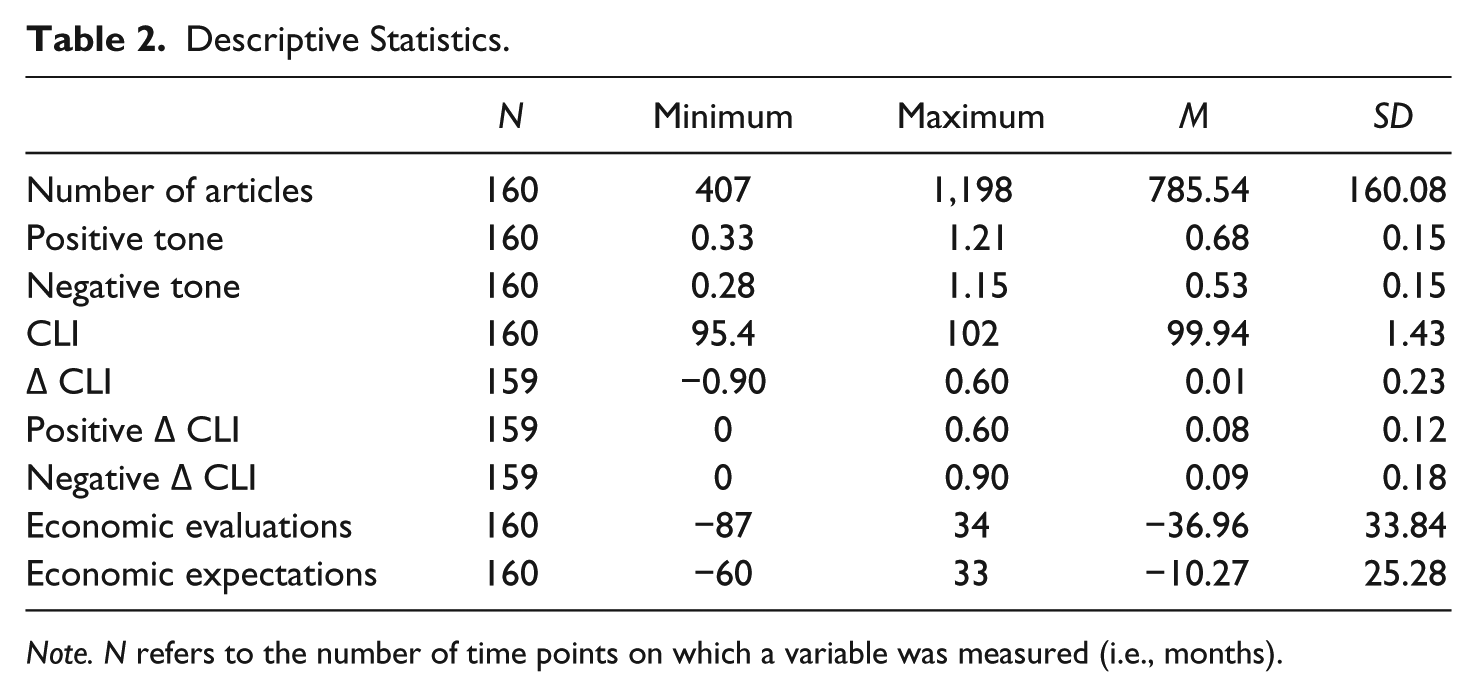
Note. N refers to the number of time points on which a variable was measured (i.e., months).
Economic Indicators
To measure the state of the national economy, we rely on the composite leading indicators (CLI) series as developed by the Organisation for Economic Co-operation and Development (OECD). This series is constructed by aggregating component series selected on the basis of economic significance, cyclical correspondence, and data quality. In contrast to measures like unemployment rates or GDP, CLI is composed of several national economic indicators and provides therefore a more complete measurement of the state of the national economy (see also Blood & Phillips, 1995; Soroka et al., 2015; van Dalen et al., 2015, 2016, who all used it as an indicator of the national economy). Related to business cycles, CLI reflects trends that the public is more likely to be concretely confronted with than rather abstract indicators alternatively used to summarize the state of the economy.
For the Netherlands, CLI is the aggregated measure of order books figures, production figures, the level of finished goods stocks, the business climate of Germany, and the AEX index (Dutch stock exchange). In our analyses, we look at the impact of the level of national economic performances (original values of CLI) and at the effect of change in the level of national economic performance (difference in CLI between the current and previous month).
For change, we distinguish between change regardless of the direction (all values converted into absolute, that is, positive, values), positive change (negative changes are replaced by 0), and negative change (positive changes are replaced by 0). For the ease of interpretation, the values of the last variable that only focuses on negative change are all converted into positive scores such that positive effects imply negative developments.
Public Opinion Data
We rely on data from the Dutch Bureau of Statistics (CBS) to measure economic perceptions. Economic evaluations of the past are measured by means of the question, “According to you, has the economic situation in the Netherlands over the last 12 months clearly improved, slightly improved, remained the same, slightly deteriorated or clearly deteriorated?” Economic expectations regarding the future are measured by the question, “According to you, will the economic situation in the Netherlands over the next 12 months clearly improve, slightly improve, remain the same, slightly deteriorate, or clearly deteriorate?” Monthly scores are defined as the average net result of positive and negative responses, expressed as a percentage. The maximum positive sentiment equals +100, the maximum negative sentiment equals −100, and a sentiment of 0 indicates a neutral (i.e., not positive or negative) economic perception.
Analytic Procedure
All variables used in the analyses are time series. This offers the possibility to sort out time order and thereby to identify the causal direction of the relationships between the variables in our models. Moreover, as aggregated measures, our variables capture real-world swings of the economy and economic news coverage. However, the structure of the data also requires a specific statistic modeling technique to deal with certain issues inherently related to time series data. Most importantly, the series need to be stationary, which implies that the mean and all covariances of the variables are unaffected by a change of time origin and do not depend on the time of measurement (Vasileiadou & Vliegenthart, 2014). Second, the error terms of the series should not be autocorrelated, meaning that the current values should not be correlated with any of the previous values.
We consider an autoregressive integrated moving average (ARIMA) model the most suitable framework for estimating the effects. ARIMA deals with (potential) nonstationarity and autocorrelation in a systematic way before any effects of the independent variables are estimated. The main assumption of ARIMA modeling is that to predict the current value of a time series variable, one should first consider the variable’s own past before adding any exogenous explanatory variables to the model. By modeling the series’ own past as good as possible, one controls for it, which makes claims on causality more persuasive (Hollanders & Vliegenthart, 2008, p. 52). In addition, vector autoregression was conducted to rule out reverse causality by controlling for the (opposite) direction of the effects. In line with our theory and statistical models, no effects were found of citizens’ perceptions on media coverage or the state of the economy, which makes ARIMA a suitable method to test our hypotheses.
The first step in building our models is testing for the series’ stationarity by conducting Dickey Fuller tests. The volume of economic news series (Table 3) is stationary, but the economic evaluations series (Table 4) and economic expectations series (Table 5) are not. Therefore, the latter two series had to be differenced, as well as the exogenous variables in these models. Subsequent tests confirm that all series meet the requirement of stationarity.
Explaining the Volume of Economic News.
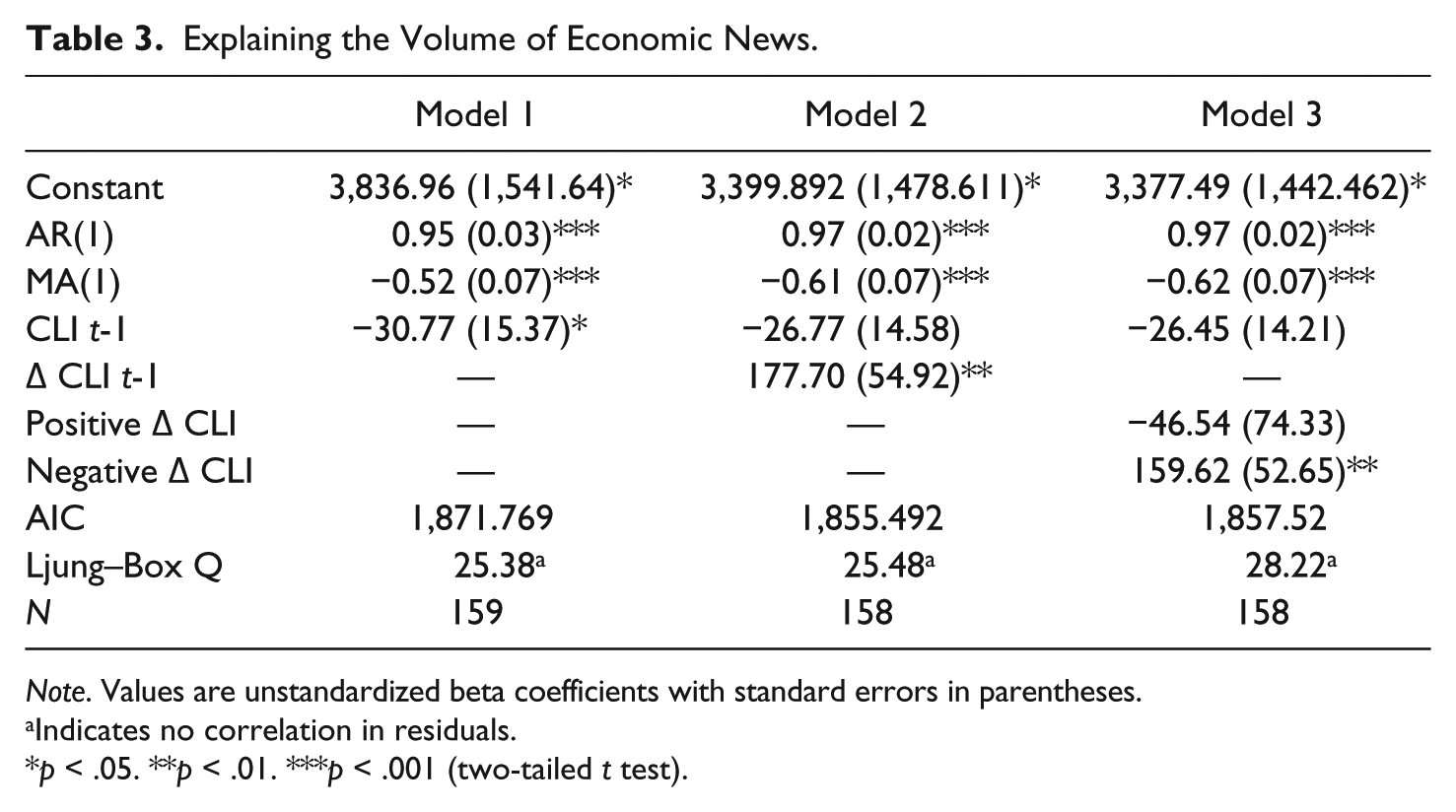
Note. Values are unstandardized beta coefficients with standard errors in parentheses.
Indicates no correlation in residuals.
p < .05. **p < .01. ***p < .001 (two-tailed t test).
Explaining Economic Evaluations (All Variables Are Differenced).
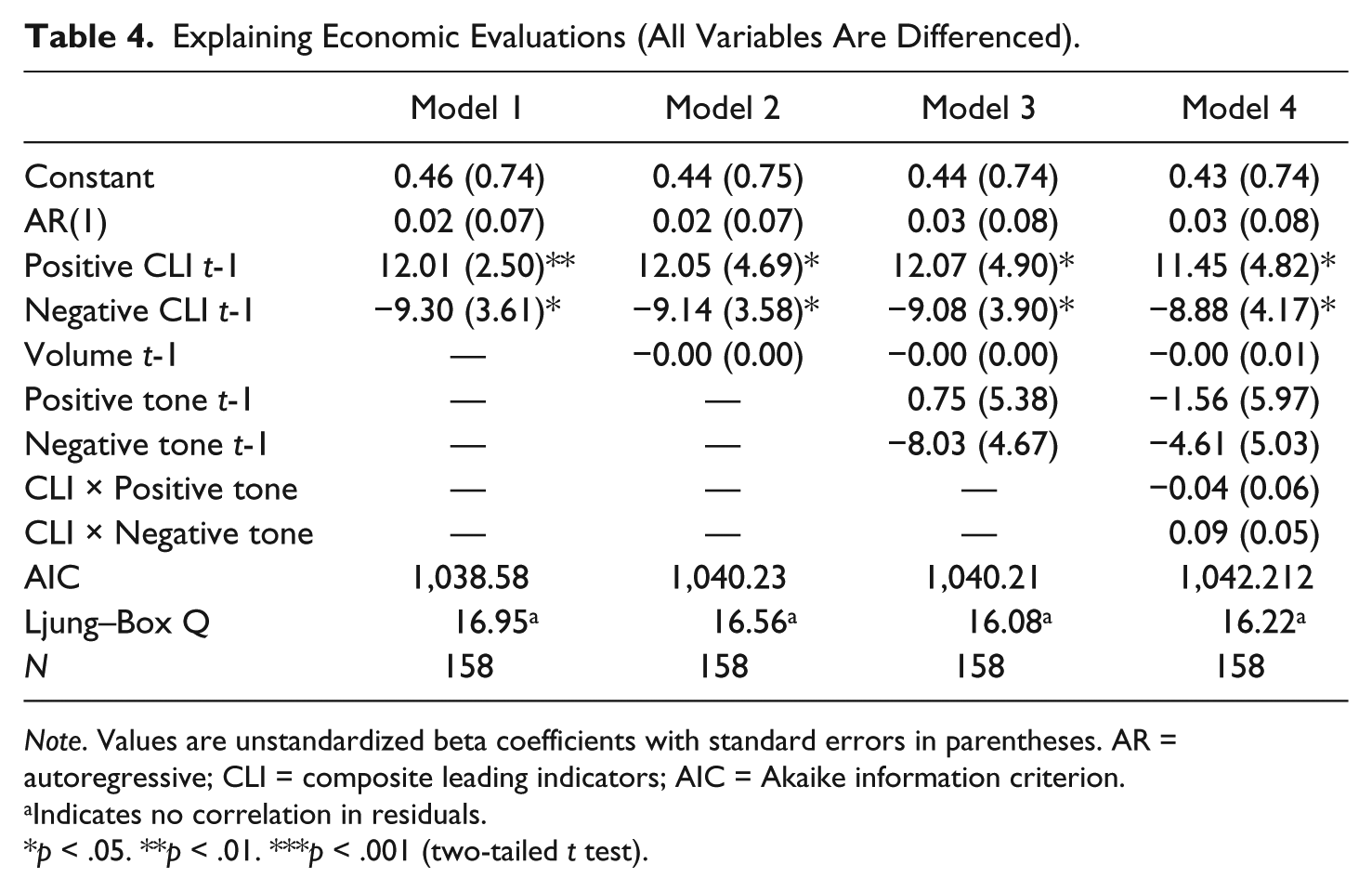
Note. Values are unstandardized beta coefficients with standard errors in parentheses. AR = autoregressive; CLI = composite leading indicators; AIC = Akaike information criterion.
Indicates no correlation in residuals.
p < .05. **p < .01. ***p < .001 (two-tailed t test).
Explaining Economic Expectations (All Variables Are Differenced).
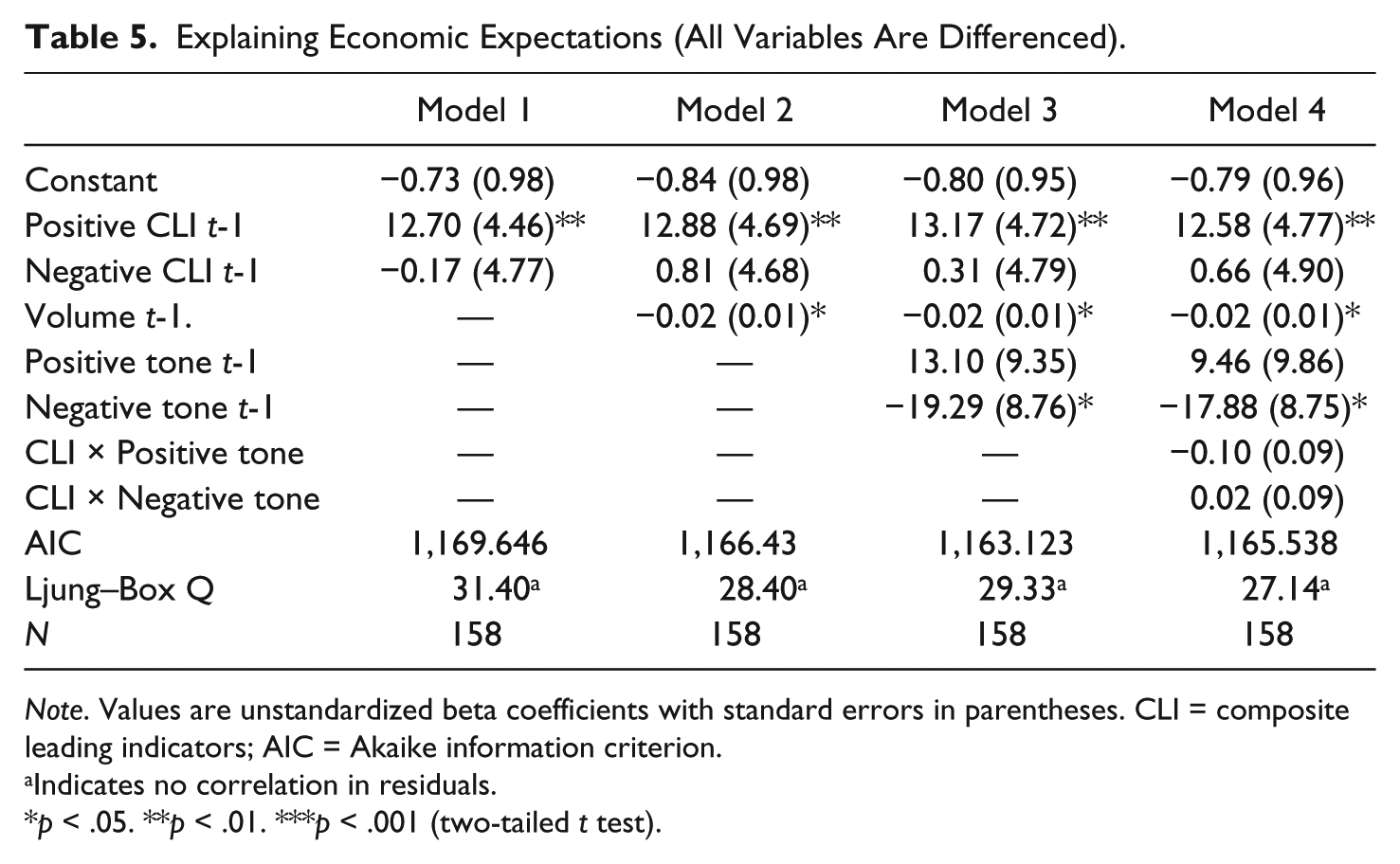
Note. Values are unstandardized beta coefficients with standard errors in parentheses. CLI = composite leading indicators; AIC = Akaike information criterion.
Indicates no correlation in residuals.
p < .05. **p < .01. ***p < .001 (two-tailed t test).
Second, we employ the Ljung–Box’s Q statistic to test whether there is any significant correlation between the residuals and squared residuals; thereby, issues of multicollinearity and heteroscedasticity are checked for. No correlation between the residuals indicates “white noise,” which means that the residuals randomly fluctuate around zero. No correlation between the squared residuals indicates that no problem of heteroscedasticity is detected: The variance in the residuals is evenly distributed for the whole period. To remove both types of autocorrelation, AR and/or moving average (MA) terms are to be added to the model if necessary. AR terms indicate the lagged endogenous variables that resemble the effects of previous values of the series on the current value; MA terms represent the influence of residuals from previous values on the current value (Vasileiadou & Vliegenthart, 2014).
In the model explaining the volume of economic news (Table 3), the Ljung–Box’s Q statistic indicates that a model including one AR and one MA-term (1,0,1) fits the data best. For our second model, explaining economic evaluations (Table 4), we include one AR-term (1,1,0). Finally, for economic expectations (Table 5), we rely on a model with no AR or MA terms (0,1,0). For all models, both the residuals and the squared residuals resemble white noise indicating that no issues of autocorrelation and heteroscedasticity bias our results. As a robustness check, all analyses were also conducted using error-correction models (ECMs), which generated the same results as the ARIMA models in terms of the direction as well as the significance of the effects. 4
Results
The state of the economy and economic news coverage
Figure 1 shows the over time development of the Dutch economy and the monthly volume of economic news. From 2002 to 2007, the total number of economic news articles gradually decreases over time, followed by a steep increase by the end of 2007. This coincides with a period of economic downturn, as the low point in the CLI line illustrates. From 2013 onward, fewer articles are devoted to the economy, which seemingly coincides with a period of economic recovery. The negative relationship between CLI and the number of monthly articles is confirmed by a pair-wise correlation coefficient of −0.42 (p = .000).
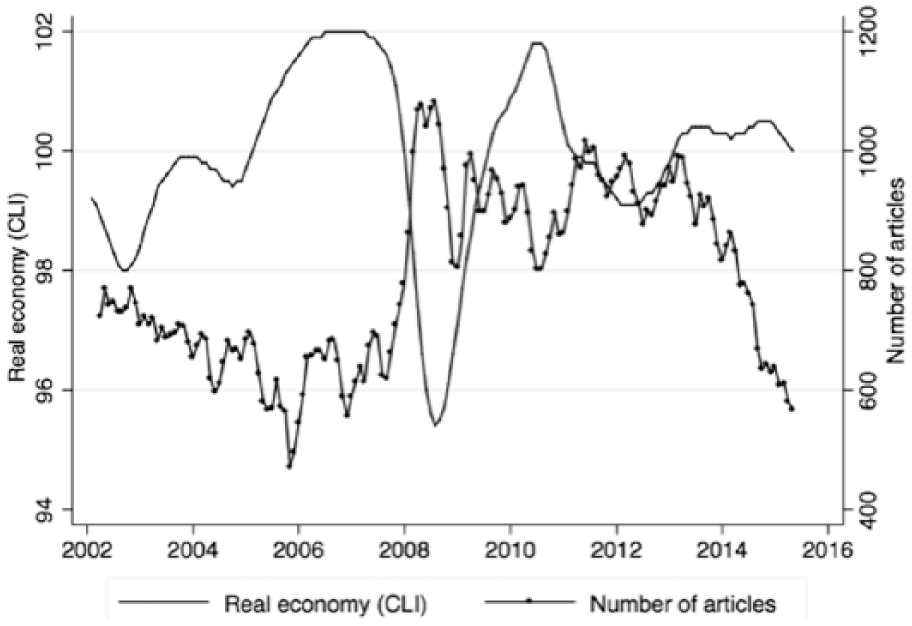
CLI and the volume of economic news.
To explain the volume of economic news, we first look at its relationship with national economic developments, measured by the original CLI values (see Table 3). In Model 1, CLI is negatively and significantly associated with the number of economic newspaper articles per month (b = −30.77, p = .045). When the level of CLI increases by 1 point, the number of economic news articles written in the next month decreases by almost 31. In other words, the better the economy performs, the less journalists write about it, but also vice versa: A deteriorating economy attracts more coverage. Based on this, we accept Hypothesis 1.
In Model 2, we add over time economic change (Δ CLI t-1) to the model. The volume of economic news is strongly determined by change in CLI (p = .001). A one-unit increase in economic change is associated with an increase of 177 news articles the next month, above and beyond the impact of the level of national economic performance. The negative effect of CLI remains, although it weakens (the coefficient decreases from −30.77 in Model 1 to −26.77 in Model 2) and becomes insignificant (p = .066). In line with earlier research, we find that journalists are particularly responsive to change in the national economy rather than to levels of economic performance (van Dalen et al., 2015), leading us to accept Hypothesis 2a.
To analyze whether the direction of those changes (i.e., positive vs. negative economic developments) makes a difference to journalists, we specify CLI-change in Model 3 into a positive CLI-change variable (negative changes are replaced by 0) and a negative CLI-change variable (positive changes are replaced by 0). Negative economic developments have a strong and positive impact on the volume of economic news (p = .002). A one-unit increase in negative economic change leads to an increase of 159 economic news articles. The negative effect of positive economic developments, however, is far from significant (p = .531). Therefore, also Hypothesis 2b is accepted.
Apparently, only a worsening economy is worth writing about; economic recovery or growth does not induce journalists to report. Additional analyses show that a worsening economy not only leads to more news, but also to more negative news. Whereas negative coverage is affected by economic change, positive coverage is not; an improving economy does not lead to more positive coverage. This asymmetry underscores the responsiveness of journalists to negative economic developments. 5
In sum, the level of economic performance is negatively associated with the volume of news. A bad economy hits the headlines. A good economy is no news. But more than to absolute levels of economic performances, journalists are responsive to changes. Model 3 shows that this responsiveness has to be ascribed to negative changes alone. Economic recovery or growth does not lead to any increases in economic news volumes, but economic downturn does. Altogether, these results point to a substantial negativity bias in economic news reporting.
Economic news coverage and economic perceptions
Evaluations
Shifting from explaining the news to explaining citizens’ perceptions, we now analyze the impact of the economy and the mediating role of news coverage on people’s perceptions, starting with their retrospective evaluations of the economy over the last year. Figure 2 shows the development of CLI and people’s economic evaluations.
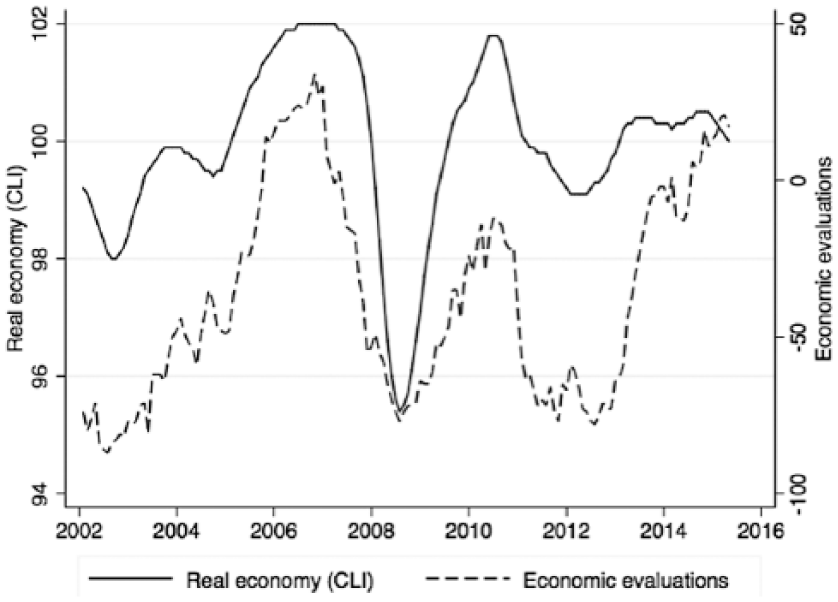
CLI and economic evaluations.
Not surprisingly, both series move to a high degree in tandem (pair-wise correlation: 0.75, p = .000). After a downward trend over the course of 2002, both the economy (CLI) and people’s evaluations of it gradually improve until they reach a peak around 2007. When the financial crisis erupts during the second half of 2007, CLI and evaluations start to move downward steeply and both reach a low around March 2009 followed by an upward trend that continues until the spring of 2011. After this peak, both series go down again. Economic evaluations reach a new low around March 2013; however, this time the pessimistic evaluations are not accompanied by particularly low CLI scores. From 2014 onward, both series score above their means, indicating more prosperous economic times and less pessimistic economic evaluations.
Figure 3 displays the development of the volume of economic news coverage together with public evaluations. Overall, both series are associated negatively. When the volume of economic news goes up, the optimism of economic evaluations goes down (pair-wise correlation: –0.48, p = .000). Finally, in Figure 4, the volume of economic news is replaced by the tone of the coverage. Negative tone is subtracted from positive tone, resulting in a measurement of which higher scores indicate a more positive tone of the coverage. Mid-2007, when the financial crisis breaks out, the tone of economic coverage is most negative. From this moment on, coverage becomes gradually more positive until it reaches a peak during the second half of 2009. The tone of the coverage is negatively associated with economic evaluations (pair-wise correlation: –0.48, p = .000).
Volume of economic news and economic evaluations.
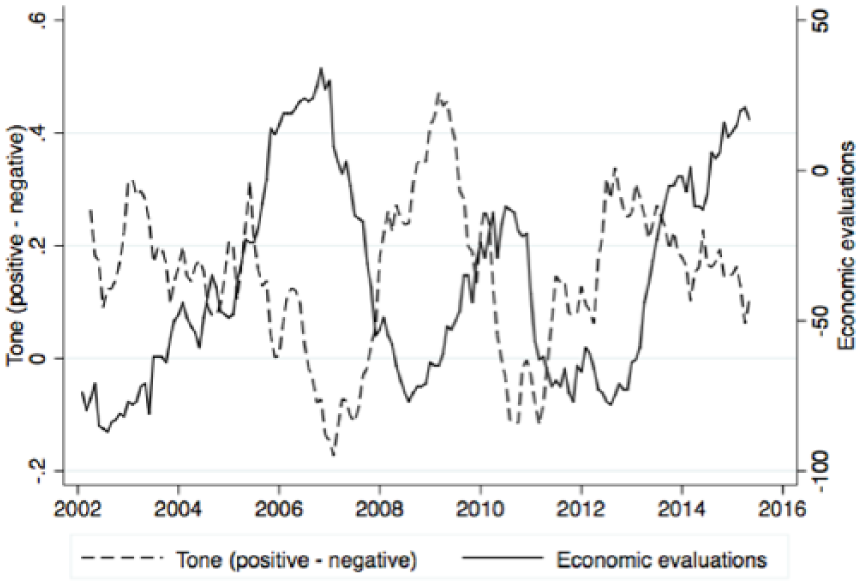
Tone of economic news and economic evaluations.
To explain economic evaluations, we start with a model that assesses the impact of real economic circumstances on people’s retrospective judgments of the economy over the last year (Table 4). Model 1 shows a significant and positive impact of positive economic change (CLI; p = .009) on changes in people’s evaluations of that same economy. This means that any positive development in the real economy (i.e., stronger economic growth than in the previous month) translates into positive developments in people’s retrospective judgments. Similarly, negative economic change leads to more pessimistic evaluations (p = .010). Real-world economic conditions, thus, affect retrospective evaluations in the direction that was expected.
Next, we add the volume of economic news to the analysis. Model 2 shows that no significant effect is found of changes in the volume of news (p = .532), while the effects of positive and negative change of the real-world economy remain significant (p = .010, p = .011).
In Model 3, we analyze the effect of tone in coverage. Thereby, we specify change in positive news sentiment and change in negative news sentiment. Both variables do not reach the level of statistical significance either (respectively, p = .889, p = .085): The tone of economic news coverage has no effect on retrospective economic evaluations. People, thus, rely on real-world economic conditions when they evaluate the economic past, and neither the extent nor the tone with which the media report about that same economy makes a difference.
In addition, we examine whether these null findings hold when we differentiate between different economic circumstances. In Model 4, we include two interaction terms: one in which economic change interacts with positive tonality and one in which economic change interacts with negative tonality. All findings hold, people’s retrospective judgments are only shaped by real economic developments—positive and negative—and no media effect is found.
Expectations
Moving from evaluating the past, we now analyze the impact of the economy and the news on economic expectations for the future. Figure 5 shows the over time development of CLI and public expectations. Like evaluations (Figure 2), people’s expectations move in tandem with the real economy, however, the pair-wise correlation coefficient is somewhat weaker (r = .52, p = .000). More variation exists in people’s expectations compared with their evaluations, illustrated by the higher peaks and deeper lows.
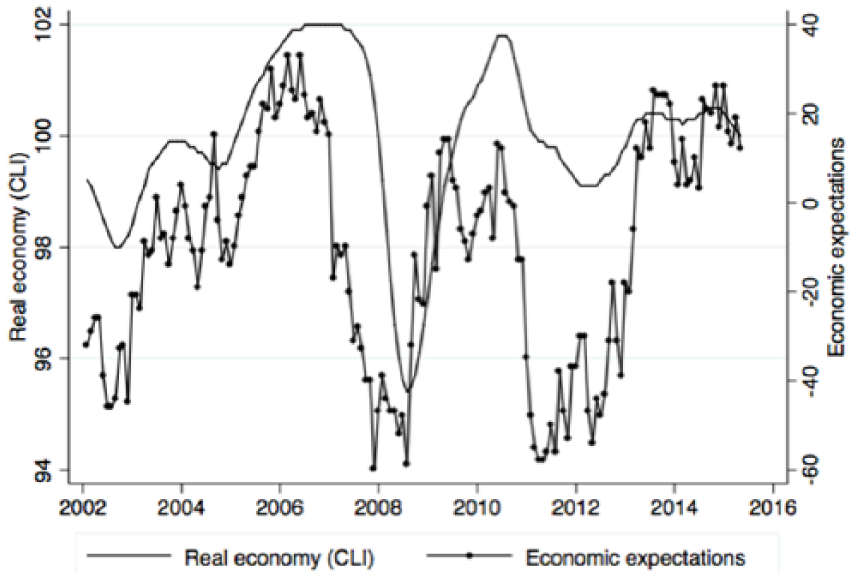
CLI and economic expectations.
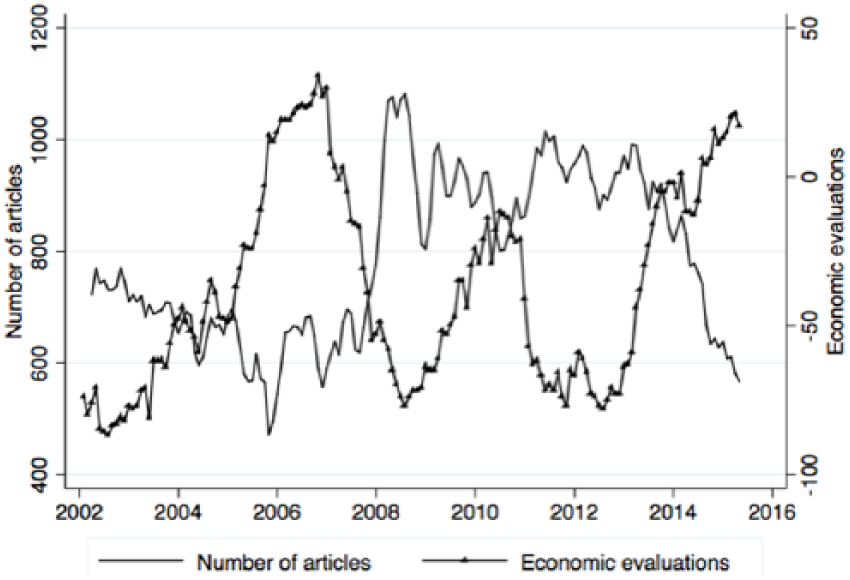
Figure 6 displays the over time development of economic news volumes and people’s economic expectations. A similar pattern is observed as for retrospective evaluations (Figure 3): When the volume of economic news goes up, people’s economic expectations for the future become less optimistic (r = –.47, p = .000). Finally, the tone of economic news is negatively correlated with people’s expectations (r = –.11, p = .161). Although Figure 7 shows that both series follow trends over time that are roughly similar, their alignment is not too obvious. Overall, upward or downward trends in people’s expectations seem to be preceded by upward or downward trends in the tone of coverage.
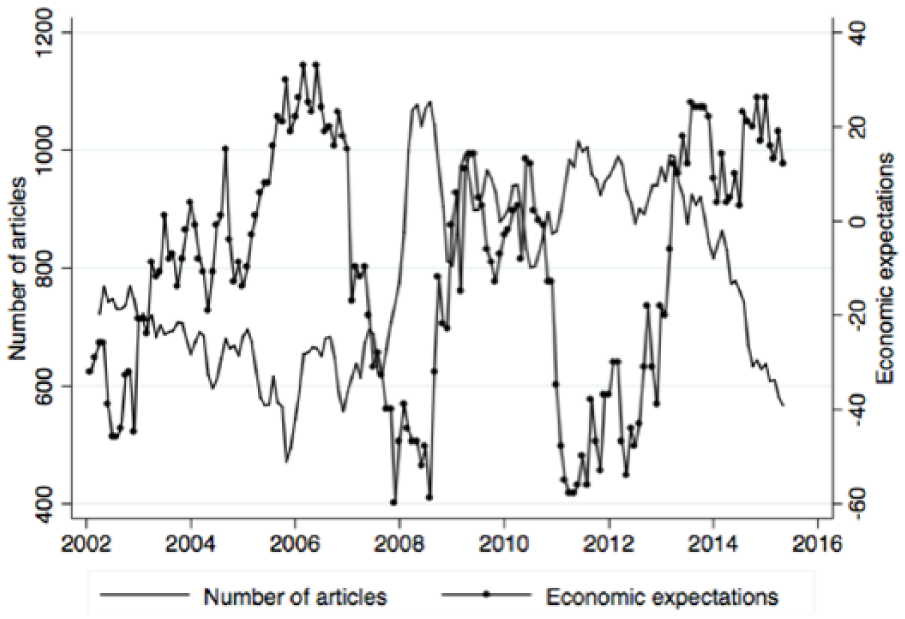
Volume of economic news and economic expectations.
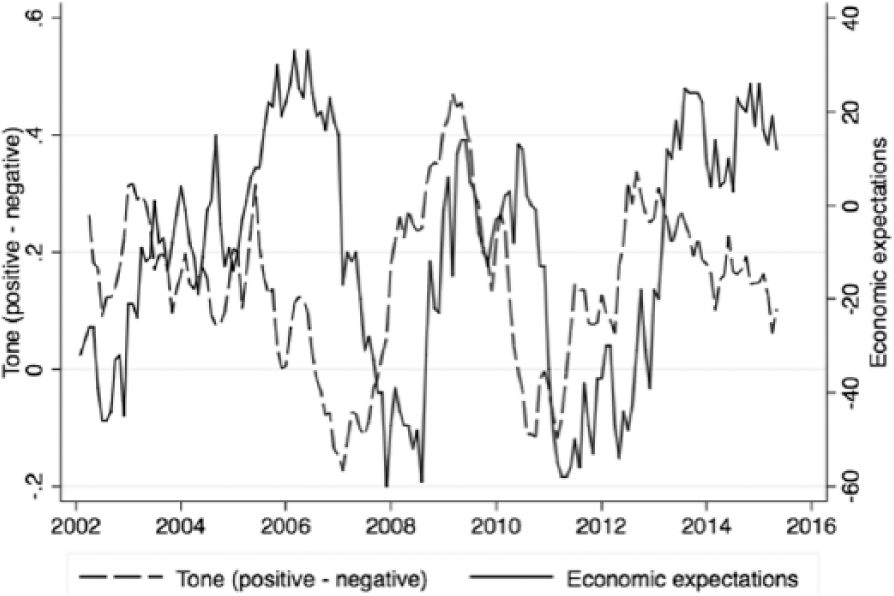
Tone of economic news and economic expectations.
To explain economic expectations, we first examine the impact of positive and negative economic change. Model 1 (Table 5) shows a significant and positive impact for positive change in CLI (p = .004), which indicates that recent economic growth leads to more optimistic expectations for the coming year. Interestingly, the negative effect of economic downturn is not significant (p = .971). Citizens’ expectations, thus, are not as susceptible to real economic change as retrospective judgments are.
In Model 2, we include the volume of news. In contrast to economic evaluations (Table 4), we find a significant and negative impact for change in the volume of economic news on people’s expectations (p = .023). When the media write more about the economy in the current month compared with the previous one, citizens’ expectations for the future turn more pessimistic, above and beyond the impact of real economic change (positive and negative). Consequently, we can answer RQ1. More economic news leads to more pessimistic economic perceptions; however, this is only true for people’s expectations for the future.
To obtain a more detailed understanding of this media effect, we include the measurement of tone in Model 3. For changes in positive news, we find no significant impact (p = .161), which demonstrates that people across the board do not adjust their expectations on the basis of increasing or decreasing positive economic news coverage. Therefore, we reject Hypothesis 3a. However, changes in negative sentiment are strongly and significantly associated with shifts in economic expectations (p = .028). When change in negative sentiment increases by 1, change in economic expectations decreases by 19.29 points on a scale that ranges from a minimum of −60 to a maximum of 33 (see Table 2). Effectively, this implies a strong negative effect of increased negative news coverage on the development of economic expectations, leading us to partly accept Hypothesis 3b. The negative effect of change in the volume of news becomes slightly weaker (p = .043), suggesting that this runs partly through (negative) tonality. The media, thus, have a strong effect on citizens’ expectations independent of developments in the real economy. We fully accept Hypothesis 4: People’s expectations for the economic future are shaped by economic news, but their evaluations of the economic past are not.
Again, Model 4 examines whether economic circumstances matter for the strength of the media effects. Two interaction terms are tested, one in which economic change interacts with positive tonality and one in which economic change interacts with negative tonality. All main effects remain, whereas the interaction terms are insignificant. Hence, we conclude that the prevalence of negative economic information for the formation of people’s prospective judgments holds regardless of economic circumstances.
Finally, we accept Hypothesis 5: Both evaluations and expectations are (co-)shaped by real economic developments. When people evaluate the past, real growth and downturn have the effects one would expect while the media do not play a role (Table 4). When evaluating the uncertain economic future, the real economy is less influential: Expectations are determined by CLI but only in case of growth. However, for these prospective judgments, economic news does matter; the volume of news and the negative sentiment of the content both lead to increasing levels of pessimism (Table 5).
Discussion
When the economy does not perform well, and especially when it develops into a negative direction, the audience is confronted with an increasing volume in economic news coverage. When the economy instead does well (e.g., when it recovers or grows), the audience will see less of it in the media. This imbalance in coverage, subsequently, affects public perceptions of the economy. Demonstrating how the effect of the (a) real-world economy travels through (b) news coverage all the way to (c) public perceptions, we provide an elaborate view of how this triangle of relationships may shape citizens’ perceptions of the past and future economy, thereby bringing together different elements that were mostly studied in separation by previous research.
The negativity bias revealed in news coverage is in line with earlier research pointing out an overemphasis on negative stories in economic reporting (e.g., Soroka, 2006, 2015). The preoccupation among journalists with negative economic conditions is in line with their role conception as watchdogs. Moreover, the fact that especially negative developments lead to increases in news reporting reaffirms the news value of negativity and newness (Harcup & O’Neill, 2001). Western economies generally are characterized by a stable growth necessary to uphold employment rates; negative developments or crises strongly deviate from this pattern, which justifies journalistic sensitivity toward this. From the perspective of the media as the fourth estate, the overawareness regarding negative developments might be considered desirable. Controlling government implies tracing wrongdoings and societal problems instead of focusing on achievements. In such a function, it may come as no surprise that the media produce more (negative) economic news when the economy goes down relative to periods of economic growth.
Not only do journalists overreact to negative economic developments, citizens in their turn most strongly respond to economic information when the news is bad. Thereby, our findings provide robust evidence for what earlier research already suggested (e.g., Soroka, 2006): Negative news leads to more pessimism, whereas positive news does not have the equivalent countereffect. In addition to existing research, however, we distinguish between evaluations of the economic past and expectations for the economic future. Hence, findings show that the unequal impact of negative as compared with positive coverage only applies to the formation of prospective judgments. This is in contrast to evaluations of the past, which are predominantly based upon real—positive and negative—economic developments: Shops that have been closed or opened, salaries that have been lowered or raised; all such real-life experiences may shape the way in which people perceive economic conditions over the last year. When people judge their nation’s economic future, they become increasingly optimistic when the economy grows. This positive impact is countered by the negative effect of economic news, of which both the volume and the negative tone lead to pessimism. These results imply that the mechanisms driving the effects of the real economy and the news are substantially different for people’s retrospective evaluations compared with their prospective expectations. By approaching it from a different angle, we were able to provide additional evidence for media-dependency theory (Ball-Rokeach & DeFleur, 1976). Whereas previous research demonstrated, for example, that evaluations of the own economic situation are less affected by economic news than those of the national situation (Boomgaarden et al., 2011), we demonstrate how media effects are conditional on the time period that is evaluated. The explanation for our findings most likely would be the higher level of uncertainty people face when judging the economic future compared with the economic past, for which other sources of information are available (e.g., real-life experiences, interpersonal communication). The different impact of economic growth and decline demonstrates that judgments regarding the past are indeed shaped differently from judgments regarding the future. Altogether, the results illustrate the relevance and importance of treating economic evaluations and expectations as truly distinct concepts in media effect research.
People’s sensitivity toward negative news when assessing the economic future combined with the tendency among journalists to report more frequently when the economy goes downward, leads to the conclusion that people’s economic expectations tend to be distorted in a negative manner, especially in times of economic distress. This is not without consequences as these economic expectations are not only found to be strong predictors of economic behavior, such as the willingness to spend (e.g., D’Acunto, Hoang, & Weber, 2015), but they also have a profound impact on political preferences, such as presidential approval ratings (e.g., MacKuen et al., 1992; Nadeau et al., 1999).
Altogether, our findings provide insights into the functioning of economic journalism in modern democracies. A tension seems to exist between the fulfillment of the watchdog role and other essential media functions, such as informing the citizenry in a correct manner (Strömbäck, 2005). Given the well-documented human sensitivity toward negative information (Tversky & Kahneman, 1975), journalists face an important task in the provision of accurate news reports in which positive economic information receives equivalent attention as negative news. Because they are central to the formation of economic expectations with all consequences these may have, economic news reports should ideally be a reflection of real economic conditions, not only content-wise but also volume-wise.
Inevitably, our study faces certain limitations. By employing data on the aggregate (i.e., national) level, we are able to investigate a long time period, but this also means that we cannot draw conclusions on individual-level behavior. More specifically, any individual-level variation that could explain the media effects more into detail is not taken into account. Goidel et al. (2010), for example, find that exposure to different types of news sources (i.e., national and local newspapers, national and local television news) influences the effect economic news has on people’s perceptions. Distinguishing between different medium types, while tracing the effect of economic news on people’s perceptions at the individual level, is a crucial avenue for future research. Panel survey data would generate complementary and more refined insights in the way and under which conditions people’s perceptions are shaped by economic news coverage although for a shorter time period.
Second, a computer-based content analysis is not the most sensitive measure when it comes to detecting nuanced differences among and within media messages. Yet, it is still the most suitable method for the analysis of large amounts of longitudinal media data. A more detailed, in-depth analysis of economic media messages, and the way in which these messages relate to real economic developments and people’s economic perceptions, might complement our findings and would be interesting for future studies.
Altogether, the current study offers important insights into the way in which journalists respond to real-world economic conditions and how their news reports, in turn, affect the economic perceptions of citizens, especially regarding their expectations for the future. The double negativity bias, found on the level of both the media and the public, raises pressing questions about the functioning of economic journalism in modern democracies.
Footnotes
Declaration of Conflicting Interests
The authors declared no potential conflicts of interest with respect to the research, authorship, and/or publication of this article.
Funding
The authors disclosed receipt of the following financial support for the research, authorship, and/or publication of this article: Research conducted for this article was funded by a VIDI grant (project number: 016.145.369) from the Netherlands Organization for Scientific Research awarded to Prof. Rens Vliegenthart.