




Abstract
This study introduces the element of time to investigate the causal relation between organizational and news media agendas. Reciprocal time-series analyses were applied to daily-level aggregated press releases (n = 17,221) and news articles (n = 74,067). Results indicate that on the first level of agenda building, organizational and news agendas are intertwined in an intimate relation of reciprocal influence, in which organizations more often take the lead. Conversely, results suggest that on the second level of agenda building, organizational and news agendas influence each other less often. Organizational and newspaper characteristics proved useful to map the contingency of agenda-building effects. The findings suggest that organizational sources are more influential in the news discovery phase compared with the news-gathering phase, and imply that the unidirectional conceptualization of news media as a channel to vent organizational messages is too narrow.
In recent years, several authors warned of the consequences of shifts in the power balance between journalists and organizational sources (e.g., Davies, 2008). As a result of decreasing financial and editorial resources of news media institutions, organizations have become more effective in regulating the topics and issues that receive news attention (Lewis, Williams, & Franklin, 2008a), herewith determining their visibility in the public sphere. These claims suggest that the news agenda is increasingly under control of public relations agenda-building efforts, and functions as an effective channel for organizations to reach their publics (Lewis et al., 2008b; O’Neill & O’Connor, 2008).
The assumption that organizational sources control when and how journalists report about organizations is, however, in dispute. Scholars have stressed that the conceptualization of mass media as a channel to vent organizational messages is too narrow and fails to take into account the dynamic and complex interplay between organizational and news media agendas (e.g., Verhoeven, 2009). Preserving their role as gatekeepers, journalists are still in control of the extent to which certain topics and issues receive attention on the news agenda (Strömbäck, 2008). Although work pressure and time constraints might well have increased journalists’ dependence on information from organizational sources (Davies, 2008), ultimately, it is still journalists who decide which organizational-subsidized content is, and which is not, newsworthy.
A reason for these conflicting perspectives might be that the relationship between organizations and news media can be characterized by interdependency and reciprocity. Indeed, the relationship between journalists, on the one hand, and organizational sources, on the other, has been characterized as semiotic, in which both actors depend on, and benefit from, each other. Previous research has revealed significant relations between organizational and news media agendas (e.g., Kim, Kiousis, & Xiang, 2015; Moon & Hyun, 2014). Yet, others have argued that “while agenda–building scholars often define agenda building as the dynamic exchange of priorities among stakeholder groups, at times, this research stream relies too much on cross-sectional data to draw inferences” (Ragas, 2013, p. 221; see also Kiousis, Popescu, & Mitrook, 2007, p. 156).
Relying predominantly on correlational analyses, previous studies have often treated the organizational-media agenda relationship as a static event, instead of as a dynamic process. By aggregating the organizational-media agenda relation into a single correlation, dynamic processes that lead to agenda convergence cannot be analyzed, nor can causality and effect sizes be estimated. Consequently, over-time variations in agenda convergence are ignored, and causal conclusions about its driving forces cannot be made. The straightforward question about whether organizations indeed exert control over the news media agenda has, thus, remained in dispute.
To answer the question whether it is organizations, or the news media, who take the lead, the current study aims to extend this emerging research stream by investigating the relationship between both agendas. We apply time-series designs (vector autoregression [VAR]) to assess the effects of organizational agendas on news media agendas, and vice versa, by relying on multiple years of press releases of, and news coverage about, organizations in the U.K. context. This statistical approach allows sustaining claims on the temporal ordering of the measured variables, and therefore brings us a step closer to assessing causality. First, on the first level of agenda building, as an indicator of organizational salience, we investigate object salience transfer between organizational and news agendas. Second, as a feature of affective attributes on the second level of agenda building, we investigate the directionality of affective attribute salience transfer between both domains.
The findings of this study contribute to the theoretical and empirical conceptualization of the dynamic interplay between organizations and news media. Positioned on the intersection between public relations research into the role of source-controlled information subsidies (see Cook, 1998), and journalism studies focusing on news production processes, this study aims to boost the theoretical integration of both domains. We argue that a stronger theoretical exchange between both currently distinctive research fields will contribute to a better understanding of the increasingly intertwined and mutually interdependent relationship (Reich, 2010). In addition, by comparing organizational and newspaper types, this study contributes to the scholarly understanding of the extent to which organizational and media characteristics explain when organizational and news media agendas interact.
Agenda Building in the Organizational-News Media Domain
Originating from the domain of political communication (McCombs & Shaw, 1972), agenda setting is among the most applied frameworks in communication research (Scheufele & Tewksbury, 2007). Ultimately, the theory posits that issue salience transfers from the media to the public agenda (McCombs & Shaw, 1972). Agenda building was proposed as an extension of the original agenda-setting theory, shifting the research focus from who sets the public agenda to who determines the media agenda. Agenda-building research aims to capture the processes that influence the formation of salience of actors, topics, and issues on the news agenda (Berkowitz, 1992; Ragas, Kim, & Kiousis, 2011). This process can therefore be related to the strategic use of messages to impact agendas such as (but not excluded to) the news media (Ragas et al., 2011).
Accordingly, scholars recently have acknowledged the value of the agenda-building theory for understanding interactions between multiple agendas: for example, the multidirectional relation of the media agenda with political sources (e.g., Van Aelst, Sehata, & Dalen, 2010), (online) public opinion/agenda (Guo & Vargo, 2015), and among different media outlets (i.e., intermedia agenda-setting effects; Vliegenthart & Walgrave, 2008).
Moreover, the role of organizational sources in the media processes of agenda building is often highlighted in previous research. Here, it is proposed that organizations that secure a prominent place on the media agenda are also more likely to be prominent on the public agenda (Carroll & McCombs, 2003). The relative success of agenda-building efforts is determined based on the placement of so-called information subsidies (Cook, 1998), generally in the form of press releases (e.g., Berger, 2001; Verhoeven, 2009). Whether information subsidies pass through the news selection “gate” is contingent upon a plurality of factors, such as their perceived newsworthiness and trustworthiness (Harcup & O’Neill, 2001). Although the evidence shows great variation in the degree to which information subsidies find their way to the media agenda, today’s conditions for organizations to set and build the news media agenda are considered advantageous (Davies, 2008).
Agenda building considers multiple levels. The first level of agenda building deals with the relative attention for objects (Carroll & McCombs, 2003). Here, the process of salience formation addresses the reciprocal influence of objects on the media agenda, and on noninstitutionalized (public opinion) and institutionalized (political parties, governments, or organizations) agendas (Kiousis et al., 2007). Hence, it is proposed that organizations who secure a prominent place on the (news) media agenda are also more likely to be prominent on the public agenda (Carroll & McCombs, 2003).
The second level of agenda building deals with substantive and affective attributes of these objects. Substantive attributes refer to the objects’ cognitive characteristics, such as a certain corporate product, financial performance, or the reputation of the CEO (Kim et al., 2015; Kiousis et al., 2007). Affective attributes refer to the emotional characteristics of the object, such as whether it is described in neutral, positive, or negative terms (Carroll & McCombs, 2003; Kim et al., 2015). At this point, it needs to be acknowledged that a so-called third level or Network Agenda Setting has started to emerge, combining the second and third levels (Vargo, Guo, McCombs, & Shaw, 2014). The third level suggests that media can make bundles of objects and attributes simultaneously salient in the public’s mind. As organizations are the single object investigated in the current study, an analysis of associations between issues and attributes, which does justice to the third level, is beyond its scope.
The ultimate goal of public relations departments is to influence not only media salience or presence of their organization (object salience, first-level agenda building) but also the tone of news about these organizations (affective attribute salience, second-level agenda building). Organizational agenda-building efforts are regarded as successful when the content of press releases resonates as intended in the news (Schultz, Kleinnijenhuis, Oegema, Utz, & Van Atteveldt, 2012). From an organizational perspective, this is understandable, because the reputational gains of branding organizational motives favorably on the news agenda in terms of tone are considerable (Kiousis et al., 2007).
Consequently, the current study investigates whether organizations succeed in influencing their affective evaluation in the news. Defined as affective attribute salience, we do not only explore media’s and organization’s attempts to inform us “what to think about” but also “how to think about” objects. The study aims to investigate how frequently organizations (as the study’s main object of interest) are mentioned, and how they are presented in terms of positive, neutral, or negative attributes on organizational and news agendas. Affective attribute salience is therefore defined as the sentiment polarity of organizations’ representations in press releases and news articles. Thus, in addition to object salience, we focus on affective attribute salience (i.e., sentiment) as a feature of second-level agenda building.
The relationship between organizational sources and news media can be characterized by interdependency: “Both sources and gatekeepers benefit from their mutual relationship, with the sources getting access to target audiences through the mass media and gatekeepers getting access to someone who can regularly provide credible information” (Shoemaker, 1991, p. 61). Without depriving journalists’ autonomy to “guard the gate,” this suggests a strongly symbiotic relationship between organizational sources and journalists, in which public access is exchanged for editorial input. These developments have raised both professional and academic concerns about the autonomous functioning of journalism as a fourth estate in democracy (Reich, 2010). To effectively capture the relationship between organizational sources and news media, a dynamic approach is needed.
Toward a Dynamic Understanding of the Organizational-News Agenda Interplay
The dominant body of agenda-building studies has primarily approached the interaction between organizational-news agendas either from the angle of organizational-news subsidizers or from the perspective of journalists, opposing or motivating the use of subsidized content. Furthermore, the studies that have actually explicitly compared organizational and news media agendas are criticized for relying mainly on correlation analysis. As argued, to adequately measure the symbiotic relationship between journalists and their sources, a reciprocal time-series design is needed, which allows for agendas to be both independent and dependent (e.g., Van Aelst & Vliegenthart, 2014).
The agenda-building studies using an overtime approach have so far focused predominantly on the interaction between political and mass media agendas. At large, these studies have revealed that the relationship between political and news agendas can be characterized by contingency (Walgrave & Van Aelst, 2006) and reciprocity (Van Aelst & Vliegenthart, 2014). Yet, this literature remains inconclusive regarding who takes the lead in this interaction (Van Aelst & Vliegenthart, 2014).
In the context of public relations research, sparse agenda-building research—relying on time-series analysis—also points to different conclusions. Taking the specific case of the Yahoo-Icahn contest, Ragas and colleagues (2011) showed that corporate information subsidies influenced the news agenda, rather than the other way around. Kleinnijenhuis, Schultz, Utz, and Oegema (2015) showed that during the British Petroleum oil spill crisis of 2010, BP’s public relations efforts were effective in generating coverage in U.S. newspapers, whereas a reverse effect remained absent. Others, however, have argued that media and organizational agendas influence each other both ways. Ragas (2013) demonstrated a mutual influence between financial news coverage and corporate information subsidies. In agreement with this, Pollach (2014) found that for most issues, corporate and news agendas mirror each other with regard to attention for environmental content. In sum, the existing literature provides conflicting evidence with regard to the directionality of first-level agenda-building effects between organizational and news agendas. This might be due to the differences in aggregation level, number of lags chosen, specific contexts, and focus of inquiry. Furthermore, the literature provides no conclusive evidence regarding second-level agenda-building dynamics in the organizational-news domain. The only indication of strong linkages is found based on correlation analysis (Kim et al., 2015; Kiousis & Wu, 2008). We formulate the following research questions on the first level of agenda building (RQ1) and the second level of agenda building (RQ2):
The Contingency of Organizational-News Agenda Interactions
In addition, this study aims to advance and nuance our understanding of the conditions under which organizational-news agenda interactions occur. Agenda building is often implicitly assumed to be a process that applies to all organizations and media types. Yet, it stands to reason that this process could be different for some organizations and media types. Adopting a comparative approach, we aim to move toward a deeper understanding of such differences and similarities in agenda-building dynamics across organizations and media types.
The first contingency factor we consider is the newspaper type (broadsheet vs. tabloid newspapers). From the field of journalism, it is evidenced that the extent to which news media boost the political agenda is contingent upon, among other factors, media types (Walgrave & Van Aelst, 2006). The same mechanism might apply to the organizational-news media interplay. We focus on print media, as newspapers still fulfill an important role in setting the agenda of other media—such as television (e.g., Vliegenthart & Walgrave, 2008). Moreover, the overtime availability of newspaper data allows us to investigate the interplay between organizational and news agendas longitudinally.
Compared with broadsheet news outlets, tabloid newspapers differ considerably with regard to content characteristics, such as the range of topics (e.g., lower share of information, foreign affairs, and hard news), presentation form (shorter stories with more visuals), and mode of address (focus on sensation, negativity, and a personalized angle of coverage; Esser, 1999; Uribe & Gunter, 2004). Previous research has argued that broadsheet newspapers, considered being the “top end” of the U.K. news market, are least likely to rely on information subsidies (Lewis, Williams, & Franklin, 2008a). Indeed, as several scholars have associated a decrease in professional norms and ethical values with tabloidization (Esser, 1999), one may argue that tabloid journalists experience relatively little resistance toward the use of public relations materials as compared with journalists working for broadsheet newspapers.
As straightforward as this assumption might be, empirical evidence that broadsheet newspapers are in fact less influenced by organizational agendas remains lacking. On the contrary, one may also argue that it is more challenging for organizations to “build” the tabloid news agenda, because organizational news content may not resonate well with tabloid news values like negativity, dramatization, simplification, personalization, and emotionalization (Sparks & Tulloch, 2000). Organizational-subsidized content might align better with broadsheet news values compared with those of tabloid news. Organizational press releases, often written in formal language, may not appeal to tabloid journalists whose editorial focus is on human interest and entertainment news (McLachlan & Golding, 2000). Moreover, tabloid journalists prefer to give voice to ordinary people instead of established institutions, like organizations (McLachlan & Golding, 2000). Hence, the strongly tabloidized news values of British tabloids (Esser, 1999) may not resonate well with the focus and mode of address of organizational press releases.
As a second contingency factor, we ask whether stock-listed, governmental, and nonprofit organizations are equal competitors for media attention and evaluation. Our choice for these organizational types is guided by previous research, which argues that these organizational types differ significantly on key variables relevant to media orientations (e.g., Liu, Horsley, & Levenshus, 2010; Wonneberger & Jacobs, 2016). Among other factors, differences in internal structures (e.g., budgets, objectives) and the organizational environments (e.g., legal constraints, political influence, public scrutiny) have been argued to profoundly impact organizations’ communication strategies (Liu et al., 2010). We will discuss these differences below.
For stock-listed corporations, as true corporate actors, reputational goals are the obvious drivers of agenda-building attempts (Manning, 2012; Schultz et al., 2012). Supported by economic resources and financial expertise, corporate agenda-building efforts are not without success. In fact, the lion share of public relations material in U.K. newspapers originates from the corporate world (Lewis et al., 2008a).
Yet, other scholars have suggested that journalists prefer information from organizations with no obvious self-serving commercial purpose (Curtin, 2009) like governmental and nonprofit organizations. Agenda-building efforts of governmental organizations are driven by their societal duty to inform the public about public expenditures and governmental conduct, which might be perceived as relevant and newsworthy by journalists. There is evidence that governmental organizations can effectively influence the object salience on the news media agenda (Van Leuven & Joye, 2014). Yet, their public relations efforts may be hampered by limited financial resources and stronger political interference compared with private-sector organizations, as this “restricts creativity in message development” (Liu et al., 2010, p. 207).
Last, it is crucial for nonprofit organizations to attract media attention for their goals to promote social change or raise public awareness, for example, by advocating a more sustainable environment or by promoting certain ideologies. In that sense, the legitimacy of nonprofit organizations depends on their ability to attract media attention for their cause (Wonneberger & Jacobs, 2016). Previous research has shown that nonprofit organizations are successful agenda builders, providing journalists with newsworthy information subsidies (Len-Rios et al., 2009; Van Leuven & Joye, 2014).
The above-reviewed literature suggests that stock-listed, public-sector, and nonprofit organizations are, at least to some extent, successful in affecting news agendas. Yet, due to a lack of comparative research, the literature does not offer clear expectations with regard to how agenda-building processes will differ across organizational types and types of media outlet. Hence, it is not possible to formulate precise predictions about relative differences—if any—in agenda-building effectiveness of these organizational types. We formulate the following research question:
Method
Data
To answer our research questions, we analyze broadsheet and tabloid news coverage and press releases of six U.K.-based organizations. The list of selected organizations was composed using the following selection procedure. To begin with, we randomly selected two stock-listed organizations (Diageo, BAE Systems) from the companies listed on the Financial Times Stock Exchange (FTSE-100). For the governmental and nonprofit organizations, we composed a list of organizations that publish press releases on wires available in LexisNexis (more specifically, State News Service and UK Government News). We found 45 distinct organizations that publish on these wires. From this list, we randomly selected two governmental organizations (National Health Service [NHS], Foreign & Commonwealth Office [FCO]) and two nonprofit organizations (Friends of the Earth [FotE], British Humanist Association [BHA]).
For each organization, we downloaded all news articles and press releases that were published in LexisNexis between March 1, 2011, and December 31, 2014. In this time frame, press releases are available in LexisNexis for all the selected organizations. For the stock-listed organizations, we searched for press releases on the following wires: M2 PressWire, ENP Newswire, PR Newswire UK Disclose, PR Newswire Europe. For the selected governmental organizations and nonprofit organizations, we used State News Service and UK Government News. These wire services distribute press releases from organizations to media institutions and individual journalists. Relevant press releases were selected by searching for the name of the specific organization in the headline and first paragraph. Our final sample consists of 17,221 press releases. The authors manually reviewed a random sample of press releases to assure that those were indeed issued by the selected organizations.
In addition, keyword searches of the organizations’ names were used to select news articles in United Kingdom’s major broadsheet and tabloid newspapers. Specifically, we selected the five largest broadsheet newspapers (Daily and Sunday Telegraph, The Guardian, The Independent and Independent on Sunday, The Sunday Times, The Observer) and the four largest tabloid newspapers (Daily Mail, The Daily Mirror, The Sunday Mirror, The Sun) available in LexisNexis. This resulted in a sample of 43,429 broadsheet newspaper articles and 30,638 tabloid newspaper articles.
Measures
Object salience
To measure object salience, we rely on the number of press releases in the case of the organizational agendas and the daily number of news articles mentioning the organization in the case of the broadsheet and tabloid agendas. For each organization and each newspaper type, object salience measures were computed. Object salience on the organizational agenda represents the number of press releases issued by the respective organizations aggregated on the daily level. Object salience on the broadsheet or tabloid agenda represents the amount of news articles in broadsheet or tabloid newspapers containing referrals to the respective organizations aggregated on the daily level. This operationalization follows the approach of previous agenda-building studies (e.g., Kim et al., 2015; Kiousis et al., 2007).
Affective attribute salience
To measure affective attribute salience, we used the lexicon-based sentiment classifier SentiStrength (Thelwall, Buckley, Paltoglou, Cai, & Kappas, 2010), a state-of-the-art algorithm to identify sentiment (e.g., Vargo et al., 2014). Previous research that compared several methods of sentiment detection concluded that SentiStrength is currently among the best available methods, reaching human-level accuracy (Thelwall et al., 2010; see Online Appendix A).
SentiStrength estimates the strength of positive and negative sentiment in texts. To effectively measure affective attribute salience, the SentiStrength lexicon was tailored to the context of organizational news. More specifically, the 50 most frequently used negative and positive words in organizational reports according to Loughran and McDonald (2011) were added to the Lexicon. The included words were not the issue-specific words that are relevant to the context of organizational content. In addition, organizational attributes with a positive (such as innovation) or a negative common meaning (such as bureaucracy) were added to the lexicon.
In the current study, we define the second level of agenda building as affective attributes of the central objects in the context of the study: organizations. Consequently, we are primarily interested in deriving a sentiment score that is specific for the manner in which organizations are described, rather than the sentiment score for the entire news article or press release in which the organizational name turns up. Sentiment scores computed for entire articles can (strongly) deviate from those calculated for the specific organization mentioned.
The following equation was used to calculate a separate mean positive and negative sentiment score per article:
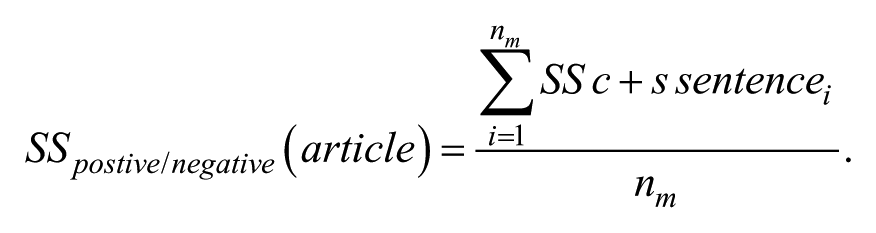
Here,
For each press release and news article, SentiStrength’s output consists of two outcomes: a positive (ranging from 1 [no positivity /neutral] to 5 [strong positivity]) and negative (ranging from −1 [no negativity / neutral] to −5 [strong negativity]) sentiment score. For example, a press release in which the social responsibility efforts of the organization are highlighted, commonly including positive words (such as benefits, good intentions, and great achievements) will receive a high positivity score but a low negativity score. On the contrary, a news article highlighting poor organizational performance will include negative words (such as failure, losses, and recession), resulting in a low positivity score but a strong negativity score. An external validation check was performed to assess whether SentiStrength produced valid results on our corpus of organizational and news content, resulting in satisfactory results (see Online Appendix A).
We used the following formula to calculate affective attribute salience on the daily aggregate level (
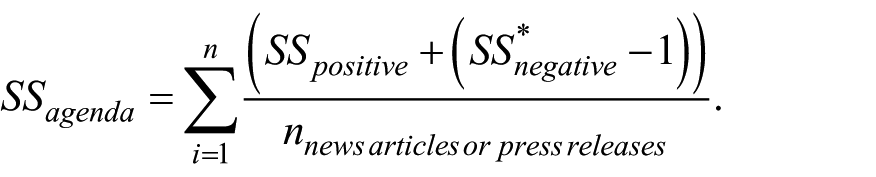
Hence, affective attribute salience on an organizational agenda is the sum of positive sentiment (
Control variables
For all our explanatory models, we controlled for Sundays. In addition, we control for the start of the first (January, February) and second (July, August) half year, as during these time periods the organizations generally publish annual reports, yearly earnings, or half-yearly earnings. In addition, summer breaks may impact organizational and news media’s affairs. Daily-level stock prices of the stock-listed organizations are included as a control in our models with stock-listed organizations, as journalists could view stock price volatility as newsworthy. 2
We find low contemporaneous correlations between object salience (r < .26* p < .05) and affective attribute salience (r < .06* p < .05) on the agendas of the organizations and media outlets. This indicates that the daily-aggregation level is appropriate for our analyses (Vliegenthart, 2014). Therefore, we aggregated the data to the daily level, herewith remaining a high level of precision and an appropriate level to capture fast-pasted media-building effects.
Analysis
As argued, despite concerns about increasing commercial pressures on the news media agenda, there is no clear theoretical rationale for a unidirectional causal relation of salience transfer between organizational and news media agendas. Therefore, both organizational and news media agendas cannot be considered exogenous in the analysis. When the underlying relationship between variables is not clear, VAR analysis is an appropriate approach to model multivariate time series. VAR analysis assesses what impact variables have on each other over time (Brandt & Williams, 2007). VAR can help establishing the causal relationship between variables, and is therefore especially suitable for the purpose of this study. In separate equations, variables are treated as both independent and dependent in VAR models (Vliegenthart, 2014). Stock prices are included as exogenous control variables in the models of the two private-sector organizations.
The best-fitted lag length is defined within the range of what can be theoretically expected. First, we established boundaries on the basis of theoretical arguments. More specifically, we argue that a maximum of 21 days allows for both fast-paced influences on the news agenda and more slow-paced influences on organizational agendas (Vliegenthart, 2014). News media generally aim to report news as fast as possible (Walgrave & Vliegenthart, 2012). Although less is known about the speed with which organizations respond to increases in news attention, we anticipate that generally, they will be able to respond within 3 weeks. Second, the appropriate number of lags within this range was based on the Akaike information criterion (AIC) fit statistics. Consistent with this expectation, AIC indicated an appropriate lag length of 21 for most organizations (see Online Appendix B).
VAR models have the advantage that Granger causalities can be calculated, which gives insight into the causal order of the variables. A variable y is assumed to Granger-cause a variable z if the prediction of z based on its own past values improves after adding y’s past to the equation (Brandt & Williams, 2007). Granger causality only considers causal influences conceivable if autoregression does not explain the relation.
For VAR analyses, all time series must be stationary. This is necessary in order for parameter estimates to be reliable (Vliegenthart, 2014). To test this, Augmented Dickey-Fuller (ADF) tests were conducted. As displayed in Table A1, the stock series of BAE Systems and Diageo had to be differenced to reach stationarity. For all other organizations, the variables measuring object salience and affective attribute salience on the organizational, broadsheet, and tabloid agenda were all significant, indicating stationary processes.
Results
We start with our descriptive findings. Table 1 provides an overview of the data characteristics. As could be expected, the sentiment is generally more positive in press releases compared with news coverage. Figure 1 presents the series of the press releases of, and news media coverage about, the six selected organizations.
Sample Characteristics.
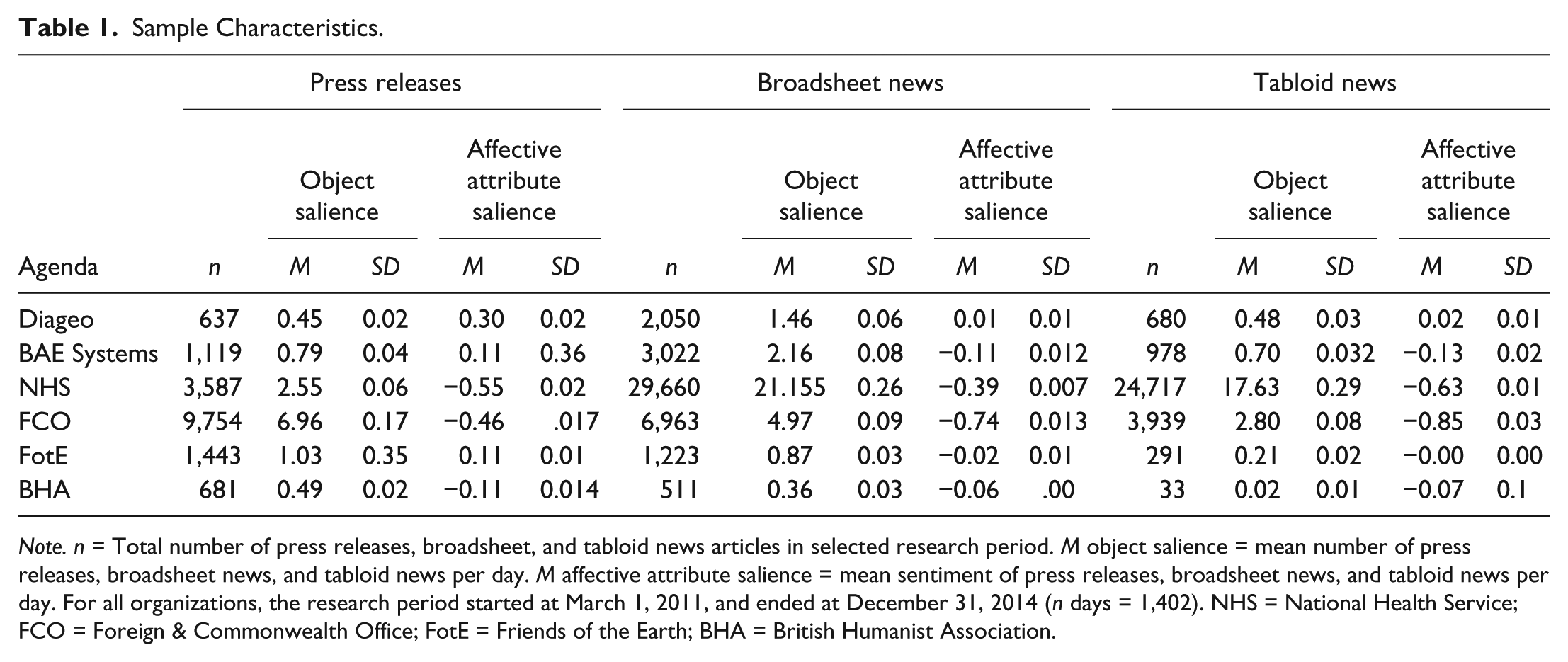
Note. n = Total number of press releases, broadsheet, and tabloid news articles in selected research period. M object salience = mean number of press releases, broadsheet news, and tabloid news per day. M affective attribute salience = mean sentiment of press releases, broadsheet news, and tabloid news per day. For all organizations, the research period started at March 1, 2011, and ended at December 31, 2014 (n days = 1,402). NHS = National Health Service; FCO = Foreign & Commonwealth Office; FotE = Friends of the Earth; BHA = British Humanist Association.
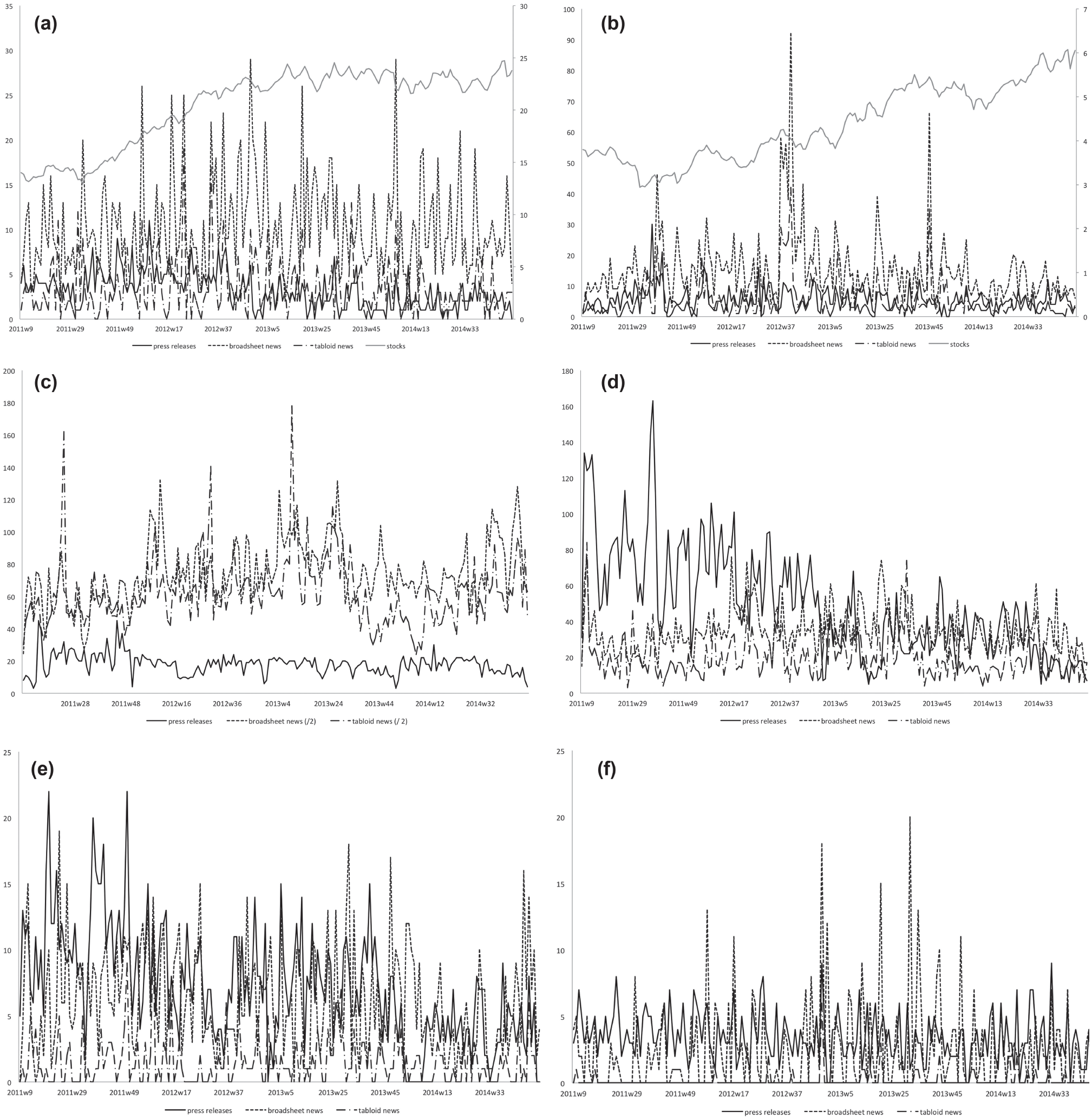
Time series of press releases, broadsheet news, and tabloid news.
Per organizational case, two VAR models were executed, one for object salience and one for affective attribute salience, sequentially with press releases, broadsheet, and tabloid newspapers as dependent and independent variables.
RQ1: Object Salience Transfers Between Organizational and News Agendas Over Time
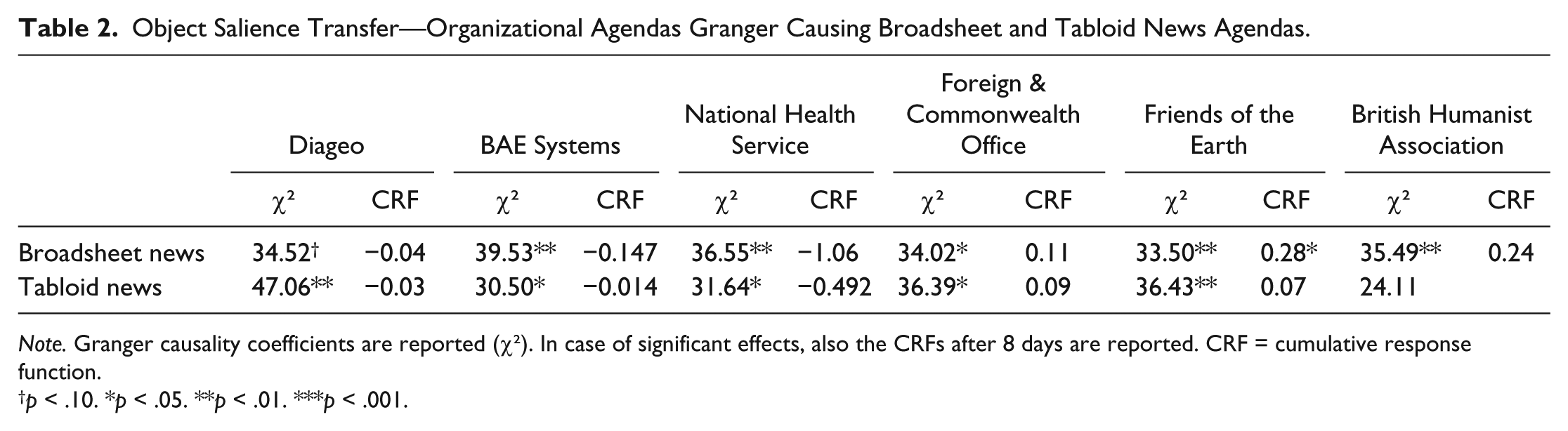
First, we asked how object salience on organizational agendas and broadsheet and tabloid agendas influence each other over time. Regarding object salience transfer of organizational agendas to broadsheet agendas, results show that in all cases, organizations Granger-cause agendas of broadsheet newspapers (Table 2). The effect of one stock-listed organization (i.e., Diageo) reaches marginal significance (p = .058). To investigate what these effects mean substantially, the Impulse Response Function (IRF) graphs are inspected. IRF graphs visualize the effects of a shock in one variable on a second variable. IRF graphs show that in most cases, agenda-setting effects of organizations on the broadsheet news are initially positive and reach significance at a lag of 1 to 4 days. This means that broadsheet newspapers publish more news articles about the respective organizations within 1 to 4 days after a 1-unit increase in press releases issued by them, after which the effect decades again. An inspection of the Cumulative Impulse Response Function (CIRF) tables shows that 8 days after an increase in press releases issued by the organizations, no significant change in the number of broadsheet newspapers about these organizations can be observed.
Object Salience Transfer—Organizational Agendas Granger Causing Broadsheet and Tabloid News Agendas.
Note. Granger causality coefficients are reported (χ2). In case of significant effects, also the CRFs after 8 days are reported. CRF = cumulative response function.
p < .10. *p < .05. **p < .01. ***p < .001.
We now look at the transfer of object salience from organizational agendas to tabloid agendas. We find that in five cases, organizations Granger-cause tabloid news agendas. Specifically, Diageo, BAE Systems, NHS, FCO, and FotE were successful in Granger causing tabloid news about their organization. Again, IRF graphs indicate that these effects are positive, and occur within 1 to 7 days. CIRF tables indicate that the change in the amount of tabloid attention could no longer be witnessed after 8 days.
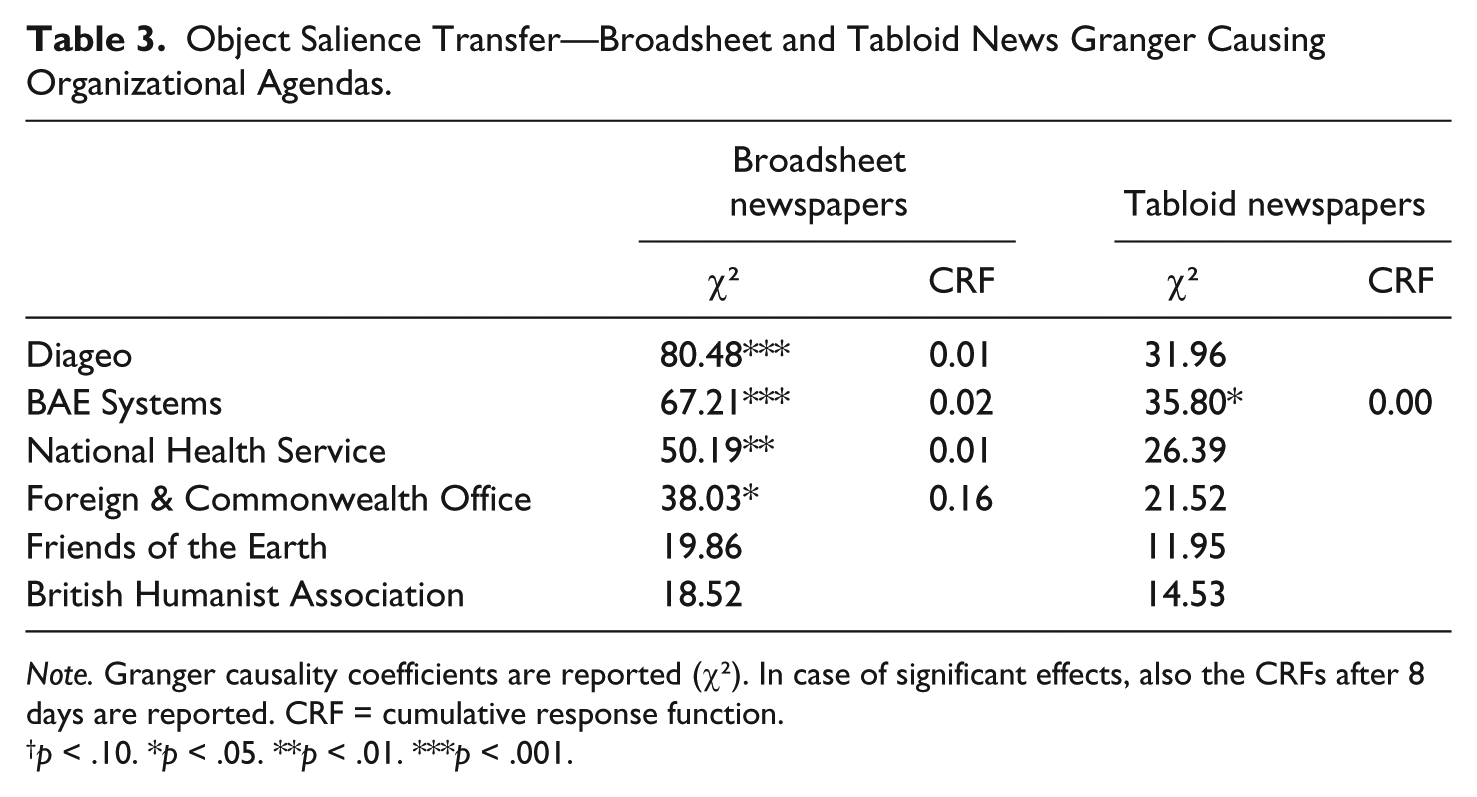
Table 3 displays the results of analyses focusing on the reverse effects, namely, object salience transfer effects from broadsheet and tabloid agendas on organizational agendas. Results indicate that broadsheet news attention Granger-causes a number of press releases issued by both of the stock-listed organizations (i.e., Diageo and BAE Systems) and both public-sector organizations (i.e., NHS and FCO). An inspection of the IRF graphs reveals that organizational responses to increases in news attention follow a more erratic pattern. Generally, organizations respond to increases in news attention for their organization within 1 to 7 days. Both nonprofit organizations were unaffected by news coverage. CIRF tables show that after 8 days, the effects have disappeared. Object salience on tabloid news agendas only Granger-caused the agenda of one organization (i.e., BAE Systems). In all other cases, no effects of object salience on tabloid news agendas were present.
Object Salience Transfer—Broadsheet and Tabloid News Granger Causing Organizational Agendas.
Note. Granger causality coefficients are reported (χ2). In case of significant effects, also the CRFs after 8 days are reported. CRF = cumulative response function.
p < .10. *p < .05. **p < .01. ***p < .001.
To summarize, of the 24 possible combinations (six organizations × two newspapers × two directions), we found only one case in which object salience formation on news media agendas was independent of organizational agendas. In seven cases, salience formation on organizational agendas was not affected by the tabloid or broadsheet news. In six cases, we found unidirectional effects of organizational agendas on news media agendas, while in none of the cases we found a unidirectional effect of news agendas on organizational agendas. In five cases, we found reciprocal effects between organizational and news agendas. We conclude that on the first level of agenda building, organizational and news agendas are often intertwined in an intimate relation, either in which they influence each other reciprocally or in which organizations take the lead.
RQ2: Affective Salience Transfers Between Organizational and News Agendas Over Time
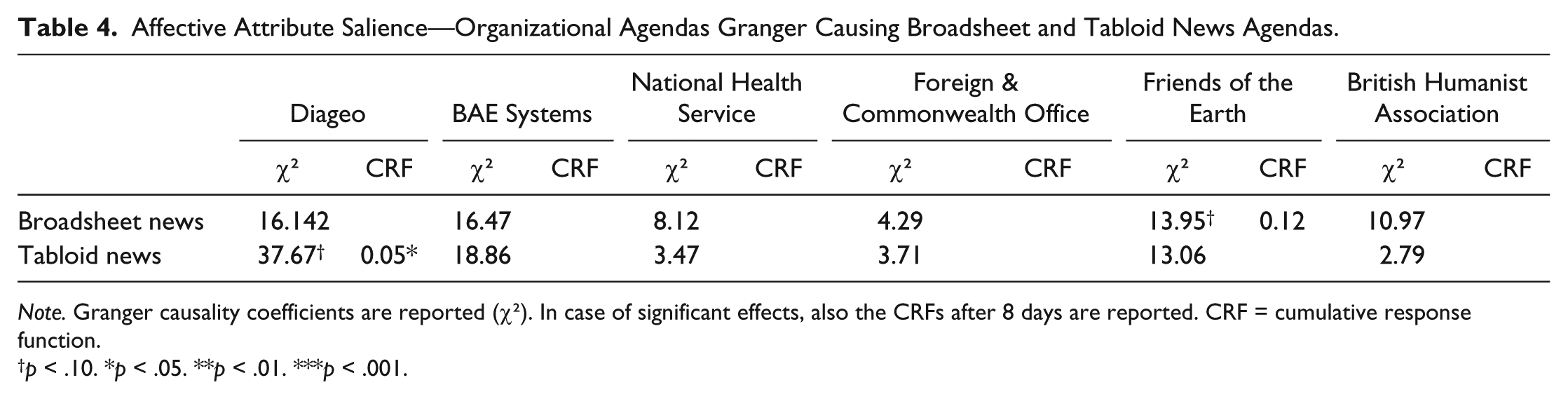
Second, we asked how affective attribute salience transfers between organizational and news agendas over time. Table 4 shows that affective attribute salience on the agenda of one of the stock-listed organizations (i.e., Diageo) exerts a marginally significant (p = .05) effect on the affective attribute salience of tabloid news. In addition, we find a marginally significant effect of the agenda of one nonprofit organization (FotE; p = .08) on the broadsheet news agenda. An inspection of the IRF graph reveals that the effect approaches significance after 2 to 4 days. Substantially, this finding indicates that a more positive presentation of these organizations in press releases leads to a more positive presentation of these organizations on, respectively, tabloid and broadsheet agendas in the following days. CIRF tables indicate that this effect remains significant after 8 days in the case of the stock-listed organization (i.e., Diageo).
Affective Attribute Salience—Organizational Agendas Granger Causing Broadsheet and Tabloid News Agendas.
Note. Granger causality coefficients are reported (χ2). In case of significant effects, also the CRFs after 8 days are reported. CRF = cumulative response function.
p < .10. *p < .05. **p < .01. ***p < .001.
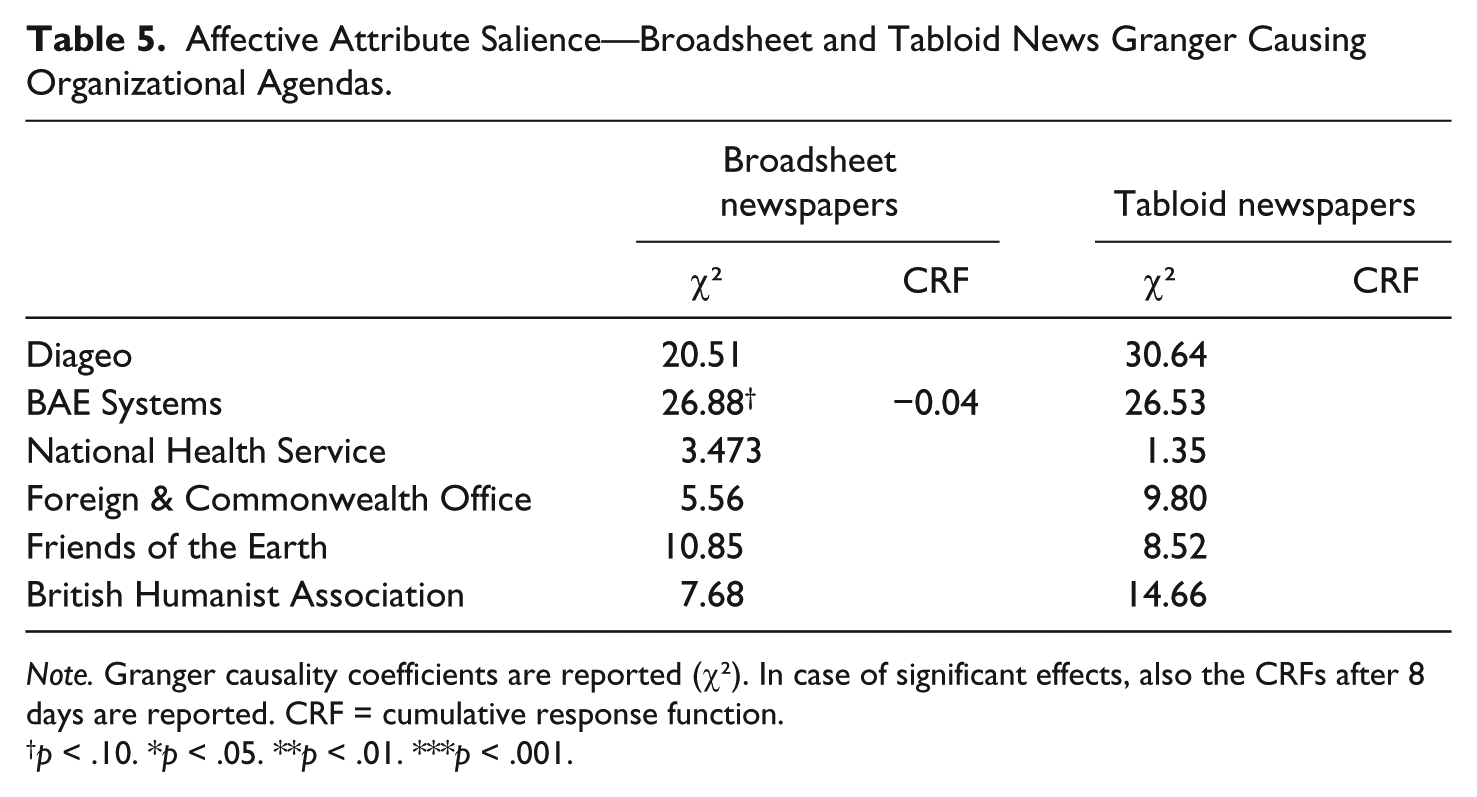
In the reverse direction, Table 5 shows that affective attribute salience on the agenda of broadsheet newspapers affects the agenda of one stock-listed organization (i.e., BAE Systems; p = .06). IRF graph shows that the effect approaches significance after a day and reaches full significance after 4 days. Substantially, this finding indicates that a more positive representation of BAE Systems in broadsheet newspapers leads to a more positive representation of the company in their press releases a few days later. The CIRF table indicates that after 8 days, this effect is no longer significant.
Affective Attribute Salience—Broadsheet and Tabloid News Granger Causing Organizational Agendas.
Note. Granger causality coefficients are reported (χ2). In case of significant effects, also the CRFs after 8 days are reported. CRF = cumulative response function.
p < .10. *p < .05. **p < .01. ***p < .001.
Thus, of the 24 possible combinations, in two cases organizational agendas influenced the affective attribute salience on news agendas. In the reverse direction, in one case we found a transfer of affective attribute salience from the news agenda to the organizational agenda. In all other cases, there is no transfer of affective attribute salience. We conclude that regarding the second level of agenda building, organizational and news agendas mostly operate autonomously.
RQ3: Difference Across Organizational Types and News Media Types
Third, we asked whether object salience transfer processes differ across news media types (i.e., broadsheet and tabloid newspapers) and organizational types (i.e., stock-listed organizations, governmental organizations, and nonprofit organizations). We start with differences in object salience transfer effects between newspaper types. While broadsheet news agendas were affected by all the studied organizations, tabloid news agendas operated in a single case independently from organizational agendas. In the reverse direction, broadsheet newspapers affected organizational agendas in four cases, while tabloid newspapers were in all but one case unsuccessful in setting organizational agendas. Thus, the strongest interdependencies were witnessed between broadsheet and organizational agendas. Organizational agendas are somewhat less affected by, and exert less effect on, tabloid news agendas.
In addition, and concerning organizational differences in object salience transfer processes, we found that all organizations affected broadsheet news agendas. We observed that not all organizations were successful in setting the tabloid agenda. Specifically, one nonprofit-sector organization (i.e., BHA) did not exert effects on tabloid agendas, while all the other organizations did.
We conclude that differences in effects of news agendas on different organizational types do not follow a clear pattern. Irrespective of large organizational differences, all organizations were successful in setting the broadsheet news agenda, and most were successful in setting the tabloid news agenda.
Last, we asked how affective attribute salience transfer processes differ across news media and organizational types. With regard to differences between news media, the results show an effect of organizational agendas on both tabloid and broadsheet news agendas. In the reversed direction, only broadsheet news agendas were successful in affecting organizational agendas. In sum, most affective attribute interdependencies were witnessed between broadsheet and organizational agendas.
With regard to differences between organizations, we found a single effect of a nonprofit organization. Moreover, both stock-listed organizations affected—or were affected by—news agendas. Thus, most affective attribute interdependencies were related to stock-listed organizations.
Discussion
The relationship between journalists and sources has often been described with the appealing metaphor of “dancing the Tango” (e.g., Strömbäck & Nord, 2006; Van Aelst & Vliegenthart, 2014). The first aim of this study was to answer the question who takes the lead when journalists “dance” with organizational sources by relying on time-series data of multiple years of press releases and news coverage. Regarding the directionality of the relationship between organizational and news agendas on the first level of agenda building, the results of the current study show that organizations are either an equal or a dominant dance partner. On the first level of agenda building, news agendas occasionally operate autonomously, but they are more often intertwined in an intimate relation with organizational agendas, in which both domains influence each other reciprocally, or in which organizations take the lead. This is in line with Gans’s (1979) classical notion: “Although it takes two to tango, either sources or journalists can lead, but more often than not, sources do the leading” (p. 116).
To measure the salience of affective attributes, located on the second level of agenda building, this study has relied on an automated sentiment analysis (SentiStrength). Based on this approach, we cautiously conclude that regarding affective attribute salience (i.e., sentiment) organizations and news media are less intertwined. On the second level of agenda building, the results show that only two organizations were successful in setting the tone of the news agenda. More specifically, one stock-listed organization (i.e., Diageo) was successful in affecting the tone of coverage about their organization in tabloid newspapers, while one nonprofit organization (i.e., FotE) successfully influenced affect in broadsheet newspapers. In the reverse direction, the results revealed that only in a single instance, broadsheet newspapers affected the sentiment of the agenda of a stock-listed organization (i.e., BAE Systems). Here, the lines between organizational and editorial content seem to have blurred, with organizations adopting traditional functions of the news media, and the news media embracing organizations as a legitimate partner in shaping agendas regarding the salience of objects and affective attributes.
Moreover, this study showed that newspaper characteristics were useful to explain interactions between organizational and news media agendas. To start, in comparison with broadsheet newspapers, tabloid newspapers proved to be ineffective organizational agenda builders: Only in one of the six organizational agendas investigated in this study, an effect was found. Generally, organizations seem to attach greater importance to broadsheet than tabloid news about their organization. In contrast, we found that in all of the here-studied cases, organizations were successful in building object salience on the broadsheet agenda. In addition, the editorial agendas of tabloid newspapers were, in comparison with broadsheet news, somewhat less frequently affected by organizations. Scholars have argued that “establishment organizations” are not likely to be prominent on tabloids’ agendas, among others because their readers do not wish to monitor them (Sparks & Tulloch, 2000, p. 107).
We did not find systematic differences in agenda-building effects between the three types of organizations under study (i.e., stock-listed, public-sector, and nonprofit organizations). Irrespective of large between-organizational differences, all organizations were successful in influencing object salience on the broadsheet agenda. Trends toward professionalization in the public relations sector may have diminished differences in the effectiveness of building news agendas. Previous research has indicated that public relations strategies of private- and public-sector organizations have become homogeneous (Cancel, Mitrook, & Cameron, 1999). This might also be the case for nonprofit organizations because also these organizations have professionalized their communication strategies (Van Leuven & Joye, 2014). The remaining differences that we found may have been due to differences in specific communication strategies used by the investigated organizations.
Importantly, our findings show that object salience and affective attribute salience transfer between organizational-news media agendas is not merely a unidirectional phenomenon. This supports the theoretical argument and sparse empirical evidence that agenda-building processes between organizational and broadsheet news media agendas are complex and formed in a dynamic interplay (Pollach, 2014; Ragas, 2013; Verhoeven, 2009). Previous research has mainly considered organizational agenda building as a powerful and unidirectional phenomenon, paying little attention to the dynamic interplay between organizational and news agendas. The results of this study, and previous research adopting time-series designs (Pollach, 2014; Ragas, 2013), however, seem to suggest that such correlations may be partly due to the responsiveness of organizations to variations on the news agendas. When this mutual dependency is neglected, the outcome of agenda-building processes may be misinterpreted.
As the focus of this inquiry has been on aggregate levels of referrals to organizations, we should be cautious in our conclusions about the implications of our findings for journalistic autonomy. Based on the general patterns observed, it seems that journalists have partly outsourced their license to decide what constitutes news to organizational sources. This may compromise their autonomy of the news discovery phase, where journalists learn about the potential of news stories (see Reich, 2006, for a similar conclusion). At least for the question what defines news, our findings are in line with the notion of coproduction between journalists and organizational sources (Reich, 2010), to which the latter contributes more strongly than the former. This may give organizations the power to lay down the options from which journalists can choose.
However, we cautiously conclude that regarding affective attributes on the second level of agenda building, journalists largely make independent choices and preserve their autonomy. This seems to indicate that in the news-gathering phase, journalists generally remain autonomous (see also Dimitrova & Strömbäck, 2009; Reich, 2006). This might indicate that journalists still hold “control over the construction of their stories” (Dimitrova & Strömbäck, 2009, p. 78). These conclusions should, however, be confirmed in future research. An explanation for the contrast between rather robust agenda-building effects of the first level compared with the lack thereof on the second level might be journalists’ and public relations professionals’ desire “agree to disagree.” Both actors seem to take the other’s agenda for granted, yet refrain from embracing their evaluative tendency.
Practically, the findings may contribute to journalists’ awareness of the power of organizational sources to influence the pool of topics they choose from. News organizations may benefit from this knowledge by encouraging their editors to explore alternative sources in the news discovery phase, to diminish their reliance on single organizational agendas and the extent to which organizations succeed in setting the news agenda, and therewith potentially also the public agenda.
The limitations of this study should be discussed. First, as a ubiquitous form of information subsidies, in this study, we relied on press releases to measure organizational agendas. Because other forms of organizational-subsidized content—such as online pressrooms, personal emails, and press conferences—could have affected the news agenda, our results may have underestimated the net effect of organizational sources on the news. In addition, due to increasing online presence of organizations, relevant organizational publics (such as customers or investors) can be reached directly, without the interference of traditional news media—either in print or web-based form. This may have significant consequences for the relation between organizational sources and journalists—now and in the future. Nevertheless, organizations’ media appearances are still considered relevant today because news media, both online and offline, are still among the most frequently used sources and provide adoptable agendas for the public that are often considered more credible and objective. The here-studied agendas might have also been affected by confounding key events or agendas—such as the public or political agenda. Second, as we have successfully assessed the validity of SentiStrength to detect sentiment in our sample of organizational and news content, we believe that our results regarding the second level of agenda building are valid. However, machine learning or natural language processing to detect emotional frames may prove successful alternative operationalizations for affective attributes on the second level of agenda building. Third, as for each organizational category only two organizations were studied, one should be cautious to generalize beyond the studied cases. More studies, as the one reported here, are needed to make more decisive conclusions. Last, we encourage future research to investigate the transfer of bundles of objects and attributes by studying the so-called third-level approach.
This study makes important contributions to the agenda-building literature. Adopting a holistic view, some studies have already considered how multiple sources interact and shape the news agenda (e.g., Kleinnijenhuis et al., 2015; Len-Rios et al., 2009; Reese, 2001). Most studies, however, have investigated the interaction between organizational and news agendas by focusing on one side of the coin (i.e., either the journalism or public relations perspective). On the contrary, this study acknowledges, theoretically and empirically, that “it takes two to tango” when it comes to organizations and the news. Herewith, this study has extended previous research that investigated the reasons of organizational-news media agenda convergence, or the lack of it, by considering it as the outcome of a dynamic process, instead of a static event. Our results show that it is important to consider reciprocity in both first- and second-level agenda-building effects between organizational and news agendas. If such mutual dependency is neglected, this may result in misinterpretation of the outcome of agenda-building processes.
Footnotes
Declaration of Conflicting Interests
The authors declared no potential conflicts of interest with respect to the research, authorship, and/or publication of this article.
Funding
The authors received no financial support for the research, authorship, and/or publication of this article.
Notes
Author Biographies
References
Supplementary Material
Please find the following supplemental material available below.
For Open Access articles published under a Creative Commons License, all supplemental material carries the same license as the article it is associated with.
For non-Open Access articles published, all supplemental material carries a non-exclusive license, and permission requests for re-use of supplemental material or any part of supplemental material shall be sent directly to the copyright owner as specified in the copyright notice associated with the article.
