



Abstract
There has been a growing number of calls to improve theory instruction in sociology. These conversations have focused on what instructors should teach (with a renewed emphasis on racism and sexism) and whom to teach (with calls to diversify the reading list), but comparatively little attention has been placed on how social theory should be taught. Building on recent findings from the literature on reading comprehension and on a popular description of theories as maps, we suggest that teaching theory can be treated as a form of cartography, a student-centered method that advocates for radical accessibility. We describe three different ways students can use theory maps—as tourists, navigators, and mapmakers—each adapted for a different stage in the learning process. We believe that adding accessibility to current calls for critique and representation brings our conversations about how to reimagine theory courses full circle.
Social theories are sites of struggle and so, too, are the courses designed to help students consume and critique them. This has become especially clear in sociology, where debates over the “sociological canon” have intensified and calls to “decolonize” theory courses have increased (R. Connell 2018; R. W. Connell 1997; Emigh, Hernández, and O’Malley 2020; Go 2020; Itzigsohn and Brown 2020; Krippner 2019; Reyes and Johnson 2020). While important and necessary, these discussions have been dominated by concerns over what and whom to teach, leaving a third, equally significant pedagogical question unanswered: How should we teach theory? Whether we teach Du Bois instead of Durkheim or give race and gender a more prominent place in our courses leaves the question of how we should teach these materials unanswered.
If we fail to pose this question in parallel to questions about content and authorship, we run the risk of teaching the “right” theories in pedagogically ineffective ways. This would sacrifice what should be the primary motivation behind our efforts to rethink courses on social theory: our students’ learning. Indeed, pedagogical methods for theory instruction should not be taken for granted since it is largely these methods that determine whether theory training is made more equitable. We believe equity is best accomplished through methods that help make theory radically accessible for students at different stages in the learning process. Taking the issue of accessibility seriously brings ongoing conversations about reimagining theory courses in sociology full circle.
The literature on teaching social theory provides many answers to the how question. In this essay we advance an answer that focuses on an issue that has eluded most of the extant scholarship: the challenge of preparing students to decode dense and abstract theoretical texts. With this challenge in mind, we argue that social theory might best be taught like a form of cartography. Theory courses can foster the production of “theory maps”—simplified visuospatial representations of dense written works—that disrupt the monotony of hypertextualized theory and help make the material more accessible for students.
We begin with a discussion that grounds this method in the literature on teaching social theory as well as the general scholarship on reading comprehension, visual pedagogy, and learning. We then describe our method and how we implement it in practice using theory maps adapted for students at different stages in the learning process: students as tourists, students as navigators, and students as mapmakers. We conclude by stressing the unique advantages of this approach.
Strategies for Teaching Social Theory
The challenges of teaching and learning social theory are well known. Virtually every article on the subject in this journal and others opens with a statement about these difficulties. The central issue is that students find theoretical texts unnecessarily complex (Griffiths 2015; Lowney 1998:69–70; McDuff 2012:167; Windsor and Carroll 2015:61). Specifically, they find them too abstract (Herring et al. 2016:5; Macheski et al. 2008:43; Pedersen 2010:198), irrelevant (Eglitis 2010:340–41; Griffith 2012:147; McCabe 2013:282; Windsor and Carroll 2015:61), archaic (Pelton 2013:108; Weber 2010:351), and sometimes simply stale and uninspiring (McDuff 2012:168, 172; Roberts and Roberts 2008:131). Students often anticipate theory courses will be harder and require far more work than other courses to succeed (Lowney 1998:69; Macheski et al. 2008:43). As a result, they experience what Lowney (1998:70) calls “theory anxiety,” a feeling of trepidation toward theory that affects students’ motivation, interest, and confidence in learning the subject (Osnowitz and Jenkins 2014:246). These issues are compounded by the fact that theory courses are often a required part of the curriculum, which can also negatively impact students’ initial disposition toward them (Eglitis 2010:341; Macheski et al. 2008:45). It is thus no surprise that participants at a workshop on teaching held during the American Sociological Association’s annual meeting in 2007 identified theory as one of the three most difficult subjects to teach in our discipline (the other two were methods and statistics) (Macheski et al. 2008).
Teacher-scholars have responded to these challenges with a flurry of creative pedagogical approaches. A review of these methods reveals two general strategies to be the most prominent. The first consists in applied assignments or learning activities. These seek to demystify the complexity of theoretical texts by having students use social theory to understand more familiar phenomenon or by bringing to bear other written or audiovisual materials that illustrate theoretical concepts in more relatable, relevant, and emotionally compelling terms. The range of teaching and learning activities within this approach includes, but is not limited to, the following: collecting and theorizing ethnographic data (Pedersen 2010); editing a sociological theory textbook (Yavuz 2020); solving puzzles to learn about theorizing (Lowney 1998); writing and performing a “theory play” (Eglitis 2010), organizing semester-long case studies (Ormrod 2011); undertaking and theorizing a “technology fast” (Hoop 2012); using cultural products, such as literary fiction, poems, and films to discuss theory (Pelton 2013; Weber 2010); and in-class simulations and role-playing activities (Holtzman 2005; Messinger 2015; Windsor and Carroll 2015).
The second strategy for teaching social theory is focused not on the complexity of theoretical texts themselves but on the feelings of confusion, anxiety, and lack of confidence that these texts can inspire in students. Methods within this strategy typically leverage the power of collaborative learning to build a supportive community in which students help each other navigate the difficult process of studying and learning social theory. Concretely, this includes online discussion forums in which students help each other formulate and answer questions about the material (Macheski et al. 2008; Osnowitz and Jenkins 2014), various types of small-group work (McDuff 2012), and frank and supportive class discussions about students’ anxiety (Macheski et al. 2008; Rinehart 1999).
The innovative entrepreneurship of theory instructors displayed in these methods is staggering and stands as an important contribution to how sociologists might best teach theory. That said, they sidestep a central issue that makes theory hard to learn in the first place: the inaccessibility of the texts themselves. Rojas (2011) puts it bluntly: “[S]ocial theory is taught at an intellectual level that towers above most other sociology courses. To understand, say Weber’s writings, you need to know history, have a broad vocabulary, and be able to read lengthy and complex sentences. . . . It’s far above what we normally ask of [students].” Indeed, it is hard to imagine that many of the creative approaches just noted do much to fundamentally alleviate this basic problem of theory instruction. They are simply not designed to directly help students decode theoretical text. We need strategies that better promote direct radical accessibility.
Lowney (1998:70) acknowledged as much about her own approach using puzzles in the classroom when stating that it did “not address the underlying causes of [students’] fear (e.g., the readings will be abstract . . .).” The success of activities designed to help students apply and use theory hinges on students having a minimally reasonable grasp of the material to begin with. While an instructor may clearly explain a theoretical argument in lecture or even provide compelling illustrations of theoretical ideas through film or literature, such strategies do not necessarily equip students with the ability to identify those arguments and ideas in the reading. This risks leaving intact the feelings of confusion and frustration felt during the reading experience, which is our students’ most direct and immediate engagement with theory. Similarly, students may feel less anxious and less alone in their struggle if they feel supported by the instructor and their peers, but this does not directly contribute to helping them develop their decoding skills. And their self-confidence may be undermined once again when they try to reread the theoretical text they were originally struggling with.
Providing students with reading questions to help guide their initial encounters with theoretical texts is a common and understandable response to this problem (Pedersen 2010:199). Consider some generic questions a theory instructor might pose: What is the author’s main argument? Is the argument convincing? How does the argument fit into broader conversations in the course? This approach has many pedagogical virtues for courses in which the readings are less complex than those commonly assigned in social theory, but its effectiveness for helping students navigate dense and abstract texts that do not always follow contemporary narrative formats is limited. The problem is that this strategy is premised on the view that reading comprehension is first and foremost a skill. But this view runs contrary to some of the main findings in research on learning and reading comprehension.
This scholarship shows that what helps students most is not necessarily practicing a skill, such as identifying the main argument, but expanding their content knowledge and vocabulary for decoding the meaning of text (Willingham 2017:116–21). In other words, effectively accessing a text relies heavily on having a deep foundation of factual knowledge about the subject matter (Bransford et al. 2000:16–17). Indeed, one of the most effective predictors of a student’s ability to comprehend a new text is their prior knowledge (Dunlosky et al. 2013:9). Understanding new and unfamiliar stuff often requires knowing some stuff already.
Research also shows it is important for readers to have a framework that helps them make sense of that factual knowledge (Bransford et al. 2000:16–17; Bruner 1977:11–12, 23–24). This allows them to connect the different pieces of information and see how they fit together as a whole. Deciphering meaning becomes challenging when readers have a weak information base to begin with. If they do not know how the pieces of information fit together, they can easily get lost in the details. Effectively interpreting texts requires both knowing stuff and understanding how that stuff fits together as a framework.
Visual aids have been shown to be an effective method for providing students with a base of factual knowledge, and they can also function as frameworks for helping students understand how that knowledge fits together. For example, in a review of research on psychology and instruction, Winn (1991:211) notes that “maps and diagrams communicate a considerable amount of information by the way in which components are placed relative to teach other and to the frame surrounding them.” Furthermore, the literature on diagrams shows that the metaphorical use of space in these visualizations improves memory and comprehension of abstract content (Winn 1991:226). Bobek and Tversky (2016) compared how visual and verbal explanations impacted learning outcomes for students in mechanical engineering and chemistry. They found that “creating visual explanations is superior to creating verbal ones . . . [because the former] map thought more directly than words and provide checks for completeness and coherence as well as a platform for inference” (Bobek and Tversky 2016:1). Others have arrived at similar conclusions (Ainsworth, Prain, and Tytler 2011; Pearl and Mackenzie 2020). Far from depriving students of agency in their learning process, visual diagrams establish the minimal understanding necessary for students to exercise their agency and engage texts productively.
Visual aids have a long history as effective pedagogical tools in the natural sciences and engineering, but it is only recently that sociologists have started to pay systematic attention to them (Brett, Silver, and Beelen 2020; Swedberg 2016). For example, Swedberg (2016:251–54) argues that diagrams—what he calls “theory pictures”—can be a pedagogically useful method for summarizing full-scale theories, social mechanisms, or concepts as long as the visualization is clear, is simple, and “connects facts through an explicit idea.” He notes several examples that successfully accomplish this: Stinchcombe’s visualization of Merton’s notion of social structure, Granovetter’s diagrams on the strength of social ties, and Burt’s depictions of structural holes. More recently, Brett et al. (2020) provide concrete guidelines for avoiding the pitfalls of “vagueness, reduction, and unwanted metaphorical inferences” when creating theory visualizations. They suggest labeling lines and arrows and integrating legends to avoid vagueness, using visual scaffolding in diagrams that depict causal or sequential paths to avoid unwanted spatial inferences, and implementing unconventional visual elements, such as squiggles and zig-zags rather than straight lines, to acknowledge the complexity and messiness of social phenomenon (Brett et al. 2020:237–39). We leverage the findings and insights from this literature to develop what we call the “cartographic approach” to teaching social theory.
Theory as Cartography
We argue for a pedagogy that relies heavily on visual aids we call “theory maps,” here understood as simplified visuospatial representations of dense written work (see also Burawoy 2013; Herring 2015; Herring et al. 2016; Trepagnier 2002). In our own teaching, we use theory maps not as special exercises but instead as essential tools of instruction that can fundamentally change students’ relationship with the assigned material. They do not replace the important tasks of reading, writing, or discussion, but we argue that these maps can transform the basic formula for how to teach social theory.
Our approach is motivated by a common description of theories as maps. For instance, Burawoy (n.d.) describes social theory as “a map of the social world.” Like maps, theories are “simplifications, telling us where we might go, pointing to dangerous or forbidden territory, raising very different questions about the social world” (Burawoy, n.d.). In a similar way, Elwell (n.d.) insists social theorists are “much like cartographers of the sociocultural world.” They distill a complex empirical reality into a set of basic concepts and situate those concepts in relation to one another for the purposes of description or explanation. Meanwhile, geographers have implied that maps are like social theories. At their core, maps are human constructions that structure how people see, describe, and traverse a shared universe (Bagrow 2017; Crampton 2001; Crampton and Krygier 2005). And, like social theories, maps can be understood as exercises of power-knowledge and are therefore fruitful targets of critique and deconstruction (Harley 1989). In short, theories are like maps and maps are like theories (see also Go 2020:14).
Building on this analogy, we make the case for implementing theory maps as a central tool for theory instruction. These “maps of maps” or “simplifications of simplifications” can directly contribute to helping students decode dense and abstract texts. In our courses, we have found that these visuospatial representations of theoretical works can disrupt the often complex and exclusionary character of hypertextualized theory.
We argue there are many advantages to teaching theory as a form of cartography. Theory maps can provide a framework of the main argument by laying out the central ideas and how they relate to each other. This is particularly important when a student encounters a given theorist for the first time and for whom extrapolating the main argument from the text is especially difficult. Instead, as they make their way through each sentence, the task becomes a more manageable one: How does this specific idea fit into the argument or conceptual frame laid out in the map?
Theory maps can also fill in important information in a straightforward way that relates it to the broader argument the theorist is making. This can be accomplished through text boxes that describe important people, processes, events, or ideas and arrows that make the connections between these explicit. With that information in hand, students can focus on interpreting the text. Additionally, students who are more familiar with a given theory can complete maps by filling in missing pieces or even create maps from scratch. This can open a pedagogical space for students to leverage what they know already in the service of deeper learning. Such a range of uses illustrates the pedagogical potential that theory maps have. From providing the foundation for active and productive decoding of text to leveraging the knowledge of more advanced students, theory maps can directly address the challenge of accessing abstract and complex theory.
Theory maps can also contribute to equity in the classroom. The suggestion that emerges from the literature on reading comprehension is not that instructors should avoid assigning complex readings because they pose an insurmountable challenge for students who lack the preparation to decode them. In fact, the opposite is recommended. Limiting students to texts they can already read hinders their opportunities to learn (Shanahan 2020). This research shows that with proper guidance, students make further strides in their reading achievement when exposed to more rather than less difficult texts because the former contribute to building their knowledge and vocabulary (Brown et al. 2018).
Building on these insights, we describe three different ways students can use theory maps—as tourists, navigators, and mapmakers—each adapted for a different stage in the learning process. We are not arguing for the addition of a special exercise. Instead, we are arguing for a reimagining of theory instruction as a form of cartography.
We draw on our experiences as theory instructors to demonstrate the effectiveness and versatility of this method. Michel has used this method in undergraduate courses on classical and contemporary social theory at two public universities, the University of California, San Diego, and San Francisco State University. These courses ranged in size from 10 to 130 students. Josh has taught an undergraduate social theory course that usually includes fewer than 20 students at the University of Southern California, a private university in Los Angeles. He also regularly teaches a two-semester graduate social theory course, first at the University of Southern California and now at Boston College (another private university). Michel engages a more diverse student body, but Josh’s classes are not homogenous, and they often include several students from economically and racially oppressed populations. In addition, we both used this method as teaching assistants in charge of discussion sections of 20 to 25 students for large undergraduate theory courses in the same program at the University of California, Berkeley.
Students as Tourists
Social theories may be simplifications of the social world, but for students reading them for the first time, they can seem more like complications. At this stage of the learning process, theories present themselves to students as a jumble of dense prose and strange concepts. To begin decoding the words on the page, students need a framework that allows them to understand where the author is going and what their ideas add up to. In the absence of such a framework, students can often get lost as they move from one sentence to the next, unable to identify the key ideas or distinguish a central line of reasoning from what are merely examples, ancillary arguments, or descriptions of related but inessential issues.
To address this challenge, we develop theory maps that can guide students on their initial “tours” of primary text. Consider an example. Figure 1 is a map of white supremacy as theorized across three short essays by Du Bois: “Of Our Spiritual Strivings” (Du Bois [1903] 1995), “The Souls of White Folk” (Du Bois [1920] 1995), and “The Superior Race” (Du Bois [1923] 1995). It was constructed by Josh. This map illustrates an opposition between the categories of whiteness and blackness, the two largest boxes in the figure. It aims to capture how a white supremacist ideology, which Du Bois describes as a sort of “religion” or “propaganda,” conceals an ugly truth: White power works to oppress, exclude, and exploit dark bodies in the United States and across the globe. This is depicted by the central arrow connecting whiteness to blackness. The two arrows next to this reference how whites look down with pity as well as how they look down with contempt. Their vision is obstructed by a great veil separating white and black subjectivity. In this map, the veil takes the form of a wavy shape that looks like it is draped over blackness and all its relevant features. Within this transparent shape we find a box for “double consciousness,” which Du Bois describes as a “twoness” of souls, thoughts, and strivings, that is, being both American and black. People behind the veil tend to internalize how whites look down with pity and contempt, hence the innermost dotted arrows. However, people behind the veil are also gifted with a “second-sight” that allows them to more clearly “see in and through” whiteness. This is represented by the outermost dotted arrows.
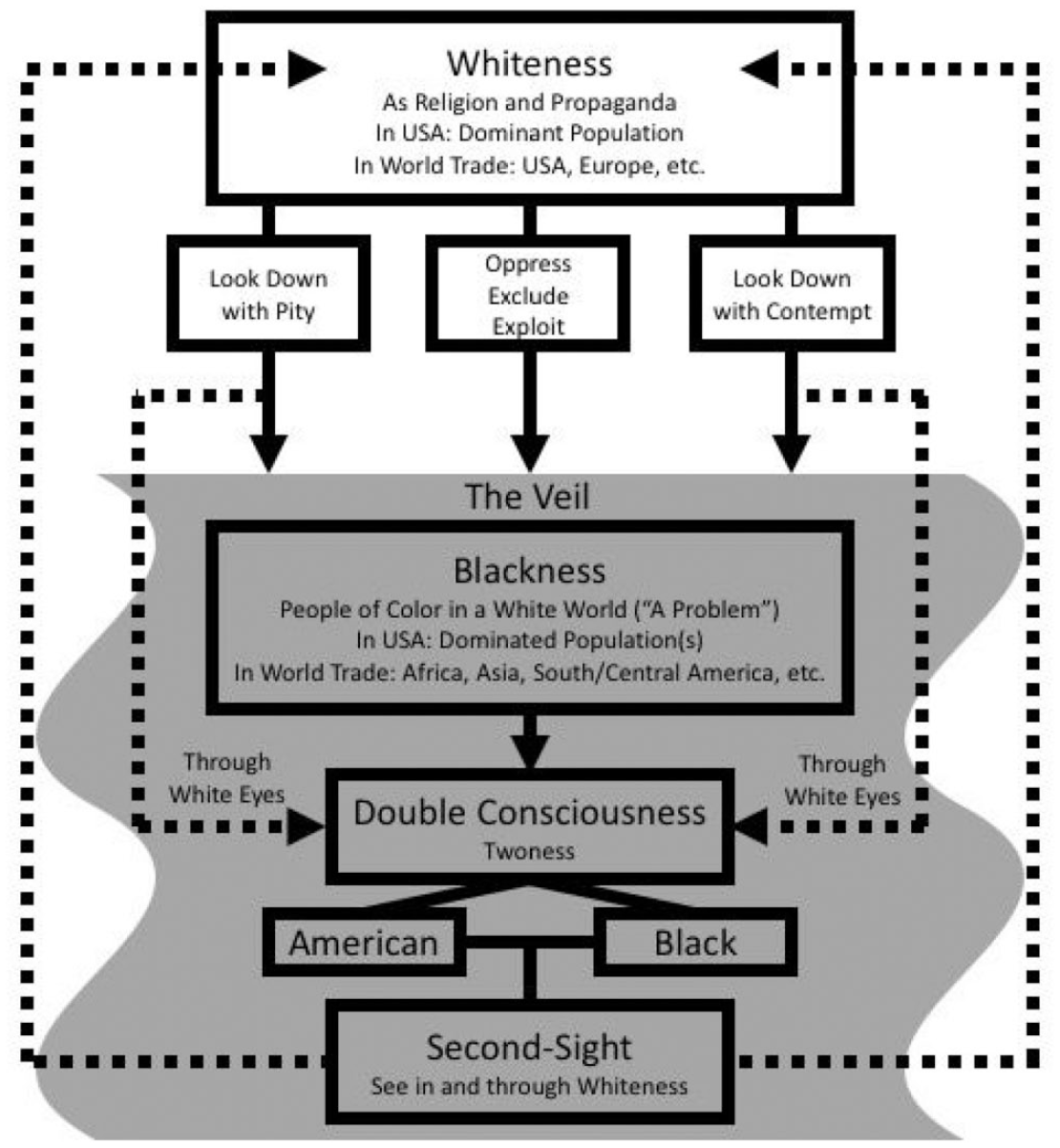
Map of Du Bois’s theory of white supremacy for student-tourists
This map was ultimately designed to simplify and spatialize several critical concepts for first-time readers of Du Bois’s essays. Josh sometimes builds this image piece by piece through lectures that are centered on decoding essential excerpts of text. Other times, he gives this map, along with short written summaries explaining it, to students in advance and encourages them to review it before, during, and after their initial reading of the source material. Either way, Josh dedicates significant classroom time to making sense of the map. He uses it to outline his lecture, and he frequently pauses to read Du Bois’s writings out loud. Indeed, special care is taken to demonstrate how the map represents and simplifies the text. This theory map certainly does not substitute the rich insights provided by a close reading of Du Bois, but it helps orient students on their initial tours of his essays.
This is just one example. Maps, including our own, can vary in terms of aesthetic style and information density (see Figure 2 by Michel in the next section). Regardless of specific style or execution, we always design theory maps for student-tourists with a common end in mind: to guide them in their early interpretations of dense and abstract text. The point is to introduce students to complicated writings in a manner that prevents them from getting lost in the process. Far from depriving students of agency, theory maps at this stage enable students to engage social theory productively by moving back and forth between the text and the map in an active effort to decode the words on the page. The next two sections consider more advanced approaches to this pedagogy through which we aim to encourage students to move beyond the position of tourist and into the roles of navigators and mapmakers.
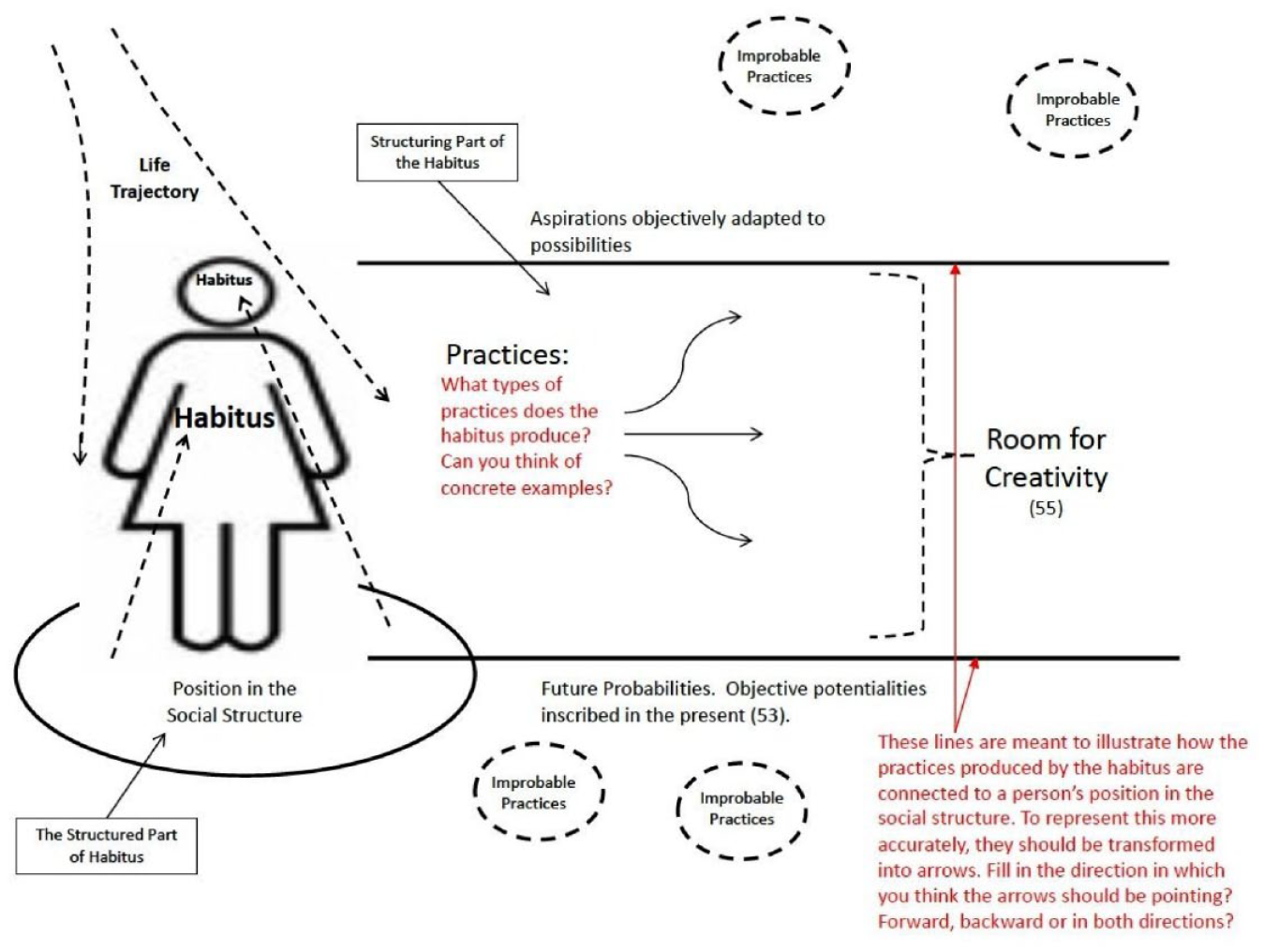
Map of Bourdieu’s concept of habitus for student-navigators
Students as Navigators
Once students have achieved a basic understanding of a theory, instructors can encourage them to transition from “tourists” to what we call “navigators.” Student navigators do not just use maps to guide their initial interpretation of the text. Instead, they use maps for a more purposeful navigation of, and a deeper access into, social theory. Consider a few ways that instructors can use theory maps to motivate active learning and critical thinking at this stage of the learning process.
Figure 2, which presents Bourdieu’s concept of habitus, illustrates how instructors can encourage students to annotate theory maps. Michel designed this map to help students navigate excerpts from Bourdieu’s Distinction (Bourdieu 1984) and The Logic of Practice (Bourdieu 1990). The map presents key components of Bourdieu’s concept and includes page numbers (from The Logic of Practice) for further guidance. Pedagogically, the map strikes a delicate balance between providing students with sufficient information to orient them through a complicated concept while leaving enough unstated so that they have to read carefully to fill in the details. The map visually points out that the structured part of the habitus refers to a person’s position in the social structure. It is only by reading Bourdieu closely, however, that students will realize that what this means in a more technical and concrete sense is that someone’s position in social structure is defined by the volume and composition of their economic, social, and cultural capital.
Michel also uses this map to ask students to illustrate the types of practices produced by the habitus with concrete examples. In doing so, students are prompted to creatively use and work with the theory. The examples students provide vary in their complexity, ranging from preferring pepperoni pizza over vegetarian pizza to tastes in fine art. In all these cases, the map facilitates the process of drawing connections between the theory and students’ lived experiences, translating Bourdieu’s understanding of practices into terms that are intuitive for them. The map further asks students to decide the direction of the arrows that connect a person’s position in the social structure with their practices. This is a more complex task to be sure, but one that many student-navigators undertake successfully by making the arrows flow in both directions, signaling the relational character of Bourdieu’s concept of habitus.
We also think it is important to provide students with opportunities to use readings to critique theory maps. For example, through in-class activities or homework assignments, we ask our students to assess the validity of the maps we provide them through questions such as these: “Does this map accurately depict what you read?” “Is there anything missing?” “Should we add something to the map?” “Should we remove something?” In our experience, students occasionally request the addition or subtraction of a feature or suggest a change in the direction of an arrow. Sometimes they ask for conceptual definitions to be included in the map. Among other things, providing students with opportunities to critique theory maps helps them develop a critical attitude toward any representation of theory, whether it takes the form of a map or an explanation during lecture.
Students can also use theory maps to help them critique the readings. Once our students generally agree that a given map accurately represents a theory, we then ask if the theory adequately maps the social world. With the corresponding theory map projected on a screen, we typically ask students questions like these: “What elements or processes are problematically omitted from this theory?” “Is the theorist’s argument convincing?” “How might we improve this theory?” While these are questions about theories rather than theory maps, scholars have documented the effectiveness of student-produced visual aids in social science and non–social science classes for addressing these kinds of higher-order questions (Bobek and Tversky 2016; Herring 2015; Herring et al. 2016; Maries and Singh 2017; Trepagnier 2002). That research is consistent with our experience. Our projected theory maps offer a shared reference point for students to critique theory in the classroom. Indeed, it is easy for students to see that a theorist neglects gender when no identifiable features of patriarchy are captured in its respective map.
There are other ways theory maps can support critical thinking. When instructors make and use several theory maps for their students, students are effectively given a “theory atlas” they can use to help them assess the similarities and differences between theories. For example, when we ask questions like “What might Weber say to Marx about the emergence of modern Western capitalism?” our students often open their maps to help them formulate an answer. Likewise, we sometimes give our students external materials (e.g., video clips, song lyrics, and newspaper clippings) for them to cross-examine in class. Many flip through their maps to identify key variations in how select theorists might examine such materials. Students can use maps to help them creatively imagine conversations and debates between theorists.
Thus, while theory maps for student-tourists are designed to demystify theory by assisting initial interpretations, maps for student-navigators provide a visual foundation that structures and promotes higher-order learning. This is unsurprisingly more difficult for students. Yet, in our experience, they generally welcome this challenge once they have built an initial foundation of understanding as tourists. The third stage of our cartographical approach, which we detail next, presents students with an opportunity to leverage a more developed understanding of theory. It entails a more challenging task but one that also tends to generate the most rewards.
Students as Mapmakers
In addition to using theory maps as tourists and navigators, students can become mapmakers themselves. We do not argue that the cartographical approach to teaching theory requires that students produce their own maps. Such a strategy can nevertheless be useful, especially after students have gone through the stages of tourist and navigator. Consider three ways in which instructors can foster the development of student mapmakers.
First, mapmaking exercises can be integrated into small assignments that do not necessarily involve mapping an entire reading or theory. For example, instructors can give students the option to map, rather than write, their regularly scheduled reading responses. This can be aided by questions like these: “What are some ways that capitalists can intensify the exploitation of wage labor according to Marx and Engels?” “How have you encountered the color line described by Du Bois?” “What might Foucault say to Weber about self-discipline?” If additional guidance is required, instructors can provide a list of key concepts and ideas in the reading and ask students to mark these terms as they appear in the reading and try to determine how they are connected to each other. The next step consists in writing them down, drawing circles around them, and connecting them with lines and arrows that suggest how they are related to each other. These instructions transform mapmaking into a step-by-step process that does not require advanced drawing abilities. Students can take photographs of their hand-drawn theory maps, or they can make these on their computer. While the quality of these submissions can vary, such exercises can provide low-stakes opportunities for students to experiment with theory as cartography.
Second, mapmaking exercises can take the form of small-group activities. Classroom size and infrastructure permitting, student groups can draw maps on chalkboards or poster paper. Again, in our experience, such activities work best when prompted by specific questions or clear instructions. In addition to fostering collective work, such small-group activities provide an opportunity for students to offer verbal commentaries on their maps. This learning opportunity can be advanced by having each small group collectively present their map to the rest of the class.
Third, mapmaking exercises can be integrated into examinations, final projects, and other higher-stakes exercises. Josh has students submit theory maps along with written responses for each question they answer in take-home exams. Figure 3 provides some examples of these submissions from an undergraduate course. 1 Map A responds to a question about Du Bois, Marx, and class struggle, and Map B responds to a question about Foucault, Durkheim, and the state. Map C draws on Mies’s ([1986] 2014) Patriarchy and Accumulation on a World Scale to offer a feminist critique of Weber’s theory of rationalization. The details are complicated, imperfect, and hard to evaluate without also knowing the assigned text and reading the students’ written responses. We simply showcase these maps to illustrate the broad variations in student submissions. Some are made on a computer, but most are hand drawn. Some build their own maps from scratch (Map A and Map B), while others opt to synthesize maps provided by the instructor (Map C).
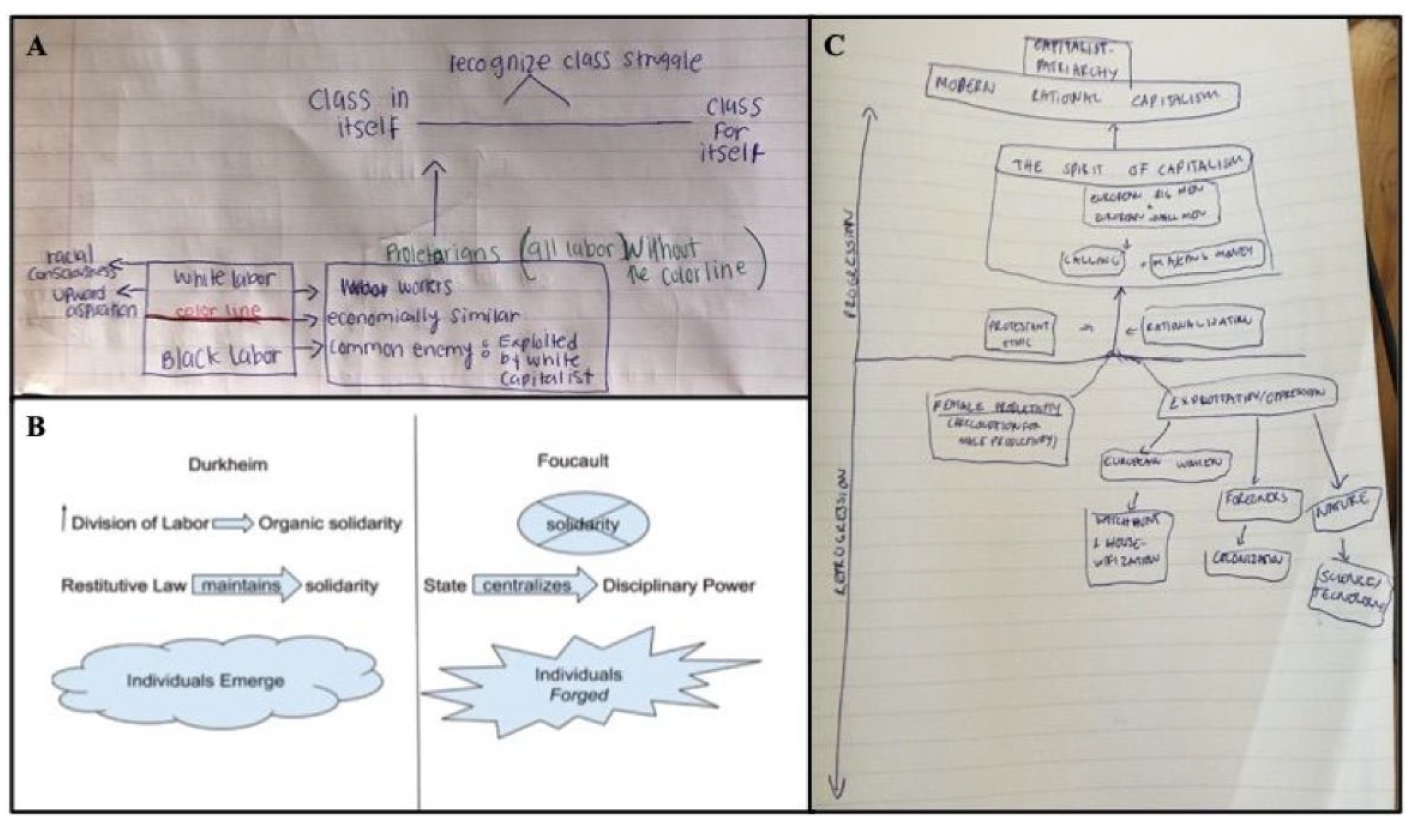
Example submissions by student-mapmakers
The path from student tourist to navigator to mapmaker can be viewed as a learning continuum, with each category involving increasingly challenging learning activities. This means we organize our classes with an understanding that the mapmaker stage is the most difficult, and this is a point frequently confirmed by students in office hours and classroom discussions. Our experience suggests that learning activities focused on students as mapmakers work best when preceded by the strategies described in the previous two sections. That said, we do not believe students’ learning necessarily becomes more “active” as they move from the roles of tourists to navigators to mapmakers. Our maps promote active learning at all stages of this continuum, but they do so in different ways and with increasing levels of complexity. In this sense, the three stages should not be viewed hierarchically from least to most desirable in terms of student learning. We ultimately understand each stage to have an equally distinct value in the learning process.
Discussion and Conclusion
We have argued that the use of theory maps can offer an effective method for teaching and learning social theory. Our cartographic approach is inclusive and student centered in the sense that it is designed to meet students at the specific stage of the learning process they are in, rather than presenting them with complex theoretical texts regardless of their familiarity with the material and without targeted guidance. By breaking down the learning process into three distinct stages defined from the students’ standpoint—tourism, navigation, and mapmaking—instructors can leverage the advantages of representing theories visually in ways that are specifically tied to each of these stages. We have argued that this cartographic approach is particularly well suited for theory courses given the complexity of primary texts, but we also believe it has more general practical and pedagogical advantages for teaching just about any course in sociology. 2
Open-ended comments from our anonymous student evaluations suggest that students find theory maps valuable. Consider a few comments from our undergraduate students: The instructor creates maps for the arguments which can be used to navigate the material, making it possible to really understand the theory well. The use of theory maps . . . made studying and quickly referencing the material for our various assignments incredibly accessible, and also served as an excellent way to figure out what to study. I appreciated that we had theorist maps that guided conversation, and thought that they were really helpful in sparking discussion among the group.
Most of the anonymous feedback we have received from students regarding theory maps—usually sparked by prompts like “Please describe the MOST valuable aspect(s) of this course”—were positive and emphasized a similar theme: Theory maps make theory more accessible. Indeed, we have noticed no obvious difference in the largely positive response students have expressed toward the use of theory maps across our respective courses and institutions. We contend that what matters in this regard is not whether the maps are useful in different settings but that each stage—tourist, navigator, and mapmaker—may be more or less relevant at different types of institutions or in different courses depending on the students’ level of preparation.
There are, however, a few potential limitations to our approach worth considering. A couple of students criticized our heavy emphasis on teaching theory cartographically. One of our undergraduate students wrote, “I didn’t find the maps very useful, perhaps because I am not a very visual learner.” Indeed, not all students are visually inclined, and some may find it challenging to learn with theory maps. Additionally, there may be a risk that instructor-produced theory maps discourage student reading. Related to this, some may argue that a heavy use of theory maps can amount to student “spoon-feeding” or “hand-holding.” Worse, if instructors assemble and distribute maps based on their own problematic interpretations of the texts, then they may encourage students to misread theory. Finally, the rise of online sociology teaching may stress the limits of the cartographical approach. Small-group mapmaking exercises, for example, may prove more difficult to organize in an online course.
These are not insignificant concerns, but we believe most of these shortcomings can be mitigated. Instructors can use theory maps and provide room for nonvisual learners to thrive through other exercises. Even mapmaking activities can be facilitated for nonvisual learners by providing step-by-step instructions, such as those we presented earlier. Furthermore, reading assignments, exam questions, and other assessments can be designed such that they cannot be completed by simply reviewing a theory map. As we have argued throughout this essay, the cartographical approach should not exist as a solo strategy. We believe this method works best when combined with a range of other learning activities. And while online teaching can present unique hurdles to some of the exercises detailed in this article, most can be tweaked for online learning. In our recent experience with remote instruction, only the in-class small-group activities proved challenging. Even so, we believe it is possible to carry out online mapmaking activities by organizing students into digital breakout rooms and having them work collaboratively on a shared platform, such as Google Docs.
In closing, we propose teaching social theory primarily—but certainly not exclusively—as a form of cartography. We frame this as a pedagogical method that seeks to make theory radically accessible for students at different stages of the learning process by directly helping them decode theoretical text. We argue this fosters not only more effective but also more equitable teaching.
Footnotes
Acknowledgements
We thank the editor and reviewers for their feedback on earlier versions of this publication. We also benefited from comments we received at the 2021 Pacific Sociological Association Annual Conference.
Authors’ Note
Authors share equal authorship of this article.
Editor’s Note
The reviewers for this manuscript were, in alphabetical order, Erin Kidder, Ryan Orr, Charles Seguin, and Devrim Yavuz.
