



Abstract
Current approaches to building inclusive classrooms for first-generation and working-class students tend to emphasize communicative strategies: receiving students with welcoming messages that acknowledge and value their life experience and promoting a growth mindset. These methods are important, but they do little to address structural sources of exclusion, such as academic inequities and disadvantages in resources like time. Communicative strategies alone secure inclusion without equity. Equity, however, involves teaching and learning activities that promote fair treatment and access at a structural level in order to offer students a concrete path to classroom success. In this article, we develop a framework for designing assignments and learning activities that addresses the type of structural barriers that most affect first-generation, working-class, and racially minoritized students. We identify three distinct types of structural disadvantages—academic inequities, resource disadvantages, and cultural discrimination—and propose three strategies for equitable design: deliberative interdependence, transformative translation, and proactive engagement. We illustrate each strategy with concrete teaching methods. We conclude by suggesting that only a transformative, comprehensive shift to equity mindedness is capable of doing justice to the increasing diversity of college classrooms.
Keywords
Over the past several decades, enrollment rates in degree-granting postsecondary institutions in the United States paint a potentially promising picture of first-generation and working-class students. Data from the National Center for Education Statistics (NCES) from 2018 showed that for the first time in the history of American higher education, the immediate college enrollment rate for students from low-income families was higher (67 percent) than the rate for students from middle-income families (64 percent) (McFarland et al. 2018:150, 152; Snyder, de Brey, and Dillow 2018). 1 The numbers for first-generation students have decreased, but that is partly the result of an overall increase in college enrollment: As more people have gained access to postsecondary education, there are fewer students with parents who did not attend college (Saenz et al. 2007:vi, 6–10).
While these trends are encouraging, wide disparities persist—in terms of both access to higher education and completion rates—between low-income, first-generation, and racially minoritized students and their more affluent, continuing-generation, majority white peers (Bowen, Chingos, and McPherson 2009:37). The research record on this is unambiguous: Compared with students from wealthier families and families in which at least one parent attended college or received a bachelor’s degree, proportionally fewer low-income and first-generation students graduate from high school having completed an academically focused curriculum, and fewer make it to college—especially four-year institutions (Forrest Cataldi, Bennett, and Chen 2018; Warburton, Bugarin, and Nuñez 2001; Wilbur and Roscigno 2016:5–6, 9). Those who do gain access to postsecondary education take longer to get there, struggle more while enrolled, and drop out at higher rates or take longer to graduate (DeAngelo et al. 2011:10–14; Forrest Cataldi et al. 2018:4–9; NCES 2015; Riggs 2014).
Racially minoritized students are more likely than white peers to be first-generation or low-income students (Postsecondary National Policy Institute 2018; Terenzini et al. 1996:8). Not all first-generation students are low-income students, but students at that intersection face the most daunting challenges. 2 Because retention and completion remain formidable challenges, more must be done to ensure access and success.
In this context, many instructors have developed initiatives to improve classroom pedagogy and atmosphere. Yet these initiatives, and the research they are based on, overwhelmingly focus on promoting inclusion through communicative strategies, paying comparatively little attention to structural barriers. Communicative strategies generally consist in messaging designed to make students feel welcomed or to avoid what we call symbolic discrimination. Symbolic discrimination refers to intentional or unintentional, explicit or implicit judgments about the moral worth of first-generation and working-class students or their ability to succeed in college. Common communicative responses to symbolic discrimination include explicitly acknowledging the value of first-generation and working-class voices or promoting a growth mindset about the skills and competencies needed to complete coursework.
Communicative strategies are important and deserve their place among a range of efforts to help first-generation and working-class students feel that they belong in college (Romero 2015). Yet they rarely address the structural sources of exclusion these students face. A working-class student who feels welcome in the classroom may struggle to succeed when a two-hour commute limits their ability to attend office hours or study groups. A first-generation student may feel valued by their instructor and peers yet fail to complete assignments they have never been given an opportunity to practice. Communicative strategies alone secure inclusion without equity. By contrast, equitable assignments and teaching activities promote just treatment, widened access, and a concrete path for educational success at a structural level.
In this article, we develop a framework for designing assignments and learning activities that addresses key structural disadvantages likely to affect first-generation and working-class students. We aim to furnish a portable model that can be used across a wide range of higher education institutions, from all-access colleges to elite universities. We believe that what happens in classrooms is consequential regardless of the support resources available (or not) for first-generation and working-class students in any given institutional context. At institutions that lack the resources and infrastructure to support first-generation and working-class students, the classroom can be a bulwark against structural barriers to their success. But even students at well-resourced institutions may encounter structural challenges in the classroom that support centers cannot resolve. In all of these scenarios, instructors’ intentional design of assignments and learning activities can have a direct impact on the educational trajectory of their students. By focusing on the classroom environment and the possibilities that lie within the agency of instructors, we seek to provide a multidisciplinary model of how educators can leverage their power to combat systemic inequities.
In the first section of this article, we develop a typology of structural barriers to academic success and review the valuable, but limited, communicative approaches typically employed to support first-generation and working-class students. Next, we present the principles of our framework for equitable design and illustrate them with practical teaching methods we have used in our classrooms. We conclude by suggesting that only a transformative, comprehensive shift to equity mindedness (Bensimon, Dowd, and Witham 2016) is capable of doing justice to the increasing diversity of college classrooms.
Structural Barriers to Academic Success
We define structural sources of exclusion as barriers to academic success that originate in three main sources of inequity: academic opportunities, material resources, and cultural discrimination. These forms of structural exclusion affect students’ ability to successfully complete coursework, and they disproportionately impact working-class and first-generation students (Hansen and Mastekaasa 2006; Jack 2016; Terenzini et al. 1996).
Inequities in academic opportunities are well documented (Adelman 1999:84–86; Forrest Cataldi et al. 2018:4; Hoffman and Lowitzki 2005). Working-class, first-generation, and racially minoritized students have been historically denied the opportunities to develop skills and knowledge that are critical for college (and beyond) compared with their wealthy, continuing-generation white peers (Bailey and Dynarski 2011; Cahalan et al. 2018; Love 2004). We want to be precise in our formulation of this barrier. We are well aware that many of the academic expectations of American higher education are rooted in classist and racist assumptions about the preeminence of English over other languages, the merits of outspoken individualism, and the authority of academic writing over other communication styles. We believe it is important to critically analyze these assumptions and to expand the range of ways in which students are invited to share knowledge and participate in the learning process. However, we should not lose sight of how working-class and first-generation students are often placed at a lifelong disadvantage by educational institutions that do not support their development of what can reasonably be considered broad educational goods. For example, students who graduate without the opportunity to develop the skills of comparative analysis, to critically scrutinize information presented by politicians and the media, or to properly interpret statistical trends are put at an unfair disadvantage in college, in the workforce, and, more generally, in life (American Sociological Association Task Force on First-Generation and Working-Class People in Sociology [ASA Task Force FGWC] 2022).
Resource disadvantages—a second source of structural inequalities—are material and temporal hardships that prevent students from fully investing in a class or taking advantage of instructional or campus opportunities. Students experience a resource disadvantage (Pascarella et al. 2004:265–66) when family care commitments, work obligations, or lengthy commutes prevent them from participating in what Wilbur and Roscigno (2016:4–5, 6–8) call “high impact curricular activities,” such as study groups, course-related community-based projects, research assistantships, or office hours.
Finally, structural disadvantages can take the form of cultural discrimination (Bourdieu 1977). Mismatches between the values of working-class and first-generation college students and the values commonly upheld in the American college classroom often negatively impact academic performance (see DiMaggio and Mohr 1985; Jack 2019; Kaufman 2005; Stephens et al. 2012:1182, 1189; Stuber 2011). Surveying first-generation and continuing-generation students about their motives for attending college, Stephens et al. (2012:1184, 1188) found that the former were far more likely to identify community-oriented reasons, such as “giv[ing] back to my community” or “working together with others.” The motives of continuing-generation students typically drew upon a more individualized model of learning, emphasizing “expressing oneself” or “becoming an independent thinker.” Classroom cultures that valorized individual independence over community orientation made first-generation students feel uncomfortable and less welcome. This, in turn, led them to view classroom tasks as more difficult and negatively affected their grades compared with continuing-generation students, even after controlling for race and SAT scores.
Research has also shown that the cultural backgrounds of first-generation and working-class students can influence their orientations toward campus authority figures (Jack 2016:15; Nadworny 2018; Stephens et al. 2012:1194; Whitford 2018). For example, these students may not foresee the purpose or benefit of attending office hours or might feel anxious about engaging instructors (Jack 2016:9–10; Nadworny 2018). Rather than viewing instructors and campus authorities as partners or facilitators in their educational advancement, these students tend to believe that they must simply hunker down and work hard on their own (Jack 2016:13). This can incur significant academic costs, such as losing out on research opportunities or tailored mentoring. And these costs have longer-term consequences as well, making first-generation and working-class students seem less competitive in the judgment of graduate school admissions committees (ASA Task Force FGWC 2022)
In their most pernicious form, these three types of structural disadvantage are mutually reinforcing. First-generation and working-class students receive an assignment that is unfamiliar, and the mechanics for completing it successfully remain largely unexplained. They are not given opportunities to develop pertinent skills or provided openings that validate their voices in relation to their more outspoken peers. They receive a low grade with feedback pointing to minor technical issues but remain confused about what went wrong in a deeper sense. They may be hesitant to share these struggles with their parents, who, in any case, often cannot provide specific guidance on academic assignments because they did not attend college themselves. Some of these students find and support each other, but many bear the experience alone and often remain invisible to each other because first-generation and working-class status do not bear clear external identity markers. They may come to question whether they are as smart as their peers or if college is right for them. Instructors attempt to make them feel welcome in class, but it is not enough.
Symbolic Solutions to Structural Problems?
Existing approaches designed to prevent symbolic exclusion primarily take the form of communicative strategies that valorize students’ presence or convey confidence about their ability to succeed. We identify three specific types of communicative strategies: cultural messaging, psychological messaging, and cultural matching. Table 1 summarizes what each of these approaches attributes the equity gap to and the character of the intervention they propose to close it.
Summary of the Three Main Types of Communicative Strategies.
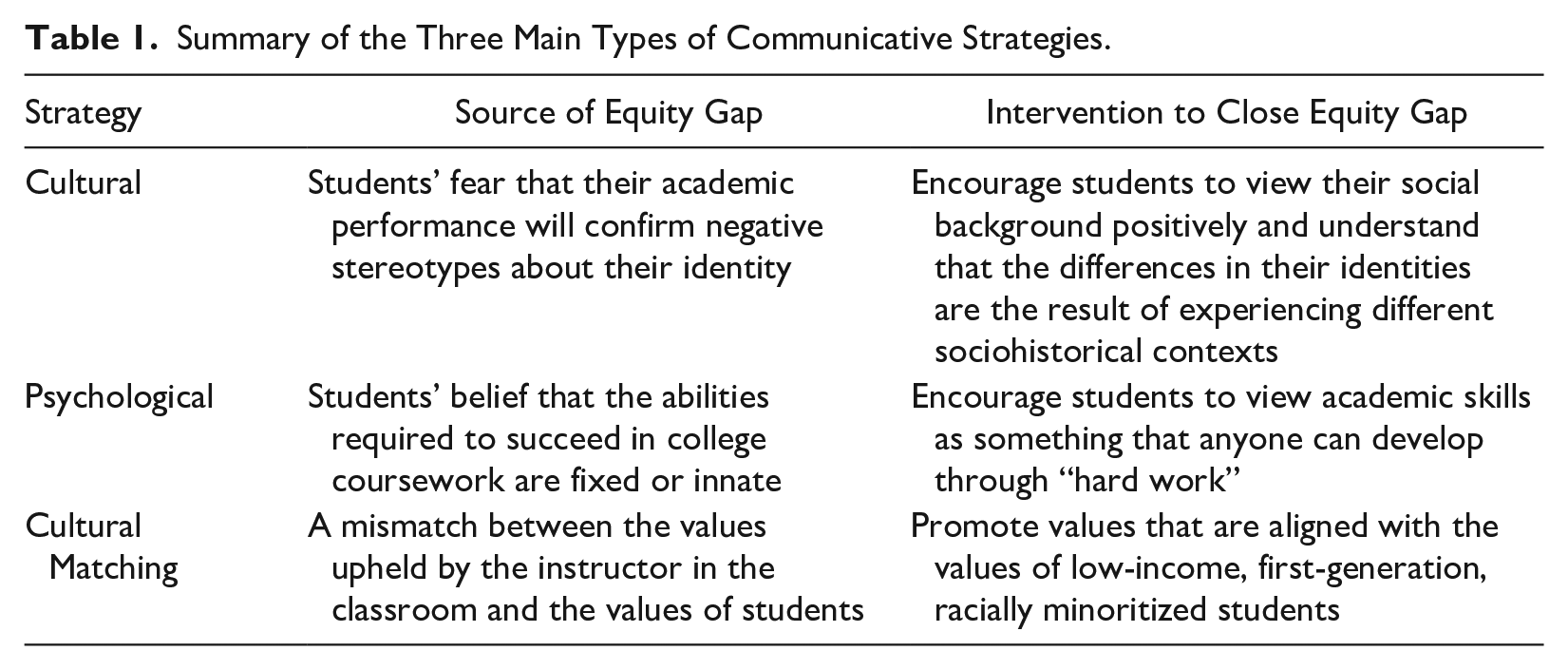
Cultural messaging is rooted in research on stereotype threat, which shows that “individuals underperform in situations that remind them that they are stereotyped to do poorly” (Schmader 2010:14). To prevent this, cultural messaging recasts group differences in a positive light and emphasizes the valuable contributions associated with students’ backgrounds and identities. This can take the form of messages designed to help students understand that differences in experiences, opportunities, and outcomes reflect adaptations to different socioeconomic contexts and that this variation is valuable (Stephens et al. 2019:157).
While cultural messaging focuses on identity, psychological messaging posits that all students can develop academic skills if they work hard enough. This approach draws on the stereotype threat literature but adds insights from research on mindset (Yeager and Dweck 2012). Psychological messaging strategies include explicitly conveying confidence in the ability of all students (Appert et al. 2018:14) or framing intelligence as a malleable rather than fixed capacity (Aronson, Fried, and Good 2002). Cultural and psychological messaging share the view that positively reframing the experiences and contributions of first-generation and working-class students, or changing their beliefs about learning, can improve their self-confidence, motivation, sense of belonging, and academic performance.
Cultural matching strategies seek to change the classroom culture so that it matches or nurtures the values of first-generation and working-class students. For example, Stephens et al. (2012:1190–95) found that messages that counter the prevailing valorization of individual independence on college campuses by promoting responsiveness to others, teamwork, and community building can improve the academic performance of first-generation students without affecting the performance of continuing-generation students. Of the three strategies described, cultural matching stands alone in addressing one of the structural barriers (cultural discrimination) we described in the previous section.
Analyzing interventions aimed at reducing the social class “achievement gap,” 3 Dittmann and Stephens (2017:112, 114) recognize that effective communicative strategies “must first address disparities in individual skills and structural conditions. . . . Motivating students to spend more time studying for an exam without knowledge of effective study strategies is unlikely to produce the desired academic benefits.” Moreover, research on communicative interventions is limited by the fact that it has largely been conducted in selective colleges where working-class and first-generation students often already possess the academic skills required to succeed—these are the type of students Jack (2019:11) identifies as the “privileged poor.” By contrast, working-class and first-generation students at larger, resource-constrained public universities and junior colleges arrive with valuable forms of cultural wealth (Yosso 2005) but may not possess the academic skills valued by the institution. It therefore remains unclear whether communicative strategies would have the same effects in settings where skills-based equity has yet to be achieved.
A Framework for Equitable Design
Our framework for the equitable design of assignments and learning activities—which we regard as one component of equitable pedagogy—is student centered, inclusive, and focused on addressing structural inequalities. This framework aligns with other efforts to name and address systemic inequalities in higher education, such as community cultural wealth (Yosso 2005), assets-based teaching (Missingham 2017), culturally responsive teaching (Gay 2010), and Universal Design for Learning (UDL; CAST 2018). Our approach takes inspiration from these efforts and draws on evidence-based literature to address the micromechanics of designing assignments and learning activities to help first-generation and working-class students succeed. We begin from the premise that the skills, resources, and cultural orientations valued in academic settings and required to succeed in the college classroom are unequally and unfairly distributed among students and, in some cases, are actively discriminatory. The goal of our framework, then, is nothing short of justice: to ensure that students who have been historically discriminated against by educational institutions have an equitable chance to thrive academically.
Our approach is based on three research-based strategies for assignment and learning activity design: deliberative interdependence, transformative translation, and proactive engagement. Together, these strategies constitute a powerful framework for supporting the success of first-generation and working-class students while also benefiting all other students. The framework is flexible: Any single principle can be implemented independently of the others (often with positive spillover effects for addressing multiple structural disadvantages), and two or more principles may be applied as part of a single assignment.
Deliberative Interdependence
Recent data and research show that students in general—and working-class and first-generation students in particular—find it meaningful and motivating to collaborate and learn from each other in class (Chambliss and Takacs 2014:4–5; Spalter-Roth et al. 2012:11–12; Stephens et al. 2012). Deliberative interdependence draws on these findings to promote equitable academic success through students’ mutual reliance and sense of camaraderie. This is achieved through the introduction of formal rules that establish interdependence among students and promote deliberation. In doing so, deliberative interdependence grounds the value of community not simply in messaging but in the way students work with each other in class. It also ameliorates inequities by assessing academic performance collectively, as each student’s individual grade depends on contributing to the achievement of the group.
Deliberative interdependence fosters peer connections through rules that define (1) how students should complete an assignment and (2) how an assignment will be graded. These rules can be introduced independently or in combination. The first type creates conditions in which students must rely on each other to complete the assignment (or part of it). The second type ensures that their performance is assessed collectively rather than individually (again, either partially or entirely). These rules ground the value of collaborative achievement in an incentive structure that makes students rely on each other to succeed. While interdependence alone does not automatically produce camaraderie, deliberation can help do so.
Deliberation is a discussion process whereby participants explicitly articulate their views on a given topic with a predefined purpose or goal. If the process is properly orchestrated to give everyone a real opportunity to participate—an issue we address later—deliberation can generate ties that promote empathy, trust, a sense of belonging, and a feeling of ownership over the outcomes produced (Carcasson 2009; Cohen and Lotan 2014:92–93; Myers and Mendelberg 2013:704–10). By making participants more cognizant of others’ needs, motivations, and reasoning, deliberation can also prompt changes in attitudes, greater clarity and self-awareness about held positions, and a more inclusive disposition toward those who hold opposing views (Myers and Mendelberg 2013:703–6).
The rules and incentives that generate interdependence must be embedded in a process of collective deliberation so that students not only hold each other accountable but collaborate to produce their best work. Michel Estefan developed this strategy and has implemented it in various formats in lower- and upper-division courses on research methods, social theory, sociology of policing, sociology of social justice, and race and racism at the University of California—both its San Diego and Berkeley campuses—and at San Francisco State University. These courses have ranged in size from 7 to 120 students; some were in person, some synchronous remote, and some hybrid.
The first format is what Michel calls the “collective quiz.” This is a two-part formative assessment tool in which students first answer multiple-choice questions in small groups by discussing each one and selecting the right answers by consensus. The second part of the quiz features a self-assessment question that students answer individually. This question asks students to rate their quiz performance using three criteria: how much of the material they read, how often they expressed their views, and how carefully they listened and encouraged others to participate. This part of the quiz provides grade variation and gives Michel the opportunity to help students understand what participation means and how they can improve their performance. Figure 1 presents Michel’s self-assessment question.
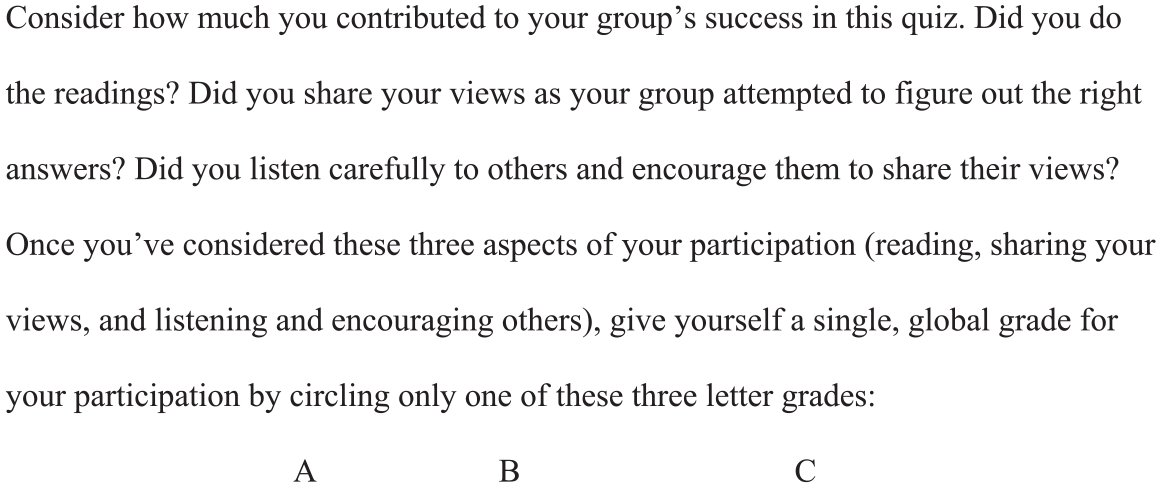
Michel’s Self-Assessment Question in the Collective Quiz.
The combination of the consensus rule for deciding answers and the self-assessment question incentivize students to express their views and invite others to do the same, thereby making student participation more equitable. The decision rule for choosing answers is central to ensuring that deliberation equalizes participation among students from different backgrounds instead of exacerbating preexisting inequalities (Karpowitz, Mendelberg, and Mattioli 2015). Consensus forces the majority to persuade those in the minority, not overrule them. 4
Michel has also implemented deliberative interdependence in synchronous online collective final exams. In this variant, students first take one hour to answer multiple-choice questions individually. Next, they are randomly placed in Zoom breakout rooms of two or three and given another hour to answer the same questions following the consensus rule. Finally, they use another hour to answer those questions again in randomly created groups of four or five, following the consensus rule. Each student’s individual final grade is the average of all three exams. Students are notified of each exam grade immediately upon completion but do not know which questions they answered correctly. This iterative process builds on research showing that learning progresses with repeated exposure in the context of “goal-directed practice” (goals such as answering questions) (Ambrose et al. 2010:125–28).
The collective quiz has worked equally well online and in person, but there are a few considerations worth noting. Online platforms—Michel has used Zoom, but any platform that allows instructors to place students in small groups would work just as well—allow instructors to organize students in small groups and decide the size of these groups with ease and efficiency. Large in-person courses held in classrooms where seats have limited or no movement complicate this. In this scenario, Michel has opted to ask students to form groups with the people sitting around them in the service of simplifying the logistics of group formation. The groups tend to be smaller, two or three students compared to four or five online, but the method has been just as effective. Michel has implemented only the collective final exam on Zoom, but he has done this for classes taught in a synchronous-remote format as well as classes that met mostly in person. One insight to be gained from this is that classes held in person can temporarily move online a few times during the academic term to hold collective quizzes, midterms, or final exams.
Michel has observed that collective quizzes and final exams elicit vigorous, dynamic conversations as students attempt to identify correct answers. His course evaluations across six classes over the past two years, as well as separate surveys he distributes, consistently show that students feel a strong sense of community in his classes. Students systematically identify the collective quizzes as the most important source of this feeling. He does not have data on the final exam because evaluations are submitted before exams week, but students have mentioned, anecdotally, feelings of camaraderie similar to those elicited by the collective quizzes; moreover, they find the format helps them learn. Indeed, Michel has noticed that as students transition to each new iteration of the exam, their deliberations tend to focus on the subset of questions they feel unsure about. This aligns with research showing that students learn more effectively when they focus on the material they know least rather than what they know best (Ambrose et al. 2010:135). 5
Mechanisms for generating deliberative interdependence that rely on softer rules and incentives can achieve the same type of collaborative learning that first-generation and working-class students value so highly. In an online discussion forum she originally created for students in a lower-division undergraduate course, Sarah Macdonald aimed to make student learning mutually dependent and encouraged structured collaboration in periods leading up to exams. She specifically selected an online discussion forum to enable students to practice explaining the material in writing. Students were instructed to post a question they had about course material and to couch that question in a brief explanation about what they understood already and what they found confusing. She would contribute to the discussion only after at least two students had weighed in with their opinions, incentivizing participation. Sarah introduced a further incentive by offering extra credit points to anyone who posed a question or answered one. Compared with the consensus rule in Michel’s collective quizzes, extra credit points are a softer way of promoting collaborative participation, since students can opt out of this portion of the assignment.
Sarah also incorporated the forum conversation into class discussion, building on students’ questions and comments to cover class material. After an exam, she sought feedback using an online survey. Students reported that it was helpful to read how others were thinking about course concepts and arguments. They also stated that explaining the material helped them achieve greater clarity and depth in their own understanding. This way of organizing online forums avoided many of the pitfalls common to this method, including forum discussions that fall flat in the absence of an incentive to participate or clear instructions about how to use the forum. Moreover, the forums promoted the type of community experience that first-generation and working-class students often seek in their courses.
Transformative Translation
Transformative translation builds upon the finding that people learn by connecting new information to what they already know (Ambrose et al. 2010:18). Unlike assimilation, in which new information is absorbed into preexisting categories, transformative translation is an active process in which students modify their understanding by drawing on existing resources as they process new material and translate between them. When instructors intentionally leverage this process, students are empowered to use their existing views and new knowledge becomes more intuitive for them. The practical challenge for instructors is to assess and tap into students’ preexisting knowledge—a challenge structurally equitable assignment design can help address.
This strategy draws on Tara J. Yosso’s (2005) theory of “community cultural wealth.” Countering traditional understandings of cultural capital, community cultural wealth centers alternative forms and sources of value that flourish in communities of color but that—we would add—also flourish in the frequently overlapping and intersecting communities of first-generation and working-class students. For as Yosso suggests more broadly, culturally marginalized students of all kinds are particularly well equipped to contribute aspirational, navigational, social, linguistic, familial, and resistant “funds of knowledge” to the classroom community. In affirming the strengths of an increasingly diverse student population, we also follow models for culturally responsive teaching that originated in K-12 education (Gay 2010). While these models often receive short shrift in higher education theory and policy, they represent a promising future avenue of research in this setting.
Although research has found that students who face structural inequalities commonly learn by translating course content through prior experiences and perspectives (Anderson and Adams 1992; Packard 2013), this approach is often regarded as invalid or unscholarly. Furthermore, relevant experience may be narrowly defined, and students may be pushed to conform to dominant modes of thinking or relating ideas. Finding that his African American students were “more likely to connect personal experiences and academic concepts,” Packard (2013:146) surveyed students’ reactions to course content in open-ended journal entries but also periodically required responses to specific prompts. In this way, Packard “legitimated” individual experiences of the course materials while developing and testing relevant conceptual knowledge. To build understanding of the sociological imagination, Hoop (2009) invited students to conduct research on local, national, and global events that occurred on their birthdate, bridging these events with personal anecdotes from familial sources. In both cases, instructors did not simply accommodate students who process new knowledge through familiar concepts; rather, they situated these acts of translation as inherently valuable.
Practices of transformative translation can be usefully paired with more well-known efforts to decolonize the classroom. But while decolonization efforts often emphasize content expansion, translation focuses on how (rather than what) students learn. Relatedly, translation activities are more fully student centered: While specialist debates about canon expansion are vital to inclusivity conversations, transformative translation promotes methodological accessibility for students and prioritizes diverse entry points to engagement. In this regard, translation practices align with UDL recommendations that educators provide multiple modes of engagement and expression.
In an introductory English course on nineteenth-century literature taught at the University of California, Berkeley, Jesse Cordes Selbin sought to introduce an unfamiliar historical period while allowing students to experiment with a range of approaches to an assignment. Each week, she required students to post one historical event to a shared digital timeline of the era, but entry topics were left to student discretion. Some supplied the dates of major wars; others, events in the history of women’s rights or shifting legislation around African American freedoms. One student athlete explored sports history, while a physics major chronicled scientific innovations. As students followed diverse paths to fulfilling the assignment, they drew upon individual sources of curiosity and investment, shared perspectives with colleagues, and both learned and taught one another about the complexities of a bygone era. Simultaneously, they deepened their knowledge of the world that contextualized the literary texts they read. In fall 2022, when Jesse reprised this assignment in an introductory survey of nineteenth-century global Anglophone literature at Gettysburg College, many students reported that the timeline helped them better understand the era of study, and one reported that identifying significant events in the history of colonial India helped them better understand both the South Asian authors on the syllabus and their own cultural-familial background. An adapted version of this project might also activate deliberative interdependence by requiring students to peer review one another’s entries not just for technical elements, like informational accuracy and proper source citation, but for unexamined premises or occluded perspectives on the event itself—a mechanism for promoting mutual support and collaborative learning that can be incentivized with a grade not only for original submissions but for reviews. Students might also collaborate on thematic clusters, thereby providing alternate perspectives on given historical events.
Translation practices promote equity in three ways. First, they help bolster the ineffable sense of belonging that is crucial to reducing academic opportunity gaps. Second, they may enhance intrinsic motivation, which, a major recent study has found, is reported less commonly among racially minoritized students than their majority peers (Isik et al. 2018). As Ginsberg (2015:2) argues, culturally responsive teaching is enhanced when interactions between students and teachers are “motivationally significant as well as content rich” and—better still—when that motivation is internally derived. Covington, Voge, and von Hoene (2017:93) have demonstrated the value of leveraging “the idiosyncratic nature of personal interest” but caution that “the given assignment must be sufficiently flexible and open to accommodate the infusion of a wide variety of student interests” while ensuring that any “changes result[ing] from this infusion of interests [do not] hijack or distort the pedagogical purposes of the original activity.” Finally, translation activities can help students connect the academic realm to their daily lives, shaping critically literate citizens within both a classroom community and other communities they inhabit.
Deliberative interdependence is usefully paired with translation activities that center personal and culturally rooted sources of experience, for these sources can help forestall any opinion homogenization that deliberative discussions risk inviting. The benefits of pairing the two strategies run in the other direction as well. Some argue that valorizing experiential knowledge may allow students simply to affirm prior beliefs or talk past one another. But—when paired with deliberative interdependence—such assignments ideally invite students to share experiences in order to foster dialogue. This provides a forum in which to critically examine held beliefs rather than merely confirm them. A related concern is that autobiography or anecdote may replace broader learning objectives. But well-developed translation practices not only advance content-based learning goals; they can facilitate comprehension of them when students make personally meaningful connections.
Proactive Engagement
Proactive engagement overlays and maximizes the benefits of the preceding strategies. Identifying key instances in the learning process where students are officially welcomed yet often left unproductively passive—such as in office hours and the assessment feedback process—proactive engagement structurally resituates students at the center of their own educational experience and puts the responsibility on the instructor to actively engage them. As research on office hours shows, all students benefit from direct interactions with educators to clarify expectations; receive individualized mentoring; unlock additional resources, such as research opportunities or letters of recommendation; and obtain information about the unwritten rules of college (Guerrero and Rod 2013; Jack 2016). However, instructors are often constrained by factors like the number of students they serve, the type of classes they teach, and the availability of support staff, such as graders. As discussed already, students (particularly first-generation and working-class students) also experience constraints in accessing instructor support (Collier and Morgan 2008; Jack 2016). Given these limitations, high-impact forms of proactive engagement are key.
Faculty are generally encouraged to invite students to take advantage of office hours and to greet them with a welcoming disposition. Some now rename them “student hours” to more clearly communicate that this time is for students (Reed 2018). While these communicative strategies are valuable, they do not fundamentally change the private character of office hours and the fact that structural inequalities can limit access for first-generation and working-class students. Strategies that distribute the benefits of one-on-one office hours to all students are central to providing equitable support, preparation, and feedback. This can be done by restoring those conversations to the classroom.
For example, students may develop competencies for successfully completing assignments when the development of the instructions and grading criteria is made endogenous to the assignment itself. In a typical class, students receive a predesigned rubric and prompt. While an instructor may invest significant time in making grading criteria detailed and clear, students generally do not participate in developing them and consequently feel no ownership over them. Crowdsourcing a rubric actively involves students in the assessment process and helps imbue grading criteria with a sense of legitimacy.
In an introductory composition class at the University of California, Berkeley, former English graduate instructor Rosalind Diaz (2018) developed a rubric collaboratively with her students. After working to identify, develop, evaluate, and employ categories for assessing their own writing, students related to the rubric in an entirely different way and became skilled at using it. Diaz’s students applied the rubric with a more discerning lens and felt a strong sense of commitment toward producing high-quality writing. As she notes, this process is particularly important for first-generation students, for whom a rubric can serve as a “gatekeeper” to knowledge rather than an equitable and transparent tool of both assessment and learning.
Because students traditionally do not receive targeted feedback until they have completed at least one assignment, the opportunity to collaboratively construct rubrics structurally incorporates student perspectives on assessment in advance. This type of activity may prove challenging in large courses, but actively incorporating students into assignment design and assessment can be deployed more simply in courses of any size. For instance, instructors might briefly survey students on which course topics and questions they found most compelling before developing essay prompts.
While these strategies can more equitably distribute benefits typically accessed individually in office hours, it is also important to preserve space for one-on-one mentoring of students who may be experiencing personal or academic crises. At the University of California, San Diego, Michel Estefan has experimented with using “support pods” to leverage the power of mentoring networks in large lecture courses of 60 students or more. These pods are small groups of students that are meant to provide an informal source of support throughout the academic term. In the first week of class, he randomly organizes students into pods of roughly five students and asks the members of each pod to exchange contact information and select a representative. He encourages students to rely on their pod members for various types of support, including reaching out to them if they missed a lecture, organizing study sessions, and sharing useful resources they may have discovered on campus. Michel also reaches out to pod representatives periodically throughout the quarter to request that they check to see if any pod members are experiencing any obstacles to their academic performance that may require his attention. This format provides the instructor with a snapshot of how all students are doing by connecting one-on-one with a more limited number of pod leaders. It further furnishes all students with options and opportunities for connecting with each other.
One final method of proactive engagement that collectivizes the type of valuable academic mentoring that usually takes place in office hours is to briefly summarize in class the questions, information, and insights that the instructor discussed during the last set of office hours. This way, first-generation and working-class students will benefit from the instructor’s advice and responses even if structural barriers impede them from attending office hours.
Conclusion
It is our belief that faculty need to take responsibility for the success of first-generation and working-class students rather than placing the burden on them to achieve individual success. To abdicate responsibility for this in our role as instructors betrays a fundamental misunderstanding about the history of unequal access to education and risks allowing classrooms to become spaces where structural inequalities are reproduced unfettered. Embracing this responsibility involves a shift in mindset and practice, from a focus on making students “college ready” to an emphasis on becoming equity-minded instructors (Bensimon, Dowd, and Witham 2016) who are student ready.
In this article we have provided three concrete strategies to fundamentally restructure courses more equitably. Deliberative interdependence, transformative translation, and proactive engagement represent an attempt to holistically rethink how assignments and learning activities are designed at a structural level. This framework is our attempt to honor the sacrifices that first-generation and working-class students often endure to make it to college and to offer them a just chance at academic success. Our experiences in the classroom and our students’ comments attest to the potential of these strategies. Our hope is that instructors use, experiment with, and extend them in creative ways that broaden the conversation around classroom equity and open a path for a more robust empirical research agenda in the service of our students’ success.
Footnotes
Acknowledgements
We thank Bernadette Piffard for their meticulous research assistantship for this article, our students for inspiring our thinking on this topic, and Linda von Hoene for her mentorship as we began the conversation about equitable pedagogy many years ago. We also benefited from comments we received at the 2020 American Sociological Association annual conference, at the 2021 Pacific Sociological Association annual conference, from Zawadi Rucks-Ahidiana, and from the reviewers and editors of this special issue.
Editors’ Note
Reviewers for this manuscript were, in alphabetical order, Marni Brown, Robert D. Francis, and Marisela Martinez-Cola.