




Abstract
The Spiritual Exercises of St Ignatius of Loyola functions as a unique program for spiritual conversion in Christianity. Despite being effective for over 500 years, there have been few formal studies of individuals’ experience of the Exercises. Based on psychological and philosophical literature on conversion through the Exercises, on practitioners’ reports, and on an Interpretative Phenomenological Analysis of survey responses and interviews with Jesuits, this research proposes a heuristic framework by which to understand the process of conversion through the Exercises as a change in the meaning system of the exercitant. The findings reveal those factors that support this change following the Exercises, and the absence of “struggle” that features in the literature. This study is a contribution to the research on conversion, validating the proposed framework.
Keywords
The Spiritual Exercises in Practice
The Spiritual Exercises have been recognized as an instrument of Christian transformation since they were first given by the author, Ignatius of Loyola, in the early 16th century (Bangert, 1972, p. 47; Idigoras, 1994, pp. 551–554; O’Malley, 1993, pp. 31–32, 308, 330–332). 1 The Exercises were composed from Ignatius’ own experience of conversion, and he intended to share them for people to have their own personal experience of conversion (both religious and lay, Catholic and other Christians; Connor, 2006, pp. 1–18; Haight, 2012, pp. 17–22; Jackson, 2006; Meissner, 1992, pp. 82–86, 88–108). 2
By “Spiritual Exercises” Ignatius means “every way of preparing and disposing one’s soul to rid herself of all disordered attachments” to find God’s will for oneself. Such exercises include meditation (pondering), contemplation (active imagination), examining one’s conscience, getting in touch with one’s feelings (desires and fears), and prayer vocal and mental (Munitiz, 1996, [1]). Examples of these exercises are provided in the text of the Exercises [47, 53, 54, 63, 112-7], and so on. Ignatius took for granted the nature of human beings to have a life-giving and joyful relationship with God who created them in love. This is possible because of humans’ capacity for self-transcendence. Self-transcendence “involves surrender to and service of a larger cause or being” (David Benner, 1988, 133). The meaning of human existence is realized in the capacity to transcend oneself in loving, in dedicating oneself to the other. Each person is created with an infinite capacity to know and to love, and this capacity is only fulfilled when the person is in love with God (Rulla, 1986, p. 252).
Yet the Exercises are not an infallible means of converting a sinner (one trapped by ego-centredness) into a saint (one living a life of self-transcendence).
Every aspirant to the Catholic Order of the Society of Jesus (Jesuits) undertakes the Spiritual Exercises as part of their formation. During the 30 days of the Exercises, the Jesuit novice has little to no contact with the world beyond the retreat, separated from the usual daily forms of communication and entertainment (TV, phones, computers, newspapers, etc.). He meets with his director (“giver”) once a day for a personal, individual review of the experiences of his day (up to an hour in length). He establishes a daily routine of prayer (four to five separate hours a day), Eucharist, meals, rest, and exercise.
The two primary forms of praying taught in the Exercises are meditation and contemplation. Meditation engages the mind. The exercitant ponders the basic principles that guide his life. 3 He prays over words, images, and ideas. In contemplation, the exercitant uses his imagination to place himself in a setting from the Gospels or in a scene proposed by Ignatius. Contemplation often stirs the emotions and enkindles deep desires. The discernment of spirits is an exercise wherein the exercitant notices the interior movements of his heart and discerns the values, actions, and goals they are directing him to.
This month of solitude and silence is divided into four phases, called “Weeks” each of which has its own particular focus.
The Four Phases of the Thirty-Day Retreat.
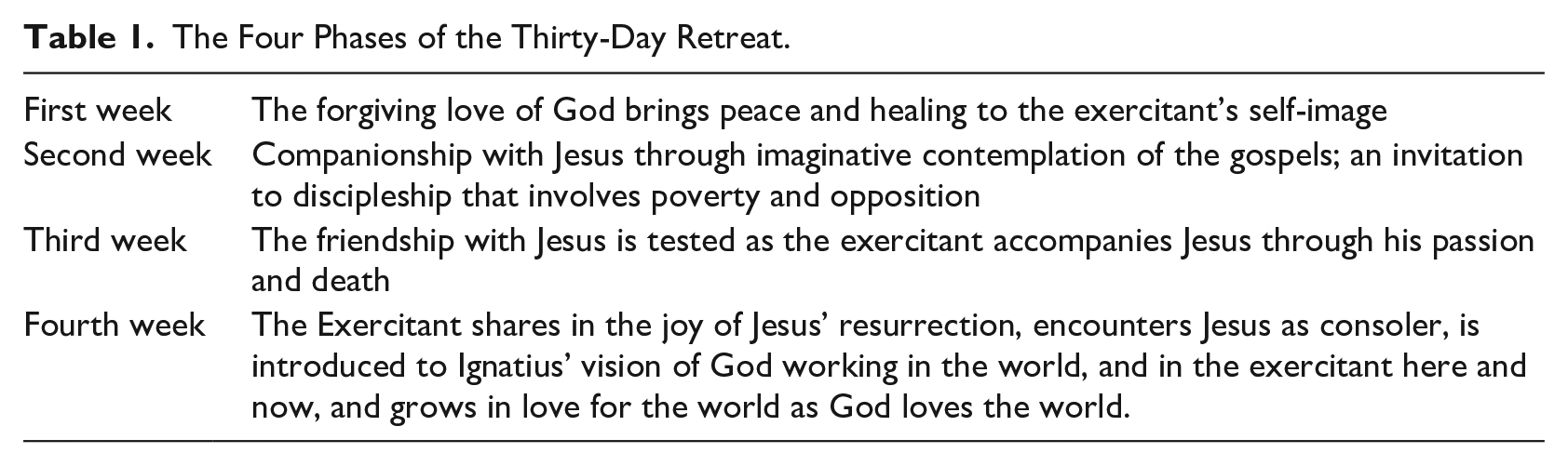
All exercitants go through the same set of spiritual exercises, though with permitted adaptations to make the Exercises more effective for each individual [4, 15, 18]. Both Jesuit exercitants and their givers frequently report that they emerge from this intensive experience of God with a new vision of life for themselves and for the whole world (Calpotura, 1994; Centrum Ignatianum Spiritualitatis [CIS], 1976, 1984; Divarkar, 1991; Meissner, 1969; Rendina, 1995; “Notes for the One Giving the Exercises,” 1998; Veale, 1985; Veltri, 1998).
At the Thirty-Sixth General Congregation of the Society of Jesus, the question was posed in relation to Jesuits themselves: “Why are the Spiritual Exercises not as effective in bringing about as deep a change in us today as we would hope?” (36th General Congregation of the Society of Jesus, 2017). Many Jesuits who study and give the Exercises responded with different reasons: they suggest that the failure to be transformed is not due to the Exercises themselves, but due to the preparation for them, the psychological woundedness of the Jesuit, or a lack of continuing prayer in the Ignatian tradition. Others refer to failures in the lifestyle that follows the Exercises, during formation and the life of active ministry after ordination (D’Cunha et al., 2017; Lukács, 2019).
Not all Jesuits experience the conversion described above despite the relative success of the Spiritual Exercises as a tool of conversion. The question “why not?” is the reason this research was entered upon. An exercitant may follow all the instructions precisely and spend all the required hours in prayer, and still not change. What needs to be taken into account for its success or failure are a number of factors. These include the psychological maturity of the exercitant and his dispositions, his relationship with the giver, and the action of God.
To address the issue of the effectiveness of the Spiritual Exercises for Jesuits, and its causes, I reviewed the literature not only on the nature of conversion in general but also more specifically on the conversion induced by the Exercises. Scholars included William Meissner (2003), 4 Kenneth Becker (2001), 5 John Veltri (1998), and Giles Cusson (1988) who were givers of the Exercises, and the philosophical works of Bernard Lonergan (1970, 2007) and Robert Doran (1978, 2011).
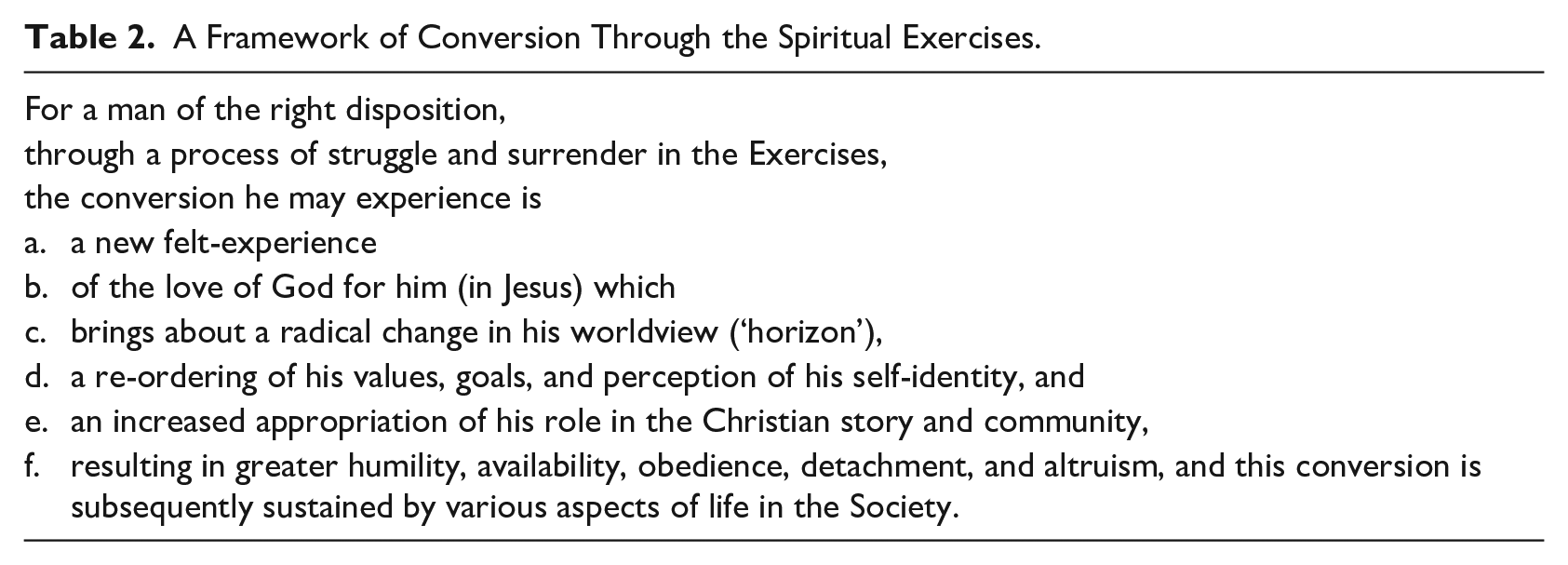
From these accounts, I created a hermeneutical framework of conversion whose purpose is to identify and describe the different elements of the process of the Exercises that can bring about a radical change in the meaning system of the exercitant. In the second stage of my research, I tested this framework against the lived experience of Jesuits who experienced the Exercises. The resultant framework offers not only a phenomenological description of the process but also suggests its normativity.
The Spiritual Exercises and Previous Research
Studies in contemplation
Recent research in cognitive psychology has focused on the working and effects of spiritual contemplative practices such as Buddhist meditation and mindfulness. These studies seek to understand how contemplation can change the practitioner’s attitudes and behavior, most specifically their attention, emotional regulation, and reduction in stress (Britton et al., 2014; Lindahl et al., 2017). Longitudinal studies have used inventories to measure any such changes over a period of time and also addressed the question of what kinds of people are pre-disposed to being changed by meditative practices (Hui et al., 2015). Some have addressed the problems of definitions and descriptions of kinds of contemplative practices, and methodological issues such as a lack of validation with some measures (Van Dam et al., 2018). Some studies have explored “mystical” experiences, again with difficulty in defining this experience, but including self-reported experiences of ego-dissolution, union with the universe, and ineffability (Taves, 2020). Many of these studies applied qualitative methods such as interviews.
The Spiritual Exercises are not a practice that falls neatly under this category of research. There are no prayer exercises that Ignatius gives that are intended to induce mindfulness in itself, rather, from an increasing awareness of his own thoughts and feelings, the exercitant is to grow in honesty and humility regarding himself, and in an awareness of God’s unconditional love for him despite his failings. With an increasing capacity for inner silence, the exercitant becomes more open to God directing his memories, desires, and imagination to engage with Jesus in the Gospel narratives, and in his present circumstances.
Conversion
While the Spiritual Exercises induce a conversion, this type of conversion is not the same as other religious or spiritual conversions described by those converted into faith or a new faith community. As a process, it stands on its own. Much of our knowledge of the Exercises is anecdotal. Some scholars of the Exercises have spoken about the transformation it can and does produce but very few have drawn together detailed studies of the psychological and faith changes with the larger context of the person’s life before and after experiencing the Exercises.
Ignatius’ European culture took the existence of God and the redemptive role of Jesus Christ through the (Catholic) Church for granted; what Ignatius learned and taught was that there is a deeper level of appropriation of this faith which can touch the heart and create a new and powerful sense of self with a mission from God in the world. He wrote that the Exercises are designed to help a person to “seek and find the divine will in regard to the disposition of one’s life for the good of the soul” [2] and for the “overcoming of self, and the ordering of one’s life, on the basis of a decision made in freedom” [21]. 6 The former expression addresses a search for meaning; the latter is the concept of transcendence by which a person can find that meaning. Michael Ivens (1998), one of the best-known English language givers of the Exercises, wrote that “The purpose of the Exercises is explained as a conversion of the heart resulting in a new quality or a new direction of life” (p. 2).
Spiritual Exercises and psychoanalytic theory
William Meissner made a study of the dynamic of the Spiritual Exercises in the light of psychoanalytic theory. Conversion in the Exercises was a transformation of the “self-system” (constituted by the ego, id, and super-ego). Meissner describes conversion as an instance of conflict resolution and an integration with the ego that can have an expansive effect on the convert’s self-awareness. Such conversion, Meissner says, is less a matter of casting aside one’s old identity and taking up a new one, so much as a transformation of the self-system. The former ego coping mechanisms are newly perceived to be ineffective, and, not without a struggle, the ego moves to a higher level of internal organization and synthesis. This transformation occurs through a change in the person’s values which Meissner calls “transvaluation” (Meissner, 1999, p. 77). A person’s identity is linked to the internalization of a value system. In conversion, one set of values is replaced with another. These new values, as they become internalized, actually modify and change the personality of which they become a part. They become an integral and functional part of the person (Meissner, 1999, p. 78).
The ultimate transformation, or conversion, of the ego, according to Meissner, is made under the influence of God’s grace. “By slow degrees, the ego comes to participate in ‘the glorious freedom of the sons (sic) of God’ (Rom 8:21) which reaches its apogee of perfection in perfect submission and responsiveness to the impulses of divine guidance and inspiration” (Meissner, 1969, p. 42).
Spiritual Exercises and Jungian psychology
Kenneth Becker (2001) made a study of the Exercises based on Jung’s own lectures (1939–1940). He critiqued Jung’s analysis of Ignatius’ text and added further interpretations of his own. Jung conceded that the Exercises could be an effective instrument for growing in psychic wholeness (Becker, 2001, p. 54). In the Exercises, we find the source of psychic energy, and healing, in the tension between light and darkness, justice and mercy, conditioned and unconditioned, self and other. The goal of individuation, whether in therapy or in the Exercises, says Becker, is to “transform the ego-attitude, to free it from its absolute, exclusive claims and to open it to the unconscious contents of the whole psyche, so that these are no longer alienated, but reconciled in a wholeness, the self, that transcends and transforms the ego’s wishes and fears” (Becker, 2001, p. 285). What Becker claims is missing in Jung’s account of individuation is the role of the person’s relationship with others, in love. “The need for [healing love] is so deep, the power of love so important in human life and growth, that it is experienced archetypally as numinous and divine . . . throughout our lives” (Becker, 2001, p. 294). Through the experience of active imagination in the Exercises, the exercitant encounters the divine love of God in Jesus Christ. His love “reconciles the alienated fragments of the psyche, helping the person to a real peace with himself or herself, unblocking the energy that was locked by fear in old patterns of negative experience and response, and the resulting swollen and infected archetypal structures” (Becker, 2001, p. 293). Becker’s study illuminates the dynamic of the Exercises with Jung’s psychological insights, and complements these with Ignatius’ invitation into the love of God in Jesus Christ; the Exercises can bring about a healing and integration of the ego and the self in this encounter with divine love.
Empirical research
Howard Sacks (1979) conducted an empirical study of 42 Jesuit novices undergoing the Spiritual Exercises and found that the experience had a “significant integrative effect on [their] self-systems.” Basing his experiment on Loevinger’s concept of ego development, Sacks found that the thirty-day retreat did have a positive impact on the exercitant’s self-system.
The Spiritual Exercises have an overall effect of raising the integrative capabilities of individuals, thereby increasing the individual’s ability to assimilate various conflicting expectations within a more unified self-system, [but] the data do not permit the precise specification of the aspect (or aspects) of the experience primarily responsible for this change (Sacks, 1979, p. 49).
Contrariwise, Imoda’s clinical study of 42 novices undergoing the Exercises in the late 1980s (only some of whom were Jesuits) revealed that few were transformed as expected, that is, who grew into the ideal person they sought to be (Imoda, 1991).
Imoda used a framework with three dimensions to measure the way in which the Spiritual Exercises contribute to a change of personality. The first is the disposition to self-transcendence toward ideals that are “theocentric.” The second dimension is also directed to self-transcendence but in this case to objects that are “natural or socio-philanthropic.” The third dimension is the least open to the transcendent, characterized by a need for the person to protect themselves.
These 42 young male religious were interviewed before and after their experience of the Spiritual Exercises. In terms of the three dimensions outlined above, Imoda found it possible to evaluate the greater or lesser maturity of each man (how they managed the tension between their ideal self and their real self, their transcended self and transcending self). Imoda was also looking for any modification in the expressed values of the person as a result of undergoing the Spiritual Exercises. In his summary, Imoda stated:
91% of immature subjects and 93% of all subjects do not improve in the 4 years of formation during which the Spiritual Exercises are made. This occurs when one evaluates maturity not only structurally but also existentially. It will be remembered that the existential criterion takes into consideration the capacity to live self-transcendent ideals, above all theocentric ideals, having internalized them (Imoda, 1991, p. 217)
Imoda’s study was not focused on Jesuits, but it does demonstrate a study of the Exercises that tries to measure psychological change. It certainly seems to show that for non-Jesuit Exercitants without lengthy preparation beforehand and a program of consolidation of the graces received afterward, the possible transformative effects of the Exercises are not sustained.
The Conversion of the Spiritual Exercises as a Change of Meaning System
Types of conversion
Conversion today is widely seen as a significant (to the convert) change in worldview, and a correlative change in the convert’s self-identity (Bryant & Lamb, 1999, p. 15). It is usually, if not always, defined in terms of a “turning way from” or “towards” within a specific period of time. However, many outcomes of conversion can also be achieved slowly as part of the person’s normal maturation and response to life events.
In Method in Theology and other writings, Bernard Lonergan (2007) proposed that men and women can experience four kinds of conversion: intellectual, religious, and moral, and, less clearly developed, “affective” conversion. 7 Later Robert Doran (1994, 2010, pp. 42–63, 2011, p. 20) developed in greater detail what affective conversion was (he called it “psychic”) and how it related to the other three.
According to Lonergan (2007), while intellectual and moral conversion opens one up to greater meaning within the created world, so that one changes one’s attitude or behavior, religious conversion, in response to the love of God, invites the person into the meaning system of God, to be a being-in-love with God and with the world God created. 8 The religiously converted person allows God’s meaning to shape and direct his or her own. God’s meaning encapsulates who God is, why God created the world, what the purpose of existence is, how this purpose will be fulfilled, what the identity of the person is, and what role the person has to play in God’s purpose. The person moves the center of his concern from himself to God and to the world as a whole (Lonergan, 2007, p. 105). 9 The religiously converted person begins to participate in the full realization of the meaning and value of the universe (Williams, 1998, p. 219). Lonergan (2007, pp. 32–33; Williams, 1998, pp. 93, 99) also asserts that this engagement with the world is not only a matter of intellect but also of affectivity. Feelings shape the receptivity of the person to the world and to experiences—they may encourage him to be open to them, or they may cause him to avoid them.
Ignatius encourages the exercitant to be in touch with his emotions during the Exercises. “Sentir” is one of Ignatius’ signature terms. It is the Spanish word he uses (both as a noun and a verb) which in English is rendered “felt” or “interior” knowledge, that which is more than merely grasped intellectually, it is felt in the heart (see Spiritual Exercises [2, 45-8, 104-8, 111-6, 121-5]). Ignatius has the exercitant deepen his affective experience of prayer with “repetitions” of earlier prayer experiences (O’Leary, 1976; Veltri, 1998, pp. 11–13).
Through such spiritual exercises or therapy, the man or woman who gains a sudden and strong appreciation of their affectivity may be experiencing what Robert Doran (1994, 2010) calls a “psychic conversion.” According to Doran, psychic conversion is a permanent change of perspective such that the person is constantly and readily in touch with his or her inner life of symbols, images, and feelings (Doran, 2010, pp. 51, 59–60; Lonergan, 2007, p. 35). In an ongoing way from this point, the psyche is allowed to present its sensations in the forms of feelings and images from which insights about the self, God, and the world can emerge. The person is newly aware of his feelings, understands their meaning, decides responsibly how to respond to them, and grasps the values these feelings apprehend (Doran, 1994, pp. 102–103, 2010, p. 62). 10 This psychic conversion may be considered as the basis for the “discernment of spirits” by which the Exercitant learns how to apprehend God’s will in his life.
The psychological understanding of conversion as a change in the person’s “meaning system” has been investigated by Paloutzian and Park and their associates (2005, 2015). Their extensive studies and conclusions provided arguments for this research of spiritual conversion through the Exercises that are characterized by the concept of meaning, and the drive of the human person toward total meaning.
What Paloutzian and Park (2005) review of research on conversion shows is that what changes is not personality but mid-level personality functions, such as a person’s values and goals, and global-level functions such as a person’s self-identity, overall life purpose, and their life narrative. These aspects relate to meaning in life. A person’s meaning system integrates cognitive, affective, motivational, and behavioral elements. Because religion is about meaning, in religious transformation what undergoes transformation is a person’s meaning system (Paloutzian and Park, 2005, p. 334). What is implied, though not spelt out by Paloutzian, is that such a significant change in a person’s meaning system affects a change in the convert’s self-identity with the result that he or she will speak of being “a new person,” having a new orientation to life. In the conversion of the Spiritual Exercises, their theory is substantiated that the exercitant’s “meaning system” does change considerably.
Most persons who enter into the Spiritual Exercises with Christian faith and commitment are challenged by the prayer exercises to deepen their understanding of what this faith means, to shift the direction of their values (from ego-centered to other-centered), to meet God in Jesus more tangibly as a living person and a model of human living, to discover who they are in God’s eyes (a trapped beloved or a loved sinner), and to live out their new worldview in loving action for the good of the world (Becker, 2001, pp. 303–305; Cusson, 1988, pp. 326–330; McDermot, 1986, p. 26; “Notes for the One Giving the Exercises,” 1998).
For a man who desires to live out his life in the Society of Jesus, not only are these changes expected but these are also fruit specific to the vocation, namely that he be in touch with his affectivity and able to articulate his feelings; has a least a rudimentary skill in the discernment of Spirits; is humble, mortified, detached/indifferent, 11 obedient, available for any mission his superiors may give him; and not afraid of poverty or humiliation (Arrupe, 1979, pp. 207–208; Chae et al., 2011). Lonergan (2007) summarizes the total experience of the conversion in the Exercises as a “falling in love” with God (and God’s people and God’s creation): “[Religious conversion] is a total and permanent self-surrender, without conditions, qualifications, reservations” (Lonergan, 2007, p. 240).
Surrender and grace
For the man who is responding to a perceived call from God to enter the Society of Jesus as a priest or brother, the conversion experience begins as he finds himself no longer satisfied with his life situation or “meaning system”—this may be an intellectual, social, or emotional lack. This novice finds himself in a liminal state of neither belonging comfortably in his present world and yet not knowing exactly where a better world may be found. He seeks greater consistency between his personal values and those of the community he lives in; between what he believes and how he acts; between his conscious (rational) self and his unconscious (intuitive self). This can be identified as a crisis or a struggle. The man initiates a search for some answers or a resolution to his discomfort. What he is looking for is a social group or a worldview that is more compatible with his needs.
Among key phenomena of the dynamic of conversion in the Exercises givers expect a resistance in the exercitant to let go of aspects of his former self; a surrender of the exercitant to this invitation, in humility; a kind of dying to self in the hands of a loving God who promises more life and more freedom. He makes the painful transition from being the center of his own world of meaning into one where God is at the heart of it. This process of painful surrender has been the focus of some studies in therapy (Gordon, 1984; Hidas, 1981; Tiebout, 1945). The exercitant discovers the poverty of his image of God, of his values, of his desires, and of his very self. These have been the constituents of his being to this moment; good as they have been, now he is invited to let them go so as to be empty enough to enter into a new horizon, a new meaning system. In imaginative prayer, he accompanies Jesus into Jesus’ own surrender of life. As a result of this trusting surrender, the exercitant experiences gratitude, joy, freedom, and other spiritual fruits. This process occurs most clearly and strongly in the First Week of the Exercises but may be (and frequently is) repeated to a lesser degree in the subsequent weeks (Cowan & Futrell, 2000; Exline & Rose, 2005, pp. 315–330; Maruca, 1980, pp. 134–143; “Notes for the One Giving the Exercises,” 1998; Schiavone, 1999, pp. 11–30; Veltri, 1998, pp. 499–501).
This outcome of the conversion effected by the Spiritual Exercises may not be apparent all at once: some of these characteristics may be seen during and immediately after the retreat; others may only develop in the years of Jesuit formation subsequently, but whose origin can in retrospect be found in this experience.
The part grace of God plays
The Spiritual Exercises are not a program of therapy but of prayer. They rely for their effectiveness on the faith of the exercitant in God’s action through the Exercises and on that action by God within the exercitant (Haight, 1993; Meissner, 1969; Ormerod, 2014a; Rolnick, 2007; Roy & Meissner, 1996). The life journey of each human through self-transcending growth into authenticity and wholeness is achieved by both a natural, created drive and by the action of God’s grace at the same time. The relationship between the dynamics of grace and the dynamics of human (natural) development is essential to the experience of total transformation/conversion in both “sudden” conversion and over a lifetime of growth.
Much has been written recently on the interaction between God’s action in a person (“grace”) and the working of the person’s own psyche. Grace empowers the person’s own capacities and gives him inner freedom (Ormerod, 2014b; Williams, 1998, p. 177; Lonergan, 1970, pp. 619–620; Rulla, 1986, pp. 196–199; Lonergan, 1985, pp. 106, 2007, pp. 31–32, 39; Ormerod, 2014a, pp. 531–533).
Meissner described and explained grace as the action of God giving the ego desire and energy to maintain control over the energies of the id and superego (Meissner, 1987, pp. 23, 56–59).
While Jung did not want to make any claims about God, he did allow a force from the unconscious, through archetypes, to effect a religious experience on a person (Becker, 2001, pp. 80–81). Becker himself, who does not write of grace specifically as a distinct concept, rather sees the presence and action of God in Christ who heals the exercitant’s divisions and empowers him to love both himself and others (Becker, 2001, pp. 297–304).
“Common factors” in psychotherapy
In this exploration of the dynamic of spiritual conversion as researched by psychologists and therapists, the identification of common factors in psychotherapy is helpful (Duncan et al., 2010; Thomas, 2006). Key constituents of therapy include the relationship with the therapist, the client’s own context of life and relationships, the client’s expectations, and the method of therapy. For this research, common factors research indicates that significant constituents of the experience include the disposition of the exercitant (open to the experience, self-reflexive, and psychologically mature), the relationship between the giver and exercitant, the quality of the giver (knowledgeable of the dynamic of the Exercises, empathic and able to adapt the meditations of the Exercises when helpful to do so), the support networks of the exercitant (relationships with family, fellow novices, and other Jesuits) and his personal resources (personality, life history), having regular Ignatian spiritual direction, and an annual retreat following the Exercises.
The fourth factor is the technique or therapeutic model that is used, which can be seen as equivalent to the process that Ignatius builds into the Exercises. This factor is more significant than the above studies rate the type of therapy used in psychotherapy. Ignatius’ process is very specific: while a therapist may select one therapy rather than another for his or her client (e.g., Gestalt, cognitive behavioral therapy [CBT], depth psychology, existential, focusing, narrative, etc.), there is only one path Ignatius offers through the thirty-day retreat (Asselin, 1983; Endean, 1998; Fleming, 1983).
The hermeneutical framework
The conceptual framework constructed in this research attempts to describe the conversion of the Exercises with the understanding that what is changed is the person’s meaning system. This framework is a lens by which we can methodologically evaluate the transformational nature of the Spiritual Exercises. Building on the literature from scholars and givers about how the Exercises work, and on the psychology of conversion from the field of psychotherapy (Jungian and psychoanalytic), this hermeneutical framework was designed to analyze and understand how conversion works through the Spiritual Exercises for Jesuits. It was then tested against the lived experience of Jesuits through the survey and interviews.
This framework confirms that the transformation or conversion experienced by Jesuits is specifically a change of their worldview and concomitantly of their self-identity which is achieved through their personal discovery and experience of the relationship of love offered by God. This research also demonstrates that this transformation, while begun with the process provided by St Ignatius, and the loving companionship of the giver, is sustained (or diminished) largely by the nature of the Jesuit community the exercitant lives in afterward.
The experience of the Exercises may not be intense or dramatic; it may not involve the radical re-orientation of the man’s meaning system. For some Jesuits, the Spiritual Exercises may be powerful in a different way, as one step along their psychological and spiritual development into their Christian identity. This development may be more subtle, more hidden than may be easily observed, and yet still a significant experience of growth into human maturation. In such an instance, it may be that even the Jesuit himself is not aware of how significant this experience is. It may be like a seed that is planted and may take some years before its growth and fruits are apparent. Only years later may the Jesuit look back and see how the dynamic of the Exercises became a template that operated unseen in his subsequent life of prayer and service.
Methodology
Study design (Interpretative Phenomenological Analysis)
My experience of the Spiritual Exercises in the Society of Jesus is as a receiver and a giver, a teacher and supervisor of givers of the Exercises. This means I have experienced the dynamic and the effects of the Exercises from three different perspectives. 12 This gives me a great deal of background knowledge which I have to be aware may bring bias into my interpretation of the data of my qualitative findings. I was aware that I had to take care not to let my own experience of the Spiritual Exercises determine what I expected to find in the experience of other Jesuits. I needed to be open to the data that they provided me (Polit & Hungler, 1999, p. 247).
Interpretative Phenomenological Analysis (IPA) was chosen as the most appropriate method for this qualitative empirical research. The aim of IPA is to explore in detail how participants make sense of their personal and social world, and the main currency for an IPA study is the meanings that particular experiences, events, or states hold for participants. The approach is phenomenological in that it involves a detailed examination of the participant’s lifeworld; it attempts to explore personal experience and is concerned with an individual’s personal perception or account of an event.
IPA involves hermeneutics and idiography. Hermeneutics is a method of interpretation and meaning based on an understanding of truth or reality being created by human thinking rather than being some external entity to be discovered (Willig, 2008, p. 70). The idiographic experience focuses on the individual more than on the experience of the general population (nomothetic; Spiers & Smith, 2021).
IPA both generates a theory of experience and tests a given theory of an experience (inductive and deductive). Through survey or interview the IPA researcher obtains a description of the phenomenon, identifies “units of meaning,” and draws out a significant structure or meaning of the phenomenon. The researcher identifies the meaning for that sample, and perhaps for similar groups of people but not for a whole population.
Within the general field of IPA, for the survey, the method of thematic analysis (TA) was chosen to analyze and interpret the data from the open-ended questions (Braun & Clarke, 2012). TA allows for both inductive and deductive approaches to analysis, and a combination of both (Braun & Clarke, 2006). My approach was a combination of both, meaning that the codes and themes were derived both from the content of the data themselves and from my theoretical framework. Thematic analysis, as Braun and Clarke present it, does not require a secondary, independent coder, which is in contrast to other qualitative approaches that do emphasize the value of this for validity (Boyatzis, 1998, p. 150; Yardley, 2009, p. 249).
Instrument—survey
Since I was able to discover little qualitative data on the effects of the Spiritual Exercises (Imoda, 1991; Paulin-Campbell, 2008; Sacks, 1979), I determined to issue a survey to English-speaking Jesuits who had experienced the Exercises between 1975 and 2010 (Toepoel, 2020). I did not use any previously created inventory since none fit my purpose. My aim with this survey was to (a) find respondents who were willing to be interviewed, (b) identify factors that could influence the effectiveness of the Spiritual Exercises, and (c) obtain a preliminary sense of the fruits of the Spiritual Exercises for Jesuits.
The sample of the population of Jesuits was homogeneous (Smith & Osborn, 2008, p. 4; Spiers & Smith, 2021, p. 56; Willig, 2008, pp. 52–73). They were all male, English-speaking, and tertiary educated. Having chosen to include most of the English-speaking (first language or equal first) Jesuits of the world, I was not able to get an equal number of Jesuits from different countries. Some provinces are better represented than others (i.e., the Philippines has 14 Jesuits, others only one). 13 Eleven countries are represented (including the United Kingdom, the United States, the Philippines, and India).
The purpose of the survey was to identify both what was happening in the Exercises and what external factors could influence the dynamic of the Exercises. General questions addressed some of the factors indicated as significant by authorities on the Exercises, including closed questions about the relationship between the spiritual director and the exercitant (Q. 32. “positive,” “awkward” “unremarkable,” “can’t recall”); the previous exposure of the exercitant to Ignatian spirituality, scaled 1 (none) to 4 (very well): “How familiar were you in practice with the Ignatian Examen (Q 8)/Ignatian discernment of spirits (Q 9) Ignatian imaginative contemplation (Q 10)/Ignatian concept of desires/graces (Q 11)?”; and open-ended questions such as “Apart from the Spiritual Exercises, the annual retreat, and seeing your director regularly, can you mention any other aspects of Jesuit life that have contributed to your formation as a Jesuit?” (Q. 39).[PE: More than 40 words found inside quotes.]
Since the open-ended survey questions did not allow room for much rich description, there was no point in analyzing them phenomenologically, and in great detail for each respondent. Rather, the search was for common themes, both across the variety of questions, and across the questions of the 72 respondents. Each question was composed to shed light on different parts of the theoretical framework (see Table 2).
A Framework of Conversion Through the Spiritual Exercises.
Questions Related to Each Part of the Framework.
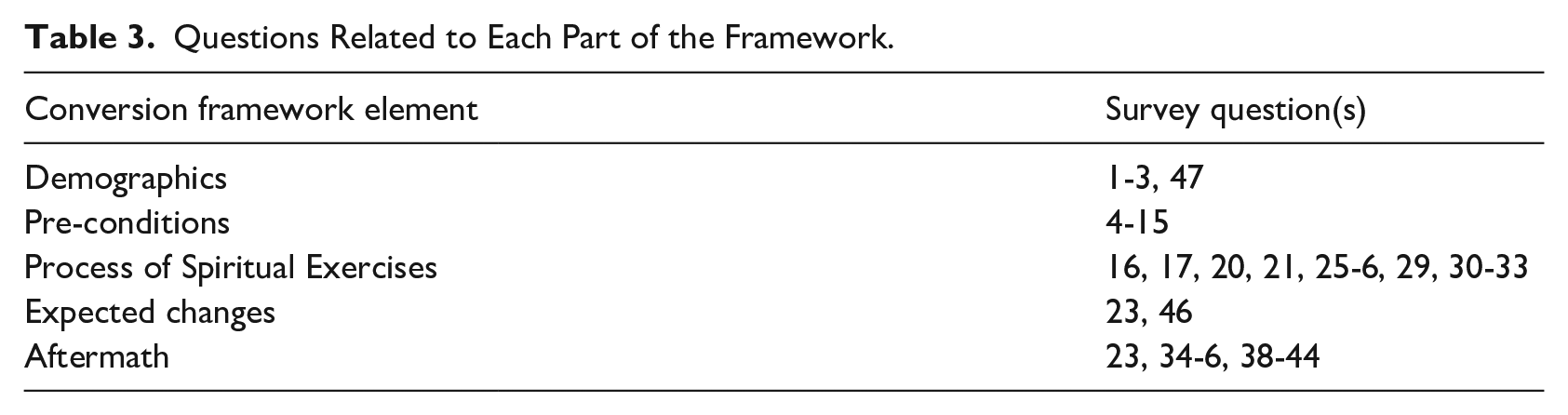
The factors to be measured included the Jesuit’s age, his main area of ministry, what his relationship with Jesus was before the Exercises, his experience of community living and of poverty before the Exercises, his familiarity with the Exercises (academic), brief descriptions of his experience of the Exercises, his relationship with his spiritual director, post-retreat experiences of spiritual direction, other experiences that have contributed to the graces he was given through the Exercises, and the Jesuit’s own opinion on how the Spiritual Exercises may have contributed to his ongoing formation and growth as a Jesuit. I did not ask the Jesuit directly if he believed he had been transformed by the experience of the Exercises. Such a self-evaluation emerged in his survey answers.
Survey—procedure
The survey was issued as a link to Google Forms. Google Forms offers the function of creating pie charts from the data and exporting all the data into an Excel spreadsheet. This allowed me to extract the short answer responses to make comparisons between and across them. This in turn allowed the questions to be manipulated so as to effect a correlation coefficient between the variables so as to see what difference that made to the other items (e.g., Does one province stand out in some way for any other item [academic study] or does having regular spiritual direction affect other factors in a noticeable way?).
Using Braun and Clarke’s model of TA, I read each respondent’s answers first, then I read all the responses to each question. From these were noted frequently occurring “meaning units” (“codes”) which were then assembled into themes. They were counted to determine their frequency in each question. These themes were identified: community, apostolate/ministry, friendship, superiors/formators, study/reading, prayer/mass/eucharist, God’s nature, God’s call, relationship (of love) with Jesus/God, sense of self-identity (sinner/broken/loved/accepted), remarks of affectivity (healing/joy/tears), mission to the poor, whole life, giving the Exercises/retreats/spiritual direction, transformation/strong change.
Interview Questions.

Instrument—interviews
The interview technique chosen was the semi-structured depth interview which “normally involves the interviewer in a process of both model building and model testing, both theory construction and theory verification, within the same session or series of sessions” (Johnson, 2011, p. 13; Wengraf, 2001, p. 4). It explores the nature of specific human phenomena by engagement with a small and homogeneous sample of persons.
For the interviews for the research, eight Jesuits were selected from the 72 survey respondents, not a large number but sufficient (Johnson, 2011, 108). I did not intend to generalize my findings to the whole population of Jesuits. Respondents were selected who were the most articulate in the short answer questions and willing and able to express their emotive responses to questions about their experience of the Exercises, given that affectivity plays a large part in the process (van Kaam, 1969, p. 328).
Most phenomenological researchers prefer their subject to be naïve about what is being researched but this was not the case in this research (Giorgi, 2009, p. 99). The interviewees knew the topic of the research (it was given to them on their consent form); they had all already reflected on the meaning of the Exercises for them in the course of their formation as Jesuits; and all had given the Exercises to others and were interested in the effectiveness of giving the Exercises that this research was addressing. With the first question of the interview, they were invited to “declare” their perspective and their interest in this research. This allowed me to take into account, to some degree, their assumptions and biases. Some were interested in any research done to enhance the experience of the Exercises, others simply were willing to assist a fellow Jesuit as needed. Overall, I don’t believe any agenda on the part of the participants skewed the data I was seeking in a significant way.
I emailed each participant who had indicated his willingness to be interviewed and we arranged a Zoom interview time. At the conclusion of the interview, I sent the audio file to TEMI, an online transcription service, whose results were very accurate.
My questions were not the same as those posed in the survey, though there were areas of overlap. With the interview questions, I was trying to do two things: one was to find out any significant moment for the Jesuits in the Weeks of the Exercises, and to give as much detail as possible about it; the other was to find out what other life events (before or after the noviciate Exercises) there were that might have had an impact on the dynamic of the Exercises, and any overall changes in their relationship with God and with the Society as a result. When drawing out the Meaning Units from the interview transcripts, those that were the same as for the survey responses were identified. These included such items as “struggle,” “love of God,” “consolation,” “ministry,” “the giver,” “prayer” “mortification,” and “Person-Environment fit.” These became the constituents of my framework.
The same eight questions were put to the participants, though not always in the same order, depending on the flow of the conversation.
Because this type of interview was largely open-ended, I refrained from asking questions related to every factor in the framework. One could assume that if something was significant for the participant in the Exercises, in a general discussion, it would come up. This meant that some of the factors were not spoken about (e.g., poverty or the giver or prayer).
Interviews—procedure
The analysis of the transcripts developed in three stages. For this research a linguistic analysis was not applied to the text: most of the conventional diacritics of speech were excluded leaving only the pauses, “um’s” and “yeah’s” and some vocal expressions (laughter; Potter & Hepburn, 2012, pp. 568–569). A sequence of numbers was given to each section of speech spoken by each of the two interlocutors, thus: INT(erviewer) 1: . . . F(athe)R A 1: . . ., INT 2: . . . . FR A 2: . . . This meant that several Meaning Units could be found in one reference.
Having obtained the transcription, any errors in the text were corrected and remarks were added about how a particular response or story was interesting or relevant to the theory. In the second reading of the transcript, Meaning Units were identified and marked with a code that corresponded with parts of the framework. For example, “pre-conditions (personal, vocational, first conversion/journey)” were labeled as “A,” “surrender (of values, image of God, old self, self-will)” as B3, and so on. In the third stage of the analysis, those MUs that corresponded with one code were clustered together and a summary was created of the essence of the man’s experiences in that area. A summary was then composed of the whole range of data (stories) according to the framework. Finally, the audio file of the interview was listened to again to check that the summary and conclusion were consistent with how the interviewer presented himself and his story. This was done for each of the eight Jesuits interviewed.
From eight different individuals, no matter how similar their experience of the Exercises and formation, I would not expect complete uniformity in their report of the dynamic and the effect of the Exercises on them. My interviews with each participant show variations in all of the constitutive parts of their conversion, both in the presence or absence thereof and in the strength or intensity of that part. No interviewee addressed all the parts in my framework (of all eight, Fr D demonstrated the total process most; some parts were only represented by one or two participants 14 ). This finding does not undermine the framework; perhaps it indicates which parts are truer to the experience of these eight men.
Demographics and Indicator of Evidence for Each Part of the Framework Presented in the Interviews.
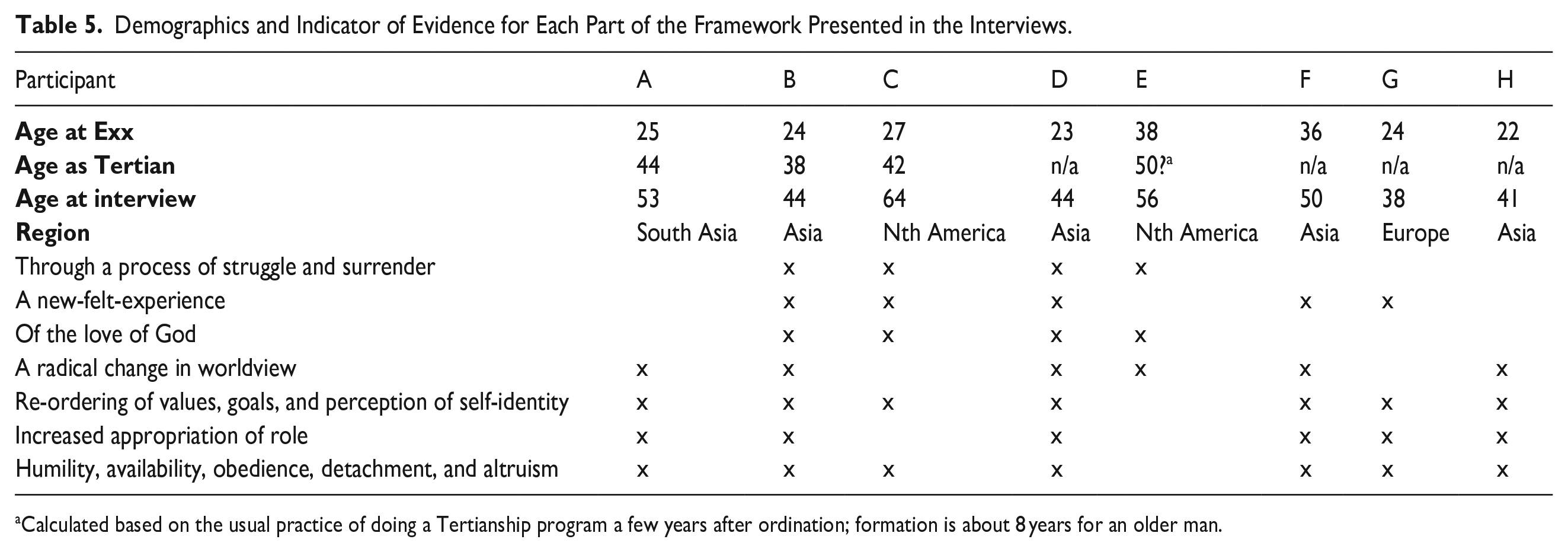
Calculated based on the usual practice of doing a Tertianship program a few years after ordination; formation is about 8 years for an older man.
Validity and Credibility
Qualitative research demands the data and its interpretation to have validity and credibility. Validity in phenomenological research is based largely on the persuasiveness of the argument in turn based on the rigor of the whole process, from the collection of data to its interpretation and application to theory (Polkinghorne, 1989, p. 57). Another common method to determine validity is triangulation (Yardley, 2009). In this research, triangulation was achieved by cross-referencing the survey responses with the interview responses and with what Jesuit givers of the Exercises provided in their writings on their experience. The information on the experience of the Exercises was verified for the survey in the interviews and for the interviews by the survey, and both by what givers reported in the literature. I also sought validation from the participants by sending them relevant quotes from their interviews that I had assigned to various parts of my framework (Johnson, 2011; Yardley, 2009, p. 242). Six of the eight acknowledged the text and expressed their satisfaction with it, some suggesting some minor amendments; two did not reply.
The credibility of this data is founded on the presumed honest character of the respondents, who, being sincere disciples of Jesus, had no agenda other than sharing their wonder about the experience of the Exercises and the desire to be of assistance to the project. The quality of the interviews themselves also contributed to the credibility and validity of the research findings, as they demonstrated spontaneity from the participant, allowed him to speak at length on the topic, and as the interviewer can be seen to seek clarification within the interview. Brinkman and Kvale also favor evidence of the participant himself giving interpretation to his story (Brinkman & Kvale, 2015, p. 192).
Findings
The survey respondents and the volunteer interviewees clearly expressed their sense of having been changed profoundly by the Exercises with words such as “new orientation,” “new direction,” “foundational,” and “change.” Most of the others gave evidence of such a change (even without these words) by their expressed dedication to Jesus, to the Society, to those whom they served which they attribute to their experience of the Exercises. Their experience of a change of meaning system seemed to be captured well by the theorized framework.
For a man of the right disposition
This part of the framework puts before us the variety of life experiences and varying levels of faith and maturity of each exercitant (Spilka et al., 1992). From both survey and interviews was evident a wide variety in the kinds of men who entered the noviciate: differing cultures, education, levels of faith, life experiences, and psychological maturity. All were from practicing Catholic families, and only a few knew Jesus as a personal friend. Some had been exposed to Ignatian spirituality. All felt called to try this new life and were willing to give up what they already had. All were considered mature enough by the formators of their province to be given a chance to prove themselves capable of the rigors of life in the Society.
Of all these pre-condition factors, none could be said to give the exercitant a greater likelihood of transformation through the Exercises than the others. The data shows how the only stand-out necessary factor for the man seeking to join the Society to experience the transformation of the Exercises is that he has the desire to do God’s will, has some maturity or the potential to grow in maturity, and he is generous and trusting of his mentors.
Through a process of struggle and surrender in the exercises
The experience of struggle and surrender, seen as significant in the literature on conversion (Connolly, 1974; Exline & Rose, 2005; Hidas, 1981; Imoda, 1991, pp. 226–229, 1998, pp. 364–365; Meissner, 1969, pp. 21–22; Tiebout, 1945), was rarely mentioned in the survey responses, even given Question 21: “Can you recall having any particular difficulty during the Exercises? Did you struggle with anything in particular?.” This experience of the Exercises was not highlighted strongly by most interviewees though it was evident in their life and ministry subsequently. Some struggled to come to terms with a new image of God (more loving, less judgmental), some with their sense of self as unworthy or inadequate for God, and some with what sin really is (i.e., not just a breaking of the law, but an attitude of defiance or mistrust toward God). Surrender was about letting a new truth be real for them. Struggle and surrender were represented most strongly by only three of the eight.
For the scholars and givers, struggle and surrender are the key points of radical change; for most of the participants, this did not emerge as a singular memorable phase of the Exercises. Is what the scholars and givers report as the “peak” of struggle and surrender, actually experienced only by very few? Is a less intense experience just as valid for conversion? This is what this data seems to indicate. This apparent discrepancy needs a more detailed study with exercitants closer to the time of their retreat.
The conversion he may experience is
a. A new felt-experience
Only some survey respondents expressed an appreciation for their feelings in the Exercises, using such words as “joy,” “cathartic,” and “tears.” The apparent lack of self-awareness did not seem to diminish the overall outcome of the Exercises. The felt-experience among those interviewed was addressed in terms of an increase in freedom from doubts and fears; an increase in the capacity to express a range of his own feelings; being overwhelmed with feelings of joy, happiness, and gratitude; and feeling vulnerable and powerless (i.e., in the Nativity and in the Third week). For several Jesuits, a lively, “sensible” engagement with Jesus in contemplative imaginative prayer was where they had a felt-experience of God.
The Exercises engaged the affectivity of these exercitants, which they were able to express more in the interviews than in the survey. There was no measure of the difference between their awareness of affectivity before the retreat and after it. Given the strong memories they had, and the energy evident in their responses, some emotional experiences in the Exercises were strong. There is also a strong indication that these Jesuits continue to be aware of their feelings in their relationship with God and others.
b. Of the love of God for him (in Jesus)
When asked what was the grace they received from the Exercises (Q 26), the positive responses included feeling God’s love, guidance and accompaniment, peace, freedom, healing, feeling close to Jesus, confirmation of the call, and greater awareness of personal sinfulness. A few mentioned specifically a “felt-knowledge” or a “deep felt-experience” of God. 15
Even though some interviewees did not speak of a particular moment or experience of the love of God for them during the retreat, they did speak of their subsequent relationship with God and others in such a way as to give a strong impression that these were founded on a conviction of the love of God for them revealed during the Exercises. They spoke in terms of the love of God having become more real than theoretical, of Jesus living in the Jesuit, of how this love was received in an experience of inner healing, and how it was felt with passion.
For both those who knew Jesus well before and those who did not, the Exercises brought these men into a new relationship with him (which in turn brought about changes in their worldview). None of these Jesuits spoke of “falling in love” with God or “being in love” with God (when I put this to one of them, he didn’t engage with that expression), nor of a moment of special bliss with God during the retreat of a kind that frequently occurs between two people in love. And yet, my impression of most of the survey respondents and all the interviewees is that they are “in love” with God and had felt, or continued to feel, that kind of love from God for them. Certainly, their expressed dedication to Jesus and to a life of service spoke clearly of God being their highest value and the focus of their emotional energy.
c. Which brings about a radical change in his worldview (horizon)
d. A re-ordering of his values, goals, and perception of his self-identity
I place these two elements together as they are two sides of the same coin: (d) is the manifestation of (c). In the survey and interviews, these were frequently elided. This part of my framework focuses on conversion as a change in the exercitant’s meaning system most clearly.
Almost every survey respondent had something of a positive change or new beginning to report on their experience of the Exercises in their relationship with God and themselves, and on their worldview, values, and goals. Thirty percent (23/72) of the respondents stated clearly that the experience for them was “foundational” to their lives as a Jesuit or had “changed” their outlook on life significantly. Two respondents used the word “transformational” to describe their experience. Out of 72, 25 stated that the experience of the Exercises had changed their life in a significant way and a few said that the Exercises were still somehow alive and active in them today. With the interviewees, a sense of receiving a new identity, or being appreciative of who they already were, was strongly expressed (“a son of God” or “companion of Jesus” or accepting his own sexuality and bodilyness) which in turn led them to take on Jesus’ goals and values (to accompany and serve the poor, to have a hope-filled attitude toward suffering and failure). These Jesuits expressed a radical change in their self-image, values, goals, behaviors, and purpose in life which are the constituent parts of a person’s meaning system.
e. And an increased appropriation of his role in the Christian story and community (Person-environment fit) 16
Most of the Jesuits demonstrated “an increased appropriation of his role in the Christian story and community” as a member of the Society in terms of willing obedience to God and to the superior. They all identified as a companion of Jesus, participating in his work of bringing love into the world through their ministry in the Society. Strongly represented is the “Person-environment fit”: most of the Jesuits interviewed gave some indication that they were seeking, and did find in the Society a place of belonging with similar-minded and hearted men.
This part of the framework links the transformation a man may experience in the Exercises directly to his desire to live it out through Society. Part of the new meaning system that Jesuits adopt through the Spiritual Exercises includes the role and status of being a religious (priest or brother) which entails living in the community and dedicating themselves to a program of ministry in the Catholic Church that may not be completely their own personal choice. These Jesuits have appropriated this new identity willingly if not completely without tension. To stay attuned to God’s will both for a large-scale project and in daily life requires habitual attention and insight into one’s affective life: this aspect of appropriating a Christ-like role in the church was the least strongly evident.
f. Resulting in greater humility, availability, obedience, detachment, openness to poverty, and altruism
This part of the framework draws attention to the behaviors and values of the men following their experience of the Exercises as evidence of a spiritual transformation. These fruits of the Exercises were not directly addressed by the survey, nor mentioned in these specific terms. Many respondents did refer to their sense of being called to the priesthood, which they believed was to be lived out in the Society of Jesus, and they were well aware that such a life is ideally given to the service to others, and directed by their superiors. These qualities and virtues (humble) Jesuits were not going to claim for themselves, but they were evident in the stories they told of their experience in the Society. Most of them demonstrated these virtues without hiding the cost involved in their own will and desires, expressing their greater desire to do God’s will (who had called them into the Society to do God’s work). All these Jesuits described their work which was clearly other oriented.
In their interviews, these Jesuits manifested humility, obedience, availability, an openness to poverty, and a strong willingness to serve others which they attributed to their encounter with God in Jesus through the Exercises. While I was unable to measure the difference between how these men lived before they experienced the Exercises, it seems that the conversion effected by the Exercises produced or enhanced the hoped-for qualities and behaviors in the Jesuits.
This conversion is subsequently sustained by various aspects of life in the society (community, regular prayer, discernment of spirits, annual retreat)
This framework identified a variety of post-Exercises factors that could sustain the radical change in the meaning system, but none of them showed up as distinctly irreplaceable. Community life was identified by many of the respondents as important in which they lived with like-minded and like-hearted companions, sharing the same values, goals, and sense of purpose. Annual retreats, spiritual direction, and ministry also helped. Studying the Exercises, or giving them, could be thought to enhance the changes induced by the Exercises for these Jesuits, but this was not found to be the case. Only a few seemed to learn and understand the movement of God’s spirit in them (discernment). The experience of discerning, even if introduced in the Exercises, was not fully developed until later with the demands of ministry.
What these participants reported about what helped keep the consolations of the Exercises alive for them, about the annual retreat, and any experience of poverty were not referred to much. What was named was being active in ministry, such as when preaching, and prayer (sometimes intentionally praying over the notes from the Spiritual Exercises again in the years following, or revisiting that experience when struggling with fidelity to the Lord).
The giver
There is one other factor investigated in the process of transformation through the Exercises that is not named in the framework but is relevant and significant. Scholars of the Exercises rate the influence of the giver in the transformative experience of the Exercises very highly (
Most of the respondents found their giver to be most helpful and encouraging, less for their knowledge of the Exercises or their instruction and more for their attentive and caring presence. The qualities of the giver named included being non-judgmental, sensitive, affirming, giving the time needed, and supportive of honesty and openness.
This factor in the transformative power of the Spiritual Exercises is a matter for further research.
Limitations
This framework is a proposal and an experiment. Its validity needs to be tested in other similar contexts as it is constructed out of the data of relatively few, self-selected participants. I recognize the limitations of the survey. I did not have a control group. Out of hundreds of Jesuits targeted, there is no way of finding and selecting any for whom someone could say “these have not changed me as expected.” Those 72 who responded to the survey presumably chose to do so because they found it a positive experience that contributed to their sense of identity as a Jesuit. Equally, we can say that many who didn’t respond also had a positive experience. What data these men provided on the Exercises may well indicate more what does work and is effective in bringing about change, than what is not.
In this study, there is no representation of African or Afro-American Jesuits. It does not distinguish clearly between the different age groups of the respondents. It does not include non-English-speaking Jesuits. It may not hold up against the experience of women in Ignatian religious congregations who experience the Exercises over 30 days. Its focus is on the experience of the first thirty-day retreat and does not take into account other significant life experiences that may induce a religious conversion for a Jesuit. The time difference between when the interviewee experienced the Exercises and recalled his experience for this study was in some cases many years. This would have an effect on what was recalled, and what was forgotten (Lindahl et al., 2017, p. 28). This framework is broad in scope such that it might be argued that it fits all sizes and is not precise enough to be helpful.
Conclusion
This framework has proved to be a useful tool by which to describe and analyze the conversion process of the Exercises as a radical change in the perosn’s meaning system. It offers not only a phenomenological description of the process but also suggests its normativity. The heart of a change in the meaning system involves the exercitant moving out of one worldview or horizon into another, re-orienting himself to a new identity with new behaviors, values, goals, and purpose. The exercitant becomes Christ-centered and Christ-hearted. It is as much, if not more, of an affective change as a cognitive one and involves some degree of psychological struggle and a surrender of the old self. Functioning as a system rather than as a stand-alone event, this transformation is affected by the kind of person who enters the Exercises, the quality of the guide who takes him through the Exercises, and the kinds of support he receives from the Society to sustain it afterward.
The complete research and supporting data can be accessed at https://nestpillmart.academia.edu/IainRadvan
Footnotes
Declaration of Conflicting Interests
The author(s) declared no potential conflicts of interest with respect to the research, authorship, and/or publication of this article.
Funding
The author(s) received no financial support for the research, authorship, and/or publication of this article.
1.
The Spiritual Exercises in italics refers to the written text; without italics, it refers to the series of meditations and other activities composed within the text. Square brackets indicate the number of the paragraph in the text.
2.
3.
Since these novices are men, I will be using predominantly the masculine pronoun for the Exercitant. Women’s experience of God and of conversion differs to some degree from those of men and their experience of the Spiritual Exercises requires a focused study that was not attempted in this research. See Annemarie Paulin-Campbell (2008, pp. 39–43); Marina McCoy (2015); M. P. Ursua (2020, pp. 91–106); Janet Ruffing and Teresa Moser ( , pp. 89–100).
4.
William Meissner (1931–2010), a Jesuit and psychiatrist, contributed significant literature to the interface between religion, religious experience, and psychoanalysis, expanding and clarifying Freud’s understanding of the field. His book Psychoanalysis and Religious Experience (Meissner, 1984) is a classic in the field. Meissner’s clarity of thought in addressing in a fresh way so many theoretical and technical issues in psychoanalysis and the psychology of religion brought him to the rank of one of the greatest theoreticians of contemporary psychoanalysis.
5.
Kenneth Becker was a Jesuit for 25 years who became a Jungian psychologist. He is the author of a detailed study of the Spiritual Exercises in the light of Jung’s psychology, with reference to Jung’s own lectures on the Exercises (Becker, 2001).
6.
7.
Put briefly, intellectual conversion comes when a person discovers that reality is more than just what one can sense empirically. It is the adoption of a critical-realist stance; moral conversion consists of a movement from making decisions based on self-interest (“satisfactions”) to making choices according to objective values; and religious conversion is a conscious surrender to life, to love, to God, to a value or Being greater than the individual. Psychic conversion occurs when a person discovers and attends habitually to his affective being manifested in sensations, symbols, and dreams.
8.
Lonergan uses the term “religious” where I would say “spiritual”: he is not referring to a new institutional allegiance but to a change of heart.
10.
Some scholars speak of an “affective” conversion, but the occurrence of “conversion” needs to be distinguished from experiences of intense affectivity: the two are not necessarily the same though they do have similar characteristics. Both of these need again to be distinguished from Doran’s “psychic conversion” though it shares much in common with them.
11.
“indifferent” in Ignatian terminology means to be prepared to suffer sickness or poverty as much as to enjoy good health or riches, choosing what will be to God’s greater glory.
12.
I received the Exercises as a novice Jesuit in 1984, and again at the end of formation in 2004. I graduated as an Ignatian spiritual director and a giver of the Exercises in 2015. I have been a supervisor of students in the same program since. I also give the Exercises to Jesuits and laymen and women.
13.
A province is an administrative unit that may or may not coincide with a national boundary.
14.
Namely: B5 (consolation), D2 (spiritual direction), D3 (prayer), D5 (study), D7 (giving the Exercises), P (poverty).
15.
Note it on experience of God, undefined here.
16.
The “Person-environment fit” model explains conversion as an outcome of the search for “an optimal fit between the needs and wants of a person and whatever the environment, group, or ideology has to offer. The conclusion emphasizes the interaction between person and context, not the personality, mental states, emotions, or cognitions of the convert per se” (Raymond Paloutzian et al., 2015, pp. 399–421 at 400).