




Abstract
Intrinsic religiosity is a focus on religion for its own sake without consideration of its perceived external benefits. God perfectionism is an external source of perfectionism that is perceived to come from a higher power. This study investigates God perfectionism as a causal pathway between intrinsic religiosity and life satisfaction. Christian college students (n = 125; male = 44%, female = 56%; Mage = 19.9 years, SD = 1.46, range = 15–56) were surveyed on perfectionism from God (standards and discrepancy), intrinsic religiosity, and satisfaction with life. Analyses indicated that intrinsic religiosity was associated with higher levels of life satisfaction (b = .33, p = .0183). Our mediation analyses found significant indirect effects from intrinsic religiosity to life satisfaction through our mediator of perceived discrepancy from God (b = .13, CI = .02 to .32), but the indirect effects via perceived standards from God were not significant. Results illustrate how intrinsic religiosity can affect life satisfaction based on one’s personal perception of God’s standards and discrepancies. Implications of these findings could lead to further research on what aspects of religiosity contribute to standards or discrepancy from God.
Religiosity is a multifarious construct that includes aspects of faith, belief, orthodoxy, and behaviors (Holdcroft, 2006). One’s experience of religiosity is linked to life satisfaction, though the pathway through which this occurs is unclear (Milevsky, 2017). The complex nature of religiosity, along with the effect it may have on one’s life makes religiosity an elusive yet key area of study. Individuals may experience their religiosity either intrinsically or extrinsically (Allport & Ross, 1967). Intrinsic religiosity is conceptualized as practicing religion for its own sake and may include aspects such as private prayer or meditation or feeling connected to a divine or spiritual presence in everyday life (Cohen et al., 2017). Conversely, extrinsic religiosity is the practice of religion for its perceived benefits, such as social acceptance, connection to the community, or personal motivations (Cohen et al., 2017). Allport and Ross (1967) defined the intrinsically religious individual as someone who “lives” their religion, whereas the extrinsically motivated person “uses” their religion.
Intrinsic religiosity
Intrinsic religiosity has demonstrated a stronger connection with positive mental health outcomes than extrinsic religiosity (James et al., 2003; Maltby et al., 2010). Among Mormon populations, intrinsic religiosity has been found to contribute to life satisfaction, mental health, & positive functioning (Allen & Wang, 2014; Sanders et al., 2015). In Protestant Christian populations, intrinsic religiosity predicts better religious coping skills (Cook et al., 2014), overall well-being, and health-related quality of life as it promotes attention and care toward religious needs (Cruz et al., 2016). Among an undergraduate sample of primarily Protestant Christians,
Reynolds and colleagues (2020) evaluated intrinsic religiosity as a moderator of the relationship between social disconnectedness and meaning in life. Results found that intrinsic religiosity significantly reduced the negative relationship between the two constructs. Milevsky (2017) found a significant relationship between intrinsic religiosity, self-esteem, and life satisfaction.
Although current literature supports the positive association between intrinsic religiosity and well-being, less is known about the mechanisms that underlie this relationship. Literature suggesting perfectionism is associated with religiosity has been steadily growing in recent years (Allen et al., 2015, 2021; Allen & Wang, 2014; Ashby & Huffman, 1999). The reason being that a main component of both perfectionism and religiousness involves having specific or “high” standards of behavior (Burns, 1980). Allen and colleagues (2021) examined factors such as scrupulosity, anxiety from God, intrinsic religiosity, and self-esteem among a sample of 547 members of the Latter-Day Saint community. Maladaptive perfectionism demonstrated a significantly positive relationship with scrupulosity and anxiety from God. In addition, maladaptive perfectionism was negatively associated with intrinsic religiosity and self-esteem. This expands our knowledge on how maladaptive perfectionism can increase negative symptoms. However, based on the limited research linking intrinsic religiosity to positive mental health outcomes through perfectionism, it is important to more closely examine this relationship to understand the role of religiosity relative to perfectionism and, subsequently life satisfaction.
Perfectionism
Literature has demonstrated great support for a multidimensional approach to measuring perfectionism. In this approach, both adaptive and maladaptive types of perfectionism contribute to the overall construct measure (Sherry et al., 2016; Slaney et al., 2001). Coined terms for classifying types of perfectionism may not be unanimous among researchers, but the most collective understanding is that there are two distinct sides: a positive/adaptive side and a negative/maladaptive side (Frost et al., 1993; Stoeber & Otto, 2006; Terry-Short et al., 1995). This approach anatomizes perfectionism into functional or dysfunctional applications (Wang et al., 2018). Adaptive perfectionism is a form of perfectionism that people use to adapt to their environment and improve their daily functioning through valuing exacting standards and order (Sherry et al., 2016; Slaney et al., 2001). Adaptive perfectionism helps people thrive in their environments and overcome stressors to help them perform well across multiple platforms. Stoeber and Otto (2006) reported results from a meta-analysis suggesting that perfectionism, when used in an adaptive way, is strongly associated with higher levels of conscientiousness, extraversion, endurance, positive affect, satisfaction with life, active coping styles, achievement, and lower levels of both external control and suicidal ideation. Individuals who score high in adaptive perfectionism also show higher levels of motivation and perform better under stress (Houltberg et al., 2017). Adaptive perfectionism is identified as a protective mediating factor for college students regarding burnout. In a population of Korean college students, E. Chang and colleagues (2016) found that adaptive perfectionism was positively correlated with intrinsic motivation, and in turn, greater intrinsic motivation was negatively associated with academic burnout.
On other hand, maladaptive perfectionism hurts functioning and inhibits coping with stressors. Maladaptive perfectionism can be described as a discrepancy that one perceives between their ideal performance and their actual performance, and they may view themselves as never good enough or never performing to the level they want (Slaney et al., 2001). Elevated levels of maladaptive perfectionism have been associated with mental health symptoms, such as depression and anxiety (Allen et al., 2015). In addition, Rasmussen and colleagues (2013) studied the relationship between maladaptive perfectionism and attitudes toward seeking mental health treatment in a college student population. As maladaptive tendencies increased, help-seeking attitudes worsened. These individuals were less likely to seek mental health treatment and more likely to hold negative views toward such treatments. Not only is this population at an increased risk of poorer mental health, but they are also more likely to avoid seeking help when they need it. This leads to a perpetuating pattern of increasing risk factors and lack of protective factors. Dunkley and colleagues’ (2003) research developed the positive and negative consequences model of perfectionism as a personality trait. This model became the basis for further research into the effects of perfectionism on depressive symptoms. In a sample of Chinese college students, a population that is known to have higher levels of perfectionism, researchers found that maladaptive perfectionism was positively correlated with depressive symptoms, and the opposite relationship was present for adaptive perfectionism (Liu et al., 2022). This confirmed past research that individuals with high maladaptive perfectionism and low adaptive perfectionism report increased depressive symptoms (e.g., Terry-Short et al., 1995). Further, this research supported that adaptive perfectionism could act as a protective factor that supports students in developing problem-solving strategies and improving learning efficiency. However, maladaptive perfectionism can harm college students’ ability to recognize personal capacity and encourage self-critical attitudes. This concept of adaptive and maladaptive perfectionism connects to the overall idea of there being a gap between the standards one sets for oneself and what they can achieve. In our work, this discrepancy creates negative life outcomes and is considered a maladaptive form of perfectionism. Meanwhile, the construct of creating standards for oneself can be seen as tool that motivates individuals to strive for achievement. In other words, setting standards is much like setting a goal to work toward, thus creating a point of comparison when measuring this discrepancy.
Religiosity can promote a sense of self-worth that protects individuals from experiencing post-performance shame and reduces feelings of threat. Steffen (2014) found that intrinsic religiosity predicted decreased maladaptive perfectionism, which led to improved effect among an undergraduate sample. This was compared to extrinsic religiosity, which increased maladaptive perfectionism and negative affect in the same sample, further supporting a connection between religiosity and perfectionism (Steffen, 2014). Past research has shown that college students who have higher levels of religiosity report more adaptive symptoms of perfectionism than maladaptive perfectionism, suggesting that religiosity may correlate with adaptive perfectionism but not maladaptive (Ashby & Huffman, 1999).
God perfectionism and well-being
God perfectionism is an external source of perfectionism that is perceived to come from a higher power, or God (Wang et al., 2018). Wang and colleagues (2018) developed the Perceived Perfectionism from God Scale (PPGS) to measure perfectionism in terms of religiosity.
The PPGS items were developed by altering the Standards and Discrepancy items from the Almost Perfect Scale-Revised (APS-R; Slaney et al., 2001) to reflect the level of perceived perfectionistic expectations and concerns from God. For example, the APS-R Standards item “I set very high standards for myself” was modified into “God sets very high standards for me” for the PPGS. The APS-R Discrepancy item “I am hardly ever satisfied with my performance” was modified into “God is hardly ever satisfied with my performance.” They found that God Standards had a significant positive correlation with religious commitment, and God discrepancy had a significant negative correlation with religious commitment (Wang et al., 2018). In a study by Houltberg and colleagues (2017), elite athletes (e.g., NCAA D1, professional, or Olympic level) reported comfort from God after a disappointing sporting performance and a sense of comfort knowing there was a greater purpose or lesson beyond the experience. However, many athletes perceived God to have perfectionist standards. Perceived God perfectionism discrepancy (i.e., gap in perceived standards from God and the athletes’ performance) was related to shame via a positive relation to perfectionistic concern (Houltberg et al., 2017). Therefore, viewing God as perfectionistic may lead to feelings of shame when an individual performs unsatisfactorily, as well as increase threat perception and stress and undermine self-worth.
Heise and Steitz (1991) argued that striving for perfectionism within Western society is influenced by religious teachings, specifically the Bible and that this association is stronger among Christians. Examining God perfectionism provides another layer of insight into the relationship between perfectionism and spirituality among religious communities. The literature on God perfectionism is limited, and not much is known about this construct. Previously, general maladaptive perfectionism has been used as a mediator of the relationship between intrinsic religiosity and negative mood, with higher levels of intrinsic religiosity predicting lower levels of negative mood (Steffen, 2014), but the relationship between these factors and God perfectionism has yet to be studied. While replicating the robust literature on the relationship between intrinsic religiosity and life satisfaction (as recently reviewed by Mancuso & Lorona, 2023), our study examined a novel variable of God perfectionism as a possible mediator of the positive or negative relationship between intrinsic religiosity and life satisfaction.
The current study
The present study seeks to investigate the relationship between intrinsic religiosity, God perfectionism, and life satisfaction. We emphasized the intrinsic motivation in our sample by measuring intrinsic religiosity, which has ties to positive life outcomes and fosters a growth mindset. Understanding it further can help tailor interventions to decrease extrinsic religiosity and boost the intrinsic benefits of organized religion. Turning a focus on the positive change they can create fosters a growth mindset for intervention rather than keeping research solely aimed at what barriers exist. While it is important to understand these barriers, such as perfectionism, research without growth focus is only half the answer to the problem. We aim to provide not just the why it happens, but how we can change it. Specifically, we seek to understand whether one’s level of intrinsic religiosity relates positively to higher life satisfaction among Christian college students. Furthermore, in this research, we examine whether God perfectionism acts as a mediator to explain the relationship between intrinsic religiosity and life satisfaction. Based on this information, the purpose of the present study is to discover if intrinsic religiosity relates to higher life satisfaction among Christian college students, and if God perfectionism explains why intrinsic religiosity is associated with life satisfaction. We hypothesize that God perfectionism is a pathway of intrinsic religiosity improving life satisfaction via increased standards-based God perfectionism but not discrepancy-based God perfectionism.
Methods
Participants
The study included 125 participants between 18 and 27 years old (Mage = 19.9 years, SD = 1.46, range = 15–56). Forty-four percent were male (n = 55), and 56% were female (n = 70).
Within the sample, 70.4% were enrolled in a Christian college, while the remaining 29.6% were enrolled in an interdenominational theological seminary. The ethnicity report was as follows: White 66.4%; Asian American 14.4%; Hispanic or Latino American 4.8%; Black or African American or Caribbean 2.4%; mixed 10.4%; other .8%. Participants’ religious denominations included evangelical Protestant 71.2%; Mainline Protestant 12.8%; none or unaffiliated 9.6%; Historically, Black Protestant 1.6%; Orthodox Christian 1.6%; other 2.4%; and Catholic .8%. Following the recommendations of Vittinghoff and colleagues (2009) for the statistical power of a mediation model, the power was reported within the acceptable range for the used sample size (1 − β = .89).
Study procedure
These students were recruited from both a college and a theological seminary located in California. They were required to be English-speaking and over the age of 18. This research study was advertised to students through printed and electronic posters. Printed posters were displayed around campus with study information and a QR code that directs interested participants to the electronic consent form and survey. Electronic posters were distributed via weekly school-wide email announcements and social media. These posters included a link to the online consent form for participation that detailed possible risks, confidentiality, and a brief description of the aims of the research study.
Survey procedure
The survey was developed and conducted in an online format that was distributed through a questionnaire link using the online platform Qualtrics. Qualtrics is a secure surveying tool frequently used by researchers to gather participant data. The researchers that developed the survey were trained in Qualtrics and completed an Institutional Review Board training certificate prior to beginning.
Students completed the online survey portion of the study online via their own personal devices, or university-provided ones. The survey took around 30 minutes to complete, and participants received a $10 gift card in compensation for their time.
Cultural considerations
The participants identified as primarily English-speaking. The study obtained consent and online survey information in English. There was a diverse representation of ethnic background, including Caucasian/European/White, African/Caribbean/Black, Asian, and Latino or Hispanic. Questions were phrased in ways that contain simple vocabulary, and researcher assistants were made available to answer any questions participants may have during the survey process.
Potential risks
Each participant was assigned a subject number to ensure confidentiality. No other personal identifiable information was collected during the questionnaire process. The digital files were stored in an external hard drive within a locked filing cabinet and only accessed by research personnel. No manipulation took place within the sample. All participants signed a consent form to participate in the study, which addressed issues of confidentiality, privacy, and potential psychological impacts. Participants were informed of their right to withdraw from the study at any point without consequences. This study was approved by the institutional review board of the Fuller Graduate School of Psychology.
Measures
We used the Satisfaction with Life Scale (SWLS; Diener et al., 1985) to measure life satisfaction. The SWLS is comprised of five items that are measured on a 7-point Likert-type scale ranging from “strongly disagree” to “strongly agree.” An item example is, “In most ways my life is close to my ideal.” Development of the SWLS reported the internal consistency ranging between .82 and .87 (Diener et al., 1985). For the current study, internal consistency for the SWLS was reported at α = .79.
We used the Duke University Religion Index (DUREL; Koenig & Büssing, 2010) to measure the independent variable of intrinsic religiosity. We used the subscale, Intrinsic Religiosity (IR) for this survey. The IR consisted of three items and was measured on a 6-point Likert-type scale. An item example includes, “In my life, I experience the presence of the Divine” (IR). Development of the DUREL reported the internal consistency ranging between .78 and .91 (Koenig & Büssing, 2010). The internal consistency for our study reported at α = .91.
We used the PPGS (Wang et al., 2018) to measure perfectionism from God. Subscales for this measure include perceived discrepancy from God (PDG) and perceived standards from God (PSG). The PPG is a 10-item measure on a 7-point Likert-type scale ranging from “strongly disagree” to “strongly agree.” The subscale of PSG is a 5-item measure designed to measure the expectations that one perceived god to have for them, and an item example is, “God sets very high standards for me.” The subscale of PDG is a 5-item measure designed to measure the discrepancy between the expectations God sets and one’s actual behavior. An example item for PDG is “God is hardly ever satisfied with my performance.” The authors of this measure reported the internal consistency ranging from .73 to .78 for PSG and ranging from .82 to .84 for PDG (Wang et al., 2018). For this study, the PDG subscale reported at α = .82, and for the PSG subscale, it reported at α = .78.
Data analytic plan
Data was analyzed within the R program following the steps suggested by the model 4 procedures from the Hayes (2018) text. Participants’ data was removed if less than 80% of the survey was complete. Mean replacement was used for items when 80% or more of the other items were complete. Visual analysis for outliers and skewness yielded no results. A parallel mediation analysis was conducted to assess the hypothesis that God perfectionism is a causal pathway of IR to improved life satisfaction through standards-based God perfectionism (see Figure 1). A multiple regression model was used to test each pathway in the mediation along with bootstrapped confidence intervals to check for significant pathways through our mediators (God standards and God discrepancy). Bootstrapping was done with 5000 samples using resampling with replacement. The confidence interval level was at 95%.
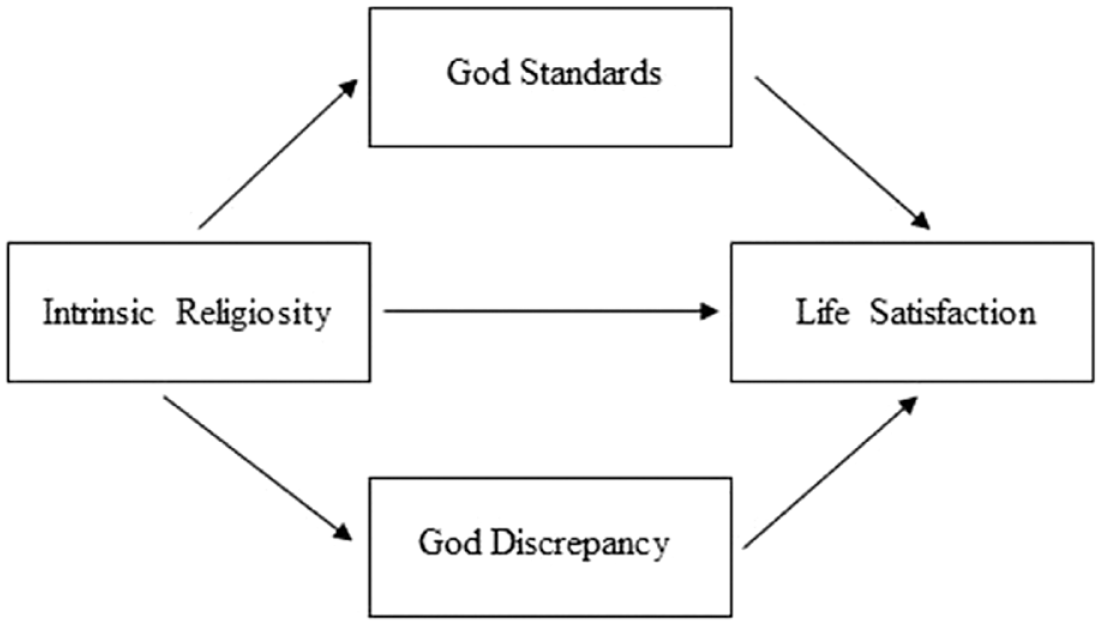
Parallel mediation analysis pathway.
Results
Descriptive statistics of study variables and bivariate correlations are presented in Table 1. Life satisfaction was positively correlated with IR and negatively correlated with PDG. IR was also negatively correlated with PDG. Perceived standards and perceived discrepancy were positively correlated. The skewness of the IR measure was found to be extremely negatively skewed at a value of −1.98. In addition, the measure of satisfaction with life was reported at –.71, showing a moderately negative skew. All other measures in our model reported near symmetrical values for skew between –.2 and .2.
Descriptive Statistics and Correlations for Study Variables.
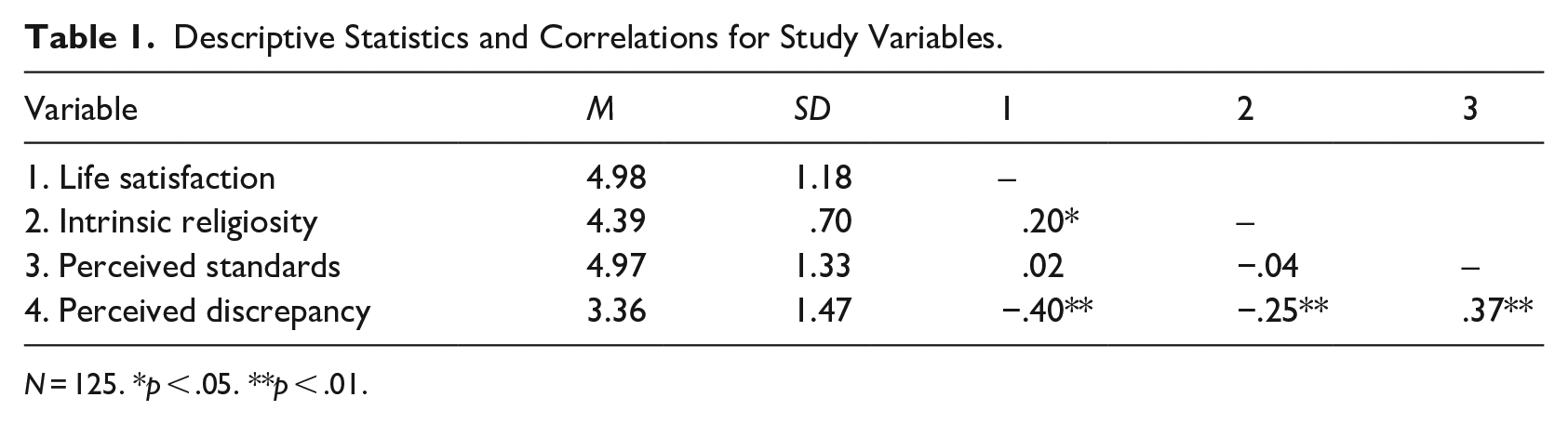
N = 125. *p < .05. **p < .01.
In terms of the main research question, we conducted a parallel mediation analysis (see Figure 2) using the PROCESS macro model 4 for SPSS (Hayes, 2018). Results indicated that IR was directly associated with life satisfaction (c = .33, p < .05). IR was also indirectly associated with life satisfaction through discrepancy-based God perfectionism (b = .13, 95% CI [02, .32]). Specifically, IR was associated with lower levels of discrepancy-based God perfectionism (a2 = −.53, p < .01), whereas discrepancy-based God perfectionism was associated with lower levels of life satisfaction (b2 = −.25; p < .01).
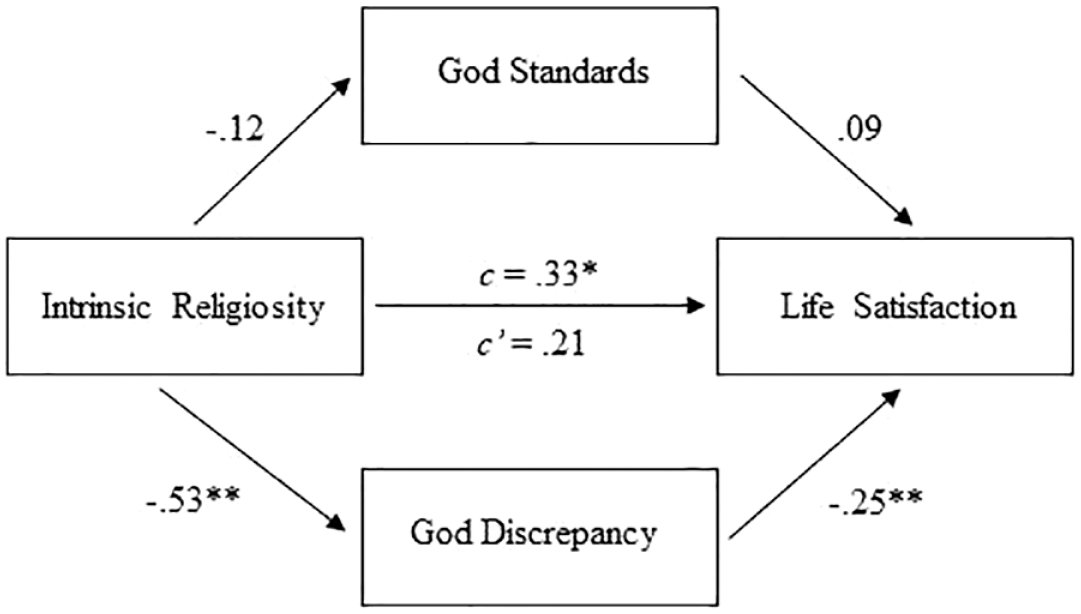
Parallel mediation model of associations between intrinsic religiosity and life satisfaction through god perfectionism.
The indirect relationship through standards-based God perfectionism was not significant (b = .01, 95% CI [−.07, .02]). The direct effect of IR on life satisfaction was not significant when accounting for both mediators (c’ = .21, p = .14), indicating presence of a full mediation.
To better understand the role of perfectionism in satisfaction with life, a hierarchical regression was run using perfectionism, measured by the Short Almost Perfect Scale (SAPS) and perceived discrepancy, on life satisfaction. Results indicated the addition of perceived discrepancy explained more of the variance in satisfaction with life than perfectionism alone. This was shown through the decrease in residual sum of squares from model 1(RSS = 147.54) with just SAPS alone, to model 2 with the addition of PD (RSS = 129.43). The difference in scores from model 1 to model 2 was 18.11, showing that model 2 was the better fit (Table 2).
Hierarchical Linear Regression Models Predicting Life Satisfaction.

Discussion
The purpose of this study was to examine adaptive and maladaptive God perfectionism as potential mediators of the relationships between IR and life satisfaction. Our first hypothesis was supported, as IR was positively associated with life satisfaction. Our results support previous literature, such as Steffen (2014), who found IR to be a predictor of life satisfaction. Next, we hypothesized that greater levels of standards-based God perfectionism and not discrepancy-based God perfectionism would mediate the association between IR life satisfaction. Results partially supported this hypothesis, in that discrepancy-based God perfectionism, and not standards-based, was the only mediator.
As maladaptive God perfectionism refers to an external source of perfectionism placed upon an individual that highlights the gap between their performance and the expectations placed upon them by a higher power, it makes sense that the absence of experiencing this form of perfectionism would increase one’s satisfaction in life. Perhaps viewing God as nonpunitive in the context of one’s religion is protective against the shame that has previously been associated with the discrepancy in God’s perceived standards and one’s actual performance (Houltberg et al., 2017). Our results of IR as directly related to higher levels of life satisfaction support previous literature. For instance, Steffen (2014) found IR to be both directly and indirectly predictive of life satisfaction, with the strongest mediator being maladaptive perfectionism, whereas increased IR predicted less maladaptive perfectionism and thereby lead to increased life satisfaction. Also supported is the research by
Allen and Wang (2014) who found negative correlations between intra commitment to one’s religion and discrepancy (maladaptive God perfectionism), with higher discrepancy predicting lower life satisfaction. These findings are consistent with our own that maladaptive God perfectionism is the strongest predictor of life satisfaction among intrinsically religious individuals in our sample. Both mentioned studies included samples of primarily White, young adult samples living at either religious universities or within faith-based communities, which could contribute to the similarities in our findings. However, our analyses indicated an insignificant indirect effect through adaptive God perfectionism, which leaves us to consider other reasons for why someone with higher IR might experience greater satisfaction in their life.
Our research indicated how life satisfaction can be affected through perceived discrepancy, however it did not hold true for perceived standards. This demonstrates that the perceived discrepancy between God’s standards and one’s performance, when God perfectionism is examined as comprised of both adaptive and maladaptive aspects, has the largest impact on life satisfaction. This supports past literature that has divided perfectionism into both adaptive and maladaptive. In research by Sherry and colleagues (2016), they provided evidence for the division of perfectionist measures into these groups and demonstrated how the maladaptive side can have a negative effect on life satisfaction. These results are also congruent with past research that has connected maladaptive views on religious standards to negative life outcomes such as feelings of inadequacy toward religious practice (Steffen, 2014).
Interestingly, our research did not support our original hypothesis that life satisfaction would be increased through PSG, or God perfectionism. One reason for this could be the way that intrinsically religious individuals perceive God. Returning to the definition of an intrinsically religious person as someone who “lives” their religion, rather than “uses” it for external gain (Allport & Ross, 1967), our research illustrated an absence of viewing God as punitive. Perhaps the same intrinsically religious individuals do not hold the view that God has specific standards that must be met for their religiosity to be genuine; it is conceivable that a more compassionate and forgiving view of God is held in higher esteem.
The authors of the PPGS indicated that their measure was unique in that it was able to separate adaptive and maladaptive God perfectionism in addition to the creation of their two subscales, PDG, and PSG (Wang et al., 2018). Within their measure development, they found that religious commitment was positively correlated with PSG using a population of Latter-Day Saints. Our research, while it used a population of Christian-identifying individuals, did not have a requirement for frequency of religious participation, which could account for the lack of a significant indirect effect for God Standards. With a decrease in the frequency of religious practice from their sample population to ours, it can be hypothesized that perceived God standards may also decrease. In addition, this could increase the discrepancy from religious belief to practice.
Alternatively, IR as measured among the current sample could be related to an “intense, rigid devotion to orthodox religious beliefs and practices” (Batson & Ventis, 1982, p. 147). As a result, a need for certainty and closure of how God views their performance may underlie the negative association between IR and God discrepancy. Such individuals could evaluate their performance to fulfill the standards set by God as the more rigid their devotion grows, which is empirically measured as IR.
Nevertheless, IR partially affects life satisfaction based on one’s personal perception of God’s standards and discrepancies. Individuals who practice religion from a less intrinsically motivated place may experience God as being more punitive and discrepant and therefore have less overall life satisfaction. More research is needed on whether those who are more intrinsically religious perceive God’s standards for them as having a positive impact on their life.
Limitations
Given the cross-sectional design of the current study, the results based on correlations are limited to speculation on causality and directionality. As reviewed elsewhere, the association between life satisfaction and IR may be bidirectional. More experiential and longitudinal research is needed to clarify the nature of this relationship and to examine how changes in mediators such as God perfectionism may influence both IR and life satisfaction. Furthermore, the overall generalizability of this study may be limited due to a relative lack of participant diversity in religious affiliation, education level, ethnicity, and age. The sample is more likely to generalize best to evangelical Protestant populations as most participants identified with this affiliation. In addition, participants’ attendance at a theological seminary may suggest an overall higher emphasis on religion than the general United States population. The religious education the individuals receive at their university or seminary is structured in favor of the teachings and beliefs of evangelical Protestants, meaning that because of their stance on the teachings of God being inerrant, they may perceive themselves as the source of error. Since this population in particular views God as perfection, the result may not mirror in other protestant groups that lack this viewpoint. As with most college samples, generalizability based on age and education level is limited, with young adults as the main participants. Gender representation was balanced, with a slight overrepresentation of women. Compared to the overall distribution of ethnicity in the United States, the study sample lacked representation of Hispanic, Latino, and Black participants, potentially indicating limited generalizability to these populations. Representation of White and Asian American participants was high, suggesting stronger generalizability to these groups. Due to the self-report questionnaire format, ecological validity is limited. To apply this study to a naturalistic setting, changes to the study design would be necessary. For example, there may be opportunities to assess God perfectionism via prayer and religious journal content that people naturally engage in during their daily lives by utilizing a phenomenological approach to qualitative methods. Overall, further studies conducted with more diverse racial and religious groups, in addition to social and cultural contexts, would provide more results to increase generalizability and to consider the relationship between religiosity and life satisfaction in less religious groups.
In research by Eichhorn (2012), the importance of the social aspects of religiosity and its impact on life satisfaction are highlighted. Eichhorn (2012) sees social pieces, such as conformity and acceptance, as key factors in predicting high life satisfaction, stronger than religiosity alone. The current study uses a sample of individuals from a population that tends to have higher levels of religiosity, which may further intertwine the elements of social belonging and religious practice. The current model has an individual focus, using a measure for intrinsic motivations, so there was a clear lack of measures that target social factors. Future directions for this research could include social measures, such as ones that target conformity and acceptance, to further tease apart religiosity and social influence. Further, Mancuso and Lorona (2023) acknowledged that social aspects of religiosity do not seem to account for all the influencing factors in the pathway from religiosity to life satisfaction. Additional research that tests possible internal and external factors as moderators, such as religious and spiritual struggles or social belonging, might be a more holistic approach.
Participation in our research had the added incentive of compensation for their time. We as researchers believe that work deserves compensation. Largent and Fernandez Lynch (2017) push for the normative approach toward participant compensation to shift from skepticism to acceptance. They make the conclusion that it is the responsibility of each researcher’s institutional review board (IRB) to make the ultimate decision if the offered compensation fits into either the category of coercion or undue inducement as defined in the Belmont Report (Emanuel et al., 2008). Since our work was approved by the IRB, there is no reason to believe that our participants were influenced negatively by the compensation for their work. However, it is worth noting that this can never be entirely proven.
Clinical implications
Implications of these findings could be useful for mental health professionals working with religious populations and spiritual counselors such as clergy. Understanding what motivates an individual’s religiosity could provide clergy and mental health professionals with a starting point on where to address life satisfaction within their communities. Cultural competency in practice requires an understanding of the influences of a patient’s beliefs and spiritual ties. In populations that regularly engage in devout practice, or have high motivation to do so, the inclusion of framework that is familiar to them in their treatment plan could benefit adherence and effectiveness of treatment. This population has high importance placed on their relationship with God, and finding ways to increase intrinsic motivation for practice along with framing the relationship into a protective factor may be beneficial for treatment planning. Further research on what aspects of religiosity and personal practice contribute to discrepancy from God could conceivably lead to the development of future interventions focused on reducing maladaptive God perfectionism in religious individuals.
Footnotes
Declaration of Conflicting Interests
The author(s) declared no potential conflicts of interest with respect to the research, authorship, and/or publication of this article.
Funding
The author(s) received no financial support for the research, authorship, and/or publication of this article.
