



Abstract
Objective:
This study examines the financial outcomes of graduates from community college baccalaureate (CCB) programs compared to those from traditional 4-year university baccalaureate programs in Ontario, Canada. It aims to understand whether graduating from a CCB program influences earnings, student loan status, and loan balances relative to university graduates. Additionally, it explores how field of study and post-graduation pathways shape these outcomes.
Methods:
Using administrative data from Statistics Canada, this study analyzes four cohorts of Ontario college and university graduates from 2010 to 2013. It employs ordinary least squares regression models to estimate the relationship between CCB graduation and financial outcomes, controlling for individual and institutional characteristics.
Results:
CCB graduates experience a wage premium of 5% to 14% 2 years post-graduation compared to their university counterparts, conditional on postgraduate pathway. They are also 13 to 14 percentage points less likely to incur student loan debt, though no significant differences are observed in loan balances among those who borrow. The wage advantages are particularly notable in applied and technical fields.
Conclusion:
The findings suggest that CCB degrees provide competitive financial returns, challenging traditional assumptions about institutional quality. This study contributes to the literature on horizontal stratification in higher education and highlights the need for further research on mechanisms driving these results.
Keywords
Introduction
Since their inception, community colleges have served as beacons of educational access and opportunity (Meier, 2013). Increased access has come through deeply subsidized tuition levels and less stringent admission policies relative to traditional public 4-year universities. Another hallmark of the community college is the transfer function that often leads to students earning an associate’s degree on their way to the baccalaureate. Together, these factors produce unmatched access for many students, including those who have been systemically and persistently underserved in higher education, like racially minoritized students and economically disadvantaged students (M. L. Skolnik, 2012; Wang, 2013).
The expansion of educational programing has also boosted academic opportunities. Historically, community colleges offered short-term certificates and 2-year diplomas, both academically and vocationally oriented (Cohen et al., 2014; M. Skolnik, 1969). However, policy changes in Canada and the United States over the past four decades have prompted these institutions to either begin or increase offering baccalaureate degrees equivalent to those traditionally granted by 4-year universities (Floyd et al., 2005; M. L. Skolnik, 2012; Wheelahan et al., 2017). In Canada, community college baccalaureate (CCB) degrees are academically equivalent to 4-year university degrees because provincial governments scrutinize and evaluate them using the same rigorous standards based on curriculum and program infrastructure that they use to evaluate 4-year universities (Panacci, 2014; M. L. Skolnik, 2012).
Two primary reasons motivated the introduction of CCB programs across Canada and the U.S.: workforce development needs and historical patterns of exclusion in college and university access. First, employment qualifications and shortages in high-demand industries increased near the turn of the 21st century (Levin, 2004; Panacci, 2014; Wright-Kim, 2022). A short-term certificate or 2-year diploma was no longer sufficient to fulfill new job vacancies, which prompted community colleges to expand their program offerings. Second, policymakers turned their attention to improving access to postsecondary education for historically underserved populations, particularly in geographically isolated regions where proximity to 4-year universities is limited (McKinney et al., 2013; Meza & Bragg, 2022; M. L. Skolnik, 2012). This is important as many postsecondary-going students are not highly mobile; most students attend postsecondary institutions within 25 miles of their homes (Hillman, 2016). Nevertheless, some research suggests that while CCB programs may increase institutional access, they do not always guarantee meaningful access to high-quality educational or economic opportunities (Cuellar & Gándara, 2021; Martinez & Acevedo, 2022; Vo & Rios-Aguilar, 2025).
Parallel to the growth of CCB programs, a budding line of research has examined various student and institutional outcomes associated with these degree offerings. This research has looked at how CCB programs shape postsecondary access and whether CCB programs lead to changes in institutional behavior (Meza & Love, 2023; Wright-Kim, 2022). However, comparatively little empirical research has explored CCB students’ postgraduate financial outcomes, specifically their wages and associated student loan burden relative to their university counterparts in Canada and elsewhere. There is emerging, descriptive quantitative research that informs initial understandings of the contributions of CCB programs (Hoang et al., 2022; Love et al., 2025; Love & Thai, 2025; Meza & Bragg, 2022; Thai & Love, 2024); yet, the field of higher education and policymakers would benefit from more descriptive evidence, particularly given challenges in ascertaining an identification strategy that allow analysts to estimate causal effects of graduating from CCB programs (except see Cominole, 2017). The evidence I present builds on existing scholarship and provides insight into the comparative outcomes of baccalaureate degrees by type of institution. Furthermore, this study considers how graduates’ post-baccalaureate decisions (i.e., enrollment in further education and labor market participation) influence these financial outcomes. For instance, these two trajectories are critical to understanding variation in earnings, as continued education may delay full-time employment, while immediate labor market entry can accelerate income. Thus, I examine these pathways to better understand how postgraduate decisions shape early economic returns.
Accordingly, this study aims to answer the research questions:
I leverage an administrative dataset from Statistics Canada that includes the universe of Ontario college and university graduates from 2010 to 2013, along with their tax records and federal student loan information, representing the most recent and complete data available to me at the time when I initially conducted, and subsequently refined, the study. To answer the first research question, I estimate ordinary least squares regression models among a sample of graduates that pursued more schooling after graduating with a bachelor’s, and who were either active or inactive in the workforce. To answer the second research question, I run the same models by field of study, followed by analyses using more restrictive samples that consider further education and labor force (in)activity.
Ontario CCB Policy Context
The decentralized nature of Canadian postsecondary education led to community colleges adopting baccalaureate programs at different times and using customized program structures. As a result, CCB programs have always been a provincial matter. In the early-to-mid 1990s, British Columbia and Alberta were the first provinces to implement a bridge model that allowed their students to earn baccalaureate degrees (i.e., after completing a two-year diploma, students could continue their courses at a nearby university). Ontario did not authorize community colleges to confer bachelor’s degrees until 2000. However, unlike British Columbia and Alberta, Ontario approved its community colleges to create standalone baccalaureate programs “from scratch” (i.e., baccalaureate degrees housed on their respective campuses; M. L. Skolnik, 2020, p. 27).
The Ontario Postsecondary Education Choice and Excellence Act, 2000 allowed all Ontario community colleges to offer up to 5% of their educational programing as baccalaureate degrees. Yet, in 2003, the Ontario government granted five colleges known as Institutes of Technology and Advanced Learning (ITALs) the ability to offer up to 15% of their credentials as baccalaureate degrees, in addition to their core mandate of delivering applied diplomas and certificates aligned with workforce needs (Wheelahan et al., 2017). As of 2017, the five colleges conferred 85% of all CCB degrees in Ontario (Wheelahan et al., 2017). Community colleges across Ontario offer baccalaureate degrees in various disciplines, including architecture, business, commerce, music, and psychology. From 2006 to 2016, the share of full-time or equivalent community college students enrolled in a baccalaureate program increased by over 430%, from 2,676 to 11,579 (Higher Education Quality Council of Ontario, 2021). In 2020, Ontario community colleges conferred over half of all CCB offerings in Canada (M. L. Skolnik, 2020).
While both the U.S. and Canada have expanded the CCB to improve access to 4-year degrees, policy frameworks governing their implementation differ substantially. In the U.S., states typically authorize CCB degrees in high-demand, non-duplicative fields, and often impose legislative or regulatory limits on the number or types of programs community colleges may offer (Kramer et al., 2021; Soler, 2019). These limitations are designed to avoid perceived “mission creep” and protect broader university interests (Kramer et al., 2021). Ontario’s policy environment has enabled community colleges to offer a broad array of baccalaureate programs, principally motivated by fields with demonstrated labor market needs. These contextual distinctions may help explain why Ontario’s CCB programs differ in their scope and structure from their U.S. counterparts (M. Skolnik, 2022).
CCB Degree Outcomes
Much of the existing research on CCB degree outcomes has originated in the U.S., given the long history of CCB programs in the country, dating back to the 1960s (Wright-Kim, 2022). Previous research comparing U.S. community college and university bachelor’s degree graduates found only slight earnings discrepancies in the short-term. For example, Cominole (2017) found no wage differential between community college and four-year university degrees a year after graduation using administrative data from Washington state and an instrumental variable approach that leveraged geographic variation. Focusing on the same context, Meza and Bragg (2022) found that community college graduates experienced a significant positive advantage in earnings a year after graduating compared to graduates of regional four-year universities. However, this wage differential for CCB graduates diminished after 3 years, which the authors attributed to differences in age and prior work experience, suggesting positive outcomes in the short term but not in the long run. Other CCB research find initial earnings premiums a year following graduation (Hoang et al., 2022; Thai & Love, 2024), with some studies seeing returns converging to those of university graduates a few years after (Love et al., 2025). Once again, it is important to note that while the research emanating from the U.S. offers preliminary insights relevant to the Ontario context, CCB populations between the countries differ. For example, CCB enrollees from the U.S. tend to be older than their Canadian peers (Love et al., 2025; Meza, 2019; Meza & Bragg, 2022; Thai & Love, 2024). For example, Love (2020) found that 58% of CCB students in Florida were over 30 years old compared to 45% of associate degree graduates in the same major. Meanwhile, my own calculations suggest a much younger group in Ontario with an average age at graduation of 25 years old.
Shifting to the Ontario context, Wheelahan et al. (2017) used a mixed methods approach to explore how CCB degrees affect student postgraduate outcomes. These researchers analyzed curricula, policy documents, student satisfaction surveys, and interview transcripts of more than 100 stakeholders and concluded that the labor market outcomes for CCB degree graduates are generally positive. For example, they found that CCB graduates felt more prepared to enter their careers than diploma and certificate students. They also found that these positive experiences led to some of the highest employment rates across the disciplines of applied arts, business, and technology, and that average salaries were higher than those of certificate and diploma students. Finally, they noted that CCB students accessed degrees at much lower tuition rates than if they had attended a 4-year university. These authors concluded that CCB degrees significantly increased access for students, especially mature students who are less mobile due to work and family responsibilities (Wheelahan et al., 2017).
While Wheelahan et al. (2017) compared outcomes between community college students enrolled in baccalaureate programs to community college diploma and certificate students, it is not yet clear how CCB students’ results compare with university students in Canada, an ostensibly more appropriate comparison group because both groups earn the same degree. Frenette (2019) reported some initial findings; using the Blinder–Oaxaca decomposition method, he found that CCB degree holders earn about 12% more per year on average within 2 years of graduation compared to university graduates. Frenette attributed this finding to the students’ age and their different fields of study. However, it is also important to note that his analysis included community college and university degree graduates from British Columbia, Alberta, and Ontario, as well as students of all majors, so his results may not be applicable to jurisdictions with a history of stand-alone CCB programs and analyses focusing on students within the same fields.
Another understudied area is student loan burden in the context of CCB degrees. Over half of Canadian postsecondary graduates from the class of 2015 completed their program with student debt (Galarneau & Gibson, 2020). Additionally, average undergraduate student debt has increased from $20,000 to $30,000 between 1995 and 2015 (Usher, 2020). Wheelahan et al. (2017) noted that students perceive CCB degrees as more economically efficient. Yet, that might not always be the case. Research from the U.S. has offered mixed results that seem to depend on sample restrictions and the inclusion of variables that account for college enrollment factors like tuition and fees paid (González Canché, 2020; Hu et al., 2018). Existing research has not examined to what extent student loan status and amount differ between community college and 4-year university bachelor’s degree graduates in Canada. For instance, if CCB graduates earn more than their 4-year university counterparts but also incur greater debt, then the earnings premium alone may not accurately reflect the short-term financial outcomes of a CCB degree.
Conceptual Framework: Horizontal Stratification
The theory of horizontal stratification, and specifically the notions of postsecondary quality and field of study, may help explain differences in economic outcomes within the same level of education (Gerber & Cheung, 2008). While human capital theory helps explain why differences in economic outcomes exist between educational attainment levels, it offers less convincing answers as to why postgraduate outcomes may differ between community college and university students who earn the same degree. I use the theory not as a deterministic model but as a guiding framework to derive hypotheses and assess whether graduates from different institutional types, despite holding the same credential, experience different returns. In the discussion, I revisit the theory’s propositions and reflect on whether the observed patterns align with expectations grounded in horizontal stratification and related empirical research.
According to horizontal stratification, differences in postgraduate outcomes within the same level of education often stem from variation in institutional quality. Four accounts explain this variation: human capital, signaling, social capital, and self-selection. Gerber and Cheung (2008) describe features of “high-quality” postsecondary institutions as those with significant financial investments, such as higher expenditures per full-time student and higher costs of attendance. These features align with the human capital explanation because students learn in an environment that theoretically imparts “cognitive and/or noncognitive skills more efficiently” (Gerber & Cheung, 2008, p. 301). Also, markers of high institutional quality might lead to economic gains in the labor market through signaling effects. In other words, it may not be the skills acquired through institutional inputs that lead to these outcomes, but rather that employers use perceptions of high-quality institutions as a proxy for ability. High entrance exam scores and rejection rates might also serve as signals of intelligence and ambition for future employers, leading to higher salaries that differentiate graduates from high- and non-high-quality institutions (Gerber & Cheung, 2008). Social capital explanations propose that advantages after college result from valuable network connections with peers, faculty, and alumni. Finally, the selection effect suggests that institutional quality is not due to actually attending the institution but instead to factors related to enrolling in the institution in the first place, such as motivation.
In addition to institutional quality, horizontal stratification considers how a student’s field of study, also known as instructional program or major, shapes postgraduate outcomes within the same level of education. Gerber and Cheung (2008) note that students majoring in business and the science, technology, engineering, and math (STEM) fields experience greater economic returns than students in the humanities and education fields. Various policy reports and peer-reviewed research consistently find significant variation in earnings that support these claims (Frenette & Frank, 2016). In Canada, Frenette and Frank (2016) found engineering majors made about $90,000 on average, while education majors earned about $60,000. These findings suggest major is an important mediator when considering financial outcomes within higher education.
Based on the institutional quality account, I hypothesize that university students will earn more than CCB program graduates, given that universities in Canada spend more on students than their college counterparts and they are more expensive for students to attend. Additionally, universities are incubators of social networks that might exceed those at community colleges due to structural inequities in the institutions’ origins. The institutional quality rationale also suggests that 4-year university students will pay more for tuition, leading them to have a higher likelihood of incurring debt and taking on greater amounts. However, while 4-year university baccalaureate graduates should experience an advantage in earnings, on average, theory predicts there to be significant variation by field of study.
Research Design
Data Sources and Sample
This study linked three administrative datasets from Statistics Canada: the Postsecondary Student Information System (PSIS), the Canada Student Loan Program (CSLP), and the T1 Family File (T1FF). The primary data source was the PSIS, which is a census of all postsecondary students enrolled in Canada between 2010 and 2013. The PSIS contains demographic information such as age, sex, immigrant status, field of study, and time to degree. The PSIS, like most datasets in Canada, does not systematically collect data on race/ethnicity, so that social marker is missing from the analysis (Robson, 2021).
I merged the PSIS with the T1FF and CSLP datasets. The T1FF links individual-level information on employment and earnings (i.e., individual tax data) while enrolled in postsecondary education and into adulthood. Next, I connected the PSIS to the CSLP repayment file, which indicates whether an individual received a federal student loan and the consolidated balance of their loans at the end of their study program. Overall, the initial analytic sample represents approximately 185,000 students who graduated from Ontario colleges and universities in comparable fields between 2010 and 2013 with a baccalaureate degree. At the time of initial analysis (Fall 2022), followed by later revision and refinement (Fall 2024), these were the most recent cohorts available with complete, linked administrative data across education, earnings, and student loans in Canada as found in the Toronto Research Data Centre. This sample includes both students who did and did not pursue more education after graduating with a bachelor’s degree, as well as those who are either active or inactive in the workforce.
To investigate whether students’ postsecondary decisions to pursue further education or be active in the labor market shape the outcomes of interest, I also run models on different samples that consider several postgraduate pathways. Specifically, I examine the following samples:
Students pursuing more education within 2 years of graduating and who are active in the labor market;
Students not pursuing more education within 2 years of graduating and who are either active or inactive in the labor market; and,
Students not pursuing more education within 2 years of graduating and who are active in the labor market.
I identify students as inactive in the labor market if they report zero employment wages on their tax return. I consider students to be pursuing more education if they enrolled in any postsecondary program leading to a credential within 2 years after graduating with their first baccalaureate degree.
There are several advantages of using administrative data to study the economic outcomes of CCB graduates. One primary strength of this data is its high-quality financial outcomes, as previous research has shown that students often underestimate their earnings and the amount they owe in student loans (Andruska et al., 2014; Hillman, 2015). The tax file also allows for more precise estimates of how much students paid for their education compared to averages of net costs. Additionally, these data sets enable linkages across different domains, preventing issues of attrition, non-response, and under/over-reporting of key variables (Figlio et al., 2017). However, a concern with administrative data is that it seldom captures key social and psychological variables that can identify motivation or attitudes related to academic outcomes (Figlio et al., 2017). Furthermore, the present data does not include important academic outcomes such as high school or postsecondary grades and credits attempted and passed. I describe these and other constraints in the Limitations section, along with strategies I have employed to contextualize the potential impact of these shortcomings.
Measures and Analytic Technique
I used three dependent variables in this study. The first is earnings, a continuous variable that includes all paid-employment income before tax deductions 2 years after graduation. Observing wages 2 years post-graduation reflects students’ early economic outcomes from their degrees and allows me to observe this outcome across the four cohorts available in the data. The second dependent variable is whether a student has a government loan. This is a dichotomous variable, equal to one if a student has a loan at the end of their first baccalaureate degree study period and zero otherwise. Finally, I examine the initial size of the student loan. This variable is a continuous measure of the student loan balance at the end of a student’s study period. I adjusted wages and student loan balances for inflation to 2013 equivalent dollars, and log-transformed both wages and student loan balances.
The key independent variable is a binary indicator, equal to one if a student graduated from a community college with a baccalaureate degree and zero if the student graduated from a university. In addition to predicting changes in the outcomes based solely on different institutional graduation, I also statistically control for several additional variables: legal sex, age (plus its quadratic transformation), field of study, immigrant status, province of residency at the point of application, tuition in the year of graduation, and time to degree (measured in months). Cohort fixed effects are also included to control for unobserved time-varying factors between graduating classes.
To estimate the relationship between CCB graduation and financial outcomes, I used ordinary least squares regression. I use ordinary least squares regression because it provides interpretable estimates of conditional mean differences aligned with the descriptive nature of the research questions. The models regress the outcome variables on the indicator variable representing CCB graduation, a vector of individual and program characteristics as described previously, and indicators for each cohort of students. Since I log-transformed wages and student loan balances, readers may consider coefficients of small magnitude as approximate percentage changes in the outcome, while larger estimates require exponentiation to be more precise. Finally, I estimate robust standard errors.
Limitations
Readers should consider three limitations when interpreting the results. First, while I previously described several advantages of using administrative data, there is always the possibility that conceptually important variables are absent, leading to omitted variable bias. This is likely the case because the data I used does not include high school grades and other measures of academic achievement that are strongly correlated with earnings (Altonji et al., 2012). Moreover, the administrative data do not capture graduates’ race/ethnicity or detailed information on employment status or work experience prior to and during their CCB studies. These omissions introduce uncertainty in interpreting the results, as differences between CCB and university graduates may partly reflect unobserved factors, such as work histories and labor market engagement, that are shaped by structural inequities (Gaddis, 2015; Love et al., 2025; Love & Thai, 2025; Meza & Bragg, 2022). For example, Love et al. (2025) find striking wage disparities by race 3 years after graduation. Although these data limitations are beyond my control, I conducted sensitivity analyses (described later) to help contextualize the potential extent of omitted variable bias introduced by these factors.
The second limitation readers should consider is the extent to which the results might hold in other jurisdictions, both in Canada and the U.S. Ontario CCB students appear to be much younger than their U.S. counterparts, which implies that the two systems might appeal to different segments of the population. This difference could lead to variations in work and educational experience, impacting wages and student loan burden. Moreover, the types of degrees offered differ substantially across the two contexts. In Ontario, colleges offer degrees in a broader set of fields, whereas in the U.S., states generally adopt programs in applied technical fields that do not duplicate university offerings. These policy and programmatic differences limit the generalizability of results to U.S. settings. While Ontario already confers most CCB degrees in Canada, it continues to expand degree offerings, likely in response to changing educational and labor market conditions. Future research should consider these contextual factors in a comparative fashion to explore how far these results can apply.
Third, while I compare CCB and university graduates, I acknowledge that treating each sector as a monolithic group conceals variation in institutional characteristics, such as resources, mission, size, and program mix. Unfortunately, the dataset does not include detailed institutional-level finance data (e.g., expenditures per student). As such, readers should interpret findings as averages across broad institutional types, and future research should examine how intra-sectoral differences shape financial outcomes within the framework of horizontal stratification.
Findings
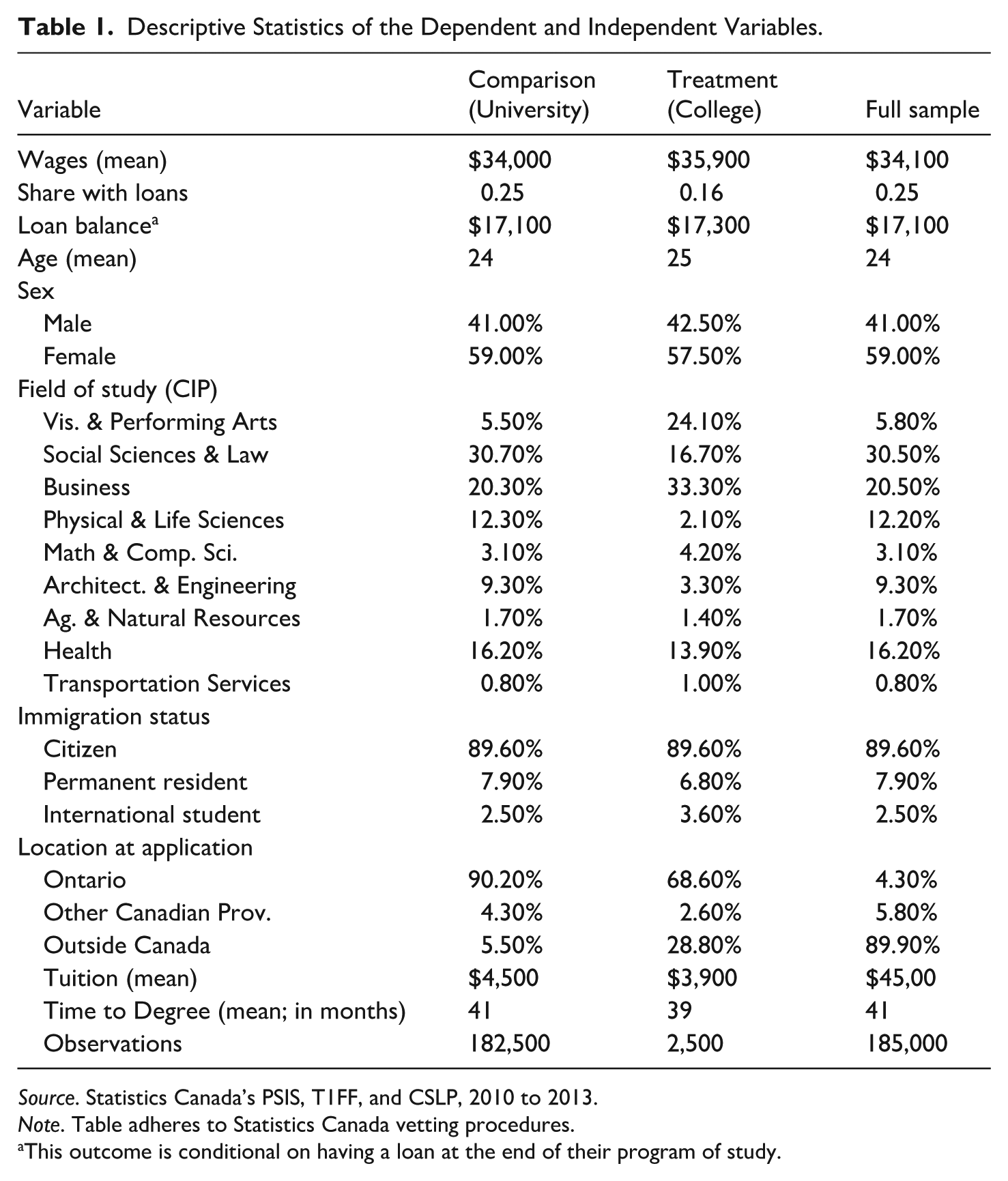
Table 1 includes descriptive statistics of the dependent and independent variables by treatment status and the total sample. CCB degrees compose around 1.3% of all bachelor’s degrees awarded in the province of Ontario between 2010 and 2013. The summary statistics show that CCB degree graduates experience a slight wage advantage. This comparison suggests CCB graduates earn about $1,900 more than university students. The share of student loan recipients is also lower among community college graduates relative to 4-year university completers (16% vs. 25%). Conditional on having a loan, CCB graduates have a slightly higher outstanding loan balance of about $200. Demographics between 4-year university and community college graduates are similar when examining age, sex, immigration status, and time to degree. I observe some dissimilarities among institutional programs. For example, about 24% of the community college sample comes from the visual and performing arts field, while only 5.5% of the university students do. Conversely, nearly a third of the university students graduate from the social and behavioral sciences and law fields while that field represents 16.7% of the community college sample. Lastly, there are differences regarding the tuition students pay according to the type of institution: 4-year university graduates reported on their tax returns paying about $4,500 in the last year of their program, while community college graduates paid about $600 less.
Descriptive Statistics of the Dependent and Independent Variables.
Source. Statistics Canada’s PSIS, T1FF, and CSLP, 2010 to 2013.
Note. Table adheres to Statistics Canada vetting procedures.
This outcome is conditional on having a loan at the end of their program of study.
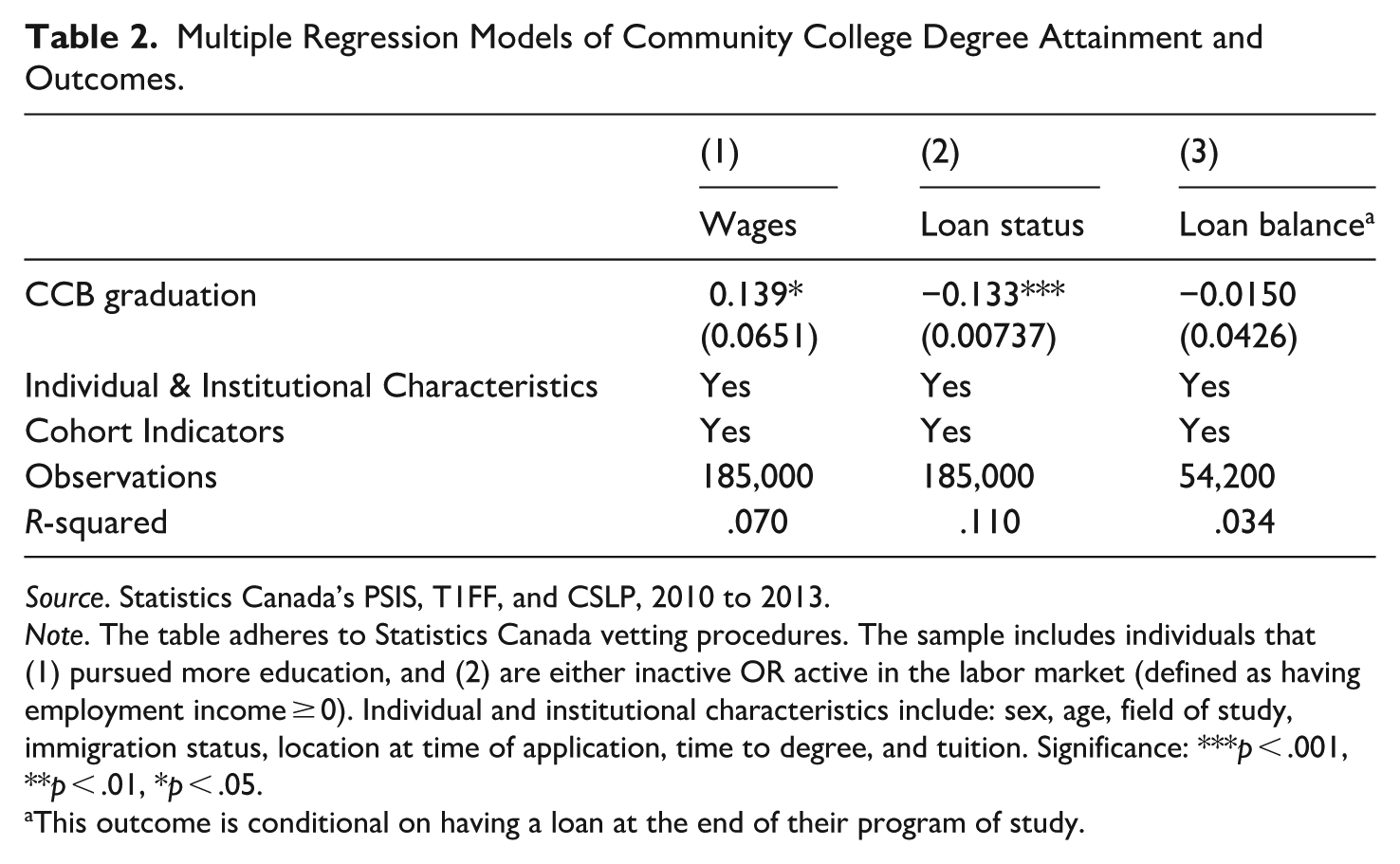
Table 2 reflects findings on the relationship between CCB degree graduation and wages, the probability of having a student loan, and conditional on having a loan, the association with student loan balance. I found that graduation from CCB programs was associated with about a 14% statistically significant increase in wages 2 years after graduation, after accounting for sex, age, field of study, immigrant status, location of residence, tuition, time to degree, and cohort indicators. Turning to loans and net of control variables, CCB graduates experience about a 13 percentage point lower likelihood of incurring federal student loan debt. Conditional on having a loan and all else equal, community college graduates take on about 1.5% less than their university counterparts, but this association is insignificant.
Multiple Regression Models of Community College Degree Attainment and Outcomes.
Source. Statistics Canada’s PSIS, T1FF, and CSLP, 2010 to 2013.
Note. The table adheres to Statistics Canada vetting procedures. The sample includes individuals that (1) pursued more education, and (2) are either inactive OR active in the labor market (defined as having employment income ≥ 0). Individual and institutional characteristics include: sex, age, field of study, immigration status, location at time of application, time to degree, and tuition. Significance: ***p < .001, **p < .01, *p < .05.
This outcome is conditional on having a loan at the end of their program of study.
Heterogeneity by Field of Study
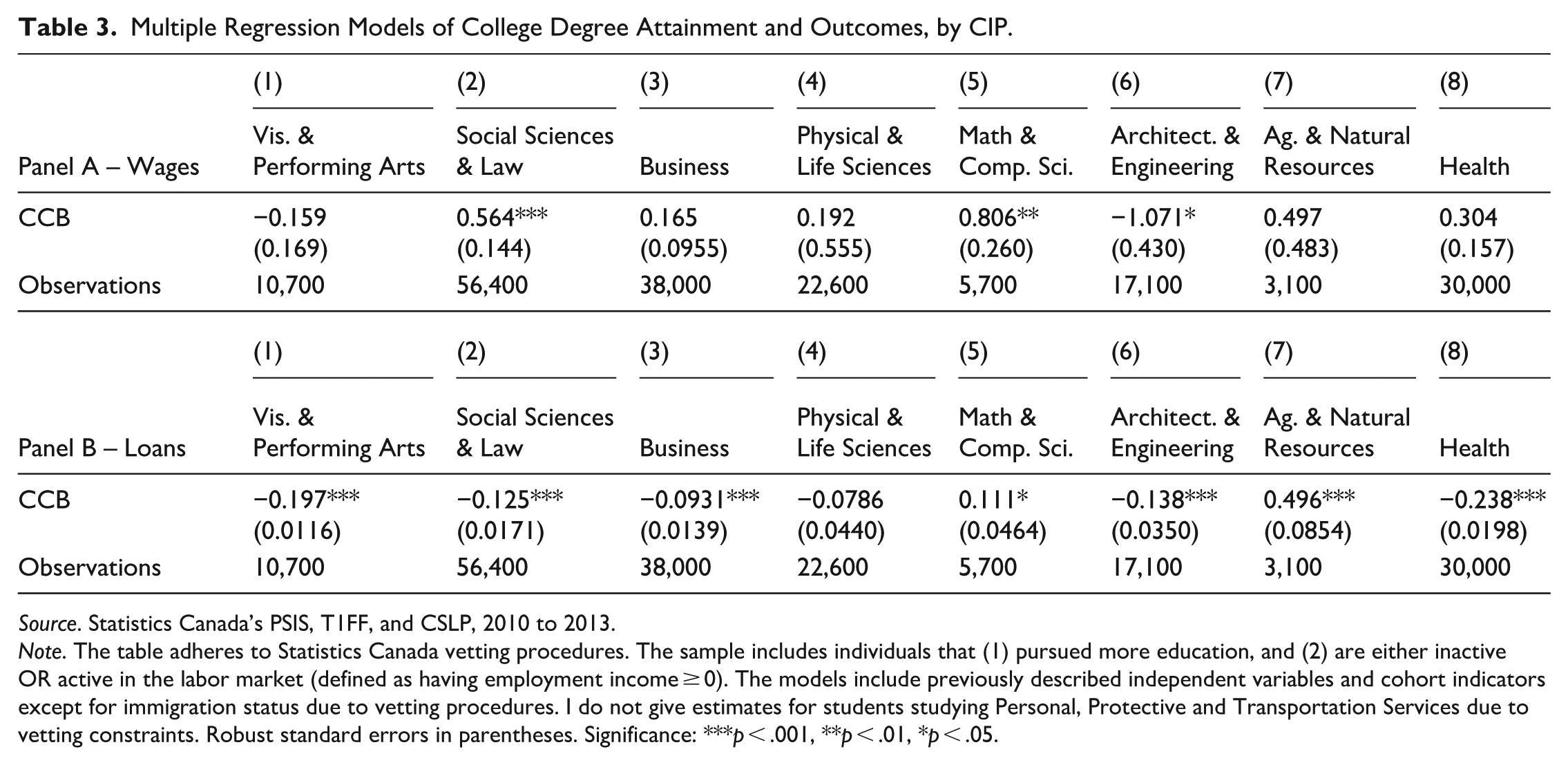
While the previous analysis provides a baseline for the relationship between CCB degree graduation and the outcomes of interest, the framework of horizontal stratification suggests that wages will vary by instructional program. I estimate the previous models by field of study and present them in Table 3. Most CCB graduates do not differ statistically from their university counterparts, but there are some notable exceptions. CCB graduates of social and behavioral sciences, and law programs experience about a 75% advantage in wages compared to university students. CCB math, computer and information sciences graduates do even better as they earn about 125% more than their university peers. However, CCB graduates of architecture and engineering programs earn about 34% less than university bachelor’s degree graduates. When focusing on loans, most CCB graduates have a lower probability on average of taking out loans except for students majoring in math and computer science and agriculture and natural resources.
Multiple Regression Models of College Degree Attainment and Outcomes, by CIP.
Source. Statistics Canada’s PSIS, T1FF, and CSLP, 2010 to 2013.
Note. The table adheres to Statistics Canada vetting procedures. The sample includes individuals that (1) pursued more education, and (2) are either inactive OR active in the labor market (defined as having employment income ≥ 0). The models include previously described independent variables and cohort indicators except for immigration status due to vetting procedures. I do not give estimates for students studying Personal, Protective and Transportation Services due to vetting constraints. Robust standard errors in parentheses. Significance: ***p < .001, **p < .01, *p < .05.
Heterogeneity by Postgraduate Pathways
Another aspect potentially mediating the relationships under study is students’ postgraduate decisions related to education and work. I found that approximately 30% of university students in the sample pursued further education within 2 years of graduating with a bachelor’s degree. However, only 11% of CCB graduates pursued further education, suggesting possible institutional barriers after attaining their bachelor’s degree. When considering employment following graduation, I found a modest discrepancy: 12% of university students were inactive in the labor market compared to 10% of CCB students.
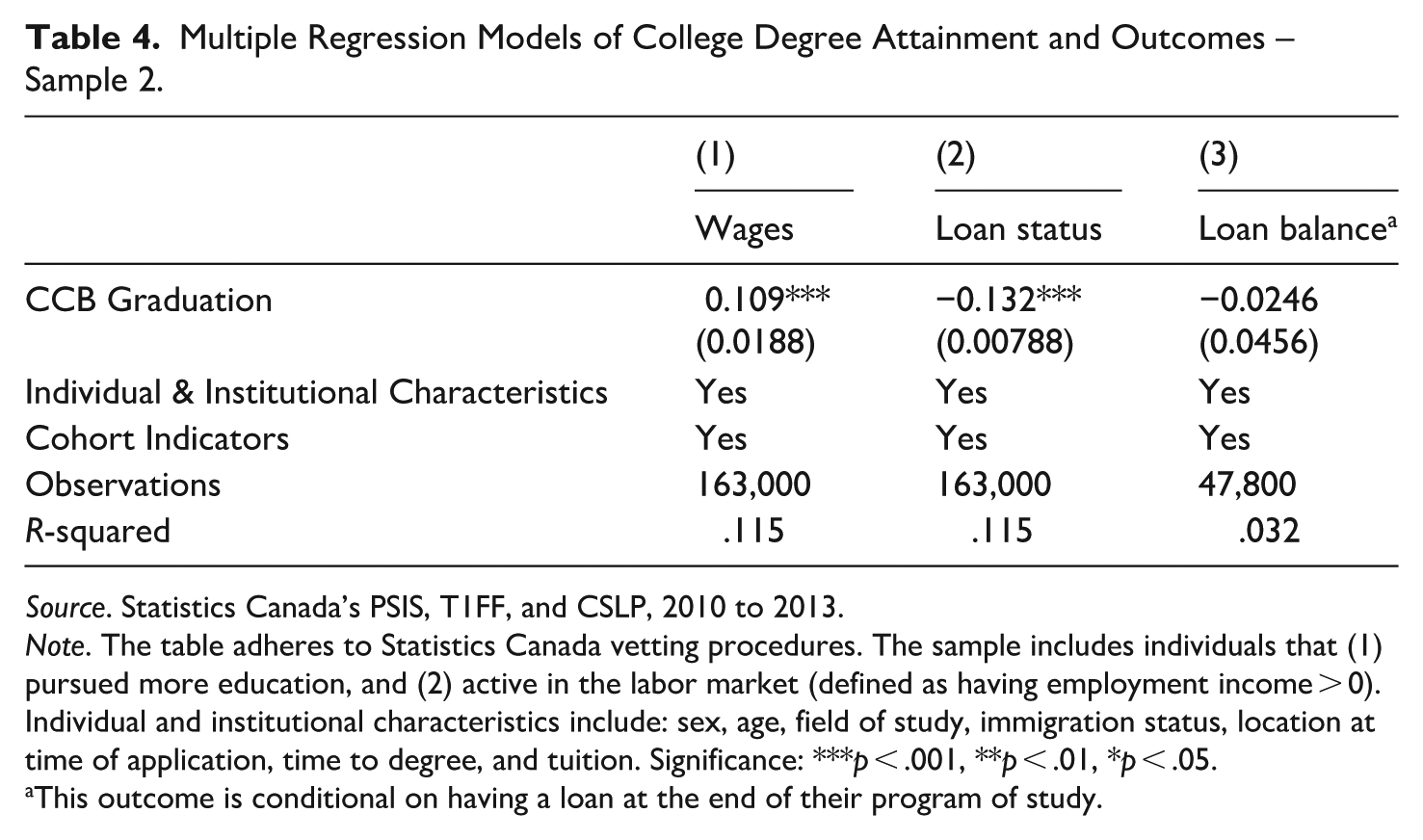
How do these different postgraduate pathways relate to wages and student loan debt? Tables 4 to 6 present regression results considering various pathways. Table 4 examines the sample of students who pursued further education within 2 years of graduating with their bachelor’s degree but who were only active (employed) in the labor market. CCB students continue to experience a short-term wage advantage of about 11%, net of controls. This group of students was about 13 percentage points less likely to take on debt, and conditional on having debt, there was no statistically meaningful difference.
Multiple Regression Models of College Degree Attainment and Outcomes – Sample 2.
Source. Statistics Canada’s PSIS, T1FF, and CSLP, 2010 to 2013.
Note. The table adheres to Statistics Canada vetting procedures. The sample includes individuals that (1) pursued more education, and (2) active in the labor market (defined as having employment income > 0). Individual and institutional characteristics include: sex, age, field of study, immigration status, location at time of application, time to degree, and tuition. Significance: ***p < .001, **p < .01, *p < .05.
This outcome is conditional on having a loan at the end of their program of study.
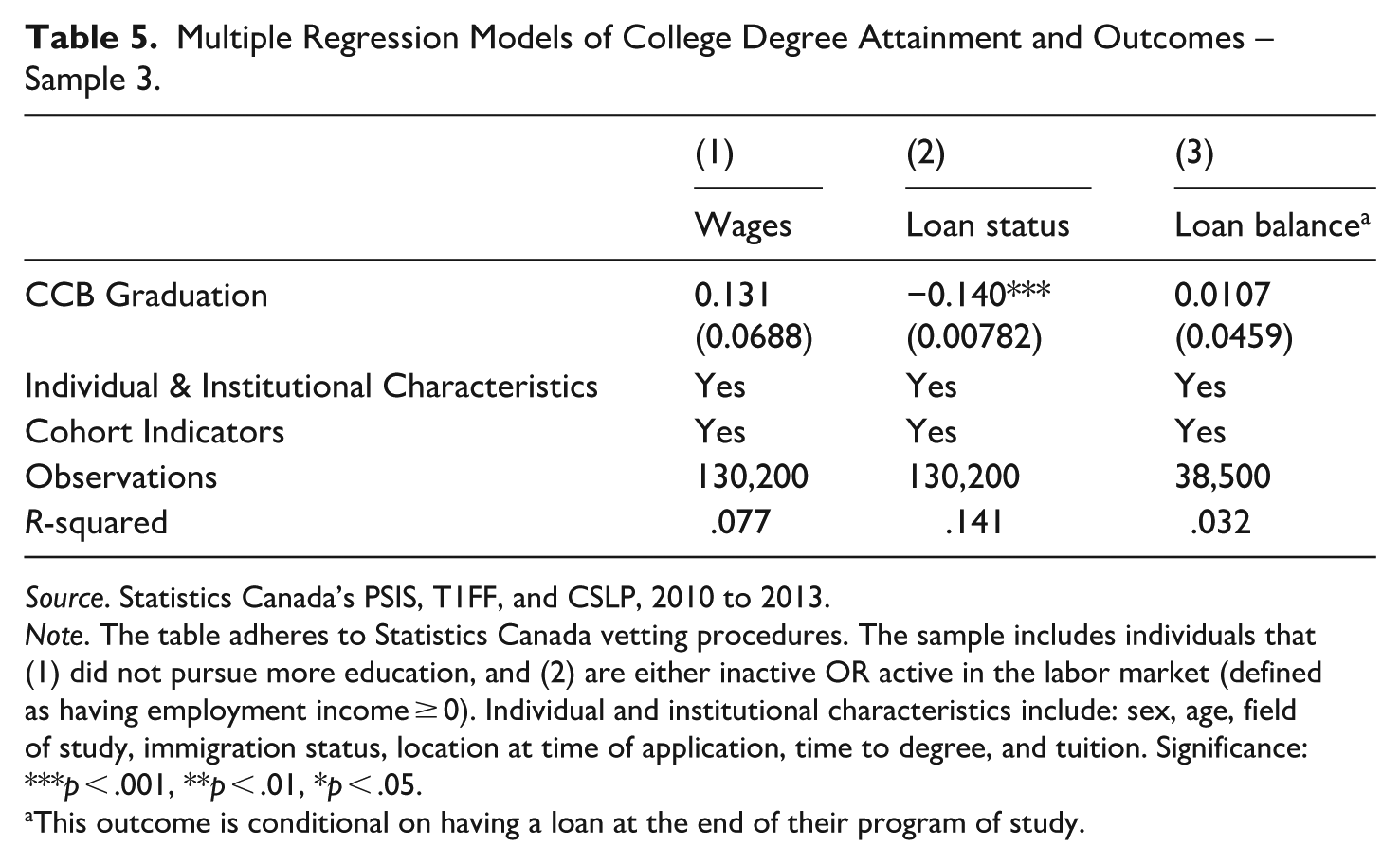
Multiple Regression Models of College Degree Attainment and Outcomes – Sample 3.
Source. Statistics Canada’s PSIS, T1FF, and CSLP, 2010 to 2013.
Note. The table adheres to Statistics Canada vetting procedures. The sample includes individuals that (1) did not pursue more education, and (2) are either inactive OR active in the labor market (defined as having employment income ≥ 0). Individual and institutional characteristics include: sex, age, field of study, immigration status, location at time of application, time to degree, and tuition. Significance: ***p < .001, **p < .01, *p < .05.
This outcome is conditional on having a loan at the end of their program of study.
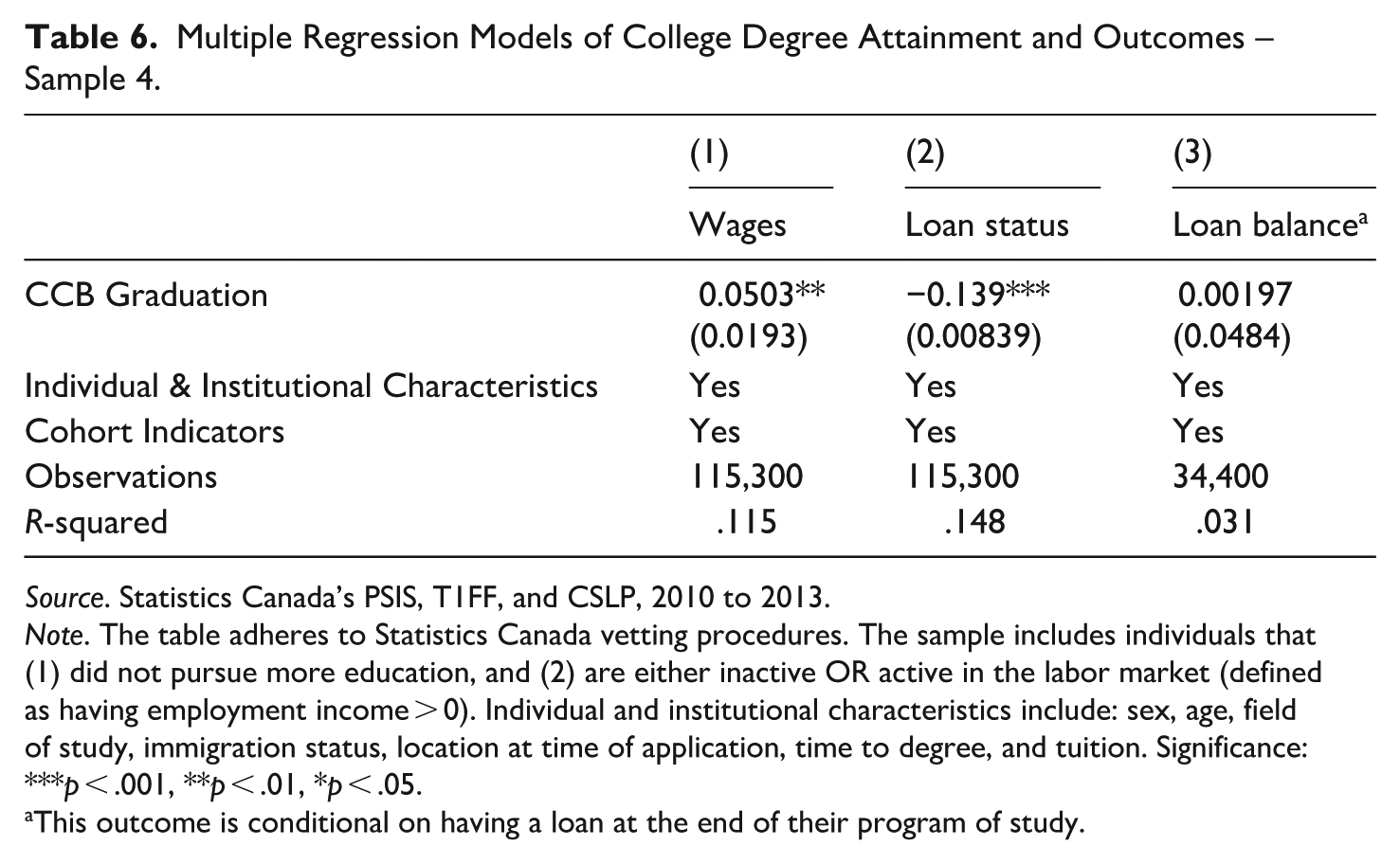
Multiple Regression Models of College Degree Attainment and Outcomes – Sample 4.
Source. Statistics Canada’s PSIS, T1FF, and CSLP, 2010 to 2013.
Note. The table adheres to Statistics Canada vetting procedures. The sample includes individuals that (1) did not pursue more education, and (2) are either inactive OR active in the labor market (defined as having employment income > 0). Individual and institutional characteristics include: sex, age, field of study, immigration status, location at time of application, time to degree, and tuition. Significance: ***p < .001, **p < .01, *p < .05.
This outcome is conditional on having a loan at the end of their program of study.
Tables 5 and 6 restrict the sample to students who did not enroll in any postsecondary certificate, diploma, bachelor’s, graduate, or professional program after their initial bachelor’s. Table 5 examines the cohort of students who were both inactive and active in the workforce. In this sample, I found a positive earnings advantage of 13%, but this estimate is statistically insignificant. This group of students also took on less debt and did not differ significantly in the loan balance at the end of their study. Finally, Table 6 includes results from the most restrictive analytic sample: students who did not pursue further education and were only active in the labor market. This group of students experienced only a 5% increase in employment earnings 2 years after graduating. Their student loan outcomes are similar to those of the other groups.
Robustness and Sensitivity Tests
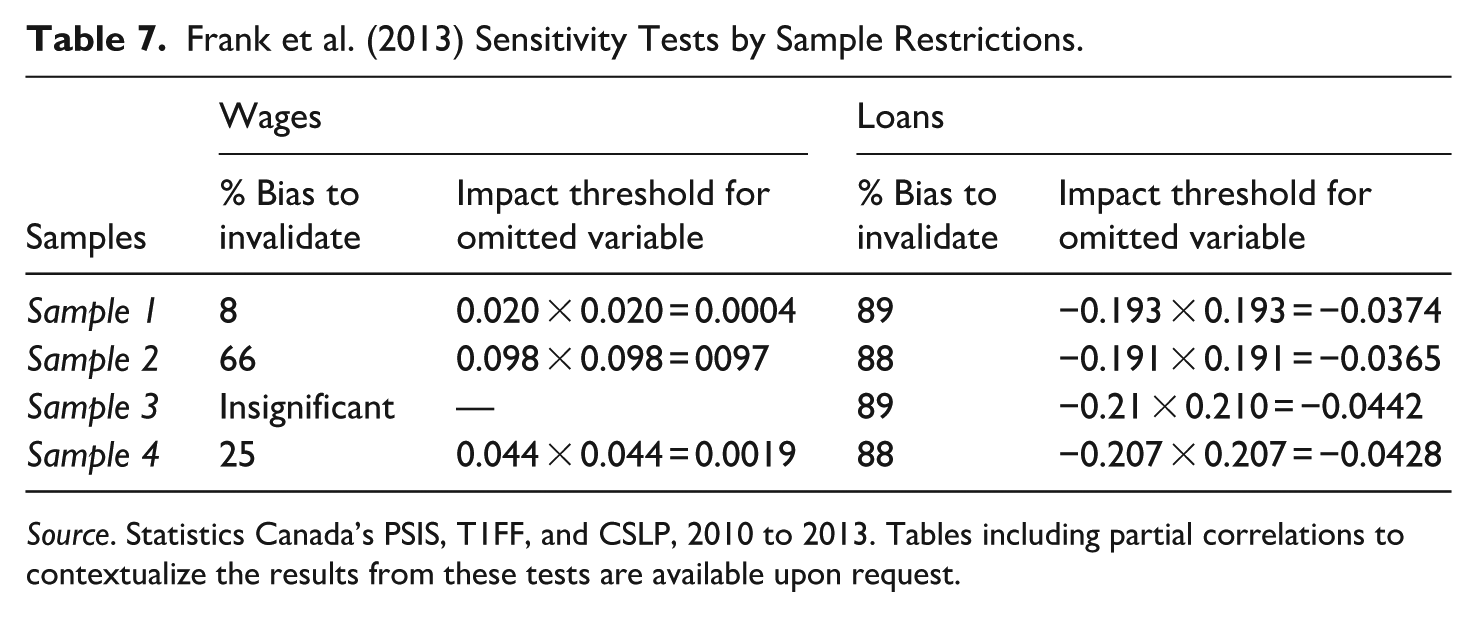
I used Frank et al. (2013) sensitivity tests to understand how much bias there must be to invalidate my results and to understand the impact of an omitted variable. Frank et al.’s (2013) robustness test has two parts. The first part calculates how much bias there must be in an estimate to invalidate or sustain an inference. This strategy identifies a threshold, typically statistical significance, and provides insight into how many observations would need to be replaced with zero for there to be no effect. The second part quantifies the impact of an unobserved variable on altering the inference of the estimate. This test uses a framework based on partial correlations, indicating how strongly the unobserved variable must be correlated with the predictor of interest and the outcome to invalidate the results (Frank, 2000).
I present sensitivity results from both parts of the tests in Table 7. The first set of columns provides insight into the sensitivity of the results for the wage outcome, while the second set focuses on the probability of having a student loan. I found that the associations I estimated for the wage outcome are quite sensitive to the sample. For example, when focusing on the sample of graduates who pursued more schooling and were both employed and unemployed (Sample 1), about 8% of the estimate would have to be due to bias for the wage outcomes, and an omitted variable would have to be correlated at 0.020 with both the treatment and the outcome to invalidate the inference (total impact 0.0004). In the context of the partial correlations found in my study, there is a positive likelihood that an omitted variable may invalidate this inference. However, the sample that included students who pursued more schooling but were only active in the labor market (Sample 2) indicates that the estimate is not relatively sensitive to bias or the impact of an omitted variable. In contrast, results of the sensitivity analyses on the loan outcome are quite robust, as about 88% of the estimate would have to be due to bias. Furthermore, an omitted variable would have to be five times more impactful than the strongest correlation found in my models to invalidate the inferences.
Frank et al. (2013) Sensitivity Tests by Sample Restrictions.
Source. Statistics Canada’s PSIS, T1FF, and CSLP, 2010 to 2013. Tables including partial correlations to contextualize the results from these tests are available upon request.
Discussion and Implications
This study provides a systematic and comparative analysis of the financial outcomes for graduates with a baccalaureate degree from community colleges and universities in Ontario. The findings reveal that graduates of CCB programs experience a wage premium ranging from 5% to 14% 2 years post-graduation, contingent on their postgraduation educational and employment pathways. Additionally, CCB graduates are significantly less likely to incur student loan debt, with a 13 to 14 percentage point reduction compared to their university counterparts. However, among those who do take out student loans, there is no statistically significant difference in the average loan balance. The study builds on previous research in the Ontario context focusing on wages and employment (Wheelahan et al., 2017), and, to my knowledge, is the first to provide evidence regarding student loan burden.
The results challenge my initial hypotheses based on the institutional quality explanation and complicate the mechanisms driving these findings. To restate, I hypothesized that universities should produce better economic outcomes given that the sector receives more revenue from the provincial government and these institutions spend more on instruction and research. In addition, 4-year universities are more selective compared to open-access community colleges. Presumably, these aspects would convey to employers that a university degree is “worth more” than a community college degree because of the human capital and signaling theoretical accounts underpinning the idea of institutional quality. However, the results suggest that Ontario CCB graduates earn more in wages 2 years following graduation than university students.
There are at least two potential explanations for the wage results: (1) variation in spending beyond instruction and research, and (2) innovative curricular practices in the classroom and the cultivation of social networks. While Ontario universities spend more than colleges on instruction and research, community colleges do spend a more significant share of their total budget on administration and student services than universities do (Usher, 2020). Evidence suggests that these categories matter for student persistence, which would lead ostensibly to improved graduation rates (Gansemer-Topf & Schuh, 2006; Webber & Ehrenberg, 2010).
Next, teaching and learning within the college classroom could also explain this study’s contradictory findings. Policymakers and relevant stakeholders often frame college baccalaureate degrees as “applied degrees,” emphasizing the practicality of knowledge and work orientation of the academic programing. Experiential learning opportunities often embedded in the curriculum reflect these aspects. However, universities are increasingly incorporating these opportunities, too. What could then account for their difference? Wheelahan et al. (2017) found that CCB programs focused on “cohort-based teaching in smaller classes than at universities, theoretically informed practical learning. . .and project-based teaching” (p. 42). When gaining student insights, Wheelahan et al. (2017) also found that students perceived to benefit from small class sizes and developing relationships with professors who had industry experiences, leading to the creation of critical social networks. Students could potentially speak to these unique experiences as strengths as they navigated the labor market, making prospective employers appreciate their academic background. Consequently, in addition to the cooperative placements, these additional aspects related to the design and execution of CCB programs’ curriculum could contribute to their graduates’ outcome differentials.
Nevertheless, it is also important to emphasize that the fourth account underpinning the institutional quality rationale of horizontal stratification, self-selection, may also be a likely explanation in the present study. It might not be that CCB programs offer more opportunities to make social and professional connections along with signaling to employers positive attributes; instead, the positive wage association might be due to exogenous variables not accounted for, such as “cognitive ability or social background,” as Gerber and Cheung (2008) note. Without systematically accounting for self-selection, the association is not causal and leaves open the chance that unobserved factors are correlated with both CCB graduation and earnings, yielding omitted variable bias and the inability to adjudicate the impact of institutional quality. These findings highlight the need for additional research to unpack the mechanism(s) driving these results.
The results from field-specific analyses also complicate the notion of institutional quality. Field-specific results illustrate that while horizontal stratification theory can explain some variation in wage premiums by field of study, it does not fully account for the performance of CCB graduates. The significant wage premiums in applied and technical fields like math, computer, and information sciences suggest the alignment of community college programs with labor market demands and practical training. These findings call for a more flexible framework that incorporates the value of vocational training into changing notions of institutional quality.
While I found limited support for the institutional quality account with regards to earnings, I did find support for the hypothesis when examining the chances of incurring debt. Since resources and investments postsecondary institutions impart cost more for 4-year universities than community colleges, it would lead to university students having more debt than community college students. This is also likely due to gradual increases in tuition due to declining support from provincial governments over time during the analytic window of this study.
Next, a notable finding is that while CCB graduates are less likely to take student loans, among those who do borrow, the average loan amount is not statistically different from that of university graduates. Although community colleges typically charge lower tuition, Ontario’s student loan system assesses financial need based on total educational costs, such as housing, transportation, and books. These non-tuition costs tend to be similar across institutions, particularly for students living away from home (Jonker & Hicks, 2016). As a result, while CCB graduates are less likely to borrow, those who do take on loans have amounts comparable to university graduates.
Despite the financial benefits of CCB programs I describe here, there are two aspects of CCB degrees that have the potential to exacerbate inequality. First, the present findings and other research document that CCB graduates experience wage advantages in the short-term; however, there is a significant knowledge gap on what the long-term economic outcomes are of CCB graduates. Studies that extend the analytic time window show the early financial advantages disappear (Frenette, 2019; Love et al., 2025; Meza & Bragg, 2022; Thai & Love, 2024). Thus, future research in this area is needed to know whether there is a wage-ceiling associated with CCB degrees. In addition to long-term economic drawbacks, it is also unclear whether CCB degrees limit opportunities for graduate and professional studies. There was a lower share of CCB students pursuing more education in the present study compared to university graduates (11% compared to 30% within 2 years). Wheelahan et al. (2017) also noted that several Ontario graduate units do not accept CCB degrees as a minimum credential for master’s programs.
Conclusion
The present study offered insights into the association between graduating with a CCB degree and important financial outcomes. Counter to theory, CCB graduates experience positive wages depending on student pathways and labor market activity. Regardless, I provide robust evidence that CCB programs lead to lower chances of incurring student debt and, among those with debt, no difference in loan balance. The findings highlight differences within the same level of education and offer emerging insights into understanding the role of institutional quality in shaping student postsecondary outcomes.
Footnotes
Acknowledgements
The author thanks the participants and facilitators of the 2022 Penn State Law, Policy, and Governance in Higher Education Mentoring Roundtables for their feedback, and Xueli Wang and Antía González Ben for their support throughout the publication process.
Ethical Considerations
This research is exempt from research ethics board review.
Funding
The author disclosed receipt of the following financial support for the research, authorship, and/or publication of this article: This research was supported by a grant from the University of Toronto through the Connaught New Researcher Award fund. Opinions reflect those of the author and do not necessarily reflect those of UofT.
Declaration of Conflicting Interests
The author declared no potential conflicts of interest with respect to the research, authorship, and/or publication of this article.
Data Availability Statement
The restricted-use administrative data for this paper come from the Education and Labor Market Longitudinal Platform. You can access these data through one of Statistics Canada’s Research Data Centres (CRDCN). Information on how to access the CRDCN can be found here:  . This research was conducted at the Toronto Research Data Centre, a part of the CRDCN. This service is provided through the support of the Canada Foundation for Innovation, the Canadian Institutes of Health Research, the Social Sciences and Humanities Research Council, and Statistics Canada, and through the support of the University of Toronto. All views expressed in this work are my own.