




Abstract
Keywords
There has been a steady concern from faculty, advocates, and administrators about the challenges in meeting the needs of the growing number of students with learning disabilities attending college (Morina & Carballo, 2017). According to Hansen and Dawson (2020), if faculty are well prepared for teaching this growing number of students, they will likely provide better support resulting in a more accessible and inclusive learning environment, culminating in better academic outcomes for students with learning disabilities. In postsecondary settings, faculty support for students with learning disabilities has been determined to be a key component of student success because it influences students’ decisions to use their accommodations, seek assistance from faculty, and persist to graduation in their programs (Cole & Cawthon, 2015).
The enrollment of students with learning disabilities in postsecondary education has increased steadily over the past three decades (Qian et al., 2018). This growth has been catalyzed by federal legislation and advocacy (e.g., Americans with Disability Act and the Higher Education Opportunity Act of 2008), promoting public acknowledgment that individuals with learning disabilities can successfully participate in postsecondary education programs. Students with learning disabilities tend to enroll in two-year community colleges more than they do four-year universities, have lower graduation and retention rates as compared to their non-disabled peers, and experience greater academic, social, and personal difficulties when pursuing a college degree (Flink & Leonard, 2019).
According to Raue and Lewis (2011), among the most common disabilities impacting learning reported at community colleges are learning disabilities, attention deficit/hyperactivity disorder, and autism spectrum disorder. Nineteen percent of college undergraduate students identify themselves to their postsecondary institution as having a disability (National Center for Education Statistics, 2021). This includes approximately 15% to 18% of undergraduates who identify from diverse identities (Asian American, Black, Latine) and 20% of White undergraduates who claim a disability in higher education settings (National Center for Education Statistics, 2021). Furthermore, adult learners with disabilities may be unaware of their disability or availability of accommodations or services available to them (Cole & Cawthon, 2015).
Research has expanded regarding students with learning disabilities attending community colleges, including research on student experiences with supports and accommodations (Flannery et al., 2007; Flink & Leonard, 2019; Qian et al., 2018). However, fewer studies have explored faculty experiences specific to working with students with learning disabilities, and there is limited research about community technical college students in professional and vocational programs with learning disabilities (Hansen & Dawson, 2020). Notably, according to Quaye et al. (2020), it is possible that student learning and accommodations were not a part of the curriculum in many faculty graduate preparation programs.
Although there may not be significant institutional differences, the majority of the disability research focuses on four-year university contexts (Davis et al., 2024; Evans et al., 2017). Previous scholars have highlighted how disability and student learning experiences may be inequitable and different among academic programs or professions (Hansen & Dawson, 2020; Theobald et al, 2019). These differences of disability student support and learning are particularly salient because they experience low representation and engagement and program completion outcomes can be transformative for postgraduate outcomes (Dougherty et al., 2018; Theobald et al, 2019).
The research notes the lack of support for disability in the career and technical education and their lack of inclusion of students with disabilities (Gottfried et al., 2016; Squires & Countermine, 2018; Theobald et al, 2019). However, the research does not further fully describe the experiences of professional and technical program faculty to better understand the nuanced ways in which they may engage and support their students (Faure & Sasso, 2023; Lombardi et al., 2018;). Professional and technical academic programs have been identified as areas of opportunity for disability inclusion, particularly within Science, Technology, Engineering, and Math (STEM) across the P-20 educational and professional pipeline (Gottfried et al., 2016). To address this gap in practice and research, the researchers used descriptive phenomenology in this qualitative study of technical community college faculty to better describe their experiences with technical and vocational students with educational learning accommodations.
Literature Review
Student with Disabilities Identity and Disclosure
Evans et al. (2017) postulated that identity is formed before a student starts college and disability identity exists as an individual and societal phenomenon. A person’s identity intersects and interacts with their disability; therefore, intersecting and multiple aspects of identity address the merging or intersection of disability and the social identities of socioeconomic status, gender, race, sexual orientation, and religion. These identities and the ways they intersect with disability is contextual in which they may distance themselves from the disability community and experience more salience with another identity (e.g., race, religion). This multiple identity approach enhances a more sophisticated, multidimensional view that disability is not a singularity that defines a person, but describes their shifting contextual and concurrent identities (Evans et al., 2017). Only considering disability only through the lens of accommodation erases disabled students’ intersecting identities (Abes & Wallace, 2018). Accommodation and accessibility should not be interpreted as not solely inclusion, but as a decision-making process for self-disclosure of disability identity (Abes & Wallace, 2018; Quaye et al., 2020).
Disability self-disclosure can be contextual or self-selective as students may attempt to avoid social stigma (Grimes et al., 2017; Grimes et al., 2019). Other students may avoid or mask their disability identity as a response to internationalized self-stigma or an imposter phenomenon (Lightner et al., 2012; Stein, 2013). Marshak et al. (2010) found five barriers that prevented students from accessing on-campus disability supports on campus which included: “(a) a desire for self-sufficiency, (b) a desire to shed the stigmatized identity they had in high school, and (c) a desire not to integrate the presence of a disability into their college identity” (p. 154). Many students desire independence which may incur a cost of academic struggle by avoiding the use of educational accommodations (Hong, 2015). In a community college setting, students with disabilities may encounter under-resourced offices with taxed support staff, additional stigma from peers, and increased demands to self-advocate due to a lack of engagement or limited support (Madaus et al., 2021; Ngo & Sundell, 2023). These realities about disability may be further compounded in technical college or program settings at community colleges as noted the coupled stigma of disability and attending a community college (Madaus et al., 2021, Ocean et al., 2025).
Career and Technical Education in Community Colleges
Disability enrollment in technical education programs at community colleges or at technical colleges is increasing (Dougherty et al., 2018; Squires & Countermine, 2018; Theobald et al, 2019). Disability enrollment in these programs or specialized institutions is historical as students with disabilities were often guided or shifted towards professional or vocational programs in which their ability was perceived as a burden or limitation (Flannery et al., 2007; Ngo & Sundell, 2023). The presence of disability supplements additional forms of diversity in career and technical education programs (Lombardi et al., 2018).
Technical programs colleges also serve diverse student populations, including first-time college students, reverse transfer students, home school students, high school dual enrollment students, adults making a career change, dislocated workers, or single parents (McCrone et al., 2019). With an average student age of 29 years old, community colleges are more likely than other postsecondary institutions to serve older students with disabilities (Madaus et al., 2021, Ocean et al., 2025). Students with unidentified learning disabilities such adult learners who pursue postsecondary education at community colleges may be unaware of their disability or availability of accommodations or services available to them (Hong, 2015). These students may experience significant academic difficulty, failure, and social isolation in college, often resulting in them dropping out (Qian et al., 2018).
Technical colleges and programs connect education and training to local, city, and community workforce development, impacting the local economy (Davis, 2023; Kisker et al., 2023). Students enroll in career or technical education programs or institutions because they are interested in specializing in or seeking work-related education in which they recognized that qualifications are essential for employment opportunities (Kisker et al., 2023). Students with disabilities who have completed a postsecondary degree or certificate are more likely to obtain professional employment compared to those who have not completed one (Theobald et al., 2019).
College Faculty Preparation for Inclusive Education
Across higher education, faculty have reported feeling like they are underprepared to teach students with disabilities (Faure & Sasso, 2023; McKeon et al., 2013; Quaye et al., 2020).This is often due to lack of accessible professional development or gaps in their professional training within their academic discipline (Faure & Sasso, 2023; Hansen & Dawson, 2020). Unfortunately, faculty preparation for inclusion or inclusive learning environments has not been addressed thoroughly in postsecondary settings (Hansen & Dawson, 2020).
Faculty attitudes may be associated with a lack of familiarity and training for disability accommodations for students (Black et al., 2014; Hartsoe & Barclay, 2017). There are significant differences among faculty based on teaching experience, prior disability-related training, and academic discipline about toward accommodations and UDI principles (Black et al., 2014). Faculty are more likely to promote inclusive education if they have participated in professional development or pre-service preparation (Lombardi et al., 2013).
Educational accessibility offices are legally mandated to provide and support student educational accommodations but often do not have the capacity or resources to support faculty development in these areas such as universal design learning (UDL) (Faure & Sasso, 2023; Petcu et al., 2021). UDL is a concept that upholds inclusive teaching and learning (Burgstahler & Moore, 2009; Lombardi et al., 2013). Equitable environments require an understanding of the unique experiences of the individuals in those environments, and a focus on UDL (Evans, et al., 2017). Faculty and open and seek these competencies and professional development, but report they do not have time or access to these training opportunities (Faure & Sasso, 2023; Nachman, 2024a)
Particularly at community colleges, faculty may feel unprepared to teach students with learning disabilities or could overestimate their knowledge of learning disabilities (Hansen & Dawson, 2020). Previous research suggests that faculty struggles include uncertainty and confusion about teaching students with disabilities (Flink & Leonard, 2019). Career and technical education community college faculty have limited understandings and their student experiences (Nachman, 2024a, 2024b). They also have may admire and have confidence in the abilities of their students which may facilitate ambiguity when to intervene and support (Nachman, 2024a).
Methods
Research Design
The purpose of this phenomenological qualitative study was to explore the experiences of community college faculty who teach students with learning accommodations at technical colleges. Descriptive phenomenology was selected to study the conscious experiences of phenomena from the first-person point of view (Giorgi, 2009). Descriptive phenomenology allows researchers to gain, as “the understanding of lived experiences linked to the idea of the intentionality of consciousness, or how meaning is experienced . . . which means that when we experience something, the ‘thing’ is experienced as ‘something’ that has meaning for us” (Sundler et al., 2019, p. 734). A conscious experience is any experience that a person has lived through or performed and can bring to memory in such a way as to recall the experiences (Giorgi, 2009; Privitera & Ahlgrim-Delzell, 2019).
The researchers used Moustakas’ (1994) guidelines for doing phenomenological research. This approach holds the tenets that reality cannot be separated from what we already know, researchers’ assumptions are present throughout the whole research process, and individual understanding of reality is based on their own social and personal experiences (Angen, 2000; Giorgi, 2009, Moustakas, 1994). Similar qualitative approaches have been used to develop a more sophisticated understanding of issues of educational accessibility and learning accommodations with different classifications of faculty (Abes & Wallace, 2018; Faure & Sasso, 2023; Flink & Leonard, 2019; Hansen & Dawson, 2020). This study was guided by the following research question: What are the lived experiences of faculty who teach vocational and professional major students with learning disabilities at a two-year community technical college?
Positionality
The researchers used the guidelines of Esposito and Evans-Winters (2021) in examining their assumptions and challenging beliefs about the phenomenology of the study. These include intersecting identities and limiting beliefs which should be centered when researching marginalized or minoritized populations such as students with disabilities (Esposito & Evans-Winters, 2021). The positionalities of the researchers from middle-class backgrounds include one African American woman, a community college psychology instructor with Attention-Deficit/Hyperactivity Disorder, (ADHD) and a mixed-heritage Latino male, a college professor, with speech disfluency. Both researchers have previous professional experiences supporting students with disabilities as faculty members. This process of positionality examination by the researchers included acknowledging shared responsibilities in supporting and advocating for the experiences of students with disabilities and that their positionalities as researchers may limit their perspective of students with learning disabilities. The experiences of the faculty participants were assumed not to be a reflection of their own experiences. This required employing appropriate probing questions and accurately interpreting the participants’ experiences.
Participants and Research Site
The research site for this study was a public, technical college in the Southeast. It is a multi-campus institution which offers credentials in 18 academic fields and specializes in vocational, technical, and professional education such as construction, manufacturing, and engineering. Tenure does not exist at institution for professional and vocational or other full-time faculty.
The 10 participants in this study were technical/career vocational faculty members at community technical colleges (see Table 1). Inclusion criteria for participation included current semester full-time or adjunct faculty status, active status as an instructor of record in a community college vocational or technical program, and previous experience with students who have been provided learning accommodations. Participants were recruited through snowball sampling in which professional contacts identified an initial participant who then began a referral chain in which participants were asked to provide referrals to other known faculty members for possible participation.
Participant Demographics.
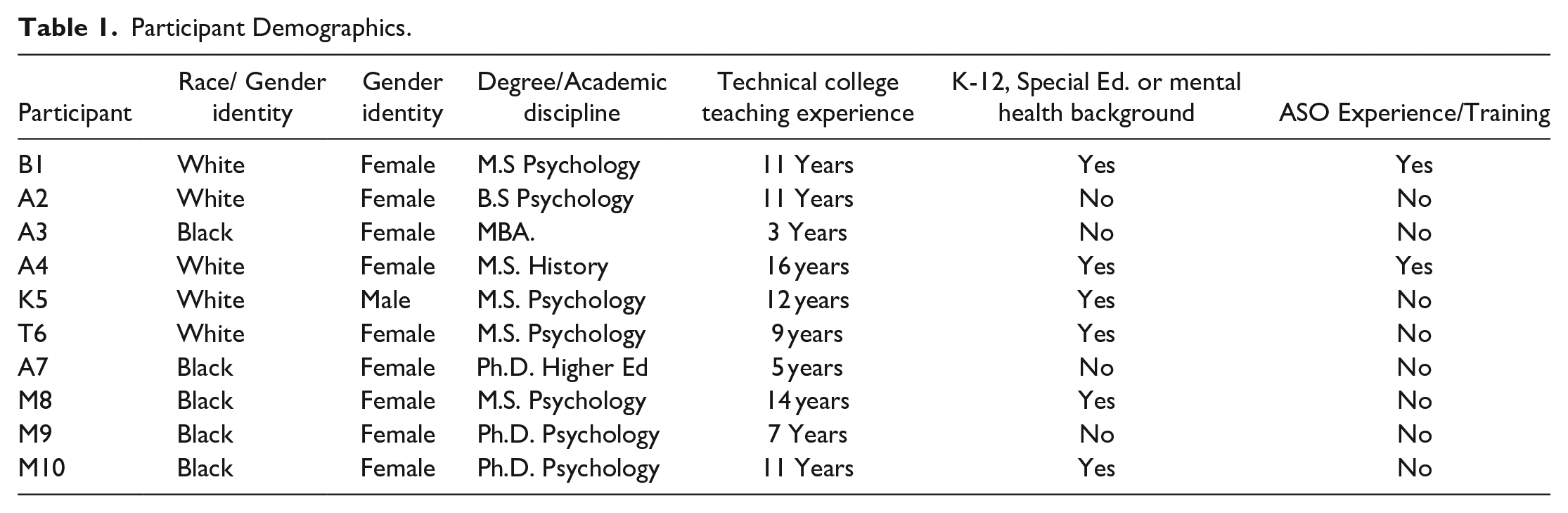
We used email to verify that potential participants met eligibility criteria.. All participant data was deidentified to maintain confidentiality, and all participants were assigned a pseudonym. All but one participant had prior training with educational accommodations. None had any training about disability or educational accommodations in their graduate degree programs.
Data Collection
The researchers engaged in individual semi-structured interviews which each lasted approximately 60 min. Probing questions were used to prompt participants or for clarification of meaning. This was a researcher-designed guide that was informed by the extant research on disability in community college contexts and faculty experiences with disabilities (Abes & Wallace, 2018; Faure & Sasso, 2023; Flink & Leonard, 2019).
The interview guide was constructed to solicit an understanding of faculty experiences and was composed of three sections of faculty background, transition, and experiences with learning accommodations. The first section explored participants’ professional faculty identity and their professional preparation. The second section explored faculty experiences with students transitioning into and navigating through their academia at a 2-year technical college. The third section explored technical college faculty members’ lived experiences and perspectives with students with learning accommodations. All interviews were held through virtual conferencing software and were recorded for transcription.
Data Analysis and Trustworthiness
In this phenomenological study, the data analysis began with elemental coding methods, which are “basic, but focused filters for reviewing the corpus to build a foundation for future coding cycles” (Saldaña, 2021, p. 364). Saldaña (2021) suggested this coding can describe specific situations or experiences. First cycle coding methods resulted in 45 open codes. These codes included descriptive, in-vivo, and process codes. More than 12 focused codes were made with the help of the second cycle of coding, which included both selective and process coding. A process of code mapping was used to organize final codes into themes which presents, a, “condensed textual view of your study, and potentially transforms your codes into organized categories, and then into concepts (Saldaña, 2021, p. 285).
This study followed Jones et al. (2014) trustworthiness strategies which included: (a) an external auditor with a priori experience and knowledge; (b) a subject matter expert; and (c) member checking using the interview transcript data. An external auditor and subject matter expert were used to clarify research bias, interrogate the organization of themes, and validate the coding. The auditor did not reinterpret these data which are the valid lived experiences of the participants.
Findings
The major findings of the study centered on two themes: faculty training and preparation to support students and faculty-student engagement for students with learning accommodations. Despite differences in the technical college faculty academic and career backgrounds, the participants’ shared their faculty experiences with regard to disabilities, student culture, and learning experiences of technical college students with disabilities in the context of a technical community college.
Previous Preparedness to Instruct Students with Accommodations
Faculty reported not to receive any formal training from their institution, although some received formal education in their graduate programs about disabilities, instructional accommodations, or inclusive learning practices. A nuance with several of the participants was that some had previous professional public K-12 education teaching or mental health community services experiences. This may have contributed to their proficiency in their careers as faculty in helping their technical college students with learning accommodations despite the lack of training at their technical college. Yet, faculty still felt unprepared to teach students with disabilities.
Only one participant reported receiving training for students with disabilities and learning accommodations at the beginning of their faculty career. This participant received training during department faculty meetings at their technical college about once every three years, totaling only two or three times. Participant K5 shared that their public school education experience also included writing Individual Educational Plans (IEPs) for special education students, and recruiting local junior colleges to speak to their students about transitioning from high school into college. Another participant, T6 shared, “as an educator of K-12 that has helped me because I’m able to recognize really quickly, just from training, what accommodations might be needed.” Participant T6, like other participants, relied on their graduate education which some provided knowledge and skills to promote inclusivity in the classroom. Participant B1, “,” responded with insight, I have a degree in psychology. I have an understanding of the various aspects of the largest or educational parts of individuals. I like to work with that population (disability), because I know from living with her [mother] and being around her for all these years, I think it prepared me for learning more and engaging more with that student population (disability). Really opened my eyes to how students, even if they have the same diagnosis, vary.
Participant A7 shared aspects of participating in a faculty boot camp training at a previous university before they could begin teaching there.
And so they train you on every facet of being an instructor, . . .but also the accommodations piece on whether students need extra time on exams, extra time to submit an assignment, or physical accommodations, like a quiet testing room, and things of that nature. I do feel like they go above and beyond to make sure that before they put us in those classrooms we are adequately prepared to teach and provide accommodations to all different types of learners.
Faculty reflection of about their experiences teaching students with disability indicated that they believed training and preparation are necessary components to understand and support students with learning accommodations as well as unidentified students experiencing academic challenges. Participant K5 emphasized, And then there’s other students that had something, like ADHD or a mood disorder, or something like that but they never ever were identified in the K-12 setting. And, those are things when going through adolescence and into early adulthood that may start coming about a little bit more and affect their college performance, especially Mood Disorders or other mental health disorders.
Participants described how their previous career experiences and training prior to becoming technical college faculty has been attributable to their knowledge for disability learning difficulties, learning accommodations, and inclusive learning strategies that have been incorporated into their current faculty positions. They used their previous career and graduate education to better understand their students with disabilities, introduce teaching strategies, or introduce differentiate approaches. These include strategies such as extended time, having to provide physical accommodation, or individual private conversations with students to agree on the most humanizing ways for facilitate their learning. Only one participant described formal training for learning accommodations provided by the Accessibility Services Office (ASO) at their technical college. This holds significance for faculty preparation and training in understanding various student learning challenges and how to implement educational accommodations.
Faculty Cope with Technical College Students
Participants described how their students with disabilities are steadily enrolling, and they are fluidly transitioning through the two-year program towards certification of a vocational program, graduation for an associate’s degree, or transfer to a four-year institution. Faculty participants described technical college students as non-traditional types of students that foster a culture of diversity of experiences, creativity, and positionalities. Participant T6 offered a typology of their students with disabilities You have your high achieving new enrollment students, and then you have your traditional students who maybe didn’t get into the college of their choice. And they’re coming to get their grades up, and then you also have people who are not necessarily going to continue on with college. But they’re getting a trade. So, it’s a huge variety of students, really all ethnicities, all you know, ages, all demographics. Really, I’ve had a 14- year-old student, and I have a 67 year old student.
Similarly, Participant B1 summarized that most vocational or technical students with disabilities were mostly first-generation or working 40 hr a week with a family. Another type of student with disabilities that was highlighted by participants was that many are formerly downsized workers seeking a career transition working towards something different, or to better themselves for their family. Participant A4 expressed the perspective that disabilities should be included in conversations about campus diversity and provided some additional context on the culture of the student body as diverse not only with regard to race, but also with regard to life experiences: We have such a diverse international student body, so not just American students, but a lot of students, whose English is not their first language. So just a lot of diversity across the board. And it’s been a very interesting and rewarding experience to teach students from many many different backgrounds.
Participants also suggested that the diversity of cultures among students with disabilities within the student body provides an environment for differing opinions and life experiences for courses to make the material personable and relatable. However, faculty also suggested that their students with disabilities needed more support than a student with disabilities going to a baccalaureate-granting college or university. They suggested this was because the students come from more disadvantaged backgrounds which they believed has been exacerbated since the COVID-19 disruption. Faculty shared individual examples of student behaviors reflective of traumatization, developmental delay, socially maladjusted, and having significant anxiety since the pandemic. Faculty A4 described this as: They shifted them to remote instruction, and they socially just don’t know how to connect. And it just breaks my heart. It really does. They’ve had their lives disrupted so badly by Covid. So, it’s just a sign of the times.
Faculty participant M9 expounded further: There’s definitely some generational components. And then some of it has to do, I think, with the population that’s unique to technical institutions. So the culture that I’m seeing is that for one in particular that I can identify because of my field in psychology, is that I’m seeing a lot of anxiety. Increased anxiety over the past five years. It’s just continuing, you know, and there’s one thing to read about it in a study, and another to just see it in your classroom. You know there has always been maybe one or two students that stood out because they were very anxious. And I don’t mean just anxious in the way that we all kind of generally get anxious, but anxious in the way that they actually share that they have a diagnosis or that they likely need to see someone potentially. The numbers of those students in my classes is, you know, it’s increased over the last several years.
The participants described belief that disability diagnosis may supersede the academic proficiency of their transitional student body. Faculty experiences with students with disabilities, regardless of their previous educational level and training, made them question their students as they wondered if they would struggle at various durations in a technical or vocational academic program. In general, faculty shared experiences in which they felt frustrated by their students. Participant A3, humorously characterized his experience as: I feel like there’s the joke that I’ve been saying, that is students have been watching too many YouTube videos because it almost feels like they’re showing up for a Ted talk, right? So from the students’ perspective, I’ve come to hear you talk. I don’t have to do anything with the information, and I don’t have to engage with it. It’s you entertaining me.
Faculty shared experiences of the challenges for faculty to entice students to read when there are competing technological alternatives for information that are appealing to students Participants emphasized that attending a two-year technical institution “is a big cultural transition” due to the reading level and literacy gap of students between high school and college. Moreover, faculty participants shared their observations of technical college students and their transitions to college culture.
Their students came directly from high school or from previous careers, but displayed learning challenges. They described learning problems associated with difficulties in the areas of time management, organizational skills, preparation, and being disengaged with poor study skills, or demonstrating poor literacy skills. The students without identified learning disabilities and accommodations were perceived by faculty to have a significant dependence upon faculty to assist them due to inadequate study and academic skills as K5 noted: I think one of the biggest barriers is just so many students have not realized that they have something whether it’s neurological or a disability or something that qualifies as a disability, that they really struggle with in the classroom setting.
This was the most significant barrier observed by faculty participants in that these students do not self-report or identify themselves as having learning challenges with a disability, or a previously diagnosed learning disability, or even needing accommodations. Similarly, faculty participant M10 shared: I feel bad, because there are many other students in the class who require so much time and attention who don’t have an accommodation. So ASO [Accessibility Services Office] sends me accommodation papers on five students across the whole eighty that I have. But, that’s not all that I’m dealing with. I am dealing with people who just really need me. It is overwhelming sometimes, and I feel bad because I want to be helpful, and I feel bad when I’m not giving enough time to the student. . . But I can’t say that I have had anyone with accommodations who ever failed my class, because I monitor that person.
These faculty felt the most concerned about students who do not have an educational accommodation and remain unregistered or do not understand they have a learning disability because they have not been diagnosed. Yet, faculty recognized that other students may have been previously diagnosed as a student with a disability, but their educational accommodations did not follow them.
Participants acknowledged that when students transition from high school to higher education they have to self-report to continue their educational accommodations, although it frequently discontinues. Participant K5 described this as, “Their special education IEP or 504 plan (from kindergarten through 12th grade, K-12) doesn’t follow them. The student has to self identify [in college]. So, if they don’t ever come to the disability or accessibility services office then they cannot, they don’t get those accommodations.”
Coincidentally, two different participants disclosed an experience about a student in their class with Tourette’s Syndrome. The shared experiences as reported by these two individual faculty participants exemplified the significance of the impact for faculty training on student engagement and support for those with diagnosed learning challenges with accommodations. Participant A7 added that they, “had one student who had Tourette’s, and sometimes there would be a verbal outbreak.” The participant tried to treat it as normal and was aware that the student was a little uncomfortable and deliberately did not isolate the student or purposely call on him in class to answer a question unless requested or volunteered. “A” expressed trying to be really respectful of the student where they would not be deeply embarrassed in the face-to-face class setting. Participant T6 shared: I had never taught a student like that. It wasn’t just a minor twitch. It was the outburst for lack of a better way to explain it, it was the sounds, outbursts, and I don’t have a background to be familiar with his disability. He did have an accommodation plan, because he needed extra time on assignments and accommodations with testing. But this particular student I think was more frustrated with the situation than his classmates, and I knew what he would be dealing with, and I obviously was as accommodating as possible. I think that he was more embarrassed by it because some students would be caught off guard when they would hear the sounds that he was making, and unfortunately he just withdrew from the college. He left. It’s really sad, because I think if he would have just pushed through. And I know when you don’t understand what a person is dealing with and you know some of the classmates may look funny, or they may make gestures. But certainly, as his professor, I was there to accommodate him and treat him, you know, fairly and just like any other student. But unfortunately he decided not to carry on, and he left, and I haven’t seen him since.
Both participants attempted to integrate the student with Tourette’s Syndrome or other students with learning accommodation into the climate and culture of their course, the best they knew how, based on their limited training. Furthermore, faculty believed their previous training increased their ability to feel competent in supporting not only students Tourette’s, but overall engagement with their classmates, and the curriculum. Moreover, faculty who lacked previous training felt this impacted their ability to maneuver the class environment for inclusivity. The student culture within these two different classroom situations was vastly different and the outcome for their student and contrasts inclusivity and isolation, but also student persistence versus student withdrawal for students with learning disabilities such as with the student with Tourette’s Syndrome.
Study participants shared their perception of the composition of the study body which was portrayed as diverse. Technical college faculty participants’ perceived that their fluidly transitional diverse student body contributes to the culture of their community college and enriched learning and teaching experiences within the classroom. They also shared a multitude of concerns ranging from mental health and academics to lack of self-advocacy and failure to report learning problems that may need accommodations from the ASO.
Discussion
The purpose of this phenomenological qualitative study was to understand the faculty experiences in supporting professional and vocational major students with educational learning accommodations at a technical community college. Faculty participants perceived their preparation and training about student disability from their institution as insufficient and relied on their graduate education as stopgap to support to support students with learning accommodations. Current literature lacks faculty perspectives on training and preparation for working with students with disabilities. There is limited research on technical college faculty insight and perspectives because it focuses on populations of students attending four-year colleges and universities. There are few studies of college students with disabilities who attend two-year community technical colleges (DuPaul et al., 2017; Elias & White, 2018; Qian et al., 2018). These findings may address some of these research gaps and contribute to existing scholarship by problematizing the concepts of faculty and student disability relationships at technical community colleges.
Faculty described their experiences with students as open, understanding, accessible, and supportive, and premised by knowledge gained in careers in public school education, special education, or mental health before joining their technical colleges as adjunct or full-time faculty. Only one faculty member reported any disability training participation. Previous research highlights the funding inequities and lack of professional development opportunities among community college faculty (Lombardi et al., 2013; Lombardi & Lalor, 2017).
Although students with disabilities have historically been tracked or limited to participation in vocational education programs, faculty at technical colleges are primary disruptors (Ngo & Sundell, 2023). Faculty further provided perspectives about how their students with disabilities are distinctive from other colleges because they required more support because they came from very diverse backgrounds with multiple identities. Technical college faculty are key connectors between industry, student success, and career connections (Davis, 2023; Davis et al., 2023; Nachman, 2024a). This can be transformational among diverse students with disabilities in providing social mobility (Gottfried et al., 2016; Theobald et al, 2019).
Participants stories about their students with disabilities confirm Evans et al. (2023), that a primary barrier to disabled students’ are the attitudes and behaviors of other people. Interpersonal aspects of ableism drastically limited sense of connection with others, which can lead to isolation or loneliness (Ngo & Sundell, 2023). Their students needed additional support and intentional connections to disability support services (Flannery et al., 2007; Squires & Countermine, 2018; Hong, 2015; Marshak et al., 2010; Stein, 2013).
Faculty described their technical college students with disabilities as “disadvantaged” because of their personal circumstances which they also believed was complicated by generational differences or changes after the COVID-19 learning disruption. These perceptions of their students reflect complicated duality. First, these reflect a community college and disability stigma which hold a deficit perspective (Ocean at al., 2025). Black et al. (2014) found that faculty attitudes are a result of the lack of familiarity and training for accommodations for students and suggested that faculty need more training on disability awareness, accommodations, and the accommodation process.
However, faculty demonstrated compassion about their multiple identities and took additional efforts to support and understand their students with disabilities (Abes & Wallace, 2018). Faculty engagement and support has been suggested to be a key component student success (Faure & Sasso, 2023). Engagement with faculty is important because when students perceive that professors have adequate knowledge about students with learning accommodations, it is easier for students to approach their professors about their accommodation needs (Cole & Cawthon, 2015). Faculty preparation is also significant in postsecondary settings for providing faculty-student engagement and support for students with disabilities, especially within career and technical education contexts (Nachman, 2024a, 2024b).
Limitations
The transferability of the findings are limited based on the small sample size, scale of the research, geographical location, and the small number of technical colleges from which faculty participated. Limitations of the study also include the homogenous group of faculty participants central to the department of social sciences in the technical colleges due to the snowball method of faculty recommendations for potential faculty participant interviews.
There are also atypical patterns of participant career experiences in public school education, special education, or mental health experience prior to becoming faculty at their technical colleges, as well as a faculty who also work in the ASO which has afforded them their knowledge base for learning accommodations. Secondly, the collection of data through interviews relied on self-reported data, because the phenomenological approach does not use numerical data to substantiate results.
Implications for Practice
The findings of this study can be incorporated by higher education administrators and faculty leaders to ultimately improve faculty-student engagement and support for students with disabilities. There are implications for practice are related to how technical community colleges can implement training tailored to improve faculty preparation for inclusive instructional practices and facilitating a culture conducive to faculty-student engagement for students with disabilities. According to Bensimon (2007), an equity-minded approach to systems, institutional mechanisms, and educator gaps in knowledge are the problem, not the students. Lack of knowledge about disability and the absence of systematic disability-specific training or educational programs are barriers to student engagement (Evans et al., 2017).
Despite the expectations of faculty to provide learning accommodations to students with disabilities, faculty in this study lacked professional development opportunities and relied on their professional experiences and graduate education. Faculty can overestimate their knowledge of learning disabilities and be unprepared to teach students with learning disabilities and tended to (Hansen & Dawson, 2020). Other than administering the learning accommodations approved by the ASO, faculty were never provided training to integrate inclusive learning strategies into their instruction for students with learning accommodations. Hartsoe and Barclay (2017) concluded that faculty should be informed about the resources on campus regardless of faculty beliefs, knowledge, or encourage the use of UDL. Faculty need training on disability awareness, learning accommodations, and incorporating inclusive learning strategies, in particular for hidden disabilities.
Outside of e-mailed communication reminders of approved student learning accommodations faculty must administer, the opportunity to strengthen faculty preparation and understanding of learning accommodation is limited or not facilitated. Developing innovative and effective ways of enhancing student engagement can require creativity and ingenuity, as college students are exposed to greater freedom and opportunities than in past decades (Quaye et al., 2020). Consequently, students must intentionally self-disclose their experiences and problems, and seek resources provided by the college to assist in transitioning through these difficult situations (Evans et al., 2017; Quaye et al., 2020). The legal mandates facilitate inequitable expectations for students with disabilities, because self-identification is a skill set legally required of no other student population (Cole & Cawthon, 2015; Quaye et al., 2020).
However, students should not be chiefly responsible for engaging themselves, but faculty and student affairs educators must foster the conditions that enable diverse populations of students to be engaged, persist, and thrive (Quaye et al., 2020). Institutions that relegates responsibility for students seeking accommodations to one office, the accessibility services office, makes it less likely that colleges will proactively seek ways to expand access or view students with learning disabilities as a form of diversity (Quaye et al., 2020; Stein, 2013). In contrast, students can build support systems with peers, the campus community, registered student organizations, and mentors such as faculty advisors and professors (Evans et al., 2023).
Students’ decisions to use their disability accommodations, seek assistance from faculty, and persist to graduation in their programs can be influenced by their faculty (Cole & Cawthon, 2015). Additionally, according to Evans et al. (2017) the challenges of students needing learning accommodations and inclusive learning strategies extend to higher education leaders and administrators most importantly because of the number of students with disabilities in higher education, and due to the dependency on students for voluntary disclosure to self-report identification of a disability (Evans et al., 2017). Enrollment in two-year vocational and technical higher education institutions continues to increase for students with disabilities (U.S. Department of Education Office for Civil Rights, 2021), understanding faculty perspectives are essential to understand program improvement and how teaching practices impact student retention and completion of educational programs (Nachman, 2024a, 2024b).
Conclusion
This study provides nuanced findings about the ways in which technical community college faculty engage and attempted to respond to their students with disabilities learning accommodations. As the percentage of adult learners with unidentified and registered learning disabilities continues to grow for community colleges, higher education leaders will need to assess this growth on the impact of student achievement, student retention, and how this impacts their institutions. Future research should consider the findings of this study and determine if the conclusions are limited to the two-year southeastern technical community colleges or representative of other technical community colleges.
Footnotes
Declaration of Conflicting Interests
The author(s) declared no potential conflicts of interest with respect to the research, authorship, and/or publication of this article.
Funding
The author(s) received no financial support for the research, authorship, and/or publication of this article.
