




Abstract
Keywords
With the Covid-19 pandemic and growing inequalities, there is an urgent need to align educational pathways with employment opportunities and outcomes in equitable ways (Fuller et al., 2022). The United States’ labor market privileges individuals with at least a bachelor’s degree since these degrees are increasingly necessary to obtain “good jobs” 1 (Carnevale, Jayasundera, et al., 2016; Kalleberg, 2011). To highlight the value of a bachelor’s degree, when 11.6 million jobs were added to the economy after the Great Recession of 2008 to 2010, 73% of those jobs went to workers with at least a bachelor’s degree and 99% of those jobs went to workers with at least some college education (Carnevale, Jayasundera, et al., 2016). Some researchers have produced evidence to highlight a positive relationship between baccalaureate attainment and improved social, economic, and life conditions (Carnevale, Campbell, Cheah, et al., 2022a; Carnevale, Campbell, Gulish, et al., 2022b; Hout, 2012). Yet, there are inequities in who benefits from baccalaureate degree attainment and alleged positive labor market outcomes, particularly with respect to factors such as gender, race, and age (Carnevale, Campbell, Cheah, et al., 2022a; Carnevale, Campbell, Gulish, et al., 2022b; Cheng et al., 2021; Paul et al., 2022).
Historically, the United States’ community colleges have played a role as a social institution that supports many states’ economic and workforce development (EWD) goals (Jacobs & Worth, 2019). In the past three decades, a growing number of states have authorized their community colleges to offer and confer bachelor’s degrees (Meza & Love, 2023). The community college baccalaureate (CCB) 2 presents a new opportunity to provide more accessible and affordable bachelor’s degrees to advance social and economic mobility for communities from historically minoritized backgrounds and to meet local or regional EWD demands (Fulton, 2020). In the past decade, the California legislature passed policies that would allow their 116 community colleges, upon program approval, to offer bachelor’s degrees (Assembly Bill 927, 2021; Senate Bill 850, 2014). California is one of the largest economies in the world and home of one of the largest and most ethnically/racially diverse community college systems in the nation. Such policies signal the relevance of CCB programs in California and across the nation to address inequities in baccalaureate degree attainment and supporting EWD goals.
Per Assembly Bill 927 (2021), California community colleges must document that their proposed CCB programs are “in a subject area with unmet workforce needs in the local community or region of the district” (p. 91). Despite the role that many community colleges play in addressing local labor market needs and EWD, there is ambiguity in how community colleges strategize and take concrete steps to successfully align with EWD (Sublett et al., 2021). According to Meza and Love (2023), CCB programs are a popular strategy to meet EWD and equity goals since they “expand access. . . [and]. . . they do so in a way that fills critical equity gaps facing adult and working learners, rural students, and those who began at a community college and want to continue where they started” (p. 1). However, there is a need to better understand how colleges justify these programs as relevant and viable to local labor market conditions and EWD. In this project, we examined the application proposals that the first 15 approved California community colleges submitted to get their respective CCB programs approved. Using a content analysis methodology, we asked the following research question: How did the first 15 approved California community college baccalaureate programs justify that their programs would successfully align with local economic and workforce development?
Relevant Literature
The Community Colleges’ Role in Economic and Workforce Development
Although state-level variation exists, many education policies have broadly reinforced the important role that the United States’ community colleges play in EWD 3 (Jacobs & Worth, 2019). For example, following the Great Recession of 2008 to 2010, the federal government began the Trade Adjustment Assistance Community College and Career Training (TAACCCT) grant program in 2011. This program was a two-billion-dollar federal investment meant to increase higher education institutions’ capacity to help workers who lost their jobs or who were experiencing the threat of job loss to acquire “the skills, degrees, and credentials needed for high-wage, high-skill employment while also meeting the needs of employers for skilled workers” (U.S. Department of Labor, 2011, p. 1). Community colleges were large beneficiaries of the TAACCCT program since 85% of the 720 institutions that received funding were community colleges (Blume et al., 2019). However, receiving funding does not guarantee successful EWD alignment.
Economic & Workforce Development Alignment: Opportunities & Challenges
Scholarship detailing the extent that community colleges successfully align with EWD can be mixed and much of the research primarily focuses on career technical education (CTE) programs (D’Amico, 2016). Some research indicates that community colleges may not always offer academic programs that align with local labor market needs (Moore et al., 2012; Sublett & Tovar, 2021). In contrast, other research signals that there is some EWD alignment since there are positive labor market returns for some academic programs, but factors such as program of study, gender, and race/ethnicity impact the extent that community college students are experiencing labor market outcomes equitably (for review of literature, see Belfield & Bailey, 2011; for more recent analyses see Grosz, 2022 or Stevens et al., 2019). Given these inequities, community colleges can be better aligned with EWD so that students achieve positive labor market experiences and outcomes (e.g., good jobs) (Sublett et al., 2021).
To support EWD alignment goals, community colleges can form collaborations with businesses and industry partners (hereafter industry partnerships) to develop EWD-aligned practices, programs, structures, and systems (Orr, 2001). Industry partnerships can be useful in providing community colleges with a better understanding of local and regional labor market conditions with relevant and timely labor market data (e.g., job projections and salaries by programs/majors) that may not always be easily accessible (Sublett & Tovar, 2021; Sublett et al., 2021; Toutkoushian, 2005). Hirschy et al. (2011), in their conceptual model for student success in community college occupational programs, highlighted student success strategies that involve industry partnerships (i.e., connecting students with their intended work environments, interacting with professionals, co-curricular career-related work experiences, career assistance, socialization to professional norms, and industry advisory boards).
Building upon and reframing Hirschy et al. (2011), we posit that there are both micro and macro policies that community colleges can embrace to support EWD alignment and foster equitable labor market experiences and outcomes for students. On a micro-level, the behavioral decisions that job seekers make—which occur in the context of one’s gender, race, and additional social identities—has implications on their ability to secure and maintain employment (Evans & Moore, 2015; Gershon, 2016; Goodridge, 2022; Kang et al., 2016). Students can enjoy improved labor market experiences by engaging in practices and programs that enhance their social capital and networks (Chetty et al., 2022) and their ability to access and activate information about social mobility, labor market, and income—what Hill (2021) calls mobility knowledge—can be tools that improve students’ labor market experiences and outcomes. To be more EWD-aligned, community colleges can implement these practices and programs through career support services, faculty mentorship, and curriculum that provide students with the support, strategies, and skills to navigate the labor market and workplaces.
On a macro-level, anti-poverty policies can inform programs, structures, and systems that foster ideas of what successful EWD alignment and advancing equity could look like for community colleges (DeLoach et al., 2023; Hirschy et al., 2011; Page, 2014; Paul et al., 2018). A policy perspective that relies on baccalaureate attainment to single-handedly equalize racial wealth gaps dismisses the prominent role that inequitable resource allocation and social structures play in limiting the ability for people, particularly Black Americans, to fully activate activating the material benefits of bachelor’s degrees (Chelwa et al., 2022; Hamilton, 2022; Francis et al., 2022). Policies relating to skill-enhancing training programs (Page, 2014) and job guarantee programs (Paul et al., 2018) are structural and systemic tools to address inequities. Such programs, structures, and systems can be translated in the context of community colleges to ensure EWD and equity. Community colleges might engage in industry partnerships to foster skill-enhancing training and/or work-based learning opportunities (DeLoach et al., 2023). This could be fieldwork/internships and/or guaranteed job placement agreements. However, industry partnerships must also acknowledge who is able to meaningfully engage in such opportunities, given the inequities in access to internships for Latina/e/o/x students (Hora et al., 2022). Ultimately, many community colleges’ academic programs, particularly those that align with EWD, are inherently skill-enhancing training programs (Page, 2014) since these academic programs emphasize the development of relevant skills desired by the labor market.
The Rise of Community College Baccalaureate Programs
Given their open-admission policies and sheer number of institutions, the United States’ community college system provides a financially and geographically accessible and affordable pathway to higher education, particularly for students from historically minoritized communities (Brint & Karabel, 1989; Deil-Amen, 2015; Reyes et al., 2019). Community college baccalaureate programs present a new opportunity to provide more accessible and affordable bachelor’s degrees that can advance social/economic mobility for historically minoritized communities and meet local EWD demands (Carnevale, Campbell, Gulish, et al., 2022b; Fulton, 2020). With at least 23 states authorized to offer CCB programs (Community College Baccalaureate Association, 2023), there is an increasing number of community colleges that offer bachelor’s degrees in the past three decades (Meza & Love, 2023).
While CCB programs may represent an equity strategy (Fulton, 2020), the development of a CCB program does not necessarily guarantee that CCB programs will advance equity goals (Cuellar & Gándara, 2021). From their interviews with administrators in three states with CCB programs, Cuellar and Gándara (2021) suggested that CCB administrators primarily saw CCB programs as a strategy to meet EWD goals and advance socioeconomic mobility for students. The potential for CCBs to address equity, and racial equity especially, was more implied than explicitly stated. Furthermore, Cuellar & Gándara argue that because there was not an explicit focus on race, this impacted the extent that outreach, marketing, admissions, and support services practices could generate positive outcomes for students from racially minoritized communities. A preference to rely on EWD goals is not an uncommon approach in practice and policy, but such approaches may be at the expense of more race-conscious policies and being able to appropriately highlight and rectify inequities (Felix & Garcia, 2023). The data support this; while the labor market outcomes for CCB graduates in California (Hoang et al., 2022), Florida (Love, 2020), and Washington (Kaikkonen & Quarles, 2018; Meza & Bragg, 2022) have generally been positive on average, there are inequities in who graduates and who experiences wage premiums by factors such as program of study, gender, and ethnicity/race (for a review of labor market outcomes for CCB programs, see Meza & Love, 2023).
California’s Community College Baccalaureate Programs
In the past decade, CCB programs have also made their mark in California’s higher education system. In 2021, California approved CCB programs to move from a pilot stage at 15 colleges to a permanent program, allowing up to 30 additional community colleges to develop CCB programs per academic year—signaling the growing relevance of these programs in California’s public higher education landscape (Assembly Bill 927, 2021; Senate Bill 850, 2014). California’s Master Plan for Higher Education of 1960 historically relegated baccalaureate conferment to their traditional 4-year public colleges (Rios-Aguilar et al., 2023; University of California Office of the President, 2017). As such, Assembly Bill 927 and Senate Bill 850 fundamentally changes the structure of California’s public higher education system.
Like other states, California’s legislation for CCBs explicitly discusses local and regional EWD goals. Community colleges must justify how their program aligns with local and regional EWD when applying for baccalaureate programs (California Community Colleges Chancellor’s Office, 2022b). During this application process, community colleges have flexibility to use various information to justify their proposed CCB programs. To provide language and insights into the various ways colleges justified their CCB programs and aligned with EWD goals, we utilize theories related to career competencies and spatiality.
Theoretical Framework
Career Capital Framework
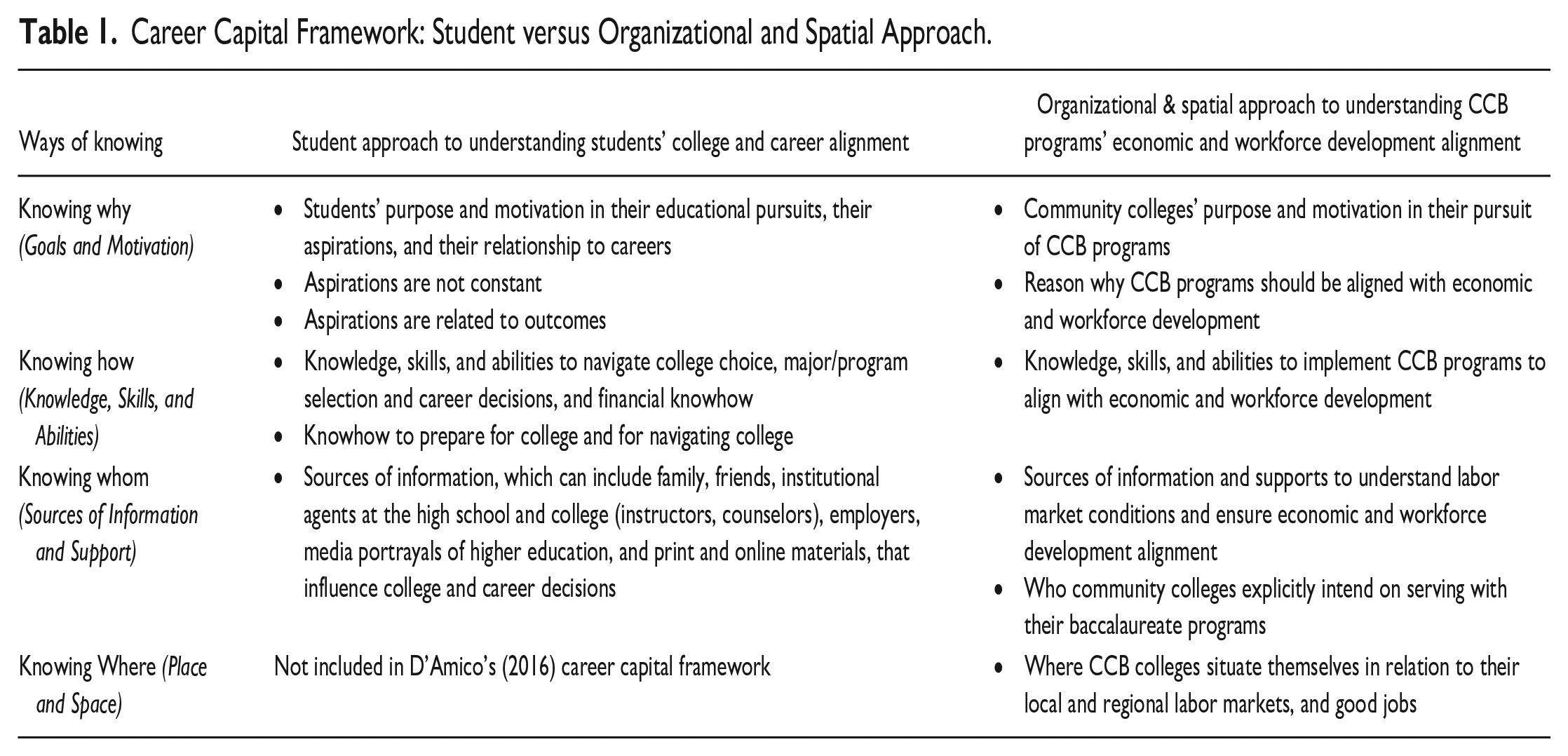
Drawing from DeFillippi and Arthur’s (1994) conceptualizations of career competencies, D’Amico et al. (2019) developed the career capital framework to explore and understand community college students’ college and career alignment through three elements: knowing why (aspirations), knowing how (knowledge and skills), and knowing whom (sources of information). While “‘ways of knowing’ is at times difficult given the fluidity of knowledge construction and the interdependence” among the ways of knowing (D’Amico et al., 2019, p. 56), this compartmentalization is useful to organize these general heuristics. The career capital framework is flexible enough to be applied in multiple community college contexts. It has been applied to understand students’ college and career alignment (D’Amico et al., 2019), as well as been used to understand students’ parents’ college experiences and decision-making (Huerta et al., 2022). Given this flexibility to organize how a unit of analysis may engage in college/career alignment and decision-making, the elements of the career capital framework can be applicable in understanding the ways of knowing that community colleges rely upon to justify their CCB programs as EWD-aligned.
Critical Spatial Perspectives
Spatial perspectives, like the concept of geography of opportunity, frame how individuals’ educational and occupational opportunities are influenced by their geography (Galster & Killen, 1995; López Turley, 2009; Tate, 2008). The geography of opportunity has been applied in community college contexts to examine how students’ decisions are informed by their local labor market and educational systems (Martinez & Acevedo, 2021; Reyes et al., 2019). Relatedly, critical geographic and spatial frameworks have been useful in articulating how racial inequities and injustices are realized and perpetuated in the spaces that we occupy (Dache, 2022; Soja, 2010; Solórzano & Vélez, 2016). The interaction and intersections of race, place, and space are social and politicized processes that have implications on racial inequities in education (D. J. Baker et al., 2023a; R. B. Baker et al., 2023b). Given the place-bound nature of CCB programs (Fulton, 2020), critical spatial perspectives are relevant in this project. In California’s proposed CCB programs, terminology such as “local community or region” are used to situate where the EWD demands must be met. As such, knowing where (space and place) community colleges understand and situate themselves in their efforts to align with their local and regional EWD goals will be a relevant element to examine.
Career Capital Framework: An Organizational and Spatial Approach
By combining the career capital framework (D’Amico et al., 2019) and critical spatial perspectives, we were guided by the ways of knowing that community colleges rely upon to justify their baccalaureate programs—knowing why (goals and motivations), how (knowledge, skills, and abilities), where (space and place), and whom (sources of information and support)—in the name of successful EWD alignment. We not only built upon the career capital framework by incorporating critical spatial perspectives but also reorient this analysis to the organizational level rather than the student level (see Table 1 for a summary of how these elements are converted from a student-level approach to an organizational-level and spatial approach). Organizational-level approaches can be valuable in understanding the broader structural opportunities and constraints in which community college students operate (Hart, 2019). Given the impact that policies, structures, and systems can have on student outcomes, it is necessary to center the ways that organizations (in this case, community colleges) can influence and are responsible for creating conditions that support and/or inhibit community college students’ ability to experience social and economic mobility. For this project, we applied the three elements of the career capital framework (D’Amico et al., 2019) to understand community colleges’ EWD alignment. Given the relevance of place and space in CCB programs, we incorporated a fourth element: knowing where. This orientation is not unprecedented since DeFillippi and Arthur’s (1994) early conceptualization of career competencies was originally in response to their field’s focus on firm-based (a.k.a., organizational-level) competency perspectives at the time. DeFillipii and Arthur wanted to focus on individual employees given the changing national and global market context at the time; however, they acknowledged the relevance of specialized knowledge and competencies that were specific to geographic regions and their respective industries.
Career Capital Framework: Student versus Organizational and Spatial Approach.
Methods
Sample
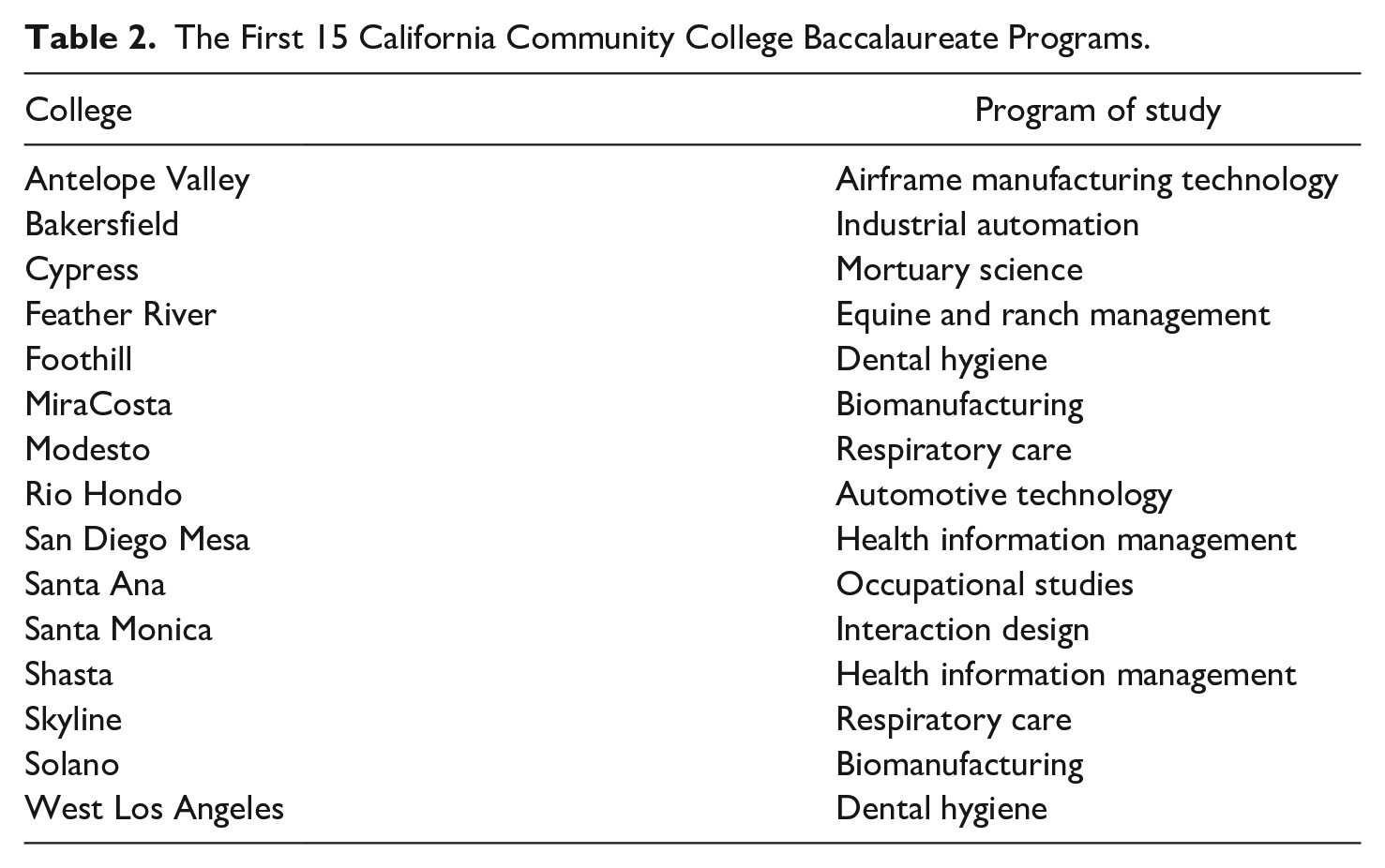
After going through the Institutional Review Board (#23-000260), we analyzed the application proposals of the first 15 approved California community college baccalaureate programs (see Table 2 for a listing of the first 15 California CCB colleges and programs). 4 We focused on the applications of the first 15 approved CCB programs since they can play an instrumental role in influencing the operations and conceptualizations of current and future California CCB programs. We retrieved this data through the California Community Colleges Chancellor’s Office (CCCCO) by filing a California Public Records Act request. The CCCCO Academic Affairs Division outlines directions for community colleges who were considering applying for a pilot CCB program (CCCCO, 2014). This included, but is not exclusive to, documentation of Need (Statement of Problem), Response to the Need, Program Management/Institutional Commitment, and Identified Resources. Within each of these sections are sub-elements. For example, under Need (Statement of Program), colleges are asked to provide a “summary of regional and/or statewide labor market and employer demand that documents the unmet workforce needs” (CCCCO, 2014, p. 6). Colleges are also asked to evaluate community support and outline course curriculum. Given the components of the application process, CCB applications are an appropriate sample to address our research question since community colleges must justify elements of why, how, where, and whom that are relevant for ensuring EWD alignment.
The First 15 California Community College Baccalaureate Programs.
Analytic Strategy
To make sense of how the first 15 approved California CCB programs justified why, where, how, for/with whom their respective programs aligned with EWD goals, we conducted a qualitative content analysis on these community colleges’ CCB application proposals. Content analysis is a flexible form of textual analysis that is a “systematic, rigorous approach to analyzing documents” (White & Marsh, 2006, p. 22) and to “understand[ing] what they mean to people, what they enable or prevent, and what the information conveyed by them does” (Krippendorff, 2004, p. xviii). In higher education research, content analysis has been used to examine a breadth of topics, from community college logics based on policy and organizational documents (Levin et al., 2018) to 10 years of research scholarship on campus sexual violence (Linder et al., 2020). As such, given its relevance analyzing documents in higher education scholarship, we utilized content analysis to understand the ways of knowing (why, how, where, and whom) that CCB colleges relied upon to justify their programs in the name of EWD.
Our content analysis included multiple cycles and rounds of both inductive and deductive coding (Miles et al., 2019) to identify bodies of text that are related to our theoretical framework (knowing why, how, whom, and where). Through this process, we generated analytic codes, patterns/themes, and findings (Miles et al., 2019; Saldaña, 2013; Strauss & Corbin, 1998). For example, in our first round of coding, we identified bodies of text that were associated to each of the four ways of knowing. Knowing why examines the extent that colleges knew the reasons that CCB programs were needed. Knowing how captures the knowledge, skills, and abilities needed to align their CCB programs with EWD. Knowing whom describes the sources of information and support the CCB colleges used to make sense of labor market conditions. Knowing whom also describes who will be served by programs. Knowing where articulates where the CCB colleges situated themselves in relation to their local and regional labor markets. In the subsequent rounds of coding, we developed new analytic codes and categories to capture, elaborate, and/or revise existing codes. For example, in round two, the subcodes for knowing whom included accreditation, auditors, and compliance agencies, business and industry, government-related units, internal constituencies & personnel, other educational institutions, and students. In round three, we created subcodes, when appropriate, for administration, faculty, and staff within the internal constituencies and personnel subcode. In the initial rounds of coding, we focused on refining the inclusion/exclusion criteria of our codes. We continued this process until we arrived at a set of refined codes and subcodes that captured the most prominent ways of knowing that the CCB colleges displayed in justifying their CCB programs. This iterative process, along with writing analytic memos and engaging in reflexivity to consider our own positionality in relation to this project (see Appendix for our Positionality/Relationality Statement), helped us ensure the trustworthiness of our codes and generating findings that address our research question (Krippendorff, 2004; White & Marsh, 2006).
Findings
Knowing About the Labor Market Through Multiple and Varied Information and Sources
The 15 approved California CCB colleges made sense of their labor market conditions and justified their respective program’s relevance to EWD using a variety of labor market information (LMI). Most often, the 15 CCB colleges provided this content in the Need (Statement of Problem) and/or Response to the Need sections of their CCB applications. The inherent structure of proposal application ensured that all 15 colleges knew why they were proposing CCB programs—to align with local or regional EWD goals. In contrast, colleges were given more flexibility to articulate their knowledge of whom they could go to for LMI and support. Through their justifications, CCB colleges also highlight their knowledge of where they situate their understanding of local and regional labor market conditions.
The CCB colleges cited a range of networks to provide them with relevant EWD information and support, and this included some combination of businesses, advisory committees, professional associations, students, politicians, state and federal entities, private vendors, as well as other LMI sources. Data came in the form of data systems affiliated with the federal and state governments (e.g., Bureau of Labor Statistics, California Employment Development Department), CCCCO (e.g., Centers of Excellence), private vendors (e.g., Lightcast), 5 as well as published reports, surveys, and official expressions of support. On average, colleges incorporated approximately five different LMI sources to justify their EWD alignment.
There was variation in which LMI sources the CCB colleges relied upon to justify their programs’ EWD alignment. For example, Antelope Valley College incorporated LMI from federal and state government databases by looking at job projections and wage information to justify their Airframe Manufacturing Technology Bachelor of Science (B.S.) program. However, given data limitations of the governments’ databases to provide information about occupation(s) that were most strongly aligned to their degree program, they also relied heavily on an advisory committee, which included representatives from local businesses, for LMI. Antelope Valley College (2014) shares: Local advisory committees had a different perspective than the usual employment data sources. The Spaceship Company representative said that the company has 80 to 100 employees who do not have bachelor’s degrees who would benefit from the proposed degree. . . The Spaceship Company currently has about 25 positions that could directly be recruited from the proposed bachelor’s degree program at this time, and six to eight graduates would be needed annually to fill vacated positions and newly created positions. . . The Northrop Grumman representative stated that 100 of the company’s current employees could benefit from graduation from the proposed bachelor’s degree. (pp. 5–6)
Antelope Valley College’s incorporation of job projections from individual businesses was not LMI that could be accessed through a federal and state government database; such databases typically report job projections for instructional programs and/or occupations. As a result, by knowing whom, CCB colleges could have access to more quality LMI that would be useful in justifying their CCB program.
There was variation in the type of LMI and metrics that the colleges reported about the individual businesses. The Spaceship Company and Northrop Grumman Corporation both provided Antelope Valley College with information on how many of their current employees could benefit from the Airframe Manufacturing Technology bachelor’s degree, whereas only The Spaceship Company provided LMI on projected annual openings. Job projection LMI also varied: The Spaceship Company gave annual projections to Antelope Valley College, Genentech Vacaville reported projections in the next 3 years to Solano College, and BioMarin reported projections in the next 5 years to Solano College. Individual businesses provided varied LMI, which speaks to the complexity of understanding labor market conditions and the value of knowing whom could provide insight on whether their CCB programs would be EWD-aligned.
By accessing job projections from local businesses, Antelope Valley and Solano College highlight that they not only knew whom to get LMI from to make sense and justify their respective CCB program’s alignment to EWD, but that they also knew where their college and students were situated. The two colleges identified local businesses that were relevant in understanding the employment prospects for graduates in their respective CCB programs. Since CCB programs are meant to provide educational access and appeal to place-bound students (Fulton, 2020), it seems important that CCB programs identify local employers where graduates could become employed. However, the extent that the CCB colleges reported job projections from individual businesses were rare; Antelope Valley and Solano College were exceptions and not the norm. Instead, the role of businesses and/or advisory committees were most commonly broad expressions of support through statements, letters, and/or meeting minutes.
All the CCB colleges provided some job projection data relevant to their CCB programs, typically at the regional and/or state level. They typically used data systems associated with the federal and state governments, the California Community Colleges Chancellor’s Office, and/or private vendors. For example, Modesto Junior College (2014) justified their Respiratory Care B.S. degree program by stating, “According to the Bureau of Labor Statistics, respiratory care practitioners are projected to increase 28% in the next six years” (p. 5). They also supplement this LMI with data from a private vendor; they reported the 5-year job projections and average hourly wages for respiratory care practitioners in two geographic areas: the Central Valley and California. By reporting these data, the 15 approved CCB colleges were able to signal that they had a sense of whom would provide acceptable LMI that would help get their CCB programs approved and where these data had to be situated. In thinking about where, CCB colleges frequently relied on regional and state geographic data—reporting LMI at the city, census tract, county, or college/district service area level.
Collectively, these cases exemplify the multiple and varied LMI sources that CCB colleges relied on to justify their programs as aligned to EWD. By doing so, colleges had multiple avenues to exhibit that they knew whom they could get information and support from, as well as where to situate themselves as a CCB program that would be aligned to local and regional EWD. However, this also meant that the type and quality of information they received and the specificity of their knowledge about labor market conditions varied. Job projections varied by the year, by the unit—job projections of individual businesses, of related occupation(s), and/or of related academic programs—and by geographic level.
Knowing About Inequitable Labor Market Experiences and Outcomes
The CCB colleges were limited in their discussion of inequitable labor market experiences and outcomes, particularly for different student populations and communities (e.g., gender, race/ethnicity, age). Community colleges are more likely to enroll students from historically minoritized communities (Brint & Karabel, 1989; Deil-Amen, 2015; Reyes et al., 2019), suggesting that they enroll students that are susceptible to labor market discrimination. For a CCB college to know why they were creating their program—to meet local or regional EWD goals—implies that successful EWD also means meeting the labor market experiences of students from historically minoritized communities.
CCB colleges acknowledged the relevance of gender, race/ethnicity, and age in conceptualizing who they are as institutions. In the Need (Statement of Problem) section of the CCB colleges’ application proposal, there is a space for those colleges to provide demographic information about their college, district, and/or region. While there are no specific directions on which demographic information to provide, CCB colleges consistently reported the number and/or proportion of people enrolled within their college and/or in their respective counties by race/ethnicity, gender, and age. This signals the CCB colleges’ knowledge of whom could and/or should be served by these programs. While CCB colleges briefly reported their gender, race/ethnicity, and age figures in a few sentences and/or through data tables, they rarely analyzed local or regional labor market inequities that might result from (the combination of) gender, sexism, race/ethnicity, racism, age, and ageism. Instead, they merely elected to provide some relevant demographic data despite opportunities to be more expansive.
The majority of CCB colleges incorporated survey data from current students and alumni as LMI to justify their programs’ EWD alignment. Yet, they were evasive in any sort of discussion about (in)equitable labor market experiences and outcomes that might have been observed from the survey data. For example, colleges typically shared that respondents were interested in and/or needed these programs to stay competitive in the labor market (e.g., EWD alignment). Yet, the reporting of these data was never disaggregated to critically examine and acknowledge potential differential experiences and outcomes of students by gender, race/ethnicity, age, etc. Through this practice, CCB colleges made invisible the knowledge of whom they could best serve and erased the possibility of articulating and/or understanding any labor market inequities that might have been experienced by their students or alumni through the application process.
One way that a handful of colleges took advantage of the opportunity to acknowledge labor market inequities was by discussing how their CCB programs would help diversify the workforce. For example, West Los Angeles Colleges’ (2014) application for their B.S. in Dental Hygiene discussed “the general need to diversity the workforce” (p. 5) and highlighted the “gender and racial disparity between the population of the state and the dental profession” (p. 5). West Los Angeles College (2014) share: . . . there is little disagreement about the need for and importance of recruiting a diverse student body to ensure that the composition of the dental workforce begins to reflect the (i) diversity of the state and (ii) that this might be a key strategy to lessen the oral health disparities that afflict the state’s minority and low-income populations. (p. 5)
As the only college to do so, their application also uniquely includes data disaggregation by gender, race/ethnicity, and age group. They discussed demographics at their college broadly, within their Allied Health division, within the Los Angeles Community College District, within their dental hygiene associate degree program, and dental hygiene students nationally. The inclusion of this data signals West Los Angeles College’s knowledge of not only whom their students are, but an understanding of where they situate their program regionally, statewide, and nationally. Given their large population of Latina/e/o/x students, they also note that they were “leading the national effort to diversify the dental hygiene profession” (West Los Angeles College, 2014, p. 3). They conducted an analysis of the costs of similar Dental Hygiene baccalaureate programs locally and justified their program by discussing how the low cost of their program would promote “access from communities of color to diversify the profession and low-income populations to be an engine of economic growth” (p. 5). However, West Los Angeles College’s acknowledgement and analysis of labor market inequities was the exception and not the norm.
Instead, the majority of CCB colleges did not discuss this function of diversifying the workforce. For the handful of CCB colleges that acknowledged this function, their discussion was very limited—often relegated to a few sentences. Foothill College (2014) shares: Foothill College has robust outreach and retention programs to increase the enrollment and success of underrepresented populations, including but not limited to Latinos, African-Americans, and Filipinos. The baccalaureate pilot will have focused strategies to ensure broad diversity of participants. (p. 11)
Again, while Foothill College articulated their knowledge of whom could be served by their CCB program (e.g., “underrepresented populations” [p. 11] such as “Latinos, African-Americans, and Filipinos” [p. 11]), the level of detail in how they would strategically implement relevant practices, programs, structures, and systems to do so was limited in their proposal.
Overall, despite the inclusion and acknowledgement of the diverse student communities that could be served by CCB programs, it was rare for colleges to elaborate on how equity in EWD was central to their program justification and proposal. Through the reporting of the gender, racial, and age composition of their relevant spaces and places, CCB colleges signaled some knowledge of whom and where they were meant to serve. However, the colleges were limited discussion of how they would provide unique and targeted programs, structures, and systems to explicitly ensure EWD and to do so to meet the needs of their diverse student populations.
Knowing About Practices, Programs, Structures, and Systems to Support EWD Alignment
Industry partnerships can help ensure CCB programs are aligned with EWD (DeLoach et al., 2023; Sublett & Tovar, 2021), but CCB colleges were limited in how they would ensure that their students would experience favorable labor market outcomes. While CCB colleges articulated their understanding of whom would be relevant in getting LMI related to their CCB programs (e.g., businesses, advisory committees, and professional associations), colleges inconsistently made any plans to involve these entities. Moreover, without doing the foundational step of identifying who was experiencing inequities in their communities (as described in the previous Findings subsection), CCB colleges were limited in how they articulated the relevant practices, programs, structures, and systems that would truly support EWD alignment.
CCB colleges could have detailed how they would ensure that their program would be successfully aligned with EWD. This could include discussions on how they would implement practices, programs, structures, and systems, such as fieldwork/internship opportunities, curricular support, career support services and guidance, mentorship and sponsorship, or (guaranteed) job pathways (Chetty et al., 2022; DeLoach et al., 2023; Cuellar & Gándara, 2021; Hill, 2021; Hirschy et al., 2011; Page, 2014; Paul et al., 2018). However, the extent that CCB colleges highlighted these strategies were limited or non-existent. If they did, it was in the form of fieldwork/internship opportunities, curricular support, and mentorship. For example, San Diego Mesa College’s (2014) proposal for their B.S. degree in Health Information Management requires at least “two directed clinical practice rotations at one or more affiliate sites” (p. 1). Santa Ana College (2014), in justifying their B.S. in Occupational Studies, states that they have “over 100 contractual agreements” (p. 3) and their proposal also includes the staffing of a fieldwork coordinator.
Curricular support and, to a much lesser extent, mentorship, were also ways that CCB colleges justified their programs. MiraCosta College’s advisory committee planned on providing insight on what lab equipment they might need to implement their B.S. in Biomanufacturing. The chair of the advisory committee at Solano College volunteered to support the curriculum development process. To help ensure that their CCB program aligned with EWD, representatives from local businesses volunteered to mentor students with their capstone projects at Antelope Valley College. Despite these occasional cases, colleges were generally inconsistent in articulating how they would concretely implement their programs to align with EWD.
Despite the value of guaranteed job placements to ensure equitable labor market experiences and outcomes (Paul et al., 2018), no CCB college articulated that they had or planned to have this in place. While fieldwork/internship opportunities and optimistic job projections are valuable for students, the lack of guarantees opens the door for inequities in labor market experiences or outcomes (Hora et al., 2022; Paul et al., 2018). CCB colleges relied on the idea that the path to a good job was contingent on developing relevant job skills through curricular experiences. While this is important, less attention was directed through providing career support services and guidance, mobility knowledge, structured relationships and networking opportunities, and guaranteed fieldwork/internship/job placements, despite their relevance for EWD and equity (Chetty et al., 2022; DeLoach et al., 2023; Hill, 2021; Hirschy et al., 2011; Paul et al., 2018). The majority of CCB colleges were evasive in detailing the implementation of practices, programs, structures, and systems that would help EWD alignment; despite this, CCB colleges found ways to highlight that they knew how to run a successful CCB program.
A handful of CCB colleges signaled their knowledge in how to implement a good, EWD-aligned program based on precedent. CCB colleges highlighted licensure exam pass rates (where applicable) and job placement rates of similar programs they developed in the past. For example, Cypress College (2014) discusses the success of their associate degree program in Mortuary Science to justify their B.S. program in Mortuary Science: “National licensure exam pass rates are much higher than national averages (96% and 100% vs. 74% and 78%)” (p. 7) Similarly, Skyline College justified their proposed B.S. in Respiratory Therapy program by highlighting 5 years (2009–2013) of positive employment placement (ranging from 78.3% to 94.7%) and employee satisfaction rates (100% all 5 years) of their Associates of Science in Respiratory Therapy program. This type of information signaled the CCB colleges’ knowledge of how to successfully run a program like their proposed CCB program; the outcomes reported suggested the colleges were performing well, even if the details of their strategies for doing so were not explicitly present in their application.
These cases demonstrate the varied and yet limited ways that CCB colleges articulated their knowledge of how their programs aligned with their knowledge of why—meeting local or regional EWD. Without explicit directions in their application, CCB colleges minimally discussed different practices, programs, structures, and systems that they had in place and/or planned on implementing to align with EWD.
Implications for Research, Policy, and Practice
Data Systems to Understand Labor Market Conditions
Given the value of understanding the labor market conditions in EWD efforts (Rose et al., 2019), improved data systems support CCB programs’ EWD alignment. The CCB colleges had varied ways of knowing about the labor market conditions drawn from multiple LMI sources. On the one hand, this can be seen as CCB colleges being savvy in understanding labor market conditions and embracing multiple ways of knowing about their local labor market conditions. On the other hand, this might speak to the ambiguity and complicated nature of understanding the local labor market conditions and limitations of existing data sources for policymakers, practitioners, and researchers (Toutkoushian, 2005). 6 While data systems affiliated with the federal and state government, the CCCCO, and private vendors generally provided colleges with some job projection and wage data, these data may not make subgroup analysis readily accessible for CCB colleges. Perhaps one of the reasons why the 15 CCB colleges were limited in discussing inequitable labor market experiences and outcomes was because this type of disaggregated data is generally not easy to obtain (Toutkoushian, 2005). Yet, disaggregated labor market data can inform course content, pedagogical practices, and student support services related to CCB programs. Disaggregated labor market data is one useful tool that can enhance how practitioners understand their local labor market conditions and be EWD-aligned (Rose et al., 2019).
Explaining Positive Labor Market Experiences and Outcomes for Students
We highlight that CCB programs can be approved and justified by using various types of labor market information, but there is still ambiguity of which combination or types of LMI CCB colleges should privilege the most in their application. LMI is complex given variability across different local or regional contexts and specific industries (Sublett et al., 2021). More quantitative and qualitative research could be beneficial. Quantitatively, future research could examine whether there is any explanatory or predictive power in the LMI that CCB colleges report in their proposals and the labor market outcomes experienced by CCB students. In other words, under what conditions are job projections directly from individual businesses more accurate in estimating whether CCB programs will meet local EWD goals in lieu of other LMI sources, such as state/federal systems? Qualitative research that includes talking to students’ local labor market experiences can also be useful at informing the extent that CCB programs are EWD-aligned. Future research could also explore whether there are additional LMI that are currently often collected but have explanatory or predictive power. For example, how might a CCB students’ prior labor market experiences, the quality of internship/fieldwork experiences, and the career capital they possess predict labor market experiences and outcomes? If such LMI has explanatory or predictive benefits, education leaders should advocate for processes to ensure that such data are collected consistently and reliably.
Comprehensively Align College and Career to Foster Student Equity
Regardless of what data is collected or reported, CCB colleges need to implement their CCB programs in ways that align with local or regional EWD and advance equity. Marketing and outreach, internship/fieldwork, curriculum, social networks, career guidance and services, and guaranteed job placement are just some ways that CCB colleges can implement comprehensive practices, programs, structures, and systems that foster equity and ensure EWD alignment (Chetty et al., 2022; DeLoach et al., 2023; Cuellar & Gándara, 2021; Hill, 2021; Hirschy et al., 2011; Page, 2014; Paul et al., 2018). This will need to involve industry partnerships (Orr, 2001). Yet, CCB colleges were limited in describing how they intended to implement CCB programs despite the opportunity in the application process for colleges to do so. This is evidenced by the fact that some colleges were able to compellingly justify their programs’ EWD alignment. Ultimately, this content analysis is limited since CCB colleges’ lack of description does not necessarily mean that they did not intend and/or would not have implemented such strategies. However, to ensure successful EWD alignment for community college students, such strategies need to be strategically planned, and the application process can be a useful tool to engage colleges in this type of planning.
Conclusion
As CCB programs continue to expand across the nation, they are framed as a strategy to support the social and economic mobility of place-bound students from historically minoritized communities. Given this function, there is value in understanding how colleges justify their programs to ensure successful EWD alignment. Using the case of California, we examined how their first 15 approved CCB programs justified their existence. We generated data to suggest that CCB colleges (i) utilized multiple and varied information and sources to understand their labor market conditions, (ii) rarely acknowledged and discussed any potential differences in student labor market experiences and outcomes, and (iii) were limited in articulating the practices, programs, structures, and systems they would implement to be EWD-aligned and foster equity. As CCB programs continue to expand, there are lots of opportunities, particularly during the application process, to support the planning and implementation of CCB programs. Policymakers, practitioners, and researchers can help ensure successful EWD alignment and equity by improving data systems to understand labor market conditions, conducting more quantitative and qualitative research to understand positive labor market experiences and outcomes for students, and comprehensively aligning college- and career-related practices, programs, structures, and systems.
Supplemental Material
sj-docx-1-crw-10.1177_00915521241274279 – Supplemental material for Exploring Economic & Workforce Development Alignment: A Content Analysis of California’s Community College Baccalaureate Program Applications
Supplemental material, sj-docx-1-crw-10.1177_00915521241274279 for Exploring Economic & Workforce Development Alignment: A Content Analysis of California’s Community College Baccalaureate Program Applications by Davis Vo and Cecilia Rios-Aguilar in Community College Review
Footnotes
Declaration of Conflicting Interests
The author(s) declared no potential conflicts of interest with respect to the research, authorship, and/or publication of this article.
Funding
The author(s) received no financial support for the research, authorship, and/or publication of this article.

Supplemental Material
Supplemental material for this article is available online.
Notes
Author Biographies
References
Supplementary Material
Please find the following supplemental material available below.
For Open Access articles published under a Creative Commons License, all supplemental material carries the same license as the article it is associated with.
For non-Open Access articles published, all supplemental material carries a non-exclusive license, and permission requests for re-use of supplemental material or any part of supplemental material shall be sent directly to the copyright owner as specified in the copyright notice associated with the article.
