




Abstract
Prior to the current wave of widespread and coordinated attacks on equity and anti-racism in public education, an increasing number of school districts throughout the United States had passed equity-oriented policies and anti-racism resolutions. These efforts play a critical role in districts’ attempts to acknowledge and address their own anti-Black racism and white supremacy. However, we empirically know very little about the components and content that comprise these policies and resolutions. To address this gap in the literature, this study critically examines the components and content of 100 school-board approved equity-focused policies and resolutions. As such, we ask: (a) How present are components of race and racism consciousness, effectiveness, and critical policy elements in equity-focused policies and resolutions? (b) How and in what ways does the presence of these components vary across different types of equity-oriented policies and resolutions? Our findings indicate that equity-focused policies and resolutions primarily include race and racism consciousness, assign institutional responsibility, and state intended actions for change. However, policy components that focus on shifting existing power dynamics and resource distribution are overwhelmingly absent. This study concludes with implications for policy, future research, and school districts.
Over the past decade, and even more so after the murder of George Floyd in 2020, school districts have taken a range of actions to promote educational justice. These actions include hiring chief equity officers and the creation of equity offices (Irby et al., 2022; Ishimaru et al., 2023; Modeste & Johnson, 2023), implementing culturally responsive leadership and teaching practices (Gay, 2018; Khalifa et al., 2016), and an increasing number of school boards have passed racial equity policies and resolutions, which acknowledge race-based education disparities and outline school districts’ role in alleviating them. In fact, after the global uprisings against racism and anti-black racism in 2020, many school boards across the United States updated their equity policies and/or passed anti-racism resolutions to publicly signal their commitment to racial justice and disdain for anti-blackness (Curry et al., 2022; National School Boards Association, 2020; Sawchuk, 2021).
By “equity policy,” we mean a formal document adopted by a school board that outlines specific goals, procedures, and governance guidelines for the district. An “equity resolution,” which we position as a type of “equity statement” (e.g., anti-racism, Black Lives Matter resolutions, 2 etc.), is a formal declaration by the board expressing its commitment to equity (see Table 2 for a typology of these documents). While both policies and resolutions can raise awareness about equity issues, policies are binding and enforceable, whereas resolutions are not binding. 3 Importantly, the resolutions can take on many forms depending on their focus. For example, anti-racism resolutions in K–12 districts can focus on actively identifying, challenging, and eliminating racism. In contrast, equity resolutions oftentimes address a broader range of issues related to fairness, opportunity, and access, while Black Lives Matter resolutions might emphasize the value of Black life, and the specific challenges faced by Black students and communities. Furthermore, we acknowledge that equity-oriented policies and resolutions can differ in origin, language, and intent, and that school districts often use them in tandem to shape equity narratives and signal their commitments. Examining both, therefore allows for a more holistic understanding of how districts publicly position themselves on issues of equity, especially during politically contentious times.
Indeed, when school boards pass equity policies or resolutions, in their various forms, they can demonstrate, to some degree, that school boards are invested in racial equity. Yet, equity policies and resolutions are rife with tensions. On the one hand, they hold promise as blueprints for district transformation, but on the other hand, they can potentially lead to mere performative work (Brown et al., 2022). In other words, racial equity policies, and even resolutions, have the potential to be either a catalyst for genuine change or a façade of superficial progress.
For instance, education institutions such as universities and medical hospitals have been publicly and empirically critiqued for having racial equity documents (e.g., policies, resolutions, statements) that are not transformative, performative, and perceived as “virtue signaling” (Arellano & Vue, 2019; Brown et al., 2022; Casellas Connors & McCoy, 2022). Virtue signaling is a strategy used by organizations that “serve(s) to reform or reinforce an organization’s image as progressive, egalitarian, and committed to social welfare, while drawing attention away from injustices that the organization is directly responsible for” (Brown et al., 2022, p. 871). School districts, like universities and medical hospitals, have the potential to virtue signal on issues of race and racism because it can portray certain values about the district that may be politically expedient at the time, show their support on popular racial issues, and because, quite frankly, to not do so can position them as a district that is against equity (Brown et al., 2022; Tosi & Warmke, 2016).
Given the potential for these policy efforts to be transformative, coupled with the risk of school districts engaging in virtue signaling, it is crucial to examine the language, content, and components of equity policies and resolutions—whether they focus on anti-racism, equity, or Black Lives. Furthermore, examining these documents is essential because education policies in particular play a central role in shaping structures, systems, practices and can either transform or reproduce the racial status quo (Brown et al., 2022). However, we know very little empirically about the content and policy components of equity-focused policies and resolutions. We aim to address this gap.
The purpose of this study is to examine the components and content of a geographically diverse sample of school-board-approved equity-oriented policies and resolutions from across the United States. By “equity-oriented,” we mean policies and resolutions that focus explicitly on equity or racial equity, including anti-racism and Black Lives Matter. 4 As such, we ask: (a) How present are components of race and racism consciousness, effectiveness, and critical policy elements in equity-oriented policies and resolutions? (b) How and in what ways does the presence of these components vary across different types of equity-oriented policies and resolutions?
This study is important for several reasons. First, it provides a much-needed understanding about the actual content in equity-oriented policies and resolutions. Second, it starts to build an empirical foundation to provide school board members, policymakers, and education leaders with research-based information that can guide their work. Third, it can offer a type of “research-based mirror” that districts can use to examine their existing or future racial equity policies.
Importantly, when we initially started this study, we were only examining equity and racial equity policies. However, after the murder of George Floyd in 2020, lots of school districts across the United States began passing racial equity, anti-racism, and Black Lives Matter resolutions. Given this, we include resolutions in our analysis for several reasons, even though they do not have the enforcing and governing power of policies.
First, equity-oriented resolutions are actual K–12 policy documents and have been empirically shown to shape policy discourse (Park et al., 2013). Indeed, school boards, including superintendents, have signed off on these resolutions, which display, at some level, districts’ position on issues of equity and racism. Second, resolutions can shape the “sense-giving” that a district provides about issues of racism, equity, and justice, which can inform how district stakeholders “make sense” of racial equity as well as how it actually plays out on the ground (Coburn & Evan, 2007; Parks et al., 2013). At the same time, these resolutions can help provide a historical context for the racial equity work in districts and why districts are taking such an interest in equity issues.
We also included resolutions in our analysis because so many school districts across the United States had passed them, especially in 2020. Thus, we believed that omitting the resolutions would be discounting a significant factor that shaped the creation of actual district-level equity and racial equity policies. To be honest, not including resolutions would make us unresponsive to the boarder context and to the realities of what school districts were actually doing. We also included resolutions because they reflect districts with demographic, geographic, and political variation, which strengthens the relevance of the sample. Finally, while various equity-oriented policies and resolutions have specific aims that differ in language and scope, at a macro level, they all signal a district’s public commitment to addressing the status quo, whether symbolic or actionable.
However, we acknowledge the limitations of resolutions in that they are a type of policy document that can be viewed as public statements that are not legally binding, and less directly inform district governance. With that said, in this paper, we examine a range of resolutions and policies, acknowledging that while our primary focus is not on differentiating between these types of documents, we included them to reflect the diverse ways they are utilized in schools to address equity-related issues.
In what follows, we review the research on federal and state-level equity policy efforts. We do this to nationally situate equity and racial equity policymaking in school districts. After that, we review the literature on race, racism, and education policy as well as anti-racism statements. Due to the dearth of specific research on equity policies and resolutions in K–12, we next review adjacent research on race, bullying, and anti-bullying policies in K–12 districts to offer a broader context for understanding equity-oriented policies and resolutions. Then, we describe the conceptual and coding framework and methods for this study. Finally, we discuss our findings and conclude with implications for district school board members, educational leaders, and future research.
Federal and State-Level Equity Policy Efforts
We begin by discussing federal and state-level equity policy efforts because it provides an important context for understanding how local policies are shaped, influenced, and situated. Importantly, federal and state policies often set the policy framework that guides local initiatives, therefore we wanted to first ground our review of the literature within the larger state and federal policy context.
In 2015, Congress passed and signed into law the Every Student Succeeds Act (ESSA), which replaced No Child Left Behind (NCLB). Like NCLB, ESSA upholds standards-based reform policies, standardized testing, and outcome-based accountability (Chu, 2019). However, differing from NCLB, ESSA puts greater focus on issues of equity, specifically bringing attention to opportunity gaps within and across schools and districts, which has accelerated the creation of equity plans in local school districts. As a result, state education agencies (SEAs) have to map out in their ESSA plans how they are going to leverage federal programs and funding to minimize equity gaps, evaluate, monitor, and report progress in their accountability systems (Chu, 2019).
Also, ESSA reroutes a large portion of policy-making power from the federal level to SEAs to develop their own state-level accountability systems and plans, which was not the case in NCLB (Chu, 2019; Egalite et al., 2017; U.S. Department of Education, 2016). As a result of ESSA, states are passing policies to require school districts to have equity plans.
Maryland, for example, since 2019 has required all school districts to have an equity plan. This policy requirement is part of the state’s “Blueprint for Maryland’s Future” reform law. School districts across Maryland are required to have equity plans to confront inequities and disparities that have historically impacted minoritized student groups, based on race, socioeconomic status, and notions of “ability.” Each district’s plan must outline its goals and strategies for improving access to advanced courses, student outcomes, and diversity in personnel and curriculum (https://blueprint.marylandpublicschools.org/).
Several other states have made policy efforts to bring equity to the forefront in local school districts. This most often happens through states passing policies, as part of their ESSA plans, which require local school districts to create equity plans. In 2017, California passed the California School Dashboard, which requires school districts to create a Local Control and Accountability Plan (LCAP) that addresses equity for all students (California Department of Education, n.d.). In Connecticut, their ESSA plan requires school districts to create and implement equity plans to confront gaps in educational outcomes for students with disabilities, emergent bilingual students, and students from low-income backgrounds (https://portal.ct.gov/SDE/Equity/Connecticut-Equity-Plan).
The state of Illinois passed the Evidence-Based Funding law, and New Jersey passed the School Funding Reform Act, both laws requiring districts to develop and implement equity plans to address inequitable outcomes for student groups that have been traditionally marginalized by schools (New Jersey Department of Education, n.d.; Office of Equity, Illinois, 2023). Like the aforementioned states, Massachusetts and Minnesota passed laws (the Student Opportunity Act and World’s Best Workforce Law, respectively) that require districts to design and implement equity plans. Despite some states requiring districts to adopt equity plans and policies, this takes place in a larger U.S. context in which race and racism shape education policymaking.
Race, Racism, and Education Policy
Despite the tendency to present policies as objective mechanisms of governance (Diem & Young, 2017), scholars have employed critical perspectives on race and racism to critique inequitable dynamics of power and privilege in policy processes (Gillborn, 2005, 2014; Horsford et al., 2018). Specifically, and more commonly, approaches in education policy analysis use frameworks like critical race theory (CRT) to consider the ways that racism is a constituent element of the U.S. education system (Diem & Welton, 2020; Dumas et al., 2014; Gillborn, 2005; Henry & Dixson, 2016; Ladson-Billings, 2006). 5
Indeed, the foundational work of Ladson-Billings (1998), as well as other critical race theorists in education (Dixson, 2023; Ladson-Billings & Tate, 1995), describe racism as endemic to every U.S. institution, including schooling, not a deviation from an otherwise benevolent institutional arrangement. Hence, CRT is an analytical tool that considers the ways that education policies cohere around socially constructed logics of racial difference that inform the inequitable distribution of educational resources and opportunities (Dumas et al., 2016; Henry & Dixson, 2016; Ladson-Billings, 2004, 2006).
CRT particularly critiques whiteness as normativity in education (Ladson-Billings, 1998). Drawing on Cheryl Harris’s notion of “whiteness as property,” Ladson-Billings and Tate (1995) describe how whiteness signifies educational merit and worth in a racialized education system, and becomes synonymous with “high achieving,” “educability,” or other ideas of academic noteworthiness. From this perspective, if education policies function as “the authoritative allocation of values” (Prunty, 1985, p. 135), then whiteness is the ideal upon which schools exist. Gillborn (2014) thus describes education policy as white supremacy, for instance. He specifically states that “policy assumes and defends white supremacy through the priorities it sets, the beneficiaries that it privileges, and the outcomes that it produces” (p. 498). CRT in policy analysis, therefore, questions taken-for-granted assumptions about whose interests and ideas are represented in policy processes (Horsford, 2017), or even more so, how white self-interests are represented as the common good for all of society (see Tate et al., 1993).
Additionally, education researchers have used CRT to understand the racial contours of national, state, and local policy processes. For example, Briscoe and Khalifa (2015) use aspects of CRT to analyze competing discourses related to the closure of a Black high school in a large southwestern city. Using “critical race discourse analysis,” the authors found that school administrators minimized community voice by refusing to understand and acknowledge stakeholders’ critiques. They specifically denied the racist implications of the school closure by rationalizing their decision-making using supposedly technical, objective measures of economic and educational viability. Similarly, Wright et al. (2020) find that the Michigan legislature disproportionately utilized the state emergency management (EM) policies to take over predominantly Black school districts. The color-evasive discourse concealed the racially punitive implementation of the EM policy, and reproduced carceral logics as a result.
Examining race and racism is important even in school choice policies. For instance, Thompson Dorsey and Roulhac (2019) used CRT to analyze the development of North Carolina school choice policies since the landmark 1954 Brown v. Board of Education decision. Rather than expand educational opportunities, converging and diverging policy interests ultimately contributed to the increased marketization of education and the ongoing concentration of educational resources amongst the “White elite.” Taken together, CRT allowed these scholars to subject education policies to a different set of assumptions. Finally, the literature underscores how important it is to examine race and racism in commonly overlooked educational policies and documents.
Equity and Anti-Racism Statements in Education Institutions
We review the research on equity and anti-racism statements because we view the various types of equity resolutions as a form of equity statements. We take this position because they both often emerge after an explicit racist incident and do not necessarily result in a policy change or concrete plan of action. As such, to center race and racism, school districts, as well as universities and other organizations, have advanced equity and anti-racism statements, especially after spectacularized and overt racism. While the empirical research in this area is burgeoning for school districts, the majority of studies have analyzed anti-racism statements at universities and medical organizations (Brown et al., 2022; Casellas Connors & McCoy, 2022; Cole & Harper, 2017; Sotto-Santiago et al., 2021).
Like equity policies, anti-racism statements are complicated in that they could be useful if leveraged as a catalyst for larger systems changes, or they could become mere rhetoric. Research suggests that education organizations’ anti-racism statements tend to minimize racism and obscure attention to racial equity, adopt diversity discourse, while de-emphasizing institutional culpability and action (Brown et al., 2022; Casellas Connors & McCoy, 2022; Cole & Harper, 2017). Casellas Connors and McCoy (2022) describe the ways institutions advance critical discourse on racism, but without producing systemic changes to redress the violence being detested (Casellas Connors & McCoy, 2022). This has been described as “interest convergence,” which can occur when “the interest of Blacks in achieving racial equality will be accommodated only when it converges with the interests of whites” (Bell, 1980, p. 523). Research also suggests that when K–12 district leaders respond to incidents of racism and racial violence, their public statements often prioritize protecting the district’s reputation over addressing the racialized harm that people experienced (Bridgeforth, 2021). Instead of acknowledging the structural roots of anti-Blackness in school districts, leaders frequently frame such incidents as unrepresentative and isolated events in the district, which limits the possibilities for meaningful change (Bridgeforth, 2021). Organizationally, then, school districts might accommodate racially equitable policies or practices to the extent their own interests are met (Tosi & Warmke, 2016).
As a result, in lieu of creating an anti-racism statement, some organizations may rely heavily on their existing mission, vision, and values to suggest that those alone are enough to promote racial equity. Or in some cases, educational institutions might make statements that point back to their mission, vision, and values (Brown et al., 2022). When this is done, it often upholds race-neutral language (Casellas Connors & McCoy, 2022). Even when universities and other educational institutions make statements that take strong positions to “eliminate” racism, they often frame racism as interpersonal, which downplays systemic and structural racism (Brown et al., 2022).
Research also suggests that educational institutions’ statements often ignore historical context and fail to acknowledge the deeper systemic roots of racism in the United States and especially in their institutions (Casellas Connors & McCoy, 2022; Cole & Harper, 2017). Hence, some statements contextualize racialized moments by situating them within more liberal notions of the Civil Rights Movement, which can conjure images of a passive Dr. Martin Luther King, Jr., and leverage a “racial imaginary” that avoids explicit racial discourse (Casellas Connors & McCoy, 2022). On the other hand, other statements not only avoid the historical context of racial histories but frame racial violence as isolated incidents and murders like George Floyd’s as “shocking” (Brown et al., 2022).
Additionally, education institutions’ anti-racism statements often lack specific and concrete plans for purposeful and immediate action. Statements often overemphasize interpersonal efforts, which undermine long-term plans to address structural racism within institutions (Brown et al., 2022; Casellas Connors & McCoy, 2022; Sotto-Santiago et al., 2021). Portraying racism as outside of the institution also insulates them from responsibility, while discourse that highlights personal impacts and reflectiveness affirms commitment and simultaneously silences dissent (Casellas Connors & McCoy, 2022). With individual framings of racism so pervasive, many statements include discourse focused on unity, allyship, and individual learning, which are important but neglect the need for meaningful institutional change in support of Black students and racially minoritized students (Casellas Connors & McCoy, 2022).
In most anti-racism statements, institutions commit to listening and learning, while rarely including plans to intentionally seek out and apply feedback from the community (Brown et al., 2022). Such listening efforts are also limited because they focus on diversity and individual actors, both of which minimize anti-Black racism and the responsibility of the institution. Therefore, in many statements, their primary action is the promise of a future plan (Casellas Connors & McCoy, 2022).
Together, this research offers important insight into how universities, medical colleges and other educational institutions make statements about spectacularized racism, yet we still know little about the content, language, and components of racial equity policies and resolutions in K–12 school districts. There is a specific racialized equity issue that has garnered policy attention at the state and local K–12 level: anti-bullying, which, again, is a race and equity issue even though it is sometimes not viewed as such.
Race, Bullying, and Anti-Bullying Policies in K–12 Districts
We importantly review the research on race, bullying, and anti-racism policies because it includes effective components to address issues of inequity through policy. Research underscores the importance of acknowledging the profound impact of bullying on Black, Indigenous, Latinx, Asian, and Pacific Islander children and youth even though it is often understudied research literature (Campbell & Smalling, 2013; Huang & Cornell, 2019). Studies suggest that racially and ethnically minoritized youth and immigrant youth are disproportionately impacted by contextual risk factors associated with bullying (Xu et al., 2010). In fact, after the 2016 presidential election, specifically in places that favor republican candidates, students have reported higher experiences of bullying and an increase of students being teased because of their race and ethnicity (Huang & Cornell, 2019).
In response to these and other longstanding bullying concerns, notably, all 50 states have passed anti-bullying laws since 2021, which apply to nearly 100,000 K–12 public schools and aim to protect nearly 60 million students (Hall & Chapman, 2018; Hatzenbuehler et al., 2015, 2017; Snyder & Dillow, 2013). The proliferation of anti-bullying policies is significant because, although the United States Department of Education (USDOE) has created guidelines for effective implementation of these policies, there is no federal policy against school bullying. There is considerable variation in district-level anti-bullying policies across contexts as a result. Some state policies do not define bullying or offer examples of bullying behavior, for example (Hall & Chapman, 2018). Still, however, the mass adoption of anti-bullying policies is one of a few national efforts to disrupt instances of identity-based interpersonal violence in schools.
Thus, while passing a district-level anti-bullying policy may not guarantee compliance given the range of contextual factors (Hall & Chapman, 2018), research does suggest that bullying victimization among students can be reduced with effective policy design and implementation. States with at least one component of the Department of Education’s robust guidelines had reduced odds of reporting instances of bullying and cyberbullying, for instance (Hatzenbuehler et al., 2017). Identifying the scope of the policy, such as where it applies, along with clear definitions of prohibited behaviors, particularly reduced students’ exposure to bullying. Likewise, including the characteristics of protected groups—such as race, gender, or sexual orientation—can also reduce bullying and its subsequent effects (Centers for Disease Control and Prevention, 2022). Despite these promising findings, most anti-bullying policies are race-evasive and typically do not mention race and racism as central to bullying victimization (Vaught, 2014).
The inattention to race in bullying and anti-bullying work is a considerable oversight. This is the case particularly since racism is a normative experience for youth of color generally (Brown, 2012), and Black youth can be especially vulnerable to bullying, discrimination, and/or harassment (Cooper et al., 2012; Rosenbloom & Way, 2004). Indeed, schools tend to be the common site of this race-based violence (Coker et al., 2009) and bullying. Although these racialized experiences are oftentimes understudied in the existing literature on bullying (see Xu et al., 2020), in practice race-based bullying is a reality.
In fact, one in four students in the U.S. experience bullying because of their race as well as their national origin, religion, disability, gender, or sexual orientation, which all intersect with race (Intercultural Development Research Association, n.d.). The prevalence of race-based bullying is partly why, in 2023, two Texas Representatives filed Senate and House Bills to prohibit and prevent identity-based bullying and harassment. Thus, anti-bullying can be possibly used to address interpersonal violence like racial discrimination and harassment.
In sum, the reviewed literature offers a useful research base to underscore and understand the ways that race and racism shape a range of educational policies. This research base is therefore important as we, and other scholars, make sense of the components of equity and racial equity policies. We next describe the conceptual and coding framework for this study.
Conceptual and Coding Framework
There are many approaches for analyzing policy documents across social science disciplines (e.g., policy circle model, comparative policy analysis). Despite the discipline, most policy analysis frameworks commonly examine policy components (Hardee et al., 2004; Roumell & Salajan, 2014, 2016). By “policy components,” we mean the different elements, facets, or parts that make up a policy. In education research, a popular framework to analyze policies—specifically anti-bullying policies in K–12 districts—is the USDOE’s identified effective policy components framework (Stuart-Cassel et al., 2011).
Education practitioners, policymakers, researchers, and government officials created this policy framework in 2010 to analyze and organize the content and scope of state and local anti-bullying laws in school districts (Stuart-Cassel et al., 2011). The framework identifies and describes key education policy components, subcomponents, and is anchored in the research on policy theory that articulates how school district policies can be implemented with greater fidelity (Desimone, 2002; Limber & Small, 2003; Srabstein et al., 2008). Identifying policy components is essential when examining K–12 district policies because it provides clarity about the intentions, aims, and discourse of a policy.
Despite the USDOE’s original focus on state and local K–12 school districts’ anti-bullying policies, this framework is useful for this study for several reasons. First, it outlines some key components that should be in equity-oriented school district policies, such as stated actions for change and making someone responsible for the change. Second, education researchers, practitioners, stakeholders from the USDOE, government officials, and policymakers created the framework with the explicit aim of understanding how education policies translate into practice in K–12 districts and schools (Stuart-Cassel et al., 2011). Third, this framework was created to specifically organize and examine state and district-level education policy (Stuart-Cassel et al., 2011).
However, while this approach is useful, this policy analysis framework is silent about race, racism, and critical policy elements. The traditional USDOE framework underscores, for example, the importance of naming protected students, taking a position on anti-bullying, and acknowledging bullying, which, in essence, can also be important to addressing racism. However, to be clear, we are not suggesting that racism and bullying are synonymous. Bullying typically describes identity-based interpersonal violence amongst individuals, while racism is a matrix of cultural, individual, and systemic violence aimed at oppressing whole groups of non-white people based on socially constructed differences to which is referred to as “race” (Ladson-Billings, 1998).
Hence, we do not apply the USDOE framework as it is currently defined. Yet, with critical revisions, components of effective policies identified within the USDOE’s guidelines can be helpful for understanding how districts might address the persistence of race and inequity-based violence in schools. We therefore add race-consciousness to the USDOE’s effective policy components to understand how (a) if racism and other forms of racial oppression are acknowledged, (b) if racialized groups are named, and (c) if districts take a stated position on equity/racial issues. These nuanced policy components are important because they acknowledge the embedded nature of racism and power dynamics in school districts and K–12 policy (Bell, 1991; Horsford et al., 2018). Thus, we drew on aspects of race-conscious education policies, which take race into account to create more equitable educational opportunities and environments (Moses, 2002).
In addition, we integrated elements of critical policy analysis (CPA) into our examination. CPA offers a lens for interrogating how power, discourse, and context shape the formation, implementation, and consequences of educational policy. Foundational CPA scholars (Ball, 1994, 1997, 1998; Fisher, 2003) have emphasized the need to understand policy not just as a technical instrument, but as a political and discursive act. Building on this lineage, Horsford et al. (2018) contend that CPA challenges traditional notions of education policy as an objective scientific process that is planned, linear, incremental, that starts with a problem to be solved and ends with policy evaluation. Rather, education policy—including those that are focused on racial equity—is a power-laden, textual, and discursive process that is institutionally rendered, contextually mediated, and complexly configured (Ball et al., 2012; Horsford et al., 2018). In other words, policy is not a straightforward matter; instead it is rife with dynamics of power relationships, situated within particular contexts, and is a type of text-based discourse.
Given this, according to Horsford et al. (2018), CPA critiques traditional notions of power, politics, and governance, examines policy as a political spectacle, centers the perspectives of the marginalized and oppressed, interrogates the distribution of resources and power, and holds those in power accountable for policy outcomes. Thus, we added concepts from CPA to account for the power dynamics within the documents and resolutions. We specifically added the following policy components to our analysis: (a) if redistribution of power is named and (b) if redistribution of resources is mentioned.
To this end, for our content analysis, we drew across the synthesis of the USDOE’s effective policy components, race and racism consciousness, and critical policy elements to construct policy components that we then used to develop a data analysis rubric for the policy documents in our sample. Overall, our rubric had three primary policy components, made up of 12 subcomponents. Our final data analysis rubric included an examination of the documents for the following policy components that are outlined in Table 1.
Policy Components Analysis Rubric
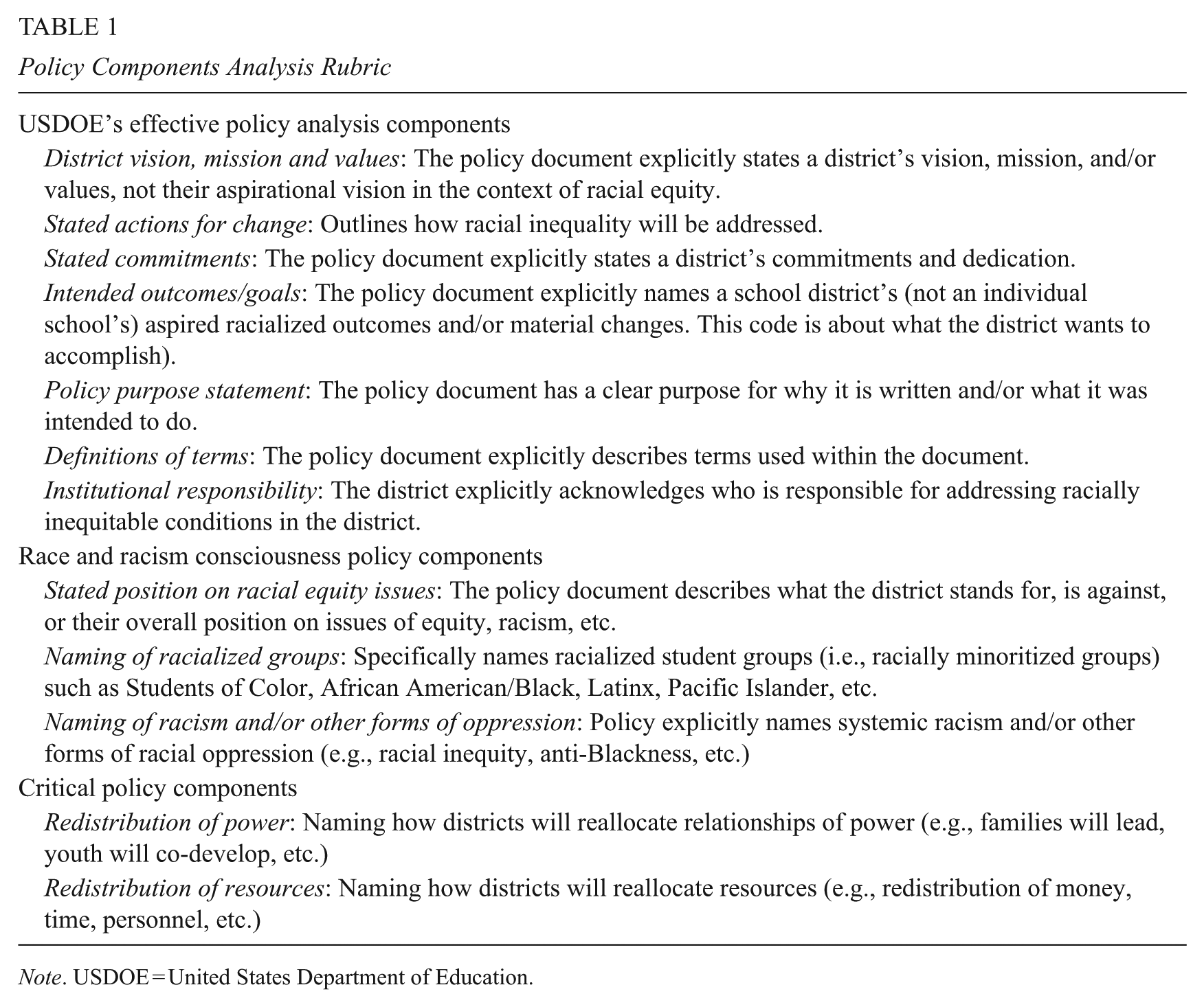
Note. USDOE = United States Department of Education.
The data analysis rubric was a template to focus our analytic coding and to ensure a systematic analysis of the policy documents (Roumell & Salajan, 2014). Using this framing, we identified 12 policy subcomponents that guided our content analysis of the racial equity policies. Finally, we view racial equity policies like Ball (1993) and Chu’s (2019) perspective of state-level equity plans which is as follows: . . . Socially constructed and value-laden, and that whose meanings are open to interpretation in order to reveal what equity perspectives are valued . . . and contain words and narratives constructed in particular ways to deliver certain possibilities of thought and action and examined as representations which are coded in complex ways (via struggle, compromise, authoritative public interpretations and reinterpretations) and decoded in complex ways . . . (p. 7; see also Ball, 1993, p. 11)
Given this understanding of racial equity policies and resolutions, we developed our coding framework to effectively account for these considerations.
Research Design and Methods
This study is part of a larger study that examines equity-oriented policies in K–12 school districts. Here, we describe our sampling process, data analysis, limitations, and researchers’ positionalities.
Document Collection and Selection
Given that there is no national dataset of K–12 school districts that have passed equity-oriented policies or resolutions, we had to construct our own dataset. To do so, we employed a semi-automated method of data collection using Anglin’s (2019) Gather-Narrow-Extract framework and took the following steps. 6 First, we created a script, using Python, to search Bing for every U.S. public school district name combined with a list of relevant search terms, such as “racial equity policy” and “equity policy,” to name a few, which returned 517,566 snippets of text. We then trained an automatic text classifier—which is an algorithm that is designed to analyze and categorize text documents based on their content—to identify the features of web page snippets that indicated that a district has a racial equity policy.
We then applied that classifier to the 517,566 snippets of text. In other words, the trained classifier distinguished between snippets of text that were linked to equity policies and resolutions and those that were not. Thus, the trained classifier identified 5,313 webpages, which included 12,000 snippets of texts/links that had a high probability of having an equity policy according to the classifier, meaning they had a probability of >.5.
Next, our research team, which consists of two faculty members and five graduate students (four doctoral students and one master’s student), manually reviewed the first 3,032 most likely web page snippets of text (out of 12,000., or 25% of the snippets of text). As a result of our manual review, we identified 312 unique equity-oriented policies and resolutions. For this study, we did a simple random sample of 100 school districts because we wanted to refine our data analysis rubric and start to understand what policy components were present in the documents.
Sample and Districts’ Context for This Study
The 100 policy documents in our sample represent school districts that span across a range of geographic and regional locations in the United States. While all of the documents represented some type of equity-oriented policy or resolution, they varied across five specific policy document types. The 100 policy documents in our sample were categorized into five policy types: Equity Policies (31), Anti-Racism Resolutions (29), Racial Equity Policies (19), Equity Resolutions (13), and Black Lives Matter resolutions (8; see Table 2 for a description of each). The policies are district-level policies that center either equity or racial equity in the title, and the resolutions are school boards’ expressed views on racial equity, equity, anti-racism, and Black Lives Matter.
A Descriptive Typology of Equity-Oriented Policies and Resolutions in School Districts
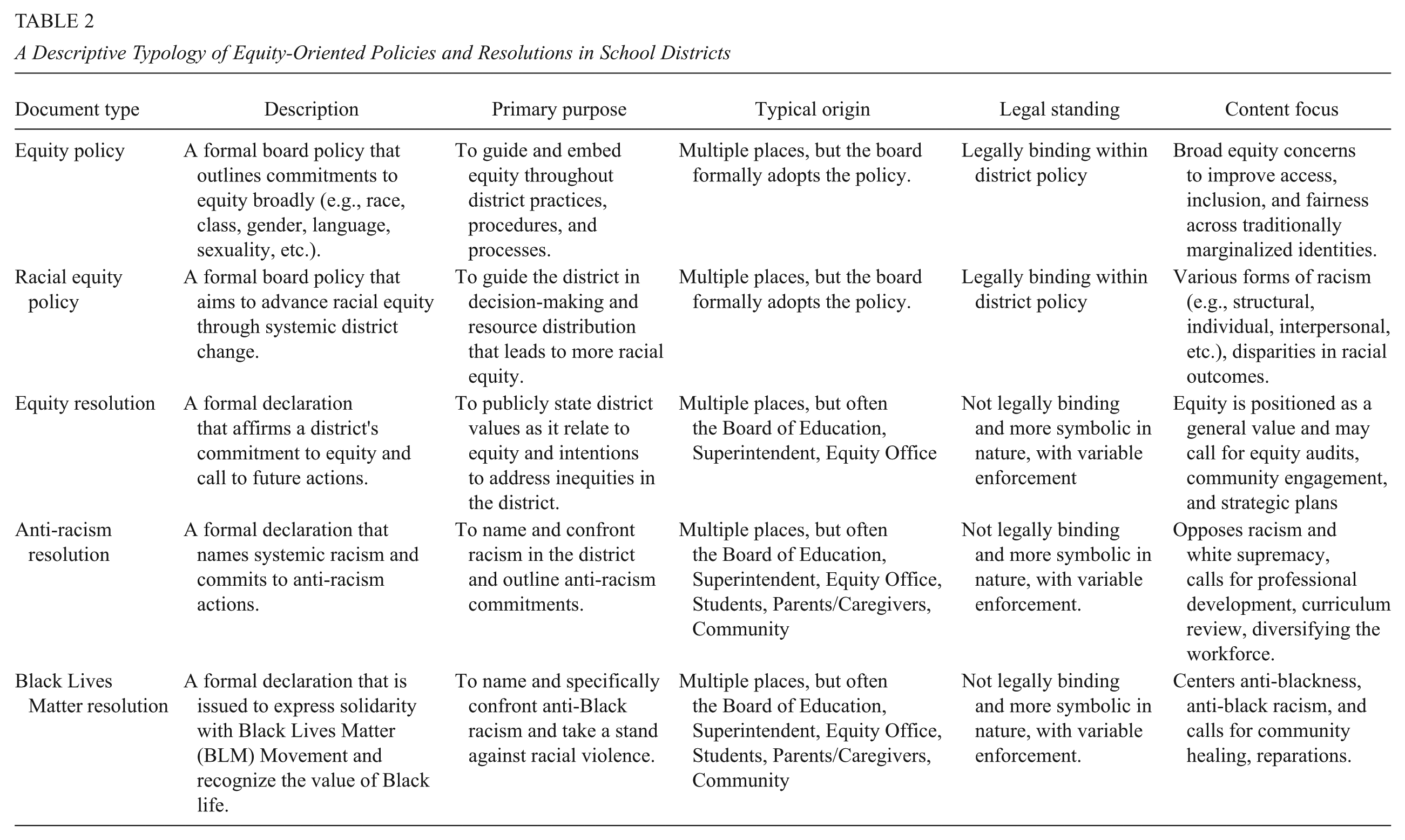
Our sample includes policy documents from 98 different school districts across 29 states (or 58% of the states in the United States). The majority of the policies and resolutions represent school districts in large suburban communities, rather thanurban or rural communities. Regionally, about one-third of the policy documents are from school districts that are located in the central and mountain region of the United States. Most of the districts were located in the central and eastern parts of the United States (see Figure 1). 7
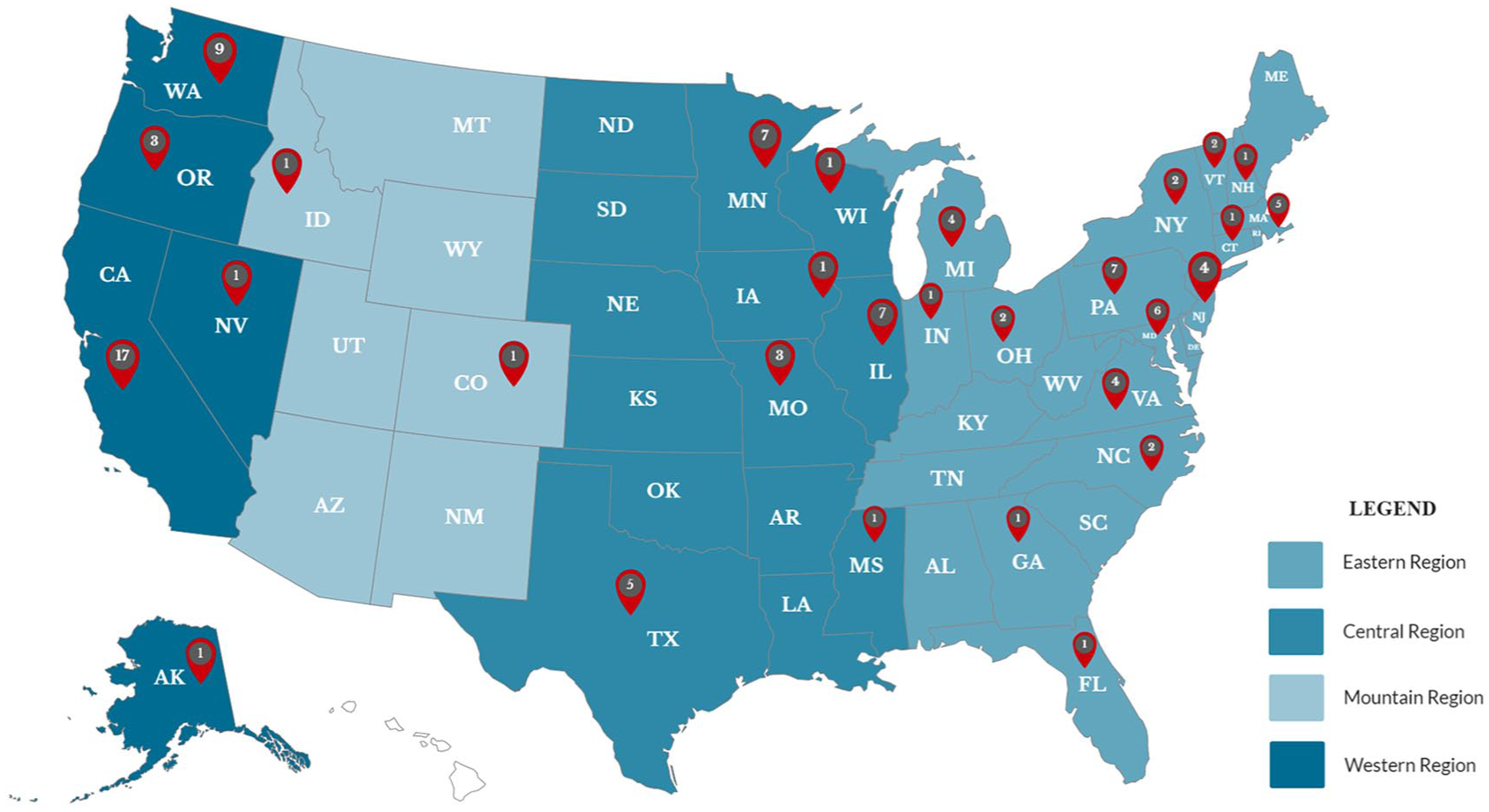
Location of school districts in our sample.
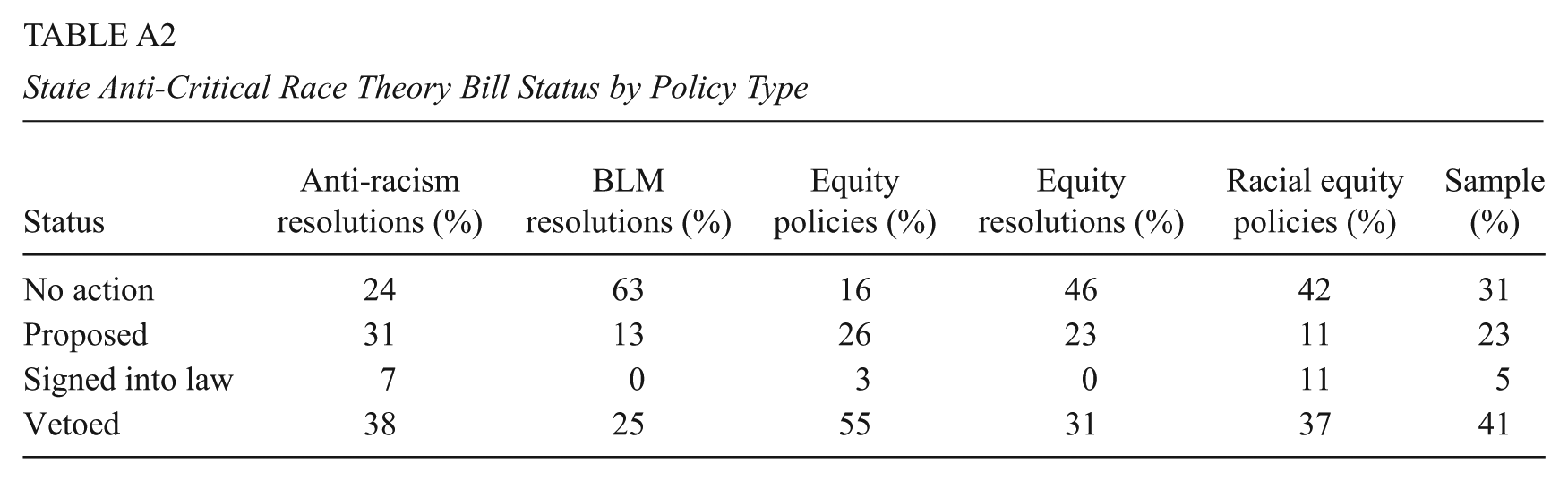
Nearly 9 out of 10 (88%) of the districts that are represented in our sample are located in states that voted Democratic in the 2020 election (see Table A1). We also found in our sample that districts with equity-oriented policies or resolutions are located in states that had either vetoed anti-CRT policies or took no action against them (see Table A2). We included this to shed light on the larger state policy context in which these districts with equity-oriented policies or resolutions are located. As such, most districts in our sample with racial equity policies or resolutions are in states that either vetoed (43%) anti-CRT bills or have taken no action on such bills (31%).
Also, during the 2019–2020 school year, the districts in our sample, collectively had racial demographics of 47% White, 22% Latinx/Hispanic, 15% Black, 9% Asian, 6% Multi-racial, and 1% American Indian (see Table 3). The average size of the student population in these districts was 21,376, with the smallest school district having 61 students (e.g., Milford Public Schools in New Jersey) and the largest having 269,172 students (e.g., Broward County School District in Florida).
School District Racial Demographics by Policy Type, 2019–2020 School Year
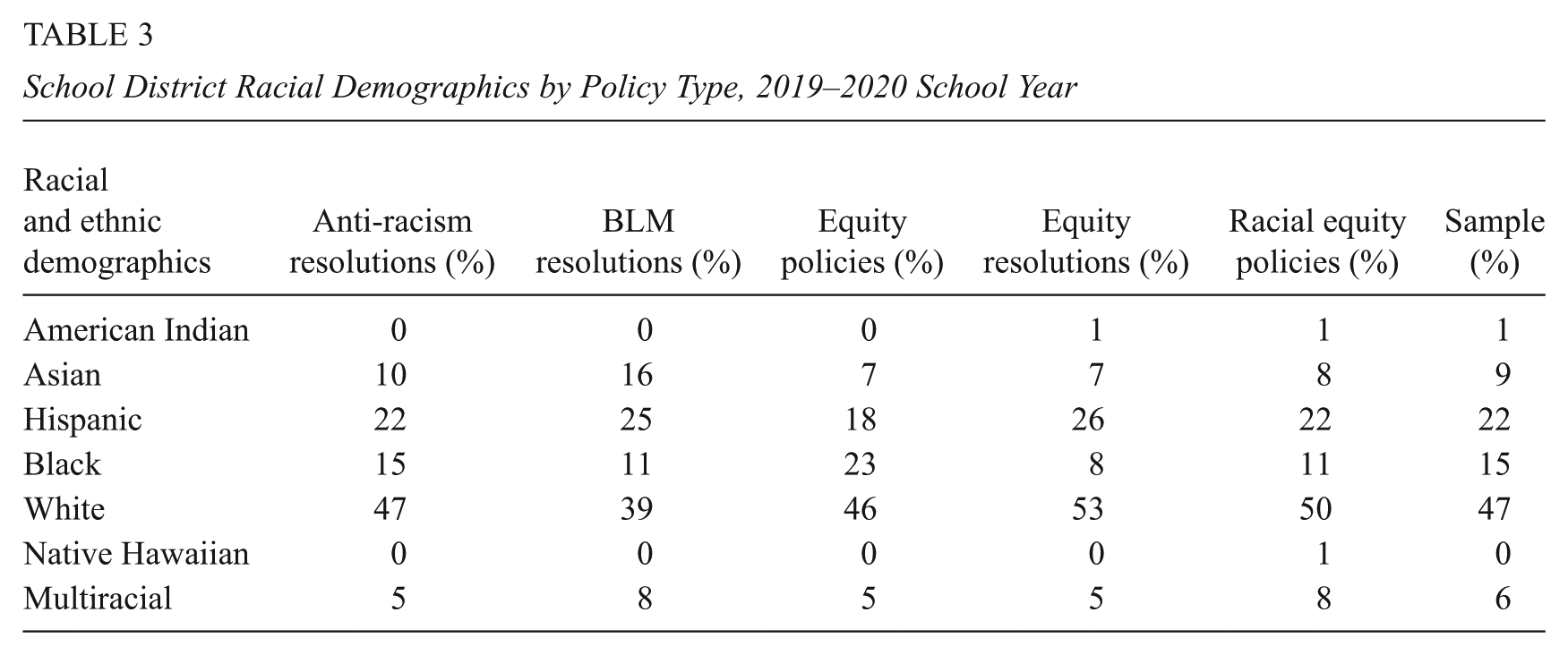
Only 14% of the students in our sample districts were identified for having a disability. Moreover, our sample consisted of districts that had an average student population of 27% Black students. The district with the largest percentage of Black students had a student population where 82% of the students were Black (e.g., Detroit Public Schools Community District in Michigan), whereas 45 school districts in our sample served less than 3% students.
Qualitative Content Analysis
This study uses qualitative content analysis to analyze school-board-approved equity-oriented policies and resolutions. We used qualitative content analysis for a few reasons. First, content analysis is widely used in education policy analysis (Chu, 2019; Cohen-Vogel & Hunt, 2007; Shaheen & Lazar, 2018), and we wanted to situate our work within common approaches used in the field. As Hsieh and Shannon (2005) argue, “the goal of qualitative content analysis is to provide knowledge and understanding of the phenomenon under study” (p. 1278; see also Downe-Wamboldt, 1992). Second, content analysis provides useful and meaningful descriptions of equity-related policy documents (Chu, 2019; George, 2009). Third, qualitative content analysis provides a method to systematically examine the presence and absence of particular policy components.
Qualitative content analysis can often start with searches for the occurrences of words, phrases, and, in the case of policy analysis, the presence of policy components (Hsieh & Shannon, 2005). Two of the most used content analysis approaches are manifest and latent analysis (Hsieh & Shannon, 2005). Thus, this is most easily done through manifest content analysis, which aims to systematically analyze explicit and observable content in text. Manifest content analysis is a foundational element to understanding the content of policies, and most often is followed up with latent content analysis, which interprets the text for its deeper or not easily recognized meaning (which our future work takes up). To this end, we conducted a manifest content analysis of the documents in our sample, and to do so, we developed an analysis rubric.
Based on the 12 policy components that we identified in our framework, we used them to create a codebook. The codebook contained operational definitions for each policy component and examples of the components. We then created a data analysis rubric in Google Sheets. Along the y-axis, we had the name and location of the school district, and along the x-axis, we had the 12 policy subcomponents. For each policy document, we wanted to examine the absence or presence of each of them. The purpose of analyzing the presence or absence of certain policy components was to identify patterns in the policy documents.
Data Analysis
To conduct analysis, we first gathered all 100 policy documents in our sample and uploaded them into Dedoose, a mixed-methods data analysis software. We randomly yet evenly divided up the policy documents for all team members to read and analyze. Each policy document had two readers/coders from our team. In other words, we analyzed the components across all policy types and then organized them based on document type and took the following steps. First, we coded each policy document in Dedoose, specifically coding for places where the policy components in our rubric were present. In other words, two members of our research team read every policy document in our sample, line by line, and scored/coded each document for each policy component as either a 0 meaning that the policy component was absent, or a 1 to represent that the policy component was present.
After the dyads read and coded each policy document, they wrote individual memos about the coding process and met to reconcile any disagreements regarding the coding. In cases where agreement could not be reached, the first author of this paper made the final decision.
Limitations
Like all research projects, this study has limitations. First, this study, which draws on content analysis, primarily viewed policies and resolutions as written documents. However, it is likely that these policies and resolutions were created following contentious negotiations among a range of stakeholders (Chu, 2019). Another limitation is that we only examined these policy documents for the policy components that we identified from our adapted rubric.
We, however, wanted to make sure that the documents accounted for effective policy components, race and racism, and critical policy elements. We also did not account for how local stakeholders would consider these resolutions and policies, given that policy implementers (e.g., administrators, teachers, etc.) enact policies within racially, socially, and politically situated contexts (Chu, 2019).
Positionality
Our research team includes two faculty members and five graduate students. Five of us are former K–12 educators, and we all anchor our work in racial justice and equity and have strong commitments to those ideals. Racially, four of us are Black (one faculty member and three doctoral students), and three are white. Two of us are men and five are women. We also believe that education policy, although limited, has the potential to create new realities in school districts, and approach this work with great curiosity and expectations. At the same time, we approach this work with a sense of racial realism,a philosophy that acknowledges the permanence of racism, enables us to avoid despair, and releases us to imagine and enact racial strategies that lead to triumph (Bell, 1992).
Findings
In this section, we present our findings in alignment with our research questions about the policy components that were present and how they varied across document types. Overall, our findings indicate that equity-focused policies and resolutions primarily include components about race and racism consciousness, assign institutional responsibility, and state intended actions for change. However, they lack critical policy components.
Presence and Variance of Policy Components
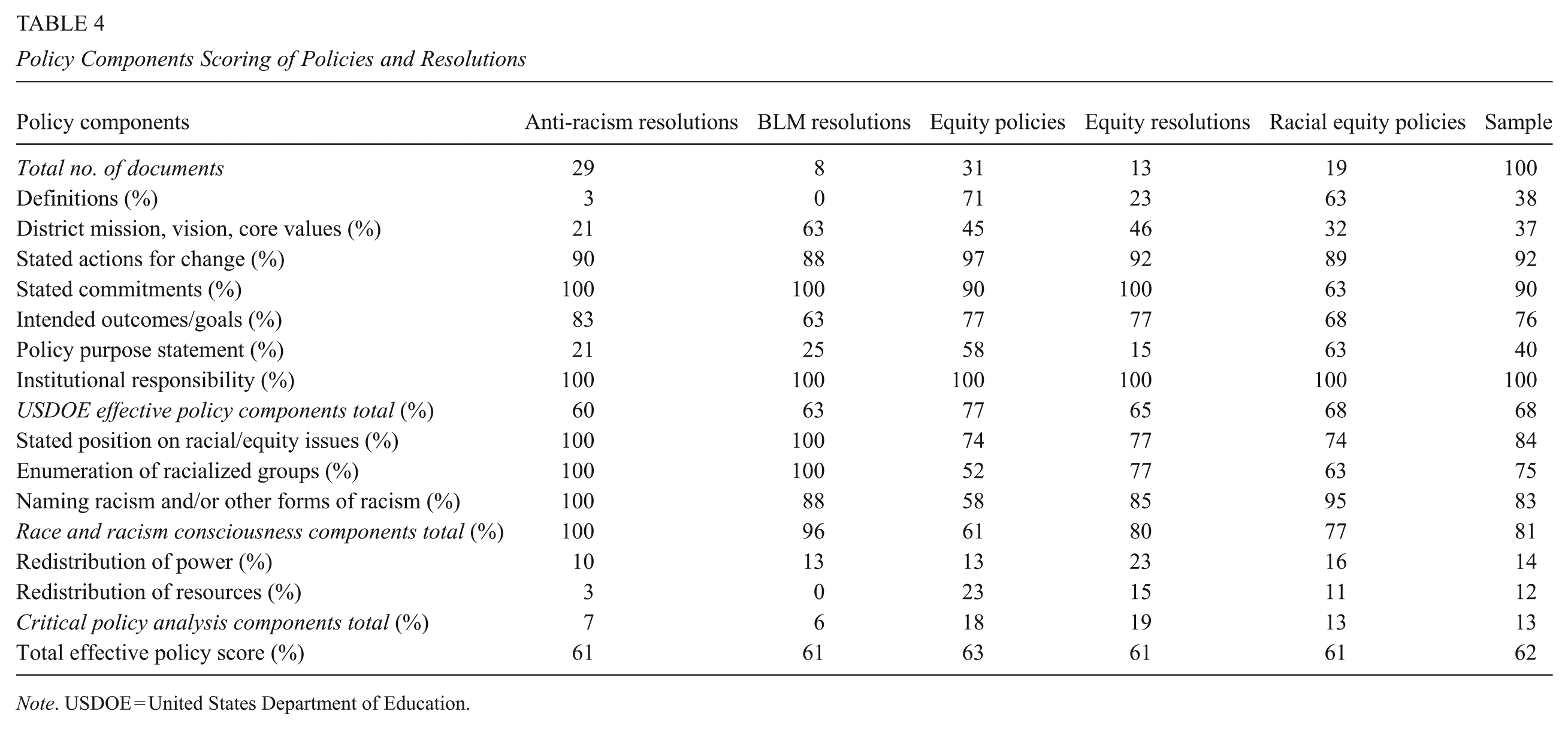
Only about two-thirds of the components were present across the documents. In other words, of the 100 policy documents that we examined on average, only 62% of the policy components that we outlined in our rubric were present. However, of the five different policy types in our sample, the percentages of the policy components that were present across each document type are as follows: Equity Policies (63%), Black Lives Matter resolutions (61%), Equity Resolutions (61%), Anti-Racism Resolutions (61%), Racial Equity Policies (61%), and Anti-Racism Resolutions (61%; see Table 4). Table 4 summarizes how each of the document types scored across the policy components.
Policy Components Scoring of Policies and Resolutions
Note. USDOE = United States Department of Education.
Across the documents, the policy component that was most present was race and racism consciousness (see Table 4). This component consists of the following subcomponents: (a) if racism is acknowledged, (b) if racialized groups are named, and (c) if a stated position on equity/racial equity issues is mentioned in the policies and resolutions. Overall, the race and racism consciousness policy component was present within 81% of the documents. All 29 anti-racism resolutions in our sample and 96% of Black Lives Matter resolutions had policy components of race and racism consciousness present (see Table 4 for the presence scoring of policies and resolutions). For example, race and racism consciousness was presented in anti-racism resolutions in statements like this: “. . . we must recognize that racism and hate have no place in our schools and society. However, we must understand and accept that racism is systemic, and it is unconsciously and consciously rooted in our institutions, policies, and practices”.
In another resolution, for example, the Asheboro City Schools Board of Education “acknowledges that complex societal and historical factors contribute to inequities within our school district. The board believes in confronting the institutional bias that results in the predictability of student performance based on race, background, and/or culture”. In other document types, this policy component showed up in Black Lives Matter resolutions, for example, in statements of commitment to “join cities, counties, and states across the country in affirming a commitment to the safety and well-being of Black people, to combating hate crimes and institutional racism, and to an education free from discrimination” while other districts made declarations of support and commitment to Black Lives Matter and anti-racism. For instance: THEREFORE, BE IT RESOLVED, that the Urbandale Community School Board declares support for the Black Lives Matter movement and affirms that Black Lives Matter; and therefore, be it further RESOLVED, the Urbandale Community School Board understands that the systematic change and internal work needed to be anti-racist is an ongoing process and requires a long-term commitment.
However, only 61% of equity policies had race and racism consciousness policy components present.
Only 52% of the equity policies had subcomponents present that named racialized groups, and 58% of them did not have any policy components that acknowledged race or racism. Put another way, 42% of equity policies had no subcomponents that named or acknowledged race or racism. Similarly, only 63% of racial equity policies had components that named racialized groups (e.g., Black, Indigenous, Latinx, Asian, Pacific Islander, White, biracial, and multiracial). Some racial equity policies named racialized groups when they acknowledged opportunity gaps. For example, one district noted, “There are persistent and unacceptable opportunity and achievement gaps for students of color in D65”.
In other policies, racialized groups of students were named when describing actions, the districts would take. For instance, one district wrote, “Cultivate empowered students, with particular focus on students of color and/or diverse cultural, linguistic, or socioeconomic backgrounds to enroll in, participate in, and complete curricular and extracurricular courses, advanced college preparation programs, career technical programs, leadership positions and other student activities”.
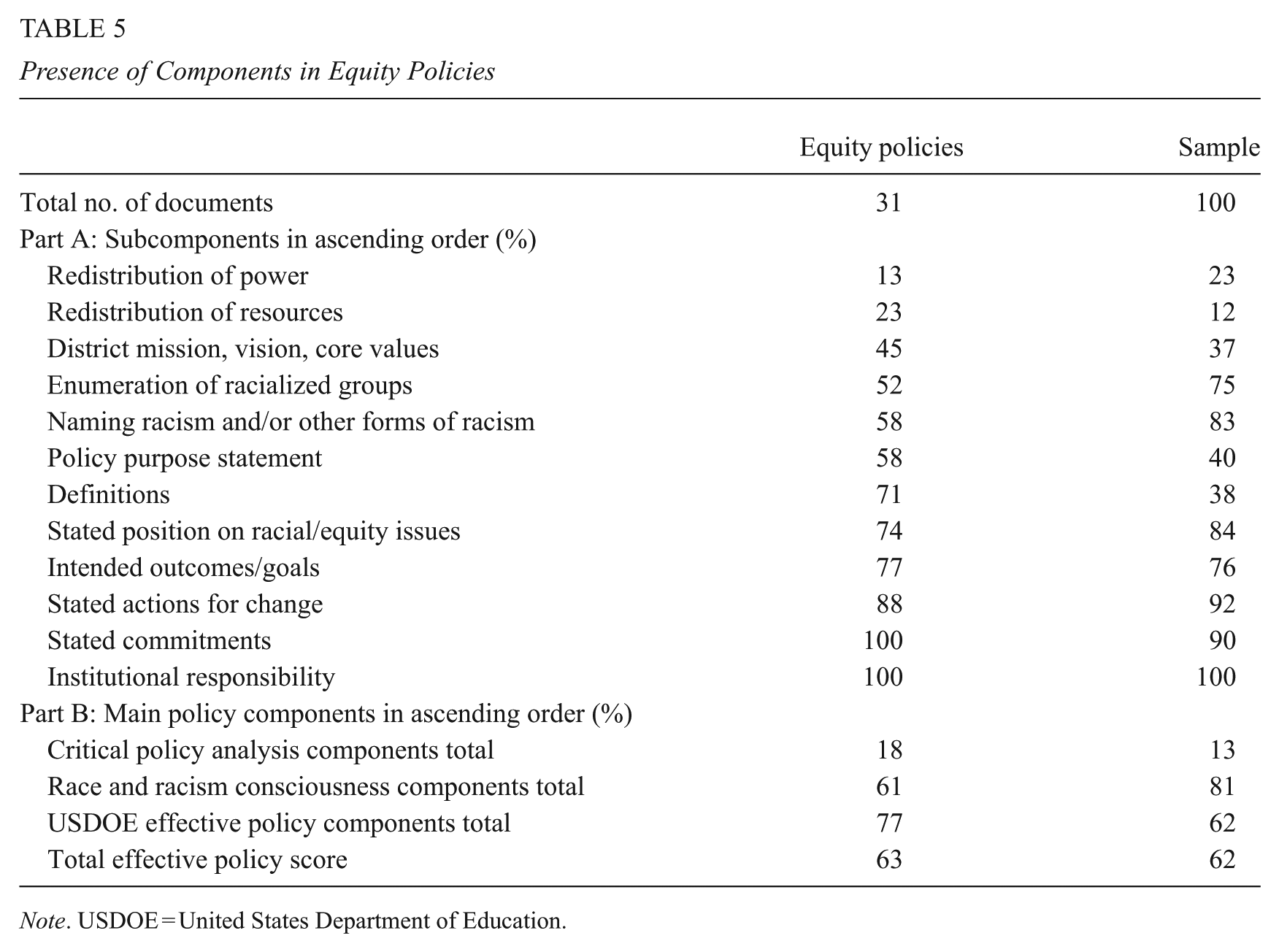
Conversely, the policy component that was least present (or most absent) across all documents in our sample was the CPA component (see Table 5). Only 13% of the documents had the CPA component present. The CPA components were most present in equity resolutions at 19% and least present in Black Lives Matter resolutions and anti-racism resolutions, at 6% and 7%, respectively.
Presence of Components in Equity Policies
Note. USDOE = United States Department of Education.
In other words, over 90% of Black Lives Matter and anti-racism resolutions, and over 80% of equity policies and racial equity policies were absent of any CPA components. This means that the documents did not mention redistributing resources or power in any way. In places where redistributing power and resources was present, it showed up, for example, like this: “WHEREAS, we must center the voices of staff, students, families, and communities who have historically endured discrimination and marginalization . . . it is essential that we establish an expectation that a diversity of students, families, and community members, specifically those who have been ignored, discriminated against, and marginalized, are heard and included on substantive school and district issues”.
In other instances, districts committed to including “partners who have demonstrated culturally-specific expertise—including government agencies, non-profit organizations, businesses, and the community in general—in meeting our educational outcomes”, or convening advisory committees at the school-level focused on including “the voices of community members, students, families, teachers, and administrators who will provide guidance and support on educational equity for the district”.
The most present policy subcomponents in the documents were institutional responsibility (which again refers to who in the district is responsible for carrying out specific aspects of the policy documents), stated actions for change, and naming of racism or other forms of racial oppression, respectively. However, across all 100 documents, the specific policy subcomponent that was the most present was institutional responsibility. Every document type included language about who was responsible for carrying out the actions that were stated in the documents. In the documents, institutional responsibility was assigned to a range of stakeholders including: school boards, the district/district staff, and the superintendent, in that order. Often the policy documents used nebulous terms like “the district,” “we” which were not specific in who the responsible actors were.
Stated actions for change were the second most present subcomponent across the documents. Ninety-two percent of the documents listed some type of stated action for change. The documents outlined a range of actions, but most often, partnering with external stakeholders, examining current practices and policies, and changing existing curriculum and pedagogical approaches. For example, some districts listed their stated actions as the “development, implementation, and ongoing review of culturally sustaining teaching and learning practices and curriculum” (Lawrence Public Schools, 2020), or the “[examination of] our policies for institutional and systemic racialized practices and [implementation of] change with sustainable policies that are evidence based”.
Naming of racism and/or other forms of racial oppression was present in 83% of all documents in our sample. In some cases, this showed up as districts implicating themselves in the perpetuation of racism. For example, one policy states “Rather than continuing to perpetuate and contribute to institutional racism, Baltimore City Schools must move to disrupt and dismantle it in every area of our work”, while another mentions “[seeking] to disrupt societal and historical inequities arising from institutional racism and white supremacy in our schools”. However, only 58% of equity policies had a subcomponent that named racism, while 100% of anti-racism resolutions had this subcomponent present.
Of the five document types, equity policies had the most present components, with 63% of the components being represented in the documents. Within equity policies, the presence of institutional responsibility and stated actions for change were at 100% and 97%, respectively, which are both part of the USDOE effective policymaking component. The least present components of equity policies were CPA. Only 13% and 23% of the CPA components were present in equity policies. Redistribution of power was only present in 13% of the policies and redistribution of resources were present in 23% of the policies. In the equity policies, however, 96% of the race and racism consciousness components were present in them.
Interestingly, anti-racism resolutions, Black Lives Matter resolutions, equity resolutions, and racial equity policies all had 61% of the components present across them. Of the three overarching components, race and racism consciousness were most present across these policy documents. In these documents the most present subcomponents were stated positions on racial/equity issues and, again, naming racism and/or other forms of racism, at 84% and 83%, respectively. For instance, Dallas Independent School District stated that “[t]he district acknowledges the history of institutional racism that systematically and systemically prohibits the educational and societal advancement of students.” Other districts similarly “[condemned] all hateful speech and systemic racism directed at Black, Indigenous, and people of color”. Across all of the document types, one of the least present components was definitions, which was present 38% of the time. Definitions were not present at all in any of the Black Lives Matter resolutions in our sample. At the same time, race and racism consciousness was present in 96% of the Black Lives Matters resolutions.
Discussion
By investigating the policy components that are present in equity-oriented policies and resolutions, this study makes an important first empirical contribution to the research. By employing an approach that accounted for effective policy elements, race and racism, and critical policy components, we sought to provide an important and foundational understanding of this important body of research. Overall, our findings indicate that the documents have most present elements of race and racism consciousness, and to a lesser degree, effective policy components. However, CPA components were by far the least present.
Nearly half of the equity policies contain no policy elements of race and racism consciousness (Horsford et al., 2018), specifically naming racialized groups and acknowledging racism. This supports research that issues of race are often left out in generic equity policies, statements, and plans (Dumas et al., 2014; Gillborn, 2005). When policy documents do not specify racialized groups and assume all students, which can typically default back to white students because other racialized groups are not specifically named (Leonardo, 2003). It also creates a dynamic to where anyone can be racist because of the nebulous nature of race and racism, and the lack of historical context about whiteness, power, and the racial hierarchy inherent in the group of people racialized as white.
Therefore, when policies do not specify any racialized group, then white people can accuse Black and other racially minoritized people for being racist. Indeed, equity policies that fail to acknowledge race or racism will probably have a more difficult chances in addressing racism in districts because race-evasive approaches do little to nothing to confront racial oppression (Dumas et al., 2014).
Throughout all of the policies, CPA was the least present. While more policies mention CPA subcomponents than resolutions, it was still more absent overall than present. With so many of the documents mentioning race and racism, which is important, they do so apart from connecting it to existing power dynamics. This suggests a few things. First, the way that racism is framed in these policy documents is such that it is delinked from notions of power and resource distribution, which more than likely will not disrupt and shift current power relations. Second, neglecting dynamics of power within the context of race and racism can produce a type of naming and acknowledgment of racism, and promises to take action, but do so in ways that maintain the existing power dynamics (Arellano & Vue, 2019; Brown et al., 2022; Casellas Connors & McCoy, 2022). It is also interesting that all (100%) of the policies and resolutions included some level of institutional responsibility, but failed to also have a plan or desire to redistribute power or resources.
One of the least present elements in all of the documents was definitions, which suggests that the architects of these policies may have thought that readers would know what they meant when they used terms like “equity,” “racism,” and “white supremacy.” While it is important to offer room for people’s interpretation of policies, when there are no parameters on what key words mean in a policy, it creates opportunities for lots of variance in understanding and in implementation, and enactment. In Black Lives Matter resolutions specifically, nothing was defined, which assumes that readers have shared understandings with the creators of the policy.
As such, our findings align with prior work in adjacent research on anti-racism statements in universities and other educational institutions in several ways (Arellano & Vue, 2019; Casellas Connors & McCoy, 2022). First, like anti-racism statements, most equity policies, especially, use diversity discourse that is race-evasive. However, while most of the policies in our sample, like anti-racism statements, offered concrete actions, they frequently did not identify specific people who were responsible for achieving these stated actions for change.
Also, similar to anti-bullying policies, only slightly over one thirds of the documents in our sample defined the terms they referenced in the policy documents. This lack of definition leaves too much room for interpretation, which could result in equity policies not getting enacted with fidelity. However, our findings differ from the research on anti-racist statements in that they typically have little to no stated actions (Brown et al., 2022), but policy documents in our study all had stated actions for change. This suggests that statements are rhetoric to convey a message, while policies and resolutions speak of some type of action.
Conclusion
This study offers implications for future research, policy, and districts that have or plan to pass racial equity policies. As such, this study underscores the need for additional research on equity-oriented K–12 policies and resolutions. Future studies might examine the ways in which equity and racism are framed in the policy documents, and what the implications are for how districts have written about their stated actions for change. In addition, future research might examine racial equity policies and resolutions inductively to understand their primary discourse, using approaches like critical discourse analysis and latent content analysis.
Questions also remain around how school districts have positioned themselves within the policy documents. Given that research on anti-racism statements suggests that organizations often obscure their own inequities and racism, we need empirical research to investigate how and if this happens in equity-oriented policies and resolutions. It would be helpful if future studies examine if and how discourse has changed in the various types of policy documents overtime, including both before and after George Floyd’s murder.
This study offers implications for policy and for districts with equity policies. Our implications are for both groups. First, districts might consider writing or rewriting their equity policies to focus explicitly on race and racism. Since this was the least present policy component in the policies, it is important to make sure it is addressed in the policies. Second, when writing equity-oriented policies, districts need to make sure that they address how they are going to redistribute resources to make sure that racial equity efforts are more than adequately supported.
In addition, when writing or rewriting these policies, it is critical for districts to think about how they will redistribute power which can come in the form of expanding leadership and having more inclusive and democratic decision-making processes. Third, it is important for districts to link their stated actions for change to specific actors and to make sure that the actions they aim to take will shift power dynamics and relationships. Finally, it is our critical hope that districts will use policy as one medium through which to usher in new racial possibilities that will create justice-rich education spaces that are radically humanizing.
Footnotes
Appendix
State Anti-Critical Race Theory Bill Status by Policy Type
| Status | Anti-racism resolutions (%) | BLM resolutions (%) | Equity policies (%) | Equity resolutions (%) | Racial equity policies (%) | Sample (%) |
|---|---|---|---|---|---|---|
| No action | 24 | 63 | 16 | 46 | 42 | 31 |
| Proposed | 31 | 13 | 26 | 23 | 11 | 23 |
| Signed into law | 7 | 0 | 3 | 0 | 11 | 5 |
| Vetoed | 38 | 25 | 55 | 31 | 37 | 41 |
Acknowledgements
We would like to thank the reviewers for their helpful support on prior iterations of the paper.
Declaration of Conflicting Interests
The author(s) declared no potential conflicts of interest with respect to the research, authorship, and/or publication of this article.
Funding
The author(s) disclosed receipt of the following financial support for the research, authorship, and/or publication of this article: This work was supported by the William T. Grant (WTG) Foundation through funding provided for the first author’s William T. Grant Scholars Project. Therefore, we are tremendously grateful to the WTG Foundation for making this work possible.

Notes
Authors
TERRANCE L. GREEN, PhD, is an associate professor at the University of Texas at Austin. His research focuses on how educational leadership equitably moves systems forward while honoring the communities they serve, as well as on school closures and consolidations.
JEREMY D. HORNE, PhD, is an assistant professor at Utah University. His research focuses on anti-blackness, Black-policy analysis, and gentrification.
KYLIE ANGLIN, PhD, is an assistant professor at the University of Connecticut. Her research leverages machine learning and natural language processing to advance research methodologies.
KATELIN TRAUTMANN, PhD, is a postdoctoral research fellow at Penn State University. Her work focuses on policymaking at the intersection of race, gender, and religion.
KIMBERLY CLARIDA, PhD, is a postdoctoral research fellow at Michigan State University. Her research focuses on the role of policy, organizational structures, and leadership in shaping equitable educational opportunities for Black and Brown students and school leaders.
KIMBERLEE RALPH, MEd, is an independent researcher. Her research focuses on educational policy.
TAYLOR SMITH, MEd, is an independent researcher. Her research focuses on educational policy and artificial intelligence in education.