




Abstract
Background
Since the legalization of cannabis in Canada, there have been numerous issues impacting private cannabis retailers, potentially affecting public health and safety. Media framing of these issues plays a crucial role in shaping public perception and policy discourse. This study examined the media's portrayal of the challenges associated with cannabis legalization and its impact on private cannabis retail operations.
Methods
News media content and framing analyses of Canadian news articles published between 2017 and 2022 were conducted. Articles were selected from Nexis Uni and Eureka databases if they referenced at least one barrier to private cannabis retail stores. Data were extracted and screened using Covidence and deductively coded to depict how the media presented these barriers, focusing on their definitions, underlying causes, moral reasoning, and suggested solutions.
Results
Of the 9,371 articles screened, 293 qualified for inclusion. The analysis revealed that media portrayals of cannabis retailers’ barriers varied, with government regulatory challenges, supply chain challenges, and unlicensed market competition as the most prominent frames. While some articles portrayed these challenges as hindrances to business success, the majority depicted them as the government's responsibility, justifying its stance by emphasizing the need to protect public health and safety and eliminate the unlicensed market.
Conclusion
This study indicates that the way media frame the challenges faced by cannabis retailers has the potential to influence public opinion and shape policy debates. Recognizing these media dynamics is essential for informing the development of effective government policies that not only support a stable cannabis retail market but also prioritize public health and safety.
Background
In 2018, Canada legalized non-medical cannabis under the Cannabis Act, aiming to limit youth exposure, discourage criminal activities, and protect public health and safety (D. of J. Government of Canada, 2021). The Cannabis Act (2018), allows provinces and territories to use various retail models, including government-operated (solely managed by the government), privately-operated (independent management), or hybrid (a mix of government and private management), enabling adults to purchase legal cannabis through physical or online stores (S. C. Government of Canada, 2019). The nascent market has seen many benefits, including increased government revenue, growth in licensed markets, higher capital expenditure, and employment opportunities (Akwasi Owusu-Bempah, 2022; Deloitte, 2022). For example, in 2021, the industry supported 151,000 jobs nationwide and contributed 43.5 billion dollars to the economy, with 15.1 billion coming from tax revenue (Deloitte, 2022). Specifically, 67.8% of the revenue came from non-medical cannabis sales (Deloitte, 2022). By 2023, the cannabis sector's value rose to US$10.8 billion, up from US$6.4 billion when non-medical cannabis was first legalized (S. C. Government of Canada, 2023).
Despite these benefits, private cannabis retailers face significant challenges due to competition from the unlicensed market and stringent regulations including restrictions on packaging and advertising, THC potency limits, licensing requirements, and competition from the unlicensed market (BDO Canada, 2022; Centre for Addiction and Mental Health, 2022; Wright-Brown et al., 2024). While these regulations align with harm reduction principles (Fischer et al., 2022; Health Canada, 2023b; Pratschke, 2024), they often impose disproportionate compliance costs on small and medium-sized enterprises, reducing their competitiveness relative to larger corporations and the unlicensed market (Competition Bureau Canada, 2024; Government of Canada, 2024; Health Canada, 2023a). This imbalance not only threatens the sustainability of legal retailers but also risks undermining public health objectives by inadvertently encouraging consumers to seek products in the unregulated market where safety standards are absent (Competition Bureau Canada, 2024; Noonan, 2021; Yousif, 2023). To mitigate these risks, a regulatory framework is needed that balances harm reduction objectives with the economic sustainability of legal retailers. Such an approach would strengthen the viability of the legal cannabis market and help achieve the public health goals of legalization.
While regulatory frameworks are crucial, understanding the challenges faced by cannabis retailers requires a broader perspective. However, academic research on these challenges in Canada is limited, and media coverage of the cannabis industry has grown exponentially, particularly in the retail market. How the media covers the cannabis retail market is essential, as it plays a critical role in influencing the agenda of policymakers. This study seeks to explore how Canadian high-circulating news media have framed the barriers facing private (licensed and prospective) cannabis retailers before and after legalization. To achieve this, we apply framing theory to systematically analyze news media content and examine how these barriers have been portrayed over time across various news sources.
Framing Theory
Framing theory is commonly discussed in the context of policymaking; however, its application remains inconsistent due to variations in operationalization (Scheufele, 1999; Scheufele & Tewksbury, 2007). Unlike agenda-setting theory, which focuses on how the media highlight specific issues to influence their perceived significance, framing theory examines how those issues are presented, with attention to specific attributes, narratives, and sentiments that shape public understanding (Wu & Coleman, 2009). While agenda setting emphasizes issue salience, determined by factors such as the frequency and prominence of media coverage, including the length or placement of news articles (McCombs, 2005; McCombs et al., 2014; Pan & Kosicki, 1993; Wu & Coleman, 2009), it does not address the underlying narratives or the connection between media coverage and political discourse (Kosicki, 1993; Pan & Kosicki, 1993). In contrast, framing theory extends beyond issue salience by analyzing how specific attributes, sentiments, and narratives influence public interpretation and response (Arowolo, 2017; Ballard, 2019; Pincus & Ali, 2016; Wang et al., 2024). For instance, framing an issue as a problem versus an opportunity can elicit markedly different public reactions.
Erving Goffman coined “frame analysis” to explore how individuals use “schemata of interpretation” to make sense of their social environment (Carter, 2013; Goffman, 1974). His foundational work has informed framing theory across disciplines such as communication, psychology, sociology, and political science (Magnusson et al., 2021). Scholars have extensively applied framing theory to examine how media shape public opinion and how political leaders use framing to advance their agendas (Aversa et al., 2023; Entman, 1993; Hawkins & Holden, 2013; Kaiser, 2013; Scheufele, 1999). Building on Goffman's ideas, frame analysis investigates how media discourse constructs meaning by emphasizing frames that shape public perceptions (Björnehed & Erikson, 2018; Pan & Kosicki, 1993). Framing plays a critical role in shaping public concerns and policy debates, particularly in areas such as crime, health, and drug policy. For example, Beckett (1994) applied a constructionist approach to analyze how media and state actors frame crime and drug-related issues, demonstrating that media portrayals often reflect strategic narratives rather than objective realities. Similarly, in health communication, media framing influences public attitudes toward medical interventions. For instance, Brujić (2024), analyzed online news coverage of the MMR vaccine, highlighting how digital news platforms shaped public perceptions of the vaccine during the Covid-19 pandemic. The study emphasized that these portrayals were influenced by cultural and contextual factors (Brujić, 2024).
Among various approaches to frame analysis, Robert Entman's model is particularly notable for its structured methodology. Entman (1993) conceptualized framing as the selection and emphasis of aspects of reality to promote specific interpretations, evaluations, or recommendations. His model operationalizes framing through four core elements, constituting a frame: problem definition (identifying the problem), causal attribution (attributing blame or responsibility), moral evaluation (assessing ethical implications), and treatment recommendation (proposing solutions) (Arifin et al., 2020; Entman, 1993). This framework enhances the reliability and validity of frame analysis (Matthes & Kohring, 2008). For example, Orsini (2017) demonstrated the utility of Entman's model in a content analysis of United States news segments on drug policy, tracking the evolution of drug-related media frames. Using hierarchical cluster analysis, Orsini found that media portrayals continued to emphasize themes of violence, crime, addiction, and health risks, reinforcing traditional prohibitionist policy narratives (Orsini, 2017). More recently, Brookfield et al. (2024) expanded Entman's approach by employing an inductive approach to analyze Australian news media coverage of youth vaping. Their study revealed how dominant frames constructed narratives centered on youth vaping as an epidemic, necessitating increased regulations, while a minority of reports framed it as a public health issue comparable to other substance use challenges (Brookfield et al., 2024). This research underscores how framing reflects broader societal and political contexts.
Building on these applications, scholars have further refined frame analysis methodologies by adapting Entman's model to improve their analytical precision. Matthes and Kohring (2008) applied Entman's model through a content analysis of biotechnology media coverage. Their study employed cluster analysis, coding data into Entman's frame elements to identify dominant frames. However, they acknowledged that while this approach enhances precision, it also introduces additional complexity and may not be suitable for analyzing large texts (Matthes & Kohring, 2008). Similarly, Foley et al. (2019) modified Matthes and Kohring's (2008) approach by shifting from an inductive, cluster-based approach to a more structured, deductive coding process. Rather than identifying frames through the analysis of coded frame components, they preselected frames of interest and systematically coded data fragments into the corresponding frame elements. While this approach increased transparency and interpretive depth, it also limited the flexibility to identify emerging frames (Matthes & Kohring, 2008). These methodological tradeoffs underscore the importance of integrating both inductive and deductive approaches in frame analysis, particularly when studying dynamic and evolving topics, like cannabis.
Media Framing of Cannabis
While considerable research has explored media framing of cannabis, much of it predates legalization in Canada or focuses on non-Canadian contexts (Kim, 2017; Kim & Kim, 2018; Lewis et al., 2023). Recent studies, however, have begun exploring specific aspects of cannabis framing following legalization. For example, Aversa et al. (2023) analyzed how mainstream Canadian newspapers framed recreational cannabis legalization, noting a shift from overly negative reporting to more balanced coverage influenced by political leanings. Similarly, Vann (2023) analyzed cannabis framing in Black newspapers and found that political contexts, lived experiences, and structural conditions significantly influence how cannabis discourse is framed (Vann, 2023).
While these studies offer valuable insights into cannabis framing, few have explicitly applied Entman's framing approach to this topic. For example, Vuolo et al. (2024) used Entman's framework to examine U.S. cannabis criminalization, revealing how racial and legal frames were constructed to associate cannabis with crime and moral deviance, driving policy adoption. Similarly, Amina et al. (2024) analyzed Kompas TV's coverage of medical cannabis debates in Indonesia, showing that media portrayals of cannabis as a psychotropic substance were shaped by ideological leanings, highlighting the media's role in shaping public discourse.
These studies demonstrate the effectiveness of Entman's framework in uncovering nuanced media narratives. However, its application to cannabis legalization and the challenges faced by private retailers in Canada remains underexplored. Applying this framework in the Canadian context could provide a deeper understanding of how media frames shape public perceptions and influence policy decisions.
Methods
This study builds on a previously published content analysis that identified key barriers faced by cannabis retailers in Canada using the same dataset (Wright-Brown et al., 2024). Content analysis has proven to be an effective method for studying the representation of social and political issues as it systematically assesses dominant discourses and narratives that shape public understanding and perception (McCombs & Shaw, 1972; Vaughan & Power, 2021). This method was particularly well-suited for this research, given the extensive media coverage of the cannabis retail market in Canada. While other methods, such as interviews, surveys, or literature reviews, might have yielded similar results, content analysis was chosen for its efficiency, cost-effectiveness, and ability to systematically examine large volumes of data without requiring participant recruitment or complex survey design (Saraisky, 2015; Songsore & Buzzelli, 2017).
This current study employs Entman's framing model to explore how these barriers were framed in Canadian news media. This approach examines how news stories characterized the barriers identified in Wright-Brown et al.'s (2024) study, identified their causes, assessed their moral implications, and proposed solutions (Entman, 1993). This framework allows for a systematic exploration of how media coverage constructs cannabis-related issues and connects them to broader societal and policy contexts.
Selection of News Media Sources
We selected a range of news media sources, including two national newspapers, the Canadian Broadcasting Corporation's (CBC) online news articles, and eight widely circulated newspapers representing the provinces and territories that operate under a private/hybrid retail model: Saskatchewan, Newfoundland and Labrador, Alberta, Ontario, British Columbia, Manitoba, Yukon, and Nunavut. These news sources were chosen for their high circulation and combined local and national coverage. Provinces with a public retail model were excluded from this study as their challenges differ from those operating under private ownership.
Data Collection and Screening Process
Nexis Uni and Eureka online databases were used to access articles published from January 1, 2017, to March 26, 2022, by using the following search terms:
(cannabis OR marijuana OR thc OR pot OR weed) AND (retail OR retailer OR store OR stores OR sales OR sale OR outlet OR outlets OR shop OR shopping OR shops) AND (barriers OR obstacles OR challenge OR challenges OR challenging OR difficult OR difficulties OR issue OR problems)
The identified articles were screened for inclusion using a two-step process supported by the Covidence software (University of North Carolina, 2022). Two reviewers independently completed each step, which included a title review and a full-text review. A third reviewer resolved conflicts when there were disagreements during the title screening.
Coding and Analysis
To analyze how the media framed the barriers encountered by private cannabis retailers in Canada, we adopted and modified Foley et al.’s (2019) approach to Entman's framing model for a more comprehensive analysis of the data. This approach combines the use of deductive frames with the integration of emergent frames for a more comprehensive analysis (Figure 1). The coding process involved extracting the data, coding it to either a priori or emergent frames, and then categorizing it according to the frame elements: problem definition, causal attribution, moral evaluation, and treatment recommendation. Figure 1 represents the modified coding process of this study, adapted from Foley et al. (2019).
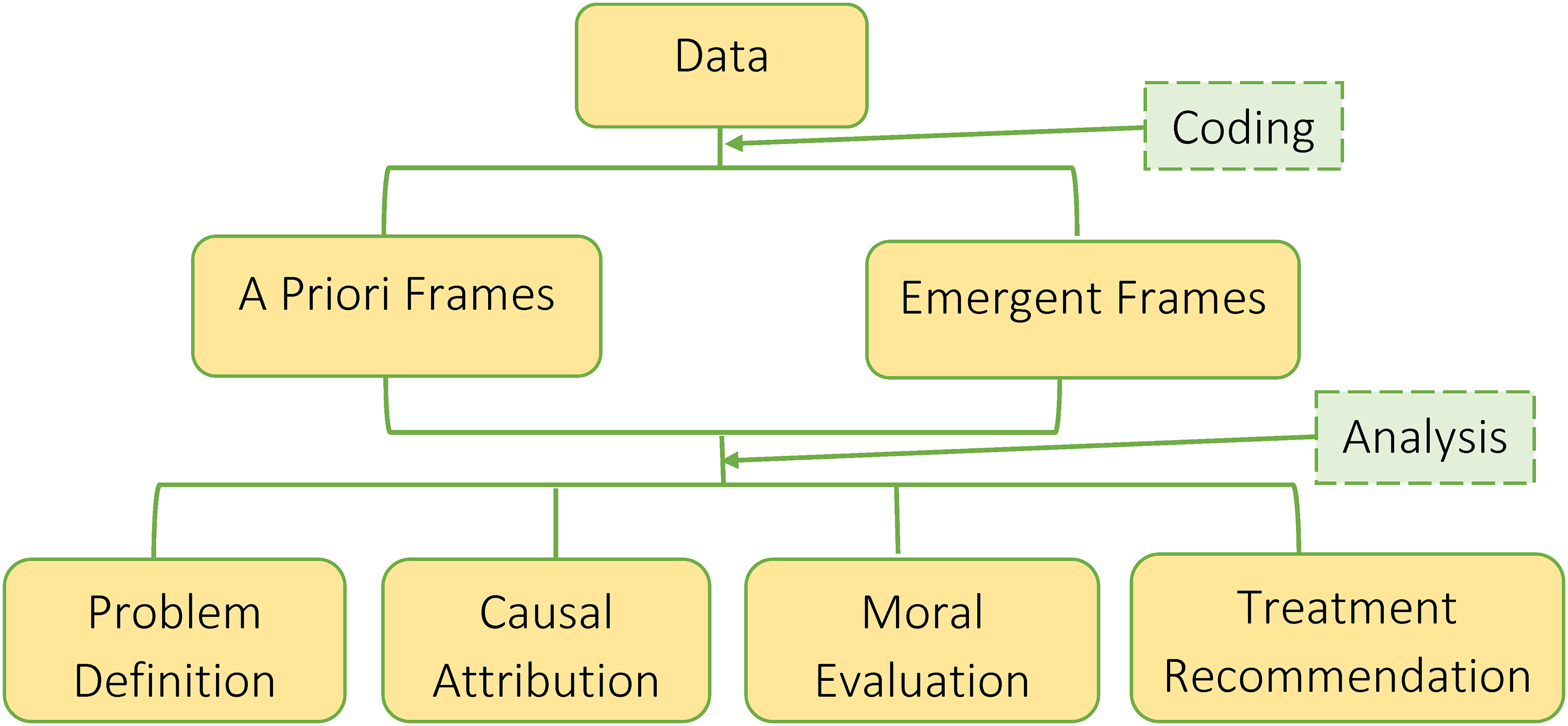
Adapted from Foley et al. (2019). © 2019 by Sage Publications. Reprinted with permission. Based on conceptual framing components from Entman (1993, p. 53) for coding and data analysis from Matthes & Kohring (2008).
The study's unit of analysis was individual articles rather than the frequency with which a barrier was mentioned. Many articles included multiple barriers from various perspectives. The barriers were coded under multiple frames. The analysis employed a coding scheme guided by the Comprehensive Cannabis Retail Framework (CCRF), a novel conceptual model developed by Wright-Brown et al. (2024) (Figure 2). The CCRF integrates two key approaches: the Canadian Public Health Association's public health approach to cannabis legalization, focused on government regulations and public health and safety, and the environmental theory of retail institutional change, which examines how retail institutions adapt to environmental factors (Wright-Brown et al., 2024). By combining these perspectives, the CCRF offers a holistic understanding of the cannabis retail market, balancing public health priorities with retail success by considering both government policies and the macro- and micro-environmental factors shaping the cannabis industry (Wright-Brown et al., 2024).
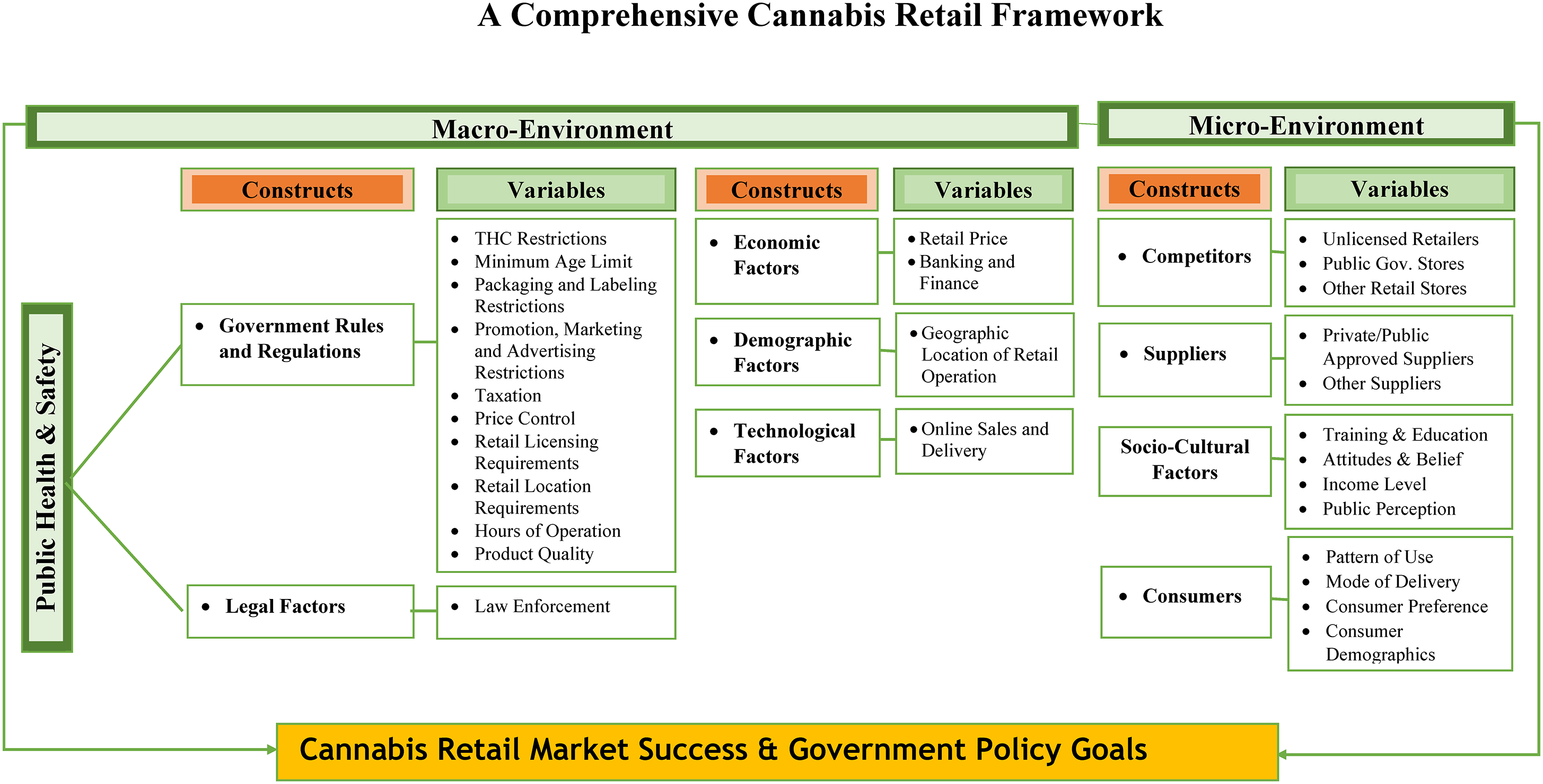
Comprehensive Cannabis Retail Framework adapted from Wright-Brown et al. (2024). Copyright © 2024 (SAGE Publications). https://doi.org/10.1177/00914509241271654.
A three-step manual coding process was conducted. First, we read each article and extracted data related to the barriers retailers faced, including descriptive features (such as the title, date, source, and jurisdiction). Also, we identified frames either derived from the CCRF or that emerged from the data. The predefined frames include government regulatory challenges, legal and jurisdictional disputes, economic and financial challenges, supply chain challenges, social equity and inclusion challenges, and unlicensed market competition. Second, we inductively and deductively coded the extracted data to these identified frames. Finally, we coded the selected data for the presence or absence of the specified frame elements: problem definition, causal attribution, moral evaluation, and treatment recommendation. We then analyzed the coded data to identify patterns, trends, and relationships in the identified frames and their elements, while capturing who reported the barriers.
Results
A total of 9,371 articles were initially identified in the previously published content analysis (Wright-Brown et al., 2024). Of these, 307 met the inclusion criteria. However, 293 articles were analyzed for the current study, as 14 were no longer accessible at the time of this analysis.
Our analysis of barriers faced by cannabis retailers from 2018 to 2022 identified seven major frames: six predetermined frames, including government regulatory challenges, supply chain challenges, unlicensed market competition, economic and financial challenges, legal and jurisdictional disputes, and social equity and inclusion challenges, as well as one emergent frame, real estate challenges. These frames were systematically categorized under Entman's four key frame elements: (1) problem definition, (2) causal attribution, (3) moral evaluation, and (4) treatment recommendation. Although each frame aligned with one or more of these elements, we observed considerable overlap between “problem definition” and “causal attribution” in certain instances.
Our study also revealed significant shifts in news coverage during the study period, as illustrated in Figure 3. The frequency of different frames varied across the years, reflecting changing priorities in the media's portrayal of challenges. Initially, government regulatory and supply chain challenges dominated the discussion but saw a decreasing emphasis in later years, while unlicensed market competition within the industry remained relatively stable since legalization. For instance, government regulations identified as barriers increased from 38 mentions in 2018 to 58 in 2019, but sharply declined afterward. In contrast, barriers related to unlicensed market competition showed fluctuations but remained more stable over time.
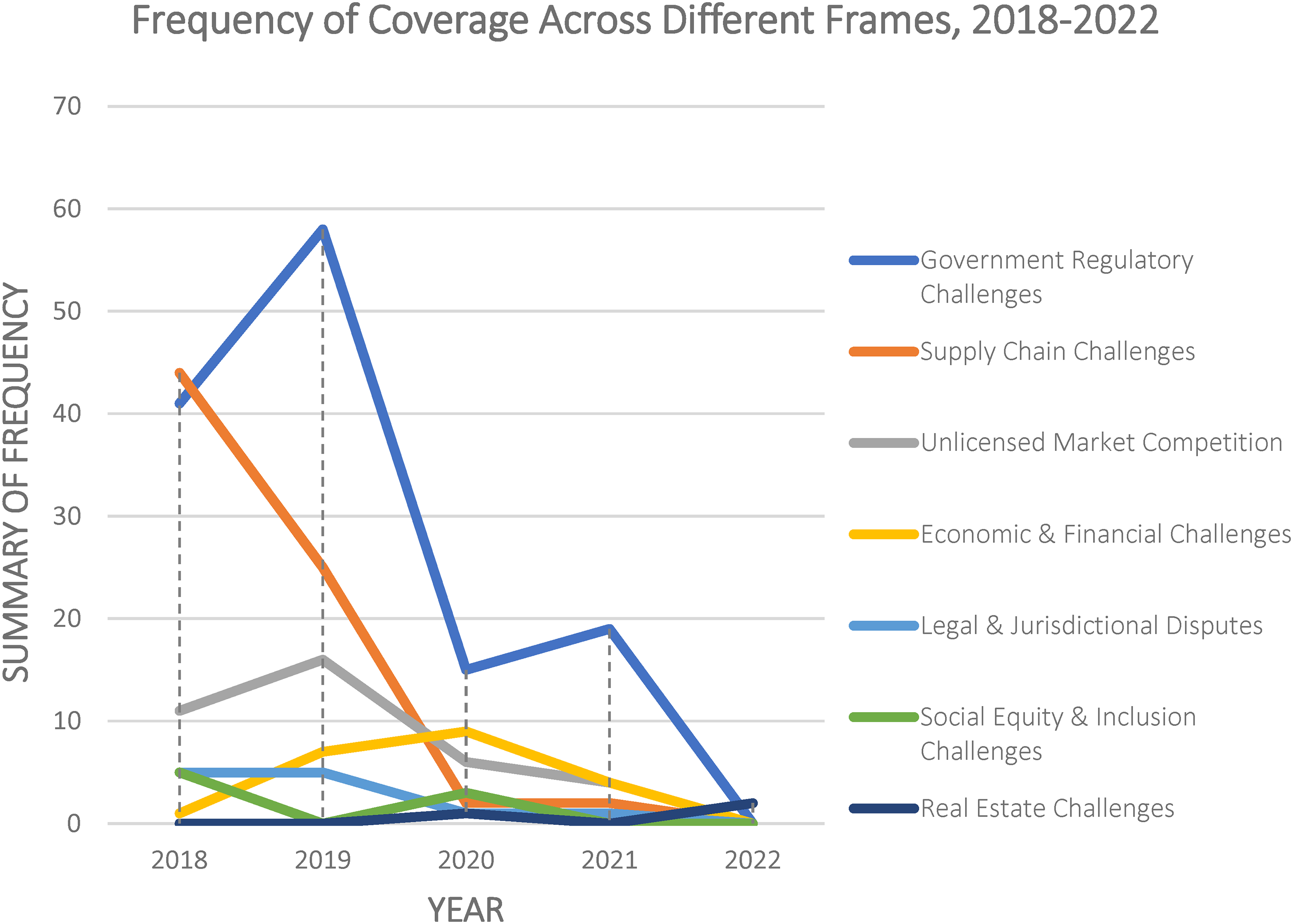
Differences in Frames, 2018–2022.
This trend was echoed across media sources. As shown in Table 1, government regulatory and supply chain challenges were the most cited frames, with the Calgary Herald and the Globe and Mail leading the coverage of these issues. Although government regulatory challenges dominated most news sources, unlicensed market competition and economic and financial challenges were also prominently represented, especially in the Toronto Star, National Post, and Vancouver Sun.
Frames Identified by Media Source.
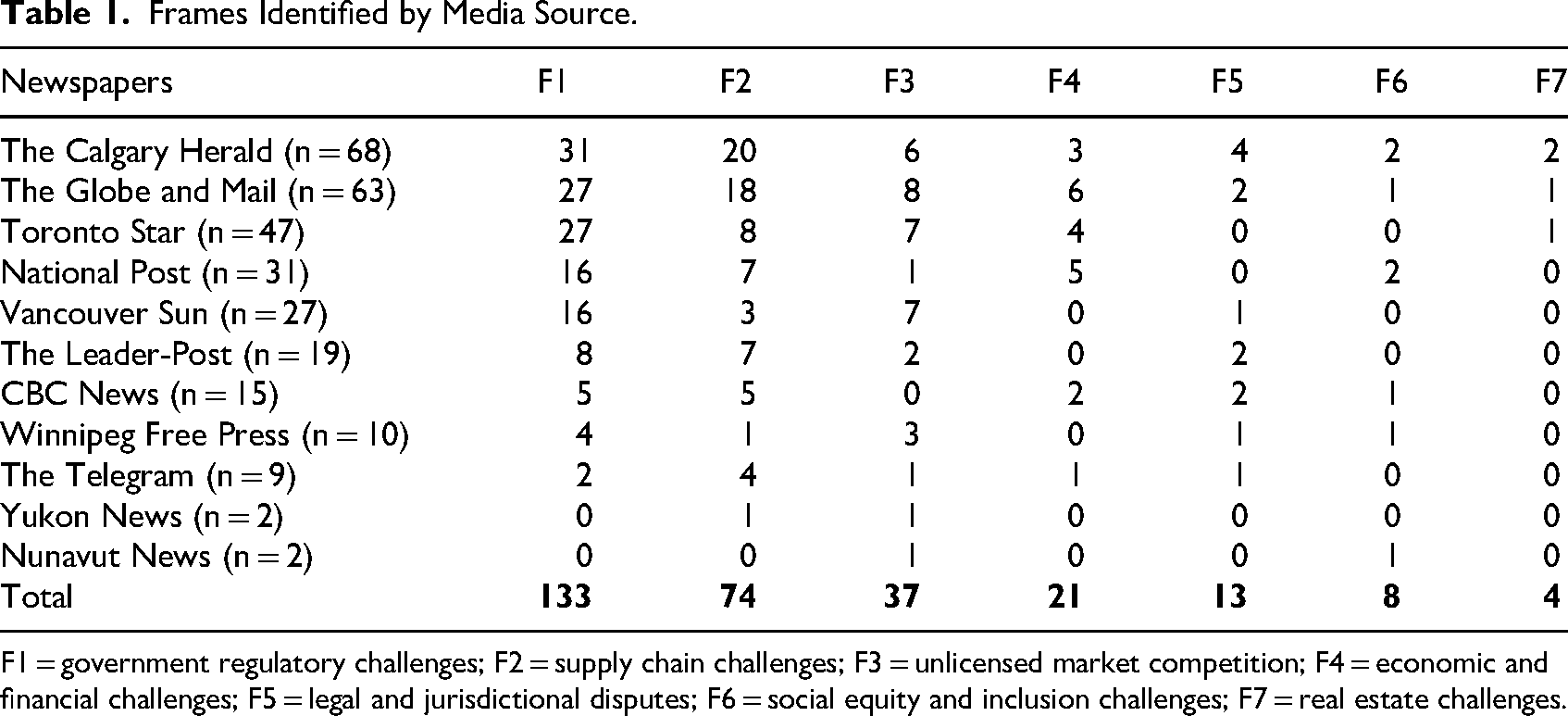
F1 = government regulatory challenges; F2 = supply chain challenges; F3 = unlicensed market competition; F4 = economic and financial challenges; F5 = legal and jurisdictional disputes; F6 = social equity and inclusion challenges; F7 = real estate challenges.
Our findings also revealed that the barriers reported in the media were highlighted across various news sources by several groups, including licensed and prospective retailers, other industry players (e.g., producers and consumers), subject experts (e.g., professors, researchers, analysts), government representatives, media representatives, and community representatives. As shown in Figure 4, licensed and prospective retailers accounted for 64% of the reported barriers, while subject experts represented 15%.
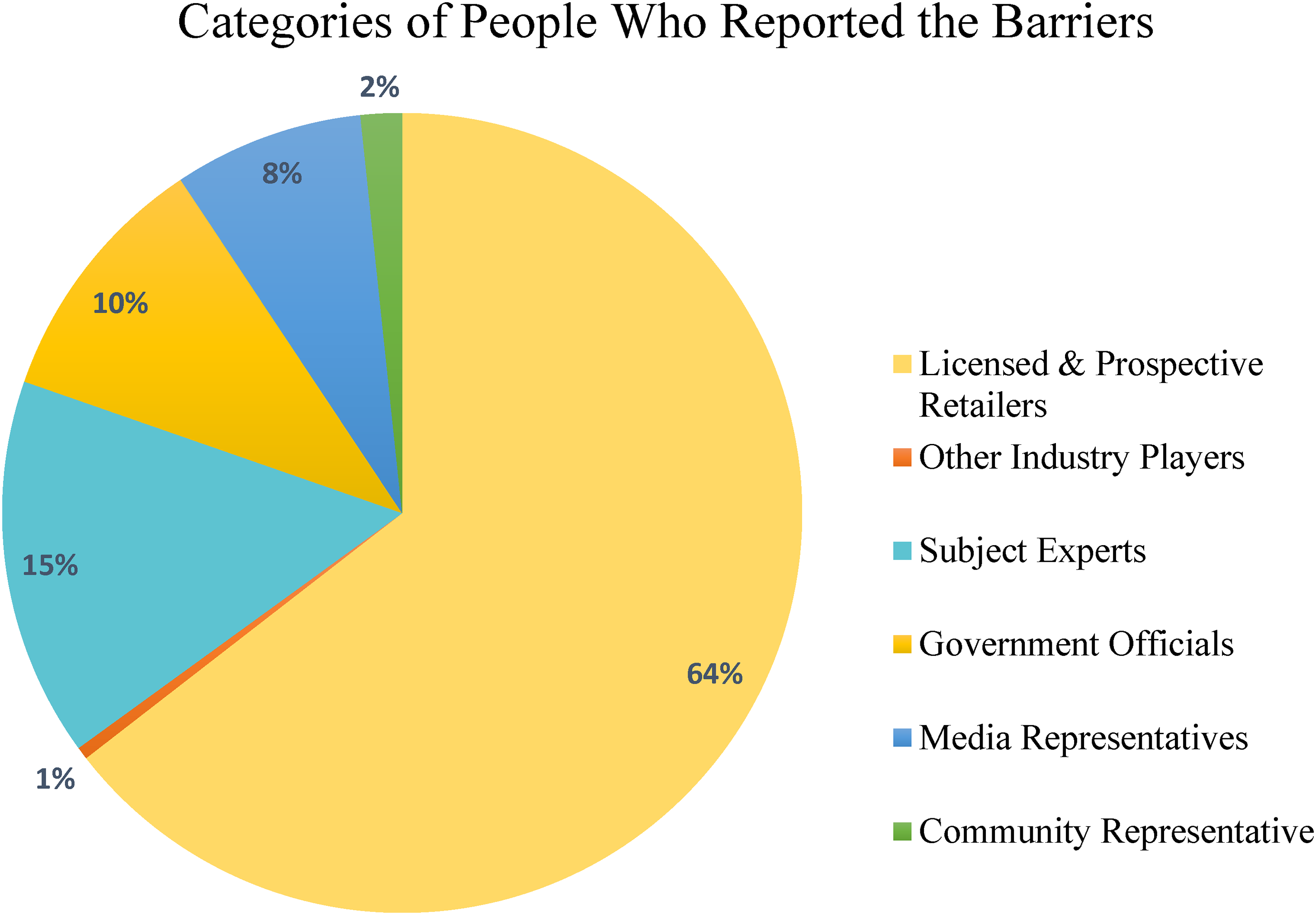
Categories of People Who Reported Barriers to the Media.
Frame 1: Government Regulatory Challenges
Problem Definition
The analysis revealed that most of the articles (45%) portrayed government regulations as significant barriers for cannabis retailers, affecting their ability to enter and operate in the market. These barriers included retail licensing requirements, store location restrictions, taxation, pricing limitations, limited number of licensed stores, advertising restrictions, and packaging and labeling regulations. Reports highlighted how these challenges limited market access and created operational challenges for businesses. Brand loyalty is a real challenge given the marketing restrictions and packaging restrictions. (Licensed Retailer) (Globe and Mail, 2019a) Every single element of getting to the opening is really bogged down with red tape and extremely difficult for a small operator to go through. (Licensed Retailer) (The Toronto Star, 2020c)
Retailers also struggled to transition to online sales, especially during the Covid-19 pandemic. The shift to e-commerce disproportionately impacted businesses without a robust online presence. Many cannabis retailers faced difficulties adapting due to regulatory uncertainties. For instance, only about 10% of licensed cannabis shops in Alberta were initially equipped for online sales. Policy-related challenges, such as stringent age-gating rules and bans on third-party delivery services further complicated this transition. Using credit monitoring service Equifax for age-verification purposes can be quite expensive, and from a technical standpoint quite difficult to implement. (Licensed Retailer) (The Calgary Herald, 2022) They're asking for your credit score to access online sales, that and a ban on using a third-party cannabis courier—such as a service similar to Skip the Dishes—puts the legal cannabis sector at a disadvantage with illicit operators who are widely believed to still control nearly 50 [percent] of the market. It's a pretty high bar when the illicits don't face that. (Licensed Retailer) (The Calgary Herald, 2022)
Causal Attribution
Media narratives primarily attributed these challenges to federal, provincial, and territorial government policies, including licensing caps, zoning regulations, high taxes, and delays in processing retail licenses. In Ontario, the initial lottery-based licensing system and early ownership restrictions heightened market uncertainty, while municipal bans further limited consumer access. Over time, as licensing caps were lifted, concerns shifted to market oversaturation and intensified competition, particularly for small retailers. Community opt-outs and limited storefronts [are] a toxic combination which pretty much guarantees that the black market will thrive. Capping retail outlets and having entire communities opt out makes the legal market in Ontario far less accessible. (Industry Players) (The Calgary Herald, 2018b) I don't mean that in a negative way. But the onerous restrictions and the regulatory situation that has a monopolistic tint to it is what might set us back. (Industry Expert) (National Post, 2019a) Market saturation isn't good for anyone… The only game plan here is to wait it out and watch the blood spill. (Licensed Retailer) (The Toronto Star, 2021a)
At the federal level, strict packaging and labeling, and advertising rules as well as high taxation were highlighted as barriers to growth. Government-controlled online sales in some provinces, coupled with reliance on provincial wholesalers, constrained product selection and pricing flexibility. Reports indicated that these factors weakened the legal market's ability to compete with unlicensed retailers, who often offered lower prices. One of the most glaring issues with Canada's cannabis framework is the way in which it is taxed, specifically, the excise taxes that are applied to medical and recreational cannabis. Excise taxes make cannabis more expensive, but they now make [cannabis] less available, which is a double-whammy in favour of the black market.(Media Representative) (Globe and Mail, 2019c) Federal packaging and advertising rules are so complex that they are driving up the industry's costs, limiting supply and inflating consumer prices. (Media Representative) (Globe and Mail, 2019d)
Unintended consequences of federal regulations were also noted. For example, window-covering requirements aimed at preventing youth exposure to cannabis were reported to have increased the risk of robberies by obscuring store visibility. The pandemic further exposed regulatory shortcomings, as shifting policies left legal retailers struggling to compete with unregulated online operators dominating the digital marketplace. Having to put security film on windows is the biggest [security] issue I have… The wrap on the exterior of the windows actually creates a security issue for the people inside because there is no visible access from the street into the shop. That allows the bad guys to feel more comfortable going into these shops and holding them up. (Licensed Retailer) (Globe and Mail, 2020)
Moral Evaluation
Media narratives portrayed government regulatory challenges as a balance between public health priorities and ensuring market fairness. Regulators defended licensing caps as necessary to prevent oversaturation and promote industry sustainability. However, critics, particularly small business owners, argued that such regulations unfairly restricted competition and economic growth, inadvertently benefiting the unlicensed market. Despite aiming to ensure fairness, these regulations were perceived as limiting job opportunities and hindering the growth potential of small and independent retailers.
The media also emphasized public health and well-being as it relates to online cannabis sales during the Covid-19 pandemic. The transition was viewed as a responsible response to social distancing measures, prioritizing customer and employee safety during the pandemic. However, it was also seen as a way to combat the unlicensed market and to align with public safety goals by ensuring better consumer protection.
Treatment Recommendation
Media reports underscored the urgent need for regulatory reforms to address government-imposed challenges in the cannabis industry. Key recommendations included revising the tax structure, streamlining the licensing process by reducing bureaucratic hurdles, and adjusting zoning regulations to prevent market oversaturation while enabling new retailers to enter the industry. Media reports have emphasized the scrutiny of the tax and regulatory framework, with calls for reforms to enhance the legal market's competitiveness. We need a taxation regime that makes sense. (Licensed Retailer) (Globe and Mail, 2021)
Expanding digital infrastructure was also highlighted as essential, with calls for government support in developing online platforms, age verification systems, and third-party delivery services to strengthen competition against the unlicensed market. Media reports have noted growing support for implementing an online click-and-collect system to improve consumer convenience, particularly in response to the increasing demand for digital and contactless shopping options.
Additionally, media narratives advocated for allowing licensed producers to operate retail stores and increasing marketing flexibility to enhance consumer access and experience. Sustainability concerns featured prominently, with reports urging reductions in excessive packaging through eco-friendly alternatives and the introduction of in-store recycling programs to improve environmental impact and public perception. Finally, media coverage emphasized the need to reassess opaque window requirements, which compromise visibility and safety, and to intensify enforcement against illegal cannabis websites and unlicensed operators to reinforce the legal market's viability.
Frame 2: Supply Chain Challenges
Problem Definition
The media extensively covered the supply chain challenges in provinces like Alberta and Ontario, highlighting issues such as supply shortages, delayed distribution, and difficulties in meeting the demand, especially for high-THC cannabis products. In the early years of legalization, the media emphasized that logistical issues in distribution and delivery limited retailers’ ability to open new stores, meet consumer demand, and compete with the unlicensed market. As the market evolved, media reports highlighted an oversupply issue, which led to declining prices and inventory management challenges, raising concerns about the long-term viability of the legal cannabis industry. We’ve had multiple orders that haven’t come through, I don’t see a quick fix… The demand is just unsustainable for the current supply chain. (Licensed Retailer) (Globe and Mail, 2018d) It's a big bummer. We paid a lot of money to build these stores, spending money at lightning-fast pace, and the staff that we’ve hired, we can’t employ them… But the other headache is who wants to open stores without any cannabis? It's a double-edged sword. (Licensed Retailer) (Globe and Mail, 2018a) Despite the sudden uptick in new stores, there still aren't enough—the biggest issue in the market right now is product oversupply, relative to the number of shops. There's a huge amount of lobbying on the industry front to increase the retail footprint, to increase access to address that oversupply issue. (Industry Expert) (The Toronto Star, 2021b)
Causal Attribution
The media attributed these supply chain disturbances to multiple factors. Early shortages stemmed from higher-than-anticipated demand, which strained the capacity of licensed producers and exposed inefficiencies in distribution networks. Delays in Health Canada's approval process for new producer licenses further constrained supply. Additionally, logistical challenges, such as excise stamp availability and distribution limitations complicated product availability. Over time, the supply dynamic shifted, with the media highlighting that the rapid approval of licenses introduced a surge of new producers into the market, contributing to an oversupply of products. Changing consumer preferences were also perceived as further influencing demand fluctuations, leading to price declines and inventory challenges for retailers. While we forecasted and planned for this level of demand, we did not anticipate the supply challenges. (Government Officials) (The Telegram, 2018) We need more licensed producers; we need Health Canada to approve more production sites. (Industry Expert) (The Calgary Herald, 2018c) Part of the problem is getting those little excise stamps. We’re short of stickers and we can’t ship without them…that slows the industry down. (Licensed Retailer) (Globe and Mail, 2018b) Supply by and large is available, but not necessarily in the specific strains that people are looking for or have bought or want to buy consistently… One week something could be a high THC product at a low price and the next batch could come in at a five [percent] lower THC, which doesn't necessarily meet what the customer's looking for. (Licensed Retailer) (The Toronto Star, 2020a) The supply of cannabis is not the issue. The issue is the supply chain. In other words, converting raw product into packaged goods and moving it to distributors or retailers and to customers. (Government Officials) (National Post, 2019b) Legal marijuana has not turned out to be the big money maker investors were promised, [nor] has it produced consistently good products. Every aspect of the cannabis supply chain is a struggle: paper-thin margins; oversaturated retail; limited product innovation; lack of manufacturing efficiencies; and low brand loyalty are just a few of many problems. (Media Representative) (Globe and Mail, 2021)
Moral Evaluation
The media portrayed the cannabis supply shortage as a conflict between regulatory restrictions and the intended public health and safety goals of legalization. They argued that the shortage of legal cannabis stores enables the unlicensed market to persist, which directly contradicts the primary goal of legalization to eliminate illegal sales and safeguard public health. By limiting the number of legal stores, consumers are less able to transition from the unlicensed market. Alberta's approach of prioritizing inventory distribution to regions with established retail stores rather than granting new licenses was depicted as a strategy to prevent consumers from seeking unregulated products. This approach underscores the delicate balance between enforcing regulations and ensuring safe, legal access to cannabis. Additionally, the media suggested a misalignment between available products and consumer demand, emphasizing the significance of meeting customers’ needs. It's just a domino effect from one thing to the next… it's tantamount to shutting down businesses. I want to keep on with this, but I don’t know how long it’ll be before my money runs out. It is causing the black market to thrive and grow — it defeats the government's whole purpose in this. (Licensed Retailer) (The Calgary Herald, 2018e) It's a strange problem to have. Usually, you run out of product because so many customers want it, or you run out of customers because they don’t. The fact the massive market is having problems of both demand and supply suggests that the legal system isn’t working properly yet. Unlike their legal counterparts, Canada's black-market dealers have plenty of supply and—for now, at any rate—plenty of demand. (Media Representative) (Globe and Mail, 2019b) The point of legalization is to get the consumers to convert to the legal market, and if there isn’t an easy point of access… then legalization will not necessarily fail but it won’t serve its purpose, which is getting rid of the black market. (Licensed Retailer) (Yukon News, 2019)
Treatment Recommendation
Media coverage spotlighted key strategies to ease supply chain challenges for cannabis retailers. A central proposal involved increasing the number of licensed producers, particularly by loosening regulations on edible production to better meet consumer demand and expand product diversity. Streamlining Health Canada's producer licensing process was also emphasized, with calls for a more efficient and less cumbersome approval system to accelerate market entry. Additionally, addressing logistical hurdles, specifically revising the excise stamp system, was framed as essential to improving distribution efficiency and minimizing delays. We need to be examining ways of giving retailers more creativity and flexibility when it comes to finding and managing supply. And we need to stop keeping would-be retailers in regulatory limbo. We need to push Ottawa to streamline regulations, while also looking to position Alberta as a production hub. (Media Representative) (The Calgary Herald, 2019b)
Frame 3: Unlicensed Market Competition
Problem Definition
The media highlighted fierce competition from the unlicensed market as an ongoing challenge for legal retailers in Canada. Despite the expansion of the legal market, unlicensed retailers continued to operate, attracting customers with lower prices, fewer regulations, and increased convenience. Factors such as branding restrictions, potency limits, and lack of online sales options for legal retailers in some provinces were perceived to have further undermined their competitiveness. It's quite unpredictable—I thought the government would try to bring in the black market. It's quite confusing. We want to be part of it—we're in limbo. (Prospective Retailer) (The Calgary Herald, 2018a) The illicit market remains an ongoing problem as new illegal cannabis ‘pop-ups’ continue to emerge. (Government Official) (The Vancouver Sun, 2021) I think I have a lot of loyal customers that are willing to go to me no matter what—unless [licensed retailers’] prices drop more than mine. I'm going to find it really surprising if they can actually drop the prices lower than what I have. (Prospective Retailer) (Winnipeg Free Press, 2018)
Causal Attribution
The media portrayed the persistence of the unlicensed market in the early years of legalization to be largely attributed to regulatory challenges, including a slow licensing process and the delayed rollout of legal stores, particularly in provinces like Ontario and British Columbia. Overregulation and limited government support were also highlighted as further hindering the legal market's ability to compete, preventing licensed retailers from establishing a dominant presence even as legalization progressed. But when red tape and poor planning are preventing the legal market from satisfying consumers, it's no surprise that some are still turning to the black market for their supply. All levels of government need to do a better job of meeting the demand. (Media Representative) (Toronto Star, 2019) No one expected the black market to be eliminated within the first year or two of legalization, but it's also not unreasonable to expect that government policies not help perpetuate its existence. (Media Representative) (The Calgary Herald, 2020)
Moral Evaluation
The media presented contrasting perspectives on the challenges retailers face. Some consumers defended purchasing from the unlicensed market as an expression of personal freedom, citing convenience, affordability, and product variety. Others framed it as support for small businesses over large corporations in the legal market. In contrast, legal retailers argued that unlicensed operators have an unfair advantage by bypassing regulations, creating an uneven playing field. Media narratives also underscored concerns about regulatory violations, emphasizing that unlicensed dispensaries undermined safety measures designed to protect public well-being. So, to have an unlicensed competitor is unfair from a business point of view and it's certainly problematic for us trying to maintain the integrity of the system… and you also worry about the safety and the quality of the product that's being sold. (Government Official) (The Leader-Post, 2019)
Treatment Recommendation
Media coverage has emphasized several strategies to curb the unlicensed cannabis market and support legal retailers. Media discussions have emphasized the need for price adjustments and product differentiation to attract a broader customer base. Reports have also called for stricter enforcement against illegal online sellers to improve product safety and ensure fair competition. Improved coordination between regulatory agencies and law enforcement has also been highlighted as essential for disrupting organized criminal involvement in cannabis trafficking. Additionally, media discussions have pointed to revising marketing and packaging restrictions, such as permitting onsite sampling and consumption, as a way to enhance consumer experience and help licensed retailers establish stronger brands. Another key recommendation has been the integration of legacy retailers into the legal market, with coverage suggesting that their expertise could bolster the regulated industry while reducing illicit operations. Successfully displacing the illicit market will require a fair and competitive legal market whereby recreational cannabis stores are granted the same privileges any other retailer is entitled to, including e-commerce. (Industry Player) (The Toronto Star, 2020b) Our hopes would be they'd crack down on some of the illegal players online. It was definitely our hope. (Licensed Retailer) (The Calgary Herald, 2019a)
Frame 4: Economic and Financial Challenges
Problem Definition
Media narratives underscored significant economic and financial challenges faced by cannabis retailers, including restricted access to financial services, high operational costs, and competitive market pressures. The media reported that many cannabis businesses struggle to secure banking services such as opening a bank account and accessing lines of credit and loans, limiting cash flow and expansion opportunities. It seems that most charted banks do not want to entertain new applications for lines of credits, loans, or new bank accounts… It has affected us. (Licensed Retailer) (National Post, 2020) It is very costly, and good luck opening a business account. They wouldn't give us a bank account. They wouldn't even talk to us about it. (Licensed Retailer) (CBC News, 2020) It has affected us. When you are a late-stage applicant operating on a pre-revenue basis, you need capital, because the cost of equipment increases, your cash burn rate is high and there's no revenue yet. (Licensed Retailer) (National Post, 2020)
Causal Attribution
The media attributed these financial challenges to financial institutions’ reluctance to serve the cannabis industry, restricting access to banking and credit. According to the media, financial institutions’ limited engagement with the industry led retailers to rely on personal or private funding sources, often at higher costs.
A lot of us had to go into our own pockets for money or RSPs because banks won't lend to us. (Licensed Retailer) (Calgary Herald)
Moral Evaluation
The media emphasized notable concerns regarding the financial barriers facing cannabis businesses, particularly smaller enterprises. The reports suggested that these financial barriers not only compromise the competitive landscape but also limit innovation and growth within the sector. Consequently, there is a pressing need for financial institutions to recognize their role in fostering a fair and equitable market. Supporting legal businesses not only fosters public health and safety but also reduces reliance on the unlicensed market.
Treatment Recommendation
Media coverage has highlighted several proposed strategies to address the financial challenges faced by cannabis retailers. Reports suggested that expanding asset-backed lending options could provide businesses with greater financial flexibility by allowing them to leverage their assets for credit. Coverage has also pointed to calls for a consignment-based wholesale model, similar to that used in alcohol distribution, as a way to reduce upfront costs and improve inventory management.
Frame 5: Legal and Jurisdictional Disputes
Problem Definition
The media highlighted the legal and jurisdictional disputes impacting the cannabis industry. Media coverage emphasized that, in the early years of legalization, licensed retailers faced delays in opening their stores, uncertainties, and financial burdens due to appeals against their approvals. Additionally, the media emphasized how legal disputes involving First Nation communities have complicated the industry, as some Indigenous communities were excluded from the provincial cannabis framework, raising concerns about jurisdiction and sovereignty. The whole system is broken, it's just a joke, all these appellants need is to put up $100 and away they go… I don't know what us small guys are going to do… it almost is like a turf war. (Licensed Retailer) (The Calgary Herald, 2018f) Nobody's appealing these stores for commercial reasons, they're willing to fight it out in the marketplace. As far as we're concerned, the city didn't have any reason to reject them … the city's process has been inconsistent. (Licensed Retailer) (The Calgary Herald, 2018f) We are the governmental authority for all business on our lands. We allowed Manitoba to license cannabis on our lands and as you can see they have chosen to remove that [license]. We will now manage the [licenses] for that site. (Community Representative) (Winnipeg Free Press, 2021)
Causal Attribution
Media coverage has highlighted the regulatory appeal process as a key factor exacerbating competition among cannabis retailers. Reports suggested that the ability to challenge site approvals has led to prolonged disputes, delaying store openings and increasing financial burdens. Additionally, media outlets have pointed to jurisdictional conflicts as the root cause of Indigenous communities’ exclusion from the legal cannabis market. In one particular case, the media surmised that tensions over unlicensed dispensaries on reserve lands stemmed from broader disputes between Indigenous self-governance rights and federal and provincial governments. If the provincial government wishes to challenge us or shut us down then we're going to end up in a judicial process because they failed to consult us… both the federal and the provincial government… First Nations, and not the federal or provincial governments, must determine the rules around the use and sale of marijuana on reserves. (Community Representatives) (CBC News, 2018)
Moral Evaluation
The media highlighted fairness as a central theme in these legal and jurisdictional disputes, emphasizing the need for an equitable regulatory framework. Coverage portrayed retailers who challenged regulatory decisions as advocating for consistent enforcement of established rules. In contrast, approved store owners expressed concerns over competitors exploiting the appeals process for strategic gains, creating perceived market imbalances. Media narratives also underscored ethical considerations surrounding Indigenous self-governance, framing First Nation communities’ efforts to regulate cannabis activities within their territories as rooted in historical practices and treaty rights. Reports suggested that excluding certain Indigenous communities from the cannabis retail market not only limits economic opportunities but also raises broader questions about sovereignty and self-determination. This discourse reflects a broader call for meaningful consultation and recognition of Indigenous governance. It's kind of like before legalization, when one drug dealer would go after another. We're simply asking for fairness, as people following the rules that have been established. (Licensed Retailer) (The Calgary Herald, 2018f) There are some communities who are saying that Canada can do what it wants, but in terms of our community, we're the sole entity who will decide. (Community Representative) (The Toronto Star, 2017)
Treatment Recommendation
Media coverage has highlighted several proposed solutions to the legal challenges faced by cannabis retailers. One prominent suggestion for alleviating the backlog in the appeals process was to increase staffing and implement procedural reforms to expedite decisions. Reports also emphasized the need for ongoing diplomatic dialogue with Indigenous communities to clarify cannabis regulations and address jurisdictional disputes. This approach was presented as a way to promote regulatory compliance while fostering cooperation between the cannabis industry and Indigenous groups.
Frame 6: Social Equity and Inclusion Challenges
Problem Definition
Media narratives emphasized the exclusion and marginalization of gray market participants and activists in the new legal cannabis regime, revealing a disconnect between the legalized market and pre-legalization industry members. Reports highlight systemic barriers facing Black and Indigenous entrepreneurs, such as high start-up costs, prolonged licensing processes, income inequality, and the need for a clean criminal record. Additionally, concerns persist about the exclusion of individuals with criminal records, which some argue, contradicts legalization's intent to destigmatize cannabis. Distrust between regulators and the unlicensed market further complicates the effort to bridge the gap between the two sectors. The media also highlighted concerns about potential social challenges and the proximity of cannabis stores to vulnerable populations, fueling apprehension of community representatives. The government, at every level, are saying to us, you're going to be locked out of the legal system and your criminal record will ban you from getting in. Even though I don't run any unlicensed dispensaries any longer. (Prospective retailer) (National Post, 2018)
Causal Attribution
Media coverage attributed this exclusion and distrust to multiple factors, including government rhetoric that reinforces perceptions of regulatory misunderstanding about legalization's intent. Historical biases in cannabis prohibition enforcement have disproportionately impacted Black and Indigenous communities, exacerbating their financial and bureaucratic challenges in entering the legal market. The media suggested that these historical injustices, combined with regulatory and economic barriers, have contributed to the continued marginalization of these groups within the legal cannabis industry. What's upsetting about this, is that it's not the beginning where the end of prohibition should be — with an apology. The continued punishment and oppression of cannabis users, the incredibly harsh penalties put into place for those operating outside the system, the misinformation and government propaganda against cannabis…. Those are all serious problems that I have with the way in which legalization is taking place.(Prospective Retailer) (National Post, 2018)
Moral Evaluation
Media coverage has highlighted competing perspectives within the cannabis industry. Reports frequently emphasized the “customer over profit” ethos promoted by unlicensed market operators who positioned themselves as advocates against cannabis stigmatization. At the same time, equity and equal opportunity within the legal cannabis market were framed as essential for a fair and sustainable industry. Media analysis also reflected concerns about systemic challenges related to community safety. Opponents of cannabis retail stores, including community leaders, expressed fears that these establishments could contribute to public safety risks and exacerbate existing social issues, particularly in vulnerable areas. We'd love to work within the system, but our top priority is people. I'm not willing to tell them to come back in a few months. I'm not sacrificing our patients while the authorities try to sort this out. (Prospective Retailer) (The Vancouver Sun, 2018) The neighbourhood currently faces an opioid abuse problem that a community safe-consumption van is expected to mitigate. An approval of a cannabis retail outlet at the location … is completely contrary to efforts to address the drug issues. (Community Representative) (The Calgary Herald, 2018g).
Treatment Recommendation
Media coverage has underscored the need for equity-driven policies to address the lasting effects of cannabis-related criminalization. Reports emphasized recommendations such as expedited pardons for past offenses, the implementation of social equity programs, and the incorporation of a racial lens in policy development to better support marginalized communities. Additionally, media discussions highlight the importance of fostering diversity in the industry through networking initiatives and resource-sharing platforms to reduce barriers and promote inclusivity.
Frame 7: Real Estate Challenges
Problem Definition
Media coverage highlighted the pressing challenges cannabis retailers faced, particularly the intense competition and bidding wars for retail space. The high demand for store locations resulted in inflated prices, non-refundable deposits, and long-term lease commitments made before licensing approvals were secured. Additionally, the media highlighted retailers’ struggles in securing suitable properties due to community skepticism and negative perceptions associated with cannabis businesses. Local retailers are being shut out by the larger players who are being opportunistic, who don’t care about the local community. There was already a very tight vacancy rate, and it's become a chess game, a challenging real estate game. (Licensed Retailer) (The Calgary Herald, 2018d)
Causal Attribution
Media coverage attributed real estate challenges to a lack of foresight among some retailers, regulatory hurdles, and community resistance. Reports indicated that many retailers entered into lease agreements early in the legalization process without fully assessing the associated risks. The prolonged licensing process and intense competition for desirable locations further inflated rental costs. Additionally, resistance from landlords and neighbors limited the availability of suitable retail spaces, intensifying the competitive and uncertain landscape cannabis retailers faced. They just basically stalled us on places we could have had open last Oct. 17, we're paying leases (for unused space) so it's a very frustrating thing. (Licensed Retailer) (Calgary Herald, 2019)
Moral Evaluation
The media narratives emphasized the need for informed decision-making within the cannabis industry to mitigate risks and avoid common pitfalls. Cannabis companies were portrayed as striving to counter negative perceptions through responsible business practices and community engagement. However, opposition to proposed cannabis shops was often framed as a defense of community interests, with concerns about maintaining family-friendly neighborhoods and protecting recreational spaces. There are some that took the risk that their development permit would be approved and started construction. If they’re not approved, they might have a really nice storage room, but not a cannabis store. (Government Official) (Calgary Herald, 2018)
Treatment Recommendation
Media coverage suggested that cannabis retailers should proactively collaborate with real estate companies to navigate challenges, particularly by securing locations previously rejected at lower rates, thus avoiding costly long-term leases. Additionally, retailers were encouraged to engage directly with local communities, addressing concerns and fostering trust to create a more supportive environment for their businesses. Oftentimes it is very important that you have a strong community that supports you because there is still a lot of stigma associated with cannabis. You have to be a good partner, you have to go talk to your neighbours. (Licensed Retailer) (Globe and Mail, 2018c)
Discussion
Our analysis of media framing of the barriers private cannabis retailers faced in Canada provides a comprehensive understanding of the various challenges and perceptions within the legal cannabis market. We identified seven keyframes: government regulatory challenges, supply chain challenges, unlicensed market competition, economic and financial challenges, legal and jurisdictional disputes, social equity and inclusion challenges, and real estate challenges. These frames are interrelated and often intersect in significant ways. For instance, media narratives on social equity and inclusion challenges frequently overlap with those concerning real estate challenges, while narratives around economic and financial challenges are closely tied to government regulatory challenges and unlicensed market competition. By examining these interconnections, this study highlights the multifaceted nature of these challenges, shedding light on how these issues are defined, the perceived causes behind them, the moral viewpoints, and the proposed solutions.
Our analysis also revealed significant shifts in how the media framed retailers’ barriers from 2018 to 2022, reflecting evolving concerns around regulatory challenges, market dynamics, and public health impacts. Canadian news media primarily focused on government regulatory challenges, supply chain challenges, unlicensed market competition, and economic and financial challenges. Early coverage, especially in 2019, emphasized government regulatory challenges, with a particular focus on retail licensing requirements, location restrictions, high taxation, and advertising limitations, attributed to federal, provincial, and territorial governments’ policies. This regulatory focus stemmed from concerns about establishing new frameworks for the emerging cannabis market (Health Canada, 2016). Our findings align with a recent study that indicates licensing and compliance requirements result in substantial startup and operational costs, with high taxes serving as a major barrier that restricts profits and overall business success (Adams, 2024). This cautious regulatory approach is designed to prioritize public health and safety over industry expansion, aiming to avoid the pitfalls seen in the alcohol and tobacco sectors (Parliament of Canada, 2017; Ritter et al., 2022).
Despite these public health initiatives, ongoing harms associated with alcohol and tobacco suggest that such regulatory approaches have not fully protected public health (Ritter et al., 2022). Our findings indicate that strict regulations, while designed to safeguard public health, may have unintended consequences. For example, the initial decision to cap the number of retail licenses in certain provinces, aimed at reducing health risks, inadvertently limited access to safe, regulated cannabis products, possibly pushing consumers toward unregulated alternatives (Bear & Meisel, 2023). Bear and Meisel (2023) further argue that delays in opening retail stores and limited availability of legal cannabis hampered efforts to steer consumers away from the unlicensed market. Similarly, our findings show that lifting the retail licensing cap eventually led to market oversaturation in some provinces. While the increase in the number of licensed stores may reduce the unlicensed market, it also raises concerns about greater cannabis accessibility and the potential for heightened public health risks (Barrass & Jesseman, 2021; Centre for Addiction and Mental Health, 2022). Furthermore, these regulatory barriers have negatively impacted the financial viability and market reach of cannabis retailers, creating a fragmented market with uneven accessibility across regions (Adams, 2024; de Koning & McArdle, 2021; Donnan, Downey et al., 2024). The cumulative effect of these regulatory burdens often discouraged potential market entrants and stifled innovation within the industry, undermining the goal of displacing the unlicensed market (Health Canada, 2023b). This paradox highlights a gap in the public health focus of cannabis legalization policies, where ensuring easy access to legal products is also crucial for minimizing the harms associated with unregulated cannabis. However, studies have shown that greater access to cannabis products is associated with increased adverse health outcomes (Cantor et al., 2024; Manthey et al., 2023; Myran et al., 2023). Cantor et al. (2024) found that greater physical access to cannabis retailers leads to increased cannabis use and related harms, underscoring the need for a balanced regulatory approach that ensures public safety while supporting market growth without overburdening retailers.
Another key frame that emerged from our study was supply chain challenges. In the early years following legalization, extensive media coverage focused on supply chain challenges like product shortages, distribution delays, and difficulties in meeting demand for high-THC products. Media reports attributed these issues to unexpectedly high demand, inexperienced producers, slow licensing, and logistical problems. Specifically, the media emphasized that supply shortages in retail stores were exacerbated by regulatory delays in approving licensed producers by Health Canada and the presence of inexperienced cultivators. These findings are consistent with prior research indicating that regulatory delays and bureaucratic hurdles can severely disrupt supply chains in emerging industries (Centre for Addiction and Mental Health, 2022; Krause & Pullman, 2021). Moreover, compliance costs and regulatory burdens across the supply chain may have inevitably driven up product prices, potentially deterring consumers from the legal market (Deloitte, 2020). However, our results show that as the market evolved and policies changed, product shortages shifted to oversupply, introducing new challenges for retailers, including the management of surplus inventory and declining prices (Lamers, 2023; Lundy, 2024). Due to the oversupply of cannabis products, producers have scaled back operations, laid off workers, and closed facilities, leading to significant price reductions (Blunt, 2023). Lamers (2023) noted that falling prices are squeezing businesses throughout the cannabis supply chain, raising concerns about the industry's sustainability. However, over time, media attention on government regulatory and supply chain challenges has diminished, while the focus on unlicensed market competition has remained steady. This shift suggests that while regulatory and supply chain issues were once significant, they may have become less prominent as the market matured. Baumgartner et al. (2009) argue that media attention to specific issues tends to fluctuate based on public and political priorities, while McCombs (2005) notes that agenda-setting effects weaken when media coverage decreases.
The media frequently emphasize the ongoing challenge that the unregulated cannabis market presents to licensed retailers, impacting both public opinion and policy debates. Despite years of legalization, the unlicensed market still controls approximately 40% of cannabis sales in Canada (Gibbs et al., 2021; Israel, 2024). This situation underscores the difficulties licensed retailers face, particularly given the unlicensed market's ability to offer lower prices and unregulated, high-potency products (Gibbs et al., 2021). Although price reductions in the legal market have alleviated some pressure, licensed retailers still struggle due to stringent regulations and higher operational costs, which can limit their competitiveness (Gibbs et al., 2021). This dynamic has broader implications for public health and the economic sustainability of the legal cannabis industry. Unregulated cannabis products, often contaminated with harmful substances or inaccurately labeled THC and CBD levels, pose health risks that can lead to adverse outcomes such as dizziness, anxiety, and psychosis (Canadian Public Health Association, 2017). For example, edibles from the unlicensed market frequently have higher THC doses, unclear labeling, and the appearance of regular candy, which increases the risk of accidental consumption (Donnan, Johnston et al. 2024). This highlights the need for rigorous regulatory measures and public health education to mitigate potential health consequences (Donnan, Johnston et al. 2024). Enhancing public awareness about the risks of unregulated cannabis products could shift consumer behavior towards the safer, regulated market, thereby increasing the legal market's customer base.
Economic and financial challenges is another key frame emerging from our study, stemming from regulatory delays and restrictions, high taxation, and limited access to financial services. Such hurdles reflect a broader systemic problem within the regulatory and financial landscape of the cannabis industry. Health Canada's legislative review aligns with our findings, suggesting that financial pressures such as taxes, fees, and compliance costs threaten the sustainability of legal operations (Health Canada, 2023b). The report notes that “companies in the legal market are struggling to realize profits and maintain financial viability” (Health Canada, 2023b). This discourse also corroborated studies confirming that high regulatory costs and taxes hinder the growth of legal cannabis operations (Ernst and Young, LLP., 2022; Kavousi et al., 2022; Zdinjak, 2022). For instance, Ernst and Young, LLP. (2022) concluded that current taxation discourages the shift to regulated products. However, another report suggested that while high taxes may drive consumers to the unlicensed market, lowering them could increase use and related societal costs (Mejia, 2022). Thus, taxation policies should balance discouraging consumption with reducing the appeal of the unlicensed market (Health Canada, 2016).
Limited access to financial services was also highlighted as a significant barrier for licensed retailers. Media reports indicate that most cannabis retailers cannot obtain loans or conduct basic banking transactions due to traditional banks’ reluctance to engage with the cannabis industry. Previous research has documented cases where banks have canceled retailers’ business accounts, citing perceived risks associated with these businesses (James & Tippins, 2021). Moreover, the federal illegality of cannabis in many countries, including the United States, forces many cannabis businesses to operate on a cash-only basis, increasing risks of theft and inefficiencies (Black & Galeazzi, 2020; Business of Cannabis, 2023). This hesitation by financial institutions is often driven by concerns over potential legal repercussions (Hill, 2021). The lack of access to essential financial services significantly impacts the financial stability and growth of cannabis businesses (Merz & Riepe, 2021). In response, a number of cannabis companies have initiated a class-action lawsuit, accusing Canadian banks of financial discrimination for refusing to open accounts and denying access to mortgages and credit lines (Montreal Gazzette, 2023). Simultaneously, advocacy for legislative reform is gaining traction. One notable effort is the United States’ SAFE Banking Act, which aims to create a safer financial environment for cannabis businesses by offering protections to financial institutions, thereby reducing the risk of federal penalties (Merkley, 2023). If enacted, such reforms could also benefit Canadian cannabis retailers by improving access to financial services and addressing economic challenges, ultimately supporting the growth of the legal cannabis industry.
These financial and regulatory pressures, coupled with evolving market conditions, fuel an ongoing debate about whether loosening restrictions could better support the industry's sustainability. This shift toward more relaxed regulations mirrors broader societal trends toward normalizing cannabis use, presenting both opportunities and risks. While easing regulatory burdens may foster industry growth and provide much-needed relief for retailers, the potential public health implications, particularly for vulnerable populations such as adolescents, warrant careful consideration. Ali et al. (2022) and Barg and Brochman (2024) caution that normalization could elevate associated risks, potentially undermining public health and safety. As such, ensuring that regulatory frameworks remain aligned with public health objectives while facilitating the sustainable growth of the legal cannabis industry will be crucial in shaping the long-term success of cannabis legalization in Canada.
Implications for Public Policy
The study underscores the significant influence of media narratives on shaping public and policy agendas in the cannabis retail market. This understanding is vital for policymakers seeking to craft effective cannabis policies. A comprehensive public health approach should encompass not only the health impacts of cannabis use but also the broader implications for market success. The ongoing media focus on regulatory challenges signals a need for reforms that balance public health and safety with the growth of the cannabis market.
One key implication is the need to evaluate the impact of provincial and federal excise taxes on the cannabis industry. High taxation on cannabis products can weaken the competitiveness of legal retailers, potentially driving consumers toward unlicensed markets (El-Cheikh et al., 2022; Grossman et al., 2024; Mejia, 2022). This challenge underscores the importance of adopting a balanced tax policy that fosters market growth while achieving public health objectives. Recent amendments proposed by Health Canada, which prioritize reducing regulatory burdens over revising the excise tax framework, reflect the complexities of aligning economic and health goals (P. W. and G. S. C. Government of Canada, 2022). The implications for policymakers include recognizing the potential benefits of adjusting cannabis taxes based on potency limits or reducing them to enable legal retailers to offer more competitive prices, making the legal market more appealing to consumers (Kavousi et al., 2022; Prieger et al., 2019). Understanding the impact of cannabis tax policies is essential for developing strategies that minimize harms and administrative costs while discouraging reliance on unlicensed markets (Grossman et al., 2024).
Another implication involves strengthening enforcement against unlicensed cannabis operations. Unlicensed retail operations pose considerable risks to public health and safety, highlighting the importance of enhanced enforcement measures. Efforts at the federal, provincial, and territorial level to close illegal stores and reduce their online presence are critical to protecting consumers and supporting the legal market (Public Safety Canada, 2020). Research suggests that offering higher quality products through legal channels, and stricter enforcement against unlicensed retailers, can shift consumer preference toward the legal market (Auriol et al., 2023). Furthermore, ongoing public education on the dangers of unregulated products is vital for changing consumer behavior and ensuring the sustainability of the legal cannabis market (Auriol et al., 2023; Canada, 2022).
Finally, the study points to the need for financial reforms within the cannabis industry. Limited access to traditional banking services continues to impede the operational efficiency and security of cannabis businesses. Expanding access to financial institutions under the Cannabis Act may provide cannabis businesses with more stable financial support while shielding Canadian financial institutions from legal risks in countries where cannabis remains federally prohibited (Chiang, 2017). Further research is necessary to explore the feasibility of implementing these financial reforms to strengthen the long-term viability of the cannabis industry.
Limitations and Future Directions
While this research offers valuable insights into media framing of cannabis retailers’ barriers in Canada, several limitations should be acknowledged. First, the focus on mainstream media and specific databases may have excluded perspectives from alternative or niche outlets, introducing potential selection bias and limiting the comprehensiveness of the findings. Future research could address this by incorporating a broader range of media sources, exploring regional differences, and utilizing multiple databases for a more representative sample. Second, the dynamic nature of online news platforms, where articles are frequently updated, modified, or removed, poses challenges for consistent analysis. This issue led to the exclusion of some articles that initially met the inclusion criteria of the previously published content analysis (Wright-Brown et al., 2024) but later became unavailable. To enhance transparency and reproducibility, the researchers included detailed documentation of how articles were identified, captured, and analyzed. Future studies considering this method could employ more robust archiving tools and methods to ensure data consistency and reliability. Third, while Entman's framing analysis approach was applied, the process of identifying and categorizing frames inherently involves some subjectivity. To mitigate potential biases, standardized coding guidelines and multiple coders were used. Future studies could complement frame analysis with other qualitative and quantitative methods, such as interviews or surveys, to triangulate findings and provide a more comprehensive understanding of media framing. Lastly, this study captures a snapshot of framing within a specific time frame, which may not capture longer-term trends or shifts in narratives. Future research may consider extending the study period and conducting follow-up analyses to observe changes in media framing over time, particularly beyond 2022.
Conclusion
This study explores how Canadian news media have framed the barriers faced by private cannabis retailers after legalization, highlighting significant challenges and the need for regulatory approaches that balance public health goals with market sustainability. By applying Wright-Brown et al.'s (2024) Comprehensive Cannabis Retail Framework and Robert Entman's framing approach, we demonstrate that media coverage not only identifies key issues but also shapes the policy agenda for future government action. Through an analysis of how issues are presented, including their underlying causes, moral perspectives, and proposed solutions, our findings emphasize the critical role of media frames in shaping policy discourse and policy development. This underscores the importance of vigilant, adaptable policy measures to address the evolving challenges of the cannabis industry while safeguarding public health and safety. Moreover, understanding media frames provides valuable insights into shifting public sentiment and potential policymaker responses. By leveraging these insights, policymakers can better align regulations with changing public attitudes and industry needs, fostering a sustainable cannabis market that prioritizes both public health and market stability.
Footnotes
Acknowledgments
A special thank you to the following individuals for their valuable feedback on a draft of this paper: Jessica O’Dea, Data Analytics Consultant, Department of Health and Community Services, Government of Newfoundland and Labrador; Queen Jacques, PhD Candidate, Community Health: Applied Health and Policy Research, Faculty of Medicine, Memorial University of Newfoundland.
ORCID iDs

Funding
The authors disclosed receipt of the following financial support for the research, authorship, and/or publication of this article: This work was supported by the Canadian Centre on Substance Use and Addiction (CCSA) and the Canadian Institutes of Health Research (grant number 20200938).
Declaration of Conflicting Interests
The authors declared no potential conflicts of interest with respect to the research, authorship, and/or publication of this article.