




Abstract
Online drug use pornography has been freely available through websites on the open internet for at least 7 years. Surprisingly there is almost no exploration of its nature, character or impacts on both performers and those engaging with this type of content within the research literature. Nor is it an issue that has engaged health care providers and other statutory and non-statutory agencies even though it may have implications within their respective domains. A preliminary scoping of the online environment is used to propose a theoretical framework that combines Goffman's performance theory with that of Turner and Schechner's positioning of ritual theory within performance theory, Butler's concept of performativity online and Luppichi's concept of the ‘technoself’. Utilising the proposed theoretical framework, it is postulated that the presence, performance and engagement of online drug use pornography is a social boundary testing and possibly breaking performance centred on iterative relationships between performer and consumers of this content.
It is generally recognised that online behaviours can have public health and personal health implications which can lead to harms (Centola, 2013). This article focuses on the convergence of social media, drug use and pornography on social media platforms and pornography sites as online drug use pornography. We define online drug use pornography as content which always contains scenes of drug use (injecting, smoking, etc.) and scenes of sexual activity (sex, masturbation, signs of sexual excitement, etc.) and/or sexualised language to describe drug use. The aim of this article is to propose theoretical foundations that may be used to inform empirical research on online sexualised drug use content in this context. These theoretical foundations, and any resulting empirical research, are likely to contribute to increased interest in public health and harm reduction outreach interventions with online communities of people who use drugs (Lakhov, 2021) and increasing debates around content regulation of online media (Young, 2022).
Utilising performance theory, this article focuses on the presentation of self (Goffman, 1956) through rituals (Bell, 1997; Schechner, 1985; Schechner & Schechner, 1988; Turner, 1982, 1988), ‘performative utterances’ (Butler, 1996), the concept of the ‘technoself’ (Luppicini, 2012) and the historical, sociological and cultural context of drugs, sex and their convergence. Referencing these theoretical perspectives, we draw on an initial scoping (i.e., searching for this content and identifying methodological approaches to study the phenomenon empirically) of one popular pornography website and one social media website with a view to generate a unique theoretical framework that we suggest can be used to guide the methodological investigation of the phenomenon of online drug use pornography in future studies.
The Convergence of Drug Use and Pornography Through the Internet
Differing technological platforms can enable or restrict different forms of online expression through their various ‘affordances’, such as the capacity to upload, promote categorise, interact with and charge for amateur-produced content. Such digital affordances have catalysed profound changes in how individuals interact with people, obtain information, produce and purchase goods and services (McNair, 2012). This includes new forms of online social expression through pornography (Attwood, 2017); greater diversity and increased availability of pornography and the amateur production of pornographic materials (McNair, 2012); the amateur journalistic reporting of drug experiences (Paasonen, 2011) and the online purchase of drugs through deep web and social media sites (Lakhov, 2021; Van Hout & Hearne, 2017).
Online drug use pornography appears to be influenced by the Web 2.0 phenomenon (diNucci, 1999), whereby, the lines between the production and consumption of content are blurred with the emergence of amateur-produced pornography (Paasonen, 2011). The convergence of digitalised pornography and drug consumption as drug use pornography lies at the intersection of both phenomena, whereby, individuals become both amateur porn producers and reporters of their own drug use. Content of this nature dating from at least 2016 continues to exist on well-established and popular pornography sites on the surface web whilst the material is also readily available on lesser-known pornography sites as well as on social media.
When scoping online drug use pornography, it appears to be fetishised, commodified, produced and engaged with by people who use drugs and sex workers who often specialise in producing and selling this type of niche, transgressive content. Featured drug use can include smoking, injecting and ‘hotrailing’ (where the drug is vaporised through heated glass and ingested nasally). The preparation for administration and the consumption of drugs appears to be used to advertise a performer and it is often a central component to the performance or act. Performers may entice the audience with suggestions of drug use and may engage in communal and virtual drug use with audience viewers sometimes as part of a one-to-one virtual sex work offering.
People are known to vicariously experience emotions through observation – the ‘mirror neuron’ effect (Hickok, 2014). Online and staged forms of emotional expression (ranging from emotionally charged movies to online pornography) can elicit emotional arousal states despite no physical connection between actors and audience. In the case of pornography, audience viewers may situate themselves within a performance using both visual (naked images) and audio (moans, groans, etc.) cues for masturbation and/or potentially the use of teledildonic devices (which are online connected sex toys). It is conceivable, that the audience for online drug use pornography similarly strives to experience drug use vicariously and may situate themselves within the performance through the ingestion of drugs during the watching of content or during ‘live cam’ sessions (where they can directly interact with the performer through video sessions).
Establishing the ‘Technoself’ Through Online Performance
Central aspects of the foundational theories underpinning performance theories are how the ‘self’ is performed (Goffman, 1959) and the social functions of rituals (Schechner, 1985) and other forms of social performances (Bell, 1999). The advent of the mass digitalisation of the self through online profiles on websites and mobile applications, and the centrality of this method of social communication in social and societal processes (such as dating, communication, booking and rating of taxis and accommodation, etc.), requires a specific focus on the performance online of the ‘technoself’ through platform-based avatars and profiles (Luppicini, 2012).
Goffman (1959) in his seminal work ‘The presentation of self in everyday life’ considers the theatre and acting useful metaphors for understanding social interactions. In Goffman's sense, the self is performed as a character to be perceived by others. The etymological root of ‘person’ is the Latin ‘persona’ or face mask and how we perform, or act can help define our personality (Goffman, 1959). Performers can present and act out a self which can be observed by the performer and others.
Digital devices can project digital reflections into the world through purposefully constructed and online personas or profiles, what Luppicini (2012) refers to as ‘technoselves’. These are performed and curated through posts, comments, images, videos and other forms of media using profiles and online avatars (Luppicini, 2012). that may or may not reflect a person's identity in non-virtual life in the physical world (Hillis, 2009). Online drug use pornography performers sometimes indicate that they are ‘actors’, possibly to avoid the attention of law enforcement agencies or the threat of removal by the site owners to demonstrate that they are not engaging in illegal acts but imitating them as part of a performance for the enjoyment of others.
Online Personas
Online personas can be cultivated in several ways. Clothing, make-up, tattoos and other signifiers can help develop these digital characters. Background music and the associated lyrics can give insight into tastes, preferences and states of mind. Various symbols can be used to provide context for a character. Satanic imagery, the swastika and other taboo symbols may be used to indicate rejection of taboos and a counter cultural transgressive ideology (Knoops et al., 2015).
A central aspect of Goffman's performance theory is the concept of the stage where performances are presented and performed. Stages tend to have special rules and rituals and can serve a range of functions. Pornography sites and social media sites are existentially the ‘technostages’ or online spaces where drug use pornography shows are presented and performed. Unlike physical theatre stages, these stages are highly manipulable using effects but are also constrained by the technological affordances of specific platforms (e.g., in terms of the length of the videos, limits on text descriptions, etc.). Specific stages and their technological affordances will frame the nature of the type of content which can be performed; how it is viewed and how it is interacted with (e.g., through ‘like’ buttons and other affect focussed symbols ‘dislike’, ‘love’, etc.). In live streaming, performances are performed live as soon as the streaming begins. However, in non-live performances, performances can be repeated, rehearsed, edited and curated.
The choice of platform or ‘technostage’ and the type of medium produced can itself signify a message of intent (McLuhan, 1964). For example, posting content on a porn site explicitly signifies that it is intended as pornography. Technostages may have ‘frontstages’ where a post, picture or video is uploaded and presented as a form of advertisement or means of drawing attention to content of interest. On these frontstages content can be framed with textual description or images (in the form of emoticons) depending on the affordances (such as character limits) offered by a particular platform. Backstage and offstage in the form of both open and closed forums and groups, performers may discuss performances and, where payments may be involved, discuss the nature and content of performances both personal and communal.
A digital auditorium may be found in comment threads where a performance can be discussed and appears to involve direct interactions with the performer who may engage with their fans and general audience. A performer may be both an audience member and a performer in this context and may actively participate in discussions around their own performance or that of their peers (Goffman, 1959). They appear to be both producers and consumers of content.
McLuhan (1964) has commented that when media is ‘hot’ (heavily contextualised and rich in sensory material such as in pornography videos), little room can be given for the active participation of a viewer in imagining its intended meaning. In contrast, when media is ‘cool’ (little context given, low in sensory material such as in a comic book or novel) more opportunities are created for the viewer to help create its intended meaning through their own subjective interpretation.
In the context, of online sexualised drug use, media may be ‘hot’ or ‘cold’ in either its portrayal of sexuality or drug use or both. In the process it may steer the potential for subjective interpretation of the material. For example, a performer may show both the preparation or the smoking of the drug, or, in the case of sexual content may choose to show or not show nudity or sexual acts. The degree of either may also be negotiated, including through payment, in live cam sessions.
Online sexualised drug use can take many forms through various media such as pictures, videos and ‘live’ streaming sessions where performers interact with an audience in ‘real time’ either sexually or through their mutual drug use. The use of digital technologies to ‘mediate sex’ using one-to-one sessions or direct interaction through digitalised sexual devices has been discussed (Dixon, 2007; McNair, 1996). However, little consideration has been given to how drugs are mediated outside of use promotion through advertising (e.g., in relation to alcohol, tobacco, cannabis and opioid industries) and use prevention through media prevention campaigns.
Performers may engage in one-to-one performances (e.g., through what are called ‘cam sessions’, i.e., online live video streaming in which participant perform acts in response collectively or where one or more are passive observers); engage in solo live performances or perform with one or more other performers in the same physical setting. People who have romantic or sexual relationships with one another may also perform and market themselves as a couple performing in this context. At times, members of the audience may be offered to participate in an act either voluntarily or by purchasing time with a performer in drug consumptive-sex work sessions. There may be a solicitation for entry to a personal/private ‘cam room’ or a request for donations.
Goffman's metaphor of the stage and acting can be applied to the study of online drug use pornography. Core elements include the presentation of the self, the type of performance, the content of a performance, drug-related props, sexual props, and the audience which views and interacts with a performance.
Performative Utterances
Identities such as race, gender and class may become embodied by the use of what is termed ‘performativity’ of messages through vocalisation, text and other ‘performative utterances’ (Butler, 1996). One may become gendered by stating and acting out a first literal designation, for example, as ‘male’ or ‘female’. Notably, the ‘pornosphere’ – the physical and digital space where pornographic materials are hosted, shared and watched – is an environment where content can be literally gendered (e.g., ‘hot girls’), racialised (‘interracial’) or ascribed a power dynamic (‘stepdad and stepdaughter’, etc.) and is particularly socially transgressive (e.g., incest) outside the realm of what would be considered acceptable in other contexts (McNair, 2012). In the context of online drug use pornography, performative expressions may be used in videos, posts and comments to reinforce and tag identities. This enables this content to become more discoverable for people searching for this content.
Performers and audience members may perform their race, gender or other identities through digital utterances using posts, etc. with the aim of constructing their online identities and/or drawing attention to their content for those who are looking for identity-based material such as that around gender or orientation. On a digital platform, gender identity can be performed through gendered utterances vocalised in videos or written as part of a profile (e.g., ‘she/her’), use of hashtags (#spun girls, #girls who use drugs) or within a profile name by either explicitly stating a name or use of a commonly gendered name like ‘Jane’ or ‘Jack’. Digital utterances referenced to gender (e.g., #spungirl) may serve to highlight gender for the audience searching for gendered content whilst also potentially being used to generate communitas with peers.
In online pornography, sexuality is performed in several ways, for example, through references to specific kinks (e.g., ‘BDSM’), role (e.g., ‘submissive’), transgressiveness (e.g., ‘pervert’) or interests in specific types of drug-related sexual activity (e.g., ‘slamsex’). Orientation may be signified through profile names (e.g., ‘Bi-girl’) or in profile description (e.g., ‘gay’). Similarly, sexualised openness/performance inference can be indicated with literal signifiers such as ‘whore’ or ‘slut’. A performer may also indicate the proclivity for engaging in sexual acts or for engaging in racialised sexual experiences.
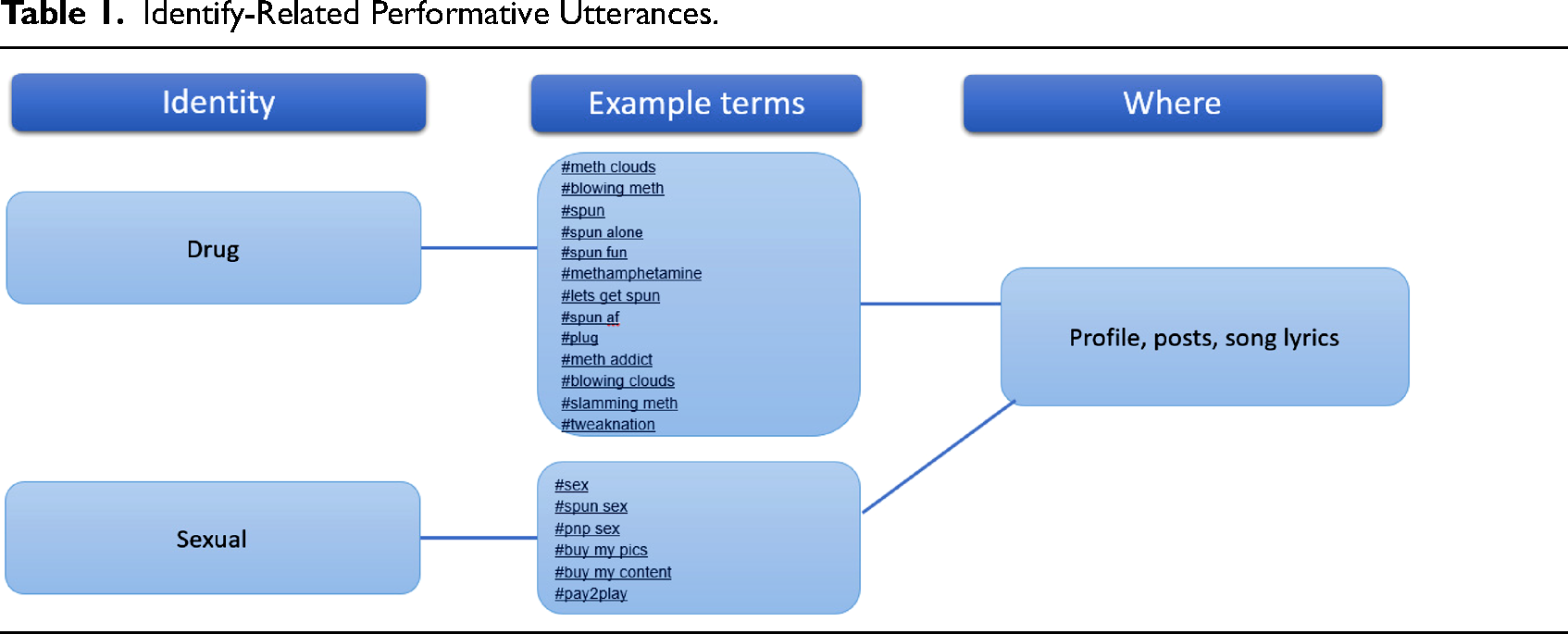
The identity of someone who uses and/or sells drugs can also be performed through such performative utterances. A person may identify as being a ‘junkie’ or an ‘addict’ or belonging to the methamphetamine using community through the use of words such as ‘spun’, ‘meth’ or ‘ice’. Dealing may be signified through the use of the term ‘plug’. Emoticons (graphic images) may also be used such as the use of a cloud to signify meth smoking or the use of syringe emoticon to depict an injecting persona (Knoops et al., 2015) and these emotions can also be used to signify belonging to particular subgroups such as people who smoke or people who inject. Codewords or code phrases may also be used to avoid law enforcement detection (Knoops et al., 2015; Lakhov, 2021).
Identity-related performance utterances may be signified as part of a profile, in posts, in videos, in pictures or using background music which may contain identity-related content (e.g., lyrics related to drugs, sex or mental health). Relevant identities include someone who uses drugs, someone who injects, someone who sells drugs and various sexual interests. Table 1 outlines some of the core terms associated with each of these identities.
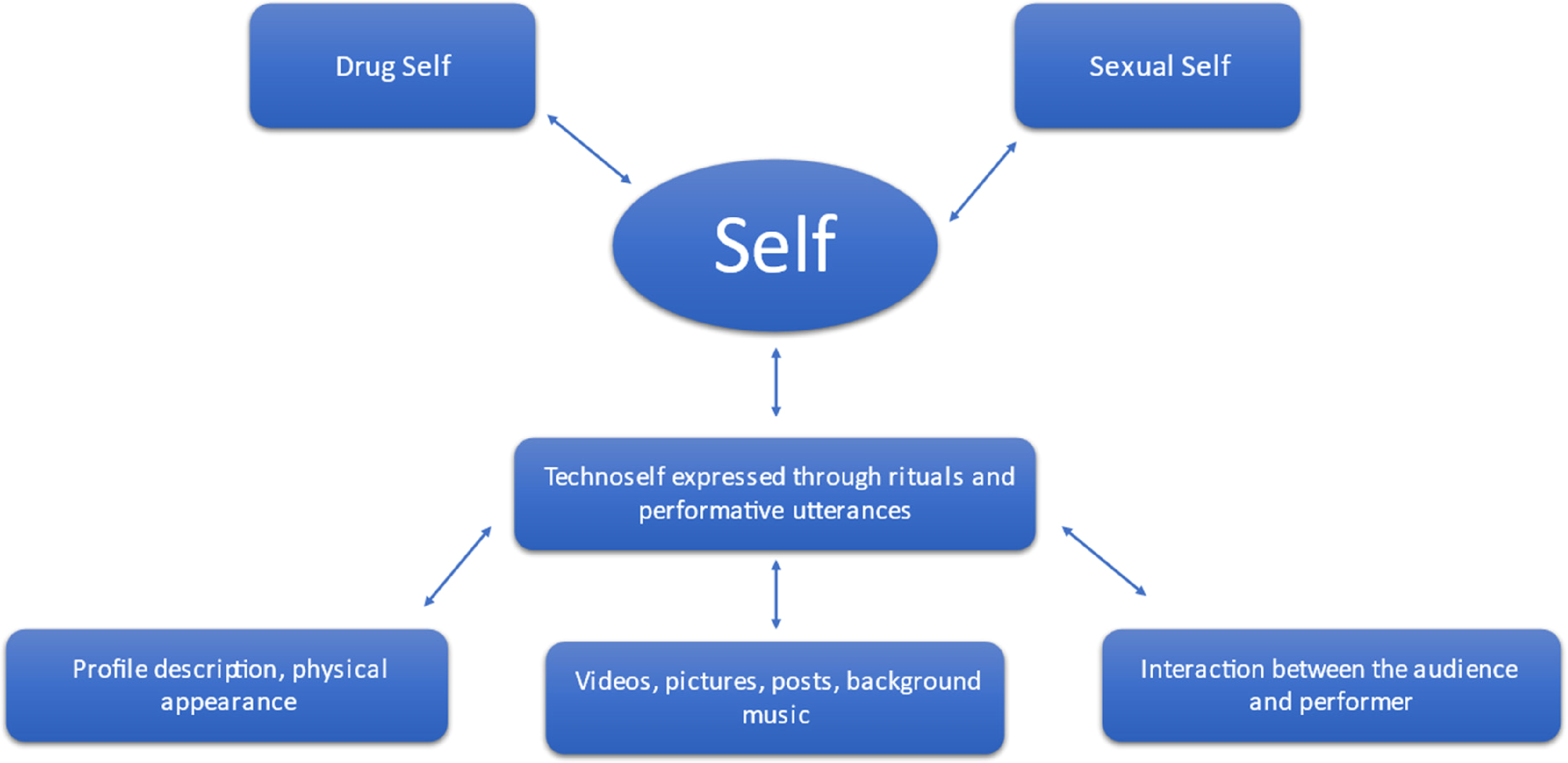
Components of the online drug use pornography performer's ‘technoself’.
Rituals
Turner (1982) analysed a range of ritualised social dramas and identified a number of core facets or stages in how a society responds and deals with these dramas: firstly, a ‘breach’ is made where social conventions are breached (e.g., when a scandal like Watergate is first reported) ; secondly, there is a ‘crisis’ where society identifies a need to respond; thirdly, there is a ‘redressive action’(e.g., impeachment proceedings) and, fourthly, there is a reintegration (e.g., Nixon resigns). In the context of this drug-related phenomena, this has been seen a number of times including the novel psychoactive substance phenomenon and the emergence of online marketplaces, whereby, a ‘breach’ from the norm is identified; a ‘crisis’ forms potentially in the form of a moral panic’; there is a ‘redressive action’ such as law enforcement responses, legal changes and treatment changes and there is a reintegration where the phenomena either disappears or changes its nature.
Rituals can present an opportunity to create a space where transgressive content, practices or roles can be explored in a socially sanctioned context. For example, weddings are culturally performed rituals that deal with the topic of sexuality in a socially sanctioned manner whilst pornography is a cultural performance that is considered transgressive or condemned (Bell, 1999).
Rituals often have practical functions. They can be used to solidify community identity and can be used to mark certain rites of passage (Bell, 1997). For example, complex and culturally situated rituals occur around the birth of children, marriages and deaths with large variances on how these rituals are organised and performed dependent on cultural identification, context and personal preferences. There are many rituals associated around courtship, sex and drug use in different cultures and certain sexual behaviours (such as penetration) and drug-related behaviours (e.g., injecting) can function as rites of passages signifying new identities (e.g., loosing virginity and becoming someone who injects drugs) (Knoops et al., 2015).
In literature, Aldous Huxley provides two contrasting sets of drug-associated rituals associated with drug use (Schermer, 2007). In both cases, these rituals serve to promote societal cohesion and perform community identity, albeit in communities with opposing values. In Brave New World the drug ‘soma’ is used daily and ritualistically in sex orgies or ‘orgie porgies’ to solidify community identity as part of a religion of consumer, hypercapitalist, hedonistic and highly hierarchical culture (Huxley, 1932). In this context, the rituals enforce a communitas where individuality is considered taboo and hedonistic and hypercapitalist values are promoted. In contrast, in Island the drug ‘moksha’ is consumed as part of a respectful ceremony to solidify community identity in a sustainable and evidence-based egalitarian society and is used to help participants to become ‘…more intelligent […] Not more intelligent in relation to science or logical argument but on the deeper level of concrete experience and personal relationships’ (Huxley, 1962).
A wedding may be described as a cultural performance which cements the union between a couple that includes many core components, but weddings can be significantly different in how they rituals are performed (Bell, 1999). Generally, the more a ritual seeks to accomplish something (e.g., marrying two people), the more regimented it is and the more it seeks to entertain the more the rituals may also be more open for flexibility or play (Schechner & Schechner, 1988) such as in the example of carnivals (e.g., in Brazil and Germany) – or in the example of modern day rave festivals – where transgression from the status quo may be celebrated and promoted (Turner, 1988).
The ritual or ‘drunken comportment’ associated with drinking alcohol in a nightclub and a wine bar can vary dramatically with differing environments, different drinking rituals and differing cultural practices, for example, in relation to dancing and sexual advances (MacAndrew & Edgerton, 1969). These rituals solidify community identity around shared values in a particular space and time. Such psychological ‘sets’ of why and how one uses drugs in a particular ‘setting’ can dramatically alter how drugs are experienced and the effects and harms of this drug use (Zinberg, 1984).
Ritualistic practices associated with drug use are often learned in the process of identity formation adopting ritualised aspects around use/consumption (Becker, 1953). Some drug-related rituals are centuries old. Cannabis, for example, has been consumed culturally and traditionally through special clay pipes with tobacco by Indian ‘sadhus’ as part of their worship of Shiva in ceremonies involving prayers and incantations (Rätsch, 2005). Similarly, various rituals are also associated with heroin injecting (Neale, 2001) and the dance and nightlife culture (Eiser, 1993; Van Hout & Hearne, 2014).
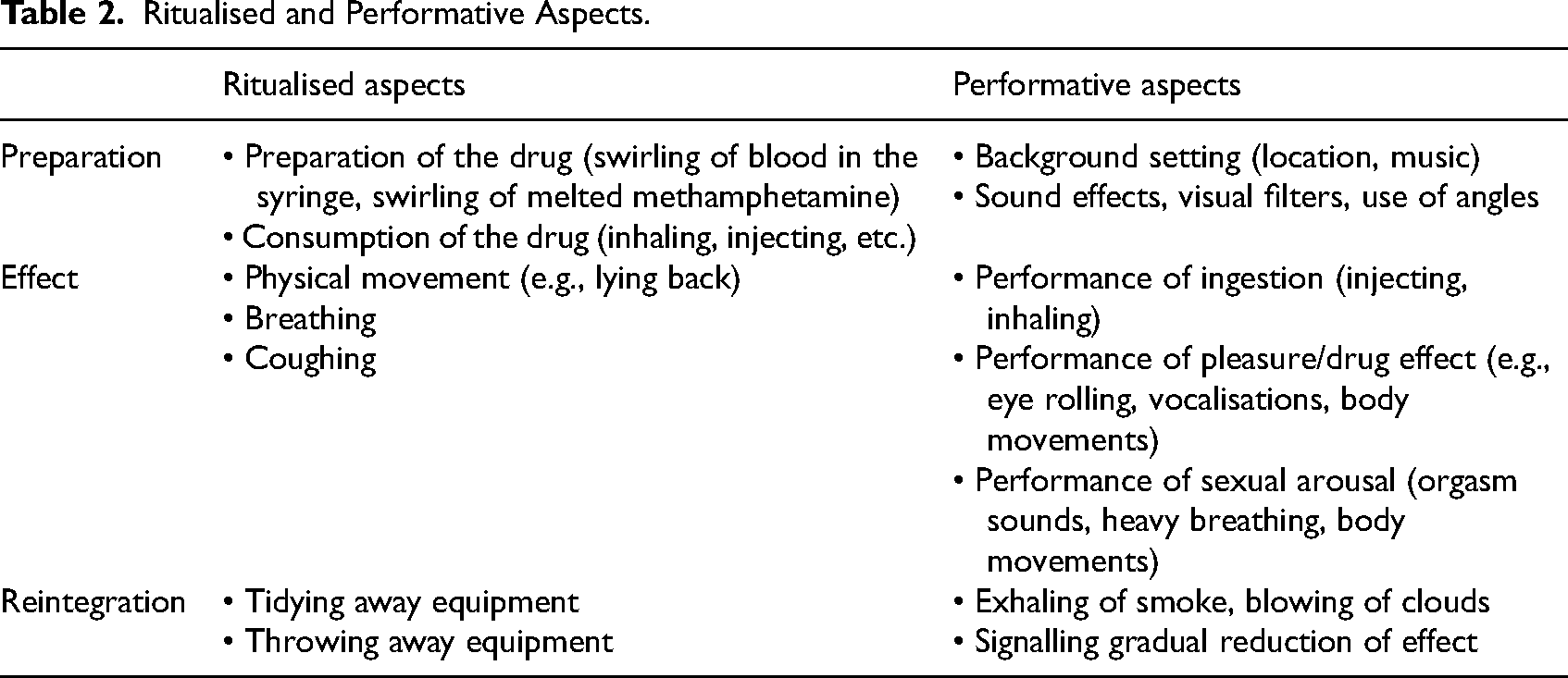
In online drug use pornography, rituals may be community formed and limited by the technological affordances of a given platform, for example, some rituals may need to be constrained or hidden to avoid detection and removal from a given platform. Central ritual artefacts in online drug use pornography are the syringe, the meth pipe and hot rails (heated glass used to snort powder). There are clear rules associated with each which focus primarily on efficiency (e.g., how to maximise a hit) but can also include performative aspects such as swirling the blood within syringes or the slow melting of methamphetamine in a meth pipe. Community members may comment on a performer's adherence to the perceived correctness of a ritual such as heating the bowl of methamphetamine or injecting technique and may be angered by perceived breaches of such rituals.
The act of injection can be ontologically disruptive (Vitellone, 2017) marking the crossing of boundaries ‘corporeal, psychological, social’ (Fitzgerald et al., 1999, p. 499) through functioning as ‘a separation rite’ (Fitzgerald et al., 1999, p. 497) distinguishing those who do and those who don’t inject. However, when the line is crossed, it can help develop communities of experience (Fitzgerald et al., 1999) as part of ‘another type of sociality’ (Vitellone, 2017, p. 49).
It may be hypothesised that drug injection as a performative act can also incorporate performances of other identities such as race and gender, whereby ritualised drug use may include gendered and racialised aspects (Bourgois & Schonberg, 2009). Similarly, the pleasurable effects of injecting can be embodied to inform and express identity (Vitellone, 2017 commenting on Bourgois & Schonberg, 2007). A number of the key ritual and performative aspects are listed in Table 2.
Identify-Related Performative Utterances.
Ritualised and Performative Aspects.
Conceptualising Online Drug Use Pornography
Online drug use pornography is a complex and surprisingly understudied phenomenon bearing in mind its presence on the internet. Amateur pornography can be a medium for self-expression (Attwood, 2017) and central to the theoretical framework suggested here (See: Figure 1) is the concept that performers are presenting a technoself through the use of rituals and performative utterances to
In the digital world, identities and intentions may be hidden and not readily accessible for empirical evaluation. Goffman's theory of the ‘presentation of self’, which applies the lens of theatre and acting as a metaphor, is therefore a useful perceptual lens through which to understand and make sense of the phenomenon, encapsulated for an ‘online context’ as the ‘technoself’ (Luppicini, 2012). How a character is developed, presented and perceived provide useful insights into the nature of online drug use pornography. Words, emoticons, hashtags and other ‘performative utterances’ can provide useful information in regards to what is meant, what is intended and how one would like to be perceived. Additionally, understanding these performative utterances will be of utility when planning and designing public interventions which engage with this population (Lakhov, 2021).
In this regard, rituals function to develop social cohesion and community identity. Understanding and conceptualising the rituals associated with online drug use pornography will yield useful insights into the particular acts that bind this community together – both online and in the physical world. Research should consider what are the commonalities and what are the deviances in the performance of these rituals? Are there special signifiers that aim to perform particular messages?
The theoretical framework proposed in this article is part of a larger study in relation to online drug use pornography being conducted by the authors based on the findings of the report. It may inform health policy and interventions with those producers, consumers and prosumers engaging in community-identified risk behaviours (such as poor injecting technique, lack of sleep and maintaining poor oral hygiene). For example, through informing online outreach activities which utilise keywords and hashtags with the aim of identifying people who use drugs and linking them to information, advice and direct harm reduction interventions (Lakhov, 2021).
Conclusion
This paper highlights the online phenomena of drug use pornography – a phenomena taking place in plain sight in the virtual world. Yet despite being available on the open internet it has received no attention either from statutory agencies or researchers. In this sense, this phenomenon may be described as ‘virtually hidden’. Like ‘mediated sex’ (McNair, 1996), where digital technologies enable sexual experiences (Dixon, 2007), the emergence of online drug use pornography may lead to new challenges arising from human adaption to this technological phenomenon.
The potential negative effects of drug-related cues on people who are dependent on drugs is well known (e.g., Perry et al., 2014). However, research suggests that online avatar therapy (where people living with psychiatric conditions create and speak to an avatar) may be effective in treating certain psychiatric conditions (e.g., Alderson-Day & Jones, 2018). It could be possible that vicarious viewing of substance use, which seemingly has a pleasurable effect for some people who use drugs, might mediate some form of displacement effect and/or might be of use in desensitisation studies. It is hoped that this work informs further empirical study of the topic which could inform new treatment approaches such as those used in virtual reality therapies. A potential displacement effect of the vicarious experience of online drug use rather than the actual experience of consuming a drug, if proven through ethically sound and methodologically robust studies, could theoretically inform new treatment approaches such as virtual reality therapies in the field.
Understanding both the performers and the audiences who watch and interact with this type of content is central to understanding its historical, social, cultural and psychological significance. This significance extends beyond that for the performer and the audience to the wider society in a range of domains including but not limited to the use of the internet and internet regulation as a means of information giving and getting, new forms of pornography, social values, new addiction phenomena and personal and public health.
Future work should consider a range of methodological approaches that are careful to both maximise potential benefits of conducting this research (such as designing more effective public health interventions) whilst limiting potential negative effect (such as the ‘Hawthorne effect’ where study participants may perform for the researcher). Understanding the words, terms, colloquialisms and cultures of online group is key in designing effective interventions for such groups (UNODC, 2021). Content analysis (including thematic and frame analysis) may be useful in determining the topics considered by this population as well as their framing of core topics. Counting, during content analysis, as well as natural language processing techniques may be useful in determining the core features of ‘hot’ versus ‘cold’ form of ‘mediated online drug use pornography’.
Schechner (1985)'s model of ‘breach’, ‘crisis’, ‘redressive action’ and ‘reintegration’ could help inform us in how, as a society, we respond to this phenomenon. In this context, we should seek to prevent that the breach leads to a ‘moral panic’ where the participants are considered ‘folk devils’ (Cohen, 2011) leading to potentially poorly thought-out approaches (Reinarman, 2005) in any ‘redressive actions’ to address the phenomenon. Ideally, we should ensure that the phenomenon is addressed from a public health and community safety perspective that seeks to minimise any unintended negative consequences of policies used to deal with the phenomenon.
Footnotes
Declaration of Conflicting Interests
The author(s) declared no potential conflicts of interest with respect to the research, authorship and/or publication of this article.
Funding
The author(s) received no financial support for the research, authorship and/or publication of this article.
