




Abstract
Drawing on the Culture-Work-Health model, this research aims to determine public organizational culture profiles and assess the mediating role of HRM satisfaction in the relationship between public cultures and quality of working life (QWL). To achieve these objectives, a content analysis of the value statements of 26 public organizations in Quebec (Canada) was carried out, and an online survey of 784 public servants working in these organizations was conducted. The coupling of qualitative and quantitative data enabled cluster analyses and structural equation models to be performed. In Study 1, 51 public values were identified and grouped into seven categories. Cluster analysis revealed five public culture profiles: agile excellence, ethical benevolence, new public management (NPM), public interest protector, and sustainable benevolence. In Study 2, the associations between these profiles, satisfaction with HRM practices, and QWL were examined using the sample of civil servants. The results show that some types of public culture have a direct effect on QWL, while others have an indirect effect via satisfaction with HRM practices. In any case, public administrators should formulate their value statement with great interest since the articulation of the displayed values has significant implications for civil servants’ QWL.
Keywords
Introduction
Attracting and retaining qualified personnel is a major challenge for public organizations in the current labor-shortage context (Keppeler & Papenfuß, 2022). In this context, offering a high quality of working life (QWL) is becoming a relevant tool for organizations wishing to position themselves as employers of choice (Chan, 2015; Gupta & Hyde, 2016; Knies et al., 2022; Sharma & Gupta, 2017) because it promotes employee well-being. Past research has shown that certain organizational cultures are more conducive to employee well-being (Gifford et al., 2002; Goodman et al., 2001; M. Y. Kim & Lee, 2022; Lund, 2003; Marchand et al., 2013). This literature is mainly based on the Competing Values Framework (CVF), according to which values are at the heart of organizational culture. Although this theoretical framework has several advantages, it was originally created to classify studies on organizational effectiveness, while the goal of this research is to assess the effect of organizational culture on employee QWL. Moreover, the values targeted in this framework are not specific to the public sector, whereas the objective of this investigation is to scrutinize the organizational culture in public administrations. Nevertheless, academic research in public administration has indicated that the values of private and public organizations differ (Van der Wal et al., 2008; Van der Wal & Huberts, 2008; Weske et al., 2020).
Accordingly, the objective of the first study is to create profiles of public organizational culture based on values in public administrations. To achieve this objective, the values displayed in 26 public organizations in Quebec (a Canadian province) were collected from administrative documentation and websites. These public values were categorized, and a cluster analysis was performed to create profiles of public organizational cultures.
Drawing on Peterson and Wilson’s (2002) Culture-Work-Health model which conceptualizes management practices as a mediating variable in the relationship between organizational culture and QWL, the second study pursues the objective of verifying whether these profiles influence satisfaction with HRM practices and the QWL of employees. In this regard, Knies et al. (2022) indicated that although the differences between the HRM practices of private and public organizations have dissolved with the emergence of new public management (NPM), some distinctions persist. They found that public sector organizations continue their tradition of investing more in employee well-being and equal-opportunity HRM practices. Conversely, they found that private organizations stand out for their performance-based HRM practices. Given the specificities of organizational values and HRM practices in public administrations, it becomes relevant to examine the relationships between culture, employee’s satisfaction with HRM practices, and QWL in the public sector.
Rather than seeing the public sector in a monolithic manner, this study stands out from the existing literature by considering that all public organizations do not have the same culture. This study will improve knowledge of HRM in public administrations by showing the existing diversity in public organizational cultures. Furthermore, by examining the effect of different public culture profiles on satisfaction with HRM practices and QWL, this study will identify types of culture that are more beneficial for the well-being of civil servants. The findings will inform public administrators about the articulations of public values associated with high QWL.
Distinctiveness of Public Organizational Values
Values can be defined as standards guiding actions (Van der Wal et al., 2008; Van der Wal & Huberts, 2008; Weske et al., 2020). Schein (2010) suggested that organizational culture has three levels: The most visible level is characterized by artifacts; the middle level is composed of espoused values; and the most hidden level is formed by underlying assumptions. Accordingly, organizational values are a central component of organizational culture (Marques et al., 2021; Molina, 2009). The CVF of Quinn and Rohrbaugh (1983) adheres to this perspective since culture is derived from competing organizational values. The CVF is composed of four types of organizational culture. The clan (or group) culture is characterized by cohesion, participation, and teamwork. The adhocracy culture is characterized by creativity, entrepreneurship, and adaptability. The market (or rational) culture is characterized by competitiveness and goal achievement. Order, rules, and regulation are dominant values in the hierarchy culture.
According to Molina (2009), values should serve as criteria to guide the actions of public administrations. He argued that values inform about the aspirations of public administrations. However, he suggested that it is common for dilemmas between competing values to arise in public administrations. For example, efficiency and fairness are values that can compete and sometimes point to different courses of action. Wagenaar (1999) noted that public administrators are constantly trying to balance competing values. At first glance, the CVF seems ideal for measuring organizational culture in public administrations since it recognizes the existence of value conflicts.
Nevertheless, according to Weske et al. (2020), there are distinctions between the organizational values in the public and private sectors. On the one hand, they found that impartiality, legality, and neutrality, values often associated with bureaucracies, are more associated with public organizations. On the other hand, they showed that the values of efficiency, innovation, and profit are more associated with the private sector.
According to Van der Wal et al. (2008), the discussion on the differences between public and private values is often theoretical or ideological, but comparative empirical studies are scarce. To fill this gap in the literature, these authors listed 20 organizational values. They then carried out a survey with managers working either in a private or a public organization. They found that organizational values of private and public managers are not completely different. Indeed, their results showed that public and private managers share a group of common values: accountability, expertise, reliability, effectiveness, and efficiency. However, despite this group of common values, they found that public sector managers give priority to legality, incorruptibility, and impartiality and that private sector managers give priority to profitability, innovation, and honesty.
Based on a review of the literature, Van der Wal and Huberts (2008) identified the main values of public organizations, as well as those of private organizations. Using a survey of 382 managers to validate the distinction between organizational values in the public and private sectors, they found that public sector managers place more importance on incorruptibility, accountability, transparency, legality, impartiality, social justice, and obedience, while private sector managers attach more importance to efficiency, innovation, and profitability. Therefore, public sector managers’ values are distinct from those of private sector managers, which highlights the relevance of focusing on public values to develop cultural profiles specific to public administrations.
Diversity of Values Within the Public Sector
Public values research has proliferated in public administration academia in the past decade (Fukumoto & Bozeman, 2019; van der Steen et al., 2018). Several studies attempt to categorize public values. In this vein, Rutgers (2008) specified that there are several ways to classify public values in literature: identifying core values; separating “traditional” values from “new” values; or highlighting basic distinctions between values. For example, Jørgensen and Bozeman (2007) identified eight core values: (a) human dignity which has justice, benevolence, and equity as co-values; (b) sustainability which seeks orientation to the future; (c) citizen participation which is oriented toward social dialogue; (d) openness to others; (e) the secrecy which relies on the preservation of confidentiality; (f) the compromise that promotes the balance of different interests; (g) integrity which is associated with honesty and ethics; and (h) robustness which means rigor and reliability.
Moreover, Bryson et al. (2014) distinguished that a new approach is emerging in public administration that goes beyond the focus on NPM values of efficiency and effectiveness to incorporate democratic values based on inclusive dialogue and deliberation with citizens and social partners. This “new” approach, they argued, emphasizes public value creation, and it recognizes that government has a special role as the guardian of public values. Finally, Kernaghan (2003) classified public values into four categories following basic distinctions between values: ethical values (integrity and fairness); democratic values (rule of law and loyalty); professional values (efficiency and innovation); and human values (benevolence and compassion). These attempts to classify public values are an acknowledgment of the diversity of values in public administrations, but none of these classifications is unilaterally accepted in the literature.
van der Steen et al. (2018) recognized the diversity of public values by highlighting four governance perspectives based on distinct values: traditional public administration, NPM, networked governance, and societal self-organization. According to these authors, traditional public administration focuses on legality. This perspective emphasizes values such as loyalty, accuracy, and neutrality of public servants. Public interest and objectivity are important values, as are equity and fairness. The perspective of NPM emerged in the early 1990s, and it aims to achieve effectiveness and efficiency. This perspective represents a shift away from traditional bureaucracy that was associated with waste. Values related to legality are still important, but the emphasis is now on performance and goal achievement. This approach is associated with the importation of private sector values into the public sector. The networked governance perspective focuses on the collaboration of public administrations and societal actors. This perspective often stems from the desire of governments to solve wicked problems requiring interinstitutional action. Civil servants must network, collaborate with different partners, and seek mutually acceptable solutions to problems. The societal self-organization perspective centers the creation of public value on autonomous citizenship. Societal actors are guided by their own priorities. The autonomy left to citizens is not the equivalent of a “laisser-faire” approach on the part of the government, which can notably react to societal self-organization by doing nothing, blocking, facilitating, or organizing any further. Using a sample of 116 civil servants, van der Steen et al. (2018) concluded that civil servants agreed with statements from more than one governance perspective. Consequently, van der Steen et al. (2018) have highlighted that the values of civil servants are diverse and represent a mix of values from different governance perspectives.
In this research, it is argued that this is also true for the values displayed in public organizations. Indeed, public organizations are likely to display values from several governance perspectives and prioritize them differently. According to Witesman and Walters (2015), there is no established hierarchy of public values. Bryson et al. (2014) advised academics interested in public values to develop typologies and new measures through rigorous empirical testing. They also indicated that researchers should address the question of the existence of a hierarchy of public values. This shows the relevance of developing a categorization of public values based on the values displayed and prioritized in several public organizations.
Based on the CVF principle that organizational culture can be derived from the articulation of organizational values, the empirical fact that organizational values in public administrations are distinct from those in private organizations (Van der Wal et al., 2008; Van der Wal & Huberts, 2008; Weske et al., 2020), and the empirical fact that there are different governance perspectives based on distinct public values (Bryson et al., 2014; Jørgensen & Bozeman, 2007; Kernaghan, 2003; Rutgers, 2008; van der Steen et al., 2018), the following question and hypothesis are formulated:
Organizational Culture and QWL: The Mediating Role of HRM
QWL is defined as “employee satisfaction with a variety of needs through resources, activities, and outcomes stemming from participation in the workplace” (Sirgy et al., 2001, p. 242). According to Sirgy et al. (2001), QWL goes beyond job satisfaction, as it also affects personal life satisfaction, general life satisfaction, and subjective well-being. For these authors, QWL contributes to job satisfaction and satisfaction in other areas of life. Job satisfaction can be defined as “pleasurable or positive emotional state resulting from the appraisal of one’s job or job experience” (Locke, 1976, p. 1304). Van Laar et al. (2007) considered job and career satisfaction as a dimension of QWL; indicating that QVT encompasses job satisfaction. Van Laar et al. (2007) added that QWL includes broader non-work factors that influence employees such as their general well-being and work-life balance. These authors created the work-related quality-of-life scale (WRQoL) with six dimensions: job and career satisfaction; general well-being; home-work interface; stress at work; control at work; and satisfaction with working conditions. This scale was chosen because it has been used in several countries and sectors (Duyan et al., 2013; Edwards et al., 2009; Farhadi et al., 2021; Mendes & Pereira, 2021; Silarova et al., 2022; Van Laar et al., 2007). An alternative to this scale for measuring QWL is that of Sirgy et al. (2001) which contains seven dimensions (need categories): health and safety needs, economic and family needs, social needs, esteem needs, actualization needs, knowledge needs, and aesthetic needs. However, the aesthetic needs dimension is less relevant for many public sector jobs that do not include a strong creative component. In addition, the inclusion of dimensions related to stress and control at work appears more relevant for examining the population under study. In a recent systematic review on instruments to measure quality of work life of health and social service workers, Wang et al. (2023) concluded that the WRQoL is psychometrically valid and reliable.
From a theoretical point of view, the Culture-Work-Health model indicates that organizational culture, in particular, the basic assumptions and core values, influences the management system and the organizational practices deployed by the managers. According to this model, organizational practices will in turn affect the organizational health and employee well-being, which will ultimately affect their QWL. Therefore, this theoretical model suggests that organizational culture affects organizational practices. It also assumes that organizational practices play a mediating role in the relationship between organizational culture and QWL. Moreover, in his well-being-oriented HRM framework, Guest (2017) conceptualizes HRM practices as an independent variable affecting employee well-being, and he suggests that QWL is an indicator of employee well-being. Past literature has shown distinctions in the values of public and private organizations that are at the heart of organizational culture (Van der Wal et al., 2008; Van der Wal & Huberts, 2008; Weske et al., 2020). Other empirical studies pointed out that HRM practices implemented in public organizations differ from those of private organizations (Brown, 2004; Brunetto & Beattie, 2020; Knies et al., 2022). These specificities of public organizations highlight the relevance of testing this model in the public sector.
Without regard to sectoral differences, previous studies have shown that certain organizational cultures are more conducive to employee well-being (Gifford et al., 2002; Goodman et al., 2001; J. Kim & Jung, 2022; Lu et al., 2022; Marchand et al., 2013; Olynick & Li, 2020). Recent results from the study by Lu et al. (2022) showed that organizational culture focused on patient safety reduces burnout and increases work-life balance. Thus, Lu et al. (2022) proposed that this type of culture constitutes an organizational resource for employee well-being. In addition, employees working in a clan culture reported the lowest levels of stress and the highest levels of job satisfaction, followed by those in cultures of adhocracy and hierarchy, and finally market culture (Olynick & Li, 2020). Moreover, group culture decreases psychological distress, depression, and emotional exhaustion, while it increases well-being (Marchand et al., 2013). This study also indicated that rational culture increases psychological distress, depression, and emotional exhaustion. Consequently, these findings reveal that group culture promotes employee well-being unlike rational culture. Lund (2003) found that the level of job satisfaction due to clan and adhocracy cultures’ type is higher than that due to market and hierarchy cultures’ type. Similarly, Zavyalova and Kucherov (2010) found that employees in a market and hierarchical culture are the least satisfied with their jobs, while those in a clan and adhocratic culture are the most satisfied. Mesfin et al. (2020) found that clan culture is positively associated with health worker satisfaction. Moreover, Grolleau et al. (2022) found that employees in innovative organizations are more likely to have high job satisfaction.
Specifically, few studies test the effect of organizational culture on QWL. Despite a small sample size (145 nurses working in Korean hospitals), An et al. (2011) found that organizational culture focused on interpersonal relationships was associated with a higher QWL, while nurses perceiving that their organization advocates a rational culture emphasizing productivity and efficiency reported lower levels of QWL. Using a sample of 299 dental hygienists in Korea, Park et al. (2018) found that the more hygienists perceived the organizational culture positively, the more their QWL increased. However, these authors did not test the effect of different types of organizational cultures on QWL. Furthermore, Gifford et al. (2002) examined the effect of organizational culture on QWL, but they measured QWL based on job satisfaction, commitment, empowerment, and intention to leave. They found that values associated with group culture increased organizational commitment and job satisfaction. Using a sample of 276 obstetrics department employees from hospitals in the United States, Goodman et al. (2001) also tested the relationship between different types of organizational cultures on QWL. They also used job satisfaction, commitment, empowerment, and intention to leave to measure QVT. They found that group culture was positively associated with job involvement and job satisfaction. Conversely, their results showed that the hierarchical culture decreased job involvement and job satisfaction. They suggested that the bureaucratic values of efficiency and stability reduce QWL among employees. Park et al. (2021) found that innovation culture is positively associated with the QWL of civil servants in Korea. However, these authors developed their own tools for measuring innovation culture and QWL. Furthermore, Koonmee et al. (2010) found that organizational cultures that institutionalize ethics have a positive effect on QWL in Thailand. In the same vein, Marta et al. (2013) also found a positive association between institutionalization of ethics in organizations and QWL. Although these results are obtained from small samples in specific occupations, and the tools used to measure organizational culture and QWL vary, these studies suggest that QWL is associated with organizational culture. Based on these empirical facts and the Culture-Work-Health model, the following hypothesis is formulated:
Regarding HRM practices, several authors have mentioned that HRM practices of public organizations have received little attention compared to those of private organizations (Brunetto & Beattie, 2020; Steijn, 2004; Xia et al., 2020). For example, Xia et al. (2020) argued that the search for efficiency in the public sector stemming from NPM has led to the implementation of HRM practices from the private sector in public administrations, which has changed the management of personnel in the public sector. These authors suggested that these changes and their consequences deserve further academic attention. In the same vein, Brunetto and Beattie (2020) claimed that politicians implemented private-sector HRM models in the public sector thinking that they would guarantee public performance, but they ignored the differences in organizational culture between the two sectors. Furthermore, Brunetto and Beattie (2020) indicated that public organizations are distinct because of their pluralism and their duty to satisfy a multitude of stakeholders, which complicates the tasks of public sector HR managers. According to Brown (2004), HRM is important in the public sector since public organizations must hire, develop, and train employees, establish compensation systems, and set working conditions, but the public sector also has the particularity of focusing its results on the public interest rather than on private interests, which complicates HRM in this sector.
Despite the importation of HRM practices from the private sector into the public sector, Knies et al. (2022) recently found that distinctions persist between the HRM practices of public and private organizations. According to their results, public organizations are more inclined to invest in the well-being of employees using practices aimed at equity, diversity, and inclusion. Conversely, private organizations are more likely to emphasize performance-enhancing practices such as pay-for-performance and performance appraisal. Given the particularities of HRM in the public sector, it is relevant to examine the relationship between HRM practices and the well-being of public sector employees.
Steijn (2004) pointed out that few studies have focused specifically on the relationship between HRM and job satisfaction in the public sector. By studying this relationship, he found that job satisfaction increases with the number of HRM practices used in the public organization. This author emphasizes the importance of developing research on HRM in the public sector to help public organizations become more efficient and enable public sector employees to realize their full potential. According to Steijn (2004), this would be beneficial not only for public administrations and public sector employees but also for citizens since more satisfied civil servants are more inclined to deliver a quality service.
In addition, Turkyilmaz et al. (2011) pointed out that job satisfaction of public sector employees is indispensable since satisfied public sector employees are more likely to provide quality services. These authors found that staff training and development, recognition and reward practices, and empowerment practices are positively related to job satisfaction in the Turkish public sector. Recently, Xia et al. (2020) found that commitment-oriented HRM practices increased job satisfaction and reduced depression among employees in the Chinese public sector. These empirical studies suggest that HRM practices improve the well-being of civil servants.
Therefore, based on the Culture-Work-Health model, which assumes that HRM practices mediate the relationship between organizational culture and QWL, and on the literature showing a positive relationship between HRM practices and the well-being of civil servants, the following hypothesis is formulated:
Methodology
General Research Approach and Objectives
A mixed methodology was used to address both research objectives. First, a qualitative study was conducted by analyzing the values statements of 26 Quebec public organizations. This study aims to identify the public values displayed by Quebec public organizations, to create categories of public values based on empirical data and to propose profiles of public cultures. The 26 public organizations were chosen because respondents to the online questionnaire identified them as employers.
Second, an online survey was distributed to 784 civil servants to assess the effect of public culture profiles on satisfaction with HRM practices and QWL. This second study aims to verify whether certain types of public culture have a distinct effect on the attitudes of civil servants. The independent variable, public culture profiles, which was developed in Study 1, was imputed in the quantitative database, thereby avoiding common variance bias.
Study 1 Methodology: Public Values Collected Via Administrative Documentation
Identification of Public Values and Creation of Value Categories
A content analysis of the values statements of 26 public organizations was carried out in May 2021. The 26 organizations were selected following the results of the online survey. In this survey, respondents specified their employer. All organizations mentioned by at least one respondent were included in this study for a total of 26 public organizations. In social sciences, convenience sampling is often used in qualitative studies when researchers have access to the target populations (Golzar et al., 2022). In this type of research design, researchers must therefore determine inclusion criteria (Golzar et al., 2022). In this study, there are three inclusion criteria: (a) the organization must be public; (b) it must have displayed its values; and (c) at least one of its employees must have responded to our survey.
Saturation is an important indicator for assessing the quality of a sample for studying a phenomenon (Hennink & Kaiser, 2022). According to Hennink and Kaiser (2022), saturation is defined as the fact that the addition of new cases in the data collection no longer provides new information on the phenomenon studied, and the data become redundant. Reaching saturation shows that the data collected have enabled researchers to observe the diversity, depth, and nuances of the phenomenon under study. In their systematic review, Hennink and Kaiser (2022) found that qualitative studies often reached saturation from a sample size of 9–17 individuals, especially those with homogeneous study populations and clear objectives.
For most organizations, values statements are presented on the organizations’ website under the mission and values tab. For organizations that did not have value statements presented on their website, their most recent annual report in which they displayed their values was used. In both types of content, the values are stated very succinctly and are sometimes accompanied by a short definition. As value statements are derived from public documentation, the disclosure of extracts from these statements makes public organizations identifiable. For this reason, value statements are not disclosed. Since the value statements were very short, the qualitative data were coded manually. All the values mentioned by the organizations were compiled.
Tong et al. (2007) divided the criteria for adequately reporting methods used in qualitative research into three categories: the research team and its reflexivity, the study design and the data analyses. Reflexivity involves researchers reflecting on how their personal biases influenced the research process and the participants (Tong et al., 2007). First, these authors advised researchers to clarify their identity, profession, and academic background to improve the credibility of the results and allow readers to form an idea of how these characteristics might have influenced the interpretation of the results. In addition, Tong et al. (2007) recommended that researchers describe their relationship with the participants so that the reader can assess whether this relationship might have influenced the participants’ responses or the researchers’ understanding of the phenomenon. Accordingly, it should be specified that the two coders in this study are university professors, and they have expertise in human resources management and organizational culture. The researchers’ reflexivity on the participants is low since they had no direct contact. It is, however, possible that their specialization on employee well-being and public administration could have influenced the themes addressed in the research as well as the questions chosen to form the questionnaire included in the quantitative part of the study.
Regarding the study design, this study draws on a tradition of inductive research, which refers to the use of a set of systematic procedures for processing qualitative data (Blais & Martineau, 2006). In accordance with the inductive approach, the researchers made a detailed reading of the raw data to bring out categories based on the researcher’s interpretations, as well as the existing literature (Blais & Martineau, 2006). Inductive content analysis is a method of analyzing data in text form and organizing specific content into more general categories (Elo & Kyngäs, 2008). This method was chosen because it enables an update of the values of public organizations and brings out patterns that enable the development of a new, data-driven understanding of the phenomenon (Graneheim et al., 2017). In short, it suits the objective of being grounded in real-world data. The data-collection protocol simply consisted of listing all the values mentioned by the 26 organizations in their values statements. Each of the 26 organizations listed between three and eight values. A total of 120 values were compiled. After eliminating duplicates, a list of 51 values was formed. The content considered for inductive content analysis is only constituted by these 51 values. At the start of the analysis, the aim was to examine the current values of public organizations. As the analysis of the compiled values progressed, it became apparent to the researchers that certain groups of values were emerging since similar values were observed. This observation has led researchers to develop value categories and to refine this categorization using previous work on public value categories (Bryson et al., 2014; Jørgensen & Bozeman, 2007; Kernaghan, 2003; Rutgers, 2008). Consequently, the categories emerged mainly from data analysis, but existing literature was also used to support categorization, which corresponds to the traditional inductive content analysis according to Armat et al. (2018). After creating the groups of values, the first coder classified the values within the seven categories. The second coder validated the seven categories and the classification of each value into the categories. Disagreements occurred for two values out of 51. A discussion between the coders made it possible to reach an agreement for the classification of these values. Inter-judge agreement was therefore used to ensure the reliability of the classification of public values.
Hierarchy of Public Values and Creation of Public Culture Profiles
Since no public organization’s values are stated in alphabetical order, it was assumed that the order of values represents the organization’s hierarchy of values (Bryson et al., 2014; Witesman & Walters, 2015). The first value being the most important, the second being the second most important, and so on. To reflect the hierarchy in the values, for each value displayed in the organization’s values statement, a score of 5 was allocated to the value listed at the first rank, a score of 4 to the value mentioned in second rank, a score of 3 to the third rank value, a score of 2 to the fourth rank value, a score of 1 the for values from 5th to 8th rank, and a score of 0 if the value is not mentioned. Each of the 26 public organizations received a score ranging from 0 to 5 for each public value. Subsequently, the score of each value associated with the same category of public values was summed so that each organization obtained a score for each of the seven categories of public values. Scores for each public value and each category of values were imputed in the quantitative database (see Study 2 methodology) for each public servant based on their employer. This implies that all employees in the same organization obtain the same scores for these variables.
To identify public culture profiles, a cluster analysis was carried out using the categories of values imputed in the quantitative database. To determine the ideal number of clusters, two stopping rules are commonly used by researchers using Stata—Calinski-Harabasz pseudo-F and Duda-Hart indices—which calculate the squared Euclidean distances between cases (Halpin, 2016). Combining these two rules with the dendrogram (see Appendix) led to a five-cluster solution. Accordingly, a median-based cluster analysis was performed to group public organizations with similar value profiles.
Study 1 Results
Public Value Categories
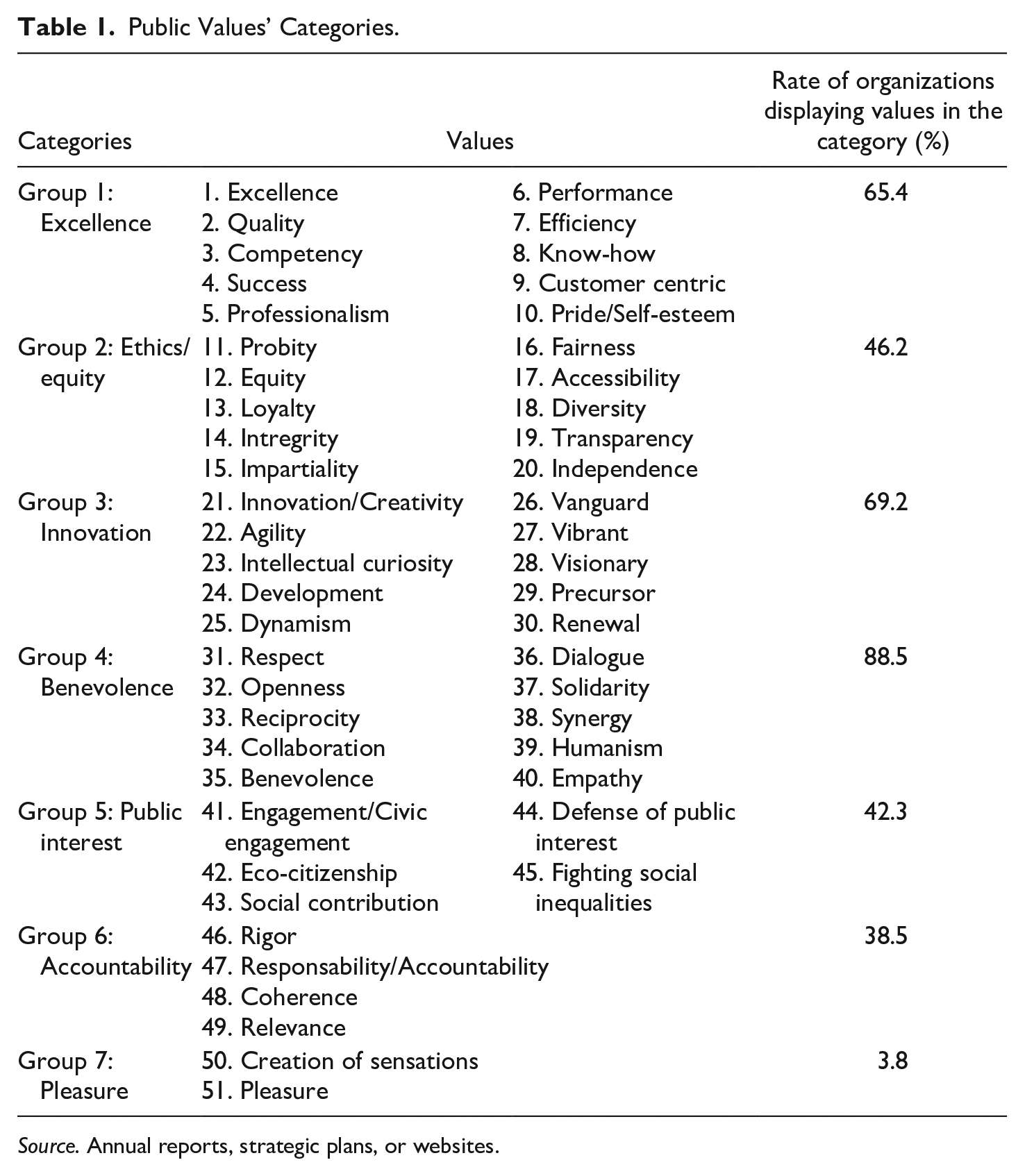
The content analysis, which aims to answer Q1, revealed that all the public organizations examined have different value statements, that is, the values mentioned in each of the organizations are different, and these values are hierarchized differently. Fifty-one public values were identified from the analysis of the value statements of the 26 public organizations. Drawing on existing typologies of public values, the 51 values derived from empirical data were classified into seven categories. Table 1 shows this classification.
Public Values’ Categories.
Source. Annual reports, strategic plans, or websites.
Seven categories of public values have been identified: 1, excellence; 2, ethics and equity; 3, innovation and creativity; 4, benevolence; 5, public interest and civic engagement; 6, accountability; and 7, pleasure.
Several values displayed by the public organizations focused on excellence, which corresponds to NPM values mentioned by Bryson et al. (2014) and the professional values mentioned by Kernaghan (2003). Ten values are classified in this category: excellence, quality, competence, success, professionalism, performance, efficiency, know-how, customer focus, and pride/self-esteem. Sixty-five percent of the public organizations examined mentioned at least one value in this category in their value statement.
The second group of public values to emerge from the content analysis concerns more traditional values such as ethics, integrity, and justice (Bryson et al., 2014; Jørgensen & Bozeman, 2007; Kernaghan, 2003). Ten values are grouped together in this category: probity, equity, loyalty, integrity, impartiality, fairness, accessibility, diversity, transparency, and independence. In the sample of public organizations, 46% mentioned one or more values in this category in their values statement.
Values linked to innovation and creativity form a third category of values displayed by public organizations. Since innovation implies an orientation toward the future, a parallel can be established with the category of sustainability identified by Jørgensen and Bozeman (2007). Innovation/creativity, agility, intellectual curiosity, development, dynamism, avant-gardism, vibrancy, visionary, precursor, and renewal are the public values included in this category. Sixty-nine percent of the public organizations examined displayed at least one value from this category in their values statement.
The fourth group of values concerns benevolence, which is like the human values identified by Kernaghan (2003) or the openness to others identified by Jørgensen and Bozeman (2007). The ten public values included in this category are respect, openness, reciprocity, collaboration, benevolence, dialogue, solidarity, synergy, humanism, and empathy. The results of the content analysis show that 89% of public organizations displayed at least one value related to benevolence in their declaration of values. This category of public values is the most omnipresent in the values statements of the public organizations considered.
A fifth group of public values, called public interest protector, also emerged from the content analysis. Some of the values in this category are linked to civic engagement, which is like the citizen participation group found in the study by Jørgensen and Bozeman (2007), but the values oriented toward the defense of the public interest are added. Five public values are grouped in this category: civic engagement, eco-citizenship, social contribution, defense of the public interest, and fighting social inequality. In the sample, 42% of public organizations displayed at least one value from this category in their values statement.
The sixth group of values that emerged from the analysis is linked to accountability, which is similar to the category on robustness identified by Jørgensen and Bozeman (2007). The four public values in this category are rigor, responsibility/accountability, coherence, and relevance. The results of the content analysis indicate that 39% of the public organizations in the sample displayed at least one value from this category.
Although marginal, the content analysis revealed a seventh category of pleasure-oriented values that has not been mentioned previously in the literature on public values. However, this category of organizational values has already been listed previously in the literature not specific to public administrations (Malbašić et al., 2015; Schwartz, 1992). The two values falling into this category are the creation of sensations and pleasure. Only 4% of the organizations in the sample displayed this type of values. This category of values is perhaps emerging in public administrations. In any case, they are not widespread in the public organizations examined.
The results of the content analysis show that all public administrations do not display the same values, nor do they prioritize the same categories of values. Benevolence appears to be a dominant value in Quebec public organizations.
Public Organization Culture Profiles
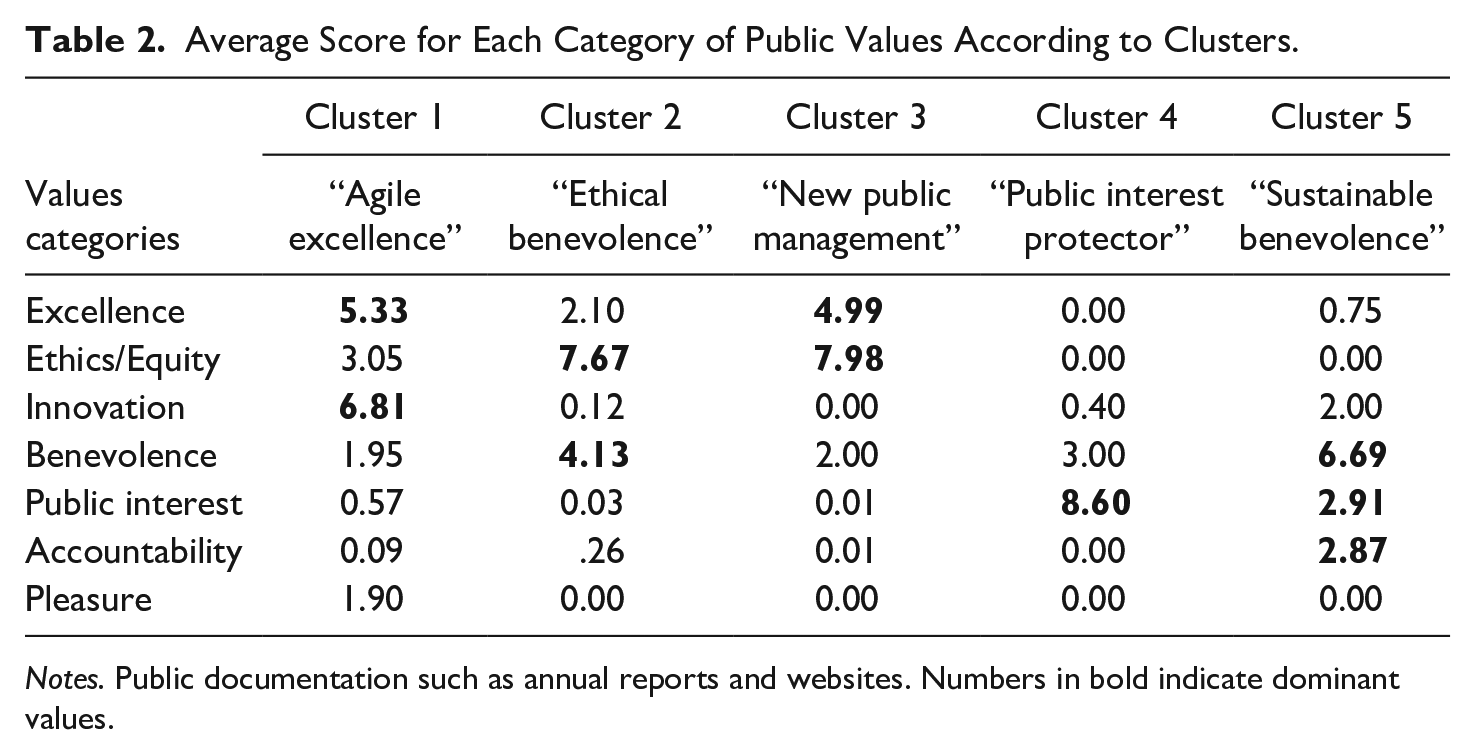
The results of the cluster analysis are presented in Table 2. Cluster analysis was used to objectively group organizations into five public organizational culture profiles, based on their scores for each of the seven value categories. Five types of organizational culture were formed: (a) agile excellence (seven organizations); (b) ethical benevolence (five organizations); (c) NPM (four organizations); (d) public interest protector (two organizations); (e) sustainable benevolence (eight organizations).
Average Score for Each Category of Public Values According to Clusters.
Notes. Public documentation such as annual reports and websites. Numbers in bold indicate dominant values.
Table 2 presents the average score for each category of public values in the five organizational culture profiles. This table shows that, in the first type of public organizational culture, dominant values are innovation and excellence. For this reason, this profile is named agile excellence. This profile represents seven public organizations. Here is an example of a value statement from a public organization classified in this profile: “1) innovation; 2) excellence; 3) openness; 4) pride and 5) agility.”
Table 2 shows that the dominant values of the second type of public organizational culture are ethics/equity and benevolence. This profile is entitled ethical benevolence. Five public organizations correspond to this cultural profile. Here is a statement of values from an organization included in this profile: “1) integrity; 2) respect; 3) fairness; 4) excellence.”
The dominant values of the third type of public organizational culture are ethics/equity and excellence. This profile is named NPM since the value of excellence is central to this approach, but it does not eliminate the traditional ethics and equity, which remain important (van der Steen et al., 2018). Four public organizations have this profile. Here is an example of a value statement for the NPM profile: “1) equity; 2) excellence; 3) integrity.”
For the fourth type of public culture, Table 2 reveals that the value category of public interest protection is predominant compared to the other values. In these circumstances, this cultural profile is entitled public interest protector. Two public organizations correspond to this profile. Here is an extract from a value statement from an organization classified in the public interest protector profile: “1) civic engagement; 2) creativity; 3) openness.”
In the last type of public culture, the dominant values are benevolence, public interest, and accountability. However, in this profile, although important, the value of protecting the public interest is less dominant than that in the previous profile. Therefore, this profile is named sustainable benevolence since benevolence toward employees and citizens is a central element of this cultural profile. Eight public organizations correspond to this profile. Here is an example of a values statement for an organization whose profile has been classified as sustainable benevolence culture: “1) respect; 2) engagement; 3) responsibility; 4) collaboration; 5) innovation.”
In summary, the agile excellence profile groups organizations that stand out by displaying values linked to innovation and creativity. Organizations falling into the ethical benevolence profile stand out by primarily emphasizing ethics and equity while placing some importance on values related to benevolence. On the contrary, in organizations with a sustainable benevolence profile, benevolence is the dominant value category, but it is combined with values linked to public interest and accountability. Organizations grouped in the NPM profile distinguish themselves by placing a strong emphasis on ethics and equity. However, rather than combining this category of values with benevolence as in the ethical benevolence profile, it is combined with excellence. Finally, organizations in the profile of public interest protector are distinguished by the very strong dominance of the category of public interest values. These results show that there are multiple organizational culture profiles in public administrations, which confirms H1.
Study 2 Methodology: Quantitative Data Collected With an Online Survey
Data and Sample
In this study, the participants answered an online questionnaire via the Lime Survey software between January 2021 and February 2021. The questionnaire addressed several themes including the QWL, working conditions, and socio-demographic characteristics. The electronic questionnaire was sent through email to members of a partner association. The study obtained an ethics certificate from a Quebec university. All the subjects gave their informed consent. No compensation was granted to the participants. All recruited participants are public sector workers who have identified their employer. Employees in this sample worked in 26 different public organizations. The total sample consists of 784 public servants with an average age of 45.4 years, and 65.6% of them are women, which is representative of the workforce of the Quebec public service since 59.5% of their workforce in 2021 were women and the average age was 46.1 years (Treasury Board of Quebec Secretariat, 2022).
Measures
QWL is the dependent variable that was measured from the online questionnaire using the French translation of the WRQoL scale (Easton & Van Laar, 2018). This scale contains six dimensions: job and career satisfaction (six items); general well-being (six items); home-work interface (three items); stress at work (two items); control at work (three items); and subjective working conditions (three items). The French version of the 23 items measuring these six dimensions is presented directly in the scale’s user guide (Easton & Van Laar, 2018), and no changes have been made to the translation or order of the items. A five-point Likert-type scale ranging from strongly disagree (1) to strongly agree (5) was used. The average of the scores of the six dimensions represents the overall QWL score. The internal consistency of the scale is excellent (Gliem & Gliem, 2003): α = .9281.
Satisfaction with human resource management (HRM) practices is the mediating variable in this study. It was measured using the following question in the online survey: “How satisfied are you with the personnel management practices in your organization?” A 5-point Likert-type scale ranging from very satisfied to very dissatisfied was used. This variable was coded 1 = satisfied and very satisfied and 0 = else.
Public organizational culture profiles is a categorical independent variable. This variable was created from the categories of public values identified in the content analysis and the cluster analysis described in Study 1. The public organizational culture profiles are: (a) agile excellence; (b) ethical benevolence; (c) NPM; (d) public interest protector; (e) sustainable benevolence.
To prevent the results from being influenced by confounding variables, the models include control variables. Perceived workload was coded 1 if the respondents indicated that their workload was too high, and 0 if not. The number of hours worked by respondents was measured as a continuous variable. The respondents’ personal income was assessed in categories. The respondents’ personal income was dichotomized from the median category, which is $60,000–$79,999. Respondents with a personal income above this category were coded 1, and the others were coded 0. Work experience was measured with the number of years of work experience. Gender was coded 1 for females and 0 for males. Level of education is coded 1 = bachelor’s degree or higher and 0 = less than bachelor’s degree. Parental status was determined based on the following question: “How many children do you have?” Respondents with one or more children were coded 1, and respondents without children were coded 0. Respondents in a couple were coded 1, and those who are single or widowed were coded 0.
Analytical Strategy
First, the relationships between cultural profiles, satisfaction with HRM practices, and QWL were examined using Structural Equation Modeling (SEM). Second, the mediating effect of satisfaction with HRM practices in the relationship between public organizational culture and QWL was tested using Stata’s medsem package (Mehmetoglu, 2018) and the method of Iacobucci et al. (2007). The Stata medsem package is a post-estimation command run after SEM estimation. This command enables an appropriate and comprehensive mediation analysis given the possibility of simultaneously examining the direct and indirect effects of SEMs (Mehmetoglu, 2018). The approach of Iacobucci et al. (2007) consists of three steps, namely estimating the model by SEM to calculate direct and indirect effects simultaneously, performing a Sobel test, and presenting the results using the following categories: “none,” “partial,” or “complete.” Since the data used are nested, it is appropriate to question the need to use a multilevel statistical approach. According to Peugh (2010), despite the use of nested data, a multilevel approach is not necessary if the variation of the variable of interest is very low at Level 2. Consequently, he recommends calculating intraclass correlation coefficient (ICC) to validate whether or not the data require multilevel analysis. The ICC measures the proportion of total variance in the data due to differences between Level-2 units (organization). According to this author, an ICC around 0 indicates little variation in the dependent variable at Level 2, which reveals that regular statistical techniques can be used. In this study, the ICC is 1.06e-15, which is very close to 0 and confirms that a multilevel approach is not necessary.
Study 2 Results
The Impact of Public Organizational Culture on QWL
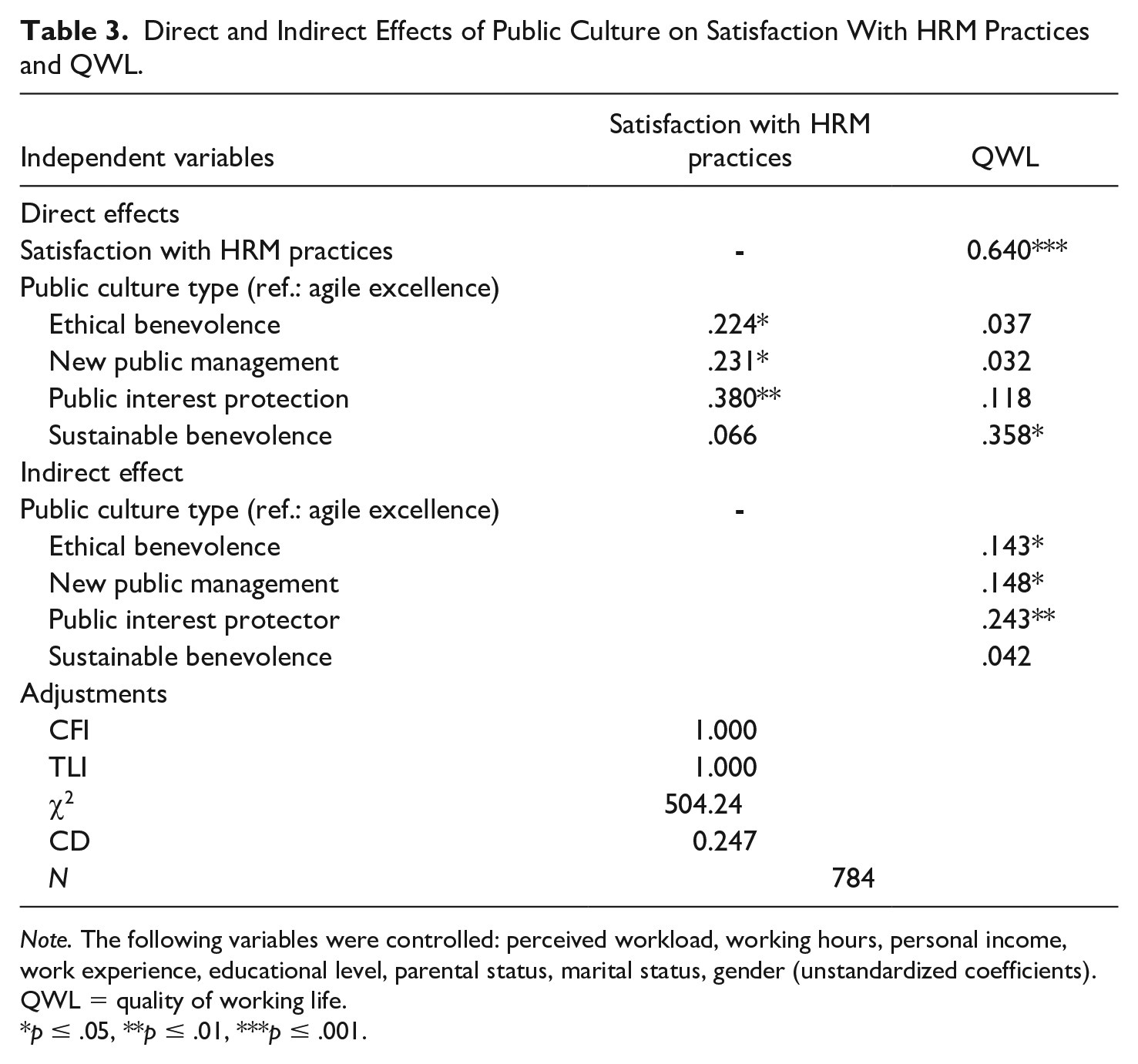
Using SEM, Table 3 presents the direct and indirect effects of the public organizational culture profiles on satisfaction with HRM practices and QWL. This table also indicates that the fit of the model is adequate since the comparative fit index (CFI) and the Tucker–Lewis index (TLI) are equal to 1.00. The CFI and TLI are two commonly used indices to assess the fit of SEM. The closer these indices are to 1, the higher the fit of the model is considered. Simplified models have been estimated, and the results remain unchanged, indicating that the model is robust.
Direct and Indirect Effects of Public Culture on Satisfaction With HRM Practices and QWL.
Note. The following variables were controlled: perceived workload, working hours, personal income, work experience, educational level, parental status, marital status, gender (unstandardized coefficients). QWL = quality of working life.
p ≤ .05, **p ≤ .01, ***p ≤ .001.
Regarding the direct effects, Table 3 shows that the effect of three public cultural profiles on satisfaction with HRM practices differ significantly from the cultural profile of agile excellence. Indeed, the results indicate that employees in ethical benevolence organizations are more satisfied with HRM practices than employees in an agile excellence organization. The same observation can be made for civil servants working in a NPM or a public interest protector organization. However, civil servants immersed in a culture of sustainable benevolence are no more satisfied with HRM practices than those immersed in a culture of agile excellence.
When examining the direct effects of culture on QWL, Table 3 reveals that civil servants immersed in a sustainable benevolence culture show higher QWL than those immersed in an agile excellence culture. The QWL of the other types of public culture are not significantly different. Table 3 also shows that satisfaction with HRM practices has a positive and highly significant direct effect on QWL. These results partially confirm H2 which postulated that the public organizational culture influences the QWL of civil servants. Only the sustainable benevolence culture leads to a higher QWL than the agile excellence culture.
The Mediating Role of Satisfaction With HRM Practices
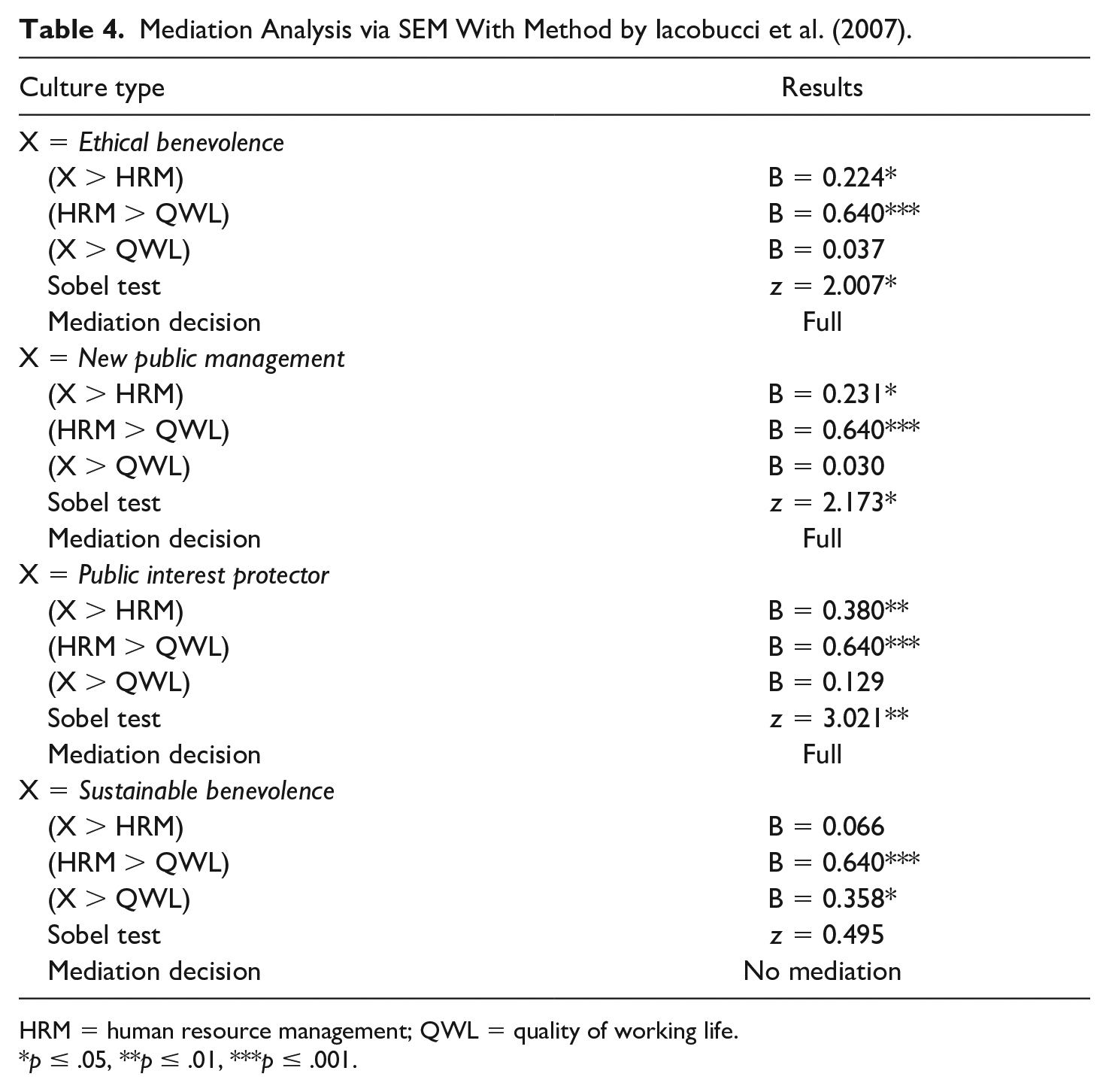
Regarding the indirect effect of culture on QWL through satisfaction with HRM practices, Table 3 shows that the ethical benevolence, NPM, and public interest protector profiles have a positive indirect effect on the QWL of public servants through their satisfaction with the HRM practices of their organization. This suggests that for these three public culture profiles, satisfaction with HRM practices plays a mediating role on QWL. To confirm the mediating effect of satisfaction with HRM practices, four mediation tests were performed using the method of Iacobucci et al. (2007). The results are presented in Table 4. This table shows that satisfaction with HRM practices fully mediates the relationship between the culture of ethical benevolence and QWL. The same observation applies to the NPM and the public interest protector cultural profiles. These results confirm H3 for these public culture profiles. However, H3 is invalidated for the sustainable benevolence cultural profile.
Mediation Analysis via SEM With Method by Iacobucci et al. (2007).
HRM = human resource management; QWL = quality of working life.
p ≤ .05, **p ≤ .01, ***p ≤ .001.
Discussion
Scientific Contributions
The results allow us to make three main observations that advance the state of knowledge. First, the content analysis of the values statement of 26 public organizations in Quebec highlighted that there was a great diversity of values in public administrations. Indeed, 51 different values have been identified, and seven main categories of values have been distinguished, which confirms the results of previous empirical studies noting the existence of a plurality of public values (Bryson et al., 2014; Fukumoto & Bozeman, 2019; Jørgensen & Bozeman, 2007; Kernaghan, 2003; Rutgers, 2008; van der Steen et al., 2018). This study adds that there is also a diversity in the articulations of values within public administrations. The cluster analysis carried out from the categories of public values revealed five profiles of public organizational culture: agile excellence, ethical benevolence, NPM, public interest protector, and sustainable benevolence. The dominant values of organizations with an agile excellence culture are innovation and excellence. Organizations with an ethical benevolence culture display ethics/equity and benevolence in their dominant values. The NPM profile is dominated by values related to excellence combined with the more traditional values of ethics/equity. The protection of the public interest constitutes the dominant value of the public interest protector culture. Benevolence and accountability are the hallmark values of the sustainable benevolence culture. This diversity of cultural profiles noted in public administrations highlights the importance of not considering the public sector as a monolithic entity.
Previous literature had shown that public values differ from private values (Van der Wal et al., 2008; Van der Wal & Huberts, 2008; Weske et al., 2020) and that there are distinct governance perspectives based on distinct public values (Bryson et al., 2014; Jørgensen & Bozeman, 2007; Kernaghan, 2003; Rutgers, 2008; van der Steen et al., 2018). This study refines knowledge in public personnel management by showing that benevolence is the dominant value category in Quebec public organizations, which goes hand in hand with the social missions of these organizations. However, most of the public organizations in our sample (over 65%) display values traditionally associated with private organizations, such as excellence and innovation (Van der Wal & Huberts, 2008), while more traditional values for the public sector such as ethics, public interest, and accountability (Van der Wal et al., 2008) are present in less than half (46% or less) of the public organizations examined. In this regard, our studies suggest that public organizations prioritize different categories of values, some of which are more traditionally associated with the private sector. Indeed, the public organizations in the agile excellence profile focus on these values. Consequently, these results support the idea that public organizations share common values with private ones, but that it is imperative to examine the prioritization and articulation of different values by comparing public organizations with each other, since they are far from identical in this respect. Based exclusively on public values, this study proposes profiles of organizational cultures specific to public administrations. By developing these data-driven profiles, the main objective of this research was achieved.
The second objective was to verify the association between these public culture profiles, satisfaction with HRM practices, and QWL. Like the Culture-Work-Health model of Peterson and Wilson (2002), HRM practices have been conceptualized as a mediating variable in the relationship between organizational culture and QWL. The results of the SEM showed that the sustainable benevolence culture has a direct positive effect on the QWL of civil servants compared to the agile excellence culture. The positive association observed between sustainable benevolence culture and QWL is in line with previous studies that have shown that employee well-being varies according to organizational culture (Gifford et al., 2002; Goodman et al., 2001; J. Kim & Jung, 2022; Lu et al., 2022; Marchand et al., 2013; Olynick & Li, 2020). This study establishes that this observation is also true in public organizations.
The third main finding arising from this study concerns the mediating role of HRM practices. SEM showed that satisfaction with HRM practices mediates the relationship between three types of culture and public employees’ QWL, namely ethical benevolence, NPM, and public interest protector. Although these three public cultures do not have a direct effect on QWL, they do have an indirect effect on this outcome. Indeed, these three types of public cultures increase satisfaction with HRM practices, which has a positive impact on QWL. This observation suggests that the choice of organizational values is an exercise to be carried out with great care since the articulation of values impacts satisfaction with HRM practices. As proposed by the Culture-Work-Health model, HRM practices are embedded in the organizational culture. It is therefore not surprising to find that organizational culture (and the associated values) influences employee satisfaction with HRM practices. The cultural profile of agile excellence relying mainly on innovation and excellence is less favorable to the satisfaction of civil servants with HRM practices.
Moreover, it becomes relevant to emphasize that these three types of public organizational culture, unlike the culture of sustainable benevolence, do not have a direct effect on the well-being of civil servants, but rather an indirect effect through satisfaction with HRM practices. In accordance with the Culture-Work-Health model, the positive effect of culture on well-being can be achieved through management practices. However, the results concerning the direct effect of the sustainable benevolence culture illustrate that this is not always the case. In these circumstances, it can be assumed that in three public culture profiles, the displayed culture first affects the employees’ perception of HRM practices as if their perception of the culture was captured through the practices of HRM. If this perception is positive, this has the effect of increasing their well-being. Conversely, the sustainable benevolence culture has a direct effect on well-being without passing through HRM practices, which suggests that this culture is more diffuse in the organization and is possibly felt in the overall work atmosphere. In any case, these results raise questions regarding the mechanisms by which employees experience organizational culture. The findings also suggest that these mechanisms can be distinct from one public organization to another depending on their cultural profile.
In addition, this study contributes to the advancement of knowledge by being the first to empirically test the Culture-Work-Health model focusing on public organizations. This study also contributes to the advancement of knowledge in the field of HRM in the public sector by showing that the perception of civil servants with their organization’s HRM practices has a considerable impact on their well-being at work. The more positive this perception, the higher their QWL. This finding highlights the relevance for public managers to care about the opinion of employees regarding these practices. Actions aimed at fostering a positive perception of these practices could improve the QWL of civil servants, which could help public organizations to stand out as an employer of choice.
Practical Contributions
Each of our studies has an important practical contribution. The results of the first study showed that despite similar missions, each public organization has a unique way of declaring its values, but it was possible to detect similar value patterns reflecting public organizational culture profiles. The public culture profiles proposed in this manuscript could be useful to public personnel management practitioners by making them aware of the different categories of public values, by helping them choose the values to prioritize in their value statement, and therefore by refining their definition of their organizational culture. Since these profiles were created solely from the values displayed by public organizations, it could allow them to more precisely categorize their type of organizational culture compared to a general typology such as the CVF. This greater precision in identifying the cultures of public organizations could contribute to improving the identity quest of several public organizations. Public personnel managers are therefore invited to consult the typology to reflect on the categories of public values, to choose the values to prioritize, as well as to facilitate their identification with a public organizational culture profile.
The main practical contribution of Study 2 is to inform managers and personnel management practitioners in public organizations that they can play a role in improving the QWL of civil servants by proposing a redefinition of the culture (based on a change in values) of their organization. For public personnel management practitioners, this means that prioritizing values linked to the sustainable benevolence profile, such as benevolence, responsibility, and the public interest, is a potential lever for improving civil servants’ well-being. On the contrary, practitioners can deduce that a culture of agile excellence that emphasizes values traditionally associated with private organizations, such as innovation and excellence, does not seem to lead to the well-being of civil servants. It may be that the adoption of private sector values in the public sector is at the root of a mismatch between the values espoused by the organization and those of public servants. Of course, it is not just a question of choosing and displaying new values linked to sustainable benevolence but also of bringing these values to life in the organization. This study therefore encourages public personnel managers wishing to improve the QWL of civil servants to give priority to a cultural profile of sustainable benevolence. In addition, they can use the profiles of ethical benevolence, NPM, and public interest protector to improve civil servants’ satisfaction with HRM practices, which is positively associated with their QWL.
Limitations
Despite its contributions, the study is not without methodological limitations. The first limitation concerns the transversal research design, which does not allow to dissociate the causes from the effects. However, it allows us to establish associations between variables. Nevertheless, the methodology presents the advantage of avoiding common method bias since the independent variable was imputed based on the results of the content analysis.
A second limitation is that a convenience sampling method was used. In fact, the collection of public values was carried out in 26 public organizations in Quebec. Although this number is considerable from an analytical point of view, an increase in the number of public organizations or the consideration of public organizations located in another country could have led to the discovery of other public values, as well as new profiles of public culture. According to Robinson (2014), in qualitative research, the danger of using a convenience sample is that the sample may not be representative of the entire population or phenomenon, which could lead to unjustified generalizations. This type of sampling therefore threatens the external validity of the study (Landers & Behrend, 2015). For Robinson (2014), the best way to justify convenience sampling is to generalize the results of the study only to the universe considered in the sample. The sample in this study is relevant because it is composed of several public organizations that have publicly displayed their statement of values. It is also rich since these public organizations are diverse in terms of missions (public service, health, education, culture) and size. Moreover, the results showed a diversity in the public values collected (N = 51) but also a certain saturation since several values came back over time and few new values were added with the inclusion of the last organization. However, the sample is geographically limited to Quebec (Canada), which limits the scope of the results outside this province.
It is also possible that the values chosen by public organizations to be displayed in their values statement may be influenced by their mission and other institutional characteristics. However, in our sample, several organizations with similar mission do not display the same values. This suggests that there is a certain uniqueness in the values chosen by public organizations in their value statements. In addition, social values in Quebec may also have influenced the values espoused by the public organizations in the sample used. Quebec culture, which values social solidarity, equal opportunities, and the French language, could have an impact on the values chosen by these organizations. Accordingly, the findings established in this manuscript as well as the practical implications are more suitable to public organizations in this Canadian province. However, the values identified in Study 1 overlap greatly with the public values listed by Jørgensen and Bozeman (2007) in the literature of academic journals from the United States, the United Kingdom, and Scandinavian countries. In a similar vein, there are several similarities between the categories of values observed in Study 1 and those mentioned by Kernaghan (2003) who focused on public value statements in Australia, New Zealand, the United Kingdom, and Canada. This suggests that despite the specificity of the context of the organizations in our sample, the findings established could apply to other contexts. However, in the future, it would be interesting to replicate this study in Asia or Africa, which could provide a new perspective on the values and organizational culture profiles of public administrations.
A third research limitation relates to the online survey collection period that occurred during the COVID-19 pandemic. During this period, teleworking was favored or even imposed on several civil servants. Several studies have shown that the pandemic has reduced well-being at work (Sadiq, 2022; Talaee et al., 2022; Yu et al., 2021). Since the data were collected in a difficult period, the QWL of civil servants could be lower than usual in the sample. However, this limit does not affect the associations found between the types of public culture and the QWL since the statements of values were established before this period.
A fourth research limitation concerns the use of a single item to measure satisfaction with HRM practices, which may have limited the construct’s validity and reliability. Although the use of a single-item measure is debated, several studies indicate that single-item measures have acceptable psychometric properties (Fisher et al., 2016; Matthews et al., 2022; Nagy, 2002; Vermeeren et al., 2011; Wanous et al., 1997).
Despite these limitations, this study proposes different profiles of public organizational cultures developed from the value statements of public organizations. In addition, this study has just opened a Pandora’s box by showing that the values displayed by public organizations in their statement of values are associated with the satisfaction of civil servants with HRM practices as well as their QWL.
Footnotes
Appendix
Acknowledgements
The authors would like to thank the Fonds de recherche du Québec Société et Culture for its funding.
Declaration of Conflicting Interests
The author(s) declared no potential conflicts of interest with respect to the research, authorship, and/or publication of this article.
Funding
The author(s) disclosed receipt of the following financial support for the research, authorship, and/or publication of this article: The author would like to thank the Fonds de recherche du Québec – Sociétée et culture for its funding granted for the project Towards an inclusive HRM model with high well-being in private and public organizations in Quebec (2020-NP-266495).
