




Abstract
Although the employability of employees has increasingly become an issue for both public and private employers, the employability in especially public organizations is under pressure due to its relatively aging workforce compared to the private sector. Moreover, scholars argue that employability outcomes such as work engagement are particularly under pressure among public-sector employees relative to private-sector employees because public-sector employees have to deal with red tape and experience possible hindrance of their public service motivation (PSM). At the same time, these propositions are understudied, and scholars call for more contextualized research comparing the public and private sectors. This study therefore compares the moderating effects of PSM and red tape in the relationships between perceived employability and work engagement across the public and private sectors. Based on comparative structural equation modeling on samples of Dutch government employees (N = 9,427) and private-sector employees (N = 2,057), it is concluded that PSM undermines the relation between perceived internal and external employability and work engagement of both public- and private-sector employees, respectively. Moreover, red tape is less undermining for public-sector employees in the relationships between respectively perceived internal and external employability and work engagement than for private-sector employees. Based on the results, contributions are discussed.
Introduction
Although the employability of employees has increasingly become an issue for most employers (OECD et al., 2016), some scholars argue that the employability in especially public organizations is under pressure (Van Harten & Rodrigues, 2021; Van Harten & Vermeeren, 2021). Developments such as increasingly complex public tasks and roles, combined with a relatively aging workforce, make employability in the public sector a critical issue as public organizations strive to attract new talent while retaining skillful yet aging employees. The scarce employability literature in public-sector settings confirms that both public employees’ self-perceived internal job opportunities in their current organization and external job opportunities to gain a job at other employers are low (De Cuyper & De Witte, 2011; Van Emmerik et al., 2012; Van Harten & Rodrigues, 2021). Moreover, scholars argue that employability outcomes such as work engagement are particularly under pressure among public-sector employees as they have to deal with red tape and experience possible hindrance of their motives to serve the public interest (i.e., PSM; Van Harten & Vermeeren, 2021). At the same time, the comparative empirical employability research studying these propositions is so far non-existent, and employability scholars therefore call for more rigorous contextualized research comparing the public sector to the private sector (Van Harten & Rodrigues, 2021; Van Harten & Vermeeren, 2021).
This study responds to this call by studying the role of PSM and perceived red tape in the relations between perceived employability and work engagement of employees across the public and private sectors. Work engagement is one of the most studied indicators of employee well-being that is defined as “[. . .] a positive, fulfilling, work-related state of mind that is characterized by vigor (i.e., high levels of energy and resilience), dedication (i.e., experiencing a sense of significance, pride, and challenge), and absorption (i.e., being fully concentrated and happily engrossed in one’s work)” (Schaufeli et al., 2002, p. 74). With this contextual focus on the relations between perceived employability and work engagement, this article makes two important contributions to the public administration (PA) and employability knowledge base.
First, it analyzes how factors that are specific to the public sector are likely to play a role in the relations between perceived employability and work engagement among employees (Van Harten & Vermeeren, 2021). The few empirical studies in a public-sector setting studying possible outcomes of perceived employability either do not pay attention to the specific context (De Cuyper & De Witte, 2011) or study general contextual factors such as leadership behavior (Camps & Torres, 2011). However, through the lens of the job demands-resources (JD-R) model, several scholars suggest that since perceived employability is a personal resource that induces control over an employees’ work life and inherently increases work engagement (De Cuyper & De Witte, 2011; De Cuyper et al., 2011; Kirves et al., 2014), it could possibly be hindered by public context-specific job demands including red tape or personal resources/demands including PSM (Van Harten & Vermeeren, 2021). This article contextualizes perceived employability within an adapted JD-R model and theoretically examines the potential roles of perceived red tape and PSM in its relationship with work engagement.
Second, this article is the first to compare the relations between employability and work engagement across public-sector and private-sector employees by considering two typical public-sector conditions (i.e., perceived red tape and PSM) (Van Harten & Vermeeren, 2021). Perceived red tape and PSM are seen as typical phenomena characterizing public-sector employees and their work better than private-sector employees (hence the meta-analyses on red tape [Blom et al., 2021] and PSM in the public sector [Homberg et al., 2015; Parola et al., 2019]). However, there are some studies that also point at the importance of red tape and PSM in predicting attitudes and outcomes of private-sector employees (Andersen et al., 2011; Taylor, 2010). Consequently, it can be discussed whether the assumption is actually correct that red tape and PSM particularly moderate the employability and outcomes of public employees compared to private employees. To date, employability studies that use data from multiple sectors have not investigated the actual influences of these possible sectoral differences (Van Harten & Vermeeren, 2021). This article therefore provides important knowledge for comparative employability research regarding possible contextual differences in the employability and its outcomes across sectors (Van Harten & Rodrigues, 2021).
Based on these two contributions, this study aims to compare the moderating effects of PSM and red tape in the relationships between perceived employability and work engagement across the public and private sectors. In line with earlier work of, for example, Kruyen et al. (2024), Blom et al. (2020), and Borst et al. (2020), it is suggested in this study that sectoral differences are a main boundary condition for differences in the relations and associations in the JD-R framework. More specifically, based on the extant literature, it is argued that differences in the relations and associations in the JD-R model across studies might stem from the variety and perception of various moderating job demands such as red tape, and personal resources such as PSM that are ingrained in the public sector and consequently might lead to finding different relations and associations regarding the same concepts in the private sector. In other words, this study specifically focusses on comparing job-level relations in line with the JD-R model in a private-sector sample and a public-sector sample and statistically tests whether differences in relations can indeed be attributed to the boundary condition sector. To reach this goal, a representative sample is used of Dutch government employees (N = 9,427) and private-sector employees (N = 2,057). The remainder of this article is structured as follows. The “Theory” section presents the theoretical background resulting in five hypotheses. In the “Method” section, the method to test the hypotheses will be presented. The results of the analyses will be presented in the “Results” section. Finally, in the “Discussion” section, several avenues for further research are explored on comparative employability research.
Theory
Employability and Work Engagement: A Contextualized JD-R Perspective
Over the years, several conceptualizations of employability have emerged. Forrier et al. (2015) categorized this range of perspectives into three approaches, respectively, the personal strengths approach, the self-perceived employment opportunities approach, and the job transitions approach. Notably, only the second approach centers on self-perceived employability itself. Scholars following the first approach define employability as personal strengths that facilitate employability perceptions, while those following the third approach focus on actual job transitions based on these perceptions (Van Harten et al., 2021). More specifically, the second approach often distinguishes between employees’ self-perceived internal job opportunities in the current organization as well as self-perceived external job opportunities elsewhere (Van Harten et al., 2021). This study is aimed at the self-perceived internal and external employability of public-sector and private-sector employees and, therefore, follows the second approach.
This study adopts the second approach, which leverages a well-established theoretical model—the JD-R model—offering a robust framework for examining how employability is related to employee outcomes, along with the potential contextual boundary conditions that moderate these relationships. Indeed, scholars that follow this approach conceptualize employability from a psychological viewpoint as self-perceived employment opportunities, which is a personal resource in the JD-R model (De Cuyper & De Witte, 2011; De Cuyper et al., 2011; Kirves et al., 2014). Personal resources are defined in the JD-R model as the “psychological characteristics or aspects of the self that are generally associated with resilience and that refer to the ability to control and impact one’s environment successfully.” As perceived employability represents employee perceptions about their ability to control and do their work, it can be seen as a typical personal resource (De Cuyper et al., 2011). Despite the importance of this personal resource, the increasing amount of PA literature shows that compared to private-sector employees, public-sector employees’ self-perceived internal and external employability are low (De Cuyper & De Witte, 2011; Van Emmerik et al., 2012; Van Harten & Rodrigues, 2021). This seems to stem from the mind-set of public-sector employees that their public job is their one and only calling, providing stability and security and leading to a strong boundary between public and private work (Van Harten & Rodrigues, 2021).
According to the JD-R model, work engagement is the most important outcome of the possession of personal resources (Schaufeli & Taris, 2014; Xanthopoulou et al., 2007). As mentioned in the Introduction, work engagement is an important indicator of employee well-being. While there is already much attention toward work engagement in private-sector studies, the attention in PA literature is growing (Borst et al., 2020). This attention in PA literature is instigated because work engagement measures feelings of purposefulness and meaningfulness, which are proved to be higher among public-sector than private-sector employees (Borst et al., 2020). In addition, work engagement has been coined as a key outcome for letting employees work longer and stimulating them to be more open for learning, which is essential for the aging staff problem that many public organizations face today (Mori et al., 2024).
Relation Perceived Employability and Work Engagement Among Public-sector and Private-sector Employees
Despite growing attention regarding employability and work engagement in PA literature, the relationship between the two is studied less frequently. However, some studies do find positive significant relations between perceived employability and dimensions of work engagement (i.e., Kirves et al., 2014) but also between perceived employability and other comparable wellbeing indicators (De Cuyper & DeWitte, 2011; De Cuyper et al., 2011). Moreover, among private-sector samples, the positive relation between perceived employability and work engagement itself is already confirmed (e.g., De Cuyper et al., 2008). 1 The common denominator in these studies is the usage of the conservation of resources (COR) theory to explain the positive relation between perceived employability and well-being outcomes in the JD-R model.
According to the basic principles of the COR theory, employees need to invest job/personal resources to protect against the loss of job/personal resources, recover from past losses, and gain future job/personal resources (Hobfoll, 2001). Translated to perceived employability, employees might invest their internal employability feelings to meet challenges posed by changes and uncertainty in their work so they can concentrate on the work at hand and report good well-being (Kirves et al., 2014). In addition, employees might accumulate additional resources through perceived external employability because it fosters self-efficacy beliefs and trust in finding other work (resource gain), which in turn increases levels of work engagement. However, it needs to be noted that these beliefs and trust in finding other work could also overturn in a negative relation with engagement if the other job chances are better than the current ones (De Cuyper & De Witte, 2011). However, in this study, the focus is not on the particular version of external employability in which other job chances are particularly better than the current ones.
Despite possible differences in the level of both perceived (internal and external) employability and work engagement across sectors, there is no literature indicating that the COR relationship between the two is expected to vary between sectors (Van Harten & Vermeeren, 2021). Consequently, the following hypotheses can be posed based on the aforementioned discussion:
Role of Publicness in the Relation Between Perceived Employability and Work Engagement Among Public-sector and Private-sector Employees
Although the univariate relations between (internal and external) perceived employability and work engagement are expected to be the same across sectors, literature suggests that PSM and red tape might be typical public-sector phenomena leading to variations in these relations across public and private-sector employees (Van Harten & Vermeeren, 2021). The particular character of the public sector derives from its publicness, which in essence is based on organizational criteria such as ownership, funding, or social control (Bozeman, 1987; Perry & Rainey, 1988). When translated to the shop floor, this results in various particular institutional practices, referring to the types of goods produced, but also to the way organizations deal with the people that make up the human resources of the organization (Antonsen & Jørgensen, 1997; van Loon & Vandenabeele, 2021). Therefore, this institutional outline results at the individual employee level on the one hand in a higher level of PSM (Perry & Wise, 1990) and, on the other hand, in a higher level of individually perceived red tape (Pandey & Kingsley, 2000) in the public sector than in the private sector. It has been subsequently argued and demonstrated that these both have indeed a substantial impact on individual behavior of public-sector employees relative to private-sector employees (Andersen et al., 2011; Borst et al., 2020; Taylor, 2010).
Contextual Condition: Public Service Motivation
Moderating Relation of Public Service Motivation in Public Sector
PSM is a personal resource more strongly owned by public-sector employees than by private-sector employees (Steijn, 2008). PSM is defined as a predisposition of individuals that entails the willingness to engage in behavior for the good of citizens and the public interest without reciprocal benefits for themselves (Perry & Vandenabeele, 2015). Consequently, from a JD-R perspective, it is seen as a personal resource that one possesses more or less, which gives energy and positively influences work engagement (Bakker, 2015; Borst et al., 2019). Indeed, personal resources are defined as personal psychological characteristics or aspects of the self that are generally associated with resilience and that refer to the ability to control and impact one’s environment successfully. PSM empowers individuals to positively influence their organizational context, thereby demonstrating its role as a personal resource (Bakker, 2015).
Whether PSM as a personal resource increases the positive relations between perceived internal respectively external employability and work engagement might depend on the sectoral context. To make use of the positive effects of PSM, the organizational environment needs to provide the possibilities to employees to actually fulfill their public service motives (Borst et al., 2019; Steijn, 2008). Since the public context often provides these possibilities, it can be expected that higher PSM will have stronger motivating effects and will increase the positive relations between perceived internal and external employability and work engagement of public servants, respectively. It is therefore not PSM in itself that strengthens the relationship, but the presence of PSM within a favorable context—also referred to as PSM fit—that acts as an additional resource and, thus, moderates the relationship (Sørlie et al., 2022).
Moderating Relation of Public Service Motivation in Private Sector
In contrast to public organizations, private organizations are less able to provide possibilities to fulfill public service motives. Here, the presence of PSM in a less-favorable context means less PSM fit and, ceteris paribus, less resources. In other words, it can be expected that the positive relations of internal and external employability on work engagement among private-sector employees will be suppressed due to their context. On the one hand, private-sector employees might care less that they possess high perceived internal job opportunities because they are unable to fulfill their public service motives. Consequently, private-sector employees become less engaged due to their perceived internal employability as long as they cannot fulfill their PSM and the lack of fit creates no additional resources. Consequently, Steijn (2008) shows that private-sector employees with high PSM are more inclined to look for jobs in the public sector. On the other hand, even if perceived external job opportunities also entail public-sector opportunities, PSM can also lead to a possibly even stronger suppression of the positive relations between perceived external employability and work engagement. Because private-sector employees feel that their PSM motives can only be fulfilled by other (i.e., public sector) jobs, PSM could, in the strongest case, even lead to an overturn of the positive relation between perceived external employability and work engagement to a negative relation 2 . This is in line with the mechanism explained by De Cuyper and De Witte (2011) who showed that employees experiencing alternative job opportunities as better than the current ones (i.e., job chances that do fulfill their public service motives) will lead to negative work engagement and commitment. This also corresponds to a lack of fit with the job demand, leading to lower levels of work engagement (C. Y. Chen et al., 2014). Based on this discussion, the following hypotheses can be posed:
Contextual Condition: Perceived Red Tape
Moderating Relation of Perceived Red Tape in Public Sector
Besides the personal resource PSM, red tape is a job demand more strongly perceived by public-sector employees than private-sector employees (Borst et al., 2020). Red tape is defined as the rules, regulations, or procedures that are perceived by employees as pointless yet burdensome. Consequently, from a JD-R perspective, it is seen as a hindering job demand because it involves excessive or undesirable constraints upon employees (Borst et al., 2019). Indeed, as defined by Demerouti et al. (2001, p. 501), “job demands refer to those physical, social or organizational aspects of the job that require sustained physical and/or mental effort and are therefore associated with certain physiological and psychological costs.” Consequently, many scholars define red tape as such a job demand because it encompasses organizational aspects of work that necessitate sustained cognitive and emotional efforts that are associated with physiological and psychological costs (Bakker et al., 2023; Schaufeli, 2017). Employees must navigate complex regulations and bureaucratic processes posed by the organization.
Based on the aforementioned mechanisms, it can be expected that perceived red tape lowers the relation between public-sector employees’ perceived employability and work engagement (Van Harten & Vermeeren, 2021). More specifically, regarding internal employability, the positive relation between the perceived internal employability by public-sector employees and their work engagement might be suppressed due to their perceptions of red tape because the experienced red tape in the current job is probably also present in other jobs within the rest of the public organization. Consequently, it suppresses their positive relations regarding their internal job opportunities elsewhere in the organization and their work engagement as they become less excited (Stazyk et al., 2011).
The mechanism described earlier would also explain why the positive relation between perceived external employability and work engagement is suppressed as well. Public-sector employees might become more intrigued by their external job opportunities and consequently experience lower work engagement in their current job since the red tape in their job annoys them (Van Harten & Vermeeren, 2021). Consequently, they experience less fit with their current job and inherently become less engaged.
Despite these mechanisms, there is however some research in which it is argued and empirically confirmed that the motivational potential of resources in relation to work engagement might increase instead of decrease due to the perceived red tape because the job resources can help with goal accomplishment under demanding circumstances (Borst et al., 2019). Blom et al. (2021) draw this line further and argue that public-sector employees might be more socialized in bureaucratic processes, meaning that they attribute a less-negative verdict upon these rules since they are seen as part of the job. Consequently, the red tape that public-sector employees perceive might suppress the positive relations between both forms of perceived employability and work engagement less strongly than expected beforehand.
Moderating Relation of Perceived Red Tape in Private Sector
Also for private-sector employees, perceived red tape can diminish the positive relations of perceived internal employability with their work engagement. This occurs because red tape can lead employees to expect similar constraints across other roles within the organization, thereby discouraging them from pursuing new internal opportunities and ultimately reducing their enthusiasm and work engagement (Stazyk et al., 2011). Confidence in internal career progression is generally tied to higher engagement, but persistent red tape can create a generalized feeling that no internal role offers escape from these restrictions.
Furthermore, similar to the public sector, it is expected that the mechanisms described earlier also explain why the positive relationship between perceived external employability and work engagement might be diminished among private-sector employees. Private-sector employees may become increasingly drawn to external job opportunities and experience reduced engagement in their current roles when red tape frustrates them (Van Harten & Vermeeren, 2021). However, this moderating effect of red tape might be perceived as weaker among private-sector employees than among public servants. Research suggests that, because public-sector employees are often more socialized to bureaucratic processes, they may view these rules as an inherent part of the job and, therefore, judge them less negatively. Consequently, perceived red tape may have a less negative moderating association in the relationship between perceived employability and work engagement for public-sector employees than for private-sector employees (Blom et al., 2020). This discussion leads to the following hypotheses:
The aforementioned theoretical discussion of all the expected relations is summarized in the conceptual model presented in figure 1.
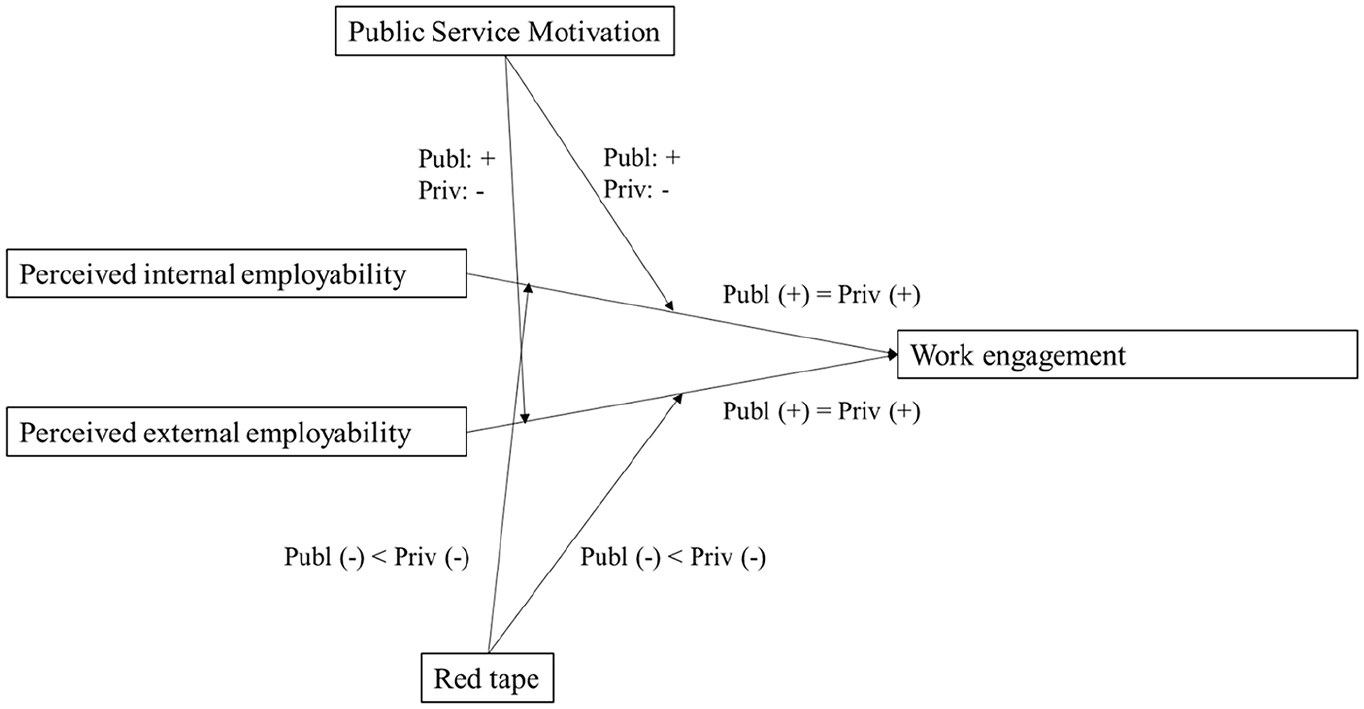
Conceptual Model.
Method
Research Context
This study is conducted within the Dutch public sector. Traditionally, Dutch public employment is characterized by an open position–based system. No general pre-entry training system for future civil servants exists, meaning that people from outside the organization can apply for job vacancies, provided that they have the required competencies. In the past two decades, due to labor market challenges and budget cuts, career mobility within the civil service is being stimulated to increase flexibility of the government while retaining employees for public employment (Groeneveld, 2009). In this system, the public employee is largely responsible for his or her own employability.
Participants
To test the hypotheses, a survey is used that is carried out in 2014 by the Dutch Ministry of the Interior and Kingdom Relations (2015). On the 14th of June, a large group of randomly selected respondents were invited by letter to fill in a Web-based survey using a personal code. On the 3rd of July, respondents received a reminder, and on the 21st of July, the questionnaire was closed.
Regarding the public sector, 31,181 questionnaires were sent to public servants employed in municipalities, provinces, water boards, central government, and the legal authorities. Of these questionnaires sent, 9,727 were returned (response rate = 31.2%). In total, 292 respondents with missing values on the variables needed for our research were excluded. After deleting participants with missing values on the research variables, data of 9,427 public servants were used.
Regarding the private sector, a reference group of 4,300 respondents was invited. Of the questionnaires sent, 2,227 were returned (response rate = 52%). In total, 170 respondents with missing values on the variables needed for the research were excluded. After removing participants with missing values on the research variables, data of 2,057 private employees were used. See Appendix 1 for an in-depth overview of the data characteristics.
Measures
The participants answered all measures on a 5-point Likert-type scale ranging from 1 (totally disagree) to 5 (totally agree). With every measure discussed in the following sections, the average variance extracted (AVE), the construct reliability (C.R.) was given for both the public- and private-sector samples. AVE represents good convergent validity when the value is above .5 while C.R. represents good reliability when the value is above .6 (Fornell & Larcker, 1981).
Work Engagement
Work engagement was measured using six items of the validated nine-item short version of the Utrecht Work Engagement Scale, also validated in the Dutch public context (Borst et al., 2019). Both the public-sector (AVE: .590, C.R.: .895) and private-sector (AVE: .637, C.R.: .913) samples show good validity and reliability.
Internal and External Perceived Employability
Perceived employability was measured using a six-item scale which was validated before in the Dutch public context (Vermeeren, 2017). A distinction is made between internal and external perceived employability. Internal perceived employability refers to the ability to maintain the current job. Both the public-sector (AVE: .566, C.R.: .780) and private-sector (AVE: .624, C.R.: .825) samples show good validity and reliability. External perceived employability refers to the ability to get a job outside the organization. Both the public-sector (AVE: .690, C.R.: .867) and private-sector (AVE: .745, C.R.: .897) samples show good validity and reliability.
Perceived Red Tape
Perceived red tape was measured using a five-item scale developed and validated for the Dutch public context (Borst et al., 2019). The introductory question reads: “The following statements relate to the regulatory pressure and administrative burdens you experience in your work. To what extent do you agree or disagree with these statements?” The items that follow this question are in line with the notion of red tape as a multidimensional construct including both the burdensome and ineffective dimensions of rules in the job of public servants (van Loon et al., 2015). Both the public-sector (AVE: .463, C.R.: .810) and private-sector (AVE: .494, C.R.: .829) samples show good reliability although the convergent validity is mediocre. However, they are acceptable when the C.R. is at least .6 (Fornell & Larcker, 1981).
Public Service Motivation
Public service motivation (PSM) was measured using a second-order two-dimensional construct that includes the dimensions of compassion (COM) and commitment to the public interest/self-sacrifice (CPI) from the validated PSM scale of Vandenabeele (2008). Vandenabeele made the scale compatible for the Dutch language and found that “public interest” and “self-sacrifice” can be collapsed into one dimension in this context (Vandenabeele, 2008). This corresponds to what Van Witteloostuijn et al. (2017) have termed the affective dimensions of PSM. These can nevertheless serve as a reasonably proxy for PSM, given the high inter-factor correlations of dimensions in any PSM instrument (Kim et al., 2013; Perry, 1996; Vandenabeele, 2008), as well as the equivalence of global and dimensional models of PSM (Wright et al., 2013). The second-order construct showed good validity and reliability in both the public-sector (AVE: .633, C.R.: .771) and private-sector (AVE: .578, C.R.: .731) samples.
Control Variables
Next to the main variables of interest, gender, age, educational level, tenure, supervisory position, and type of contract were included as control variables in the analyses. Age and tenure were expressed in number of years. Educational level included 11 subsequent categories ranging from primary education to postgraduate education. Supervisory position was included as a dichotomous variable indicating whether respondents have managerial responsibilities. Type of contract was included as a dichotomous variable indicating whether respondents have a permanent or a temporary contract.
Data Analysis
To test the hypotheses, structural equation modeling was applied using Mplus version 7.4. A three-step approach was used in which first, the measurement models of the public and private sample were examined, followed by the analysis of measurement invariance across the two samples (public and private sectors), after which the structural models including the moderators were developed to test the hypotheses (Anderson & Gerbing, 1988). In all these steps, the robust maximum likelihood (MLR) estimator was applied (in contrast to normal ML) as the data are continuous, but several items have a non-normal distribution, which is corrected for through MLR.
In line with Step 1, the measurement model was tested through a confirmatory factor analysis of work engagement, internal employability, external employability, red tape, and PSM. To assess whether the latent constructs fit together, the comparative fit index (CFI), Tucker–Lewis index (TLI), and root mean square of approximation (RMSEA) were used to assess how well the models fit the data. CFI and TLI values above .90 and RMSEA values below .08 indicate good fit (Byrne, 2012). The results in Table 1 show that the measurement model of both the public (CFI: .923, TLI: .912, RMSEA: .048) and private samples (CFI: .922, TLI: .911, RMSEA: .053) fits the data well.
Results of Measurement Models: Comparing Hypothesized Models With Alternative Models.

Given that the data come from a single source, common-method variance (CMV) may be an issue. At the same time, the main objective is not so much to examine direct relationships, but rather to focus on sectoral differences and the moderating influences of PSM and red tape. For these aspects, CMV is less relevant. Nevertheless, CMV was checked to some extent using Harman’s single-factor test in both the public and private samples. Although this test has been criticized, it is frequently employed to indicate potential CMV (George & Pandey, 2017). As shown in Table 1, these one-factor models had significantly poorer fits than the original measurement models, suggesting that CMV is somewhat less likely to be an issue. In the Discussion section, further reflections will be included.
In line with step two, measurement invariance between the public- and private-sector samples was tested. This test checks whether the interpretations of the items are not significantly different between the public- and private-sector samples. This is necessary to verify that potential significant differences in direct and/or moderating relations between the variables across the two sectors are not a consequence of the study design but are truly attributable to contextual differences between sectors. In this test, three levels of invariance are compared, with each test more stringent than the one before. First, configural invariance tests whether the constructs in this study have the same factor structure across groups, meaning that all parameters are freely estimated. Second, metric invariance tests whether the meaning that respondents an attribute to the latent factors is similar across groups by fixing the factor loadings to be equal across groups while freeing the intercepts. Third, scalar invariance tests whether the latent factors and the level of items are similar across groups by fixing both the loadings and intercepts to be equal across groups. Cutoff criteria of ≤–.01 in CFI and ≤.015 in RMSEA were used for indications of invariance as these are the criteria for large samples of more than 300 respondents (F. F. Chen, 2007).
Applied to the public- and private-sector samples, the fit measures of the comparison between the configural (CFI = .924, TLI = .913, RMSEA = .049) and metric models (CFI = .923, TLI = .914, RMSEA = .049) decrease within acceptable margins, indicating metric invariance (∆CFI = −.001, ∆TLI = +.001, and ∆RMSEA = +.000). When comparing the metric (.923, TLI = .914, RMSEA = .049) and the scalar models (CFI = .915, TLI = .909, RMSEA = .050), the fit measures also decrease within acceptable margins (∆CFI = −.008, ∆TLI = −.005, and ∆RMSEA = +.001). In other words, scalar invariance and inherent measurement invariance are present. It is, therefore, allowed to compare the direct and moderating relations between the constructs across the public- and private-sector samples. These comparisons are studied through the structural models in Step 3.
Results
Descriptive Statistics
In prelude to the structural models, first the descriptive statistics are presented. Table 2 presents the correlations between the variables for both sectors, whereas the means of the variables for these sectors are presented in Table 3.
Correlations.

Note. Public-sector employees below the diagonal, and private-sector employees above the diagonal.
p ≤ .05. **p ≤ .01. ***p ≤ .001.
Descriptive Statistics.

p ≤ .001.
There are significant differences between the public and private sectors. As Table 3 shows, public servants are significantly more engaged than private-sector employees (M = 3.90 and M = 3.73, respectively, p = .000). Interestingly, public servants also have a significantly higher perceived internal employability than private-sector employees (M = 3.62 and M = 3.40, respectively, p = .000) but a much lower perceived external employability than their private-sector colleagues (M = 3.01 and M = 3.35, respectively, p = .000). In addition, public servants have a significantly higher PSM and also perceive significantly more red tape in their work than private-sector employees (M = 3.65 and M = 3.05 vs. M = 3.32 and M = 2.83, respectively, p = .000).
Structural Models
Whether the significant differences are also visible in the relations between the concepts is presented in Table 4. Two structural models are developed in which Model 1 studies the direct and moderating relations of perceived internal employability, and Model 2 studies the direct and moderating relations of perceived external employability. In both models, a baseline model with only the direct relations is given, as well as a full model with the double moderation. To test whether the full models with the double moderations are the best-fitting models, the Akaike Information Criterion (AIC) and Bayesian Information Criterion (BIC) are checked. When these decrease, compared to the baseline models, it suggests an improvement in model fit. AIC and BIC are both measures that account for the trade-off between model fit and model complexity, penalizing for the number of parameters to prevent overfitting.
Structural Equation Models.

Note. Zdiff is calculated with the formula: Z = (b1 − b2) / (√(SEb12 + SEb22)). If Zdiff is equal to or higher than 1.96, the difference is significant.
p ≤ .05. **p ≤ .01. ***p ≤ .001.
Besides AIC and BIC, the models present the standardized regression coefficients for both the public- and private-sector samples, as well as the Z-test to study whether differences in coefficients between both sectors are also significant. Adjusted p-values were calculated using the Benjamin-Hochberg procedure to control the false discovery rate. Moreover, to actually check whether the standardized regression coefficients are also practically important, the often-used rules of thumb of Cohen et al. (2003, p. 297) are used. More specifically, the coefficients regarding the direct relations in Table 4 are compared to β ≈ .10, β ≈ .30, and β ≈ .50 for small, medium, and large direct-effect sizes, respectively, while the moderating relations are compared to β ≈ .02, β ≈ .13, and β ≈ .26 for small, medium, and large moderating-effect sizes, respectively. Moreover, when moderators are significant, the related interaction plot is presented to interpret the direction of the moderation. Every plot shows the estimated moderation effect below (+1 standard deviation above the mean) and above average (respectively, –1 and +1 standard deviation of the mean) PSM or red tape in the relations between internal or external employability and work engagement.
Direct Relations
As Table 4 shows, the structural models explained between 16.9% and 18.4% of the variance in work engagement among public-sector employees and between 20.5% and 21.1% among private-sector employees. Moreover, the comparative goodness of fit measures (AIC and BIC) and the explained variance of the full moderation models all improve relative to the baseline models, meaning that the moderation models show more parsimonious results than the baseline models. According to H1a, it was expected that perceived internal employability has a positive significant relationship with the work engagement of both public-sector and private-sector employees. This hypothesis is accepted since table shows that perceived internal employability indeed has small to medium positive relations with the work engagement of both public-sector employees (β = .167, p ≤ .001) and private-sector employees (β = .229, p ≤ .001). H1b is also accepted, as the perceived external employability also has small to medium positive relations with the work engagement of both public-sector (β = .209, p ≤ .001) and private-sector (β = .223, p ≤ .001) employees. Moreover, in line with H1c, no significant difference was found in the positive relations between, respectively, perceived internal (Zdiff = 1.95, p ≥ .05) and external (Zdiff = .454, p ≥ .05) employability and work engagement across public-sector and private-sector employees.
Contextual Condition: PSM
Although the direct relations between perceived internal and external employability and work engagement, respectively, are positive, it was expected that PSM would further strengthen these relations among public-sector employees (H2a and H2b) but decrease these relations among private-sector employees (H3a and H3b). As Table 4 and the related Figure 2 show, PSM indeed has a small to medium negative moderating effect on the positive relations between perceived internal (β = −.084, p ≤ .05) and external (β = −.077, p ≤ .05) employability and work engagement among private-sector employees, respectively. However, contrary to the expectations, PSM also has a small to medium negative moderating effect on the positive relations between perceived internal (β = −.042, p ≤ .05) and external (β = −.042, p ≤ .05) employability and work engagement among public-sector employees, respectively. In other words, higher PSM is associated with weaker relationships between internal and external employability and work engagement for both public- and private-sector employees. H2a and H2b are therefore rejected, while H3a and H3b are accepted.
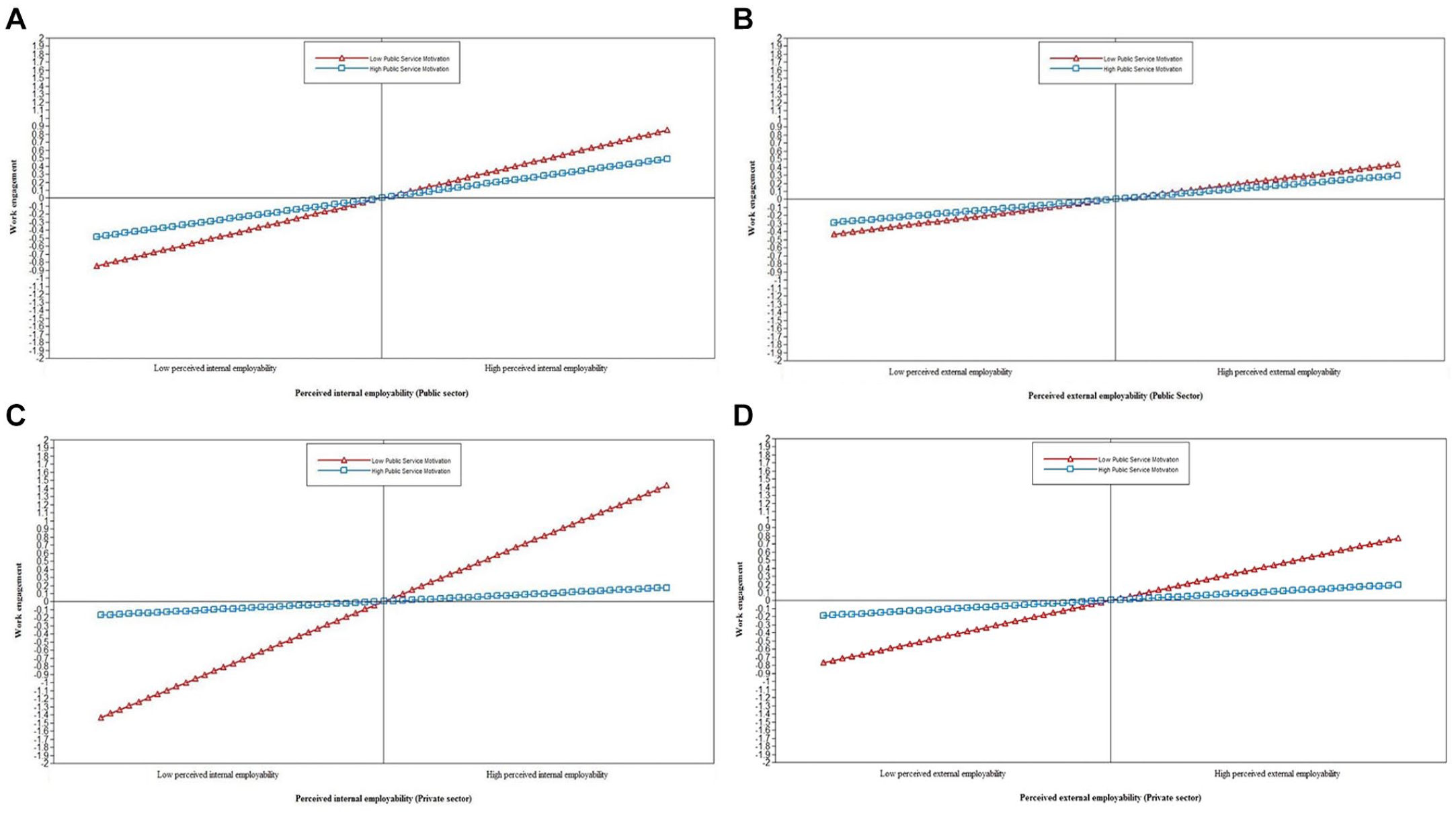
Interaction Plots Regarding Significant PSM Moderations.
Contextual Condition: Perceived Red Tape
Besides PSM, it was also expected that perceived red tape would decrease the positive relations between perceived internal and external employability and work engagement among both public- and private-sector employees, respectively (H4a, H4b, H5a, and H5b). At the same time, it was expected that perceived red tape would be a more negative moderator for private-sector employees than for public-sector employees (H5c). However, Table 4 shows that perceived red tape is no significant moderator in the relations between perceived internal and external employability and work engagement of public-sector employees, respectively. H4a and H4b are, therefore, rejected. Moreover, perceived red tape is also no significant moderator in the relation between perceived external employability and work engagement of private-sector employees. As shown in Table 4 and Figure 3, perceived red tape has only a small to medium diminishing moderating effect on the positive relationship between perceived external employability and work engagement among private-sector employees (β = −.096, p ≤ .001). H5a is therefore rejected, and H5b is supported. The moderating relationship of perceived red tape between perceived external employability and work engagement is also the only relationship that significantly differs between sectors (Zdiff = 2.89, p ≤ .001). Consequently, H5c is only partially supported.
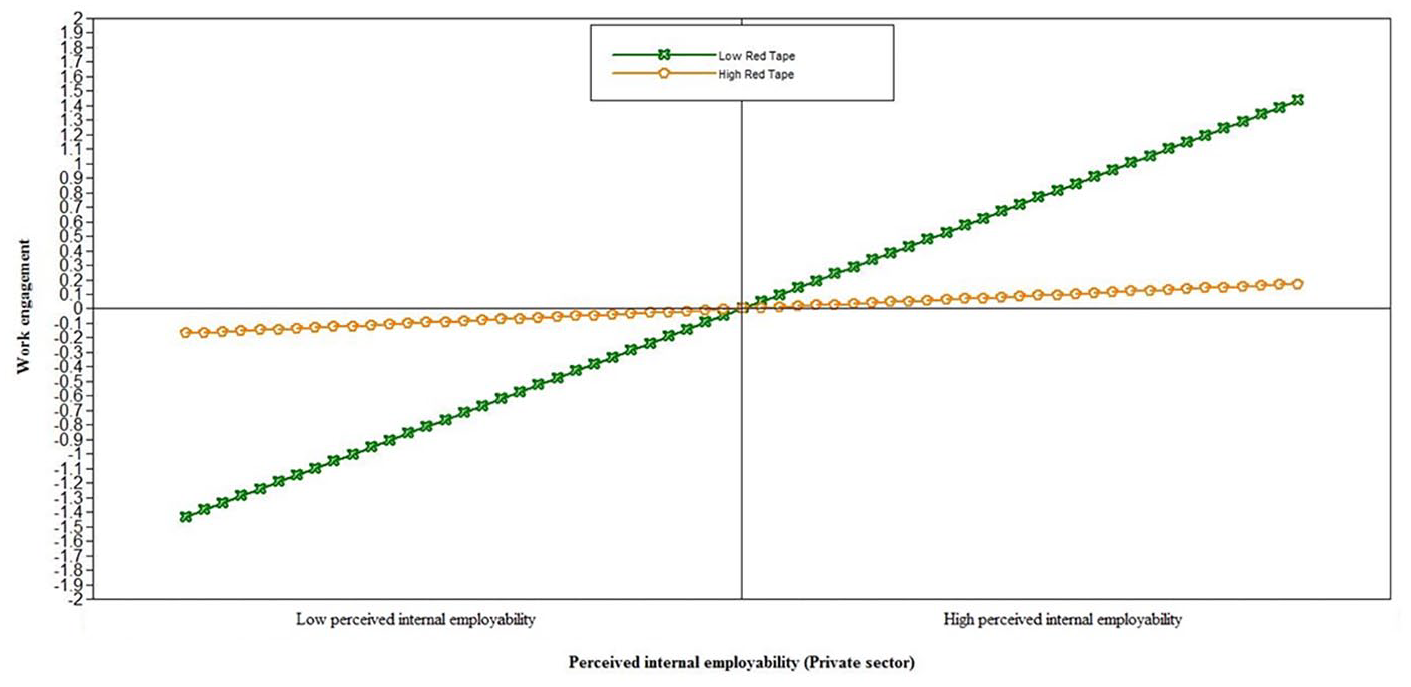
Interaction Plot Regarding Significant Red Tape Moderation.
In Figure 4, the results discussed earlier are summarized in a structural model.

Structural Model.
Discussion
This study sought to contribute to the (comparative) employability literature in PA by comparing the moderating effects of PSM and red tape in the relationships between perceived employability and work engagement in the public and private sectors. As such, this study adheres to calls for more rigorous contextualized research comparing the employability of public- and private-sector employees (Van Harten & Rodrigues, 2021; Van Harten & Vermeeren, 2021). The findings are suggestive of three conclusions that contribute to the public-sector employability literature.
First, public-sector employees seem to possess a higher perceived internal employability but a much lower perceived external employability than their private-sector colleagues. The latter finding is in line with previous evidence from the limited employability literature in public-sector settings (Van Harten & Vermeeren, 2021). Public-sector employees perceive their job as their calling, which provides stability and security and is clearly demarcated from private work with different values and goals they cannot identify themselves with (Van Harten & Rodrigues, 2021). Consequently, compared to private-sector employees, public-sector employees do not have a high self-appraisal of external job opportunities, particularly outside the public sector.
However, in contrast with the employability literature, this study shows that the perceived internal employability is higher among public-sector employees than among private-sector employees. This might be explained by the fact that existing literature to date has primarily focused on specific public-sector settings as public schools and public health care (De Cuyper & De Witte, 2011; Van Harten et al., 2016). These public settings require particular professional backgrounds (e.g., a doctor with a very specialized medical background), restricting access to other internal jobs and, consequently, leading to lower perceived internal employability. In contrast, the public-sector employees in this study work in PA and have a more generalistic background, which can lead to having more (perceived) internal job opportunities and may be strengthened by the Dutch context where individual public-sector employees are responsible for their employability (Groeneveld, 2009). That is also confirmed by Van Emmerik et al. (2012) who found that the internal employability perceptions of municipal employees in terms of personal strengths are high. These types of internal employability perceptions are lower among private-sector employees (Van Harten & Rodrigues, 2021). Consequently, this might explain why a higher perceived internal employability is found among public-sector employees than among private-sector employees.
Second, the personal-resource PSM negatively moderates the positive relationships between perceived internal and external employability and work engagement among both private- and public-sector employees, possibly due to its interaction with the respective environments. In line with expectations based on the fit theory, private organizations appear less able to provide their employees with the possibilities to fulfill their public service motives (i.e., PSM-misfit; Steijn, 2008). As a result, the relation between their perceived internal job opportunities and work engagement may become weaker for higher levels of PSM. Moreover, private-sector employees with higher levels of PSM will perceive alternative external job opportunities as better than the current ones (i.e., job chances that do fit with their PSM), which offers an explanation for why the positive relation between perceived external employability and work engagement is suppressed by PSM as well. After all, private-sector employees that experience many options (due to their perceived external employability) to move to another organization that aligns with their PSM no longer feel engaged in their current job.
Contraryto expectations, however, PSM also appears to negatively moderate the relationships between perceived internal and external employability and work engagement of public-sector employees, despite public organizations’ provision of opportunities for public-sector employees to fulfill their public service motives (Leisink & Steijn, 2009). This finding is likely a mix of two potential explanations. First, following fit theory, it may be that the needs of public-sector employees with higher PSM are not sufficiently met and that no needs-supplies fit is achieved. This would mesh with the findings that, in certain cases, PSM does not act as a resource but rather as a demand (Giauque et al., 2013; van Loon et al., 2015). Second, in this case, as the needs to fulfill public service motives are adequately met by working in a public-sector environment (i.e., PSM-fit; Steijn, 2008), public-sector employees with high PSM, perceive the internal opportunities as redundant which leads to a less-strong relation with work engagement, thus (indirectly) suppressing the fit effect. Public-sector employees might be less interested in other internal jobs because their current job already fits with their needs (Van Harten & Vermeeren, 2021, p. 287). This is in line with the lack of a significant (negative) correlation between PSM and internal employability.
Third, the job demand perceived red tape only appears to negatively moderate the positive relationships between perceived internal employability and work engagement for private-sector employees and not for public-sector employees. This may be because employable public-sector employees perceive red tape more easily as part of their job than private-sector employees, which explains why their work engagement is not suppressed by it (Blom et al., 2020). In contrast, internally employable private-sector employees in particular are less positively engaged when they perceive high red tape, which may be due to them being less socialized in dealing with burdensome bureaucratic processes than public-sector employees (Borst et al., 2019).
In terms of practical implications, this study’s findings point toward two main suggestions on how to keep employable public-sector employees engaged. The aging public service workforces in Western countries in combination with a tighter labor market present challenges for public employers on how to attract but also retain employees (Van Harten & Vermeeren, 2021). One of the ways to address these issues is by focusing on what relates to people’s work engagement. First, providing internal job opportunities as a way to retain highly engaged employees appears to be a more viable approach for those employees who do not have (very) high public service motives. Among employees with (very) high PSM, the findings suggest that internal job opportunities may not be related to their engagement at all. Second, to attract employees, it appears to be a promising strategy to focus on employable private-sector employees with higher PSM as they appear less engaged in their current job despite their high employability perceptions. In this way, the public sector is able to better compete with the private sector for employable employees.
Despite these revealing theoretical and practical implications, this study is not without limitations. The first set of limitations concerns the secondary data that have been used to test the theoretical claims in this article. First, cross-sectional data are used, which does not allow to claim causal inferences concerning the presented results. As such, the possibility exists that work engagement is not only an outcome of the personal resource employability but also a personal resource in itself (Borst et al., 2020), although previous longitudinal studies have found that employability precedes engagement (De Cuyper et al., 2011; Grosemans et al., 2024; Gurbuz et al., 2023). In addition, the data could be subject to CMV. However, several hypotheses are focused on sector differences, which makes CMV less problematic (Siemsen et al., 2010). Equally, survey research investigating moderator effects are less prone to suffer from CMV (Jakobsen & Jensen, 2015). Still, several hypotheses are addressing situations outside this realm. Since CMV is multi-source, according to Podsakoff et al., “none of the most-used statistical techniques [. . .] provide a satisfactory solution to controlling for CMB (Podsakoff et al., 2024, p. 48).” Therefore, one must rely on design-based ex ante strategies to avoid CMV from biasing findings. Although several of these have been applied in the original process of data collection (e.g., reverse-scored items, spatial separation, varied scale types, and randomized order of items), spurious correlations can never be completely ruled out. As a consequence, future corroboration of our findings is crucial. Hence, future studies could employ experimental designs to overcome CMV.
Second, secondary data are used, which limits the breadth and depth of the data. The downside of using secondary data is that the operationalizations of some factors, such as employability or PSM, were fixed beforehand. For employability, this means that there are different approaches to measure employability which could not be taken into account (Forrier et al., 2015). As stated earlier, for PSM, this posed less of a limitation given suitability of the measure as a proxy for PSM. Moreover, several interesting contextual factors could not be included such as variables related to person–organization fit. Third, a characteristic of secondary data is that it often applies a historical lens and is less timely. For descriptive purposes, this may be a problem as it is no longer representative of a current situation. However, for explanatory objectives, this does not need to be harmful. As the purpose of this study is to identify relationships between variables, the age of the data—this set was collected in 2014—poses less of a problem. Nevertheless, it is important to account for possible changes in the environment, as they may influence the validity of the correlational findings, in case the environment moderates these relations. 3
These limitations do hint at possible future research directions. First, this study focused on the general distinction between perceived internal and external employability. While this is the most-often-used distinction in the handful of public-sector studies, there is a more profound typology available as well (De Cuyper & De Witte, 2011). This typology adds a second dimension to employability next to the internal and external one. It adds the distinction of qualitative (and quantitative) employability. Consequently, it distinguishes four types of employability, which might be helpful to use in future studies to make an even more refined distinction between types of employees that might fit even more strongly to reality. Second, since the moderating mechanisms of PSM between employability and work engagement might be explained by PSM-fit, it could be a fruitful endeavor to integrate the PSM-fit concept into the JD-R model of work engagement in future research (Borst et al., 2019). The empirical inclusion of PSM-fit can help in proving the assumptions that remain theoretical for now.
In addition, future research might also focus on other public-sector contexts such as education and health care to validate results and look for possible variation depending on sub-sectors. As discussed earlier, there is, for example, a reason to believe that a difference exists in perceived internal employability by education and health care employees vis-à-vis public servants in PA (Van Emmerik et al., 2012 vis-à-vis De Cuyper & De Witte, 2011). To draw this line further, employable public servants in PA might not be hindered in their work engagement by red tape because it is more accepted as part of the job in this context (Borst et al., 2019). However, public-sector employees in other public contexts such as education and health care might experience much more negative moderating effects of red tape (Borst et al., 2019). Although this research has been able to provide important knowledge for comparative employability research regarding contextual differences in the employability and its outcomes across the public and private sectors, there is more to discover.
Footnotes
Appendix
Data Characteristics.

| (Sub)sector | Population | Sample | Response | Response (%) |
|---|---|---|---|---|
| Public sector | ||||
| Central government | 109,658 | 10,937 | 3.590 | 32.8 |
| Local government | 131,258 | 9,844 | 3.131 | 31.8 |
| Provinces | 9,883 | 4,375 | 1.179 | 27.0 |
| Legal authorities | 3,482 | 1,642 | 570 | 34.7 |
| Water boards | 9,414 | 4,383 | 1.257 | 28.7 |
| Private sector | ||||
| Agriculture and fishing | 105,000 | — | 30 | — |
| Mineral extraction (e.g., mining and quarrying) | 11,000 | — | 6 | — |
| Industry | 740,000 | — | 296 | — |
| Electricity, gas, steam, and water supply, waste management | 59,000 | — | 29 | — |
| Construction | 306,000 | — | 125 | — |
| Wholesale and retail trade | 1,287,000 | — | 436 | — |
| Catering industry | 357,000 | — | 105 | — |
| Transportation, storage, and communication services | 365,000 | — | 207 | — |
| Financial and insurance activities | 246,000 | — | 65 | — |
| Accounting, management, architecture, engineering, scientific research, and other administrative and support service activities | 1,399,000 | — | 240 | — |
| Private human health services, residential care, and social work activities (so no academic hospitals) | 1,247,152 | — | 565 | — |
| Cultural and other private-sector services | 260,000 | — | 123 | — |
Declaration of Conflicting Interests
The author(s) declared no potential conflicts of interest with respect to the research, authorship, and/or publication of this article.
Funding
The author(s) received no financial support for the research, authorship, and/or publication of this article.
