




Abstract
The European Union Work-Life Balance Directive aims to promote a better work-care balance by introducing extensive parental leave. However, a change in policy does not necessarily mean behavioral change. Starting from the idea of gendered organizations and gendered policies within local government a conceptual model is developed to investigate under which organizational circumstances male civil servants in Dutch municipalities are willing to take parental leave. With a vignette experiment (N = 572) among civil servants in the summer of 2021, the organizational characteristics that affect employees’ decisions on the potential use of parental leave are investigated. Adverse career consequences have the largest influence, followed by managerial support and coworker support. Furthermore, the larger the work ambition is, the more negative the effect of career consequences is for using parental leave. That adverse career consequences hardly had an effect among male civil servants with low work ambition shows that the relationship to parental leave uptake is nuanced. The results of this study underscore the importance of contexts in implementing policy goals and achieving greater gender equality in local government.
Introduction
The European Union Work-Life Balance Directive (2019) recognizes that many caregivers struggle to combine work and care and aims to promote a better work-life balance. It introduces, among others, more extensive parental leave across European Union member states, which has to be implemented in the public and private sectors. One of the ways in which public organizations can improve employees’ work-life balance is by implementing work-family policies. These work-family policies reduce work-family conflict and increase employee well-being, organizational commitment, and performance (Begall et al., 2022; Mulvaney, 2014; Rapoport & Rapoport, 1990; Smith & Gardner, 2007). The introduction of work-family policies is thus positive for both the organization and employees, especially when these policies go beyond national standards.
There are major differences in the way family policy is implemented at the national level between countries. Most notable are the differences between (Nordic) European countries and the United States. With the more centralized way in which European bureaucratic countries are organized, European bureaucratic agencies have more possibilities to implement (extended) family policy than in the decentralized way in which the United States is organized. Also, the parliamentary system of government as can be found in European countries, which is more focused on consensus, makes it easier to pass family policy than the majority rule in the United States in which party politics play a prominent role. Furthermore, in European countries, there is a history of involvement of politics in the family life of citizens, while the United States is more liberal and laissez-faire in its involvement in citizens’ lives (Morgan, 2006). The implementation of family policy is also an outcome of the already existing social welfare programs, which differ across European countries as well. Especially in the Nordic countries, there is an extensive social welfare system with comprehensive national programs that make it possible for citizens to better combine work and care (Ferrarini, 2006), which in turn influences European Union policies.
When national governments are lagging behind in making work-family policy available for workers, local governments can act as change agents. For instance, in the United States, there was no paid parental leave plan available at the national level. However, several states and organizations offer paid leave programs. The state of New York passed the New York State Paid Leave program in 2016 and several universities and pharmaceutical companies have implemented (un)paid leave programs for parents in the past (Gordon & Rauhaus, 2019). Another example is the state of California that implemented CA-PFL (California’s Paid Family Leave Program). This included 6 weeks of partly paid leave, and fathers are 46% more likely to use leave when CA-PFL is available to them (Bartel et al., 2018). An example from Canada is the state of Québec, where the Parental Insurance Plan provides reserved partly paid parental leave for fathers; this plan increased the use of parental leave by fathers in Québec by 25 percentage points, compared with other provinces (Mayer & Le Bourdais, 2019). Milkman and Appelbaum (2013) argue that even municipalities can act as laboratory settings for testing and implementing work-family policies like parental leave. This makes it interesting to look at the municipal context through which parental leave policies can be implemented as a test case for nation-broad implementation. It is also possible that local governments implement more encompassing work-family policies for their civil servants as HRM policy. For example, the Dutch municipality of The Hague introduced fully paid parental leave 5 years prior to the change in national legislation to make it more attractive, and thus more inclusive, for civil servants in all pay levels in 2018. Furthermore, the collective labor agreements for civil servants at the local level in the Netherlands introduced paid paternity leave at a higher payment rate than the national government in 2020.
The public sector in the Netherlands is fairly gender-balanced, 47% of civil servants at the local level are male, and 56% of top civil servants (De Groot, 2022). Male civil servants work on average 16% more hours a week than female civil servants (Statistics Netherlands, 2023). This is congruent with the one-and-a-half earner model that characterizes the Netherlands. In the majority of families, men work full-time while women have a part-time job (Yerkes & Hewitt, 2019). Although women’s labor force participation has grown, 67% of employed women work part-time compared with only 17% of men (Van den Brakel et al., 2020). Gender differences also manifest themselves in the use of work-family policies—instruments aimed at making it easier to combine work and care (Blair-Loy & Wharton, 2004; McDonald et al., 2007). Especially among men, there is a discrepancy between the presence of work-family policies, such as part-time work and parental leave and actual use. On average, in the Netherlands, parental leave use is higher among mothers (37%) than among fathers (23%); unfortunately, it is not known if this differs between the public and private sectors. Earlier research showed that work-life balance is a key motivation for people to work in the public sector (Buelens & Van den Broeck, 2007; Groeneveld et al., 2009). Existing possibilities to achieve a better work-life balance mainly lie in the avalailability of part-time work and flexible work schedules. When paid parental leave can improve work-life balance, this could be a reason for male and female civil servants to use parental leave.
Fathers often decide not to make use of work-family arrangements due to financial considerations (Bueno & Grau-Grau, 2020; Bygren & Duvander, 2006). In a traditional family, men earn more than their female partners. This means that the loss of income is larger when they (temporarily) work fewer hours. Besides financial considerations, the organizational context plays a role in decisions regarding parental leave (Bygren & Duvander, 2006; Van Breeschoten et al., 2019) and more so for men than for women (Geisler & Kreyenfeld, 2019).
This paper concerning potential parental leave use in Dutch municipalities can thus be seen as a test case; if implementing parental leave does not work in the municipal setting, the policy will probably face difficulties in achieving its intended goals at the national level. The focus is on fathers because the largest changes can be made in the use of parental leave by fathers, and it is expected that mothers benefit in returning to work from their partners taking leave (Patnaik, 2019). Decisions about parental leave are made within the household but are affected by the organizational context. Since a better work-life balance also adds to more vital civil servants, it is interesting to research which organizational factors within local government can increase the use of parental leave by male civil servants. This leads to the following research question: Which organizational factors in local government (career consequences, managerial support, support from coworkers, use by others) explain the potential use of parental leave by male municipal civil servants in the Netherlands?
This study aims to contribute to the literature by focusing on men’s motivations for using work-family policies, and specifically parental leave and theoretical underpin this with the idea of the gendered nature of organizations and work-family policy, and the portrayal of men as ideal workers (Acker, 1990; Brandth & Kvande, 2020; Grau-Grau & André, 2024; Munn & Greer, 2015; Schoppe-Sullivan & Fagan, 2020). Furthermore, this is one of the few studies that includes the use of parental or paternity leave in the (local) public sector by men. It thereby adds to research that has been done at the national level or in national governments. Where earlier research indicated that several organizational factors are important, the vignette experiment makes it possible to test which organizational factors are most important for civil servants in the Netherlands when deciding to use parental leave. This paper can also contribute to practice, informing public sector HR managers how to ensure that male civil servants can use their entitlements to parental leave.
The Ideal Worker and the Local Level
Blair-Loy (2003) posited that organizations have an ideal worker norm, the ideal worker is fully committed to the job and will neglect private obligations, like care work, and personal needs if necessary for the organization’s goals. Blair-Loy’s (2003) ideas are based on Acker’s (1990) seminal work on gendered organizations, which argues that organizations and organizational structures are not gender-neutral, they are built upon the idea of the ideal or universal worker. According to Davies and Frink (2014), this gendered ideology that separates work from home remains persistent in the workforce, even though more women entered the labor market and the increasing wish of men to better combine work and private life matters. Since women perform the majority of care tasks in most households, this separation of work and home within organizations has long been seen as mainly a problem for women. Grau-Grau and André (2024) argue that not only women can be marginalized in organizations, but also caring men. Both men and women will act as ideal workers to avoid career consequences (Reid, 2015). Therefore, Grau-Grau and André (2024) expect that men who want to use work-family policy to better combine work with care tasks, for example, use parental leave policy, deviate from the ideal worker norm more than women, from whom it is expected that care is part of their identity.
Although these organizational theories do not focus on the public sector, they are more directed to organizations in general, there is increasing attention to the ways in which local governments are organized. While public organizations were considered to be more feminine than masculine in the 19th century, this changed in the 20th century (Stivers, 2000; Bishu & Heckler, 2020). In the United States, the New York Bureau of Municipal Research created a more statistical, rational, positivist way of looking at public administration as a science at the turn of the 20th century, which, according to Stivers (2000), steered how public administration as a way of organizing has evolved. Stivers (2000) contrasts this feminine and masculine part of public administration, with Settlement Women who lived among the poorest families to understand the causes of poverty, and Burau Men, who were focused on private sector practices and executive power. Although the interpretation of her historical analysis has also been contested (e.g., Stillman, 2002), others are influenced by her in developing a care-centered public administration which should not be put aside as being part of the domain of social work (Burnier, 2009). The way in which Stivers’ normative theory of public administration focuses on the daily realities of peoples’ lives and the important role of citizens (Alexander, 2009) makes it a good connection to the work of Acker (1990) on how organizations can influence workers. Besides looking at care for citizens, we propose that this can be expanded to care for civil servants through work-family policy in local government agencies. It is important to care for civil servants through accessible work-family policy in a family-friendly organizational setting to give good care to citizens.
Secret and Swanberg (2008) argue that the nature of the work of municipal employees, with continuous interactions with citizens, increases the likelihood of work-life spillover and thus the need for work-family policies at the municipal level. In Queensland, the local government has shifted their work-family policy toward work-life policy to include not only working mothers but all employees. Although awareness of these policies was high, many workers, including many men, reported that they did not feel they could use these policies (Colley, 2010). This implies that work-family policy in the public sector is not always perceived as accessible for use for men. Offering hybrid working or other flexible work arrangements to employees is mostly seen as helping women to combine work and care (Mullins et al, 2021), making it less accessible for men in local government. Earlier research showed that public sector organizations implement policies like paid sick days and policy leave (Lee & Hong, 2011) to increase gender diversity within the organization (Matos, 2015) and promote work-life balance among all employees, men and women (Feeney & Stritch, 2019). It is therefore problematic that if local organizations want to increase diversity and work-life balance, there are organizational restrictions for civil servants to use these options.
Work-family policy can only work if it is used after implementation by men and women to better combine work and care. Bishu and Heckler (2020) showed that women in manager positions in municipalities position themselves as more masculine to make them more accepted as leaders, for example, by not discussing their private life matters. Women working in male-dominated public sector jobs face gendered barriers to their careers and work experiences (Bishu & Headley, 2020). Rudman and Mescher (2013) showed that this can also be the other way round. In their experimental study, men who requested a family leave were seen as weaker, less dominant, and scored higher on feminine traits than masculine traits. This adds to the theoretical model of Grau-Grau and André (2024) that caring men might be punished for deviating more strongly from the ideal worker norm than women when using work-family policy. If the ideal civil servant is a man who fully focuses on work and is not distracted by private life, the deviation from the norm might hamper male civil servants, more than female civil servants in the use of work-family policy. Therefore, in the following, the focus is on male civil servants. The question remains which organizational factors can be used to stimulate men who want to care to use work-family policies in local government organizations.
Use of Work-Family Policies
Work-family policies come in many shapes and sizes—parental leave being one of them—and aim to facilitate the combination of work and care responsibilities (Blair-Loy & Wharton, 2004). Looking at the sub-national or local level in the public sector, the effects of paternity or parental leave are scarcely researched. Yu (2022) found that civil servants at the federal level would like to be able to use paternity or parental leave in the United States. After the passing of the Federal Employee Paid Leave Act, female civil servants in law enforcement expressed they were afraid to use leave because of negative career consequences (Yu, 2022). Women in the Korean government experienced poorer performance ratings when they used parental or maternal leave programs (Choi & Park, 2014). Using literature from the private sector, it is known that men make considerably less use of work-family facilities such as parental leave than women (Haas & Hwang, 2016; Hill et al., 2003). This is remarkable because there is reason to believe that men and women benefit from work-family policies to a similar extent. For instance, the majority of working fathers experienced just as much work-family conflict as working mothers (Hill et al., 2003), and a U.S. study showed that men consider flexibility in their work and a good work-life balance just as important as women (Vandello et al., 2013). Munn and Greer (2015) showed that using parental leave has a positive influence on fathers’ work-family balance, which is associated with stress reduction, higher organizational commitment, and higher organizational performance.
A possible explanation for men’s underuse of work-family policies may be found in the financial incentives that promote the unequal distribution of both parental leave and work and care tasks (Birkett & Forbes, 2019; Bygren & Duvander, 2006). Research carried out in Germany (Geisler & Kreyenfeld, 2019) into that country’s parental leave reform has shown that financial compensation can reduce inequality, enabling more men to focus on fatherhood and childcare. Another explanation for men not using leave may be that it is not socially accepted because men are expected to demonstrate higher work ambition than women (Blair-Loy & Wharton, 2004; Haas & Hwang, 2016). When paternity leave in Spain was extended from 13 days to a month this increased the legitimacy for Spanish fathers to use the leave and it closed socioeconomic gaps in uptake of the leave (Jurado-Guerrero & Muñoz-Comet, 2021). Similarly, Korean fathers indicated that they felt constrained by their identity as workers instead of caregivers, in taking parental leave (Kim & Kim, 2020). It may thus well be that men make less use of the formal routes offered by work-family policies to avoid stigmatization (Grau-Grau & André, 2024; Kossek et al., 2006). Feeney and Stritch (2019) underscore the importance of not only having policy in place but also designing the organizational structure and culture of governmental organizations in such a way that employees can access and use these policies; therefore, in the next section, the focus is on organizational factors within local government that can increase or decrease the potential use of parental leave by men.
Organizational Factors Within Local Government
Organizational factors are important for the implementation and use of family leave policy in governmental organizations (Kim, 2001). McDonald et al. (2007) showed gendered uptake of flexible work practices in an Australian local government organization. They explained this mainly by the organization of the workplace and how men’s claims on work-family policy are often seen as illegitimate and negative for their careers. In this paper, the focus is therefore on four organizational factors that can influence the use of parental leave: career consequences, managerial support, coworker support, and role modeling.
The fact that men are less likely to make use of flexible work arrangements may be due to their concern that doing so could have
H1: If men expect negative career consequences for using parental leave, they are less likely to use parental leave than when they do not expect negative career consequences.
Support from managers and colleagues when making use of work-family policy makes employees more likely to do so (Abendroth & Den Dulk, 2011; Secret & Swanberg, 2008; Van Breeschoten et al., 2019). When employees believe that their manager has a positive attitude toward work-life balance and see work-family policies as an appropriate means of ensuring a good work-life balance, they are more likely to make use of such policies. In a study by Smith and Gardner (2007) into the use of work-family policies among government employees, support from managers was found to be one of the most important predictors, as managers can have a major influence on organizational culture. Buick et al. (2024) also showed the importance of supportive managers in using flexible work options for public sector employees. For example, managers tend to be more sympathetic to men in prominent positions who wish to work flexibly for professional development purposes than they are to fathers who wish to spend more time with their children (Brescoll et al., 2013). Secret and Swanberg (2008) did a qualitative case study in the municipal workforce and discovered that managerial support is much needed for a family-friendly policy to work. The same was found in an Australian municipality where managers at the local level supported and trusted their employees to use their flexible work arrangements to the benefit of the municipality (McDonald et al., 2007).
H2: If men experience support from their manager for using parental leave, they are more likely to use parental leave than when they do not experience support.
The literature is ambiguous regarding the influence of coworker support. Coworker support was positive for job commitment for public sector workers (Sloan, 2017), but no effect was found for the use of work-family policies by Smith and Gardner (2007). Blair-Loy and Wharton (2002) argued that supporting coworkers could even buffer perceived negative career consequences. In addition, coworkers seem to play a significant role specifically in fathers’ decisions about taking parental leave (Bygren & Duvander, 2006). Supportive coworkers can be seen as part of a supportive organizational culture within the local government that increases use (Secret & Swanberg, 2019).
H3: If men experience support from their coworkers for using parental leave, they are more likely to use parental leave, than if men experience no support from their coworkers.
There is a difference between the formal presence of work-family arrangements and their actual use in the workplace. For example, a male manager in the public sector may actively inform an employee of his leave entitlement after the birth of his child, but then choose not to make use of them when his own child is born (Feeney & Stritch, 2019). Managers and coworkers can act as role models for other fathers. If managers choose to take parental leave, employees may feel more comfortable doing so (Van Breeschoten et al., 2019), which would imply that the use of work-family provisions by others can be normative. For example, Bygren and Duvander (2006) found that if fathers within the organization have made limited use of paternity leave in the past, the chance of other male employees taking full leave in the future, and thus deviating from this “norm” is lower (Grau-Grau & André, 2024).
H4: If other fathers in the department have used parental leave before them, men are more likely to use parental leave, than if other fathers have not used parental leave.
It is important to also take into account heterogeneity within the group of male civil servants. If organizations want HRM policies to work, they need to know for whom this policy works, and what they can do to make it more inclusive. Not all men are interested in spending more time at home; therefore, work ambition and relative care ambition are taken into account as possible moderators. Men who have a high work ambition are expected to be more sensitive to potentially adverse career consequences or at least to weigh these more heavily when deciding whether to take leave. In addition to work ambition, men may have a care ambition, in the sense that they aspire to a role as an active father. Research by Bueno and Grau-Grau (2020) showed that active fathers see caring for their children as their highest priority and make choices based on their care ambition; their career takes second place. In that light, it is assumed that career consequences are less important if a man’s care ambition is higher.
H5: The negative relationship between career consequences and using parental leave is stronger for men with a higher work ambition, than for men with a lower work ambition.
H6: The negative relationship between career consequences and using parental leave is weaker for men with a higher care ambition than men with a lower care ambition.
The conceptual model with the relationships between the four organizational factors and the moderators is presented in Figure 1.
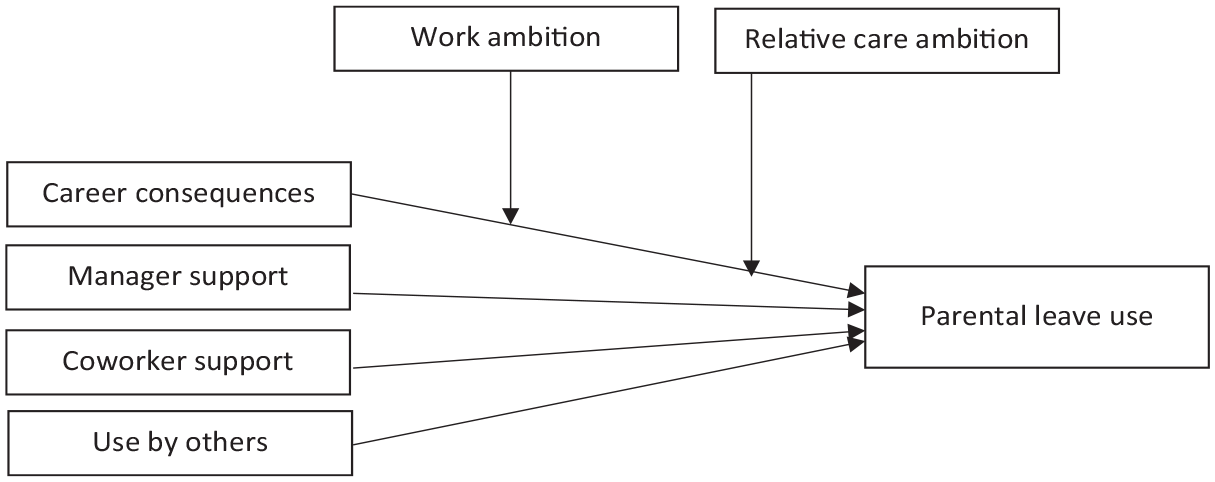
Conceptual model.
The Dutch Context: Parental Leave Arrangements
At the moment of research, in the summer of 2021, parents in the Netherlands could take a total of 26 working weeks of unpaid parental leave during the first 8 years of their child’s life (Dutch Government, 2020). Municipalities applied a more generous parental leave regime than the national statutory entitlement. According to the collective labor agreement for municipalities, civil servants were entitled to a maximum of 13 weeks of leave on partial pay in the form of a percentage of their salary. This percentage is set at a minimum of 50% but may be as high as 90% for those on the lowest salary scales (CAO Gemeenten, 2020).
As a result of agreements at the European level, since the summer of 2022, paid parental leave is now an entitlement for everybody in paid employment in the Netherlands (Ministry of Social Affairs and Employment, 2019). Parents receive part of their daily wage in the form of a benefit for a maximum of 9 weeks of parental leave. This period of paid leave must be taken during the child’s first year of life so that families have time to get used to the new situation and make conscious choices about the division of work and care. This change was one of a series of reforms to work-family policy in the Netherlands. Until recently, fathers (or same-sex partners) were only entitled to 2 days of paid leave in the Netherlands, but since the beginning of 2019, this expanded to 1 working week of leave paid for by their employer. Since July 2020, fathers have been able to supplement this with a further 5 weeks of birth leave during which they receive a governmental benefit. Important to note is that this study was performed in the summer of 2021 before extended paid parental leave was introduced. To investigate how the introduction of the new paid parental leave can be made to a success, four organizational factors are researched that are known to increase the use of parental leave.
Methods
To investigate which organizational factors can explain the use of parental leave among male municipal civil servants, this study used a factorial survey vignette experiment (Auspurg & Hinz, 2014). In vignette experiments, respondents are not asked to report on their behavior but are presented with hypothetical situations. The hypothetical nature of the vignettes can give us a glimpse into the future when the policy will be implemented. This is relevant in the case of this study, as it took place in the summer of 2021, while the introduction of statutory paid parental leave in the Netherlands was planned for the summer of 2022 (Ministry of Social Affairs and Employment, 2019). An advantage of the vignette experiment is that it is possible to weigh different organizational factors. People generally have difficulty indicating which factors are more important in a decision-making process. By not asking respondents about their motives, but having them imagine different scenarios, it is possible to assess which factors are most important in their decision-making process.
The Vignettes
Since there are four independent variables, each with two levels (career consequences, managerial support, coworker support, and role modeling), a 4*4 design was used, resulting in 16 vignettes. During the experiment, respondents were asked to imagine that they and their partner were expecting their first or next child and were faced with the choice of whether or not to take partially paid parental leave. They were asked to assume that they had the financial freedom to take that leave. This assumption was made because factors that are known to have a strong influence should be excluded from the experiment because they could outweigh the other concepts (Auspurg & Hinz, 2014). The respondents were then presented with information about their work environment: career consequences, managerial support, coworker support, and role modeling (the use of leave by other fathers in the department). See Figure 2 for an example of a vignette.
Career consequences are expressed in terms of the extent to which using parental leave could have negative consequences for the civil servants’ future employment career within the municipality (0 = no career consequences, 1 = career consequences).
Managerial support is expressed through whether the manager supports employees wanting to use parental leave (0 = your manager does not support taking parental leave, 1 = your manager supports taking parental leave).
Coworker support gives the respondent an insight into the potential reaction of colleagues (0 = most of your direct colleagues do not support using parental leave, 1 = most of your direct colleagues support using parental leave).
Use by others gives an indication of whether using parental leave is commonplace among fathers in the employee’s department (0 = in the past few years, a small proportion of the fathers in your department took parental leave, 1 = in the past few years, a large proportion of the fathers in your department took parental leave).
After each vignette, the respondent was asked the following question: “How many weeks of partly paid parental leave would you take in the above situation?” (0-9 weeks). To avoid overburdening the respondents, vignettes were randomly distributed among respondents, where each respondent was presented with four vignettes (Auspurg & Hinz, 2014).
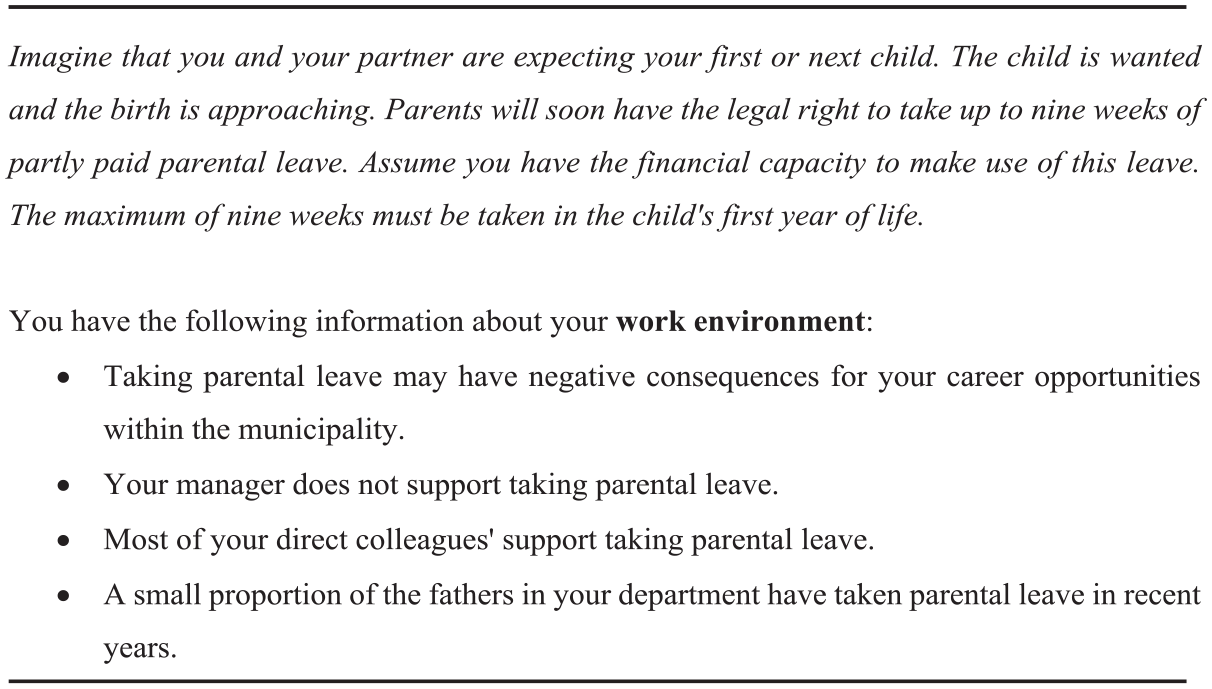
Example of a vignette.
Work Ambition and Relative Care Ambition
Work ambition was measured with the 9-item Career Ambition Scale using a 5-point Likert-type scale (1 = totally disagree, 5 = totally agree) (Dikkers et al., 2010). Examples of items include “I have the ambition to reach a higher position” and “A career is important for my self-actualization and self-development” (see Supplementary Material for all items). Based on the exploratory factor analysis, the item “In my work I like to be challenged” was removed because the factor loading was too low (<0.40). For the remaining eight items Cronbach’s α = .86. In the absence of a suitable scale for relative care ambition, a new scale was developed, inspired by McGill (2014) and Van den Brakel et al. (2020), consisting of 5 items on a 5-point Likert-type scale (1 = totally disagree, 5 = totally agree). Examples of items include “I prefer not to work full-time to have time for care tasks” and “Time for my family is more important than time for work” (see Supplementary Appendix II for full scale). An exploratory factor analysis led to the removal of the item “If care responsibilities affect my work, then my work has priority” due to a low extraction score (<0.20). Cronbach’s α = .66 for the four remaining items. At the individual level, having a partner and having children are controlled for, since the more the hypothetical situation overlapped with the respondent’s actual situation, the better he would be able to relate to the hypothetical situation. Age and working hours are also included.
Respondents
The vignette experiment was conducted among male civil servants in seven municipalities and one municipal umbrella organization in the Netherlands (Drechtsteden, Rotterdam, Utrecht, and Nijmegen), which are part of a larger research project about how men combine work and care. Although these municipalities differ in their organizational structure and existing work-family policy, there were no significant differences between these organizational units in the vignette experiment. The fact that respondents were not randomly selected does not necessarily cause problems in terms of reliability and generalizability. Internal validity was enhanced by randomly distributing the vignettes among the respondents and having them assessed by a large group of respondents (Auspurg & Hinz, 2014; van Breeschoten et al., 2018). Due to the experimental nature of vignette research, general statements about causality can therefore be made even using a non-random sample (Auspurg & Hinz, 2014).
Within the municipalities, all male employees were approached by e-mail to ask them to participate in an online research survey, the response rate was 43%. An age limit was applied in selecting the research sample to make the experiment as close to reality as possible. Research on the ideal age for parenthood shows that men in the Netherlands identify the upper limit for fatherhood, on average, as 47 years (Loozen & Kloosterman, 2019). Since the actual age at which parents have children is higher than this ideal picture, it was decided to include male municipal civil servants aged up to 55 years old. This brought the total number of respondents to 143, who were presented with 4 vignettes each, making the N for the vignettes 572. The civil servants in this survey had an average age of 43 and worked almost 36 hours a week (which is full-time as defined in the collective labor agreement for municipalities). The majority of respondents had a partner (84%) and two-thirds of the total sample had at least one child. There was hardly any variation between the municipalities with respect to these control variables.
Data Analysis
The data were analyzed using multilevel regression analysis since vignettes are nested into respondents. If the independent variables at the respondent level are included in the regression analysis without taking nesting into account, the results may be biased (Auspurg & Hinz, 2014). Since not the respondent but the vignette is the unit of analysis, the data file was converted from a wide format to a long format prior to analysis. The intraclass correlation (ICC) is 0.19, which means that the organizational factors in the vignette explained just under 20% of differences in the potential use of parental leave. The other 81% was explained by differences between individuals (Model 0, Table 1). The first model only included the vignettes (Model 1), then control variables were added (Model 2), and the non-significant control variables were removed step by step leading to a complete and sparse Model 3, with a significant improvement of the −2 log likelihood compared with Model 1, which only included the vignette variables. The hypotheses were tested using Model 3.
Multilevel Regression Analyses of Parental Leave Uptake in Weeks (N = 572).
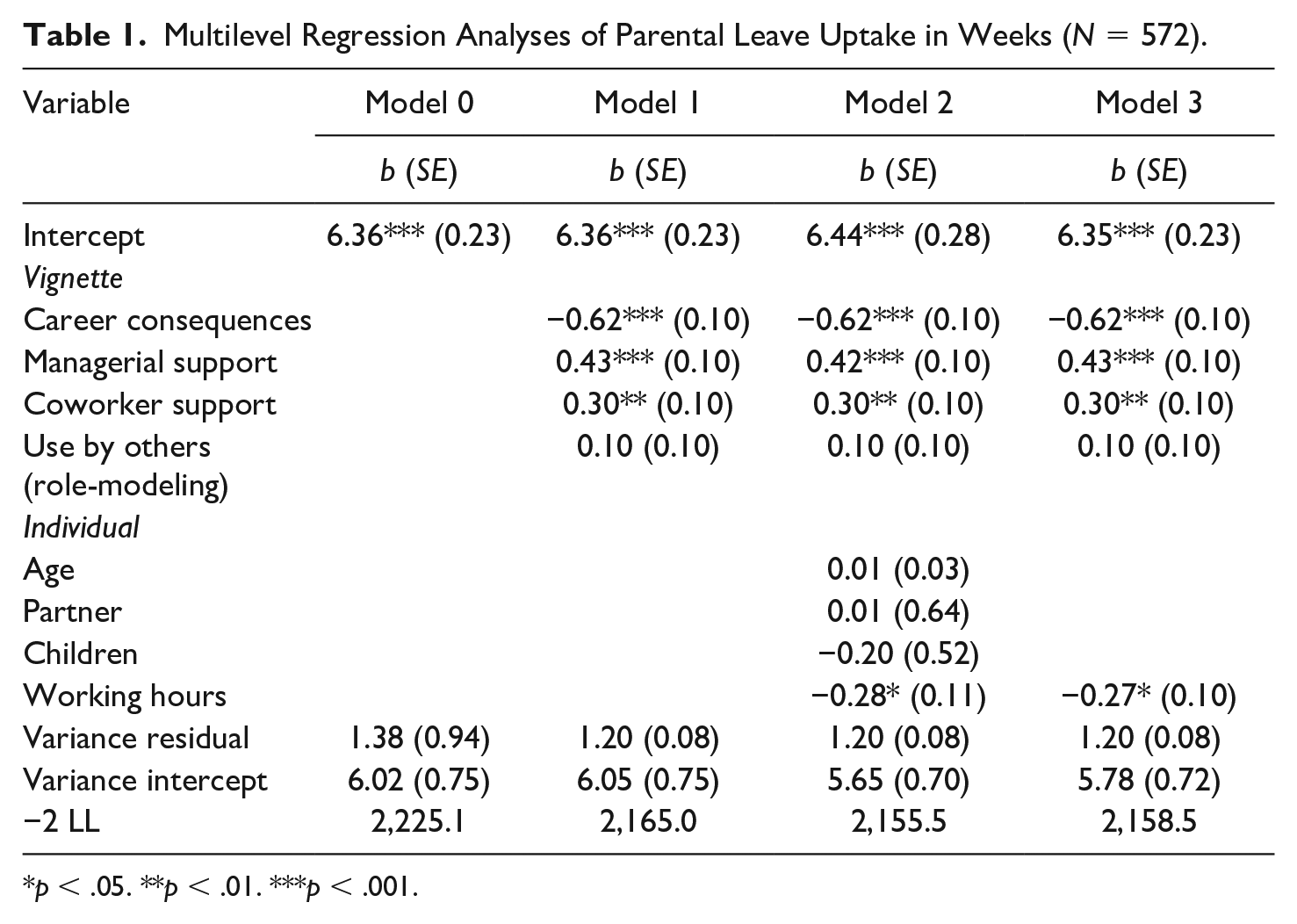
p < .05. **p < .01. ***p < .001.
Results
Although the dependent variable is the intended use of parental leave, the term use or taking of parental leave will be utilized to improve the readability of the results. Model 2 of Table 1 shows that from the control variables, only working hours were related to the use of parental leave. The more hours a male civil servant worked, the less weeks of parental leave he intended to take (b = −0.28, p < .05). This could indicate that full-time working civil servants have more problems with deviating from the “ideal worker norm” or have a higher desire to conform to this norm (Grau-Grau & André, 2024).
The first hypothesis stated that if men expect negative career consequences, they will be less inclined to take parental leave. This is indeed the case (b = −0.62, p < .001). The second hypothesis focused on managerial support. Male civil servants were more inclined to take parental leave when they expected support from their direct manager (b = 0.43, p < .001). The third hypothesis focused on coworker support. Civil servants were more likely to use parental leave when they perceived that they would have the support of coworkers (b = 0.30, p < .01). This confirms H1, H2, and H3. No support was found for role modeling by the use of parental leave by coworkers (H4) (b = 0.10, p = .295). This could be the case because the policy has not been enacted yet and it is thus harder for respondents to imagine how it would be when others used this policy compared with imagining having or not having support for their decision.
Due to the categorical nature of the vignette variables, the regression coefficients can be compared. Clearly, the influence of adverse career consequences was the largest (b = −0.62), followed by managerial support (b = 0.43) and coworker support (b = 0.30). In general terms, this means that the positive effect of support from the manager and coworkers can be almost completely offset by the expectation of adverse career consequences. If the most unfavorable climate is calculated for taking leave—that is, adverse career consequences and no managerial or coworker support—male civil servants would on average take 28.7 days of leave. In the most favorable leave climate—that is, no adverse career consequences and managerial and coworker support—this is significantly higher at 35.4 days, or almost one and a half working weeks longer.
To correctly interpret the hypothesized moderating effects of work ambition and relative care ambition on the relationship between career consequences and taking leave, these interactions were added to the analysis separately (see supplementary Material, Table A1). Based on the results, Hypothesis H5 was confirmed: the effect of career consequences on using leave was stronger among male civil servants with a higher work ambition (b = −0.40, p < .01). However, Hypothesis H6, which posited that a higher relative care ambition would weaken the relationship between career consequences and leave-taking, was rejected. Men with a higher relative care ambition (i.e., care ambition outweighs work ambition) did not take more leave than men with a lower relative care ambition if adverse career consequences were expected.
The interaction effect of work ambition with career consequences is visualized in Figure 3 for three levels of work ambition. For men with lower work ambition, there was hardly any difference in the leave taken when no adverse career consequences were expected (29.8 days) and when adverse career consequences were expected (30.5 days). This picture was different for civil servants with a higher work ambition: when they expected taking leave to negatively influence their future working career within the municipality, the leave they chose to use was shorter by more than 1 working week compared with when they expected no adverse career consequences (26.9 vs. 33.3 days).
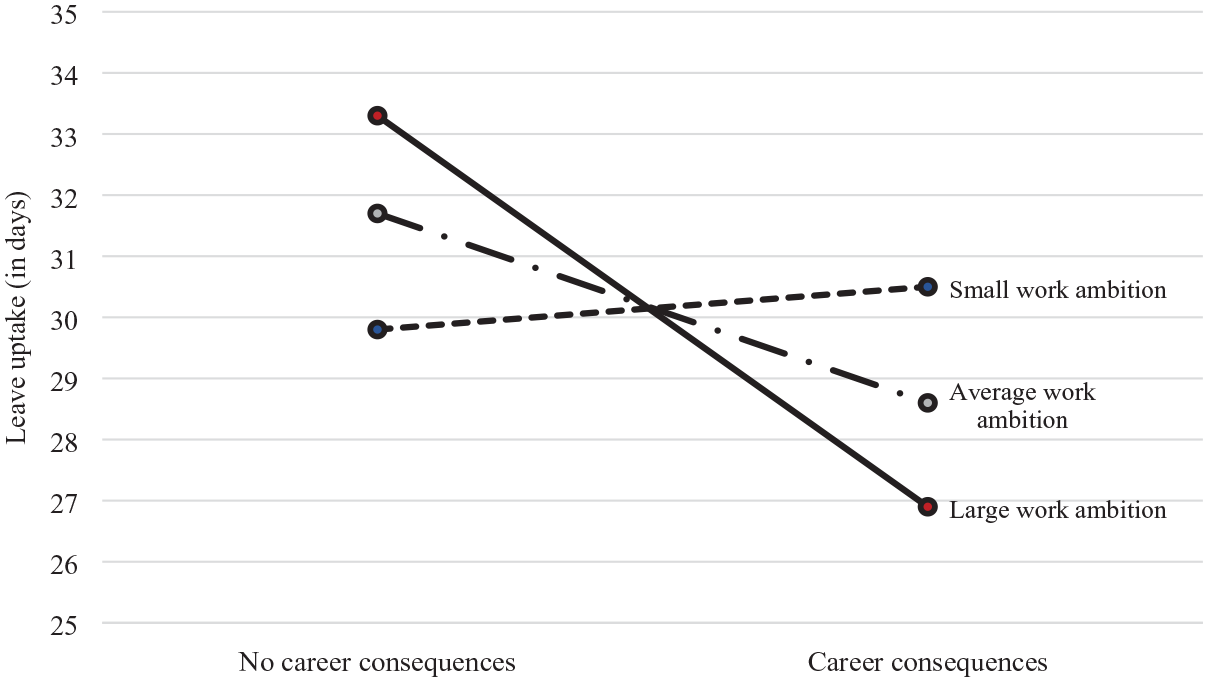
Interaction of career consequences and work ambition on leave uptake.
Discussion and Implications
This study has sought to provide more insight into how work-family policy in the local public sector can be implemented in a way that civil servants also feel the liberty to make use of the policy (Feeney & Stritch, 2019; Matos, 2015; Secret & Swanberg, 2008). To achieve this goal this study focused on men in local government and parental leave policy (Patnaik, 2019). From the idea of the gendered nature of organization (Acker, 1990) and Stivers’ (2000) work on the masculinity of local bureaucracy a framework to research organizational factors in the public sector that may affect the use of work-family policies such as parental leave was developed. Since men who want to work less hours, for example, through using parental leave, deviate more from the “ideal worker norm,” they are less likely to use these kinds of policies (Blair-Loy & Wharton, 2004; Grau-Grau & André, 2024), also within public organizations (Kim, 2001; McDonald et al., 2007). Therefore, this research focused on the contexts in which men feel more legitimized to use parental leave policy. The research preceded the introduction of the extension of parental leave policy in the Netherlands in 2022 and therefore deals with hypothetical situations. Interesting about the current test case is that municipalities in the Netherlands are quite gender-balanced and often have more progressive work-family policies in place compared with other sectors. Based on earlier research, four organizational factors have been tested with respect to men’s use of parental leave in a factorial vignette experiment: career consequences, managerial support, coworker support, and use by others.
The expectation of negative career consequences had the largest impact on men’s inclination to take parental leave, leading to an average reduction in the leave period taken of 3 working days. This reduction can be considered substantial, as it is longer than the total length of paid leave that Dutch men were entitled to by law prior to 2019. The effect of career consequences was stronger among civil servants with higher work ambition: the more important a work career is for a (future) father, the less parental leave they would choose to take. This is in line with the idea that deviating from the ideal worker norm might be “punished” by the municipality (Blair-Loy & Wharton, 2004; Grau-Grau & André, 2024; McDonald et al., 2007). For men with high work ambition, this difference amounted to 7 days. Relative care ambition was found to have no effect on the relationship between career consequences and taking leave. The fact that civil servants’ use of parental leave is explained partly by the employee’s assessment of the risk of negative career consequences fits with the picture that men are less likely to make use of the rights provided by work-family policies in the public sector due to a fear of stigmatization (McDonald et al., 2007).
In line with previous research (Abendroth & Den Dulk, 2011; Secret & Swanberg, 2016; van Breeschoten & Evertsson, 2019), perceived support from managers and coworkers is a relevant factor in men’s use of work-family policies. Whether other men in the department had already taken parental leave, and thus acted as role models, did not appear to have any influence, unlike career consequences and support from managers and coworkers. One possible explanation could be the fact that the respondents did not have an adequate frame of reference to consider leave taken by others in the hypothetical situations presented because it is rather unusual to take parental leave in the Netherlands (Van den Brakel et al., 2020).
If parental leave can contribute to a better work-life balance, it is relevant to work toward a climate in which men who want to make use of their entitlement to parental leave face fewer obstacles. This means that taking parental leave should not be associated with lower organizational involvement or commitment. It is advised to communicate proactively that the municipality understands that men and women need to combine care and work and that they will not be judged for doing this. In addition, the study shows that it is not only important that public sector managers actively support work-family initiatives, but that a positive attitude toward taking leave is needed across all layers of the organization to create an optimal organizational climate. Support among managers and coworkers for the use of parental leave could be increased not only by improving the family-friendliness of the organization but also by identifying potential issues that may arise as a result of an employee’s absence and proactively preventing these.
This paper has three important drawbacks. First, this is a vignette experiment about a policy that was not yet in place at the time when the experiment was carried out. This means that the paper is not looking at actual behavior (Collett & Childs, 2011), but at perceived future behavior which might not even be relevant for some of the respondents because they will not be in a situation in which they have a newborn baby at home. Second, the internal validity of the self-developed relative care ambition scale was on the low side with Cronbach’s α = .66. A measuring instrument for (relative) care ambition with stronger internal consistency would be required to make more conclusive statements. Third, although only four vignettes were administered to each respondent (which does not exceed the maximum of five recommended by Auspurg and Hinz (2014)), around a third of respondents consistently took the maximum number of weeks of parental leave for each of the four vignettes. This could mean that these respondents were determined to take the maximum possible leave, that organizational factors did not influence their choices, or that the respondent—despite the information provided about the differing organizational environment in each situation—did not take into account the differences between the vignettes.
Conclusion
This study underlines the importance of organizational context for men’s decisions in using work-family policy in local government agencies. The premise underlying this study was that if implementing work-family policy does not work in local government, the policy will have trouble achieving its goals at the national level since local government in the Netherlands is quite gender-balanced and usually seen as progressive regarding work-family policy. Where Bishu and Headley (2020) found that equal opportunities did not lead to gender-equal outcomes, where women were in the negative, which was also found by Yu (2022), the Dutch case is different since most women work part-time while men work full-time and therefore deviate more from the ideal worker norm when using work-family policy. The Dutch government wants to improve support for young families to combine work and care. Reforms to arrangements such as parental leave are part of several policy measures that are introduced to achieve these goals. By using a vignette experiment to preview partly paid parental leave, this research has provided more insight into how the organizational environment is viewed by public employees making decisions regarding parental leave. This is useful in light of the central government’s objective of making parental leave more attractive so that parents have time to think about the division of work and care responsibilities. However, since this research only included hypothetical situations, additional research is needed to fully understand the complexities and implications of parental leave utilization in public sector workplaces.
Supplemental Material
sj-docx-1-ppm-10.1177_00910260241248637 – Supplemental material for Work-Family Policy for Fathers in Dutch Municipalities: A Vignette Experiment on Contexts for Parental Leave Among Male Civil Servants
Supplemental material, sj-docx-1-ppm-10.1177_00910260241248637 for Work-Family Policy for Fathers in Dutch Municipalities: A Vignette Experiment on Contexts for Parental Leave Among Male Civil Servants by Stéfanie André and Thom Teulings in Public Personnel Management
Footnotes
Declaration of Conflicting Interests
The author(s) declared no potential conflicts of interest with respect to the research, authorship, and/or publication of this article.
Funding
The author(s) disclosed receipt of the following financial support for the research, authorship, and/or publication of this article: This publication is part of the project Fathers Combining Work and Care with project number VI.Veni.211S.046 of the NWO talent program VENI 2021 which is financed by the Dutch Research Council (NWO).

Supplemental Material
Supplemental material for this article is available online.
Author Biographies
References
Supplementary Material
Please find the following supplemental material available below.
For Open Access articles published under a Creative Commons License, all supplemental material carries the same license as the article it is associated with.
For non-Open Access articles published, all supplemental material carries a non-exclusive license, and permission requests for re-use of supplemental material or any part of supplemental material shall be sent directly to the copyright owner as specified in the copyright notice associated with the article.
