




Abstract
Employee performance management (PM) can benefit employees, organizations, and wider stakeholders, but it is often done poorly, and public administrations pose contextual constraints to doing it well. It has inherent tensions between the goal of accountability and development, is complex, and requires alignment across both a formal administrative level and an informal psychosocial level. In public administration, three contextual factors add complexity and difficulty—competing goals, red tape and public service motivation. This study examines how line managers—a neglected group in PM studies—“do” performance management in practice. Data were collected via interviews with public sector managers in the “new public management” influenced New Zealand public sector. Competing goals and red tape make PM difficult, offer little accountability, and inhibit employee development, which often must run parallel to formal practices. They also limit managerial skill development. Failings in one practice, such as setting employee goals, impact subsequent formal and informal practices. Public service motivation provides workarounds. To work well, modern performance management could be reconstrued less as a compliance activity and more as a psychosocial process reinforced by a formal, prescribed organization system. Practical insights into barriers and opportunities, to improve performance management, are identified.
Introduction
Emerging poly-crises and variable, uncertain, complex, and ambiguous (VUCA) environments require new capabilities in public administration (van der Wal, 2020). However traditional administrative systems, including new public management, often assume stable machine-like processes and are focused on compliance and accountability rather than development (Rainey, 2009). Public sector studies of employee performance management (PM), a component of these wider systems, find it can be effective when done well, but is instead often seen as a time-wasting administrative ritual (West & Blackman, 2015). This gap between the aspiration of modern PM and its reality is possibly because it faces inherent tensions between the informal behaviors it entails for developing staff, which require trust; and formal administrative processes for appraisal, judgment, and rewards for accountability (Macky & Johnson, 2003). The burden of managing these tensions fall on line managers, and in public administration (PA), these tensions are accentuated: public values of transparency and accountability create red tape and administrative burdens, while employees are motivated to serve the public—often across multiple, sometimes competing, objectives (Feeney & Rainey, 2009; Shim & Park, 2019). This study looks at how line managers conduct PM, both formal and informal, within difficult public sector contexts that include competing goals, red tape; and also high public service motivation (PSM).
Performance management now spans a much broader set of practices than the traditional and simple appraising and rewarding of employees. These traditional activities always sought objectivity and rationality, but were in practice prone to a wide range of biases (Shields et al., 2015). The broader span of practices that PM now entails includes an informal social-psychological system that includes regular and informal goal adjustment, feedback and coaching. These informal activities are less attended to in the literature but are critical to the perceived fairness and effectiveness of the formal system (Audenaert et al., 2019; Bauwens et al., 2019).
These two systems, formal administrative and informal psychological, need to be consistent and aligned to work well: informal systems need to be supported with formal administrative processes to be legitimate and carry consequences; and formal systems risk harming exchange relationships if introduced without consideration of psychological welfare (Harrington & Lee, 2015). While flaws in appraisal practices are well known, broader studies of how PM acts as a system are rare (Shields et al., 2015).
Line managers are increasingly responsible for implementing human resource management (HRM) practices. They represent the organization to employees. They are also responsible for managing both the inherent tensions within PA, and PM. Studies find that PM is challenging in PA contexts and sometimes has poor outcomes. They point to poor alignment and integration with organizational, job, and employee needs, inconsistent implementation across the various activities that PM entails, low credibility, and sometimes harm, perhaps because of poor implementation (Anh Vu et al., 2022; Decramer et al., 2021; Franco-Santos & Otley, 2018; Hope, 2002; Plimmer, Proctor-Thomson, et al., 2017; Taylor, 2014). Known line manager challenges include getting recognition for this difficult role, establishing realistic performance expectations in the face of competing goals, providing adequate feedback in demanding environments, and ensuring administrative compliance (Australian Public Service Commission, 2014). The experiences of line managers, however, are understudied and calls for more research on their experiences are quite recent (Leroy et al., 2018; Tseng & Levy, 2019).
How both formal and informal performance management systems intertwine and reinforce, or undermine, each other for both accountability and development is the purpose of this article. The overall research aim is pragmatic: to identify how both formal and informal systems of performance management can work well in public administration environments. More specifically, it explores how PM practices operate through competing goals, red tape, and PSM to shape the broader PM system.
This study makes four contributions to the literature. First, it examines how both formal and informal performance management operate in the public sector context. Second, it examines the interplay between these formal and informal strategies and practices that public sector managers use. Third, it focuses on the often-forgotten role of line managers in the PM process, who implement the system, but often have limited influence over it and have obligations to both subordinates and bosses. Fourth, it identifies effective responses to challenges and opportunities for improvement. While there are many useful but narrow (often quantitative) studies of specific PM practices, this qualitative study addresses broader “how” and “why” questions of the complex development and accountability system known as PM. This qualitative study sought rich, descriptive data through 22 semi-structured interviews, triangulated with documents, with New Zealand public sector managers.
Literature Review
Public sector organizations provide a unique context for PM, likely to shape both how and whether it is effective (Sole, 2009). While public organizations may employ HRM practices that are analogous to private sector organizations, they have tighter legal and administrative requirements, broader public expectations than profit, harder to measure impact, less autonomy, and stemming from these, often risk averse, bureaucratic, and hierarchical traditions in jobs that often depend on co-production and relational ways of working (Boye et al., 2022; Piatak et al., 2020). These all shape how systems work. PM traditionally drew heavily from classical approaches to management that assumed “stable, clearly defined structures and processes,” with managers adopting machine processes (Rainey, 2009, p. 29). Emerging poly-crises and variable, uncertain, complex and ambiguous (VUCA) environments challenge the fitness of these assumptions. More contemporary approaches recognize the need for more human and relational factors, as well as formalized processes, recognition of the political context and administrative features of public organizations as well as the need to develop new capabilities such as resilience and adaptability (Piatak et al., 2020; Plimmer et al., 2023).
Public organizations often-competing goals and priorities potentially undermine the clear and specific goal-setting of modern PM (Vu et al., 2019). Their propensity for red tape and emphasis on formal administrative processes over interpersonal processes risk undermining the informal psychosocial processes now recognized as critical to effective PM (West & Blackman, 2015; Vu et al., 2019). Public sector employees have high PSM, meaning that motivational techniques differ from those in some private sector jobs (Perry, 2020). PA organizations, prone to both red tape and employees needing intrinsic rewards, experience the tensions inherent in PM acutely.
Traditionally, employee performance management was an appraisal process for administrative purposes of benefits and discipline (Blackman et al., 2015; Vu et al., 2019) and often something of an empty ritual (Cederblom & Pemerl, 2002). Since this narrow administrative focus gave way to the broader and richer set of practices known as employee performance management (Vu et al., 2019), formal appraisal is still important. It supports administration of employees including reward, recognition and legal processes, can support procedural and distributive justice, and is associated with less workplace bullying (Aguinis, 2009; Plimmer, Proctor-Thomson, et al., 2017). But it is now one part of a suite of practices that comprise goal setting, feedback, development or training, performance evaluation, rewarding good performance, and handling poor performance (Smither, 2012; Vu et al., 2019). It “includes setting expectations, measuring employee behaviors and results, providing coaching and feedback, and evaluating performance over time to use in decision-making. The purpose is to align individual efforts to achieve organizational goals” (Dorsey & Mueller-Hanson, 2017, p. 7).
While performance management systems aim to develop staff, its subsystems of setting goals, supporting improvement, appraising and managing consequences are also managerial control mechanisms for accountability (Franco-Santos & Otley, 2018). These activities comprise subsystems, each supporting in some way the other subsystems. Goal setting provides a framework that defines success and can include performance, learning, and behavioral goals, which then provide frameworks for the later subsystems of feedback, development, feedback and consequences (Balcazar et al., 1985; Franco-Santos & Otley, 2018). These other subsystems are in theory mutually reinforcing. Feedback and development help achieve goals and provide the procedural justice needed for accepted pay decisions. Appraisal supports reward decisions and the setting of new goals (Aguinis, 2009).
Dualities, Tensions, and Paradoxes in Performance Management
In practice, however, supportive relationships between these subsystems are not always achieved, and cause unintended consequences (Franco-Santos & Otley, 2018): the wrong goals are set, so the wrong behaviors are rewarded; staff are not given development opportunities to improve and so feel injustice in the face of perceived unfair pay (Daley, 2008). Setting low ball goals or gaming their measurement are perhaps the best-known attempts to avoid poor appraisal and consequences. Managers can also get an illusion of control, and confuse measures with actual performance. Deciding and achieving measures can waste time and conflict with professional standards. Much of the research on “unintended dysfunctional consequences has taken place in public-sector organizations” and found that performance management can cause “perverse (rather than necessary evils), not just for the users of the system, but also for other stakeholders (e.g., public, patients, students, society in general)” (Franco-Santos & Otley, 2018, p. 719).
While the formal logic of performance management is administratively coherent, in practice it only operates well with a parallel informal system, where procedural and interactional justice perceptions are maintained before formal systems are invoked. Goals may need informal adjustment during the working week (Latham, 2004), feedback should be provided in a friendly manner without the need for documentation, good performance should be recognized without the need for bureaucratic procedures, and the experiential learning that characterizes much development is by definition informal (Johnson et al., 2018). These informal aspects of performance management rely on unwritten, implicit, and emergent processes (Schleicher et al., 2018; Vu et al., 2019). They mean that managers must navigate ambiguity, provide informal support, and embrace innovation (Gunn et al., 2021).
Distinctions between formal and informal systems are well-featured in organization studies (Mintzberg, 1979). Formal systems rely on bureaucratic rules that allocate tasks in standardized processes. In stable settings, they can work well. They clarify accountabilities and responsibilities, monitor behavior and outputs, and reduce uncertainty (Garvin, 2012). In contrast, informal systems rely on values, beliefs, and traditions that provide tacit guidelines of trust and support (Falkenberg & Herremans, 1995). In ambiguous situations, they are particularly important. Public organizations are in the paradoxical situation of being both stable, rule-bound organizations, begetting formality; yet also operating in ambiguous and uncertain environments that require strong informal practices (Bozeman & Feeney, 2014). In PA, this duality potentially accentuates tensions between formal and informal performance management systems.
In sum, while the rhetoric of formal performance management is logical and coherent, it leans heavily on informal psychosocial processes. This duality, of formal and informal systems, is complex and means that what looks good in theory may not work well in practice: managers, often hard-pressed and torn between organizational and employee demands have been found to favor what is measurable over what is important in setting goals, to avoid giving feedback and adequate development, to show biases in appraisals, and to be unable to give meaningful rewards.
This study identifies how the five subsystems that comprise PM, each including both formal and informal systems, work logically and coherently in practice rather than theory. While weaknesses in each specific practice have been identified (see Table 1), the relationships between practices at a system level remain underexplored. Table 1 shows a summary of the literature, formal administrative process and logic compared with informal practice and problems.
Formal Administrative Process and Logic Compared With Informal Practice and Problems.
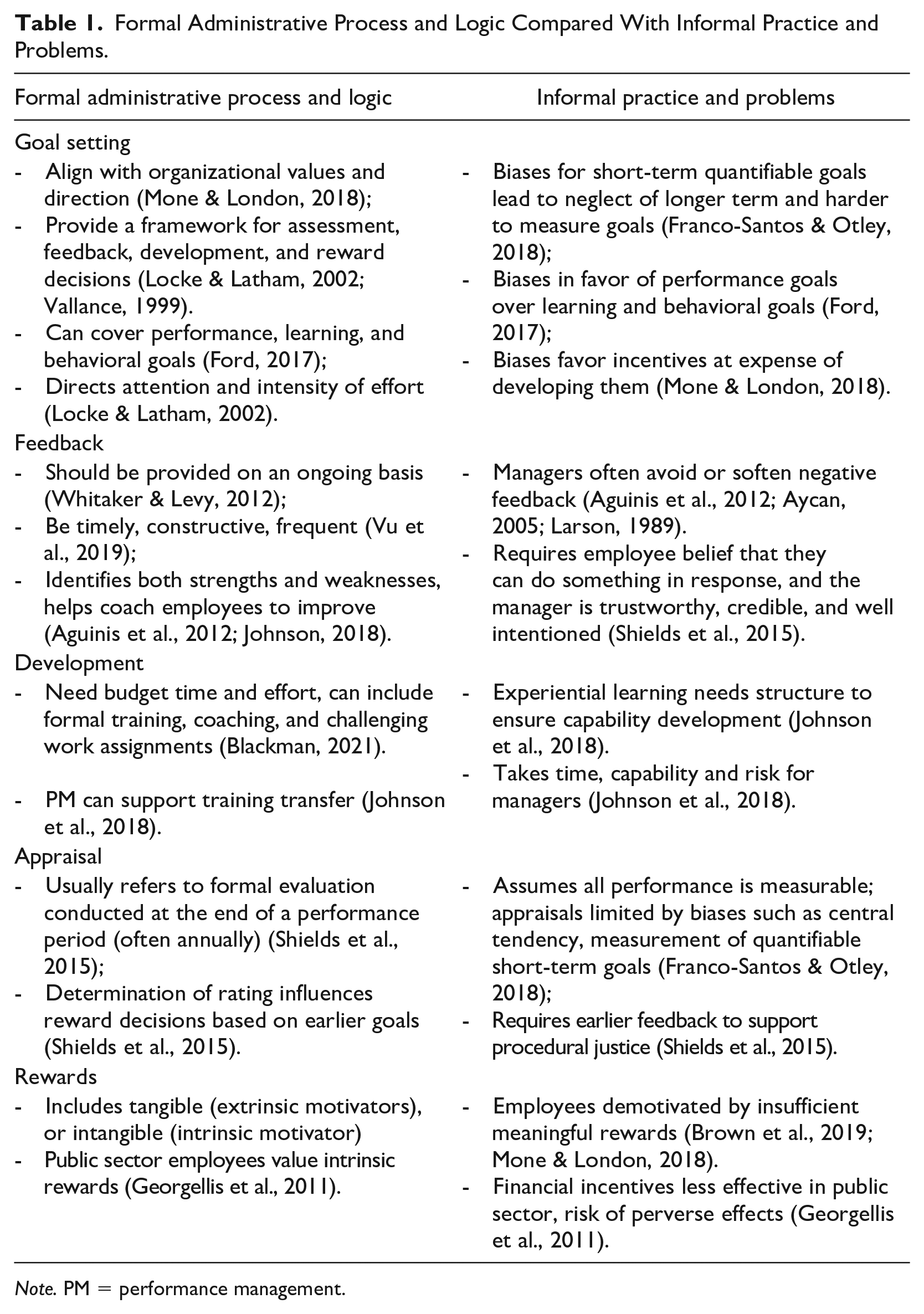
Note. PM = performance management.
A Challenging PA Context: Competing Goals, Red Tape, and PSM
Despite the above problems, public sectors have been enthusiastic adopters of performance management (Grote, 2000). Its formal accountability logic aligns with New Public Management (NPM) reforms, which focus on goals, accountability and private sector management practices (Plimmer, Bryson, et al., 2017; Taylor, 2014). In practice, however, performance management has mixed results in PA (Blackman et al., 2022), that reflect poor implementation, rigidity, and a failure to adapt. The distinct features of public sector work perhaps make performance management inherently difficult. Goals are assumed to be stable and measurable (Plimmer et al., 2019). Giving feedback requires skill, development requires time, and sophisticated HRM (Buick et al., 2018; Johnson et al., 2018), all of which are sometimes lacking. Appraisals are hard to do objectively (Gillespie et al., 2018). Rewards are often limited and lack sufficient motivating power. Three distinct features of PA—competing goals, red tape, and PSM—may accentuate these problems. A better understanding of their roles may point to solutions.
Public sector workers and organizations often face competing pressures, and goals, from internal and external stakeholders, as well as public calls for both accountability and transparency (Berman et al., 2021). Citizens, service recipients, other agencies, and ministers can have different perspectives on what goals matter and what success looks like (Song & Meier, 2018), which can filter down to ambiguous and contested job goals. For managers, this in turn potentially complicates feedback and rewards, increases cognitive load, and distracts attention from PM. Such ambiguous and politicized environments may inhibit the trust and candor needed for PM to be effective (Gunn et al., 2021). For employees, poor goal clarity risks undermining direction, level, and persistence of effort (Latham, 2004). Competing goals potentially undermine goal setting and harm the effectiveness and credibility of subsequent PM practices.
Red tape commonly describes unnecessary procedures (Bozeman & Feeney, 2014), and it can undermine performance management effectiveness, through tangled rules and regulations, and capricious and lethargic bureaucratic behavior (Bozeman & Feeney, 2014). In some ways, red tape is in the eye of the beholder: one person’s pointless rule can be another’s essential safeguard. Unnecessary procedures, however, can inhibit managers’ ability to appropriately support employees and to reward good performers (Blom et al., 2021; Bozeman & Feeney, 2014). It can also create the belief that performance appraisals take time and effort, increase conflict and stress (Christensen & Lægreid, 2010) decrease engagement (Borst, 2018), and collide with officials’ desire to serve the public (Steijn & Van der Voet, 2019). Red tape potentially adds compliance costs and complexity to an already difficult process.
The elevated PSM of public servants has implications for PM, as well as HRM generally (Klatt & Fairholm, 2023). Public service motivation (PSM) concerns an “individual’s predisposition to respond to motives grounded primarily or uniquely in public institutions and organizations” (Perry & Wise, 1990, p. 368). While concerned with impacts on society, it overlaps with altruism and concern for others (Homberg & Vogel, 2016). It is associated with higher commitment, job satisfaction, motivation, performance, and whistle blowing. While trait-like, it is also shaped by HRM practices such as participation, individual appraisal, and professional development (Giauque et al., 2015). These in turn lead to broad positive outcomes such as affective commitment, quit intentions, and job satisfaction (Georgellis et al., 2011; Gould-Williams & Mohammed, 2021). PSM is now recognized as a group as well as an individual phenomenon (Breaugh et al., 2022).
PSM likely influences performance management effectiveness in several ways (Anderfuhren-Biget et al., 2010). It enhances the valence and power of goals, but only when they are congruent with PSM (Jensen et al., 2019). High PSM public servants are less motivated by pay-for-performance, often preferring recognition, the chance to serve the community instead, job security (Homberg and Vogel, 2016; Johansen, 2020), or other forms of recognition such as diversified work tasks, autonomy, flexible work hours, and influence in important decisions (Schott & Pronk, 2014). These all point to the triangulating role of managers in facilitating congruence between goals, PSM and recognition. PSM potentially encourages recognition in a variety of ways and protects staff against poor formal PM systems.
Summary
While the formal logic of performance management is well understood, how its formal and informal subsystems work and interact are less well understood, especially in PA environments shaped by competing goals, red tape, and PSM. The dualities, tensions and paradoxes in PM would be exacerbated by the PA context, causing system-level impacts—relationships between subsystems—that extended beyond difficulties experienced in each subsystem. Contextual problems and subsystem problems potentially aggregate to system-level impacts in PA.
Methodology
This qualitative, interview-based research draws on the experience of managers in public sector organizations (Thorne et al., 2004). Performance management systems lend themselves well to such an approach: they are complex with multiple inter-relationships, and implemented in highly socially contingent and bias prone ways, while striving to be objective rational systems. This study sought rich, descriptive data regarding how line manager participants’ enacted PM.
Data Collection
Participants were New Zealand public sector managers. New Zealand is well suited for public administration research, as in some ways it often pioneers reforms later adopted elsewhere (Berman & Karacaoglu, 2020). It was an enthusiastic adopter of new public management and has recently adopted widespread post NPM reforms aimed at addressing subsequent declines in collaboration and spirit of service, open government, and stewardship of organizations (Scott et al., 2020).
Participants had to meet two criteria: employment in a New Zealand public sector organization, and be a manager of knowledge workers—where the tensions and ambiguities of public sector work are salient. Managers of knowledge workers specifically were selected as they sharply experience the competing demands of multiple, complex, high stakes tasks, and commonly have high PSM (Drucker, 1999; Plimmer et al., 2023). Many frontline bureaucrats experience these challenges too, but sampling was narrowed to knowledge workers to balance both transferability and replicability. Participants initially were sought after through professional networks such as LinkedIn. Snowball sampling was then conducted to identify more participants. To ensure rich data from a diverse sample (n = 22) representatives from multiple public sector organizations participated (see Table 2).
Participant Information.
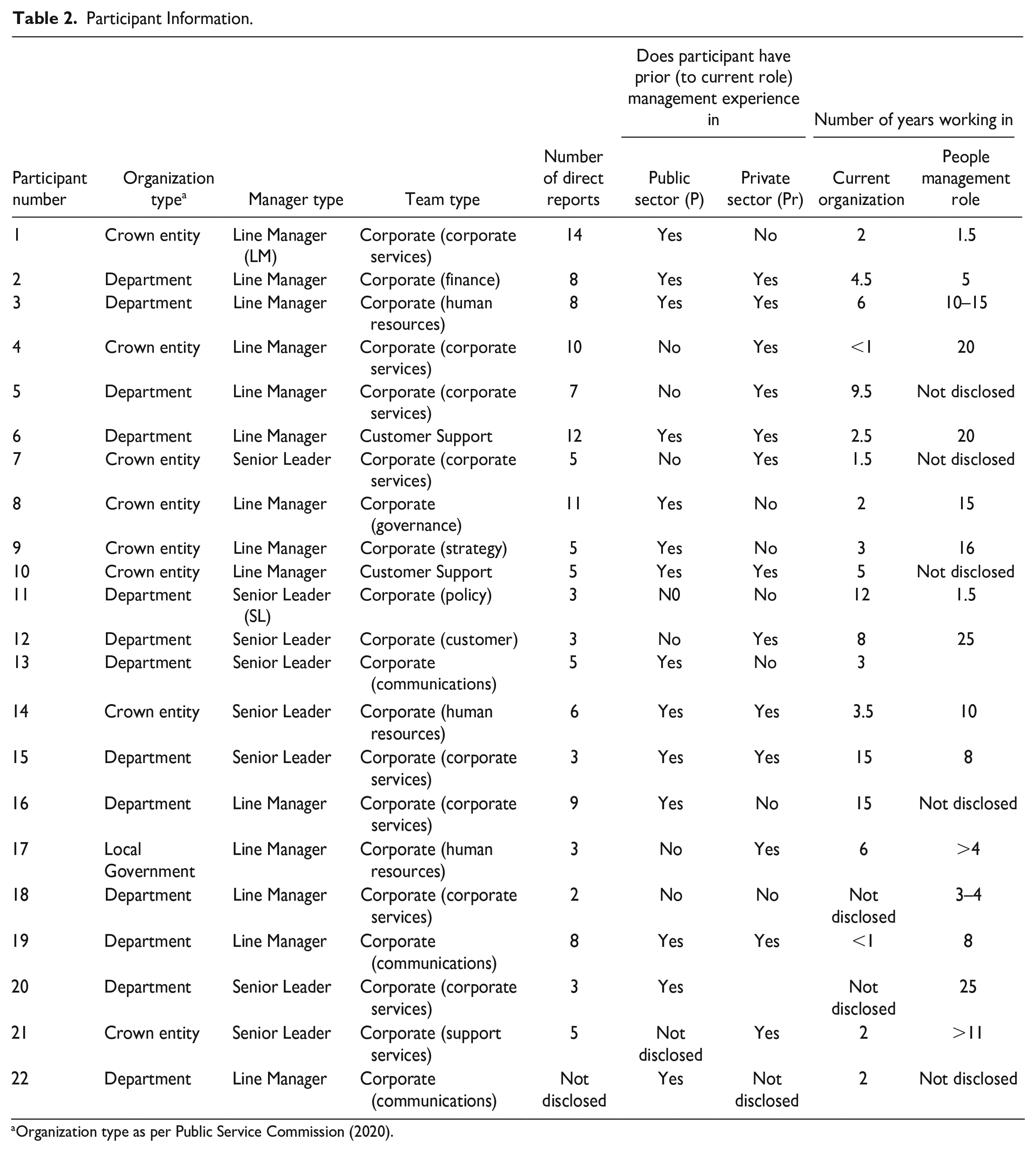
Organization type as per Public Service Commission (2020).
Participants were given the option of in-person or Zoom interviews: ultimately, 11 were via Zoom and 11 face-to-face. The participant recruitment and data collection were drawn out. Workloads for managers made securing interviews difficult. Coding checks did not find any discernible difference in data collected by either face to face or zoom. Interviews were conducted over 5 months and ranged between 40 and 75 min in length. Table 2 shows the participant details.
Data were collected in three phases, with reflection and reflexivity on method and provisional findings taken at each stage, allowing for participant experiences to inform later research stages (Morgan & Nica, 2020). These diverse collection and analytical strategies allowed for deep and rich understandings of manager strategies and how they worked, and to build a nuanced understanding of context and strategies.
Semi-structured interviews ensured both consistent lines of enquiry and flexibility to adapt to respondents. They allowed for a conversational and collaborative style of data collection. Interviews were allowed to go in natural directions, led by the participant (interviewee) but controlled by the researcher (interviewer). It allowed them to emphasize what is important to them and provided the freedom to respond and interpret questions in their own manner (Allen, 2017).
Interviews first clarified participants’ organization, team, and job and manager experience. It sought perceptions of team performance as this potentially influenced approaches. Interviews then sought information on general beliefs and approach to performance management, followed by questions about experiences with specific PM practices and perceived subordinate views. After the initial five interviews, the interviews also addressed the role of competing goals, PSM, and red tape. This is because in early interviews these issues consistently emerged as important contextual themes. Organizational documentation such as performance management templates and guides were used for triangulation. Data gathering and analysis took place over 4 months. Peer review tested biases and assumptions when interpreting the data and arriving at conclusions.
Multiple strategies were used to address the risk of social desirability and self-serving blind spots (Bergen & Labonté, 2020). Strategies included conducting interviews in private settings, building rapport through self-disclosure and humor, providing study aims and details, and clearly stating to participants that their honest and objective reflection was most important. Cues for detecting social desirability were also sought, including vague or partial answers, the use of jargon, and facial expression and body language. Other techniques included the use of indirect questions, proving assurances, requesting examples, and prefacing questions with sympathetic understanding of the context. Participants appeared candid, even in the face of probing and challenging questions that sought disconfirming information.
Care was taken to avoid analytical bias (Malterud, 2001). Assumptions and interpretation were regularly reviewed by researchers and peer reviewers (Guba & Lincoln, 2005). The biases, perspectives, and self-interest of participants were scrutinized; diverse experiences and perspectives were sought. Thick, descriptive data were obtained, which allowed comparison of the context with other possible contexts in which transfer might be contemplated (Guba & Lincoln, 2005).
Template analysis was used as it balances structure with flexibility in analysis. First, prior to interviews, codes were defined in light of the stated aims of the research project and examination of other relevant research. Second, following the first five interviews, a step back was taken to understand if the initial template was “good enough” and whether any modifications were required. The template continued to be refined until interview 12, after which saturation was reached. A further 10 interviews were conducted to ensure dependability, confirmability and transferability. Statements were initially coded into pre-determined themes: contextual themes and PM practices. Emergent codes were then added. This process enabled interpreting data by specific practice (e.g., goal setting), then by second tier theme (formal/informal) and then emergent codes (e.g., competing goals). Data and analytic procedures were maintained meticulously, such as verbatim transcription and recording coding rules and protocols (Guba & Lincoln, 2005). Table 3 shows the coding categories.
Coding Template.
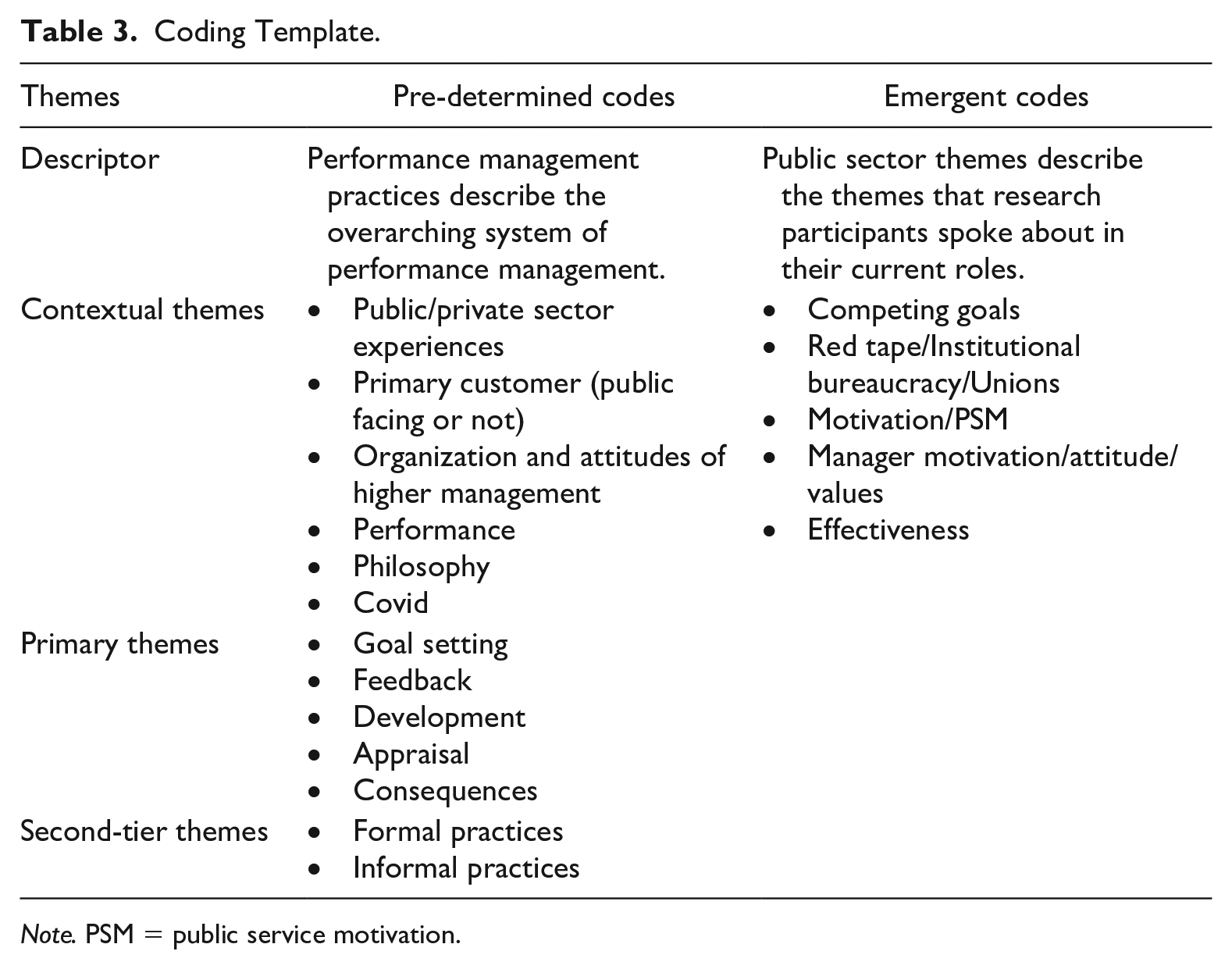
Note. PSM = public service motivation.
Causation coding was then used to identify causal processes and experiences of individuals in context (Miles et al., 2014). This allowed for causal attributions or beliefs to be mapped out, at both individual and at an aggregated/generalized level. It provides a three-part process of antecedent conditions, processes, and perceived outcomes. In this study, antecedent conditions comprised formal and informal PM practices. Processes comprised attribution codes which examined how an antecedent condition led to outcomes and systemic level effects. This was done by searching for causal verbs such as “undermine,” “because,” and “consequently.” These were subsequently coded to system impacts, or outcomes (Saldaña, 2021) (Table 4).
Causal Coding of Relationships Between Public Administration Factors and PM.
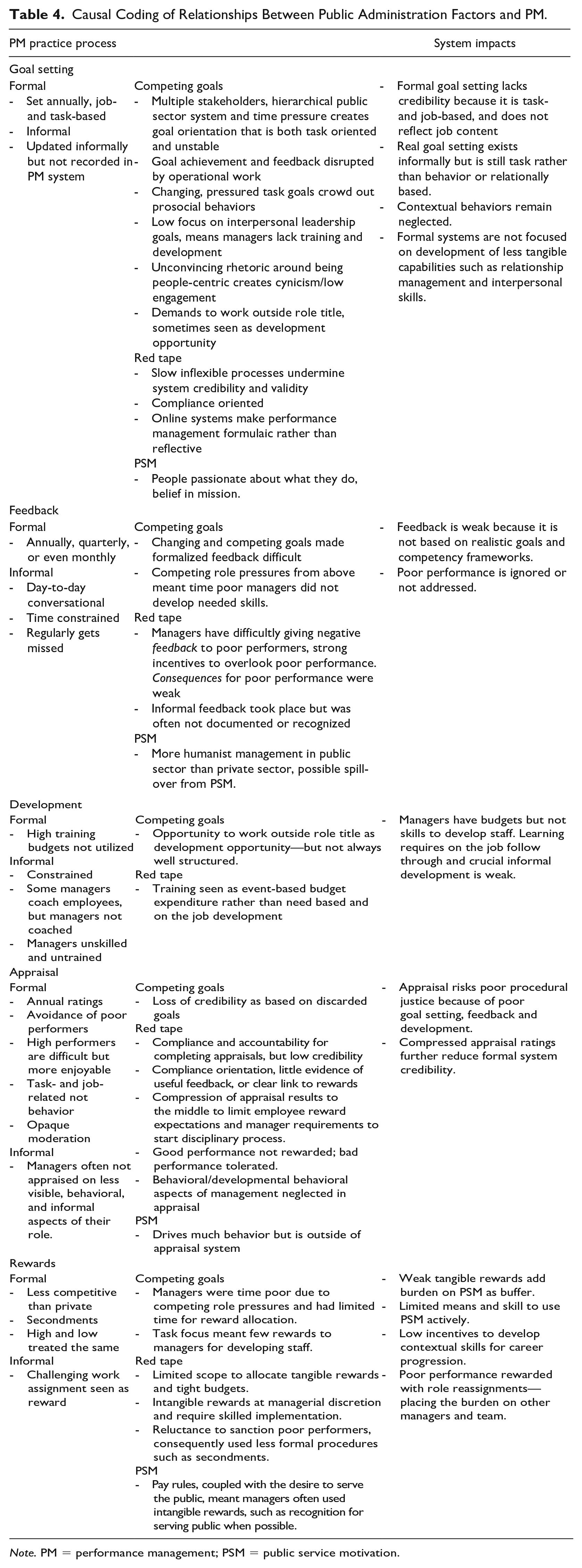
Note. PM = performance management; PSM = public service motivation.
Findings
Findings are depicted in three steps. Contextual factors are outlined first, as they shaped responses to the study’s broader research questions. Findings on PM in the public sector environment are then summarized. A summary of causal coding then depicts the systemic processes of how formal and informal PM practices operate through competing goals, red tape, and PSM to shape the broader PM system.
Context
Management in the Public Sector
Organizations prescribed formal performance management systems that included aspects of goal setting, appraisal, feedback, development, and consequences. Although organizations had policies for each of the formal components of PM, they were not articulated strongly, coherently or with conviction in either documentation or interviews. Informal practices, such as coaching, were apparent, although they were reportedly difficult to do: they were not valued, developed recognized or measured by organizations. It was time intensive and competed with other priorities.
The Impact of Private Sector Experience
Participants had diverse career backgrounds. Thirteen had previous private sector experience. Two worldviews emerged in the analysis, shaped by whether they had private sector experience (n = 13) or not (n = 9).
Those with a private sector background shared similar views to “public sector lifers” but stated them more strongly, such as in comments that red tape and rigid processes impeded addressing poor performance. They demonstrated public sector motivation, but were more calculating, with money or the “crown’s purse” (Isabella, SL, Pr). For instance, they considered it an important factor in running a good team, or competing for good staff in the market. They commented on slow public sector processes: “when you’re impatient like me it drives me bananas, but it gives you a chance to get things done and have the conversations and think about things” (Ella, LM, Pr). In contrast, public sector lifers, a phrase used by participants both with and without private sector experience to describe what were entirely an in the public sector career, expressed much less emotionally strong and extensively articulated views about red tape, budget, wastage, and tolerance of poor performance.
Public Sector Environment
Competing Goals
A clear tension emerged between the changing nature of work tasks and the rigidity of performance management systems, which assume stable tasks and goals and annual goal setting. At the beginning of performance appraisal rounds conversations about goals quickly became obsolete, as political demands had changed goals. Participants spoke of the need for team members to undertake various tasks due to the fluid nature of priorities. “. . .the bureaucracy of working with government and the task focus overtakes things, often (Phoebe, SL, Pr)” and “. . . getting pressure from above, and in a public service context this is usually a minister (Chloe, LM, Pr).” Organizations responded rhetorically to conflicts between annually set goals and constantly changing day-to-day deliverables by “creating a narrative about flexibility, adaptability and resilience in their teams (James, LM).”
There was a common rhetoric throughout the interviews about the ability of team members to work outside their role title and do various tasks due to the fluidity of priorities: “. . . there is a tendency to treat everyone like Swiss army knives, where everyone can turn their hand to various tasks” (James, LM). Participants spoke of this as both a challenge but also as an opportunity for team members to develop and “work to your ability, not your role title” (Lauren, LM).
Public sector organizations were reported as being very task focused but also expressed strong rhetoric around “people first,” “people before process,” “bringing your whole self to work,” and well-being. These dual management values disengaged managers, with “mixed signals about what the organization wants of people leaders” (Philippa, LM, Pr). Many participants felt statements about valuing people and wellbeing was disingenuous, and when it came down to it, “. . . they [the organization] say it all the time, but it is very process” [driven] (Sophia, LM).
Red Tape/Institutional Bureaucracy
Formal performance management systems were often referred to as efficient but also bureaucratic, low value and ineffective. “We have a formal performance agreement that’s a written templated document, and there’s a horrible online system, and you click a button and it populates” (Simone, SL, Pr). Online systems were seen to make performance management more formulaic which meant relationships between performance management subsystems, such as between goal setting, development, appraisal, and rewards were often weak at best, with less opportunity to build relationships. The task and process focus reflected organizational priorities and overwhelmed more relational approaches. Organizations encouraged leaders to talk regularly with subordinates between appraisals, but these were focused on well-being and rapport building. The annual review was what was counted and attended to. Informal performance management, such as adjusting goals and feedback, were not seen by either themselves or their subordinates as performance management, but as work arounds to performance management.
Participants’ own managers did not engage in performance management activities beyond task directives and feedback. Participants were often too busy and felt torn between senior managers, leaders, process requirements and technical experts to be effective at any role. Formal development budgets were seen as high but hard to spend well, beyond short event-based courses which had limited or no impact. Time, limited skill, and motivation hindered informal development.
Participants reported rigid but opaque appraisal and reward processes. This included pressure to compress appraisal ratings to the middle, where good performance was only partially recognized, but not rewarded, and bad performance was tolerated formally, and dealt with informally in work allocations. Appraisals were limited to once yearly, and moderation systems distinguished poorly between average and high performers. Good performance was not well rewarded.
Many felt the public sector enabled, even incentivised, people to not perform highly, and that “people seemed to be ok with not performing.” This is despite its impacts: “The impact of poor performance on your team is a demotivating factor—for people working with them and the perception that management doesn’t do anything about it” (Phoebe SL, Pr).
Red tape compounded difficulty in giving negative feedback to poor performers, creating incentives to overlook poor performance. Difficulties included complex legal processes, past bad experiences with such processes, a lack of need to be competitive in government, and unclear expectations of government employees. Processes were also secretive. This spilled over to PM more broadly, meaning there was little peer learning between managers, and training usually happened only after a serious breakdown in relationships. Participants with private sector experience spoke of it being easier to end employment contracts in the private sector, where it was often done by paying the employee out. There was an opinion that the “use of public money for that purpose would not go down well” (William, LM, Pr). Difficulties in managing poor performers often preoccupied interviewees. Both high and low performances were dealt with through means such as informal secondments—as either a reward or to remove them, sometimes with poor performance concealed from the new work group. High performers were seen as sometimes difficult but more fun to work with.
Unions were synonymous with red tape: “The unions are litigious, and that precludes you from having open conversation” (Hazel, SL, Pr). The public sector was seen as “a lot more averse to managing people out than private” (William, LM, Pr). Formal processes for dealing with low performance were rarely applied. “As a manager, sometimes you inherit poor performers. These people perform the same way for the last 15 years, but no one has told them” (Naomi, SL, Pr).
Public Service Motivation
Participants spoke strongly of wanting to serve the public, the importance line of sight to the end (public) customer, organization values and vision, as well as aligning tasks, interests, development opportunities, and team cultures to serving the public. Some participants explicitly spoke about “the end customer” and “interaction with front-line staff” (Charlotte, LM, Pr) and alignment between organizational mission and personal values as motivating factors. Elements of public service motivation, such as the desire to serve the public, came out stronger from participants who worked in teams and organizations where the public was the primary stakeholder or customer, rather than an elected Minister.
Many participants mentioned that “people work at [organization] because they are passionate about what they do, they don’t work here for the money or the development” (Isabella, SL, Pr). It was acknowledged that employees are motivated by different things, and that these change over an individual’s life course, for example, development, pay, and flexibility. Pay was an issue when people went into it with a private sector mind-set, that their performance will link to KPIs and pay increases or bonuses. Pay rules, coupled with the desire to serve the public, meant managers often used intangible rewards, such as recognition. Participants felt that the performance management system was rigid, lacking clear purpose or intentions, demotivating and distracted attention from serving the public, thus undermining PSM.
In sum, findings show that public sector themes of competing goals, red tape, and public service motivation shape both formal and informal performance management. There are tensions in performance management centered on flexibility versus certainty, complex job demands and skill level, people versus process, and a desire to be compassionate to staff versus a desire to meet demanding stakeholder needs.
Causal Coding
Competing goals turned formal task-based systems into irrelevant red tape, and contextual, or behavior-based goals were neglected. Irrelevant goals, without real benchmarks, made feedback difficult, made it difficult to address poor performance, and left managers and others not encouraged to develop contextual (interpersonal) skills.
The neglect of contextual skills left formal systems unfocused on capability development, and so confined training and development to formal event-based courses. This limited scope for informal development. Lack of development was compounded by managers themselves having limited development. Irrelevant goals also made formal assessment difficult, which with red tape, and with managers not developed or rewarded for the skills associated with accurate appraisal and feedback giving, encouraged compression in formal appraisals.
Compliance rather than credibility was valued. This in turn hindered the fair allocation of rewards, as the assessments they were based on did not reflect job content. As well as difficulty in addressing poor performance, there was difficulty in rewarding excellence. There was also reliance on informal PSM related rewards such as interesting and impactful job assignments, which managers varied in their ability to execute. Despite this, many managers and their employees remained passionate about what they did. This seemed closely tied to PSM. It lessened the onus on both formal and informal systems to maintain motivation and engagement. Our findings also indicate that many managers seemed very humanist, albeit time pressed and under-developed, in their approach to staff. These results are summarized in Table 4.
Discussion and Implications
This study sought to examine how both formal and informal performance management systems intertwine and reinforce, or undermine, each other in public sector organizations. Difficulties within PM practices are already known (see Table 1), but this study extended those findings by examining the relationships between specific PM practices, both formal and informal, with PA contextual features. This was done through examining the neglected role of line managers, who must operationalize PM. In our interviews, competing goals, red tape, and PSM quickly emerged as important contextual features that both compounded and mitigated innate challenges with PM. It found that formal systems were seen as poorly fitted to the competing (and changing) goals of public administration; were high in red tape and hard to follow.
In sum, PM systems were formally focused on accountability but did not achieve it, and this focus stopped effective informal development. These findings suggest that PM in current forms may be poorly suited to build capabilities to address emerging poly-crises and other complex challenges. To an extent, however, PSM buffered against the harmful effects of the performance management system.
Competing goals undermined the foundational PM practice of goal setting and harm the effectiveness and credibility of subsequent PM practices. Competing goals, focused on heterodox stakeholders burden both rational systems of public administration and employees (Plimmer et al., 2023; Rutherford & Meier, 2015). In this study they predominated and displaced contextual (psychosocial and relational) goals. Formal rigid task goals reflect NPM and the logic that organizational goals should cascade down to employee-level goals. Their consequence of weak formal and informal feedback contributed to poor assessment, and hence range compression and weak rewards, indeed undermining credibility and effectiveness. As well as risking lowered commitment, restricted contextual skill development inhibited on-the-job learning where much development takes place (Johnson et al., 2018). They placed public servants in the dilemma of serving task goals that were formally set but obsolete.
Task-based goals limits capability development of both subordinates and managers. Public sector managers have limited autonomy, thus limiting discretion in setting goals; and more risk aversion, potentially a factor in range compression (Boye et al., 2022). There was also limited scope for the relational job design and work that might support PSM (Piatak et al., 2020).
Red tape adds compliance costs and complexity to an already difficult process. The task focus of current performance management regimes seems intently tied to NPM and its adoption of private sector techniques, measurable goals and other forms of managerialism (Plimmer, Bryson, et al., 2017). NPM sought to remove red tape, but may have in the process created more with its emphasis on accountability (Löfgren et al., 2022), and lessened emphasis on the psychosocial context that PM systems rely on. Digitization of performance management systems seemed to strengthen perceptions that performance management was red tape, rather than a psychosocial process to maximize performance. Digitization may be efficient, but it does not give it purpose and does not address other problems such as inadequate goal setting, development, feedback, and rewards. This finding is congruent with other studies that have found a bias of efficiency over effectiveness in PA (Magnusson et al., 2020). This study extends that to the digitization of personnel functions.
PSM influenced PM by providing both managers and subordinates with high-level personal goals and rewards that were outside PM practice. It possibly buffered against job demands (Homberg & Vogel, 2016). It also offered alternative forms of rewards, within the boundaries of managers’ undeveloped relational skill sets. These were sometimes expressed through secondments and tasks that allowed PSM to be fulfilled. Some studies find that public servants are not highly motivated by external rewards, and that they can crowd out intrinsic PSM-style motivation (Chen & Hsieh, 2015). Despite the weak financial incentives found in our study, PM potentially primes a harmful focus on extrinsic rewards so lessening motivation. PM’s poor reflection of actual job content, and its rating compression, may also lead to motivation-reducing procedural and distributive unfairness (Aguinis, 2009).
These contextual problems and subsystem problems aggregated to system-level impacts in PA. Beyond the downstream effects of poor development, appraisal, and rewards, the combination of red tape and competing (task) goals hindered system development. Beyond the lack of contextual goals to encourage better feedback and employee development, findings indicated that poor contextual goals aggregated and accumulated through the organizational hierarchy. PM shapes who gets ahead and who does not (Aguinis, 2009). The lack of support for contextual behaviors by senior managers, the rhetoric but inaction about being people-centric and flexibility point to a system that facilitated narrow task-based managers skilled in rhetoric to get ahead. This reinforced these practices through the organizational hierarchy.
Findings build on past studies that line managers are squeezed between subordinate, executive, and organizational demands, and are required to play a number of roles including people leadership, subject matter expert, and strategic leaders (Buick et al., 2018). Formalized PM is another demand on middle managers, and it makes tensions between rule compliance and outcomes, uniformity and discretion, and the needs of both subordinates and superiors difficult to reconcile (Knies et al., 2015). Competing goals from external stakeholders enhance these tensions, making PM more complex and time-demanding. Consistent with past studies, difficulties with low performers preoccupied managers (West & Blackman, 2015) and PM often defaulted to administrative appraisal tasks (Johnson et al., 2018; Taylor, 2014) Informal psychosocial practices ran parallel to formal systems but were under-nourished and compensated rather than reinforced through formal systems.
Performance management systems are often based on assumptions about people and the organization’s environment and the best way to get control (Broadbent & Laughlin, 2009). Poly-crises, loss of trust, and VUCA environments suggest a need to revise the traditional PM assumptions of accountability in a stable environment, with greater emphasis on adaptability and resilience (Plimmer et al., 2023). These likely require a rebalancing and better integration of accountability (formal processes) and development (informal processes) goals for PM. A strong imbalance between formal and informal systems discredits formal systems and does not build accountability or high performance (Sagnak, 2016).
Practical Implications
First, the purposes behind employee performance management should be clearer, with a stronger focus and attention to its inevitably conflicting goals of development and accountability. Links to organizational mission, values and purpose should be clarified, with clearer representation of behaviors or competencies, rather than the current task-goal focus. Connections between the subsystems of PM need to be coherent and clearly articulated, and more support—such as training, development and recognition—to support informal processes is needed. Managers need better performance management too—that recognizes their contextual skills and leadership roles. Strengthening managerial behaviors such as coaching and feedback would not only improve the informal psychosocial system but also reciprocally reinforce the legitimacy and scope for consequences of formal administrative aspects (Harrington & Lee, 2015).
Greater attention to, and training for, line management, particularly in areas relating to employee voice and culture and the use of performance management as a means of justice rather than control, might also help build long-term capability (Plimmer et al., 2017).
Recognition of how to better use intangible rewards, including training, development, secondments, job design and recognition would also help. More relational PM might encourage PSM, and related behaviors, particularly for those already with reasonable levels of it (Giauque et al., 2015).
Last, more attention needs to be paid to high performers, and low performers need to be dealt with effectively. Treating low, and high performers the same, by being moved to other roles, and requiring high performers to pick up lower performers’ workloads, is unfair. Good performers feel resentful when poor performers get similar rewards and keep their jobs without contributing their share (Leavitt & Johnson, 1998). Neglecting high performers risks losing them due to a lack of motivation or feeling undervalued.
Greater transparency of performance management practices among managerial peer groups would build managerial skills and organizational knowledge. Informing staff how performance management activities were implemented, and experienced, beyond their own practice, would both need and create a more trusting and open learning environment. This would help agencies and managers address low performance.
Study limitations include the sample size but it well exceeds the common threshold of 12 participants for saturation identified by Guest et al. (2006) when content is clear, data gathering is structured and participants are homogeneous (New Zealand public servants). Social desirability may have influenced results, but many steps were taken to address this. Managers may have exaggerated their personal engagement in informal practices, but this topic is not the purpose of our study. The sample of knowledge workers may not apply to other job types, such as street level bureaucrats. But as they also experience competing goals, red tape and PSM (possibly more so) findings do likely generalize (Lipsky, 2010). Findings in the New Zealand public sector may not necessarily transfer to other jurisdictions, but results are broadly consistent with the tenor of international studies (De Waal & Gerritsen-Medema, 2006; Franco-Santos & Otley, 2018; Vu et al., 2019).
Conclusion
This research highlighted that formal and informal performance management practices are intertwined but poorly integrated, that formal practices are rigid and poorly match the nature of jobs, and that crucial informal practices are both unsupported and crucial to effective performance management. Formal systems are needed: they provide documentation, accountability, and assurance around legal processes, but without informal support they lose credibility. Formal processes are the shell for social behaviors.
Modern performance management is a psychosocial process that bounces off formal, prescribed organization systems. Contextual elements of the public sector overlay performance management systems, and warrant more attention when implementing performance management.
Footnotes
Declaration of Conflicting Interests
The author(s) declared no potential conflicts of interest with respect to the research, authorship, and/or publication of this article.
Funding
The author(s) received no financial support for the research, authorship, and/or publication of this article.
