




Abstract
Improving well-being is an important human resource management issue within public sector organizations as it is linked with improved employee and organizational outcomes. A key antecedent to employee well-being is work–life balance, which can be supported or impeded by flexible working. The extent to which flexible working supports work–life balance and, ultimately, well-being depends on how flexible working is implemented, where managers play a central role. Managers can enable work–life balance by providing employees with work-family-specific support, which incorporates a range of behaviors, including facilitating access to flexible working. However, research to date says little about how and why managers engage in these behaviors and whether this differs within the same organizational context. This article addresses this gap, presenting four approaches to managerial support for flexible working: unconditional support, performance contingent support, no support, and support based upon the approval of others (transfer responsibility). It explores the reasons for each approach through the lens of Conservation of Resources (COR) theory. It suggests that different approaches create the potential for employee well-being to vary considerably within the same organizational and team context. These findings inform how to support and manage flexible working arrangements in ways that optimize well-being in the public sector.
Introduction
Improving well-being is an important human resource management issue within public sector organizations (Borst & Knies, 2021; Vakkayil et al., 2017; Zhang et al., 2020), particularly as it is associated with enhanced employee performance and productivity (Keyes et al., 2000; Pradhan & Hati, 2019; Soriano et al., 2020; Zhang et al., 2020). However, research highlights there are challenges faced by many public servants that impede their well-being (see Borst & Knies, 2021). It is widely recognized that the New Public Management and Post-New Public Management reforms have increased demands on public servants (van der Voet & Van de Walle, 2018). Public servants have experienced reductions in staffing levels and cost-cutting initiatives, while also expected to increase service delivery (Borst & Knies, 2021; Mayne & Zapico-Goñi, 2009; van der Voet & Van de Walle, 2018). These factors can increase job strain, which has been linked with poor well-being (Jonsdottir et al., 2020).
A key antecedent to employee well-being is work–life balance (Kossek et al., 2012; Shuck & Reio, 2014; Zheng et al., 2016), which can be supported or impeded by flexible working (Casey & Grzywacz, 2008; Palumbo et al., 2022; ter Hoeven & van Zoonen, 2015). Whether flexible working supports work–life balance depends on how flexible working policies and practices are implemented (Amri et al., 2022) and managers play an instrumental role in this (Hammer et al., 2009). However, research to date says little about how and why managers provide support. This is important, as greater exploration of managers’ perspectives is needed for understanding how managers implement human resource practices (Vakkayil et al., 2017), and specifically how they implement flexible working practices. There is also a lack of qualitative studies on flexible working practices more broadly (Kelliher & de Menezes, 2019), which has inhibited a more nuanced understanding of the phenomenon. This article seeks to address these gaps by asking the following research questions:
This article presents a qualitative study undertaken in the Australian Public Service (APS), which demonstrates that (a) different approaches to managerial support for flexible working exist within the same context; (b) approaches are shaped by both individual and organizational factors; and (c) these differences create the potential for well-being outcomes to vary considerably within the same organizational context. This study contributes to public management knowledge by revealing the nuanced nature of managerial choices regarding flexible working. Conservation of Resources (COR) theory is used to explain the different managerial approaches, suggesting that managers’ capacity to support flexible work practices is shaped by their knowledge, self-efficacy, and experience with flexible working, and their willingness to support flexible working may be motivated by perceptions of resource loss or gain. It highlights the need for public sector organizations to focus on changing managerial resources, particularly providing greater support and development to optimize the benefits and mitigate the risks associated with flexible working.
The article is structured as follows: first, it defines well-being and discusses how it can be enabled or impeded through flexible working. Second, it highlights the importance of managerial support for flexible working. Third, it identifies gaps in the literature, leading to the research questions. Fourth, it outlines the research design of this study. Fifth, it presents the findings, which indicate four approaches to managerial support for flexible working. Sixth, it analyses the different approaches through the lens of COR theory, highlighting the potential for different well-being outcomes to emerge in the same organizational context. Finally, the conclusion and implications for practice are presented.
What Is Well-Being and How Is It Supported?
Well-being is commonly conceptualized as a multidimensional phenomenon that includes both hedonic and eudaimonic well-being (Deci & Ryan, 2008; Ryan & Deci, 2001). Hedonic well-being comprises an affective component: high levels of positive affect (i.e., pleasure, enjoyment, joy, happiness, affection, contentment, and pride) and low levels of negative affect (i.e., shame, guilt, sadness, fear, anger, stress, worry, frustration, depression, and anxiety). It also comprises a cognitive component: evaluative judgments about overall life satisfaction and satisfaction across multiple life domains (i.e., work, health, recreation, relationships with partner, children, and friends) (Diener et al., 1999, 2017; Diener & Ryan, 2009).
Eudaimonic well-being is optimized when individuals live their life in accordance with their “true self” and realize their potential (Deci & Ryan, 2008; Ryan & Deci, 2001). It is characterized by a range of dimensions, including self-acceptance, positive relations with others, environmental mastery, autonomy, having a sense of purpose and meaning in life, and personal growth (Ryff, 2014; Ryff et al., 2021; Ryff & Singer, 2008). Eudaimonic and hedonic elements are both required to optimize well-being (Giuntoli et al., 2021; Huta & Ryan, 2010; King, 2008).
Flexible Working As an Enabler of, or Impediment to, Work–Life Balance
Studies have revealed multiple workplace antecedents to employee well-being (Kossek et al., 2012; Zheng et al., 2015), including employees having work–life balance (Kossek et al., 2012; Lahat & Ofek, 2022; Shuck & Reio, 2014; Zheng et al., 2016). Work–life balance is the extent to which employees manage and negotiate work and nonwork roles (T. Kalliath & Brough, 2008; McCarthy et al., 2010), with a good work–life balance defined as “satisfaction and good functioning at work and at home, with a minimum of role conflict” (Clark, 2000, p. 751).
Employee-driven flexible working is one way of supporting work–life balance (McCarthy et al., 2010; Stout et al., 2013; Thompson & Prottas, 2005; Zheng et al., 2016) through enabling employees to exercise greater control over when and where they work (Bentley et al., 2016; Shuck & Reio, 2014). Employees having control over working time and location is important for their well-being (Hall & Atkinson, 2006; Kossek et al., 2006) as they can then regulate other aspects of their life, having the ability to reschedule work activities to address pressing personal matters (Hall & Atkinson, 2006; Lapierre & Allen, 2006). This enables higher levels of job satisfaction and overall life satisfaction (Hammer et al., 2009; Morganson et al., 2010; Yun et al., 2019). Moreover, flexible working reduces job-related anxiety (Yunus & Mostafa, 2021) and employee stress (Weale et al., 2019; Zheng et al., 2015), while also promoting employee happiness (Atkinson & Hall, 2011), thereby positively affecting employee well-being.
Working from home can also contribute to work–life conflict and impede work–life balance due to employees working longer hours (Palumbo et al., 2022; Russell et al., 2009; van der Lippe & Lippényi, 2020). Work–life conflict can reduce job satisfaction (Talukder, 2019) and, if experienced over time, can pose major health risks (Almeida et al., 2016). In addition, sustained working from home is associated with feelings of professional and social isolation (Mele et al., 2021; Morganson et al., 2010) and lower quality of relations with coworkers, thus posing risks for employees’ eudaimonic well-being (Miglioretti et al., 2021).
However, research also highlights that the potential impact of remote working on work–life balance is dependent upon the extent to which employees can exercise choice in where they work, their level of job autonomy, self-management skills, workload, and their work-based relationships and support (Andrade & Lousã, 2021; Boell et al., 2016; Marino & Capone, 2021). In particular, the support employees receive and how flexible working is implemented determines individual work–life balance and well-being outcomes (Amri et al., 2022). This highlights the role of middle managers, who are a key source of support for employees and central to flexible working implementation.
The Role of Managerial Support in Flexible Working
Supervisors and managers play a major role in determining whether (or not) employees will benefit from flexible working arrangements (Bentley et al., 2016; Ko et al., 2013; Thompson & Prottas, 2005). Managerial support may optimize the advantages, while reducing negative repercussions and costs, associated with flexible working (Choi, 2018). This is due to managers being closely involved in an employee’s daily work activity (Major & Lauzun, 2010) and playing a key role in shaping employee workloads (Andrade & Lousã, 2021; Platts et al., 2022). Managers are also well positioned to support employees to disconnect from work and draw boundaries between their work and personal domains (Platts et al., 2022). As such, managers play a central role in reducing employee stress (Foy et al., 2019).
The literature shows the importance of managers providing work-family-specific support (Kossek et al., 2011). This includes providing emotional support, where supervisors are aware of, and talk to employees about family and personal life commitments (Hammer et al., 2009). It also includes managers role modeling strategies and behaviors that employees believe will lead to desirable work–life outcomes (Hammer et al., 2009). Managers can also provide employees with access to flexible working, particularly working from home (Casey & Grzywacz, 2008; Hammer et al., 2009; McCarthy et al., 2010; Warner & Hausdorf, 2009), with support also demonstrated through trusting employees who work remotely, with trust demonstrated in the way team members working remotely are managed (e.g., staying connected, avoiding micromanaging, or perceived surveillance) (Bentley et al., 2023). Managers can demonstrate support through proactively restructuring work to facilitate employee effectiveness on and off the job (Hammer et al., 2009), including reducing employees’ work overload and increasing their job control, for example, through developing more efficient ways of working, redesigning jobs, and working with employees to determine priorities. Managers can also provide employees with more decision-making power and autonomy to organize their own work tasks (P. Kalliath et al., 2020; Karjalainen, 2023; Warner & Hausdorf, 2009). Finally, managers can support employees to psychologically detach from work and draw firm boundaries between their work and domestic domains, including setting time windows for communication and meetings (Platts et al., 2022).
Work-family-specific support can aid well-being by enabling employee perceptions that they have more resources to meet demands in both work and family domains (Kossek et al., 2011). Fundamentally, managers providing work-family-specific support helps reduce the risks associated with flexible working (i.e., work–family conflict) and enables flexible working to generate positive outcomes, such as improved job satisfaction (Ko et al., 2013) and overall employee well-being (Bentley et al., 2023; Kossek et al., 2011; Lapierre & Allen, 2006; Zheng et al., 2016).
Why Do Public Sector Managers Support Flexible Working?
While public sector managers may support flexible working, they may also resist implementing it (Colley & Williamson, 2020). Research on working from home specifically highlights the following reasons for managers not supporting it: low levels of trust and concerns about employee productivity and performance (Williamson et al., 2018), operational requirements, managerial preferences for employees to work from the office, and organizational policy or culture (Colley & Williamson, 2020). Notably this research seems to be underpinned by the assumption that managers choose to either support flexible working or not (see Colley & Williamson, 2020), with a lack of in-depth exploration of managerial support and the reasons for it.
One way of explaining public sector managers’ willingness to support flexible working is by using COR theory. Halbesleben et al. (2014) define resources as “anything perceived by the individual to help attain his or her goals” (p. 1338) and argue that a key principle of COR theory is that “individuals are motivated to protect their current resources (conservation) and acquire new resources (acquisition)” (p. 1335; see also Hobfoll et al., 2018). It posits that individuals will experience stress when there is a loss of resources (or threat of losing resources), or when resource investment does not lead to gains (Hobfoll, 2002). According to COR theory, a range of factors can be resources, including job security, decision authority, autonomy, control, opportunities for professional development, resilience, social support, energy, time away from work, knowledge, self-efficacy, and family-friendly workplace policies (Halbesleben et al., 2014; Hobfoll, 2001, 2002). Perceptions regarding the value of a resource shape whether individuals will invest current personal resources to acquire new resources.
COR theory posits that individuals endeavor to obtain, retain, and protect their resources (what they value)—and work hard to avoid resource loss—because losing resources is stressful (Hobfoll, 2001) and has a deeply negative impact on well-being (Halbesleben et al., 2014). Hobfoll (2001) also maintains that if an individual has experienced resource losses in the past, they will scale back on resource investment in the future to conserve their limited resources. Resource loss can occur when demands exceed resources, or when there is insufficient return on resource investment (Halbesleben & Buckley, 2004). Research shows that while managers may have more resources compared with other employees, they also experience high demands pertaining to their managerial role, such as having greater responsibilities and making unpopular decisions (Skakon et al., 2011; Zeike et al., 2019). Therefore, managers may need to adopt different approaches to conserving their own resources, affecting their choices regarding supporting flexible working.
This research provides an in-depth exploration of the reasons underpinning managerial choices regarding support for flexible working practices and the implications for employee well-being in the public sector. It addresses claims by Vakkayil et al. (2017) regarding the importance of exploring managers’ perspectives and perceptions for understanding their subjective views and how this shapes their implementation of human resource practices. It also addresses Kelliher and de Menezes’ (2019) call for further qualitative studies on flexible working.
Method
This study adopted a qualitative research design, underpinned by a relativist ontology which posits that “reality exists in the mind, with each individual creating his or her own version” (Moon & Blackman, 2014, p. 1170) and a subjectivist epistemology that holds “what constitutes as knowledge depends on how people perceive and understand reality” (Moon & Blackman, 2014, p. 1172), highlighting that reality is created through multiple individual perceptions (Creswell, 2013). Therefore, this study posited that managers might have different perceptions regarding flexible working, which could have differential impacts on employee well-being in the APS.
The APS provides policy advice to the federal government and implements policies through projects, programs, regulations, and services. It comprises approximately 153,945 employees across 107 agencies (Australian Public Service Commission [APSC], 2021a). Since 2016, enhancing flexible working has been identified as a priority in the APS in multiple policy documents, including the APS Gender Equality Strategy which encouraged agencies to adopt a “flexible by default” approach (see APSC, 2016). The Australian Public Service Workforce Management Contestability Review also advocated for enhanced flexible working (see McPhee, 2016) and, more recently, the APS Workforce Strategy proposes that flexible working is essential to being an employer of choice (see APSC, 2021b). At the time of this study (pre-COVID-19), however, research suggested that pockets of resistance to flexible working existed across the APS, particularly with many middle managers not fully implementing flexible working policies (Williamson et al., 2018).
This study was undertaken in a division within one of the largest departments in the APS that administered a range of health, social, and welfare payments, and other related services for the Australian public (see Table 1 for characteristics). Organizational policies were designed to support flexible working and employee well-being, but access to flexible working was enabled through formal arrangements approved by middle management. At the time of this study, there were both low levels of employee well-being and engagement (as reported in confidential internal APS Census result reports) and evidence of some employees who wanted to work flexibly not being supported to do so, despite apparent senior management support of flexible working.
Division Characteristics at Time of Data Collection.
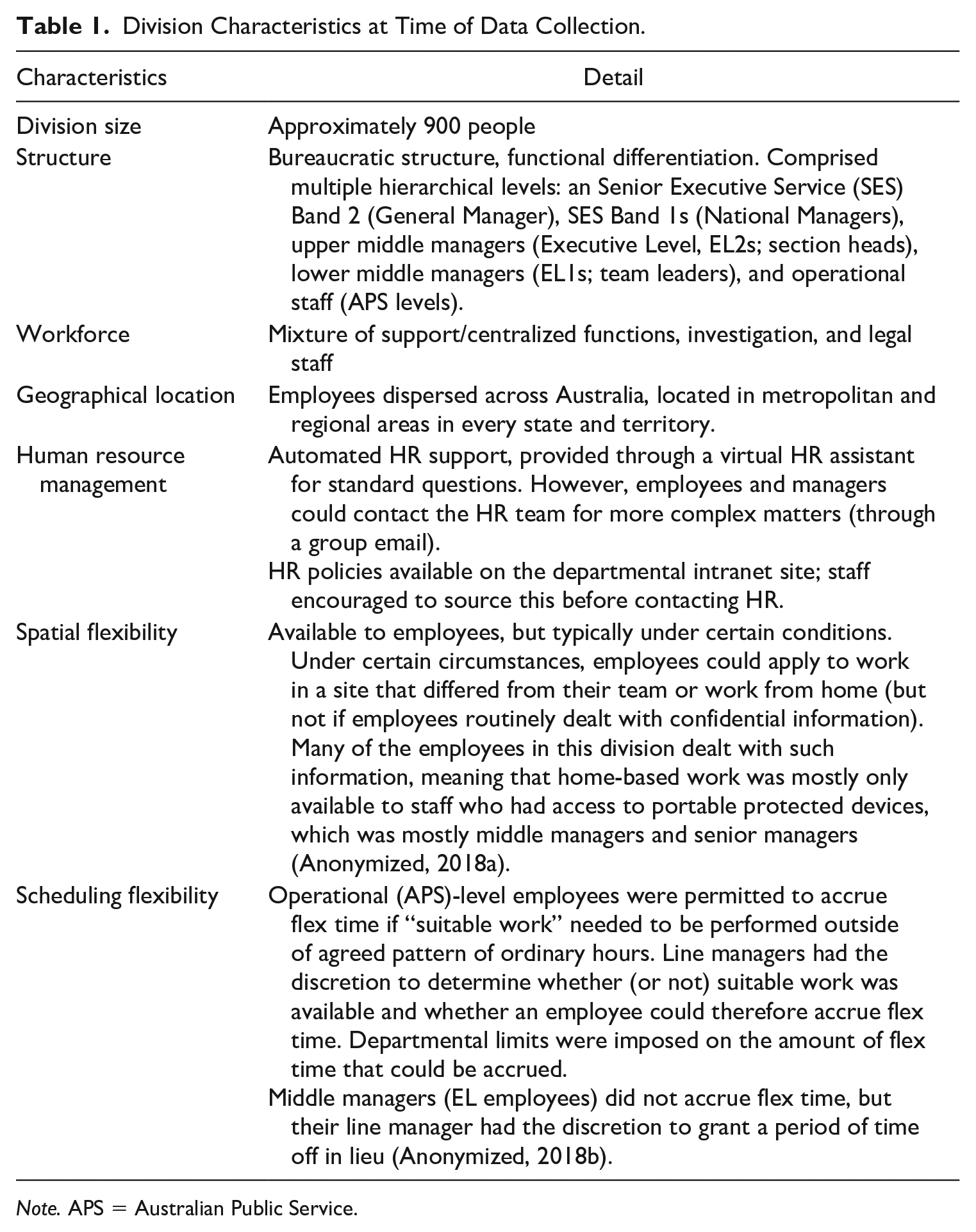
Note. APS = Australian Public Service.
Data Collection
In this study, qualitative data were collected to provide rich, descriptive data (Corbin & Strauss, 2008) on perceptions regarding well-being. Administrative data on organizational policy and primary data through semi-structured individual and group interviews were collected.
Administrative Data: Organizational Policy
Sixty-two departmental policy documents and supporting material relating to well-being in the division were analyzed to identify the supports in place for well-being, including flexible working policies.
Qualitative Data: Individual and Group Semi-Structured Interviews
Data were collected using semi-structured group and individual interviews in five locations across Australia. A purposive sampling strategy was employed, recruiting a full complement of staff levels from a range of business functions, including operational employees and managers from metropolitan and regional offices. Potential participants were sent a recruitment email and participant information sheet and consent form and volunteered to participate by contacting the research team and submitting a signed consent form. Semi-structured interviews ensured consistency across all the interviews and allowed flexibility for the participants to express their views on factors they felt were important. Participants were asked questions about their role, what they understood as well-being, and the key factors that enabled and impeded well-being, including flexible working and managerial support.
Individual Semi-Structured Interviews
Sixteen individual interviews with senior (Senior Executive Service, SES) and upper middle managers (Executive Level, EL2) were conducted to identify perceptions regarding the high-level factors that affect employee well-being. Holding individual interviews was deemed important for ensuring these managers felt free to discuss key well-being issues existing within the division. Individual interviews were undertaken to navigate known challenges with gaining access to senior managers as they enabled flexibility with scheduling and location (see Harvey, 2010; Ma et al., 2021; Mikecz, 2012). Individual interviews guaranteed confidentiality, thereby encouraging more candid discussions regarding well-being issues within their team/group, rather than senior managers engaging in impression management, which often occurs (Harvey, 2010; Ma et al., 2021; Mikecz, 2012). This was deemed important to minimize the risk of participants only presenting a positive account of well-being and downplaying any potential problems.
Group Semi-Structured Interviews
Ten group interviews with 57 participants at the lower middle management (EL1) and operational levels (APS) were conducted to explore the day-to-day factors that affected employee well-being. Group interviews enable researchers to take advantage of group dynamics, with the insights of group members stimulating discussion and the surfacing of agreement and divergence (Frey & Fontana, 1991). Each group consisted of five to eight participants at similar levels (i.e., a group for operational employees and another for middle managers). Groups comprised employees and middle managers from different teams, anticipating discussions regarding cross-team similarities and differences regarding well-being, and factors that enable or impede it. The interviews revealed similarities in the types of work undertaken by participants, with similar degrees of knowledge-based work and citizen-facing work; differences were primarily evident in the extent to which flexible working was supported and employee well-being was a central focus of managers.
In total, 26 semi-structured group and individual interviews were conducted, with 73 participant contributions (see Table 2).
Details of the Participant Sample.
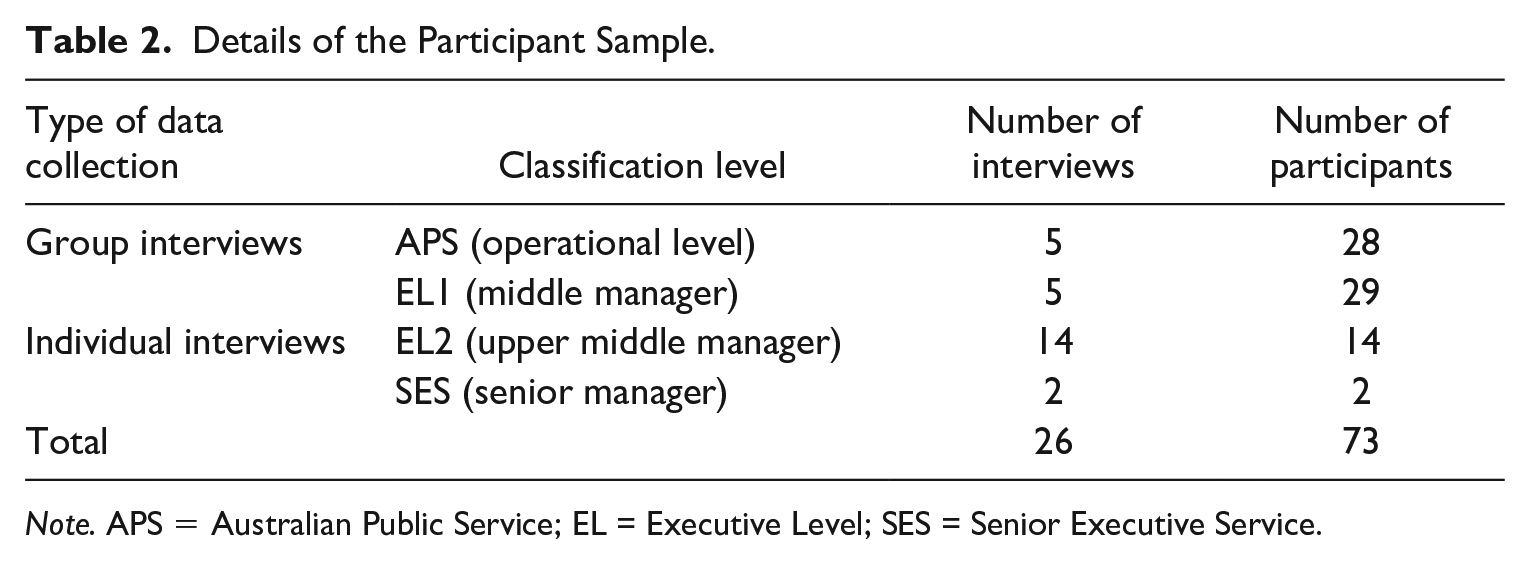
Note. APS = Australian Public Service; EL = Executive Level; SES = Senior Executive Service.
Participants were deidentified during data transcription. Individual interviews are labeled according to their allocated participant number and level (e.g., P1: upper middle manager, P6: senior manager) and group interviews are labeled according to their group number and level (e.g., G1: middle manager, G6: operational).
This project received ethics approval from the Human Research Ethics Advisory Panel A: University of New South Wales Canberra (project: HC190236).
Data Analysis
The interviews were recorded, transcribed, and loaded into the qualitative research software NVivo (version 12). An inductive process of open, axial, and selective coding was undertaken to identify emergent patterns, themes, and interrelationships (Patton, 1990). The open coding process involved (a) reviewing the data line-by-line and breaking it into discrete parts; (b) comparing the data for similarities and differences; and (c) grouping it into categories based on this comparison (Corbin & Strauss, 2008). During this process, the research team worked intensively with the data to establish a comprehensive set of emergent themes (Creswell, 2013). Next, axial coding was undertaken to cluster data together, identifying associations between themes (Corbin & Strauss, 2008). The axial coding revealed distinctive managerial attitudes and behaviors, for example, trusting, controlling, results and productivity-oriented, focus on employee well-being, support flexible working, do not support flexible working, unconfident, and mixed approaches to flexible working. These codes were explored further using selective coding, where these attitudes and behaviors were categorized according to four different approaches to managerial support: unconditional support, universally unsupportive, performance contingent support, and managers who transferred responsibility for decisions regarding flexible working arrangements to others. Once these themes were developed, the research team revisited the data to confirm the soundness of themes and seek further explanation for the different approaches; this process led to the identification of the centrality of type of prior experiences with flexible working. These are presented below.
Findings and Discussion
This study supports existing research indicating that flexible working is important for employee well-being. When asked to describe the enablers of well-being in their workplace, flexible working was the most cited factor. Participants explained how determining when and where they worked enabled work–life balance, which supported their well-being. Work–life balance enabled employees to continue delivering work in balance with personal and family preferences and responsibilities. Although asked about broader forms of flexible working, most participants focused on working from home, or in a satellite office closer to home. At the time of this study (pre-COVID-19), there was low uptake of working from home due to a heavy focus on office attendance within core work hours. This study also supports research suggesting managerial support for flexible working is integral to its uptake; our findings revealed that managerial readiness and willingness to support flexible working was one of the most important contributors to well-being emergence.
However, many participants reflected on managerial differences in support for, and enabling of, flexible working. Analysis revealed four distinct approaches to managerial support for flexible working: managers who were unconditionally supportive of flexible working arrangements; managers who were universally unsupportive; managers who provided performance contingent support; and managers who transferred responsibility to others (i.e., senior managers and human resource professionals). These are presented below.
Approaches to Managerial Support for Flexible Working
Unconditional Support
Managers who expressed unconditional support for flexible working conveyed the strong value that they placed in people and the need to ensure managers support the whole person, taking into consideration employees’ work and personal commitments: [We need to] treat people as individuals, really. Everyone’s got their own life . . . outside of work, and sometimes the two will clash, and if you are genuinely supportive of the person’s well-being, then you’ll need to be supportive of what they’re trying to achieve outside of work, just as much as what they’re trying to achieve inside of work. (P3: upper middle manager)
These managers saw flexible working as integral for supporting employees to balance work and personal commitments, with their focus being on optimizing their well-being: I’m quite happy to advocate for a staff member to move to a different location, because I know that being away from home or spending 20% of your day on a train is not good for you, and I don’t want staff members having to go through that, because at the end of the day, they’re not going to be happy, and they’re not going to be doing the best work. (P4: upper middle manager)
These managers also expressed the need to develop an environment where flexible working is accessible to all to enhance employee well-being: ‘I think it’s about creating an overall positive work environment . . . [where] flexibility is accessible. It’s then utilized, and there’s not a one size fits all for everyone, so it’s all based around the individual themselves’ (G1: middle manager). For these managers, the focus of their work environment was “to support and utilize [flexible working] and to get the outcome” (G2: middle manager), rather than focusing on policies, processes, and extant employee productivity levels. That is, they saw the provision of support and access to flexible working arrangements as integral to business output attainment. It was clear that these managers had the confidence, knowledge, and skills to interpret policies in ways that enabled employees to access flexible working. They achieved this through “thinking outside the square” (P1: upper middle manager), ensuring employees could access underpinning resources such as IT, work from different locations, and be supported through appropriate pastoral care.
Operational level employees who worked for managers providing unconditional support discussed how they had “a bit more control and flexibility with our work” (G6: operational) and “we can all pretty much come and go . . . I’ve got an awesome team leader. She’s great with that sort of stuff” (G6: operational). Flexible working enabled these employees to balance work and nonwork commitments, enabling them to attend appointments during business hours: I’ve had a personal situation where you kind of manage certain appointments at the end of the day. So, I start at 7:30, take a half an hour for lunch, so then I don’t infringe on work time. So, I leave at 3:30 each day to get to various appointments . . . There’s never been an issue with not being able to adjust my working . . . times. (G7: operational)
When reflecting on a time where their son was experiencing health issues, one operational level participant said, [Flexible working] certainly has a positive impact on my well-being. Because I’m paid to work, I feel obliged to be at work if I’m well . . . But knowing that there was nothing wrong with me—and my son, who is [an adult] . . . didn’t need someone to take his temperature or anything like that [as there was nothing physically wrong] . . . I didn’t have to sit by him and talk to him every minute of the day, but if I was in the house, he was fine. So that had such a positive impact on my well-being, and on his. (G7: operational)
It was clear that managers who provided unconditional support for flexible working provided work-family-specific support to employees, as they saw this as central to maintaining productivity. Unconditionally supportive managers had a strong focus on employee well-being and were focused on making life easier for employees, with a heavy emphasis on supporting employees to realize satisfaction across their work and nonwork domains. This seemed to be motivated by the desire to enhance employees’ positive experiences and happiness (positive affect), thereby reducing anxiety and stress (negative affect).
Universally Unsupportive
These are managers who did not support flexible working. It is worth noting that this approach of managers was reported by subordinates or other managers; none of the middle management participants disclosed they personally did not support flexible working. When reflecting on unsupportive managers, participants claimed that they demonstrated a high need to exercise control over their employees, with a tendency to micromanage. Unsupportive managers seemed to value control as a mechanism for ensuring productivity and business output attainment. In the context of this article, this manifested as a desire to physically see employees at their desks: “There’s probably still a few control freaks . . . I had someone who used to say to me . . . I like to use all five senses. I like to see them, touch them, smell them” (P8: upper middle manager). Some managers reported that other managers had rigid ideas about the “ideal worker”: . . . I think there’s still a perception in certain quarters that . . . sitting behind a desk and doing a seven-and-a-half-hour day is a measure of how good you are as an employee. Despite, and regardless of the fact, that the output of your work is maybe not being considered, it’s the fact that you’re actually sitting in an office, and you appear to be present. (P3: upper middle manager)
Participants who were subordinates of unsupportive managers claimed that their managers used policy specifications prioritizing “business needs” as the reason for not approving flexible working arrangements, with policy stating that flexible work should be approved if not in conflict with business needs. Group interview data highlighted variations in individual managers’ interpretation of business needs and its compatibility with flexible working. For example, in an operational employee group interview, some participants said one manager had not approved working from home requests citing that privacy requirements prevented it, due to the risk that confidential information could be accessed by others. Whereas the managers of other participants, who had to access similar types of information, supported working from home arrangements:
Just wondering why . . . we get told that we can’t [work from home] because of the stuff [information] that we access, but then you kind of access the same kind of stuff as us [yet get to work from home] . . . we get told that due to the customer personal information that we’ve got, that we can’t work from home . . .
. . . [but] you lock your screen when you leave your desk, and you’ve got all that. You’re still bound by APS code and all that sort of jazz, privacy and clean desk and all that sort of stuff. So, you know, you get up, you just lock your [portable device]. (G6: operational)
Universally unsupportive managers seemed to view office attendance—and their oversight over what employees were doing—as critical for meeting work requirements. This may be partly due to managers lacking self-efficacy to balance work deliverables and employee well-being in a flexible working context. This approach potentially impedes hedonic well-being through employees not being permitted to exercise control over working time and location. In addition, employees who cannot access flexible working will see others being supported to work flexibly, with negative social comparisons likely to reduce their hedonic well-being (see Diener et al., 1999; Fujita, 2008). This was evident in this study, where variation in support for flexible working was creating a sense of organizational injustice among operational level employees.
Performance Contingent Support
This approach to support was most prevalent in the data, with multiple manager participants expressing willingness and desire to support flexible working; however, such support was contingent on employees already being productive. The high prevalence of these managers was an unexpected finding because the predominant view in current literature is that managers are either supportive or unsupportive of flexible working. An exception to this is Stout et al. (2013) who also found that managers would only support flexible working arrangements if employees were perceived as already responsible and productive.
When reflecting on what they perceive most managers desire, an upper middle manager stated, . . . what a lot of managers want to see first, is that the person is productive, and that you’ve got some trust that if you’re going to allow them to have this arrangement and be at home, that they will be productive during that period. (P5: upper middle manager)
Some discussed how they were willing to support flexible working arrangements, provided employees were doing their “fair share” (P14: upper middle manager), reliable, and able to “produce the outcome within the hours required” (G2: middle manager). Differentiation was made between those who worked productively while working from home and those who did not: . . . you’ve got a productive person that you’d like to be able to give that flexibility to . . . [and] there’s other people who will have the same expectation who you know will not be productive, under the same arrangements. (G3: middle manager)
These decisions seemed to be based on perceptions regarding whether the provision of support and access to flexible working was worthwhile and likely to enable productivity.
For some managers, the expectation was established that their employees would be productive while working outside of the office and they would demonstrate this through being visible online. This seemed to be accepted by operational level employees, with one stating, So, I’ve had an electrician, a plumber come in one day and they come between 9:00am and 3:00pm. If I can take that home, logged in at work, I had my phone, had my Skype on, and I could work and access all my work at home and do it all while the contractors came in and did their work, and it was brilliant. It didn’t impact on my flex, it didn’t impact on my productivity, I was checking in throughout the day, and that was great, really, really good. (G6: operational)
Overall, the managers who provided performance contingent support were focused on enabling some employees to meet their work and nonwork commitments. However, reasons for support were not well-being oriented; instead, they centered on degree of productivity, with support only offered to those already demonstrating high levels of productivity as they were perceived to be more trustworthy and able to work autonomously. Therefore, managers perceived it was worthwhile supporting employees’ access to flexible working as it would not impede their performance, nor would it require managers to invest more time and energy than necessary to manage these employees. Even then, there was an element of surveillance from those managers who required employees to be visible online, suggesting they did not completely trust employees working remotely.
Those providing performance contingent support could potentially improve the well-being of some employees, while undermining the well-being of others. This is because these managers are only willing to support flexible working for employees who they consider to already demonstrate high productivity levels. Supporting flexible working arrangements for productive employees could reinforce and increase well-being through (a) enabling employees to exercise control over their working time and location (Gröpel & Kuhl, 2009; Hoffman-Bidzinska, & Rutliowska, 2015) and (b) demonstrating these employees are trusted. Conversely, performance contingent support could undermine the well-being of employees who are not perceived by managers as productive and not trusted to work remotely. This could occur through constraining the ability of employees to balance their work and nonwork demands (see also Gröpel & Kuhl, 2009; Hoffman-Bidzinska & Rutliowska, 2015) and the erosion of manager–employee relations due to lack of trust (Brunetto et al., 2013).
Transfer Responsibility
This approach to support was provided by managers reluctant to support flexible working arrangements without the approval of others—usually human resource or more senior managers; they lacked knowledge, skills, and confidence, leading to reluctance to make decisions that could have adverse impacts. These managers were concerned about senior management’s perceptions of their managerial judgment and capabilities. Consequently, they were unwilling to take full responsibility for approving flexible working arrangements. These managers stated that it was important to check with human resource professionals and their own managers to ensure policy compliance before approving arrangements: Well, to be honest with you, I would probably need to go . . . talk to the HR Division or area . . . to try and get a handle on what is on offer and what’s available, and how best to implement those things. For example, flexible working hours, that kind of stuff. (P3: upper middle manager)
Another manager stated that, “I work closely with my director [upper middle manager] to see what we can manage ourselves and what’s available. Quite often I do go straight to HR. But my manager is ultimately my first point of call” (G1: middle manager). These managers expressed the need for an escalation point and to defer to others as “backside covering,” in case desired employee productivity levels were not achieved: . . . it’s always good to have that escalation point. So, therefore, any advice you’re providing or any actions you’re putting in place for that particular staff member, you have your backside covered, because you have obtained that advice from departmental experts. (G1: middle manager)
Where guidelines are unclear, exemplars of practice are lacking, or others do not endorse flexible working requests, managers may not support flexible working due to concerns about productivity or adverse outcomes.
In summary, this study aimed to explore how and why managers support flexible working in the public sector. It found four managerial approaches to supporting flexible working: unconditional support, performance contingent support, universally unsupportive, and support based upon the approval of others (transfer responsibility). The next stage of the analysis was to establish why these four approaches existed.
Reasons for Different Approaches to Support for Flexible Working
Applying COR theory to explore managerial approaches revealed that decisions to support flexible working are based on perceived trade-offs between resource investment and anticipated business output gains. As identified in the literature review, a range of factors can be resources according to COR theory; those most relevant to this study include autonomy, control, opportunities for professional development, social support, energy, knowledge, self-efficacy, and family-friendly workplace policies (Halbesleben et al., 2014; Hobfoll, 2001, 2002) In this study, it was clear managers made decisions regarding whether it was worthwhile investing their personal resource of energy to provide employees with support and access to flexible working arrangements. Applying COR theory to explain the different managerial approaches suggests that managers’ capacity to support flexible work practices is shaped by their knowledge, self-efficacy, and experience with flexible working, and their willingness to support flexible working may be motivated by perceptions of resource loss or gain.
A key reason for managerial differences was their prior experience with managing flexible working arrangements. Study findings suggest that differences resulted from whether previous experiences involved managing employees who performed and achieved goals while working remotely. These experiences shaped perceptions about whether employees who are working flexibly can be trusted to perform with limited supervision. These perceptions are central due to trust being underpinned by the belief that resource investment will be reciprocated by others, leading to goal attainment. As such, trust is a belief that guides decisions regarding resource investment (Halbesleben & Wheeler, 2015). In this study, it was clear that managerial willingness to support flexible working is underpinned by the belief that investing their energy (personal resource) to provide employees with support and access to flexible working will be reciprocated through employees being productive.
Unconditionally supportive managers had previous positive experiences with flexible working. They reported managing employees who worked productively while working remotely and they had seen effective flexible working, and its management, role modeled by others. These experiences underpinned their approach based on trust, with views such as, I think I have a lot of trust in people . . . I always think everyone’s doing the right thing. I know most people do the right thing. And I found the more and more trust and flexibility I gave to people, the more and more productive [they are]. (P8: upper middle manager)
These managers had developed the belief that investing their personal resources to provide employees with support and access to flexible working would enable the achievement of business outputs. These beliefs were further supported through senior managers role modeling a trust-based managerial approach and effective flexible working themselves. This enabled middle managers to build up the personal resource of self-efficacy with managing flexible working arrangements, as highlighted by one middle manager: . . . the way I manage my staff . . . [is] installing that trust you’re getting the job done by not micro-managing or questioning what you do every second of the day . . . That approach is certainly the style of my [manager] and I think what works in my favour as well, is she very much has a similar lifestyle to me . . . [she] has a family, two girls very similar ages to me, so she can relate on a personal level, and that really helps. And just being able to see her apply the flexibility within our agreement, and actually stay true to what’s in there and make it work, that gives you confidence that then you can do that . . . And that’s a ripple effect then, because you get the confidence to say that works, and I’m going to do that for my staff too. And that certainly contributes to your well-being at work, because a piece of work that I may not be able to get finished today before I have to rush off and pick my daughter up from dancing by a certain time, I can log on later at night and finish that off and come in fresh the next day. (G8: middle manager)
COR theory posits that individuals will invest resources when they perceive that it will lead to anticipated gains (Hobfoll, 2002). In this study, managers who provided unconditional support perceived that investing their own personal resources—in particular, their energy—to provide resources to others (support and access to flexible working) was integral to productivity. In turn, their positive experiences with employees working productively equipped them with high self-efficacy with managing flexible working arrangements; that is, it enabled them to acquire additional resources. According to COR theory, this could result in a perpetual cycle where managers are more capable of future resource gains (Hobfoll, 2001). This meant that managers who provided unconditional support perceived resource investment as worthwhile; thus, they were motivated to continue supporting employees to work flexibly. It also meant they further developed their knowledge and skills with managing employees working flexibly, enhancing their capacity, and further building up their resource of self-efficacy over time.
In contrast, managers who were universally unsupportive and those who provided performance contingent support had negative experiences with flexible working. They reported previous experiences investing their energy (personal resource) to provide employees with support and access to flexible working; however, in some instances, employees were not productive while working remotely. This meant their resource investment was not reciprocated by employees they perceived to be underperforming, impeding their ability to achieve business outputs. It also resulted in resource loss, primarily through the requirement to invest additional personal resources managing underperforming employees, with little to no perceived gain. These experiences shaped their perceptions regarding flexible working support, which can be understood through applying COR theory. COR theory posits that individuals will experience stress when there is a loss of resources (or threat of losing resources), or when resource investment does not lead to gains (Hobfoll, 2002). Once an individual has experienced, or is threatened by, resource loss, they are more vulnerable to future losses. Therefore, they will be motivated to avoid future resource loss, positioning themselves so they are less vulnerable to it (Hobfoll, 2001, 2002). In this study, it is likely that the stress and resource loss associated with negative experiences with flexible working contributed to the unwillingness of managers to support flexible working; more specifically, they were unwilling to make themselves vulnerable to experiencing future resource losses.
Managers who provided performance contingent support and those who were universally unsupportive responded to these experiences in different ways. Managers who provided performance contingent support perceived that investing resources would only enable goal attainment via employees who were already productive and that it was not worthwhile investing in those who they perceived as unproductive. This led to performance contingent support managers only approving requests from employees whom they perceived to be productive and trustworthy. In this study, managers who provided performance contingent support trusted employees who demonstrated high levels of productivity while working flexibly; therefore, it is likely they interpreted this as a signal that investment of resources in supporting flexible working by these employees would lead to desired outcomes. However, managers who were universally unsupportive chose to not invest any resources in supporting flexible working and were seemingly motivated by avoiding future resource losses. Instead, they used control as a resource, due to the belief this was necessary for achieving business outputs. This led to perceptions that these managers were focused on controlling employees: “For some people, power is everything, and they want to use their power however they please” (G6: operational). For managers who were universally unsupportive and those who provided performance contingent support, reluctance to invest resources for some or all employees could also reflect a lack of resources—knowledge and self-efficacy—in managing performance issues for employees working flexibly.
Importantly, participant discussions highlight the potential for managers to change approaches, following a change in resources. When reflecting on a manager who was previously universally unsupportive of flexible working, one participant reflected on the transition made over time with different teams: . . . he managed a fantastic team . . . and he was a convert [to supporting flexible working] . . . because they were great people, and were such high producers of work, and so dependable, that I think they changed his mind . . . he’s actually a really good case of where I think he’d gone from needing that constant control to realizing that he was just getting awesome people working with him. (P8: upper middle manager)
In this situation, the manager commenced with a high-performing team that was already working flexibly; due to the high levels of productivity, the manager acquired the resource of support to achieve business outputs. This enabled a change in motivation to support flexible working, due to the belief that investing resources (energy) to provide support and access to flexible working will generate future gains.
COR theory can also be used to understand the approach adopted by those managers who transferred responsibility. These managers lacked experience with managing flexible working arrangements generally. Therefore, rather than being motivated by avoiding resource losses, these managers could have been motivated by acquiring additional resources. Hobfoll (2001) posits that people will seek to acquire additional resources that compensate for a lack of fit between capacity and demand. In this study, managers who transferred responsibility lacked knowledge and self-efficacy with managing flexible working arrangements. Consequently, they sought additional resources—in the form of support from HR managers and their senior managers—to compensate for their own lack of resources.
These different experiences highlight that many managers lacked the resources required to meet the demands of their role. First, managers lacked social support (resource) for managing both flexible working and performance issues. Comments made by one participant reflected some general sentiments: . . . there’s no support [for managers] . . . I can’t remember the last time I spoke to someone in HR. To try to get advice with HR you’ve got to dig through ridiculous task cards, you go to a bot that is supposed to answer all your questions. (G1: middle manager)
Some participants also stated that social support was lacking in parts of the division and that this was detrimental for managers: . . . if you don’t have a supportive [manager] in place, or someone who you can go to talk to, then you do kind of get stuck and you’re at a bit of a loss as to where to go next. (G3: middle manager)
Second, participants also discussed the lack of learning and development (resource of professional development) for middle managers, particularly the lack of social and experiential learning: . . . where’s . . . the support that you get on the job? Because I can go away and do a course for a couple of days, that’s easy, I can do that. I can go and do that tomorrow. But I feel, where’s that buddy or mentoring system, or someone to help you through those things, to get better at doing that? (P5: upper middle manager)
This was particularly an issue, given the varying managerial experiences. This supports research by Williamson et al. (2020) which found that managers were seeking more training and guidance to assist them with managing flexible working and workloads, particularly with how to manage performance and underperformance.
Implications of Different Approaches for Employee Well-Being
Reflection on these findings reveals that different approaches to managerial support create the potential for employee well-being to vary considerably within the same organizational context. Varying well-being could occur within the teams of managers who provide performance contingent support or transfer responsibility, due to them supporting some employees to access flexible working arrangements, but not others. The importance of social comparison for hedonic well-being (see Diener et al., 1999; Fujita, 2008), noted earlier, suggests that hedonic well-being is impeded when employees see their colleagues receiving support for flexible working when they themselves do not. Managers who were universally unsupportive provided the same level of support for all employees, suggesting they may contribute to their employees’ well-being in similar ways. However, employees could still experience impeded well-being due to comparison with colleagues from other teams who are supported by their managers to work flexibly.
Managers who provided unconditional support for flexible working could also see variable well-being outcomes in their teams. While their support is likely to enhance the hedonic well-being of their employees, their high self-efficacy could also lead to blind spots and knowledge gaps for this group of managers. Managers who are unconditionally supportive, and who provide work-family-specific support, may not be aware of the psychosocial risks associated with flexible working. In this study, none of the discussions with unconditionally supportive managers reflected the potential negative consequences for well-being for some employees. This is a potential problem, as research highlights risks for the well-being of those with high workloads or who work longer hours (see Andrade & Lousã, 2021; Palumbo et al., 2022) or women with caring responsibilities (see Karjalainen, 2023; Russell et al., 2009; van der Lippe & Lippényi, 2020) when working remotely. Lack of acknowledgment of these risks is an issue, as Bentley et al. (2023) argue, managers need to have the knowledge and skills to identify and manage psychosocial risks and to enable remote working to realize desired well-being outcomes.
Conclusion
This study aimed to explore when and why public sector managers support flexible working and the implications for employee well-being. It reveals the coexistence of four managerial approaches to supporting flexible working, proposing that managers support flexible working under certain conditions and not under others. It draws on COR theory to posit that managers’ capacity to support flexible work practices is shaped by their knowledge, self-efficacy, and experience with flexible working and their willingness to support this practice may be motivated by perceptions of resource loss or gain. It highlights that the presence of these different approaches to managerial support creates the potential for employee well-being to vary considerably within the same organizational context.
Implications for Practice
Analyzing approaches to managerial support for flexible working through the lens of COR highlights the need to identify and address sources of stress (Hobfoll, 2001) and the core motivational reasons for managerial choices, that is, addressing the deeper sources of reluctance to support flexible working requests. It also highlights that there may be sound motivational reasons rooted in well-being preservation (for managers) for not approving employees’ flexible working requests. This can lead to managers avoiding situations that are likely to impede their well-being, in particular, where their demands exceed their resources of self-efficacy and knowledge.
This study highlights that many managers lack self-efficacy, knowledge, and skills in managing flexible working arrangements; this is an important issue for public sector organizations to address. Recent research suggests that the COVID-19 pandemic has created a shift to new ways of working, with hybrid working models leading to employees dividing their time between working in the office and from home (Faro et al., 2021; Williamson et al., 2021). Managers will increasingly need to be competent to manage employees working across different locations and at different times, yet research suggests many public sector managers lack these capabilities (Colley & Williamson, 2020; Williamson et al., 2020). This study has shown this has important implications for employee well-being; findings also suggest that managers with high self-efficacy with managing flexible working arrangements may also have knowledge gaps regarding how to manage the well-being of employees working flexibly.
The findings suggest that different approaches to support for flexible working coexist within the same work context. Although the findings show mixed support for flexible working, research undertaken by Sweet et al. (2017) demonstrates that managerial attitudes toward flexible working are malleable. Attitudes can be shaped by training and development, incentives, workplace norms, and positive experiences with managing flexible working arrangements. This aligns with Hobfoll’s (2001) call for interventions that change an individual’s resources and/or their environments to remove obstacles to the successful application of resources. Doing so can help stop resource loss spirals before they gain momentum (Hobfoll, 2001), for example, providing managers with sufficient support to manage performance issues proactively and effectively (before they become problematic). This identifies the importance of adequately supporting and developing managers, with findings suggesting that all managers require support and development in how to manage flexible working in a way that optimizes benefits and mitigates risks.
In this vein, this study provides three key implications for practice within the public sector. First, this study highlights the need for public sector leaders to understand managerial resources and motivations, with a focus on addressing underlying reasons for unwillingness to support flexible working. This should help address managerial needs and, consequently, aid a shift in attitudes and behaviors. Second, this study highlights the importance of supporting and developing all managers to manage flexible working arrangements more effectively. This could involve building managerial toolkits for identifying and managing psychosocial risks (for detailed suggestions, see Bentley et al., 2023). However, development initiatives will also need to be tailored to address specific managerial knowledge gaps and equip managers with the specific resources they need, rather than a one-size-fits-all approach. For example, managers providing unconditional support may require development to work with employees to mutually determine if flexible working arrangements are desirable and beneficial, as well as collaboratively identify and manage potential psychosocial risks (see Bentley et al., 2023). Managers providing performance contingent support could be supported to actively manage the performance of employees with lower productivity levels by more senior managers working with them to develop their skills and knowledge of how to clarify performance expectations and to provide constructive feedback to employees working remotely. Managers who transfer responsibility can be developed to improve their confidence with applying organizational policies supportive of flexible working more effectively. Unsupportive managers may require leaders role modeling flexible working behaviors, indicating higher level management commitment to flexible working and how to use it in advantageous ways. Third, this study demonstrates the potential for employee well-being to vary considerably within the same work context, highlighting the importance of collecting well-being data at multiple levels to highlight intrateam and interteam differences. This could help identify where issues exist and inform work undertaken to further understand and target interventions to address these issues effectively.
These findings are important for public sector organizations, as they can help inform how to support flexible working arrangements in ways that optimize employee well-being. This is particularly important post-COVID-19 as employees now expect to access flexible working (Alexander et al., 2021; Hickman & Robison, 2020) and there is a greater awareness of the importance of employee well-being (Horne, 2021; Jones, 2020; Mahajan & St-Jean, 2021).
Contribution to Knowledge, Theoretical Implications, and Future Research
This study extends knowledge through qualitatively exploring the reasons why managers support flexible working (or not) and the implications for employee well-being. There are two theoretical implications of this study. First, this study demonstrates the applicability of COR theory to flexible working and well-being, highlighting its value for understanding how and why managerial motivations shape choices regarding supporting flexible working. It also highlights the need to understand the factors that influence managerial well-being and how this affects their capacity and motivation to support others. Future research could focus on building new theory linking COR theory, flexible working, and well-being. Second, the findings of this study highlight that supporting overall well-being within the public sector is more complex than managers providing access to flexible working arrangements in a way that improves work–life balance. Managers have their own well-being reasons for not supporting flexible working arrangements which, at their core, concern conserving their own resources. This matters due to the literature emphasizing the importance of managerial support for flexible working (Casey & Grzywacz, 2008; Hammer et al., 2009; McCarthy et al., 2010; Warner & Hausdorf, 2009), yet paying inadequate attention to exploring the factors that shape their capacity to support employees. This highlights the need for further qualitative research to better understand how managerial perceptions regarding their demands and resources shape their motivation and willingness to support employees.
Undertaking research in the same organizational context—with participants from the same division—enabled the identification of more nuanced factors at play, suggesting the role of managerial confidence, experience, preferences, knowledge, and skills in shaping choices. It also highlights that approaches to support are also influenced by organizational factors, particularly the lack of senior leadership support and the limited development opportunities provided to managers. However, as it was a qualitative study in a specific public sector context, findings are not generalizable across settings; however, they may be transferrable to similar contexts (as per Guba, 1981), particularly public sector organizations that have responsibility for service and program delivery. However, future research could be undertaken in public sector organizations responsible for policy and/or regulatory functions to see if the findings are applicable in these contexts.
Footnotes
Declaration of Conflicting Interests
The author(s) declared no potential conflicts of interest with respect to the research, authorship, and/or publication of this article.
Funding
The author(s) received no financial support for the research, authorship, and/or publication of this article.
