




Abstract
The COVID-19 pandemic further illuminated the importance of strategic human capital management (SHCM). As the pandemic surged in the United States, employee retirement and resignation rates grew rapidly. Not surprisingly, the significant number of individuals seeking new employment opportunities or entirely exiting the labor force exacerbated human capital shortages that were already crippling public sector organizations. Fortunately, research has shown organizations that engage in SHCM initiatives can simultaneously enhance performance-related outcomes and successfully endure turbulent workforce conditions. Job satisfaction and employee turnover intention are two such outcomes that have received ample consideration among researchers. But while public sector scholarship has empirically demonstrated that SHCM influences employee job satisfaction, it has failed to adequately account for its indirect linkage to voluntary employee turnover. Therefore, using local government data collected biannually from 2016 to 2022, this study explicitly examines how endogeneity issues factor into the dynamic relationship between SHCM, job satisfaction, and turnover intention. The results of two-stage least squares regression analysis suggest that SHCM is indirectly related to employee turnover intention by way of employee job satisfaction.
Introduction
The COVID-19 pandemic serves as a portentous reminder of how susceptible the public sector workforce can be to startling environmental shocks. For decades, the public sector labor force has endured a flood of economic, social, and demographic issues. Turbulent workforce conditions, including financial crises, recessions, globalization, and human capital shortages, have plagued U.S. governments at all levels (Ansell & Trondal, 2018; Jarrell & Pewitt, 2007; Jimenez, 2017; Mylona & Mihail, 2019). As a consequence of such ongoing labor force shocks, a wealth of scholarship has accumulated supporting the use of strategic human capital management (SHCM). Scholarship largely operationalizes SHCM as the alignment of personnel policies and practices with an organization’s strategic objectives (Jacobson et al., 2014; Ray et al., 2023; Suh & Battaglio, 2022; Tompkins, 2002). In doing so, human resource departments embrace the idea that employees within their respective organizations possess invaluable human capital (i.e., knowledge, skills, and abilities) that can be leveraged to mitigate the effects of turbulent workforce conditions and concurrently enhance employee and organizational performance-related outcomes (Boselie et al., 2021; Collins, 2021; Guo et al., 2011; Jacobson et al., 2014; Jacobson & Sowa, 2015).
Although research has observed the effects of SHCM on a host of dependent variables, scholars have paid particular attention to its relationship with employee job satisfaction. Scholarship has shown that satisfied employees are more likely to exert their human capital in ways that can reduce organizational costs and enhance productivity (An et al., 2020). Indeed, prior research suggests that high job satisfaction levels can result in an abundance of positive organizational outcomes, including voluntary turnover reduction (Barbosa de Oliverira et al., 2019; Cantarelli et al., 2016; Park et al., 2018). This relationship is of paramount importance, given the loss of governmental human capital due to recent U.S. retirements and resignations (Dill, 2021; Fry, 2021).
Reducing turnover intention and actual turnover has, by and large, remained a considerable concern for personnel practitioners and scholars, although recent retirement and resignation trends have brought heightened attention to this issue (Dill, 2021; Fry, 2021; Jarrell & Pewitt, 2007; P. Kim et al., 2022; Lynn, 2001). Prior to the COVID-19 pandemic, baby-boomers (i.e., individuals born 1946–1964) had already begun to retire, albeit at a slower pace than initially projected, and unprepared organizations struggled to replace invaluable human capital. However, amid the pandemic, retirement rates (i.e., the percentage of U.S. adults 55 and older that exited the labor force due to retirement) rose from 48.1% in the third quarter of 2019 to 50.3% in the third quarter of 2021 (Fry, 2021). Simultaneously, in what has been termed the “Great Resignation” a tremendous number of younger employees elected to make career transitions, and as such, resignation rates increased by 60% from 2020 to 2021 (Dill, 2021).
Despite the significant body of scholarship that finds support for the relationship between SHCM practices and employee job satisfaction, as well as job satisfaction and voluntary turnover, public sector research has failed to sufficiently connect these three organizational phenomena through empirical testing (Boselie et al., 2021; H. Lee, 2017; Ray et al., 2023; Suh & Battaglio, 2022; Watty-Benjamin & Udechukwu, 2014). Nevertheless, grounded in the extant literature, this research theorizes that employee satisfaction is endogenously related to voluntary turnover, given that its underlying linkage passes through organizational utilization of SHCM practices. Simply put, an organization that effectively employs SHCM is likely to experience greater levels of employee satisfaction. As a result, satisfied employees are less likely to consider leaving the organization, thus reducing voluntary turnover rates (Barbosa de Oliverira et al., 2019; Cho & Lewis, 2012; Vermeeren et al., 2014). This research, therefore, contributes to the current literature by considering the potential endogeneity of employee job satisfaction and how it is determined by SHCM practices. It also aims to shed new light on the relationship between job satisfaction and turnover intention, using a distinctive theoretical lens.
To make the empirical contributions discussed above, this article analyzes cross-sectional data, collected biannually from 2016 to 2022, through the City of Tempe Arizona’s employee survey. The remainder of this article, therefore, proceeds as follows: The succeeding section establishes a theoretical framework linking SHCM practices, employee job satisfaction, and voluntary turnover intention. This study then turns to a discussion of testable hypotheses. The subsequent section highlights the data, variables, and empirical strategy employed to assess the hypotheses. This article concludes by presenting the results of econometric analyses and their implications.
Theory and Hypotheses
The literature on SHCM is extensive and observes that its adoption can lead to myriad positive employee and organizational outcomes. In general, SHCM embraces the human capital embedded in employees as a significant organizational asset that drives performance. By aligning managerial practices, designed to develop and leverage employee human capital, with an organization’s strategy and goals, SHCM offers compelling and effective mechanisms for achieving desirable organizational outcomes (Collins, 2021; Lim et al., 2017).
As such, prior empirical studies have explored the effects of a wide-ranging list of SHCM practices on performance outcomes. A significant portion of this research has separately explored the effects of SHCM practices on employee jobs satisfaction and turnover, though the effects of many of the practices studied are organizational- and/or context-specific (Boselie et al., 2021; Collins, 2021). That is, not all SHCM practices transcend organizational or sector boundaries. Nevertheless, there are indeed universally accepted quality practices identified by the normative literature that can be employed effectively in an assortment of contexts to impact job satisfaction (Boselie et al., 2021; Collins, 2021; Gould-Williams, 2003; Melnik et al., 2013; Walk et al., 2022). Scholarship suggests that professional development, supervisory support, and employee engagement practices fall into this category (Walk et al., 2022).
Bolstered employee job satisfaction is one of the most significant outcomes resulting from SHCM utilization. Research suggests that when organizations engage in SHCM initiatives, employees are more likely to notice and appreciate the value that is assigned to their individual human capital (H. Lee, 2017; Mariani et al., 2021). By investing in employee human capital through SHCM, organizations demonstrate a firm commitment to enhancing individual growth, development, and work experiences. Undoubtedly, such efforts generally result in satisfied employees (Jakobsen et al., 2019; Jiang et al., 2012; Johansen & Sowa, 2019; Melnik et al., 2013; Sikora & Ferris, 2014; Vermeeren et al., 2014).
At its core, job satisfaction represents the degree to which employees experience a positive view of their position as a result of various workforce characteristics and conditions (Johnson & Rohde, 2022; Selden, 2009). Scholarship suggests that as satisfaction increases, employees generally demonstrate greater levels of desirable work-related behaviors, such as motivation to enhance productivity, commitment to an organization, and creativity for the benefit of the organization (An et al., 2020; Cantarelli et al., 2016; Gould-Williams, 2004; Johnson & Rohde, 2022; Vermeeren et al., 2014; Wright & Davis, 2003). Of particular interest, however, is the relationship that employee satisfaction holds with voluntary turnover reduction. Intuitively, satisfied employees are far less likely to consider leaving the organization that employs them. This is of vital importance given the performance implications linked to turnover intention and behavior.
For decades, scholars have paid particular attention to turnover intention and behavior, given the performance implications tied to them. In general, empirical research has found that voluntary turnover behavior is negatively associated with organizational productively, performance, and cost savings (An et al., 2020; Wright & Davis, 2003). It is important to note here that this research is explicitly concerned with voluntary turnover, not total turnover. Voluntary turnover occurs when employees elect to leave an organization on their own free will to pursue an alternative job or to entirely exit the labor force (An, 2019; S. Lee, 2018; Shepherd et al., 2020). Conversely, involuntary turnover takes place when employees are terminated from their positions or die while employed. Of course, this form of turnover typically occurs when employees are terminated due to poor performance, malfeasance, or workforce reduction (An, 2019; S. Lee, 2018; Shepherd et al., 2020). Research indicates that involuntary turnover is not as consequential as voluntary turnover. Some employees perform poorly enough so that the costs of replacing them is compensated for by higher performance (Meier & Hicklin, 2008; Selden & Moynihan, 2000).
In contrast, not all voluntary turnover may result in the loss of invaluable employee human capital. Largely considered an organization’s most valuable asset, human capital is generally defined as the knowledge, skills, and abilities embedded within employees. When employees leave an organization by their own volition, they take their human capital with them. Not surprisingly, human capital is not easily replicated or replaced (Boselie et al., 2021; Collins, 2021; Jacobson et al., 2014 ; Jacobson & Sowa, 2015; Johansen & Sowa, 2019; McGregor, 1991). As such, organizations incur significant costs when voluntary turnover occurs, especially in large numbers. Organizations are subjected to recruitment, retention, training, and development costs (largely measured in terms of time, finances, and labor) due to voluntary turnover (Stritch et al., 2020). Resources that could have been devoted toward achieving organizational goals and objectives must be diverted to replacing and rebuilding human capital levels (Cho & Lewis, 2012; G. R. Lee et al., 2021). Consequently, if an organization fails to promptly and effectively replace lost human capital, its performance will suffer (S. Lee, 2018; Meier & Hicklin, 2008).
But while empirically linking job satisfaction to voluntary turnover behavior (i.e., employees that do in fact willingly leave their positions) is ideal, doing so can prove challenging as a consequence of data limitations. For example, in many instances, employee survey data is anonymized to protect the confidentiality of respondents, and hence it is impossible to trace, at the individual level, whether or not an employee that reports they intent to voluntarily leave their organization will in fact engage in such behavior. Thus, prior research has often had to rely on employee reports of voluntary turnover intention (i.e., whether or not employees plan to willingly leave their position) as a proxy for actual voluntary turnover behavior (Johnson & Rohde, 2022; S. Y. Kim & Fernandez, 2017; G. R. Lee et al., 2021; Park et al., 2018; Pitts et al., 2011). Importantly, however, scholarship underscores that while these two measures are correlated, reported voluntary turnover intention does not always equate to actual voluntary turnover behavior (Cohen et al., 2016). Nevertheless, ample research provides evidence that voluntary turnover intention serves as a positive and statistically significant predictor of actual voluntary turnover behavior (Ali, 2019; G. R. Lee et al., 2021). In fact, G. R. Lee et al. (2021) argue that the overall management literature indicates turnover intention is likely the most significant antecedent or predictor of turnover behavior. Accordingly, given this significant linkage between turnover intention and behavior, as well as data limitations discussed in further detail below, the remainder of this article focuses on turnover intention.
Thus, grounded in the scholarly literature reviewed above, this article aims to empirically establish a causal association between certain SHCM practices, job satisfaction, and turnover intention. Although organizations employ a wide variety of SHCM practices, some are more typical and frequent than others. Such practices include professional development, supervisory support, and employee engagement. These practices are routine in progressive organizations and validated by the literature as effective managerial strategies (Breaugh, 2021; Giauque et al., 2022; Gould-Williams, 2004; Hameduddin & Fernandez, 2019; Hassett, 2022; Jakobsen et al., 2019; Johansen & Sowa, 2019; Mariani et al., 2021; McGregor, 1991; Park et al., 2018; Penning de Vries et al., 2022; Selden, 2009; Walk et al., 2022). In short, this research is explicitly interested in testing a causal model that explores the effects of the aforementioned SHCM practices on job satisfaction, as well as the endogenous relationship between job satisfaction and employee turnover intention.
The literature acknowledges the performance effects of a wide-ranging list of SHCM practices (Boselie et al., 2021; Gould-Williams, 2003; Melnik et al., 2013; Walk et al., 2022). This research, however, is explicitly concerned with professional development, supervisory support, and employee engagement practices, and their relationship with employee job satisfaction and turnover intention. Such practices are of particular importance given normative scholarship that suggests their impact is not contingent on the type of organization, sector, or workforce setting (Boselie et al., 2021; Gould-Williams, 2003; Melnik et al., 2013; Walk et al., 2022).
Professional development is considered a core element of SHCM and is largely defined as the degree to which employees have access to training and education designed to enhance human capital in an organization (Hassett, 2022; Lizano & Barak, 2015; Mariani et al., 2021; Mostafa et al., 2015; White & Cadiz, 2013). Examples of professional development opportunities include coaching, mentoring, on-the-job experience, and human capital development (Hassett, 2022). Scholarship suggests that having access to resources designed to develop human capital is either related to positive organizational outcomes or employee perceptions of positive outcomes, including job satisfaction and turnover reduction (Hassett, 2022; Lizano & Barak, 2015; White & Cadiz, 2013). By investing in employee growth and development, organizations highlight the value that is placed on their workforce, which consequently, fosters a supportive workplace environment and concurrently improves employee satisfaction levels and desires to remain at an organization (Colbert et al., 2016; Hassett, 2022; Ingraham & Getha-Taylor, 2004; Jakobsen et al., 2019; S. Kim, 2002; Lizano & Barak, 2015; White & Cadiz, 2013).
Supervisory support is also considered a core component of SHCM and is tied to positive organizational outcomes in the management literature. Penning de Vries et al. (2022) define supervisory support as the extent to which managers value the contributions of their subordinates and care about their well-being. Supervisory support manifests itself in a variety of ways, including aiming to increase personal commitment among employees or supporting employee career development (Bakker et al., 2003; Hassett, 2022; S. Llorens et al., 2006; Penning de Vries et al., 2022; Xanthopoulou et al., 2007). Scholarship suggests that supervisory support is largely considered a job resource that fulfills employees’ needs to feel appreciated and viewed as an integral part of the organization (Penning de Vries et al., 2022; Xanthopoulou et al., 2007). Consequently, individuals that feel supported, through a variety of managerial strategies, by their direct supervisors and leadership teams exhibit greater levels of job satisfaction and are less likely to consider leaving their positions (An et al., 2020; Jiang et al., 2012; Penning de Vries et al., 2022; Vermeeren et al., 2014).
Employee engagement represents yet another key aspect of the SHCM process. Schaufeli et al. (2002, p. 74) define work engagement as “a positive, fulfilling, and work-related state of mind that is characterized by vigor, dedication and absorption.” Through this conceptualization, vigor is illustrated through high levels of employee energy, motivation, resilience, perseverance, and sustained on-the-job effort; whereas dedication is characterized by employee involvement, enthusiasm, pride, inspiration, and tenacity in challenging work contexts. Employees exhibit absorption, however, by becoming engrossed in their work and having difficulty disengaging in job responsibilities (Schaufeli et al., 2002). Not surprisingly then, research finds that SHCM initiatives designed to stimulate engagement, by developing a more inclusive organizational culture, establishing a team mentality, and integrating employees at all level into the decision-making process, are connected to greater satisfaction levels and lower turnover intention rates among employees (Breaugh, 2021; Giauque et al., 2022; Hameduddin & Fernandez, 2019; Hassett, 2022; Rich et al., 2010; Xanthopoulou et al., 2007).
In short, research indicates that it is intuitively forthright to view job satisfaction as being contingent upon certain organizational behaviors, especially SHCM practices (An et al., 2020; Melnik et al., 2013). It is, therefore, reasonable to suggest that job satisfaction is endogenously dependent upon commonly-used professional development, supervisory support, and employee engagement practices. As such, this study expects the following hypothesis:
As discussed, however, it is well-established that employee job satisfaction is intimately tied to employee turnover intention and behavior (G. R. Lee et al., 2021). Simply put, satisfied employees are less likely to report that they intend to voluntarily leave an organization and then follow through with their assertion. Here, it is important to note that this study operates under the supposition that employee reports of turnover intention will likely result in voluntary turnover behavior. But while empirical research has demonstrated that these two constructs are closely related, turnover intention does not always result in actual turnover behavior. That is, in some instances, employee that indicate they intend to voluntarily leave an organization, do not always do so for a variety of factors, such as job security, economical concerns, and limited employment alternatives (Ali, 2019; Cho & Lewis, 2012; Cohen et al., 2016; G. R. Lee et al., 2021). It is, therefore, crucial for scholarship to exercise caution when drawing organizational implications related to employee turnover intent (Cohen et al., 2016).
Thus, it is postulated that professional development, supervisory support, and employee engagement practices precede and influence high levels of employee job satisfaction. In turn, it is assumed that job satisfaction is endogenous and the aforementioned SHCM practices influence voluntary employee turnover indirectly through it. That is, to account for the potential endogeneity of employee job satisfaction, it is treated as an endogenous predictor of voluntary turnover. It is, therefore, expected that:
Data, Variables, and Methods
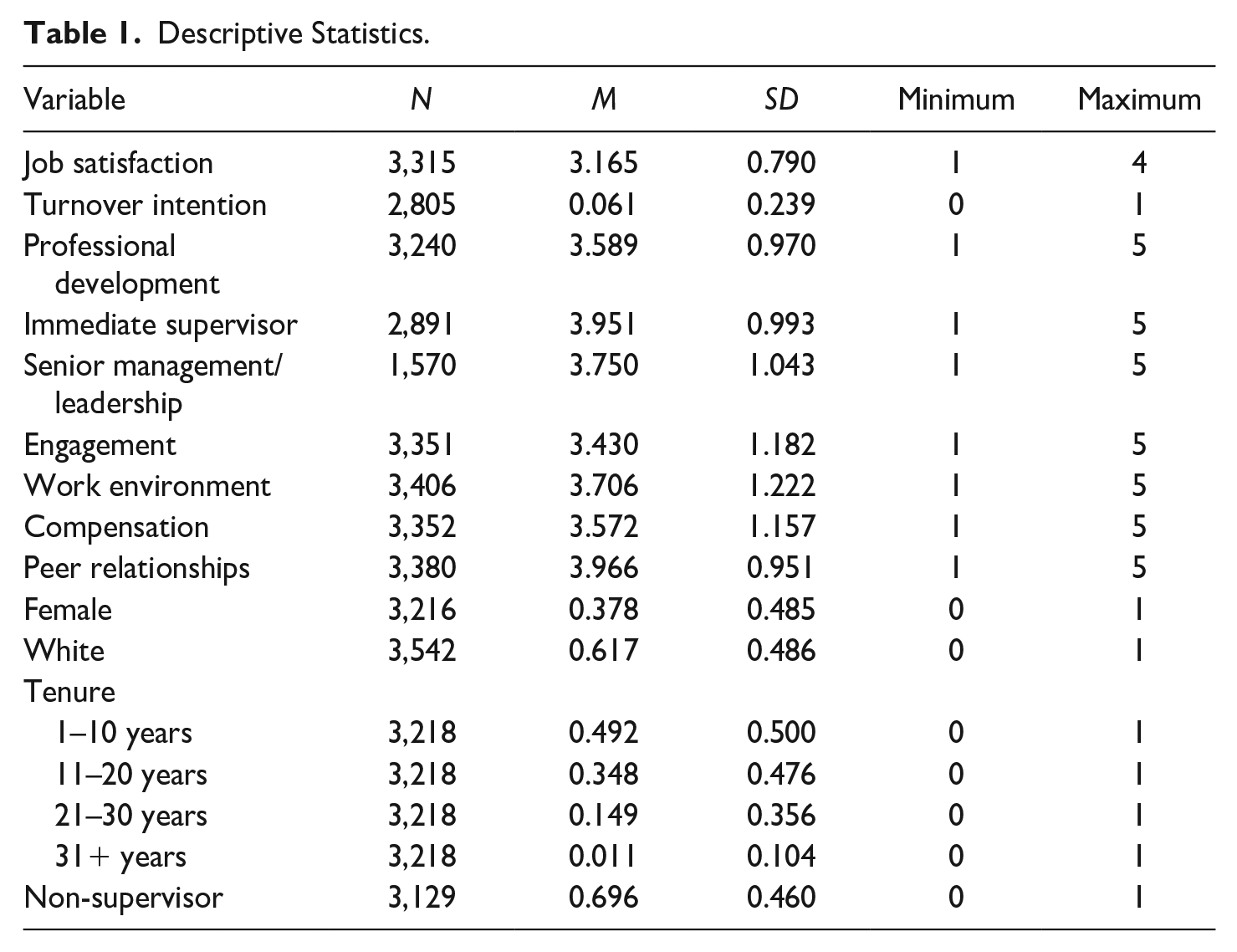
To test the research hypotheses, this study utilized data collected biannually from 2016 to 2022 through the City of Tempe Arizona’s employee survey. The survey was administered to all city employees working in various departments by an external consulting agency starting in 2016 and resulted in biannual response rates of 76%, 60%, 48%, and 37%, respectively. Although the response rate declined each year, the overall sample size for the study was still substantial with 979 observations included in the final analyses. Overall, the survey was developed to measure individual perceptions and viewpoints related to a wide range of workforce and employment characteristics. In addition, the study also collected important demographic information from respondents, such as race and gender. Table 1 depicts the distribution of the variables included in this study’s analytical sample.
Descriptive Statistics.
Job Satisfaction
A single survey item was used to measure overall employee job satisfaction. Here, the survey asked, “Overall, how satisfied are you with your current job?” Respondents were required to use a 4-point Likert-type scale, ranging from “Very Satisfied” (coded “4”) to “Very Dissatisfied” (coded “1”). In addition, responses of “Don’t know” were coded as missing. Prior studies have validated the use of this single survey item as a construct for job satisfaction, and as such, it has been widely employed in social science research (An et al., 2020, p. 596). Therefore, in the following analyses, this measure of job satisfaction is considered an endogenous treatment variable for employee turnover intention. However, since it is postulated that job satisfaction is endogenously determined by particular SHCM instruments, it is first treated as a dependent variable in the following analyses.
Turnover Intention
Employee turnover intention is binary and represents this study’s primary dependent variable. This variable was also measured using a single survey item. Through the City of Tempe employee survey, individuals were asked to respond to the statement— “I would like to finish my public service career with the City of Tempe.” Responses were coded “1” for “Yes”; “0” for “No”; and “.” for “Don’t Know.” Barbosa de Oliverira et al. (2019) argue that the use of this single survey item measuring turnover intention is largely supported by empirical research and is commonly utilized by researchers.
Implicitly, this survey item serves as a measure of whether or not an individual intends to pursue a career elsewhere or retire as an employee of the city government. As such, this variable represents a measure of turnover intention rather than actual voluntary turnover behavior. Because this study did not have access to actual turnover data, it was necessary to rely on employee reports of whether they planned to leave the City voluntarily. As discussed, although differences between turnover intention and behavior exist, research suggests that turnover intention is directly and positively associated with turnover behavior (Ali, 2019; Cho & Lewis, 2012; G. R. Lee et al., 2021). Therefore, this study argues that turnover intention serves as an adequate proxy for voluntary turnover behavior.
SHCM Instruments
This research employs measures of SHCM practices supported by prior literature; specifically, professional development, employee engagement, and supervisory support. Research suggests that these SHCM practices are positively associated with employee job satisfaction (Giauque et al., 2022; Penning de Vries et al., 2022; Sikora & Ferris, 2014; Vermeeren et al., 2014; Walk et al., 2022). Survey items related to each of these practices were, therefore, used to develop instruments for job satisfaction in the following analyses. For each survey item explicitly outlined below, respondents were asked to rate their level of agreement with particular statements through the same 5-point Likert-type scale that was used for job satisfaction (i.e., “Strongly Agree” coded “5”; “Strongly Disagree” coded “1”; and “Don’t Know/NA” coded as “.”).
Engagement
Prior research has largely relied on Utrecht Work Engagement Scale to develop measures of employee engagement; however, the City of Tempe’s employee survey makes limited use of preexisting measures (Breaugh, 2021; Giauque et al., 2022; Schaufeli et al., 2019; Seppälä et al., 2008). Thus, only one survey item was deemed suitable for testing. Employees were asked to rate their level of agreement with the following statement— “Overall, I am satisfied with the level of employee engagement in my department.” It is nonetheless plausible to argue that this single survey item encapsulates the three particular aspects of engagement embraced by a significant body or research; that is, vigor, dedication, and absorption (Breaugh, 2021; Giauque et al., 2022; Schaufeli et al., 2019). Furthermore, prior research by Johansen and Sowa (2019) employed a single overall measure of employee engagement by aggregating two survey items. In addition, prior research has relied on employee perceptions of engagement levels to estimate this construct (Hassett, 2022; White & Cadiz, 2013).
Professional Development
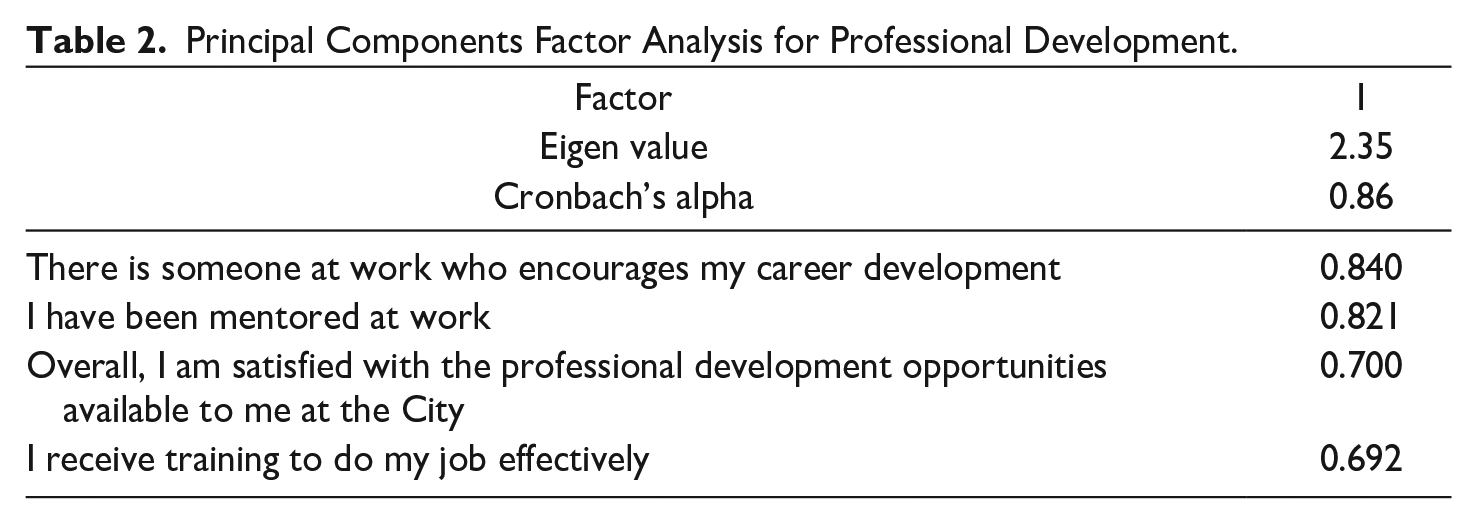
To create a valid construct for professional development initiatives, four survey items were included in a principal component factor analysis. Similar to Lim et al. (2017), variables that gauge the degree of professional development initiatives, as well as employee satisfaction with such initiatives were analyzed. Table 2 lists these survey items and the results of the factor analysis. All four items loaded strongly onto a single factor with an Eigenvalue greater than 1. In addition, the chi-square value for the Bartlett test of sphericity is high (6,102.70) and statistically significant (p<.000), suggesting that the survey items are intercorrelated. Internal reliability statistics also illustrate a sufficient fit, with a Cronbach’s alpha value of .86. As such, items were aggregated into a one-dimensional professional development measure.
Principal Components Factor Analysis for Professional Development.
Supervisory Support
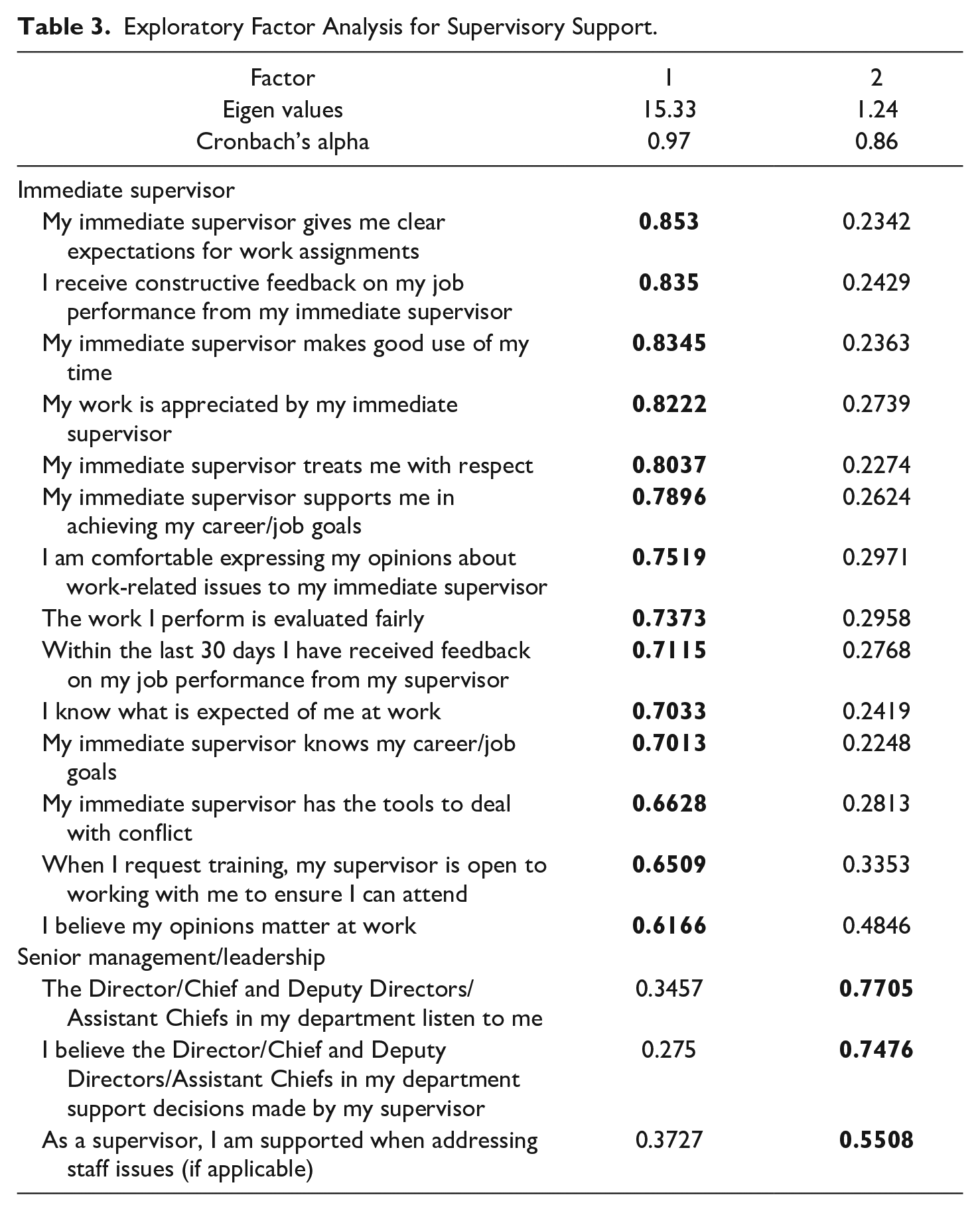
Following research by Barbosa de Oliverira et al. (2019), exploratory factor analysis was used to develop measures for supervisory support. Given that the City of Tempe’s employee survey asks individuals to answer 27 questions related to their perceptions of supervisory support, exploratory factor analysis was deemed the most appropriate technique for the aggregation of variables that were intercorrelated and intuitively measured similar constructs (Barbosa de Oliverira et al., 2019). Through the factor analysis, 19 survey items loaded onto two factors with Eigen values >1, and thus were retained. Once again, the chi-square value for the Bartlett test of sphericity was high (33,141.08) and statistically significant (p<.000), indicating that measures included in the analysis are intercorrelated. Intuitively, survey items that appeared to be related to support provided by one’s immediate supervisor loaded onto Factor 1; whereas, survey items that seemed to capture support provided by senior management and/or leadership positions loaded onto Factor 2. Consequently, each cluster of survey items was aggregated to create two new indexes designed to serve as indicators of employee perceptions of support offered by their (a) immediate supervisors and (b) senior management/leadership. Cronbach’s alpha for the indexes measuring immediate management support and senior management/leadership support are 0.97 and 0.86, respectively. Table 3 provides the detailed results of the exploratory factor analysis.
Exploratory Factor Analysis for Supervisory Support.
Control Variables
This study includes several organizational characteristics to control for their likely effects on employee job satisfaction and turnover intention. In particular, the models control for employee perceptions of their work environment, overall compensation, and peer relationships. Prior research suggests that each of these variables is positively associated with job satisfaction and negatively associated with turnover intention (see S. Lee & Whitford, 2008; Maroulis, 2017; Sanchez-Sanchez & Fernandez Puente, 2021; Selden & Moynihan, 2000; Wright & Davis, 2003).
In addition, this study controls for employee tenure length, position type, and employment status. Survey respondents were asked to report the length of time they worked for the City, using a 4-point scale with 10-year increments (i.e., 1–10 years, 11–20 years). Employees were also asked to report on whether or not they served in a supervisory capacity. It should be noted that this article does not speculate on the directional relationship between these variables and employee job satisfaction and turnover intention.
Finally, this study also controls for employee demographics in terms of race and gender with binary variables. For gender, individuals that reported being female were coded as “1” and “0” otherwise. Similarly, employees that reported being white were coded as “1” and “0” otherwise. Once again, a clear expectation for the direction or impact of these controls is not established.
Methods
This research employs a two-stage least squares (2SLS) regression framework to shed light on the causal relationships between SHCM, job satisfaction, and turnover intention. With 2SLS regression, instrumental variables that are correlated with independent variable of interest, but not the dependent variable, uncouple the exogenous and endogenous effects of the independent variable of interest, assuming all exogenous controls are included in the equation (Themudo, 2014). The basic formula for the first stage in the regression model is illustrated in Equation 1:

Here, the endogenous variable X or job satisfaction is regressed against I or instruments (i.e., professional development, employee engagement, direct supervisor support, and general management/leadership support), and C or the exogenous controls in the equation. The predicted values for Xˆ or job satisfaction are calculated in the first stage. Then, in the second stage of the regression, shown in Equation 2, the predicted values of Xˆ, instead of the actual values of X, are used to isolate the true correlation between job satisfaction and turnover intention (Jimenez, 2017).

Importantly, the use of 2SLS regression is ideal, given that all the data examined in this study are derived from a single source. That is, 2SLS regression eliminates the possibility of common source bias, since the measures used represent the predicted values of X, not the actual values of X (Jimenez, 2017; Wooldridge, 2009).
In the first and second stage regressions, department and year fixed effects are included to control for changes in job satisfaction and turnover intention within departments over time. Doing so is undoubtedly crucial to account for the emergence of the COVID-19 pandemic and the likely effects that it imposed on the City’s labor force. In addition, robust standard errors are clustered at the departmental level, since failure to account for the multilevel nature of the data can bias standard errors downward (An et al., 2020; Raudenbush & Bryk, 2002). Finally, although I observe 4 years of data for city departments and control for department and year fixed effects, individual level identifiers for respondents were not collected to maintain employee confidentiality. Consequently, it was not possible to account for employee fixed effects.
Findings
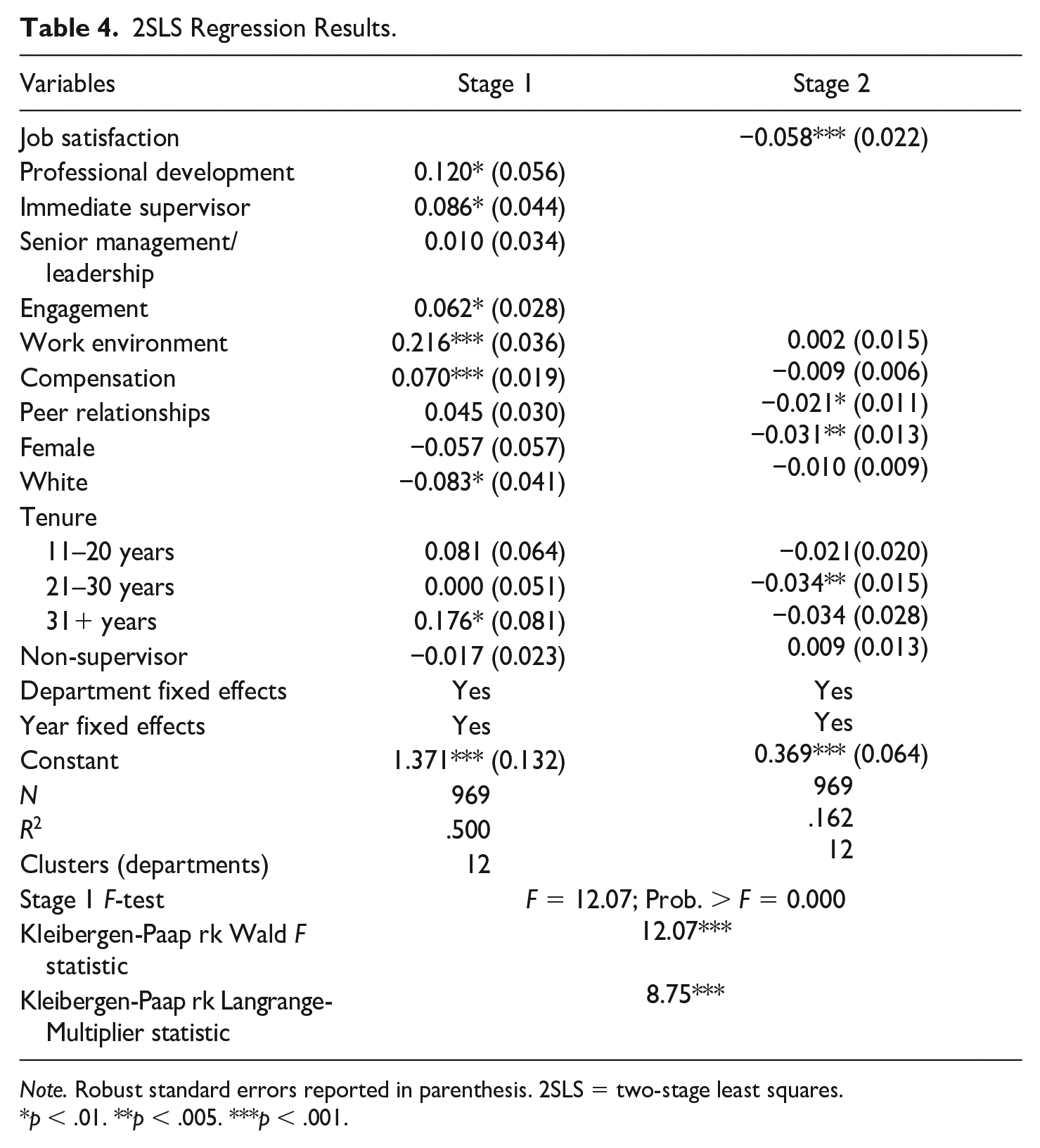
The results of 2SLS regression analysis are reported in Table 4. The model’s R2 value shows that a significant proportion of the variability in the dependent variable is explained by the covariates. That is, the model shows that 50% of the variability in employee job satisfaction is explained by the covariates after controlling for sample size and number of parameters. Results of the first stage regression show that employee satisfaction with the City’s professional development initiatives is positively associated with overall job satisfaction. In addition, the statistically significant and positive coefficient for the measure of employee satisfaction with support from one’s immediate supervisor provides evidence that it has a favorable effect on job satisfaction. However, while the coefficient for employee satisfaction with senior management and leadership support is positive, its impact was not statistically significant. Thus, it is not realistic to argue that this instrument impacts employee job satisfaction. Nonetheless, the statistically significant and positive signed coefficient for employee satisfaction with engagement initiatives does in fact positively predict employee job satisfaction. Therefore, these first-stage results, taken together, generally provide substantial support for H1.
2SLS Regression Results.
Note. Robust standard errors reported in parenthesis. 2SLS = two-stage least squares.
p < .01. **p < .005. ***p < .001.
Findings concerning the first-stage control variables were somewhat mixed, however. The controls measuring various organizational characteristics performed largely as expected. That is, measures of employee satisfaction with their work environment and compensation were statistically significant and positively associated with job satisfaction. Alternatively, the control measuring employee peer relationships produced a negative coefficient, though it was not statistically significant. Likewise, the binary controls for gender and supervisory status exhibited negative coefficients but did not produce statistically significant relationships with employee job satisfaction. The binary control for race did, however, exhibit a negative and statistically significant relationship with employee job satisfaction. In particular, being white, relative to all other races, was negatively associated with job satisfaction. Findings also suggest that controlling for tenure length also matters. Here, working for the City for 31 or more years, relative to working for the City for at least 10 years, was positively associated with job satisfaction. However, working for the City for 11 to 20 years and 21 to 30 years, relative to working for the City for at least 10 years, did not produce statistically significant relationships with job satisfaction.
Moving on to the second stage results, the R2 value shows that 16.7% of the variability in employee job satisfaction is explained by the covariates after controlling for sample size and number of parameters. More importantly, however, the endogeneity test statistics in Table 4 provide strong evidence that employee job satisfaction is endogenously determined and the instrumental variables employed are appropriate. The statistically significant results of the first stage F-test of excluded instruments indicate they are jointly significant and correlate with job satisfaction (Jimenez, 2017). In addition, the Kleibergen-Paap rk Wald F statistic of 21.63 is quite high and rejects the proposition that the explanatory power if the instruments is weak. Though the Kleibergen-Paap rk LM statistic of 8.82 is moderate and suggests that under identification of the model may be an issue, it is important to interpret this test with caution due to the limited number of clusters included in the analysis. Therefore, overall, these results provide strong support for H1 and H2.
Given that there is significant data suggesting that the SHCM practices serve as valid instruments and job satisfaction is endogenous, the remainder of this section, therefore, focuses on the results of the second stage regression provided in Table 4. Here, after instrumenting for the predetermined SHCM variables, this research finds that job satisfaction does indeed hold a negative and statistically significant relationship with employee turnover intention, thus supporting H2.
The controls performed differently in the second stage regression, with respect to the first stage regression. That is, the control for peer relationships was negatively associated with employee turnover intention, while work environment and compensation were not significantly associated with turnover intention. Being employed 21 to 30 years, relative to being employed 1 to 10 years, was found to be negatively associated with turnover intention. Although being employed 11 to 20 years and 30 or more years, relative to being employed 1 to 10 years, were not significantly associated with the turnover intention. Finally, in the second stage regression, the binary controls for supervisory status and race were not statistically significant predictors of employee turnover intention. However, being female, relative to not being female, was negatively associated with turnover intention and this relationship was statistically significant.
Discussion and Conclusion
Contributions
This article began by asserting that more research is necessary to establish a causal relationship between SHCM, job satisfaction, and turnover. Therefore, this study makes two primary contributions to the extensive body of literature that investigates the numerous outcomes of SHCM in the public sector. First, this study finds significant evidence that employee job satisfaction is endogenously determined by employee perceptions of SHCM practices. In particular, employee satisfaction with professional development, supervisory support, and employee engagement practices were found to be positively associated with employee job satisfaction. Though only one of the two supervisory support variables was found to be significantly associated with employee job satisfaction. More specifically, the construct measuring the support that one receives from their immediate supervisor was positively and significantly related to job satisfaction, whereas the measure of support provided by senior management and/or leadership did not exhibit a statistically significant relationship. At first blush, it seems reasonable that both of these measures would be statistically significant predictors of job satisfaction. However, because direct supervisors have more frequent and substantive interactions with their employees, relative to supervisors at the upper organizational echelons, it is rather intuitive to assume that the support received from one’s direct supervisor is fundamentally more impactful. In fact, some employees will have very little interaction with upper level managers and leaders on a day-to-day basis, thus employees are not likely to perceive them as providing frequent and genuine support (Colbert et al., 2016; Mylona & Mihail, 2019; Penning de Vries et al., 2022; Selden, 2009).
Second, this article empirically demonstrates that job satisfaction is endogenous and negatively associated with employee turnover intention. That is, employee satisfaction with professional development, supervisory support, and engagement practices indirectly impacts turnover intention through higher job satisfaction levels. By and large, prior public sector research has examined the relationship between SHCM and job satisfaction, in addition to job satisfaction and turnover, separately. Alternatively, it has assumed that SHCM is a direct predictor of employee turnover without adequate causal evidence (Boselie et al., 2021; H. Lee, 2017; Ray et al., 2023; Suh & Battaglio, 2022; Watty-Benjamin & Udechukwu, 2014).
The findings of this study provide both theoretical and practical implications. In particular, while the results provide additional evidence of the many positive outcomes related to SHCM practices, this study illustrates that they do not always serve as direct predictors. As such, scholars and practitioners should be cautious when making causal assumptions concerning the effects of SHCM. By making SHCM investments, organizations may not directly achieve the desired outcome(s). In addition, this research further illuminates the importance of employee job satisfaction in public sector organizations, especially in terms of its relationship with employee turnover intention. Scholarship has clearly shown that turnover intention predicts voluntary turnover behavior, which is largely associated with negative performance-related outcomes (Ali, 2019; Cho & Lewis, 2012; Cohen et al., 2016; G. R. Lee et al., 2021; Stritch et al., 2020). Given that satisfied employees are less likely to consider leaving an organization, managers should continue to focus on employing strategies designed to enhance satisfaction levels (G. R. Lee et al., 2021).
Limitations and Future Research
Despite this study’s fruitfulness, it is necessary to acknowledge its limitations and underscore areas that warrant further investigation. Since this study used cross-sectional data for a single organization that only covered 4 years and did not track employees across years, its findings have limitations in terms of external and internal validity. A more robust longitudinal data set that follows employees over a lengthier period of time would hamper internal validity concerns and allow researchers to make stronger causal assertions. Furthermore, because this study focuses solely on the City of Tempe, additional research is needed to address potential external validity issues and determine if this study’s hypothesized relationships hold the same bearing on other governmental entities, especially beyond the local level. In addition, despite the strong statistical evidence that endogeneity is present in the regression models, it is plausible that additional endogenous factors (e.g., organizational culture) are omitted. Albeit beyond the scope of this article’s theoretical framework, future scholarship should consider investigating whether or not additional instruments play a role in the dynamic relationship between SHCM, job satisfaction, and turnover intention.
Finally, because actual turnover data were not accessible, this study had to utilize a proxy for turnover behavior as its dependent variable in the second-stage regression. The construct used officially measures employee turnover intention, not turnover behavior. Scholarship, however, has shown that turnover intention directly predicts turnover behavior (Ali, 2019; Cho & Lewis, 2012; G. R. Lee et al., 2021). Therefore, it’s reasonable to argue that the outcomes of this study would remain relatively unaltered had a measure for actual turnover behavior been employed. Still, it remains important to interpret the results with caution, and when possible, future research should avoid using proxies for turnover to produce more confident conclusions.
Closing
Overall, by underscoring the importance of replicating this research and proposing recommendations for future scholarship, this article has drafted an empirical roadmap for future researchers to follow. Traditional personnel theories assume that SHCM practices can causally influence performance-related outcomes, such as employee turnover. This research, however, sheds light on the necessity of considering potential endogeneity between SHCM and organizational factors that directly influence performance. In this study, SHCM practices indirectly affect employee turnover through job satisfaction. Substantively, the results suggest that effective SHCM practices lead to heighten levels of employee job satisfaction, which in turn, reduces employee turnover. In short, while additional research is required, this study highlights the value of SHCM and concurrently encourages scholars and practitioners to rethink the ways in which it plays a role in the performance dynamic of organizations.
Footnotes
Declaration of Conflicting Interests
The author(s) declared no potential conflicts of interest with respect to the research, authorship, and/or publication of this article.
Funding
The author(s) received no financial support for the research, authorship, and/or publication of this article.
