




Abstract
This study systematically develops an online training program improving line managers’ career-oriented people management behavior, including a pilot test. This program was developed based on the six steps of the Intervention Mapping protocol. Interviews were held with line managers and physicians to understand their needs and challenges with regard to people management. The program aimed to create (self-)awareness, enhance knowledge, support the exchange of experiences, and stimulate reflection on career-oriented people management behavior and leadership style and skills. Eight senior line managers of medical professionals employed in a large Dutch academic public hospital followed the training as part of the pilot test. The program was evaluated through observations, follow-up interviews, and a survey. This study makes a methodological and theoretical contribution to the human resource management literature. It shows how career-oriented people management behavior of line managers can be enhanced, which is important as earlier studies have demonstrated the benefits of this behavior. Systematically developing this program is relevant as studies have shown that the effectiveness of leadership programs is limited because of research design issues. Moreover, this study contributes to leadership development programs as this training could be offered as part of leadership programs.
Introduction
Line managers play a central role in implementing human resource management (HRM) policies and supporting employees through “people management behavior” (Knies & Leisink, 2014a; Op de Beeck et al., 2018). This refers to line managers’ implementation of HRM policies and their leadership activities (Knies et al., 2020; Purcell & Hutchinson, 2007). One important responsibility in this regard is supporting employees in their careers (e.g., Crawshaw & Game, 2015) through career-oriented people management behavior. This is understood as line managers’ implementation of career-related HR practices and line managers’ offering career support that may enhance career development. They can do so, for instance, by empowering employees so that they can behave proactively (Audenaert et al., 2020), and creating an employable workforce (Van der Heijden & Bakker, 2011), among others by facilitating and stimulating employees’ ability and willingness to work and continue working until the retirement age (Oude Hengel et al., 2012). The importance of line managers’ career-oriented people management behaviors and employees’ proactive career behaviors has increased with the rise of the retirement age (which resulted in an aging workforce) and the dynamic and demanding work context (e.g., Baruch, 2004; De Vos & Van der Heijden, 2015). This has challenged employees’ employability during the course of their careers, that is, their ability and willingness to work and continue working until retirement age (Oude Hengel et al., 2012). This makes effective people management important to ensure that employees can continue their work in a challenging work environment.
Despite the urgency of line managers’ people management behaviors, their success in doing so is unclear. Human resources (HR) professionals and line managers often consider line managers’ HR skills and knowledge inadequate. They, for instance, refer to a lack of necessary skills and knowledge needed for line managers’ leadership responsibilities, such as awareness of relevant career opportunities and communication skills (e.g., Crawshaw & Game, 2015; Perry & Kulik, 2008). However, if line managers successfully fulfill these specific career-oriented leadership responsibilities, this results in beneficial individual and organizational-level outcomes such as increased job satisfaction, well-being, employability, and job performance of employees (e.g., Arnold, 2017; Gilbert et al., 2011; Op de Beeck et al., 2018). The beneficial potential of career-oriented people management behaviors makes it relevant to examine how line managers can be supported in effectively implementing these leadership responsibilities. However, to our knowledge, so far, no leadership programs have focused on enhancing career-oriented people management behavior. The effectiveness of leadership programs with other foci has been studied in intervention studies, such as transformational and/or transactional leadership (e.g., Avolio et al., 2009; Jacobsen et al., 2022). Although highly relevant to our understanding of how certain leadership behaviors can be stimulated in an organizational intervention, these interventions do not address line managers’ career-oriented people management behavior. Rather, studies into people management behavior mainly focus on its antecedents, outcomes, or measurement (e.g., Knies et al., 2020; Penning de Vries, 2021; Perry & Kulik, 2008). This study adds to this body of literature by elaborating on the design of an intervention study to examine how line managers’ career-oriented people management behavior can be stimulated. This is relevant, given the indications that training and supporting line managers is imperative for the effective implementation of leadership responsibilities (Perry & Kulik, 2008).
Existing leadership intervention studies in other areas usually focus on their effectiveness and outcomes (e.g., Avolio et al., 2009; Jacobsen et al., 2022) and rarely elaborate on how interventions are developed. The present study contributes to the HRM literature by describing the systematic development of a people management training program. Focusing on the design of interventions is important, as the effectiveness of leadership interventions is often limited due to research design issues (see Schott et al., 2020, for a review). The following research question is addressed:
This online career-oriented people management program is systematically developed and pilot-tested based on the Intervention Mapping protocol (Bartholomew et al., 2016). This study focuses on the people management behavior of line managers of physicians working in an academic hospital in the Netherlands. Line managers in this context have completed medical education and are selected as a manager from within the profession. Line managers often combine their management tasks with performing medical tasks. A people management training is highly relevant for these line managers, as they are not primarily trained for taking up leadership responsibilities. The theoretical framework explains the concepts that are central in the training intervention developed in this study.
Theoretical Framework
Understanding the Concept of People Management
People management underlines the crucial role of line managers in shaping employees’ perceptions of HRM through their implementation of HR practices and leadership behavior oriented at supporting employees (Knies et al., 2020). People management behavior consists of two dimensions (Knies et al., 2020). The first is the implementation of HR practices by line managers, which is divided into two subdimensions: the implementation of (a) general practices like training opportunities for all employees in their team, and (b) tailor-made arrangements, for instance, providing a certain employee a flexible time schedule on a certain day.
The second dimension of people management is leadership behavior, referring to a manager’s supportive behavior (Knies & Leisink, 2014b). This includes two subdimensions: support for (a) employees commitment like taking an interest in an employees’ functioning and recognize that employees could further develop in a certain area, and (b) career development, for instance, by supporting employees in their career planning (Knies et al., 2020).
Line managers’ people management behavior is important, as empirical studies have shown that this will create positive employee and organizational outcomes, such as higher employee job satisfaction, performance, and employability, possibly because employees who receive favorable treatment are likely to reciprocate with more positive work behavior and work attitudes (e.g., Blau, 1964; Gouldner, 1960; Taris & Schreurs, 2009).
This study examines career-oriented people management behavior. This means that line managers’ implementation of career-related HR practices that may enhance career development is studied. An example of this type of career-oriented people management behavior is that line managers actively offer their physicians training programs that help them to fulfill certain roles, for instance, a training program on providing education to residents. Line managers may also stimulate employees’ proactivity in designing their careers, for instance, through career crafting. This study further examines the career support that line managers offer to professionals to enhance their career potential and employability. An example of this type of career-oriented people management behavior is that line managers support physicians by discussing possible career trajectories, for instance, in terms of making promotion such as becoming a professor or head of department, or in terms of making horizontal career transitions such as changing tasks or roles such as becoming a member of a certain committee within the hospital or in one’s professional association.
People Management in Public Professional Organizations
This study examines line managers working in a Dutch hospital. Theorizing suggests that there is no simple public–private sector dichotomy (Knies et al., 2020). Instead, there are varying degrees of publicness, depending on ownership (i.e., government-owned), funding (i.e., publicly funded), and authority (i.e., political authority dominant over economic authority) (Rainey, 2009). In the Netherlands, health care is provided by legally private bodies delivering a public service (ownership) (Knies et al., 2018), which are publicly financed (funding) and are subject to government control (authority). As such, hospitals in the Netherlands are public in terms of funding and authority, but not in terms of ownership. They can therefore be considered to be semi-public. Several distinctive features of people management by line managers in the public sector have been mentioned in the literature, such as (a) line managers are increasingly responsible for the implementation of HR practices due to devolution, (b) line managers working in the public sector perceive higher levels of red tape in the form of personnel rules and constraints than private sector managers, and (c) public sector line managers experience constraints on their discretionary room due to the influence of government control and political oversight (Knies & Leisink, 2018; Penning de Vries, 2021).
Despite these features of people management by line managers working in the public sector, differences within the public sector exist (Knies & Leisink, 2018; Penning de Vries, 2021). This may, for instance, be due to characteristics of the professional setting where the line managers in this study work (Penning de Vries, 2021). The professional work setting is characterized by highly specialized knowledge and skills, a high degree of job autonomy, strong self-regulation through strong intra-occupational norms and social closure from “outside” influences (Andersen et al., 2018; Freidson, 1994). The latter is reflected in how line managers are selected, that is, they are typically appointed from within the profession. In health care, this results in doctors becoming “hybrid” managers who combine both roles (Currie et al., 2016). The fact that these line managers are trained as doctors and are not primarily trained for their leadership role might create challenges for their people management behavior. Moreover, the high autonomy and self-control that professionals have might result in a negative attitude toward line managers who might attempt to interfere with this professional autonomy (Freidson, 1994; Noordegraaf, 2015). These challenges are likely to result in different needs of line managers in professional settings compared with non-professional work settings (Veld et al., 2010), making it relevant to examine the people management behavior of line managers in a professional context.
People Management Training for Line Managers
Developing and implementing a people management training program is expected to contribute to line managers’ expression of people management behavior and to create positive perceptions in their teams regarding their leadership behavior. This hypothesis is based on earlier empirical evidence for a positive relationship between supporting and training line managers and people management effectiveness (Perry & Kulik, 2008). Leadership training has further been shown to enhance employees’ perceptions of supervisory support (Tafvelin et al., 2019). Theoretically, this expectation is based on the resource-based view of the firm (Wright et al., 1994). According to this view, resources are the main sources of competitive advantage for an organization. Among these, human resources (in particular human knowledge, skills and attitudes) are highlighted (Barney, 1995). Training is considered the main activity to enhance these aspects (Aragon & Valle, 2012).
Method
Sample and Procedure
This study took place among line managers of physicians working in a Dutch academic hospital. These hospitals are primarily financed by public funds and subject to public regulation (Knies et al., 2018). In this academic setting, professionals are employed by the hospital, and there is a formal hierarchy between the board of the hospital, line managers, and professionals. Line managers of medical specialists are typically medical doctors. These line managers are usually the head of a medical department and appointed by de board of directors of the hospital. They have both medical and management responsibilities, meaning that they provide patient care and are responsible for the performance of their team in terms of, for example, quality of care, finance, and HRM.
The local Medical Ethical Committee of the hospital reviewed the study and argued that this study falls outside the scope of the Dutch Law on Medical Research and therefore no formal ethical approval was required (WMO) (METC 2019; 21-244/C). Nevertheless, this study adhered to the following standards to protect the participants. The online survey started with a cover letter informing participants about the content and aim of the study and assured them that participation was voluntary, and that responses would be kept confidential. Participants provided informed consent before moving on to the survey items. The intervention was registered in the Netherlands Trial Register (ID9562).
The Intervention
The intervention was systematically developed following the six steps of the Intervention Mapping protocol: (1) needs analysis, (2) definition of program objectives, (3) methods and practical applications, (4) intervention program development and pilot test, (5) adoption and implementation, and (6) evaluation (Bartholomew et al., 2016). Moving back and forth between the steps is part of this process.
Step 1: Needs Analysis
The needs analysis included several aspects. First, needs and challenges of line managers and physicians were collected in interviews with nine line managers and 15 physicians (Appendix B). These interviews focused on physicians’ needs to stay employable and line managers’ people management behavior. Second, the current status quo was examined in a survey sent to line managers and physicians prior to the training program to examine line managers’ current people management behavior on all four dimensions according to themselves and the physicians in their team. And third, the content of the training program was informed by the needs analysis elaborated upon in Van Leeuwen (2022), and by existing career-oriented training interventions (Van Leeuwen et al., 2020).
The first part of the needs analysis consisted of interviews with line managers and physicians. Results show that physicians experienced a lack of support from their line managers in their careers and in staying employable during their careers. This is in line with the findings from the interviews with line managers, who mentioned that they are not actively involved in this. These line managers mentioned several reasons for their lack of career-oriented people management behavior. First, some explained that this was due to their lack of knowledge and skills needed for managerial tasks. Second, some stated that the production-driven environment in which they work withheld them from starting conversations about what physicians need to continue their careers, as they believe they have nothing to offer. Third, many line managers were unfamiliar with career possibilities for physicians, which withholds them to start career conversations. And last, some believed that it was not their responsibility to pay attention to this but that physicians are self-responsible for this. Despite these reasons for the passivity of many line managers, physicians ask for more personal attention and tailor-made arrangements which support them to continue their work. An elaborate description of the outcomes of the interviews that were used for the needs analysis can be found in Van Leeuwen (2022).
The second part of the needs analysis was done by sending a survey to line managers and physicians prior to the training program. Findings show that line managers did not actively implement general HR practices for physicians in their team (see Table 1). They were more involved in offering tailor-made arrangements and providing support for physicians’ commitment. In general, line managers evaluated their own people management behavior more positively than physicians. This difference was significant for line managers’ implementation of tailor-made arrangements, F(1, 48) = 7.33, p = .009, and their support for physicians’ commitment, F(1, 51) = 7.77, p = .007.
Means and Standard Deviations for Line Managers’ People Management Behavior.
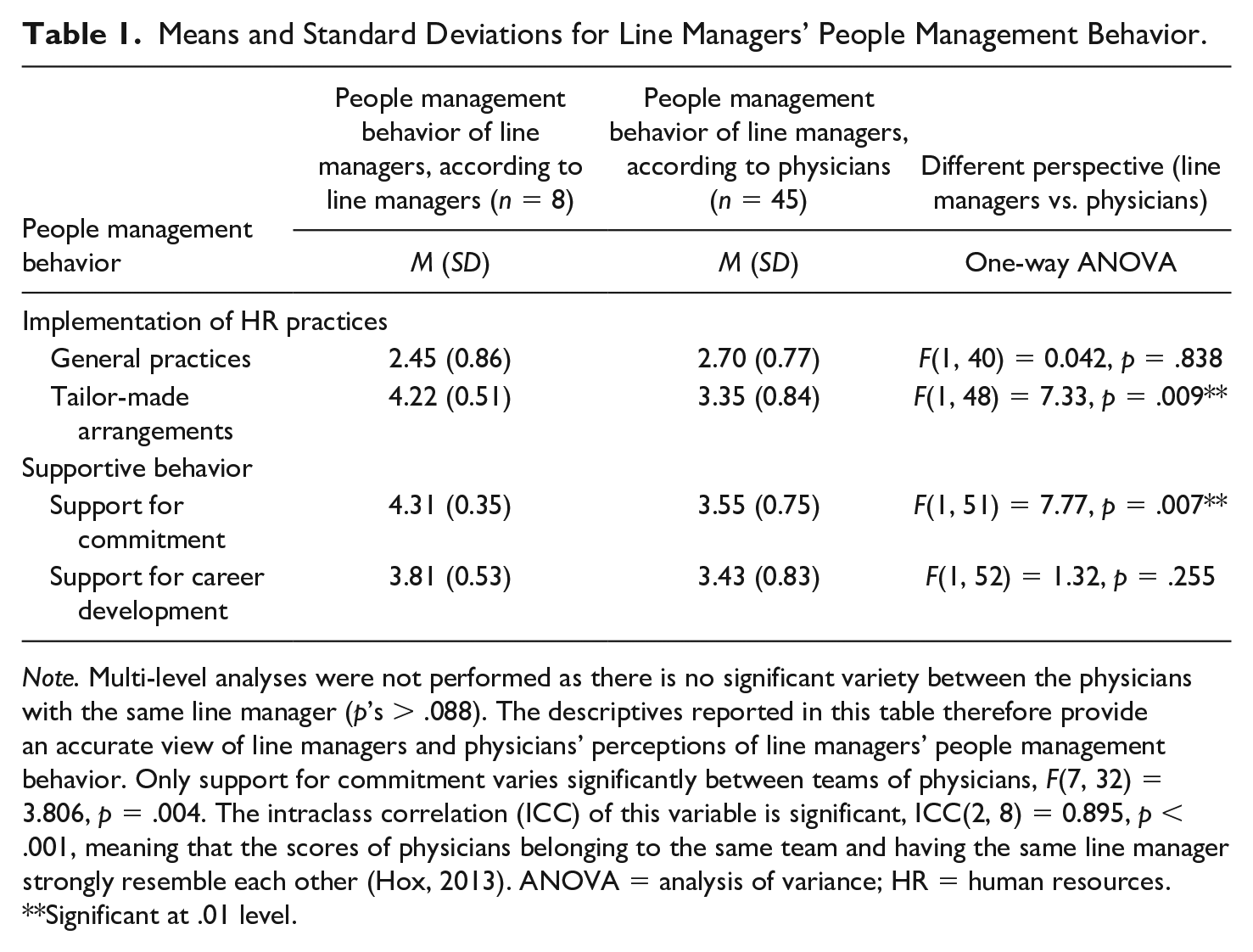
Note. Multi-level analyses were not performed as there is no significant variety between the physicians with the same line manager (p’s > .088). The descriptives reported in this table therefore provide an accurate view of line managers and physicians’ perceptions of line managers’ people management behavior. Only support for commitment varies significantly between teams of physicians, F(7, 32) = 3.806, p = .004. The intraclass correlation (ICC) of this variable is significant, ICC(2, 8) = 0.895, p < .001, meaning that the scores of physicians belonging to the same team and having the same line manager strongly resemble each other (Hox, 2013). ANOVA = analysis of variance; HR = human resources.
Significant at .01 level.
Step 2: Defining Program Objectives
The second step of the Intervention Mapping protocol is to identify the objectives for the program and the specific behavior, that is, what needs to change in order for the participants to show the desired new behaviors? This program aimed to create awareness, enhance knowledge, increase self-awareness, support the exchange of experiences, and stimulate reflection on career-oriented people management behavior and current leadership style and skills.
Step 3: Methods and Practical Applications
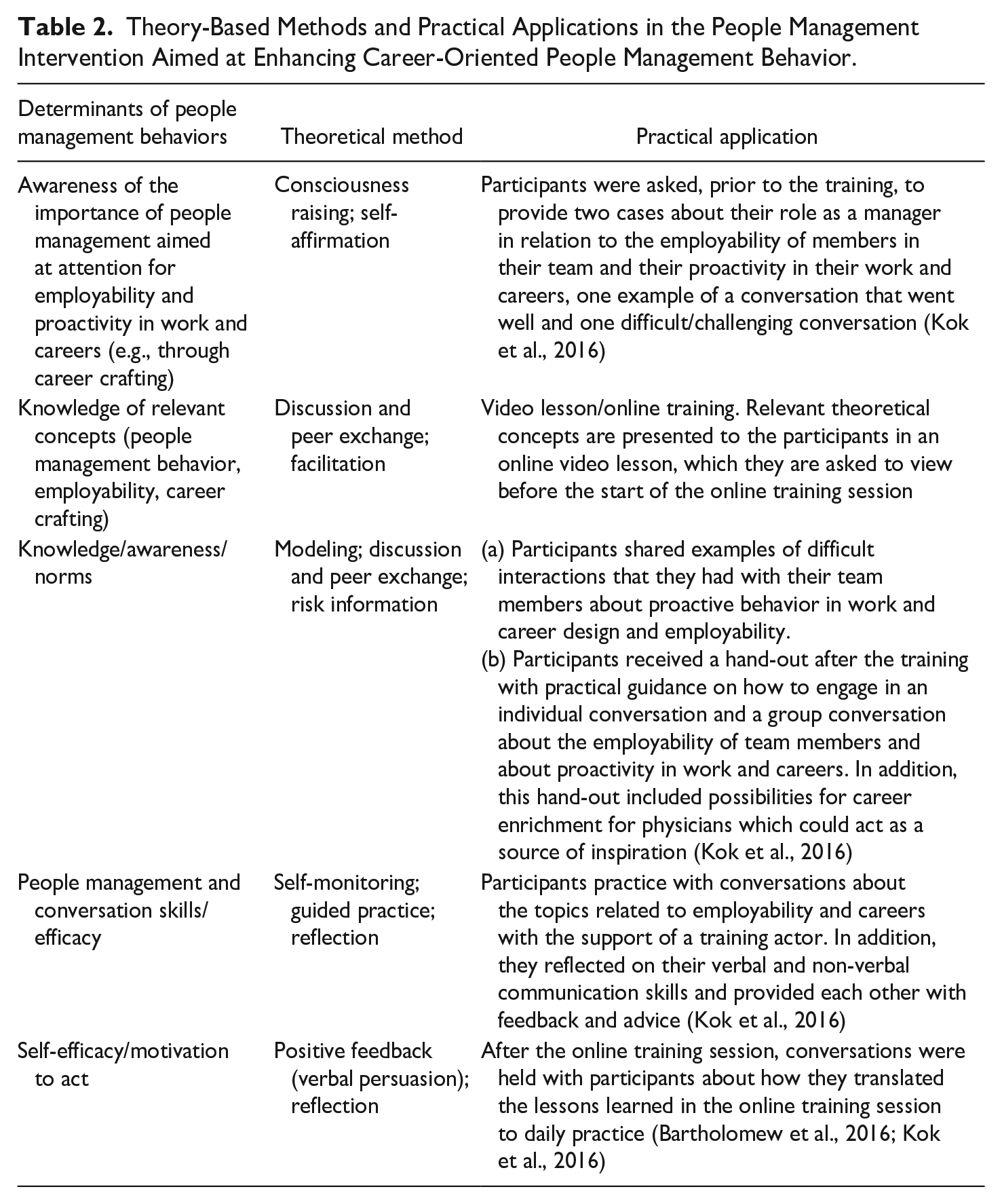
In line with the third step of the Intervention Mapping protocol, several methods were identified and used in practical applications to achieve these program objectives (see Table 2).
Theory-Based Methods and Practical Applications in the People Management Intervention Aimed at Enhancing Career-Oriented People Management Behavior.
Step 4: Development of Intervention Program
The career-oriented people management program for line managers was further developed with a planning group that advised on the content of the program. This group included the researchers of this study, a senior board member of the hospital, and three line managers of physicians. The program included information on how leaders can stimulate proactive behaviors of their employees. As such, this study emphasizes and integrates a career perspective that includes a focus on career proactivity and employability of team members, as part of existing people management behaviors. To do this, tools from leadership development and coaching interventions were used, such as the Goal-Reality-Options-Will model, also known as the GROW model (Whitmore, 1992). The career-oriented people management program consisted of several elements. First, one-on-one intake conversations were held with line managers to explain the process of the program. Line managers provided two examples of conversations with staff about a topic related to employability or proactivity in work or career design (one successful and one challenging conversation). The first cases were used to further develop the content of the training program. The latter cases were used as practice material during the training session.
Line managers were further asked to watch a video lesson before the group session. This video was specifically designed for this program and covered the background and theory of the main concepts discussed in the program (i.e., people management behavior, employability, and career crafting), how a coaching people management leadership style can support employee proactive career and work behavior through career crafting and the job demands-resources (JDR) theory, which explains the relationship between job demands and resources on one hand and outcomes such as well-being, motivation, and performance on the other (Demerouti et al., 2001).
After watching the video, line managers took part in an online training session, lasting three and a half hours. The session focused on line managers’ role in physicians’ employability and their role in stimulating the career proactivity of physicians in their team, recognizing their own leadership and communication style. The literature on people management behavior was used as background information on the areas where line managers could be supportive in and to provide concrete examples of career-oriented people management behavior (Knies et al., 2020). Furthermore, line managers practiced their communication skills and held career-oriented conversations with the support of a training actor about the difficult cases that they provided. Peers exchanged ideas and experiences when discussing the cases related to employability and proactivity of physicians.
After the online training, line managers received a hand-out with instructions and advice on the implementation of the lessons learned in the training in conversations with physicians in their team about employability and stimulating proactivity (for instance, through career crafting). Line managers were asked to organize a one-on-one conversation with a physician in their team and a group conversation with their team of physicians on topics related to their employability and proactivity.
Step 5: Adoption and Implementation of a Pilot Program
The program was adopted and all medical line managers (n = 38) were invited via email to participate in this leadership program as part of the pilot test. Eight line managers participated in the people management program. These eight managers (two women and six men) were on average 51.25 years old (SD = 7.40) and had on average 8 years of experience as a line manager (SD = 8.12). The size of their teams varied from five to 12 physicians.
Step 6: Evaluation of a Pilot Test
Line managers’ experiences with the online career-oriented people management program were examined in a pilot test. This was done by collecting qualitative and quantitative data in (a) observations, (b) follow-up interviews, and (c) a survey (cf. Abildgaard et al., 2016).
First, qualitative data were collected in observations during the training program to better understand line managers’ experiences with supporting physicians in their team in topics related to employability and proactivity. Attention was paid to examples of their current people management behavior and factors that helped or hindered them to engage in people management behavior.
Second, follow-up interviews with line managers examined the factors that helped and hindered effective implementation of the learning points from the intervention in daily practice, and contextual factors that affected the behavior of line managers (see Appendix C for the topic list). The questions were based on the important aspects of process evaluations focusing on three dimensions: (a) contextual factors that act as barriers or facilitators that affect the training transfer and implementation of new behaviors after the intervention, (b) factors in this implementation process, and (c) participants’ mental models referring to participants’ attitudes toward the intervention (Nielsen & Randall, 2013; Van Leeuwen et al., 2020) (see Appendix A).
Third, quantitative data were collected in a survey completed by line managers 12 weeks after the program. Before distributing the survey, it was tested on the content and wording of the items by line managers. The survey examined the effectiveness of different elements of the training intervention, participants’ satisfaction with and degree of participation in the intervention, and their use of the intervention in daily practice. The questions were based on the aspects of process evaluations (Nielsen & Randall, 2013) (Appendix A) as well as the model on abilities, motivation, and opportunities within the work environment (also known as the AMO model) which has been shown to affect performance and influence behavior (Appelbaum et al., 2000).
The qualitative data collected in observations and interviews were analyzed using open, axial, and selective coding (Boeije, 2005). First, interviews and notes from the observations were open-coded, resulting in a list of codes. Then, the data were categorized by linking data elements to appropriate codes (axial coding). This resulted in a coding scheme with the following codes: contextual factors (subcategories: opportunities, time, priority, trade-off with production, planning and Covid-19 policies), appreciation of training elements (video lesson, peer exchange, practicing with training actor, “homework” assignments, and the online format), and effects of training program (subcategories: reflection, stimulation, motivation, and self-efficacy). This coding scheme was used for selective coding.
The quantitative data collected in surveys as part of the needs assessment and a survey to evaluate the pilot test were described (Ms and SDs) for the different dimensions of people management behavior. Furthermore, as part of the needs analysis, line managers’ perceptions were compared with physicians’ experiences using one-way analyses of variance. People management behavior was examined with a scale developed by Knies et al. (2020) measuring its two dimensions: (1) implementation of HR practices with the implementation of (a) general practices (αemployees = 0.94; αmanagers = 0.93) and (b) tailor-made arrangements (αemployees = 0.80; αmanagers = 0.76) and (2) leadership behavior showing support for employee’s (a) commitment (αemployees = 0.91; αmanagers = 0.59 1 ) and (b) career development (αemployees = 0.90; αmanagers = 0.77) from the perspective of professionals (e.g., “My line manager shows an interest in my personal functioning”) and line managers (e.g., “I inform employees in my team about opportunities for training and development”). Examining people management from both line managers’ and professionals’ perspectives is important, as research has shown that their perceptions may vary (e.g., Boselie et al., 2009; Lee & Carpenter, 2018). Answers were given on a 5-point Likert-type scale (strongly disagree–strongly agree).
Results of the Pilot Test
A quantitative survey together with qualitative follow-up interviews provided insight in line managers’ experiences with this program. Quantitative data from the survey (Table 3) show that line managers are in general very positive about this training program. They stated that the training program was mainly effective in enhancing consciousness and motivation to engage in people management behavior and was less effective in enhancing skills for conversations with physicians about their careers and employability.
Evaluation of Process Elements (n = 6).
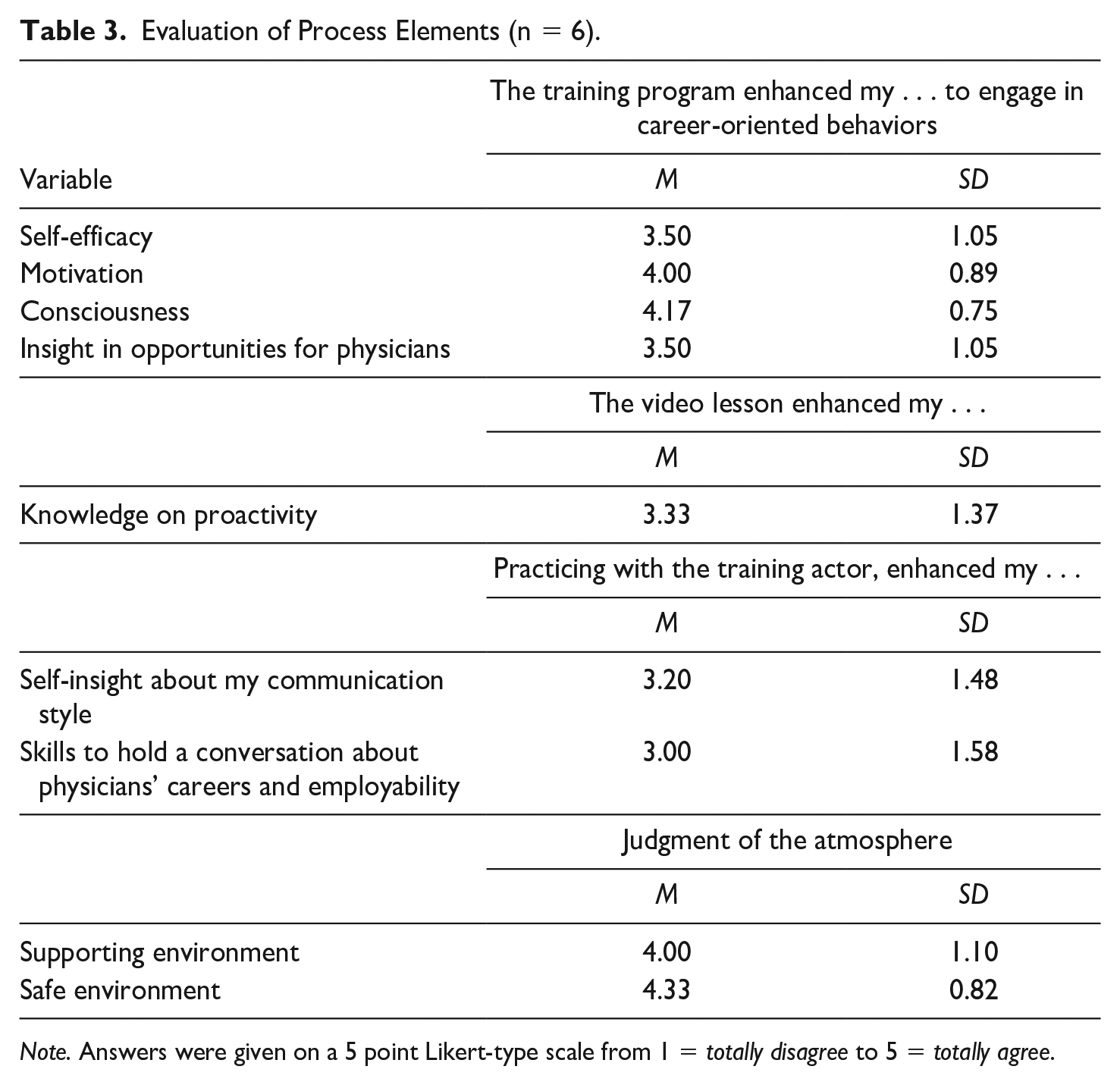
Note. Answers were given on a 5 point Likert-type scale from 1 = totally disagree to 5 = totally agree.
This is in line with line managers’ experiences as expressed in qualitative follow-up interviews held after the training program. Line managers explained that participating in this program in general enhanced their consciousness of the importance and reflection on their own people management behavior and attention for the employability and proactivity of their team members. One line manager explained that this training program acted as a “reality check” (R6). Reflecting on his people management behavior in this program made him aware of the importance of “constantly keeping an eye on the people in his environment.”
Despite line managers’ appreciation of the program in general, they also provided information about the effectiveness of different elements of the training program. One line manager mentioned that the survey stimulated self-reflection:
The survey helped me to give an honest judgment of what I am good at and what my challenges are. You learn a lot from this reflection. (R8)
Others were especially positive about exchanging experiences with peers, which enhanced awareness of their behavior and communication style. Line managers had different opinions about the video lesson. Some were extremely positive about it. They wanted to share it with their staff members and found it useful to prepare for the session and learn more about the topics that were discussed during the online session, for instance, about the concept of career crafting, while others found it too slow.
Line managers further mentioned in follow-up interviews several factors that helped and hindered them to implement the lessons learned in the training program into daily practice.
Stimulating Factors
One line manager explained in an interview that as part of the annual conversations that they should have with their team members, line managers should address the topic “work and behavioral agreements.” These agreements can, for instance, refer to how work tasks are structured, and which developmental activities physicians are planning to undertake. The line manager explained that the online training had not only helped him to tick this box, but to actually seriously discuss work content and career preferences with physicians in his team. He mentioned,
[Participating in this program] helps to structurally pay attention to these themes. Following this training ensures that you give these themes serious attention. (R1)
The lessons of the training program were also useful in relation to the periodic hospital-wide survey on employees’ work experiences. A line manager mentioned in an interview that he had just received the scores of this survey for his department. The outcomes showed that physicians in his team experienced very high levels of workload. He felt that this forced him to think about how they could improve on this workload issue. He used the team conversation assignment that followed from the training program to raise attention for this in a staff meeting on workload, where he invited staff to think about small actions they could take as a group to alleviate workload.
Another line manager mentioned during an interview that since one of his younger team members had suffered from a heart disease, he paid more attention to job design to enable himself and others to continue to work in a sustainable way. This was a wake-up call for this team and made them realize that they should pay more attention to the well-being of their team members.
Hindering Factors
Interviews further shed light on the factors that hindered line managers in implementing the lessons learned in the training into daily practice. High workload (and, thus, lack of time) was frequently mentioned as a hindering factor. One line manager explains,
You should manage your own boundaries. It is a continuous struggle. On the one hand you want to do your best for the individual physicians and the team of physicians, and on the other hand you should make sure that you are not overloaded yourself. That is very difficult. (R6)
This high workload, combined with high “production standards,” makes it difficult to pay attention to physicians’ well-being, development, and employability. Line managers are afraid that attention for this will result in loss of production. Line managers feel responsible for achieving production goals, and some of them therefore do not discuss well-being-related matters, as they are afraid that possible arrangements will interfere with production standards. One line manager says,
In my role as line manager, I am overloaded by negative outcomes of the annual survey on employees’ work experiences. The conclusion is that the workload is too high. Everyone looks at me, like you should plan to lower the workload and find solutions for all of us. While simultaneously I am worried about the production standards. (R4)
In a demanding, production-driven work environment, line managers sometimes chose purposely not to invest in people management behavior or to discuss career matters as this is not given priority. This shows that they find it hard to have career-oriented people management conversations outside the designated annual meetings.
Some other explanations were given in interviews why line managers regularly do not choose to start discussions about career-related topics. One line manager mentioned that he is not motivated to discuss career-related matters, as he believes that he has nothing to offer due to a lack of career opportunities for physicians. Covid-19 regulations, especially the policies that forbid team meetings, were further raised as a reason not to organize a team conversation, which was one of the assignments in this training program. In addition, some line managers mentioned that they did not proactively support physicians in their careers or with regard to well-being-related matters as they found it difficult to manage professionals:
It is difficult, because you are one of them. Now, after 5 years of experience as the head of the department, I have the feeling that I’m getting better. At the start, everything was new. I have the feeling that my ascendancy is now increasing. I am less stressed about talking with physicians. I am used to it now, know how to do it, and find it easier. At the start, I had conversations with people who were my colleagues, that was a difficult situation. (R4)
It took this line manager 5 years to feel more comfortable in his position as a line manager. Furthermore, by analyzing the word choice of this line manager, it seems that he now feels to be more than just a colleague of these physicians. This role perception helped him to support physicians in his team. Another line manager mentioned that he usually did not discuss work–life balance issues, as he felt uncomfortable when discussing private matters. He was now more active in this regard as he learned that some people in his team need this.
Discussion
This study’s aim was to systematically develop an online training program improving line managers’ career-oriented people management behavior by examining physicians’ and line managers’ needs and to pilot test this program as part of the systematic development of the program.
Lessons Learned From a Development Perspective
This study makes an important methodological contribution to the HRM field as this is one of the first studies that describes the systematic development of a leadership intervention. Systematically designing leadership interventions is highly relevant, as the effectiveness of leadership interventions has been argued to be often limited due to research design issues (see Schott et al., 2020, for a review). Systematically designing a people management intervention, using a methodology that is commonly used and widely accepted in other fields (e.g., medical fields) (Bartholomew et al., 2016), together with an analysis of the process of this intervention in a pilot test (Nielsen & Randall, 2013), results in a proof-of-concept people management training for line managers which can be developed further in future studies. This systematic approach can serve as a source of inspiration for developing future intervention studies.
Evaluation of the pilot test tells that the effectiveness of this people management training program is limited by several barriers. These barriers are important to consider in the future use of these training programs. Two different types of barriers were raised. The first category refers to barriers that hindered line managers from implementing the lessons learned in the training program into daily practices. The second category refers to barriers that follow from the content and format of the training program.
First, line managers were hindered in implementing the lessons from the training program into daily practice due to structural factors such as a lack of time, high workload, high production standards, and Covid-19 policies. This is in line with studies showing that line managers in health care work in highly institutionalized environments, where regulation and policies reduce their autonomy, for instance, regarding the type of support that they can offer to professionals (Andersson & Gadolin, 2020). As such, the process analysis stressed the importance of considering contextual factors when analyzing the effectiveness of training programs, since these factors are likely to impede or strengthen the transfer of the training content into daily practice.
Second, this study shows that the hybrid role and identity of line managers in this setting results in challenges for their people management behavior. They sometimes display managerial behavior, and sometimes their professional identity affects their behavior (Witman et al., 2011). An emphasis on professional values (e.g., autonomy, independency and a strong patient-orientation) instead of managerial values (e.g., attention for the well-being of employees) might explain line managers’ low level of engagement in people management. Strong autonomy and independency (Freidson, 1994) withhold them from providing support to physicians in their team in career- or well-being-related matters, as they do not want to interfere in personal life matters of professionals. In other situations, managerial values such as efficiency and productivity explain their lack of supportive behavior, as they are afraid that offering (tailor-made) arrangements will impede achieving production standards. The fact that their behavior is affected by both professional and organizational logics is in line with a recent development in professional work environments described as “organizational/professional hybridity” and “organizing professionalism” (Noordegraaf, 2015).
The second category of barriers follow from the content and setup of the training program, which results in several lessons for future use of the training program. First, it is important that the cases that line managers offer prior to the training (which are used as practice material during the session) are closely related to the training themes, namely employability and employees’ proactivity in their work and careers. In this study, some cases had a better fit with these themes than others. Stricter selection on the cases that line managers provide could enhance the fit of these themes with the topic of the training session.
Furthermore, changing the order of the different elements of the training program could enhance this fit. If line managers are asked to watch the video lesson before the individual conversation where they provided two cases, this is likely to result in more clarity about the type of cases that are useful to discuss during the program.
Furthermore, time is an important element. This was a relatively brief one-session online program. Future programs could benefit from having enough time during the session to practice both the communication skills-elements, as well as practicing with the career-oriented people management themes. Also, to make sure that participants have enough time to work on the follow-up assignments, the period between the online training session and the deadline for the assignments could be extended, or the assignments could be announced earlier on in the program. In this way, participants can save some time in their schedule for the assignments. Finally, it is recommended to organize this program in a period without holidays or scientific meetings to limit the chance that participants have no time for follow-up assignments or will not respond. Building commitment up front by explaining the program as more than a once-off session may help, for example. in commitment in follow-up session, which can form an incentive to work on the assignments.
Furthermore, the program was online and although this had time and space advantages during the Covid-19 pandemic, future programs may benefit from a face-to-face setting, particularly because non-verbal skills development is easier done offline.
Proof-of-Concept of a People Management Training Program
This study makes an important theoretical contribution to the HRM literature by describing the systematic development of an online training intervention aimed at enhancing career-oriented people management behaviors. Finding a way to enhance the career-oriented people management behavior of line managers is important as previous studies have shown the benefits of this behavior of line managers (e.g., Arnold, 2017; Gilbert et al., 2011; Op de Beeck et al., 2018), but simultaneously argue that line managers’ success in doing so is inadequate (e.g., Crawshaw & Game, 2015; Perry & Kulik, 2008). This study contributes to the literature by showing how line managers can be trained to engage in people management behavior. A pilot test shows that this program is effective in enhancing self-reflection and that people management behavior of line managers can be trained. Following the theory of Kirkpatrick and Kirkpatrick (2016), training programs can be evaluated on four levels: (a) reaction (participants’ appreciation of the training, and whether they find it engaging and relevant to their job), (b) learning (learning the intended knowledge and skills), (c) behavior (participants’ implementation of the learned behavior into daily practice), and (d) outcomes (whether intended outcomes occur because of the training program). Findings of this study show that the first level of effectiveness is reached. Participants were satisfied with the training program and found it relevant to their job. Some line managers mentioned that they had learned about proactivity of employees in designing their work and careers through career crafting, and about communication styles, suggesting that the second level of effectiveness is reached. Moreover, some line managers mentioned that they provided more support to professionals after the training program, for example, by organizing a staff meeting on how to handle a high workload and by having individual career conversations, which is in congruence with the third level of effectiveness. In this pilot test, it is not studied whether the changed behavior of line managers affected other outcomes, due to a lack of power. More extensive tests could be included in future studies, to further validate the effectiveness of the program. Future studies could use the people management training program developed in this study to examine its effects on other outcomes, such as the performance or well-being of professionals, in larger and different samples to examine whether the third and fourth level of effectiveness of Kirkpatrick and Kirkpatrick’s model (2016) are reached.
Examining People Management Training Programs in Other Settings
Most aspects of the training program developed in this study are likely to be relevant beyond the context of this study. For instance, the video lesson on the theory of people management behavior, employability, career crafting, and the job demands-resources model is not context specific. Moreover, the program can be tailored to the needs of the participants working in a certain setting. In this study, the content of the online training program was largely based on the cases that were provided by physicians themselves. This principle can be used in various settings. And last, regardless of the setting in which line managers work, asking them to organize a one-on-one conversation and a group conversation after following the training will help to enhance the transfer of knowledge into daily practice.
Despite this, as elaborated upon in the literature review, people management by line managers working in a professional (e.g., Freidson, 1994; Noordegraaf, 2015) and public sector context (Knies & Leisink, 2018; Penning de Vries, 2021) differs to some extent from line managers working in other settings. For examining the implementation of people management training programs in other settings, it is therefore important to consider the following points.
First, some of the needs and challenges of line managers in professional settings differ from those of line managers working in non-professional work settings (Veld et al., 2010). One important element in this regard is the complexity of implementing HR practices in a professional environment due to professionals’ lack of trust toward line managers (Freidson, 1994; Noordegraaf, 2015). In other settings, line managers’ people management responsibilities may be accepted easier by team members due to a better defined hierarchy between line managers and staff. Therefore, the success rate of changing employee behavior as a result of changed behavior of line managers may be higher in non-professional work settings. Future studies into other, non-professional, public sector settings can further explore whether this is true.
Second, it is important to recognize the target group of a leadership training program. In the setting of this study, line managers are the right target group due to their HR responsibilities (Knies & Leisink, 2018; Penning de Vries, 2021). In other settings, others may be responsible for the implementation of HR practices and supporting team members in their careers. Recognizing the right target group (i.e., who must attend the training program) is important to maximize the benefits of the training program.
And third, the high level of education and self-regulation of line managers working in medical settings may have enhanced the effectiveness of peer exchange and the survey. The pilot test showed that peer exchange was important for the effectiveness of the people management training in this setting. This might be especially useful in professional work environments as professionals are used to peer support systems and may accept advice from peers sooner than from others due to professionals’ preference of self-regulation (Dennis, 2003). The survey was another element that helped some line managers in this study to engage in people management behavior as this worked as a reflection tool. This may be particularly true for the line managers who were examined in this study, as they are highly educated professionals who are responsible for their own learning process and able to reflect on survey questions and translate them into actions (Campbell et al., 2010).
Contextual variability makes it important for future studies to align the content of the training program with the outcomes of a needs analysis, which is the first step of the Intervention Mapping protocol (Bartholomew et al., 2016). This will enhance the fit between training programs and the context in which they are implemented.
Limitations
This study relied on a small sample. This was caused by the small population of line managers qualifying for participation in this study. Although this sample was suitable for testing this novel pilot intervention study, replicating this intervention study in a larger sample possibly in other settings or occupational groups will allow for more sophisticated statistical analyses.
No randomization could take place in this study because of the small sample size. Ideally, future studies examining the effectiveness of people management training programs use randomization, for instance, by dividing line managers in a (wait-list) control group and a treatment group.
A third limitation is the likelihood of self-selection bias in this study, as mainly experienced senior line managers participated in this program. As these participating line managers mentioned that the program was useful to them, such a program is expected to be even more effective for line managers with less experience.
Practical Implications
Evaluating training programs and doing pilot intervention studies is highly relevant to practice (Kirkpatrick & Kirkpatrick, 2016). This program can be useful to line managers, whose abilities are important for effective HRM implementation, and for employees of participating line managers who may feel more supported by their manager because of such a training. The findings of this study demonstrate the value of this training program, help to improve the program for future use, and help to maximize transfer of learning to behavior.
Although line managers are increasingly responsible for HR responsibilities, many of the existing training programs for line managers are not focused on people management skills. The training program developed in this study could be implemented as part of existing leadership development programs. This is especially relevant in today’s dynamic work environment to maintain employees by investing in their employability, and by supporting them in how to continue their work by stimulating proactivity in job and career design. Also in professional work settings, this is highly relevant as line managers in this context are not primarily trained for their leadership responsibilities, and sometimes feel unable and uncomfortable in this role. Moreover, the online training format might be especially relevant in demanding work environments where time is limited.
Conclusion
This study described the development of an online people management training program in line with participants needs. Six steps of the Intervention Mapping protocol were followed to systematically design a training program for line managers to enhance their career-oriented people management behavior. A pilot test demonstrates the proof-of-concept of this people management training program for line managers, which could be implemented as part of existing leadership development programs. The results presented in this study can help to improve this program for future use in various settings and help to maximize transfer of learning to behavior.
Footnotes
Appendix A
Appendix B
Appendix C
Declaration of Conflicting Interests
The author(s) declared no potential conflicts of interest with respect to the research, authorship, and/or publication of this article.
Funding
The author(s) received no financial support for the research, authorship, and/or publication of this article.
