




Abstract
Place leadership is at a critical juncture. Since the 1990s, it has been taken for granted that for places to prosper, effective partnerships combining the interests of multiple stakeholders are essential. The leadership of place-based partnerships is crucial to their success and has accordingly received increased attention in academic and policy circles, but the notion of place leadership remains an ideological phenomenon founded on numerous case studies with few conclusions that can be generalised across wider spatial scales or beyond advanced economies. This article examines place leadership through examining England’s local enterprise partnerships, in particular looking at the role of the private sector vis-a-vis the public sector. The complexity of these partnerships is explored, and the article argues for the role of collaborative leadership to address that complexity. It contributes a set of guiding principles to guide new ways for place-based working that can better embrace the private sector and engender a more collaborative leadership practice.
Driving economic development policy: Leadership and place
Place leadership at a sub-national level has become increasingly important in the United Kingdom and beyond, reinforced by the pace of globalisation and the consequences of this for local and regional economies (Bentley, et al., 2017; Shutt and Liddle, 2019). In England, economic development policy was decentralised by the Labour government in 1997 to regional development agencies (RDAs) who were tasked with the development and implementation of policy across nine regions. They were regarded by some as a logical tier for economic development that brought Britain in line with the regionalism common in Europe (Bentley et al., 2010). During a time of economic austerity, the Conservative/Liberal Democrat Coalition government (2010–2015) abolished the RDAs, viewing them as bureaucratic and costly, and replaced them with 38 local enterprise partnerships (LEPs). This signalled a move to sub-national economic development and a policy of localism. The white paper Local Growth: realising every place’s potential (BIS, 2010) set out the government’s vision marking a further shift from away from centralised government whereby LEPs adopted the geography of local communities, authorities and importantly businesses.
In recognising the embeddedness of local economic influences, the creation of LEPs placed greater value on local networks and institutional context in shaping micro-economic behaviour. These multi-organisational collaborations between the public, private and third sector were created to increase the influence and engagement of the private sector over place leadership towards a more shared, collaborative form of leadership that could achieve synergistic benefits beyond their own reach and capability (Hemphill et al., 2006; Huxham, 2003).
Variation in their structure was deliberately built into the development of the LEPs from the outset whereby the white paper enabled local areas to define their own partnership arrangements with some parameters stipulated by the government including private sector leadership. As such, there is some variety in the form, constitution and legal status of the LEPs across the country, dependent on local circumstances. That said, most fit into one of three broad structures: a private company, generally owned by its constituent local authority or authorities and with its board acting as a board of directors, an unincorporated, voluntary partnership organisation or part of a broader city-regional governance arrangement such as a combined authority. The LEPs are funded via a competitive bidding and negotiation process whereby the LEPs develop multi-year economic plans for central government to secure growth funding and in some cases, non-financial levers.
Government confidence that the private sector had the ability to lead the economic recovery was clearly evident in the white paper that set out the expectation that business representatives would form half of the LEP board and take the role of Chair (BIS, 2010: 14). The policy reflects free market approaches that favour giving a larger role to private enterprise as a key stakeholder in economic development and a contributor to national income, job creation and employment. Business-led initiatives and private sector engagement have the potential to kick-start development, increase productivity and generate better quality jobs; and public–private partnerships where the private sector delivers services on behalf of the public sector have become an established mode of delivery since the 1990s (Bovaird, 2004).
There has been some exploration of the engagement of the private sector in place-based economic governance (d’Albergo et al., 2018; Harrison, 2020; Syrett and Bertotti, 2012) but questions remain about the benefits or otherwise of an increased role for the private sector in leadership of economic development over an approach under greater public sector control.
Whilst the leadership of place-based networks has received increased attention (see Anderton, 2017; Budd et al., 2017; Horlings et al., 2018; Quinn, 2017; Rossiter and Smith, 2017), the concept remains an ideological phenomenon founded on numerous case studies with few conclusions that can be generalised across wider spatial scales or beyond the focus on advanced economies (Beer et al., 2019; Sotarauta and Beer, 2017). There is growing agreement that place leadership exists as a specific ideology of leadership that is not solely concerned with what leadership is like but crucially with the context within which it is embedded and its purpose (Sotarauta and Suvinen, 2019). Theoretical contributions are starting to develop these issues and offer some guidance on models of place leadership that argue they are the product of collaboration (Hambleton, 2015), shaped by local circumstance (Beer and Clower, 2014; Gibney, 2014) and transformative rather than transactional (Collinge et al., 2010). However, it remains an under-developed field, and there have been calls for greater attention to be paid to developing a systematic approach to understanding place-based leadership (Beer and Clower, 2014).
To date, leadership studies have relied heavily on organisational, hierarchical leadership and methods have been largely quantitative, prompting calls for more creative, qualitative methods as a way of understanding organisational discourses and leadership work and to capture the day-to-day experiences of organisational actors (Sutherland, 2018). This article seeks to redress the balance and presents the findings of a systematic study into one form of place-based partnership – the LEPs in England. The article focuses on the leadership practices within these partnerships to consider if and how the LEPs adopt a collaborative practice of place leadership.
The research was undertaken with the 10 LEPs based within the Midlands, and data were collected over an 18-month period through multiple stages that in total comprised over 30 semi-structured interviews with LEP chief executives, chairs of the board and boards members from the public, private and education sectors. Interviews were supplemented with documentation reviews of the LEP strategic plans and a series of eight non-participant observations of board meetings.
The results highlight that leadership of, and within, these multi-organisational networks is complex. Each place is heavily influenced by local contextual factors, embedded norms and existing power relations that affect the way they are led. The complexity of these networks means that partnerships that were able to engender a greater sense of collaborative leadership appeared better able to secure the benefits of commitment and contribution for the wider partners which has implications for the impact they could make in the local area (Bentley et al. 2017; Huxham and Vangen, 2000; Vangen and Huxham, 2003). However, despite attempts to encourage these shared leadership practices, existing patterns of organisational power persist with the public sector dominating the leadership of the partnerships in many cases.
This article is structured as follows. Firstly, we present the key perspectives drawn from the existing theory on place leadership. Next, we outline the methodology which leads into a presentation of the findings and a discussion of the leadership practices within the LEPs, highlighting the power tensions at play for place leadership. The article concludes by highlighting the complexity of place leadership and the tensions between what was intended for leadership roles to do, and the reality of what institutional forces, and public sector activities allowed them to do. It offers a series of guiding principles to extend existing conceptual frameworks to guide place leadership that embraces the private sector whilst encouraging further research in this area to understand how historical patterns and existing institutional forces might be managed and adapted to enable these partnerships to be directed towards more adaptive and less administrative leadership practices.
Theorising place leadership
Place leadership is a complex phenomenon that is distributed and shared across both geographic and organisational boundaries (Avolio et al., 2009; Murphy et al., 2017; Sotarauta, 2010). In understanding the leadership of and in England’s LEPs, an appreciation of their wider contextual complexity is crucial given the economic, social and political disparities that exist across the 38 geographical areas of the LEPs. To guide the exploration of the LEPs’ leadership, there is a rising literature on place leadership that aims ‘to understand better how and to what extent the places where we live, work and play are shaped by human relationships and interactions and, specifically, in what ways the meanings ascribed to concepts such as leader, leading and/or leadership can be used to explain how these places evolve’ (Sotarauta et al., 2017: 188).
Recent theoretical contributions have provided some guidance to help understand models of place leadership that argue they are the product of collaboration (Hambleton, 2015), shaped by place (Gibney et al., 2009), context (Beer et al., 2019) and transformative rather than transactional (Collinge et al., 2010). Sotarauta et al. (2017) acknowledge that the role of place leadership in the making and shaping of cities and regions remains slippery and contested. Critics of the notion of localities as coherent entities (Jezierski et al., 1994; Massey, 1991) argue that localities were fragments separated out from a larger system, formed through administrative mechanisms created and sustained by the local government’s administrative functions (planning, transport and economic development) (Collinge and Gibney, 2010). Others have pointed out that place leadership is particularly difficult to achieve in highly centralised countries like the United Kingdom but easier in those with established regionalism, highlighting the need to tailor leadership to national cultures as well as regional contexts (Hambleton, 2015).
Reflecting critically on how leadership is enacted allows us to investigate how and why some places can adapt to ever-changing economic, social and environmental circumstances (Gibney, 2014). Within these place-based systems, complexity leadership practices are required to transform the socio-economic patterns of place. This was certainly the narrative of the government white paper that sought to encourage greater engagement of and leadership from the private sector in the economic recovery and prosperity of all local areas. But this has been difficult to achieve, and the literature suggests that the public sector remains the dominant leader of place. The UK Lyons (2007) inquiry recognised a clear role for local authorities as place shapers with the responsibility to mould local places and promote their best interests. The public sector has dominated place-based partnerships and has been a major contributor to the leadership of the RDAs, LEPs and combined authorities partly because their structures are geographically bound.
Bowden and Liddle (2018), exploring the changing nature of those in the leading roles of place-based partnerships, draw a vehicle metaphor to highlight that the most influential positions of driver (strategic direction) and navigator (sensing and adapting to day-to-day changes) have historically been held by the public sector. Recognising the complexity of the leadership of the LEPs that forced responsibility for leadership onto the private sector, Bowden and Liddle’s exploration of a series of case studies revealed just a few isolated cases where the public sector was relegated to the back seat, retaining a supporting role as the knowledge expert. However, this was not through private sector leadership, but more a result of central government insistence, leading the authors to call for further research to explore whether this marked the beginning of a growing trend.
A more detailed understanding of the theories of complexity leadership is helpful in setting a framework for the subsequent investigation of the leadership in, and of, the LEPs. The terms complexity, shared, distributed, collaborative and collective leadership are often used interchangeably, and all can be viewed as process- rather than person-centric models of leadership. Applying the concepts of complexity science, these theories regard leadership as an interactive system of dynamic, often unpredictable agents that interact with each other to produce outcomes such as knowledge dissemination, increased learning, innovation and further adaptation to change (Uhl-Bien et al., 2007). Leadership is shared or distributed across and within a group of individuals rather than localised in any one individual. These models encourage us to explore leadership processes (how is order constructed and changed) and not leadership traits or attributes.
Uhl-Bien et al. (2007) identify three intertwined leadership roles within complexity leadership theory: administrative leadership that is grounded in traditional, bureaucratic notions of hierarchy, alignment and control; enabling leadership that structures conditions to address creative problem solving, adaptability and learning; and adaptive leadership, a generative dynamic that underlies emergent change activities. Murphy et al. (2017) study of urban regeneration projects has expanded Uhl-Bien et al.’s work to focus in particular on the enabling leadership practices. Presented as four couplets of enabling practice, these activities observed in the context of urban regeneration shifted the balance towards either an administrative or adaptive leadership practice (see Figure 1). Enabling leadership practices. Source: Murphy et al. (2017): 695.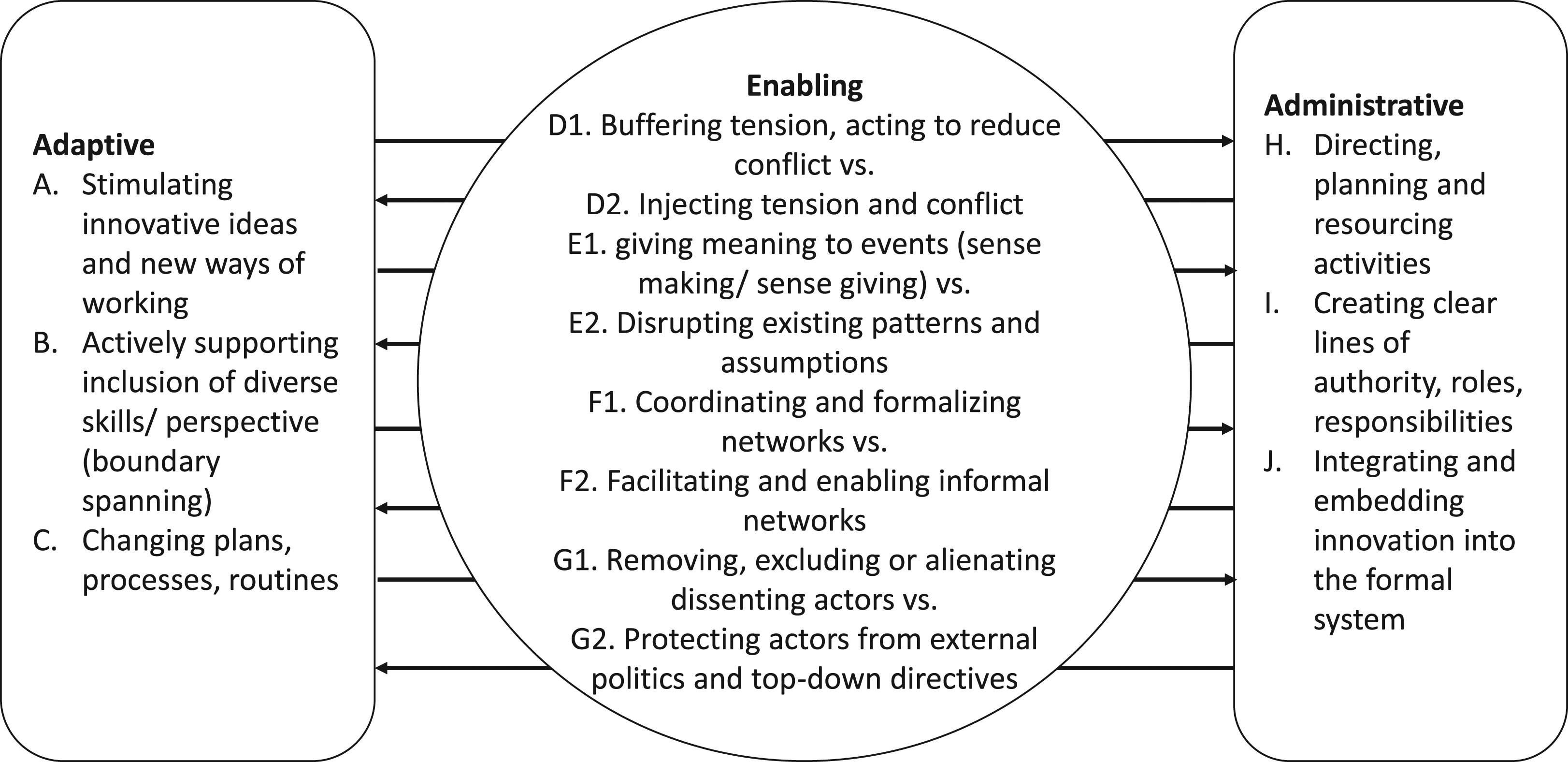
As the world prepares to enter a phase of recovery and renewal, it will need effective place-led leadership and collaborative action that encourage adaptive practices capable of stimulating innovation and economic growth. The research study examined the pre-pandemic collaborative leadership practices within the LEPs to explore whether they had adopted collaborative place leadership capable of this task.
Method and approach
To guide the research, a layered approach to data collection was adopted so that leadership practices could be observed in the real world. Methodological approaches to exploring leadership have received increased criticism for their reliance on quantitative methods where questionnaires and surveys dominate (Bryman, 2004; Klenke, 2016). Whilst qualitative techniques are being deployed using interviews and case studies, there have been calls for the adoption of more innovative approaches to understand the complexity of leadership practice to which this research responds. Sutherland (2018) argues for deep participant observation as a way of understanding organisational discourses and leadership work.
Having reviewed all the strategic economic plans of the 38 LEPs in England, the 10 LEPs that sit within the East and West Midlands area were selected for investigation. They were empirically chosen because they provided a range of partnerships including those from both urban and rural areas, those with access to differing levels of human and financial resources, and areas that were newly formed partnerships as opposed to areas that had founded the LEP on a historical collaboration. This was important to ensure the validity of the results to other partnerships.
Ten semi-structured interviews were conducted with individuals in the partnership management and co-ordination role. In most cases, the role is titled ‘Chief Executive Officer’ although other titles were applied including partnership director, chief officer, and LEP manager. Throughout the remainder of the article, the term partnership manager will be used for consistency to cover all alternative titles. These individuals were selected because they were ultimately responsible for the day-to-day management of partnership activity and could also provide a detailed overview of the partnership. To ensure a breadth of viewpoints were accessed beyond the partnership managers, these interviews were supplemented by an additional 16 semi-structured interviews with LEP board members including the chairs of four partnerships, four senior representatives from local business, four board directors from higher and further education, and four elected members from different local authorities. A final set of interviews was conducted with three representatives from the main government department overseeing the LEPs, the Department of Business, Energy and Industrial Strategy in both the West and the East Midlands and with a respondent from the LEP Network – a lobby group that oversees the interests of all 38 LEPs. Finally, to provide an additional means of authenticating the interview data, a series of eight observations was undertaken of LEP board meetings to observe leadership in action. The researcher maintained a non-participative, overt but unobtrusive approach to the observation of board meetings. Non-participation was favoured over a more participative approach for reasons of increased validity and reliability (Adler and Adler, 1994). In this manner, the meeting could be observed operating as if the researcher were not there.
Interviews were recorded with the respondent’s consent and notes taken during the observations. These were transcribed before thematically analysing and coding the data. An initial coding framework was developed, and statements were organised under the appropriate themes with subthemes added. Open coding also included additional themes to be noted and added, ensuring the analysis was not blinded by the initial framework (Marshall and Rossman, 2016). Triangulation was used to strengthen the overall validity of the results using both data triangulation (the collection of a variety of sources) and methodological triangulation (the use of multiple methods) (Patton, 2015).
Collaborative leadership of the LEPs
Cross thematic analysis of the interviews and observations of board meetings revealed that the leadership of the LEPs was complex. Whilst some respondents single out the LEP Chair as the heroic leader, the volume of activity, limited availability of resources (human and financial) and geographic and thematic reach of the LEPs meant that shared leadership, distributed amongst different actors within the multi-institutional environment, was essential (Huxham and Vangen, 2000; Vangen and Huxham, 2003). Interviewees recognised the benefits accrued from responsibility being shared amongst board directors which locked in the commitment across partner organisations, sectors and spaces. Sharing the load was said to enable the vision to permeate across the system and made the responsibility for leading the LEP a collective effort.
However, the results indicated a frustration voiced by several respondents both within the LEPs and government that the private sector had not had a greater influence over the leadership of the LEPs. The LEPs were intended to be business-led but across the interviews, the overriding response was that whilst LEPs had achieved high levels of business engagement, they were not benefitting from the leadership practices of the private sector or from a private sector influence over the system’s norms and values. As such private sector leadership was largely titular with the day-to-day leadership provided by the public sector. Respondents highlighted that leadership was driven by local authority partners because they had: 1. Connectivity: well-established geographical ties to the LEP geography that business did not share. 2. Resources: access to dedicated economic development staff to deliver core LEP responsibilities where business did not. 3. Power: politically and publicly accountable leaders with responsibility as the LEP’s accountable body, whereas business was unelected and unaccountable.
This view was shared by government representatives who cited their frustration at the dominance of the public sector over the LEP’s operating culture: I can’t think of one that isn’t local authority dominated and I think that is what I would like to see flipped because that was always the intention and that was the reason why it was supposed to be a business person chair but even with the way that the boards are set up at the moment it doesn’t really give the power to the business side of it (regional government interviewee).
Several interviewees felt that the accountability for large sums of public money meant that a truly collaborative model of leadership between private and public sector was unobtainable. Fundamentally, the LEP model was seen as somewhat flawed in that the accountability for public funds would always mean that a local authority/elected body would need to take a lead role, meaning LEP leadership was constrained by the public sector.
Further, the public sector was found to be funding the majority of key administrative functions that lead, manage and co-ordinate LEP business. This cements the level of power and influence they hold over place-based partnerships and the way they function. Through the analysis of interviews, the reliance on the local authority to lead the co-ordination of the partnership was clearly apparent. A range of management functions including co-ordination, data and performance management, marketing, finance, and administration were undertaken by public sector employers acting on behalf of the partnership and overseen by a partnership manager who was often employed by a local authority.
There were no examples cited in the interviews of the private sector funding management posts and only one reference to part funding by higher education. In the observations of board meetings, this was discussed on only one occasion (LEP 4), and partners agreed it was unrealistic to expect the private sector to contribute financially to the management of the LEP. largely because the majority of local businesses were resource-strapped small and medium enterprises. This lack of shared resourcing for partnership co-ordination created a reliance on local authority staff, and the findings painted a clear picture of the public sector seated firmly in the driving seat of the leadership of the LEPs despite limited resources. This meant that leadership was often localised in public sector–funded individuals who served in the role of co-ordinator or supervisor rather than being shared across and within a group of individuals. Returning to Murphy et al. (2017) framework for enabling leadership, the public sector influence on the leadership of the LEPs took the role of ‘co-ordinating and formalising (existing) networks’ (see Figure 1 F1) which leans towards an administrative practice.
Taking the lead on the direction and delivery of LEP activity puts the public sector in an influential position over the norms and values of the partnership, which was shown to have both a positive and a negative outcome on the partnership. In some cases, the influence of the public sector has resulted in mimetic isomorphism (DiMaggio and Powell, 1983) whereby the LEP adopted the institutional logic of its leadership and with it, the culture of the public sector. This was noted by regional government representatives who highlighted there had been a lack of cultural shift from a bureaucratic, risk-averse public administration to a more innovative, relational form of collaborative governance. As one interviewee explained: We have seen that the transport subgroup will probably be run by the local authority transport expert and the housing and planning subgroup will be run by the local authority housing manager and they have needed to rely on that because of a lack of funds. But as a result, that culture shift hasn’t happened as much as we might have liked. I sometimes feel they are not brave enough and part of this is how they are led at executive level (Regional government interviewee).
Similarly, there was evidence to indicate that the reliance on public sector to take up the leadership role had resulted in an over integration with local authority governance arrangements. This was noted by several interviewees as an inhibitor to collaboration because the local authority held too great an influence over the partnership: I am an employee of the City Council and if they wanted to end my employment they could do so. You are not only accountable to the board at the end of the day you are an employee of the Council, so you don’t have independence completely (LEP 5 Chief Executive).
As such, the influence of the public sector over the LEP constrained potential leadership, and interviewees felt this could hamper the LEPs ability to unlock the wider synergist benefits of collaboration. It some cases this had negative outcomes – it stilted the private sector’s level of engagement in and contribution to the LEP which in turn resulted in the LEP being less innovative or transformative in its approach. This goes against the original ethos of the partnerships that were intended to adopt more business-led techniques and be more dynamic. Accordingly, some interviewees expressed disappointment that the private sector impact had not been as great as was hoped: We haven’t necessarily changed the landscape as much as I probably would have liked but I think that with the level of local authority involvement does slow things down and I think that we could have had more of an impact if we got the private sector to speak more loudly (LEP 8 business representative).
The results suggest that the intended shift from top-down public administration of economic development policy towards a more adaptive, shared process of leadership has not been achieved in all areas.
In other areas, the public sector–funded leaders play more of an enabling role, and respondents in several LEP interviews highlighted the skills and knowledge held by these individuals who were able to support other actors within the partnership to develop and deliver complex growth programmes. Respondents recognised the influence these managers had on developing more collaborative forms of leadership. In some LEPs, interviewees observed that staff turnover in the area of economic development was low which enabled localities to retain an established body of local experience and institutional knowledge. This meant these key figures were able to adapt to changes in both central and local political and policy landscapes and able to reduce any tensions that might arise for other partners. Many had worked in a variety of economic development positions across the same area for some considerable time as economic development officers, regeneration and growth co-ordinators. As such, their knowledge and experience built over time had been retained locally including both explicit knowledge but also the less conscious ‘know-how’ that was valued by interviewees. This meant they were able to make sense of and translate complex policy and programmes for time-strapped partners. As one respondent highlighted: The complexity and the volume of activity that the LEP is now involved is significant. I question whether all board members would be able to develop sufficient knowledge on every aspect which we are deciding on without the help of the Executive team (LEP 1 HE representative).
This sense making aligns with another of the couplets presented in Murphy et al. (2017) leadership model. Here, the LEP chief officers are praised for their skills in ‘giving meaning to events’ (see Figure 1 E1) which again aligns with the LEP’s leadership practice with the administrative as opposed to the adaptive.
The continuity of the postholders within these economic development roles meant that they had often endured numerous iterations of economic development partnerships (from RDAs to LEPs and onto combined authorities). This continuity of leadership helped to nurture solid levels of trust between institutions, organisations and local businesses. Their established networks across different sectors meant they were able to broker relations and reduce areas of tension and conflict that might exist between partners. However, the increasing breadth of the role and the range of partners engaged meant that considerable time was required of the partnership managers to negotiate and resolve these tensions and conflict between partners. Interviews and observations revealed that these tensions were often between different authorities within the public sector, and these drew considerably on the time and resource of a staff team that was already limited. Respondents identified that this conflict resolution and mediation role between authorities hampered the effectiveness of the LEP. As a government representative identified: The Local Authorities have not organised themselves well so that has often built up this mistrust and has meant that the LEP manager are spending a lot of time keeping everybody happy and engaged rather than driving the LEP forward (regional government representative).
These practices can be mapped against the enabling aspects of Murphy et al. (2017) leadership model, and in this case, the practice of ‘buffering tensions, acting to reduce conflict’ (see Figure 1 D1) again leans towards an administrative rather than an adaptive practice.
There was evidence through the interviews and observations of the board meetings of LEP managers intervening and taking steps to exclude dissenting voices. This included controlling the level of debate, discussion and participation from key actors: The LEP team got together and said ‘right this is our vision and here is the strategic economic plan and here is the documentation and this is what we are going to do. It has been a little bit top-down (LEP 10 business representative).
Through observations of board meetings in two of the LEPs’ case studies, private sector board directors called for greater opportunity to debate key partnership decisions, but these comments were quickly moved on from. In one case, private sector board directors called for greater engagement and debate over the development of the key LEP strategy, and in another, it was the decision of the re-election of the Chair as the following excerpt from a board meeting observation highlights: Partners do engage in the meeting but often it is to complain about not being more involved. For example, the decision over who will succeed the current Chair is discussed but has clearly already been decided upon and agreed behind the scenes and then put to the Board to ratify (Observation of LEP 10 Board meeting January 2017).
Following Murphy et al. (2017) model, these enabling practices of ‘removing, excluding or alienating dissenting actors’ (see Figure 1 G1) serve to again shift the LEP’s model of leadership towards an administrative practice, inhibiting the partnership from adopting more adaptive practices.
Discussion
The findings highlight that the nature of leadership in multi-organisational networks is complex, driven by not only the personal traits of various individuals in positions of leadership, but also path dependency, cultural norms and power relations which have a constraining influence on the leadership practice. The LEP chief officers have a clear influence on the leadership practices of their LEP, and whilst this was often regarded favourably by those interviewed, following Murphy et al. (2017), it indicates a strong leaning towards administrative leadership practices. Examples of all four of Murphy et al. (2017) enabling leadership couplets were found, and in each case, the practice was directed towards the administrative and not the adaptive. This reinforces the picture that the shift from a top-down public administration paradigm of economic development policy towards a more adaptive, collaborative form of place leadership is yet to be achieved across the LEPs.
The LEPs are led by the private sector in a heroic way in terms of their chairing role, but the private sector has not influenced these collaborations as much as was intended, leaving the public sector to fill the vacuum. In many cases, those leading are capable, knowledgeable and experienced, but they have been unable to break from the cultural norms of the public sector which means their leadership practices lean towards the administrative, transactional and bureaucratic.
This research has reiterated how and why the nature of leadership is complex, particularly where place-based collaborations are involved, as there are wider networks of influences at play. However, there is recognition that the multi-level, multi-organisational, often messy geography of the LEPs requires more collaborative leadership practices. In the cases explored here, it is shown how the public sector has come to the fore in taking on the leadership role and influenced the framing of the LEPs, their values, operating rules and practices which has meant that an adaptive and transformative practice has been difficult to achieve.
This is understandable given that as relatively new entities dependent on central government funds, LEPs were under pressure to establish legitimacy and so looked to the rules and practices of their wider organisational environment (Meyer and Rowan, 1977). The intended rebalancing towards a more collaborative form of leadership that embraces the private sector’s norms and values has not been achieved, and it is the public sector that has provided the route to securing the confidence of government. This has a mimetic influence on the LEP as they adopt the rules and norms of the public sector, but this has not necessarily equated to adopting the most efficient or best organisational practices which has impacted their ability to adapt towards a more transformative performance (Skelcher and Sullivan, 2008). Even in areas where the public sector manager is regarded as a valuable leader of the LEP, they have struggled to transcend their parental influences and their enabling practices adopt an administrative rather than adaptive approach. This suggests that it is important to look beyond the traditional clusters of attributes that are considered positive for effective leadership, but instead to look at the wider influences that affect the ability of leaders to influence action. In the context of LEPs in England, there are tensions between what was intended for leadership roles to do, and the reality of what institutional forces, and public sector activities have allowed them to do. This combined with the individual leadership traits means that transformative leadership is hampered in many cases by the dominant public sector and the constraints placed upon it.
Embracing the private sector: Moving from administrative to adaptive leadership
There is an increasing emphasis on the importance of place leadership as a ‘missing ingredient’ in accounts of economic development (Rodríguez-Pose, 2013), and as we enter a phase of post-pandemic renewal, the recovery will rely on effective place-led leadership and collaborative action.
Sotarauta et al.’s (2017) call for guidance for local stakeholders looking to develop the abilities and capacities required for leading in both formal and informal complex networks and if we are to encourage a truly collaborative leadership practice that is adaptive and transformative, then the private sector will need this support. This necessitates a move beyond the ‘business as usual’ approach to start to see and behave differently, more like a business (Harrison, 2020). Leading these cross-boundary processes is a complex art where varying institutional environments and professional styles come into play, and this requires a much broader palette of both relational and technical leadership attributes that are responsive to local cultures as well as shifting agendas.
The public sector has a deeper embedded legacy – they have more time and dedicated roles; they have more experience of the technical and relational skills that are required, and they are more contextually embedded with an organisational boundary that is often coterminous with the locality. The private sector lacks this embeddedness – they do not necessarily value the locality or operate within the boundaries of place imposed by the LEPs. If we want business to share the leadership responsibility, we need to help them make the shift to represent place and not organisations, to leaders of place and not leaders of agency.
Murphy et al. (2017) framework offered a valuable model to guide leadership practices and called for an extension of their analysis to other settings and sectors. This article applied the model and demonstrated that the mimetic and coercive forces of central and local government are often too strong to shift the enabling leadership practices of LEP leadership away from the top-down administrative towards a more adaptive and transformative practice.
To progress towards a more collaborative form of place leadership, this article offers some guiding principles to supplement Murphy et al.’s model and assist the LEPs in embracing the private sector and supporting leadership practice more broadly: 1. Recruit partners who display the factors that are valued in leaders of place-based partnerships. The analysis of the data highlighted factors that were consistently considered to have an enabling effect on collaborative, adaptive and transformative leadership practices. These are summarised in Figure 2 in contrast to those factors that ensure administrative, transactional leadership will endure. 2. Support leaders to accept and understand that place leadership is an uncertain and challenging affair that will vary in intensity between and across places (Collinge et al., 2010). The ‘hierarchical leadership and professional project management skills’ that partners may already have will need to be adapted and combined with the building of processes that facilitate inclusive collaborations between institutions and firms (Gibney et al., 2009: 7). 3. Accept that power distribution will be messy and changing, and whilst leaders may be used to having the authority within their own organisation, they need to learn to lead without formal power. Leaders need to be accepting of the relational challenges that come with place leadership. Strategic leaders need to develop and sustain work over an extended period of time with agencies that are not directly controlled by each other and are in a constant state of flux (Gibney et al., 2009). 4. Understanding multi-level governance is crucial and not only the horizontal relations but also the vertical ones to be able to court the central government. Even the local authority has power limitations, and it is the central government that holds the ultimate power in England, compared to other countries where power and autonomy sit with local authorities such as Sweden. Enablers of adaptive, transformative versus administrative, transactional leadership. Source: Authors’ own, extending Murphy et al. (2017).
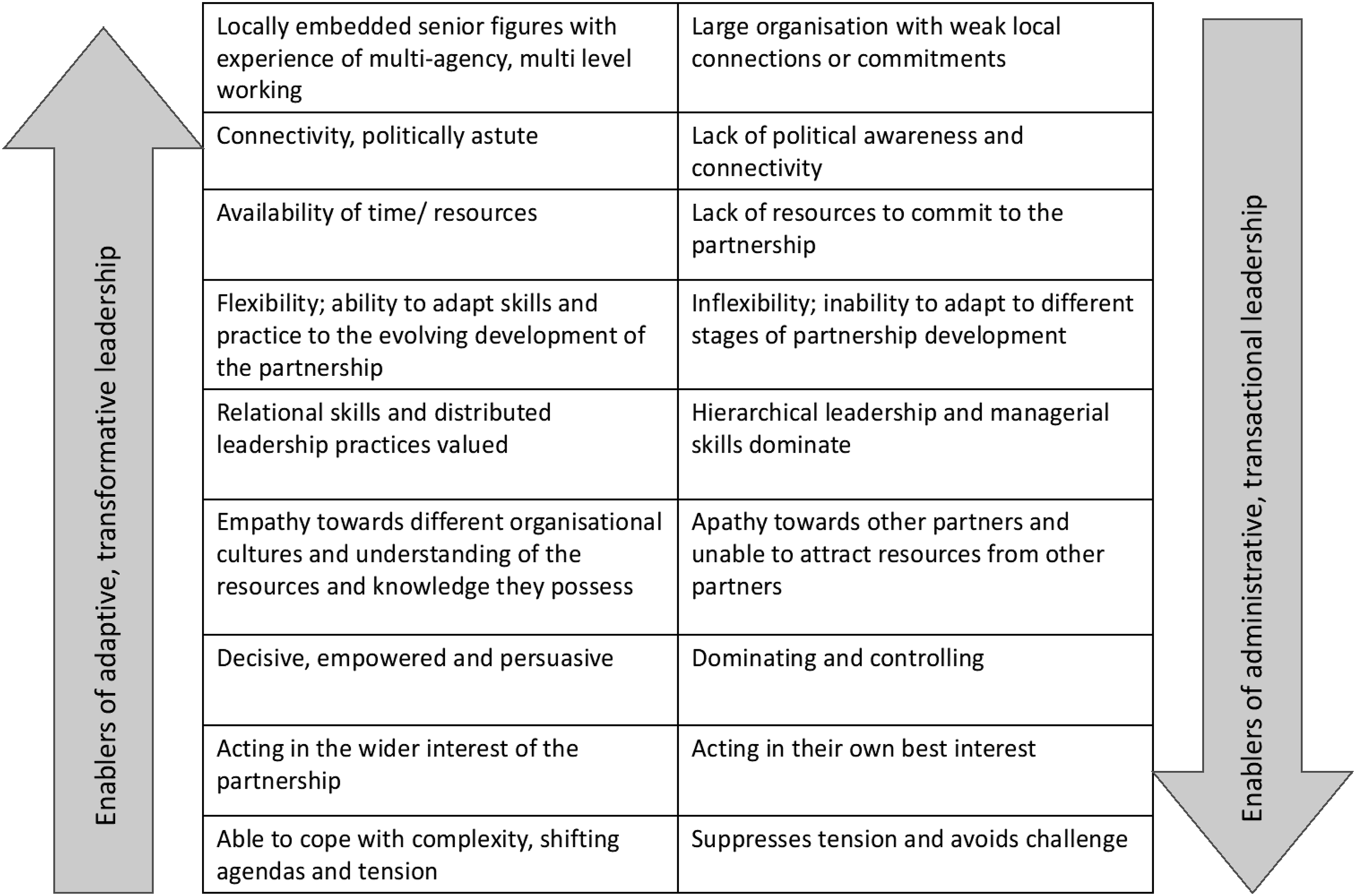
Through the exploration of the topic of leadership in English LEP, this research highlights the importance for future research on understanding how leadership can be transformative to consider the nature of power relationships at the local level and the structure of power relations with the local institutions. Furthermore, there is a need to understand how the enabling practices highlighted in Figure 2 can be encouraged to allow leaders of place to become adaptive and transformative, more able to respond to changes as necessary and whether they are driven by the public or private sector.
Conclusion
This article has reiterated the complex nature of place leadership. The context leaders are involved in the connections between leaders and material place (Ropo et al., 2013), and the power relations enmeshed into the politics of places (Hartley, 2005) have all been shown to generate a challenging environmental complexity. To navigate this complexity leadership of place, leaders need to be able to respond to changing circumstances whilst retaining a sense of continuity (Hughes, 2010), yet this presents a great challenge in the context of LEPs, where the remit has expanded frequently, policy has changed considerably and leaders have had to respond with few levers to effect change.
Whilst the research is geographically localised given its focus on the English LEPs, which limits the generalisability of the findings beyond that context, the results offer insight within and beyond the United Kingdom for those seeking to understand the leadership of place-based multi-organisational models of governance and leadership roles within complex networks. It has value beyond the United Kingdom as Europe increasingly adopts a more energised and integrated approach to place-based development (Gibney et al., 2009).
Through investigating the leadership of England’s LEPs, the research makes a number of contributions to the literature on place leadership. Firstly, the article offers an analysis of the complexities of place leadership in the real world which extends beyond the small case study or anonymised organisational setting. In so doing, the article helps address concerns over the quantitative nature of many studies of leadership and contributes towards building ‘a reliable cumulative body of knowledge about place leadership in different contexts’ (Beer et al., 2019).
Secondly, in evaluating the leadership of England’s LEPs, the research reveals that although the leadership of these multi-organisational collaborations was assigned to the private sector, their level of influence over place has been limited. The shift away from the historical, hierarchical patterns of leadership has been difficult, leaving the public sector to dominate the leadership of the LEPs. Whilst those leading are often capable individuals, they are held back by the cultural norms of the local authority which results in leadership practices that lean towards the administrative, transactional and bureaucratic over the adaptive.
Finally, to move the practice of place leadership forward towards a more transformative approach, the article contributes a set of guiding principles to guide new ways for place-based working. To progress towards a more collaborative form of place leadership, these principles supplement earlier models to assist place-based partnerships in embracing the private sector and engendering a more shared, collaborative form of leadership.
Footnotes
Declaration of conflicting interests
The author(s) declared no potential conflicts of interest with respect to the research, authorship, and/or publication of this article.
Funding
The author(s) received no financial support for the research, authorship, and/or publication of this article.
