




Abstract
There is a need to better understand how individuals in different religious groups construct and maintain their worldviews. This study explores how religious practices, beliefs, and relationships create and sustain the worldviews of five British Muslims. Semi-structured interviews were inductively analyzed using interpretative phenomenological analysis (IPA) to idiographically explore the participants’ lived experiences. This analysis developed multiple subordinate themes that formed two superordinate themes: “Submitting to Allah” and “Being a British Muslim.” The participants’ experiences of being raised in Muslim families strongly shaped their beliefs and they each strongly identify themselves as both Muslim and British. These important relationships taught them to follow the teachings of the Qur’an and to live their lives in submission to God. The analysis suggests the belief that the Qur’an is the authoritative and enduring revelation of God to mankind provided the core of their worldview and that this belief had far-reaching implications for every aspect of their lives. Their social relationships and religious practices both continually affirmed this fundamental belief in their sacred text and created a social reality in which the participants experienced God and submitted to the will of Allah. The combination of many different religious practices, social relationships, and personal experiences imbued the Qur’an with the power and authority to shape the participants’ lives and sustained their religious community. The participants’ intratextually fundamentalist approach to the Qur’an helped them create coherent worldviews that were filled with meaning and purpose.
Learning to make sense of the world is a fundamental task of the human mind throughout our lives (Bruner, 1990; Searle, 2010). Individuals develop their understandings of reality from both their own experiences and from the people around them, and these meaning systems or worldviews help them to survive and understand their subsequent experiences (Johnson et al., 2011; Park et al., 2013; Taves et al., 2018). People can draw on many cultural resources to help them develop their personal worldviews, and for many people religious traditions provide an important source of existential knowledge (Lee, 2015). However, our understanding of how these worldviews develop and are sustained is still limited and requires further investigation (Barrett & Lanman, 2008; Murphy, 2017, 2021; Park, 2013; Taves et al., 2018).
Worldviews are multifaceted and complex, encompassing intertwined answers to different “big questions” about life and the world (Taves et al., 2018). Johnson et al. (2011) identify ontology, epistemology, semiotics, axiology, teleology, and praxeology as the six key aspects of worldviews. Taves and Asprem (2018) identify a similar list but replace semiotics and teleology with cosmology. Taves et al. (2018) argue that these worldviews can be either implicit or explicit and that they are created and communicated through language, stories, and other symbols. The different sources of explanations and understanding can also be categorized as “existential cultures” and individuals can draw on multiple existential cultures to develop their own worldviews (Lee, 2015). Taves and Asprem (2018) argue that using “worldviews” as the operative analytical concept enables studies to examine the interplay between worldviews and everyday ways of life without being limited by contested definitional boundaries. This approach can thus explore the processes through which people create, use, and reproduce meaning in their lives, enriching our understanding of the meaning-making processes that are a central aspect of religion and spirituality (Hood et al., 2018).
Sacred texts and traditions
Sacred texts play a central role in many religious traditions but beliefs about them, and attitudes toward them, vary considerably. Even within particular religions, different groups often approach and interpret the same sacred texts in very different ways. These understandings of sacred texts range from believing they are literally divinely spoken to believing they are merely human creations that can help understand truths about the world. Sacred texts and traditions can be both important existential resources to help explain the world and also the objects of key beliefs (Hood et al., 2005).
Hood et al. (2005) suggest that the way some groups treat their sacred texts as supremely authoritative can have a variety of effects on their beliefs systems and practices. They label such groups as fundamentalists, although their conception of fundamentalism is precise and differs from many more vernacular uses of the term. Hood et al. (2005) argue that while specific forms of fundamentalism are embedded in specific historical contexts, their distinguishing feature is an intratextual approach that “elevates the role of the sacred text to a position of supreme authority and subordinates all other potential sources of knowledge and meaning” (p. 13). While vernacular uses of fundamentalism can treat it as a synonym for extremism or radicalism, the concept of “intratextual fundamentalism” is explicit about breaking the assumed link between fundamentalism and militarism or violence (Hood et al., 2005). Unfortunately, while some groups embrace the label “fundamentalist” as a point of pride, for others it is perceived as a derogatory or dismissive term. This article does not conceptualize fundamentalism as derogatory and the characterization of our participants as intratextually fundamentalist is an etic categorization based on Hood et al.’s (2005) definition, which reflects how many mainstream religious traditions view their sacred texts and relationships with the divine.
Within the psychology of religion, much of the work on religious fundamentalism has used Altemeyer and Hunsberger’s (1992, 2004) religious fundamentalism scales (McCleary et al., 2011). Their conceptualization of religious fundamentalism places greater emphasis on militancy than the intratextual definition, but still emphasizes the belief that a specific set of religious teachings are authoritative and must be followed (Hood et al., 2005; Schaafsma & Williams, 2012; Williamson et al., 2010). McCleary et al.’s (2011) meta-analysis suggests religious fundamentalism has a strong effect on prejudice and a moderate effect on militancy. However, they note that the highest effect sizes came from American samples and that it appears the relationships between fundamentalism and other constructs may vary between different cultures.
That the content of fundamentalists’ beliefs and their wider cultural context both affect their worldviews and behaviors seems intuitively plausible. Blogowska and Saroglou (2013) suggest that because fundamentalists submit to specific texts, the nature of the religious texts people are exposed to should shape their beliefs and behavior. They tested this hypothesis in three experimental studies and their findings support the idea that presenting different aspects of religious texts that are considered authoritative can change how people act.
Meaning-making is a central aspect of religiosity (Hood et al., 2018; Park, 2013) and there is evidence that fundamentalist religious systems can be particularly effectively at meeting the psychological needs of those who hold them (Friedman & Rholes, 2008; Hood et al., 2005; Salzman, 2008, etc.). For many communities, sacred texts are both the object of deeply held beliefs and provide a framework that helps understand the rest of the world (Hood et al., 2005) and cope with challenging life experiences (Pargament et al., 2013). However, these texts still require interpretation and these interpretations (and the applications of them) are part of a broader web of sociocultural factors (Hood et al., 2009). Understanding how this type of religious worldviews develop and influence people’s lives therefore requires both methodologies that are sensitive to these nuances of context and detailed studies of the experiences of specific communities (Murphy, 2017; Murphy et al., 2022).
Studying Muslim experiences
There are over 1.8 billion Muslims worldwide (Partridge & Dowley, 2014), and in the United Kingdom 6% of the population identify as Muslim (Curtice et al., 2019). Islam traces its origins to the revelations of the Prophet Muhammad in the 7th century, recorded in the Qur’an, and there are multiple long and authoritative traditions of interpreting the Qur’an (Morgan, 2010; Murata & Chittick, 2011). However, it is widely believed by Muslims that the Qur’an was recited by the angel Gabriel to the Prophet, who shared it with the rest of humanity (Murata & Chittick, 2011). This belief, that Muhammad is the messenger of God, is part of the first pillar of Islam and its core declaration of faith.
The global significance of Islam means it is important to understand Muslim experiences of God. Furthermore, the psychology of religion’s disproportionate focus on Christianity means that more studies of other religious traditions, particularly Islam, remain sorely needed (Abu-Raiya, 2013; Hood et al., 2009; Loewenthal, 2013). In the 21st century, the actions of Islamist extremists and terrorists have increased the prominence of Islam within British political discourse (Brown & Richards, 2016; Gilliat-Ray, 2014) and this heightens the need for high quality and sensitive research exploring the lived experiences of British Muslims. As traditional Islamic theology does not distinguish between the spiritual and the temporal (Moughrabi, 1995), a holistic approach to understanding the experiences of Muslims is particularly helpful.
Like other religions, Islam is multidimensional and so it is important to acknowledge that Islam can mean different things to different people, so quantitative scales often cannot capture the rich and multifaceted nature of Islam (Abu-Raiya, 2013). However, empirical studies have suggested that beliefs and practices are of central importance to most Muslims (Abu-Raiya & Pargament, 2011). Islam is an integral part of the lives of many Muslims, and the majority of Muslims view life through the perspective of their faith (Abu-Raiya, 2013; Abu et al., 2008), with many of these individuals having an understanding of their faith and the Qur’an that can be characterized as fundamentalist (Beller & Kröger, 2018). Abu-Raiya (2013) notes that while many aspects of Muslim experience are similar to other religious traditions, there are also some distinctive nuances such as the importance placed on pilgrimage to Mecca and the sense of the universality of the larger Islamic nation (the Ummah). As Abu-Raiya (2013) argues, there is a pressing need for more empirical data to clarify misconceptions about the role of Islam in individuals’ lives and idiographic studies have an important role to play in deepening our understanding of how different elements of Muslims’ experiences shape their beliefs and actions.
Studying religious complexity
When studying how people experience and understand the world, it is important to recognize the complexity of people’s lived experiences. Religiosity and spirituality are also far more than just beliefs, with relationships, identity, and practices being crucial constituents (Day, 2011; Hood et al., 2009; McGuire, 2008). Even within a single religious community, people can have contrasting understandings and expressions of their shared beliefs (Chaves, 2010; Slone, 2004). Exploring the complexity of people’s worldviews and experiences requires methodologies that are sensitive to these differences and an awareness of the limitations of our terminology and concepts (Murphy, 2017). Qualitative approaches are particularly suitable for investigating these topics, and there is a need for them to be used more widely within the psychology of religion (Abu-Raiya, 2013; Coyle, 2008; Hood et al., 2018).
Interpretative phenomenological analysis (IPA; Smith et al., 2009) is a qualitative methodology that explores individuals’ experiences and how they make sense of them. IPA is particularly adept at investigating “complex, ambiguous and emotionally laden” topics (Smith & Osborn, 2015, p. 41) such as religion (Murphy et al., 2022). Exploring, in detail, the convergences and divergences between the experiences of each participant enables the development of a deeper understanding of how multiple events shape each other and the participants’ interpretations of them. Previous studies using IPA have explored a range of topics including how Muslims deal with particular situations (e.g. Muishout et al., 2018; Watts et al., 2014) and how they reconcile aspects of their lives that are perceived as conflicting (e.g. Hunt et al., 2020; Jaspal & Cinnirella, 2014). However, none have used IPA to explore the experiences of British Muslims more broadly and investigate how they make sense of the world.
The current study sought to enrich our understanding of how British Muslims transmit, sustain, and develop their beliefs and practices through a detailed exploration of the experiences of five individuals. IPA studies investigate both primary and secondary research questions (Smith et al., 2009). Primary research questions examine how people experience and make sense of phenomena, while secondary research questions seek to increase our understanding of the phenomena (but are usually only partially answerable). This study’s primary research question was: “How do the Muslim participants experience the relationship(s) between themselves and the things they consider sacred?” The secondary research questions were “How do these relationships form and develop?” and “What are the relationships between beliefs and experiences deemed spiritual and/or religious?” The study therefore explored a broad range of the participants’ experiences, to develop a rich understanding of how the participants experienced the world and the perceived influences of many different sociocultural factors on them. Investigating these processes not only enhances our understanding of religious worldviews and fundamentalism, but also helps develop broader insights into how people’s beliefs develop through their personal and social experiences.
Method
IPA explores individuals’ experiences and how they make sense of them (Smith et al., 2009). IPA explicitly rejects the concept of data saturation, and instead idiographically investigates the experiences of a relatively small and purposively chosen sample in detail. Participants are recruited from relatively homogeneous groups and chosen to provide a range of perspectives on the phenomena being studied (Smith et al., 2009). This study investigated the experiences of five participants, which provided a good balance between allowing detailed analysis of each individual’s experiences and exploration of the differences between individuals’ experiences (Smith, 2011; Smith et al., 2009).
Participants
A large town in the southeast of England, with a single mosque, was selected for the study. Five participants were purposively recruited using two gatekeepers (Patton, 2015; Smith et al., 2009) and predetermined eligibility criteria, namely, (a) self-identify as practicing Muslims; (b) be members of the local Muslim community; (c) be aged 18–65; and (d) not have converted to their faith in the past 2 years. The two gatekeepers were both members of the community who met the eligibility criteria and who were acquaintances of members of the research team. These preexisting relationships were important in cultivating the necessary trust between the participants and the researchers, as many Muslims are suspicious of psychological research studying them (Abu-Raiya & Pargament, 2011). As previous research into the psychology of Islam has primarily used American or Iranian samples (Abu-Raiya, 2013), the use of a British sample also offers a different perspective into Muslims’ experiences. It should be noted, however, that IPA focuses on understanding the experiences of very specific groups and these participants should not be considered representative of all British Muslims. Muslims living in other parts of Britain, particularly larger cities with larger Muslim populations, are likely to have had quite different experiences.
The participants (three women, two men) reflected the wide range of backgrounds within the local community, but all came from Muslim families and identified as Sunni. The participants reported a range of ethnicities, and their family origins included the Middle East, Indian Subcontinent, and the Far East. Their ages ranged from in their 20s to their 50s, and each was assigned a pseudonym to help preserve their anonymity: Aatifa, Bahiya, Chahid, Dahra, and Ebrahim (Madill, 2012). Further details about each participant have not been provided to ensure the internal anonymity of the study, in line with our ethical obligations to the participants. However, the full context and circumstances of each participant were carefully considered as part of the analysis. Some participants were initially cautious about the purpose of the research but chose to take part after an informal conversation. As the interviews progressed, the participants appeared increasingly relaxed and open, sharing intimate details about their lives, suggesting good rapport and trust developed.
Data collection
The first author conducted semi-structured interviews with each participant individually. The interview schedule covered seven broad areas, each introduced with an open question and supplemented by additional prompts. Interviews began by asking the participant to speak about who they are and their background, and how they found meaning in their lives. Participants were then asked to tell the interviewer about God and their religious or spiritual activities, and to describe specific experiences of God. The interview ended by exploring how the participant’s beliefs had changed during their lifetime. The interviews were intentionally broad and encompassing of the participants’ lived experiences, so that rather than leading them to specific topics (such as the Qur’an or Ramadan), they were free to discuss whatever they felt was most important to them. Participants were briefed prior to their interviews and each interview was followed by a debriefing. The interviews ranged from 31 to 61 min, with a mean duration of 48 min. The researcher explicitly took a non-judgmental stance and offered an opportunity to discuss their own views and beliefs during the debrief. The quality of the interview data was reviewed by the research team and found to meet or surpass the standards for good qualitative research (Patton, 2015; Smith et al., 2009).
Analytical process
Each interview was recorded, transcribed, and imported into NVivo 11 before being initially analyzed by the first author. The transcripts were then annotated with initial comments and reflections, before coding their content for themes. The coding was inductive and iterative, initially examining each participant’s experiences individually before reexamining them collectively (Smith et al., 2009). Emergent themes were developed and consolidated, before being grouped conceptually into superordinate themes (Smith, 2011; Smith et al., 2009). During this iterative process, the themes were repeatedly refined as they were discussed by the research team and rigorously tested against the data. Writing up qualitative research is an integral part of the analysis (Smith et al., 2009) and our understanding of each theme continued to evolve throughout this period. Interview extracts have been chosen to illustrate the themes and show key aspects of the participants’ experiences.
The analysis presented below is an interpretative account of the participants’ experiences and how they made sense of their lives, based upon the complete data from the interviews. This interpretative approach, by definition, involves going beyond the descriptive data. Interpretation means attaching significance to what was found, making sense of findings, offering explanations, drawing conclusions, extrapolating lessons, making inferences, considering meanings, and otherwise imposing order on an unruly but surely patterned world. (Patton, 2015, p. 570)
Such interpretative accounts cannot prove causation but should attempt to offer the best possible understandings of the processes associated with the phenomena under investigation and this can include suggesting causal mechanisms (Maxwell, 2013; Schwandt, 2001).
Researcher backgrounds
The research team consisted of the first author, who conducted the interviews and was the principal analyst, and two supervisors. The first author and one of the supervisors both identified as not religious, while the third member of the team was a practicing Lutheran. We were committed to engaging with the participants’ experiences in their own terms, putting aside assumptions (from both our own experiences and the extant literature) as much as possible (Smith et al., 2009).
Ethics
A university ethics committee granted approval for the study and each participant gave informed consent. To protect the participants’ anonymity, only minimal personal information about them is included here. Briefing and debriefing addressed any concerns participants had, but they primarily expressed curiosity about the research and gratitude for the opportunity to share their experiences.
Results
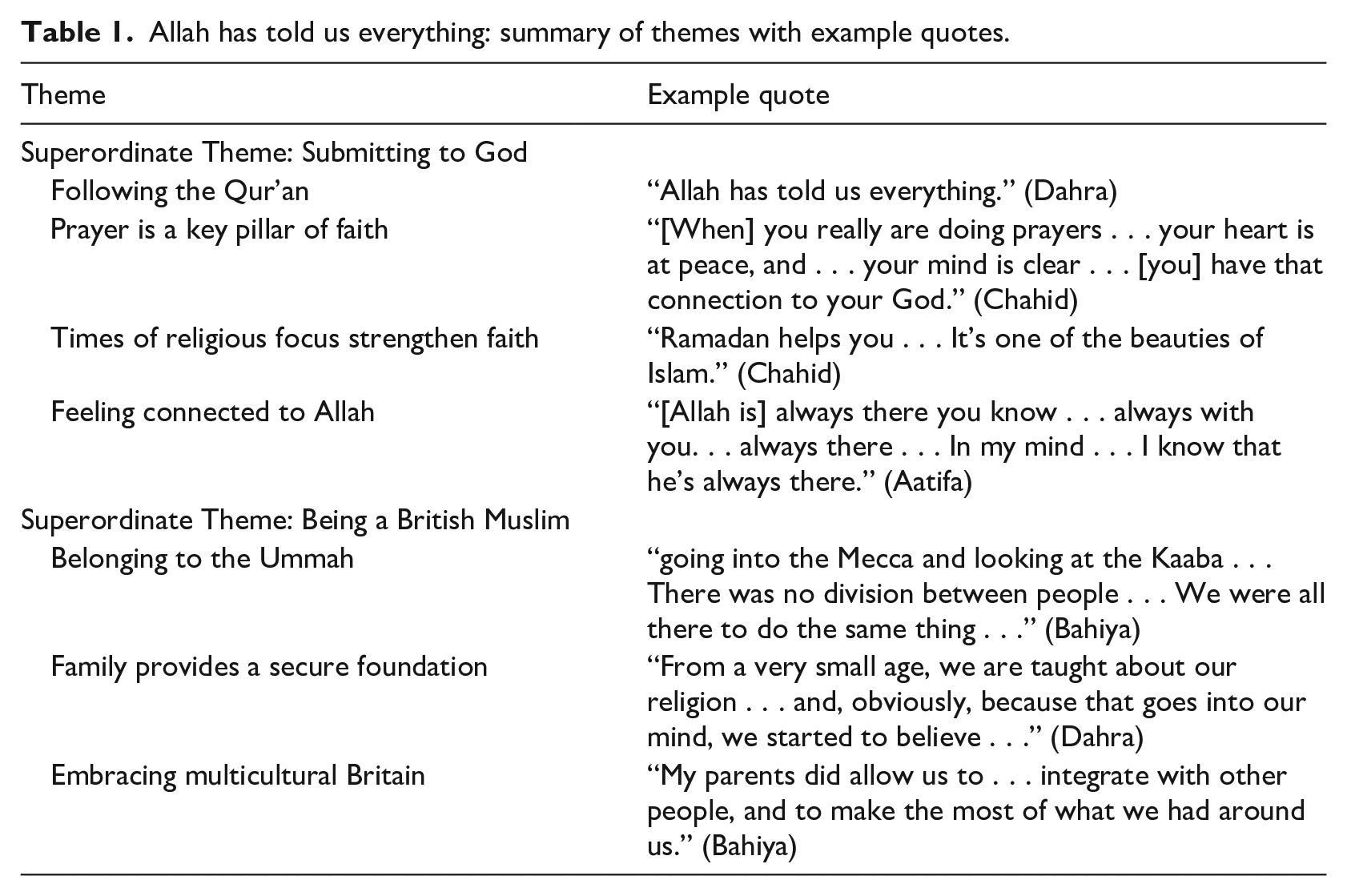
As summarized in Table 1, two superordinate themes, comprising seven subordinate themes, were ultimately developed using the hermeneutic principles of IPA (Smith et al., 2009). The two superordinate themes, “Submitting to God” and “Being a British Muslim,” were fundamental aspects of these participants’ lived experiences, and each of their subordinate themes was present in the accounts of all five participants.
Allah has told us everything: summary of themes with example quotes.
Submitting to God
The participants all described how they experienced and submitted to Allah in their daily lives. This submission to God was the heart of their faith and they worked to make it a reality in their lives. The Qur’an, prayer, and other religious practices all helped them understand what Allah desired and to experience a sense of closeness to God. Being part of a sacred community, with hundreds of years of history, helped them to make sense of their lives and guided their actions and relationships.
Following the Qur’an
The Qur’an was very important to all the participants. As Ebrahim said, “[The Qur’an] is a way of life. For human[s], for Muslims . . . it tells us about the history, it tells us about the science, it tells us about the way the life should be . . . The Qur’an’s role is the fundamental, basic role of a Muslim ideology.” The participants repeatedly referred to the Qur’an to explain their other beliefs and their choices. Dahra succinctly conveyed the participants’ attitudes to the Qur’an with five words: “Allah has told us everything.” For the participants, Allah was the source of all knowledge who revealed everything humanity needs to know in the Qur’an. This revelation was complete and absolute; no experiences of their own could change it. The Qur’an provided the framework by which they understood both themselves and the wider world.
The participants studied the Qur’an so they could understand it better and be better Muslims. They believed they needed to navigate competing interpretations of it to know what God required of them. Ebrahim, when discussing extremists, noted how if the “Qur’an says something—if you don’t understand the full meaning of it, you can be very easily misguided by somebody who wants disturbance in the world.” The participants believed misunderstanding the Qur’an sometimes caused other Muslims to do bad things, because the Qur’an itself was perfect and promoted righteousness. Studying the Qur’an was an act of devotion and Bahiya discussed how “reading the Qur’an and actually knowing what it meant” was how she made the faith her own and internalized it.
There were elements of traditional Islamic teaching that the participants found difficult or challenging. In these situations, the participants drew on their other experiences, and the elements of their faith that they were sure of, to help them accept the more difficult teachings. Chahid discussed the existence of angels and djinn, and said he found them difficult to reconcile with his scientific understanding of the world. Despite these difficulties, he concluded that You can’t prove everything, but things that I can see around me, that I’ve been told, does that fit in with . . . what I see about life . . . I then have to, logically, if I’m believing this, this and this, I have to then say, OK, for me, this is the truth.
Their belief that Islam was a complete and final revelation meant the participants saw evidence for any element of it as evidence for it all. For these participants, the Qur’an was Allah’s revelation to the Prophet and so it could be trusted completely.
Prayer is a key pillar of faith
Prayer, or more accurately Salah, is one of the five pillars of Islam (Abu-Raiya, 2013), and played a central and crucial role in the participants’ lives and faith. When they prayed, the participants felt a sense of peace and a connection to God. Ebrahim described how, when he prayed, “if the connection is made right . . . I feel that a kind of electricity, going from top to bottom . . . It’s, like, a very good feeling . . . you feel good . . .” The participants described how the quality of their experiences while praying varied and they attributed this to differences in the ways they approached prayer. They said simply performing the ritual brought only minimal benefits, but when they focused on what they were doing, and did it with conviction, the effects were usually more profound. Dahra noted it was “all about belief.” The tangible intimacy with the divine that the participants experienced during prayer affirmed their belief in the reality of Allah and the truth of the Qur’an.
The participants all believed they should pray five times a day, but admitted they often did not. Prayer required time and space to be set apart, and that could be difficult. Bahiya discussed how she “had moments where . . . [I’ve] doubted everything . . . so I’ve stopped doing my prayers . . . not doing my prayers is . . . my disconnect from the faith.” For these participants, praying was a key expression of their submission to God and when they were experiencing doubts, they often found prayer more difficult and less meaningful. This could, in turn, amplify their doubts and feelings of disconnection from God. Despite these periods of doubt and wavering belief, all the participants remained committed to their faith.
Times of crisis could stimulate a return to more regular prayer and said this often strengthened the participants’ faith. Aatifa spoke about how she prayed, “if I’ve got something important coming up like exams . . . it’s led to the sort of success . . . I feel that has impacted my life.” The participants described experiencing positive feelings or consequences after prayer revived their flagging faith and said this sometimes began a cycle of positive thoughts and practice that led them back to God. Praying was a ritual act of submission for the participants. It focused their minds on God, on who they were as Muslims, and on how they should be living their lives.
Times of religious focus strengthen faith
Like prayer, Ramadan and the Hajj are pillars of Islam (Murata & Chittick, 2011) and strengthened the participants’ faith in God and their sense of being Muslims. Ramadan is a sacred month in the Islamic calendar, during which the participants fasted and observed other religious rules. The participants experienced Ramadan as a sacred time when they felt closer to God and saw it as an opportunity to reflect on their lives and make changes to become the people they wanted to be. Chahid described how, “Ramadan helps you . . . It’s one of the beauties of Islam that Islam gives you that month to really . . . stop being lazy, to stop procrastination, and . . . get going, basically.” Each year, Ramadan drew the participants’ focus to God and reminded them of what they believed they should do as good Muslims. Aatifa discussed how she experienced Ramadan as a blessing, noting that when she couldn’t participate it made her “feel like you’re missing out on something . . . It’s just different. It’s more religious than your whole life, really.” Her disappointment was based on her previous experiences of the benefits of participation, rather than due to a sense of obligation or the expectations of others.
Pilgrimages had a similar effect, although they were less frequent. Every adult Muslim is required to make the Hajj once in their life (Morgan, 2010), if it is within their financial and physical capacity, and many of the participants had not yet had the opportunity to do so. Bahiya had visited Mecca twice and described how going into the Mecca and looking at the Kaaba, I think I was in complete awe . . . There was no division between people . . . We were all there to do the same thing . . . It was exhausting, physically and mentally [but] I was buzzing.
The many ritual acts involved in the Hajj were suffused with significance and meaning for her: they were tangible demonstrations of her submission to God. Performing them with millions of others affirmed her beliefs and made her feel part of a large community that shared a special and enduring relationship with Allah. Stories about experiences on the Hajj were later shared with other believers, and these helped nurture the faith of those still waiting for the opportunity to experience it themselves. Looking forward to, preparing for, completing, and remembering visits to Mecca all helped the participants focus on becoming closer to God.
Feeling connected to Allah
Allah was a central figure in the lived experiences of all the participants. They experienced God tangibly when praying and less directly through reading the Qur’an and participating in the Islamic community. Each participant reported times when they experienced tangible connections with God, but these feelings of connection were not constant. The participants believed they were never alone, even when they could not feel God. Aatifa described how Allah was “always there you know, watching over, erm, always with you . . . always there . . . I know that directly, physically, [Allah is] not in front of me . . . but in my mind . . . I know that he’s always there.” The feelings of being close to God that the participants described were often somewhat ineffable, but that did not diminish their importance. During trials and tribulations, the memories of such experiences reminded them that their God was real and often caused them to seek divine comfort again.
The participants also attributed events in their daily lives to the will of Allah, making God an intrinsic part of their lived experiences. Dahra viewed every aspect of her life through the prism of her faith. She said, “Our fate is: whatever happens is from Allah . . . When he gives us good health, money, everything is there, we’re happy, we’re thankful to him. But, on the other side . . . at times, he’s testing us, our patience.” Experiencing positive events helped nurture a trusting relationship between the participants and God. In contrast, negative events usually did not create negative feelings toward God. The participants trusted in God’s plan and viewed negative experiences and struggles as having a purpose, which helped them to cope with them.
The participants’ relationships with God developed during their lives. Ebrahim described how, as he grew to know more about the Qur’an and God, his understanding and experiences changed: When I was young, I’m more scared . . . Allah is all about punishment. . . [but] I realized, Allah is not all about punishment . . . Allah is all about mercy, forgiveness . . . He is more generous than he is angry . . . We know that Allah is more kind than 70 mothers . . .
This softening of his relationship with God came through both personal experiences of God forgiving him and exposure to teaching that enabled those experiences.
Being a British Muslim
Being Muslim was a core part of the participants’ self-identity. They saw themselves as part of a global and historical community that stretched back centuries. The participants recognized that their values and practices resulted from their upbringing within a specific cultural context, and they embraced being both British and Muslim. They did not see these two identities as conflicting. Being British shaped how they were Muslim and being Muslim shaped how they were British.
Belonging to the Ummah
The participants strongly identified as Muslims and the importance of their shared beliefs and traditions was clear. They had viewed themselves as members of the Muslim community, the Ummah (Murata & Chittick, 2011), for their entire lives. When describing the essence of Islam, Dahra said, “It spells like I-S-L-A-M . . . I would say, ‘I Shall Love All Mankind’—so that’s what it is. That’s what our aim is.” This shift into the plural was common when talking about their faith and it shows the communal nature of their identity and beliefs. Being part of a global and historic community reinforced their beliefs and gave them more confidence to express them.
Their sense of common identity with other Muslims was rooted in their shared faith in the Qur’an, but the participants were aware of the diversity of global Islam. While working in Saudi Arabia, Bahiya said she “started learning that how much is really cultural and how much is religious . . . I look at things and I think, no, that’s cultural, that’s got nothing to do with the religion.” This distinction, between cultural and core elements of Islam, allowed the participants to navigate the diverse ways that Islam was taught and practiced while maintaining their belief in the truth and oneness of Islam. Their local Muslim community was also diverse, which Chahid said led to: “lots of discussion . . . on a range, a wide range, of subjects and people have obviously got their different opinions . . . [but] it’s quite open and it’s quite healthy.” Belonging to the Islamic community unified them and they saw it as a fundamental part of being Muslim, even when “cultural factors” caused conflicts.
Family provides a secure foundation
Every participant was raised in a practicing Muslim family and their families had an enduring influence on them. The participants’ parents took them to the mosque and taught them how to pray and to read the Qur’an. As Dahra described it, From a very small age, we are taught about our religion . . . and, obviously, because that goes into our mind, we started to believe . . . You will see your adults, your parents, other siblings doing those things like praying. So although at that age, you don’t understand . . . we would just follow them.
The actions of the people surrounding her provided a powerful example to follow. As she grew older, her family (and the wider Muslim community) taught her to understand who they were. The participants learned, by observing others, what was and what wasn’t acceptable for Muslims to do. Bahiya described how she “was never told I had to do this, or I didn’t have to do that, but, um, I knew where my boundaries were.” Being a good Muslim involved being part of the community and their families ensured they understood their place within it.
Now that the participants were older, they made sure that their religion was a central part of their family life too. Being good Muslims and teaching their children to be good Muslims were among the participants’ highest priorities. Ebrahim described how “Religion is the binding force of the family.” Even as adults, the participants’ families provided a secure place where they could live their faith in the context of a wider society that largely did not share their beliefs.
Embracing multicultural Britain
Being British Muslims was important to many of the participants. Chahid, when describing his family life, said he had “tried to raise my children to be Muslims, but also British Muslims.” The participants’ awareness of the diversity within Islam, and the impact of culture on how the religion is interpreted and practiced, allowed them to embrace both being British and being Muslim. The participants all identified as part of British culture, rather than distinct from it. Bahiya described herself as “very English” and said “my parents did allow us to . . . integrate with other people, and to make the most of what we had around us.” The participants appreciated and valued the opportunities of the multicultural and tolerant society they lived in, even if it sometimes made it harder to practice their faith.
Despite the challenges they sometimes faced, the participants were all grateful to be living in Britain and to have the opportunities they associated with that. As Dahra said, when talking about raising her children, “this country is multi-[cultural], and I love it . . . it’s difficult and it’s lovely.” These difficulties included differences in values, practices, and understanding. The participants saw themselves as being different to most of the people around them, but they were proud to be British Muslims and embraced both aspects of that identity. They considered many of their core values, such as being kind and respectful, to be both British and Islamic.
Discussion
This is the first study to have used IPA to broadly explore the religious experiences, beliefs, and worldviews of a sample of British Muslims. The analysis suggests that for these British Muslims faith was an integral part of their lives. They viewed themselves as part of a distinct group that recognized and submitted to the will of God, as revealed by the Prophet Muhammad in the Qur’an. This revelation taught them about God, the world, and themselves. For the participants, the Qur’an was tangible proof of God’s existence and nature. It supported the teachings of their community and explained their experiences, while having its own, sacred nature affirmed by those same things. The many connections between the participants’ beliefs and experiences show the complexity of how religious worldviews develop and are sustained.
The Qur’an and intratextual fundamentalism
The participants’ worldviews were firmly rooted in the Qur’an, and they considered it highly authoritative in their lives. The participants’ belief that “Allah has told us everything” was a central part of their lived experience and identity. Understanding how the Qur’an shaped their lives is essential to understanding them.
As noted previously, Hood et al. (2005, p. 13) argue the principal criterion for identifying religious fundamentalism is that it “elevates the role of the sacred text to a position of supreme authority and subordinates all other potential sources of knowledge and meaning.” They argue that fundamentalist meaning systems are often highly complex, comprehensive, and rooted in personal experiences of their sacred text(s) and the practices associated with the text(s). Liht et al. (2011) identify three underlying aspects of religious fundamentalism: an external locus of authority, a fixed conceptualization of religion, and an elevation of the sacred over the worldly. In the current study, the participants’ experiences clearly included all of these features. Other recent work suggests this form of intratextual fundamentalism is a categorical, rather than multidimensional, phenomenon (Beller & Kröger, 2017; Hammer & Lazar, 2019). These data are consistent with such an understanding. The participants’ beliefs about themselves, the world, and the Qur’an appeared to form cohesive and mutually reinforcing worldviews.
Religious fundamentalism is often conflated with extremism or radicalism, but militancy and authoritarianism are not core features of fundamentalism (Hood et al., 2005; Sadowski et al., 2019). The participants in this study were not Islamists, extremists, or radicals (cf. Moghaddam et al., 2013; Verkuyten, 2018). They were all integrated members of their communities who explicitly denounced violent implementations of Jihad. Intratextually fundamentalist beliefs about the divine nature of the Qur’an are historically understood as a core tenet of Islam (Murata & Chittick, 2011), and these participants provide another example of how religious individuals with fundamentalist attitudes to their sacred text(s) can reject militancy and extremism. As such, this study provides an important and necessary counterbalance to research and discourse on Muslims than focuses on more extremist groups.
Hood et al. (2005) argue fundamentalist worldviews are often effective at providing a unifying philosophy of life and a sense of coherence, purpose, meaning, and self-worth. Ysseldyk et al. (2010, p. 67) also suggest “religious identification can offer a robust social support system, a comforting and compelling worldview, and a unique psychological enrichment to which many people hold fast.” This was the case for these participants, who described living lives that were full of meaning and which were supported by their religious community. The participants also appeared to find their faith useful in helping them cope positively with difficult and challenging situations in their lives. This echoes the finding of Phillips and Ano (2015) that fundamentalism can be associated with positive forms of religious coping.
The analysis in the current study supports the usefulness of the concept of intratextual fundamentalism, supports the claim that it is not intrinsically militant, and suggests individuals can find this style of religiosity beneficial as a source of meaning and wellbeing. We therefore suggest that researchers using quantitative methods to study fundamentalist groups should use Williamson et al.’s (2010) Intratextual Fundamentalism Scale rather than either version of Altemeyer and Hunsberger’s (1992, 2004) Religious Fundamentalism Scale. The study also shows that sacred texts, and the traditions of interpretations around them, can be important existential resources for individuals that play a significant role in development of their worldviews (Lee, 2015; Taves et al., 2018) and that the details of how individuals use such resources matters, rather than just the frequency with which they refer to them or attend religious services (cf. Blogowska & Saroglou, 2013). Researchers should try to capture and explore such details rather than relying exclusively on proxy measures of overall religiosity (cf. Abu-Raiya, 2013).
Relationships, identity, and experiences
The participants’ families, and the wider Muslim community they belong to, played important roles in shaping and sustaining their faith. Other Muslims taught the participants both that they were Muslims and what it means to be a good Muslim. Being Muslim was core to participants’ social identities, and identifying as Muslims affected their beliefs, behaviors, and sense of self (Salzman, 2008; Ysseldyk et al., 2010). Duderija (2008) argues that scriptural interpretation and sociocultural relationships are important in how Western-born Muslims construct their religious identities and these factors appear to have both been important in shaping the identities and worldviews of the participants in the current study. As Peek (2005) shows, the process of moving from an ascribed religious identity to a chosen and declared one is shaped by the social and historical context of the individual. The participants’ faith helped them construct identities that made sense of their lives and gave them symbols to express those identities (Marranci, 2009).
The participants were all integrated into the wider community around them (Berry, 1997; Berry et al., 2006), but they maintained their own religious and cultural identities, rather than assimilating entirely into the more secular society in which they lived (Kramer, 2003). Their personal experiences of British society as welcoming, tolerant, and multicultural seem to have enabled them to avoid feeling marginalized or pushed toward extremist ideologies (cf. Verkuyten, 2018). This suggests that both a supportive faith community and diverse public spaces, including schools, are important for helping the positive integration of minority communities with wider society (Aziz, 2019; Kramer, 2003).
A third factor, in addition to the two identified by Duderija (2008), also appeared important in shaping the participants’ identities and worldviews. Personal experiences that the participants deemed sacred appeared to play a significant role in developing and sustaining their faith and beliefs. These experiences were interpreted using a framework provided by the Qur’an and their religious community. This attribution of experiences to supernatural causes the individual already believes in, and the subsequent interpretation of these experiences as confirmatory evidence for those beliefs, is common across a wide range of belief systems (cf. French & Stone, 2013; Luhrmann, 2012; Spilka et al., 1985). The participants’ experiences during religious practices and the interpretative framework of their belief systems seemed to reinforce each other. The Qur’an helped them understand their experiences, and their experiences helped them understand and trust the Qur’an.
The participants described developing relationships with Allah that influenced their lives and beliefs, with these experienced relationships forming an important part of their psychological and social realities (Berger & Luckmann, 1967; Searle, 2010). As a supremely powerful and benevolent being, Allah also appears to have functioned as a source of security for the participants (cf. Granqvist & Kirkpatrick, 2004; Kirkpatrick & Shaver, 1990). Their relationships with God affirmed the participants’ sense of self and Muslim identity, helping them to live confidently in a world where they trusted everything that happened was according to God’s plan.
Constructing their worldviews
Scriptural interpretation, sociocultural relationships, and personal experiences that they deemed sacred, all appear to have played important roles in shaping and sustaining the participants’ worldviews. People learn from those around them and the social realities in which they live are created and sustained through interactions with other people and the world (Berger & Luckmann, 1967; Searle, 2010). These participants grew up in families and a community that collectively worked to teach them to understand the world through the prism of their faith. As adults, they continued to identify as British Muslims and maintaining their identities involved a wide range of practices that affirmed their faith. These practices, particularly daily prayer and observation of Ramadan, were important ritual reminders of who they were and what they believed. These practices not only reinforced their collective social identities but also gave them direct experiences which helped them feel connected to Allah.
In contemporary Britain, people can draw on a wide range of existential cultures and resources to help them understand the world and create meaning (Lee, 2015; Murphy et al., 2022). Although these participants were influenced by some other aspects of their cultural context, the Qur’an and their faith in Allah provided the principal foundations for the construction of worldviews that met their psychological and social needs (cf. Hood et al., 2005; Park et al., 2013). Their sacred text, religious community, and personal experiences of the divine, all contributed to and enhanced their faith. Their trust in Allah, and the revelation of the Qur’an, meant they could tolerate uncertainty even when they did not have conclusive answers to difficult questions. Their faith involved a relationship with a being who they believed was far wiser than either themself or other people, and they had learned to trust God. They based their lives on their understandings of the Qur’an, and the many facets of their lives combined to make their worldviews both persuasive and robust. This combination of many different experiences seemed far more powerful and persuasive for the participants than the sum of its individual components.
The multifaceted nature of the participants’ worldviews (cf. Johnson et al., 2011; Taves et al., 2018), and the complexity of how different elements of their experiences interacted, demonstrates why it is important for researchers to resist easy simplifications in their methodological choices. While there is undoubtedly a continued place for quantitative research approaches, important details can be lost when participants’ experiences are reduced to just scores on brief survey measures. The psychology of religion continues to rely disproportionately on relatively crude quantitative methods and both more sensitive quantitative approaches and rigorous qualitative approaches are needed to develop richer and more impactful understandings of religious and spiritual phenomena (cf. Coyle, 2008; Hood et al., 2018). People’s lives, beliefs, and experiences are complex and if we wish to develop meaningful understandings of the processes that shape them then we must use tools that can capture and exploring that complexity.
Limitations and future directions
This study provides a rich understanding of the participants’ lives, but other Muslims will have different lived experiences. The focus on a particular group of Muslims is an important element of IPA’s methodology and should not be considered a weakness. IPA values depth of analysis over volume of data, with a smaller dataset being viewed as advantageous because it enables a deeper exploration of each individual’s experiences (Smith, 2011; Smith et al., 2009). However, it seems likely that the Qur’an, prayer, times of religious focus, and feeling a connection to Allah will also be important elements in many other Muslim’s lives, even if how they are experienced and used in different contexts varies (cf. Abu-Raiya, 2013; Moughrabi, 1995; Murata & Chittick, 2011). Similarly, social influences and identity are likely to also be important in other contexts.
Additional studies, investigating the experiences of other Muslims in a wide range of geographical locations, should be conducted to explore the effects of social and cultural influences in ways that are not possible with a single IPA study. Further studies exploring how other religious and nonreligious groups develop their worldviews are also needed, to establish the extent of the transferability of these findings to different groups. These studies should use a wide range of methodologies, although as this study demonstrates qualitative approaches are particularly adept at exploring these topics.
The interviews for this study were conducted during Ramadan and in a period when the country had recently experienced Islamist terrorist attacks. These factors may have heightened the salience of individuals’ Islamic identity and influenced how they viewed themselves in relation to their wider society (cf. Peek, 2005). In a quantitative study, the timing of the data collection might raise questions about the validity of the findings. However, one advantage of qualitative approaches is that they can account for and explore the influences of contextual issues such as these within the data without diminishing the quality or validity of the research (Smith et al., 2009). As such, collecting data during a period when the participants were already thinking more about their religiosity is likely to have enhanced the quality of the data and analysis by enabling them to provide richer insights and deeper reflections on their beliefs and practices. It should also be noted that the participants did not consider the recent terrorist attacks to have undermined their sense of being British Muslims; they were proud of both aspects of their identities. However, Muslims in different communities may have different experiences and these contextual factors should be kept in mind when considering the transferability of the findings of this analysis.
The non-Muslim identity of the interviewer will also have influenced the data gathered (Chryssides, 2019; Dwyer & Buckle, 2009; Kanuha, 2000). Interviews by outsiders can increase the salience of differences and may make the participants try to present a more positive version of their community. However, interviews with a nonjudgmental outsider can also make it easier for participants to admit deviations from the social norms of their group. There was good rapport between the participants and researcher, and the data generated were rich and insightful. Nevertheless, all interview data is co-constructed by the participant and researcher and can only provide partial insights into their lived experiences (Smith et al., 2009). IPA is, by its nature, an interpretative methodology that does not claim to offer objective or universal truths; what the methodology offers is rigorous and robust descriptions and explanations of phenomena that increase our understanding of them (Maxwell, 2013; Patton, 2015).
Conclusion
This study shows how individuals integrate many different experiences, beliefs, and practices as they develop their personal worldviews. The beliefs of these British Muslims were strongly shaped by their families, their experiences of God, and their experiences of living in what they perceived to be a tolerant and inclusive society. These beliefs were rooted in the revelation of the Qur’an, which they believed was the supreme source of knowledge and meaning for humanity. Their sacred text provided an interpretative framework and narrative to help make sense of their lives, and its authority was repeatedly reinforced by what they and their community did. Their beliefs and experiences created a secure and affirming worldview that enabled them to positively engage with the wider world. As they submitted to what they understood as God’s will, they also encouraged others to do the same, sustaining their community and the religious tradition they valued so highly. Their sacred scriptures, social relationships, and personal experiences all played a vital role in developing and maintaining their worldviews. Future studies of worldview dynamics should consider all three of these areas and the interactions between different facets of individuals’ lives.
