




Abstract
Scholarship on the hybrid and interrelated nature of religion and secularism among religious minorities is still scarce. This study explores how young adult religious minority students in Israel, Muslims and Druze, integrate their religious worldviews within modernity, separately for each group and comparatively for both, with special attention to their conflictual position as minorities. The research data were collected as part of a mixed-methods research project—Young Adults and Religion in a Global Perspective (YARG), which used the Faith Q-Sort method (version b)—and through semi-structured interviews. The findings reflect the multiple ways in which modernization processes can shape the religious worldviews of minority students and confirm previous findings on the multifaceted manifestations of religiosity and secularization. Furthermore, the study highlights the indirect manner through which the position of “religious/ ethnic minority” might promote secularization.
Introduction
Religion, no matter what religion it is, every religion in the world is one that has a world behind it, there is a history behind it, there is a culture behind it, there are one million things behind it, so no matter how much you ask there are always new things to know, (YILSK240, Druze Israeli)
This study explores how conservative religious minorities incorporate modernity and religion into their worldviews using psychological and comparative approaches. Religiosity is here understood as a set of subjective worldviews among Muslim and Druze minorities in Israel, groups previous comparative research has ignored, to the best of my knowledge. As religious and ethnic minorities native to Israel, Muslim and Druze communities have a unique cultural position in terms of religion and ethnicity, both highly salient in their identities and all aspects of their lives. Thus, while exploring the interplay between religion and secularization among minority groups, this study also evaluates the role of ethnicity and minority positions in these processes.
Modernity: the interplay between religion and secularism
The constant shift in religion’s social significance is a key process in the evolution of modern cultures (Eisenstadt, 2010). Research in the sociology of religion has sought to predict the role of religion in society and among individuals (Pollack, 2008), mainly focused on secularization processes (e.g. Dobbelaere, 2002; Wilson, 2016). However, recent researchers have indicated the need to abandon the binary distinction between “religious“ and “secular” as these terms are hybrid and multifaceted (e.g. Fischer, 2015; Nynäs, Keysar, Shterin, & Sjö, 2022). Individuals often hold seemingly contradictory ideas or act contrary to their beliefs or official doctrines (Chaves, 2010; Slone, 2007).
Recognizing the diversity of lived religious experiences (e.g. Lee, 2015; McGuire, 2008), recent research suggests applying a worldviews framework as an “overarching rubric that encompasses both religious and nonreligious outlooks” (Taves, 2018, p. 1; see also Johnson et al., 2011; Murphy, 2017; Oman, 2013). A complex set of socially constructed representations, worldviews attempt to answer the “big question” of “existential philosophies” (Lee & Bullivant, 2016). They emerge from meaning-making processes underpinning our evolutionary attempts to construct a world-model and a self-model (Johnson et al., 2011; Taves et al., 2018). As meaning systems, worldviews are formed through interaction with one’s environment, and they are maintained as long as they serve their functional goal of generating a sense of meaning and purpose in life (Taves, 2018). Religion is one meaning system enacted in various ways in everyday life (Park et al., 2013), but it is not the only one. Atheists believe in a variety of things that appear to serve some of the functions that religious beliefs serve for others (Day, 2011; Lee, 2015). Rather than categorizing, this approach advocates for religion and different expressions of secularization, such as nonreligion and atheism, to be viewed as manifestations of the same psychological process of seeking meaning in life (Taves, 2018).
Worldviews are formed in social environments and are inextricably linked to their larger cultural context (Taves et al., 2018). Culture has a transformative impact on religious beliefs and practices, as well as reshaping of shared language, values, and customs (Johnson et al., 2011). However, most research on links between modernity, religiosity, and religious worldview formation has largely focused on Western, primarily Christian, cultures, with an emphasis on “categorial” worldviews, such as nonreligious (e.g. Sheard, 2014; Taves, 2018) and atheist (e.g. Day, 2011; Lee & Bullivant, 2016). Research in non-Western cultures has underscored the complexity of secularization processes among people from conservative traditions, who face a clash between their communities’ traditional confirmative norms and the liberal values of their out-group. Rather than choosing one or the other, people who live in a socially and culturally conflicted reality endeavor to connect their various, sometimes contradictory, identifications (e.g. Novis Deutsch & Rubin, 2018). This highlights the importance of studying religious and secular worldviews in non-Western contexts. Abu-Raiya and colleagues (Abu-Raiya, 2017; Abu-Raiya et al., 2008; Abu-Raiya & Pargament, 2011) emphasized the challenges posed by extending to Muslim populations theoretical frameworks and methodologies developed and validated among Christian populations, and the need for more diverse samples reflecting Muslim communities’ significant cultural, geographical, ethnic, and socioeconomic differences. This emphasizes the importance of accounting for a group’s social status (minority vs majority), when considering religiosity (Small & Bowman, 2011). Minorities can be culturally and religiously different from the majority, as well as nationally, racially, and ethnically. Minorities must contend with other socially conflictual aspects of reality that affect their religious worldviews, in addition to the larger values-related conflicts conservative groups face in modern societies (Aud et al., 2010). However, research on the interplay between religion and secularization in modern cultures is scarce in relation to religious minorities. Here, I approach secularization from the perspective of the individual level, “of the mind” (Dobbelaere, 2002), entailing decreased religiosity levels and a self-distancing from religion and religious traditions.
How do members of conservative religious and ethnic minorities integrate their religious worldviews in the face of modernity and secularization processes? This question becomes even more pressing when these individuals’ ethnicities are inextricably linked to conflict with the majority. This is the focus of this study.
Arab society in Israel: modernization processes in a conflictual context
Israel’s citizens are divided into two distinct national, cultural, and ethnic groups: Jews (nearly 74% of the Israeli population) and Arabs (nearly 21%) (Central Bureau of Statistics [CBS], 2021). Arabs in Israel are vulnerable to inter-religious conflicts and wars in the Middle East. Furthermore, as a national and ethnic minority in the predominantly Jewish state of Israel, they experience discrimination in various areas, including employment and land ownership (Pappé, 2011; Rubinstein, 2017).
However, as Israel’s economy expands, Arab integration into Israeli society has grown significantly (Liss-Ginsborg & Asaf, 2014). The number of Arab academics, particularly women, has risen dramatically, and Arabs now hold key positions, including ministerial positions, in many state institutions. This could explain the shifts in Arab society toward more liberal and individualistic views (Al-Krenawi, 2008).
In Israel, there are two main ethnic Arab groups: 93% Arabs (mostly Muslims (84%) and Christians (9%)) and 7% Druze (CBS, 2021). This distinction is primarily related to, and reflected in, the Druze’s strong sense of belonging to Israel and their mandatory service in the Israeli Defense Forces (IDF). Muslim and Christian Arabs are not required to, and mostly do not, serve in the IDF, condemning Arabs who do as “betrayers” of the Palestinian cause (Katz, 2000). Accordingly, the two groups’ national identities differ significantly: Muslims and Christians primarily identify as Palestinian-Arabs (Smooha, 2017), and Druze identify first as Druze and then as Israelis (Pew Research Center, 2016). Overall, Arabs in Israel are at a crossroads of several conflicting minority identity aspects, with religion marking one’s place among them all: nationally (Palestinians vs Israelis), ethnically (Arabs/Druze vs Jews), and culturally (conservative vs liberal values). Reflections of modernization processes in the religious worldviews of Israel’s diverse religious minorities are therefore contextual, not consistent.
This study focuses on the Muslim and Druze communities because of their high degree of cultural similarity on the one hand—their conservative nature, and the significant divergence between their responses to their environment. It focuses on young adults because this is a critical period for socialization and identity formation (Inglehart & Welzel, 2005). Furthermore, because of young people’s adaptation to and incorporation of cultural and social changes, such as technological developments and evolution of the digital culture, indicators of value change will be most salient among them (Collins-Mayo, 2010). The focus on students stems from previous research recognizing universities as a key location for intercultural encounters and negotiations (Arar & Mustafa, 2011). For conservative minority students, experiencing contradiction between their culture’s conformist authoritarian thinking and academia’s pluralistic, liberal thinking, and exposure to religious diversity, may result in intra-psychic conflict (Novis Deutsch & Rubin, 2018).
Muslims in Israel: a conflict-ridden minority position
Muslims are the largest religious minority group in Israel, 17.9% of the population, almost all Sunni (CBS, 2021). As Palestinians living in Israel, Muslims are subjected to numerous opposing cultural and religious influences, contributing to internal and external conflicts. Nationally, as a native minority suffering discrimination with a larger Arab and Muslim population abroad, they face pressure to distinguish themselves from the Israeli identity and remain loyal to their Palestinian nation and cause. They must, however, integrate into Israeli society because they live within Israel’s geographical territory (Jamal, 2017; Lybarger, 2007). Religiously, they adhere strongly to religious beliefs and practices (Abu-Raiya, 2013) as a coping strategy in face of discrimination and oppression (Abu-Raiya & Pargament, 2015) but have partially absorbed Western liberal trends from the wider Israeli culture that contradict their culture’s conservative, confirmative, and traditional shared values with the larger Muslim-Arab world, with which they maintain close ties (Jamal, 2017). Consequently, it is not surprising that Muslims in Israel reported experiencing religious and spiritual struggles (Abu-Raiya et al., 2015).
For Muslims in Israel, the outcomes of these conflicts are associated with the political arena, with higher rates of a return to religion during periods of escalating political tension between Israel and Palestinians (Gara, 2015). However, these processes of returning to religion are not uniform and unequivocal and seem to conflict with socioeconomic dynamics, such as technological development and the flourishing of digital culture among young adults (Kheir & Moberg, 2020). Intergenerational disparities in the values and levels of religious observance are evident (e.g. Pew Research Center, 2016; Weinstock et al., 2015).
Thus, while young adult Muslims in Israel face the same values-related conflicts of modernization as Muslims worldwide, the forces shaping the outcomes of these conflicts are different.
Druze in Israel: secret religion and double minority position
In 2019, Druze constitute nearly 1.6% of the Israeli population and 7% of the Arab population (CBS, 2021). Formally, there is a clear dichotomous distinction between being Religious (Uqqal—the Wise) and non-Religious (Juhal—the Ignorant) among Druze. Only after a lengthy application process to join the religious community can a person become Religious 1 and be permitted to enter the house of worship (Khelwa), participate in communal prayer, and access religious texts, which are kept secret from both non-Religious Druze and outsiders (Falah, 2000).
The Druze obligatory service in the IDF since 1956 distinguishes them from Arabs in Israel and influences their perceptions of their community’s traditions and values, as evidenced by their behavioral choices (Leish, 1996; Rubinstein, 2017). Increased education and living standards among the Druze, particularly in the last three decades following global economic and technological developments, have bolstered these perceptual changes (Abbas, 2010; CBS, 2021).
These social dynamics present today’s Druze with two severe crises. The internal crisis concerns the preservation of their culture and its transmission to future generations (Court & Abbas, 2014), a crisis exacerbated by the undermining of the status of the Druze religious leadership (Mansour, 2010). The external crisis stems from Druze’s status as a dual minority (among Arabs and Jews) in a precarious political position: their allegiance to Israel exposes them to harsh Arab criticism, but they also do not enjoy full equality of rights with Jews (Faris, 2010). The Druze community’s social resilience seems weakened by these conflicts, as evidenced by young couples migrating to large Jewish cities (Hasbani, 2010).
Unlike Muslims, Druze have no larger religious community outside Israel to which they can pledge religious or national allegiance. This, combined with the Druze religion’s secrecy and their greater involvement in Israeli society, exposes them to modernization’s cultural changes in a unique way. This study focuses on the reflections of these changes in their religious worldviews, compared to Muslims in Israel. The main research question is as follows: What varieties of religious or secular worldviews can be identified among young adult Muslim and Druze students in Israel?
Three sub-questions will be addressed to answer this question: (1) How do Muslims and Druze integrate their religious and secular worldviews? (2) How do ethnic and religious identities influence their worldviews? (3) What are the similarities and differences between the two groups in relation to these questions?
Methods
This study analyzed a data subset derived from the Young Adults and Religion in a Global Perspective (YARG; Nynäs, Keysar, Kontala, et al., 2022) project. YARG is a large international mixed-methods study on young adults’ religiosity and values worldwide, which was conducted in two stages: first, a quantitative survey, and then the Faith Q-Sort (version b, FQS-b; Nynäs, Keysar, Kontala, et al., 2022), which were administered in combination with a semi-structured interview. 2
Participants
The sample comprised 22 Muslim and 23 Druze students, aged 18–30 years, purposefully chosen from a larger survey sample of 425 students (Muslims: N = 199; Druze: N = 226). 3 Of the full sample, 10% were chosen for the extensive interviewing process. As required by the Q-methodology approach, 4 these were selected with a focus on maximizing variety in terms of value profiles, gender, demographic aspects, religiosity, and attitudes. While these smaller samples are not statistically representative of their respective cultural groups, they do reflect a much larger value profile diversity than if randomly chosen from the population. Survey data were collected from five Israeli universities and colleges. Females constituted 64% of the Muslim and 48% of the Druze sample. All participants gave informed consent.
Measurements
The Faith Q-Sort
The FQS, developed by Prof. David Wulff (2019), is a new research instrument based on Q-methodology for systematically studying religious/spiritual subjectivities. The YARG team in collaboration with Wulff further developed the FQS, and the FQS-b (Nynäs, Keysar, Kontala, et al., 2022) consists of 101 statements on printed cards, covering a wide range of contemporary religiosities (see Supplementary Materials, Appendix A—FQS-b Statements). These were translated into Arabic, with male and female versions, and back-translated into English by two professional translators and the author. They were adapted to an Arab cultural context to assure clarity, under the supervision of the YARG research team. Each participant was asked to sort the cards into a normal distribution ranging from the five cards that most accurately describe him or her (+4) to the five cards that least describe him or her (−4), with the center of the distribution reserved for statements the respondent regarded as neutral or irrelevant (0). Each individual sorting is thus a unique Q-sort, but patterns (“Prototypes”) can be discerned between the individual sorts. Rather than a group of people, each prototype represents a coherent state of mind or culturally endorsed worldview. Thus, a pattern’s strength is determined by the clustering of items, not the number of people who express it.
Ken-Q® was used to analyze each group’s Q-sorts separately to generate prototypes from the individual sorts. Unlike standard factor analysis (R-method), which correlates variables across subjects, the Q-method involves clustering subjects across variables (see Watts & Stenner, 2012), generating the following results: (1) for each prototype, (a) a complete list of statements ordered by Z-scores, (b) a list of mean rankings for each statement, and (c) a list of significant defining statements that distinguish them from others; (2) a list of statements comparing each pair of prototypes; (3) a consensus statement list, that is, a list of statements ranked similarly or highly similarly by all prototypes.
The content of the statements that fall at the extremes for each prototype, as well as its distinguishing statements, is intertwined in the representation process of the prototypes that emerge from the factor analysis to form a meaningful pattern. A two- or three-word label is required to make each prototype easy to identify. An international and culturally diverse group of researchers labeled the prototypes that emerged among the different samples of the YARG project in three steps (for more details, see Nynäs, Keysar, Kontala, et al., 2022). The labels were chosen to characterize each prototype and indicate how it differs from other prototypes in a given sample.
Semi-structured interviews
The research interviews followed the sorting procedure, beginning with five questions about the participant’s experience with the sorting process, thoughts or suggestions about the statements, and an inquiry into the statements ranked as most or least descriptive. This served as a springboard for a deeper exploration of the context for the beliefs, practices, and values that surfaced during the sorting, focusing especially on the participant’s personal history, sense of self, and current life situation; their thoughts on and personal engagement with religion; and their broader social and cultural contexts.
Conducted in Arabic by the author in her University of Haifa office, the interviews lasted 1.5 h on average, excluding the sorting process. They were analyzed using Dedoose© mixed-methods software and a holistic content approach (Lieblich et al., 1998). Quotes from the interviews are presented to highlight and reflect the core features of the prototypes that emerged among the research samples.
The sorting process and interviews were recorded, transcribed, and translated into English by professional translators. The research methodology was approved by the Board for Research Ethics both at Åbo Akademi University, Finland, and at the University of Haifa, Israel.
Researcher description
Study data were gathered by the author while working as a YARG project research assistant in Israel. As a minority (Druze) student, I was aware of the insecurity that research participants might feel when discussing a contentious and debated aspect of their identity—religion—against the backdrop of Israel’s ethnic and national reality. Being “one of them” had a positive effect on building trust, as indicated by the length of the interviews, which also included the participants sharing personal experiences with me. Furthermore, they all expressed positive feedback at the end of the interviews.
The YARG project organized several training courses in methodology, data collection, and analysis to guarantee uniform standards and reflexivity. I also took two research ethics courses with two different academic institutions to increase my awareness regarding data collection and data analysis processes. I met with the YARG co-investigator in Israel on a weekly basis to refine procedures and to raise and reflect on personal and other issues arising during data collection.
The data were analyzed in stages, involving the YARG core team. Specifically, this article involved supervision by four senior researchers affiliated with two academic institutions, ensuring that any personal effect in data analysis was minimized.
Results
FQS prototypes among young adult Muslim students in Israel
Five prototypes were identified in the Muslim sample. This sample’s FQS consensus statement list indicated that the Muslim respondents generally distanced themselves from religious practices to fulfill social needs, taking part in them neither to meet others’ wishes [FQS7] 5 nor to maintain social relationships [FQS21]. This is reflected in their neutrality toward the statement “Has a thorough knowledge of religious scriptures or texts” [FQS42], since prayer and religious practices demand reading the Quran. However, neutrality toward religious practices need not imply a lack of interest in Islam. They value their purity and strive to safeguard it [FQS48], have not sought another spiritual or ideological home [FQS72], and are not fearful of turning to the divine [FQS39]. This might be one reason they do not feel adrift, without a goal [FQS35]. The following is a brief presentation of the Muslim prototypes based on the items ranked as most/least descriptive and defining statements (ranked significantly differently from other prototypes).
M1: Committed Practicing Believer
This prototype is characterized by the highest sense of religiosity. Religious faith is a never-ending quest [FQS13, +4], they long for a deeper faith [FQS8, +4]. “Being religious or spiritual is central to who he or she is” [FQS16, +3] is also reflected in their emphasis on following religious practices as they forsake worldly pleasures for religious reasons [FQS98, +4]. They strongly believe in scriptural infallibility [FQS15, +4], do not doubt deeply held convictions [FQS57, +3 and FQS2, -2], adhere to religious traditions [FQS31, −3], and believe strongly in a benevolent divine being [FQS85, −3].
M2: Institutionally Unattached Universalist
These respondents express a strong belief in God, but do not manage their lives in accordance with religious teachings. They perceive the divine as a mystery that can never be fully understood [FQS88, +4] and as a sheltering parent [FQS41, +4], and do not pray to him only for solace and protection [FQS62, −2]. Organized religion plays no role in their lives—they deny being active members of a religious or spiritual community [FQS97,−4]. They support freedom of choice in matters of faith and morality [FQS100, +3], believing one can be deeply moral without being religious [FQS83, +4]. However, while religion is not the ultimate guide for the Institutionally Unattached Universalists, this does not imply detachment from religion, as they still invest time or money in religious institutions [FQS1, +4].
M3: Religiously Uninterested but Culturally Committed
Characterized by a low sense of traditional religiosity and by feeling distant from God [FQS45, +4], self-realization is their primary spiritual life goal [FQS93, +3]. They believe in some way, but neither view themselves as religious [FQS28, +4] nor view events in this world through religious lenses [FQS79, −3]. Their lack of interest in religion is an integral part of their identity, rather than resulting from a change in religious attitudes [FQS37, −4], possibly linked to or intensified by being consumed by daily obligations, leaving little time for spiritual issues [FQS43, +4]. They are neither confident of attaining eternal salvation [FQS38, −4] nor think certain beliefs are crucial for salvation [FQS22, −3], but seek self-realization.
M4: Experientially Inclined Committed Believer
Characterized by a deep sense of God’s presence and religious belief that is not actualized in practice, they believe in a divine being with whom one can have a personal relationship [FQS53, +4], which they seek to intensify [FQS49, +4]. Their beliefs are not reflected in daily religious practices, but they become more religious or spiritual in times of need [FQS17, +4], express their religiosity primarily in charitable acts [FQS27, +3], and long for a deeper faith [FQS8, +2]. Their conflicted feelings about their lived religiosity and their perception of the divine as a compassionate entity to whom they can turn at any time [FQS39, −4] may be the reason they reported experiencing moments of deep illumination [FQS89, +4] and feeling peaceful while facing life’s difficulties [FQS75, +4].
M5: Scripture and Institution-Oriented Traditionalist
Characterized by a strong belief in the validity of religious texts and adherence to religious institutions, they believe religion is central to becoming a more moral person [FQS3, +4], do not believe religious scriptures are outdated [FQS32, −4] or of human authorship [FQS18, −4], and live with a conscious anticipation of an afterlife [FQS52, +4]. While thinking the world’s traditions point to a common truth [FQS4, +4], they emphasize loyalty to the religion of one’s nation [FQS46, +4] and maintaining their ancestors’ religious traditions [FQS58, +4], apparently to maintain religion itself. This prototype adheres strongly to religious traditions, disagrees intensely with feelings of contempt for religious institutions [FQS25, −4], and perceiving hypocrisy in religious circles [FQS101, −4].
FQS prototypes among young adult Druze students in Israel
Three different prototypes were identified among Druze respondents. Notably, the Druze had a longer consensus statement list compared to the Muslim sample. In general, the Druze students strongly disagree with the idea of divinity being “empty of significance or meaning” [FQS55], do not feel uncomfortable in turning to the divine [FQS39], are moved by the atmosphere of sacred places [FQS14], and have a strong sense of a higher order of reality in nature [FQS11]. They view faith as a never-ending quest [FQS13], long to deepen their faith [FQS8], and are not seeking a different spiritual home [FQS72]. They saw statements concerning involvement in religious activities to maintain social relationships [FQS21], spending time talking about their convictions [FQS6], or giving money to religious organizations [FQS1] as neutral or irrelevant. However, they still observed basic religious commandments, such as keeping themselves pure [FQS48] and refraining from engaging in activities to alter their state of mind [FQS50]. Notably, they believed that religious circles were full of hypocrisy [FQS101]. The following are the main Druze prototypes.
D1: Confident Religious Traditionalist
Holding a strong religious faith and being religious or spiritual are central to who they are [FQS16, +3], they seldom if ever doubt their deeply held convictions [FQS57, +4]. They neither perceive religious scriptures as misguided [FQS32, −4] nor regard religion as an illusion created by human fears [FQS60, −4]. They feel no contempt for religious institutions and practices [FQS25, −4], but observe prescribed religious practices with great care [FQS67, +3], ascribing high value to sustaining religious traditions [FQS58, +4] and also expressing a high affirmation of belief in reincarnation, which is central to the Druze [FQS90, +4]. Accordingly, they feel closest to those of the same faith [FQS47, +3].
D2: Non-committed Adherent
Holding rather liberal religious views and emphasizing personal self-realization as the primary spiritual goal in life [FQS93, +4], they believe in some way, have no contempt for religious institutions [FQS25, −4], but do not consider themselves religious [FQS28, +4]. Their attitude toward Druze religious beliefs is unclear: they reject ideas foreign to the Druze religion, such as viewing the divine as feminine [FQS19, −4], but seem to doubt essential religious beliefs, like reincarnation [FQS90, +1, compared to +4 among the other Druze prototypes]. Moreover, they emphasize the importance of remaining faithful to the religion of one’s nation [FQS46, +4]. This emphasis on loyalty to one’s religion does not imply religious conservatism, as the Non-committed Adherents believe all religious traditions point to a common truth [FQS4, +3], support freedom of choice in matters of faith and morality [FQS100, +4], and believe that one can be moral without being religious [FQS83, +4].
D3: Socially Concerned Conformist
Characterized by a sense of social concern and traditional religious belief, they are touched by the suffering of others [FQS77, +4], yearn to change societal structures [FQS56, +4], and believe that morality is not tied to religiosity [FQS83, +4]. They do not perceive religion as an illusory human creation [FQS60, -4], strongly affirming basic Druze beliefs like reincarnation [FQS90, +4], although this does not imply adherence to religious traditions. The conflict between adherence to religious traditions and following personal desires might explain the Socially Concerned Conformist’s sense of guilt for not living up to their ideals [FQS5, +3].
To sum up, neither Druze nor Muslim respondents seem to highly value religious practices such as prayer per se and do not engage in such practices out of social interests. However, compared to the Druze, Muslim respondents are more observant of religious demands and are involved in religious practices aimed at promoting society, such as charity. These practices seem to follow a broad worldview shared by the young adult students of both groups, of actively seeking to make the world a better place to live. This upbeat attitude could be one reason why these young adults do not feel adrift, which could also be related to the fact that the samples consisted of students whose lives tend to be purpose-filled, at least in conjunction with their studies.
Manifestations of secularization among the FQS prototypes
This section focuses on secularization indicators among our research sample by comparing the ranking of FQS statements that tap into secularization among the prototypes expressing the greatest distance from religion to the other prototypes in both groups, supplemented by interview data. The discussion will therefore center on Druze D2: Non-committed Adherent, Muslim M2: Religiously Uninterested but Culturally Committed, and Muslim M3: Institutionally Unattached Universalist. Table 1 presents the Druze and Muslim prototype ranking of the FQS statements relating to secularization processes.
Young adult Muslim and Druze students’ ranking of “secular” FQS statements.
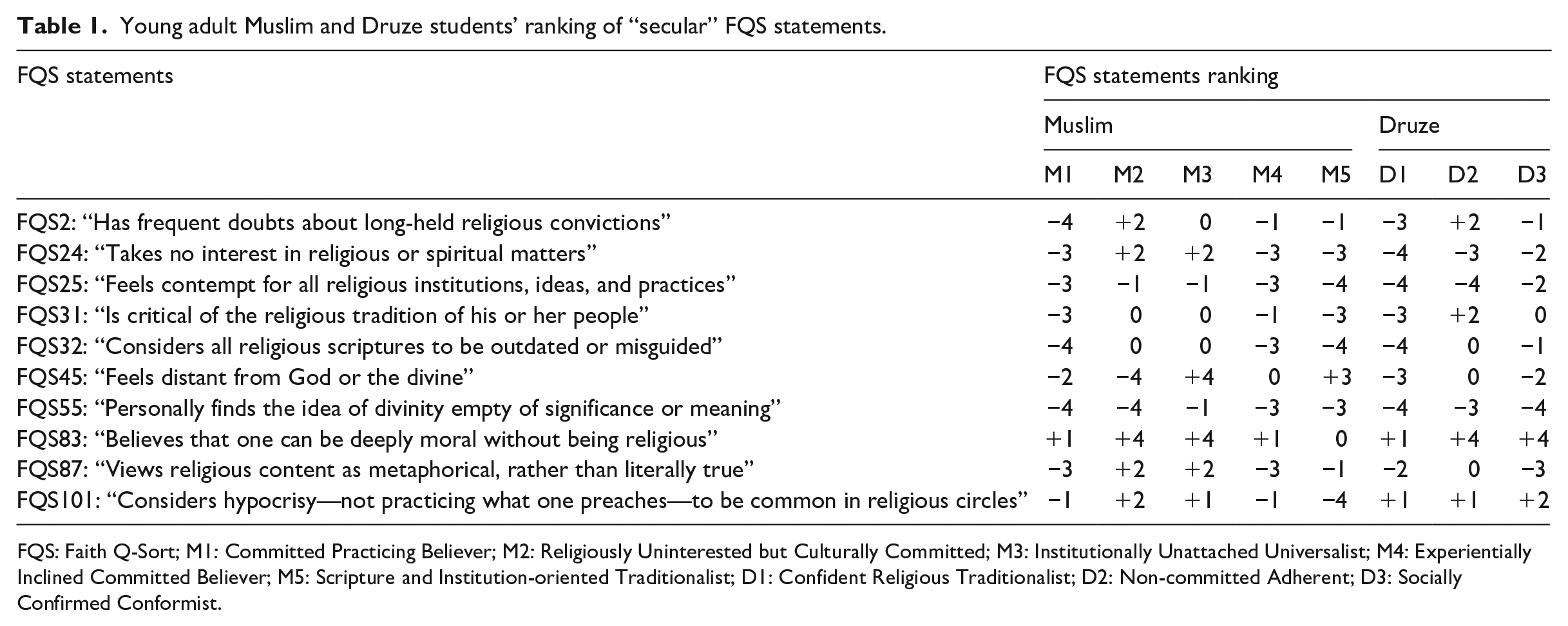
FQS: Faith Q-Sort; M1: Committed Practicing Believer; M2: Religiously Uninterested but Culturally Committed; M3: Institutionally Unattached Universalist; M4: Experientially Inclined Committed Believer; M5: Scripture and Institution-oriented Traditionalist; D1: Confident Religious Traditionalist; D2: Non-committed Adherent; D3: Socially Confirmed Conformist.
Table 1 shows that religion appears to play no role in the lives of the M2: Religiously Uninterested but Culturally Committed and M3: Institutionally Unattached Universalists, as evidenced by their agreement with the statement “Takes no interest in religious or spiritual matters,” in contrast to the other Muslim prototypes’ strong disagreement with this idea. This lack of interest in religious affairs is reflected in their neutrality toward statements echoing a stance on religion-related issues, such as criticizing their communities’ traditions or reflecting on the relevance of religious texts, and seems to be stronger among the M3: Institutionally Unattached Universalists who were also neutral toward the idea of doubting long-held religious convictions, as respondent YILSK018 clearly stated when asked about the role of religion in her life: “It is something that I put on the side . . . it exists, I cannot deny it, I cannot delete it from my ID card.”
This notion of perceiving religion as only a label clarifies its marginality in the lives of the M3: Institutionally Unattached Universalists, indicating this is a long-held stance. In contrast, and uniquely among all Muslim prototypes, the M2: Religiously Uninterested but Culturally Committed affirmed having doubts about their long-held religious convictions, seemingly the result of changing worldviews following intercultural encounters, which increase openness to new ideas and practices. Respondent YILSK020, for example, explained that relocating into a mixed city of Jews and Arabs during her studies had affected her in this way, indicating clearly how leaving a conservative hometown to live in a multicultural society might remove the traditional religious filter through which young adult Muslim students’ eyes view and interpret the world. This process is further accelerated by the difficulty of following and obeying religious rules in these societies, a difficulty sometimes linked to the individual’s status as a member of a religious minority in Israel: choosing a religious path may reveal one’s religious identity, which can lead to prejudice and serve as a barrier to self-development, as reported by respondent YILSK041 about her friends who wear the Hijab: “Most of them are unemployed . . . If I were wearing the Hijab now, I would not have been working where I am.”
Being a member of a minority religion in Israel has ramifications for one’s decision to follow a religious route in life. Despite state laws guaranteeing religious freedom, it appears that the Israeli reality does not allow this for some young adults from religious minorities. They distance themselves from religion to “blur” their religious identity, avoid discrimination, and integrate into Israeli society. However, the opposite appears true for other “secularized” young adults: to combat discrimination, they emphasize their religious affiliation, as demonstrated by the respondent YILSK018, for whom “Muslim” is merely a label, when she expresses her need to stand up for and protect Muslims by emphasizing her religious identity if she is mistaken for a Jew: Like, I feel that since many things are happening against Muslim people, like, I put myself in the front, as if I am a Muslim who they would call “a good Muslim” . . . they all think at first glance that I am a Jew, even the Arabs think that I am a Jew . . . Like, I feel that “No! I am a Muslim.”
Considering the period of time in which this interview was conducted, during 2017, when Muslim Palestinians had carried out stabbing assaults on Israeli citizens, this notion shows another way in which the Israeli political scene might affect the religious identity of Muslim students as a minority group. Because of her “liberal-Jewish-like” appearance, YILSK018’s religious identity may have been hidden from others, but by revealing it, she uses her “secularity” and religious identity to combat negative religious stereotypes. Notably, secularization was found to be associated with discrimination only in the Muslim sample.
Whatever the reason for the lack of interest in religion among the M2: Institutionally Unattached Universalist and M3: Religiously Uninterested but Culturally Committed, for both it seems to be replaced by universalist values of humanity, acceptance, and respect for all, as reflected by respondent YILSK278: “I am not particularly religious, but humanitarian. For me, humanity is more important than religion . . . It is not always religion that builds the person, the values, and principles, and morals—education is more important.” Besides indicating adherence to universalist values, this notion clearly reflects both prototypes’ strong belief that morality is not contingent upon religion. Their decentralization of religion is also apparent in their affirming the idea that religious content is not literally true, and that hypocrisy is common in religious circles, as expressed by respondent YILSK020 who criticized the contradiction between the percepts religious people preach and their actual behavior. This critical view of religious circle is also evident in the fact that both prototypes only slightly reject the notion of feeling contempt for religious institutions and ideas, as compared to the high rejection by all other prototypes of this anti-religious statement.
The main difference between M2: Institutionally Unattached Universalist and M3: Religiously Uninterested but Culturally Committed lies in their relation to God. The former’s lack of interest in religious issues had no effect on their belief in God and sense of closeness to him. They all cited their great trust in God as a vital reinforcing power while facing traumatic events, expressing a sense of assurance that stems from putting faith in God. In contrast, the marginality of religion in the life of the M3: Religiously Uninterested but Culturally Committed contributes to a sense of distance from God, making them amenable to the idea of a meaningless divinity, which directly opposes Islam. Respondent YILSK064 ties these ideas to his actions that contradict religious law: I believe in the existence of God, and I believe Islam is the right religion among all religions. However, at the same time, I do not abide by what my religion imposes on me, and sometimes I even contradict it . . . “God exists,” you know . . . but I don’t follow all the religious rules of my religion.
This statement seems to indicate, by virtue of YILSK064’s double assertion, that he does not act according to what he knows to be true (God’s existence and the superiority of Islam), that his beliefs do not prescribe his actual behavior, and thus may be weak.
Notably, all M2: Institutionally Unattached Universalist and M3: Religiously Uninterested but Culturally Committed respondents expressed and highlighted their frustration with their community’s traditions, claiming they are old-fashioned, ill-adapted to modern demands, and impede self-fulfillment. Respondent YILSK020 claimed that in her view traditions disrespect the exclusivity of the individual person, criticizing being treated like “the rest of the herd” in a way that denies the freedom to choose one’s own personal path in the name of “incomprehensible” traditions. The individualistic approach here is foreign to the conformist norms of Arab society in Israel, indicating the effects of modernization processes.
While secularization among these Muslim students manifests as a lack of concern with religion, unwillingness to commit to the demands of religious life, and at times feeling distant from God, it seems to take a different form among the Druze D2: Non-Committed Adherent. As with the Muslim M3: Religiously Uninterested but Culturally Committed and M2: Institutionally Unattached Universalist, the Druze D2: Non-Committed Adherent was neutral toward the idea that religious scriptures are misguided, but (unlike the former prototypes’ neutrality that reflects unconcern with religious matters) related this stance to the Druze religion’s secrecy and lack of access to Druze religious texts, being non-Religious (Juhal). Accordingly, and uniquely among the Druze prototypes, the D2: Non-Committed Adherents were the only ones to doubt and criticize long-held religious convictions, believing they are social constructs rather than evolving from religious texts. Respondent YILSK276 clarified the links between these ideas, relating how her traditional views changed dramatically after leaving her hometown for college and questioning what she had hitherto accepted as the norm: “I started thinking about things, and say ‘What is this nonsense?’”
As this notion indicates, the secrecy of the Druze texts hinders the ability of the non-Religious to determine the sincerity of the reasoning behind religious traditions. This also pertains to their indifference toward the idea that religious content is not literally true.
D2: Non-Committed Adherents have doubts about religious convictions and, like the other Druze prototypes, believe hypocrisy is common in religious circles. They do not, however, despise all religious institutions and ideas, and strongly deny a lack of religious or spiritual interests. Respondent YILSK240’s idea reflects these points of view: I am a believer, like, I am a Druze, but I am not that religious a person . . . I do not feel that the religious institutions, with all due respect, should affect me negatively, in fact, they should affect me positively. So, whatever they decide, I think about it. . . and then decide if it is a yes or no. But I certainly respect the religious institutions.
This notion expresses universalist values of respect for other religions and religious institutions and relates to the D2: Non-Committed Adherent’s strong belief that one can be moral without being religious. Furthermore, the previous quotes from respondents YILSK240 and YILSK276 reveal that this prototype’s distance from religion is not due to a lack of interest in religious matters, but to disagreement with the Druze community’s religious convictions and a need for personal liberty to make decisions about their own lives rather than blindly following these convictions.
Finally, like the other Druze prototypes, the D2: Non-Committed Adherent strongly rejects the idea of divinity being devoid of significance or meaning but, unlike the others, is unconcerned about feeling distant from God. In their interviews, they did not mention God except to say that they believed in him. This reflects their general neutrality toward religion, as becoming Religious is the ultimate way for Druze to feel close to God: as YILSK240 explains, “I am not Religious, but I am a believer, there is a difference between Religious and believer.”
Discussion
Previous research has criticized the application of psychological theories and conceptual frameworks developed primarily in Western cultural contexts to non-Western and non-Christian contexts (e.g. Abu-Raiya, 2017), indicating the need for systematic empirical research using a “bottom-up” approach, grounded in cultural worldviews and practices (e.g. Abu-Raiya & Pargament, 2011; Ghorbani et al., 2007). This study is another step in that direction, aiming to investigate the effects of modernization in the religious worldviews of religious minorities in a non-Western context, with a focus on their ethnic position in society. It explored some of the varieties of religious and non-religious worldviews among young adult Muslim and Druze students in Israel, the contrasts and similarities between them, and the implications of their ethnic and religious minority status in the Jewish state of Israel. Despite the small sample size, which is a feature of the Q-methodology, the data revealed some interesting findings.
Concerning the study’s main research question regarding varieties of religious or secular worldviews among young adult Druze and Muslim students, five different prototypes emerged among the sample of young adult Muslim students and three prototypes among the Druze. Both groups included highly religious prototypes, as well as others that reflected distance from religion, with similar ways of reflecting these religiosities. Following recent studies indicating the complexity and multidimensionality of religion as a lived experience (McGuire, 2008), the study findings further confirm the lack of dichotomy between the religious and the secular, and the need to adopt a functionalist approach that focuses on the meaning systems that shape the worldviews of individuals and groups (Taves, 2018; Taves et al., 2018).
Overall, respondents’ religiosities in both groups appear to be composed of four major components, each with multiple manifestations and varying in nature and strength: (1) faith in religious texts, convictions, traditions, and God; (2) feelings of closeness to God and being spiritually protected by him; (3) a sense of religious belonging; and (4) involvement in religious practices (expressing religious faith either actively (e.g. prayer and/or charity) or passively (e.g. by refraining from religiously forbidden practices). These components are consistent with Saroglou’s (2011) model of religion as a multidimensional concept with four Bs: believing (cognitive), bonding (emotional), belonging (social), and behaving (moral). Notably, however, the current samples’ emotional religious experience (bonding) seems to manifest primarily in their personal relationship with God, which can usually, but not always, be associated with a strong sense of the other Bs. As Islam and Druze are both conservative and orthopractic religions that focus on worshiping God by adhering to religious dictums, it is surprising that the young adults bonding to God sometimes seemed not to travel the traditional path of religious praxis as much as create a personal spiritual space in their lives.
To further elucidate the research findings, I will now go through them in detail in two parts corresponding to the first and second research sub-questions while also referring to the third sub-question, the differences and similarities between the two groups.
How do young adult Muslim and Druze students integrate their religious worldviews within the secularization processes of modernity?
Despite the cultural changes and conflicts experienced by Druze and Muslim communities in Israel, modernization processes do not appear to affect their sense of religious belonging and faith in God. All the students in our samples remain committed to their religious communities, none intend searching for another religious home, and none expressed any atheistic thoughts. This is especially noteworthy given the samples were composed of students, who are more likely than their non-student peers to be exposed to intercultural encounters on campuses and therefore more likely to be affected by such encounters.
These findings can be explained using Tajfel and Turner’s (1979) Social Identity Theory. Religious identity is central to one’s self-concept and the promotion of one’s wellbeing and can be especially important in difficult circumstances (Ysseldyk et al., 2010). Living in a country where religion and ethnicity are interwoven, and as ethnic group membership is impermeable, religious minorities in Israel will always be “othered.” Thus, when an individual’s sense of security and safety is undermined, a collective religious identity empowered by a community of members sharing the same experiences and convictions becomes highly valuable (Ysseldyk et al., 2010).
This also reflects the functionalist approach of the meaning systems for the study of religious worldview (Taves, 2018). Meaning systems emerge in a social and cultural context. When religion pervades one’s environment and serves an adaptive social goal, religious meaning systems become highly resistant to change. This could also explain the absence of atheistic thoughts among the research participants: membership in a religious community, the essence of which is worshipping God, leaves no room for any assertions about the existence of God. However, a word of caution is required here. Recent findings (e.g. Exline et al., 2014), suggest that people may be hesitant to disclose certain types of inner religious struggles, particularity doubts about the existence of God or the afterlife, which may be taboo, or at least socially unacceptable, in Islamic culture (e.g. Abu-Raiya et al., 2015). Given that some of the interviewees indicated a distance from God, it is possible that they were reluctant to express any atheistic thoughts they had.
The effects of modernization on the participants’ religiosities are most visible in the strength of their beliefs in their respective communities’ religious traditions and texts, primarily reflected in their involvement levels in religious practices and their relationship with God. As evidenced by the three prototypes of both groups who expressed the greatest distance from religion, modernization appears to foster distance from religion in a variety of ways, depending on the peculiarities of the case at hand.
For the Muslim sample, lack of interest in religion generally appears a long-held position, whereas for Druze it appears to stem from the secrecy of the Druze religion and the inability of the non-Religious (Juhal) to confirm whether religious traditions and rules truly reflect the religious texts. As they encounter new people, ideas, and practices, students from both groups appear to adopt universal values that contradict their communities’ traditional values. Parallel to, or perhaps because of, this change, they question their religious traditions and perceive hypocrisy as common in religious circles. These processes seem to have one of two effects: for the Druze, it shakes their faith in elementary religious beliefs, while for Muslims, it fosters the adoption of new, non-Islamic beliefs. For instance, whereas D2: Non-Committed Adherents uniquely affirmed the belief in reincarnation only slightly (rather than strongly, like the other Druze prototypes), M2: Institutionally Unattached Universalist affirmed a belief in reincarnation even more strongly than the D2: Non-Committed Adherent. Thus, modernization seems to promote secularization by eroding faith in religious beliefs and providing other options. A methodological corollary of this is that when exploring signs of secularity in conservative groups, observing micro-level utterances is worthwhile. Rather than expecting to find statements like “I reject the idea of reincarnation,” we should expect, and are more likely to find, such qualifiers as “Sure, I support the idea of reincarnation. . . a little.”
From a worldview standpoint, answers to existential questions are not required by all individuals in all cultures. It is possible to live life without giving such philosophical issues much thought (Lee, 2015). Many believe that traditional religion’s answers are either inadequate or irrelevant to their lives (Sheard, 2014) and secular worldviews can provide the same meaning provision functions (Park et al., 2013). Muslim students’ long-held lack of interest in religion appears to reflect a disinvolvement in thought processes over such existential questions, seeing them as irrelevant. In contrast, the Druze’s decreased belief is because the legitimacy of religious orthodoxy cannot be confirmed, undermining the credibility of their religious meaning systems. It is therefore no surprise that students from both groups become “open” to new ideas. Furthermore, the disparity between articulated worldviews (as expressed in texts and language) and enacted worldviews (as they are applied in practice) appears to undermine the stability of their religious worldviews (Taves et al., 2018). Henrich (2009) proposed that people tend to accept information expressed verbally by cultural models, to the extent that these models express “Creditability-enhancing displays, CREDS”—actions performed that match or prove the verbal expressions. CREDS were more effective than words in predicting religious beliefs among individuals (Lanman & Buhrmester, 2017). The lack of CREDS by religious leaders apparently contributes to the undermining of students’ religious beliefs.
Future psychological research could investigate the role of personal characteristics in shaping such effects on worldviews and the role of values in this process. For example, are people who value conformity and those who value self-enhancement similarly affected by the mismatch between religious leaders’ actions and words?
How does their status as ethnic and religious minorities influence Druze and Muslim religious worldviews?
Israel’s unique cultural, national, and politically conflicted context raises another indirect way in which modern societies may promote distance from religion: secularization as what I would term an “imperative/necessary choice.” This serves the adaptational goal of avoiding discrimination and/or acculturation stress, which can sometimes foster the adoption of counter-traditional behaviors (Berry, 2006). In other cases, however, the findings indicate that religious minority students can combine secularization with religiosity to combat negative stereotypes about their religious communities, by emphasizing both their religious affiliation and their “modern” liberal values.
Although mentioned as a potential bias in self-report methodology, the tendency to present the religious group in a positive light, termed “theological desirability” (Abu-Raiya et al., 2007), emerged as serving an adaptive goal among the Muslim students in the current research sample.
These findings tap into the previous notion that enacted and articulated worldviews may differ (Taves et al., 2018). However, rather than undermining the stability of religious worldviews, this disparity seems to serve an adaptive purpose in this case, implying that meaning-making processes should be described in social, cultural, and environmental terms (Lee, 2015; Taves, 2018), and that the study of worldview dynamics should pay attention to social dynamics in both everyday and exceptional circumstances and seek to identify the factors that distinguish these dynamics across worldviews and cultural contexts (Droogers, 2014), as the same terms and phenomena can differ, even within a specific context.
That discriminatory experiences are confined to the Muslim sample is consistent with earlier findings indicating that Druze are more involved in Israeli society and suffer less discrimination (Kheir, 2011; Smooha, 2017). However, Druze religiosity appears influenced by their history of discrimination and persecution, which emphasizes the importance of maintaining the community’s continuity and acts as a current buffer against modern culture’s secularizing effects. As a religious minority with no dominant country or religious community worldwide, Druze continuity was achieved through religious upbringing from an early age, in accordance with religious traditions that aim to protect the three major elements in one’s life: religion, land, and honor (Falah, 2000). This could explain why, compared to the various religious worldviews among the Muslim sample, the Druze expressed a stronger sense of religious belief and belonging, emphasizing the importance of religious loyalty and continuity. This is even more remarkable given that all Druze respondents bar one were non-Religious (Juhal). Their stronger faith and coherence also imply that religiosity is primarily linked to religious belief and trust in the community’s religious traditions, rather than knowledge of religious texts and practices, suggesting that answers to the existential questions inherent in religious meaning systems are not necessarily acquired by learning religious texts, but primarily delivered through socialization processes, empowered by the adaptive effects of group membership on wellbeing, particularly in conflictual contexts (Ysseldyk et al., 2010). However, as seen earlier, we note that when a disparity between actions and verbal assertion is perceived among the “teachers”—religious models—this socially based worldview becomes more fragile.
Modernization’s indirect effects on young adult minority students’ religiosities are also apparent. Recent research in Europe has focused on the emergence of new spiritual practices and beliefs to create meaning in life, partly explained by people’s difficulties in following religious rules in the face of modern life’s demands (e.g. Utriainen, 2014). Similarly, Muslim students expressed a lack of religious commitment due to inability or lack of time to conform to religious demands, though still expressing a strong belief in and sense of God’s presence and referring to him at times of need. This distinction between beliefs and religious practices is prominent in previous studies on Muslim religiosities (Abu-Raiya & Pargament, 2011).
Given that the essence of Islam is the worship of God, we can reasonably assume that the divide between actualizing religious belief and faith in God among Muslim students reflects a similar adaptation to modern life, a “compromise” due to a lack of ability or unwillingness to get more religiously involved, due to a variety of possible factors. First, as members of a minority group facing acculturation stress and discrimination (Shannan, 2007), those choosing a religious path emphasize their religious identity, potentially exposing themselves to further discrimination. Second, confronted with liberal modernity norms on campuses versus the conservative nature of their hometowns, some Muslim students chose the “worldly life,” contradicting their religious traditions. Third, the dearth of public prayer facilities in their immediate surroundings makes it difficult for Muslim students to become more religiously committed. Following a religious path may also be time-consuming, an “extra task” or “burden” for students who work to fund their studies. Stressing their faith in God, relating to him “directly” without adhering to religious practices and beliefs could be a coping strategy for “keeping in touch” with religion’s ultimate goal in their own way.
Limitations and future directions
A number of limitations associated with this study need to be acknowledged. The very distinctive characteristics of the two groups analyzed and the methodology’s emphasis on a given sample’s exclusiveness rather than inclusiveness limit the extent to which these results can be generalized. The small sample size, though appropriate in Q-methodology, is also acknowledged. However, even if generalizing to larger populations is impossible, small samples can still be used to generate highly relevant results (Watts & Stenner, 2012). Future research can broaden the scope by focusing on non-student young adults, as well as other minorities, and religious trends by age and gender. The study’s findings specifically point out the necessity for future research to concentrate on determining what aspects of cultural context significantly influence the religious worldviews of religious minorities. Do religious worldviews and belonging persist among religious minorities of the same ethnicity as the majority? Or is religious affiliation bolstered by a background of political strife and discrimination? In other words, even if religious minorities have distinct ethnic backgrounds, will their religious identity be less significant to them in a diverse and peaceful environment?
A second limitation relates to the FQS method. Despite the efforts made to define the FQS statements, some of the expressions used do not correspond to the language people use in everyday life (Nynäs, Keysar, & Sjö, 2022), especially for translated statements in literal, rather than spoken, Arabic. Research participants frequently described certain terms as vague and requiring clarification, due to unfamiliarity with their literal version or conceptual alienation. Therefore, although used in several studies with both religious and non-religious groups (e.g. Lassander & Nynäs, 2016), the FQS still requires thorough evaluation before implementation. Nonetheless, combining the FQS with semi-structured interviews allowed research participants to express their concerns, religious feelings, and thoughts in their own words, thus elaborating on the FQS sorting and reducing the possible negative effects of any misunderstandings.
Stenner et al. (2008) claimed that the Q-sort is intended to “maximize the expression of qualitative variation and to record it in numerical form” (p. 218). The FQS’s central strength is thus allowing comparisons across samples, via defining elements, difficult if based on qualitative data, and lacking depth and personal perspective if based solely on quantitative data. However, additional research is required to validate the FQS across different samples.
A third limitation relates to potential biases in self-reported methods in religious studies, specifically research participants’ tendency to present their religious worldviews favorably or presenting religion in a positive manner—“theological desirability” (Abu-Raiya et al., 2007). The research interviews took place in 2017, when Muslim Palestinians carried out stabbing attacks on Israelis. Some research participants openly discussed the attacks’ negative effects on their daily lives and the increased likelihood of encountering prejudice in mixed Arab-Jewish contexts. I therefore believe that theological desirability influenced the findings, with one Muslim respondent sincerely declaring her need to defend Islam. However, their openness in discussing these issues with me in a respectful research context makes me believe this effect was minimal. I also believe that social desirability—as opposed to the theological desirability manifested by Muslim respondents—was more prominent among the Druze. Knowing the acceptable norms in the Druze community probably limited some participant willingness to express their ideas and feelings to me. I tried to mitigate this effect by always starting interviews with “You can say whatever you want, knowing that it will be kept secret, and that I will not judge you, because I believe that everyone has the right to think and live their lives the way they want.” This appeared to comfort some participants, but its impact is difficult to assess. My being Druze may actually have had a positive effect on some Druze participants, allowing them the freedom to criticize the Druze leadership, which they would not do in front of a “foreigner.” Future research should evaluate such biases and researcher positioning effects by asking interviewees their opinion on such a topic beforehand, for example, multiple choice questionaries containing items such as “I would feel more comfortable speaking to an interviewer from my own community.” Actualizing the participant’s choice, if possible, could contribute to minimizing these biases, and future research could also focus and elaborate on these biases.
Summary and concluding remarks
Research on the role of religion in contemporary contexts has revealed the need for an all-encompassing framework for studying the “religious” and the “secular,” as well as capturing the complexities of lived religion (McGuire, 2008; Murphy, 2017; Taves, 2018). The study of worldviews represents such a framework. The worldview approach is based on the premise that different people construct different meaning systems in cultural contexts to answer existential questions, resulting in a subjective sense of meaning and purpose in life. Thus, while some may find answers to these questions in religion, others may choose other answers that we refer to under the umbrella of “secular.” This meaning system will be maintained as long as it is functional and serves an adaptative goal. Thus, a person may become “secular” if finding answers to existential questions is irrelevant to them or if religious answers become insufficient or no longer make sense. However, most of the research on religion and religious worldviews was conducted in Western cultures. The current study focused on investigating the religious worldviews among young adults of two religious minorities in Israel, Muslims and Druze. The data indicated that regardless of secularization processes, the Arab religious minorities remain fairly committed to their faith, and their religiosities are tailored to each person’s lifestyle and needs, combining both religious and secular elements. Furthermore, Arab religiosity has not been accompanied by the emergence of new non-traditional religions or atheism.
What makes religion such a powerful meaning system that people cling to and do not easily abandon? The data emphasize the significant role culture plays in shaping the worldviews of individuals and groups alike, becoming a “container” through which the meaning-making processes that shape a person’s worldviews take place; cultures may thereby sometimes limit the flexibility and ability to adopt new worldviews.
Among religious minorities, especially when religious affiliation differentiates one ethnically from the majority, religious belonging becomes highly salient to identity, and religious group membership plays a significant role in promoting wellbeing (Ysseldyk et al., 2010). This follows the Existential Security Thesis, which argues that living in existentially insecure societies fosters a need for religious reassurance, especially for religious minorities, as people experiencing existential anxiety value religion and redemption more than others (Norris & Inglehart, 2015). In a land where religion is strongly linked to existential concerns, “religious fidelity” becomes crucial for each community’s survival. As ethnic and religious minorities in Israel, Muslim and Druze “otherness” exposes them to discrimination and they turn to their communities’ religious institutions (Gara, 2015). This reinforces their religious identity and may be one reason for the steadfastness with which they maintain that identity.
In such religiously saturated contexts, one is born into a culture in which religious meaning systems are inherent in every aspect of daily life; one’s mind becomes programmed through religious language and symbols, and any deviation from the common religious worldviews will always be defined through a religious “I am not” approach. Furthermore, even if one dares question the truthfulness of religion in such circumstances, expressing nonreligious or atheistic views would be very risky, as this carries socially negative consequences (Exline et al., 2014). Consider the following scenario: if a person born into a purely atheistic culture wants to describe their answers to existential questions, they are unlikely to mention God, and they may not easily accept the idea of his existence if introduced to it. Their minds are not familiar with the “new language,” and even if they learn it, it will never be their “mother tongue.” Their native language will always be there.
Thus, the current data show that, in some contexts, the ability to move between meaning systems is limited, and change should be defined in terms of deviations from culturally normative worldviews, rather than conversion. Instead of referring to the “nonreligious,” the term “less religious” seems to be more appropriate.
Overall, modernization does not seem to convert Druze and Muslims into non-religious people, nor does it affect their religious affiliation or core religious beliefs. It does, however, appear to undermine their trust in and adherence to their communities’ religious traditions. Will modernity lead to increased secularization, with future generations of Druze and Muslims losing their grip on religion? Or will the Israeli reality strengthen their internal cohesion and sense of religious belonging as ethnic and religious minorities?
The need for future research is clear: As respondent YILSK240 so eloquently put it, “no matter how much you ask, there are always new things to learn.”
Supplemental Material
sj-docx-1-prj-10.1177_00846724221145340 – Supplemental material for Reflections of modernization in religious worldviews of Israeli religious minority students
Supplemental material, sj-docx-1-prj-10.1177_00846724221145340 for Reflections of modernization in religious worldviews of Israeli religious minority students by Sawsan Kheir in Archive for the Psychology of Religion/Archiv Für Religionpsychologie
Footnotes
Acknowledgements
I thank all participants who contributed to this study; I thank my supervisors, Professor Peter Nynäs (Åbo Akademi University), Dr. Sofia Sjö (Åbo Akademi University), Professor Yohanan (Yohi) Eshel (University of Haifa), and Dr. Nurit Novis-Deutsch (University of Haifa) for providing advice and guidance during the preparation of this paper; and I thank the two anonymous reviewers for valuable feedback on an earlier version of this paper.
Funding
The author(s) disclosed receipt of the following financial support for the research, authorship, and/or publication of this article: This research was funded by Åbo Akademi University, Åbo Akademi University Foundation, The Donner Institute, and the Academy of Finland (application no. 288730). The research methodology was approved by the Board for Research Ethics both at Åbo Akademi University, Finland, and at the University of Haifa, Israel. The materials analyzed in this article may be obtained by contacting the YARG Principal Investigator, Prof. Peter Nynäs (

Supplemental material
Supplemental material for this article is available online.
Notes
References
Supplementary Material
Please find the following supplemental material available below.
For Open Access articles published under a Creative Commons License, all supplemental material carries the same license as the article it is associated with.
For non-Open Access articles published, all supplemental material carries a non-exclusive license, and permission requests for re-use of supplemental material or any part of supplemental material shall be sent directly to the copyright owner as specified in the copyright notice associated with the article.
