




Abstract
The present study drew from the career construction theory of career adaptation and assessed the extent to which career agility and psychological capital (as psychological states of adaptive readiness) activated employees’ career adaptability resources and fostered their career resilience and career satisfaction (as modes of career adaptedness). A sample of (N = 412; mean age = 38.79 years) Black African employees in the public services participated in the study. Correlational statistics showed positive associations between the study variables. Mediation effects highlighted technological adaptivity, agile learning, optimism, and hope as activators of career concern, career control, and career curiosity, which in turn boosted self-reliance, personal resilience, and work resilience. Psychological states of career agility and psychological capital had also direct effects on the career adaptedness modes of career resilience and career satisfaction. The findings enriched career adaptation theory and have utility for organisational career development practice in the public services.
Keywords
In the globalised, technology-driven work world employees are constantly adapting to uncertain and less structured and unpredictable career pathways while also exploring more opportunities for career mobility and continuous growth because of hybrid and virtual employment spaces and digital-era upskilling demands (Nalis et al., 2022). Researchers argue that rapidly changing work and career conditions demand the capacity for agentic career adaptation (Haenggli et al., 2021; Peeters et al., 2022). In addition, the activation of career adaptability resources has become essential for adapting to and managing an unpredictable career in the uncertain, technological-driven work context (Coetzee et al., 2020; Nalis et al., 2022). In the South African context, the capacity for agentic career adaptation seems especially true for employees in the public services. Research in the public services domain reports on low levels of career and job satisfaction and engagement because of employees’ sense of slow career progression, career plateauing, and concerns about uncertain career pathways in the evolving digitally driven workspace (Mbiko, 2023; Ramgoolam, 2020). In this regard, Mbiko (2023) argues for a career development support and counselling framework that fosters career adaptive behaviour for greater career resilience and career satisfaction in the public services domain.
The career construction theory (CCT) of career adaptation (Savickas, 2013; Savickas et al., 2018) explains that individuals adapt to changing socio-career conditions that potentially thwart career progression and career satisfaction by them being proactive adaptive agents in the management of their careers (Nilforooshan, 2020). Career adaptation is seen as the dynamic interplay between psychological states of adaptive readiness (adaptivity), the active use of career adaptability resources, and positive psychological modes of adaptedness that foster successful adaptation to changing career and work conditions (Hirschi et al., 2015; Savickas, 2013).
Empirical research suggests that, in response to changing work conditions, the self-regulation capacity denoted by individuals’ career adaptability can act as a mediating mechanism that transmits individuals’ psychological states of adaptivity into positive modes of career adaptedness (Hirschi et al., 2015; Hirschi & Valero, 2015; Johnston, 2018; Tolentino et al., 2013). However, there is a quest for more research (Johnston, 2018) to better understand the mediating role of career adaptability in the link between psychological states of career adaptivity and psychological modes of career adaptedness. Johnston (2018) further argues that the activation of career adaptability may depend on the precondition of psychological states of adaptive readiness and having a sense of personal control and optimism towards the possibility to change turbulent situations.
Presently, research on psychological states that account for individuals’ adaptive readiness (i.e., career adaptivity) and that function as activators of their career adaptability seems sparse (Coetzee et al., 2020; Johnston, 2018). The present study addresses this gap in research by its objective to elucidate the extent to which the under-researched construct of career agility (Coetzee et al., 2020, 2021) and the well-researched construct of psychological capital (Luthans & Youssef-Morgan, 2017) jointly (as states of adaptivity) contribute to the activation of individuals’ career adaptability resources (Johnston, 2018; Savickas, 2013). It is assumed that the activation of career adaptability resources may foster individuals’ career resilience (Coetzee et al., 2015) and career satisfaction (Greenhaus et al., 1990) as psychological modes of career adaptedness. Insight into the dynamic interplay among these constructs of agentic adaptive career behaviour may inform career development support and counselling practices in workspaces such as the public services.
Career agility
Career agility reflects a malleable psychological state of adaptivity in the digital-era work domain (Coetzee et al., 2021). Coetzee et al. (2020) differentiate between three cognitive-affective states of career agility: (1) technological adaptivity (positivity and optimism that accelerated technological development opens up new job and career opportunities for career growth), (2) agile learning (eagerness to search for opportunities to learn new skills that will improve career and job success), and (3) career navigation (willingness to navigate the environment for new career opportunities, take advantage of, and remain informed of changes and opportunities in the technological-driven job market). Research provides evidence that high levels of career agility function as important psychological states of adaptive readiness that activate the use of career adaptability resources (Coetzee et al., 2020).
Psychological capital
Psychological capital (PsyCap) refers to four malleable positive psychological states (self-efficacy, hope, resilience, and optimism) that synergistically facilitate the positive appraisal of circumstances and the likelihood of succeeding in a situation (Baluku et al., 2020; Luthans & Youssef-Morgan, 2017). Self-efficacy is the perceived ability to mobilise one’s motivation, cognitive resources, and courses of action to succeed. Hope refers to the agentic motivation, goal-directed energy, and perseverance to succeed in a specific context and the pathway(s) to accomplish tasks. Resilience is the ability to adapt to changing demands and bounce back from adversity, uncertainty, risk, or failure. Optimism denotes positive expectancies that motivate the pursuit of goals in difficult situations (Newman et al., 2014). Research provides evidence that the states of PsyCap motivate individuals to exert greater effort to perform well, which in turn enhances job satisfaction (Luthans et al., 2007). Synergistically, the PsyCap states denote a sense of control, intentionality, and agentic goal pursuit that foster adaptability strategies and positive psychological modes of adaptedness in changing contexts (Baluku et al., 2020; Del Castillo & Lopez-Zafra, 2022; Luthans & Youssef-Morgan, 2017).
Career adaptability
The career adaptability resources of career concern (preparing for the future through career planning), career control (ownership of one’s career development and career decidedness), career curiosity (envisioning and exploring future work selves), and career confidence (self-efficacy in solving problems and achieving goals) denote a self-regulatory, malleable career-related capability to adapt and successfully solve unfamiliar and complex problems throughout the career (Klehe et al., 2021; Tokar et al., 2020). Career adaptability reflects a ‘can do motivation’ that may evoke proactive modes of adaptedness in the work domain (Klehe et al., 2021; Nilforooshan, 2020). Career adaptability is inter alia positively associated with modes of career adaptedness such as career satisfaction and occupational self-efficacy (Johnston, 2018) and is predicted by career agility and psychological capital states such as hope and optimism, including sense of control, future work self, proactivity, and low tolerance for unpredictability (Coetzee et al., 2020; Duffy, 2010; Hirschi et al., 2015; Johnston, 2018).
Career resilience
Career resilience is a psychological mode of adaptedness that reflects self-efficacious agency in adapting to changing and adverse career and work conditions for attaining career and skills development goals (Coetzee et al., 2015; Han et al., 2021). Generally, career adaptation is motivated and guided by individuals’ goal of proactively and confidently integrating and aligning inner career needs and outer opportunities for career advancement and success (Tokar et al., 2020).
While career adaptability is about the active use of psychosocial resources, career resilience denotes demonstrated career agency in confidently coping with challenges and adversity when they occur in the work environment (Peeters et al., 2022). As antecedent, career agility is a psychological state of willingness and readiness to embrace and adapt to new career and development opportunities that may arise in the digital-era work environment (Coetzee et al., 2020).
Generally, career resilience reflects a psychological mode of career adaptedness that alludes to positive career adaptation (i.e., demonstrated quality of being adapted to changing work conditions). In this study, career resilience constitutes three modes of agentic career adaptedness (Coetzee et al., 2015): (1) self-reliance (self-efficacious adaptedness to job changes by embracing new skills development opportunities and career goals for one’s future working life), (2) personal resilience (proactively adjusting career and skills development goals in response to changes in the company’s structure and strategy), and (3) work resilience (embracing turbulent changing technological and work conditions as an investment in one’s career growth). There is empirical evidence that career resilience fosters positive career adaptation because of an agentic mode of optimal functioning. Empirical research shows positive associations between career resilience, objective and subjective career success, and career satisfaction (Han et al., 2021; Peeters et al., 2022).
Career satisfaction
Career satisfaction denotes a cognitive-affective mode of contentedness which reflects positive career adaptedness. Individuals feel satisfied with the career success achieved, the progress they made towards meeting overall career goals, and goals for advancement, income, and skills development (Greenhaus et al., 1990; Matsuo, 2022; Spurk et al., 2015). Research shows that career adaptability, career planning, and goal-directed career behaviour enhance career satisfaction (Coetzee et al., 2022; Johnston, 2018). Positive associations between constructs of career adaptivity, career adaptability resources, and psychological modes of career adaptedness such as job and career satisfaction are also evident from research (Jawahar & Liu, 2017; Johnston, 2018; Tokar et al., 2020).
Drawing from the CCT of career adaptation (Savickas et al., 2018) and previous research, we argued that individuals’ psychological states of adaptivity (operationalised as career agility and psychological capital) positively activate the confident use (i.e., ‘can do motivation’) of career adaptability resources. In turn, the activation of career adaptability resources fosters positive psychological modes of career adaptedness (operationalised as career resilience and career satisfaction). We further argued that the activation of career adaptability resources helps to transmit (i.e., mediate) the positive effects of individuals’ career agility and psychological capital onto their career resilience and career satisfaction. To investigate the dynamic interplay among the study’s constructs of positive career adaptation, we formulated the following four research hypotheses.
Research hypotheses
H1. Career agility (technological adaptivity, agile learning, and career navigation) positively predict (a) career resilience (self-reliance, personal resilience, work resilience) and (b) career satisfaction.
H2. Psychological capital (self-efficacy, hope, optimism, resilience) positively predict (a) career resilience (self-reliance, personal resilience, work resilience) and (b) career satisfaction.
H3. The effects of career agility states on modes of career adaptedness of (a) career resilience and (b) career satisfaction are positively mediated by career adaptability resources.
H4. The effects of psychological capital states on modes of career adaptedness (a) career resilience and (b) career satisfaction are positively mediated by career adaptability resources.
Figure 1 illustrates the hypothesised associations among the study constructs of adaptivity (career agility and PsyCap), career adaptability resources, and psychological modes of career adaptedness.
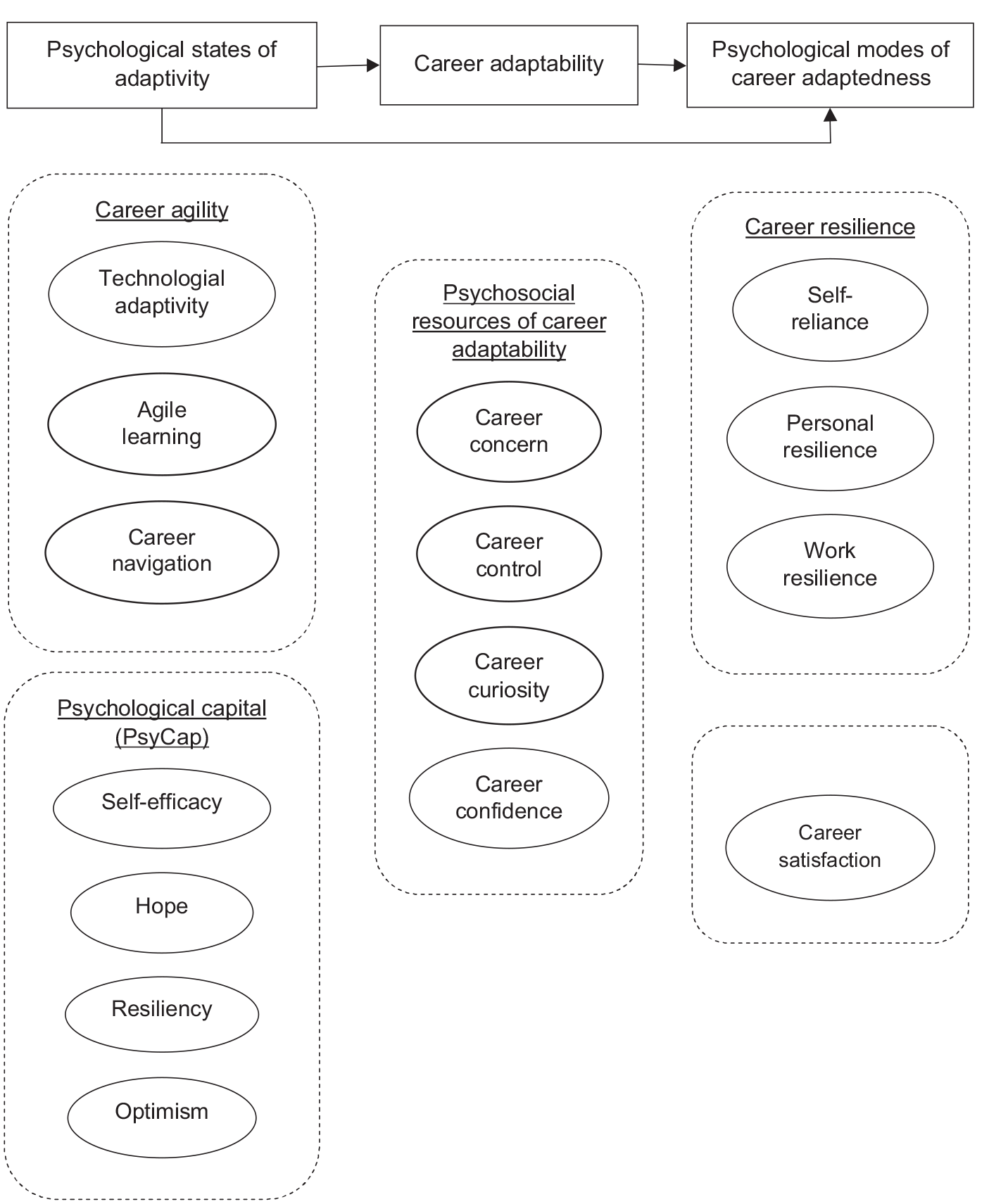
Conceptual model of the research.
Method
Participants
The participants were a random sample of N = 412 Black African employees in a South African public service government organisation residing over the mining industry. The mean age of the participants was 38.79 years (SD = 9.68). The sample was represented by 54% women and 46% men. The participants occupied staff (70%) and managerial/supervision level positions (30%). In terms of tenure, 66% of the participants had up to 10 years of job experience and 34% had more than 10 years of job experience.
Measures
Career adaptability
The English version of the 24-item Career Adapt-Abilities Scale (CAAS; Savickas & Porfeli, 2012) was applied to measure four facets of participants’ career adaptability on a 5-point Likert-type scale (1 = not strong; 5 = strongest): career concern (six items; for example, ‘Preparing for the future’); career control (six items; for example, ‘Taking responsibility for my actions’); career curiosity (six items; for example, ‘Becoming curious about new opportunities’); and career confidence (six items; for example, ‘Overcoming obstacles’). Coetzee et al. (2020) reported high internal consistency reliability and construct validity of the CAAS for the South African context.
Psychological capital
The English version of the 24-item Psychological Capital Questionnaire (PCQ-24: Luthans et al., 2007) was utilised to measure four facets of participants’ psychological capital on a 6-point Likert-type scale (1 = strongly disagree; 6 = strongly agree): self-efficacy (six items, for example, ‘I feel confident helping to set targets/goals in my work area’); hope (six items, for example, ‘I can think of many ways to reach my current work goals’); resilience (five items, for example, ‘I usually manage difficulties one way or another at work’); and optimism (seven items: ‘I’m optimistic about what will happen to me in the future as it pertains to work’). Baluku et al. (2020) reported acceptable internal consistency reliability and construct validity of the PCQ for the African context.
Career agility
Participants’ three facets of career agility was measured on a 7-point Likert-type scale (1 = strongly disagree; 7 = strongly agree) by means of the 18-item Career Agility Scale (CAS; Coetzee et al., 2021). The scale is currently available in English only. Examples of items included technological adaptivity (seven items: for example, ‘I feel my career growth and success are guided by my response to changing technological and socioeconomic conditions’); agile learning (five items, for example, ‘I continually search for opportunities to learn new skills that will improve my career and job success’); and career navigation (six items, for example, ‘I am able to navigate and adapt to change and uncertainty in my job and career environment’). Coetzee et al. (2021) reported high internal consistency reliability and construct validity of the CAS in the South African context.
Career resilience
The adapted South African-based Career Resilience Questionnaire (CRQ) of Mogale (2015) was utilised to measure three facets of participants’ career resilience on a 7-point Likert-type scale (1 = strongly disagree; 7 = strongly agree): self-reliance (five items: for example, ‘I feel it is important to establish a set of career goals in the planning of one’s future working life’; personal resilience (four items, for example, ‘I have taken definite steps in the past year to further my career’); and work resilience (six items, for example, ‘Frequent stressful changes in one’s working environment are worthwhile investments in one’s career growth’). The scale is currently available in English only. Coetzee et al. (2015) reported good internal consistency reliability and construct validity for the scale as applied in the South African Public Service context.
Career satisfaction
Participants’ general career satisfaction was measured as a global construct by means of the English version of the five items of the Career Satisfaction Scale (CSS) of Greenhaus et al. (1990). Responses were measured on a 7-point Likert-type scale (1 = strongly disagree; 7 = strongly agree). Examples of items included ‘I am satisfied with the progress I have made towards meeting my goals for advancement’ and ‘I am satisfied with the progress I have made towards meeting my overall career goals’. A South African study by Coetzee et al. (2022) reported high internal consistency reliability for the CSS.
Procedure
Participants received a no-reply URL link by email to complete the research questionnaire. Participation was voluntary, anonymous, confidential, and with informed consent.
Consideration of ethics
The research institution provided ethical clearance for the study (ERC Ref: 2020_CEMS_IOP_033). The participants’ organisation provided permission for the study survey.
Data analysis
The IBM Corp. (2021) SPSS Statistics version 28.0 software package was used to perform the descriptive and correlation statistics. The JASP Team (2022) computer software package was used to conduct a multi-factor confirmatory factor analysis (CFA) to assess the distinctiveness of each of the 15 construct variables. The following rules of thumb (threshold values) were applied for good model fit and construct validity (Hair et al., 2019): chi-square/df ⩽ 3; root mean square error of approximation (RMSEA) ⩽.06 or ⩽.08; standardised root mean square residual (SRMR) ⩽.05; and comparative fit index (CFI) ⩾.90.
Based on the guidelines of Rönnkö and Cho (2022), the CFA paired covariances among the 15 construct variables were investigated for issues of potential multicollinearity and false positives due to uncorrected measurement errors. The upper limit confidence interval (ULCI) of the positive factor covariances and the lower limit confidence interval (LLCI) for negative covariances between the multi-factor CFA model’s various construct variables were inspected at the 95% level. Rönnkö and Cho (2022) advise that CFA ULCIs or LLCIs smaller than .80 point to evidence of discriminant validity after correcting for measurement error (i.e., each scale factor measures distinct constructs).
To test the research hypotheses, the 95 percentile bootstrap method with the LLCI and ULCI range not including zero was adopted by means of the JASP Team (2022) software program to assess for significant direct and indirect (mediating) effects. Structural equation modelling (SEM) with the SAS software program (SAS, 2013) was conducted to test the model fit of the final significant mediation models. Maximum likelihood estimator was applied for the CFA, mediation, and SEM analysis.
Results
The multi-factor CFA had good model fit indicating construct validity of the measurement model: chi-square = 5938.32; df = 3071; chi-square/df = 1.93; p < .001; RMSEA = .05; SRMR = .05; CFI = .90. Inspection of the factor paired covariances showed that all covariances were positive and that the ULCIs were all below .80, thus indicating discriminant validity between the study variables.
Table 1 presents the internal consistency reliabilities, means, standard deviations, and bi-variate correlations. The composite reliability and Cronbach alpha coefficients indicated acceptable (.69) to high (.94) internal consistency reliability of the various scales’ constructs. As expected, all the construct variables had highly significant and positive associations at p = .000 (r ⩾ . 24 to r ⩽ .61; small to large practical effect).
Descriptive statistics and bi-variate correlations.
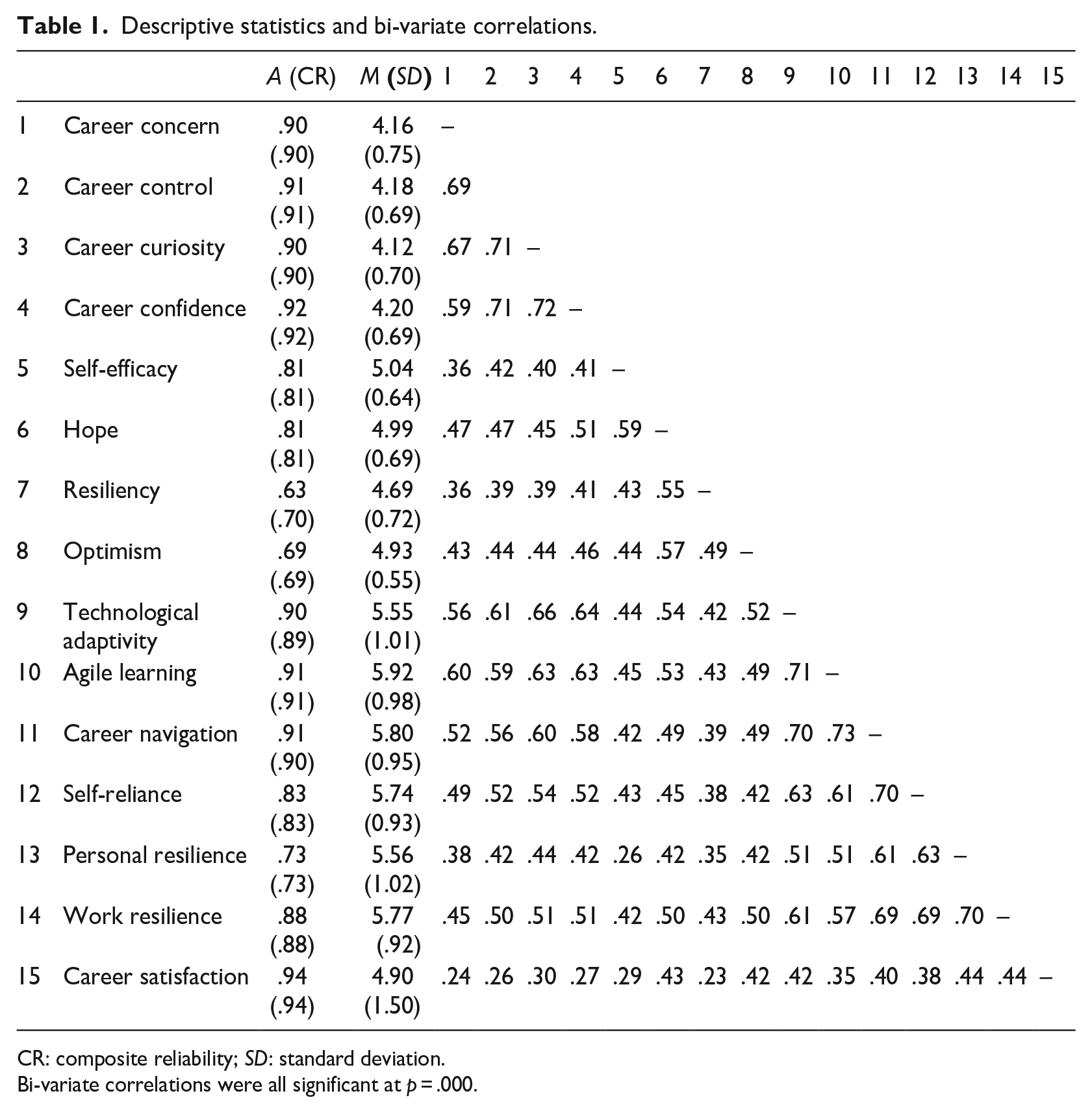
CR: composite reliability; SD: standard deviation.
Bi-variate correlations were all significant at p = .000.
Table 2 presents, for parsimony reasons, only the significant direct and indirect effects for the link between the career agility variables (technological adaptivity, agile learning, and career navigation) and the career resilience variables (self-reliance, personal resilience, and work resilience) and career satisfaction. Technological adaptivity had significant and positive direct effects on career satisfaction (β = .30; p = .01; LLCI = 0.09; ULCI = 0.51), self-reliance (β = .15; p = .003; LLCI = 0.05; ULCI = 0.24), and work resilience (β = .17; p < .001; LLCI = 0.07; ULCI = 0.26). Career navigation had significant and positive direct effects on career satisfaction (β = .30; p = .02; LLCI = 0.05; ULCI = 0.54), self-reliance (β = .49; p < .001; LLCI = 0.37; ULCI = 0.60), personal resilience (β = .51; p < .001; LLCI = 0.37; ULCI = 0.65), and work resilience (β = .51; p < .001; LLCI = 0.40; ULCI = 0.63).
Parameter estimates of significant direct and indirect effects: career agility as predictor.
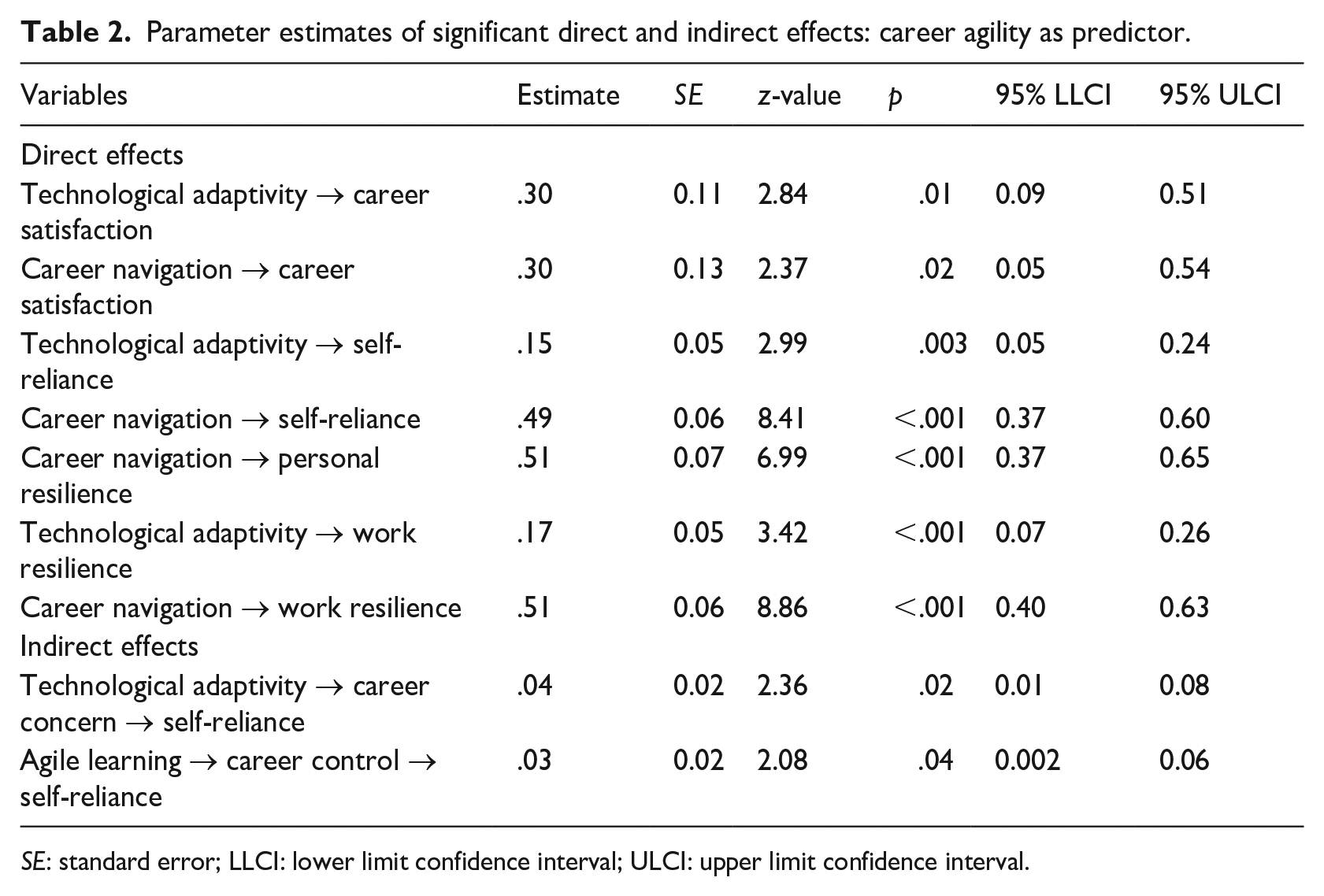
SE: standard error; LLCI: lower limit confidence interval; ULCI: upper limit confidence interval.
Mediating (indirect) effects of career adaptability were observed for only career concern and career control. As shown in Table 2, the indirect path from technological adaptivity to self-reliance via career concern was positive and significant (β = .04; p = .02; LLCI = 0.01; ULCI = 0.08). The indirect path from agile learning to self-reliance via career control was also positive and significant (β = .03; p = .04; LLCI = 0.002; ULCI = 0.06). The total direct and total indirect effects were significant which indicated a partial mediation effect. The results provided evidence in support of H1 and partial evidence in support of H3.
Table 3 presents, for parsimony reasons, only the significant direct and indirect effects for the link between the psychological capital variables (self-efficacy, hope, resilience, and optimism) and the career resilience variables (self-reliance, personal resilience, and work resilience) and career satisfaction.
Parameter estimates of significant direct and indirect effects: psychological capital as predictor.
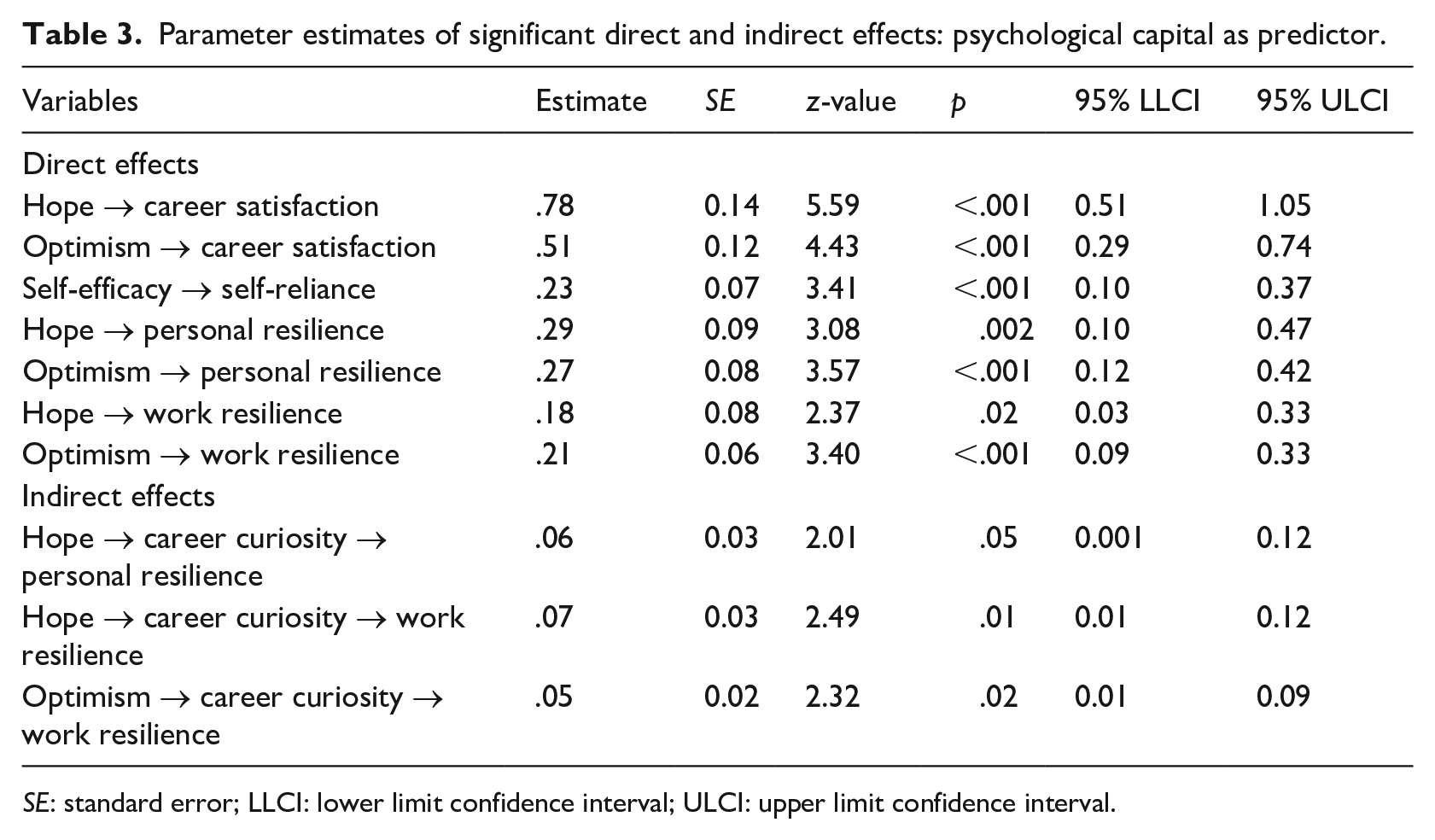
SE: standard error; LLCI: lower limit confidence interval; ULCI: upper limit confidence interval.
As shown in Table 3, hope had significant and positive direct effects on career satisfaction (β = .78; p < .001; LLCI = 0.51; ULCI = 1.05), personal resilience (β = .29; p = .002; LLCI = 0.10; ULCI = 0.47), and work resilience (β = .18; p = .02; LLCI = 0.03; ULCI = 0.33). Optimism had significant and positive direct effects on career satisfaction (β = .51; p < .001; LLCI = 0.29; ULCI = 0.74), personal resilience (β = .27; p < .001; LLCI = 0.12; ULCI = 0.42), and work resilience (β = .21; p < .001; LLCI = 0.09; ULCI = 0.33). Self-efficacy had significant and positive direct effects on self-reliance (β = .23; p < .001; LLCI = 0.10; ULCI = 0.37).
Mediating (indirect) effects of career adaptability were observed for only career curiosity. As shown in Table 3, the indirect paths from hope to personal resilience (β = .06; p = .05; LLCI = 0.001; ULCI = 0.12) and work resilience (β = .07; p = .01; LLCI = 0.01; ULCI = 0.12) via career curiosity were positive and significant. The indirect path from optimism to work resilience via career curiosity was also positive and significant (β = .05; p = .02; LLCI = 0.01; ULCI = 0.09). The total direct and total indirect effects were significant which indicate a partial mediation effect. The results provided evidence in support of H2 and partial evidence in support of H4. Figure 2 illustrates the structural models that manifested from the SEM analyses.
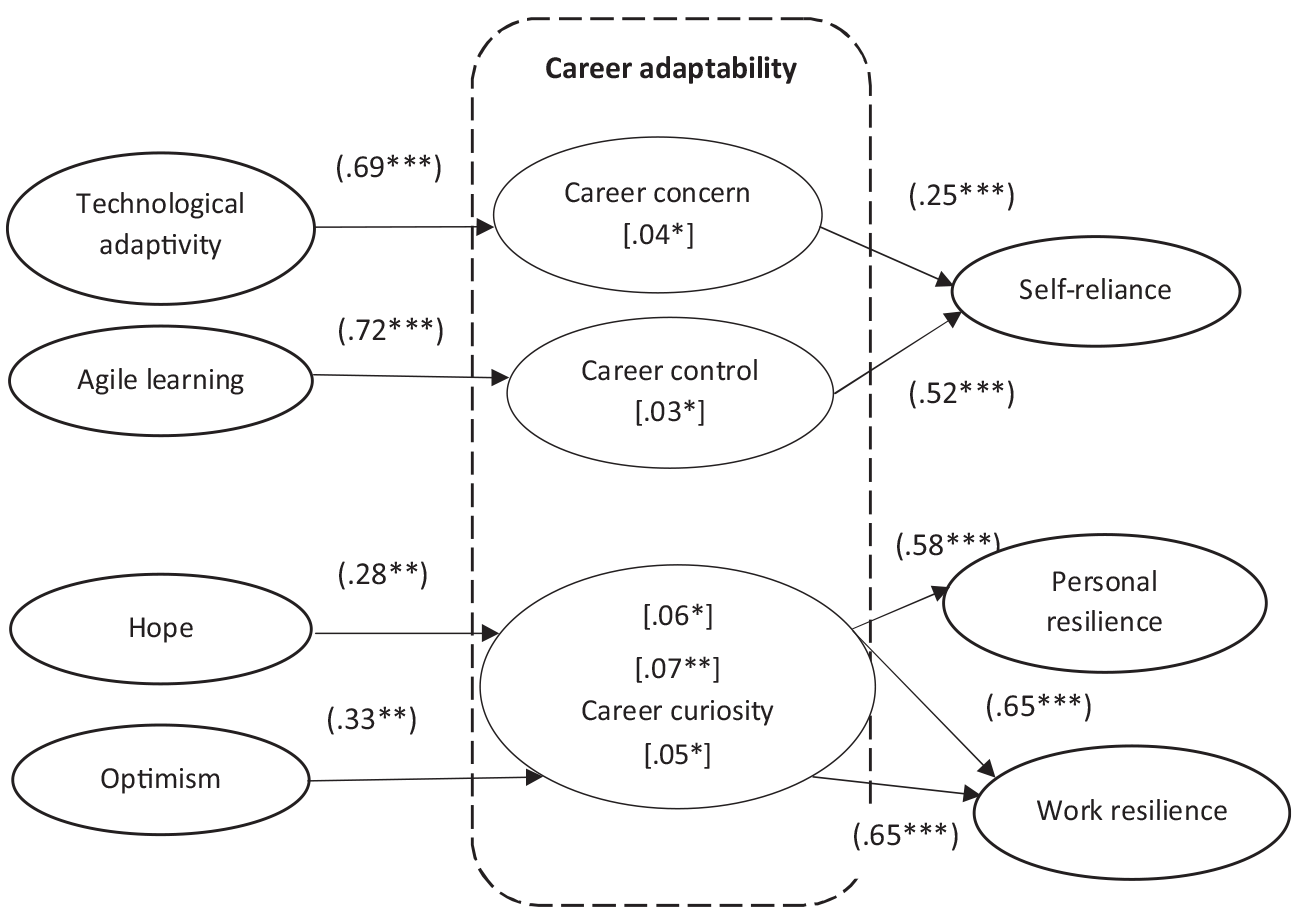
Structural models: significant mediating effects of career adaptability.
The fit indices for the SEM pertaining to the two career agility variables as predictors indicated acceptable model fit: chi-square = 1156.08; df = 333; chi-square/df = 3.47; p < .0001; RMSEA = .07; SRMR = .10; CFI = .90. The SEM fit indices pertaining to the two PsyCap variables also indicated acceptable model fit: chi-square = 620.61; df = 287; chi-square/df = 2.16; p < .0001; RMSEA = .05; SRMR = .08; CFI = .93.
Discussion
The findings deepened understanding of the extent to which career agility and PsyCap (as states of adaptivity) activated career adaptability resources and fostered career resilience and career satisfaction (as modes of career adaptedness). In the present study, the activation of career adaptability resources did not enhance career satisfaction. A cognitive openness and positive affective state towards technological change (technological adaptivity) (Coetzee et al., 2020) activated career planning in preparation for the future (career concern) (Klehe et al., 2021) and evoked self-efficacious adaptation to job changes involving capitalising on new skills development opportunities and renewing career goals (i.e., self-reliance: Coetzee et al., 2015). The eagerness to expand one’s skills and knowledge through new job and career opportunities (i.e., agile learning: Coetzee et al., 2020) activated ownership for personal career development and making career decisions (career control: Nalis et al., 2022) which also boosted self-reliance. Empirical research by Coetzee et al. (2020) corroborates the notion of technological adaptability and agile learning as adaptivity states that activate career concern and career control.
The internalised agency, determination, and willpower to invest the energy in personal goals and ways to achieve tasks (i.e., hope) and expectancies of positive outcomes and a better future (optimism: Baluku et al., 2020) activated the envisioning of future work selves and engaging in career exploration (career curiosity: Nalis et al., 2022) and the acceptance of turbulent changing and work conditions as an investment in one’s career growth (i.e., work resilience: Coetzee et al., 2015). The activation of career curiosity by hope also evoked proactive adjusting of personal career and skills development goals in response to changes in the company (i.e., personal resilience: Coetzee et al., 2015).
Technological adaptivity, career navigation, hope, and optimism fostered contentedness with progress towards meeting career goals for advancement, income and skills development (i.e., career satisfaction: Spurk et al., 2015), self-reliance, and work resilience. Previous research shows that optimistic individuals adapt better in career transitions and exhibit satisfaction (Baluku et al., 2020). Hope fosters self-directed career management and career self-efficacy (Baluku et al., 2020). The findings suggest that the energised positive affect, open-mindedness, and motivation reflected in the career agility and PsyCap states of adaptive readiness spark confidence in agentic career adaptation.
The findings of the study offer new insights for career development support and counselling practices in the contemporary work context. Practically, the findings suggest that industrial psychologists and career and human resource practitioners should assess employees’ level of adaptive readiness (i.e., career agility and PsyCap) and design career development and counselling interventions that foster these malleable psychological states for the activated use of career adaptability resources. Such an approach opens new avenues for enhancing employees’ career resilience and satisfaction in work domains characterised by limited and uncertain career progression opportunities (e.g., the public services). Career counselling discussions could explore the extent to which employees perceive the constructs measured in this study as resources for enhancing their career resilience and career satisfaction within a workspace that appears career-thwarting with constraining and uncertain career development conditions.
The cross-sectional, correlational design of the study does not allow for corroborating the potential causal inferences about the links among the variables. We recommend future studies for the use of longitudinal designs because the study constructs are all malleable and can be developed over time. We further encourage replication of the study in other occupational contexts and for multi-cultural populations.
Conclusion
The findings of the present study enriched the CCT of career adaptation (Savickas, 2013) by elucidating the extent to which career agility and PsyCap act as states of adaptivity that have positive links with career adaptability resources and the adaptedness modes of career resilience and career satisfaction. The findings have utility for digital-era career adaptation theory and organisational career development practice in especially work domains such as the public services.
Footnotes
Declaration of conflicting interests
The author(s) declared no potential conflicts of interest with respect to the research, authorship, and/or publication of this article.
Funding
The author(s) received no financial support for the research, authorship, and/or publication of this article.
