




Abstract
The present study drew from modern person-environment’s needs-supply fit theory and assessed the extent to which career embeddedness acted as a moderator in the link between individuals’ career agility and their perceptions of the value-oriented psychological contract. A sample of (N = 293; mean age = 38.58 years) employees in the human resources and financial services industry participated in the study. Moderated regression results demonstrated that career embeddedness moderated the link between high levels of career agility (career navigation and agile learning) and positive perceptions of value-oriented obligated employee attitudinal inputs, including organisational obligated outcomes of job characteristics, career development opportunities, relationships, and rewards. The findings of the study inform career development support practices for the career agile employee in organisations who invest in the value-oriented psychological contract.
Keywords
Alternative work arrangements, gig economy, and virtual and contingent work made possible by accelerated technological innovation and globalisation imminently gave rise to the value-oriented psychological contract of the career agile individual (Coetzee, 2021; Ghislieri et al., 2018; Scheel & Mohr, 2013; Veldsman, 2020; Veldsman & Van Aarde, 2021). Value-oriented content alludes to employees’ expectation that their agreed obligated contributions to the organisation will serve their idiosyncratic career values and needs, a valuable higher organisational cause, and that the employer fulfils agreed value-oriented organisational support obligations (Coetzee, 2021; Dhliwayo, 2021; Scheel & Mohr, 2013). The employee–employer agreement expresses individuals’ need for meaningful work that enables them to evolve their career identity and make a difference to customers, society, or the environment (Aderibigbe, 2021; Coetzee, 2021). Employment conditions should benefit both the employee and the organisation and enhance the fit between individuals’ personal career values and needs and those of the organisation (Darrow & Behrend, 2017; Davis & Van der Heijden, 2018; Ferreira et al., 2022; Guan et al., 2021).
Today’s more turbulent workplace conditions have a profound impact on individuals’ career behaviour and needs. Individuals have become more career agile and are questioning the embeddedness of their careers in an organisation (Coetzee et al., 2021; Ferreira et al., 2022). This trend brought to question how individuals’ career agility and career embeddedness relate to their perceptions of the value-oriented psychological contract. The constructs of career agility (Coetzee et al., 2021) and career embeddedness (Ferreira et al., 2022) are recent constructs that are not yet well-researched. Career agility explains individuals’ shifting psychological career development needs in the light of their adaptation to the changes that accelerated technological developments bring to the nature of work and careers (Coetzee et al., 2021; Konstant, 2020). As such, it stands to reason that their career agility may explain their psychological contract perceptions. Career embeddedness describes individuals’ feelings of psychological career development needs-fit and career values-fit derived from supportive organisational conditions (Ferreira et al., 2022). Research shows that the fulfilment of individuals’ psychological career needs is an important aspect of the value-oriented psychological contract (Coetzee, 2021; Dhliwayo, 2021). However, given the sparse research on career embeddedness (Ferreira et al., 2022), it is not clear whether individuals’ career embeddedness would moderate the link between individuals’ career agility and their perceptions of the value-oriented psychological contract.
The objective of the present study was to draw from modern person-environment’s (PE) needs-supply fit theory (Darrow & Behrend, 2017; Guan et al., 2021) to assess whether the positive relationship between career agility and value-oriented psychological contract perceptions is stronger for employees who have high (vs) low career embeddedness. We hypothesised that the prediction of positive value-oriented psychological contract perceptions from high levels of career agility differs across levels of career embeddedness. In other words, we assessed whether there is an interaction (moderating) effect between individuals’ career agility (predictor) and career embeddedness (moderator) in explaining psychological contract perceptions. All three constructs denote aspects of PE needs-supply fit that deepen understanding of the extent to which individuals’ psychological career needs influence their perceptions of the value-oriented psychological contract.
The value-oriented psychological contract
In the present study, the psychological contract denotes the nature of employees’ perceptions of an exchange agreement with the employer (Deas, 2021). Value-oriented content in the psychological contract is evident in research showing that individuals’ perceptions of employees’ obligations towards the organisation (in exchange for organisational support conditions), involve their contributions and efforts towards the company mission, vision and values, recognition for value-adding ideas, creative thinking and solutions that enhance organisational performance, loyalty towards the organisational brand and mission, high-quality task performance and service delivery, and positive teamwork (Coetzee, 2021; Coetzee & Deas, 2020). Employees attach core psychological career values to their perceptions of employer obligations in exchange for them fulfilling on perceived employee obligations. Such career values include the need for the organisation to offer a people-oriented work environment that allows opportunities for working with others (teamwork), self-expression (e.g., creativity, independence, challenging, innovative and meaningful work, work-life flexibility, and career development support), and extrinsic rewards (e.g., recognition, competitive remuneration, financial rewards, and job security; Coetzee, 2021; Macnab et al., 2005).
Drawing from person-environment (PE) fit theory (Darrow & Behrend, 2017; Diefendorff et al., 2016; Guan et al., 2021; Jiang, 2017), research found evidence of perceptions of needs-supply fit obligations expressed in the desire for congruence between the efforts made by the organisation to help employees realise their career, performance, and development needs, values and interests, and employees’ desire to contribute to a higher organisational purpose and people-oriented work culture (Coetzee, 2021). Veldsman’s (2020) work corroborates these findings and emphasises that the modern-day psychological contract will be about a short-lived transactional and equitable exchange of employee–employer obligated value-matching.
The value-oriented psychological contract encapsulates principles of Adams’ (1963) equity theory: employees are motivated by their inner drive to maintain equity between the obligated performance-related and attitudinal inputs or efforts they bring to their jobs, and the organisational obligated outcomes that they expect to receive in exchange against the perceived inputs and outcomes of others (Adams, 1963; Deas, 2021). Perceived fair equitable input-outcome balance encompasses a PE fit value-matching assessment of a fair ratio of fulfilment of expected organisational obligated outcomes towards employees’ psychological career values needs in lieu of the expected delivered individual obligated inputs (Guan et al., 2021). Bal and Vink (2011) found that perceived value-matched obligations are associated with positive appraisal of the employment relationship and consequently, to job satisfaction and affective commitment. Payne et al. (2015) also noticed that people are likely to remain in an exchange agreement with employers when they perceive that its degree of balance is equitable and matches their personal goals, motives, and values.
Relevant to the present study are Deas’s (2021) four psychological contract value-oriented dimensions: employee primary and secondary obligated inputs, organisational obligated outcomes, employee obligated inputs delivered, and employer obligated psychological contract fulfilment.
Employee primary obligated inputs refer to obligations to meet task requirements, provide inputs and ideas in the execution of tasks, act ethical and honest, and engage in creative thinking. Secondary employee obligated inputs encompass the obligation to demonstrate a hard-working attitude, to be engaged in the job, to be loyal towards the organisation and its brand, fulfil the organisation’s vision, mission and values, and contribute meaningfully and constructively to the organisation’s success, performance, and culture (Deas, 2021).
Organisational obligated outcomes include employees’ expectations regarding what they need to receive in exchange for their inputs (e.g., career development support, respectful and equal treatment; fair compensation packages and benefits, work-life balance, challenging, innovative and meaningful jobs; and opportunities for teamwork; Coyle-Shapiro & Conway, 2005; De Vos et al., 2003; Freese et al., 2008; Isaksson et al., 2003; Rousseau, 2001, 2008).
The dimensions of employee obligated inputs delivered and employer obligated psychological contract fulfilment serve as two ‘equity check-points’ that contribute to perceptions of person-environment fit or misfit. Perceived needs-supply exchange misfit (i.e., inequity or unfairness) results in restoration efforts that may include relationship renegotiation or termination in the search for a better person-environment value-match (Darrow & Behrend, 2017; Ferreira et al., 2022; Guan et al., 2021; Jiang, 2017).
Research on the value-oriented psychological contract as theorised by Deas (2021) is non-existing. The present study seeks to contribute new knowledge on the extent to which the psychological needs of career agility and career embeddedness explain employees’ perceptions of the value-oriented psychological contract.
Career agility as predictor of the value-oriented psychological contract
Career agility alludes to individuals’ agency in managing their psychological career PE needs-supply fit in a shape-shifting technological-driven career world (Coetzee et al., 2021). Implicitly, career agility speaks to individuals’ psychological need for sustaining career success and employability through responsive, self-regulated adaptation to a fast-changing career world. Career agile individuals confidently capitalise on and search for new career development and upskilling opportunities that facilitate meaningful outlets for creative self-expression of needs, interests, and values made possible by technological advancement (Andela & Van der Doef, 2019; Coetzee, 2021; Coetzee et al., 2021; Hall et al., 2018; Sampaio et al., 2021). Career agile individuals demonstrate technological adaptivity (i.e., active readiness to capitalise on the new career development opportunities made possible by technological innovation), an agile learning mind-set (i.e., intrinsic motivation to actively set and manage goals for capability-expanding learning opportunities), and proactive career navigation of the changing digital-driven employment market (i.e., ideation of new job and career opportunities, and navigating and adapting to changes; Coetzee et al., 2021; Konstant, 2020; Nilforooshan, 2020).
Being a psychological adaptation mechanism, career agility reduces career insecurity in uncertain employment contexts, increases individuals’ self-efficacy in career identity management, and raises new standards for career PE needs-supply fit (Alisic & Wiese, 2020; Coetzee et al., 2021; Guan et al., 2021). Employees expect new career value-matching organisational support conditions that fulfil their psychological need for new, exciting job and career opportunities that allow for creative self-expression of shifting interests and values, and learning new skills that will improve their career and job success in digital markets (Coetzee et al., 2021; Guan et al., 2021; Konstant, 2020). The career agile employee is eager to innovatively deliver on their agreed obligated psychological contract inputs. In turn, they expect employers to fully commit to the provision of expected obligated organisational support conditions that will enable them to express their career agile mind-set and needs (Veldsman, 2020). However, research on the construct of career agility is sparse, and it is not yet clear to what extent career agility predicts employees’ perceptions of the value-oriented psychological contract.
Career embeddedness as moderator
The construct of career embeddedness denotes evaluations of the quality of social exchanges in the form of assessing whether there is an equitable balance between PE needs–supply fit (i.e., psychological career identity needs vs favourable supportive organisational conditions for career development needs fulfilment; Ferreira et al., 2022; Guan et al., 2021). Employees’ career development needs include their desire for networking and promotional opportunities that further their career progress, upskilling, and learning and development, as well as compatibility between their career values and the values of the organisational culture (Coetzee & Bester, 2021; Ferreira et al., 2022; Vondracek et al., 2014). When employees feel that the organisational culture and conditions provide support for their career development needs and values, they perceive their careers as being embedded in the organisation because of satisfactory psychological career needs-supply fit (Darrow & Behrend, 2017; Vondracek et al., 2014). Employees’ sense of career embeddedness was found to enhance their feelings of belonging to and affective commitment towards the organisation (Ferreira et al., 2022).
In the present research, we treated career embeddedness (i.e., deep-seated situatedness of the career in the organisation) as a moderating variable because we were interested in whether the link between career agility and value-oriented psychological contract perceptions was conditional upon individuals’ levels of career embeddedness. People may have low or high levels of psychological career needs-supply fit (as denoted by their career embeddedness) and these may interact with their career agility in predicting perceptions of the value-oriented psychological contract. We hypothesised that the presence of career embeddedness may strengthen or reduce the link between career agility and perceptions of the value-oriented psychological contract for employees who have high (vs) low career embeddedness. We tested the following research hypothesis:
H1. Career embeddedness will moderate the relationship between career agility and value-oriented psychological contract perceptions.
However, research on the moderating role of career embeddedness is non-existent and as such the present study may help to enrich understanding of the role of career embeddedness in explaining the value-oriented psychological contract in relation to career agility.
Method
Participants
A convenience sample of employees (N = 293; mean age = 38.58 years) from global digital-minded human resource and financial services organisations in South Africa (70%), Zimbabwe (15%), and various countries in Europe (15%) participated in the study. The sample was represented by men (54%) and women (46%) from Black (63%) and White (37%) ethnic origins.
Instruments
The career agility scale (CAS; Coetzee et al., 2021) is a three-facet scale (18 items) that measures participants’ responses on a 7-point Likert-type type scale (1 = strongly disagree; 7 = strongly agree). The first facet measures individuals’ technological adaptivity (7 items; for example, ‘I search for job roles that evolve with changing technological conditions because they offer opportunities for growth and creativity’). The second facet measures individuals’ agile learning orientation (5 items; for example, ‘I continually search for opportunities to learn new skills that will improve my career and job success’). The third facet measures individuals’ career navigation mind-set (6 items; for example, ‘I am always on the lookout for gaps in the market and employment conditions that I could fill in a unique way’). Exploratory and confirmatory factor analyses by Coetzee et al. (2021) provided evidence of construct validity and internal consistency reliability of the three-facet and overall construct of the CAS in the South African context.
The career embeddedness scale (CES; Ferreira et al., 2022) was used as a measure (14 items) of the deep-seated situatedness of the career in an organisation based on employees’ perceptions of person-environment fit with the organisation. The CES measures individuals’ sense of career development fit (9 items; for example, ‘My career in this organisation helps me to uphold my marketability and employability’) and career values fit (5 items; for example, ‘My career values are compatible with my current organisation’s values’). Participants’ responses are measured on a 7-point Likert-type scale (1 = strongly disagree; 7 = strongly agree). In the present study, the CES was treated as an overall construct. Exploratory and confirmatory factor analyses by Ferreira et al. (2022) provided evidence of the construct validity and internal consistency reliability of the overall construct of the CES in the South African context.
The psychological contract inputs-outcomes inventory (PCIOI: Coetzee & Deas, 2020; Deas, 2021) is a 46-item multi-level scale that measures four dimensions of employees’ value-oriented psychological contract perceptions. The employee inputs dimension (12 items) measures perceptions about primary task performance obligations and secondary attitudinal obligations (e.g., ‘I feel obligated to deliver tasks that are in line with expectations’/‘I feel obligated to be loyal to the organisation and its brand’). The organisational outcomes dimension (29 items) measures six facets of employees’ expectations of the organisation (i.e., organisational culture, career development opportunities, rewards, relationships, work-life balance, and job characteristics). Examples of items include ‘I expect equal treatment of all employees’ (organisational culture); ‘I expect my manager/supervisor to be committed to my career development’ (career development opportunities); ‘I expect an attractive compensation package’ (rewards); ‘I expect opportunities for teamwork’ (relationships); ‘I expect the opportunity to work remotely’ (work-life balance); and ‘I expect purposeful work where I can make a difference’ (job characteristics).
The third dimension of the PCIOI measures employees’ perceptions of psychological contract fulfilment (5 items) as a checkpoint of the organisation delivering on employee expectations (e.g., ‘I feel as a whole the organisation has fulfilled my expectations’). The fourth dimension (2 items) measures employees’ self-reflected check on whether they delivered on their primary task and secondary attitudinal input obligations towards the organisation (e.g., ‘I feel I delivered on the secondary employee inputs’). Participants’ responses are measured on a 5-point Likert-type scale (1 = not at all; 5 = to a great extent). Exploratory and confirmatory factor analyses by Coetzee and Deas (2020) provided evidence of the construct validity and internal consistency reliability of the four-dimensional structure of the scale in the South African context.
Procedure
Participants were invited via an electronic link in an email and on the professional platform LinkedIn to voluntarily complete the survey. A total of 293 participants (N = 293) agreed to participate in the study. Participation was anonymous and with informed consent that the data may be used for research purposes. The data were converted into a SPSS file for data analysis. There were no missing values in the data set.
Ethical considerations
Ethical clearance to conduct the research was obtained from the University of South Africa (ERC Ref#: 2020_CEMS/IOP_014). Participants’ anonymity, privacy, and voluntary participation were respected.
Data analysis
Data were analysed using IBM Corp. (2020) SPSS Version 27 and SAS/STAT® software version 9.4M5© (2017). The PROCESS procedure for SPSS Version 3.4 (Hayes, 2018) was used for the moderated regression analysis. Variables were mean-centred prior to the moderated regression analysis. Results were interpreted at the 95% confidence level interval and by evaluating the lower level confidence interval (LLCI) and upper level confidence interval (ULCI) range to not contain zero.
Results
Scale reliability and bi-variate correlations
Table 1 shows that the three scales had good internal consistency reliability (α ⩾ .79; composite reliability [CR] ⩾ .79). The bi-variate correlations between the three scales and their constructs were positive, significant, and ranged between r ⩾ .12; small practical effect; and r ⩽ .40 (moderate practical effect), p ⩽ .05. Technological adaptivity did not correlate significantly with career development opportunities (organisational outcome) and career embeddedness did not correlate significantly with rewards (organisational outcome).
Descriptive statistics and bi-variate correlations.
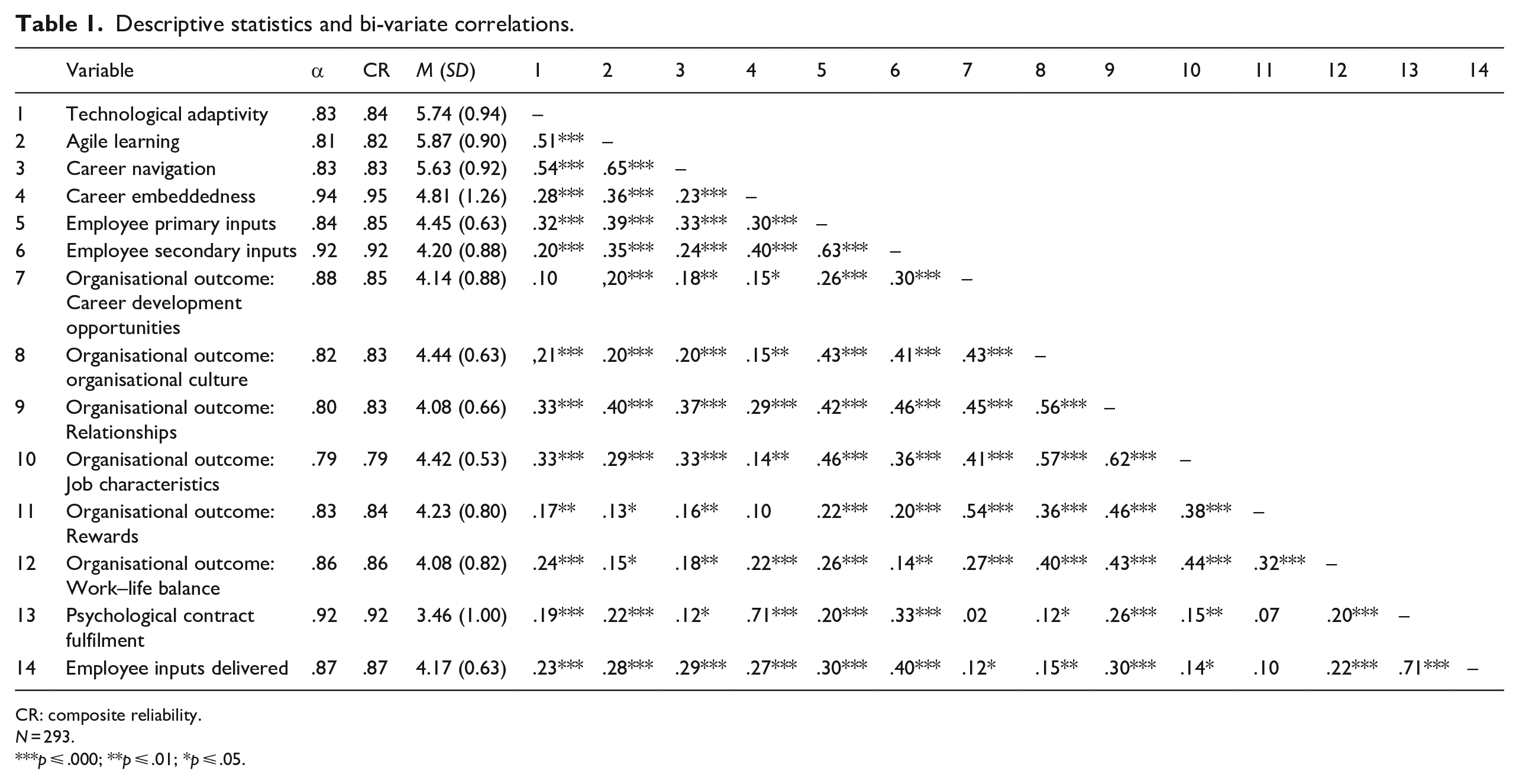
CR: composite reliability.
N = 293.
Moderated regression
We first tested the discriminant validity of the measurement model to check for potential issues of multicollinearity among the three scales’ variables. The measurement model included the three facets of career agility, the overall career embeddedness construct, and the four dimensions of the PCIOI. The confirmatory factor analysis model showed a good fit with the data and thus good discriminant validity of the measurement model: chi-square/df = 2.71; p < .0001; root mean square error of approximation (RMSEA) = .08; standardised root mean square residual (SRMR) = .07; and comparative fit index (CFI) = .92.
For parsimony reasons, Table 2 reports only the significant moderated regression results. The PCIOI dimensions of primary task inputs, organisational outcome dimensions of organisational culture and work-life balance, the psychological contract fulfilment, and delivery of primary and secondary inputs had no significant interaction effects between career agility and career embeddedness. As shown in Table 2, the analysis of variance (ANOVA) models of each of the five moderated regression models were significant at Fp ⩽ .05 and explained 4% (R2 = .04 [small practical effect]) to 21% (R2 = .21 [moderate practical effect]) of the variance in the psychological contract variables: secondary employee inputs (F = 25.44; p = .000; R2 = .21 [moderate practical effect]) and the organisational outcomes of career development opportunities (F = 3.93; p = .01; R2 = .04 [small practical effect]), job characteristics (F = 17.79; p = .000; R2 = .16 [moderate practical effect]), relationships (F = 17.52; p = .000; R2 = .16 [moderate practical effect]), and rewards (F = 4.52; p = .004; R2 = .05 [small practical effect]).
Significant moderated regression results.
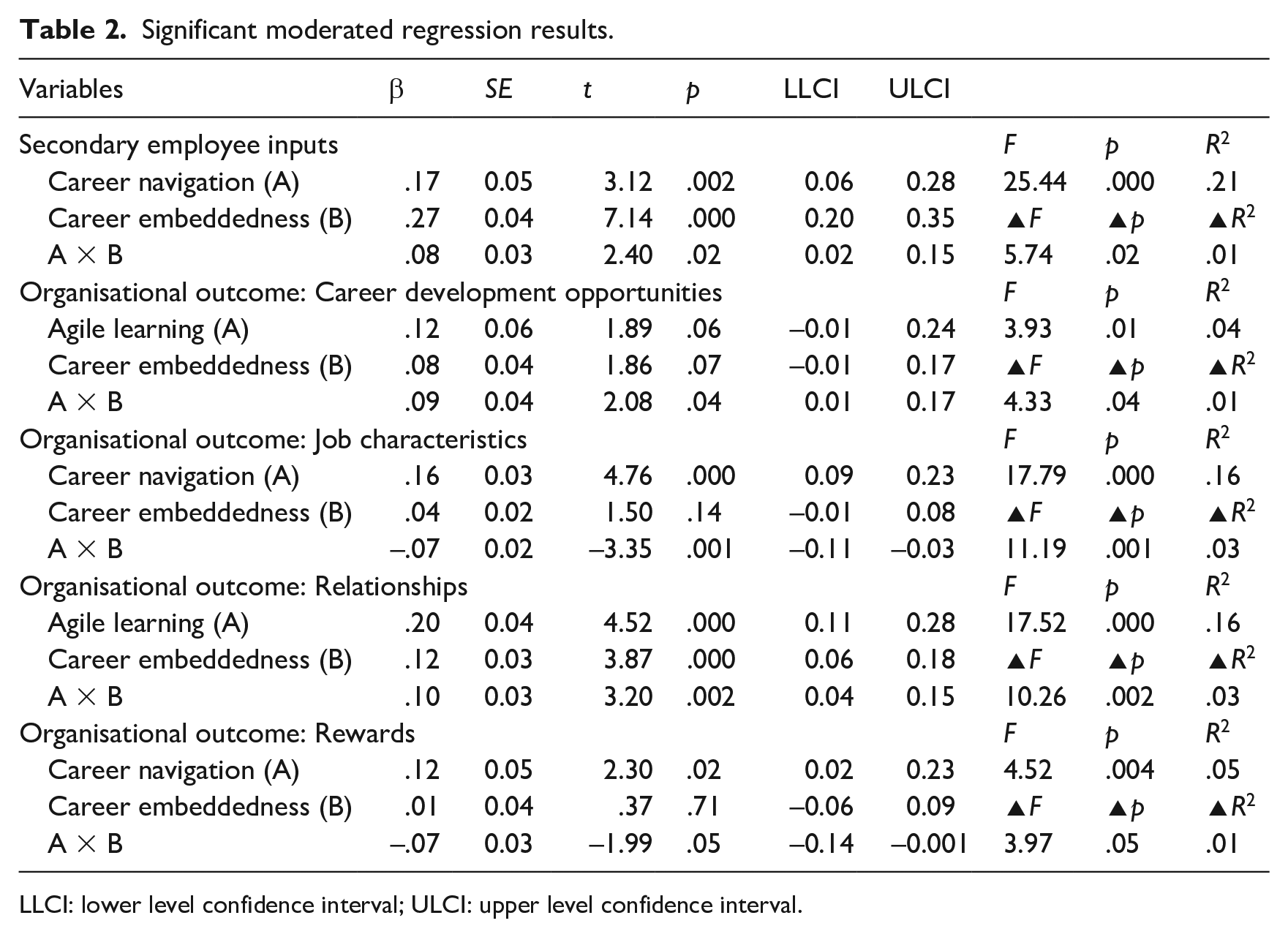
LLCI: lower level confidence interval; ULCI: upper level confidence interval.
Table 2 further shows that career navigation had significant interaction effects with career embeddedness in predicting secondary employee inputs (β = .08; p = .02; LLCI = 0.02; ULCI = 0.15; f2 = .27 [moderate practical effect]) and the organisational outcome of job characteristics (β = −.07; p = .001; LLCI = −0.11; ULCI = −0.03; f2 = .19 [moderate practical effect]) and rewards (β = −.07; p = .05; LLCI = −0.14; ULCI = −0.001; f2 = .05 [small practical effect]). In these three models, career embeddedness did not have a significant main effect on the psychological contract variables of job characteristics and rewards when combined with the significant main effect of career navigation. Jointly, career navigation and career embeddedness had significant main effects on secondary employee inputs.
Figures 1 to 3 illustrate the interaction effect between career navigation and career embeddedness in predicting secondary employee inputs, and the organisational outcomes of job characteristics and rewards. The results in these three figures show that when participants’ career embeddedness was either low or high, high levels of career navigation was positively related to relatively higher levels of secondary employee inputs, including the organisational outcomes of job characteristics and rewards in contrast to those participants with lower levels of career navigation. The results also indicated that participants with low career navigation and relatively low career embeddedness scored significantly lower on perceptions of secondary employee inputs, and the organisational outcomes of job characteristics and rewards than those with higher career embeddedness.
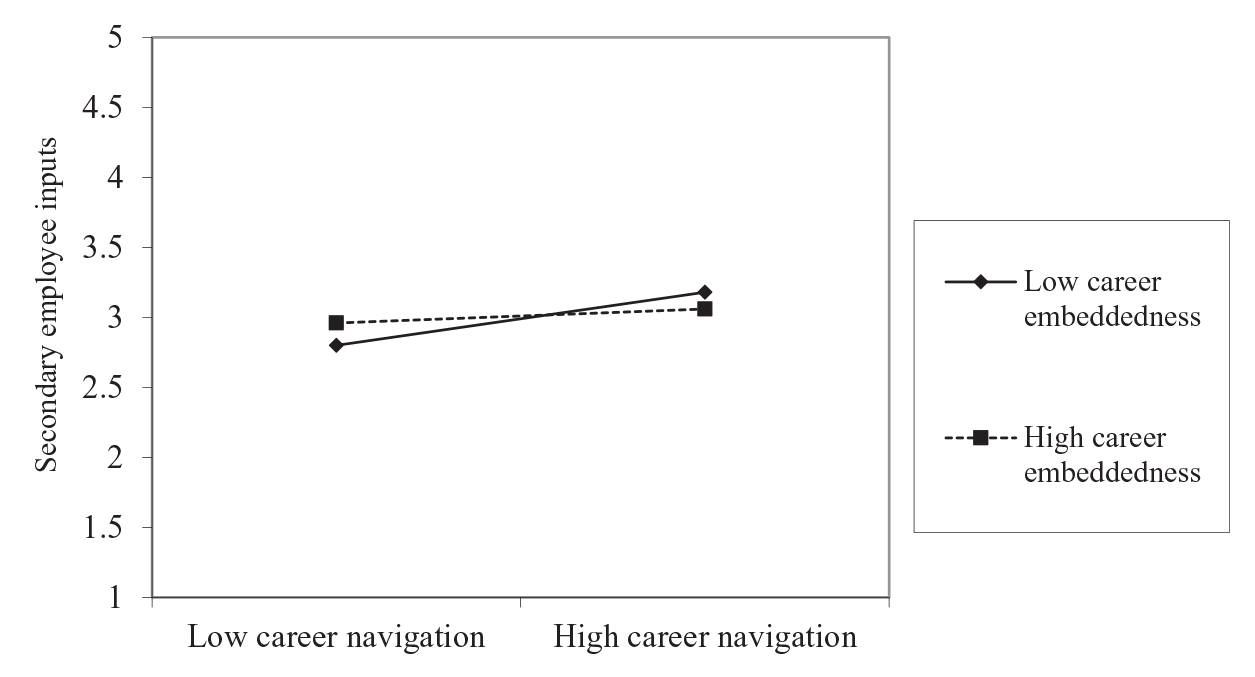
Interaction effect between career navigation and career embeddedness in predicting secondary employee inputs.
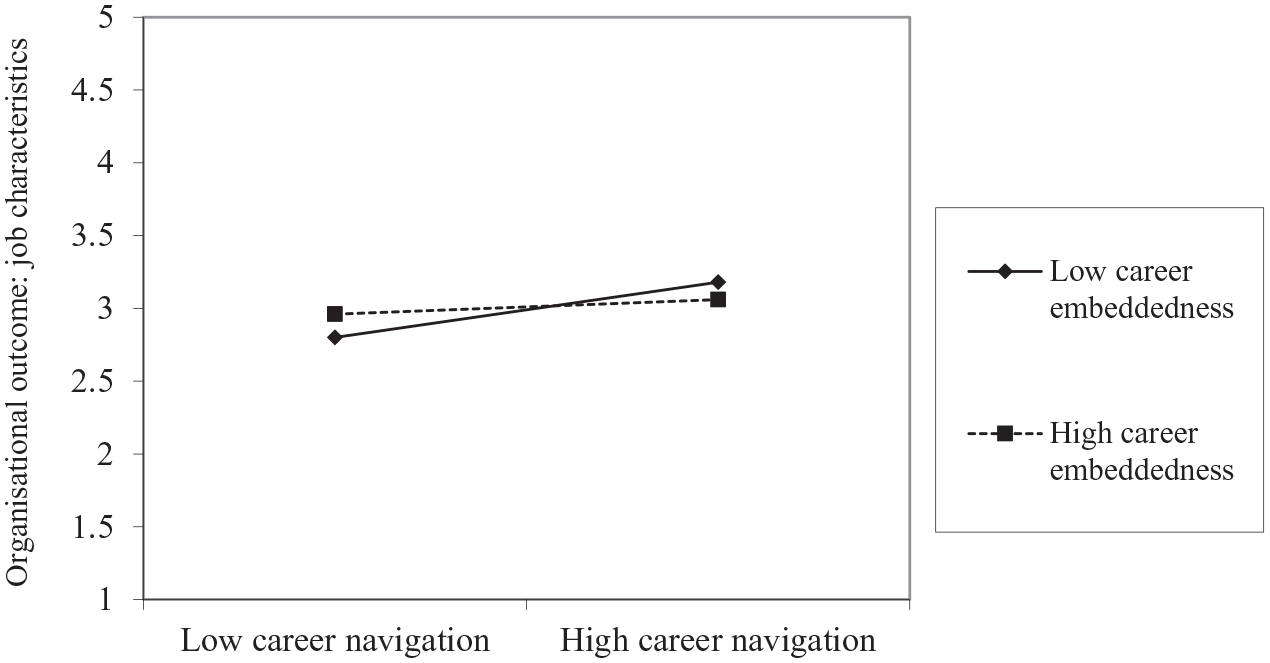
Interaction effect between career navigation and career embeddedness in predicting the organisational outcome of job characteristics.
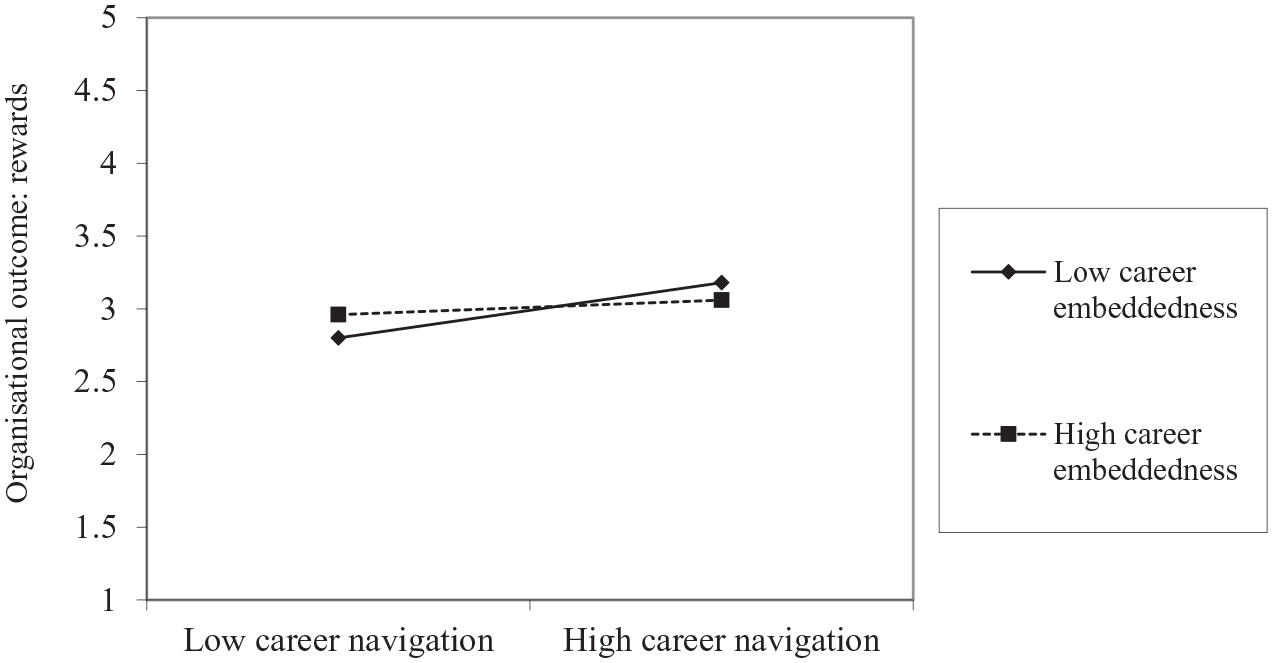
Interaction effect between career navigation and career embeddedness in predicting the organisational outcome of rewards.
Table 2 shows that agile learning had significant interaction effects with career embeddedness in predicting the organisational outcomes of career development opportunities (β = .09; p = .04; LLCI = 0.01; ULCI = 0.17; f2 = .05 [small practical effect]) and relationships (β = .10; p = .002; LLCI = 0.04; ULCI = 0.15; f2 = .19 [moderate practical effect]). Agile learning and career embeddedness had jointly significant main effects on relationships as organisational outcome. Career embeddedness did not have significant main effects on career development opportunities when combined with the significant main effect of agile learning.
Figures 4 and 5 illustrate the interaction effect between agile learning and career embeddedness in predicting the organisational outcomes of career development opportunities and relationships. The two figures show that when career embeddedness was high, high levels of agile learning were positively related to higher levels of the organisational outcomes of career development opportunities and relationships. When career embeddedness was either low or high, low levels of agile learning were positively related to lower levels of the organisational outcomes of career development opportunities and relationships.
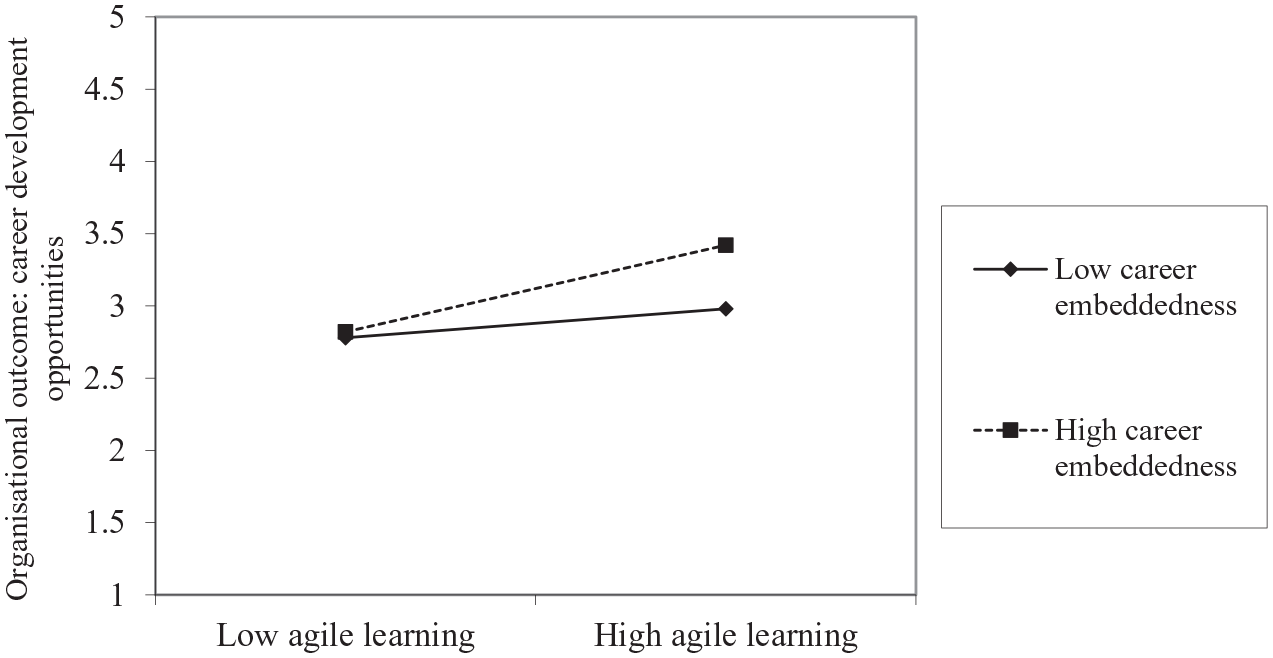
Interaction effect between agile learning and career embeddedness in predicting the organisational outcome of career development opportunities.
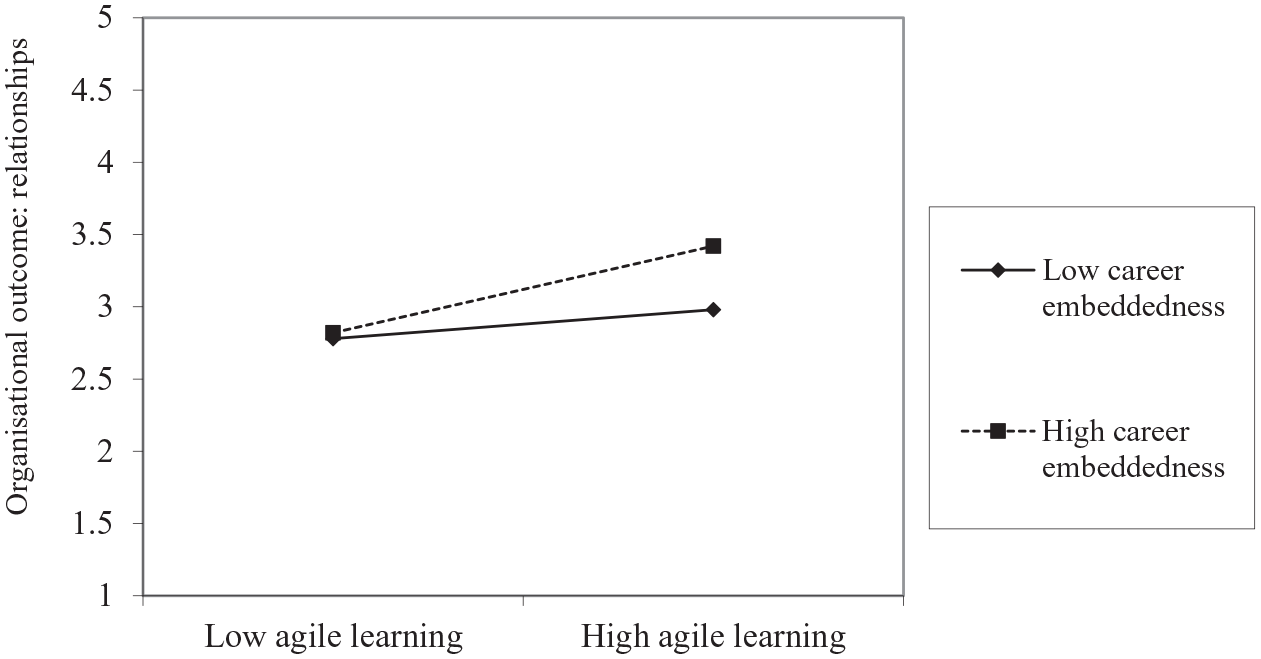
Interaction effect between agile learning and career embeddedness in predicting the organisational outcome of relationships.
Discussion
This study set out to examine whether the positive relationship between career agility and value-oriented psychological contract perceptions is stronger for employees who have high (vs) low career embeddedness. The findings suggest that individuals with a strong psychological need to adapt to and navigate changing work contexts for new career opportunities (i.e., career navigation), along with a desire to actively set career goals for continual upskilling, learning, and growth (i.e., agile learning: Coetzee et al., 2021), are likely to feel obligated to demonstrate a hard-working attitude and loyalty towards the organisation brand, be engaged, contribute meaningfully, and make a valuable contribution to the mission, vision, and success of the organisation (Coetzee, 2021). These findings are in agreement with the value-oriented nature of the modern psychological contract (Scheel & Mohr, 2013).
The findings allude to intrapersonal career PE needs-supply fit that is reflected in the individual having the need for continual learning, growth, and upskilling in the process of adapting to changes in the career environment, while supplying the organisation with the obligated valued attitudinal inputs. The findings could be attributed to the notion of reciprocity in social exchange agreements such as the value-oriented psychological contract (Coyle-Shapiro & Kessler, 2002). Career navigation and career agility appear to create a perceived obligation on the part of the career agile employee (as recipient of new technological-driven career and upskilling opportunities) to reciprocate with valued attitudes that benefit the organisation as a whole. This also seems true of individuals who feel that their careers are deeply situated (embedded) within the organisation because of perceived career opportunities and development support structures, and a compatibility between personal career goals and those of the organisation (Ferreira et al., 2022). Research shows that fulfilment of idiosyncratic development/growth support and values enhances employees’ willingness to reciprocate and actively engage with organisational goals (Davis & Van der Heijden, 2018).
The association of career navigation and agile learning with the organisational outcomes of career development opportunities, meaningful and challenging job characteristics, teamwork opportunities, and fair/attractive compensation and benefits (Coetzee, 2021), reflects evidence of interpersonal career needs-supply fit dynamics postulated by Guan et al. (2021). Career agility in the form of career navigation and agile learning denotes individuals’ psychological self-regulatory need to manage PE needs-supply fit in changing work contexts (Guan et al., 2021). The findings suggest that career agile employees, who value managing their adaptation to changes in the career/job environment, are also likely to perceive the organisation as fulfilling its obligations to supply supportive conditions that make their adaptation, learning, and upskilling possible.
Career embeddedness (Ferreira et al., 2022) furthermore appeared to act as a boosting PE needs-supply fit moderating condition. For employees with a strong career navigation drive, career embeddedness may raise employees’ perceptions of them fulfilling their attitudinal obligations of being hard-working and contributing meaningfully to the organisation’s success, business objectives, vision, mission, and values. In addition, career embeddedness seems to raise perceived organisational obligation fulfilment (i.e., challenging and meaningful job characteristics and fair benefits/compensation). For employees with a strong agile learning mind-set, career embeddedness apparently raises perceived obligated organisational fulfilment of supportive conditions for career development and teamwork. Research shows that PE fit perceptions of supportive career opportunities and development structures foster compatibility between personal career goals and those of the organisation and enhance the functioning of social support from the affiliated career environment in self-regulated career planning, exploration, and adaptation (Jiang, 2017).
Practically, the findings suggest that managers and practitioners should seek to enhance employees’ career embeddedness by creating agile organisational career- and teamwork-supportive conditions that speak to the psychological career needs of the career agile employee. Such supportive conditions should focus on using technological innovation to create challenging and meaningful jobs and competitive benefits and compensation packages.
The study findings should be interpreted within the limitations of the cross-sectional research design. Future research should replicate the study in a broader range of industry settings in larger samples to extend the generalisation of the findings. Longitudinal studies may help to study the shifting career needs and value-oriented obligations across multiple settings and population groups.
Conclusion
The findings provided initial evidence of career agility and career embeddedness as noteworthy constructs to study in relation to the value-oriented psychological contract. The study highlights the importance of understanding the moderating effect of career embeddedness in the career agility–value-oriented psychological contract link. Our hope is that the study stimulates future research on the constructs and their basic premises.
Footnotes
Declaration of conflicting interests
The author(s) declared no potential conflicts of interest with respect to the research, authorship, and/or publication of this article.
Funding
The author(s) received no financial support for the research, authorship, and/or publication of this article.
