



Abstract
Recent studies have documented the retreat of the Northern Cities Shift (NCS) in the Inland North, as well as the advance of a split between pre-nasal and pre-oral /æ/ (B
Keywords
1. Introduction
The Northern Cities Shift (NCS), first described by Labov, Yeager, and Steiner (1972), is the defining feature of the Inland North dialect of North American English (Labov, Ash & Boberg 2006), affecting primarily five lax vowels, especially
Concurrent with the retreat of the NCS and affecting a subset of the same vowels, two sound changes are currently advancing in many varieties of North American English: the divergence of the pre-oral /æ/ of
In the present study, we investigate the status of the NCS, the B
Full-time enrollment in institutions of higher education in the United States almost doubled from 1970 (~5 million) to 2019 (~10 million), 1 and yet the significance of higher education as a factor in language change remains under-investigated. Studies examining the role of higher education in language change have generally used education level as a proxy for social class (e.g., Wagner 2008; Prichard 2016; Duncan 2018), including in the Inland North (Thiel & Dinkin 2020). As the recent NCS reversal has been associated with higher levels of education, this is typically interpreted as one indication that NCS-reversal is a change from above, with speakers of higher socioeconomic status leading in an ongoing change. Beyond serving as a proxy for class, however, access to higher education changes speakers’ access to linguistic features and may change their orientation toward localness. Prichard (2016) has found that higher education, especially at a nationally oriented university, can predict fewer local speech features and more supralocal ones, while Bigham (2010), Sayahi (2011), and McCarthy (2011:183) have pointed out that universities may be important sites of language contact. Moreover, both Eckert (1988) and King (2021) have demonstrated the value of understanding multiple individual motivations for the adoption or rejection of ongoing changes in the early adoption and now reversal of the NCS. Taken together, these point toward the need for a more complex analysis of the role of higher education in sound change, particularly in communities where universities have a large social and economic presence.
In the rest of this paper, we present additional background information about the sound changes in question, about higher education and language change, and about Rochester and the neighborhood we worked in. We briefly discuss some of our quantitative results with respect to the status of the NCS, the B
2. Background
First described in depth in 1972 (Labov, Yaeger & Steiner), the NCS (Figure 1) is conjectured to have originated in the nineteenth century during the period of westward migration from New England (Labov, Ash & Boberg 2006; Dinkin 2009). Early scholarship documented the NCS’s advance throughout the Inland North (Labov, Yaeger & Steiner 1972; Eckert 1988; Niedzielski 1999; Evans, Ito, Jones & Preston 2000; Clopper, Pisoni & de Jong 2005; Roeder 2010; Durian & Cameron 2020). It was argued that because the NCS had “not yet risen to social consciousness and [was] not subject to social correction” (Labov, Yaeger & Steiner 1972:13), Inland North speakers “did not hear the shift in their own speech” (Niedzielski 1999:81).

The Northern Cities Shift
More recently, the NCS has been widely documented as retreating in the same regions where it was previously found to be advancing (Niedzielski 1999; Labov 2010; McCarthy 2011; Driscoll & Lape 2015; Wagner, Mason, Nesbitt, Pevan & Savage 2016; Milholland 2018; Nesbitt 2018, 2021; D’Onofrio & Benheim 2020; Durian & Cameron 2020; Thiel & Dinkin 2020). In Upstate New York, findings from Ogdensburg (Thiel & Dinkin 2020), Cooperstown (Dinkin 2022), Syracuse (Driscoll & Lape 2015), Buffalo (Milholland 2018), and Rochester (King 2018, 2021) suggest a retreat of the NCS concurrent with a rising awareness of its features and an association with a blue-collar Rust Belt identity from which younger speakers in particular are trying to distance themselves. In perceptual dialectology maps and other contexts, Syracuse speakers characterized the vowels of their region as “horrible,” “flat,” and “harsh”; one described consciously avoiding using the fronted and raised
Another ongoing change in progress in several varieties of North American English (including in the California Vowel Shift; Eckert 2008) is the divergence of the pre-oral /æ/ of
Another advancing feature in American English is the merger of /ɔ/ and /ɑ/ (the
Both of the vowels affected by the Low-Back Merger are also involved in the NCS. While the lowering and fronting of
In studies of sound change, including many of those cited above, education level has, because of its role as a vehicle for social mobility, often been used as a proxy for social mobility, social class, and associated ideologies (e.g., Wagner 2008; Prichard 2016; Duncan 2018). More importantly, orientation toward higher education—either through enrollment at a university or simply through ambition to enroll—can be a marker of upward social mobility and interest in moving beyond the local community (De Decker 2006; Wagner 2012) and can promote the rejection of local linguistic variants as well as the adoption of supra-local standards (Wagner 2012). These findings suggest that as the number of college-educated (and college-aspiring) Americans increases, we may find more adoption of supra-local norms, whether this is associated with changes in socioeconomic status or not.
In a study that specifically examined the role of higher education in local sound changes, Prichard (2016) found that Philadelphia speakers attending national universities were leading in the adoption of the nasal
Universities are also settings of language and dialect contact (Bigham 2010; Sayahi 2011). McCarthy (2011:183) has suggested that because universities attract “people from all across North America, the university-educated simply have more opportunity to come into contact with speakers with a range of American dialects.” Bigham (2010), for example, found that university students in southern Illinois were converging upon a vowel space in between the vowel spaces of the contact varieties (including the Inland North dialect). As universities are sites of dialect contact, university students and others associated with this university are thus also in a position to develop a more heightened awareness of their own speech in comparison to others and to be introduced to a wider variety of linguistic features for potential adoption (Bigham 2010; McCarthy 2011).
With respect to the Inland North, in Buffalo (Milholland 2018), Syracuse (Driscoll 2016), Ogdensburg (Thiel & Dinkin 2020), and Chicago (McCarthy 2011), the decline of the NCS is associated with higher levels of education, and more highly educated speakers show less NCS-like vowels, especially for
Rochester, located in the western part of New York State, is the fourth largest city in the state, with approximately 206,000 residents at the time of this study (U.S. Census Bureau 2018). Much like the Rust Belt region as a whole Rochester has experienced a long period of economic decline, leading to demographic shifts as people—especially those younger and more highly educated—leave Rochester for economic opportunities. This changing economy has resulted in a rising importance of higher education in the local economy, which is now dominated by the presence of several colleges and universities. Currently the largest employer in the area is the University of Rochester.
For the present study, we have chosen to focus on Rochester’s 19th Ward (also known by residents as “the Ward”), which is located directly across the Genesee River from the University. The Ward is the largest and most racially and economically diverse neighborhood in Rochester with a population of about 22,000 people (19wca.org). The proximity of the neighborhood to the University, as well as the complicated relationship between the city and the University, which we describe later, make the Ward an ideal location to explore the nuances of access to higher education and the role of “town and gown” relations in language change.
The complex relationship between the University of Rochester and the city and neighborhoods around it is neither new nor unique. The concept of town and gown relations—the interactions between universities and the communities in which they are located—is an old one, and recent work demonstrates the economic, social, and cultural impact that universities and their cities have on one another (Pickford 1989; Bender 1991; Mayfield 2001; Massey, Field & Chan 2014). Increasingly, cities and universities, including the University of Rochester and the City of Rochester, have been trying to foster more mutually beneficial relationships through programs such as the University of Rochester’s Community Ambassador program, although much progress remains to be made. For individuals, the relationship between “town” and “gown” is also changing, as more and more people in the United States are now getting a college education.
Beyond higher education, Rochester is also an ideal location to explore the interactions of the NCS, B
3. Methodology
Much of the foundation for our consideration of town-and-gown in this study comes from insider knowledge of the University of Rochester. The first author was a University of Rochester undergraduate student from 2015 to 2019, and the second author has worked at the University of Rochester since 2015. In this capacity we have had access to many informal conversations with students, faculty, and staff about the 19th Ward and the relationship between the University and the neighborhood.
In addition to our experience with the University, this study is also informed by three years of participant observation in the 19th Ward by the first author from 2016 to 2019. Initially, her time in the Ward was infrequent and consisted mainly of participation in small community service events such as tree-planting; as time progressed, she became more involved and completed the majority of her participant observation in the summer of 2017 and from June to October 2018. During this time, Author Kapner worked with members of the 19th Ward Community Association (19WCA) to catalog and curate the 19WCA’s archival collections chronicling local history. She attended and helped at neighborhood events including outdoor concerts and festivals. Kapner lived in the 19th Ward in Summer 2018 and volunteered weekly at the Westside Farmers’ Market, a popular gathering place which featured, in addition to produce for sale, free entertainment and educational events, and represented a pillar of community identity. Both authors also began a collaboration with the 19WCA on a joint oral history/sociolinguistic project, from which came the recordings used in the present study.
Participants in the project were recruited via word-of-mouth convenience sampling between 2017 and 2018 in a joint effort by both History and Archives (H&A) Committee members and Author Kapner. The participants all identified as residents of Rochester’s 19th Ward (although two—SR and JC—did not at the time actually live there). They ranged in age from twenty to eighty-five, with birth years clustering around the middle of the twentieth century (median birth year = 1956). Nine participants self-identified as men (including one who also self-identified as transgender) and six self-identified as women. A chart of demographic information for the participants is shown in Table 1.
Demographic Information: Age, Race, Gender, Education Levels

Because of the recruitment methods, our group is not well balanced demographically: we included only one Black speaker (the rest were white), and ages skew toward the older end of the range. The makeup of the sample represents the reality of this social network, although it is not a faithful representation of the makeup of Rochester as a whole or even of the 19th Ward. While the neighborhood as a whole is quite diverse by race and age, this does not necessarily translate to diversity within individual social networks: the participants in this study were all members of a social network which consists mainly of older white residents. Our methods also resulted in confounding of certain variables, which ultimately made quantitative analyses difficult. For instance, the group overall was very highly educated, making it difficult to quantitatively assess effects attributable to level of education, and the youngest speakers were also those with higher terminal degrees. This too represents the reality of not only this social network, but of rising education levels in the community we studied, as well as nationally. At the same time, by limiting our sample to a single social network, we are able to understand in greater detail the factors impacting sound change on an individual level. Our application of qualitative analysis methods allowed us to maintain such a focus and also provide insights that set out a starting point for further study. Finally, our sample of fifteen speakers also included three speakers who are members of one family, which further narrows the representative diversity of the sample in some ways. It does, however, allow us to focus more narrowly on the progression of change, which we do in section 4.1.
Participants were informed before participation that this was a joint oral history/sociolinguistic project and that the recordings would be eventually made available to the public. Recording sessions took place from June to November 2018. Sessions began with an oral history interview conducted by the first author and members of the H&A Committee and also included a semantic differential task and a word list. The study materials are available from the authors by request. Following the completion of the word list, we often had an informal metalinguistic conversation with the participant(s) about the Rochester accent. We obtained just over one hour of speech from each speaker, and all but one interviewee completed the word list. The oral history recordings were publicly archived with the Rochester City Library as part of the Rochester Voices project (RochesterVoices.org).
Recordings were transcribed manually in Praat (Boersma & Weenink 2023). The recordings were force-aligned and the first and second formants measured using DARLA
2
(Kendall & Thomas 2010; Reddy & Stanford 2015). The measurements were averaged and normalized with the Lobanov (1971) method using NORM (Thomas & Kendall 2007), using first and second formants only. We completed additional post-measurement processing and sorting using custom programs in Python. A total of 18,900 tokens were included in the analysis. To quantify speakers’ degree of
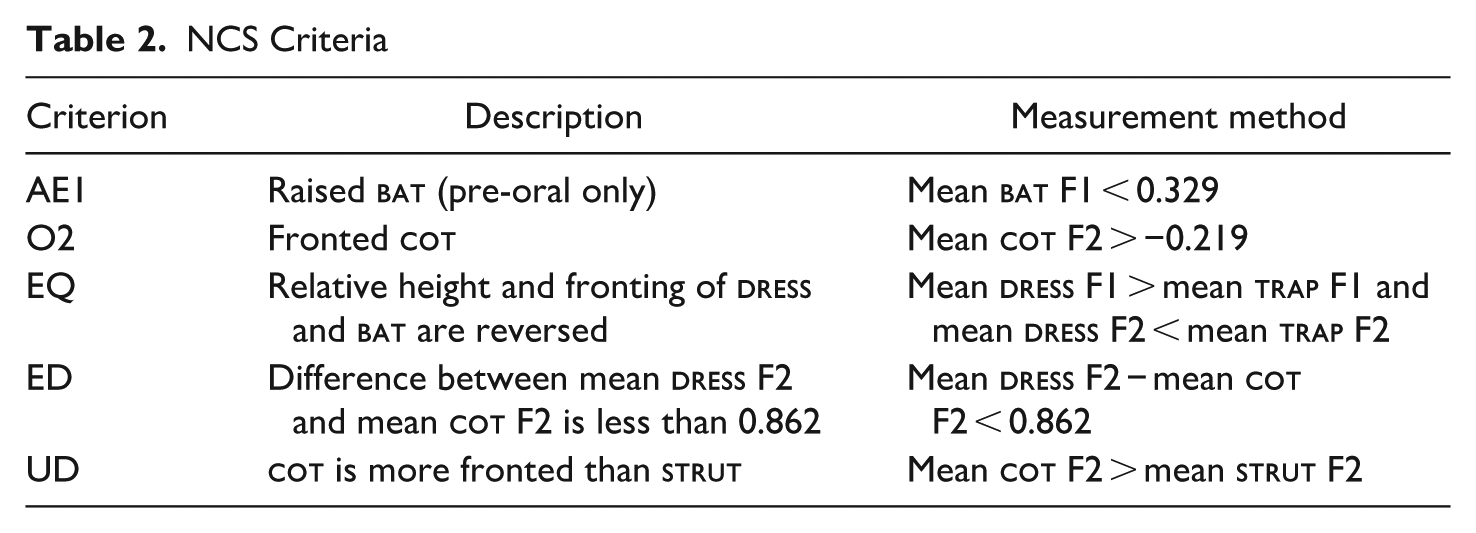
As a way to measure speakers’ level of adoption or rejection of the NCS beyond measurements of individual vowels, we used Dinkin’s (2013) version of Labov’s (2007) criteria for the NCS to calculate a score for each speaker (Table 2). A speaker’s NCS score was the number of criteria they exhibited, with each of the two components of the EQ criterion counting as 0.5 point toward their score. The Labov criteria are calculated with benchmarks from the Atlas of North American English (ANAE; Labov, Ash & Boberg 2006), which are in turn based on the Labov ANAE normalization method rather than the Lobanov method. We therefore used Dinkin’s (2021) Lobanov-transformed versions of these benchmarks in calculating the scores. We produced all vowel space plots in R (R Core Team 2023).
NCS Criteria
We conducted all statistical tests using mixed-effects linear regression models with the lme4 package (Bates, Mächler, Bolker & Walker 2015) in R (R Core Team 2023). In our analysis we considered the social factors that we hypothesized to be meaningful, including year of birth, education level, and a measure of degree of connection to higher education (which we termed HEI, Higher Education Index). We also included speech style (word list or oral history interview) and type of university attended as nominal variables, as well as the random effects of individual speaker and word. Below, we report the results of our analysis from participant observation, vowel measurements for individual speakers, and the content of the interviews, along with some of our quantitative findings.
4. Results
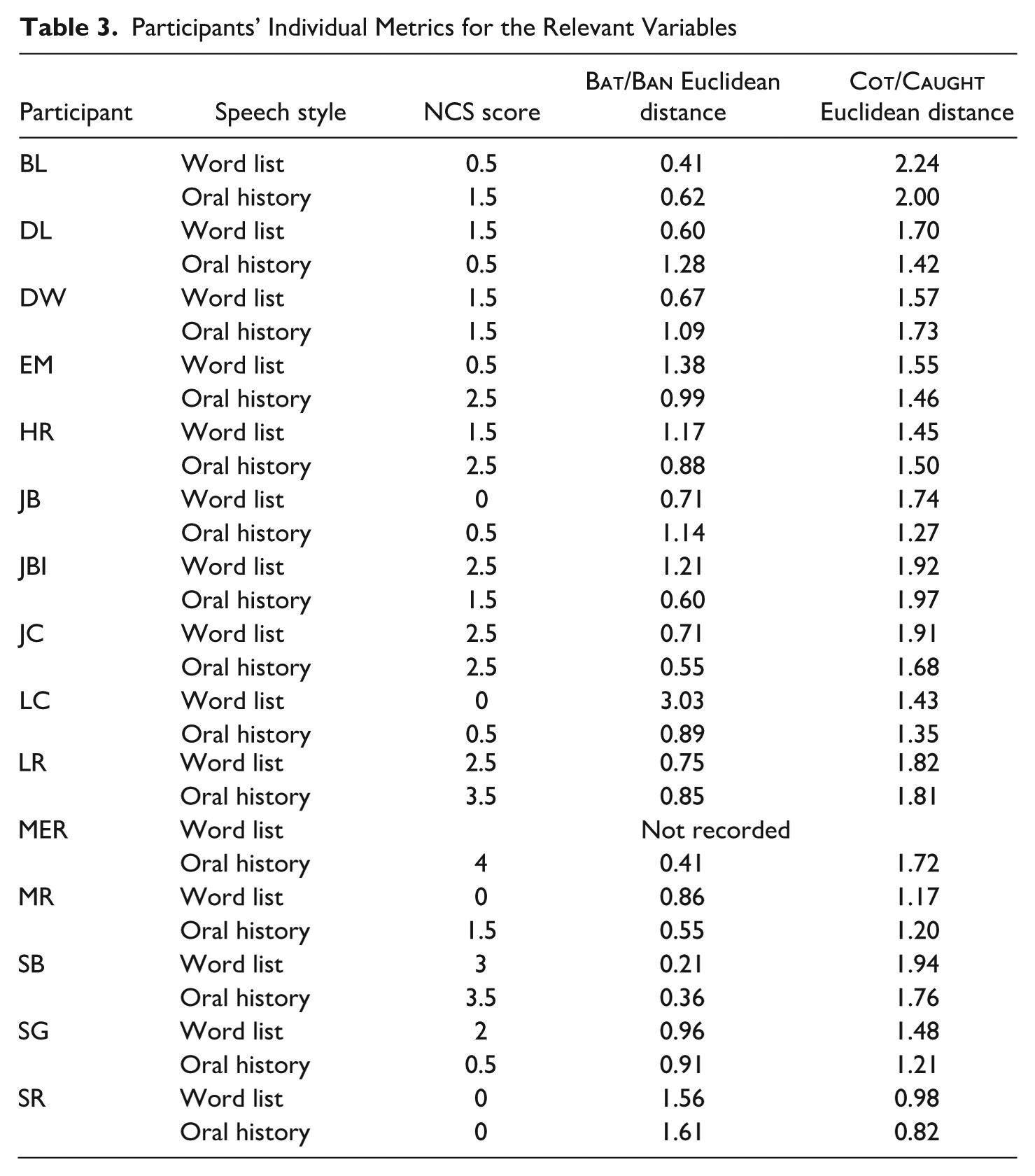
We begin this section by presenting a case study of sound change in a single Rochester family, which we use to set the stage for and motivate the rest of our analysis. We then zoom out to the broader group, describing our observations and results with respect to language attitudes, style-shifting and attention to speech, and finally the relationship between the University and the 19th Ward and its effects on local speech patterns. For reference, Table 3 provides each participant’s values for three of the variables we discuss here: NCS score, and
Participants’ Individual Metrics for the Relevant Variables
4.1. Case Study: Change Within One Family
In this section we explore sound change in apparent time by focusing on one family, three members of which were interviewed for this study. At eighty-five years old, LR was the oldest participant in this study. We interviewed him first with his son, HR, who was fifty-six years old. In a second interview, we interviewed LR, HR, and HR’s twenty-year-old son SR. All three grew up in the 19th Ward and the family is quite close; as such, they represent an interesting case study from which to examine language change over time. And indeed, within this family we find support for the reversal of the NCS and the adoption of supralocal B

LR’s Vowel Space (Oral History Interview): (a) Word List and (b) Oral History Interview

HR’s Vowel Space—Oral History Interview: (a) Word List and (b) Oral History Interview
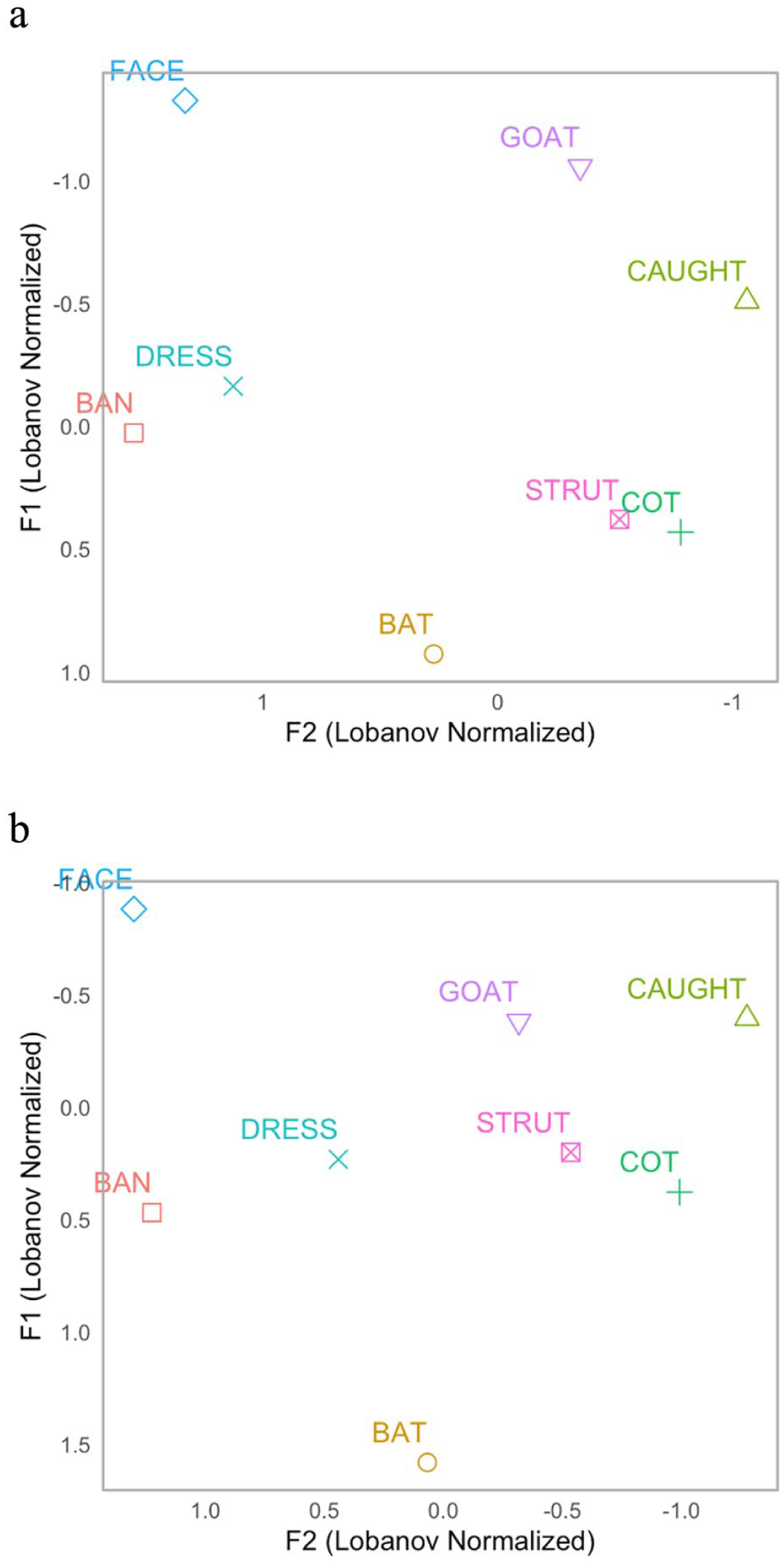
SR’s Vowel Space: (a) Word List and (b) Oral History Interview
When we consider features of the NCS,
For all three speakers, the
These three generations of a 19th Ward family illustrate something in line with our initial hypothesis and with previous studies. Over three generations we see an advance of the supralocal
Three Generations in One Family
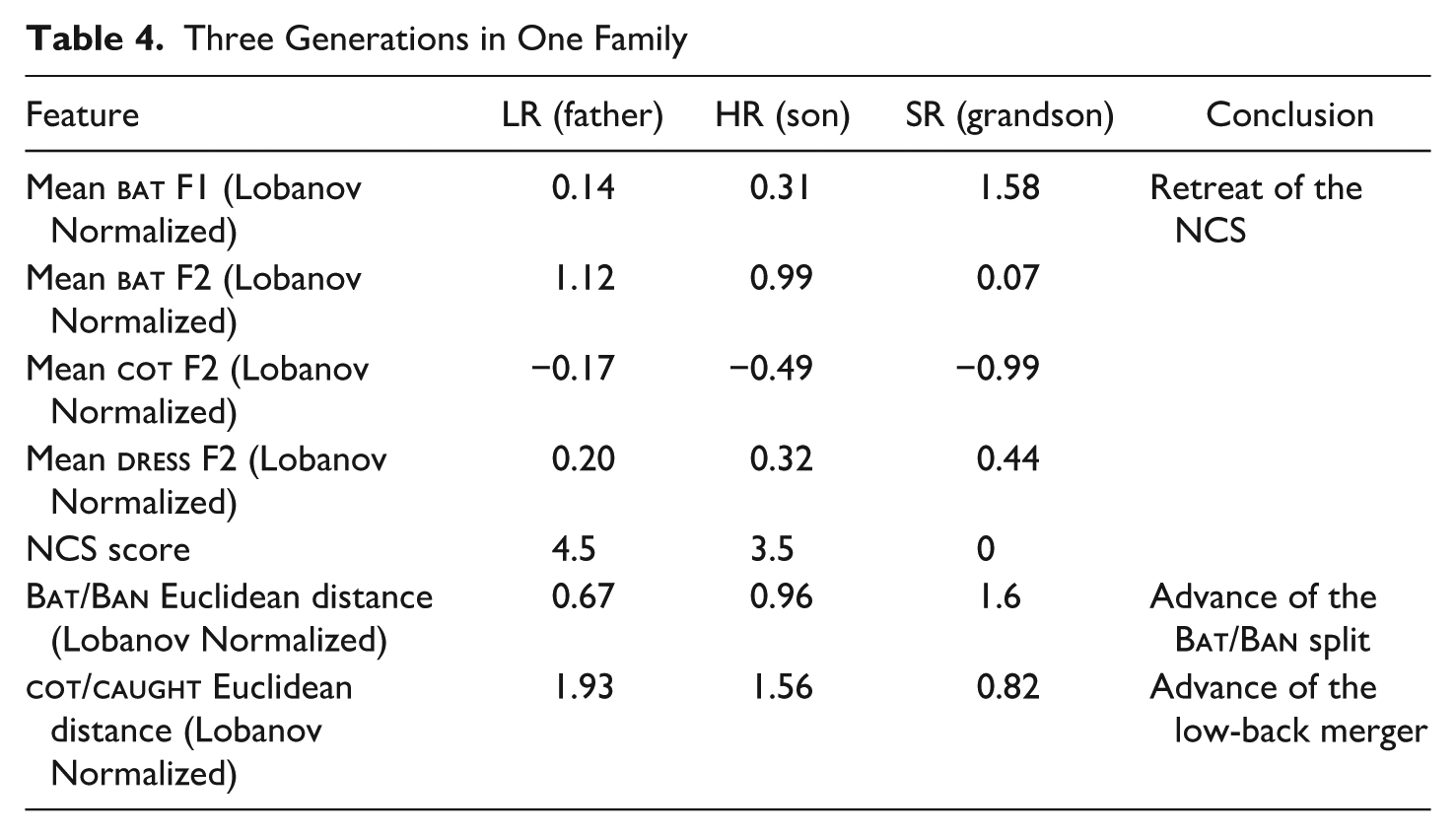
Contra our expectations, however, this family is not fully representative of our sample as a whole. They represent an ongoing reversal of the NCS in apparent time, consistent with previous recent studies in the Inland North, and in this they are representative of larger community norms across the dialect region. However, their pattern is an oversimplification of the more nuanced relationship between the NCS, localness, and the university in Rochester, for which we provide more evidence below.
4.2. The Broader Social Network: Sound Change and Higher Education
4.2.1. Attitudes Toward the NCS
Early in our work in the 19th Ward we found that the
Overall, participants express mixed attitudes toward the NCS, although none of the views expressed in the interviews were fully positive. SG says in his oral history interview that “you either have that Rochester accent or . . . you’ve been blessed,” even though in a later discussion with the interviewers he said that he thinks “it’s kind of a cool accent,” “kind of unique,” and that he does not find it “a negative thing.” MR says he finds the Rochester accent “obnoxious and annoying,” and BL, when asked whether he likes the sound of the Rochester accent, says “no” because “it could grate on you.” At least some participants considered their own awareness unusual. MR mentions the “Great Lakes Vowel Shift” but also commented that “ninety percent of people in Rochester don’t think they have an accent.” In general, our observation was that the participants in this study had relatively high awareness of the existence of a Rochester dialect and of some of its features (namely the
4.2.2. Apparent Time and Attention to Speech
In our quantitative analysis of the sample as a whole the NCS does not appear to be reversing in apparent time. We ran a series of linear mixed-effects regression models with the critical value Bonferroni corrected to p = .05/5 = .01. We found no significant correlation (p > .01) between age and the NCS features we explored:
4.2.3. The University and the Neighborhood
As participant observers and from the content of the oral history interviews, we were able to glean substantial knowledge of the relationship between the University and the 19th Ward in general and of specific participants’ relationships with the University of Rochester and with higher education more generally. Two themes that emerged throughout were the complexity of the relationships and the ways that many 19th Warders place local identity in opposition to the University.
Because of its proximity and economic prominence, the University of Rochester has a significant influence in the 19th Ward, but it is a complicated relationship. The Genesee River is a physical and symbolic separator between “town and gown,” with the University campus on the east side and the Ward on the west. For many years there was a “taboo” (JB) on student housing on the West side of the river, and students rarely ventured into the Ward. The construction in 1991 of a foot bridge between the campus and the neighborhood reflected and supported a growing interest—at least by the University—in breaking down the divide. In the words of JB, it “changed everything.” Since that time, the University has constructed two student dormitory areas on the Ward side of the river, a decision met with mixed reactions by Ward residents. Many students also “buy or . . . rent houses and apartments in the neighborhood” (SR). At the time of this study, there were multiple new businesses opening in the Ward targeting student customers, but SR, at the time a University of Rochester undergraduate, observed that “people don’t go [to the Ward] so much just to hang out.”
On one hand, residents acknowledge that “the University of Rochester has surpassed Kodak and Xerox as . . . [Rochester’s] biggest employer, so [that is] a benefit for . . . the southwest quadrant” (JC), that is, the section of the city containing the 19th Ward. JB credits the “huge explosion of the U of R student population” with helping to raise property values and improve maintenance of buildings in the Ward. Residents appreciate the economic benefits of students for Ward businesses and the availability of volunteers for community service projects.
On the other hand, many residents express concern that the growing student presence in the Ward “is changing the character of the neighborhood” (JB) as students “don’t get a chance to develop roots” (JC) and the houses students rent are often “held by absentee landlords” (EM). In the view of some residents, students are not invested in the community, but bring noise, gentrification, and over-policing (EM).
For their part, students have mixed views of the Ward. The first author recalls being told upon her arrival as a first-year undergraduate—by many people including alumni and members of the University police force—that the 19th Ward was “dangerous” and that she should avoid spending time there. LC, a Ward resident and University employee, says that “hearing the way that students and faculty and staff talk about or assume” things about the neighborhood is “frustrating.” Students live in the Ward because it is close to Campus, and non-University-owned housing in the Ward is substantially cheaper than University-owned housing. They do not, in the assessment of both the students and Ward residents, live in the Ward out of particular interest in neighborhood culture and community; most would agree that there is a “lack of connection” (EM). In our observations, even students who live in the Ward rarely venture more than two or three blocks into the large neighborhood and rarely engage with Ward businesses.
Strong relationships between people “from the University” and Ward residents are perceived as rare, at least by those we spoke with. Only four of the fifteen speakers we recorded for this project had current or official ties to the University, and as a student Author Kapner felt herself to be an anomaly in her strong relationships with the Ward. EM describes an “us versus them” attitude between students and Ward residents. Efforts to build a better relationship between the University and the Ward are ongoing and supported by individuals on both sides but are finding limited success. At the time of the interviews, JB was directing the University’s Neighborhood Ambassadors program, which tried to connect students with the Ward to promote better relations; the impact of the program was unclear. In the words of JC, “the challenge for us is to welcome the U of R presence here, engage them as partners and work together.” “Movement ahead is slow” (JC).
Despite their relative lack of formal affiliation with the University of Rochester, the people in the social network interviewed for this study are as a whole quite highly educated: seven of the fifteen participants had graduate degrees, and all participants except one (SG) earned at least a high school diploma and attended college for a time. One participant (SR) qualified by the metric of education level as having achieved only some undergraduate education, but he was at the time of the study a current undergraduate student with aspirations to earn a PhD in the future. Another participant (MR) had earned an undergraduate degree only, but his father and his closest childhood friends’ parents were University of Rochester professors and his wife earned her PhD from the University; he cites the University as a force which repeatedly “drew [his] family” to Rochester. On the other hand, some participants with graduate degrees have had comparatively little connection with universities. Two participants (MER and JBI), for example, earned graduate degrees in nursing in the 1960s but have not had any interaction with higher education since then. One participant (SB) expressed an orientation away from higher education, saying that he went to college only out of fear that his girlfriend would not stay with him unless he did: “I went to college because . . . I realized if I don’t get a college degree she’s gonna end up dumping me.” In other words, terminal degree, attitude toward the University, and connection with the higher education in general and with the University of Rochester in particular are not necessarily related.
While the University of Rochester is geographically adjacent to—and even moving into—the Ward, there is a strong sense that the University is not part of the neighborhood. Even with formal and informal connections between the two, the University and the neighborhood remain seen in opposition to one another. In the following section we illustrate how this complicated relationship may influence the variable use of both local and supralocal dialect features for individual speakers.
4.2.4. Higher Education and Sound Change
LR, HR, and SR, described above, represent sound change over time in a 19th Ward family, but they also represent the varied and evolving roles of higher education in the community. LR’s parents were blue-collar workers in the garment industry. LR (the grandfather, born 1933) got a job at his uncle’s pharmacy and then went to a state university to become certified as a pharmacist; he spent his career as a pharmacist in Rochester. LR’s wife (HR’s mother) did not, as far as we are aware, go to college. HR (LR’s son, born 1962) went to the same state university as his father to become a civil engineer and met his wife (SR’s mother) there. SR (LR’s grandson, HR’s son, born 1997) was, at the time of interviewing, a student at the University of Rochester, with plans to obtain a doctoral degree. LR was the first generation to be college-educated, HR had one college-educated parent, and SR was raised by two college-educated parents. LR went to college to become certified to work at the family business, HR to become an engineer, and SR as a stepping-stone to further education. The family has therefore become more and more closely connected with higher education over time, and the differences in the vowel systems of the three speakers reflect this connection between higher education and change in apparent time.
As one of the oldest speakers in the sample, we might expect BL (born 1943) to demonstrate more traditional local patterns like LR or even HR. Yet BL displays only a few features of the Inland North dialect. He has an NCS score of only 0.5 on the word list and 1.5 on the oral history interview (although he does have some of the most fronted

BL’s Vowel Space: (a) Word List and (b) Oral History Interview
It seems that BL’s exposure in higher education has led to a rejection of local speech patterns, but not necessarily to an adoption of supralocal ones. We see a similar pattern with MR, who has however relatively more contact with higher education as his parents and spouse were all University professors. As noted above, MR demonstrates high awareness of the NCS. He also has a low NCS score of 1.5, and his

MR’s Vowel Space: (a) Word List and (b) Oral History Interview
Both BL and MR serve as examples of how these two motivations—the avoidance of the local and the adoption of the supralocal—may not always operate in tandem, and we can illustrate this further with the contrast between two of our youngest speakers, SR and LC (Figure 7), who are the two speakers in this sample with the closest ties to higher education, but with different orientations with respect to the University and the Ward.

LC’s Vowel Space: (a) Word List and (b) Oral History Interview
As a full-time student at the time of interviewing with college-educated parents and aspirations for attaining a doctorate, SR represents one of the speakers with the greatest level of connection to higher education. He is a part of the 19th Ward community, but he spends the vast majority of his time in the University setting. He grew up in the 19th Ward, but his aspirational ties are not to Rochester: he plans to move away from his hometown to pursue a PhD. SR describes having friends from many different places as a defining part of his social experience at the University, and he shows strong adoption of the supralocal features. SR’s speech thus reflects his supralocal aspirations more than his local reality. In this way, he represents a white persona similar to King’s (2021) Mobile Black Professionals, or to the students described by Wagner (2012) who aspired to attend non-local colleges. For SR, higher education represents a means to achieving those aspirations: he needs a research-oriented undergraduate degree in order to reach his next goal of a PhD program outside of Rochester. This orientation is reflected in SR’s relatively split
LC is the second-youngest speaker in the sample; she was thirty-four at the time of interviewing. She grew up in the 19th Ward but left Rochester for college, again reflecting the broader diachronic patterns of greater orientation toward higher education in this community. LC was a full-time employee of the University of Rochester, in a role involving frequent interaction with students and faculty and mediation between the University and the Ward.
Like SR, LC’s
For both speakers, supralocal speech patterns reflect their aspirational orientations. We suspect that for SR, this is largely subconscious, while LC’s style-shifting represents a more conscious awareness of the social meaning of local and supralocal patterns, reflecting an ideology that places higher education and Ward identity in opposition to each other such that she must mediate these through her speech patterns and the social capital they generate. LC has spent more of her life outside the Ward. She has more experience in higher education, and, as a woman, occupies a slightly less hegemonic place in society than SR. In her oral history interview, LC embraces her 19th Ward identity, but in the formal word list context, she leans on the supralocal pattern to (re)orient toward the University. LC and SR both demonstrate a retreat of the NCS in apparent time, driven in part by changing relationships to higher education, but the extent to which they draw on the social meaning of the NCS is demonstrably different. We can further illustrate this with the speaker JC. 5
Like SR and LC, JC has ties with both the University and the Ward. As of 2018, he held leadership roles in multiple service organizations in the Ward and often served as a point person for volunteer groups from the University of Rochester and nearby Rochester Institute of Technology (RIT); this how Author Kapner first met him. JC’s involvement with the University is less immersive than LC’s and SR’s and takes place almost entirely in the 19th Ward. His master’s degree has little influence on his connection to higher education. JC expresses mixed attitudes toward the University, as described above, and he positions himself as an advocate for the Ward.
Despite JC’s regular connection with the University, he does not exhibit the

JC’s Vowel Space: (a) Word List and (b) Oral History Interview
Finally, SB is the speaker described above who went to college only because of concerns that his girlfriend would break up with him if he did not. As of 2018, he was raising his children in the suburbs outside the 19th Ward and generally expresses perhaps the most neutral (as opposed to uniformly positive) view toward the Ward of anyone in the sample. Yet perhaps surprisingly, SB exhibits one of the most quintessentially Rochesterian vowel spaces in this sample (Figure 9): he has the relatively high NCS scores of 3.5 on the oral history interview and 3 on the word list. He is a non-adopter of the

SB’s Vowel Space: (a) Word List and (b) Oral History Interview
The varied and at times conflicting patterns in this group relative to these sound changes and the role of higher education reflect a great deal of variation and complexity within the community with respect to the NCS, supralocal speech patterns, and relationships with higher education. To make sense of the heterogeneity in this sample, we need to consider rejection of local and adoption of supralocal patterns separately, considering access to those forms as well as motivation to use or reject them, in light of other social factors about the speakers.
5. Conclusion and Discussion
Within a single family in Rochester’s 19th Ward (section 4.1), we find an illustration of several ongoing changes in progress, in line with our expectations: an apparent time retreat of the NCS and adoption of the
Yet statistical analyses fail to reveal strong patterns for the sample as a whole in the ways that we expected (section 4.2.2). For the most part we feel that this is likely due to the small and relatively socially homogeneous sample. Yet it is also possible that the great deal of variability we are finding in the use of the erstwhile Inland North dialect in Rochester’s 19th Ward is a reflection of the fact that the NCS has only recently began to regress, and that the social meaning of the NCS as a marker of local-ness has not been fully established in the local community. It may be that we should expect to find this level of inter- and intra-speaker variability in the linguistic means for constructing identities with respect to place, particularly in the context of a newly stigmatized local dialect in a community that has undergone quite recent socio-economic upheaval. In other words, we are not on the surface able to demonstrate the type of orderly heterogeneity (Weinreich et al. 1968; Labov 1972) that we might expect, because of ongoing change in the meaning of the NCS locally. With respect to the
Our interviews and participant observation reveal a complex situation of town-gown relations in Rochester (section 4.2.3). The participants in this study are quite proud of being 19th Warders and of their broader Rochester identities. This particular group of speakers, recruited for an oral history project about local culture, likely represents a social network with a particularly high level of local pride. Meanwhile, even as Ward residents find themselves in increasing contact with the University community of practice, and the University expands into the neighborhood, there is a strong sense that the University will never become part of the neighborhood. At least for some in this study, the 19th Ward identity is defined in opposition to the University. We also find that for these speakers, terminal degree, attitude toward the University, and connection with the higher education in general and with the University of Rochester in particular are not necessarily related: the interactions of higher education and identity are far more complex.
We observe that speakers in this community are generally aware of a “Rochester accent” and some of its features (section 4.2.1), particularly raised and fronted
In his review of literature on place, identity, and language, Reed (2020) points out that it is not uncommon for speakers to use stigmatized features of local language varieties as a way to index pride in being from that place. Summarizing Lane’s (1998) study of speakers of a variety of Danish local to the village of Thyborøn, Reed (2020:7) says, “a speaker’s identity with Thyborøn seemed to be more important than the stigma from using marked features.” The adoption of the NCS in the present study seems to follow this same pattern.
Race may have a role to play here as well. D’Onofrio and Benheim (2020) and Van Herk (2008) argue that the NCS represents a kind of “symbolic ‘White flight’” (D’Onofrio & Benheim 2020:485), and that its widespread reversal in apparent time reflects a rejection of racist ideologies. While the participants in this particular study all condemn racism and speak with pride about the diverse racial makeup of the Ward, the fact remains—reflected in the racial makeup of this sample—that this social network is primarily white, as were the interviewers. It is possible that for the white speakers in this sample, the NCS may, as described by King (2021:174), “indirectly index Whiteness” even in the context of stated opposition to racism. DW, the only Black speaker in this sample, seems to fit with King’s (2021) persona of the Mobile Black Professional, for whom the reversal of the NCS indexes a career “not defined by manual labor,” and as well as competence or professionalism (King 2021:174). Her lack of NCS reflects the patterns King describes for this persona.
Overall, our findings contribute to the understanding of the changing social meaning of the NCS in the Inland North, and the roles of place and identity. Drawing on a combination of participant observation and phonetic analysis, particularly in one family of speakers, we find that we can draw some conclusions about the regression of the NCS, and the progression of the
Footnotes
Acknowledgements
The authors wish to acknowledge the detailed feedback of four anonymous reviewers, and to thank the fifteen Rochester speakers for their enthusiastic participation. We also received valuable assistance from Sandra Talarico, Jackie Farrell, MaryDan Cooper, Christine Ridarsky, Michelle Finn, Justin Davidson, Carolyn Caza, and many others at the 19th Ward Community Association, the University of Rochester, and UC Berkeley.
Declaration of Conflicting Interests
The authors declared no potential conflicts of interest with respect to the research, authorship, and/or publication of this article.
Funding
The authors disclosed receipt of the following financial support for the research, authorship, and/or publication of this article: This research was partially funded by a University of Rochester Barth-Crapsey Undergraduate Research Award, awarded to the first author.
