




Abstract
While multiethnolects have been documented in major European metropolises over the last several decades, no such varieties have been reported in North America. This is surprising given the high degree of global immigration in many North American cities. We consider Toronto, Ontario, one of the most multicultural cities in the world, and explore the features of a Multicultural Toronto English. Data comes from young people in an ethnolinguistically diverse region of the Greater Toronto Area. We investigate five vocalic phenomena:
1. Introduction
Since the earliest research on European multiethnolects, the role of (im)migrant children in the development of these varieties has been recognized as critical. As Kotsinas (1988:129) writes in her foundational work on “Rinkebysvenska,” a multiethnolect spoken in suburban Stockholm, “[a]s a consequence of the great immigration in Sweden during recent decades, about one tenth of the children in Swedish schools have an immigrant background.” This raises a question for North American linguists: why have such multiethnolects not been observed in analogous contexts here with a much higher immigrant population? The settler-colonial nation state of Canada has been a country of immigrants since its foundation. Early settlers predominantly came from France and the British Isles (either directly or via the United States), with other European settlers arriving through the early twentieth century. However, since the 1960s, major conurbations like the Greater Toronto Area (GTA) have become the destination of (im)migrant populations from across the globe. While in Stockholm in the late 1980s, a 10 percent immigrant population was remarkable, in 2016 (the time of the latest census), 46 percent of the population of the GTA were immigrants, 18% of Toronto’s immigrant population arrived in the twenty-first century, 47 percent arrived under the age of twenty-five, 51 percent of the population identified as a visible minority, and 48 percent had a mother tongue other than English (Statistics Canada 2017a). Indeed, multiculturalism as a cultural mosaic has become a core ethos of the Canadian identity and official state policy, which “ensure[s] that all citizens keep their identities, take pride in their ancestry and have a sense of belonging” (Government of Canada 2021). However, this policy does not always manifest in praxis, and today multiculturalism and immigration in Canada continue to be contested by politicians and pundits. The success of the cultural mosaic approach must be recognized as “a two-way street: it entails the willingness of new Canadians to embrace their new home and—equally significantly—the willingness of the wider society to lower the barriers to their becoming active and productive members of their adopted home” (Berns-McGown 2013:1).
Others have thoroughly investigated the ethnic enclaves of communal migration in Toronto (e.g., Hoffman & Walker 2010), but many of the city’s neighborhoods fit Cheshire, Kerswill, Fox, and Torgersen’s (2011) description of neighborhoods where multiethnolects arise: underprivileged areas that have become home to new arrivants of many different national, ethno-racial, and linguistic backgrounds. Indeed, as linguists who live in, have grown up in, and/or teach students from such places in the GTA, we have heard linguistic features from young, mainly racialized, Torontonians, on public transit, at soccer pitches, in malls, on university campuses, on social media, and elsewhere, that differ from Normative Canadian English (NCanE). Our choice of the term “normative” here as opposed to “standard” is highly intentional. For us, normative entails that the hegemonic norm is exactly that: not a linguistic fact but an ideological one that is inseparable from race, place, and class. Indeed, NCanE is a variety that is ideologically linked with hegemonic middle class, (sub)urban, whiteness (cf. Denis & D’Arcy 2018).
In this paper we seek to document features of this alternative, non-normative way of doing language in Toronto that is not linked to middle class, urban whiteness, which we label Multicultural Toronto English (MTE). As an early exploration of this linguistic alterity, we report on a systematic sociophonetic investigation of several vowel phenomena in the speech of young people in an ethnolinguistically diverse area of the GTA, comparing and contrasting it with NCanE. Our own everyday experience of hearing this linguistic alterity has led us to focus on vocalic features as, over the last several years, we have casually documented several vowel realizations that differ from NCanE.
The paper is organized as follows: in section 2 we clarify our understanding of multiethnolects, provide broader context on the GTA, and situate a locally-salient language practice known emically as “Toronto Slang” vis-à-vis MTE. In section 3, we introduce our methodology. Next, in section 4, is the presentation of our results for each of the vowel phenomena we investigate. We then step back, in section 5, and view individual speaker and vowel patterns from a holistic lens. Here we draw on Cheshire, Kerswill, Fox, and Torgersen’s (2011) application of Mufwene’s (2001) “feature pool” to multiethnolects (introduced in section 2) to understand how speakers pattern and, from there, how to situate MTE (or more accurately, its features) within the sociolinguistic ecology of the city. We offer a conclusion in section 6.
2. Multiethnolects: Styles, Vernaculars, Features, and Linguistic Alterity
Since the late 1980s, sociolinguists have reported on new linguistic practices in major metropolises in Northern Europe that have emerged as a result of language contact between the broader community language and languages spoken by recent immigrants (Cheshire, Nortier & Adger 2015; Nortier 2018). These new practices—often termed “multiethnolects” (Quist 2000) in recognition of influence from not one but many immigrant languages and spoken by individuals of not one but many ethnolinguistic backgrounds—have been reported in Stockholm, Berlin, Copenhagen, London, and elsewhere. While characteristically associated with young children of immigrants, multiethnolects have also been reported to be used by young people who ethnically identify with the local majority.
These multiethnolects have strong associations with neighborhoods and areas that have traditionally been working-class areas, that are socioeconomically, psychogeographically, 1 and sometimes physically isolated, and that have more recently become destinations of first arrival of immigrant populations (Cheshire, Kerswill, Fox & Torgersen 2011:152). Migration in these contexts has been more global than communal. That is, rather than the settlement of particular ethnolinguistic groups (e.g., Little Italy or Chinatown), new arrivants come from around the world. Thus, diversity, multiculturalism, and multilingualism are characteristic of these contexts.
In these cases, young people exhibit rapid language shift to the ambient majority language. It is this milieu of being “globally-connected but locally-disconnected” (Castells 2000:436) that Cheshire, Kerswill, Fox, and Torgersen (2011) have argued incubates multiethnolects. The idea is that relative isolation results in a weaker availability of local, adult native speaker models than in other neighborhoods. Because of this, young, new arrivants acquire the ambient language on the model of immediately older siblings and peers, themselves typically second language speakers. The result is potential for new linguistic practice to emerge with features traceable to at least three sources: features related to second language acquisition, features related to language/dialect contact, and features that arise through internal innovation (Cheshire, Nortier & Adger 2015:16).
An open question in the literature on multiethnolects is what exactly a multiethnolect is: is it a style (e.g., Quist 2008; Nortier 2018) or a Labovian vernacular (i.e., their habitual, unmonitored way of speaking) (e.g., Wiese 2009)?
2
As Cheshire, Nortier, and Adger (2015:4) observe, multiethnolects seem to serve a “dual status” and so may be both, functioning as a stylistic resource for some speakers and as an aspect of vernaculars for others. This approach is an empirically and theoretically satisfying middle ground. Cheshire, Kerswill, Fox, and Torgersen (2011:154) view multiethnolects as a “repertoire of [non-normative] features” (whether lexical, grammatical, phonological, or discourse-pragmatic). These features, together with the ambient normative variety, form a feature pool (cf. Mufwene 2001). From this pool, certain features may be “selected” by speakers and come to index certain social meanings (e.g., stance, persona, place, race, class, their intersections). For example, Cheshire, Kerswill, Fox, and Torgersen (2011) conceptualize Multicultural London English as a set of non-normative features selected out of the feature pool that can be heard most prominently in certain neighborhoods of London (e.g., near-monophthongal
We take Cheshire, Kerswill, Fox, and Torgersen’s (2011) approach as our baseline for understanding MTE, which, we argue, exhibits a “dual status” nature. Indeed, MTE is inherently linked with what is locally labeled “Toronto Slang” in media and social media metadiscourse (Denis 2016; Bigelow, Gadanidis, Schlegl, Umbal & Denis 2020; Khan 2020; Denis 2021; Elango 2021). We use the term “slang” here only as part of this label and do not intend to signal that Toronto Slang constitutes slang in any linguistically-technical sense.
Toronto Slang is not coextensive with MTE; it is a set of non-normative features that, in Agha’s (2003) sense, have come to be enregistered as “Toronto” features. While the label ostensibly entails widespread use by all Torontonians, Toronto Slang is linked in metadiscourse with the same neighborhoods where we have heard non-normative features ourselves and is typically associated with racialized and immigrant youth (Khan 2020; Denis 2021; Elango 2021). Indeed, many features of Toronto Slang are borrowings from other languages, mainly, if not entirely, from Jamaican Patwah and Somali, the languages of the largest Black ethnolinguistic community in the city and largest African diasporic community in the city respectively. As in other cases of the diffusion of Black cultural productions in North America (and elsewhere), much discourse around Toronto Slang revolves around cultural appropriation (see Denis 2021 for discussion of the (de)racialized meaning of Toronto Slang and the tension between race- and place-based indexicality).
The metalinguistic description of Toronto Slang is limited to lexical items and to morphosyntactic and discourse-pragmatic phenomena that are popularly understood to fall under the “word” category, consistent with the “bag-o-words” folk linguistic understanding of language (Pullum & Scholtz 2001; Eckert 2003:395). No overt discussion of phonetic or phonological features appears in Toronto Slang metadiscourse (Bigelow, Gadanidis, Schlegl, Umbal & Denis 2020). However, non-normative sound features can be heard in reflexive performances on social media. Additionally, folk respellings offer some suggestion of salience of at least two phenomena:
Toronto Slang seems to be what Rampton (2009:149) has identified as a “stylization”: “reflexive communicative action in which speakers produce specifically marked and often exaggerated representations of languages, dialects and styles that lie outside their own habitual repertoire.” Indeed, the use of Toronto Slang in social media is typically reflexive, marked, and exaggerated. An implication of categorizing Toronto Slang as a stylization is that it must be a stylization of something. We suggest it is a stylization of MTE.
This sets up our main question. Given the dual-status of multiethnolects, the prevalence of Toronto Slang in local metadiscourse, and our own everyday experience, what are the features of the MTE feature pool? Or from Cheshire, Kerswill, Fox, and Torgersen’s (2011) perspective, what non-normative features heard in Toronto are not just part of speakers’ stylistic repertoires but also appear in the habitual vernaculars of some?
3. Methodology
3.1. Field Work and Data
In the summer of 2018, we conducted fieldwork in Brampton, a city in the GTA located immediately northwest of the City of Toronto proper (see Figure 1). 3 Brampton is an area that is frequently linked with Toronto Slang in metadiscourse (Denis et al. 2020). It is a highly multicultural region of the GTA: 52 percent of the population are immigrants, 41 percent of immigrants arrived after 2001, and 48 percent arrived before the age of twenty-five (Statistics Canada 2017b). In recent years, the main source countries of immigration to Brampton are India, Jamaica, Pakistan, the Philippines, and Guyana. Almost half of the population has a mother tongue other than English and a quarter of young people (under seventeen) are considered to have “low income status” (Statistics Canada 2017b). In many ways, Brampton is similar to multiethnolectal areas of European cities described by Cheshire, Nortier, and Adger (2015).
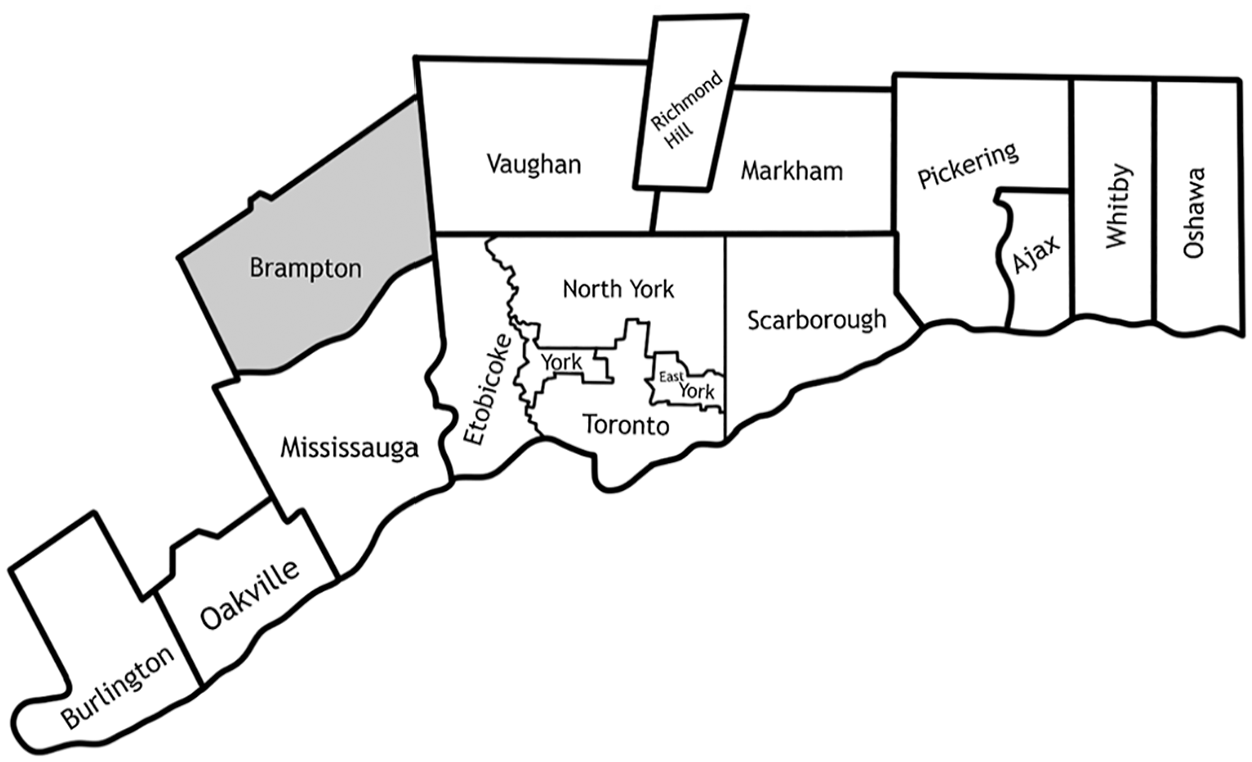
Brampton (Highlighted) Within the Greater Toronto Area
Our fieldwork goal was to document the language of young people, twenty-five and under, in Brampton. We recruited participants aged eleven to twenty-five who had been living in Brampton for at least one year. Recruitment was facilitated mainly through cold-approaching young people at the Chinguacousy branch of the Brampton library and the Bramalea City Centre. Both sites are within walking distance of two high schools in the neighborhood of Bramalea. As such, many high school students spend their free periods and after-school hours at these two sites, both studying and socializing. A few participants were also recruited through the personal networks of the researchers. In total, we recruited thirty-two participants who were roughly evenly stratified by age and gender, as shown in Table 1. Gender was self-reported, and no participants identified outside of the normative gender binary.
Participant Sample
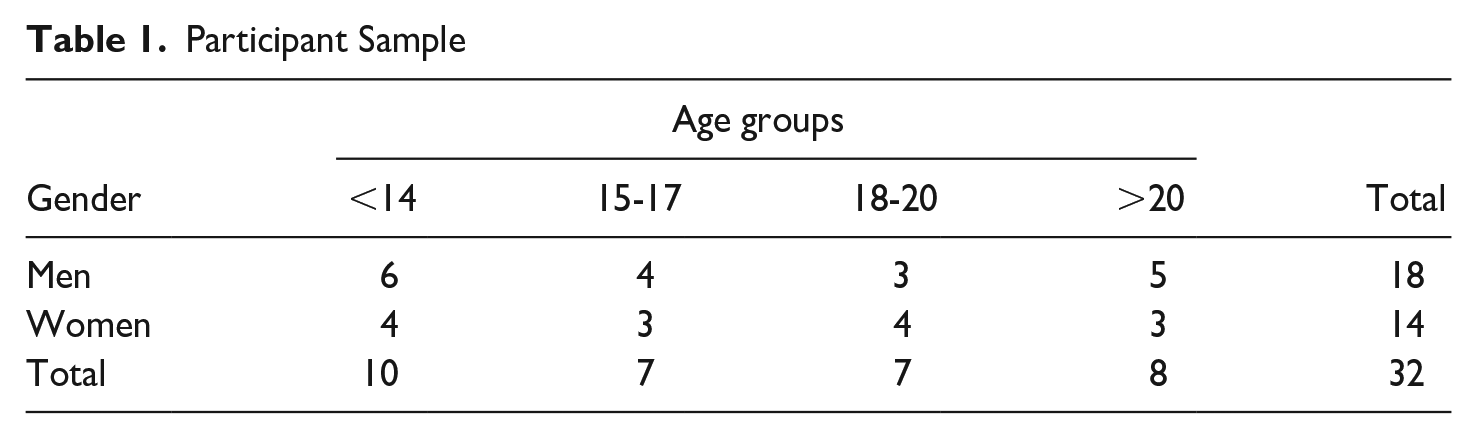
Our sample was not controlled otherwise and thus reflects the diversity of Brampton (and the GTA in general) with respect to ethnicity, immigration, and language background. Our participants spoke eighteen languages, including Hindi, Arabic, Punjabi, Spanish, Twi, and Patwah, and self-identified with thirty-nine ethnic descriptors including Indian, Jamaican, Malay, Canadian, Saudi, Anishinaabe, and Nigerian. Twelve speakers reported mixed ethnicities. The sample also reflects diversity with respect to immigration. Fifteen participants were born in Canada (one of whom was born in Ottawa, Ontario, but moved to the GTA at eight years old). All but five of these fifteen participants are second generation (i.e., their parents were born elsewhere and immigrated to Canada). The remaining seventeen participants moved to Canada (and the GTA) at different points in their lives: five immigrated to Canada before age five, eight between five and nine years old, and four between ten and fifteen years old. All of these participants can be considered 1.5th-generation Canadians, that is, individuals who immigrate to a new country in adolescence or younger. This distinction from “first generation” recognizes that much of their socialization takes place in the new country, unlike those who immigrate as adults. Five of these participants lived elsewhere in Canada before moving to the GTA. One speaker had lived in Brampton for just over a year when interviewed, but the remaining had spent at least three years in the area. The ethnolinguistic diversity of our speakers is somewhat comparable to other studies of multiethnolects in Europe (e.g., Quist 2008:48; Cheshire, Kerswill, Fox & Torgersen 2011:196; Drummond 2018:178); unlike our sample, some of these have not included first-generation immigrant speakers.
Critically, we did not a priori seek out participants who use MTE features (whether stylistically or vernacularly) or, other than age and having lived in Brampton for one year, fit a particular sociodemographic profile. Again, if we conceive of MTE as a set of features, there are no speakers of MTE because MTE is not a variety per se. Instead, by cold-approaching young people in their everyday contexts, our goal was to document an authentic slice of the sociolinguistic ecology of the area. Our hope was that some of our speakers would exhibit the same non-normative features that we had previously heard outside of the research context. The multidiversity of our sample means that there may be variance in our data that we are unable to account for. However, since our goal is to document non-normative features of a multiethnolectal feature pool, an examination of a genuine representation of speech in the community that focusses on overarching patterns meets our needs.
Once participants were recruited, the fieldwork procedure involved three tasks which were audio recorded using the internal microphone of a Zoom H2n digital recorder: a wordlist, a reading passage, and a sociolinguistic interview. All of our participants read the wordlist, all but one read the reading passage, and nineteen participated in a sociolinguistic interview. In this paper, we focus only on the wordlist data.
This focus is fourfold deliberate. First, the wordlist is the only task that all of our participants completed, and thus it allows for the greatest coverage of the diversity found among our speakers. Second, it ensures both the inclusion of all vowel phonemes/allophones (aiding in our normalization procedure) and equal coverage from all speakers of the phenomena we examine in detail. Third, the best description of the vowel system of NCanE, Boberg (2008, 2010), is also from wordlist elicitation, enabling direct comparison. Finally, since Labov (1966), the wordlist style (along with the minimal pairs task) has been considered the context in which speakers experience the greatest degree of self-monitoring and are most likely skewed toward the ambient normative variety. Thus, we take the presence of any non-normative vowel realizations in our wordlist data as especially strong evidence that these patterns are indeed a part of a speaker’s everyday system; not even the pressure of conforming to the prescriptive norm during the wordlist task is enough to suppress a well-engrained, non-normative habitual practice. We note that in other work, we are examining the interview and reading passage data.
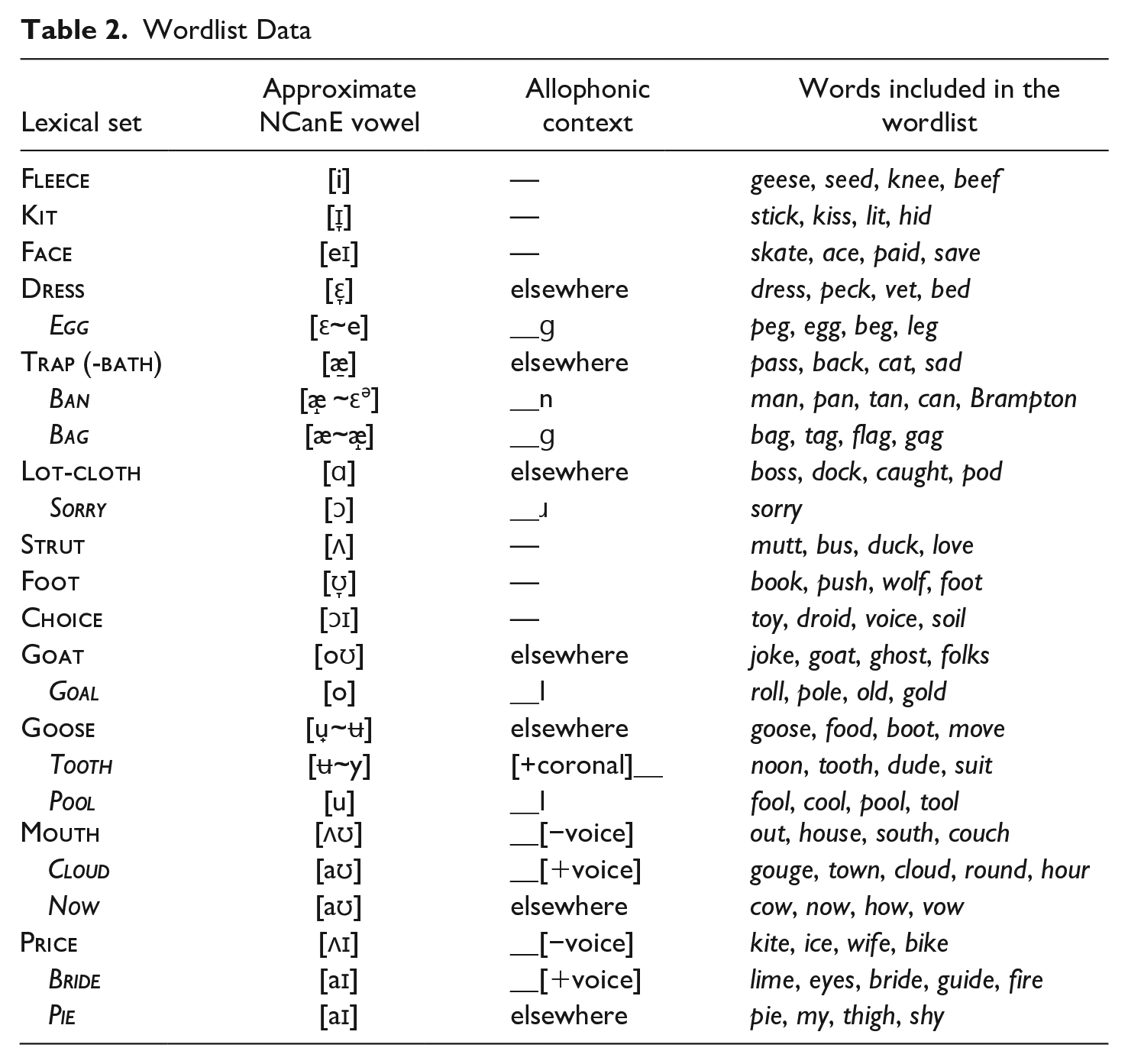
The wordlist included four (or sometimes five) words to represent each of twenty-four different vowel and allophonic contexts of NCanE as given in Table 2. The words in Table 2 are organized into Wells’ (1982) standard lexical sets (dialect neutral mnemonic keywords). We add our own keywords for certain allophonic contexts (indented and italicized in the table). The approximate NCanE articulation is given in IPA based on Boberg (2008:136, 2010:153), as is a description of the specific phonological context where an allophone occurs (or if the allophone occurs in phonologically “elsewhere” conditions), where relevant. The list of words in our wordlist is included in the rightmost column. 4 We suggest that Boberg’s (2008, 2010) data represents NCanE in so much as his participants are middle-class, at least third generation Canadian, and are very likely mostly white. 5 Each participant read the wordlist twice for a total of 196 vowel tokens per speaker (except for two participants who read it only once each).
Wordlist Data
3.2. Data Analysis
The data was segmented and transcribed in ELAN (2018). FAVE (Rosenfelder et al. 2014) was used to force align and extract the first and second formant of every primary stressed vowel. Formant measurements were taken at the FAVE default for each vowel. We manually normalized the raw formant measurements following the Lobanov method (by-speaker z-scores). Rather than a single measure for each vowel token, we included five measures taken at 20 percent, 35 percent, 50 percent, 65 percent, and 80 percent of the vowel duration during normalization. We did not rescale these to Hertz-like values, so a normalized F1 (F*1) value of 0 with a normalized F2 (F*2) value of 0 represents the mean center of a speaker’s vowel space, and a value of 1 on either scale represents one standard deviation from the center.
By and large, we take a holistic approach to analysis: which speakers exhibit the NCanE pattern and which do not? For each of the vowel phenomena we consider, we plot the data as by-speaker boxplots, and we devise speaker-internal benchmarks for determining if a speaker patterned with NCanE. The specifics of these benchmarks are discussed in the relevant sections. Our interpretations are aided by a series of conditional inference tree models (CITs), a nonparametric decision tree technique that models data by determining optimal binary partitions according to the predictors that the CIT is given based on the distribution of the dependent variable (Tagliamonte & Baayen 2012). One advantage of CITs is that they allow for models that include non-orthogonal factors (e.g., age of arrival to Canada, age of arrival to the GTA, and individual speaker itself). For each of our phenomena, we model the data with the following predictors: age, gender, age of arrival to Canada, age of arrival to the GTA, and individual speaker. We do not provide the usual tree-structure visualization of our CIT models but instead represent the resultant partitions in the by-speaker boxplots by shading: darker boxes represent groups of more normative speakers according to the CIT, and the lighter boxes represent groups of more non-normative speakers. In most cases, the only predictor that the CITs use to partition the data is individual speaker. Though factors like gender and age of arrival may not be selected by the CITs, we closely examine the groupings of speakers that each model produces and are able to qualitatively understand what potentially unifies groups of similarly behaving individuals from a bottom-up perspective. Following the literature on multiethnolects, we hypothesize that those speakers who were not born in Canada, especially young men, are more likely to exhibit alterity (see Cheshire 2013).
We consider five broad vocalic phenomena in our data, four of which have sub-phenomena. In all cases, the intention is to examine the extent to which speakers in our sample conform to the NCanE pattern or not. The first two phenomena,
4. Vowel Patterns
We know what the vowel space of NCanE looks like. In this section we explore the following questions: What does the feature pool for young racialized Torontonians look like? Which normative features of NCanE are selected by our speakers? Are there deviations from the norm in our data? If so, what are these non-normative features that we suggest might constitute the repertoire of features of MTE following Cheshire, Kerswill, Fox, and Torgersen’s (2011) conceptualization of what a multiethnolect is?
4.1. Goose Fronting
The advancement of the
Our benchmark for determining participation is to compare the F*2 (i.e., normalized F2) of each speaker’s Tuw and Kuw tokens relative to a stable central vowel. The nuclei of both
Figure 2 (along with all of the following charts) presents a boxplot by individual speaker. The chart is split into four facets based on two factors: gender and birthplace. Women are in the two leftmost facets and men in the rightmost two. Within each binary gender category, speakers are further divided into those born in Canada (on the left) and those not (on the right). In the two facets that include speakers born outside Canada, speakers are ordered by age of arrival along the x-axis. Speakers’ ages of arrival are also listed in the x-axis labels. In all of the charts, the boxplots are shaded based on the results of a CIT model: darker boxes indicate more normative realizations and lighter ones indicate more non-normative realizations. In Figure 2, the y-axis represents the difference in F*2 space from the mean F*2 of a speaker’s
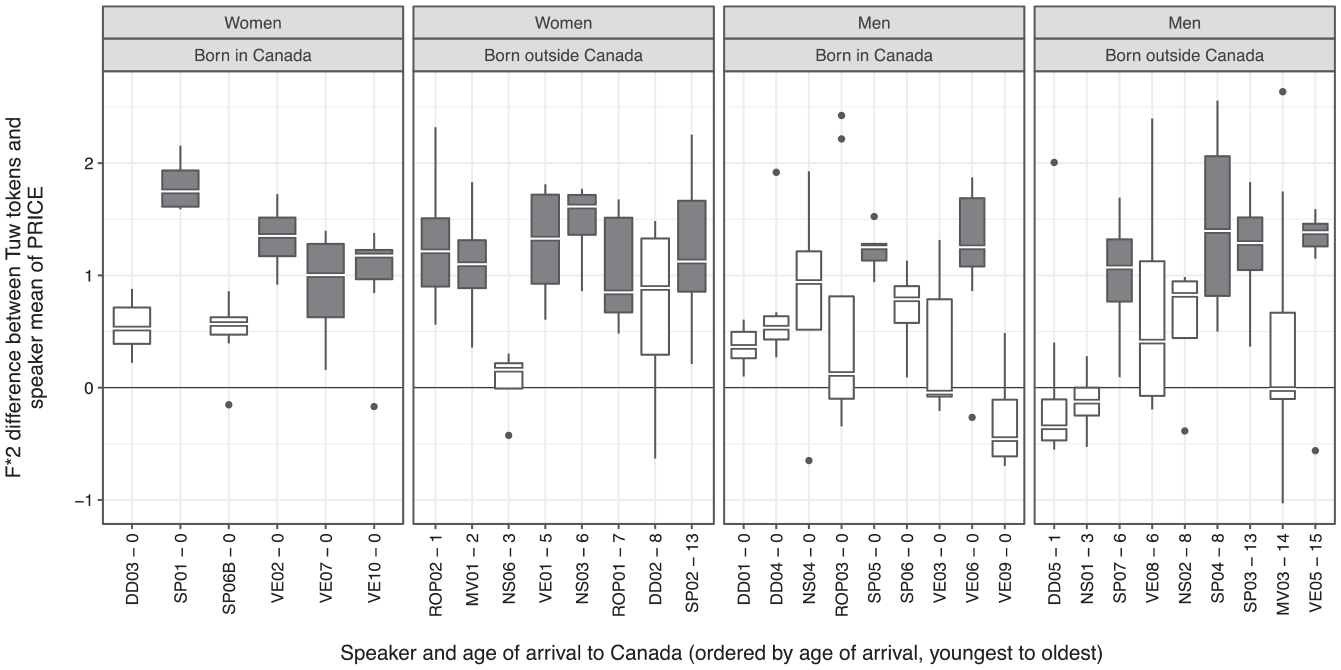
Boxplot of F*2 Difference Between Speakers’ Tuw Tokens and Speakers’ Mean
Our CIT model splits the data into two groups based on our individual speaker variable: those with a more advanced Tuw (dark grey boxes in Figure 2) and those with a less advanced Tuw (white boxes). Regardless, Figure 2 suggests that our speakers are, by and large, participating in
The two groups partitioned by the CIT suggest a possible gender effect with the majority of women in the more advanced group and the majority of men in the less advanced group. Age of arrival does not seem to play an important role in distinguishing speaker behavior; some of the speakers who arrived later in life exhibit realizations of post-coronal
Figure 3 presents the results for the post-non-coronal contexts (Kuw). The y-axis represents the difference in F*2 from the mean F*2 of each speaker’s
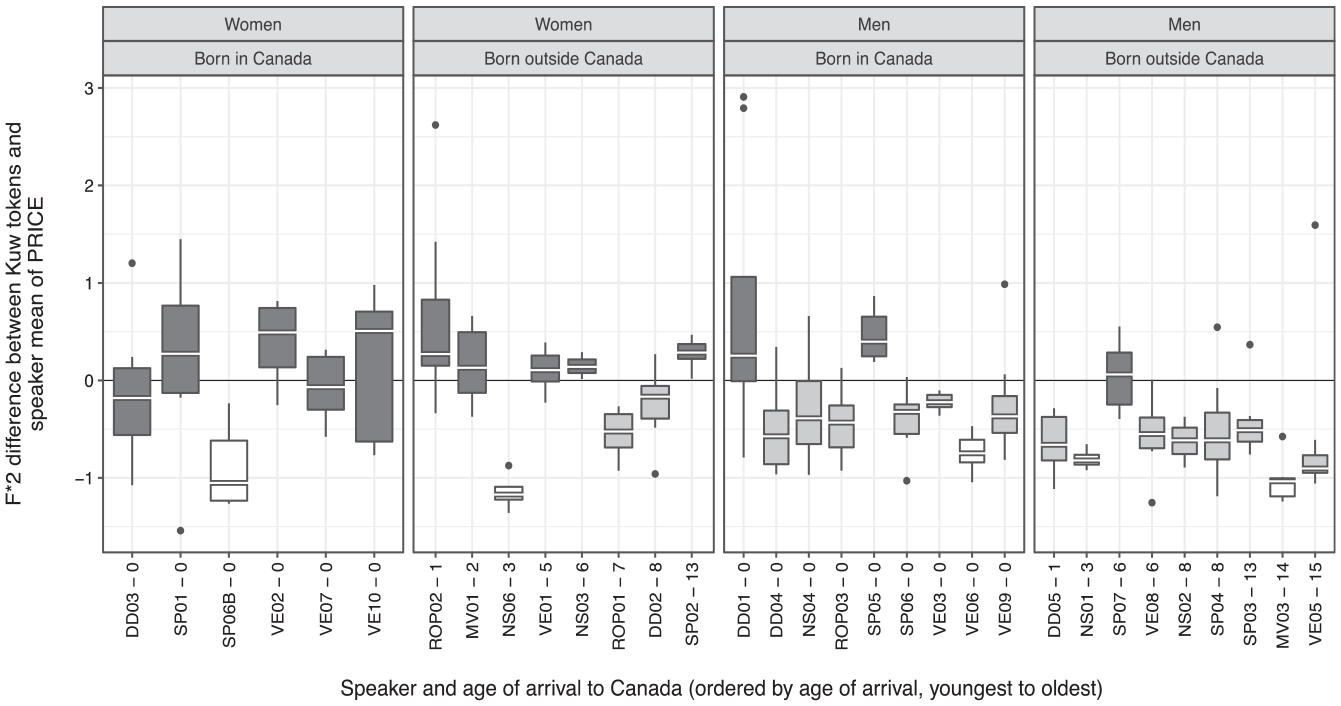
Boxplot of F*2 Difference Between Speakers’ Kuw Tokens and Speakers’ Mean
As with Tuw, women are generally more advanced than men. Eight women are above the benchmark and two others whose Kuw vowel overlaps with
To summarize the findings for
4.2. Canadian Vowel Shift
The second phenomenon we consider, the Canadian Vowel Shift (CVS), has also been documented widely in NCanE and elsewhere. Esling and Warkentyne (1993) described the first step in the shift, the retraction of
We consider each of the three vowels involved in the CVS independently, as the extent to which each has shifted varies diachronically;
The lowering of
The literature suggests that
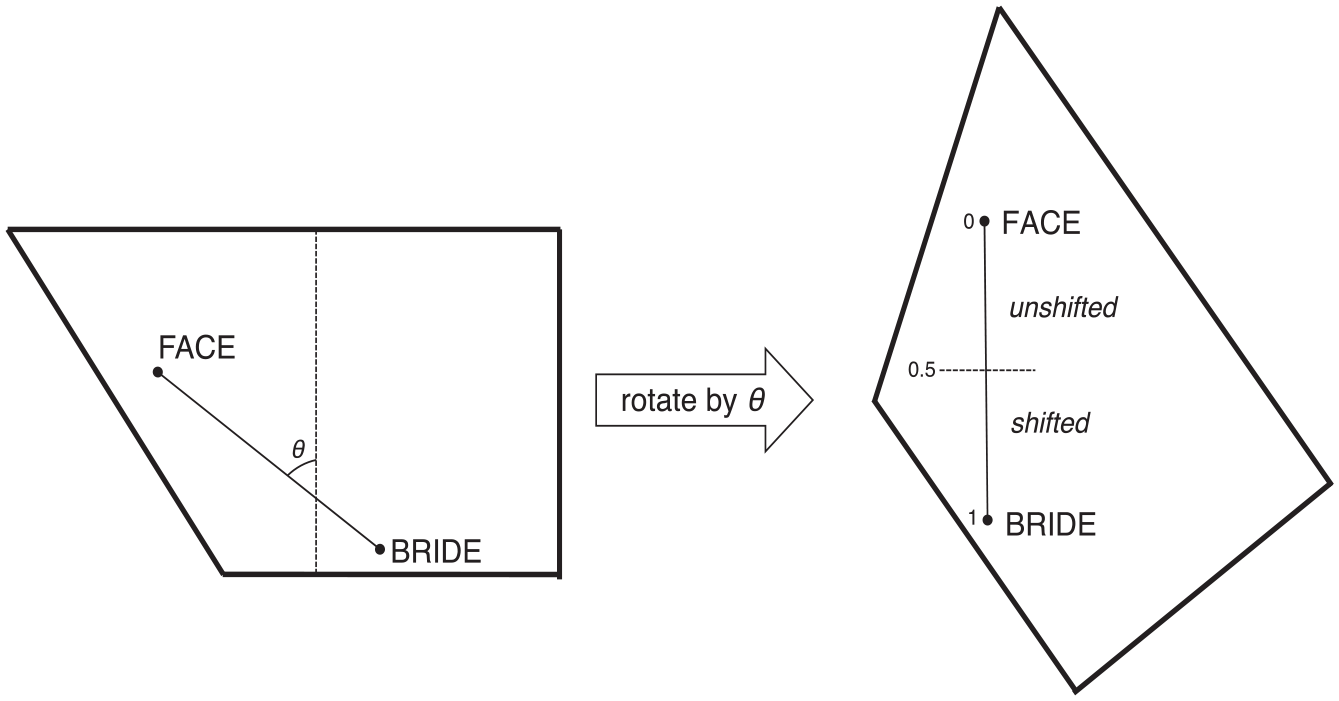
Schematization of Benchmark for Determining Participation in
Figure 5 presents the results for
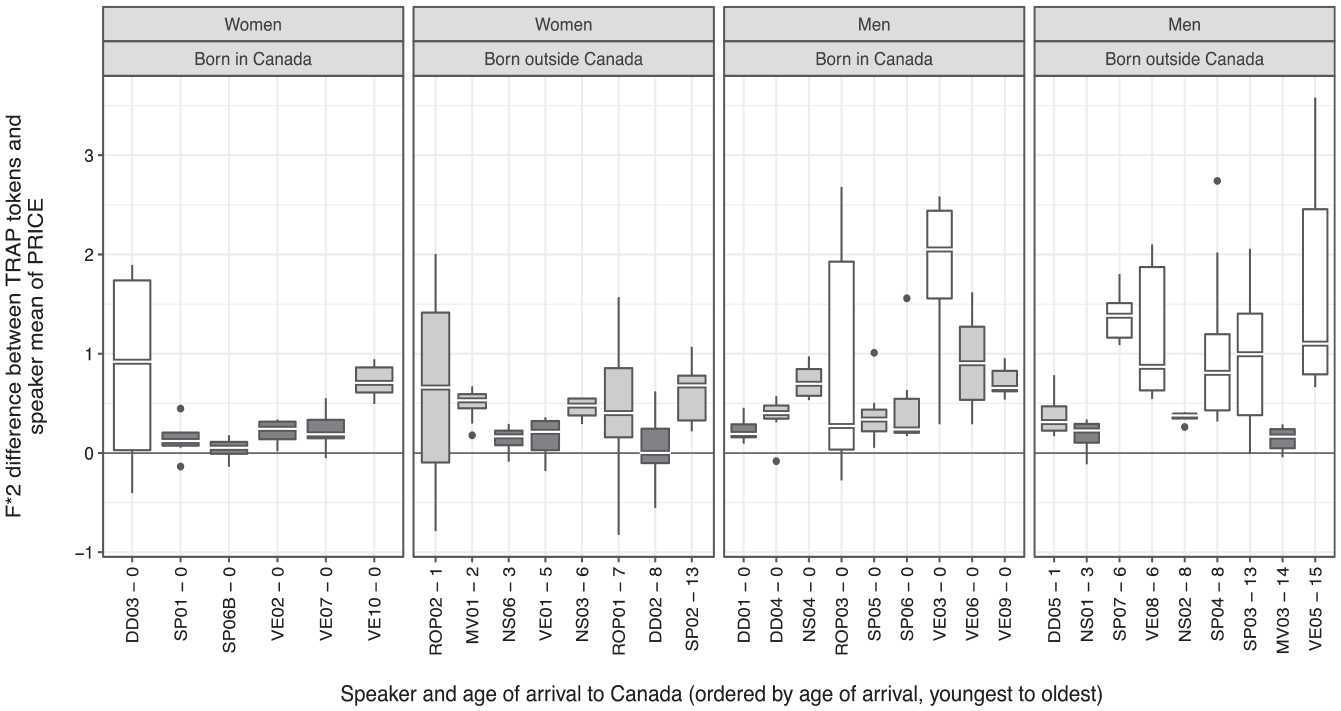
Boxplot of F*2 Difference Between Speakers’
All of the women in our sample exhibit some degree of retraction with most nearing the position of
Figure 6 presents the results for
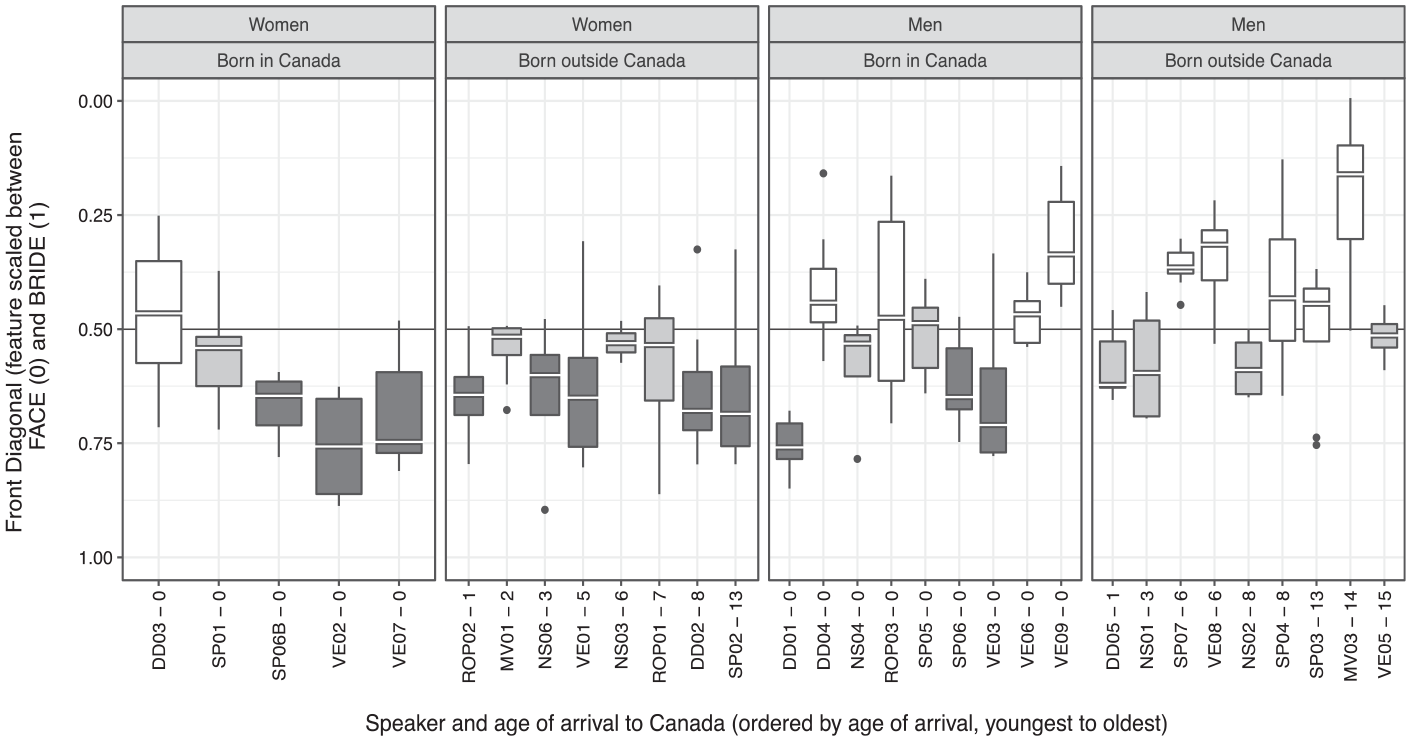
Boxplot of Front Diagonal Position of
The women are again more consistent than the men. All but one are categorized in the most shifted and middle groups. There is more variability among the men. Three are categorized in the most shifted group, nine are in the less shifted groups, and six hover around the benchmark. Again, gender seems to be relevant to the CIT groupings: the vast majority of women are in the most shifted group while the men are more evenly distributed among the three groups, leaning toward less shifted. Among the men, there is a slight suggestion that those not born in Canada are less shifted—none are categorized in the most shifted group.
Figure 7 presents the results for
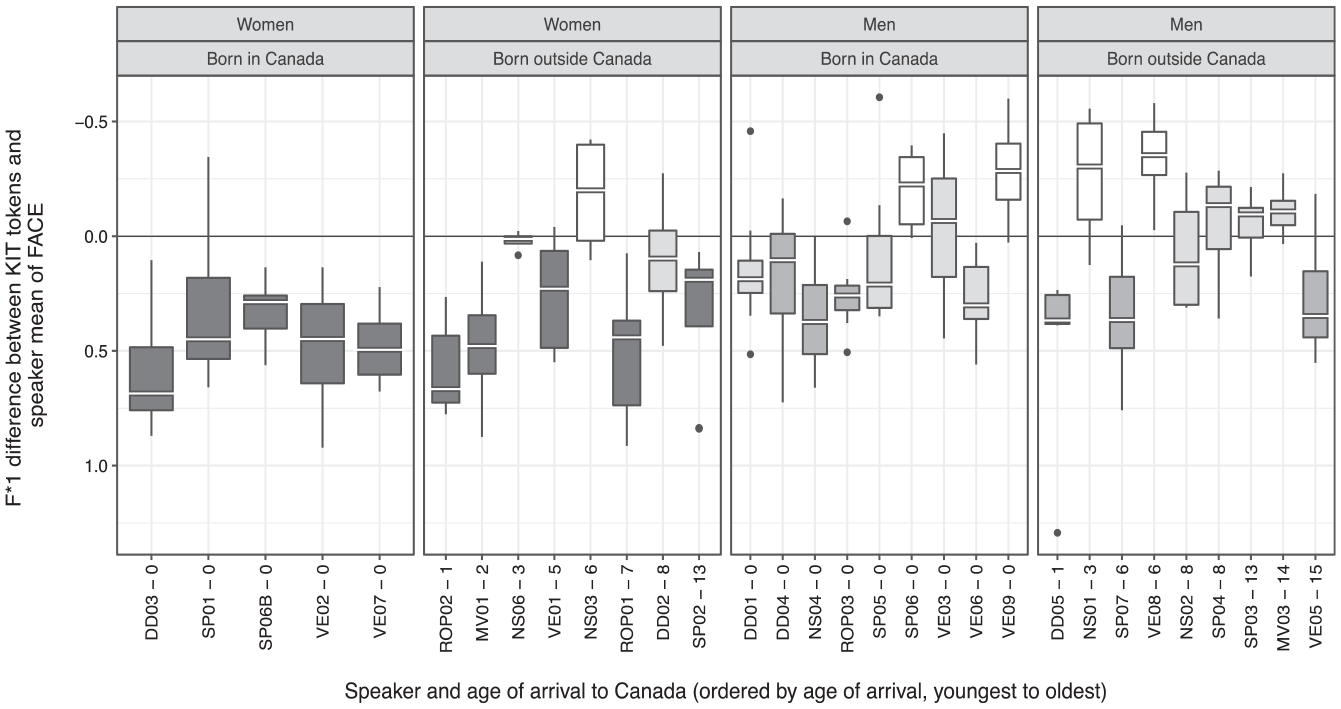
Boxplot of F*1 Difference Between Speakers’
All but three women are categorized in the most shifted group. The men, whether born in Canada or not, are consistently less shifted than all of the women born in Canada and the majority of women not born in Canada. However, six men are placed in the second most shifted group and another eight are placed in the third group, hovering around our
To summarize the patterns found for the CVS: the women in our sample are overall more shifted than the men for each of
4.3. Canadian Raising
Canadian Raising (CR) is a stable allophonic phenomenon in NCanE involving the raised articulation of the nucleus of the
To investigate the extent of participation in CR for both ayT and awT we again employ feature scaling. We rescale the F*1 dimension relative to each speaker’s mean of ayD or awD and each speaker’s mean of
Figure 8 presents the results for awT.
14
The y-axis represents F*1 rescaled to awD and
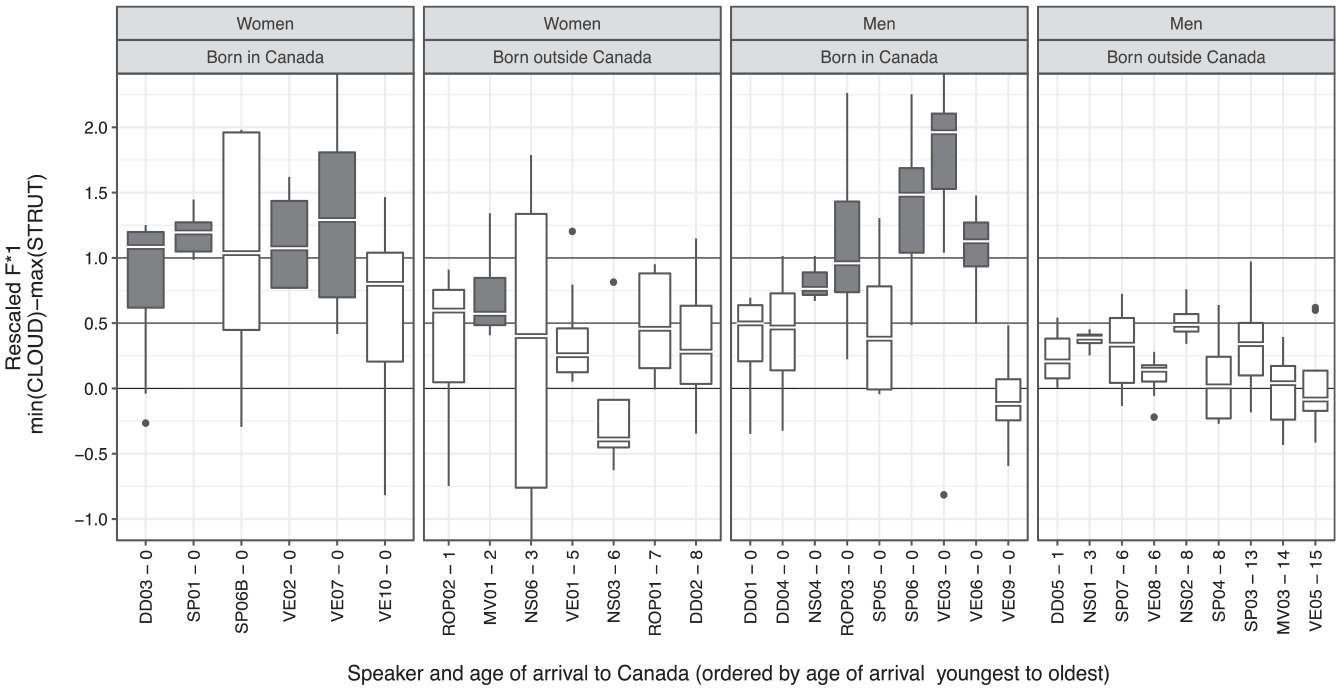
Boxplot of F*1, Rescaled by Mean F*1 of awD (
There are two important observations to make, however. First, the women born outside Canada are individually more variable than the men born outside Canada. Six of seven of them have at least one token of awT that is higher than or near their
Figure 9 shows the results for CR of ayT with our speakers. The y-axis represents F*1 rescaled to ayD and
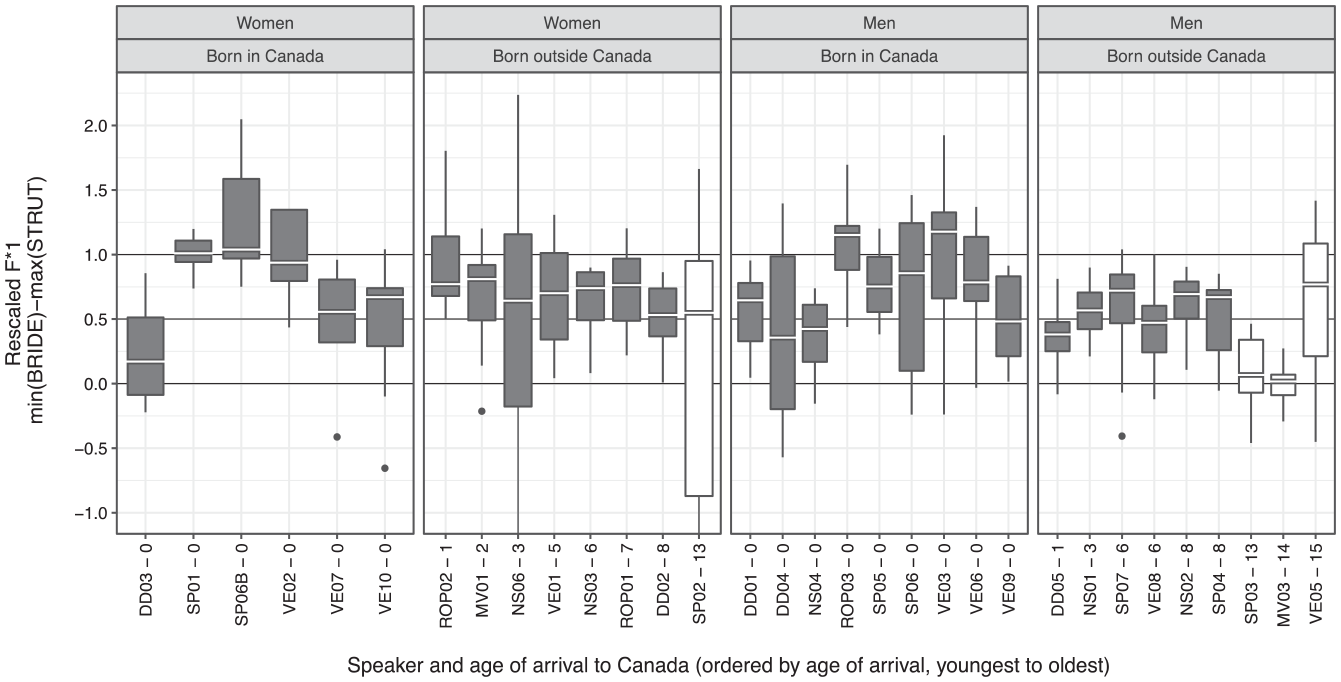
Boxplot of F*1, Rescaled by Mean F*1 of ayD (
CR of ayT contrasts with awT in that the distinction between speakers born in Canada and born outside of Canada is not evident. Rather, it is only those speakers who arrived later in life who lack the allophonic distinction. This is consistent with observations from second language/dialect acquisition: conditioned allophony is difficult to acquire later in life (Barlow 2014). That said, two of the four speakers who arrived later in adolescence still exhibit median values above 0.5 and some tokens at and above the
In sum, our results for CR offer an interesting contrast between awT and ayT with respect to age of arrival. We observe the significance of immigrant generation with respect to the former, such that all but one first generation speaker lacks raising; for the latter, only speakers who immigrated to Canada as teenagers lack raising. We discuss this distinction in detail in section 6.
4.4. Ban and Bag Tensing
The next set of features we consider involves the allophonic realization of the
We consider the two allophonic contexts separately because pre-nasal tensing is more widespread geographically, appearing in most dialects of North American English, while pre-ɡ raising is more limited both geographically and often with respect to the extent of tensing (Labov, Ash & Boberg 2006:182; Mielke, Carignan & Thomas 2017; Sullivan 2022). Boberg (2008:147) notes some regional differences across Canada (e.g., in British Columbia
In our analysis of
The CIT for
As shown in Figure 10, the most tensed group, colored in black, are all women and have tensed realizations of
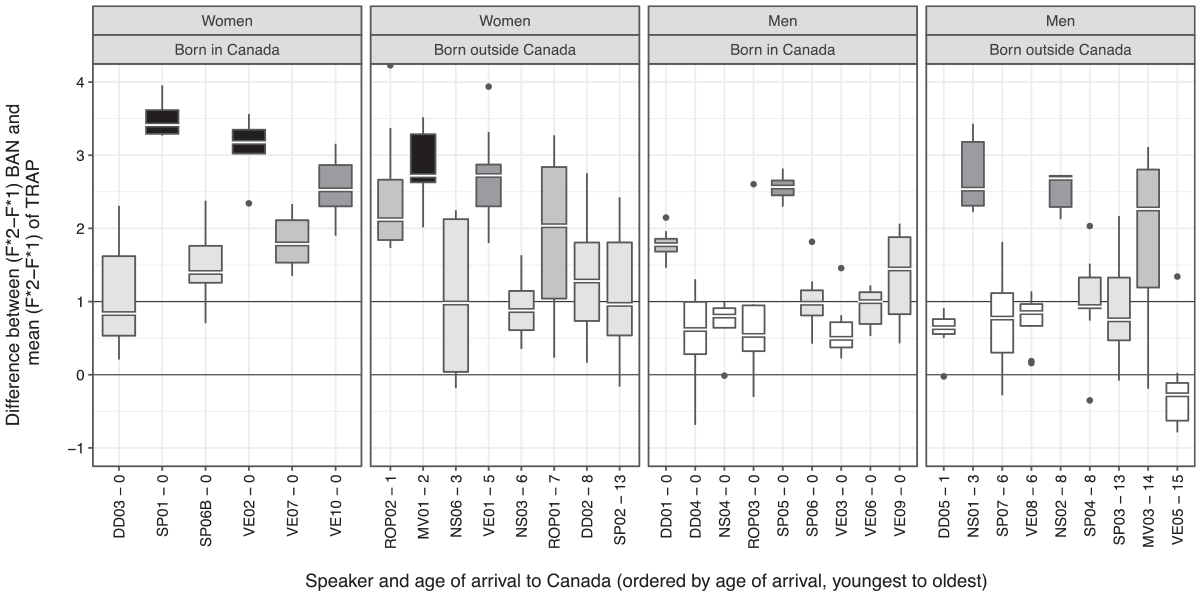
Boxplot of F*2-F*1 Difference Between Speakers’
Figure 11 displays the results for
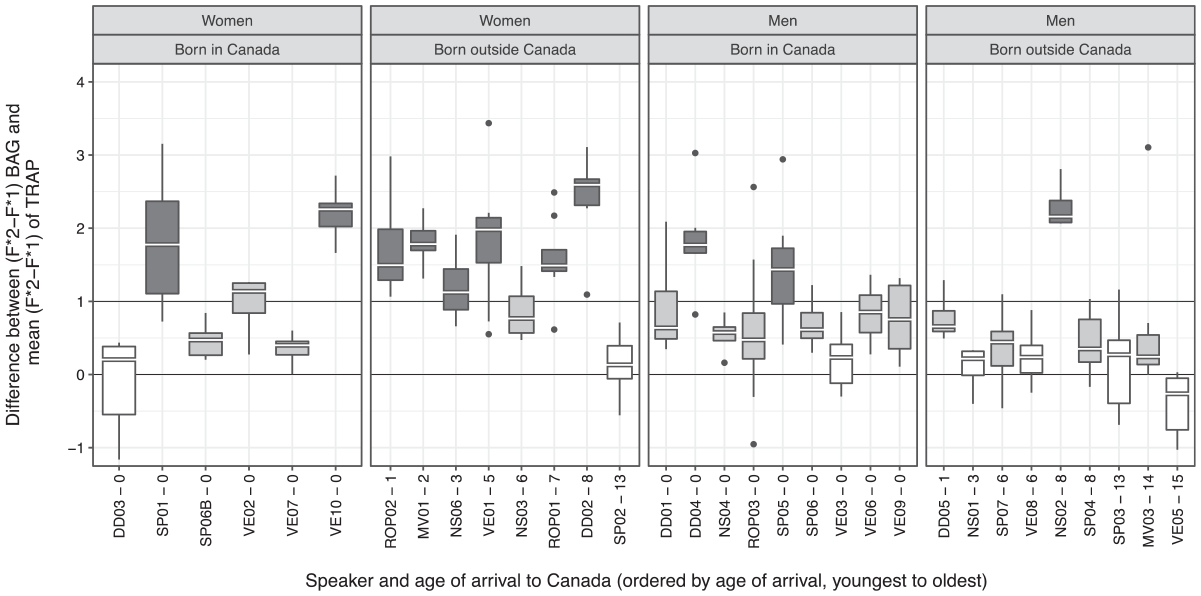
Boxplot of F*2-F*1 Difference Between Speakers’
To summarize, both
4.5. Goat Monophthongization
Labov, Ash, and Boberg (2006:217) note that
For our analysis, we separate out pre-lateral contexts, which are generally monophthongal in NCanE. To assess the extent of monophthongization, we consider the change in the articulation of each token of
Our benchmark for determining if a token is monophthongal or not is relative to the canonically monophthongal vowels in our data. The mean Euclidean distance in F*1/F*2 space between the 35 percent duration and 65 percent duration of all tokens of
Figure 12 plots the results for
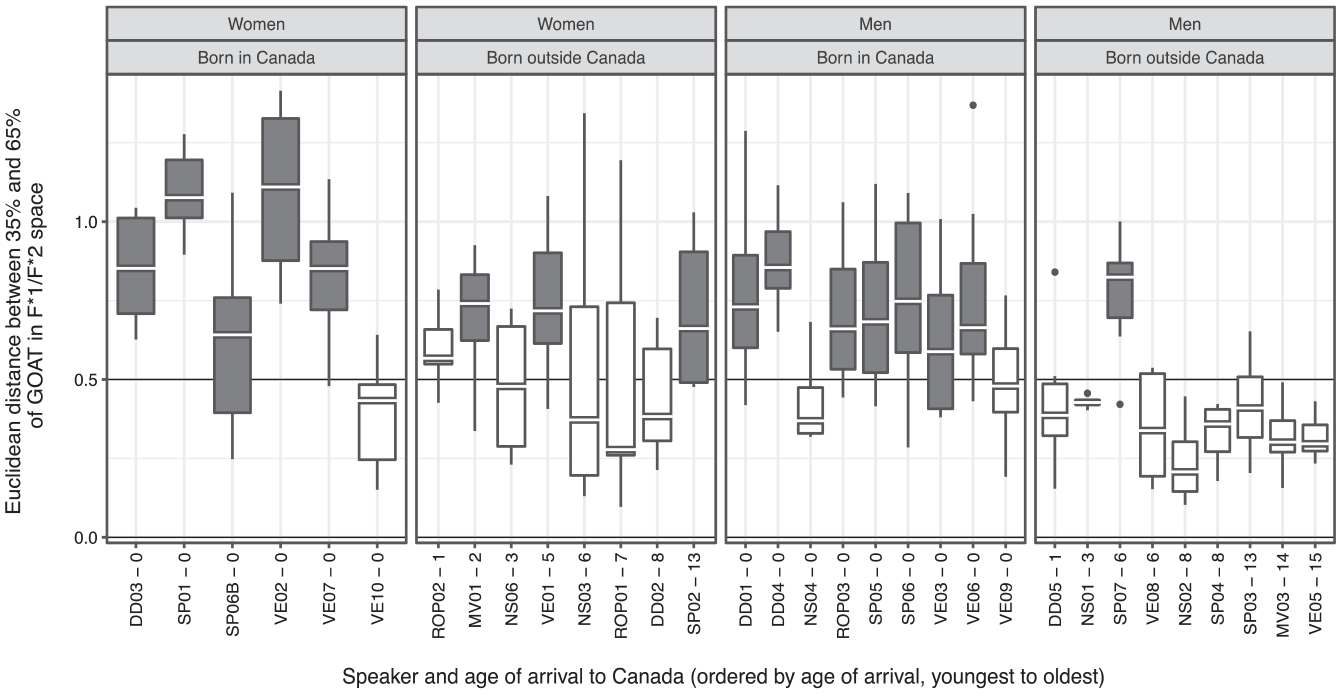
Boxplot of the Euclidean Distance of
Our analysis of these five vowel phenomena has revealed a great deal of interspeaker variability. There is strong suggestion in the data that gender and age of arrival to Canada, while not categorically predictive of speaker behavior, likely play a role with respect to who aligns or not with the norms of NCanE. In section 5, we take a step back and consider all our results holistically.
5. Speaker and Vowel Co-variation Patterns
Table 3 compiles the results of each of the vowel phenomena by speaker. This allows us to investigate possible patterns of behavior across and within speakers holistically. For each phenomenon, we report each speaker’s median value of the relevant measure. We also color code the cells according to the CIT categorizations. Dark grey cells indicate that the speaker exhibits the NCanE pattern, no shading indicates that the speaker does not, and light shading indicates a pattern in between. Speakers who were excluded from an analysis in section 4 are marked in black and their value is crossed out. The two rightmost columns list the number of phenomena in which each speaker exhibited a normative pattern and a non-normative pattern respectively. We have also provided some social information for each speaker: age, gender, and age of arrival to Canada. We separate four groups as we did in our figures in section 4: women born in Canada, women not born in Canada, men born in Canada, and men not born in Canada. Those not born in Canada are sorted by age of arrival (youngest to oldest). In the two right most columns, the median number of normative and non-normative features (out of a maximum of 10) are given below the four groups.
Summary of All Vowel Patterns by Speaker
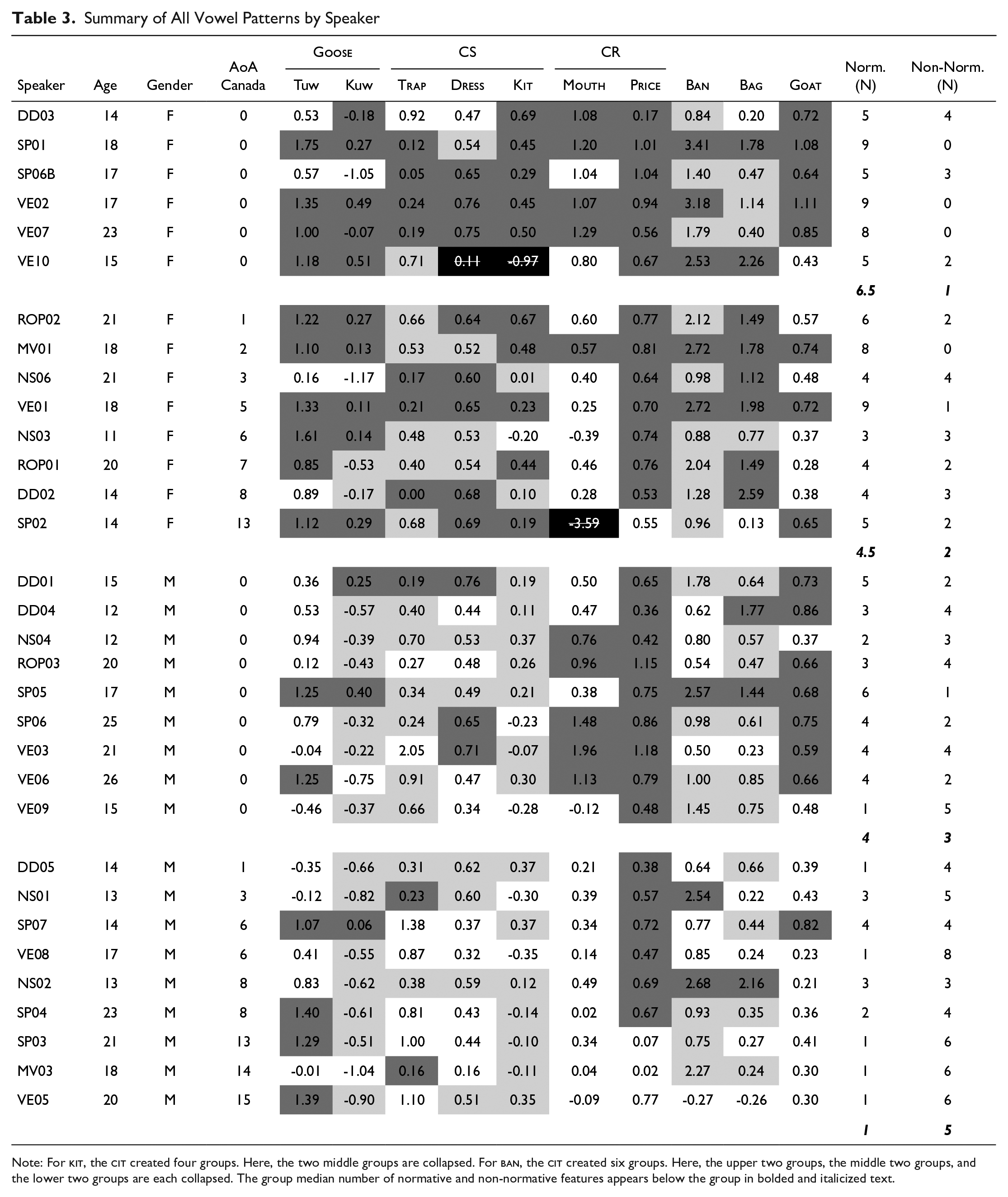
Note: For kit, the cit created four groups. Here, the two middle groups are collapsed. For ban, the cit created six groups. Here, the upper two groups, the middle two groups, and the lower two groups are each collapsed. The group median number of normative and non-normative features appears below the group in bolded and italicized text.
We first note that there is a clustering pattern with respect to participation in NCanE and non-participation. The majority of the dark grey cells (NCanE pattern) are among the women born in Canada (by speaker median = 6.5 NCanE phenomena). Women born outside of Canada (median = 4.5) and men born in Canada (median = 4) are less normative, and men born outside of Canada are the least normative (median = 1). In total, four speakers have no non-normative features: three women born in Canada, and one woman not born in Canada. No speaker exhibits the NCanE pattern for all ten vocalic phenomena.
The distribution of non-normative features is a mirror image of this: the majority of unshaded cells (non-normative pattern) are among the men born outside of Canada (median = 5); men born in Canada are next (median = 3), then women born outside Canada (median = 2) and women born in Canada (median = 1). There are no speakers who are entirely non-normative; everyone patterns normatively for at least one of the phenomena.
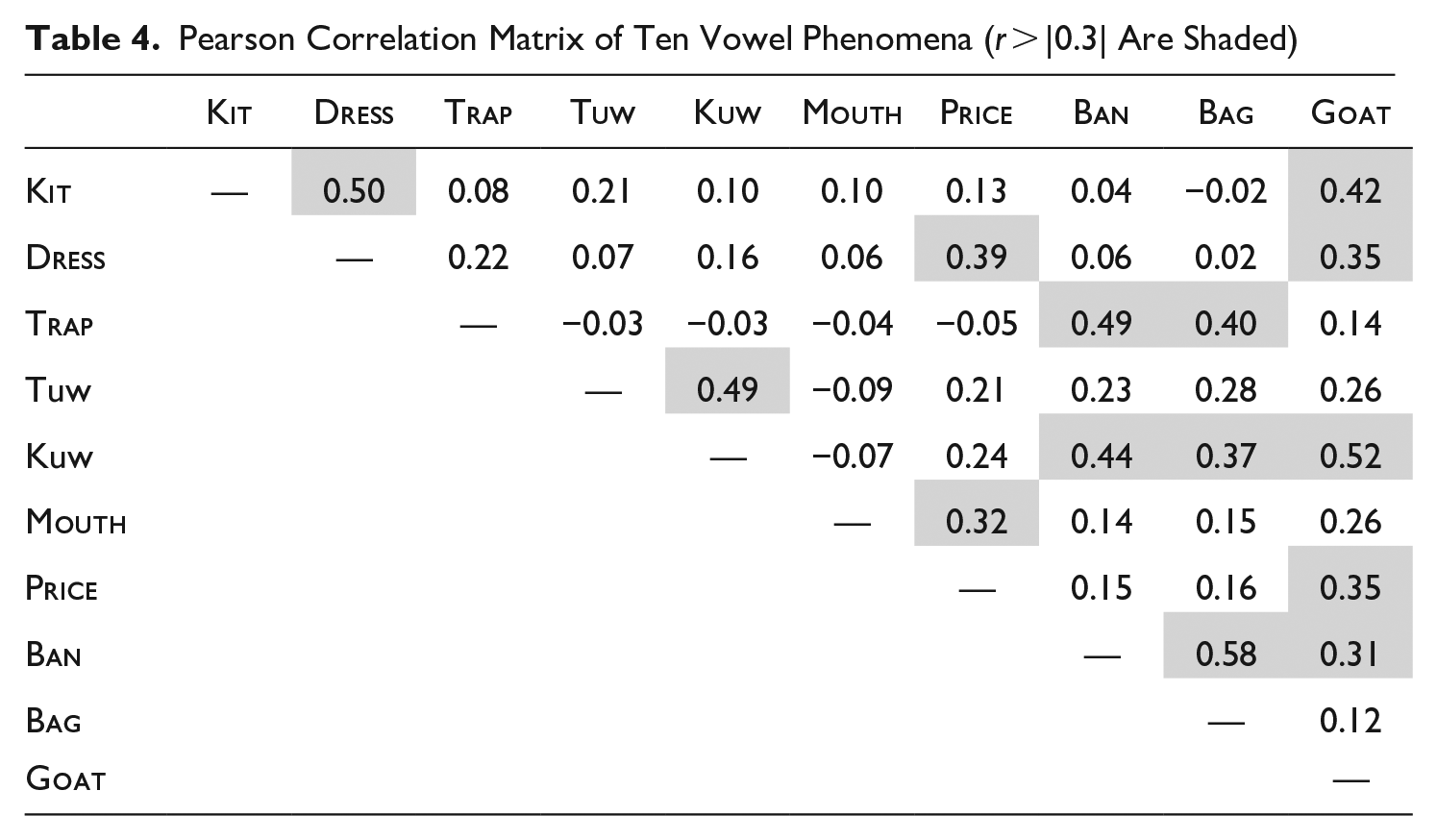
We now abstract away from individuals to focus on the co-variation between the different vowel phenomena. Table 4 presents a Pearson correlation matrix of our ten vowel phenomena; we set the value being correlated for each to have a consistent directionality (higher values are more normative, and lower values are more non-normative).
18
We highlight correlation coefficients above absolute 0.3, a benchmark generally interpreted as indicating (at least some) non-orthogonal relationship between two factors. Given that we make forty-five pairwise comparisons, which substantially increases the possibility of spurious effects, we are cautious to overinterpret these results. Regardless, we find correlations between
Pearson Correlation Matrix of Ten Vowel Phenomena (r > |0.3| Are Shaded)
6. Discussion
The feature pool for young, racialized Torontonians, as represented by our slice of data, contains features of NCanE but also deviations from this norm. For the changes in progress we consider (the CVS and
The features we consider that are not undergoing change in NCanE offer less ambiguous insight with respect to gender. Unlike the changes in progress, we observe realizations of
Age of arrival also plays an important role for several of the phenomena we consider:
Indeed, our results suggest that the level of salience of a phonological feature may play a role in whether or not that feature is adopted by young people in the context of ethnolinguistic diversity. Other than the speakers who arrived latest in life (age of arrival thirteen, fourteen, and fifteen), all our speakers have acquired raised ayT. This suggests that the lack of raised awT among our 1.5th generation speakers (those not born in Canada) is not due to any cognitive-acquisitional effect, but a sociocultural one. It is well-established that the CR of awT, and not ayT, indexes Canadian identity. For example, Nycz (2018:196) finds that among Canadians living in New York, the height of awT but not ayT, varies by interactional stance: it is most raised when expressing alignment with Canada and least raised when expressing disalignment. Nycz (2018:196) suggests that speakers do this agentively. Borrowing from Eckert’s (2008) concept of an indexical field, we further suggest that this ideological link between language and place may indirectly index other associated social meanings (i.e., other features of a stereotypical Canadian and NCanE: whiteness, middle-classness, etc.) (cf. Wiltschko, Denis & D’Arcy 2018 on eh). The linguistic resistance to raised awT we observe in Figure 8 may reflect a broader ideological resistance: linguistically aligning with the hegemonic group may not be desirable in a multiethnolectal context where people’s access to the privilege of being a stereotypical Canadian is limited and thus, racialized, immigrant Canadians may be more agentively resisting the indexicalities of raised awT. 20
We further suggest that this resistance may be gendered given the patterning of
7. Conclusion
Our results support an understanding of MTE as a variable repertoire, in the sense of Cheshire, Kerswill, Fox, and Torgersen (2011). There is a great deal of phonological variability present in the Toronto speech community, much of it traceable to the many languages, dialects, and second-language varieties heard every day, especially in highly-multilingual neighborhoods. For young people in these neighborhoods, these variants include the NCanE options (as heard in the ambient community, possibly by teachers, some peers, and some peers’ parents/caregivers), but there also exist alternatives (as heard from possibly their own immigrant parents/caregivers, their older siblings, and some of their peers). This feature pool (Mufwene 2001) is available to a speaker to select from both for stylistic purposes but also as potentially part of their habitual vernacular—as indicated by the presence of non-normative features in our wordlist data.
While age of arrival and the critical period of language acquisition may offer explanation for why some second-language speakers of CanE do not acquire all features of NCanE, this can only be a partial explanation. Critically, we observe speakers born in Canada or who arrived well before the critical period who are very non-normative (e.g., VE09, DD05, NS01, and VE08) and speakers who arrived later in adolescence who are more normative than some speakers who were born here (e.g., DD02, SP02). Thus, age of arrival should not be understood as a cognitive-acquisitional factor in this case, but rather as a sociocultural one that may determine differential access to the multiethnolectal feature pool. Some new Canadians will conform to hegemonic Canadian norms, including the linguistic. Chambers (2002) describes this in his discussion of “The Ethan Experience”—named for the child of Eastern European immigrants, who grew up in Canada and spoke NCanE without any trace of his parents’ second-language variety of English. But what we have shown is that others do not align with the dominant norms.
Our data suggests that through linguistic alterity (which includes features traceable to immigrant languages and the immigrant linguistic experience including non-parent-to-child acquisition of the ambient language), young GTAers possess a means to resist the hegemony of white, middle-class “Canadian” English. In this way, we follow Doran’s (2007:498) argument that “le français des jeunes de banlieue” (essentially a Parisian multiethnolect) indexes “a range of identity issues, specifically tied to a desire among ethnically-mixed youth populations to create alternative definitions and means of expression of identity, in ways that challenge traditional republican conceptions of what it means to speak, and to be, French” (our italics). But resistance does not entail total rejection. We understand MTE not as a rejection of being “Canadian” or of a “western lifestyle” (cf. Kerswill 2014 on media representations of Multicultural London English), but rather as semiotic transvaluation (i.e., a redefining of the norms by which indexical meaning is evaluated) of what it means to sound Canadian. MTE, then, is a linguistic assertion that there are many ways of being and sounding Canadian inclusive of those who are not born in Canada, who are not white, and who do not speak NCanE. Of course, resistance is a stance and stances are most clearly articulated in interaction. Our future work looks to investigate this link further in interaction and metadiscourse.
While our focus has been on the GTA and the effect that multilingualism and the languages of immigrants and their children in the city has had on English as spoken by young people, these concluding observations and their implications apply more widely. We suggest that multiethnolects should not be understood simply as an inherent consequence of a certain linguistic ecology (one of group second language acquisition in the context of “local disconnect” from the ambient norms). Rather, the role of agency and self-determination of young people who find themselves in such contexts is critical. Multiethnolectal repertoires as linguistic alterity are an alternative that speakers make use of in everyday acts of resistance—resistance against the neo-colonial and ethno-nationalist systems of oppression that both prop up hegemonic norms and are responsible for the circumstances of the local disconnect often faced by recent immigrants. This is true whether such oppression manifests in a context of overt political and/or popular anti-immigration sentiment as with many European multiethnolects (see Doran 2007; Wiese 2009) or, as in the case of Canada, despite a state-sanctioned policy of multiculturalism.
Footnotes
Acknowledgements
The authors would like to acknowledge the support of the Office of the Vice-Principal, Research, University of Toronto Mississauga and audiences at the 2019 meeting of the American Dialect Society, and audiences at various talks in Toronto, London (Ontario), Melbourne, and York. We also thank Alex D’Arcy and Peter Grund and our anonymous reviewers for their incisive and helpful comments. We also thank Paul Kerswill for valuable feedback on an early draft of this paper.
Declaration of Conflicting Interests
The author(s) declared no potential conflicts of interest with respect to the research, authorship, and/or publication of this article.
Funding
The author(s) disclosed receipt of the following financial support for the research, authorship, and/or publication of this article: This research was funded by a University of Toronto Connaught New Researcher Award, awarded to the first author, and the Office of the Vice-Principal, Research, University of Toronto Mississauga.
