




Abstract
Although Indian English is the best-documented South Asian English, its diachronic development has not been described to a great extent. The present study begins to address this gap by offering a real-time perspective on the evolution of modals and semi-modals in Indian English. It sketches the changes in the frequency of modals and semi-modals in three corpora of Indian newspaper texts from 1939, 1968, and the early 2000s. Changes in the frequency of eleven modals and eleven semi-modals are found to be similar to the trends previously observed for written American and British English: semi-modals, as well as the modals can, could, and would, rise greatly in frequency. An analysis of the types of modality expressed by individual modal verbs provides in-depth insights into shifts in Indian English during the period. The study’s findings raise methodological and theoretical considerations for the diachronic study of modality in corpora in English generally: the increasing amount of direct quotation in news reportage partly accounts for a rise in modal frequency in this subgenre, which constitutes a confounding aspect seldom articulated in the study of newspaper language. Individual modal verbs exhibit different directions and speeds of change that are not reflected in the trajectory of modals as a category, demonstrating that an aggregate measure is not a suitable point of comparison between varieties to determine their degree of similarity or difference in terms of modal verb usage.
1. Introduction
Indian English (IndE) is considered “the oldest ‘non-native’ variety of the English language” (Sridhar 2020:243) and is a major variety both in terms of number of speakers and its worldwide influence. IndE has even been described as a norm-providing variety in South Asia (Gries & Bernaisch 2016). Despite its longevity and the appreciable body of research dedicated to it, historical descriptions of IndE have remained scarce. The need for diachronic research on IndE has been observed since at least 2006 (Mukherjee & Hoffmann 2006:166), but, because of lack of available data, such studies have started to appear only recently, notably with Fuchs (2020). In the meantime, much work on language change in the variety has drawn on synchronic data. This approach is premised on the fact that different contemporary genres, varieties, or styles correspond to different stages of change in progress. For example, Collins and Yao (2012) relied on comparisons between present-day spoken and written data to infer direction and speed of change, on the basis that speech universally changes more rapidly than written norms. Others (e.g., Mukherjee & Hoffmann 2006; Mukherjee & Gries 2009) have compared present-day data for IndE and its colonizer parent variety, British English, to pinpoint their degree of difference and deduce IndE’s normative orientation. It has been illustrated, however, that such methods may be imperfect substitutes for diachronic work (Gries, Bernaisch & Heller 2018). Genuine diachronic datasets minimize the number of assumptions necessary to uncover trends.
Generally, for Englishes labeled “postcolonial” in the literature, historical data offer the added benefit of relying less on cross-variety comparisons, in particular with American (AmE) and British English (BrE), to sketch language change. 1 Diachronic studies are necessary not only because they work towards describing the linguistic history of Englishes which have been far less scrutinized than British or settler colonial varieties, but also because they can propel forward the theoretical models which have been central to the study of variation in English worldwide (Mukherjee & Bernaisch 2020:756). Most notably, the Dynamic Model of postcolonial Englishes (Schneider 2007) proposes that postcolonial Englishes (including settler colonial Englishes) are the results of specific sociopolitical and linguistic processes that occur in five phases in a temporally linear fashion. 2 Historical linguistic descriptions of these varieties can therefore provide empirical evidence of stages of development (Noël, Van Rooy & Van Der Auwera 2014:3-4) or contribute to the (re)examination of the model’s assumptions, for example, by positing the existence of “steady states” not foreseen by the model (Mukherjee 2007).
The present study contributes to the description of IndE from a diachronic perspective. It introduces new historical data in the form of newspaper corpora spanning three sampling points (1939, 1968, and the early 2000s), which are used to gain insights into the recent history of written IndE. The variables investigated here, modal (1) and semi-modal (2) verbs, are expected to exhibit dynamic shifts in frequency and uses, as they have in the history of English more generally.
(1) Mr M K Jalan, who presented a memorandum to Mr Poonach, said that the operational restrictions on the movement of textile should be removed on all railways. (1968_Ln_247)
(2) This recommendation resulted from the mission's finding that the existing gaps in training were indeed formidable and needed to be removed without delay. (1968_Ed_24)
Synchronic evidence has suggested that IndE modals may be especially conservative, a tendency that contrasts with the considerable changes which modals in other varieties have undergone in the twentieth century and beyond. This study therefore seeks to determine whether historical data confirm the conservativeness identified previously with synchronic methods. The hypothesis is that the frequency of modals as a category should remain stable across the period studied, and that verbs which were found to be declining elsewhere may not be in IndE. Stability, or a rise, would provide more evidence regarding the idea that IndE has adopted norms distinct from those of its former colonizer, BrE, in which modals are declining. This research adds to the copious body of work concerned with the study of IndE grammar, providing observations that are relevant to both our understanding of modality in English and language change in this postcolonial variety.
Section 2 summarizes theoretical considerations pertaining to the description of IndE and of modals and semi-modals in AmE and BrE. Section 3 presents the newspaper corpora and lists the variables of interest and their classification. The results, presented in section 4, give a detailed view of modal use in historical Indian newspapers by demonstrating variations in frequency over time, genre, and semantics. These results are discussed in section 5 pointing to their methodological and theoretical implications for the diachronic study of modality as well as language change in IndE.
2. Background
2.1. Indian English
A large amount of research on IndE has focused on verb-related phenomena such as verb complementation (Mukherjee & Hoffmann 2006), collostructions (Mukherjee & Gries 2009), the subjunctive (Hundt, Hoffmann & Mukherjee 2012), the dative (Bernaisch, Gries & Mukherjee 2014; Gries & Bernaisch 2016), the progressive (Van Rooy 2014; Fuchs 2020), light verb constructions (Hoffmann, Hundt & Mukherjee 2011), and modals and semi-modals (Wilson 2005; Collins & Yao 2012; Deuber et al. 2012; Van Der Auwera, Noël & De Wit 2012; Loureiro-Porto 2016, 2019). Other research on grammar includes lexicosyntax and morphosyntax (Sedlatschek 2009) and syntactic features of spoken IndE (Lange 2012). Some of these studies have related their findings to IndE’s current phase in the Dynamic Model, so a consensus has emerged that the variety has reached the endonormative stabilization stage; in other words, it presents tendencies diverging from those of its former colonizer variety, BrE. IndE is said to follow an independent path according to its self-determined norms and even to be a norm-provider for other Englishes in the region (Gries & Bernaisch 2016). For example, Hoffmann, Hundt, and Mukherjee (2011) observe that present-day IndE exhibits much higher frequencies of light verb constructions (e.g., take a look, give boost) than BrE and other South Asian Englishes, indicating distinct norms. Other research has exposed tendencies of IndE to be especially conservative, which is also interpreted as evidence of endonormative orientation. This can be seen, for instance, in the comparatively low level of grammaticalization of semi-modals of necessity (Loureiro-Porto 2016, 2019) or the maintenance of the modals must (Mair 2015) and need (Van Der Auwera, Noël & DeWitt 2012), which have declined in use in BrE. The only (to my knowledge) detailed diachronic investigation of IndE grammar, Fuchs (2020), has brought to light converging trends in the use of the progressive in British and Indian newspaper writing, showing mostly similarity rather than divergence between the two. The emerging picture is that IndE shows, simultaneously, marked innovation (the light verb constructions), preservation of certain forms (the modals), and concord with BrE (the progressive). Hence, Fuchs (2020:13) takes up Mukherjee’s (2007) idea that IndE is in a state of equilibrium between endonormative and exonormative forces. These divergent findings may be manifestations of this state, whereby different domains of grammar are subject to different forces. Much of this research differs in the type of data used (various newspaper corpora, written ICE-India and the Kolhapur corpus, spoken ICE-India), which makes generalization problematic. Also, with the exception of Fuchs (2020) and Mair (2015), they rely on synchronic methods. 3 The exclusive use of present-day data is less suitable when it comes to drawing conclusive and detailed insights on temporal trends in IndE. Claims of endonormative stabilization and equilibrium should ideally balance synchronic insights with diachronic ones. The case of modals in particular should benefit from further investigation to determine whether their alleged conservativeness is corroborated by diachronic data.
2.2. Modals, Diachronically
In English, modals and semi-modals are the principal means of grammatically encoding modality, i.e., of distinguishing theoretical and hypothetical meaning from factual meaning (Leech [1971] 2004). They differ from each other in that core or central modals (in this paper, simply modals) are fully grammaticalized auxiliaries (e.g., will, must, could) while semi-modals (also called quasi-modals, semi-auxiliaries, or emerging modals) are semantically similar lexical verbs which have acquired, and continue acquiring, auxiliary properties (e.g.,
While change in the frequency of modals is a point of contention, semi-modals are not controversial: the Brown family of corpora as well as the TIME corpus exhibit a clear and important increase in frequency across the twentieth century. A number of hypotheses have been put forward to explain these changes in writing. The rise in frequency of semi-modals is specifically attributed to grammaticalization, as these semi-modals continue acquiring new grammatical uses distinct from their original lexical equivalents (e.g.,
3. Method
3.1. Newspaper Corpora
There is widespread agreement that corpus-supported observations of diachronic change, especially as regards modal verbs, must take genre differences into account (Biber & Gray 2013; Leech 2013; Mair 2015). This finding can be seen as an argument favoring carefully controlled, aggregate, multi-genre data in order to come close to the idea of representative corpora (the approach championed in Leech [2011]). However, it also highlights the value of corpora or studies that are confined to a single genre (or single publications), insofar as genre is minimized as a confounding parameter. On the basis of differing diachronic tendencies in frequencies exhibited by modals in otherwise minimally different subgenres, Biber and Gray (2013:106) have argued that “historical change should be studied relative to particular registers, rather than attempting a kind of average for English.” Consequently, this study is intended as a piece of the puzzle in the historical description of modals in IndE in one genre rather than an attempt to draw conclusions for the variety as a whole.
In India, the press is a major vehicle through which users of English engage with the language. Sridhar’s (2020:244) account that “English is more read and heard than it is written, and more written than spoken” points to the significance and potential impact of printed material on English-using Indian society and IndE itself. English-language newspapers have a particularly potent reach because of their country-wide—and politically powerful—readership (Sridhar 2020:252). As such, they are a particularly relevant standardizing force and vector of norms, representing “acrolectal written English usage” (Bernaisch, Gries & Mukherjee 2014:11). Accordingly, the effects of endonormative stabilization is likely to be observable in the press.
Composition and Size of the Newspaper Corpora
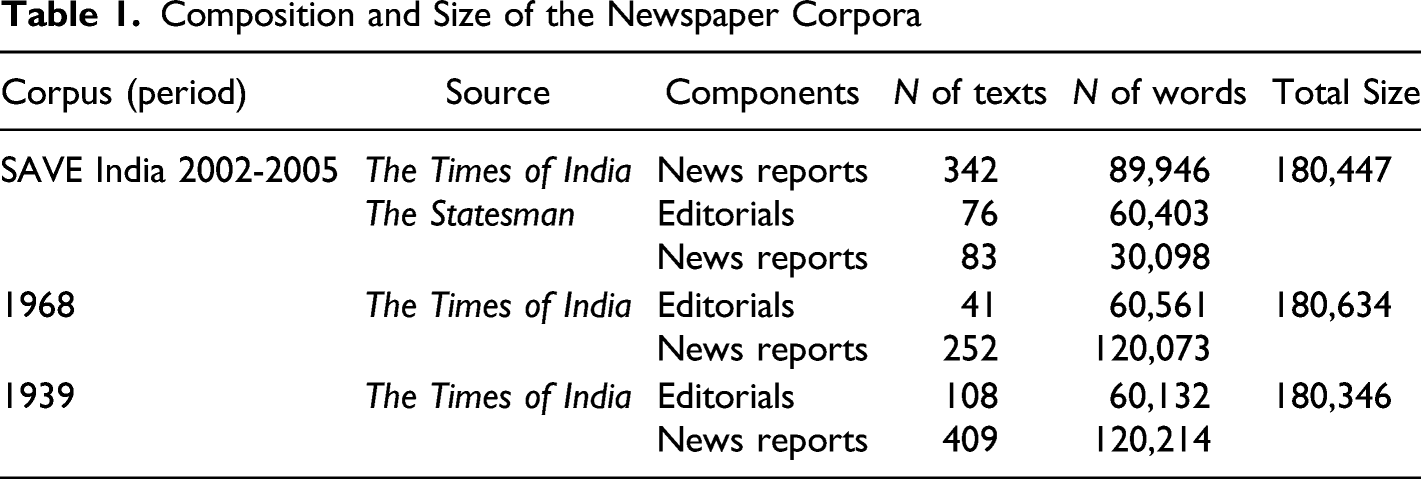
The other two corpora contain texts from The Times of India for the years 1939 and 1968. These corpora are not yet publicly available but may be accessed by contacting the author. The material comes from high-quality digitized microfilms and was processed with an Optical Character Recognition (OCR) software, ABBYY FineReader. Individual texts were manually extracted and proofread for OCR errors before they were included in the corpora. Special care was taken to exclude texts from news agencies. The text types and size of these materials match those of the SAVE subcorpus: approximately 120,000 words of local and national news and 60,000 of editorials. In 1939, India’s territory extended to what is today Pakistan and Bangladesh. Because of the need to match the other two corpora as closely as possible, texts that hail from present-day Pakistan and Bangladesh were excluded from the 1939 corpus.
Together, these three corpora allow a time depth of about sixty-seven years and are distributed at roughly thirty-year intervals, i.e., the span of a generation. As shown in Table 1, the corpora and their components are nearly identical in size but differ in the number of individual texts they contain. The 1968 material stands out as containing fewer (and therefore longer) articles than the other periods. The implication of that, and of the relatively small size of the corpora, is that special attention must be paid to individual texts and authors as potential confounding factors, especially as regards editorials. The reporting of the results in section 4 takes those factors into account. The fact that the articles in 1939 and 1968 were generally not signed restricts any further analysis of potentially idiolectal traits. The texts offer no information on the proportion of Indians and colonists employed by the newspaper.
It is noteworthy that the two older corpora match the chronology of B-Brown/B-LOB and Brown/LOB, as well as newspaper corpora of other postcolonial Englishes (for the 1930s and 1960s) that are currently being compiled. In the absence of much balanced historical IndE data, the newspaper corpora therefore allow for at least tentative comparisons with some findings from Leech, Hundt, Mair, and Smith (2009), Leech (2011, 2013), and Mair (2015) for the Brown family.
3.2. Variables and Classification
The modals investigated are the nine core modals and two marginal modals considered in previous research (Leech, Hundt, Mair & Smith 2009; Leech 2013; Mair 2015): would, will, can, could, may, should, must, might, shall, ought (to), and need. An equal number of semi-modals, those researched by Collins (2009a), are examined:
With the help of AntConc (Anthony 2019), all possible forms of these verbs and constructions were considered, including inflections (e.g., past forms), clitics (e.g., ’ll, n’t,’d), forms resulting from coalescence (e.g., gotta, wanna), and negation (not) between semi-modal elements. For the semi-modals, all contiguous tokens were retrieved, as well as non-contiguous ones that are split by one element, generally an adverb, as in (3). Such instances account for forty-one of the 1095 semi-modals analyzed.
(3) Some of these services provided connections to international services and passengers had thus to walk a considerable distance. (1968_Ln_196)
Tokens were manually analyzed making sure to exclude nouns (e.g., need, May), non-modal uses, and fixed expressions (e.g., devil-may-care). Tokens found in quoted material were included unless it was obvious from the context that the person cited was not Indian, such as Franklin D. Roosevelt or George Harrison.
These procedures resulted in a total of 8255 tokens, each of which was classified according to its meaning. This classification was guided by the terminology and examples in works on modality, such as Palmer ([1979] 1990), Huddleston and Pullum (2002), and Collins (2009a). Any use diverging from those was also recorded. Three main types of modality were distinguished: deontic, epistemic, and dynamic. Deontic modality expresses necessity, obligation, or permission, which come from a deontic source (the speaker, rules, social conventions, etc.). Epistemic modality expresses the likelihood that something is possible, based on logical reasoning. Dynamic modality expresses ability or theoretical possibility which is intrinsic to the subject or forced by circumstances. In (4), for example, contextual elements (only) signal that can expresses strong likelihood based on logical reasoning, i.e., epistemic necessity. Can in (5) refers to an intrinsic (in)ability of the subject to tell the future and is hence classified as dynamic, whereas in (6) the writer (a deontic source) aims to proscribe an idea or behavior. Epistemic (it is impossible that India regards herself) or dynamic (India does not have the ability to regard herself) readings make little sense here given a premise which sets up a warning of what awaits India if the writer’s recommendation is not heeded.
(4) Further totalitarian aggression, whether by war or threat of war, can only have one meaning, namely, aggrandisement at the expense of other States and the reduction of the democracies to helplessness. (1939_Ed_72)
(5) They have it in their power to plunge Europe and the world into war, and no man can forecast what they will do. (1939_Ed_72)
(6) We are witnessing in Spain the sad end of a democracy which fell into Marxist hands. India cannot regard herself today apart from world affairs. When we look outside, our own troubles and divisions seem puny compared with the external danger to our national existence and freedom to which we are exposed. (1939_Ed_63)
However, not all modals express these three meanings, and these three meanings are not the only ones which certain modals express. Would, could, and might have a past-tense use (of will, can, and may, respectively) and a hypothetical use, as in (7), in which all three verbs can express speculation. Each past and hypothetical use can express deontic, epistemic, or dynamic modality. Should is also a special case, with subjunctive/mandative, adversative, purposive, emotive, and conditional meanings in addition to its more common deontic and epistemic meanings (Huddleston & Pullum 2002:187). Examples of these uses are given in section 4.4. B
(7) But it is a grim thought how different it could all have been if there had then been a Congress government in West Bengal (1968_Ed_31)
Since context is often unhelpful or ambiguous (in cases of reported speech, for example), the “indeterminate meaning” category is comprised of tokens whose meaning cannot be confidently discerned.
4. Results
4.1. Overall Frequencies
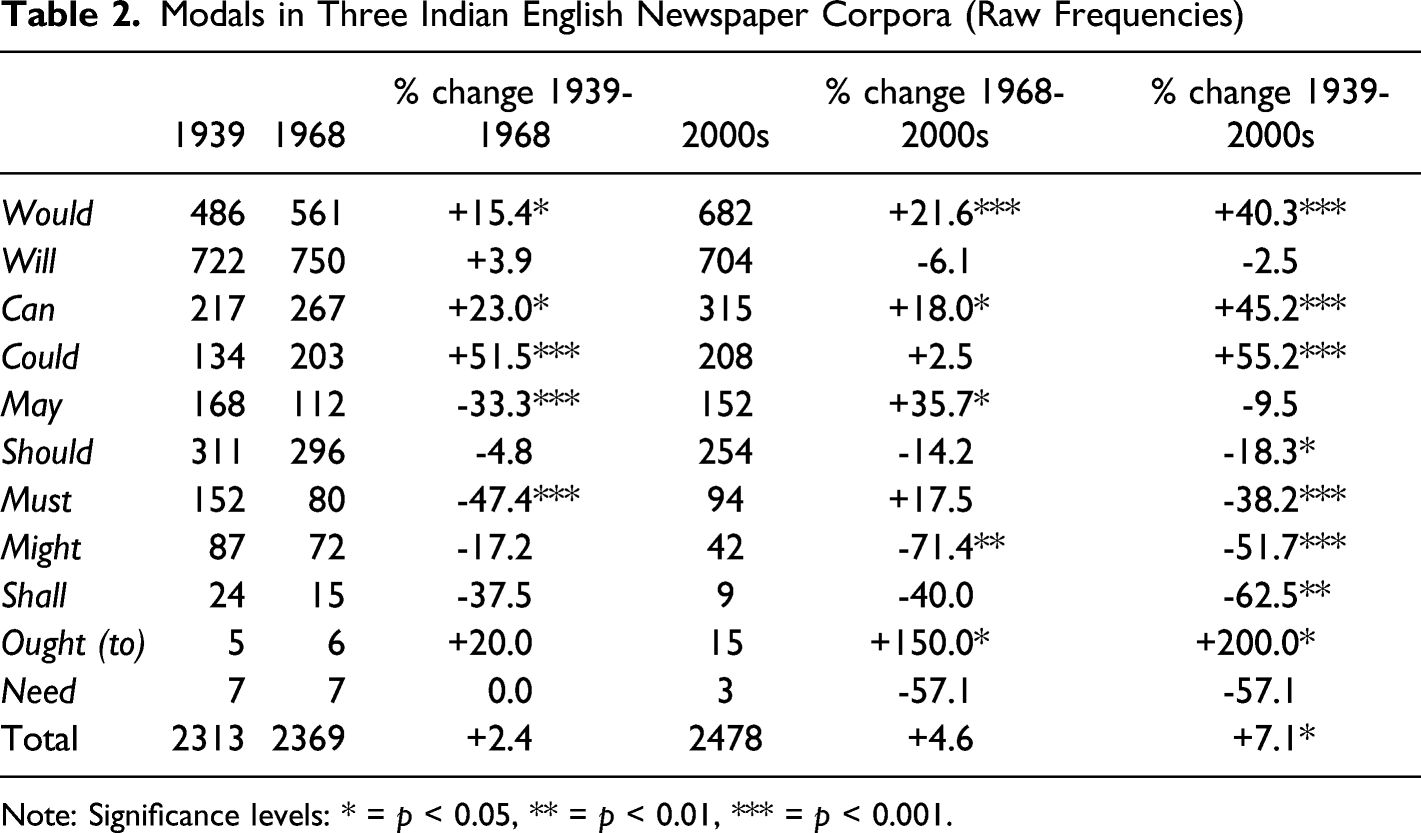
Modals in Three Indian English Newspaper Corpora (Raw Frequencies)
Note: Significance levels: * = p < 0.05, ** = p < 0.01, *** = p < 0.001.
Looking into the 1939-1968 and 1968-2005 intervals, noteworthy contrasts appear. May shows a drop in frequency between 1939 and 1968, followed by a rise of equal proportion between 1968 and the 2000s. These developments are individually significant, but the overall change (1939-2000s) is not. Conversely, should and shall show no significant change in frequency during those segments, but the difference between 1939 and 2005 shows significant loss of frequency, although it should be noted that ten of the twenty-four instances of shall in 1939 originate from a single text reporting new legislation.
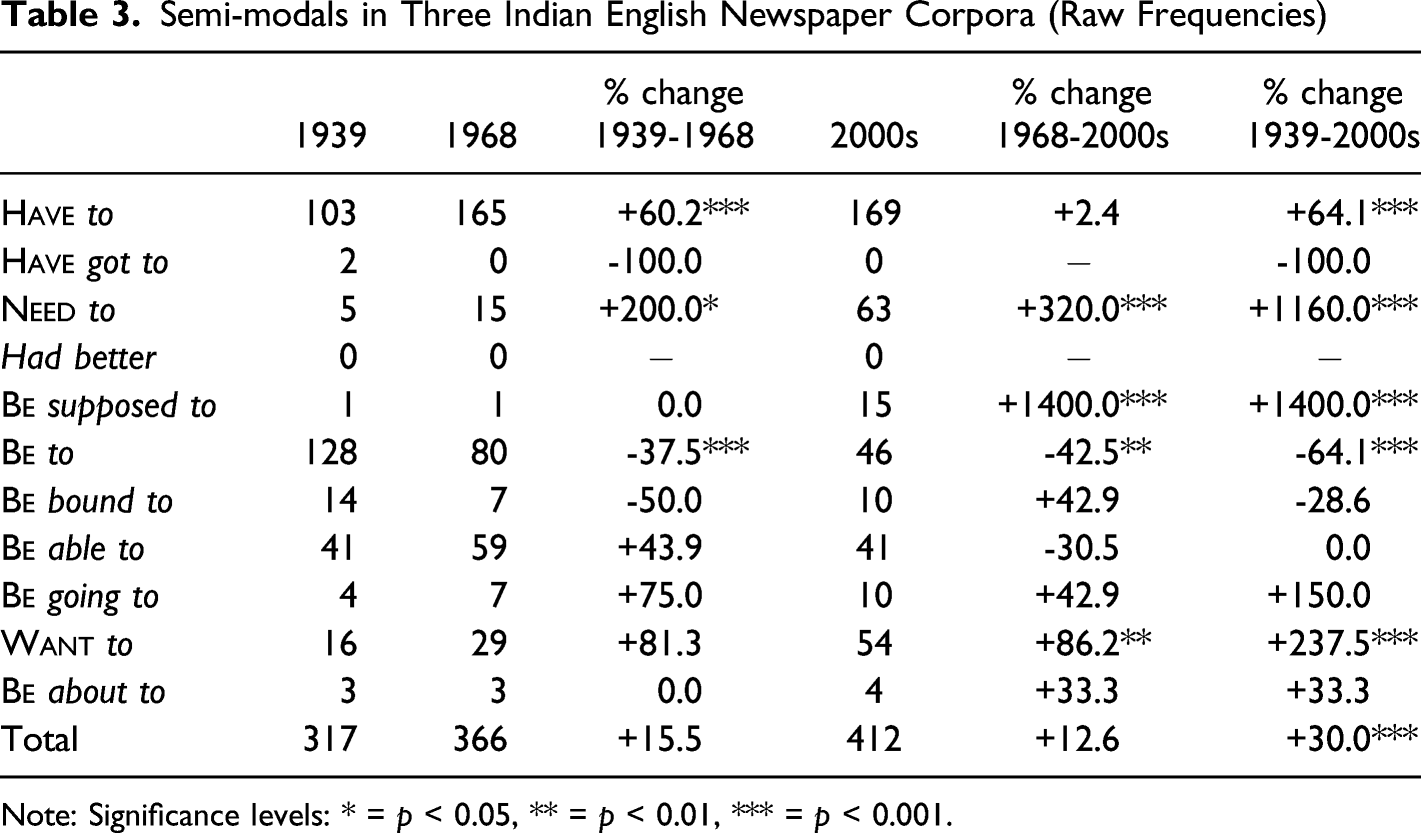
Semi-modals in Three Indian English Newspaper Corpora (Raw Frequencies)
Note: Significance levels: * = p < 0.05, ** = p < 0.01, *** = p < 0.001.
The near absence of
H
With the exception of
(8) The direction of the hill ranges is generally from north to south, and the railway surveyor might have to resort to much zig-zagging to obtain practicable gradients and curves. (1939_Ed_16)
The increase of both modals and semi-modals implies that IndE newspaper writing increasingly modalizes clauses, which goes counter to the findings of Leech (2013) for written AmE and BrE, in which the decline of modals is not proportionally compensated for by rising use of semi-modals. In other words, this “modality deficit” is not found in the present analysis. Leech (2013) suggested that a loss of verbal modality may be compensated for by an increase in the encoding of modality in lexical items, yet he found that the opposite was true: modal lexical expressions had also declined. Thus, Leech (2013) found that modality as a whole was declining in AmE and BrE. Given the rising tendencies of both types of verbs overall in the present study, an important topic for future research would be to explore whether this rise occurs for lexical items as well.
4.2. Register and Genre
The fact that the three newspaper corpora are constituted of two subgenres—i.e., editorials and news reports—makes it possible to determine the distribution of modals and semi-modals in terms of style, which this section explores. Given the importance of genre and sub-genre in our assessments of diachronic trends (Leech 2011; Biber & Gray 2013), distinguishing between them is worthwhile, especially since editorials and news have different objectives. Editorials differ from news reports in that their purpose is to share a viewpoint and construct an argument rather than report events. They are more likely to contain judgments of likelihood, recommendations, orders, wishes, and predictions which are expressed through modality. In (9), for example, the author relies on dynamic and epistemic modals to provide rebuttals. Editorials can also be more casual than news reports, in that authors may have more creative freedom in terms of topic, tone, format, and style. Example (10)—taken from the same 1968 text as (9)—may be considered more casual than most news reports, with its rhetorical question, value judgment, get-passive, and repetition. This style may also be reflected in the use of modals and semi-modals.
(9) Prof Weiner's reasoning may look dotty. But there is method in it. A democratic political system, he argues, has its own dynamic. Whatever changes in popular attitudes it may try to bring about it cannot wish away the given social environment. (1968_Ed_12)
(10) How can we get rid of that horrid old bore – the too, too slow rate of growth? (1968_Ed_12)
Editorials are fewer in number but usually greater in length than news reports, which means that they are likely less diversified in terms of authors. Consequently idiosyncratic uses may play a greater role in the editorial data. As mentioned in section 3, editorials from 1939 and 1968 are never signed, and many in the SAVE subcorpus are not either, which renders more precise considerations of individuations impossible.
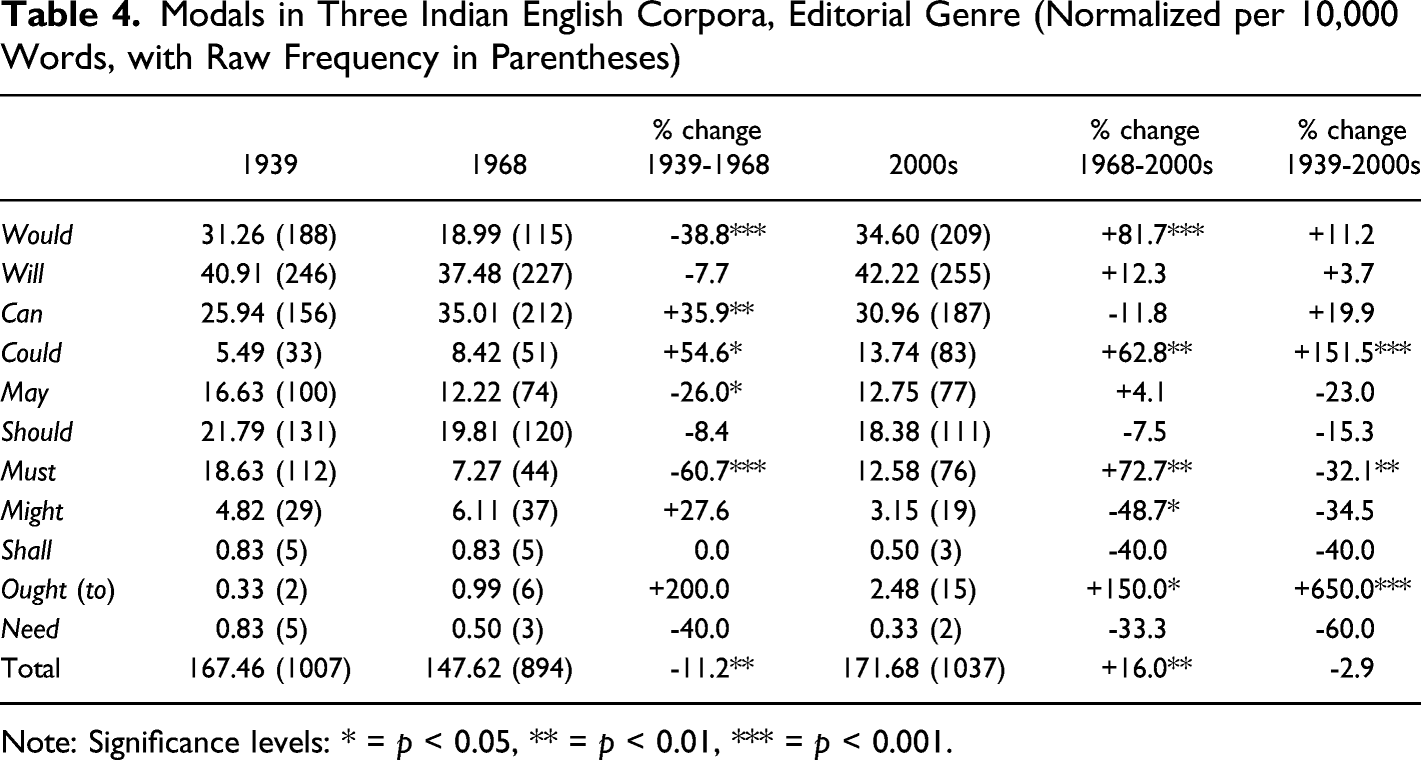
Modals in Three Indian English Corpora, Editorial Genre (Normalized per 10,000 Words, with Raw Frequency in Parentheses)
Note: Significance levels: * = p < 0.05, ** = p < 0.01, *** = p < 0.001.
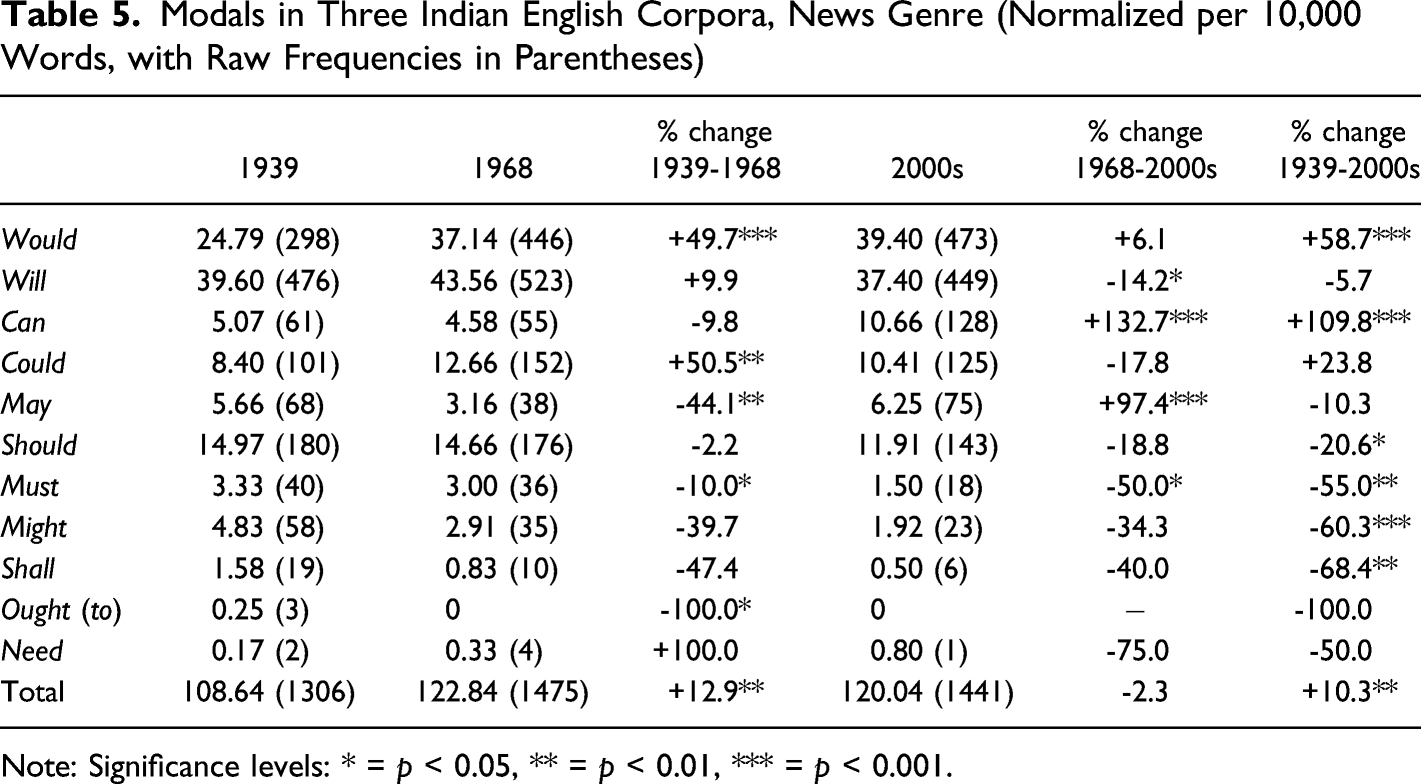
Modals in Three Indian English Corpora, News Genre (Normalized per 10,000 Words, with Raw Frequencies in Parentheses)
Note: Significance levels: * = p < 0.05, ** = p < 0.01, *** = p < 0.001.
The news reports appear to be responsible for the rise of would and can found in section 4.1. Despite this fact, can is vastly more frequent in the editorial genre. The rise of could and ought (to) is especially strong in the editorial genre, though the frequency of ought (to) remains low, and five of the fifteen instances in the editorials from the 2000s come from a single text. The decline of must is clear in both genres, which is some evidence of a long-term, robust decrease of frequency for this modal in written IndE. The decline of should, might, and shall is significant only in the news genre. The frequency of shall in 1939 is, however, largely due to a single text containing ten instances out of nineteen. While frequency differences for these modals in editorials also appear to show the same tendency, they are not statistically significant. Will, may, and need do not show significant tendencies in either genre.
That news reports exhibit a significant rise in the use of modals when editorials do not points to a change in style in news reports during the twentieth and twenty-first centuries, one which may involve colloquialization. For these data, it is possible that colloquialization is brought about by a shift in journalistic practices. An indication that practices have changed can be seen in the rise of direct quotes throughout the period: a rudimentary corpus search for quotation marks (“ ”) returns 114 hits for 1939, 277 for 1968, and 474 for the 2000s. The “growing popularity of direct quotes in news reportage” in Indian newspapers has also been observed by Sedlatschek (2009:315), indicating that this observation is not limited to the corpora used here. News reports, then, are increasingly speech-like over time, in the sense that they contain more speech reporting. This is an observation made by Mair (2006:188) for the American and British press as well, a phenomenon he terms “oralization.” Given the pervasiveness of modals in speech (Leech, Hundt, Mair & Smith 2009:77), it is logical that an increased reliance on direct quotes would have an effect on the frequency of modals in the press. This potential correlation between genre and modality is explored in more detail in section 4.3.
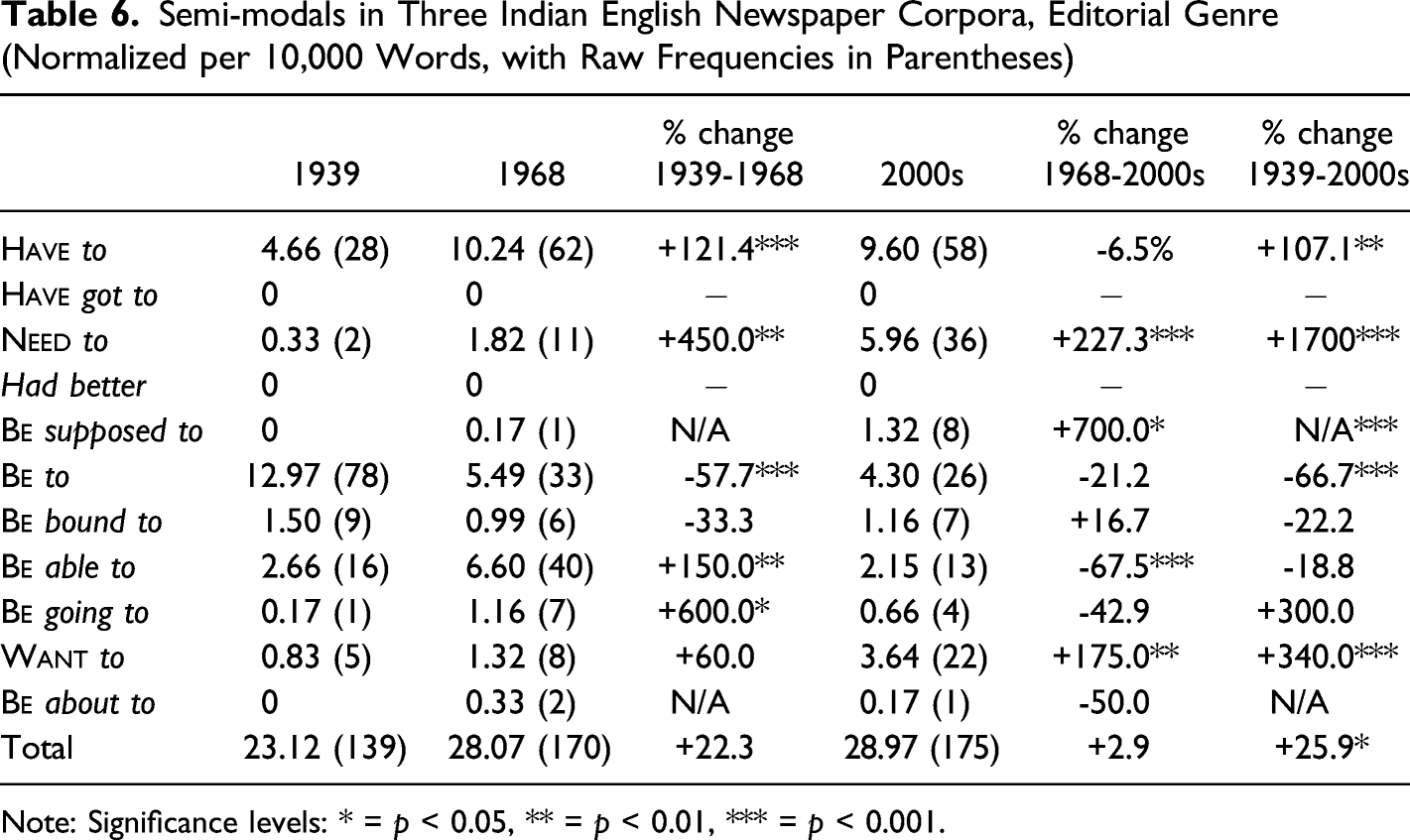
Semi-modals in Three Indian English Newspaper Corpora, Editorial Genre (Normalized per 10,000 Words, with Raw Frequencies in Parentheses)
Note: Significance levels: * = p < 0.05, ** = p < 0.01, *** = p < 0.001.
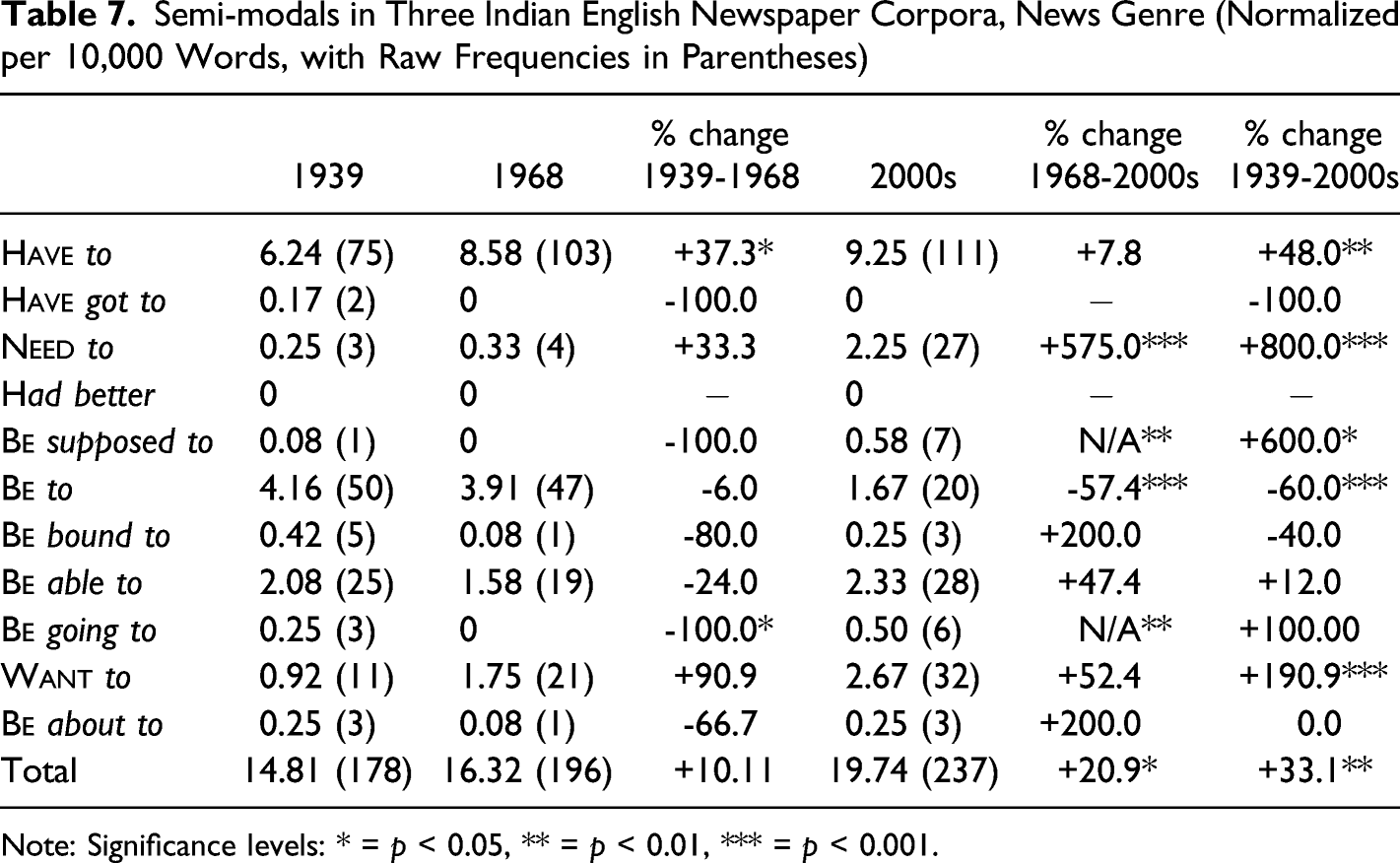
Semi-modals in Three Indian English Newspaper Corpora, News Genre (Normalized per 10,000 Words, with Raw Frequencies in Parentheses)
Note: Significance levels: * = p < 0.05, ** = p < 0.01, *** = p < 0.001.
The growth of
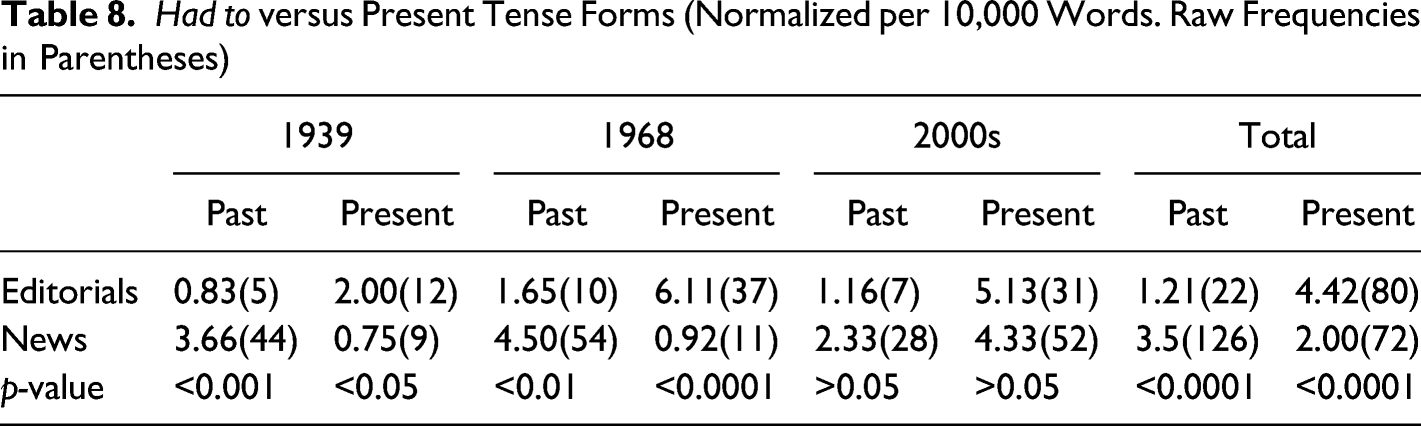
Had to versus Present Tense Forms (Normalized per 10,000 Words. Raw Frequencies in Parentheses)
4.3. The Role of Direct Quotes
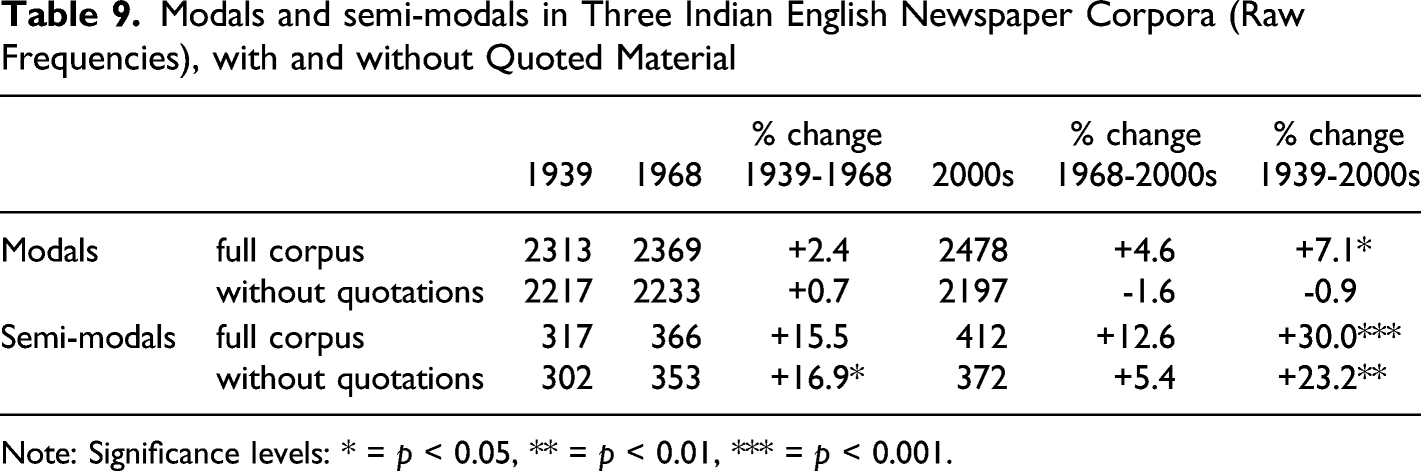
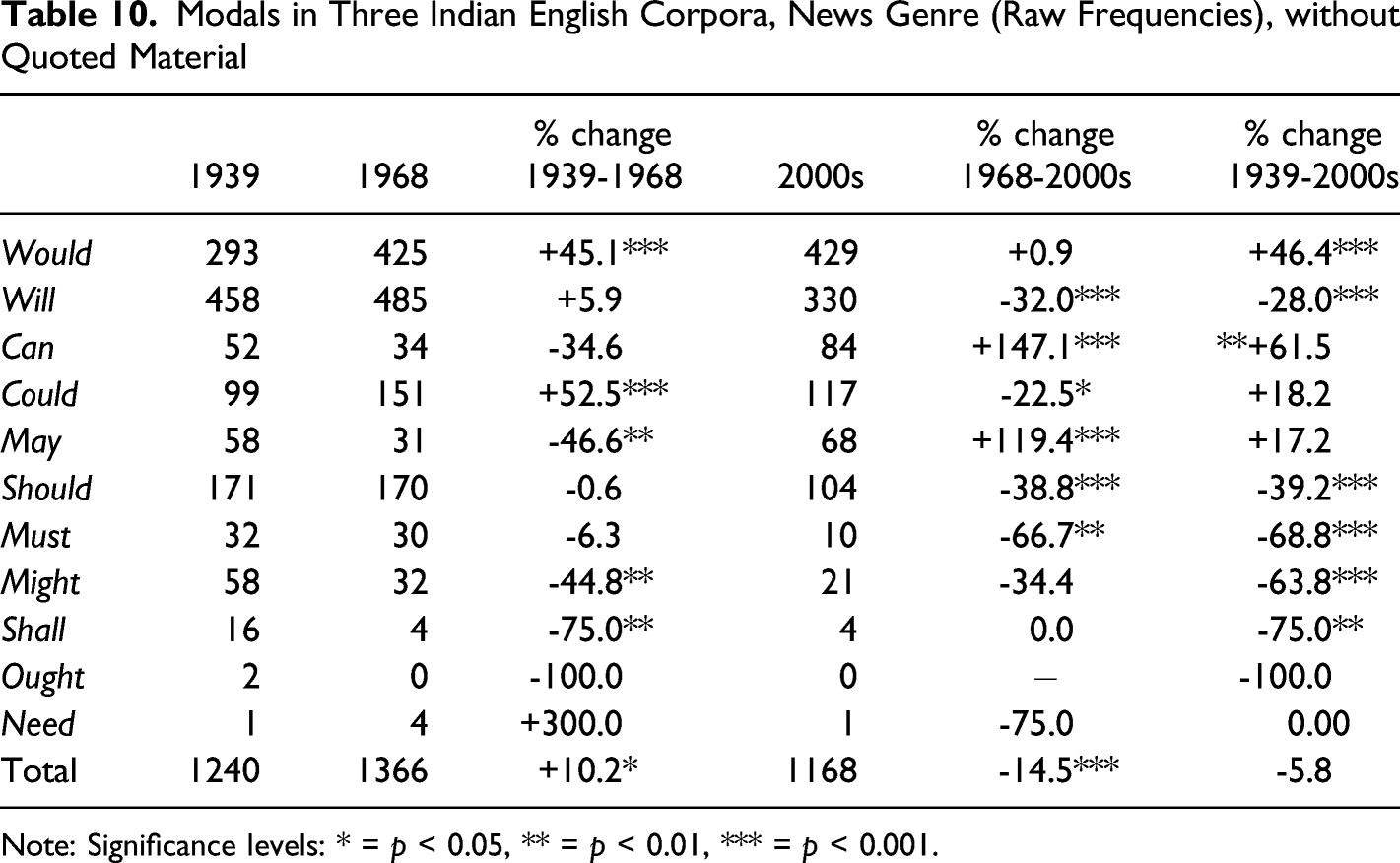
In section 4.2, I called attention to the effect of direct quotations, which may account for overall increases in modal and semi-modal verbs over time. In order to evaluate the potential contribution of quoted speech to the results shown so far, all modals and semi-modals found in direct quotes, such as exemplified in (11), were collected and examined.
(11) To this, Mr. Sakerlal Balabhal, interrupting said: “It may be so in Bombay.” (1939_Ln_284)
Modals and semi-modals in Three Indian English Newspaper Corpora (Raw Frequencies), with and without Quoted Material
Note: Significance levels: * = p < 0.05, ** = p < 0.01, *** = p < 0.001.
Modals in Three Indian English Corpora, News Genre (Raw Frequencies), without Quoted Material
Note: Significance levels: * = p < 0.05, ** = p < 0.01, *** = p < 0.001.
These findings provide some reassurance that direct quotes have limited effects on the trajectory of modals and semi-modals outlined earlier. Although the effect is not substantial, my data show that quoted material has the potential to change our overall sense of frequencies for individual modals in newspaper language.
4.4. Meanings and Uses
This section provides a deeper dive into the uses of would, should, must,
4.4.1. Would and Should
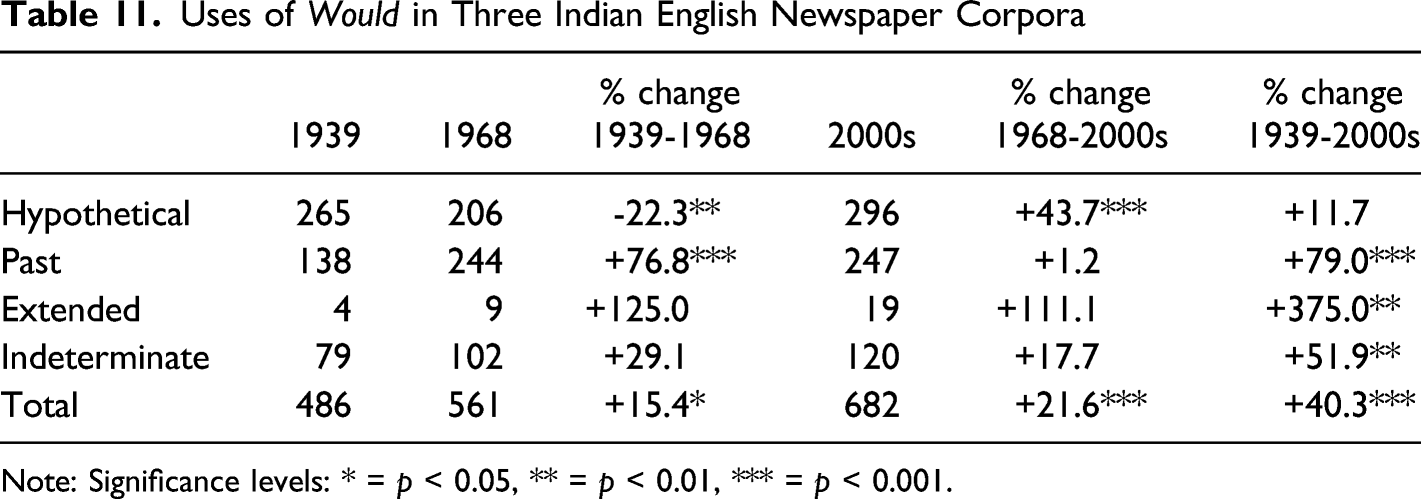
As shown in Table 2 (section 4.1), would underwent a significant and large increase in frequency. The case of this modal is notable because it is employed in a novel way in IndE: in addition to its hypothetical and preterite uses, so-called “extended would” (Collins 2009a) is used in non-hypothetical and non-past contexts, where will would be expected in AmE and BrE. These meanings are exemplified here, with would in (12) expressing the hypothetical character of an unrealized event, and in (13), as the past form of will to express past futurity. By contrast, the extended use illustrated by (14) is neither past nor strictly hypothetical but takes on a pragmatic function indicating “polite and tactful unassuredness” (Collins 2009b:34). In this case, the speaker is tentatively hopeful regarding the realization of an event. When none of these meanings are distinguishable, the token was deemed “indeterminate,” as in (15), where reported speech makes it uncertain whether would is intended as the past tense of will (the association will welcome…) or a hypothetical (the association would welcome… [given the opportunity]).
(12) A sheltered bus station was first proposed at Khodadad Circle itself, but both the municipality and the police disapproved of the idea. The police contended that it would add to the traffic congestion at that point […] (1968_Ln_150)
(13) They were ready to board the plane but were told at the last minute that the flight would be delayed by 45 minutes as a special was being carried out. (1968_Ln_82)
(14) “We will soon send our proposal to the Centre. I am hopeful that it would be accepted in the interest of the state,” added Bhattacharya. (SAVE_Ln_toi_75)
(15) In reply to a Question by the Chairman, Mr. Kasturbhal said the association would welcome an all-India textile board to consider all common questions concerning the textile industry in India. (1939_Ln_116)
Uses of Would in Three Indian English Newspaper Corpora
Note: Significance levels: * = p < 0.05, ** = p < 0.01, *** = p < 0.001.
The rarity of extended would may be affected by the large amount of backshift in the corpora, which makes extended would indistinguishable from its use as the preterite of will (hence the comparatively high amount of indeterminate tokens). Another factor influencing the frequency of extended would is, once more, the amount of direct quotes present in the corpora. Of the thirty-two instances found in the three corpora, thirteen are in direct quotes. Of those, eleven are to be found in the SAVE mini corpus, which contains the most recent texts. The apparent increase of extended would might simply be due to changes in journalistic style, which, as we have seen, appears to rely more on direct quotes in the twenty-first century than in 1939. Ignoring the quoted material, frequencies of extended would fall to four (1939), seven (1968) and eight (2000s). None of these differences is significant.
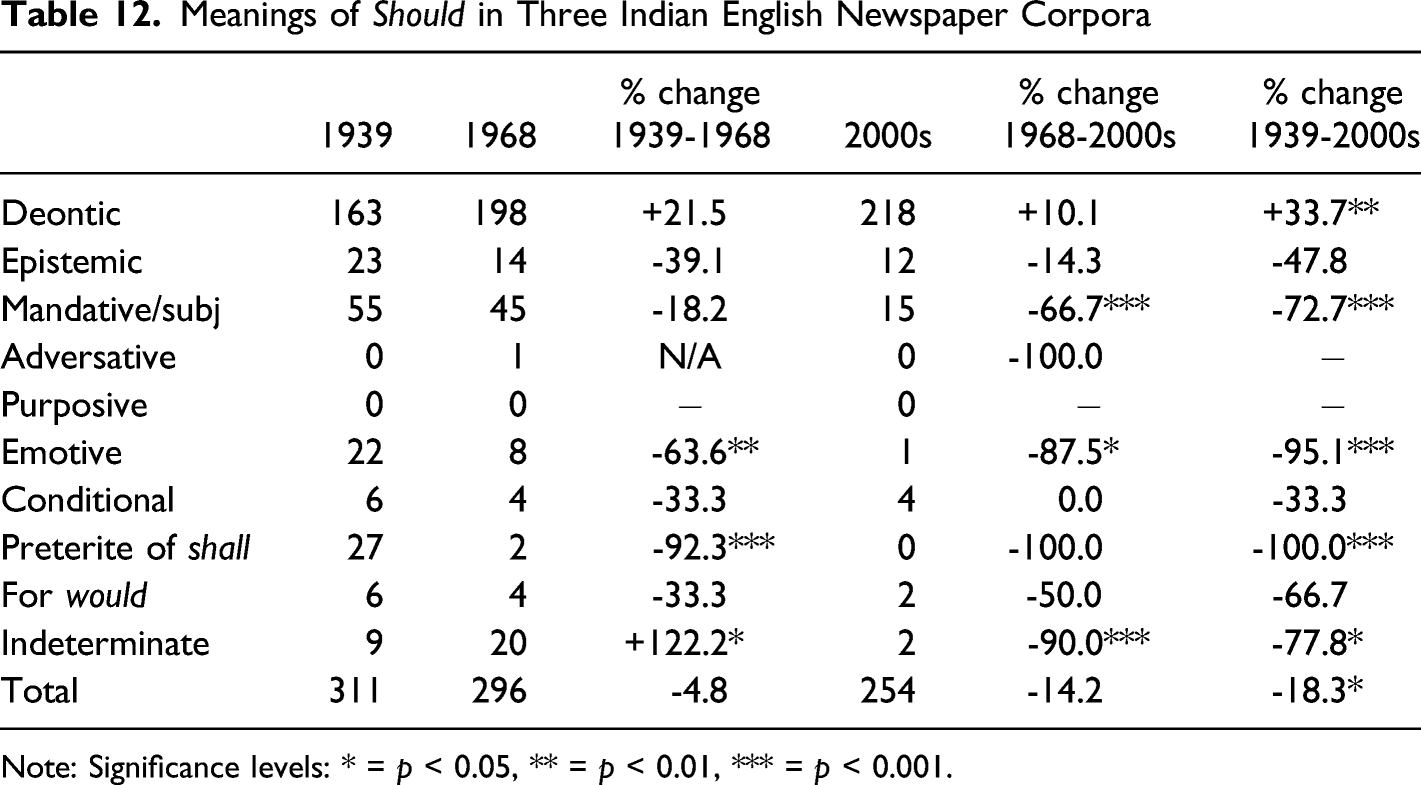
Meanings of Should in Three Indian English Newspaper Corpora
Note: Significance levels: * = p < 0.05, ** = p < 0.01, *** = p < 0.001.
Verb Forms after Selected Trigger Verbs in Three Indian English Newspaper Corpora 7
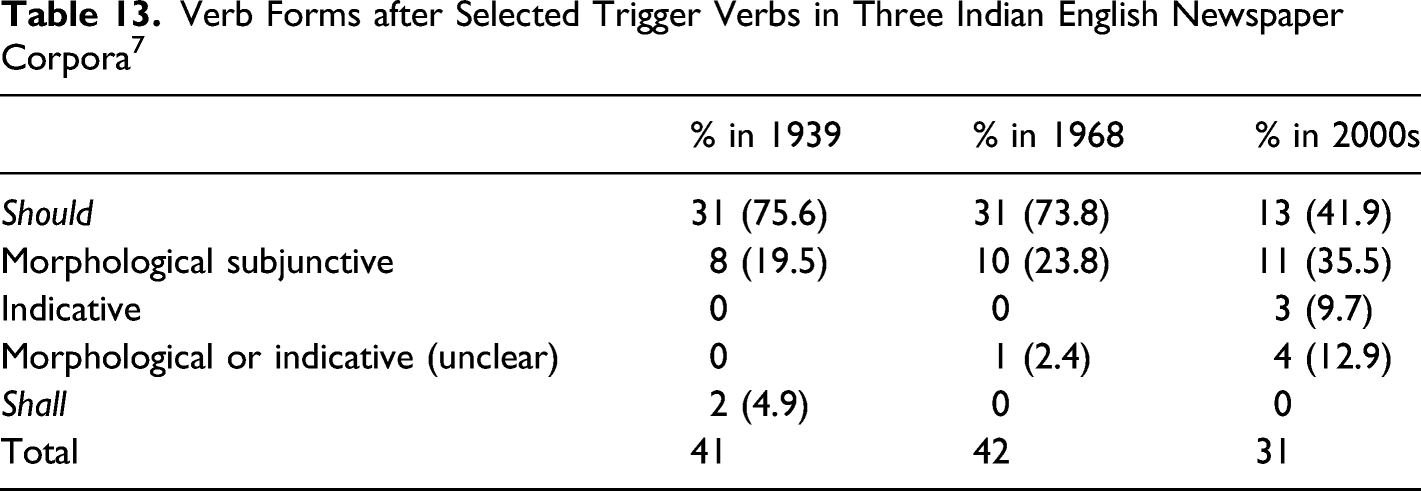
One instance of adversative (lest something should happen) and none of purposive (in order that something should happen) uses were found in these corpora, but this is not surprising given that Collins (2009a:48) only finds a small handful of them in much bigger and more diversified corpora of British, American, and Australian English.
The emotive meaning of should “occurs primarily with predicative items indicating surprise or evaluation” (Collins 2009a:50), as in (16), in which should is part of a clause complementing an adjective conveying subjective evaluation (here, a lack of surprise). This meaning declines between 1939 and the 2000s. It may be hypothesized that this use of should is replaced by a type of hypothetical would. This option would work in (16). (16) Nevertheless it was inevitable that they should feel the effects of self-government in the neighbouring territories of British India, with which the Orissa States are closely interlinked. (1939_Ed_20)
Finally, should as the preterite of shall is also falling out of use during the period studied. Again, given that Collins (2009a) does not find any unambiguous instance of this in contemporary AmE, BrE, and Australian English, this result is predictable.
While the mandative/subjunctive, emotive, and preterite uses of should are declining, its deontic use (denoting obligation) is increasing. Interplay with other modals and semi-modals might be responsible for this phenomenon: deontic should may be less face-threatening than deontic must, for instance, or even deontic
4.4.2. Must and Have to
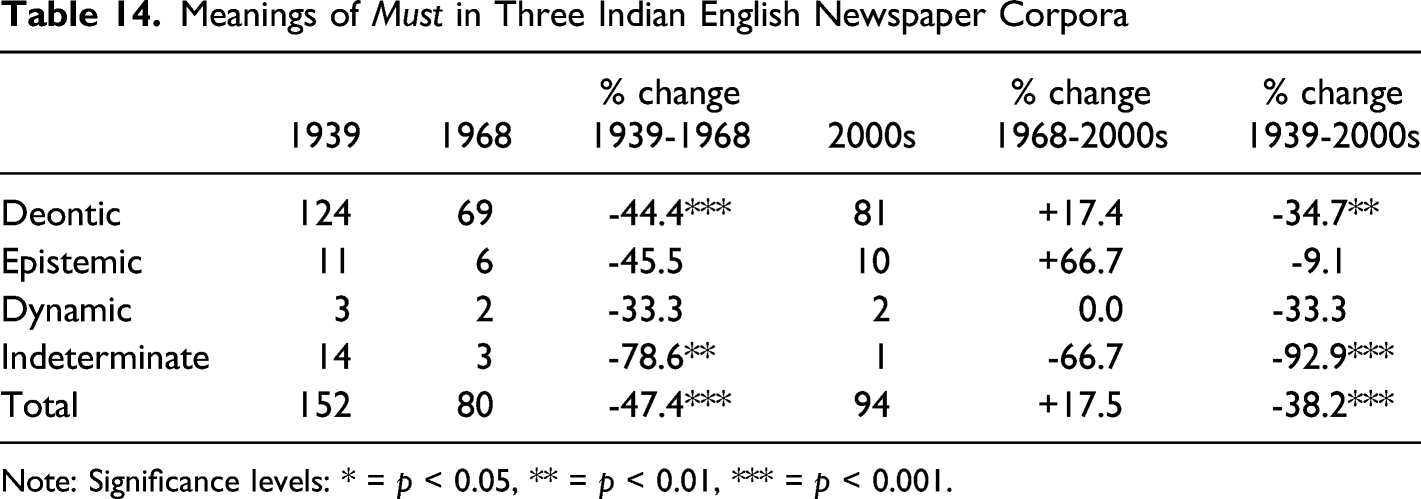
Meanings of Must in Three Indian English Newspaper Corpora
Note: Significance levels: * = p < 0.05, ** = p < 0.01, *** = p < 0.001.
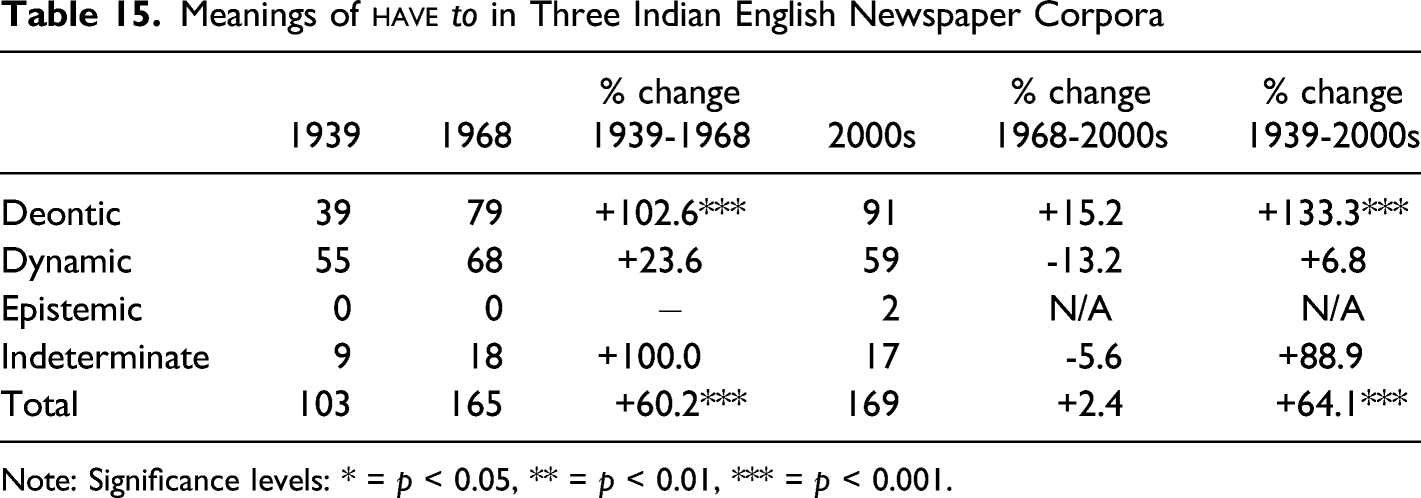
Meanings of
Note: Significance levels: * = p < 0.05, ** = p < 0.01, *** = p < 0.001.
The only statistically significant tendency for must is the decline of its deontic meaning, denoting strong obligation. Deontic
4.4.3. May
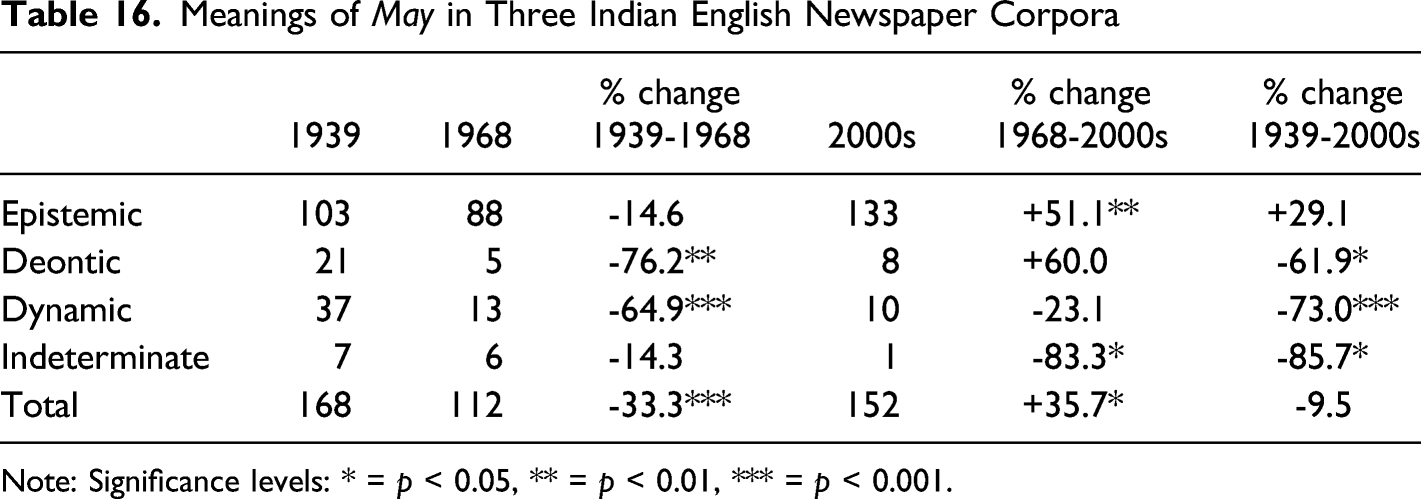
Meanings of May in Three Indian English Newspaper Corpora
Note: Significance levels: * = p < 0.05, ** = p < 0.01, *** = p < 0.001.
5. Discussion and Conclusion
This paper set out to describe variation and change in modals and semi-modals in written IndE during the twentieth century. This aim developed from claims that modals and semi-modals have behaved especially conservatively in IndE compared to written AmE and BrE. The hypothesis was that findings from diachronic data should be consistent with this observation. Specifically, I posited that the frequency of modals as a category should remain stable and that verbs declining elsewhere (must, need, shall) would not lose frequency. This would show divergence from IndE’s historical input variety, BrE, whose modals have been declining in written language. I assumed that such a tendency would be a sign of endonormative stabilization, whereby the linguistic norms of a postcolonial variety are self-determined.
The results show that modals as a category have slightly but significantly increased in frequency between 1939 and 2000s in IndE newspapers, but only when all quoted material is preserved. Otherwise, this increase is neutralized. Newspaper language is a combination of writers’ own words and those of the people they choose to quote, and the way these dimensions of journalism are employed have changed, which has clear linguistic consequences. The measure excluding quoted material is consistent with the hypothesis submitted at the beginning of this paper: in Indian English newspapers, between 1939 and the 2000s, core modals have not significantly decreased or increased in frequency.
Crucially, however, the tendencies exhibited by most core modals do not fundamentally differ from those of AmE and BrE as reported in Leech (2011) and Mair (2015). The least frequent modals (must, might, and shall) are also those which decrease most rapidly in IndE. Can, could, and would increase in frequency in IndE, as is the case in AmE (and BrE, except for would). Not only are these three modals responsible for the rise in frequency of the whole category, they also appear to be increasing at a higher rate than they do in AmE overall: can increases by only 25.7 percent in AmE against 45.2 percent in IndE, could by 24.3 percent against 55.2 percent in IndE, and would by 18.9 percent against 40.3 percent in IndE. This remains true when excluding quoted material. In the data from the TIME corpus (Millar 2009:199), modals as a category increase by 22.9 percent between the 1920s and 2000s, a change largely driven by massive increases of can, could, and, contrary to the other corpora mentioned here, may. Might also increases there, unlike in the Brown and IndE newspaper corpora. The tendencies of individual verbs in IndE are closer to those of the Brown corpora (which contain multiple genres) than those of TIME (similar in genre), as is the speed of these changes. The results raise questions regarding the relevance of using modals as a category to determine direction or speed of structural change. Clearly, the fact that the category increases in IndE newspapers and not in aggregate corpora for AmE and BrE is by itself no indication that it is moving in a different direction from the other two varieties. Looking into the individual modals, it appears to be the opposite: IndE newspaper writing does not diverge from written AmE and BrE, and it is even possibly faster in the rise of certain modals. In short, the results are consistent with the expectation that modals as a category have remained stable or increased in frequency, but they do not indicate endonormative stabilization (i.e., divergence from British tendencies), contrary to the rationale formulated at the outset. Rather, Indian English newspapers match British and American writing when individual verbs are considered.
Semi-modals have evolved as expected: they have increased in frequency overall, and this rise is also clear in both editorials and news reports, at almost identical rates in both, which indicates that this trend is robust. In this regard, IndE press language is on par with tendencies discovered for other varieties and does not come across as especially conservative or innovative. While the study did not specifically set out to explore colloquialization, the fact that semi-modals increase overall is a convincing sign that colloquialization is taking place, as these verbs are more frequent in speech (Balasubramanian 2009:195-196). Colloquialization also appears in the shape of oralization (Mair 2006:188), whereby speech is inserted into written language, as news reports were found to contain increasingly more direct quotes. Oralization, the expansion of semi-modals, and the trends presented for most individual modals are visible starting as early as in the 1939-1967 interval, indicating that they are not new, contrary to the post-1990 liberalization of the Indian economy and any concomitant influence of AmE. The implication is that these phenomena constitute trends parallel to that of American and British media, in continuity with those set in motion via the colonial input, rather than recent Americanization.
These conclusions stand in contrast with most other studies on the grammar of IndE but join Fuchs (2020) in reporting little evidence of endonormative tendencies. Notably, both this study and the findings of Fuchs (2020) on the progressive are based on historical newspaper data. While diachronic evidence should depict actual change more precisely than synchronic approaches (Gries, Bernaisch & Heller 2018), the niche representativity of newspaper data remains a problem. Unfortunately, other types of materials are not yet available for historical studies of IndE, owing to a certain inequality between postcolonial Englishes and other Englishes in terms of the types and amount of corpus data readily accessible. Sridhar (2020:254) notes to this effect that such fragmented accounts describe IndE “like the proverbial elephant by the Hindus, correctly in parts but missing the big picture,” referring to the parable in which individuals encountering an elephant in the dark are each only able to touch one of its parts and thus end up misidentifying the creature as various unrelated objects rather than one large animal. Future work will hopefully strive to further diversify types of data for IndE and expand the scope of our enquiries to the variety’s full range of registers.
Footnotes
Acknowledgements
I thank Stephanie Hackert, Diana Wengler, and Melanie Keller for their comments on early drafts and their support during this process. I am deeply grateful for the editors’ gracious feedback and smart suggestions, as well as for the knowledgeable insights of two reviewers.
Declaration of Conflicting Interests
The author(s) declared no potential conflicts of interest with respect to the research, authorship, and/or publication of this article.
Funding
The author(s) received no financial support for the research, authorship, and/or publication of this article.
