



Abstract
Objectives:
This study investigates phonetic backward transfer in first-generation multilingual Indians in Glasgow (‘Glaswasians’). According to the Revised Speech Learning Model (SLM-r) bilinguals’ languages interact and influence each other in a shared phonetic space which can over time lead to an assimilation or dissimilation of sound categories. This prediction is applied to explore whether and how the sound systems of Glaswasians’ native languages, Hindi and Indian English (IE), are influenced by the host variety Glasgow English (GE) after migrating to Glasgow. It also examines whether GE will affect IE more than Hindi due to linguistic proximity.
Methodology:
Two speaker groups were recruited. Both groups are native multilingual speakers of Hindi and Indian English, but differ in their language environment. The ‘Glaswasian’ group live in Glasgow, United Kingdom, and are constantly exposed to the ambient dialect of Glasgow English. The ‘Indian’ group live in India, where Hindi and Indian English are unaffected by contact with Glasgow English. Speakers were recorded reading sentence lists in English and Hindi containing three types of sounds: /b d ɡ/, /l/, /u/.
Data analysis:
The analysis looked for effects of Group (Glaswasian/Indian) and Language (Hindi/English) on multiple acoustic properties – pre-voicing and burst intensity for /b d ɡ/; F1, F2, F3 for /u/; F2-F1 difference for l/. Acoustic measures were taken in Praat; repeated measures analyses of variance (ANOVAs) and t-tests were conducted in R.
Findings:
Results were mixed for Glaswasians. Assimilation emerged in /u/ in Indian English (IE) and Hindi for F2, F3, and also for F2-F1 difference in /l/ in IE; partial assimilation appeared in both languages for /b d ɡ/; and dissimilation appeared in Hindi for /l/ and /u/. However, IE did not show more influence from GE than Hindi, suggesting that linguistic proximity may not necessarily modulate the nature of interaction between sound systems.
Originality:
This paper demonstrates backward transfer across languages and dialects. It illustrates the complexity of backward transfer and examines the impact of a majority language (English) onto a minority language (Hindi) in a novel group. In addition, it compares a bilingual experimental group with a bilingual ‘control’ group, which is rarely done.
Significance:
This study contributes to the knowledge of cross-linguistic transfer and phonetic variation and change while highlighting the various ways in which backward transfer can be manifested.
Keywords
Introduction
A bilingual mind is a space wherein two or more languages not just co-exist but also interact with each other (Flege, 1995; Kroll et al., 2012). This interaction is usually seen in context of different languages; deviation from the rules of either language due to the influence of the other causes interference (Romaine, 1989; Weinreich, 1953). This interaction is bidirectional. Not only can L1 affect L2 (Forward Transfer; Lado, 1957) but L2 can also affect L1 (Backward Transfer; e.g., Cook, 2003; Kartushina et al., 2016). The latter changes are discussed in several ways: for example, (Chang, 2012, 2013) uses L1 phonetic drift to refer to changes in the L1 due to increasing L2 experience. Other researchers (e.g., Ahn et al., 2017; Bergmann et al., 2016; de Leeuw et al., 2013; Köpke, 2007; Schmid, 2011; Yagmur, 1997) have used the term L1 phonetic attrition to refer to structural, non age-related, diachronic changes (de Leeuw, 2009) that usually reflect a deterioration in L1 (Bergmann et al., 2016; Chang, 2012). For the purposes of the present study, we use the term Backward Transfer to cover any or all such changes in the L1. Although there is a growing interest in studying backward transfer in languages (Ahn et al., 2017; Bergmann et al., 2016; Köpke & Schmid, 2004; Mayr et al., 2012; Stoehr et al., 2017), it has not extended to dialects as extensively (although see Kunkel et al., 2023) for a recent example relating to perception in French.
In this paper, we examine backward transfer in a situation of simultaneous bilingual and bidialectal contact. In doing so, we compare the backward transfer between languages (Glasgow English to Hindi) with backward transfer across dialects of the same language (Glasgow English to Indian English) in a group of immigrant Indian bilinguals in Glasgow. Alam (2006) introduced the term ‘Glaswasian’ to refer to the South-Asian minority ethnic community in Glasgow who had migrated from India, Pakistan, Bangladesh and other South-Asian countries, and settled in Glasgow. This study focuses on a subset of Glaswasians: Hindi-English Indian bilinguals who exhibit a case of language contact between Hindi, Indian English (IE; their native dialect of English) and Glasgow English (GE). This study investigates how certain sounds of speakers’ native varieties (Hindi and Indian English) have changed after coming into contact with a new dialect (Glasgow English), which is the socially dominant, majority variety in their current environment (Glasgow). This will be established by comparing the speech of Glaswasians to that of an effective control group in India ‘Indians’. Like Glaswasians, Indians also comprise Hindi-Indian English bilinguals, but unlike Glaswasians, they have never had any contact with Glasgow English.
Therefore, this study addresses three core research questions. The first is whether Glaswasians’ native varieties Hindi and Indian English are undergoing changes due to the influence of Glasgow English from the perspective of Flege & Bohn’s SLM-r (Flege & Bohn, 2021). The second is whether these changes appear in the form of assimilation or dissimilation (explained in section ‘Proposition 2: maintaining the contrast between L1 and L2 categories’). The third is whether Indian English will exhibit higher transfer from Glasgow English due to its linguistic proximity as compared to Hindi (Rothman, 2010, 2013, 2015; Trudgill, 1986).
The revised speech learning model
The Revised Speech Learning Model (SLM-r; Flege & Bohn, 2021) like its predecessor (Flege, 1995), proposes that all speech sounds of a bilingual’s languages exist in the same phonetic space. This common phonetic space allows for these phonological systems to interact and mutually influence each other, which causes changes for sounds of both L1 and L2. This development of the common phonetic space over the individuals’ lifetime in response to L2 learning is the focus of the SLM-r. Two propositions of the SLM-r that are highly relevant to the study of backward transfer are:
Proposition 1: Phonetic categories established in childhood for L1 sounds evolve over the lifespan to reflect the properties of all L1 and L2 phones identified as a realization of each category.
Proposition 2: Bilinguals strive to maintain contrast between L1 and L2 phonetic categories.
Proposition 1: backward transfer throughout the lifespan?
This proposition argues that the adult brain does not completely lose its linguistic plasticity with age, but keeps on evolving, and that the L1 system is also dynamic and ever evolving. The SLM-r proposes that language systems modify themselves in many ways by adding, merging, or deleting sounds when they encounter a new language system. This is supported by several studies, which have shown that the L1 sound categories undergo phonetic restructuring due to the influence of L2 (Bergmann et al., 2016; de Leeuw et al., 2013; Lev-Ari & Peperkamp, 2013; Mayr et al., 2012; Mora & Nadeu, 2012; Stoehr et al., 2017; Tobin et al., 2017).
Researchers have shown that backward transfer can occur in adult immigrant learners of L2 who had been immersed in the L2 atmosphere for a period of time ranging anywhere from 3 years to over 5 decades. These effects can occur on a range of phonemes, including vowels, sonorants, and obstruents. Lev-Ari and Peperkamp (2013), for example, examined the effect of long-term L2 immersion on L1 in a group of late English-French bilinguals residing in France for at least 3 years (but up to 49 years). They found that the voice onset time (VOT) for their L1 word-initial voiceless English stops had significantly reduced and become like the shorter VOT in French voiceless stops. Bergmann et al. (2016) investigated a group of German L1 migrants in North America who had acquired English (L2) as adults and had been immersed in the host country for 6.5 to 34 years. Four German speech sounds /a:/, /ɛ/, /ɔ/, /l/ were examined in spontaneous speech and immigrants’ speech was compared to that of a monolingual L1 German control group. They observed that formants in /a:/ and /l/ in L1 had shifted towards L2, and that bilingual speakers were rated as less native-like in their L1 than monolingual speakers. de Leeuw et al. (2013) also examined a group of German-English bilinguals, residing in Anglophone Canada for 18 to 55 years, for production of L1 German/l/. This consonant is known to have a ‘clear’ realization (i.e., palatalized secondary articulation) with low F1 and higher F2 in German, in contrast to Canadian English, where its realization is darker (i.e., velarized or pharyngealised secondary articulation), with higher F1 and lower F2. The results showed an influence of the darker Canadian-English /l/ on L1, such that the bilingual German /l/ became darker.
Voice onset time is a common target of backwards transfer effects. Mayr et al. (2012) compared voiceless plosives in two L1 Dutch monozygotic twin sisters, one of whom had been immersed in an L2 English environment for more than 30 years. This sister showed longer VOT values for voiceless stops in L1 Dutch compared to her twin, apparently influenced by the longer VOT for voiceless stops in L2 English. Another evidence comes from the German-Dutch bilinguals examined by Stoehr et al. (2017). They found that their VOT for /p t k/ in L1 German became more like that of the VOT of L2 Dutch. This was argued to be the result of infrequent and irregular contact with their L1 German. Major (1992) further showed that backwards transfer reflects not only increased contact with L2 and decreased contact with L1, but also L2 proficiency. He examined VOT in word initial /p t k/ in five American English-Brazilian Portuguese immigrants, who had been living in Brazil for 12 to 35 years. Brazilian Portuguese stops are known to have very low VOT (approximately 20 ms), whereas American English voiceless stops are very heavily aspirated (approximately 85 ms). The results revealed that two participants had shortened their English VOTs in the direction of Portuguese VOT, suggesting that they had merged their L1 and L2 phonetic categories. More importantly, Major argued that the bilinguals were engaged with their native American English daily since they were English teachers and/or staff members in English language institutes; therefore, it was not a lack of L1 use that led to this L2 influence.
What is more, research on L1 phonetic drift has shown that changes in the L1 can even be brought into effect after a short immersion period (Chang, 2012; Turner, 2023). Chang (2012) demonstrated this in a longitudinal study on L1 English students who were in Korea for a 6-week beginners’ course in Korean. He found that immersion in the L2 environment caused the VOT of L1 English voiced and voiceless stops to become longer – closer to the longer VOT of Korean stops. There was also a subtle drift in their English vowels towards Korean vowels. Chang argues that this drift was a result of experience with L2 can cause L1 phonetic drift (supported by Chang, 2013), and not a lack of L1 contact and use (as argued by Stoehr et al., 2017), because his participants would thoroughly engage with their L1 English every day after teaching in L2 Korean would end. Turner (2023) reported a similar systemic drift in L1 English vowels of 42 L2 French learners, who were residing in France for a short immersion period of six months. This examination revealed that L2 phonetic development predicted L1 phonetic drift, which was reversed upon re-immersion in the home country.
The effects of backward transfer have also been shown in speech perception. For instance, Mora and Nadeu (2012) studied the perception of two contrastive native vowels /ɛ/ and /e/ in Catalan-Spanish bilinguals. While Catalan contrasts between these vowels, Spanish only has /e/ in its five-vowel system. Perceptual accuracy tests showed that speakers who used Spanish (L2) more frequently than Catalan (L1) discriminated Catalan vowels /ɛ/ and /e/ less accurately and more slowly. Their production of Catalan /ɛ/ was also found to be acoustically more like Spanish /e/. The results showed a backward transfer of Spanish on Catalan as an effect of extensive L2 use. Speech perception across dialects was investigated by Kunkel et al. (2023), who examined Hexagonal French (HF) speakers exposed to Quebec French (QF) as a second dialect (D2). In QF, /a ~ ɑ/ and /ɛ ~ aɛ/ are phonemic contrasts absent in HF. HF speakers who had relocated to Quebec performed worse than native QF speakers at discriminating these contrasts and, surprisingly, were less accurate than HF speakers without QF exposure. These findings suggest that extended D2 exposure may not necessarily enhance perceptual discrimination and may even integrate D2 contrasts into D1 phonemic categories, reducing discrimination accuracy.
In sum, L1 is not immune to influence from L2; we seek here to probe the nature of that susceptibility in Glaswasians.
Proposition 2: maintaining the contrast between L1 and L2 categories
The second key proposition from the SLM-r relates to perceived phonetic similarity between L1-L2 categories and the precision in the definition of L1 category at the first instance of L2 exposure. The speakers may perceive certain sounds as phonetically similar or distinct in L1 and L2; and when this happens, the sound system can reorganize itself in different ways.
The first type of reorganization is called phonetic category dissimilation. The SLM-r proposes that when the speaker can discern enough dissimilarity between two phonetically similar sounds in the L1 and L2, they establish a new category for the L2 speech sound while causing the nearest L1 sound category to drift away from it (Flege & Bohn, 2021). In this model, the greater the perceived phonetic differences between an L2 sound and closest L1 sound, the greater the chance that a new category will be established for the L2 sound. SLM-r’s ‘category precision hypothesis’ argues that individuals will more readily contrast between L1 and L2 categories and create a new L2 category if their L1 categories are more precisely defined at the time of first exposure to L2. For instance, Flege and Eefting (1987a) reported that Dutch-English bilinguals with high proficiency in English produced Dutch /t/ with shorter VOT than what is found in Dutch. This means that the bilinguals exaggerated the shorter Dutch VOT characteristic of monolinguals, to contrast it from longer English VOT and possibly create a separate L2 phonetic category. Dissimilation has also been reported in vowels (Flege et al., 2003; Guion, 2003). For instance, Guion (2003) reported that early Quichua-Spanish bilinguals successfully partitioned their vowel space to accommodate their L1 and L2 vowels, but at the cost of a systemic raising of the L1 vowels to maintain a perceptual distinction with the L2 vowels.
The second type of reorganization is called phonetic category assimilation, where perceptually similar L1 and L2 sounds are linked together and processed as the same sound category (Flege & Bohn, 2021). Flege (1987) observed this process in French-English bilinguals. Compared to monolingual French speakers, bilinguals produced native French /t/ with longer VOT, like that of their L2 English /t/. Harada (2003) found further evidence of assimilation by examining word-initial voiceless stops /p t k/ in early Japanese-English bilinguals. Their L1 Japanese VOT was found to have become longer, more English-like, which is evidence of assimilation. The evidence of assimilation also comes from a number of studies for various bilingual language pairs, few of which are discussed above in section ‘Proposition 1: backward transfer throughout the lifespan?’ (Bergmann et al., 2016; de Leeuw et al., 2013; Lev-Ari & Peperkamp, 2013; Major, 1992; Mayr et al., 2012; Stoehr et al., 2017).
However, there is also a third possibility, that the sounds remain distinct if phonetic category assimilation or dissimilation does not take place. It is possible that when there is no interaction between the sound systems, the sound category boundaries will not shift (Macleod & Stoel-Gammon, 2009; MacLeod et al., 2009; Stoehr et al., 2017). For instance, MacLeod et al. (2009) found that early bilingual speakers of Canadian English and Canadian French produced monolingual-like values for vowels of either language. This indicated formation of separate categories across the two languages for similar vowels. Further examination by Macleod and Stoel-Gammon (2009) revealed this pattern for VOT as well. This was such that early bilingual Canadian English-Canadian French speakers maintained monolingual-like phonemic contrasts but they exhibited more variation within categories than monolingual speakers.
Based on the above review, most of the current evidence on the backward transfer effects of assimilation and dissimilation, and even no change comes from investigations limited to a single type of sound category, most often voiceless or voiced plosives examined for VOT (Flege & Eefting, 1987; Kang & Guion, 2006; Lev-Ari & Peperkamp, 2013; Major, 1992; Stoehr et al., 2017) or vowels examined for formant patterns (Guion, 2003; Mora & Nadeu, 2012). There is still relatively little evidence to understand how backward transfer operates across a broader range of sound categories. A few exceptions, such as Bergmann et al. (2016), who examined both vowels and the lateral /l/, and Chang (2012), who investigated plosives and vowels, suggest that backward transfer may not manifest uniformly across segments. Yet, systematic comparisons across multiple sound categories remain rare.
Present study
The purpose of the present study is to investigate the nature of backward transfer of L2 Glaswegian English to each of the Glaswasians’ L1s: How does Glasgow English affect Hindi, and how does it affect Indian English? Furthermore, if there is evidence of change in the native varieties, we ask whether the effects are assimilatory or dissimilatory in nature. Do the two languages shift in the direction of L2 Glasgow English phonetic norms (assimilation), or away from them (dissimilation)? Are these changes similar across different types of sound categories? To this end, two groups of speakers, Glaswasians (the experimental group) and Indians (the control group), were recorded producing words containing three types of sounds (/l/, /b d ɡ/, and /u/) embedded in carrier phrases. These sounds were recorded in both English and Hindi, and analysed for acoustic differences between the groups. The control group provided the baselines in the native varieties and significant differences between Glaswasians and Indians would indicate the presence of backward transfer.
Research questions
There are three research questions driving this study:
Research Question 1 (RQ1): Do Glaswasians show evidence of backwards transfer from Glaswegian English into either Indian English or Hindi?
Research Question 2 (RQ2): If so, does the transfer appear as assimilation or dissimilation?
Research Question 3 (RQ3): If so, does the transfer affect Indian English more strongly than Hindi?
The first two research questions are motivated by the SLM-r (Flege & Bohn, 2021), which argues that similar sounds in the L1 and L2 are more likely to become perceptually linked and get assimilated. Therefore, those sounds were selected which occur as phonemes in Glasgow English, Indian English and Hindi, but are phonetically different in their realizations in the native and acquired systems. However, if the speakers discern enough dissimilarity between these similar sounds, then dissimilation between categories, rather than assimilation, may emerge. Furthermore, by examining backward transfer across different types of sound categories (voiced stops /b d ɡ/, the lateral /l/, and the vowel /u/), this study aims to determine whether these effects exhibit systematicity, that is, whether similar mechanisms underlie changes across segments, or whether they are category-specific, reflecting segment-dependent patterns of reorganization. Addressing this question will extend our understanding of how cross-linguistic influence operates beyond individual sound categories.
The third research question is motivated by the claim that in cases of language contact, mutually intelligible dialects influence each other (Trudgill, 1986). Therefore, there may be more evidence of backward transfer of Glasgow English to Indian English, another variety of the same language, than to Hindi, a different language altogether. de Leeuw (2009) made a similar prediction but regarding similar languages, not dialects. In a foreign accent assessment, de Leeuw expected to find L1 attrition at the level of perception in native German speech of bilinguals with L2 Dutch, but not in native Germans with L2 English. This prediction was based on the reasoning that Dutch is phonetically more similar to German than English is to German. So, based on this, German-Dutch speakers were expected to show more L1 attrition than German-English speakers. However, the results did not show any difference between Dutch L2 and English L2 speakers. This was attributed to the possibility that different L2s may not have the same effect on the same L1 or that maybe listeners confused potentially Dutch foreign accented speech with German regionally accented speech. Therefore, while this influence was not reported for similar languages, it is possible that it may be present in mutually intelligible dialects.
Research context
The Glaswasians examined in the present study form a part of the wider Glaswasian community whose establishment was initiated in Glasgow as early as 1930s when the original immigrants started arriving in the United Kingdom from the Indian sub-continent (Maan, 1992; see Al-Asiri et al., 2025 for details). These original migrants were the source of much chain migration to Glasgow, with new migrants either settling in Glasgow or dispersing to other areas from Glasgow. Most of these migrants were from the North-Indian state of Punjab, were Sikhs or Muslims by religion, and spoke Punjabi and/or Urdu. In 1947, following the creation of Pakistan, migration was separate from India (usually Sikh and Hindu speakers of Punjabi/Urdu/Hindi) and Pakistan (usually Muslim speakers of Punjabi/Urdu). According to the 2011 census, in Scotland, 4% of the total population comprised ethnic minorities, with Asian being the biggest ethnic minority (3%). Of this, 17.3% ethnic minorities were based in Glasgow. One of these groups is the Indian minority comprising 1.5 % of the minorities (33,000 Indians), while the largest minority in Scotland is that of Scottish Pakistani. Previously, some research has been conducted on these Glaswasians from various generations (see Al-Asiri et al., 2025 for details), and in the wider context, there is also some research on both first- and second-generation United Kingdom ethnic accents. Evidence from these studies demonstrate how regional accent features are identifiable even in interference patterns in first-generation speakers.
Methodology
Participants
Two groups of speakers of mixed gender were recorded. The Glaswasian group contained 20 adult speakers (11 F, 9 M; ages: min. = 18, max. = 79, M = 47.1, SD = 21.17). They were first-generation immigrants, born in India and later migrating to Glasgow, their host country. This contrasts with second-generation immigrants, who are the children of first-generation immigrants and are born or predominantly raised in the host country. These Glaswasians had been residents in Glasgow for at least 3 years (min. = 3, max. = 56, M = 24, SD = 21). This lower limit on Glaswasians’ length of residence was based on the results from (Sharma & Sankaran, 2011), who found that Punjabi-English first-generation Indians in London only started showing evidence of backwards transfer after their first 3 years of residence. For the present study, Glaswasians spoke Hindi as their native language (they were exposed to it since birth and grew up speaking it at home in addition to instruction in school) and acquired it before coming to Glasgow. They were recruited from the Hindu Temple in Glasgow, an Indian restaurant and the University of Glasgow. Reported occupations included HR consultant, chef, dance and music teacher, research support staff, students, civil servant, yoga teacher, assistant manager, marketing manager. This goes to show that they were actively involved in the Glaswegian society, thereby having several opportunities of interacting with the societal variety, Glasgow English. Five Glaswasians with the longest length of residence in Glasgow (range: 36–56) had retired from their jobs.
The ‘Indian’ group contained 20 Indian speakers who reside in India, are native speakers of Hindi and English, fluent and dominant in Hindi, and used Hindi to communicate in daily life and have not had any contact with Glasgow English. They were recruited in the city of Udaipur (Rajasthan, India), of which one of the authors is native. They were recruited by directly contacting friends, acquaintances and relatives, and belonged to a diverse range of professions. Importantly, both Glaswasians and Indians are bilingual speakers of Hindi and English (Indian English). However, only Glaswasians are additionally exposed to Glasgow English and also the Englishes – Indian English and Glaswasian English – spoken by other members of their ethnolinguistic minority community in Glasgow (Alam, 2006, 2015a; Stuart-Smith et al., 2009).
In addition to Hindi, all participants in both Glaswasian and Indian groups spoke at least one additional regional language as their native language, which they were exposed to and acquired since birth. In Glaswasians, these languages were Punjabi, Bengali, Marathi, Urdu, Gujarati and in Indians these were Punjabi, Bengali, Marathi, Urdu, Gujarati, Malvi, Rajasthani. The control group was more limited in the regional languages they spoke, which were Rajasthani and Gujarati.
The diversity of Indian immigrants to Glasgow meant that it was not possible to restrict all participants to those with identical language backgrounds (with respect to speaking the same dialect of Hindi, same variety of Indian English or the same regional language). We ensured that Glaswasians and Indians had studied in English medium schools and their regional languages were, at a minimum, from the Indo-Aryan subgroup. Since the sounds investigated here are similar across Indo-Aryan regional languages, it was possible to minimize the possibility of uncontrolled transfer effects from more dissimilar languages, such as the Dravidian languages spoken in South India. This limitation could not be avoided in the present study, but future research can be more careful about accounting for this in a population which is as linguistically diverse as this.
Target sounds
Word-initial /l/
The two allophones of the alveolar lateral relevant to this study are ‘clear’ and ‘dark’ /l/. When the tip/blade of the tongue touches the alveolar ridge and the tongue body is also raised, the sound produced is a ‘clear’ or ‘light’ alveolar /l/ (Hayward, 2000; Ladefoged & Johnson, 2015; Recasens, 2004). /l/ is dark when for the same primary articulation, the tongue body is raised towards the velum, that is, it is velarized [ɫ] (can also be pharyngealised in Glasgow English) (Ladefoged & Johnson, 2015; Recasens, 2004; Simonet, 2010). Dark /l/ typically shows a lower second formant (F2) and higher first formant (F1) than clear /l/ which has higher F2 and lower F1. In Glasgow English, the lateral is realized as [ɫ] in all word positions (Stuart-Smith, 2004; Wells, 1982). Macdonald and Stuart-Smith (2024) report the average F2-F1 difference for fully phrase-initial /l/ in spontaneous Glaswegian vernacular to be around 750 Hz. However, both Hindi and Indian English only have clear /l/ in all positions in the word (Gargesh, 2008; Wells, 1982) and so we expect their F2, and F2-F1 differences, to be higher than Glaswegians.
In relation to backward transfer in previous research, an assimilatory shift of L1 clearer /l/ towards L2 darker /l/ was reported by Bergmann et al. (2016), de Leeuw (2019), de Leeuw et al. (2013) in German-English bilinguals, de Leeuw et al. (2018) in Albanian-English bilinguals and Barlow (2014) in Spanish-English bilinguals. Some previous research also exists on /l/ in the accents of second and later generations of British-Asians in the United Kingdom (Kirkham, 2017; Stuart-Smith et al., 2011). However, the focus of these sociophonetic studies is on the integration of host and heritage phonetic features representing hybrid identity markers for second and so forth generation speakers, as opposed to instances of backward transfer in first-generation speakers.
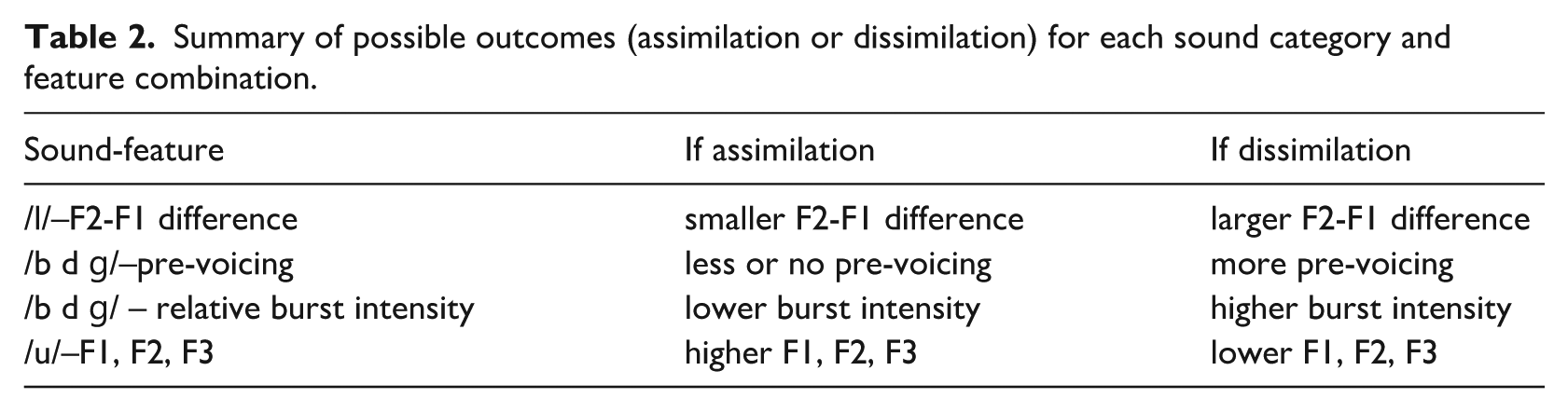
In the current study, we ask whether Glaswasians show assimilation, dissimilation, or no evidence of backwards transfer in word-initial /l/. If they show dissimilation, then they will produce darker /l/ than Indians in both L1s (Table 2). Since dark /l/ has a higher F1 and lower F2 than clear /l/, assimilation to dark /l/ will emerge in the form of a smaller F2-F1 difference in the Glaswasians compared to Indians. On the other hand, in case of dissimilation, Glaswasians will produce clearer /l/ in both languages by exhibiting larger F2-F1 difference in order to dissimilate or contrast it from the dark /l/ in Glasgow English (Table 2). Finally, if there is no backward transfer or interaction, then Glaswasians will have the same F2-F1 difference as Indians as the sounds will remain uninfluenced.
The variables involved for this sound are Group (Glaswasian/Indian) and Language (English/Hindi). A Group effect will indicate backward transfer, and a Group by Language interaction will reveal whether IE and Hindi differ in their sensitivity to this transfer.
Word-initial /b d ɡ/
The voiced stops /b d ɡ/ are present in the phonological systems of all three varieties. Glasgow English /d/ is realized as voiced denti-alveolar stop (Stuart-Smith, 2004), whereas Indian English /d/ is usually realized as a voiced retroflex stop (e.g., Gargesh, 2008), Hindi shows two voiced coronal stops, /d̪/ and /ɖ/ (e.g., Singh & Tiwari, 2016). The manner and place of articulation is similar for the bilabial and velar voiced stop in all three phonological systems. Here we are interested, however, in possible transfer related to fine phonetic detail in the stop voicing contrast. Several acoustic cues differentiate voiced stops from voiceless stops (cf. e.g., Lisker, 1986). The two which are considered here are as follows:
1. VOT: VOT refers to the time between the release of the articulators (here stop burst) and the onset of voicing (Lisker & Abramson, 1964). Word-initial voiced stops in English typically show little or no voicing during closure, and then a short period of VOT. Word-initial Hindi voiced stops on the other hand are highly pre-voiced, i.e. they show voicing throughout the closure, or a period of voicing before the release of the stop burst (s, 1994; Lisker & Abramson, 1964; Pruitt et al., 2006; Schertz & Khan, 2020) as pre-voicing is a common phenomenon in Indic languages (Lisker & Abramson, 1964) as shown in Table 1. Indian English voiced stops show a similar degree of pre-voicing to Hindi, as also shown in Table 1. Syllable-initial Glaswegian voiced stops do not show as much phonetic voicing during closure (though like other Scottish accents, they are more voiced than e.g. American or British English). Stuart-Smith et al. (2015) reported that 56.8% of word-initial voiced stops did not have voicing at all, and partial and full voicing was seen for 12.6% and 30.6% of voiced stops, respectively.
Pre-voicing across varieties of Indian English and Indic languages including Hindi.
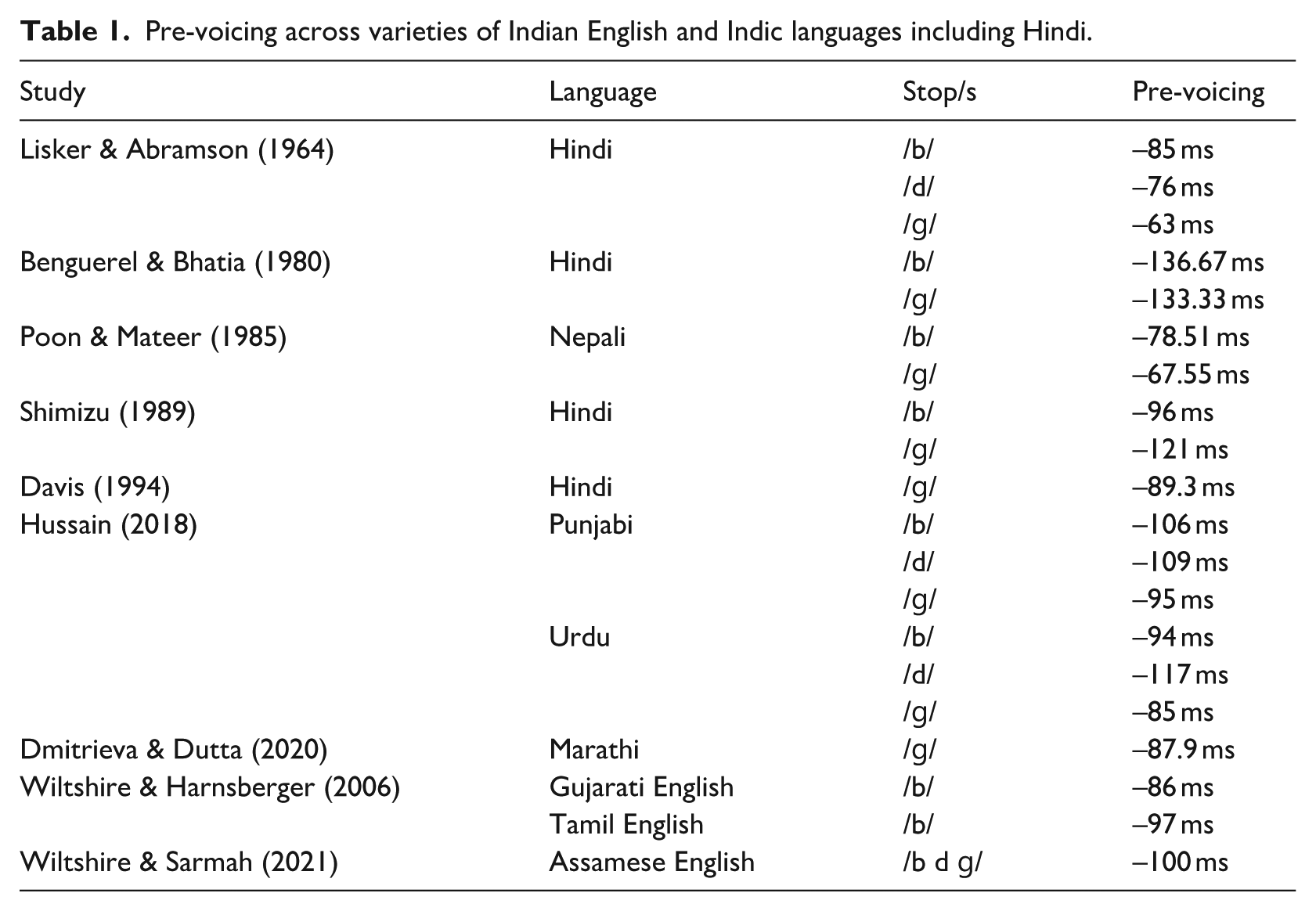
Substantial previous research has examined backward transfer in VOT in voiceless stops (Chang, 2012, 2013; Flege & Eefting, 1987a, 1987b; Lev-Ari & Peperkamp, 2013; Mayr et al., 2012; Stoehr et al., 2017) and voiced stops (Chang, 2013; Stoehr et al., 2017). While the finding of assimilation is much more common for VOT in voiceless stops (Lev-Ari & Peperkamp, 2013; Major, 1992; Stoehr et al., 2017), there is less evidence of change for pre-voicing in L1 voiced stops in response to L2 contact (Flege & Eefting, 1987a; Mayr et al., 2012; Stoehr et al., 2017).
2. Burst Amplitude: The spectral amplitude, or loudness, of the stop burst has also been shown to distinguish both place and voicing in Hindi stops (Pruitt et al., 2006; Singh & Tiwari, 2016). In a small-scale study, Shaktawat (2018) also observed that native Glaswegian speakers had less intense bursts than Glaswasians whose English was influenced by Urdu/Punjabi. Here burst amplitude is captured using the measure of Relative Burst Intensity (Kirkham, 2011; Sundara, 2005; Sundara et al., 2006). Prior to Shaktawat (2018) and Kirkham (2011) examined relative burst intensity (RBI) in British-Asians (in Sheffield) in coronal plosives /t/ and /d/, where British-Asian /t/, but not /d/, was found to have greater burst intensity than the British English counterpart.
In sum, word-initial Glaswegian plosives have lower burst intensity and less pre-voicing than either Indian English or Hindi (Shaktawat, 2023). In the current study, we ask whether Glaswasians show evidence of assimilation, dissimilation, or no transfer in their production of word-initial /b d ɡ/. If there is assimilation, then Glaswasians will exhibit (1) less or no pre-voicing, (2) lower burst intensity as compared to Indians in both languages (Table 2). However, in case of dissimilation, Glaswasians will exhibit (1) more pre-voicing, and/or (2) higher burst intensity than Indians to contrast them from Glasgow English norms (Table 2). Finally, if there is no backward transfer, then Glaswasians will exhibit the same pre-voicing and burst intensity patterns as Indians in both languages.
Summary of possible outcomes (assimilation or dissimilation) for each sound category and feature combination.
The variables involved for this sound category are Group (Glaswasian/Indian), Language (English/Hindi) and Phone (b/d/ɡ). A Group effect will indicate backward transfer, and interaction between Group and Language will indicate if one language is more susceptible to transfer than the other. Interactions between Group and Phone or Language and Phone will indicate that different places of articulation are differentially sensitive to transfer effects.
Word-medial /u/
A characteristic feature of Scottish English is the realization of /u/, as a mid-high, central-front vowel [ʉ], with weakly-protruded or neutral lip position and a fronted tongue body (Stuart-Smith, 2004; Wells, 1982). Moreover, Stuart-Smith et al. (2017) found that that Glasgow English [ʉ] showed lowering, as opposed to fronting in other Anglo-English dialects. However, in both Indian English and Hindi this vowel is realized as a high, fully back vowel with well-rounded lips (Gargesh, 2008; Maxwell & Fletcher, 2009; Wiltshire & Harnsberger, 2006). F1 lowers as the vowel height increases and F2 decreases as the vowel becomes backer. Furthermore, all formant frequencies tend to decrease as the length of the vocal tract increases (Hayward, 2000). The length of the vocal tract can be increased by lip protrusion and rounding. Therefore, increased rounding in vowels tends to lower all the formants but especially F2 (Hayward, 2000).
Previous research on backward transfer with vowels has been variable. Some has observed assimilation (Bergmann et al., 2016; Chang, 2012; Mayr et al., 2012; Mora & Nadeu, 2012); others have found dissimilation (Flege et al., 2003; Guion, 2003; Oh et al., 2011), and others have found no change (Bergmann et al., 2016; Flege, 1987). Furthermore, as was the case with /l/ and the voiced plosives, most research on /u/ in British-Asians has been in relation to its realization in second, third and so forth generations (Alam, 2015; Evans et al., 2007; McCarthy et al., 2011, 2013). It remains an open question, therefore, to what extent first-generation Glaswasians will manifest backward transfer effects in their /u/ vowel.
In the case of assimilation to Glasgow English, Glaswasians will have lower vowel height reflected in higher F1, more fronted articulation reflected in higher F2 values, and less-rounded articulation which would be reflected in higher F1, F2 and F3 than Indians in both languages (Table 2). However, in the case of dissimilation, Glaswasians will exhibit lower F1, F2 and F3, likely from a higher, backer and more rounded articulation even than Indians to contrast the native /u/ from the Glaswegian counterpart (Table 2). Finally, if there is no interaction and backward transfer, then Glaswasians will have similar values for F1, F2, and F3 as Indians. An effect of Group will indicate backward transfer, and its interaction with Language will reveal whether Indian English and Hindi differ in their sensitivity to this transfer.
Materials
The participants were recorded reading one sentence-list each in English and Hindi. The carrier sentence for the English wordlist was Say ____ again and for the Hindi wordlist was /kəha: ___ a: pne?/. It can be translated as ‘Did you say____?’. The target consonants occurred in word-initial position whereas the target vowel occurred in word-medial position surrounded by consonants. The target sound always occurred in the stressed syllable in disyllabic words. There were ten words per target sound.
Procedure
The data for both groups was collected over the months of July and August (2018). The College of Arts Ethics Committee, University of Glasgow, granted ethical approval for this study. All participants gave their informed written consent prior to participating. They were recorded in quiet rooms on a Zoom H4n recorder with an external Beyerdynamic Opus 55.09 headset microphone. The control ‘Indian’ group was recorded in India remotely with informants using a variety of microphones – mostly on recorders of mobile-phones. Therefore, as compared to the Glaswasian group, there may be more inter-speaker variability within the Indian group since they used different recording devices. However, this should not cause any between-language variability since they used the same device to produce both Hindi and English sentences.
Data analysis
The recorded speech data was acoustically analysed in two steps. First the audio files were annotated in PRAAT (Boersma & Weenink, 2018) with segment boundaries positioned according to acoustic landmarks on both waveform and spectrogram. A PRAAT script was run on these annotations to extract the following measures: mean measures of the first three formants for /U/ vowel; mean values of the first two formants for /l/ and the difference between them (F2-F1), and VOT and RBI for the voiced plosives. Statistical analyses and visualizations were conducted in R in R Studio, Version 3.6.3 (R Core Team, 2020). Repeated-measures factorial analyses of variance (ANOVA) (using ez package, version 4.4.0) and t-tests were used for cross-analysis across variables Group, Language and Phone (Phone only for voiced plosives). Group is between-subject but within-item, while Language and Phone are within-subject and between-item. The t-tests were performed with a Bonferroni-correction for multiple comparisons.
Results
/l/
The dependent variable here is F2-F1 distance. Smaller F2-F1 distance indicates a darker /l/ whereas larger F2-F1 distance indicates clearer /l/.
There was a significant main effect by subject and by item for Language, F1(1, 38) = 33.3, p < 0. 001; F2(1, 18) = 90.21, p < .001, qualified by interaction between Group and Language, F1(1, 38) = 5.22, p < .03; F2(1, 18) = 42, p < .001. The nature of the main effect of Language was that for both groups English /l/ has a larger F2-F1 distance than Hindi /l/, and so is clearer than Hindi /l/. The nature of interaction between Group and Language was that the difference between groups appears to go in different directions between the two languages. Glaswasians had darker /l/ than Indians in English, but in Hindi it was the reverse (as illustrated in Figure 1).
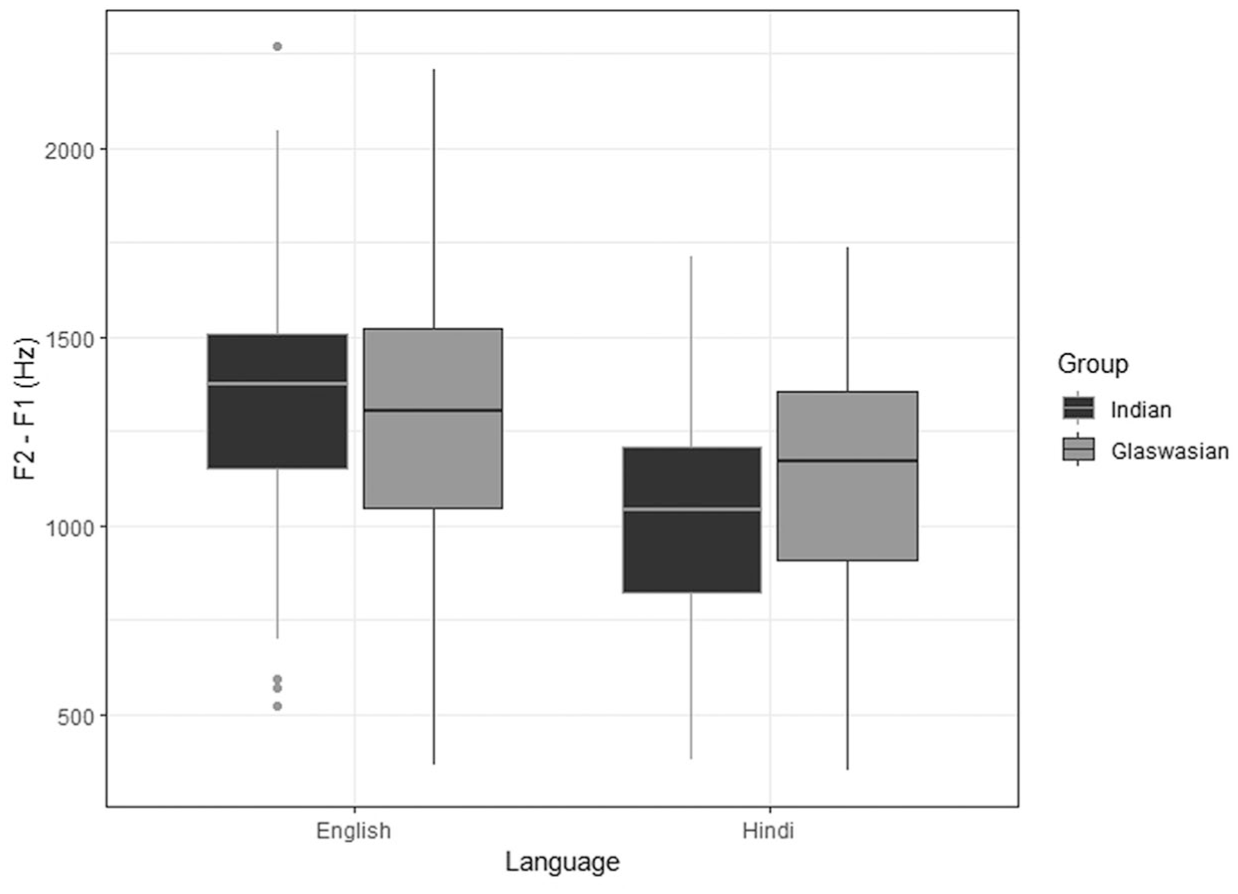
F2-F1 difference for Glaswasians and Indians for word-initial /l/ in English and Hindi.
A post hoc Welch paired t-test aggregated across items was conducted to compare F2-F1 distance across groups and language. Since two comparisons were required to explore these findings, the new α-level of significance was set at .025 (.05/2). In English, there was a significant difference between groups in the F2-F1 distance, t2(9) = −3.9, p = .003. The mean F2-F1 distance was reduced for Glaswasians relative to Indians. In other words, in English, /l/ is darker in Glaswasians than in Indians. This is consistent with assimilation as Glaswasian /l/ in Indian English was assimilated to Glasgow English by becoming darker with less F2-F1 distance.
There was also a significant difference in F2-F1 distance in Hindi, t2(9) = 5.23, p < .001. The mean difference for Glaswasians was larger than Indians indicating that Hindi /l/ in Glaswasians was clearer than that of Indians. This pattern is consistent with dissimilation wherein the speakers are contrasting clear Hindi /l/ and darker Glasgow English /l/.
/b d ɡ/
In the ANOVA test, the assumption of sphericity was checked using Mauchly’s Test for Sphericity and degrees of freedom were adjusted using Greenhouse-Geisser correction.
Pre-voicing
The dependent variable here is negative VOT. Higher values indicate less pre-voicing and lower values indicate more pre-voicing. Very few plosives showed no voicing during closure at all.
There was a significant main effect by subject and by item for Phone, F1(1.84, 69.9) = 34.2, p < .001; F2(2, 54) = 38.07, p < .001, qualified by an interaction between Language and Phone, F1(1.56, 59.59) = 5.21, p = .01; F2(2, 54) = 4.29, p = .01. The nature of the main effect of Phone was that pre-voicing values differ according to stop place of articulation: /b/ has the lowest VOT, indicating highest pre-voicing (lower VOT values), followed by /d/ and then /ɡ/. The nature of interaction between Language and Phone was that the effect of language on pre-voicing was different for different plosives. In /b/ and /ɡ/, there is more pre-voicing in English than in Hindi. In /d/, pre-voicing is almost the same in both languages, with English showing comparatively less pre-voicing with longer VOTs (Figure 2).
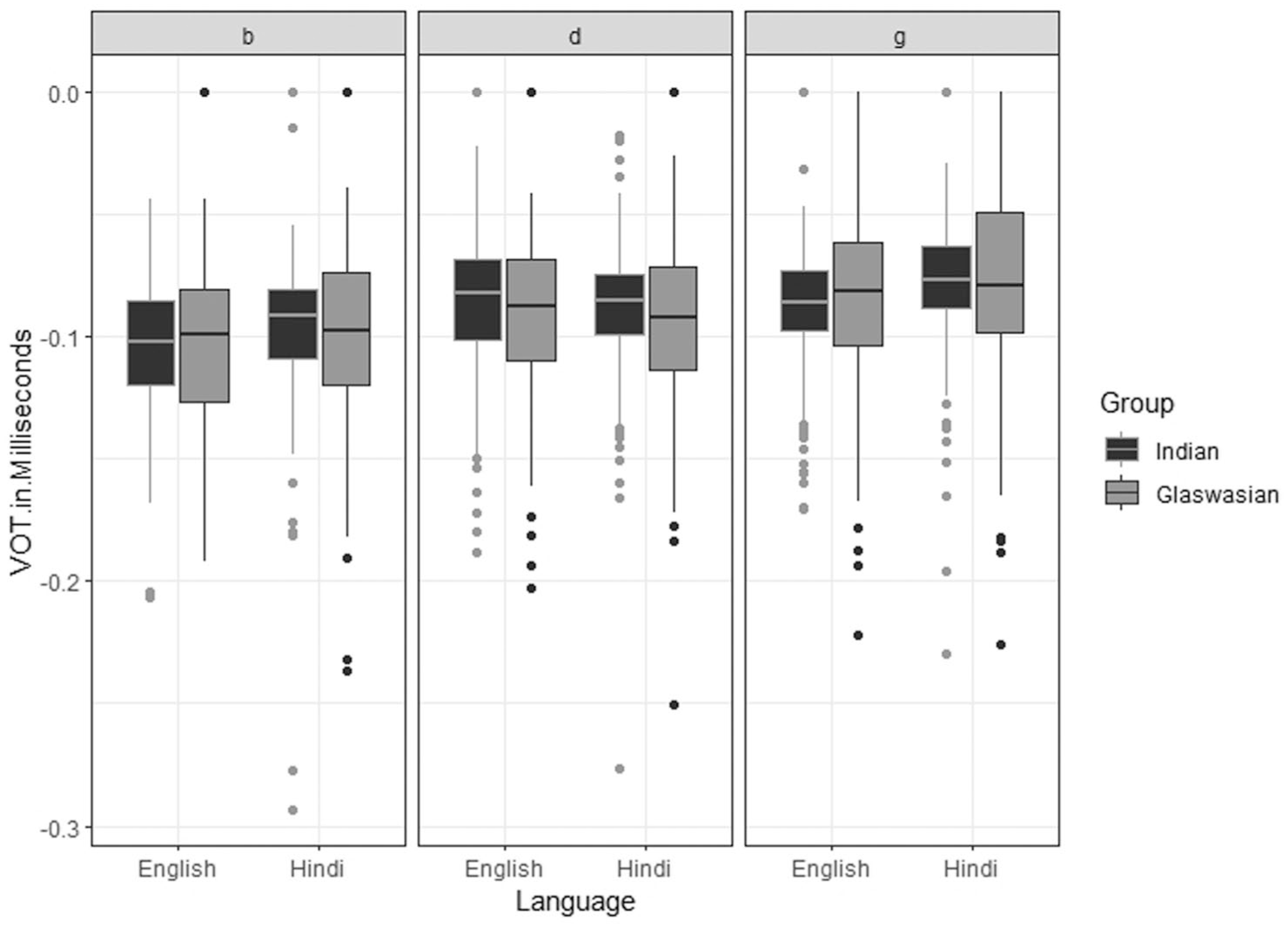
VOT of /b d ɡ/ across Language and Group.
However, there was no significant main effect of Group by subject, F1(1, 38) = 0.54, p = .46, but it was significant by item, F2(1, 54) = 11.09, p < .001. Similarly, Language was insignificant by subject, F1 (1, 38) = 1.98, p = .16, but significant by item, F2(1, 54) = 6.75, p = .012. Group was not qualified by any other interactions both by subject and by item– Group and Language, F1(1, 38) = 0.20, p = .65; F2(1, 54) = 1.41, p = .24, Group and Phone, F1(2, 76) = 1.18, p = .31; F2(2, 54) = 3.05, p = .055, and Group, Language and Phone, F1(2, 76) = 0.03, p = .94; F2(2, 54) = 0.10, p = .90.
Since the main effect of Group was only significant by item, a post hoc Welsh paired t-test aggregated by item, across all phones and languages, was conducted to compare mean pre-voicing between Glaswasians and Indians. This difference turned out to be significant, t2(59) = 3.25, p = .001. The mean pre-voicing across all phones and languages, was reduced for Indians as compared to Glaswasians. In other words, Glaswasians had higher pre-voicing than Indians in general. This is evidence of dissimilation wherein Glaswasians are contrasting higher pre-voicing in their native voiced plosives and lower pre-voicing in Glasgow English voiced plosives.
RBI
There were significant main effects both by subject and by item for Phone, F1(1.9, 72.28) = 289.19, p < .001; F2(2, 54) = 254.62, p < .001, and Language, F1(1, 38) = 15.30, p < .001; F2(1, 54) = 11.39, p = .001, qualified by interactions between Group and Language, F1(1, 38) = 13.92, p < .001; F2(1.54) = 35.97, p < .001, and Language and Phone, F1(1.63, 62.09) = 7.88, p = .001; F2(2, 54) = 3.76, p = .029. A main effect of Group was significant by item, F2(1, 54) = 7.6, p = .001, but not by subject, F1(1, 38) = 2.30, p = .1. This indicates a lack of a robust effect and must be interpreted with caution.
The nature of the main effect of Phone was that the intensity varied by place of articulation: the phone /ɡ/ had lowest burst intensity, /d/ the highest and /b/ was closer to /d/. The main effect of language was driven by its interaction with Group. Whereas the Glaswasians had similar burst intensities in English and Hindi, Indians produced higher burst intensity in Hindi than in English for all three phones. The nature of interaction between Language and Phone was that the effect of language on burst intensity was different for different phones– in /b/ the burst intensity was almost equal for both languages, whereas in both /d/ and /ɡ/, Hindi has higher burst intensity than English.
Other significant interactions emerged by subject and by item between Phone and Group, F1(1.9, 72.28) = 7.36, p = .001; F2(2, 54) = 22.40, p < .001, and between Group, Language and Phone, F1(1.63, 62.09) = 4.55, p = .01; F2(2, 54) = 7.6, p = .001. These interactions indicate that the effect of Group on intensity is also different for different phones and languages. Indians had significantly higher burst intensity for /d/ and /b/ than Glaswasian speakers, whereas Glaswasians had slightly higher burst intensity than Indians for /ɡ/.
Post hoc Welch paired t-tests aggregated by item were conducted to compare mean RBI between groups across Language and Phone. Since six comparisons were required to explore these findings across Language, Group and Phone, the new α-level of significance was set at .008 (.05/6). For /b/, the mean difference between Glaswasians and Indians was insignificant in English, t2(9) = .58, p = .57, but significant in Hindi, t2(9) = −9.56, p < .001. For /d/ the mean difference between groups was significant in both English, t2(9) = −4.56, p = .001, and Hindi, t2(9) = −15.05, p < .001. For /ɡ/, the difference was insignificant in English, t2(9) = 2.52 p < .03, but significant in Hindi, t2(9) = −8.10, p2 < .001. Therefore, Glaswasian /b ɡ/ in Hindi and /d/ in both Hindi and English underwent assimilation as they have lower burst intensity than Indians (Figure 3). On the other hand, Glaswasian /b/ and /ɡ/ in English did not undergo any change as they had similar values as Indians.
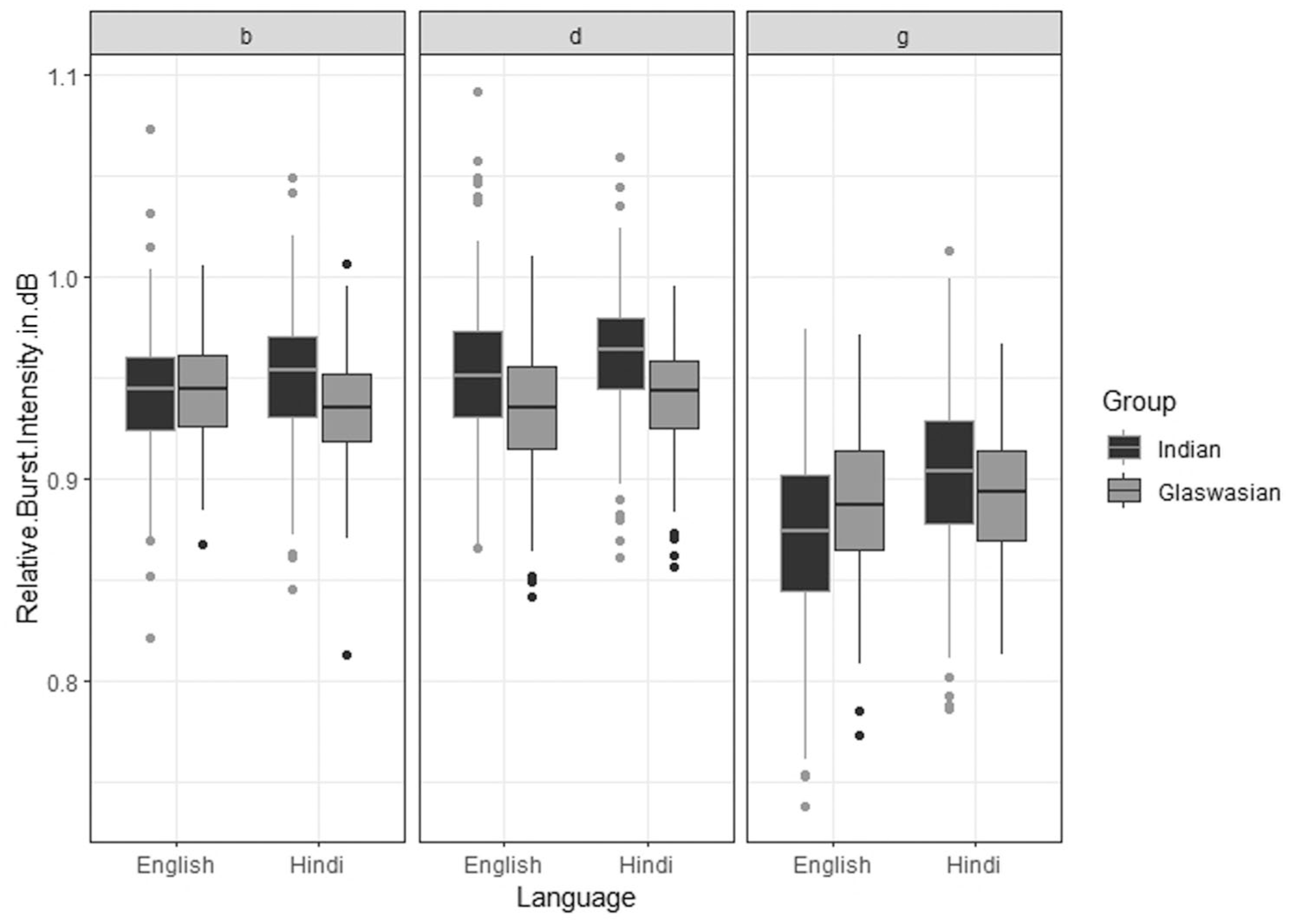
RBI for /b d ɡ/ across Language and Speaker Groups.
To summarize, in case of pre-voicing, both groups showed similar VOT values: Glaswasian VOT was more or less equal to Indian VOT. Therefore, pre-voicing for Glaswasians remained unchanged in both languages. In case of burst intensity, all Glaswasian speakers produced their plosives in Hindi with significantly lower RBI than Indians, and so were more like what we might expect for Glaswegian (relatively quieter bursts). This pattern is consistent with assimilation to Glasgow English, wherein Glaswasian production of their Hindi voiced plosives has become more Glaswegian. However, in English, only /d/ had significantly lowered RBI for Glaswasians than Indians. Therefore, all three voiced plosives in Hindi became more Glaswegian by undergoing assimilation. On the other hand, /b/ and /ɡ/ in the Glaswasians’ English remained uninfluenced.
/u/
The dependent variables here are F1, F2 and F3.
F1
Here the dependent variable is F1. Lowered F1 indicates increased vowel height (a closer vowel), while larger F1 values are related to a more open vowel. Lower F1 may also indicate more rounding and higher F1 may indicate less rounding.
The main effect of Group was insignificant by subject, F1(1, 38) = 2.19, p = .14, but significant by item, F2(1, 18) = 55.14, p < .001. The main effect of Language was insignificant both by subject and by item, F1(1, 38) = 2.67, p = .11; F2(1, 18) = 2.09, p = .16. The interaction between Group and Language was insignificant by subject, F1(1, 38) = 2.94, p = .09, but significant by item, F2(1, 18) = 11.53, p = .003. This inconsistency between by-subject and by-item analysis indicates that results must be interpreted with caution.
Post hoc Welch paired t-tests aggregated by item were conducted to compare mean F1 across Group and Language, with α-values Bonferroni-corrected to .025 for the two comparisons. The mean difference between Glaswasians and Indians was insignificant in English, t2(9) = −2.41, p = .03, but significant in Hindi, t2(9) = −9.9, p < .001. F1 was similar for both groups in English but significantly lower for Glaswasians in Hindi than Indians. The results suggest that Glaswasian speakers’ productions of /u/ in Hindi has become more raised than Indians in Hindi, and possibly also less rounded. This pattern is evidence for dissimilation of Glaswasian F1 likely reflecting a shift in vowel height in Hindi, but no influence in English (Figure 4).
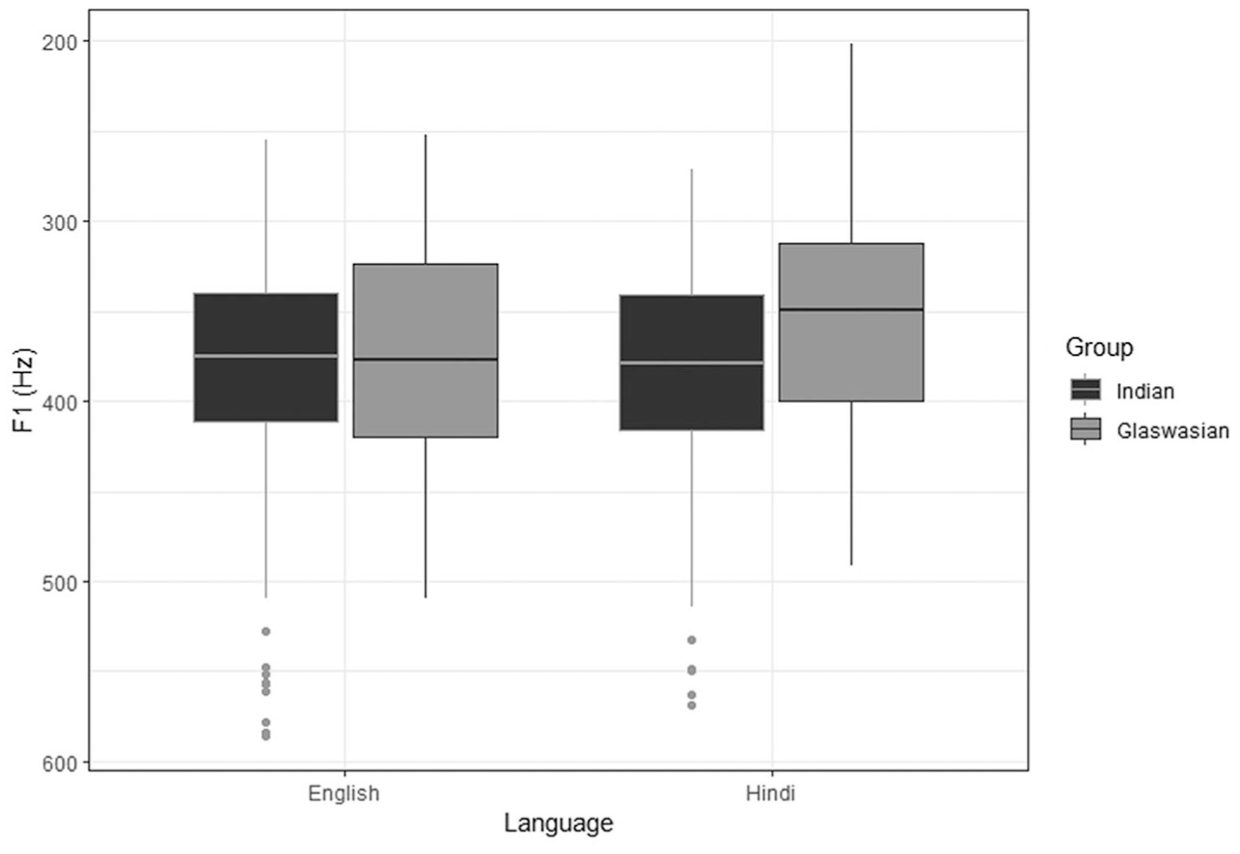
F1 across Language and Speaker Groups.
F2
Here the dependent variable is F2. Low F2 may indicate backness and rounding, whereas higher F2 suggests fronting and less rounding.
There was a significant main effect of Group by subject and by item, F1(1, 38) = 5.94, p = .01; F2(1, 18) = 48.31, p < .001, which indicates that F2 is different for the two groups– Glaswasians have significantly higher values than Indians consistently for both languages (Figure 5). There was no main effect of Language by subject or by item, F1(1, 38) = 3.64, p = .06; F2(1, 18) = 0.39, p = .53. The interaction between Group and Language was significant by item, F2(1, 18) = 5.28, p = .033, but not by subject, F1(1, 38) = 1.92, p = .17. Therefore, this interpretation should be made with caution.
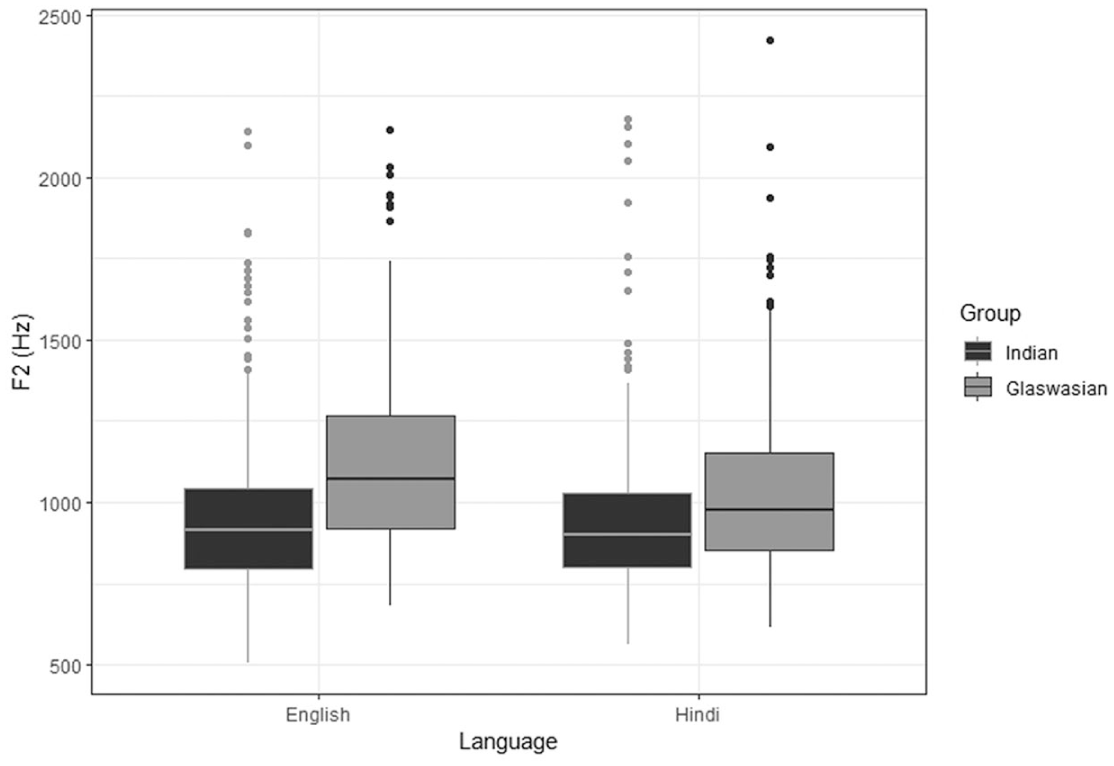
F2 across Language and Speaker Groups.
Post hoc Welch paired t-tests aggregated by item were conducted to compare mean F2 across Group and Language. Since two comparisons were required to explore these findings, the new α-level of significance was set at .025 (.05/2). The mean difference between Glaswasians and Indians was significant in both English, t2(9) = 6.21, p < .001, and Hindi, t2(9) = .3.47, p = .006. This pattern is evidence for assimilation of Glaswasian F2 in both languages, suggesting more fronted and less rounded /u/ in Hindi and English, like Glaswegian.
F3
As Figure 6 shows, there was a significant main effect of Group by subject and by item, F1(1, 38) = 7.33, p = .01; F2(1, 18) = 93.61, p < .001, which indicates that F3 is different for the two groups – Glaswasians have significantly higher values than Indians for both languages. A significant main effect of Language also emerged, F1(1, 38) = 4.83, p = .03; F2(1, 18) = 7.96, p = .01, such that F3 is higher in English than in Hindi. The interaction between Group and Language was insignificant, F1(1, 38) = 0.46, p = .49; F2(1, 18) = 2.47, p = .13.
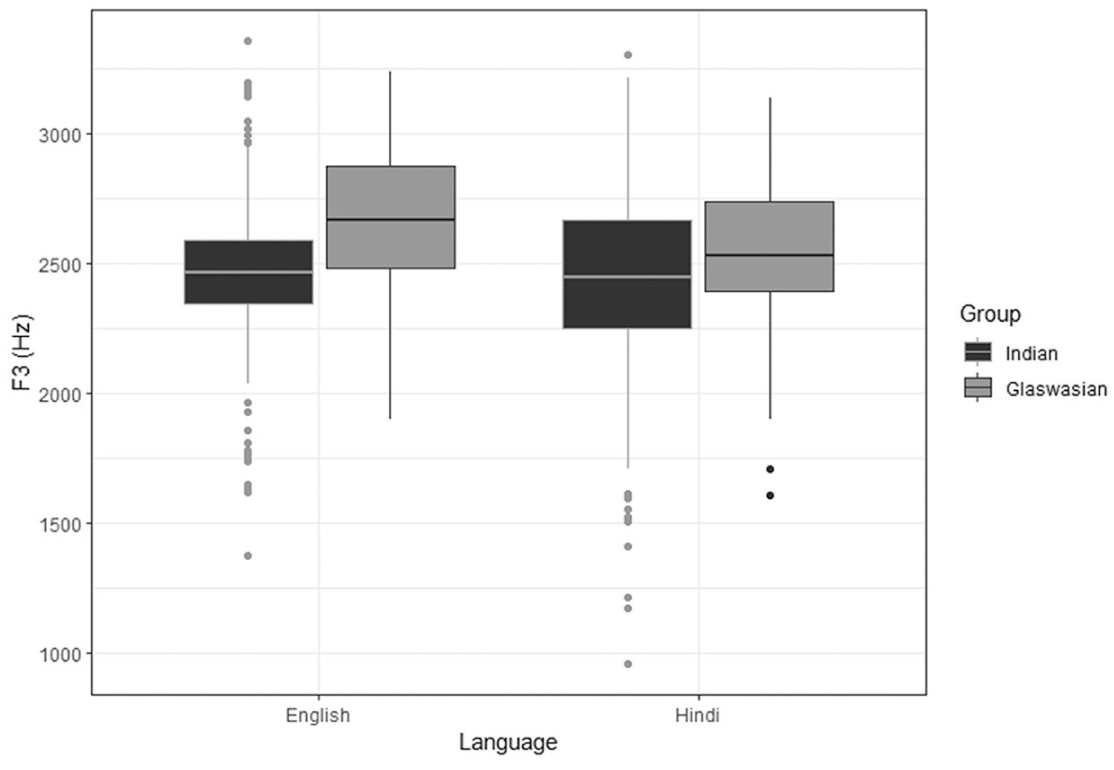
F3 across Language and Groups.
Post hoc Welch Two Sample t-tests aggregated by item were conducted to compare mean F3 across Group and Language. Since two comparisons were required to explore these findings, the new α-level of significance was set at .025 (.05/2). The mean difference between Glaswasians and Indians was significant in both English, t2(9) = 10.6, p < .001, and Hindi, t2(9) = 4.8, p < .001. This pattern is evidence of assimilation to Glasgow English of Glaswasian F3 in both languages, likely reflecting less rounding in Glaswasian speakers’ productions of/u/ in both their Hindi and English.
Discussion
Table 3 summarizes the results by showing how this interaction between phonological systems influenced the sounds in terms of assimilation, dissimilation and no change. The aspects that have become more Glaswegian-like in their realization are categorized under ‘Assimilation’, those that have become more unlike the Glaswegian and native realization are categorized under ‘Dissimilation’; whereas those that retain their original features and have not been influenced at all are categorized under ‘No Change’.
Direction of backward transfer summarized across sounds for Glaswasian speakers’ English and Hindi.
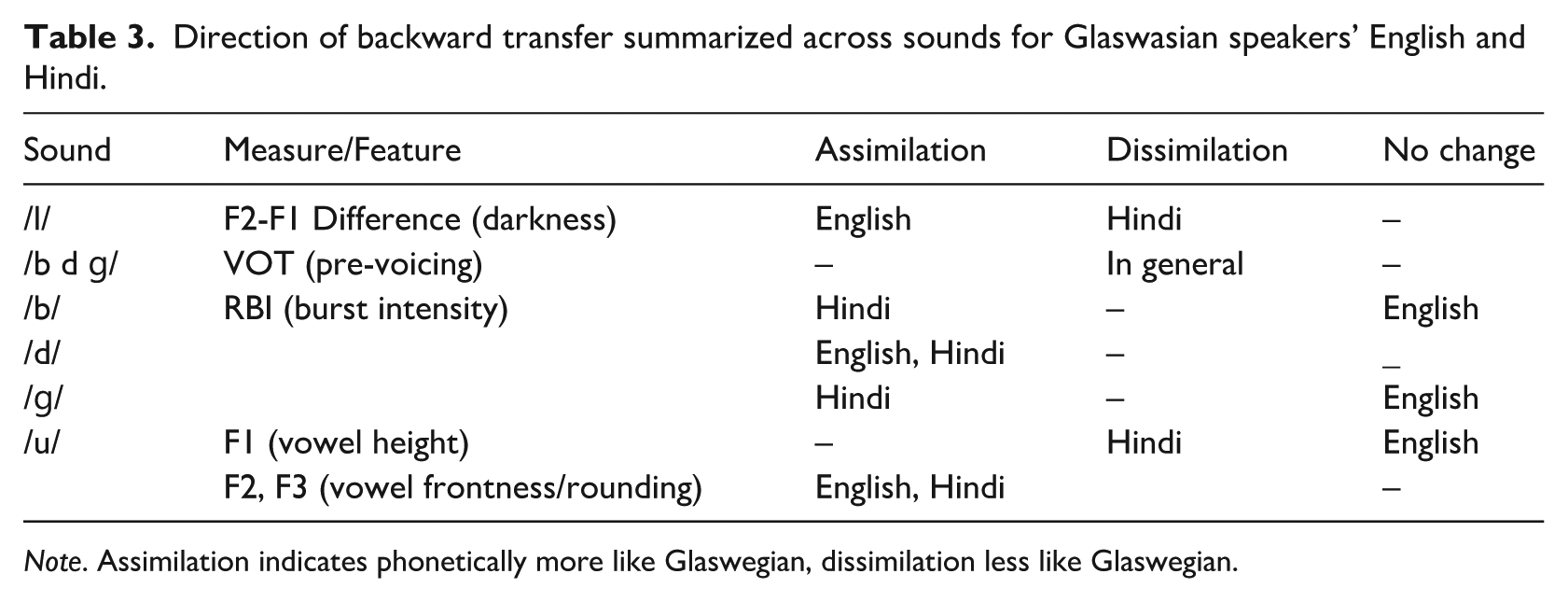
Note. Assimilation indicates phonetically more like Glaswegian, dissimilation less like Glaswegian.
Three key patterns can be observed in the findings regarding backward transfer. First, for all sounds bar /d/, there is a difference by language in how Glaswasian Hindi and English categories have behaved in response to Glaswegian categories. Glaswasians have assimilated their Indian English clear /l/ to dark /l/. However, they have dissimilated and contrasted their /l/ in Hindi from the Glaswegian variant, which is now even clearer than the Indian control Hindi variant. Therefore, while Glaswasians have merged the clear and dark sound category in English, a new category has been formed for Hindi /l/, or the existing category for Hindi /l/ has shifted away from the new, merged English category. An identical pattern can be observed for burst intensity in the voiced plosives /b ɡ/ which underwent assimilation in Hindi but remained unchanged in Indian English. Similarly, in the vowel /u/, F1 in Hindi underwent dissimilation but remained unchanged in Indian English.
Second, findings also reveal equivalent behaviour of sound categories for features in both languages. This can be identified for /u/ (F2, F3), and /d/ (RBI), where Glaswasians showed assimilation in both Hindi and IE.
Finally, the findings also suggest partial assimilation (Romaine, 1989) in /b d ɡ/ and /u/ wherein some measures (RBI; F2, F3), but not all (pre-voicing; F1), show assimilation.
These findings are consistent with the principles of the SLM-r (Flege & Bohn, 2021), which posits a common phonetic space in the multilingual mind where all sound systems can interact and influence each other. The observed co-occurrence of assimilation, dissimilation, and partial-assimilation across sound categories suggests that backward transfer is a multifaceted process. These findings suggest that rather than being either uniform or random, backward transfer may be influenced by both general phonetic mechanisms and category-specific properties. However, to determine the extent to which such effects are indeed systematic or category/segment dependent, further research which examines a wider range of sounds and speakers is needed.
The case of /d/ offers an interesting window into the nuances of assimilation. This phone showed the most assimilation for burst intensity (found in both Hindi and Indian English), which is surprising because in other respects this stop phonetically is the most distinct among /b d ɡ/ to their Glaswegian counterparts. This is because native Indian English and Hindi /d/ has a retroflex realization but is denti-alveolar in Glasgow English, whereas /b ɡ/ have similar manner and place of articulation across Indian English, Hindi and Glasgow English. The SLM-r predicts more assimilation for similar L1 and L2 phones and less otherwise. However, this situation of most assimilation in /d/ is supported by the research on perceptual confusability. Confusability between dental, alveolar, and retroflex plosives is common for both native and non-native speakers (Ahmed & Agrawal, 1969; Bundgaard-Nielsen, Baker, Kroos, et al., 2015; Bundgaard-Nielsen, Baker, Maxwell, & Fletcher, 2015; Singh & Tiwari, 2016). Ahmed and Agrawal (1969) found these contrasts difficult to distinguish by native Hindi speakers and Pruitt et al. (2006) reported the same for American and Japanese speakers’ perception of Hindi dental and retroflex plosives. Similar confusability has been observed for dental and alveolar contrasts in Wubuy, an indigenous language of Australia (Bundgaard-Nielsen, Baker, Kroos, et al., 2015; Bundgaard-Nielsen, Baker, Maxwell, & Fletcher, 2015). This shows that it is possible to find perceptual confusability between sounds which might otherwise be considered phonetically distinct. Therefore, along with being the evidence for a common phonetic space, susceptibility to assimilation might also be used as a proxy measure for perceptual similarity.
Another surprising outcome emerged with the lateral produced by the Indian controls in Hindi, which is usually reported to have a clearer realization (Gargesh, 2008; Wells, 1982). However, in this study it was unexpectedly much darker as compared to its English counterpart. It is very unlikely to be a function of recording on mobile phones as the English /l/ produced by the same speakers was very clear. Therefore, it seems possible that this is a new finding which shows that there is some change in progress in how /l/ is realized in Hindi in India.
There are also instances where no backward transfer was found, such as /u/ for F1 in English and /b ɡ/ for burst intensity in English. This may be attributed to the status of Glasgow English in the wider British context. That is, while Glasgow English is the majority in Glasgow, it is somewhat marginalized in the British context. Therefore, it is possible that immigrant speakers might resist some of the features of Glasgow-English in favour of more ‘standard’ British-English phonetic features. 1 To consider this, we might look at salient Glaswegian features that set this variety of English apart from other British varieties. These features are monophthongised FACE & GOAT vowels, /u/ fronting, less aspirated voiceless stops, rhoticity, darker laterals, and denti-alveolar realization of the coronals /t d/. Of these, the present study only examined the /u/ vowel and the lateral. The findings suggested shift towards Glasgow English (assimilation; /u/ for F2, F3, and /l/ in English), shift away from Glasgow English (dissimilation; /l/ in Hindi), and no change (u for F1 in English). Based on this evidence, it remains unclear if they are resisting Glaswegian features. However, in the wider context, there is plenty of research evidence to demonstrate that British Asian accents of English show evidence of transfer according to the local regional accent, for example, Al-Asiri et al. (2025), Alam (2015), Heselwood and Mcchrystal (2000) and Wormald (2015). Moreover, Al-Asiri’s (2023) investigation of the Iraqi-Arab immigrant populations in Glasgow and London shows that this is also not just limited to Asians.
Glasgow English and Indian English have typological proximity and hence more potentially perceptual similarity. Based on this, we predicted that the effect of Glasgow English on Indian English would be more substantial and immediate thus causing definite assimilation than for Hindi (Trudgill, 1986). However, results do not support this prediction. As discussed above, the interaction showed mixed results, and in fact, for the sounds and features considered here, a bit more backward transfer was found in Hindi. Sounds in Indian English and Hindi were influenced differently by Glasgow English causing different outcomes. There are cases where the English sound was assimilated but the Hindi sound was dissimilated (/l/), or where the Hindi sound was assimilated but the English sound was not (burst intensity in /b ɡ/). Thus, we conclude that even though Indian English is more closely related to Glasgow English linguistically, it does not ensure that it will necessarily undergo transfer from Glasgow English. Therefore, familial proximity, perceptual and articulatory similarity do not seem to be the only factors (though they are major factors) that explain transfer. However, the transfer-effects found here may not be permanent. It is possible that the sounds studied here are in the process of an on-going change and only a longitudinal study can explore if they do change over time and how. In addition, as argued by the SLM-r, backward transfer processes may be affected by many other factors such as but not limited to individual speaker characteristics and phonetic context. Taking these into account in future work will allow for better examination of this phenomenon.
Conclusion
This study confirms that experience of an L2 sound system can significantly affect the production of sounds in L1, at the level of both language and dialect, consistent with the two major propositions of the SLM-r. Indian immigrants in Glasgow are experiencing phonetic backward transfer that can be brought into effect in a variety of ways (dissimilation, assimilation, partial assimilation and partial dissimilation). Moreover, it is the first study to examine this in a minority ethnic context in United Kingdom, as well as in relation to Hindi. It analyses the mechanism that may be involved in the creation of hybrid accents (such as the ‘Glaswasian’ accent; Alam, 2006) which is further discussed in detail in Al-Asiri et al. (2025), in relation to Thomas’ (2019) model of ethnolect development. The study also extends our understanding of how cross-linguistic influence operates in the multilingual mind across different sound categories by showing that backward transfer does not follow a fully systematic pattern across categories but reflects selective, category-dependent interactions between sound systems. Future studies can attempt at examining whether these patterns of transfer persist for these sounds in different groups of speakers and contact situations, and whether they extend to other sounds or not. A longitudinal study would certainly be helpful in tracking the permanence of this sound change.
Footnotes
Acknowledgements
Gratitude to anyone who helped with data collection, participants and referrers. Thanks also to the anonymous reviewers for their review and helpful guidance.

Ethical considerations
The University of Glasgow, in accordance with legislation and the requirements of UK research councils, granted the ethical clearance for this study.
Consent to participate
Written informed consent to publish this paper was obtained from the participants.
Funding
The authors received no financial support for the research, authorship, and/or publication of this article.
Declaration of conflicting interests
The authors declared no potential conflicts of interest with respect to the research, authorship, and/or publication of this article.