




Abstract
The present article looks at different patterns of adjectival postmodification in Old English. A detailed corpus analysis is performed, whose results are interpreted within the framework of Construction Grammar. This study contributes to previous research on the subject by using a large set of corpus data which pave the way for adopting a usage-based approach. The results indicate that the patterns analyzed fulfilled different functions, which in the framework adopted is grounds enough for assigning them to different conceptual categories, i.e., “constructions.” Further, I investigate the mutual relations between these constructions as well as the internal dynamics of their functions and development. The findings support the basic constructionist notion that language is most effectively described as a complex and dynamic network of interrelated constructions.
1. Introduction
The present article looks at different patterns of adjectival postmodification in Old English (OE), as illustrated in (1)-(3).
(1) ða dioflu gearwe (cobede,Bede_5:14.440.13.4432)
‘the devil ready’
(2) hefige synne & myccle (cogregdC,GDPref_and_3_[C]:15.207.25.2737)
‘heavy sin and great’
(3) halig mod sylfwille (coaelive,ÆLS[Agatha]:204.2139)
‘pure mind spontaneous’
In (1), the adjective immediately follows the noun, but in (2), it is additionally preceded by a conjunction, in which case a prenominal adjective is obligatorily present; it might also appear when the conjunction is absent, as in (3). The aim of the study is to explore the characteristics of each pattern with the help of a large set of corpus data. The framework for the interpretation of these data is Construction Grammar. The central assumption in the following analysis is therefore that formal similarities (in this case the postnominal placement of an adjective) are as important in classifying patterns as the functions which those patterns fulfill. This approach follows directly from the basic constructionist tenet that language is a network of “constructions” which are defined as form-function pairings. Since “network” entails interrelations, these will be shown to obtain between the analyzed patterns both synchronically and diachronically. In other words, it will be demonstrated that pairings of form and meaning (constructions) occupying different network nodes may be linked horizontally, while change will be presented as the reconfiguration of links between particular forms and particular meanings. Globally, the paper will strengthen the notion that language—both at a given point in time and over time—is best studied as a complex network of constructions.
The subsections that follow discuss the constructionist framework. To explain the notion of language as a network most fully, emphasis is placed on Van de Velde’s (2014) suggestion that aside from hierarchical links, constructions may be also connected horizontally, and that forms and meanings are organized in a many-to-many fashion. Section 2 outlines the methodology of the study. Section 3 is a quantitative and qualitative analysis of patterns in (1)-(3), and provides foundations for section 4, where these patterns are mapped onto a constructional network. Section 5 explains the internal dynamics of the above patterns—now interpreted as constructions—as they appear to be changing over time. Conclusions and further study directions follow in section 6.
1.1. The Framework
Studies within a broad constructionist framework have spawned a number of discrete theoretical approaches. Hoffmann and Trousdale (2013) note that the main advantage of these approaches lies in the fact that they “provide a uniform analysis of [. . .] linguistic features [and] achieve this without recourse to transformation/derivations or the employment of empty elements” (Hoffmann & Trousdale 2013:2). This is possible thanks to a shared central assumption that language as a system is best described through the concept of a “construction,” an “extended notion of the Saussurean sign” (Hoffmann & Trousdale 2013:2) operating on all linguistic layers. Thus, constructions are defined as “conventional, learned form-function pairings at varying levels of complexity and abstraction” (Goldberg 2013:17), which can range from monomorphemic items to long strings, characterized by different degrees of specificity. Crucially, constructions do not function in isolation, but form an ordered hierarchical network of vertical inheritance relations (Goldberg 1995, 2006, 2013; Croft 2007). This means that nodes in the network occupied by lexically underspecified abstract schemas take up positions higher in the hierarchy and sanction more concretized constructions situated lower in the vertical structure (see, e.g., Hoffmann & Trousdale 2013:2). For instance, inheriting from a general [Preposition + Noun Phrase] schema is a more specific [Preposition + Bare Noun] construction—indicating a “stereotypical activity associated with ‘N’”—whose fully substantive instantiations are such (micro-)constructions as at work and in prison (Goldberg 2013:21). These, in turn, are realized in actual communication by means of constructs, i.e., “empirically attested tokens” of a given construction (Traugott & Trousdale 2013:16).
Productive as this set-up of a network is, it does not always handle well such phenomena as constructional polysemy or functional overlap. To address this issue, Van de Velde (2014:147) suggests that network relations between constructions may obtain even if the latter are not linked hierarchically. He postulates the existence of horizontal links, whereby “the form-function relation of a particular construction may be partly motivated in relation to its neighbors” (Van de Velde 2014:147). Van de Velde (2014) explains this phenomenon using a number of examples, one of which concerns different types of subordinate clauses in Dutch, namely temporal and concessive. The former trigger the Subject-Verb inversion in the main clause, while the latter do not. The different syntactic behavior of the main clause indicates different degrees of integration of the respective subordinate clauses: time clauses are more tightly integrated into the sentence than concessive clauses. Looking at these two patterns from a constructional perspective, Van de Velde (2014:158) concludes that they are horizontally related constructions, in that it is “only in contrast to integration that non-integration is semiotically meaningful.”
Van de Velde’s (2014) addition of another dimension to mutual relations between constructions thus reinforces a basic tenet of constructionist approaches, namely that there exist “abstractions across sets of constructions which are (unconsciously) perceived by language-users to be closely related to each other in the constructional network” (Traugott & Trousdale 2013:14). Therefore, mapping constructions onto such language network architecture takes place in keeping with one of the core assumptions of cognitive grammar, according to which “formal distinctions are useful to the extent that they convey semantic or pragmatic [. . .] distinctions” (Goldberg 2013:16). This usage-based approach allows for detecting subtleties and nuances that other models may inadvertently overlook. In studies in OE syntax, Cichosz (2019:210), adopting a detailed constructional analysis, has shown “that clauses with quotative inversion, regardless of some superficial similarity and a partial structural overlap, pattern neither with clauses following the V-2 rule nor with V-1 declaratives” and confirmed that “such clauses should not be included in studies of the V-2 rule.” Therefore, the study proved that even formally similar patterns may be interpreted—on grounds of their different functions—as constructions sanctioned by different nodes in a constructional network.
This is an important outcome in the context of the present paper, which looks at three patterns that also share some formal similarities, i.e., they all have adjectives in the postnominal position. Following the constructionist framework, the main goal of this study is to determine if these patterns overlap functionally. In other words, do they have the same meaning and can therefore be classified as constructions sanctioned by one abstract schema, or do they represent different schemas? Until quantitative and qualitative evidence is given and interpreted, examples (1)-(3) above will be referred to as “patterns,” henceforth labeled N(oun)A(djective), A(djective)N(oun)C(onjunction)A(djective), and A(djective)N(oun)A(djective), respectively. “Pattern” differs from “construction” in that it only concerns form, as can be gleaned, e.g., from Traugott and Trousdale (2013). Hunston (2014:115) summarizes this difference by noting that patterns “are about output only, and are wholly descriptive,” while “constructions are viewed as mental constructs.” What follows is that patterns which users construe as fulfilling similar functions are grouped under broader schemas “as part of our domain-general capacity to categorize, establish relations, and to operate on both local and global levels” (Traugott & Trousdale 2013:50). In the following analysis, I will try to demonstrate that under this logic (1), (2), and (3) are indeed separate constructions, each sanctioned by discrete higher-level schemas. Even so, I will also make an attempt to show, in line with Van de Velde (2014), how for some of the adjectival constructions analyzed subtle “differences in meaning are correlated with differences in form, in such a way that we get a cline of closely-related constructions” linked horizontally (Van de Velde 2014:154-155).
Finally, since adjectival postposition in Present-Day English (PDE) is virtually gone, at least in the case of (2) and (3), where multiple adjectives are involved, I will suggest a constructional interpretation of how these two constructions—which I believe to have been originally linked horizontally—have been replaced by their prenominal variants, exemplified in (4) and (5) and henceforth labeled ACAN and AAN, respectively.
(4) stulor and digele swica (cocathom2,ÆCHom_II,_28:228.215.5075)
‘furtive and secret deceiver’
(5) geleaffullum læwedum mannum (cocathom2,ÆCHom_II,_4:39.299.871)
‘faithful lay men’
Crucial for a diachronic constructional approach to change is the concept of “reanalysis.” As Traugott and Trousdale (2013:58) remark, “no construction is entirely new,” and its initial appearance is contingent on establishing a temporary link between a construct and an already existing construction, which is possible thanks to our ability to think analogically. The authors explain that “the view of usage-based change [. . .] assumes that in their roles as speakers and hearers language users are not mirror images of each other,” so “speakers and hearers do not necessarily process language in similar ways” (Traugott & Trousdale 2013:53). In other words, while speakers might want hearers to interpret their utterance in a preconceived way, hearers decode it differently, and while—from their perspective—there often exist schemas in the network that will “fully sanction the construct [. . .] [i]n some cases no direct link may in fact be available, and then the hearer will attempt to make the best fit with an extant node or feature of a node, resulting in partial sanction” (Traugott & Trousdale 2013:52). However, in time, such peripheral constructions are likely to become more prototypical members of the schema. I will suggest that this is precisely what happened in the case of (4) and (5), which have replaced their postnominal counterparts, but have largely retained the functions of their predecessors, even though originally they may have fulfilled somewhat different roles.
It will be further argued, on the other hand, that these earlier meanings did not necessarily cease to be associated with the original forms (cf. Fried 2013). Expanding on this phenomenon, Van de Velde (2014:142) invokes the concept of “degeneracy,” which in evolutionary biology refers to a scenario where similar functions are performed by different structures, but these also “play a role elsewhere in the system.” In the diachronic perspective of change, this multi-functionality is achieved through strengthening and weakening of already existing links in a network, which is by definition characterized by “many-to-many relationships between form and meaning” (Van de Velde 2014:173). Van de Velde (2014) demonstrates this particular property at work by explaining, e.g., how the degrees of the agentivity of the experiencer ceased to be encoded in Dutch case frames due to inflectional leveling of Middle Dutch. Instead, it came to be realized by means of prepositions and voice, i.e., strategies that they had already relied on to a limited degree, and that, having taken on this new role, did not relinquish their other functions. In this paper, I will try to show that the (changing) network of OE adjectives is also at least partly “degenerate,” in that it displays some many-to-many relationships which undergo reconfiguration over time. In general, the proposed interpretation of the data is intended to strengthen the basic constructionist notion that language is a dynamic network of interrelated elements.
1.2. Previous Studies on OE Adjective Position
So far, the postnominal placement of OE adjectives has not received a constructionist treatment, and previous studies are divided on how to group patterns and what criteria to use. Most notably, Haumann (2003, 2010) draws a line between the “simple” postposition of (1) and (3), on the one hand, and the and-type postposition of (2), on the other. Haumann (2010) argues that adjectives in simple postposition are predicative, and as such only reference temporary qualities and receive restrictive interpretation. The presence of an optional prenominal adjective, as in (3), has no bearing on the reading of the postnominal one, for which the above interpretive properties are said to hold. As observed by Ringe and Taylor (2014:455), in line with Haumann’s (2010) argumentation, the postnominal modifier is still “a (secondary) predicate adjective, generated in post-nominal position.” Conversely, for cases such as (2), Haumann (2003) gives a deletion-based account, explaining that the second adjective is actually pre-posed in relation to some elided semantic material. In other words, the underlying structure of (2) would be along the lines of hefige synne & myccle synne (such an analysis is largely consistent with Sielanko 1994 and Pysz 2009). As a result, the postnominal adjective is seen as purely attributive and assigned the same status as adjectives in simple surface pre-position, shown in (6).
(6) niwe win on ealde bytta (cowsgosp,Mt_[WSCp]:9.17.534)
‘new wine in old bottles’
In sum, Haumann (2003, 2010) sees (1) and (3) as instances of true postposition, while in (2) the adjective is “falsely” postposed.
Fischer (2000, 2001, 2012) considers (1), (2), and (3) as examples of “linear iconicity” in OE. In this model, postnominal adjectives are predicative and discourse-new, so they are not really integrated with the head noun and as such are more likely to follow rather than precede it. If they are attributive and discourse-old, they will simply come before the noun, as illustrated in (6), or, when multiple adjectives are involved, in a pattern that “occur[s] frequently” in OE (Fischer 2012:261), exemplified in (4). But, since OE generally did not allow stacking, they are much less likely to omit the conjunction: example (5), though attested, is a rarity according to Fischer (2000, 2001). However, Pysz (2009:227-233) and Bech (2017) claim that recursion is more frequent.
The status of postnominal adjectives as new informational units tallies well with their strong inflection, Fischer’s (2000, 2001, 2012) primary criterion for interpreting OE adjectives. The author therefore rejects Haumann’s (2003, 2010) model, the rationale being that it is uneconomical as it would “have to admit two types of postposed strong adjectives, one predicative [. . .], one not” (Fischer 2012:260). Meanwhile, Fischer’s iconicity-based account treats all strong postnominal adjectives uniformly, as instances of “true” postposition, which is indicative of the adjective’s predicative character. The looseness of the noun-adjective bond is additionally supported by the observations made in Fischer (2000, 2001), namely that strong postnominal adjectives reference “stage-level” properties or are interpreted adverbially and allow further complementation by Prepositional Phrases (PP) and Noun Phrases (NP) in the dative case (see section 2). This behavior apparently “makes clear that the adjective is not attributive” (Fischer 2001:260).
2. Study Design
Given the competing hypotheses concerning the status and mutual relations of the patterns illustrated in (1), (2), and (3), the aim of this study is to establish whether these are sanctioned by one schema or represent distinct constructions (in the sense of Construction Grammar). The following research questions are addressed:
a) What are the frequencies of the investigated patterns in relation to their prenominal counterparts, i.e., NA versus AN (examples 1 and 6, respectively), ANCA versus ACAN (examples 2 and 4, respectively), and ANA versus AAN (examples 3 and 5, respectively), and what are the relations of each postnominal structure to its closest prenominal counterpart (cf. Fischer 2000, 2001, 2012; Haumann 2003, 2010)? 1
b) How do the postposed adjectives in each pattern compare with respect to referencing stage-level/individual-level properties (cf. Fischer 2000, 2001; Haumann 2010)?
c) Are there any further semantic and/or functional differences between the postnominal adjectives in the patterns investigated?
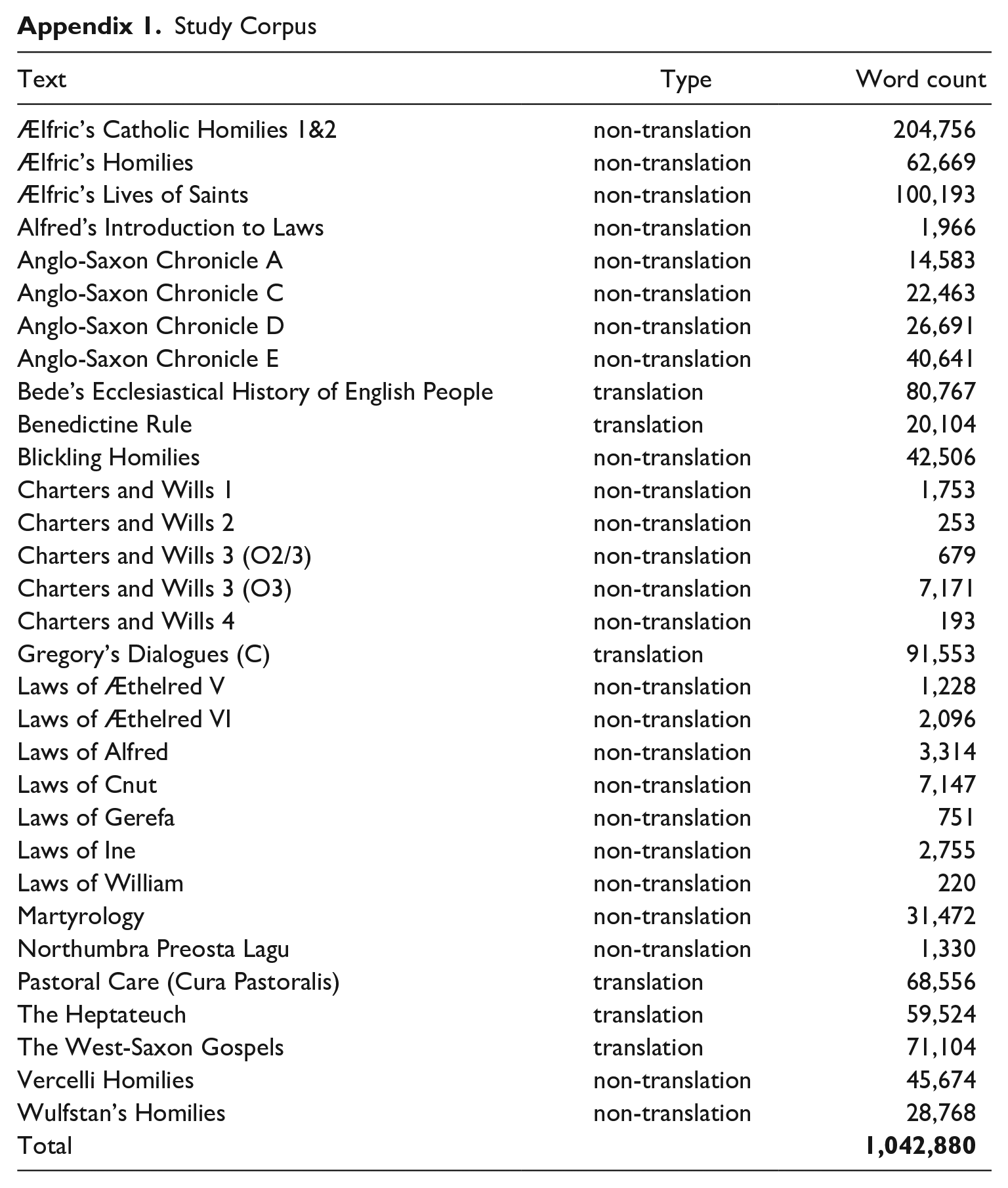
The study is based on the York-Toronto-Helsinki Parsed Corpus of Old English Prose (YCOE; Taylor, Warner, Pintzuk & Beths 2003), a 1.5-million-word syntactically annotated database. Both translated and non-translated texts were analyzed. With regard to the former, only those with readily identifiable sources were included, because in order to control for a potential Latin influence on postposition (a possibility raised, e.g., in Mitchell 1985; Fischer 2000, 2001), source and target noun phrases had to be compared manually. Consequently, free translations as well as those with unknown sources were eliminated from scrutiny (e.g., Boethius’s Consolation of Philosophy, Bald’s Leechbook, or The Old English History of the World based on Orosius). Non-translated texts were selected according to length and only those numbering upward of 10,000 words were included; 2 shorter texts classified by the corpus annotators as laws and documents were counted together and included in the study corpus to ensure genre variation. The division into translated and non-translated texts will be detailed in 3.1, which addresses the absolute and relative frequencies of the patterns studied. This is to establish whether Latin source texts may indeed potentially bear on the distribution of the relevant adjectival patterns, and, consequently, to determine if the division into translated and non-translated texts should be retained throughout this study. The study corpus is included in Appendix 1.
In order to extract relevant data from the corpus, appropriate queries were entered into CorpusSearch 2 (Randall, Kroch & Taylor 2005-2013), a free downloadable software designed for extracting data from parsed corpora. All queries processed by the program were written in Notepad++ and can be found in Appendix 2. After data extraction, certain strings were manually excluded from further scrutiny. For the simple postposition type, excluded categories were adjectivally modified indefinite pronouns, where the adjective is obligatorily postposed, as in (7), and adjectives in the vocative case, which were excluded on the grounds of being virtually limited to the formulaic string Hlaford leof, as in (8).
(7) nan þing swa besorh (cobenrul,BenR:43.68.4.836)
‘no-thing so dear’
(8) Hlaford leof (coaelhom,ÆHom_6:87.923)
‘Lord beloved’
In addition, God ælmihtig, ‘God almighty,’ was excluded from calculations. Some authors, e.g., Crisma (1999) and Bartnik (2009), point to the alternating position of the adjective in this phrase depending on the presence or absence of the definite article. This appears to be a special case of postposition and will not be included in the analysis so as not to skew the numbers.
Also, to control for the variable of weight (understood as the number of words in a phrase), postnominal adjectives governing complements in the form of PPs or NPs in the dative, such as (9) and (10), have been excluded from the initial calculations (Tables 1 and 2). However, because Fischer (2000, 2001) sees complementation as an important indicator of the adjective’s verb-like character and, consequently, as a factor in postposition, these examples were included in later calculations, and are discussed with reference to Table 3.
(9) witega mihtig
‘prophet mighty in words and in deeds’
(10) cempa uncuð
‘battle unknown to-us (dat) all (dat)’
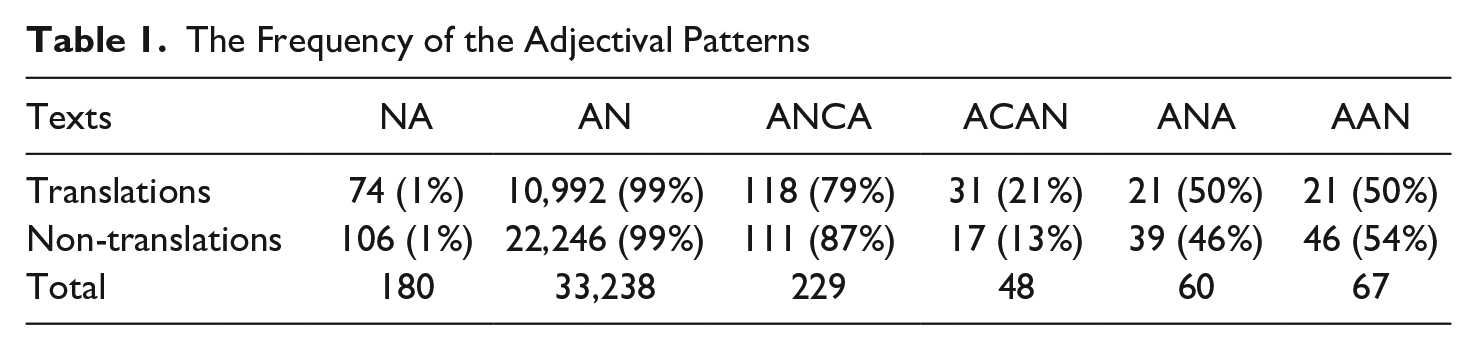
The Frequency of the Adjectival Patterns
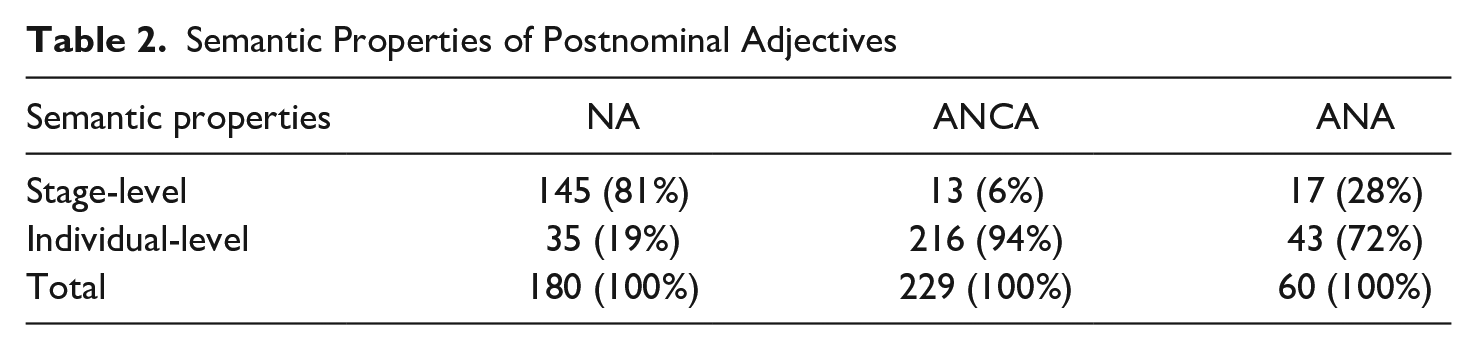
Semantic Properties of Postnominal Adjectives
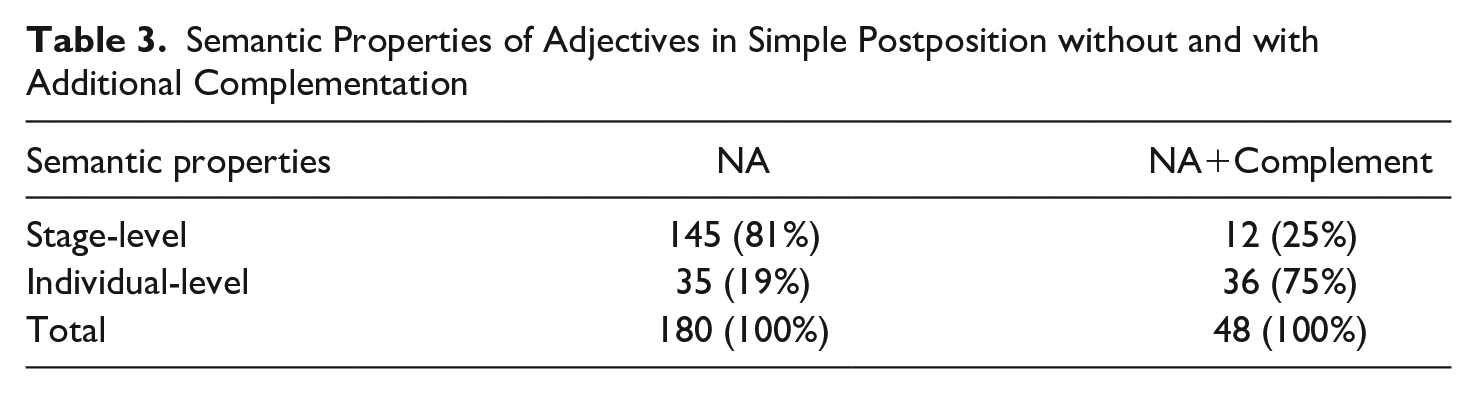
Semantic Properties of Adjectives in Simple Postposition without and with Additional Complementation
Finally, for the AAN and ANA patterns, in line with Bech (2017), the following elements, which the corpus annotators classified as adjectives, were excluded: agen ‘own,’ ilca ‘same,’ oðer ‘other,’ self ‘same,’ swilc ‘such.’ Bech (2017:12) remarks that “their degree of ‘adjectivity’ can be discussed,” they can be “categorized as peripheral, non-descriptive, determiner-like adjectives, and they easily combine with descriptive adjectives.” However, for the and-type pattern, with the conjunction suggesting that two separate qualities are discussed and the modifiers do not combine in a hierarchy and work descriptively, examples such as (11) were counted.
(11) tyllicum synnum & oðdrum (coverhom,HomU_7_[ScraggVerc_22]:33.2841)
‘such sins and others’
As the research questions suggest, certain semantic properties of postposed adjectives will be discussed. To describe these particular properties, Fischer (2000, 2001) simply uses the terms “incidental” and “inherent,” while Haumann (2010) suggests the labels “stage-level” and “individual-level.” Example (12) illustrates an incidental/stage-level adjective, i.e., one referring to a temporary state rather than an enduring property, while (13) illustrates an inherent/individual-level adjective, i.e., one describing a permanent quality of the head noun.
(12) se fearr angenga his heorde forsawe (cocathom1,ÆCHom_I,_34:465.12.6688)
‘the bull solitary his heard despised’
(13) and brohte an reaf ungerydelic him to (coaelive,ÆLS_[Martin]:925.6559)
‘and brought a garment rough him to’
Additionally, Fischer (2000, 2001) points to a visible tendency of “adverbial” adjectives to occur postnominally. These adjectives seem to refer to time, direction, degree, etc. and it is clear that, similarly to stage-level adjectives, they do not describe any enduring properties of their nouns. Consequently, in this study, adverbial adjectives, such as (14) and (15), will be grouped together with those like (12).
(14) ðam walle ufonweardum (cobede,Bede_5:13.428.32.4322)
‘the wall top-of’
(15) þone deað neah (cogregdC,GDPref_and_3_[C]:36.249.3.3518)
‘the death near’
While the material would no doubt lend itself to a finer semantic analysis, e.g., under Dixon’s (1982:16) model of adjectival semantic types in English, the subsequent analysis will—due to considerations of space—rely on a broader classification, as adopted by Fischer (2001) and Haumann (2003), who employ it specifically in the context of OE. It needs to be noted, however, that assigning the adjectives to these general categories was not always a straightforward task. While adverbial adjectives were fairly unambiguous, it was sometimes problematic to decide if a given modifier denotes a temporary state or an inherent quality, as in (16) and (17).
(16) Ecgbriht abbud unscyldig (cochronC,ChronC_[Rositzke]:916.1.1118)
‘Egbert abbot innocent’
(17) hire sunu deadne (cogregdC,GD_1_[C]:2.17.13.159)
‘her son dead’
In (16), which is an entry from the Anglo-Saxon chronicle for 916, we learn that an abbot by the name of Egbert was slain. This is the first and only mention of this man and his death, and it is therefore unclear if he was killed for no apparent reason, having done nothing wrong, in which case his innocence would be interpreted as a temporary state, or if the adjective simply refers to his ways as a devout man of God, in which case it denotes an enduring feature of character. In (17), the person, a young man whose corpse is carried by his mother, is described with an adjective which is generally difficult to classify: on the one hand, dead obviously refers to an enduring quality, but, on the other, it could be argued that it describes a state (even if irreversible) which the experiencer goes into under particular circumstances. Given a relatively small number of postnominal adjectives in the corpus sample, I decided to try to resolve these and similar ambiguities and assign particular semantic labels to all the adjectives/participles extracted. Example (16) was classified as individual-level, while (17) as stage-level, by analogy with e.g., seoc ‘sick.’
With regard to terminology, the term “adjective” will henceforth be used with reference to both prototypical adjectives and participles, since the distinctions between the two are often blurred, and sometimes, participles are more “adjectival” than “prototypical” adjectives (see, e.g., Crystal 1980:9; Huddleston & Pullum 2002:540-541). For OE, adjectives and participles are treated on a par, e.g., by Fischer (2012), whose article entitled “The status of the postposed ‘and-adjective’ construction in Old English: Attributive or predicative?” concerns both parts of speech, with examples of adjectives and participles used interchangeably. This is also true for Fischer (2000, 2001). Also, the annotators of the YCOE seem to have used the “adjective” label for some elements whose morphology would suggest that they are participles: e.g., unlacnode, ‘uncleaned,’ features a characteristic participial suffix -od-, but the word is classified simply as an adjective. Consequently, for the sake of the conciseness of the description, adjectives and participles will be considered collectively, with the defining characteristic of both parts of speech resting ultimately with their ability to modify nouns.
3. Results
In this section, in order to address the question of whether the patterns selected for this study are interpretable as separate constructions, they are analyzed in terms of their frequencies against their preposed counterparts, the semantic properties of the postnominal adjectives involved, and—for the patterns involving two adjectives—the relations of the adjectives to the head noun and to each other. 3
3.1. Frequency
Table 1 presents the incidence of the postnominal patterns analyzed across the corpus sample (with the texts divided into translations and non-translations). Additionally, it shows how the patterns in question compare frequency-wise to their closest prenominal counterparts. This purely quantitative comparison already suggests the existence of different constructions.
Table 1 demonstrates that, in the patterns with a single adjective (NA and AN), prenominal placement is clearly the preferred variant (and the numbers are consistent with those quoted, e.g., in Sampson 2010). However, in the patterns with two adjectives, the numbers either break roughly even between pre-position and flanking, in the case of the asyndetic variant (ANA and AAN), or are decidedly higher for postposition, in the case of the of the and-type (ANCA and ACAN). But the uneven frequency relations of the three postnominal patterns to their prenominal counterparts say nothing about the character of these patterns in their own right. Therefore, the following subsection will examine the semantic properties of postnominal adjectives in NA, ANCA, and ANA.
What Table 1 also shows is that the proportions between the postnominal patterns and their closest prenominal counterparts are roughly the same for translations and non-translations, so the Latin source syntax is unlikely to have influenced postposition. To make sure, however, the postnominal adjectives in all three variants were manually compared with their sources, and while 43 percent did follow Latin (in that the source featured one or more adjectives whose relative position to the noun was to the right), 57 percent did not follow the original Latin pattern, which further suggests that the postnominal placement of the adjective was a native phenomenon and was not caused by the source interference. Thus, the division between translated and non-translated texts will be ignored.
3.2. Stage-level versus Individual-level Properties
Both Fischer (2001, 2012) and Haumann (2010) agree that the postnominal position (for the patterns either of them see as “truly” postnominal) favors adjectives referring to temporary states, such as (18).
(18) þæt him nænig syn ungebeted butan wrace aleoðod wære (cogregdC,GDPref_and_4_[C]:43.331.27.4998)
‘that him no sin unrepented-for without punishment forgiven be’
‘that no sin unrepented for should be forgiven to him’
Table 2 presents the semantic properties of the postnominal adjectives in the three patterns investigated.
The results suggest that the postnominal adjectives in NA and ANCA belong to different categories: the former are predominantly stage-level, while the latter are almost exclusively individual-level, these differences being statistically significant (chi-square = 235.203, p < .00001). The third pattern, ANA, is closer to ANCA, at least in terms of the adjectives it allows into the postnominal position: the preference is rather for individual-level adjectives. Examples follow in (19)-(21).
(19) on þone seofoðan dæg eode se cyning sarig to þam seaðe (coaelhom,ÆHom_22:484.3594)
‘on the seventh day went the king sorrowful to the pit’
(20) hluttor wæter & wered (cocathom1,ÆCHom_I,_34:469.114.6769)
‘clear water and sweet’
(21) rice men hæþne (comart3,Mart_5_[Kotzor]:Ja14,A.3.95)
‘powerful men heathen’
The picture may be refined further if adjectives governing complements are considered in relation to the NA pattern (e.g., Fischer 2001 considers them together under the “verbal” category). This comparison is presented in Table 3. In the table, all the tokens of the two dominant types in the pattern with additional complementation, i.e., the “full-type,” as in (22) and the “like-type,” as in (23), are counted together.
(22) spyrtan fulle metes (cogregdC,GDPref_and_3_[C]:14.203.3.2657)
‘baskets full of meat’
(23) man us gelic (cocathom2, Æ CHom_II,_15:158.275.3514)
‘man like us’
Clearly, complemented adjectives do not display the tendency to reference stage-level properties, instead denoting permanent, individual-level states, as illustrated by (24) and (25), and the difference between NA and NA+Comp in that respect is statistically significant (chi-square = 51.984, p < .00001).
(24) sum creopere lama fram cildhade (coaelive,ÆLS[Peter’s_Chair]:25.2277)
‘some cripple lame from childhood’
(25) culfre swa hwit swa snaw (comart3,Mart_5_[Kotzor]:Oc31,A.6.2078)
‘dove as white as snow’
In (24), the person described is not disabled under some specific circumstances, but the affliction is permanent, while in (25), the adjective denotes the dove’s hue, which is likened to snow, but clearly inherent to the bird. Therefore, if the semantic properties of OE postnominal adjectives are anything to go by, it is by no means justified to lump all patterns together (cf. Fischer 2001, 2012), nor is it tenable to draw the line between the and-type, on the one hand, and the non-conjoined patterns, on the other (cf. Haumann 2003, 2010). NA clearly stands out, being the only postnominal pattern associated with the adjective’s stage level properties. This is not the case when further complementation is present. Also, the asyndetic and conjoined split patterns, ANA and ANCA, mostly use the postnominal slot to accommodate individual-level adjectives.
3.3. Separate versus Hierarchical Modification
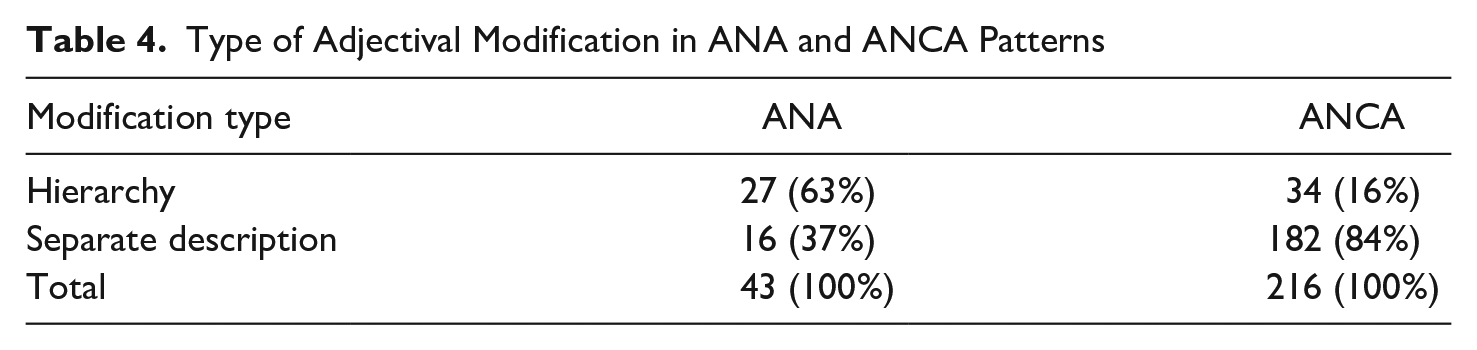
While the two patterns involving multiple adjectives (ANCA and ANA) are indeed similar on the count of denoting individual-level properties, examples (20) and (21) show that both adjectives used in either case operate on rather different levels of description. In (20), in Bech’s (2017:14) words, the two adjectives “separately describe the noun,” while in (21) “one adjective has scope over the other,” meaning that the reference is to “powerful heathen men,” not to “men who are heathen and powerful.” Bech (2017) notices that the type in (21), where the adjectives are hierarchically ordered, is attested in the AAN pattern, which is, on the other hand, “dispreferred for noun phrases with two descriptive adjectives,” and these, in turn, would likely require a conjunction (Bech 2017:16). While the author focuses on the AAN pattern and herself admits that other types of adjectival modification would need to be examined, her intuitions seem to be somewhat borne out by (20) and (21). The asyndetic (though split) pattern of (21) appears to mostly involve a hierarchical structure, while the and-type of (20) is used predominantly to house two independent adjectives, which is unsurprising given what the semantics of and implies. Table 4 illustrates the difference in the distribution of these two types of description across the two patterns analyzed (only those instances are compared where the second adjective of a pair is individual-level, given a possible ambiguity involving ANA; see a discussion of 53 and 54 in section 5). The difference between these two patterns is statistically significant (chi-square = 41.516, p < .00001).
Type of Adjectival Modification in ANA and ANCA Patterns
To be sure, the picture emerging from these numbers is by no means uniform, and it is probably better to speak of tendencies rather than categorical classes. But at the same time, treating ANA and ANCA on a par on grounds that both decidedly prefer individual-level adjectives (and even that would have to allow for a number of exceptions) would fail to do justice to what was likely a more complex linguistic situation. Bech (2017:17) aptly concludes her brief analysis of OE (and Old Norwegian) adjectival patterns by saying that “we would not expect syntactically variable languages like Old English and Old Norwegian to be completely consistent.” Acknowledging the distinct character of ANA and ANCA provides a more fine-grained description than grouping these two together would.
4. Old English Postnominal Adjectival Constructions: Characteristics
Despite some variability within the formal patterns studied, which should by no means be ignored, a constructional approach would suggest recognizing the following four constructions (understood as pairings of form and meaning and as such distinct from mere patterns, as explained in section 1.1) involving postnominal adjectives:
a) NA
b) NA+Comp
c) ANA
d) ANCA
The first construction could be more accurately described as NA(stage), whose meaning would be ‘the noun is modified by an adjective referencing stage-level properties.’ It is the only pattern analyzed which clearly prefers stage-level adjectives, and this fact alone would be reason enough to see NA as a construction different from both ANA and ANCA, regardless of whether the latter two are treated together (cf. Fischer 2012) or separately (cf. Haumann 2003, 2010; Pysz 2009). The corpus data suggest that Fischer’s (2000, 2001) proposal for NA is at least partly well-founded: the adjective’s verbalness, understood as its clearly adverbial interpretation or a reference to an “appropriate action involving the thing” (Fischer 2001:273n3, after Vendler 1967:175), is difficult to argue with in the majority of the examples.
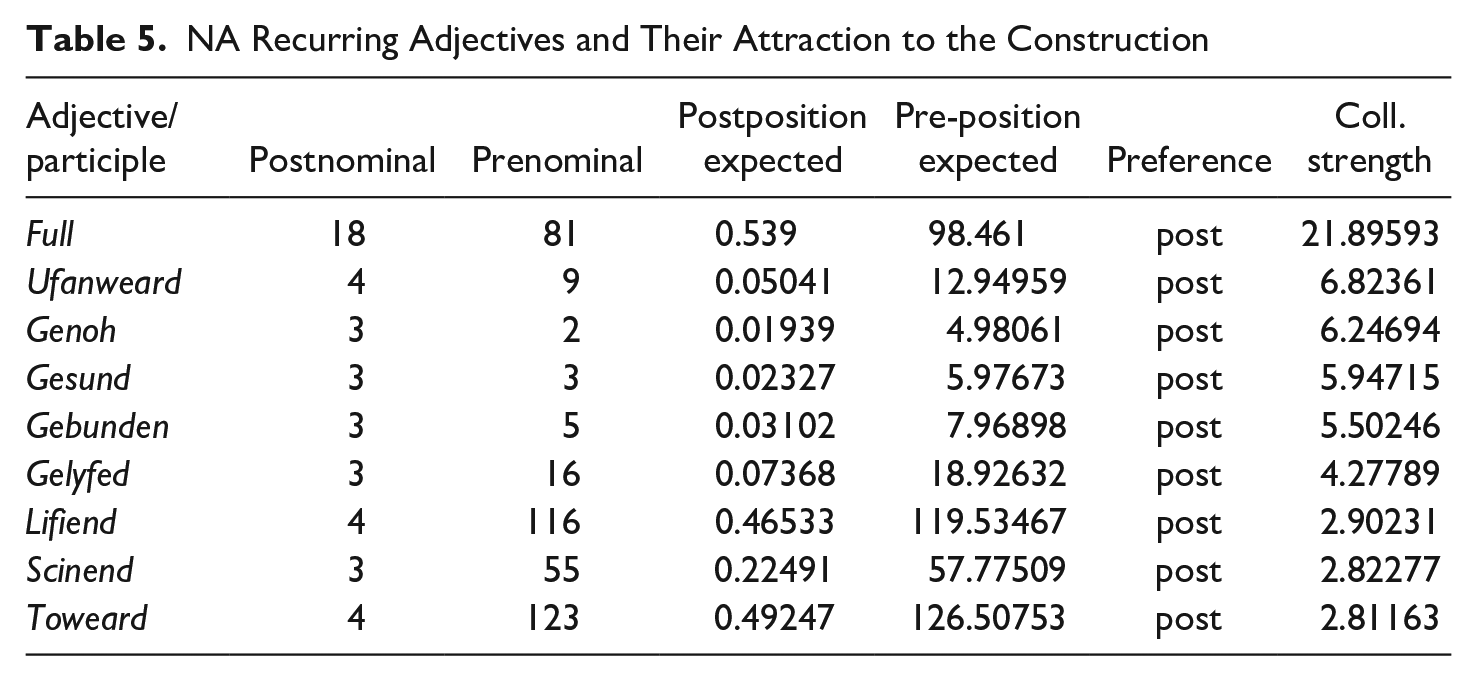
Since this postpositive adjectival construction—unlike ANA and ANCA—is a decided minority pattern when compared to its closest prenominal counterpart (180 instances versus more than 30,000), an additional analysis was performed to verify if it is token-productive, rather than confined to a small set of lexemes. The method applied was “distinctive collexeme analysis,” which measures how strongly a lexeme is attracted to a given construction (Stefanowitsch & Gries 2003). Coll.analysis 3.2a (Gries 2007), a script working in R (R Core Team 2014), was used to perform the relevant calculations. Table 5 lists those adjectives in NA which occur at least three times: 4 there are ten such adjectives, accounting for forty-five instantiations of the construction. Among these, the adjective full clearly stands out, occurring eighteen times. This adjective may appear in such phrases as “six full years/months” or “seven full baskets/barrels,” where its reading is adverbial (referring to duration) or stage-level (denoting a temporary state), respectively. Such contexts should favor postnominal placement. The distinctive collostructional strength analysis, which takes into account the observed and expected frequencies of tokens across alternative constructions, indicates that full indeed displays an extremely strong association with NA (with a collostructional strength of almost 22; 3 is considered statistically significant at p < .001). All the other frequently recurring adjectives also prefer the postnominal placement. Among them, gelyfed is the only one receiving individual reading; as such it would not be expected to follow the noun, yet its association with NA, at 4.28, is very strong. However, it needs to be noted that in all three cases this adjective is preceded by an intensifying adverb (wel and swiþe), so the Adjective Phrase is rather heavy, since it includes an additional word and may appear after the noun for that reason. Also, an authorial preference may have played a part, as these occurrences are all found in Ælfric’s works, where individual-level adjectives in postposition seem to be overrepresented (Grabski 2017:104). Other than that, the adjectives/participles associated with NA are stage-level/adverbial. Their attraction to this construction is therefore not surprising and appears to support the observation that NA was a minority pattern specialized for accommodating verbal adjectives (some of which recurred frequently).
NA Recurring Adjectives and Their Attraction to the Construction
On the other hand, the NA+Comp pattern seems to be an entirely different construction in that most of the time the postnominal adjective receives an individual-level reading. Syntax-wise, it is possible that the postnominal placement of the adjective in the NA+Comp construction was simply the work of the end-weight principle, according to which heavy elements move to the end of a phrase. Fischer (2004:19) specifically rejects this possibility (she discusses the Middle English situation, but claims it is a direct continuation of the OE tendencies), claiming that postposition in the complemented pattern is iconic, since “it is the predicative nature of the AP, not its length, which is crucial.” However, this argument is potentially circular (i.e., “the adjective is postnominal, because it is rhematic, and we know it is rhematic, because it is postnominal”) and impossible to verify. The stage-level interpretation seems by far the more reliable and quantifiable diagnostic feature, and it was shown that NA and NA+Comp have different values in this regard. Therefore, from a constructionist perspective, it seems more appropriate to posit two different constructions, the latter of which would simply convey the meaning ‘the scope of the adjective describing the noun is narrowed by the complement’; the adjective’s semantics is secondary.
The next construction is ANA, which does not appear to be a mere sub-schema sanctioned by NA, because most of the time the postnominal adjective in this pattern is unambiguously individual-level, such as (21) above, and (26)-(28).
(26) efenealdan lytlingas unscæþþige (cocathom1,ÆCHom_I,_5:222.164.1028)
‘even-aged children innocent’
(27) micel leoht heofonlic (cobede,Bede_3:6.174.18.1710)
‘great light heavenly’
(28) ging æðeling good (cobede,Bede_3:15.220.21.2259)
‘young prince good’
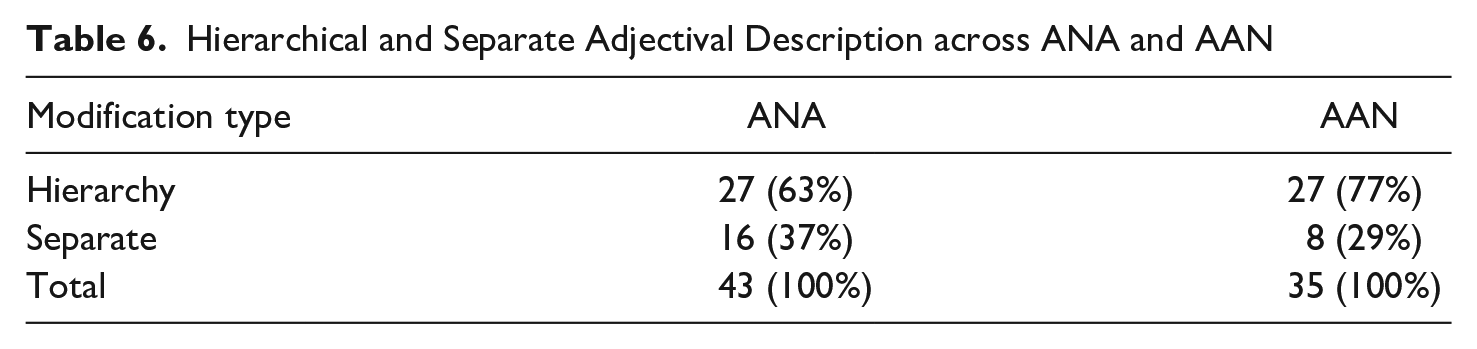
These examples upset the “clear division of labor” that Haumann (2010:61) says exists between prenominal and postnominal adjectives, with the latter supposedly always receiving stage-level interpretation. The postnominal adjectives in the ANA pattern are not only regularly individual-level (see Table 2), but they often form up a hierarchical structure together with the prenominal adjectives (see Table 4). Based on this tendency, the meaning of the ANA schema could be ‘the adjectives describe the noun hierarchically.’ In a sense, then, ANA seems to be functionally closest to AAN, which Bech (2017:15) has discovered to specialize in describing hierarchical relations. Table 6 below compares the two patterns. Similarly to Bech (2017), I excluded pairs involving non-prototypical adjectives from the AAN pattern (see section 2). Among the remaining pairs of purely descriptive adjectives, hierarchical modification turned out to be dominant, and the difference between the two patterns on the count of hierarchical versus separate description is not statistically significant (chi-square = 1.253, p = .2204).
Hierarchical and Separate Adjectival Description across ANA and AAN
That the two patterns were functionally similar may be also supported in (29)-(32), where the same noun is modified by the same two adjectives, but on one occasion they are stacked prenominally, and on another they flank the noun.
(29) rice hæþene men (comart1,Mart_1_[Herzfeld-Kotzor]:De27,A.5.93)
‘powerful heathen men’
(30) rice men hæþne (comart3,Mart_5_[Kotzor]:Ja14,A.3.95)
‘powerful men heathen’
(31) ealdra hæþenra manna (cogregdC,GD_2_[C]:8.121.17.1449)
‘old heathen man’
(32) ealde men hæþene (comart2,Mart_2.1_[Herzfeld-Kotzor]:Jy0,A.1.97)
‘old men heathen’
Such pairs may indicate an ongoing shift in the language toward the present-day situation in which prenominal stacking is permitted, but phrases such as (30) and (32) are ungrammatical. OE may have indeed disfavored adjectival recursion, as claimed by Fischer (2000:169), but placing the second adjective postnominally in the ANA construction appears to have little to do with the looseness of the bond between this adjective and the noun (pace Fischer 2000, 2001). As shown above, the postnominal adjective frequently relates to the noun in a hierarchical combination with the other adjective, just as two adjectives stacked prenominally often would.
While ANA is similar to ANCA in terms of the properties of the postnominal adjectives, the two adjectives in the latter pattern are much less often hierarchically related and typically describe the noun separately, as illustrated in (20) and in Table 4. Therefore, this was likely a separate construction, meaning ‘the noun has the properties referenced by both adjectives independently,’ and the interpretation of these adjectives is probably of lesser importance to defining the character of this construction: most of the time, they are individual level, but separate modification by what were clearly stage-level adjectives (or participles) did happen, too, as in (33).
(33) byrnende leohtfæt & lyhtende (cowsgosp,Jn_[WSCp]:5.35.6120)
‘burning lamp and shining’
Again, as in the case of ANA and AAN, OE allowed for some degree of variability, alternating between the split variant, i.e., ANCA, and that with two conjoined adjectives preceding the noun, i.e., ACAN, shown in (34) and (35).
(34) reðum cynegum & wælræwum (cocathom1,ÆCHom_I,_16:309.69.2981)
‘fierce king and cruel’
(35) eawfæste & wuldorfulle weras (cocathom2,ÆCHom_II,_28:228.215.5075)
‘pious and glorious men’
According to Grabski (2017:172), there do not seem to be any significant functional differences between (34) and (35) (although see section 5 for the discussion on how the construction in 35 may have developed). Of the forty-eight cases of ACAN reported (Grabski 2017:134), forty-five seem to involve adjectives describing the noun separately, in line with (35), with one of the three exceptions shown in (36). The punishment in question shall be handed out to those Benedictine monks who, after repeated admonishments, will not surrender material objects. The corresponding passage in the Latin original has a bare noun, correptioni, but the OE translator decided to elaborate on the character of the penalty, which likely took the form of severe flagellation, so the adjectives are perhaps best interpreted as hierarchically related.
(36) swyðlicum and lichwamlicum þrealum (cobenrul,BenR:33.57.10.705)
‘great and corporeal punishment’
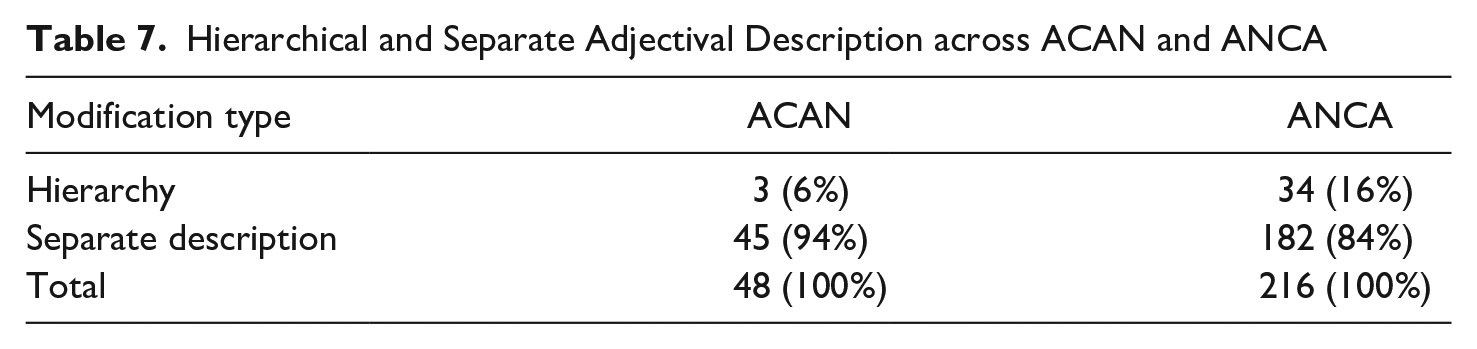
Table 7 compares ACAN and ANCA with respect to the type of adjectival modification, showing that the difference between the two is not statistically significant (chi-square = 2.201, p = .1079).
Hierarchical and Separate Adjectival Description across ACAN and ANCA
Fischer (2012) tries to demonstrate other crucial differences between ACAN and ANCA and thinks that the split pattern is simply informed by the basic rule for all kinds of adjectival postposition in OE, i.e., the postnominal adjective is discourse-new. However, she herself notices that many adjective pairs in the ANCA pattern are synonymous, but does not see this fact as being at odds with the postulated newness of the information provided. This interpretation is somewhat problematic when some examples of ANCA from translated texts are compared with their originals: it turns out that in a number of cases two OE adjectives render one adjective from the source. Witness (37) and (39), with their source passages in (38) and (40).
(37) anlic wer & foremære (cogregdC,GDPref_and_4_[C]:32.306.25.4563)
‘excellent man and illustrious’
(38) spectabilis vir
‘remarkable man’
(39) rihte timan and gedafenlican (cobenrul,BenR:47.72.10.871)
‘right time and fitting’
(40) horis conpetentibus
‘hour proper’
The two-for-one correspondence is well-attested in the sample studied and is summarized in Table 8.
Instances of the ANCA Construction Corresponding to a Single Source Adjective in Translated Texts
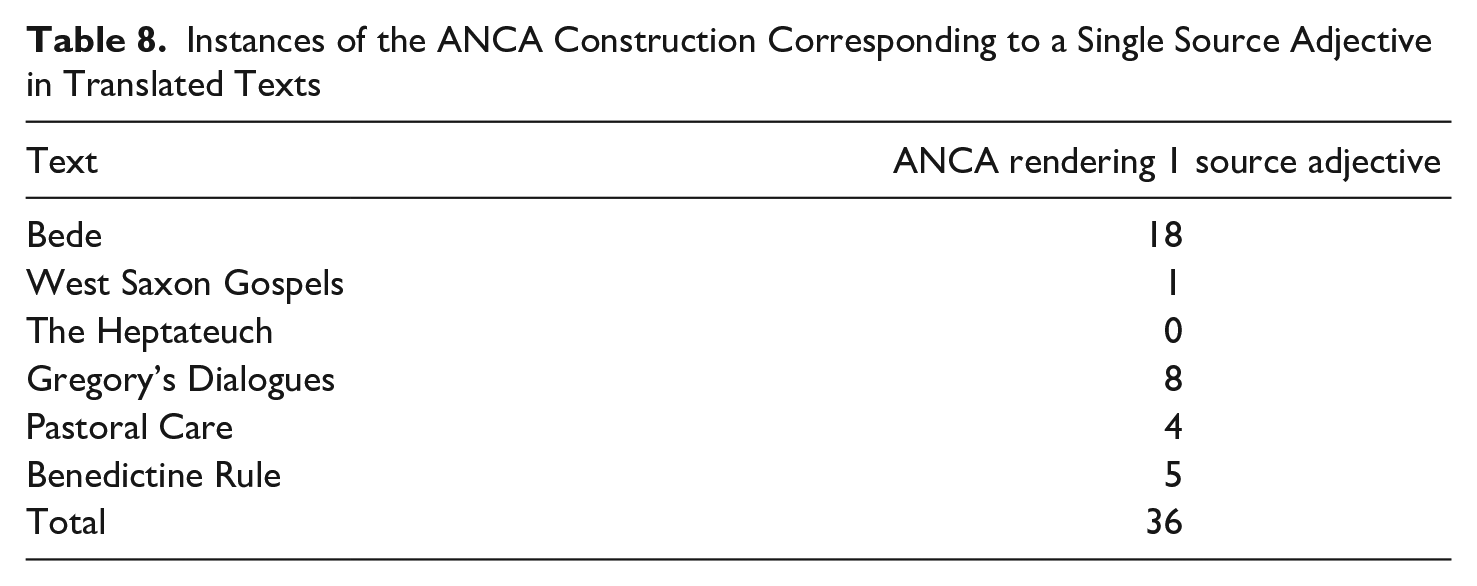
Aside from the two scriptural translations, which unsurprisingly were less ready to add material absent from the original text, other OE texts show that the ANCA construction could be used to render one adjective from the source. This correspondence suggests that the postnominal placement was not motivated by the desire to underline a new informational unit, because both adjectives had the same status in the discourse. Therefore, it is possible that ANCA fulfilled very similar functions to ACAN (just as ANA was functionally close to AAN), and that the alternation between the two (again just as in the case of AAN and ANA) was an indication of an ongoing change toward an almost categorical premodification. Before it happened, speakers of OE, as suggested by Mitchell (1985:616), may have disfavored “groups joined by conjunctions” and tended to split them.
Therefore, a possible way of interpreting these findings in a constructionist framework could assume the existence of formally distinct constructions falling under one abstract schema: asyndetic, which sanctioned both the (outgoing) ANA and the (incoming) AAN constructions, and conjoined, which sanctioned both the (outgoing) ANCA and the (incoming) ACAN constructions. Traugott and Trousdale (2013:65-66) and Hilpert (2013:463-464) notice that such temporary coexistence is not uncommon and indicates a change in progress. The mutual relations between both split patterns and their respective prenominal counterparts are discussed more fully in section 5.
5. Old English Postnominal Adjectival Constructions: Internal Dynamics
It seems that, by and large, the NA and NA+Comp schemas of OE have been retained in Present-Day English. Although perfectly acceptable in pre-position, stage-level adjectives still tend to occur post-nominally, as noticed, among others, by Bolinger (1952:1136), who writes that “the qualifier that follows shows a detachable, especially a transitory, state.” Then, the heaviness of the Adjective Phrase is still likely to result in its postnominal placement, regardless of the properties of the adjective, as observed, e.g., by Biber, Johansson, Leech, Conrad, and Finegan (1999:519) and Quirk, Greenbaum, Leech, and Svartvik (1985:418-419). On the other hand, the ANCA and ANA constructions, with their properties as defined in the previous sections, have apparently given way to the prenominal variants of ACAN and AAN, 5 and the process culminating with this replacement can be studied from the perspective of diachronic construction grammar.
While their disappearance represents an interesting problem, the nature of this process is probably best captured if the original relations between the outgoing constructions are acknowledged first. ANCA and ANA may be seen as horizontally related (in the sense of Van de Velde 2014): they share some formal similarity (i.e., involve two adjectives flanking the noun) and, while their respective meanings overlap to an extent—in both, the noun has the qualities described by two adjectives, and these adjectives mostly denote individual-level properties—they clearly differ with respect to the character of adjectival description (separate versus hierarchical). From a constructional perspective, which revolves around the idea of pairings of form and meaning forming nodes in a language network (Goldberg 2006), they are separate constructions, but the existence of either is motivated by the other: hierarchical modification is “semiotically meaningful” (Van de Velde 2014:158) when set against separate modification, and vice versa. Therefore, the two constructions may be seen as linked in a horizontal fashion.
This observation may be further substantiated by the fact that, even though neither ANCA nor ANA has survived, the subtle differences in meaning which they originally stood for have been retained in the emerging ACAN and AAN. As demonstrated in Table 1, both prenominal variants started to appear already in the OE period and today roughly represent the division along the lines of separate and hierarchical modification. However, they may have at first operated in slightly different roles and been then reinterpreted by language users. Fried (2013:434), in her fine-grained analysis of the process of constructionalization, argues that change typically starts with constructs, i.e., actual linguistic tokens with pragmatic meaning, rather than with their mental representations, i.e., constructions. Still, for the sake of the present, holistic discussion it will be argued that the “starting point” was indeed a construction, which was sanctioned by a separate schema and then reanalyzed by speakers-hearers, who matched it with another schema.
As for ACAN, a quick look at how it functions in the translated texts—which are generally earlier than non-translations—is potentially instructive as to its original function. ACAN appears thirty-one times in the translations selected and in twenty-one of these cases it is traceable to a noun phrase in the original text; out of these, as many as twenty render the source noun modified by a single adjective. This is demonstrated in Table 9 and exemplified by (41)-(44).
Instances of the ACAN Construction Corresponding to a Single Source Adjective in Translated Texts
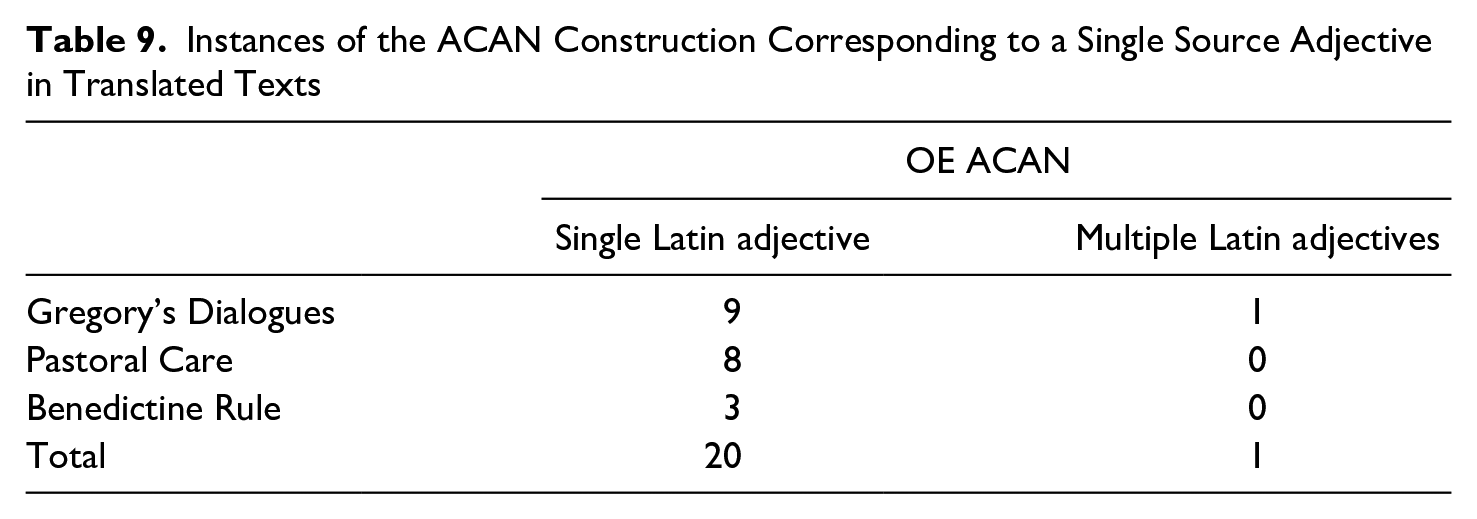
(41) torhtum & swutolum wordum (cogregdC,GD_2_[C]:36.175.2.2130)
‘splendid and clear words’
(42) sermone luculento
‘sermon excellent’
(43) unwærlicu & giemeleaslicu spræc (cocura,CP:15.89.7.571)
‘incautious and careless speech’
(44) incauta locutio
‘careless speech’
Using doublets—involving various classes of words—to render a single Latin word is characteristic of interlinear glosses, as observed by Kuhn (1947) and Kotake (2017). Although the texts in question are not glosses, they likely draw upon this tradition—in any case, they use two words to render one item from the source. Motivations behind double glosses differ, as do classifications of such pairs, but Kotake (2017) finds some of them to be binomials, which for Kopaczyk and Sauer (2017:16) are first and foremost characterized by repetition, including semantic repetition, which “may be a reason why a binomial arises at all.” Regardless of whether the analyzed examples of ACAN are labeled binomials, they seem to be motivated precisely by semantic repetition as they consist of synonyms or near-synonyms, likely employed to get as precise a rendition of a foreign word as possible (although Kotake 2017:92 thinks that stylistic reasons may have sometimes played a part). As shown in Table 8, the split type, ANCA, also accommodated pairs going back to one Latin word, but this pattern was more versatile (and apparently more popular) and very often corresponded to two Latin adjectives. ACAN, on the other hand, is almost always associated with a single source adjective, a fact which perhaps should not be overlooked, and which could potentially be explained if the motivations between the split type are considered. Mitchell (1985:616) hypothesizes that the splitting of conjoined phrases may have been easier to process. If this pattern was indeed cognitively motivated, then maybe the eventual shift to pre-position was gradual, and the prenominal conjoined variant was at first employed when the two adjectives were (near-)synonyms and were essentially processed as one. Therefore, the construction was simply sanctioned by the abstract schema AN, where A(CA)N was an option for synonymous pairs. However, in time, some speakers—in their role as hearers—may have interpreted such strings as consisting of two independent, non-synonymous adjectives, which is only expected given the semantics of and. This reinterpretation would result in a partial match with the conjoined schema of OE and its subsequent expansion by less prototypical members, which in time became “more central” (Traugott & Trousdale 2013:52). Already in OE, there are pairs of prenominal conjoined adjectives which not only are non-synonymous, but also display a “sloppy DP identity” (Fischer 2012:256), i.e., refer to separate instances of the modified noun, as in (45).
(45) broðerlicere and moderlicere yrmðe (‘cocathom2, ÆCHom _II,_2:16.146.382’)
‘brotherly and maternal poverty’
In the case of AAN, it was a fairly common combination already in OE, but, as noticed by Bech (2017:12), in the majority of cases it involved “peripheral, non-descriptive, determiner-like adjectives” which “easily combine with descriptive adjectives,” such as (46) and (47) (her 33 and 34).
(46) se ylca arwyrða wer (cogregdC: 7.49.20.558)
‘the same honorable man’
(47) oðrum langsumum spræcum (coaelive: 86.1263)
‘other lengthy speeches’
Another group of adjectives which Bech (2017:12) quite regularly (sixty-four instances) finds in prenominal stacks are adjectives denoting type or origin, which she describes, after Quirk, Greenbaum, Leech, and Svartvik (1985), as the “least adjectival and most nominal” of all adjectives, so they essentially form compounds with their nouns and as such might not have required a conjunction, as in (48).
(48) gungne Brytiscne man (cochronE,ChronE_[Plummer]:501.1.166)
‘young British man’
Apparently, then, the AAN pattern was quite productive in OE, only one adjective of the pair was most frequently non-prototypical. Hence, it is possible that the constructs from (46)-(48) were not interpreted as an asyndetic combination of two adjectives, but inherited from a more general AN schema, which mandated (A)AN, where the first element was an adjective-like modifier, and A(A)N, where the second element compounded with the noun. But at one point some language users (hearers) might have interpreted both these modifiers in a more “adjectival” manner and construed (46)-(48) as involving two hierarchically ordered adjectives, thus establishing a link with the asyndetic adjectival schema. Bech (2017), also working on the YCOE, finds twenty cases of AAN where the two adjectives combine in a hierarchy, exemplified by (49) (her 44).
(49) an uncuð geong man (cosevens1: 559.438)
‘an unknown young man’
However, this pattern seems to be predominantly associated with a different schema, as another 258 instantiations of AAN are still combinations involving non-prototypical adjectives. This means that only 7 percent of constructs following this order are actually sanctioned by the asyndetic schema. Meanwhile, this same schema sanctions 27 out of 124 instantiations (i.e., 21 percent) of ANA; these constructs involve two clearly descriptive, hierarchically related adjectives. This suggests that in OE, AAN, unlike ANA, was not yet conventionalized in the community of speakers as a construction inheriting from the asyndetic schema.
The examples analyzed in this section suggest that OE adjectival constructions were plotted on a fairly complex network of form-function pairings. This intricacy is down to the fact that these relations are of a many-to-many character. In other words, the network appears to be degenerate, in that it consists of “structurally different elements [that] can fulfill the same function,” but they are simultaneously employed in other roles (Van de Velde 2014:142). While ACAN is eventually reinterpreted as a construction under the conjoined schema, it may still function in its original capacity, namely as a combination of two synonymous adjectives sanctioned by the AN schema (this scenario still dominates in OE). AAN is gaining ground in the asyndetic schema and starts to accommodate hierarchical relations. But that does not prevent it from retaining its primary function under AN, where it accommodates quasi-adjectives. Importantly, thanks to the new roles assigned to them, ACAN and AAN could eventually replace the outgoing ANCA and ANA, which means that the original horizontal network and the semantic distinctions that it encoded (the difference between separate and hierarchical modification) could be preserved by elaborating extant nodes and strengthening already existing links, rather than creating new ones. Therefore, degeneracy is not merely a static property of the language network, but can be observed diachronically, as a productive strategy of maintaining horizontal networks despite change (Van de Velde 2014:173).
Studying deviations from the dominant tendencies may help refine the picture further and support the notion that language is a construction network with fluctuating links. As noticed earlier (see section 3.3, Table 4), while the instantiations of the ANCA construction were typically constructs involving two adjectives which modified the noun separately, there were also cases which involved hierarchically related adjectives under this schema, such as (50).
(50) god gear & wæstmbeorende (cobede,Bede_4:17.302.32.3070)
‘good year and fruitbearing’
The period in question followed three years of drought and famine which plagued the south Saxons before bishop Wilfrid converted them to Christianity, at which point the rain immediately fell and revived the crops. Perhaps, then, the year was good, because it was fruitful, not good and fruitful.
On the other hand, while the ANA and AAN constructions—the asyndetic schema in general—preferred hierarchical modification, they also sanctioned separate modification, such as (51) and (52).
(51) medmicle nose þynne (cobede,Bede_2:13.144.14.1391)
‘small nose thin’
(52) yfelum ricum ealdormannum (coblick,LS_12_[NatJnBapt[BlHom_14]]:161.14.2046)
‘evil powerful princes’
Example (51) is part of a description of bishop Paulinus, and appears to employ two similar adjectives which elaborate one another rather than forming a hierarchy (although it should probably be noted that the corresponding Latin phrase reads naso adunco pertenui, ‘small hooked nose,’ for which it could be argued that the description is indeed hierarchical). Example (52) comes from a homily celebrating the birthday of John the Baptist, who was one of few prophets exceptionally graced by the Holy Spirit, and as such could stand up to earthly rulers, including those evil and powerful (the Modern English translation by Richard J. Kelly also uses a conjunction).
These minority examples illustrate the process of obsolescence and innovation under the respective schemas, as certain members of a schema become less prototypical and move to its fringes, while others go in the opposite direction, becoming more central. Example (48) likely illustrates the former scenario, affording us a glimpse into the past: the YCOE data indicate that ANCA was the most productive (frequency- and versatility-wise) schema for multiple adjectives in OE, but since this construction is virtually non-existent in PDE, it must have gradually surrendered its functions to other constructions. This trend might have started with relinquishing the hierarchical modification of (50). This type is already quite regularly in the purview of ANA and AAN, and is moving to the fringes of the conjoined schema, eventually obsolescing as its less prototypical member (Traugott & Trousdale 2013:52), though still attested at the stage of the language covered by the data used for this study. In other words, since OE seems to have disfavored stacking or even flanking the noun with non-conjoined adjectives, hierarchical adjectival modification possibly once required a conjunction, too, and was handled by ANCA, but in time this form-function link weakened and the meaning came to be associated with the asyndetic schema, first gaining ground in the split type of ANA, and then moving to AAN (as explained earlier in this section). Establishing this link may have well involved degeneracy, as the pattern ANA already existed, as in (53) and (54).
(53) strangne þeofmann gehæftne (cowsgosp,Mt_[WSCp]:27.16.2018)
‘strong bandit bound’
(54) Nazareniscan hælend ahangenne (cowsgosp,Mk_[WSCp]:16.6.3522)
‘Nazarene Jesus hanged’
In (53) and (54), the second adjective receives a stage-level interpretation, so it would have likely occurred in postposition regardless of whether the noun was additionally premodified. Therefore, these constructs may have simply represented the (A)NA construction, sanctioned by a more general NA schema, but in the examples above the adjectives may be also interpreted as hierarchically related: it is a strong man that is tied down, not a strong and tied down man, and, obviously, it is Jesus from Nazareth who is crucified, not the Nazarene and crucified Jesus. Perhaps such ambiguous cases led to a reinterpretation, and the pattern ANA acquired the meaning of hierarchical description under the emerging asyndetic schema.
Examples (51) and (52), on the other hand, may foreshadow the expansion of the asyndetic schema, which eventually (by means of AAN, with ANA falling out of use) came to accommodate, alongside hierarchical modification, also separate adjectival description. Already in OE, Bech (2017:15) reports eight cases of AAN which clearly feature non-hierarchically ordered adjectives. But crucially, she has also found ten examples “for which it is difficult to decide whether the adjectives are hierarchically structured or modify the noun independently of each other.” For instance, with regard to ealdum leasum spellum, ‘old false tales’ (her example 49), the author ponders if these are “false tales that are old, or old and false tales.” Once again, it is probable that the same dilemma already faced speakers of OE, and while ealdum leasum spellum was indeed intended by the speaker to be decoded as “false tales that are old,” the hearer might have interpreted it as “old and false tales.” Consequently, an instance of AAN, which typically meant ‘the noun is modified by hierarchically related adjectives,’ now means ‘the noun is modified by the adjectives separately,’ so a new pairing of form and meaning is provisionally founded and over time conventionalizes, moving from the periphery of the schema to its more central areas: it is still more popular in ANA than in AAN (16 versus 8 cases, see Table 6), but is nevertheless becoming a fringe part of the postulated asyndetic schema.
The postulated changes were likely only gaining momentum in the OE period. Table 10 presents three main developments in the network of adjectival constructions discussed: the appearance of the prenominal conjoined construction, the appearance of the asyndetic conjoined construction, and the further development of the latter to accommodate separate description.
Innovative Adjectival Constructions across Different OE Texts and Periods
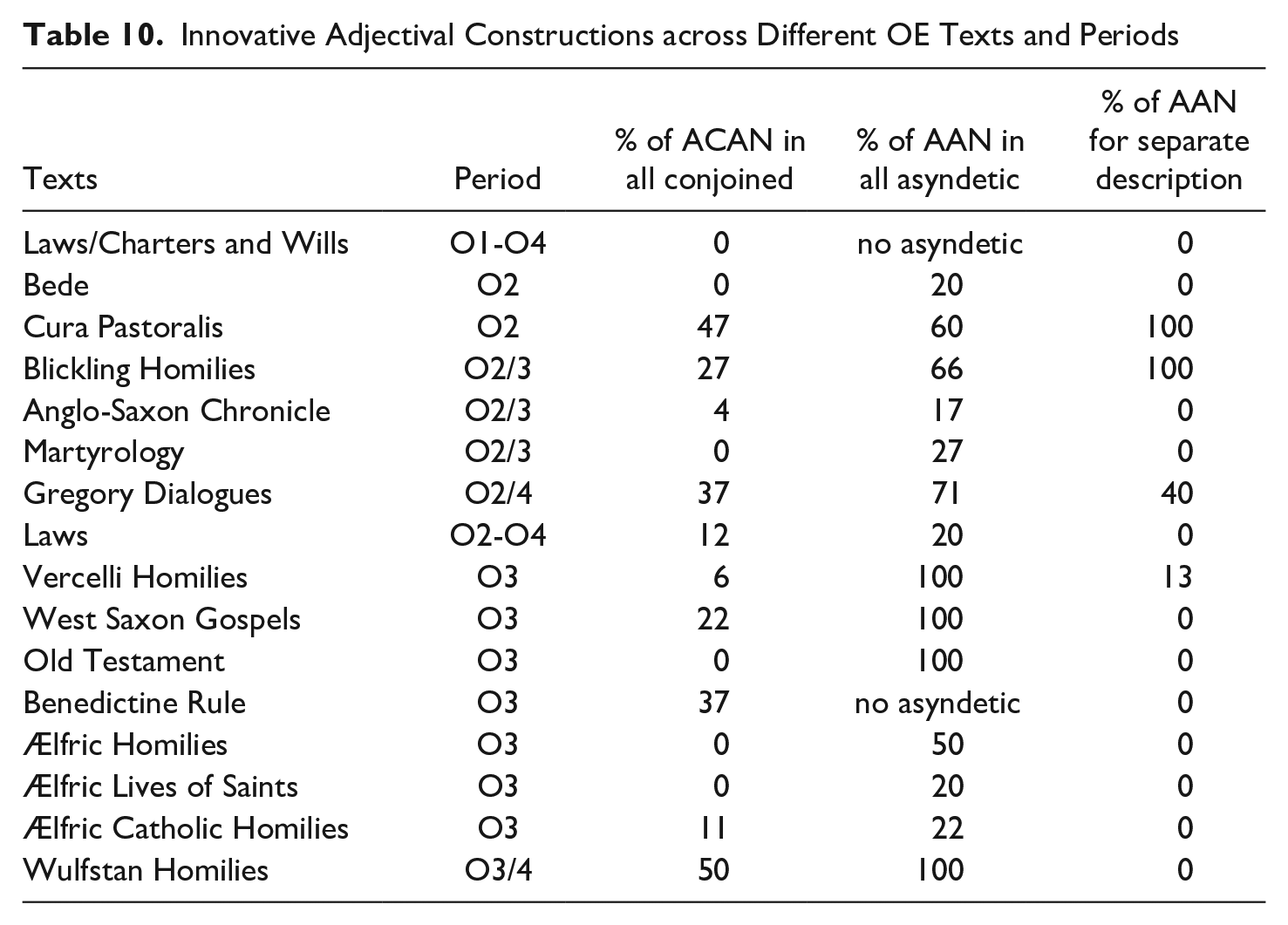
The picture is still somewhat inconsistent. ACAN catches up with ANCA in Wulfstan, which is a late text (and a late manuscript). It is also well-attested in Gregory’s Dialogues, which is older, but the manuscript is indeed dated to the final OE period, and in the Benedictine Rule, another late text. But it is also well-represented in Cura Pastoralis, a ninth-century manuscript. AAN carries the day in a number of late texts or late manuscripts and is relatively rare in an early Bede, but is not too popular in Ælfric in late tenth/early eleventh century. Separate description in AAN is generally scarce, but occurs in texts from various periods. The evidence thus hints at textual idiosyncrasies. Apparently, in order to fully capture the dynamics of the developments over time, it would be necessary to analyze later material. But even a cursory look at Middle English (ME) data (obtained from the Penn-Helsinki Parsed Corpus of Middle English; Kroch, Taylor & Santorini 2000) suggests that change is underway. While the ANCA pattern outnumbers ACAN at an 8:2 ratio in the OE sample analyzed, the two are almost evenly balanced in ME, and it is actually the prenominal variant that slightly dominates (198 versus 208). Such a visible change in relative frequencies of competing structures is typically indicative of ongoing constructional developments (Hilpert 2013). For AAN, Bech (2017:15) reports 38 instances of purely descriptive adjectival pairs out of 296 in total for OE (13 percent), whereas between 1150 and 1350, 65 out of 102 instances of AAN (63 percent) involve stacked prototypical adjectives. Of these 65 pairs, 29 (45 percent) are adjectives modifying the noun separately, while for OE, it is 8 out 38 (21 percent) (Bech 2017:15). All this points to a reconfiguration inside the network.
In sum, the dynamics of OE adjectival constructions sketched in this section imply that change may be generally seen as the reconfiguration of links between the nodes which already exist in the network. As proposed by Van de Velde (2014:173), “form-function changes involve strengthening of already available resources with extension to new domains.” This is schematically represented in Figure 1. The diagrams show the situations in OE and Present-Day English. Solid lines and broken lines are used to represent strong and weak links, respectively.
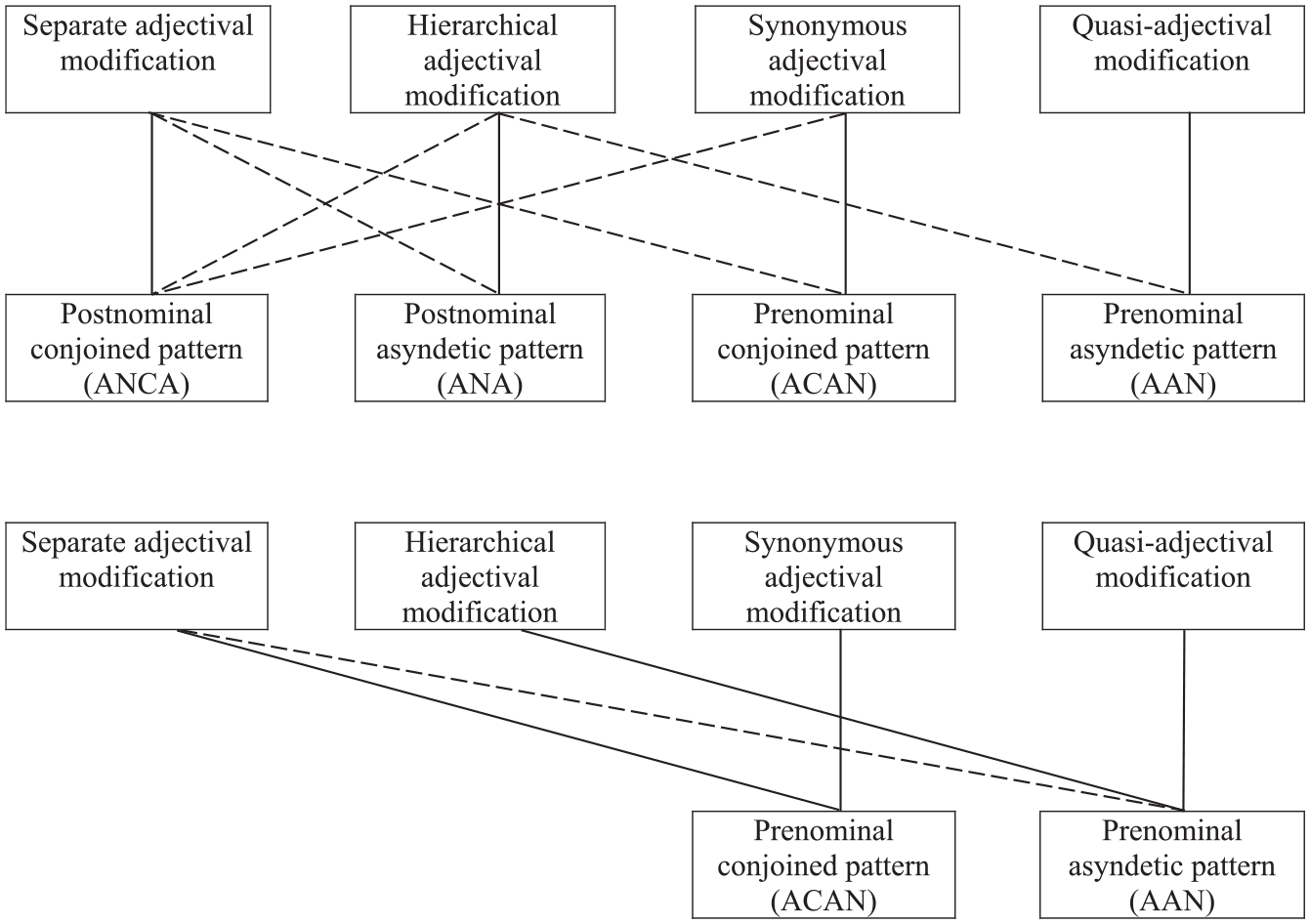
Many-To-Many Form-Function Relationships in OE and Present-Day English Networks of Adjectival Constructions
Importantly, the strategy of falling back on the existing network nodes seems sufficient for the preservation of horizontal networks of related constructions. As ANCA and ANA obsolesce and virtually disappear, their functions and mutual relations are reproduced by means of ACAN and AAN, so that the horizontal network of multiple adjectival modification and some finer differences encoded by it can be preserved. At the same time, the former functions of the prenominal conjoined and asyndetic patterns are retained elsewhere in the system. Thus, the network appears to be degenerate: it is characterized by multifaceted form-function links, and then this property is exploited in the scenario of change (cf. Van de Velde 2014).
6. Conclusions
This study has addressed the question of how best to treat OE postnominal adjectival structures. Previous accounts have been somewhat divided, either sharply distinguishing between the asyndetic variants and the and-adjective type, or proposing a uniform treatment of all adjectives occurring to the right of the noun. The quantitative and qualitative analyses performed on a representative set of corpus data indicate that postnominal adjectives in the respective patterns display markedly different tendencies with respect to relative frequencies against their preposed counterparts, semantic properties, and their relation to the head noun and—in the case of multiple adjectives involved—also to each other. It appears that single adjectives placed postnominally specialized in referencing stage-level properties, or their position resulted from the heaviness of a phrase further complemented by a PP or dative NP. On the other hand, when two adjectives flanked the noun, they typically referred to its enduring properties, but the character of modification differed depending on the pattern: the asyndetic type preferred adjectives organized in a hierarchical structure, while the and-type mostly involved cases of separate modification. Functionally, these two types were closer to their respective prenominal counterparts rather than to each other. These findings—in accordance with the definition of a construction as a pairing of form and meaning—allow for identifying the following postnominal adjectival constructions of OE, each embedded with a unique function: NA, NA+Comp, ANA, and ANCA. While these patterns are not fully consistent, it has been argued that this is a result of their ongoing reanalysis by the speakers of OE. The findings support the basic constructional notion that language change is essentially change in usage (cf. Traugott & Trousdale 2013).
Additionally, I have argued that the constructions involving multiple adjectives, i.e., ANA and ANCA, likely operated in a horizontal network and overlapped functionally with their prenominal counterparts, i.e., AAN and ACAN. The latter eventually supplanted the former, but without detriment to the original differences in meaning which their predecessors encoded. This smooth transition appears to have been facilitated by the many-to-many relationships holding between particular forms and particular meanings, a phenomenon which Van de Velde (2014) refers to as degeneracy. Thanks to this property, change did not necessitate introducing new resources, as new meanings could be mapped onto existing forms, which simultaneously did not cease to be associated with their former functions. To be sure, an extended analysis of the studied constructions in subsequent periods would be required in order to fully appreciate the character of the change posited. It would likely involve elaborating on the phenomenon of “layering,” which Hilpert (2013:463) describes as “the coexistence of different constructions for the expression of similar grammatical meaning.” This would naturally work best if a full-scale diachronic comparison between periods was conducted; a quick glance at Middle English data suggests that this line of inquiry could be productive.
In sum, the multifaceted relations between the OE adjectival constructions support one of the basic tenets of the constructionist approach, namely that language is a complex network of interrelated constructions. Studying language under this working assumption appears to be effective for capturing the intricacies of the system at a given point in time, as well as for detailing processes of change. Globally, the constructionist framework adopted for this case study of OE patterns of adjectival post-modification has demonstrated that language “continues to change and adapt,” and that its structure and changes which it undergoes are “an extension of numerous domain-general cognitive capacities such as shared attention, imitation [. . .], chunking, and categorization” (Beckner et al. 2009:16-17).
Footnotes
Appendix 2. Corpus Queries
Appendix 1
Study Corpus
| Text | Type | Word count |
|---|---|---|
| Ælfric’s Catholic Homilies 1&2 | non-translation | 204,756 |
| Ælfric’s Homilies | non-translation | 62,669 |
| Ælfric’s Lives of Saints | non-translation | 100,193 |
| Alfred’s Introduction to Laws | non-translation | 1,966 |
| Anglo-Saxon Chronicle A | non-translation | 14,583 |
| Anglo-Saxon Chronicle C | non-translation | 22,463 |
| Anglo-Saxon Chronicle D | non-translation | 26,691 |
| Anglo-Saxon Chronicle E | non-translation | 40,641 |
| Bede’s Ecclesiastical History of English People | translation | 80,767 |
| Benedictine Rule | translation | 20,104 |
| Blickling Homilies | non-translation | 42,506 |
| Charters and Wills 1 | non-translation | 1,753 |
| Charters and Wills 2 | non-translation | 253 |
| Charters and Wills 3 (O2/3) | non-translation | 679 |
| Charters and Wills 3 (O3) | non-translation | 7,171 |
| Charters and Wills 4 | non-translation | 193 |
| Gregory’s Dialogues (C) | translation | 91,553 |
| Laws of Æthelred V | non-translation | 1,228 |
| Laws of Æthelred VI | non-translation | 2,096 |
| Laws of Alfred | non-translation | 3,314 |
| Laws of Cnut | non-translation | 7,147 |
| Laws of Gerefa | non-translation | 751 |
| Laws of Ine | non-translation | 2,755 |
| Laws of William | non-translation | 220 |
| Martyrology | non-translation | 31,472 |
| Northumbra Preosta Lagu | non-translation | 1,330 |
| Pastoral Care (Cura Pastoralis) | translation | 68,556 |
| The Heptateuch | translation | 59,524 |
| The West-Saxon Gospels | translation | 71,104 |
| Vercelli Homilies | non-translation | 45,674 |
| Wulfstan’s Homilies | non-translation | 28,768 |
| Total |
|
Declaration of Conflicting Interests
The author declared no potential conflicts of interest with respect to the research, authorship, and/or publication of this article.
Funding
The author disclosed receipt of the following financial support for the research, authorship, and/or publication of this article: The findings of this article will eventually contribute to a larger project run at the University of Łódź called The variation of syntactic and phraseological constructions in Old English prose (NCN SONATA 2017/26/D/HS2/00272), financed by the National Science Center.
