



Abstract
Histories of Japanese science have been integral in affirming the Meiji Restoration of 1868 as the starting point of modern Japan. Vernacular genres, characterized as “premodern,” have therefore largely been overlooked by historians of science, regardless of when they were published. Paradoxically, this has resulted in the marginalization of the very works through which most people encountered science. This article addresses this oversight and its historiographical ramifications by focusing on kyūri books – popular works of science – published in the years following the Restoration, when there was unprecedented public interest in science. It asks, what if we take these kyūri books on their own terms as science books, just as those of the time saw them? This article explores three genres of kyūri books, namely fictionalized formats, such as the epic tale (monogatari); epistolary guides; and genres, such as the sutra, that drew on religious textual practices. It argues that these literary genres provided interpretive frameworks that shaped readers’ encounters with “modern” science. This exploration underscores the importance of engaging with vernacular genres to understand the emergence of science as a global category in the nineteenth century.
Introduction
The Meiji divide looms large in the historiography of modern Japan. Described as “the ultimate watershed in the whole of Japanese history that definitively separates the ‘old’ from the ‘new’,” the Meiji Restoration of 1868 is typically taken as the starting point of Japan’s modern era. 1 This moment of rupture was brought about by the overthrow of the Tokugawa military government, which presided over two centuries of peace, by the imperial Meiji regime, and the emergence – it is usually posited – of the Japanese nation-state. This is not to say that this characterization remains unchallenged. Far from it. For some time now, scholars have been chipping away at this narrative by drawing attention to the many continuities between Japan of the Tokugawa era and the modern nation-state. 2 Yet this narrative remains remarkably influential, perhaps nowhere more so than in histories of science. Canonical Japanese histories of science often use the Meiji Restoration of 1868 as their point of departure. 3 Shigeru Nakayama, one of the pioneers of the field, argued that, although Western science had previously been “entering Japan in a stealthy way,” it was only in the Meiji period (1868–1912) that traditional forms of knowledge “wilted” away, allowing science to “surge unimpeded.” 4 Even more recent works that problematize the equation of science with modernity – take, for example, Kanamori Osamu’s magisterial series on the history of Japanese scientific thought – do not venture across the Meiji divide. 5
In recent years, challenges to this narrative have come from scholars interrogating scientific practices and practitioners in early modern Japan. In his study of nature studies, or honzōgaku, Federico Marcon challenged the idea of science as a Western import by demonstrating the many parallels in how perception of nature developed between Tokugawa Japan and Europe, despite very little interaction between the two contexts. 6 In her study of shashin (the term means “representations of the real” and was adopted as a translation term for the photograph in the late nineteenth century), Maki Fukuoka deliberately crosses the Meiji divide to undermine the existence of an opposition between “premodern” Japanese scholarship and “modern” Western science. She achieves this by showing how the concept of shashin predated the photograph and was tied to the emergence of distinctively Japanese techniques of visualization among some honzōgaku practitioners. 7
These studies have challenged Nakayama’s description, with its social Darwinist overtones, of modern science sweeping away all before it. They show modern science to be a beneficiary of a long tradition of scientific practices in Japan. As Marcon argues, though honzōgaku may have “lost its name,” it “transferred to the practitioners of the new scientific fields two centuries of knowledge, research, data, images, techniques, attitudes, styles, facilities, expertise, schools, social relations, books, and specimens.” 8 Inconveniently, however, even if many traditional scientific fields did not completely die away, they were largely superseded. Honzōgaku, for example, did survive the Meiji transition, but it did so in rump form. As a recognized scientific field, it was superseded by disciplines such as botany and zoology. The seemingly abrupt demise of many traditional forms of knowledge is one reason why historians of science have been so reluctant to challenge the prevailing historiography of modern Japan.
The Meiji government that ascended in 1868 deliberately cultivated a sense of renewal to set itself apart from the deposed Tokugawa regime. It did so by portraying the rupture as not just political, but also as epistemic. Shortly after the Restoration, the new government presented its “Charter Oath,” the five articles of which set out the overarching principles guiding Meiji reforms. Deftly depicting the Tokugawa as a period of stagnation and ignorance, the new administration promised in the fourth article to “break through the shackles of the former evil practice.” The fifth asserted that Japan was now to turn outward to “seek knowledge from throughout the world.” 9
In reality, much of the Meiji project was built on foundations laid by the previous Tokugawa rulers. 10 The Meiji government did, however, introduce some measures that constituted a significant departure from the policies of the preceding regime. One such introduction was a new national school system. Notable in this new school system was the emphasis placed on science. In 1872, the government announced the elementary school curriculum for the new school system, which detailed the proportion of time to be spent on each subject. Over the eight years of elementary education, no less than forty percent of class time was to be allocated to scientific subjects, a proportion that, the education historian Itakura Kiyonobu notes, surpassed that of any other country at the time. 11
The new school system provided another opportunity for the government to reinforce a sense of rupture. The Meiji government achieved this discursively: the new state-sanctioned science was to be known as rika. Until then, the term commonly in use to describe the physical sciences was kyūri. Both kyūri (究理) and rika (理科) were originally Chinese terms that become associated with Western natural philosophy in Ming China (1368–1644), when Jesuit missionaries used them as translation terms for European (Aristotelian) philosophy. 12 This was a strategic decision by the Jesuits. Both terms were associated with Neo-Confucianism, the all-encompassing philosophy that provided the principles not only for state governance, but also for ordering all in the universe. The characters ri (理), found in both terms, and ka (科) were synonyms for the practices of “classifying” and “arranging” all in the world according to Neo-Confucian cosmology. Kyūri (究理) referred to the “fathoming of principles” that underpinned such classification. 13 Through their use of these terms, Jesuits aimed to underscore the affinity and compatibility of European and Chinese philosophical systems and, in so doing, ingratiate themselves with their hosts. Kyūri was the term more widely adopted in Japan. Its relatively widespread use there can be attributed to Tokugawa-era scholars of Western learning who adopted it as a translation term for the Dutch term natuurkunde (natural philosophy). 14 Thus, while both kyūri and rika had long been part of the Neo-Confucian lexicon, the relative obsolescence of rika in Japan gave the term a freshness that made it feel suited for describing a new, modern discipline.
What also gives rika a sense of novelty was that in the early 1870s the term kyūri must have felt ubiquitous. At the time, Japan’s urban centers were experiencing a boom in the publication of kyūri-sho, popular books on science. From 1870 to 1874, about sixty of these popular science books were published, catering to a public seeking information about new infrastructure, such as the telegraph and railway, that was rapidly transforming the landscape. 15 This period was also characterized by a preoccupation with bunmei kaika (civilization and enlightenment) among the government and elites. Its proponents advanced an agenda of radical transformation that entailed reforms ranging from the introduction of universal conscription to the adoption of modern manufacturing methods. 16 Kyūri was seen as an integral component of bunmei kaika. Thus, although the term had long been used by Neo-Confucian scholars and among tiny circles of western-leaning scholars, when kyūri erupted in the public’s consciousness its meaning had shifted. Rather than “natural philosophy” in a broad sense, kyūri came to represent “Western science” in the early Meiji period. This spike in popular demand for kyūri books was a welcome commercial opportunity for writers and publishers, and it attracted the attention of many prominent names. These included the educators Fukuzawa Yukichi and Takada Yoshitoshi, the artist Kawanabe Kyōsai, and popular writer Kanagaki Robun. But not all works were of high quality. Unable to produce new content quickly enough to satiate demand, many publishers simply regurgitated material published elsewhere.
Kyūri books have been almost completely ignored by historians of science and dismissed as vehicles of light entertainment. Paradoxically, this has resulted in the marginalization of the very works through which most people encountered science in this era of unprecedented public interest. This article addresses this oversight and its historiographical ramifications by focusing on kyūri books published during the early Meiji publishing boom. It asks, what if we take these kyūri books on their own terms as science books, just as those of the era saw them? How might this change our understanding of how the public encountered and understood science? This article argues that vernacular literary genres employed in kyūri books were integral in shaping the early Meiji public’s engagement with science. It shows how these “premodern” literary genres provided interpretive frameworks that shaped readers’ encounters with “modern” science by enabling them to draw on familiar modes of textual engagement. The focus here is on three genres of kyūri books, namely fictionalized formats, such as the epic tale (monogatari); epistolary guides; and genres, such as the sutra, that drew on religious textual practices. This exploration shows that kyūri books were effective because they appealed both intellectually and aesthetically. They demanded forms of engagement that drew on embodied practices, such as copying, intoning, and memorizing, that are incongruous with the contemporary image of science as a disinterested and disembodied endeavor. Importantly, in an age where superstition was recast as an evil, far from displacing superstition with truth, writers of kyūri books harnessed the supernatural to heighten the affective appeal of science.
What arises from this exploration is the importance of engaging with vernacular genres to understand the emergence of science as a global category in the late nineteenth century. As the historian Marwa Elshakry points out, though science became increasingly global at this time, “it was nevertheless discussed and debated in very local terms.” 17 In Japan, as elsewhere, there was an inchoate mix of conceptualizations of science. This is reflected in the variety of terms used. In the early Meiji period, kyūri referred to a relatively circumscribed field. Those who popularized kyūri did so to promote a mechanistic view of nature rooted in Newtonian physics. For many early Meiji intellectuals, this mechanistic view of nature represented a powerful antidote to the Neo-Confucian cosmologies that underpinned Tokugawa authority. 18 Kagaku, the term that eventually became accepted as a translation term for science, was not in use at the time. 19 Like science, the eventual spread of the term kagaku was influenced by global trends such as the professionalization and institutionalization of the sciences, the development of international communication systems, and increased standardization of laws and procedures. 20 Science was also appropriated as a rhetorical device. Rika (and later kagaku) was embraced by the Meiji regime, which deployed the language of science in service of its own political and social agendas. 21 Rather than a weakness, this malleability was a necessary condition for science’s increasingly global reach in the nineteenth century: science could be used by diverse groups who saw in it a tool to argue for their visions of the future.
Rika vs. kyūri
The difference between rika and kyūri was therefore not simply one of naming. Rika and kyūri books were also distinguished by their audience, style, and materiality. To provide pedagogical material for use in the school curriculum, the Ministry of Education set about developing new textbooks as soon as it had inaugurated the new school system. These were materially different from kyūri books. Kyūri books were typically printed using woodblocks and made from thin paper of woven mulberry tree fibers, which were bound together using strings made from twisted strands of paper. More than one contemporary Western observer would remark about the gossamer quality of these traditionally produced books. The rika textbooks commissioned by the Ministry of Education were, however, typically typeset and hardbound in Western style. These textbooks, one historian notes, were perceived as “luxury” items. 22 Their sturdy physical presence afforded them a prestige that the more ephemeral woodblock printed books could not match. The material form of books also impacted how readers would engage with the text. During the early Meiji period, typesetting overtook xylographic woodblock printing as the predominant mode of book production. Because xylographic prints were a facsimile of the scribe’s handwriting, authors customarily took advantage of the versatility of this form of printing to imbue works with their own “calligraphic personality.” 23 Two works with identical content but with different calligraphic personalities could in theory engender a different affective response in the reader. With the move to typesetting, script moved from being something with “value in and of itself” to being primarily a “means of transmitting meaning.” 24 Through the use of typesetting, the Ministry of Education removed that personal, and subjective, connection with the writer of the book.
Rika and kyūri works were also distinguished by the sources on which they drew. Kyūri writers drew on a wide range of sources. These included texts originally written in Chinese under the direction of Protestant missionaries, such as Alexander Wylie, W. A. P. Martin, and Benjamin Hobson, and which were imported to Japan in the years prior to the Meiji Restoration. 25 Other writers of kyūri books also drew on even older sources, such as Japanese translations by Dutch scholars during the Tokugawa period. Rika textbooks, however, tended to be translations of British, American, or French works. Sources for such works included Garrigues’ Simples lectures sur les sciences, les arts et l’industrie, as well as science primers in chemistry and physics by the British authors H. E. Roscoe and Balfour Stewart, respectively.
In translating European and American textbooks, Ministry of Education translators adopted a reverential approach that was quite unusual for their era. This deference can be seen in the emphasis on fidelity to the lexis, style, and format of their sources. A consequence of this close translation style was the introduction of a new pedagogical genre: the school textbook. For kyūri book writers, fidelity was to their audience. They molded their sources into genres with which their readers were familiar, omitting swathes of text if they felt it was irrelevant and adding annotations and commentary whenever they considered it necessary. Most kyūri writers declined to name their sources, so these can often only be guessed at or discerned through forensic textual examination.
This approach to textual production was shaped by the exigencies of the early Meiji literary marketplace. This marketplace catered to a public that was relatively literate by international standards. Tokugawa-era governance – wherein the village was the smallest administrative unit – had bequeathed a population where elites, even in rural areas, were highly literate. 26 In urban areas, literacy rates were higher. Among such urban populations, being able to read and write was increasingly “framed as a new social must.” 27 Furthermore, although there was a gulf in literacy between men and women, by the nineteenth century, writing had come to be seen as an important part of femininity, meaning that, at least in urban areas, many women were able to read and write. This emphasis on literacy and the relatively widespread culture of reading in the Tokugawa period saw the development of publication centers in the shogunal seat of Edo (later Tokyo), the imperial capital of Kyoto, and the commercial center of Osaka. As a sign of the importance of print culture in nineteenth-century Japan, one of the first acts of the incoming Meiji government was to introduce a stringent system of censorship to suppress any opposition to the government. 28 Thus, unlike the Ministry of Education, writers of kyūri books did not have a captive audience. They had to compete in a thriving marketplace. Kyūri works would have to embed unfamiliar concepts within existing intellectual frameworks to have any hope of competing with more attractive lighter fare. Kyūri writers saw no conflict between “old” forms of inscription and “new” kinds of knowledge. Traditional literary genres had long shaped Japanese readers’ engagement with the world, and it was to these that they turned to mediate the public’s engagement with science. Moreover, in such a competitive environment, any attempt to educate would also need to entertain. Sure, readers wanted information. But they would not tolerate dreary didacticism. To be successful, kyūri books needed not simply to instruct, but also to delight. 29
The epic tale
Although science’s claim to truth set it apart from other subjects of entertainment, some kyūri writers found fiction effective for promoting science, and published works in the monogatari, or epic tale, format. It was a common strategy to describe works as monogatari to draw an association in readers’ minds with romantic epics, such as The Tale of Genji, and military sagas, such as The Tale of the Heike, from the classical and medieval periods. The term monogatari set readers’ horizon of expectation, priming them to expect narrative prose. 30 Even if focused on science, a reader would not expect a monogatari to dryly recount facts. They would expect a human protagonist in whose story they could become invested and on whose adventure they would be swept along. 31
A notable example of a kyūri book of the monogatari genre is An Illustrated Tale of Science (Gahon kyūri monogatari).
32
In keeping with the expectations of the genre, An Illustrated Tale of Science opens by introducing its protagonists and setting the stage for a dramatic encounter – in this case between the so-called “irrational beliefs” of the past and the new field of learning that is kyūri. A school bearing the sign “Eigaku kyōjusho,” meaning “English Studies School,” has appeared in Shitaya, a neighborhood in the new capital of Tokyo.
33
The gates of this school mark the threshold to the narrative. Itariya Ro’eimon is a merchant who lives nearby. Attracted by the promise that this school holds of preparing his adolescent son for his future, he crosses its gates and meets Eiran, the school’s proprietor. The merchant explains to Eiran why he is so keen for his son to study there: I have seen a telegraph erected in front of our house. Through this copper wire, one can talk to someone even a thousand miles (ri) away. A steam locomotive can travel 40 or 50 miles in just an hour. A hot air balloon can fly through the air. My son asks me how these things can be, but I do not know these things. I hear from various people that the complexity of Western machines takes away bone-breaking work, be it from weaving textiles, building houses, or pumping water. It would be truly regrettable not to understand how these devices work even though we can see the benefits these inventions have brought to us. If we can master this learning, we can surpass the West and can also make new useful inventions so that we can outwit the West.
34
Itariya Ro’eimon explains that his son Futsurō has already studied writing and poetry. Study of Sinological works, such as the Four Books of the Confucian tradition, were the bedrock of education for elite males in premodern Japan. 35 How is studying in this school of Western learning different from what his son has experienced before, Ro’eimon asks. The difference lies in its utility to his son’s future, Eiran explains: “In essence, learning does not consist in such impractical pursuits as study of obscure Chinese characters, reading ancient texts which are difficult to make out, or enjoying and writing poetry.” “After all,” he points out, “among scholars, those who have been skilled in practical matters have been few indeed.” More problematic for a merchant, studying poetry could be detrimental to his business: “rare also has been the chōnin (townsfolk) who, if he was well versed in poetry, was also successful in business.” (p. 4 chō) For Ro’eimon’s son to be successful, Eiran asserts, first he must learn the “26 horizontal-writing characters” (presumably referring to the English alphabet), and master counting on the abacus. Encouraged that the school will provide the type of learning that will help his son rise in the world, Ro’eimon entrusts his son Futsurō to Eiran, who is assisted by his own son, Rōma.
Eiran’s assertions about the uselessness of traditional Japanese education for a merchant and the need to focus on literacy and numeracy are not the words of Okada Hanji, the author of An Illustrated Tale of Science. Rather, they are the words of the well-known Meiji intellectual Fukuzawa Yukichi (1835–1901). Eiran’s words are copied almost verbatim from Fukuzawa’s An Encouragement of Learning (1872), an influential tract that argued the importance of practical learning (jitsugaku) for both personal and national independence. 36 Okada made some minor, but notable, changes to Fukuzawa’s text. Rather than the alphabet, Fukuzawa in fact advocated the study of kana, the Japanese phonetic syllabary, as a means of consulting translated texts. Fukuzawa saw reading translations as a precursor to learning Western languages, which would allow readers direct access to foreign works through which one “can search for the truth.” 37 In addition, Okada refers only to “scholars” when describing those engaged in impractical pursuits, while Fukuzawa pointedly denounced “Confucian Learning” for being worthless to Japan’s future. It was Fukuzawa’s Illustrated Introductory Physics (Kunmō kyūri zukai, 1868) that provided the template for kyūri books. In this and subsequent works, Fukuzawa promoted kyūri to challenge the Neo-Confucian cosmologies that underpinned the Tokugawa regime. Many note the widespread influence of Fukuzawa’s work on Meiji intellectuals, and we see here its influence on a writer who may have extended its reach and effectiveness by repackaging it into another format. By transforming Fukuzawa’s polemic into narrative prose, and having fictional characters ventriloquize his words, Okada was able to intensify the emotional appeal of Fukuzawa’s work.
The reader of a monogatari would also expect to find illustrations as the genre has its origins in the illustrated picture scrolls of the Heian period. Visuals play an important role by adding a layer of exposition to the monogatari. The opening image in An Illustrated Tale of Science shows Ro’eimon and his son Futsurō meeting Eiran and Rōma inside the English Studies School (see Figure 1). The illustration is replete with icons intended to underscore the chasm between the students and teachers. These icons include the tonsorial: Ro’eimon and Futsurō both wear topknots, the former with his forelocks shorn, while Eiran and Rōma wear their hair in a short style. Others are sartorial: although the students’ clothing is typical of that worn by relatively well-to-do urban classes, it is coded as Japanese when compared to the suits worn by the teachers, who are literally elevated by being positioned on Western-style chairs. The otherworldly aura of the English Studies School is further reinforced by having a carpet, rather than tatami, on the floor and through other items dotted around the room: a hardcover book, a Western-style clock, and what appears to be a fireplace at the back of the room. Keen to emphasize that the school is furnished with Western-style windows that do not slide open in the manner of those in the Japanese style, the illustrator erroneously shows the window opening inward, rather than outward.
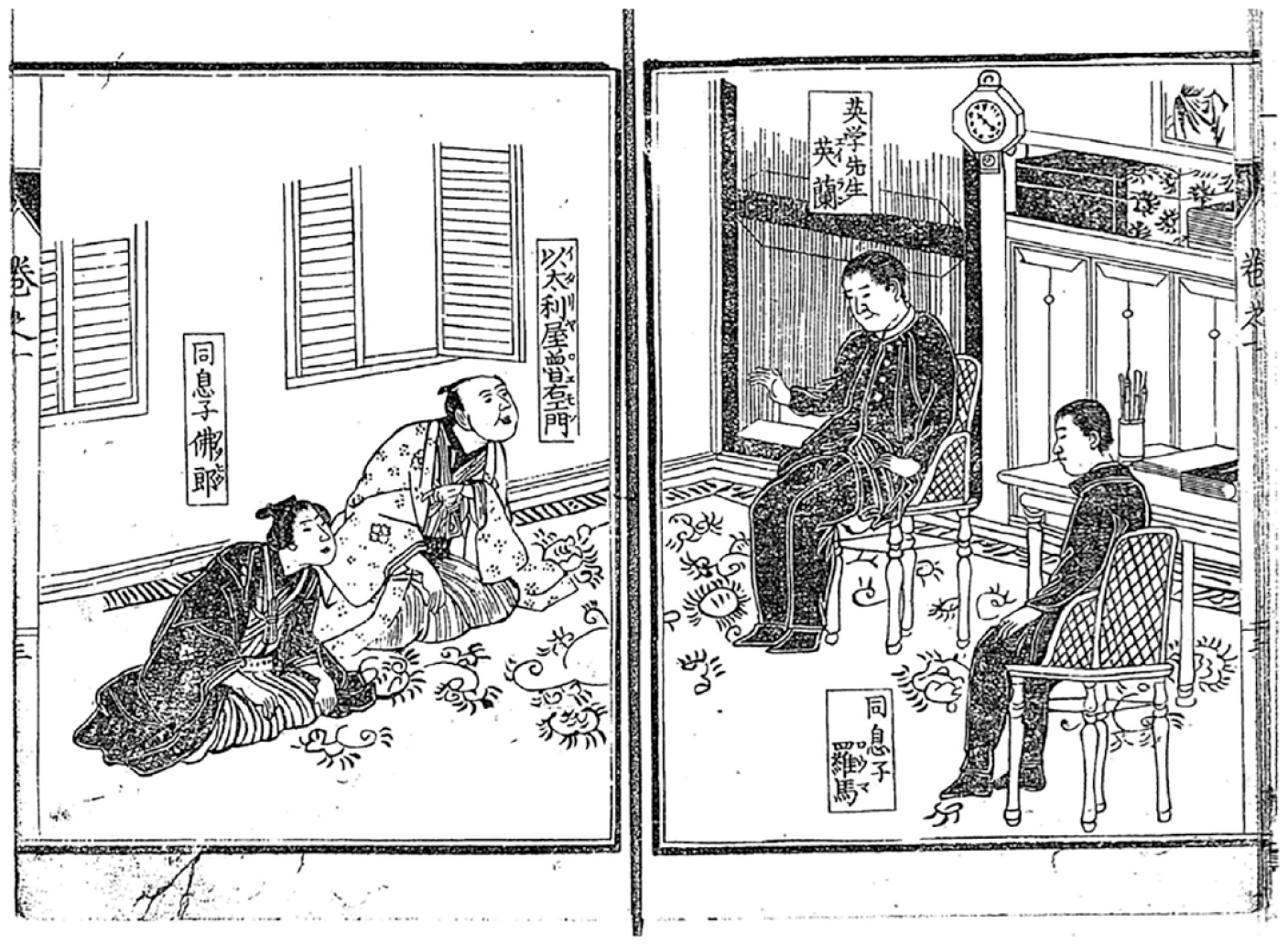
Itariya Ro’eimon and Futsurō meet Eiran and Rōma in the English Studies School. An Illustrated Tale of Science, 1872. Courtesy of the National Diet Library, Tokyo.
Wordplay is also used to heighten the sense of exoticism. The teacher’s name, Eiran, is a portmanteau of characters to signify Britain (ei) and Holland (ran), while Rōma refers to Rome. Itariya Ro’eimon combines Italy (Italia) with Ro’eimon, then a common adult male given name. Futsurō comprises the character for France (Futsu) with -rō, a common suffix in adolescent boys’ names. 38 These names are included to identify the characters as Japanese. The author includes a father and son in each pair, perhaps to suggest filial relationships and hierarchies. Perhaps he considers Britain and Holland to be the inheritors of learning handed down from classical antiquity. He may also be suggesting that France, which at the time still suffered reputational damage in Japan for its support for the deposed Tokugawa regime, and a fractured Italy, should learn from Britain and Holland. The messaging in the images is sometimes ambiguous and inconsistent, and perhaps one should not read too much into the choice of names. Like the various ornaments in the illustrations, the names of the characters may well have been chosen to confer a sense of foreignness rather than to provide insight into international geopolitics.
Though a monogatari, much of An Illustrated Tale of Science takes the form of a dialogic lesson. This rather pedestrian genre, known as mondō in Japanese, was typical of didactic texts. The author does, however, attempt to liven up the content by creating a narrative arc that traces Futsurō’s journey from ignorance to enlightenment. On his first day at the school, Futsurō learns that he will be taught by Rōma and the story that develops focuses on the relationship between the two adolescents. Their first lesson starts with a discussion about thunder. Rōma explains that the principles behind natural phenomena such as this are the same as those that govern the functioning of technology, such as the telegraph. Rōma asks his pupil if he knows how thunder is generated. “Oh, I don’t know much about thunder,” Futsurō responds, “but I do know of the beast raijū who descends, tearing up forests and destroying roofs.” “Is thunder the work of a demon?” he asks. 39 Rōma ridicules him: “there are no demons or evil spirits in the world.” Everything, he explains, has a rational explanation. Just as ignorance is common to us all, Rōma points out, so too is learning: “Even in the West, in the past people did not know the reasons for thunder and attributed it to the screams of an evil god.” However, scholars pondered this phenomenon and found the explanation for it in electricity, he explained. Rōma finishes his explanation by admonishing Futsurō: “attributing natural phenomena thunder to raijū or beasts, in this age of civilization and enlightenment, would be to invite ridicule.” As Rōma and Futsurō’s dialogue progresses, they tackle increasingly complex questions about the natural world until, eventually, all Futsurō’s outdated beliefs are eradicated. At the work’s end, Futsurō fulfills the promise of becoming an independent, fully fledged human in the vein described by Fukuzawa Yukichi in An Encouragement of Learning.
An Illustrated Tale of Science contains little that is novel. As shown, the premise of the work was borrowed from Fukuzawa Yukichi’s influential treatise. Fukuzawa’s treatise was considered radical at the time, but Okada was able to smooth the acceptance of Fukuzawa’s message by repackaging it as a monogatari. In this way, Okada encouraged readers to identify with the merchant Itariya Ro’eimon and his son Futsurō and, in so doing, grasp the value of kyūri to their lives. Not only was kyūri immediately beneficial to their practice as merchants, it also had wider benefit to the country as kyūri-educated citizens could help Japan become a prosperous and powerful nation. Okada made the message even more compelling to early Meiji readers by introducing humorous imagery. And though the tale was set in the exotic locale of a Western school, there was sufficient that was reassuringly familiar so as not to alienate readers.
Epistolary styles
The popularity of epistolary guides in the early modern period made them attractive as vectors of knowledge in a wide variety of fields. These manuals sold well because of the importance of letter-writing – and the etiquette that undergirded this mode of communication – to the maintenance of social relations in Japanese society. Codes of epistolary practice were introduced to Japan from China as early as the ninth century, and naturally, courtly elites were early adopters: there is ample evidence of this in the eleventh century romantic epic The Tale of Genji, in which the narrator displays considerable sensitivity over the nuances of handwriting and the choice of words in epistles by the protagonist. 40 By the seventeenth century, letter-writing had proliferated throughout Japanese society. This did not, however, lead to a deterioration in etiquette. It led, rather, to a surge in the publishing of epistolary guides to help readers navigate the intricacies of epistolary conventions. Writers of these guides were renowned for having their ear to the ground, and addressing the most current topics would distinguish a publication in a competitive marketplace. It was therefore almost inevitable that kyūri would be adopted as a theme in this genre by the early Meiji period.
Letter-writing etiquette extended beyond matters of syntax and style. Refinement was also demonstrated through one’s choice of topic and one’s depth of knowledge on that topic. To this end, guides provided letter-writers with samples that would allow them to demonstrate their familiarity with scientific topics. Providing samples that could be copied wholesale or tweaked if desired, A Monthly Epistolary Guide: An Expedient to Science (Kyūri shōkei jūnigetsu chō) presented material that would allow writers to simultaneously display their erudition while remaining sensitive to seasonal changes. 41 This work provided epistles that enabled those writing in March to explain that it was the warming up of the air in spring that stimulated the blooming of cherry blossoms. In May, a letter-writer would be able to display their understanding of how the arrival of tsuyū, the late spring rainy season, created the moist conditions in which fungi would develop. The guide would also help letter-writers show their familiarity with the precipitation cycle and exhibit their understanding of how the snow that blanketed the ground in December was just one guise in which water, which existed all around us in various forms, could appear. One could also write knowledgeably about gravity by reciting the apocryphal account of Isaac Newton’s “discovery” of gravity in his family orchard in Lincolnshire. The letter sample for September 16 allows the letter-writer to explain that as Newton witnessed an apple fall from a tree, he realized that there was a “force drawing everything to the earth like a magnet.” 42 Following epistolary convention, the account of Newton’s discovery of gravity concludes by inviting the recipient to respond: “I look forward to your reply.”
Letter-writing did not only serve as a medium for new knowledge about kyūri. As a social practice, epistolary conventions were also altered by this knowledge. These customs were thrown into disarray by the announcement in December 1872 that the lunar calendar would be replaced by the Gregorian one, and that variable-hour timekeeping practices would be supplanted by the twenty-four-hour clock. 43 Epistolary guides stepped in to help letter-writers navigate a new development that was particularly jarring: the seasonal demarcations that regulated letter-writing were aligned with the lunar calendar. Year-Round Epistolary Guide: Science and the Exchange of Gifts (Kyūri zōtō nenchūchō) explained to readers how gift exchanging practices would be affected by the calendrical revolution. 44 To do so, it started with a comparison of the new Gregorian “solar” calendar with the soon-to-be-discarded lunar one, explaining the orbit of the earth around the sun, before segueing into discussion of Galileo, the development of telescopes, and planetary motion.
It was not only gift-giving that was thrown into disarray by the new science. Performing Buddhist commemorative rites on the anniversary of a death was another important societal custom tied to the lunar calendar and was one that also impinged on epistolary practice. Year-Round Epistolary Guide stepped in to explain the changes through discussion of historical figures. Using the examples of Ōishi Yoshino, the famed leader of the forty-seven rōnin, whose exploits are celebrated in the play Chūshingura (The Treasury of Loyal Retainers), and the celebrated poet Matsuo Bashō, Year-Round Epistolary Guide demonstrated how calendrical changes meant that the seasons in which their commemorative rites were performed had changed. Greetings therefore needed to be adjusted accordingly. It was no longer possible to rely on calendrical guides that had previously proliferated among all sectors of society. To avoid embarrassing faux pas, one now needed to use epistolary guides informed by kyūri.
Epistolary guidebooks were written in what is known as sōrōbun style. Sōrōbun was a highly codified style of Japanese employed almost exclusively for letter-writing. Its grammatical structure was based on classical Japanese, but with a syntax that adhered to Chinese. In addition, it was written almost exclusively in Chinese characters without Japanese phonetic glossing and dispensed with overtly Japanese grammatical markers such as particles and conjugational suffixes. This required the reader to engage in a complex process of decoding and nonlinear reading. Thus, while their content was largely similar to kyūri books of other genres, epistolary guides produced an experience that was considerably different for the reader. Laura Moretti points out that guidebooks appealed for what she calls their “epistemic function.” The enjoyment of reading, she explains, was “also the intellectual excitement derived from reading something that a reader finds interesting for all sorts of reasons.” 45 Part of the enjoyment of engaging with texts written in sōrōbun style came from the challenge of deciphering the text. In an encounter with kyūri epistolary guides, the reader was certainly not a passive recipient of knowledge. Epistolary guides written in sōrōbun did not aim to provide readers with unobstructed access to universal knowledge; the language demanded to be given as much attention as the content.
Epistolary guides were invariably written in elegant calligraphic style. It was not simply the content of these works that readers aimed to emulate, but also the beauty of their scripts. The importance of the aesthetic of these texts can be seen in how the division of labor in producing these guides is inscribed on their frontispieces. Authorship (-cho) and inscription (-sho) are considered distinct roles. Sometimes a supervisor (-etsu) is also mentioned. The supervisor would be a well-known scholar whose role was to assure the reader of the quality of the work, primarily through the weight of their reputation. A supervisor could also endorse the work by writing a foreword. Here, too, the quality of their script would serve as evidence of their status and expertise. Trustworthiness was therefore conveyed through material means. Moreover, as it was expected that readers would trace the script as they read it, the readers also corporeally submitted to the authority of the scribe. 46 This tracing had a pedagogical function: not only did it enable readers to learn how to write correct and beautiful characters, but it was also felt that copying would enhance memorization by encouraging the reader to, in essence, embody their inscriptions. 47
The emphasis on decorum and beauty in epistolary genres made them suitable modes of writing for women. Regardless of their class, women were expected to develop competence in writing formal correspondence. 48 Consequently, in the early modern period, many letter-writing books were scripted by women. Women were also educators during this time; figures from the Ministry of Education indicate that, even by conservative estimates, women comprised about ten percent of the teachers in Edo by the mid-nineteenth century. 49 It is likely, then, that they compiled educational material. However, curiously, no women are named – either as authors or scribes – in any kyūri books, even epistolary guides, published in the early Meiji period. It is conceivable that women scribes operated under male noms de plume, but there is little evidence of this practice during this period. 50
Although women do not appear as authors or scribes of published works, they are almost omnipresent in kyūri books in another sense. Authors, or those who endorsed their works by penning forewords, would underscore that their writing was simple enough to be understood by women. Women also sometimes appear in the illustrations that adorn the frontispieces of kyūri books (see Figure 2). Women were thus clearly a target audience for kyūri books. This focus likely stemmed from an anxiety that the irrational beliefs of women were a threat to the civilization and enlightenment project. 51 There was widespread sentiment among Meiji intellectuals that women were a potential impediment to Japan’s advancement. This attitude was made even more explicit in official works, such as nishiki-e (single-sheet multicolored woodblock prints) of famous inventors produced by the Ministry of Education. 52 The prints assert that the world would have been robbed of the steam engine had James Watt succumbed to the wrath of his aunt, who “was angry at him for wasting his time on something so useless.” Another print shows the inventor of cotton-spinning machinery, Richard Arkwright, remonstrating with his wife, who smashed his models in a bout of anger. She was enraged, the print explained, that “he was wasting money in vain” working on a project the value of which was not immediately evident.
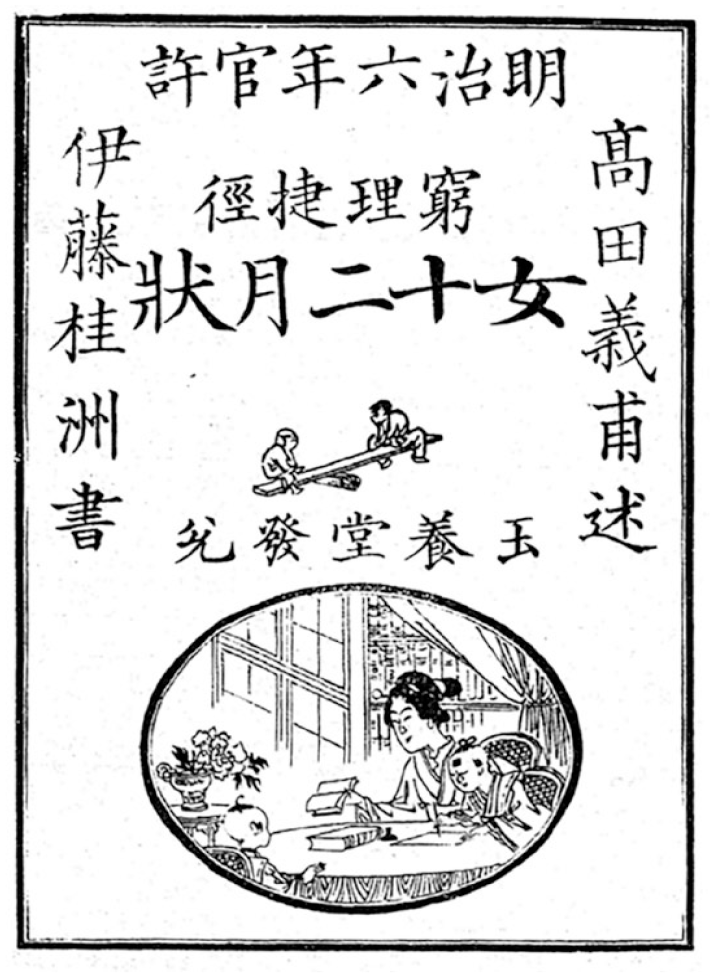
Frontispiece of an epistolary guide on science for women. Courtesy of the National Diet Library, Tokyo.
Nevertheless, these works show a quiet transformation in the perception of women. The frontispiece in Figure 2 shows a mother educating her children. This role as educator was a new one for women; in the Tokugawa period, it was the father who was responsible for the education of children. The suggestion in this frontispiece, therefore, was that a kyūri-educated woman could be an asset to the household. This presaged a shift that was to gain momentum a decade later whereby the education of women came to be seen as a societal good. Education, a later generation of reformers would argue, would enable women not only to become enlightened and supportive wives, but also to take charge of the education of children in the household.
Epistolary guides facilitated the early Meiji public’s acceptance of science by demonstrating the relevance of kyūri to practices, such as letter-writing and gift-giving, that were vital to Japanese communal life. This genre also offers insights into conceptions of gender during this period. As a public activity, kyūri was the preserve of men, just as science (rika) was also to become. Men alone were authors of the kyūri books, even epistolary ones, despite the custom of women penning letter-writing guides, and despite women being a major audience. Though women were seen as a potential threat to the bunmei kaika project because of their perceived ignorance, they were also presented as a potential resource: kyūri would enable women to take on a new role in modern Japanese society. But it was one firmly rooted in the home, as “good wives” and “wise mothers.”
Buddhist textual practices
After the Meiji Restoration, moves to render Shintō the state religion of Japan aroused anti-Buddhist sentiment in the country. The ruling class felt that Shintō and Buddhism, which had been intertwined for much of Japanese history, were distinct religions that needed to be separated. This had violent repercussions and resulted in the haibutsu kishaku (abolish Buddhism and destroy its icons) movement, which saw widespread desecration of Buddhist material culture and violence toward its clergy. 53 Though there were several charges against Buddhism, particularly damaging was the allegation that Buddhism was antithetical to civilization and enlightenment. This charge represented an existential threat to Buddhism and required the religion to adapt to ensure its continued survival. A consequence of the campaign to abolish Buddhism was, as James Edward Ketelaar puts it, “an emerging sense among Buddhists that they needed to re-imagine [their] thought and practice.” 54 Thus, while Buddhism might have seemed an unlikely source of practices for engaging with science, the influence of this religion can be seen in the practices of both inscription and reading of some kyūri works.
One way of demonstrating the compatibility of Buddhist religious practice with the enlightenment project was to take its most iconic literary genre – the sutra – and render it a vector of scientific knowledge. One such work was Takada Yoshitoshi’s Sutra of Physical Sciences (Kyūri kinmō kyō). While the title clearly identified Sutra of Physical Sciences as a kyūri book, it also had the appearance of a religious text. 55 Adhering to the format of a sutra, it was written in Sinitic, and each line of text comprised four Chinese characters. 56 Sutras were typically intoned. However, in intoning the text, Chinese characters were merely adapted to the phonological norms of Japanese. Thus, while this type of reading allowed one to recite the text on the page, it did not permit the reader to actually understand its content. Vocalizing was the main aim, with comprehension a distant concern.
The lack of phonetic glossing of Chinese characters and the inclusion of reading markers in Sutra of Physical Sciences does, however, suggest that vocalization was not the sole form of reading intended. Reading, or punctuation, markers were provided and these permitted readers to rearrange the syntax of the Sinitic text to conform to vernacular Japanese. A reader could thus choose to enjoy a more silent engagement with the text. There is some evidence that readers did just that. An advertisement for Sutra of Physical Sciences appearing in a Tokyo newspaper in 1874 favorably compared its comprehensibility to other kyūri works on the market at the time, which it said were full of impenetrable newly created terms. 57 However, while readers could choose whether to intone Sutra of Physical Sciences in a manner typical of sutras, they were certainly expected to read other kyūri books aloud. The titles of Science for Chanting (Kyūri anshō bon) and Science for Recitation (Sodoku kyūri sōshi), for example, clearly exhort the reader to chant the text, indicating that oral intonation was considered a legitimate means of engaging with kyūri. 58 While intoning a text was considered a good way to memorize the content of a work, there was also an element of corporeal discipline intended. This means of engagement placed lesser importance on comprehension. In some cases, particularly for Sinitic texts, which were syntactically and phonologically different from vernacular Japanese works, the meaning of the text would have been incomprehensible to anyone listening. Moreover, as the reader’s energies would be directed to vocalizing the text, there was necessarily less emphasis on comprehension.
Takada Yoshitoshi’s Sutra of Physical Sciences invited yet another means of engagement. Its frontispiece described it as “a civilization and enlightenment handwriting primer” (kaika shōkei shūji kaitei), thereby beckoning readers to engage in the ritual of shakyō. Shakyō refers to the longstanding religious practice of tracing sacred scripture. This liturgical practice, which remains important in much of Buddhism, was considered a more meaningful form of engagement than the more passive practice of silent reading. Indeed, it is said that shakyō is the religious practice that confers the greatest merit. As with epistolary genres, in which readers were expected to physically engage with works by tracing the handwritten text of the scribe, the reader submits corporeally to the authority of the writer. However, in the case of Sutra of Physical Sciences, the writer’s authority is deployed in service of secular, rather than religious, enlightenment. 59
Another Buddhist practice encouraged in service of civilization and enlightenment was that of shiyui, or contemplation. In the practice of shiyui, one sits in silence for an extended period allowing the object of one’s thoughts to emerge clearly in one’s consciousness. This practice was encouraged by Kiyohara Michihiko in his 1872 work Science Puzzles: A Handbook for Girls (Jijo hikkei kyūri nazo). With this work, Kiyohara encouraged shiyui in service of a major preoccupation of the Meiji government: the eradication of superstition. The word often used to describe superstition was fushigi, a catchall term that Gerald Figal defines as phenomena ranging from “the strange, the mysterious, the uncanny” to the “inexplicable, incredible, magical, miraculous.” 60 The embodiment of fushigi were bakemono or yōkai, supernatural beings that served as “allegorical signifiers” to “explain the unexplainable.” 61
In Science Puzzles, Kiyohara aimed to distinguish kyūri from fushigi. He made effective use of the material form of his book to demarcate fushigi from rational thought. Science Puzzles was divided into two volumes. Each page of the first volume presented a puzzling natural phenomenon usually attributed to a fushigi presence and asked the reader to contemplate a rational explanation for the phenomenon. Each puzzle presented in the first volume is accompanied by a visually arresting image drawn by the renowned ukiyo-e artist Kawanabe Kyōsai. The image alongside each puzzle illustrates the fushigi presence to which the natural phenomenon is usually attributed. Kiyohara exhorts the reader to first think of a rational explanation and, only after doing so, proceed to the second volume where they can find the answer. 62 In contrast to the visual extravagance of the first volume, the second volume is austere and comprises mainly text. Illustrations, much reduced in number, tend toward the abstract. The reader is urged not to skip the step of shiyui that lies between the two volumes: “to look at the second volume right away” would be like “overturning a jar of miso” (p. 1 chō) Kiyohara warned, alluding to the wastefulness of such an approach.
Kiyohara’s application of shiyui to secular ends advanced not only the modernizing aims of the Meiji government, but the survival of Buddhism too. Many of the so-called superstitions Kiyohara attacked in his works were rooted in Buddhist cosmology. 63 In volume one of Science Puzzles, Kiyohara asks the reader to contemplate whether the sound of thunder is really made by Yakusha banging a drum. Yakusha referred to a terrifying demon believed to live in the sky. This Yakusha was also a Buddhist deity. Originally Indian, he was introduced to Japan in the sixth century and later become one of the eight protectors of Buddhism. In early modern Japan, some people attributed the sound of thunder to the machinations of Yakusha. This stemmed from a belief that everything in the universe had an animating force, or seiki. This was an example, as Kazuhiko Komatsu has explained, of how people used the supernatural to personify phenomena, thereby helping them make sense of the unknown and the unknowable. 64 But Kiyohara aimed to reform this traditional episteme by asserting seiki was not in fact the basis of everything. Rather, he explained, it was den (electricity). And this den had two opposing forces. When these two forces approach each other, Kiyohara explained, they transmit energy, releasing a booming sound. “This is the principle,” he revealed, “that lies behind thunder.” 65
Kiyohara also asks his readers to contemplate whether onibi – another uncanny presence – really exist. “Common folk,” he points out, attribute the flash of light that often appears at dusk to onibi, a demon fire. The appearance of onibi as a mysterious blue streak of light was believed to signal the moment the soul left the body of the deceased, hence its frequent appearance in cemeteries. 66 But Kiyohara discredits this explanation. This phenomenon, he asserts in volume 2, was caused not by the soul leaving the body, but by emissions of phosphorus. What about tatsumaki (lit. twisting dragon) (see Figure 3), which many believed was a literal dragon that rises to the heavens under dark stormy clouds? That too could be explained. Tatsumaki was in fact a phenomenon caused by seawater being caught up between opposing electric forces in clouds during a storm. Were comets really “an omen of war?” No, that is a “fallacy,” Kiyohara explains patiently. “Comets are celestial bodies whose movements follow predetermined orbits, which have been observed by humans.” 67 Though Kiyohara duly provides knowledge to explain all these phenomena, it is the practice of thinking, of shiyui, that he finds the most potent against superstitious belief. In this way he demonstrates that Buddhism could provide the tools to eradicate superstitious belief.
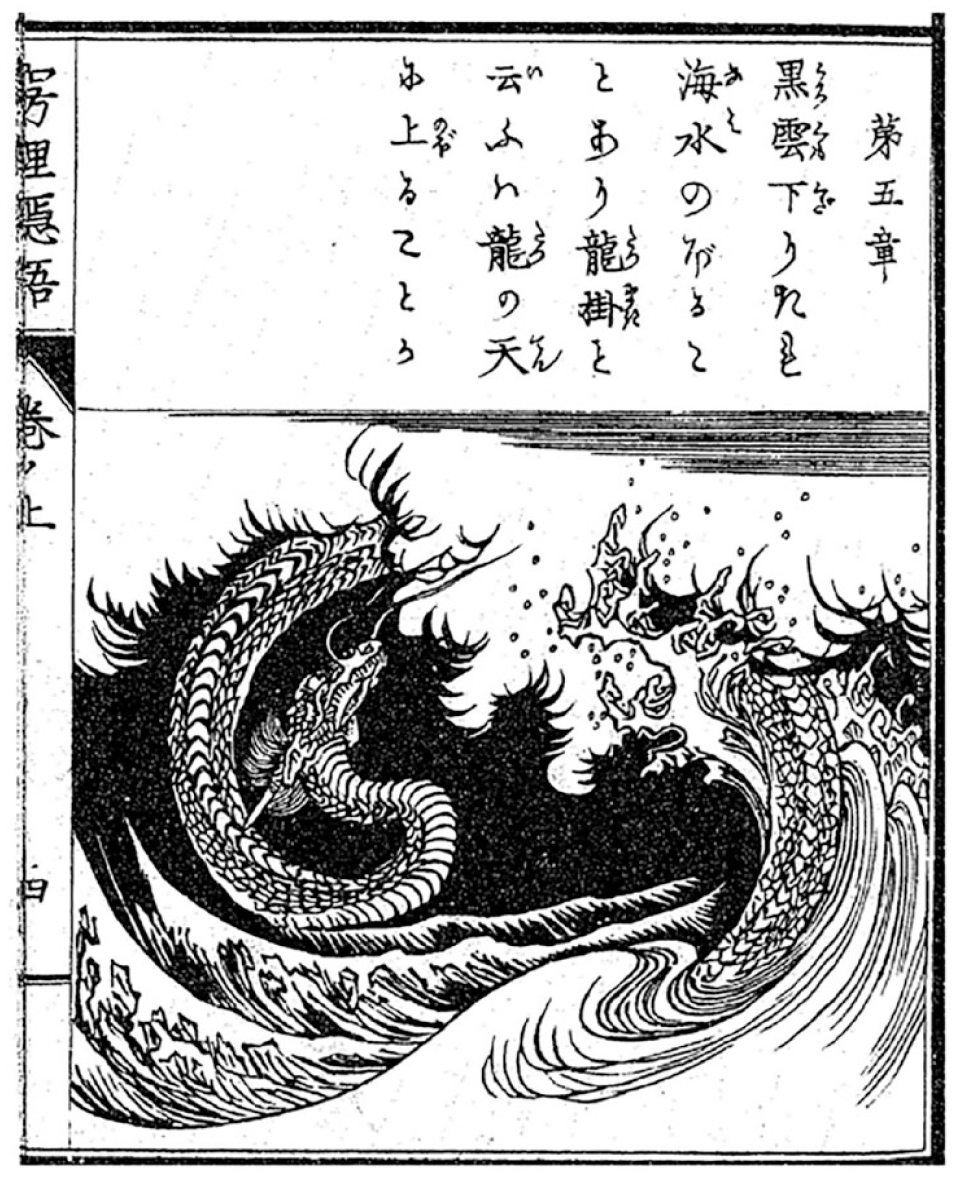
Illustration of a tatsumaki (twisting dragon) in Science Puzzles: A Handbook for Girls. Courtesy of the National Diet Library, Tokyo.
Kiyohara’s focus in Science Puzzles on the supernatural is notable. As many vernacular understandings of natural phenomena were rooted in Buddhist cosmologies, it was in the interest of Buddhists to distance themselves from these explanations and to present themselves as proponents of civilization and enlightenment. As the religious scholar Jason Josephson Storm has pointed out, “part of the process of constructing the category religion was a parallel process under which previously contiguous phenomena were excluded from ‘religion’ through their definition as ‘superstition’.” 68 We see in Kiyohara’s work an attempt to use kyūri as a wedge to separate religion from superstition; kyūri, not Buddhism, was now the appropriate prism for interpreting the external world. We see more developed formulations of this stance by the Buddhist philosopher Inoue Enryō later in the Meiji period, in his 1904 work An Explanation of Superstition (Meishinkai), in which Inoue argued that superstition “obscures or wraps the true light of religion.” 69 Kyūri was a means of lifting this shroud which, once removed, would leave true religion – one that concerned itself with a much more circumscribed sphere – intact.
Kiyohara’s work invited multiple ways for readers to engage with it. In a thriving marketplace of vernacular works, kyūri could not simply aim to educate, they also needed to entertain. Supernatural beings were not only a means by which the “common folk,” as Kiyohara put it, explained natural phenomena. They were also a form of entertainment voraciously consumed by the urban classes. Uncanny beings were an integral part of early modern Japanese visual culture. The publication in the late eighteenth century of encyclopedias such as Illustrated Night Parade of a Hundred Demons (Gazu Hyakki Yagyo, 1776) by Toriyama Sekien (1712–88) led to a flourishing of yōkai, or supernatural beings, in popular culture. The emergence of new media formats in the Meiji period, such as the newspaper, only provided further fora for them to inhabit. They were also subsumed into playful practices such as storytelling circles and were adopted as motifs in everyday items, such as kimono, folding screens, and ornamental boxes. 70 As was the case in medieval and early modern Europe, in Japan, consuming wonder and the wonderous was common among the cultural elite. 71 Having first appeared on illustrated scrolls aimed at the aristocratic classes in the medieval period, by the early modern period yōkai came to appear in productions aimed at commoners. It was the urban and urbane classes who were the most enthusiastic consumers of the supernatural. Many of the yōkai in Kiyohara’s book of puzzles belonged to what some scholars call the “folkloresque” – new, modern creations that did not necessarily derive from earlier folktales. 72 Thus, Science Puzzles was not necessarily aimed at an audience that held superstitious beliefs, but an audience that took pleasure in believing that others clung to such irrational fears. Herein lies the effectiveness of Kiyohara’s work. His book offered the urban classes a means of marking their sophistication. Unlike the “common folk” who believed the ridiculous superstitions presented in volume one, they were a more intelligent sort that accepted the rational explanations provided in the work’s second volume.
Conclusion
The narrative tales, epistolary guides, and religious formats are but three of the many popular genres in which kyūri books appeared. There were others, including illustrated primers (zukai), dialogic works (mondō), and conversations (kaiwa). These formats all made creative use of existing literary genres to make kyūri accessible and relevant to a wide range of readers, providing a multimodal and multisensory experience that was simultaneously intellectual and affective. Though these means of engagement may now strike one as incongruent with science, this was how much of the Meiji public encountered science. If we acknowledge this, it becomes untenable to overlook them in histories of science of modern Japan.
Science was a means for the new Meiji government to assert its legitimacy and authority. The strategy of demarcating rika from kyūri was important to this. So too were the generic forms introduced to distinguish rika from kyūri. For early Meiji intellectuals who aimed to introduce the “scientific spirit” to Japan, practices such as chanting and tracing, which were associated with traditional literary genres, hewed too closely to traditions and sources of authority that they wished to eradicate. The scientific spirit, they argued, was based on observation and experiment. 73 These practices were not meant to be mediated. Thus, while copying (shakyō) aimed to bolster the authority of science by appropriating a Buddhist practice, it relied on the authority of the scribe to mediate the encounter with science. As for chanting, it conjured uneasy associations with superstitious thought. 74 And, while the quiet contemplation of shiyui recognized the agency of the individual, it encouraged the reader to turn their eyes inward, rather than outward to the natural world.
Kyūri books also provide a reminder, if any was needed, of the blurry distinction between elite and popular science. Although kyūri books were aimed at non-specialist audiences, they could be anything but simple. The grammatical complexity of epistolary genres, for example, required high levels of literacy and demanded intense engagement with texts. The practice of shiyui, which was borrowed from Buddhism, also put the onus on the reader. Kyūri books often presented considerable intellectual challenges, and, in many cases, readers welcomed this.
Meiji elites saw science as an important means of molding modern citizens, but lacked the means of creating sufficient affective appeal to a public who were concerned about more quotidian matters. Though the government aimed to sideline vernacular interpretations of science, it was traditional literary works that did much of the work of convincing the public of the value of science. As Sujit Sivasundaram has pointed out, “for science to be successful, it has to travel, and it must rely on mediators to take it to other places.” 75 To understand how science became a global category, it is these mediators and their “very local terms” that we must examine if we are to understand how a category as ill-defined and diffuse as science came to have such local salience.
Footnotes
Acknowledgements
Earlier versions of this paper were presented at the Science and Technology in Asia Seminar Series at Harvard University and at the East Asia Seminar Series at the University of Cambridge. I thank participants at both events for their insightful questions, which helped me clarify my argument. I am grateful to Bernie Lightman, as well as the editor of History of Science, and two anonymous referees for their generous and helpful feedback.
Declaration of conflicting interests
The author declared no potential conflicts of interest with respect to the research, authorship, and/or publication of this article.
Funding
The author received no financial support for the research, authorship, and/or publication of this article.

1.
David Mervart, “Meiji Japan’s China Solution to Tokugawa Japan’s China Problem,” Japan Forum 27, no. 4 (2015): 544–58, 545. The term “premodern” has largely been abandoned in preference for “early modern” to refer to the Tokugawa, or Edo, period (1600–1868). This latter term reinforces Japan’s interconnectedness with the global economy despite the Tokugawa Shogunate’s stringent restrictions on overseas travel by Japanese citizens and its limitations on the presence of foreigners on Japanese soil. However, in this article, I use the term “premodern” to underscore the salience of the Meiji divide to histories of Japanese science. See Kären Wigen, “Mapping Early Modernity: Geographical Meditations on a Comparative Concept,” Early Modern Japan: An Interdisciplinary Journal 5, no. 2 (1995): 1–13.
2.
Notable among such works is Mark Ravina, To Stand with the Nations of the World: Japan’s Meiji Restoration in World History (New York, NY: Oxford University Press, 2017).
3.
See, for example, Masao Watanabe, The Japanese and Western Science, trans. by Otto Theodor Benfey (Philadelphia, PA: University of Pennsylvania Press, 1976), Nakayama Shigeru, David L. Swain, and Yagi Eri (eds.), Science and Society in Modern Japan (Tokyo, Japan: University of Tokyo Press, 1974), James R. Bartholomew, The Formation of Science in Japan: Building a Research Tradition (New Haven, CT: Yale University Press, 1989), and Morris Low, Building a Modern Japan (New York, NY: Palgrave Macmillan, 2005).
4.
Shigeru Nakayama, The Orientation of Science and Technology: A Japanese View (Folkestone: Global Oriental, 2009), p.137.
5.
Kanamori Osamu (ed.), Meiji Taishōki no kagaku shisōshi [Essays on the History of Scientific Thought in Modern Japan] (Tokyo, Japan: Keisō Shobō, 2017). For a discussion of this work, see Hansun Hsiung, “Épistémologie à la japonaise: Kanamori Osamu and the History and Philosophy of Science in Japan,” Contemporary Japan 33, no. 1 (2021): 123–37.
6.
Federico Marcon, The Knowledge of Nature and the Nature of Knowledge in Early Modern Japan (Chicago, IL: University of Chicago Press, 2015).
7.
Maki Fukuoka, The Premise of Fidelity: Science, Visuality, and Representing the Real in Nineteenth-Century Japan (Stanford, CA: Stanford University Press, 2012).
8.
Marcon, The Knowledge of Nature, p.300 (note 6).
9.
John Breen, “The Imperial Oath of April 1868: Ritual, Politics, and Power in the Restoration,” Monumenta Nipponica 51, no. 4 (1996): 407–29, 410. For an elaboration of this argument, also see Marcon, The Knowledge of Nature (note 6).
10.
Ravina notes that “both the successes and the failures of the late Tokugawa era paved the way for Meiji reformers. Tokugawa-era reformers broke down resistance to change by insisting on the need to adopt Western-style institutions and to challenge local traditions.” Ravina, To Stand with the Nations of the World, p.86 (note 2).
11.
Itakura Kiyonobu, Nihon kagaku kyōikushi zōho [A History of Science Education in Japan: Expanded Edition] (Tokyo, Japan: Kasetsusha, 2009), p.89.
12.
Giulia Falato, “Language Learning and Negotiation: The Experience of Jesuit Translators in Late Imperial China,” in Jieun Kier et al. (eds.), Missionary Translators: Translations of Christian Texts in East Asia (Abingdon: Routledge, 2022), pp.1–23. See also Benjamin A. Elman, On Their Own Terms: Science in China, 1550–1900 (Cambridge, MA: Harvard University Press, 2005).
13.
Togo Tsukahara (Matthew Fargo and Jordan Sand, trans.), “科学 Kagaku, 究理 Kyūri/Science,” Review of Japanese Culture and Society 25 (2013): 109–15, 109.
14.
Ibid., 110. In the early Meiji period, kyūri books predominantly covered topics such as the movement of celestial bodies, meteorological phenomena, and the physics of movement, as well as technologies, such as steam engines and locomotives, that were developed based on an understanding of such concepts. See Kaneko Ayumi, “Neishon to Jitsugaku: ‘keimō’ to ‘gesaku’ no kōten,” in Kanamori Osamu (ed.), Meiji Taishōki no kagaku shisōshi [Essays on the History of Scientific Thought in Modern Japan] (Tokyo, Japan: Keisō Shobō, 2017), pp.13–64.
15.
For our purposes, a “kyūri book” is one that identifies itself as such either in its title or subtitle, or indicates in its preface that it covers the subject. Although the exact number of kyūri books is difficult to pin down, there is some agreement about their approximate number. See, for example, Itakura Kiyonobu, Nihon kagaku kyōikushi zōho [A History of Science Education in Japan: Expanded Edition] (Tokyo, Japan: Kasetsusha, 2009).
16.
Bunmei kaika is a composite term coined in the early Meiji period. Comprising the words bunmei (civilization) and kaika (opening and transformation), it was translated simply as “Enlightenment” in early English-language scholarship – see Carmen Blacker, The Japanese Enlightenment: A Study of the Writings of Fukuzawa Yukichi (Cambridge: Cambridge University Press, 1969) – but this translation has been criticized for the associations it immediately triggers with the Enlightenment movement in Europe. Alistair D. Swale, The Meiji Restoration: Monarchism, Mass Communication and Conservative Revolution (Basingstoke: Palgrave Macmillan, 2009).
17.
Marwa Elshakry, Reading Darwin in Arabic, 1860–1950 (Chicago, IL: University of Chicago Press, 2016), p.16.
18.
Kaneko, “Neishon to Jitsugaku,” p.29 (note 14).
19.
The term kagaku was first used around 1874 but took several decades to gain currency. Joshua A. Fogel, The Emergence of the Modern Sino-Japanese Lexicon: Seven Studies (London: Brill, 2016), p.181.
20.
Helen Tilley, “Global Histories, Vernacular Science, and African Genealogies; or, Is the History of Science Ready for the World?,” Isis 101 (2010): 110–19, 113.
21.
As Tilley points out, this was also the case with African elites in the early twentieth century. Ibid., 118.
22.
Tsukahara, “科学 Kagaku, 究理 Kyūri/Science,” 110 (note 13).
23.
Peter F. Kornicki notes that, as facsimiles of handwritten manuscripts, woodblock prints capture the “calligraphic personality” of the scribe. Peter F. Kornicki, The Book in Japan: A Cultural History from the Beginning to the Nineteenth Century (Leiden, Netherlands: Brill, 1997), p.29.
24.
Raja Adal, “Japan’s Bifurcated Modernity: Writing and Calligraphy in Japanese Public Schools, 1872–1943,” Theory, Culture & Society 26, nos. 2–3 (2009): 233–47, 234.
25.
For a comprehensive list of missionary translations in Chinese that were imported and reprinted in Japan during the late Edo period, see Liu Jianhui and Joshua Fogel, Demon Capital Shanghai: The “Modern” Experience of Japanese Intellectuals (Portland, OR: Merwin Asia, 2012), p.82.
26.
See Richard Rubinger, Popular Literacy in Early Modern Japan (Honolulu, HI: University of Hawaii Press, 2007).
27.
Laura Moretti, Pleasure in Profit: Popular Prose in Seventeenth Century Japan (New York, NY: Columbia University Press, 2020), p.30.
28.
Kornicki, The Book in Japan (note 23).
29.
Drawing on the work of the literary theorist Nakano Mitsutoshi, Laura Moretti notes that although early modern prose was expected to include moral teaching, “humour could feature as well in order to make the teachings more palatable.” The most successful works therefore balanced these two demands. She points out that “the expectation of early modern prose was to instruct and to delight.” Moretti, Pleasure in Profit, p.14 (note 27). See also Nakano Mitsutoshi, “Saikaku gesakusha setsu saikō: Edo no manako to gendai no manako o motsu imi” [Reconsidering Ihara Saikaku from Early Modern and Contemporary Perspectives], Bungaku 15, no. 1: 140–57.
30.
“Horizon of expectations” (Erwartungshorizont) is a term used by the literary theorist Hans Robert Jauss to refer to historically contingent “cultural norms, assumptions, and criteria” that shape readers’ engagement with a work. Chris Baldick (ed.), The Oxford Dictionary of Literary Terms (Oxford: Oxford University Press, 2015).
31.
The early-modern literary theorist Motoori Norinaga described the monogatari as a genre that depicts “events of the world and the thoughts of human beings.” Reading such works, he explains, allows one to “gain a knowledge of life and better understand the actions of human beings and the workings of their emotions.” Motoori Norinaga, “The Tale of the Genji, A Small Jeweled Comb, 1796,” in Haruo Shirane (ed.), Early Modern Japanese Literature: An Anthology, 1600–1900 (New York, NY: Columbia University Press, 2002), pp.622–5, 622. The coverage of kyūri in monogatari differed from its treatment in comedic genres, such as gesaku, where the emphasis was on wordplay and parody. For example, the author and journalist Kanagaki Robun wrote humorous parodies on kyūri themes, but science was employed mainly for humor, and there was no attempt to educate readers about science.
32.
Okada Hanji, Gahon kyūri monogatari [An Illustrated Tale of Science], 3 vols (Tokyo, Japan: Hakubundō, 1872).
33.
Tokyo, formerly Edo, was renamed when it became the capital in 1868.
34.
Okada, Gahon kyūri monogatari [An Illustrated Tale of Science], pp. 1–2 chō (note 32). Translations are my own unless otherwise indicated.
35.
Ronald Dore, Education in Tokugawa Japan (London: Routledge, 2011).
36.
An Encouragement of Learning was originally a series of pamphlets written and published between 1872 and 1876. Fukuzawa Yukichi, Gakumon no susume [An Encouragement of Learning], trans. into English by David A. Dilworth (New York, NY: Columbia University Press, 2013). Fukuzawa was a prolific educator and public intellectual who established his own school, Keijo gijuku, which produced many authors and translators. Among his books was Kinmō kyūri zukai [Illustrated Book of Physical Sciences], 1868, from which Okada also copied images. Fukuzawa Yukichi, The Autobiography of Yukichi Fukuzawa, trans. into English by Eiichi Kiyooka (New York, NY: Columbia University Press, 1966). This similarity between Gahon kyūri monogatari and Gakumon no susume has also been noted by Akita Maki, “Kyūrigaku no ryūkō o meguru jiba: Fukuzawa Yukichi to gesakushatachi no keimō jidai” [The Magnetic Field around the Rise of Kyūri: The Age of Enlightenment for Fukuzawa Yukichi and Gesaku Writers], Nihon shisō shigaku 35 (2003): 169–87.
37.
Fukuzawa, Gakumon no susume [An Encouragement of Learning], p.5 (note 36).
38.
It was common practice to change name multiple times throughout one’s lifetime. A name change would usually accompany significant changes in status or fortune.
39.
Okada, Gahon kyūri monogatari [An Illustrated Tale of Science], 10 chō (note 32). A raijū is an imaginary animal common in early modern Japanese folklore. Although it could take many forms, it often resembled a dog or a wolf. It was said to descend to the ground with lightning strikes, and could kill humans and animals and destroy trees. On raijū, see Michael Dylan Foster, The Book of Yokai: Mysterious Creatures of Japanese Folklore (Berkeley, CA: University of California Press, 2015), pp.197–8.
40.
Markus Rüttermann, “‘So That We Can Study Letter-Writing’: The Concept of Epistolary Etiquette in Premodern Japan,” Japan Review 18 (2006): 57–128, 66.
41.
Uchida Shinsai, Kyūri shōkei jūnigetsu chō [A Monthly Epistolary Guide: An Expedient to Science], 2 vols (Tokyo, Japan: Gyokuyōdō, 1872–4).
42.
Ibid., pp.19–24.
43.
See chapter 8 of Yulia Frumer, Making Time: Astronomical Time Measurement in Tokugawa Japan (Chicago, IL: University of Chicago Press, 2018).
44.
Takada Yoshitoshi and Fukuzawa Ryōtan, Kyūri zōtō nenchūchō [Year-Round Epistolary Guide: Science and the Exchange of Gifts], 2 vols (Tokyo, Japan: Senshōbō, 1873).
45.
Moretti, Pleasure in Profit, p.9 (note 27).
46.
Kornicki, The Book in Japan (note 23).
47.
The practice of tracing the script of epistolary guides accounts for the foundational role of such guides in the development of a pedagogical genre called the ōraimono. During the Edo period, ōraimono were very widely used, and it is estimated that there were over 7,000 works with ōrai (correspondence) in the title during that period. Eventually, they lost their epistolary characteristics, and became seen simply as an instructional genre. During the early modern period, ōraimono covered a wide range of subjects including geography, history, commerce, and, by the early Meiji period, kyūri. Ishikawa Ken, Koōraimono ni tsuite no kenkyū: jōsei, chūsei ni okeru shotō kyōkasho no hattatsu [Research on Early Ōraimono: The Emergence of Primers in the Classical and Medieval Periods] (Tokyo, Japan: Kōdansha, 1949). See also Markus Rüttermann, “What Does ‘Literature of Correspondence’ Mean? An Examination of the Japanese Genre Term Ōraimono and its History,” in Matthias Hayek and Annick Horiuchi (eds.), Listen, Copy, Read: Popular Learning in Early Modern Japan (Leiden, Netherlands: Brill, 2014), pp.139–60.
48.
Marcia Yonemoto, The Problem of Women in Early Modern Japan (Berkeley, CA: University of California Press, 2016), p.65. Moretti also points out that the second volume of Onna shikimoku [Formulary for Women], an early modern moral guide for women, “commences by stressing that writing (tenarai) is de rigeur for all women, be they highborn (takaki) or lowborn (hikiki).” Moretti, Pleasure in Profit, p.191 (note 27). Epistolary styles were also considered a suitably feminine genre of scientific discourse in eighteenth- and nineteenth-century Britain. See Ann B. Shteir, Cultivating Women, Cultivating Science: Flora’s Daughters and Botany in England, 1760 to 1860 (Baltimore, MA: Johns Hopkins University Press, 1996).
49.
P. F. Kornicki, “Women, Education, and Literacy,” in P. F. Kornicki, Mara Patessio, and G. G. Rowley (eds.), The Female as Subject: Reading and Writing in Early Modern Japan (Ann Arbor, MI: Centre for Japanese Studies, The University of Michigan, 2010), pp.7–38, 21.
50.
One reason that women are not named as scribes of kyūri epistolary guides is perhaps because of “the womanly virtue of modesty.” Works – if penned by women – likely circulated in manuscript form, rather than being printed with woodblocks and sold on the market. Owing to antecedents from the classical Heian period, such as The Tale of Genji author Murasaki Shikibu, who circulated her writings in manuscript form, manuscripts were considered a more appropriately “feminine” form of textual production. There were also obstacles to publishing, not least a belief among publishers that women authors would not be commercially viable. Additionally, authors would often provide subventions to publishers as an incentive to producing their works, something few women would have the economic means to offer. See ibid., p.36, and Anne Walthall, “Women and Literacy from Edo to Meiji,” in P. F. Kornicki, Mara Patessio, and G. G. Rowley (eds.), The Female as Subject, pp.215–35 (note 49).
51.
See, for example, chapter 1, “The Formation of Ryōsai Kenbō Thought,” in Shizuko Koyama, Ryōsai Kenbo: The Educational Ideal of “Good Wife, Wise Mother” in Modern Japan (Boston, MA: Brill, 2013), pp.11–51.
52.
This series, entitled “Great Names of the Westerners,” profiled European and American inventors. It was part of a larger cache of woodblock prints published by the Ministry of Education in 1873 for family education.
53.
James Edward Ketelaar, Of Heretics and Martyrs in Meiji Japan: Buddhism and its Persecution (Princeton, NJ: Princeton University Press, 1990).
54.
Ibid., p.214.
55.
Takada Yoshitoshi and Itō Keishū, Kyūri kinmō kyō [Sutra of Physical Sciences], 2 vols (Tokyo, Japan: Gyokuyōdō, 1873).
56.
As Peter F. Kornicki points out, Sinitic, or literary Chinese, was not a spoken language but a cosmopolitan language of reading and writing, or “scripta franca,” in East Asia until the late nineteenth century. Aids, such as punctuation markers, would be added to texts to help readers “translate” the text into local vernaculars. Peter F. Kornicki, Languages, Scripts, and Chinese Texts in East Asia (Oxford: Oxford University Press, 2018).
57.
Kyūri kinmō kyō [Sutra of Physical Sciences], Tōkyō Nichi Nichi Shimbun, March 10, 1874. Takada Yoshitoshi also published another sutra, Tōon sanji kyō [Three Character Sutra]. This was a Ming-era Chinese educational text that circulated widely in Japan. Takada’s contribution was to add reading markers. Like Sutra of Physical Sciences, Three Character Sutra does not contain any phonetic glossing. Nevertheless, Takada explicitly directs readers, both through the work’s title (Tōon means “Chinese pronunciation”) and through its preface, to intone the text. Takada Yoshitoshi, Tōon sanji kyō [Three Character Sutra] (Tokyo, Japan: Kōgeidō, 1872).
58.
Uryū Hajime, Kyūri anshō bon [Science for Chanting], 3 vols (Uryū Hajime, 1874); Author unknown, Sodoku kyūri sōshi [Science for Recitation] (publisher unknown, 1873). Sodoku means reading a text aloud without attempting to understand it.
59.
There are antecedents for the use of sutras to communicate scientific knowledge. For example, the early modern scholars Udagawa Yōan and Yoshio Nankō used the sutra format in their Sutra Botanica (Botanika kyō) and Sutra of Western Astronomical Observations (Seisetsu kanshō kyō), respectively. Citing Nishimura Saburō, Federico Marcon suggests that this format may have been used out of a desire to demonstrate “respect and gratitude of the gift of a new corpus of knowledge.” Marcon, The Knowledge of Nature, p.258 (note 6); Nishimura Saburō, Bunmei no naka no hakubutsugaku [Natural History in Civilizations, West and East], Vol. 2 (Tokyo, Japan: Kinokuniya shoten, 1999), p.486.
60.
Gerald Figal, Civilization and Monsters: Spirits of Modernity in Meiji Japan (Durham, NC: Duke University Press, 1999), p.223, ff.6.
61.
Kazuhiko Komatsu, An Introduction to Yōkai Culture: Monsters, Ghosts, and Outsiders in Japanese History, trans. into English by Hiroko Yoda (Tokyo, Japan: Japan Publishing Industry Foundation for Culture, 2017).
62.
In the foreword to Science Puzzles, Kiyohara urges the reader to first consult volume 1 and to contemplate (shiyui) the principles of each phenomenon. After doing so, readers are to proceed to the second volume. Kiyohara Michihiko, Jijo hikkei kyūri nazo, 2 vols [Science Puzzles: A Handbook for Girls], illustrated by Kawanabe Kyōsai (Tokyo, Japan: Mankyūkaku, 1872).
63.
Buddhism was implicated in many so-called superstitious beliefs. For example, tengu, demons believed to live in the mountains, were seen by some as an enemy of Buddhism that would kidnap priests. At the same time, others portrayed them as the spirits of immoral Buddhist priests. In some folkloric tales, Buddhist priests would perform exorcisms or provide charms that could ward off evil spirts. Supernatural creatures, or “yōkai,” could themselves find peace by recanting evil deeds and embracing Buddhism. See Figal, Civilization and Monsters, p.84 (note 60), and Tsukahara, “科学 Kagaku, 究理 Kyūri/Science,” 113 (note 13).
64.
Komatsu, An Introduction to Yōkai Culture (note 61).
65.
Kiyohara, Jijo hikkei kyūri nazo [Science Puzzles: A Handbook for Girls], Vol. 2, pp.1–2 (note 62).
66.
Komatsu, An Introduction to Yōkai Culture (note 61).
67.
Kiyohara, Jijo hikkei kyūri nazo [Science Puzzles: A Handbook for Girls], Vol. 2, pp.3–5 (note 62).
68.
Jason Ānanda Josephson, “When Buddhism Became a ‘Religion’: Religion and Superstition in the Writings of Inoue Enryō,” Japanese Journal of Religious Studies 33, no. 1 (2006): 143–68, 149.
69.
Ibid., 152.
70.
Noriko T. Reider, “The Emergence of ‘Kaidan-shū’: The Collection of Tales of the Strange and Mysterious in the Edo Period,” Asian Folklore Studies 60, no. 1 (2001): 79–99.
71.
Lorraine Daston and Katherine Park, Wonders and the Order of Nature, 1150–1750 (New York, NY: Zone Books, 1998).
72.
Sumie Jones and Charles Shirō Inouye (eds.), A Tokyo Anthology: Literature from Japan’s Modern Metropolis, 1850–1920 (Honolulu, HI: University of Hawaii Press, 2017).
73.
The Meiji philosopher Nishi Amane, for example, argued that “[the] methods of investigation in the modern West are three in number: observation, experience, and proof.” Later philosophers used the term shiken, now translated as “experiment,” to describe “experience.” Nishi Amane, cited in Joshua A. Fogel, The Emergence of the Modern Sino-Japanese Lexicon: Seven Studies (Leiden, Netherlands: Brill, 2015), p.192.
74.
As Ofer Gal points out, the etymological roots of enchantment can be traced back to chanting (chanson). Ofer Gal, The Origins of Modern Science: From Antiquity to the Scientific Revolution (Cambridge: Cambridge University Press, 2021), p.195.
75.
Sujit Sivasundaram, “Sciences and the Global: On Methods, Questions and Theory,” Isis 101 (2010): 146–58, 158.