




Abstract
In social stratification research, the most frequently used social class schema are based on employment relations (EGP and ESEC). These schemes have been propelled to paradigms for research on social mobility and educational inequalities and applied in cross-national research for both genders. Using the European Working Conditions Survey, we examine their criterion and construct validity across 31 countries and for both genders. We investigate whether classes are welldelineated by the theoretically assumed dimensions of employment relations and we assess how several measures of occupational advantage differ across classes. We find broad similarity in the criterion validity of EGP and ESEC across genders and countries as well as satisfactory levels of construct validity. However, the salariat classes are too heterogeneous and their boundaries with the intermediate classes are blurred. To improve the measurement of social class, we propose to differentiate managerial and professional occupations within the lower and higher salariat respectively. We show that implementing these distinctions in ESEC and EGP improves their criterion validity and allows to better identify privileged positions.
Introduction
Four decades ago, Erikson, Goldthorpe and Portocarero (1979) published a comparative analysis of social mobility using a class schema that would become known as EGP. This schema had an immense influence: it became the paradigmatic approach to class analysis in sociological research. A review of empirical papers published between 2015 and 2019 in top sociology journals shows that 78% of those investigating social class differentials used EGP or an update of this schema, known as ESEC 1 (Barone, Hertel and Smallenbroek 2021). EGP-like schemes are widely used in social stratification research on social mobility, educational and labor market inequalities and their application also extends to other research domains, such as studies on values, lifestyles, attitudes and class voting (Manza, Hout and Brooks 1995; Rose and Harrison 2010; de Regt, Smits and Mortelmans 2012; Kulin and Svallfors 2013). Hence, EGP-like measures represent the paradigmatic measurement of social class in sociological research.
However, they did not remain unchallenged. Several researchers have repeatedly criticized that EGP-like measures fail to capture the core class divides of post-industrial occupational structures driven by educational expansion, occupational upgrading or polarization as well as increasing female labor force participation (Esping-Andersen 1993; Oesch 2006; Güveli and Graaf 2007; Weeden et al. 2007; Hertel 2017). This criticism has only rarely been addressed in previous validation studies (Williams 2016). In this article, we assess the criterion and construct validity of EGP and ESEC, making three main contributions.
First, we assess the homogeneity of the salariat class, the category that groups all managerial and professional occupations together. Indeed, critics maintain that EGP-like schemes have poor discriminant power to pinpoint privileged positions, especially in post-industrial class structures (Güveli, Need, and De Graaf 2007). Figure 1 substantiates this criticism by presenting the distributions of EGP and ESEC in 31 European countries in 2010 and 2015, based on data from the European Working Conditions Survey (Eurofound 2017). As can be seen, the higher and lower salariat classes collectively account for 34% to 49% of employed respondents in western continental Europe, the UK, Scandinavia and Baltic countries. In Southern Europe and some Eastern European countries these values are lower, but the salariat classes still comprise between one quarter and one third of the employed. The distribution for ESEC is very similar, confirming that about four out of ten workers are assigned to the salariat class in several rich countries. Incorporating top-level managers, high school teachers, lawyers, journalists and artists as it does, this large and heterogeneous class is a major source of concern for the analysis of social inequalities. When such a large share of employees is assigned to ‘privileged’ positions without assuming any hierarchical distinction within the salariat class, it is doubtful that occupational advantage is measured with sufficient precision. This is even more problematic in the context of research indicating that the worldwide growth of income inequality is driven by the increasing concentration of resources in top-level occupations (Piketty, Saez and Zucman 2018). Problems at the top of the class hierarchy correspond to similar heterogeneity at the bottom. As Figure 1 shows, the working classes comprise roughly 30% to 40% of employees in each country. Again, EGP-like schemes assume no vertical distinction within this large group, for instance between skilled and unskilled blue-collar workers.
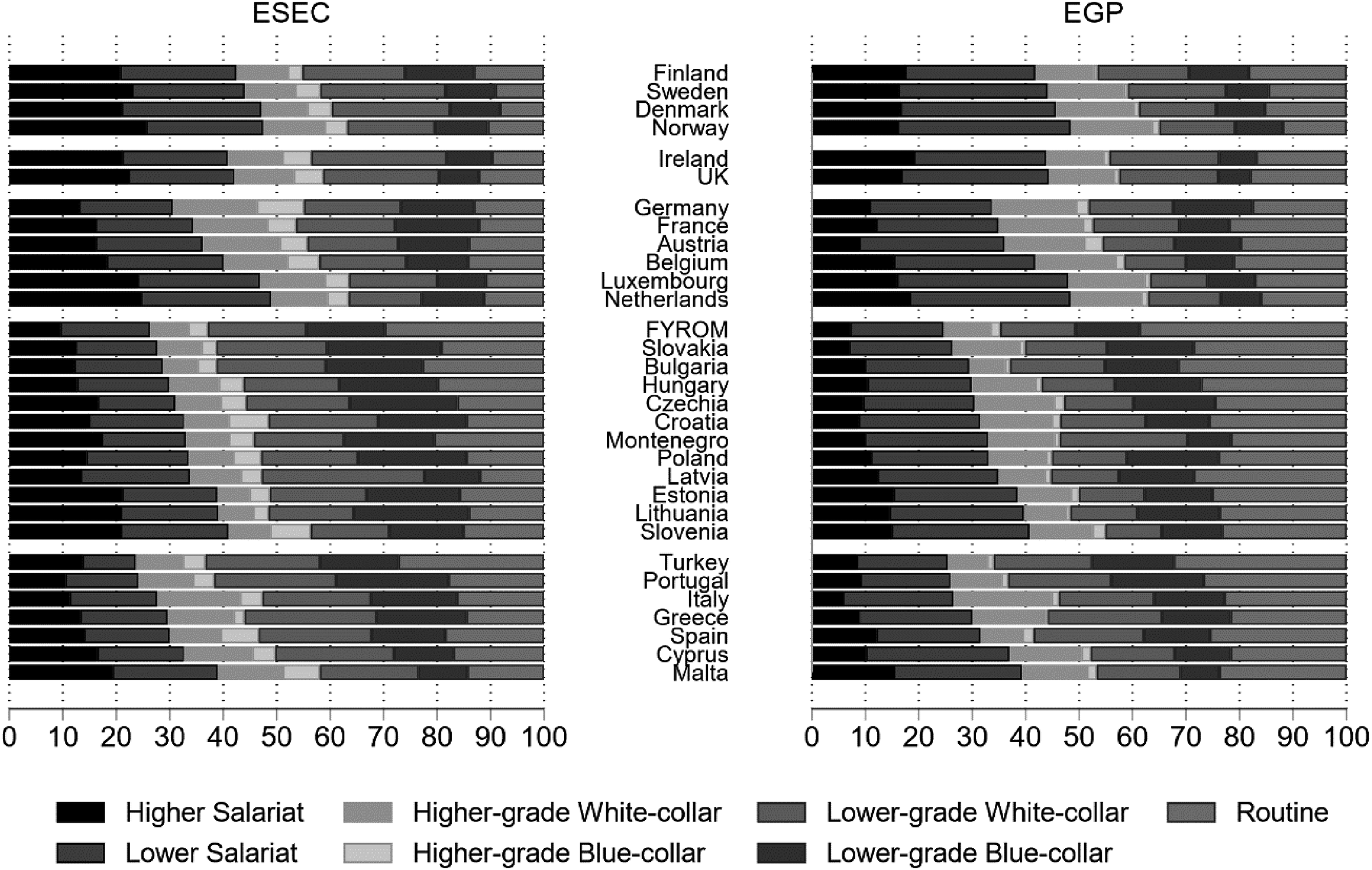
Class distributions in 31 European countries according to the ESEC and EGP schemes. Note: EWCS 2010, 2015. All currently employed individuals aged 18–65 excluding self-employed. Weighted proportions. Sample size: 63,877.
Unsurprisingly, several critics of EGP have proposed to introduce more fine-grained distinctions within the salariat classes, typically by differentiating between managerial and professional occupations, or within the working classes (Oesch 2006; Hertel 2017). However, the empirical evidence supporting these claims is based on external criteria, such as income, mobility patterns or political preferences. These external criteria are relevant to assess the heuristic value of these class schemes, but advocates of EGP-like schemes have rightfully replied that they were not primarily designed to measure these outcomes (Evans and Mills 1999; Rose and Harrison 2010). Instead, EGP-like schemes specify employment relations as their core theoretical construct (Goldthorpe 2007). Therefore, their validity as well as the relevance of additional distinctions should be assessed against this yardstick.
Following the classical distinction in validation research, we study both the criterion and construct validity of the EGP and ESEC schemes. Following Borsboom, Mellenbergh and van Heerden (2004), criterion validity refers here to the correspondence between class categories and the underlying theoretical construct of employment relations which, according to Goldthorpe's (2007) class theory, involves the two dimensions of time horizon and reward types of contractual arrangements. Construct validity refers instead to the association between class and external criteria measuring different dimensions of occupational advantage. In particular, we select income, socio-economic status, autonomy and contract type.
Our second contribution involves the supposed gender-neutrality of EGP-like schemes. 2 EGP was built to analyze social mobility among men in industrial societies. Some critics argue that the increasing labor market participation of women and the expansion of female-dominated service occupations resulted in new class cleavages that EGP is unable to map (Esping-Andersen 1993; Oesch 2006). More fundamentally, it is unclear whether EGP-like schemes measure employment relations equally well for men and women and whether the advantages and disadvantages afforded by social class (e.g., income, work autonomy) are gender-neutral. Our criterion and construct validation exercise provides evidence on this under-researched issue, which is fundamental to establishing whether EGP-like schemes can be applied to both genders.
Our third contribution involves the validity of EGP and ESEC for comparative research. EGP was devised to facilitate cross-country analyses of social mobility and its success is inextricably tied to the growth of comparative studies in social stratification research. These studies implicitly assume that EGP and ESEC measure employment relations equally well across countries and that class-related hierarchies, defined for instance in terms of income or social status, are largely invariant, at least among market societies (Erikson et al. 1979; Erikson and Goldthorpe 1985; Erikson and Goldthorpe 1992). This assumption is indeed required in order to interpret country differences or similarities in a substantive manner, rather than as mere measurement artefacts. Our validation exercise covers 31 countries that differ markedly in terms of economic development, occupational structures and institutional arrangements.
In the next section, we provide a concise description of the theoretical rationale of EGP and ESEC in order to articulate the underlying constructs that we measure. In the third section, we systematically review previous validation studies in relation to the aforementioned research gaps. The fourth section describes the data, variables and methods for the validation analyses. Section five reports the criterion validation results for each of the above three issues, while section six reports the results of the construct validation analyses. Section seven concludes with a discussion of our findings and their implications for the use of EGP-like schemes in sociological research.
The Theoretical Framework of EGP-Like Schemes: Social Class and Employment Relations
This section presents the social class categories of EGP and ESEC, the theoretical constructs that they are supposed to measure and the explanatory mechanisms postulated by Goldthorpe's (2007) theory. Figure 2 presents a graphical summary of these elements ignoring the self-employed classes that are not conceptualized using employment relations. On the right panel, we find the employee class categories, ranked into a three-level hierarchy (Erikson and Goldthorpe 1992; Goldthorpe 2007; Rose and Harrison 2010). The higher and the lower salariat (classes I and II in EGP), predominantly comprising managerial and professional occupations, constitute the top of the class hierarchy. 3 The intermediate classes comprise higher-grade white-collar employees (IIIa) and higher-grade blue-collar employees (mainly technicians and manual supervisors, V). Finally, lower-grade white-collar workers (mainly sales and service occupations, IIIb), lower-grade blue-collar workers (VI) and routine workers (VIIab) are placed at the bottom of the class hierarchy. We refer to these three levels as upper, intermediate and working classes. Importantly, no hierarchy is assumed within each level, for instance between the higher and the lower salariat (Erikson and Goldthorpe 1992; Goldthorpe 2007; Rose and Harrison 2010).
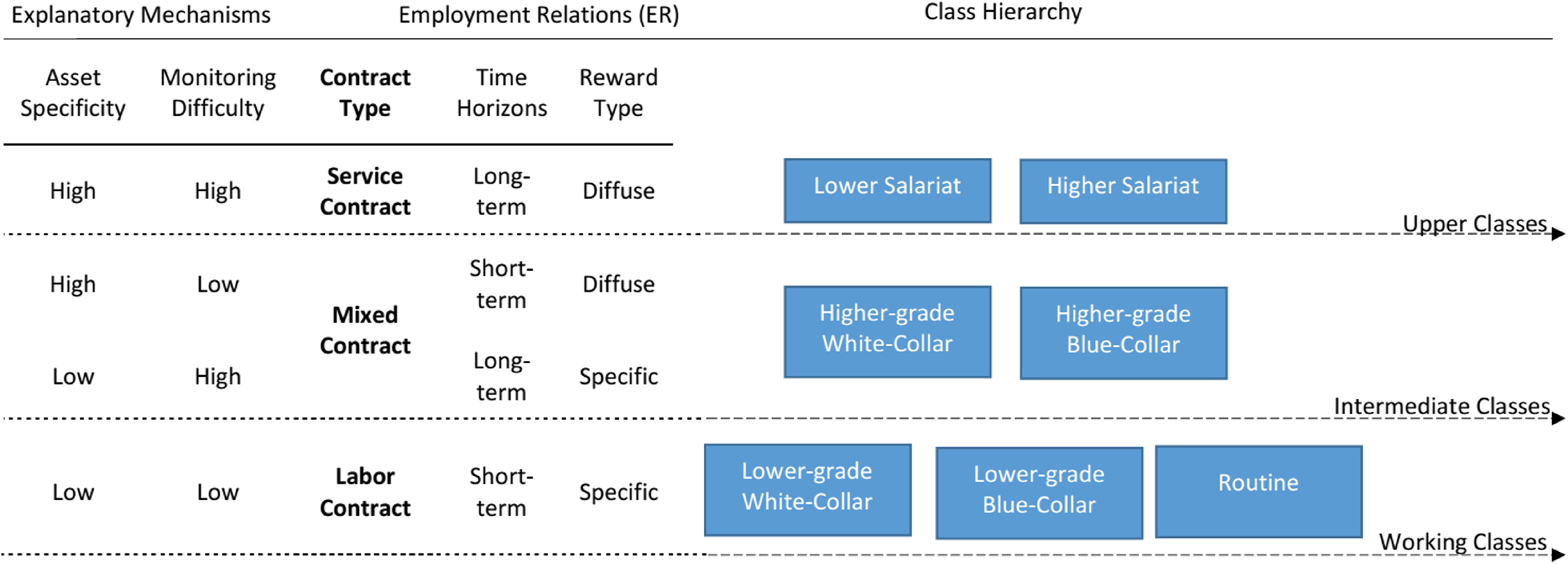
Goldthorpe's conceptual framework and class hierarchy.
The first criterion of class allocation in EGP-like schemes refers to the possession of the means of production (Erikson and Goldthorpe 1992). This criterion differentiates between employers, who buy the labor of others, employees who sell their labor, and independent workers, who do not buy nor sell labor 4 . With employees accounting for about nine tenths of the active labor force in western countries, further distinctions within dependent employment are required (Rose and Harrison 2010). These distinctions are theoretically justified on the basis of differences between occupations in their typical employment relations, i.e., the formal and informal contractual arrangements between employees and their employers.
Goldthorpe (2007) conceives of employment relations as the conceptual heart of social classes. They constitute the solution to the principal-agent problem that employers face when attempting to extract effort from employees in a free market exchange. Buying command over employees’ time only ensures partial control over their effort and always leaves employees the possibility of shirking. Opportunities for shirking are not equally distributed across occupations. They depend on two key characteristics of occupations: the difficulty of monitoring the execution of work tasks and their asset specificity. These two characteristics are the explanatory mechanisms driving systematic variations between classes in the two core dimensions of employment relations, namely the time horizon (long-term vs. short-term) and the type of rewards (diffuse vs. specific) involved in contractual arrangements. The left panel of Figure 2 illustrates the relationship between latent explanatory mechanisms, dimensions of employment relations and social class categories.
Managerial and professional occupations in the salariat classes present severe monitoring problems, as it is difficult (and costly) to scrutinize the quality of performance. Rather than trying to measure and reward productivity in detail, employers therefore set a system of diffuse rewards, involving for instance bonuses related to the performance of the firm or of their work teams, as well as fringe benefits. High monitoring problems create incentives for diffuse rewards to motivate workers to provide consistently high-quality performance. Moreover, these occupations display high asset specificity, that is, their execution involves large amounts of job- and organization-specific skills. Since managers and professionals are difficult to replace, employers seek to foster a long-term commitment to the firm that motivates them to develop these skills. Consequently, employers offer prospective, long-term incentives, such as occupational security or opportunities for career development. At the opposite extreme, unskilled, routine occupations are easy to monitor and involve low asset specificity. Therefore, employment relations in these occupations involve a shorter time horizon and more specific forms of compensation (e.g., piecewise or timewise). Within the intermediate classes, higher-grade white-collar jobs involve low asset specificity but moderately high monitoring problems, and are thus regulated via a mixed type of contract, characterized by diffuse but short-term rewards. Conversely, higher-grade blue-collar occupations display high asset specificity but low monitoring problems, and are thus regulated via a qualitatively different type of mixed-form contract, displaying long-term but specific types of rewards.
Hence, the two explanatory mechanisms (asset specificity and monitoring problems) drive variations in the two dimensions of employment relations, resulting in the three-level hierarchy of EGP and ESEC displayed in Figure 2. Employment relations in salariat class occupations are regulated via a service contract involving long-term incentives and diffuse rewards. The working classes are offered a labor contract scoring low on both dimensions, whereas the intermediate classes display mixed contractual arrangements (Rose and Harrison 2010).
Review of Criterion and Construct Validation Studies
Criterion Validation Studies
The theoretical framework of employment relations underpins the empirical procedures to build EGP-like schemes. First, information on employment status and the number of employees for the self-employed is used to differentiate employers, independent workers and employees (cf. footnote 4). Then the latter are further differentiated on the basis of their ISCO titles and supervisory status, as displayed in Figure 3. The algorithms to build EGP-like schemes thus do not directly rely on indicators of employment relations, which are seldom available in survey data. Instead, they group together occupations into the same class category based on their supposed similarity in terms of employment relations. These assignments involve a significant degree of subjective judgement and guesswork (Mitnik and Cumberworth 2018; Rose and Harrison 2010:25). This issue motivated scholars to carry out some criterion validation studies to assess the correspondence between class categories and the supposed patterns of employment relations, using survey data containing both the information to build EGP-like schemes and indicators of the two dimensions of employment relations. In Figure 3 we display the most common indicators used to measure the time horizon and reward types of employment contracts.
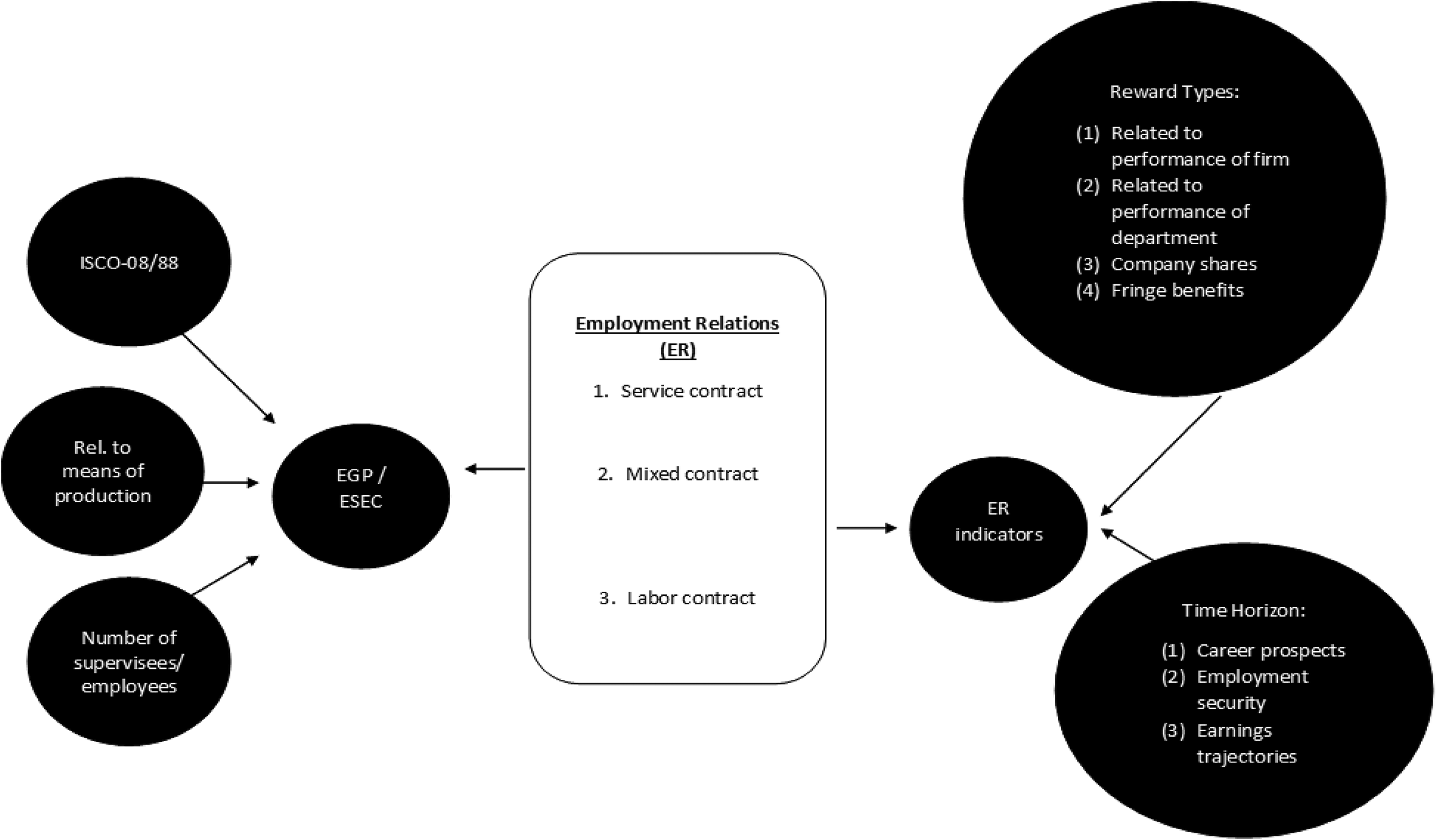
EGP-like class scheme assignment procedures and employment relations measures.
We identified 17 articles assessing the criterion validity of EGP and ESEC using indicators of employment relations, such as items on internal promotion prospects and pay increase schemes (time horizon dimension), or on payment methods and access to special bonuses and fringe benefits (type of rewards). We report detailed information on these 17 articles in the supplementary materials. These indicators (or some synthetic scores) are typically regressed on social class. Alternatively, a latent class approach identifies a typology of employment relations, which are then cross-tabulated with the class scheme under study. Overall, the broad patterns of results of these criterion validation studies support the underlying theory, that is, employment relations in the salariat classes are closer to the service contract type, while those in the working classes are closer to the labor contract type.
At the same time, deviations from the theory are far from negligible. Evans and Mills (2000) report that one third of the higher salariat class (EGP I) did not have a service contract and that mixed-form contracts were more common than service contracts in the lower salariat (II). Two other studies suggest that the boundaries between higher-grade white-collars (IIIa) and professions in the lower salariat (II) may be weaker than EGP would suggest (Evans and Mills 1998; McGovern et al. 2007). Service class contracts also do not seem to be the exclusive privilege of the salariat: Zou (2015) found that in China a service contract is the rule rather than the exception among supervisors in higher-grade blue-collar positions (V). Evans and Mills (1998) reported a similar problem in UK, noting that the only difference between higher-grade blue-collar (V) and managers in the lower salariat (II) relates to the number of supervised employees. Interestingly, some of these studies suggest that the lower salariat (II) may be more heterogeneous than supposed. Professionals in the lower salariat (II) bear more resemblance to higher-grade white-collar positions (IIIa), while managers in the lower salariat (II) are akin to supervisors in higher-grade blue-collar positions (V). However, a key feature of EGP-like schemes is precisely the aggregation of managerial and professional occupations based on the assumption that they share comparable employment relations. Previous criterion validation studies have not assessed this assumption (but see McGovern et al. 2007), despite the criticism mentioned in section 1 that the salariat class of EGP-like schemes is too large and heterogeneous.
Fewer problems are reported with regard to differences between the intermediate and working classes. Several studies find systematic differences between the employment contracts of higher-grade (IIIa) and lower-grade (IIIb) white-collar classes (Evans 1992; 1996; Evans and Mills 1998; McKnight and Elias 2003; McGovern et al. 2007; Bihagen, Nermo and Erikson 2010; Brousse, Monso and Wolff 2010; Wirth et al. 2010; Zou 2015; Williams 2016), thus corroborating this differentiation suggested by Erikson and Goldthorpe (1992) for the analysis of women's social mobility. The ESEC schema institutionalized this division by demoting lower-grade white-collar occupations to a labor contract for both genders. Unfortunately, only two out of the 17 validation studies conducted separate analyses for men and women, and they reported mixed results (Birkelund, Goodman and Rose 1996; Evans 1996). Hence, it remains unclear whether EGP-like schemes measure the employment relations of men and women equally well, even though this is a critical assumption when comparing class attainment across genders.
An additional limitation of existing research is that only two validation studies involve more than one country (Evans and Mills 1999; Bihagen et al. 2010). Moreover, taking all country case studies together allows little generalization: 11 of the 17 studies involved the UK 5 . This is a major limitation since EGP and ESEC have been extensively used in comparative research, thus implicitly assuming that the relationship between social class and employment relations is cross-nationally invariant.
Furthermore, only three out of 17 criterion validation studies focused on ESEC (Brousse et al. 2010; Wirth et al. 2010; Katrňák 2012), whereas the remaining articles tested only the validity of EGP (or its British adaptation, known as NS-SEC). ESEC was introduced one decade ago as an improved version of EGP (see footnote 1) that would replace its predecessor (Rose and Harrison 2010). Even according to Erikson and Goldthorpe themselves ESEC should supersede EGP (personal communication). However, EGP continues to prevail in current stratification research (Barone et al. 2021). In the absence of validation studies contrasting the two schemes other than the volume that introduced ESEC (Rose and Harrison 2010), there is little justification for either choice.
Finally, due to data constraints, several previous studies conflate indicators of employment relations (time horizon and reward types) with indicators of the underlying explanatory mechanisms (asset specificity and monitoring problems). If the research question is whether EGP and ESEC measure what they purport to measure (criterion validity), then the critical issue is the association between class and employment relations. This association could be explained by the two supposed mechanisms, or by other mechanisms, such as productivity-based differences between occupations (Tåhlin 2007; Williams 2016). It should be noted that the formulation of the explanatory mechanisms arrived late (Goldthorpe 2007) and, even if Goldthorpe's explanation is wrong, EGP and ESEC could still correctly measure employment relations. Unfortunately, only four of the previous 17 studies preserve the distinction between measures of employment relations and of the underlying mechanisms (see supplementary materials). This paper complements earlier research by carrying out the first large-scale, comparative criterion validation analysis, assessing the validity of both schemes separately for men and women, and across multiple operationalizations that are common in empirical research. In line with the underlying conceptual framework, we differentiate between the two dimensions of employment contracts but ignore the separate analysis of the explanatory mechanisms.
Construct Validation Studies
Class theory predicts social class differences in life chances, for instance in terms of systematic earnings differentials or with regard to unemployment risks. Construct validation studies of EGP and ESEC have therefore assessed the extent to which the two schemes are associated with these outcomes and whether the association pattern is consistent with theoretically derived hypotheses (Rose, Pevalin and O’Reilly 2005). Additionally, these indicators of life chances provide a benchmark to assess class hierarchies, since higher classes should score more favorably on them.
The volume on ESEC edited by Rose and Harrison (2010) contains the most extensive construct validation analysis of EGP and ESEC, assessing their predictive power with regard to a variety of external outcomes, such as wages, unemployment and poverty risks and health indicators. The broad patterns of class differentials are consistent with the theory for both ESEC and EGP, with the former performing marginally better for most outcomes. Corroborating results are also presented by Goldthorpe and McKnight (2006) who study the association of class (NS-SEC variant) and selected economic characteristics to demonstrate vertical class differences. Unemployment risks differ in particular between blue-collar and white-collar classes; long-term unemployment experience differentiates the higher salariat with the lowest risks from the lower salariat and intermediate classes in the middle, and from the working classes, which experience the highest risks (Gallie et al. 1998). A similar pattern is observable with regard to class-specific earnings-age profiles (Westhoff et al. 2021).
The studies presented in Rose and Harrison (2010) also examine the relation between social class and indicators of asset-specificity and monitoring problems. For both EGP and ESEC, the higher salariat class (or EGP I) display higher values than the lower salariat (II) on both dimensions for men and for women. Moreover, lower-grade white-collar and blue-collar occupations (IIIb and VI) display higher values than routine occupations (VII). Similar patterns are detected for wage differentials and poverty risks. Four additional studies assess class differences in work autonomy, taken as an indicator of monitoring problems and three of them report that it is higher for the higher salariat than for the lower salariat (McGovern et al. 2007; Wirth et al. 2010; Evans 1996; Williams 2016;). Two studies also confirm the existence of significant wage differences between the two salariat classes (Evans 1992; 1996).
Overall, the criterion and construct validity studies lend considerable credibility to EGP-like schemes while also suggesting that class boundaries are blurrier than the theory predicts. Gender and cross-national differences, however, are clearly under-researched and there is virtually no evidence to suggest that the employment relations of higher and lower managers and professionals are sufficiently homogeneous to warrant their aggregation into a unified upper class.
Data, Variables, and Methods
Data and Variables
The European Working Conditions Survey (EWCS) is a repeated, cross-national survey targeting workers aged 15 or older who did paid work for at least 1 h in the past week, selected via multi-stage, stratified sampling and interviewed face-to-face (Eurofound 2017). We use data from 2010 (Gallup Europe 2015) and 2015 (IPSOS 2015) as only these waves include ISCO information at the 3-digit level required for class assignment. Sampling weights account for different selection probabilities of primary sampling units, while post-stratification weights reflect actual population size and the socio-demographic structure of the country. We study data from 31 of the 36 countries in the ECWS. Romania and Kosovo are dropped from the analyses due to a high percentage of missing data, while Albania, Switzerland, and Serbia are dropped owing to small sample size.
After country selection, the EWCS data consists of 80,527 respondents. We restrict the age range (18–65) and, following standard practice in criterion validation studies of class schemes, also exclude all self-employed from the analysis, as they do not report data on employment relations. We exclude respondents who work less than 5 h per week, and those in education, apprenticeships, or training. We retain respondents who worked even though they stated their main activity to be unemployed, retired, on parental leave or doing household labor. From the 64,325 respondents left, we obtained an analytic sample of 61,993 individuals after deletion due to missing data. More information on the EWCS design, missing data and missing data analysis can be found in Appendix A and C.
We construct EGP and ESEC using 3-digit ISCO codes of occupational titles, a dummy for self-employment and the number of supervisees to promote certain ISCO codes to the salariat or higher-grade blue-collar classes. For EGP we employ ISCO-88 codes and the algorithm developed by Ganzeboom and Treiman (1996). For ESEC we use the routine for ISCO-08 codes proposed by Rose and Harrison (2010) and implemented in the ‘iscogen’ Stata package (Jann 2019). The question on supervision that we use to identify supervisors is quite restrictive (“How many people work under your supervision, for whom pay increases, bonuses or promotion depend directly on you?”) and thus allows us to capture managerial professions with enough precision (Pollak et al. 2010).
We test four different versions of EGP and ESEC. In the first version, the two salariat classes are distinguished as in the original classifications (Erikson et al. 1979). The second one merges them together, following common practice in comparative stratification research (Erikson and Goldthorpe 1992). The next two versions introduce a distinction between managers and professionals within the salariat class. The third version merges higher and lower salariat, but distinguishes between managers and professionals. The fourth version combines the distinction between higher and lower salariat with the distinction between managers and professionals, thus resulting in four salariat classes. Higher Managers are respondents in the higher salariat (higher service class for EGP) with major group ISCO 1 occupations (managerial occupations) or with supervisory duties; higher professionals comprise the remaining incumbents of the higher salariat. We follow the same logic to differentiate lower managers from lower professionals 6 .
For the criterion validation analyses, we select various indicators for the two dimensions of employment relations. The time horizon dimension is measured with three items. Respondents were asked to state their agreement with two statements about their occupation (ranging from 1 “strongly agree” to 5 “strongly disagree”): “I might lose my job in the next 6 months” and “My job offers good prospects for career advancement”. A third item asks whether respondents’ salary has “decreased”, “not changed” or “increased” within the last 12 months. The career advancement item is reverse coded so that higher scores indicate a longer time horizon. About 89% of the analytical sample has valid answers for all these items, while 9% has one missing response. Missing data likely reflect occupational uncertainty and ceiling effects (See Appendix C). To take advantage of all the information available, we use the EM algorithm to estimate the most likely covariance matrix (Little and Rubin 1989), with auxiliary variables on job and workplace conditions to make the MCAR assumption more plausible and reduce bias (Collins, Schafer, and Kam 2001) (see Appendix C).
The second dimension of employment relations (reward types) was assessed with four dichotomous items asking respondents if earnings from their main job include: “Payments based on the performance of the company where you work?”, “Payments based on the performance of your team/department?”, “Income from shares in the company you work for?”, “Advantages of other nature (e.g., medical services, access to shops, etc.)?”. The items were coded so that higher scores indicate more diffuse remuneration criteria. In the analytical sample 96% of cases have valid answers. Missingness is not associated with social class, gender or immigration history and only weakly associated with educational attainment (see Appendix C, Tables C5-C8).
While reward type items represent objective characteristics of occupations, the same is true for only one out of three items used to construct the time horizon index. The other two are subjective perceptions about future prospects (perceived danger of job loss and advancement opportunities). We choose those expectations here because they consistently represent a subjective element in the theoretic rationale behind employment relations. As explained above, employment relations are primarily designed to incentivize effort production on behalf of the employing organization. Employees’ subjective perceptions of contractual arrangements are thus ultimately more relevant than their objective features to foster employees’ commitment to the firm. Even though not completely predictive, however subjective beliefs must be rooted in objective economic conditions at least to some extent. 7
For the construct validation analyses, we choose earnings, contract type, two autonomy scales and the International Socio-Economic Index (ISEI) as alternative measures of occupational advantage. Hence, we primarily focus on labor market indicators. While all indicators are straightforward measures of occupational advantage, contract type and autonomy scales might be erroneously considered internal to employment relations. Especially in case of contract types, it may be important to recall that it is the inadequacy of formal contracts – from the perspective of employers at least –that results in employment relations. In fact, temporary or spot contracts do not only characterize the most precarious positions but also offer lucrative side-jobs, for instance to consultants or providers of private medical care.
Income equals net monthly earnings in euros from the main paid job. If respondents were unable to answer or refused, they were asked to indicate their income band (in 12 categories); in this case we take the midpoint of this band. 8 We take the natural log of income and z-standardize it. Contract type differentiates permanent contract holders from respondents with a temporary or fixed-term contract. 9 The decision autonomy scale is based on five items reflecting the extent to which workers can influence decisions that are important for their work (e.g., “you are consulted before objectives are set for your work”), while the work autonomy scale refers to workers’ control over the order of tasks, their speed and the method to implement them. The wording of these items is available in Appendix H. ISEI is a score ranging between 16 and 90 that reflects the level of income and education of respondents in different occupations (Ganzeboom, De Graaf and Treiman 1992). This selection of outcomes is consistent with an understanding of social class as a proxy for economic returns to social position following Goldthorpe and McKnight (2006: 12) who state that “it is in economic life that the implications for individuals of the class positions that they hold should be most immediately apparent”. Appendix B provides descriptive statistics for all variables.
Modeling
We used Principal Component Analysis (PCA) to summarize the items of each dimension (Jolliffe 2002; Jolliffe and Cadima 2016). We marshalled PCA instead of factor analysis because we started from a well-defined theoretical framework (employment relations) and aimed to build indices that could measure its core components, namely time horizon and reward types. By favoring PCA over factor analysis, we did not assume to identify a common cause for the distribution of employment relations. More generally, this study does not claim to measure the causal process by which occupational characteristics are translated into employment relations but only study the association between the latter and class measurements.
We ran the two PCAs for indicators of time horizon and reward types on pooled country data to establish a common metric for the pooled regression models described below. As regards the time horizon items, the first PC captured 44% of the variance in the items with an eigenvalue of 1.33. The other two PCs had eigenvalues below 1 and were hence discarded. PC item loadings ranged from 0.55 to 0.59. As regards the four dichotomous items on reward types, we conducted a PCA on the tetrachoric correlation matrix of the raw data. The first PC captured 61% of the variance in the items with an eigenvalue of 2.44. The other PCs were discarded with eigenvalues below 1. Item loadings on the first component ranged from 0.44 to 0.55. 10
Validation Strategy
In the criterion validation analyses, we regressed the two continuous PC scores of time horizon and reward types on social class. In a first step, we ran pooled OLS models to assess the overall pattern of association with social class, controlling for gender, age, age squared, and country of birth. By contrasting the four operationalizations of social class described above, we assessed the assumed homogeneity of the salariat class and tested the proposed subdivisions directly. In a second step, we investigated to what extent the relation between social class and employment relations differs between genders by running separate pooled models for men and women. In a third step, we examined class differences in employment relations across countries. For steps one and two, we estimated the beta coefficients with the pooled EWCS country data recovered from the following regression equation:

where
In the next step, we fitted equation (2) separately to each country sample with superscript N denoting country. We standardized the beta coefficients to make them comparable across countries.

In step three, we quantified the overall strength of class effects using the kappa index (Manza et al. 1995), which is the country-specific standard deviation of the class parameters:

where
For the construct validation analyses, we assessed the patterns of association between ESEC or EGP and the labor market indicators described above using either OLS regression or linear probability models. All models control for survey year, country of residence, gender, country of birth, age and age squared. 12 We regress these outcomes on social class based on the pooled data set of all 31 countries.
All regression models are estimated using sampling and post-stratification weights. The statistical significance of differences between coefficient pairs is assessed with Wald tests. All differences between social classes that we comment on in the text are statistically significant at the 5%-level (the full test results are reported in Appendix G). We provide the do-files via figshare on the sage website as detailed in the author's note.
Results
Criterion Validation Analyses
Comparing ESEC and EGP
Figure 4 plots the unstandardized beta coefficients displaying the net association between ESEC or EGP and the time horizon (left graph) and reward type (right graph) scores. The coefficients were estimated on the pooled data (equation 1), taking the higher salariat class as reference category. Figure 4 shows that the pattern of class differences is highly similar for EGP and ESEC: point estimates are virtually identical and in 10 out of 12 cases confidence intervals for class parameters of the two schemes overlap. The schemes’ similarity of found empirical patterns extends to all results reported below, which suggests that they are highly interchangeable measures of employment relations. For simplicity, we only present results for ESEC and report those for EGP in Appendix E. Figure 4 also shows that class differences are more pronounced with regard to the time horizon dimension than reward types. The coefficient for the most disadvantaged ESEC class (routine workers) is −0.76 for time horizon and −0.48 for reward type.
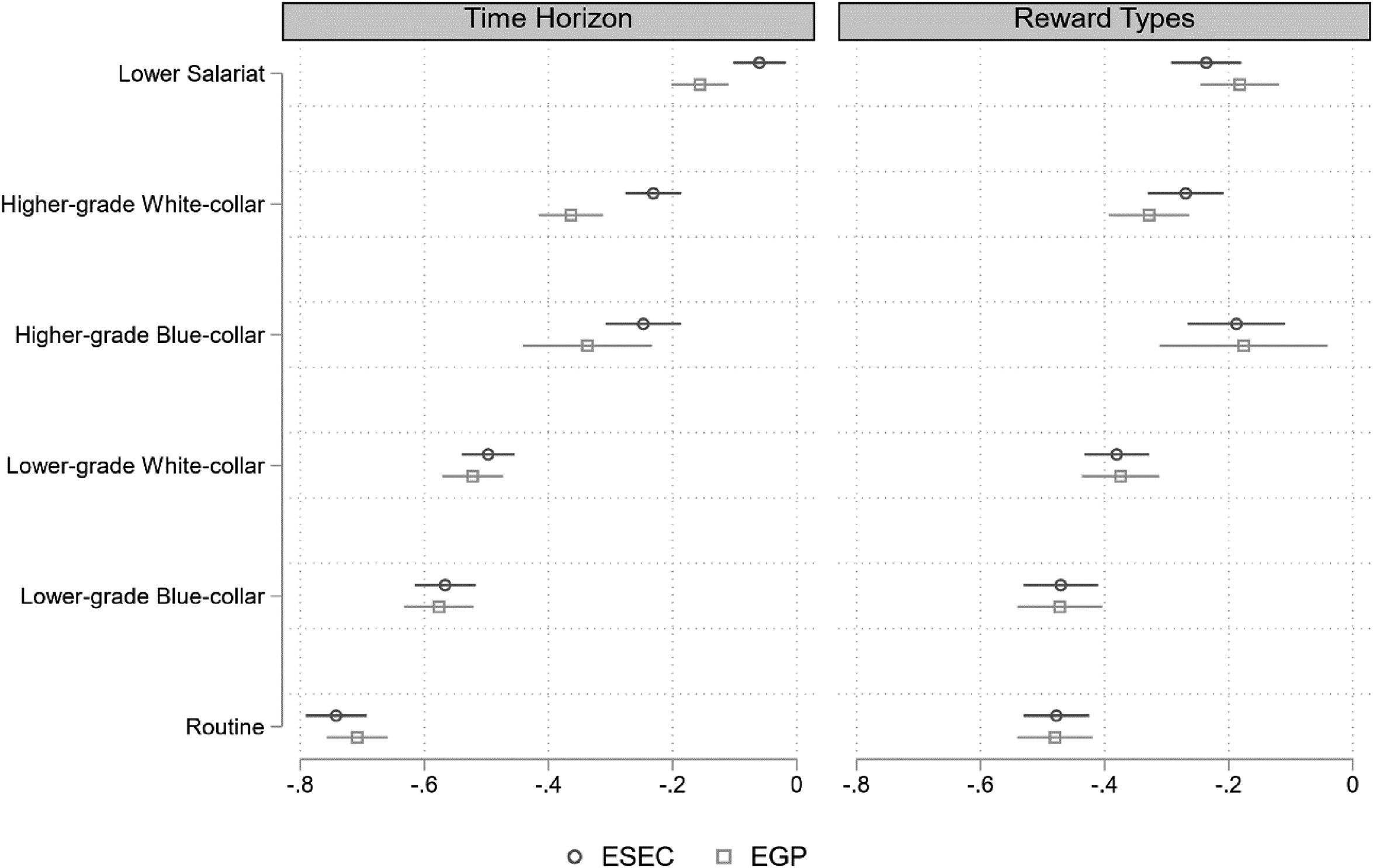
Class coefficients and their 95% confidence intervals obtained from regressing time horizon and reward types dimensions separately on EGP and ESEC classes. Note: Weighted data for 31 countries from EWCS 2010 & 2015. The coefficients of the higher salariat are set to 0 (reference category). Sample sizes: N(Time) = 55,447 (ESEC) / 55,444 (EGP) 21 and N(Payment) = 59,884 (ESEC) / 59,880 (EGP). Coefficients obtained from equation (1).
Employment Relations and Hierarchical Differences Between Social Classes
For both outcomes we detect vertical differences between salariat, intermediate and working classes in Figure 4, as reported in earlier validation studies based on a limited number of countries. However, we also detect class differences within the same vertical level. First, employment relations in the lower salariat feature shorter time horizons and less diffuse reward types than those of the higher salariat, thus challenging the notion of a unified service class. In fact, reward types in the lower salariat resemble those of the intermediate classes to such an extent that these negligible differences were not statistically significant despite the large sample size.
Second, the two intermediate classes display highly similar values on both dimensions and are clearly distinct from the higher salariat and the working classes, a result that confirms their vertical location within the class hierarchy. Moreover, results partly support the claim that these two classes have qualitatively different forms of mixed employment relations. Specifically, higher-grade blue-collars’ employment relations are more favorable with regard to reward types but do not score substantively higher on the time dimension compared to those of their white-collar counterparts.
Third, we found evidence of further vertical differences at the bottom of the class structure. First, the employment relations of lower-grade white-collar workers differ significantly in both dimensions from those of lower-grade blue-collar and routine workers, positioning them in-between the intermediate and the other working classes. Second, routine workers experience the least favorable employment relations with regard to the time horizon, while they are similar to lower-grade blue-collar workers with regard to reward types. Overall, these results suggest that, based on their own criterion of employment relations, EGP and ESEC are more hierarchical than theoretically assumed, thus challenging the standard assumption of a three-level hierarchy.
Next, we assess the internal heterogeneity of the two salariat classes with respect to the distinction between managerial and professional occupations. Figure 5 displays regression coefficients (equation 1) estimated with the four alternative categorizations described above, with higher-grade blue-collars as the reference category. Model 1 contrasts a unified salariat class with higher-grade white-collar and blue-collar employees, in line with standard assumptions. Model 2 vertically differentiates the lower and higher salariat, while Model 3 replaces this dichotomy with the distinction between professionals and managers. Model 4 jointly introduces both differentiations, resulting in four subdivisions within the upper class: higher and lower managers and higher and lower professionals.
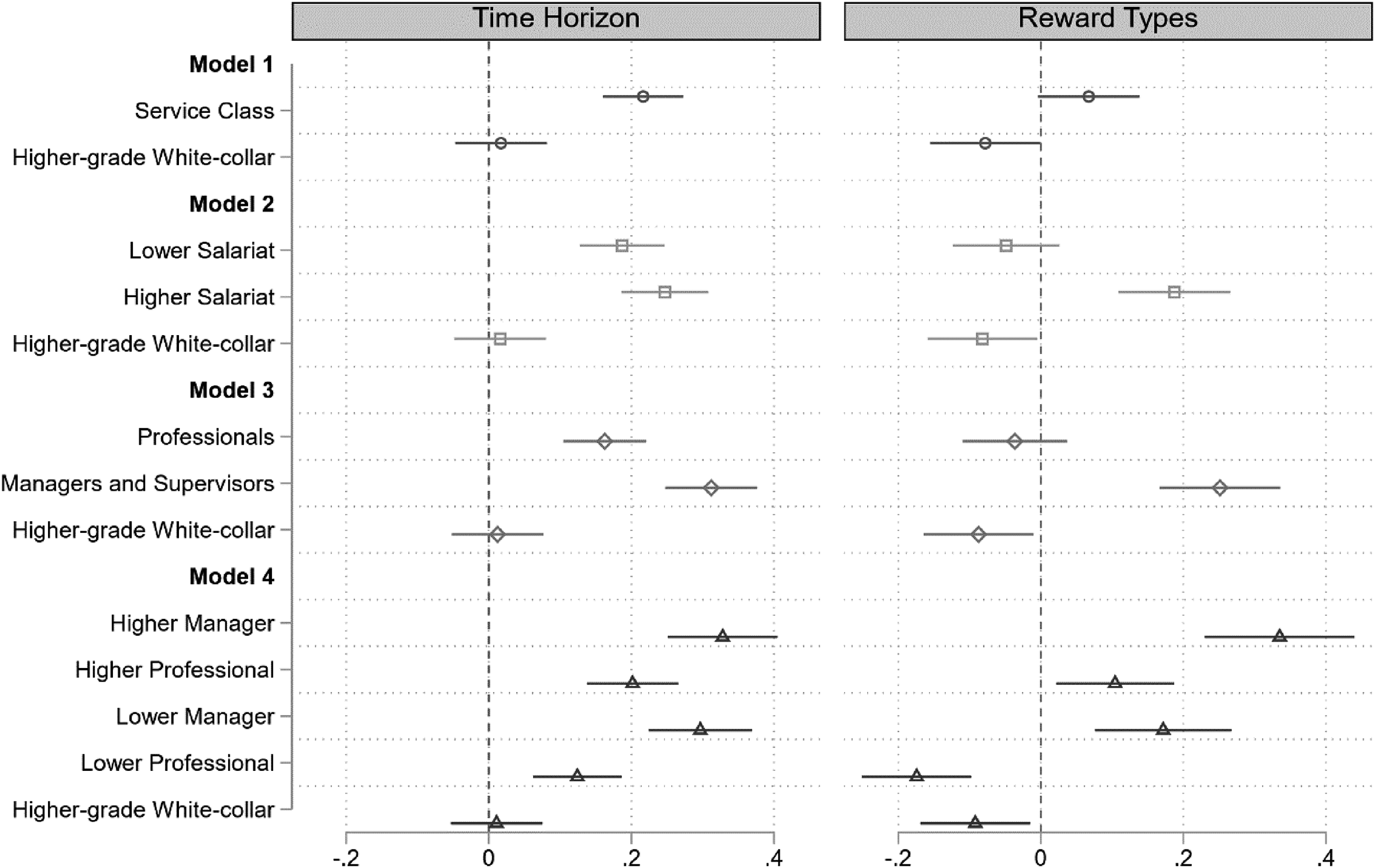
Class coefficients and their 95% confidence intervals for alternative specifications of higher classes and higher-grade white-collar intermediate positions. Note: Weighted data for 31 countries from EWCS 2010 & 2015. Four independently estimated regressions with alternative categorizations of the salariat. Reference category: higher-grade blue-collar workers. Sample sizes N(Time) = 55,447 (ESEC) / 55,444 (EGP) and N(Payment) = 59,884 (ESEC) / 59,880(EGP).
Model 1 reveals pronounced differences between the unified salariat and the intermediate classes with regard to time horizons, but smaller differences in reward types. However, Models 2 and 3 highlight further systematic heterogeneity within the upper class with regard to employment relations. According to Model 2, the higher salariat scores higher than the intermediate classes on both outcomes, while there is no significant difference between the lower salariat and higher-grade white-collars in terms of time horizon, or between the lower salariat and higher-grade blue-collars in terms of reward types. The results of Model 3 are even more damaging for the standard assumption of a unified service class, as professionals score below managers on both dimensions and are barely distinguishable from the intermediate classes in terms of reward types scores. Model 4 shows that higher and lower managers and higher professionals are offered more favorable employment relations than lower professionals. This difference is substantial and statistically significant for both dimensions of employment relations, thus challenging the standard assignment of lower professionals to the upper class in ESEC and EGP.
Moreover, lower managers score between higher professionals and higher managers in terms of their employment relations’ time horizon, with negligible differences in terms of reward types if compared to higher professionals. Overall, these results challenge the assumed homogeneity of employment relations within the salariat classes and suggest that the real demarcation line between upper and intermediate classes runs between lower professionals and the other fractions of the salariat classes.13
Appendix J reports the results of a two-way ANOVA analysis that formally tests the statistical significance of the two divides between higher and lower salariat classes and between managers and professionals. Results show that both are significant and that the divide between managers and professionals explains substantially more variation of the two dimensions of employment relations than the divide between higher and lower salariat classes.
In order to further investigate which lower salariat professions blur the boundaries of employment relations between upper and intermediate classes, we compared the average scores on the two dimensions for the detailed, 3-digit ISCO-08 occupational categories within the lower salariat (Appendix D). The highest deviations of quantitative importance (i.e., occupations with more than 100 cases) with regard to time horizon and reward types scores involve medical associate professionals (medical and pharmaceutical technicians; nursing and midwifery professionals), educational professions (all teachers below Higher Education), mid-rank bureaucrats in the public sector (government regulatory associate professionals), librarians, archivists and curators, journalists, writers and other artistic professions. According to these results, the current practice of assigning these occupations to the lower salariat as part of the upper class is somewhat questionable. It may be noted that women are overrepresented in several of these lower professional occupations, but since the models presented in this section control for gender, this could not have driven the results. However, the relation between class and employment relations might differ between men and women, as discussed in the next section.
Gender Differences in the Criterion Validity of ESEC
Figure 6 presents class differences in employment relations estimated separately for men and women, in order to assess whether ESEC displays equal criterion validity across genders (Appendix E Table E3 reports similar results for EGP). The graph shows class coefficients and their 95% CIs pertaining to the time horizon (left graph) and reward types (right) scores for women (circles) and men (squares). The reference categories are, respectively, women and men in the higher salariat.
Comparing point estimates at a glance yields similar association patterns between class and employment relations among men and women. Indeed, for time horizon a model incorporating an interaction term between class and gender does not improve model fit compared to the additive model displayed in equation 1 (Appendix L). However, with regard to reward types, the interaction is statistically significant. Indeed, as can be seen in Figure 6, women's class positions are poorly differentiated in terms of reward types. In particular, women in the lower salariat do not significantly differ from those in intermediate and working-class positions. Unexpectedly, female higher-grade blue-collars resemble the higher salariat with regard to reward types. 14 Overall, the reward types characterizing the contractual arrangements of women are less differentiated along social classes than those of men.
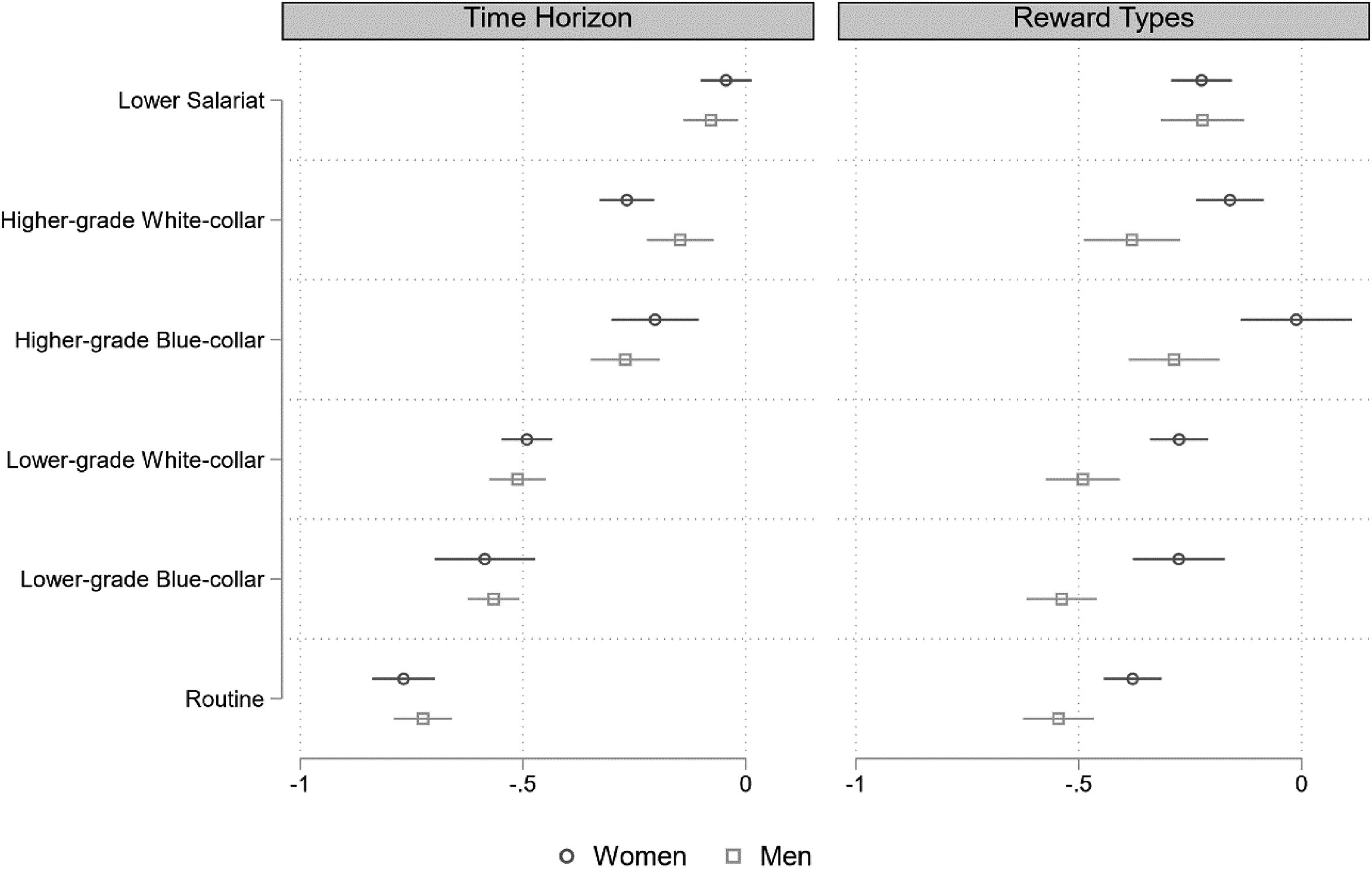
Class coefficients and their 95% confidence intervals obtained from regressing time horizon and reward types dimensions on ESEC classes by gender.
Cross-National Differences in the Criterion Validity of ESEC
Figure 7 presents the kappa indices regarding the time horizon (left) and reward types (right) dimensions of employment relations for each of the 31 countries under examination. For any given country, larger kappas indicate that class differences in employment relations are more pronounced in this country. Markers to the left (right) of the dashed vertical lines indicate lower (higher) than average kappas. Figure 7 suggests that countries differ little with regard to the overall magnitude of class variation in employment relations. As regards time horizon, the average kappa for the standardized coefficients is 0.11 and country values range between 0.07 and 0.14 for virtually all countries, with Greece as an outlier displaying more pronounced class differences. 15 Class stratification according to reward types displays even less variation, with most countries scoring between 0.07 and 0.12. In appendix I, we present similar results for EGP.
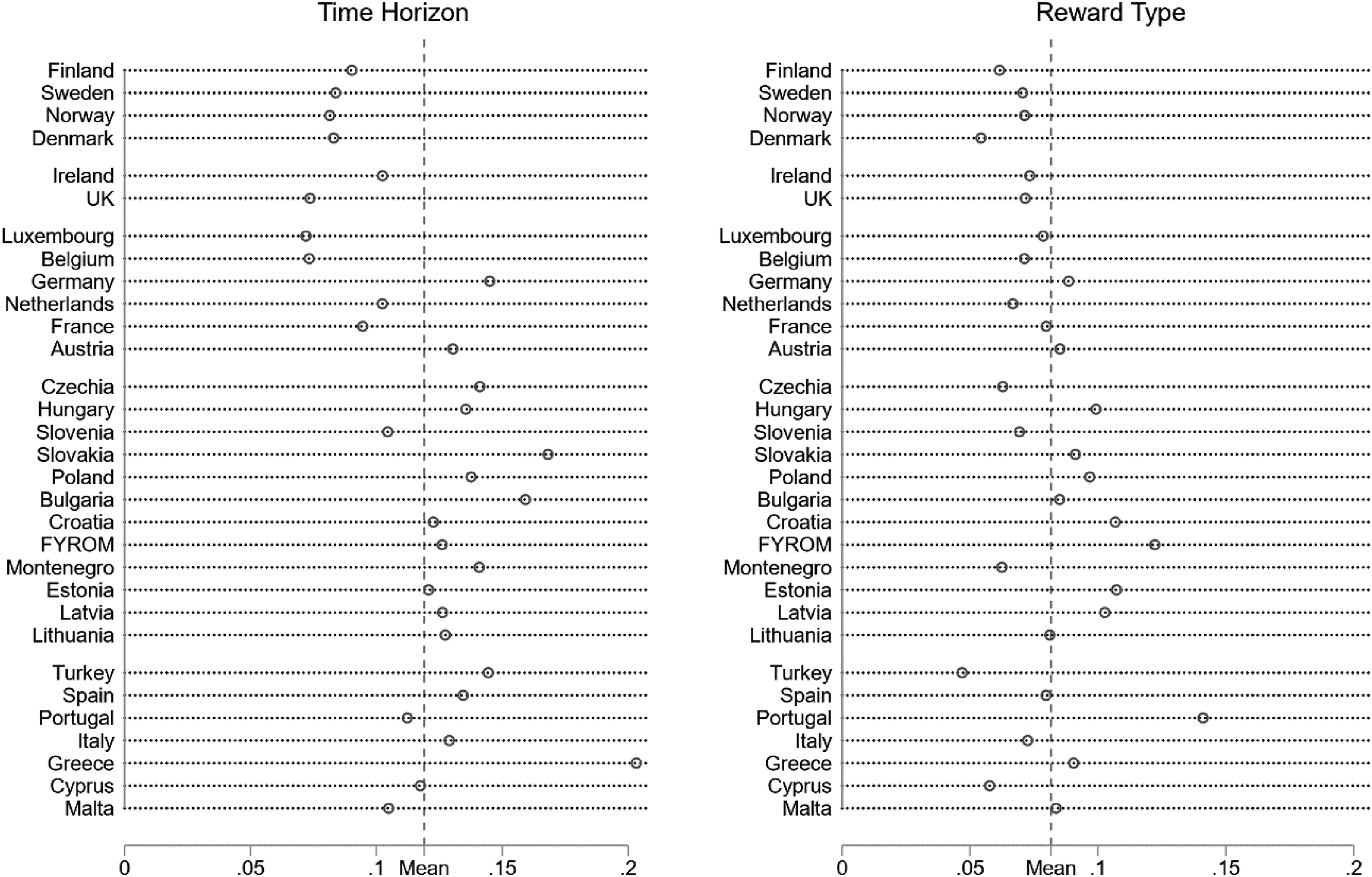
Country-specific kappa indices summarizing class differences with regard to employment contract time horizons and reward type. Note: Weighted data for 31 countries from EWCS 2010 & 2015. Figure displays the country-specific standard deviations of the standardized class coefficients from equation (3).
We formally tested country differences in the associations between class and employment relations by comparing the fit statistics of a model applying equation 1 to the pooled data with an alternative model incorporating interaction effects between country and social class. Results show that the former clearly outperforms the latter, thus confirming that country similarities outweigh differences (results reported in Appendix L). Moreover, in Appendix K we show that partitioning variance into two levels shows that only 7% of the variation in reward types and 15% in time horizon lies between countries, with the rest being accounted for by individual-level differences.
Country differences are not only small, but also non-systematic. In particular, Figure 7 reveals that the country clusters of western continental Europe, Southern Europe and Eastern Europe display marked internal heterogeneity. Scandinavian countries score slightly below-average on both dimensions and the same is also true for the UK and Ireland to some extent. To further investigate the possibility of systematic country differences, we regressed the country kappas on indicators for country clusters and on measures of economic modernization (GDP per capita in purchasing power parities, % tertiary educated, % employed, % workers in ISCO major groups 1 or 2, and in ISCO major groups 8 or 9). We did not find any indication of systematic country differences, with the exception of a statistically significant and moderately negative association between the share of highly skilled occupations (ISCO major groups 1 or 2) and the kappa values for time horizon scores. Overall, these results indicate that ESEC and EGP display highly similar criterion validity across countries, thus setting a solid ground for comparative research based on these class schemes.
Because of a lack of comparable data, we cannot discard the possibility that the previous conclusion may not be generalizable to non-European countries. For instance, we investigated whether it was possible to include the US in our comparison, but relevant items did either not exist or had a different wording in the US. This undermines comparability, which is a central consideration when tackling the issue of applicability of EGP-like schemes outside Europe. Relying on data from the ISSP, however, we can at least partly address this issue using two indicators of employment relations’ time horizon (job advancement prospects and job security). Unfortunately, no suitable item for reward types is available in ISSP data. It is still reassuring that, at least for the time horizon dimension, results (reported in appendix M) indicate that class patterns for the US do not deviate from those observed for European countries even though we used different items and another data source.
Construct Validation Analyses
The studied class schemes are seldom used as mere proxies for employment relations, but rather more generally as indicators for social position. After having established that EGP-like classes vary in terms of employment relations, we therefore set out to validate them against different external constructs informative in terms of labor market advantages. By comparing construct validity of EGP-like classes across a set of outcomes, we do not want to offer substantial insights into the relationship between class and outcomes but instead aim at evaluating whether we observe expectable vertical class patterns in line with class theory. The studied outcomes thus serve as external benchmarks to assess class hierarchies, considering that they are widely used in stratification research.
We can identify at least two different understandings of social class in empirical research that correspond to their usage as social position indicators: a narrow perspective according to which classes measure differences in economic resources among occupations (Chan and Goldthorpe 2007; Rose and Harrison 2010), and a broader view that understands class position as a summary measure for economic and cultural resources (Connelly et al. 2021; Lambert and Bihagen 2014). These different views may result in different empirical practices. For instance, in studies on educational inequality, the class of origin can be taken as a measure of the economic resources of the family and thus modeled together with parental education or other measures of cultural resources (Goldthorpe 2007:28). Alternatively, it can be taken as an omnibus measure of family background that accounts for differences in cultural and economic resources between families (Breen and Müller 2020).
We selected measures that speak to both perspectives on class (economic measure vs. omnibus measure): While class differences in earnings, contract types and autonomy scales assess primarily economic outcomes, ISEI status is a composite measure of the mean income and educational attainment level of occupations representing an omnibus measure of socio-economic position. We regressed each of these outcomes on the social class categories, controlling for the same socio-demographic characteristics as before. Following the results of section 5.1.2, we differentiated the salariat in its four constitutive class subdivisions. Higher-grade white-collars were the reference category.
Figure 8 plots the regression coefficients for the ESEC classes, demonstrating that class differences are especially pronounced regarding socio-economic status and earnings, and also large in terms of work and decision autonomy. Class differences in access to permanent contracts are small among the upper and the intermediate classes, which display a substantial advantage over the working classes. For the other four indicators, two systematic patterns emerge: higher managers enjoy the most advantageous occupational prospects while routine workers display the least advantageous ones. Hence these two classes define the extreme poles of the class hierarchy, further corroborating our previous results concerning the existence of vertical divides within both the upper and the working classes. Moreover, within both the upper and the lower salariat, managers outperform professionals in terms of earnings, work and decision autonomy, another result that echoes class patterns in employment relations. Confirming the patterns observed in the criterion validation analyses, we find that lower professionals display lower income, work and decision autonomy than all other upper class’ subdivisions, thus replicating the above patterns for the time horizon and reward types of employment relations. While earning less than lower managers, lower professionals, however, outperform them on the ISEI scale, which is based on the average levels of income and of education of occupations. Hence, when looking at multiple occupational and economic indicators, lower professionals must be clearly located below the other upper classes, while their cultural resources could justify a more favorable placement. In supplementary analyses we found the same patterns detected for ISEI when studying class variation in terms of a social distance measure (ICAMS) or a prestige measure (SIOPS). 16
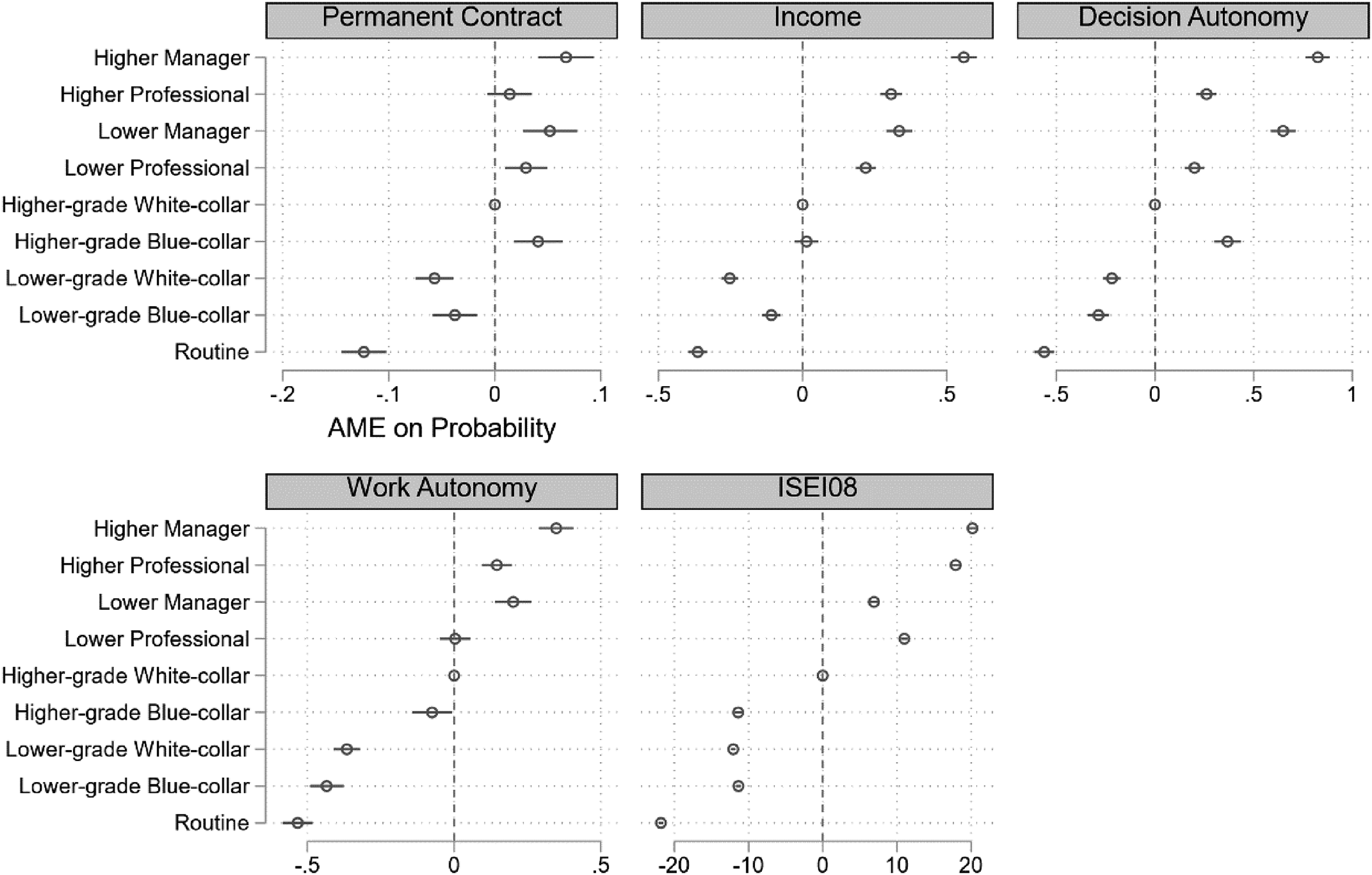
Regression coefficients for income, work autonomy, ISEI, and average marginal effects (AME) for the probability of having a permanent contract with confidence intervals. Note: Weighted data for 31 countries from EWCS 2010 & 2015. Figure displays unstandardized coefficients and AMEs (permanent contract). We take the natural logarithm of income and z-standardize it as well as the two autonomy scales. ISEI and the probability of having a permanent contract are displayed in their untransformed scales.
The two intermediate classes display systematically better prospects than all three working classes across all outcomes, while the comparisons with the salariat classes point to systematic disadvantages with regard to income, socio-economic status and autonomy. Since none of the two intermediate classes systematically outperforms the other, their joint placement in the middle ranks of the class hierarchy is supported. Finally, the point estimates and confidence intervals concerning lower-grade white-collars and lower-grade blue-collars indicate that these two classes enjoy similar occupational prospects and outperform routine workers.
Overall, five major conclusions emerge from the results reported in Figure 8. First, class patterns for different indicators do not always go in the same direction, showing that the relative prospects of different social classes vary depending on the occupational outcome. Second, the broad patterns of differences between ESEC (or EGP) classes are in accordance with class theory pointing to adequate construct validity. However, our third conclusion is that both the upper and the working classes are more internally heterogeneous than the three-level hierarchy assumption predicts. Fourth, our results point to systematic differences between managerial and professional occupations and further challenge the assignment of lower professionals to the upper class.
With regard to the two perspectives on social class, finally, the construct validation analyses suggest that ESEC classes display substantial differentiation with respect to both the outcomes referring to class as the economic dimension of social position (income, permanent contract and the autonomy scales) and those referring to class as omnibus measure of social position (ISEI). The suggested subdivision between managers and professionals in the lower and higher salariat allows to identify significant differences between ESEC classes in particular with regard to the economic outcomes. At the same time, the internal heterogeneity of the service class is lower when predicting class differences in ISEI: from a broader perspective on social class as an omnibus measure, further internal differentiation of the salariat seems to be less necessary. We will elaborate on this point in the conclusions of this article.
Robustness Checks
In this section, we briefly summarize the results of several robustness checks. First, the pattern of results is unchanged when including only respondents working at least 20 hours per week. Including further individuals who did not respond to the question differentiating between employed and self-employed individuals had virtually no effect on our results (Appendix E). Dropping the control variables described in section 4.2 from the original analyses did not alter the patterns of results, nor does controlling for public sector employment.
Second, the results are robust to alternative data reduction techniques regarding the employment relations items (Appendix C). The PCA scores for the two dimensions of employment relations display high Pearson correlations (r > = 0.95) both with scores based on simple additive indexes and with scores from a confirmatory factor analysis. Additionally, PCA scores estimated from the pooled data and corresponding scores separately estimated for each country display correlations above 0.95.
A third set of sensitivity analyses concerns the class variables. We compared the results obtained when using three-digit and four-digit versions of ISCO-88 and ISCO-08, finding only negligible differences in the association patterns of social class and employment relations. We also compared the reported results based on a narrow definition of supervisory status to those obtained using ISCO-08 titles to define supervisory status, and to a third set of results obtained by assigning class solely based on occupational codes without using information on supervisory status. The pattern of results is unchanged (Appendix E). Moreover, applied researchers might be frequently limited to using a more aggregated version of EGP-like class schemes. We therefore also studied the association of class and employment relations based on alternative aggregations of the original class schemes. 17 The results (reported in Tables E8 and E9 of the appendix) confirm the patterns of the main analyses for men and women across class (ESEC or EGP) and occupational schema (ISCO-88 or ISCO-08).
Conclusions
This study assessed the criterion and construct validity of ESEC and EGP by analyzing class differences in employment relations and labor market outcomes in 31 European countries. The theoretical framework of these class schemes implies that employment relations are differentiated on a bi-dimensional space defined by their time horizon and reward types. Class differences along these two dimensions reflect two explanatory mechanisms: human asset specificity and monitoring problems. Whereas most previous criterion validation studies assessed only one of the two dimensions of employment relations or conflated them with measures of their explanatory mechanisms, in this work we could differentiate between the two dimensions relying on the data of the EWCS. Moreover, this study contributes to the literature with a large-scale, comparative validation analysis assessing the criterion validity of both schemes separately for men and women and across multiple operationalizations that are common in class analysis. Furthermore, the construct validation analyses asses class differences with respect to multiple occupational indicators relevant to stratification research and informative about different views and usages of social class.
Our results offer some good news for users of EGP-like schemes. First, differences in employment relations between upper, intermediate and working classes largely follow the patterns predicted by the theory, indicating that these class schemes display good criterion validity. This conclusion may be tempered, however, when considering that class differences are not very large. For instance, the distance between the higher salariat and the two intermediate classes in ESEC is below 0.3 standard deviations for both dimensions of employment relations. Moreover, by differentiating between these two dimensions, we could show that the two intermediate classes (higher-grade white-collar and higher-grade blue-collar positions) do not display the qualitative differences that were invoked to treat them as separate classes.
Second, we found that country variations in the magnitude of class differences in employment relations are small and unsystematic. This is an important conclusion because EGP-like schemes are used in extensively comparative research, with little evidence of their criterion validity across countries with different economic features and institutional arrangements. Since these schemes display similar criterion validity across countries, country differences in social class patterns can be interpreted in substantive terms, and not merely as measurement artifacts.
Third, we found that gender commonalities exceed differences with regard to class-based patterns of employment relations. The overall similarity of the association patterns between men and women provides solid ground for gender-based analyses of class inequalities using EGP-like schemes. However, class differences in terms of reward types are far less pronounced among women. Occupational sex segregation and the devaluation of female-typed labor may contribute to explaining gender differences in social class patterns of reward types (Levanon, England and Allison 2009; Hausmann, Kleinert and Leuze 2015; Blau and Kahn 2017). Our results thus call for further exploration of the gender-specific mechanisms explaining why women from intermediate and upper working classes display less variation than men with regard to reward types (Goldthorpe and McKnight 2006;). One possible venue to integrate gender into class theory may be to investigate systematic differences in employment relations among service contract holders. In particular, by aggregating managers and professionals together, EGP-like schemes conceal gender inequalities at the top of the class hierarchy. 18 The finding that managerial positions are always economically advantaged if compared to professional positions within the same class and the lack of variation with regard to women's reward type scores might point to a particularly systematic attenuation of these service contract elements in employment relations of female salariat personal. At the same time, the broad commonality suggests in our view that there is little need for a gender-specific theory of class based on employment relations.
A fourth reassuring finding is that ESEC and EGP measure employment relations equally well, and this conclusion applies to different operationalizations of these class schemes (3-digit and 4-digits ISCO, 1988 and 2008 ISCO, with or without supervision information). Owing to data availability constraints, EGP-like schemes are often built in several different ways: our results indicate that these different operationalizations are largely interchangeable.
Our study however did not unequivocally corroborate the validity of EGP-like schemes. In particular, our results question the theoretically assumed vertical differentiation into three hierarchical levels. We will discuss this issue in the remainder of the conclusion and offer on this basis some operational advice for practitioners. Across almost all analyses we found that EGP-like schemes fail to discriminate well between upper-class positions not only when using external indicators such as income or ISEI as was done in previous research, but even when using the theory's preferred yardstick of employment relations. Moreover, a unified salariat class at the top of the this three-level class hierarchy currently accounts for about two fifths of the workforce in many developed countries. This simple fact invites social stratification researchers to redesign the boundaries of privileged classes. In fact, the heterogeneity of the upper class has served as an argument to abandon EGP-like schemes in favor of alternative schemes incorporating more fine-grained distinctions at the top (Esping-Andersen 1993; Oesch 2006; Güveli and Graaf 2007; Hertel 2017). Construct validation analyses contrasting EGP-like schemes with these competitors are therefore an important avenue for future research (Weeden et al. 2007; Lambert and Bihagen 2014). At the same time, abandoning EGP-like schemes would come at the cost of introducing a major discontinuity with four decades of class analysis dominated by EGP. Moreover, the encouraging results of previous validation studies, the four desirable properties of these class schemes identified in this study, and their prominence in class analyses in recent years (Barone et al. 2021) constitute compelling arguments against such a drastic solution. Based on our results, we therefore identify and critically evaluate three pragmatic measurement solutions to the problem of the heterogeneity of the upper class.
A first reaction to the upper-class heterogeneity problem would be to continue using EGP-like schemes while ignoring the postulated three-level hierarchy, thus treating the distinction between higher and lower salariat classes as a genuinely vertical difference. For example, this is the solution found in studies modeling access to advantageous positions as access to the higher salariat only (Bernardi and Ballarino 2016). Our results provide some justification for this pragmatic solution: employment relations in lower salariat positions feature a shorter time horizon and less diffuse rewards while average earnings and socio-economic status as well as job autonomy and acces to permanent contracts are more favorable in the higher salariat. Our study thus shows that the distinction between the two salariat classes is unambiguously hierarchical.
However, our results also point to the limitations of this pragmatic solution, which downplays the heterogeneity between managerial and professional occupations of the salariat classes. The aggregation of managers and professionals into an undifferentiated upper class is possibly the most distinctive feature of EGP-like schemes compared to other class schemes. Critics of these schemes provided evidence that managers and professionals differ in several respects, including income, mobility patterns, political preferences and voting patterns (Oesch 2006; Kitschelt and Rehm 2014; Hertel 2017). However, they did not assess the heterogeneity of these two class subdivisions with regard to employment relations, that is, the theoretical construct which underpins EGP-like schemes. Conversely, previous criterion validation studies using indicators of employment relations did not address differences between managers and professionals. Our study provides this missing piece of evidence and reaches two major conclusions. On the one hand, the employment contracts of lower professionals display shorter time horizons and less diffuse reward types than those of lower managers and of higher managers and professionals. On the other hand, lower managers significantly differ from higher professionals in terms of their employment relation's time horizon but not reward type. The construct validity analyses replicate these two key patterns with respect to class differences in income, work and decision autonomy.
Hence, a second solution to the above problem of differentiating upper-class positions is to separate lower professionals from the rest of the upper class. This solution is easy to implement and can be justified within the theoretical framework of EGP-like schemes to the extent that professions in the lower salariat (e.g., librarians, high school teachers, nurses) involve lower asset specificity and fewer monitoring problems than managerial occupations and professions in the higher salariat (e.g., lawyers, university professors, doctors). Indeed, Goldthorpe (2007) suggested that workers in the lower salariat may be offered an attenuated form of the service contract, although our results indicate that this applies specifically to lower professionals.
A third solution is to develop EGP-like schemes by integrating the distinction between managers and professionals within both the lower and higher salariat, as recently suggested by Ganzeboom (2018) with the ISEC scheme. This third solution allows for further differentiation without necessarily casting aside the framework of employment relations.19 Indeed, we found that higher managers outperform higher professionals and that lower managers outperform lower professionals with respect to the time horizon and type of rewards characterizing their employment relations. These pairwise comparisons were not always large nor statistically significant, but when we contrasted managerial and professional occupations altogether, we detected a statistically significant, sizeable advantage of the former. Moreover, class analyses abundantly documented systematic substantial differences between managers and professionals in terms of cultural orientations, lifestyles and voting patterns (Weeden and Grusky 2005; Oesch 2006; Kitschelt and Rehm 2014). Hence, this solution has the advantage of defining classes in terms of characteristic differences in employment relations within service contracts while suggesting stronger connections between the analysis of class inequalities, class identities and class action.
Our results also challenge the three-level hierarchy assumption of EGP-like schemes with regard to differences within the working class. In particular, we found that contracts in routine occupations (corresponding to EGP VII) display significantly shorter time horizons than those of lower-grade blue-collars (EGP VI) and white-collars (IIIb). We did not find the same pattern for reward types, but we suspect that this reflects the main limitation of the underlying indicators available in the EWCS, namely, vague questions on piecewise and timewise payment methods that do not discriminate well between employment relations at the bottom of the class hierarchy. Moreover, the construct validation analyses indicate that routine workers are offered permanent contracts less often and have lower income and work autonomy than the other working classes. These findings suggest that the vertical differentiations at the bottom of the class structure are also not in line with the assumed three-level hierarchy.
Finally, the hierarchical position of lower-grade white-collars (IIIb) in empirical research is also ambiguous, as they are variously merged with higher-grade white-collars (IIIa), with lower-grade blue-collars (VI) or with routine occupations (VII). Erikson and Goldthorpe (1992) suggested that the third solution is preferable, but only in the case of women. Our results indicate that the second solution is far more satisfactory than the others for both genders, thus placing lower-grade blue and white-collars together and above routine occupations. Overall, we thus conclude that a five-level hierarchy incorporating vertical distinctions within both the upper class and the working class is a more realistic representation of class hierarchies in contemporary societies. 20 This five-level distinction is corroborated both by our analyses of employment relations and by the external indicators of economic and socioeconomic advantage.
What do our findings then imply for practitioners choosing an EGP-like class scheme as measurement for social class? We would like to argue that this depends on the analyst's understanding of what social class schemes measure. If analysts use social class as an omnibus measure for social position accounting for variation in economic as well as cultural resources, they may refer to the five hierarchical levels that we have identified and keep aggregating managers and professionals. Our results based on ISEI confirm this five-level hierarchy and suggest that status scores do not substantially differ between professional and managerial occupations within the salariat because professionals compensate lower incomes with higher educational attainment. Such a broad understanding of class, however, comes at the price of conflating economic and cultural resources, which are averaged out when social class is treated as an omnibus measure of socioeconomic position (Bukodi and Goldthorpe 2013; Bukodi et al. 2018; Rose and Harrison 2010). When social class is instead understood more specifically as the economic dimension of social position, however, analysts should forgo the three-level hierarchy and additionally implement the proposed distinctions within the salariat (Goldthorpe and McKnight 2006; Westhoff et al. 2021). When considering employment relations and economic outcomes, we detect salient differences between higher and lower salariat positions as well as between professionals and managers. Accounting for those differences is not only theoretically coherent but may also help to (re-)align class analysis with broader stratification research and lay understandings of economic inequalities.
Author's Note
Analyses for this paper were conducted using micro data from Eurofound in Stata 15. Data access is restricted and can be requested by email from Eurofound. Replication “.do” files can be downloaded from figshare using the link from the article's SAGE web page.
Supplemental Material
sj-docx-1-smr-10.1177_00491241221134522 - Supplemental material for Measuring Class Hierarchies in Postindustrial Societies: A Criterion and Construct Validation of EGP and ESEC Across 31 Countries
Supplemental material, sj-docx-1-smr-10.1177_00491241221134522 for Measuring Class Hierarchies in Postindustrial Societies: A Criterion and Construct Validation of EGP and ESEC Across 31 Countries by O. Smallenbroek, F. Hertel and C. Barone in Sociological Methods & Research
Supplemental Material
sj-do-2-smr-10.1177_00491241221134522 - Supplemental material for Measuring Class Hierarchies in Postindustrial Societies: A Criterion and Construct Validation of EGP and ESEC Across 31 Countries
Supplemental material, sj-do-2-smr-10.1177_00491241221134522 for Measuring Class Hierarchies in Postindustrial Societies: A Criterion and Construct Validation of EGP and ESEC Across 31 Countries by O. Smallenbroek, F. Hertel and C. Barone in Sociological Methods & Research
Supplemental Material
sj-do-3-smr-10.1177_00491241221134522 - Supplemental material for Measuring Class Hierarchies in Postindustrial Societies: A Criterion and Construct Validation of EGP and ESEC Across 31 Countries
Supplemental material, sj-do-3-smr-10.1177_00491241221134522 for Measuring Class Hierarchies in Postindustrial Societies: A Criterion and Construct Validation of EGP and ESEC Across 31 Countries by O. Smallenbroek, F. Hertel and C. Barone in Sociological Methods & Research
Supplemental Material
sj-do-4-smr-10.1177_00491241221134522 - Supplemental material for Measuring Class Hierarchies in Postindustrial Societies: A Criterion and Construct Validation of EGP and ESEC Across 31 Countries
Supplemental material, sj-do-4-smr-10.1177_00491241221134522 for Measuring Class Hierarchies in Postindustrial Societies: A Criterion and Construct Validation of EGP and ESEC Across 31 Countries by O. Smallenbroek, F. Hertel and C. Barone in Sociological Methods & Research
Supplemental Material
sj-do-5-smr-10.1177_00491241221134522 - Supplemental material for Measuring Class Hierarchies in Postindustrial Societies: A Criterion and Construct Validation of EGP and ESEC Across 31 Countries
Supplemental material, sj-do-5-smr-10.1177_00491241221134522 for Measuring Class Hierarchies in Postindustrial Societies: A Criterion and Construct Validation of EGP and ESEC Across 31 Countries by O. Smallenbroek, F. Hertel and C. Barone in Sociological Methods & Research
Supplemental Material
sj-do-6-smr-10.1177_00491241221134522 - Supplemental material for Measuring Class Hierarchies in Postindustrial Societies: A Criterion and Construct Validation of EGP and ESEC Across 31 Countries
Supplemental material, sj-do-6-smr-10.1177_00491241221134522 for Measuring Class Hierarchies in Postindustrial Societies: A Criterion and Construct Validation of EGP and ESEC Across 31 Countries by O. Smallenbroek, F. Hertel and C. Barone in Sociological Methods & Research
Supplemental Material
sj-do-7-smr-10.1177_00491241221134522 - Supplemental material for Measuring Class Hierarchies in Postindustrial Societies: A Criterion and Construct Validation of EGP and ESEC Across 31 Countries
Supplemental material, sj-do-7-smr-10.1177_00491241221134522 for Measuring Class Hierarchies in Postindustrial Societies: A Criterion and Construct Validation of EGP and ESEC Across 31 Countries by O. Smallenbroek, F. Hertel and C. Barone in Sociological Methods & Research
Supplemental Material
sj-do-8-smr-10.1177_00491241221134522 - Supplemental material for Measuring Class Hierarchies in Postindustrial Societies: A Criterion and Construct Validation of EGP and ESEC Across 31 Countries
Supplemental material, sj-do-8-smr-10.1177_00491241221134522 for Measuring Class Hierarchies in Postindustrial Societies: A Criterion and Construct Validation of EGP and ESEC Across 31 Countries by O. Smallenbroek, F. Hertel and C. Barone in Sociological Methods & Research
Supplemental Material
sj-do-9-smr-10.1177_00491241221134522 - Supplemental material for Measuring Class Hierarchies in Postindustrial Societies: A Criterion and Construct Validation of EGP and ESEC Across 31 Countries
Supplemental material, sj-do-9-smr-10.1177_00491241221134522 for Measuring Class Hierarchies in Postindustrial Societies: A Criterion and Construct Validation of EGP and ESEC Across 31 Countries by O. Smallenbroek, F. Hertel and C. Barone in Sociological Methods & Research
Supplemental Material
sj-do-10-smr-10.1177_00491241221134522 - Supplemental material for Measuring Class Hierarchies in Postindustrial Societies: A Criterion and Construct Validation of EGP and ESEC Across 31 Countries
Supplemental material, sj-do-10-smr-10.1177_00491241221134522 for Measuring Class Hierarchies in Postindustrial Societies: A Criterion and Construct Validation of EGP and ESEC Across 31 Countries by O. Smallenbroek, F. Hertel and C. Barone in Sociological Methods & Research
Supplemental Material
sj-do-11-smr-10.1177_00491241221134522 - Supplemental material for Measuring Class Hierarchies in Postindustrial Societies: A Criterion and Construct Validation of EGP and ESEC Across 31 Countries
Supplemental material, sj-do-11-smr-10.1177_00491241221134522 for Measuring Class Hierarchies in Postindustrial Societies: A Criterion and Construct Validation of EGP and ESEC Across 31 Countries by O. Smallenbroek, F. Hertel and C. Barone in Sociological Methods & Research
Supplemental Material
sj-do-12-smr-10.1177_00491241221134522 - Supplemental material for Measuring Class Hierarchies in Postindustrial Societies: A Criterion and Construct Validation of EGP and ESEC Across 31 Countries
Supplemental material, sj-do-12-smr-10.1177_00491241221134522 for Measuring Class Hierarchies in Postindustrial Societies: A Criterion and Construct Validation of EGP and ESEC Across 31 Countries by O. Smallenbroek, F. Hertel and C. Barone in Sociological Methods & Research
Supplemental Material
sj-do-13-smr-10.1177_00491241221134522 - Supplemental material for Measuring Class Hierarchies in Postindustrial Societies: A Criterion and Construct Validation of EGP and ESEC Across 31 Countries
Supplemental material, sj-do-13-smr-10.1177_00491241221134522 for Measuring Class Hierarchies in Postindustrial Societies: A Criterion and Construct Validation of EGP and ESEC Across 31 Countries by O. Smallenbroek, F. Hertel and C. Barone in Sociological Methods & Research
Supplemental Material
sj-do-14-smr-10.1177_00491241221134522 - Supplemental material for Measuring Class Hierarchies in Postindustrial Societies: A Criterion and Construct Validation of EGP and ESEC Across 31 Countries
Supplemental material, sj-do-14-smr-10.1177_00491241221134522 for Measuring Class Hierarchies in Postindustrial Societies: A Criterion and Construct Validation of EGP and ESEC Across 31 Countries by O. Smallenbroek, F. Hertel and C. Barone in Sociological Methods & Research
Supplemental Material
sj-do-15-smr-10.1177_00491241221134522 - Supplemental material for Measuring Class Hierarchies in Postindustrial Societies: A Criterion and Construct Validation of EGP and ESEC Across 31 Countries
Supplemental material, sj-do-15-smr-10.1177_00491241221134522 for Measuring Class Hierarchies in Postindustrial Societies: A Criterion and Construct Validation of EGP and ESEC Across 31 Countries by O. Smallenbroek, F. Hertel and C. Barone in Sociological Methods & Research
Supplemental Material
sj-do-16-smr-10.1177_00491241221134522 - Supplemental material for Measuring Class Hierarchies in Postindustrial Societies: A Criterion and Construct Validation of EGP and ESEC Across 31 Countries
Supplemental material, sj-do-16-smr-10.1177_00491241221134522 for Measuring Class Hierarchies in Postindustrial Societies: A Criterion and Construct Validation of EGP and ESEC Across 31 Countries by O. Smallenbroek, F. Hertel and C. Barone in Sociological Methods & Research
Supplemental Material
sj-do-17-smr-10.1177_00491241221134522 - Supplemental material for Measuring Class Hierarchies in Postindustrial Societies: A Criterion and Construct Validation of EGP and ESEC Across 31 Countries
Supplemental material, sj-do-17-smr-10.1177_00491241221134522 for Measuring Class Hierarchies in Postindustrial Societies: A Criterion and Construct Validation of EGP and ESEC Across 31 Countries by O. Smallenbroek, F. Hertel and C. Barone in Sociological Methods & Research
Supplemental Material
sj-do-18-smr-10.1177_00491241221134522 - Supplemental material for Measuring Class Hierarchies in Postindustrial Societies: A Criterion and Construct Validation of EGP and ESEC Across 31 Countries
Supplemental material, sj-do-18-smr-10.1177_00491241221134522 for Measuring Class Hierarchies in Postindustrial Societies: A Criterion and Construct Validation of EGP and ESEC Across 31 Countries by O. Smallenbroek, F. Hertel and C. Barone in Sociological Methods & Research
Supplemental Material
sj-do-19-smr-10.1177_00491241221134522 - Supplemental material for Measuring Class Hierarchies in Postindustrial Societies: A Criterion and Construct Validation of EGP and ESEC Across 31 Countries
Supplemental material, sj-do-19-smr-10.1177_00491241221134522 for Measuring Class Hierarchies in Postindustrial Societies: A Criterion and Construct Validation of EGP and ESEC Across 31 Countries by O. Smallenbroek, F. Hertel and C. Barone in Sociological Methods & Research
Supplemental Material
sj-do-20-smr-10.1177_00491241221134522 - Supplemental material for Measuring Class Hierarchies in Postindustrial Societies: A Criterion and Construct Validation of EGP and ESEC Across 31 Countries
Supplemental material, sj-do-20-smr-10.1177_00491241221134522 for Measuring Class Hierarchies in Postindustrial Societies: A Criterion and Construct Validation of EGP and ESEC Across 31 Countries by O. Smallenbroek, F. Hertel and C. Barone in Sociological Methods & Research
Supplemental Material
sj-do-21-smr-10.1177_00491241221134522 - Supplemental material for Measuring Class Hierarchies in Postindustrial Societies: A Criterion and Construct Validation of EGP and ESEC Across 31 Countries
Supplemental material, sj-do-21-smr-10.1177_00491241221134522 for Measuring Class Hierarchies in Postindustrial Societies: A Criterion and Construct Validation of EGP and ESEC Across 31 Countries by O. Smallenbroek, F. Hertel and C. Barone in Sociological Methods & Research
Supplemental Material
sj-do-22-smr-10.1177_00491241221134522 - Supplemental material for Measuring Class Hierarchies in Postindustrial Societies: A Criterion and Construct Validation of EGP and ESEC Across 31 Countries
Supplemental material, sj-do-22-smr-10.1177_00491241221134522 for Measuring Class Hierarchies in Postindustrial Societies: A Criterion and Construct Validation of EGP and ESEC Across 31 Countries by O. Smallenbroek, F. Hertel and C. Barone in Sociological Methods & Research
Supplemental Material
sj-do-23-smr-10.1177_00491241221134522 - Supplemental material for Measuring Class Hierarchies in Postindustrial Societies: A Criterion and Construct Validation of EGP and ESEC Across 31 Countries
Supplemental material, sj-do-23-smr-10.1177_00491241221134522 for Measuring Class Hierarchies in Postindustrial Societies: A Criterion and Construct Validation of EGP and ESEC Across 31 Countries by O. Smallenbroek, F. Hertel and C. Barone in Sociological Methods & Research
Supplemental Material
sj-do-24-smr-10.1177_00491241221134522 - Supplemental material for Measuring Class Hierarchies in Postindustrial Societies: A Criterion and Construct Validation of EGP and ESEC Across 31 Countries
Supplemental material, sj-do-24-smr-10.1177_00491241221134522 for Measuring Class Hierarchies in Postindustrial Societies: A Criterion and Construct Validation of EGP and ESEC Across 31 Countries by O. Smallenbroek, F. Hertel and C. Barone in Sociological Methods & Research
Supplemental Material
sj-do-25-smr-10.1177_00491241221134522 - Supplemental material for Measuring Class Hierarchies in Postindustrial Societies: A Criterion and Construct Validation of EGP and ESEC Across 31 Countries
Supplemental material, sj-do-25-smr-10.1177_00491241221134522 for Measuring Class Hierarchies in Postindustrial Societies: A Criterion and Construct Validation of EGP and ESEC Across 31 Countries by O. Smallenbroek, F. Hertel and C. Barone in Sociological Methods & Research
Supplemental Material
sj-do-26-smr-10.1177_00491241221134522 - Supplemental material for Measuring Class Hierarchies in Postindustrial Societies: A Criterion and Construct Validation of EGP and ESEC Across 31 Countries
Supplemental material, sj-do-26-smr-10.1177_00491241221134522 for Measuring Class Hierarchies in Postindustrial Societies: A Criterion and Construct Validation of EGP and ESEC Across 31 Countries by O. Smallenbroek, F. Hertel and C. Barone in Sociological Methods & Research
Supplemental Material
sj-do-27-smr-10.1177_00491241221134522 - Supplemental material for Measuring Class Hierarchies in Postindustrial Societies: A Criterion and Construct Validation of EGP and ESEC Across 31 Countries
Supplemental material, sj-do-27-smr-10.1177_00491241221134522 for Measuring Class Hierarchies in Postindustrial Societies: A Criterion and Construct Validation of EGP and ESEC Across 31 Countries by O. Smallenbroek, F. Hertel and C. Barone in Sociological Methods & Research
Supplemental Material
sj-grec-28-smr-10.1177_00491241221134522 - Supplemental material for Measuring Class Hierarchies in Postindustrial Societies: A Criterion and Construct Validation of EGP and ESEC Across 31 Countries
Supplemental material, sj-grec-28-smr-10.1177_00491241221134522 for Measuring Class Hierarchies in Postindustrial Societies: A Criterion and Construct Validation of EGP and ESEC Across 31 Countries by O. Smallenbroek, F. Hertel and C. Barone in Sociological Methods & Research
Supplemental Material
sj-do-29-smr-10.1177_00491241221134522 - Supplemental material for Measuring Class Hierarchies in Postindustrial Societies: A Criterion and Construct Validation of EGP and ESEC Across 31 Countries
Supplemental material, sj-do-29-smr-10.1177_00491241221134522 for Measuring Class Hierarchies in Postindustrial Societies: A Criterion and Construct Validation of EGP and ESEC Across 31 Countries by O. Smallenbroek, F. Hertel and C. Barone in Sociological Methods & Research
Supplemental Material
sj-xls-30-smr-10.1177_00491241221134522 - Supplemental material for Measuring Class Hierarchies in Postindustrial Societies: A Criterion and Construct Validation of EGP and ESEC Across 31 Countries
Supplemental material, sj-xls-30-smr-10.1177_00491241221134522 for Measuring Class Hierarchies in Postindustrial Societies: A Criterion and Construct Validation of EGP and ESEC Across 31 Countries by O. Smallenbroek, F. Hertel and C. Barone in Sociological Methods & Research
Footnotes
Acknowledgements
We would like to thank the participants of the ISA RC28 2021 Spring Meeting in Turku, the DIGCLASS seminar series from the JRC in Seville, and the 40th conference of the German Sociological Association in 2020 for their valuable comments and feedback as well as the four helpful and constructive anonymous reviewers.
Declaration of Conflicting Interests
The author(s) declared no potential conflicts of interest with respect to the research, authorship, and/or publication of this article.
Funding
The author(s) disclosed receipt of the following financial support for the research, authorship, and/or publication of this article: This work was supported by the Bundesministerium für Bildung und Forschung [German Federal Ministry of Education and Research] (grant number NWGWIHO01).

Supplemental Material
Supplemental material for this article is available online.
Notes
Author Biographies
References
Supplementary Material
Please find the following supplemental material available below.
For Open Access articles published under a Creative Commons License, all supplemental material carries the same license as the article it is associated with.
For non-Open Access articles published, all supplemental material carries a non-exclusive license, and permission requests for re-use of supplemental material or any part of supplemental material shall be sent directly to the copyright owner as specified in the copyright notice associated with the article.
