




Abstract
Despite the fact that third parties are present during a substantial amount of face-to-face interviews, bystander influence on respondents’ response behavior is not yet fully understood. We use nine waves of the German Family Panel pairfam and apply fixed effects panel regression models to analyze effects of third-party presence on items regarding the sharing of household tasks between partners. We find that both male and female respondents report doing a smaller share of household tasks when their partner is present during the interview as compared to when their partner is not present. Similarly, if the respondent’s partner is present, both partners’ reports correspond more, so that they are less prone to resulting in unrealistically high sums. These results indicate that for items concerning household labor, partner presence does not compromise data quality but may in fact improve it.
Keywords
Face-to-face interviews, in particular when dealing with personal or sensitive topics, are often designed to involve only the interviewer and respondent, excluding the presence of others. Third-party presence may compromise data quality as respondents may refuse to answer sensitive questions or may tailor their answers to the other person. Therefore, privacy during the interview is standard for most face-to-face interviews in order to minimize social influences (Bradburn and Sudman 1979; Neuman 2012). However, this standard is difficult to enforce: In most population surveys, third parties are present during a substantial portion of all interviews (Aquilino 1997; Mneimneh et al. 2017; Tourangeau and Yan 2007; Zipp and Toth 2002). It is therefore important to understand the effect of third-party presence on response behavior. However, previous research on this topic is scarce, and existing results are mixed: Some studies find the hypothesized effect of third-party presence (e.g., Aquilino 1997; Aquilino, Wright, and Supple 2000; Herrera et al. 2017; Zipp and Toth 2002), while others find inconsistent or very small effects (e.g., Aquilino 1993; Diop, Le, and Traugott 2015; Hartmann 1995; Pollner and Adams 1997) or no effect at all (e.g., Lau et al. 2017; Pollner and Adams 1994; Silver, Abramson, and Anderson 1986; Smith 1997).
Aquilino (1997) proposes a differentiated view of third-party presence: Third-party effects may depend on factors related to both the question content and the person(s) involved. For example, effects may be different for factual questions as compared to questions concerning attitudes and feelings. Similarly, whether the third person knows the true answer (in the case of factual questions), is in some way affected by the respondent’s answer, or has an interest in a particular answer may also play a role. Accordingly, third-party presence has been found to at times even increase the accuracy of sensitive information (see also Mneimneh et al. 2015). When analyzing third-party effects, it is therefore essential to understand the mechanisms with regard to the survey questions of interest. For this reason, it seems promising to investigate the effect of third-party presence on response behaviors for certain types of questions in detail instead of a broad range of questions or the entire interview.
This article focuses on the effect of the respondent’s partner’s presence during a computer-assisted personal interview (CAPI) on responses to a multiple-item question capturing the partner’s relative housework share in different housework domains. This question was chosen for several reasons: First, the division of housework is currently attracting considerable scholarly attention in sociological research (e.g., Auspurg, Iacovou, and Nicoletti 2017; Cordero-Coma and Esping-Andersen 2018; Dommermuth, Hohmann-Marriott, and Lappegård 2015; Gordon and Mickelson 2015; Hu and Yucel 2018; Newkirk, Perry-Jenkins, and Sayer 2017; Ruppanner, Bernhardt, and Brandén 2017; van der Lippe, Treas, and Norbutas 2018). Second, as we will explain in detail below, questions regarding the division of housework have properties that are likely to favor effects of partner presence on responses: They are more difficult to answer than simple factual questions, and the answer directly relates to the (present) partner.
The current analysis is based on data from the German Family Panel pairfam, a large, randomly sampled panel study running since 2008. To the advantage of this analysis, the pairfam data include both the respondent and his or her partner’s view on housework division, as both are posed the identical question separately. The congruence between these two measures can be used as a source of additional information when tracing the effect of a partner’s presence on the respondent’s answers. Further, respondents (and their partners) are surveyed annually, which allows for a fixed effects estimate of the effect of partner presence. In principle, fixed effects models estimate the effect of partner presence by comparing each respondent’s answers for panel waves for which the partner was present during the interview with the answers of the same respondent for panel waves for which the partner was not present. Consequently, fixed effects estimation is not biased by time-constant unobserved heterogeneity. Thus far, most studies on the effects of third-party presence have relied on cross-sectional data or estimate models that use cross-sectional information. These analyses cannot preclude that the effect of third-party presence found is the result of an estimation bias due to unobserved heterogeneity in form of general differences between respondents with and without third-party presence during the interview.
Existing Literature
Items measuring involvement in household tasks have been the focus of previous studies on bystander effects. Aquilino (1993) was—to our knowledge—the first to analyze this topic, using data from the 1987–1988 National Survey of Families and Households to investigate effects of spousal presence on responses to several questions concerning marriage. He uses a measure of the respondents’ own and their spouses’ number of hours spent doing housework as dependent variables, while controlling for numerous individual, household, and relationship characteristics that could have an effect on spousal presence during the interview. While respondents’ reports of their own housework involvement were not affected by spousal presence, respondents’ reports of their spouses’ housework hours were two to three hours higher if their spouse was present during the interview. Aquilino discusses two possible explanations for this effect: Respondents might ask their spouse about their time spent doing housework in order to report accurately or they may try to please their spouse, if present, by reporting more hours of housework done by their partner.
More recently, Tao (2013) uses three waves of Taiwan’s Panel Study of Family Dynamics to analyze respondents’ reports of their own and their partner’s weekly average number of hours devoted to housework. The author applies random effects models and finds that respondents’ relative housework contribution (i.e., the ratio of own and partners’ housework hours) was lower if their spouse was present during the interview. The finding holds for both male and female respondents.
A rather different approach was taken by Zipp and Toth (2002) who analyze the effect of third-party presence on a wide range of measures in the first wave of the British Household Panel Study, including items concerning the distribution of household chores between spouses. Both husbands and wives rated both spouses’ share using six household chore items (e.g., cooking, grocery shopping) on a 4-point scale. Unlike Tao (2013) and Aquilino (1993), the focus of their study is the effect of partner presence on the accordance of both spouses’ answers to the same question. They find that spousal presence leads to greater agreement on many of the analyzed items, among them those concerning the division of household labor. In additional analyses, they consider the interview order of each couple, finding that women interviewed after having been present during their husband’s interview adapt their responses to better match their husband’s. Zipp and Toth (2002) conclude that spousal presence has little effect on the first (or only) interview conducted in a household.
The authors of all three articles discuss the possibility that the effect of partner presence found on response behavior could be spurious, as respondents whose partner was present during their interview might differ from the others in characteristics relevant for the division of housework. If such characteristics are not accounted for in the analysis, the effect of partner presence may be over- or underestimated. For instance, gender role values might affect both partner presence and division of labor. Conservative men, for example, might not want their female partners to be alone with a male interviewer and therefore be more likely to attend their partners’ interviews. If these men contribute less in the household than other male partners, a positive estimation bias of the effect of partner presence on womens’ own relative housework share would result. Further, in conservative couples, female partners might be more likely to be housewives and, therefore, more likely to be present during their partner’s interview (see the role of opportunity structure in determining partner presence found by Preetz and Langeheine 2017). At the same time, these women tend to do more housework, which would negatively bias the estimation of a potential effect of partner presence on men’s reports. Further potential unobserved confounding factors include couple compatibility and intimacy (Aquilino 1993; Zipp and Toth 2002).
The three studies attempt to rule out such spurious effects: Aquilino (1993) as well as Zipp and Toth (2002) control for individual and relationship characteristics that may affect spousal presence. Due to data restrictions, however, not all relevant variables can be controlled for. The alternative approach implemented by Tao (2013) does not ensure that the estimated effect is unbiased, either. While a random effects model is preferable to cross-sectional models as it makes use of longitudinal information, it still utilizes partly cross-sectional information for estimation. Thus, the risk of a substantial bias due to unobserved heterogeneity remains, albeit to a lesser extent than in cross-sectional models.
Research Questions and Hypotheses
With regard to questions on the division of housework, there are several theoretical arguments as to why a partner’s presence might have an impact on response behavior. Zipp and Toth (2002) show that partners do not always agree on the amount of housework done or on how exactly the housework is divided. This is in line with more general studies on housework reports that do not address effects of third-party presence: In particular, reports on men’s absolute housework hours tend to differ between both partners, with men’s own reports exceeding those of their female counterparts (Geist 2010; Kamo 2000). In other studies, respondents have been shown to overstate their housework time in answers to survey questions compared to time diaries (Coltrane 2000; Marini and Shelton 1993; Press and Townsley 2016; Schulz and Grunow 2012). Similarly, respondents are found to report higher housework shares than their partners report about them (Carrasco and Domínguez 2015; Geist 2010).
These findings may be due to two mechanisms: a genuine misperception about one’s own and/or one’s partner’s housework contribution, as well as a self-serving distortion of at least one partner’s answer (Geist 2010). Regarding the former, respondents simply do not have access to the information necessary, while in the latter case, they deviate (consciously or unconsciously) from the truth in order to improve their perceived standing by giving a more socially desirable answer.
Estimating the average share of housework is not a simple factual question such as, for example, questions regarding gender or employment status. In order to give an accurate estimation, respondents must think about the tasks done by themselves and those done by their partner, estimate the time involved in completing these tasks as well as their frequency, and come to a (mathematical) conclusion based on this information. This evaluation might suffer from an egocentric availability bias (Ross and Sicoly 1979), as self-generated inputs are typically more readily available in our memory. It might therefore be easier for respondents to think of and remember their own time spent completing household tasks than that spent by their partner. As a consequence, the evaluation of a respondents’ contribution could be biased upward. The presence of a partner during the interview could, however, increase the salience of the partner’s housework contribution. Respondents may even ask their partners directly about their contribution. The egocentric availability bias should therefore be reduced by the presence of the respondent’s partner during the interview.
On the other hand, the tendency to overstate one’s own share of housework might be the result of the urge to give socially desirable answers. Gender roles as exhibited within a partnership are likely to be associated with a respondent’s definition of social desirability concerning the distribution of household labor. In general, work for the welfare of other family members is regarded as socially desirable as well as a high personal workload (Achen and Stafford 2005; Kamo 2000). 1 Accordingly, respondents may exaggerate their own share of housework in order to present themselves as caring and hardworking.
They may give more correct answers, however, if their partner is present: According to Aquilino (1997), third-party presence is expected to reduce social desirability bias for factual questions if the bystander has full knowledge of the information requested and would therefore be aware that the respondent deviates from the truth when giving a socially desirable answer. Further, in the case of information regarding the distribution of housework, exaggerating one’s own share does not only imply that respondents deviate from the truth but also that they try to improve their perceived standing in the eyes of the interviewer at the cost of their partner whose share is underestimated (Boeije 2004). Downplaying the partner’s contributions is likely to cause conflict if the partner becomes aware of it. For this reason, we assume that the exaggeration of the respondent’s own share is less likely if their partner is present during the interview.
Based on these deliberations, the first hypothesis is formulated as follows:
If not only one, but both partners are interviewed concerning their share of housework, a second hypothesis can be formulated building on the argumentation for Hypothesis 1. If both partners’ reports on their own housework share are unbiased, the reported shares will add up to 100%. As argued above, however, a bias toward the overestimation of one’s own share is expected. If this is the case for one or even both partners, the sum of their reported shares will add up to more than 100%, a phenomenon we term here as “overstating per couple.” The expectation is that less overstating per couple will occur if the partner is present during an interview due to the respondents’ diminished tendency to exaggerate their own share of the housework.
Data and Method
Data
Our analysis is based on waves 1–9 of the German Family Panel (pairfam), Release 9 (Brüderl, Drobnič et al. 2018). pairfam is a nationwide randomly sampled longitudinal study of the birth cohorts 1971–1973, 1981–1983, and 1991–1993. The study collects data on partnership and family dynamics, including a wide range of further topics such as employment, values, and health (for more details, see Huinink et al. 2011). The panel started in 2008 with 12,000 main respondents who have since been surveyed annually. 2 In addition to the main respondents (called anchor respondents in the following), their partners, parents, and children are surveyed (if the anchor respondents consent). 3 We use data from both the anchor and the partner.
While anchor respondents are surveyed via CAPI, partners receive a self-administered paper questionnaire that is either sent to the partner’s address or handed over by the interviewer to the anchor or the partners themselves, if present. Some partners complete the questionnaire during the anchor interview so that the interviewer receives the questionnaire when leaving the anchor’s home, others complete the questionnaire at some point after the anchor interview and send it to the survey institute. According to the methods report of wave 8 (Brix, Wich, and Schneekloth 2016), for instance, 28% of the partner questionnaires were completed during the anchor interview. Regarding our analysis sample, in 75% of the cases, partners complete the questionnaire during or within 2 weeks after the anchor person’s interview, in 90% within 6 weeks. 4
Our analysis is restricted to heterosexual (married and unmarried) cohabiting couples with data from both partners in at least two panel waves in order to enable longitudinal analysis (N = 3,603 couples). Of these couples, 224 were excluded as they report that one of the household tasks is completely done by another person or that the question doesn’t apply to their situation. Additionally, we exclude 142 couples due to missing values on one of the household task items and a further 41 couples due to missing values on independent variables. The final analysis sample consists of 3,196 couples 5 (1,472 couples with male anchor persons and 1,724 couples with female anchor persons). The data structure of the sample is that of an unbalanced panel: The observations of partnerships begin and end in different panel waves, depending on the beginning and end of cohabitation episodes and on whether anchors and their partners take part in the panel waves and provide complete answers.
Measures
Anchor respondents and partners are asked the same question regarding the division of housework: “To what extent do you and your partner share duties in the following domains?” Domains include (1) housework (washing, cooking, cleaning), (2) shopping, (3) home and auto repairs, (4) financial and administrative matters, and (5) taking care of children. Response categories include (almost) completely my partner; for the most part my partner; split about 50/50; for the most part me; (almost) completely me; another person; doesn’t apply to our situation. We use only the first four items for our analysis, as the item “taking care of children” is answered only by respondents with children. Additionally, we treat the answers “another person” and “doesn’t apply” as missing.
The following dependent variables are constructed from the anchor respondents’ and their partners’ answers to these four domain items. For the first hypothesis, the additive index “own housework share” is generated from the anchor respondents’ response to each of the four items. The index ranges from 0 “completely my partner” (if the answer “is completely my partner” on all four items) to 16 “completely me” (if the answer is “completely me” on all four items). According to Hypothesis 1, partner presence is expected to be associated with lower values of the index.
To ensure that possible effects of partner presence on the respondents’ own reported housework share are not caused by time-variant unobserved heterogeneity, we also generate an identical index for the partner in order to test whether the partner’s presence during the interview affects the partner’s reports in the self-administered paper questionnaire. This index (i.e., the partner’s own ratings from the paper questionnaire) should not be associated with partner presence.
To test the second hypothesis, we calculate the sum of the two additive indexes “own housework share” (from both anchor respondent and partner). This sum is 16 if both partners agree on their share of the household duties, while values smaller than 16 result if the partners (or one of them) understate their housework shares, and values larger than 16 if they overstate them. Based on this sum, we construct two dependent variables that are used as alternative indicators to test hypothesis 2: The first is a dichotomous variable measuring whether the couple overstates their share of housework. The variable “overstating per couple” is coded 1 if the sum is larger than 16, and 0 otherwise. The second variable measures the degree of overstating. The variable “degree of overstating per couple” is generated by subtracting 16 from the sum and setting all resulting negative values to zero. 6 This second variable thus ranges from 0 to 16 and has the value 0 in case of no overstating and the value 16 in case of maximum overstating. According to Hypothesis 2, partner presence is expected to be associated with less overstating, which should manifest in a lower probability of overstating (binary variable) as well as a lower degree of overstating (metric variable).
Due to a lack of theoretical arguments for effects of partner presence on understating per couple, no hypothesis was generated concerning this association. In regard to the question of how partner presence affects data quality, it seems important, however, to consider understating as well. We therefore additionally analyze whether partner presence increases understating per couple with two analogously constructed variables to capture understating. The binary variable “understating per couple” has the value of 1 if the sum of the “own housework share” indexes is less than 16, and 0 otherwise. The variable “degree of understating per couple” is constructed by subtracting the sum from 16 and setting negative values to 0, meaning that it is 0 in case of no understating and captures the degree of understating if couples understate. The variable therefore ranges from 0 to 16, with 16 indicating the highest degree of understating.
Descriptive statistics for the dependent variables are shown in Table 1. The figures show that female and male anchor respondents as well as their spouses have a mean value greater than 8 on the “own housework share” indexes. Accordingly, the average sum of both partners’ housework shares results in more than 16, indicating that couples tend to overstate their own share of household duties. The variable “overstating per couple” shows that in 52% (male anchor respondent) and 51% (female anchor respondent) of observations housework is overstated. Understatement is observed for 25% of observations in both gender groups. For the remaining 23% (male anchor respondents) and 24% (female anchor respondents), the sum of both partners’ housework shares reaches 16. The average degree of overstating is 1.01 for couples with male anchor respondents and 0.98 for couples with female anchor respondents. The average degree of understating is 0.44 for couples with male anchor respondents and 0.43 for couples with female anchor respondents.
Descriptive Statistics.
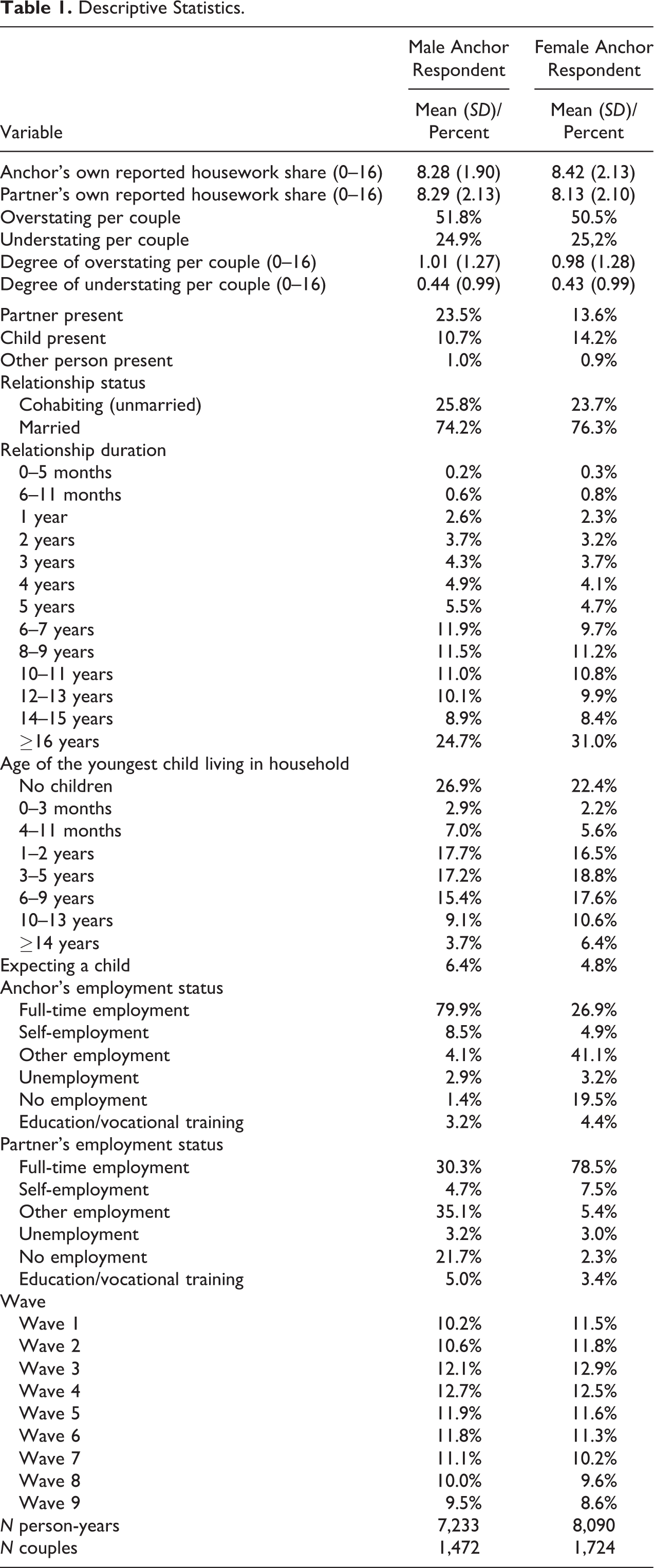
Third-party presence is reported by the interviewer at the end of the interview. The interviewer specifies whether other persons from the following categories were present during the interview: “spouse/partner,” “children,” “other family members,” or “other persons.” Our hypotheses concentrate on the effects of partner presence, but we control additionally for the presence of children and other persons. We add other family members to the category other persons due to the small number of cases in the former category.
All estimated models control for relationship status, relationship duration, age of the youngest child in the household, pregnancy, occupation status of both anchor respondent and his/her partner, and panel wave (see Table 1 for descriptive statistics). 7 These variables are assumed to affect both the partner’s probability of being present and the division of household tasks. As time-constant unobserved heterogeneity cannot bias fixed effects estimations, time-constant variables such as migration background do not need to be controlled for in these models.
Analysis
Fixed effects regression is applied (for details of fixed effects estimation see, e.g., Brüderl and Ludwig 2015; Wooldridge 2010). As fixed effects models are based on individual changes over time rather than comparing individuals whose partner is present during the interview with individuals whose partner is not present (as would be the cross-sectional approach), they are preferable over cross-sectional methods in order to avoid bias due to unobserved heterogeneity in time-constant characteristics. Our models thus capture differences by partner presence, implicitly accounting for all (observed and unobserved) time-constant factors in addition to controlled time-varying characteristics.
For the analysis, we assume both respondents’ and partners’ housework share indices to have metric scale level and apply linear fixed effects regression 8 accordingly for the analysis of these variables. For the dichotomous variable overstating per couple (and analogously for understating per couple), we apply the logistic model as is standard for this type of variable. As the fixed effects logit model uses only cases with change in the dependent variable for estimation, we estimated a linear probability model as a robustness check (available from the authors upon request). The direction and general significance of the effects of partner presence are identical to those in the fixed effects logit models.
Regarding the dependent variable “degree of overstating” (and “degree of understating,”), we apply linear fixed effects regression models. Due to the distribution of the variable, we also run fixed effects Poisson models as a robustness check. The estimated results (available on request) are very similar to the linear regression results and lead to the same conclusion regarding the hypotheses.
We estimate separate models for male and female anchor respondents. Cluster-robust standard errors 9 are shown for all models that allow for clustering (i.e., for linear models).
Results
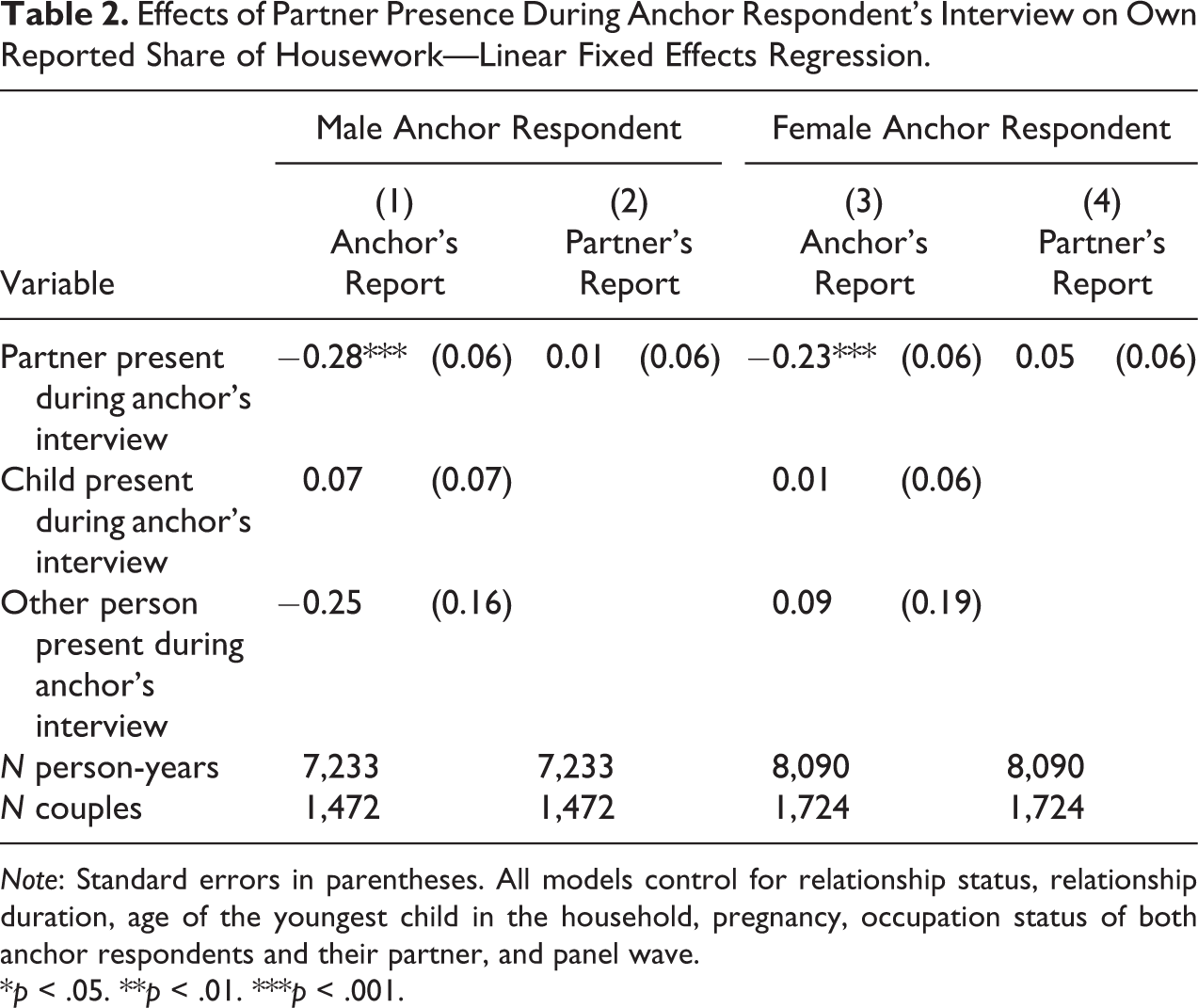
Models 1 and 3 in Table 2 show the effect of a partner’s presence on an anchor respondent’s own reported housework share (model 1: male anchor respondents; model 3: female anchor respondents). In accordance with Hypothesis 1, both male and female anchor respondents report lower housework shares in waves in which their partner is present during the interview than in waves without partner presence. Whether children or other third parties are present during the interview has, in contrast, no effect on the respondent’s report.
Effects of Partner Presence During Anchor Respondent’s Interview on Own Reported Share of Housework—Linear Fixed Effects Regression.
Note: Standard errors in parentheses. All models control for relationship status, relationship duration, age of the youngest child in the household, pregnancy, occupation status of both anchor respondents and their partner, and panel wave.
*p < .05. **p < .01. ***p < .001.
While the estimates are not at risk of bias by time-constant unobserved factors and several time-varying factors are accounted for, the effects may still be biased by unobserved time-varying factors. For example, factors such as health issues might increase the likelihood of partner presence and also have an impact on the division of household chores. Therefore, we run the same regression with partners’ own reported housework share as the dependent variable. If the effect observed in the anchor data resulted from an unobserved factor affecting both the division of housework and partner presence, the same effect (with reversed sign) should also be observable in the partner data. As models 2 and 4 in Table 2 show, there is, however, no effect of the partner’s presence during the anchor respondent’s interview on the partner’s own reported housework share. 10 This implies that partner presence is not associated with a real change in the division of housework but rather causes anchor respondents to modify their response behavior.
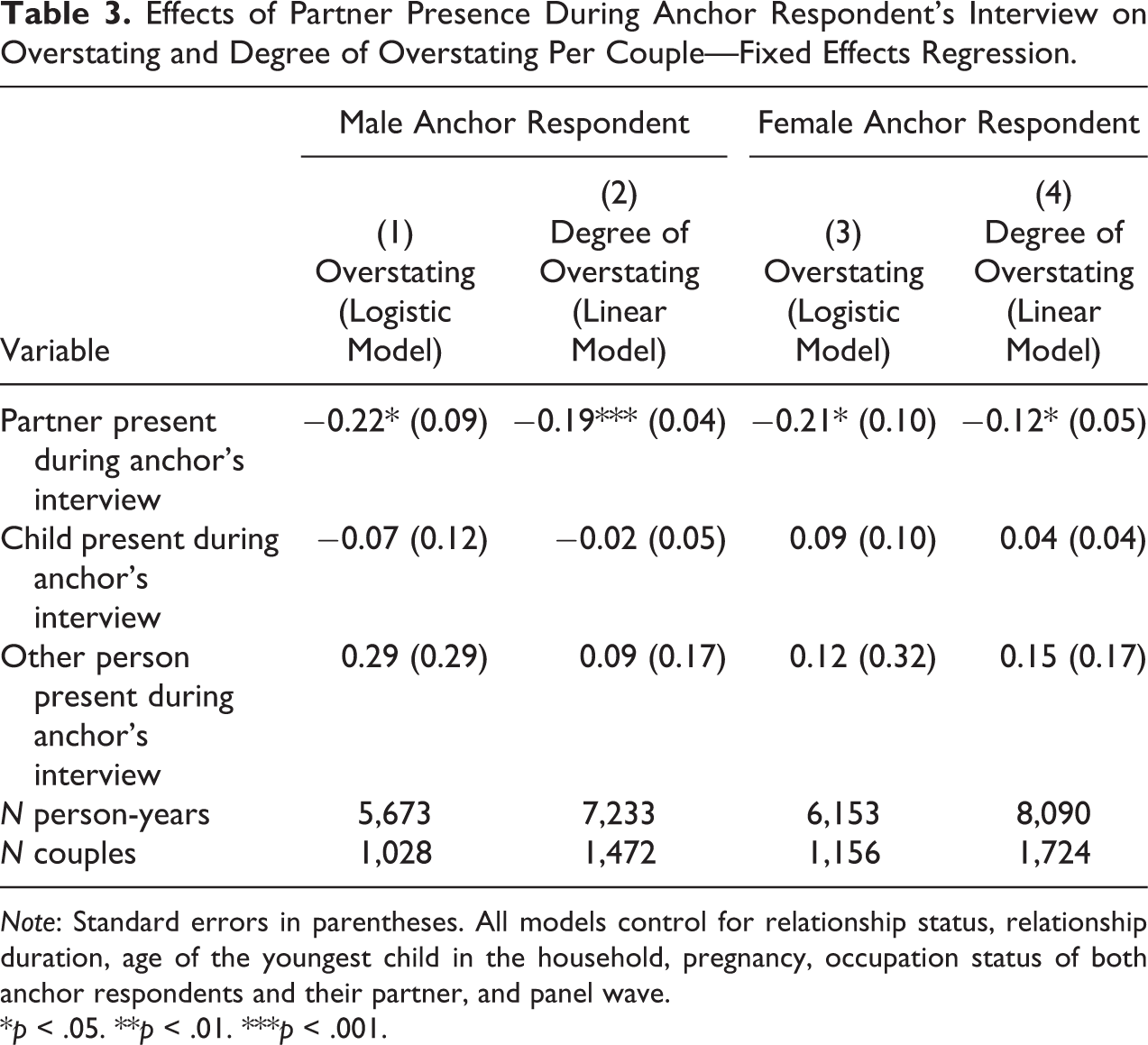
We now turn to the effect of partner presence on overstating per couple. Table 3 shows results for both dependent variables: “overstating per couple” and “degree of overstating.” The number of observations differs between the two dependent variables as the logistic model includes only couples with change in the dependent variable. Models 1 and 2 include couples with male anchor respondents, whereas models 3 and 4 include couples with female anchor respondents.
Effects of Partner Presence During Anchor Respondent’s Interview on Overstating and Degree of Overstating Per Couple—Fixed Effects Regression.
Note: Standard errors in parentheses. All models control for relationship status, relationship duration, age of the youngest child in the household, pregnancy, occupation status of both anchor respondents and their partner, and panel wave.
*p < .05. **p < .01. ***p < .001.
The probability of overstating per couple is smaller in interviews in which the partner is present during the anchor’s interview than in interviews without partner presence. We find this effect for both male (model 1) and female (model 3) anchors, which supports Hypothesis 2.
The alternative indicator for Hypothesis 2 (i.e., the degree of overstating) is reduced by partner presence as well: Couples overstate less if the partner is present as compared to interviews during which the partner is not present (Table 3, models 2 and 4). The presence of other persons than the partner neither significantly affects the likelihood of overstating per couple nor the degree of overstating.
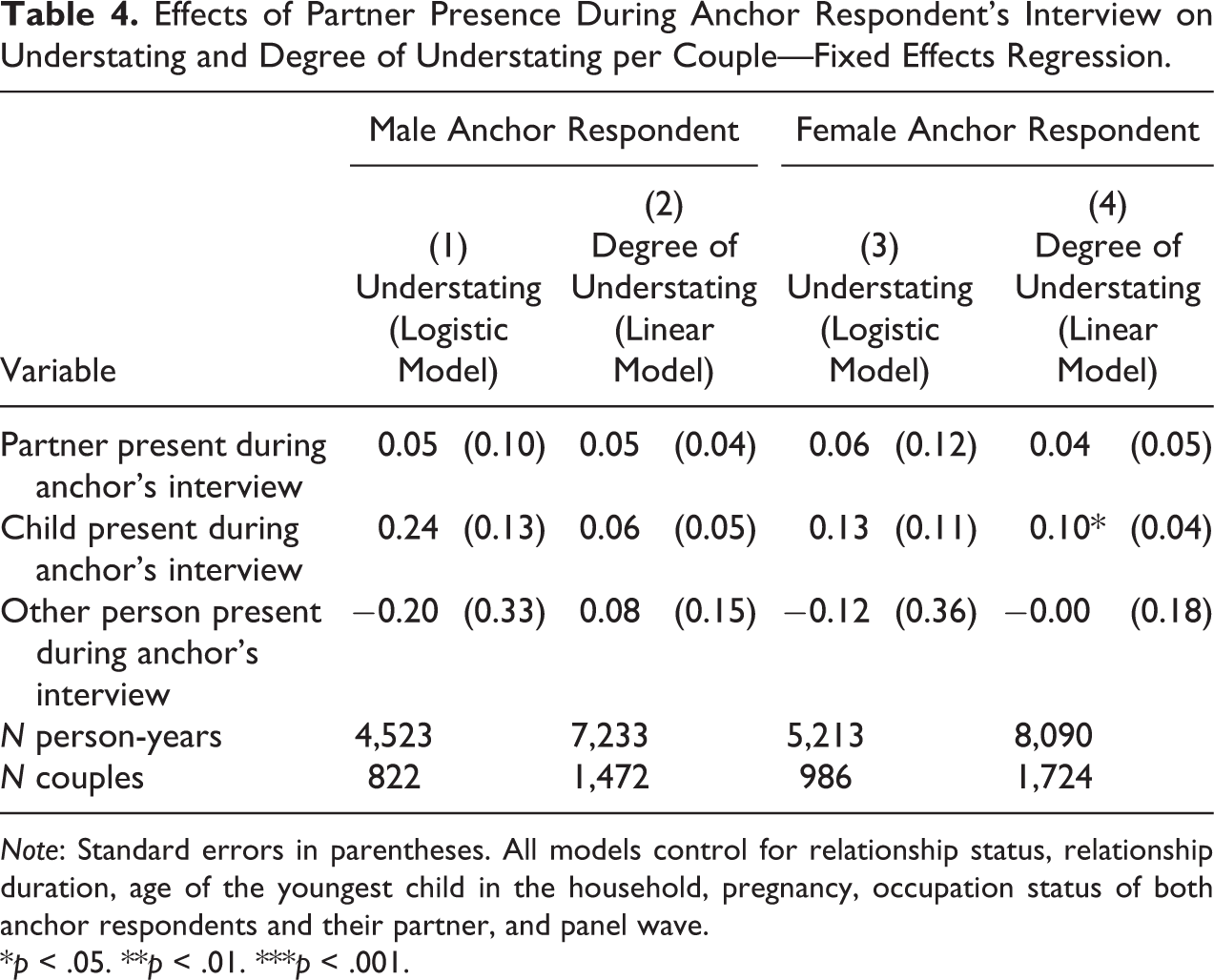
The same models were run with “understating per couple” as the dependent variable in order to test whether partner presence causes a bias in the opposite direction (Table 4). Neither the probability nor the degree of understating is significantly different in waves with and without partner presence.
Effects of Partner Presence During Anchor Respondent’s Interview on Understating and Degree of Understating per Couple—Fixed Effects Regression.
Note: Standard errors in parentheses. All models control for relationship status, relationship duration, age of the youngest child in the household, pregnancy, occupation status of both anchor respondents and their partner, and panel wave.
*p < .05. **p < .01. ***p < .001.
Discussion
The present study investigated effects of partner presence during face-to-face interviews on response behavior in the German Family Panel pairfam, focusing on items regarding the division of housework. The interesting feature of these items is that the answers do not only provide information about respondents’ share of household tasks but also about the share of their partner. The items are examples of questions that relate not only to the respondent but also to the bystander and are thus more likely to be affected by bystander presence.
Two potential mechanisms may be at work here: On the one hand, partner presence may reduce egocentric availability bias; in particular, respondents may ask their partner about housework shares to avoid genuine misperception. On the other hand, self-serving bias may be reduced as respondents may not want to answer dishonestly and downplay their partner’s contribution to housework while they are listening in on the interview. Both mechanisms imply that the respondent’s own reported share of housework should be smaller if their partner is present during the interview. This hypothesis was confirmed for male and female respondents. We also found that both the likelihood and the degree of overstating per couple are lower when the partner is present. As both mechanisms have the same implications, we cannot disentangle effects of reduced misperception and reduced self-serving bias. Hence, further research using a research design adapted to differentiating these mechanisms will be valuable.
In contrast to the presence of the respondent’s partner, the presence of children or other third parties during the interview did not affect respondents’ reported housework share or the probability or degree of overstating per couple. These results supports Aquilino’s (1997) notion that third-party effects depend on the type of third person involved.
Our analysis contributes to research on the effects of partner presence on responses to survey questions concerning the division on housework. By applying fixed effects regression models that only use intraindividual variation in partner presence between the waves for estimation, we can rule out an estimation bias due to unobserved time-constant heterogeneity as the cause of the partner presence effect. Our results confirm Tao’s (2013) results on the effect of partner presence on reported housework share as calculated from respondents’ reports on both partners’ time spent doing housework. On the other hand, these results challenge the conclusion of Zipp and Toth (2002) whose analyses imply that spousal presence has little effect on the first (or only) interview conducted in a household but does affect responses in the partner interview conducted shortly after the first respondent’s interview, as the partner (especially if female) tends to adapt to the answers of the first respondent if present during their partner’s interview. According to our results, in contrast, partner presence seems to have a direct effect on primary respondents’ answers, while we do not find an effect on partners’ responses.
In sum, we find robust effects of partner presence on respondents’ response behavior, which is notable regarding the crude measurement of partner presence in our study. The average pairfam interview duration was almost one hour, and interviewers only indicated whether the partner was present at any point during the interview or not present at all. We can therefore not be sure whether a partner was present (and listening) during the interview module covering the division of household labor. Thus, the effects of partner presence during an interview might prove to be more pronounced with a more detailed measure.
One limitation of our study should be noted: We rely on the assumption that the measure of the division of housework is metric, as we build additive indexes from the items, add up partners’ responses, and apply linear regression models to the resulting variables. This assumed measurement level is not evident from the fully verbalized 5-point answer scale of the housework items. To replicate our results and rule out the possibility that findings are biased due to a violation of this assumption, additional studies could use the actual number of hours spent on housework or alternative variables measuring the division of housework with a metric scale of measurement.
Based on the theoretical considerations and the fact that partner presence leads not only to a lower reported housework share of the respondent but also to a lower probability and degree of overstating per couple, we conclude from our results that in the case of items concerning the division of household labor, partner presence does not compromise data quality but may even improve it. The presence of a partner seems to reduce a response bias that might be caused by social desirability or availability bias. This conclusion, however, is only tentative, as the true division of housework between partners is not known. Nevertheless, these findings fit in with prior results, indicating that social desirability bias is reduced if the third party knows the true answer (Aquilino 1993, 1997).
Our conclusion that partner presence may improve data quality raises the question of which constellations of question type and third person produce positive effects of third-party presence on data quality. As bystander effects are of immediate practical relevance for survey design, further research is necessary in order to identify the mechanisms at work.
Footnotes
Acknowledgment
We would like to thank Josef Brüderl, Natalja Menold, Klaus Pforr, and Reinhard Schunk for their helpful advice regarding methodological issues. This paper uses data from the German Family Panel pairfam, coordinated by Josef Brüderl, Sonja Drobnič, Karsten Hank, Bernhard Nauck, Franz Neyer, and Sabine Walper. Pairfam is funded as long-term project by the German Research Foundation (DFG)
Declaration of Conflicting Interests
The author(s) declared no potential conflicts of interest with respect to the research, authorship, and/or publication of this article.
Funding
The author(s) disclosed receipt of the following financial support for the research, authorship, and/or publication of this article: Pairfam is funded as long-term project by the German Research Foundation (DFG).
