




Abstract
Underpinned by framing theory, this study examines how the mainstream news media constructs the war and tourism narratives. Using frame analysis and Qualitative Comparative Analysis (QCA), this paper systematically unpacks the intertwined relationship between war and tourism in constructing its narratives during the ongoing Russia-Ukraine war. Three main frames were identified, including “impact,” “response” and “status,” which encompass eight specific issues. Results of Qualitative Comparative Analysis show that there are three influential narrative patterns associated with negative emotional frames: dashed hopes in tourism destinations, debates over travel bans versus human rights principles, and pessimism and uncertainty in the tourism industry. This research advances tourism literature by providing a new interpretative and analytical lens to the intricate interplay between war and tourism, serving as an important reference for future frame analysis research in tourism.
Introduction
War and tourism share a complex relationship (Butler & Suntikul, 2013). When there is a war, particularly on a large scale, it presents significant destruction not only in the war zone but also has wide economic, social, and political implications beyond the war zone. Such extensive impacts invariably permeate the tourism system. For instance, war-induced political instability and economic upheaval can destroy once popular tourism destinations (Mansfeld, 1999), while battlefields and war heritage may emerge as new tourism attractions for the destinations where the war took place (Henderson, 2000; Williams et al., 2023). However, previous studies on war and tourism tend to follow a narrow behavioral conceptualization, treating war and tourism as a linear relationship. This literature is often packed with “impact” perspectives, failing to capture the dynamic and interconnected nature of war and tourism. Given that wars remain a reality in the 21st century (Butler & Suntikul, 2013; Tomej et al., 2023), the intricate interplay between war and tourism presents significant research opportunities. Mainstream news media, as a publicly accessible channel, play a pivotal role in conveying and interpreting war-related information. Mainstream news outlets, historically rooted in print media and now also encompassing online platforms (Holt et al., 2019), offer signposts or interpretative values, enabling the public to comprehend issues that might seem “distant” or perplexing, a role particularly crucial during times of crisis or turmoil (Solnet et al., 2022). As such, news media provides an ideal lens into the complex and interconnected relationship between war and tourism.
News media often use frames to construct narratives. Through framing, the media can “select some aspects of reality and make them more salient in a communicating text to promote a particular problem definition” (Entman, 1993). Scholars have largely identified news frames based on informational content (informational frames), which include issue-specific frames and generic frames (De Vreese, 2005). Recently, researchers have started to explore the emotional frames in news articles, as such frames influence how readers process news content, ultimately shaping their perspectives and attitudes (Kühne & Schemer, 2015). Extant tourism research has largely focused on informational frames in the news (Liu & Pennington-Gray, 2015; Wu et al., 2012) with little reference to the emotional frames. This, unfortunately, fails to recognize the fact that informational and emotional frames are intertwined in constructing news narratives. This integrative perspective in frame analysis is important as it offers a more comprehensive understanding of media narratives, highlighting the symbiotic relationship between factual reporting and emotional engagement. Integrating these frames allows for nuanced insights into how specific issues are presented and prioritized in the media. This integration can potentially bring to light certain aspects that might not typically garner the spotlight but play a significant role in shaping the discourse and influencing public opinion.
Therefore, this study aims to examine how mainstream news media construct narratives about war and tourism. Specifically, (a) how new media narratives on war and tourism are constructed through both informational and emotional frames? (b) what are the configurational relationships between informational frames and emotional frames? This research takes a critical approach that aligns with the “critical turn” in tourism scholarship (Ateljevic et al., 2007), seeking to provide a new, novel and alternative voice in tourism scholarship to understand and change tourism by locating the phenomenon in its wider political, economic, cultural and social contexts. A sequential research design including frame analysis and qualitative comparative analysis (QCA) was employed. The current ongoing war between Ukraine and Russia was chosen, as it is the most serious conflict in Europe since World War II, disrupting the global supply chains and the world economy including tourism (Balli et al., 2023; Pandey & Kumar, 2023). This study makes significant contributions to extant tourism literature by moving the current literature from the narrow behavioral conceptualization of the linear relationship between war and tourism to its interconnected relationship. It also provides a novel methodological approach for media narrative analysis in tourism by integrating informational and emotional frames to reveal media strategies.
Literature Review
Tourism, War and Media
The relationship between war and tourism is complex. Wars can have significant negative impacts on the tourism industry, leading to reduced revenues and tourist arrivals (Reddy et al., 2020; Selvanathan, 2007), disrupting tourism market (Balli et al., 2023; Corbet et al., 2023) and placing considerable operational pressure on tourism businesses (Tomej et al., 2023). They can even lead to once popular tourism destinations being permanently mired in violence and instability (Mansfeld, 1999). However, wars can also stimulate tourists to conflict-free areas, creating new growth opportunities for tourism in these places (Butler & Suntikul, 2013). For instance, Lebanon’s civil war shifted tourist flows to its neighboring countries (Harb, 2016), while Thailand benefited from the Vietnam War, transforming into an international tourism nexus (Ouyyanont, 2001). Moreover, war also affects the tourism by altering the perceptions and behaviors of the public (Josiassen et al., 2022; Y. Lee, 2006), residents (Farmaki, 2024) and tourism practitioners (Josiassen et al., 2023; Nicolau et al., 2024). Beyond the impacts of war on tourism, tourism literature has recognized the critical role tourism can play in economic recovery and cultural reconciliation in war zones. The dynamics, sites, and historical and social impacts of war can be attractive for tourists (Bigley et al., 2010; Henderson, 2000), providing destinations with the opportunity to offer war-related tourism, such as war tourism (Williams et al., 2023) and dark tourism sites (Miles, 2014). Particularly, in the aftermath of war, tourism is often considered by political entities as a new source of revenue for the country or region (Butler & Suntikul, 2017; Mirisaee & Ahmad, 2018). In addition, tourism can be used as a strategic tool to promote cooperation and trust-building between hostile and divided regions (Ioannides & Apostolopoulos, 1999; Pizam et al., 2002), promoting broader societal reconciliation.
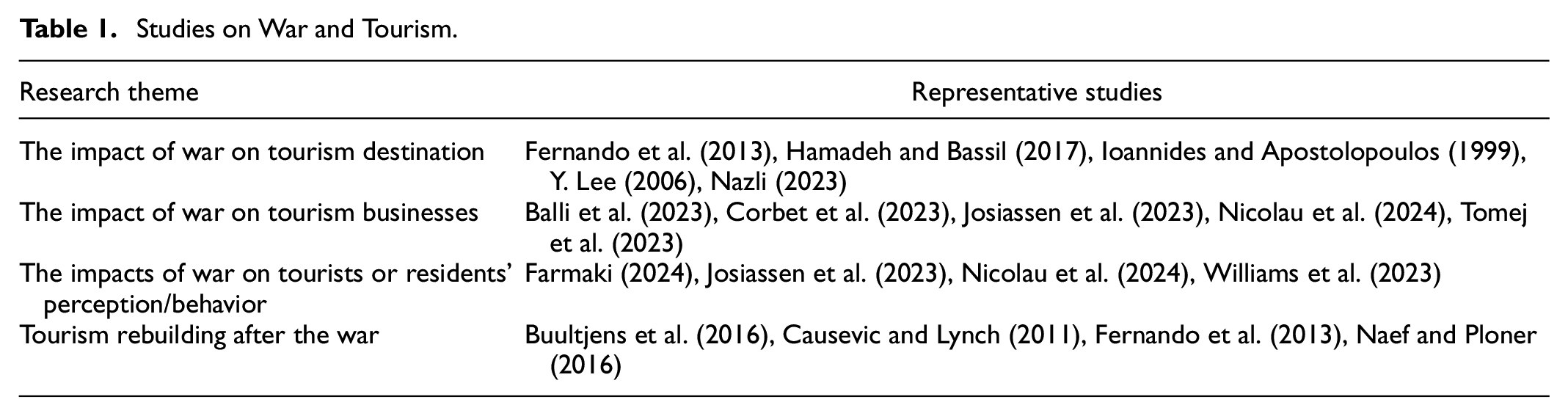
Despite the existence of a significant body of research (Table 1), previous studies on war and tourism tend to follow a narrow behavioral conceptualization, treating war and tourism as a linear relationship, often packed with “impact” perspectives. With little academic research giving scientific evidence and the growing number of industry articles expressing a variety of conflicting claims, the ongoing discourse confuses stakeholders about tourism’s future trajectory. This confusion implies uncertainty among tourism stakeholders about their strategies and actions, with a general belief that the challenges resulting from the war are immense and beyond the individuals’ capacity to cope with. Many might be hesitant to act for the future growth of tourism, or they might act irrationally and ineffectively. This increasing skepticism may weaken society’s capacity for dealing with various external challenges and promoting tourism recovery after the war.
Studies on War and Tourism.
Currently, the frequency of wars and armed conflicts (e.g., the most recent Israeli-Palestinian conflict), along with the globalized nature of tourism, presents pivotal opportunities to unpack the relationship between war and tourism, especially during the period of wars. However, the complexity of war is far beyond the general public’s knowledge, with the news media serving as the primary channel through which the public gains knowledge for these intricate events. News articles not only record events in real time but also reflect the perspectives of various stakeholders, creating a rich tapestry of the social and political climate surrounding the events (Schmidt et al., 2013). Furthermore, the news media portrays what is deemed significant (Severin & Tankard, 1997), guides readers on what to consider (Cohen, 2015) and sets the agenda (McCombs & Shaw, 1993). Recognizing this influence, tourism researchers have identified news media as a vital source of knowledge that can provide invaluable insights into emerging phenomena such as the sharing economy (Cheng, 2016) and the COVID-Pandemic (Chen et al., 2022). As such, a thorough analysis of media narratives allows for deep insights into the dynamic and interconnected relationships between war and tourism.
Framing Theory
Framing theory has a long tradition in sociology and psychology (Borah, 2011). The concept of frame in sociology was first introduced by Goffman (1974), who defined a frame as an “interpretive schema” that enables individuals to locate, perceive, recognize, and label events and information, helping to make sense of otherwise meaningless information. Later, framing theory was introduced into mass communication research and the concept of “news frame” emerged, which focuses on how news is constructed (Vliegenthart & van Zoonen, 2011). Gitlin (1980) considers frames to “enable journalists to process a large amount of information quickly and routinely [and to] package the information for efficient relay to their audiences”(Gitlin, 1980, p. 7). In other words, the frame serves as the central organizing idea in news, which can be used to organize facts and convey meaning (Gamson & Modigliani, 1987). It involves the selection and salience of some aspects of perceived reality, and has the ability to define problems, explain causes, communicate ethical evaluation, and/or indicate improvements or remedies (Entman, 1993). News frames are often used to explain and simplify complex phenomena for the public and can influence the audience’s evaluation and interpretation of events and issues (De Vreese, 2005). When specific events are reported through specific frames, the highlighted issues and focus not only guide the direction of public discourse but may also serve as a reference for future policymaking (Wu et al., 2012).
Frame analysis, a research approach for interpreting discourse (Pan & Kosicki, 1993), has been extensively used in studies on war news coverages (S. T. Lee & Maslog, 2005). Extant research indicates that the news media often interpret wars using different frames, reflecting their biases and positions. For instance, Fahmy (2010) compared the visual narratives of the 9/11 and Afghanistan wars in English and Arabic media, discovering that the former emphasized human suffering while the latter focused on material destruction and humanized portrayals of war victims. Dimitrova and Strömbäck (2005) discovered that the US media more frequently used a military conflict frame, while the Swedish media tended toward a responsibility and anti-war protest frame, presenting a more negative overall portrayal. The last decade has seen a growing number of tourism studies using frame analysis to unpack the complexity of tourism. One stream has primarily focused on the news frames of tourism-related hot issues or emerging phenomena, such as China’s holiday reform policy (Wu et al., 2012), the sharing economy (Leung et al., 2019) and over tourism (Pasquinelli & Trunfio, 2020). The second stream focuses on understanding how news media depict and shape the image of tourism destinations. For instance, Santos (2004) analyzed travel news in the US, identifying key frames representing Portugal’s tourism destination image; Hansen (2020) examined how Copenhagen tourism was framed in Danish newspapers from 2017 to 2019. These studies underscore that frame analysis is an efficacious research approach instrumental in interpreting how news media convey various topics and events related to tourism.
In frame analysis, the domain approach focuses on identifying frames from the informational content of news (informational frame), as this content reflects the central idea, background, and focus of the news articles. However, researchers have started to recognize there is an equal need to identify emotional frames of news. Drawing on the emotion-as-frame hypothesis (Nabi, 2003), expressed emotions can serve as frames as they can influence audience information processing and opinion formation (Kühne & Schemer, 2015). Emotional frames amplify the ability of news content in triggering audience’s cognitive responses through emotional responses (Lecheler & Matthes, 2012), subsequently influencing audiences’ perceptions and decisions. For instance, Kim and Cameron (2011) found that different emotional frames (anger vs. sadness) of news on a corporate crisis induced different emotions and further influenced how audiences processed information and evaluated the company. However, existing literature treats informational and emotional frames as separate, failing to capture how these two types of frames are combined to craft narratives. The combined approach is critical, as the combination of both frames not only enables readers to obtain relevant factual information but also elicits emotional responses to this information, thereby boosting readers’ overall comprehension of the news articles.
Research Design
The study employed a sequential research design, including frame analysis (Phase 1) and Qualitative Comparative Analysis (QCA) (Phase 2) to identify how the news media construct narratives of war and tourism. The frame analysis aims to identify the informational and emotional frames utilized in news articles, while the QCA seeks to reveal the configurational relationships between informational frames and emotional frames. It is important to note that, similar to any studies using news articles, what media present is socially constructed, reflecting the meaning and connotation placed on war and tourism by the society (Y. Lee, 2006). As naturally occurring data, news articles collectively offer a substantial collection of information to reveal the complexity of war-tourism relationship.
Data Collection
The keywords “tourism” and “war” and (“Russia” or “Ukraine”) were used to search for relevant news articles in the ProQuest Newsstand, which is widely considered “one of the most comprehensive databases of news content and provides access to news articles from more than 1,500 English newspapers worldwide” (Cheng & Edwards, 2019, p. 61). News articles from Feb 24th, 2022, the day Russian President Putin announced a “special military operation” against Ukraine, to Feb 24th, 2023, were collected. After excluding duplicate and irrelevant content, 242 articles were retained for further analysis. Key information includes the news source (newspaper), the publication date, and the entire content of the news article. Figure 1 shows the number of monthly news articles published over the period.
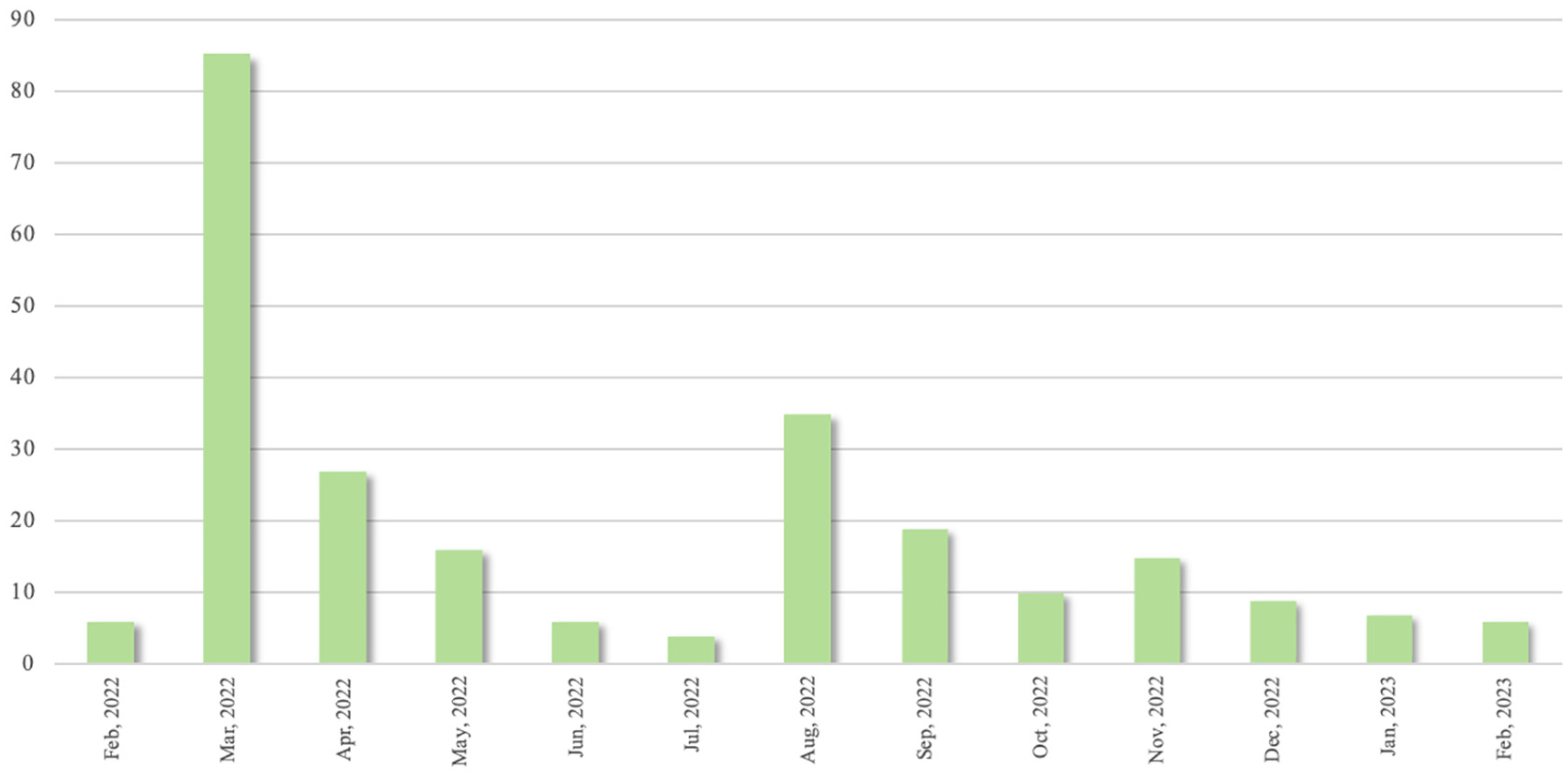
Number of news articles published by month.
Phase 1: Frame Analysis
In Phase 1, the frame analysis approach was used to unpack news discourses on the Russia-Ukraine war and tourism, involving the identification of news frames from both informational and emotional perspectives.
Frame analysis from an informational perspective distinguishes between issue-specific frames, which focus on in-depth interpretations of a particular topic or event, and generic frames, which seek universal patterns in news reporting (De Vreese, 2005; Santos et al., 2013). We focus on identifying specific issue frames, as this enables us to capture the media’s narrative emphasis on the Russia-Ukraine war in relation to tourism and shed light on the media’s portrayal of the relationship between the war and tourism.
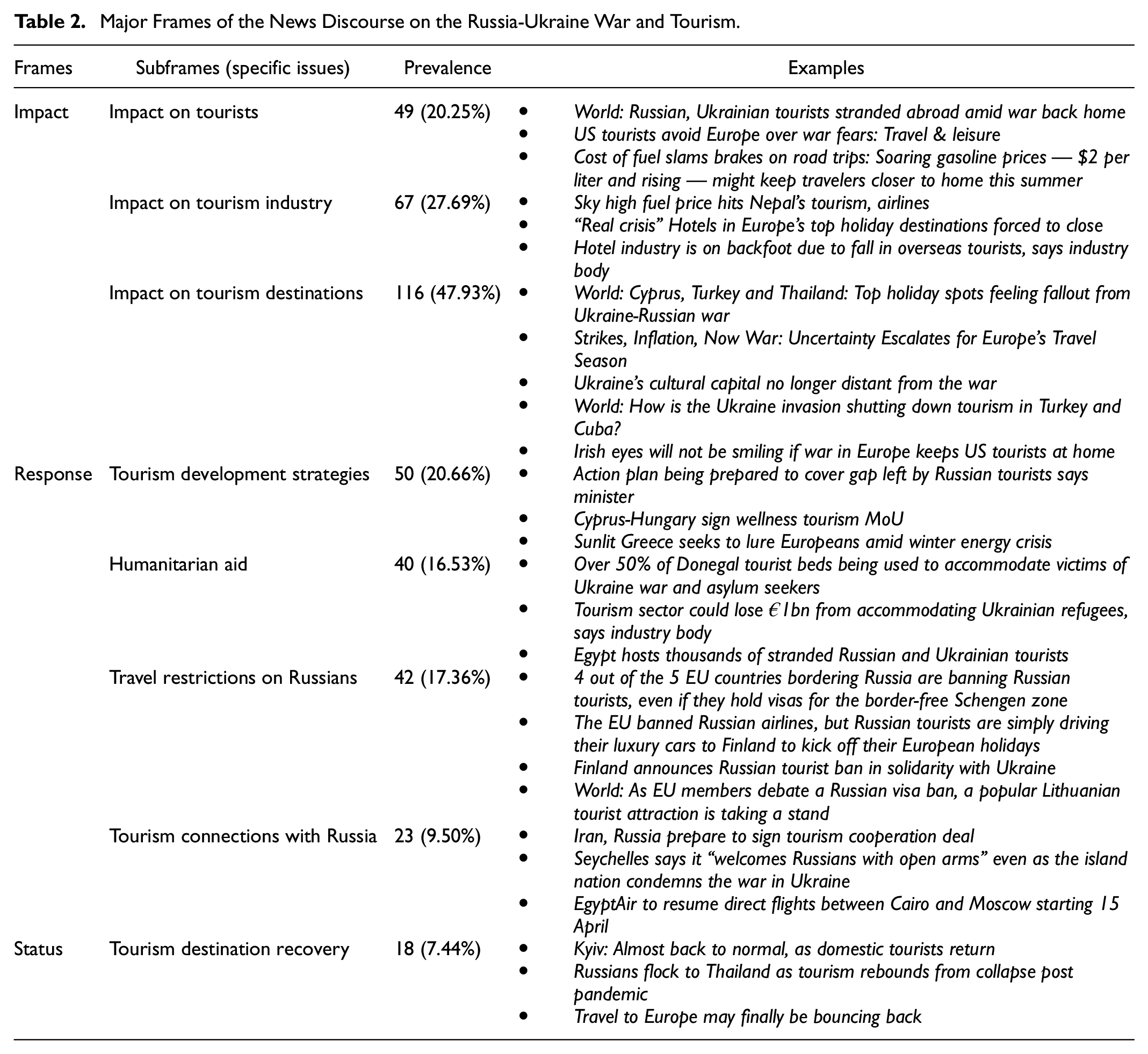
The frame system consists of lower-level subframes and higher-level main frames (Minsky, 1977). Subframes provide detailed information about specific issues, while main frames are more abstract and general in nature. An inductive analysis approach was utilized to derive subframes and main frames (Solnet et al., 2022). The overall analysis process comprises four steps. Firstly, researchers conducted initial coding of 30 randomly selected news articles. During the coding process, if a news article encompassed more than one main issue, all of them were encoded (Leung et al., 2019; Matthes, 2009). For example, an article about tourists stranding might also address assistance measures implemented by tourism stakeholders. The news articles were repeatedly read until no new issue categories were identified (Cheng et al., 2017). Next, researchers performed cross-checks on the coding results and engaged in comparison and discussions to address discrepancies and established a preliminary coding scheme. In the third step, using the preliminary list of frames, researchers independently coded all news articles. Finally, the researchers discussed variations in coding, finalizing three main frames and eight specific issue frames (Table 2).
Major Frames of the News Discourse on the Russia-Ukraine War and Tourism.
News frames identified from an emotional perspective are emotional frames, including specific emotions and sentiment polarity. Our focus is on emotional polarity due to its effectiveness in capturing “emotionality” (the presence or absence of sentiment) (Cho et al., 2003), serving as a standard method for assessing the “tone” of news coverage, and as a summarizing measure of specific emotional content (Soroka, 2006, 2012). Linguistic Inquiry and Word Count (LIWC) was utilized to identify emotional frames. LIWC is effective in identifying positive and negative emotional terms in the text, capturing its emotional expression (Brugman et al., 2023; Stevens et al., 2021). When the emotional tone score is high, the text often reflects a positive sentiment, whereas a score below 50 suggests a negative emotional tone.
Findings
Informational Frames (Specific Issue Frames)
Table 2 lists all frames, subframes (specific issues), and the prevalence of each in the news articles. The three main frames are Impact Frame, Response Fame, and Status Frame. Impact Frame comprises three specific issues: the impact of war on (1) tourists, (2) tourism industry, and (3) tourism destinations. Response Frame includes four specific issues: (1) tourism development strategies, (2) humanitarian aid, (3) travel restrictions on Russians, and (4) tourism connections with Russia. Status Frame encompasses one specific issue—tourism destination recovery.
Impact on Tourists
When reporting tourists, the news media framed three main categories (1) tourists from warring countries, specifically Russia and Ukraine; (2) highly security-sensitive tourists, such as those from the USA; and (3) potential tourists, explaining how they might be affected. For tourists from warring countries, this conflict has led to a significant number of Ukrainians becoming refugees, compelled to seek refuge in comparatively safer regions, while Russians face challenges in international travel due to war-related travel and economic sanctions. Many Ukrainian and Russian tourists are stranded at their destinations due to the war and associated sanctions, experiencing psychological distress. The impact of the Russia-Ukraine war on global tourists involves changes in travel conditions, psychological responses and altered travel preferences.
Regarding the travel conditions, during the initial stages of the war, aviation sanctions have resulted in inconvenience in international travel. With increased oil prices, options for tourism destinations have been limited due to the increase in travel expenses and geopolitical concerns. For the psychological responses, the general public has expressed concerns and anxieties about the safety of future travel. Many tourists have opted to adjust their travel plans, including canceling or altering their destinations. Public travel preferences have also shifted toward domestic travel, short-haul trips, and destinations perceived as relatively stable.
Impact on Tourism Industry
When reporting the tourism industry, the news media similarly framed three categories of subjects including (1) industry sectors, including the airline, accommodation and cruise industries; (2) specific tourism businesses, such as airports and hotels; and (3) practitioners, including operators and employees. The news media has provided a detailed account of the war’s impacts on the operations of tourism industry entities and their economic performance. Operationally, a myriad of challenges have emerged for tourism businesses due to war and war-induced factors, notably rising operational costs and forced changes or interruptions in tourism operations. The accommodation sector, in particular, grapples with strains from supply chain disruptions and shortages of capital. Tourism practitioners engaged in operations associated with Russia and Ukraine have encountered unemployment. Furthermore, the tourism performance metrics were severely affected with declines in tourist arrivals, booking volumes, investment losses, and reduced revenues. Tourism practitioners have expressed uncertainty and worries about the future of the tourism industry.
Impact on Tourism Destinations
For tourism destinations, three main categories were mentioned: warring countries, countries, and regions adjacent to war zones, and those with strong tourism links to warring countries. News coverage focused on the impact of the war on the tourism infrastructure and the performance of tourism destinations. Regarding infrastructure, the news articles emphasize the damage to Ukraine’s tourism resources and attractions, disruptions in some destinations’ air connectivity with Russia, and the strain on accommodation resources in some destinations that provide support to refugees and stranded tourists. The news articles raised concerns over the tourism performance including tourist arrivals, tourism revenues, the recovery rate from the impacts of COVID-19, and the potential to meet annual tourism economy targets.
The news media framed impacts on tourism performance as two effects: diminishing and diversion. The “diminishing effect” portrays the immediate adverse impact on tourism destinations at the war’s onset, marked by fewer tourists, lower revenues, slow recovery, and failing to achieve tourism economic targets. The “diversion effect” highlights the surge of Russian tourists to certain destinations amid the war, such as a significant rise in Russian tourists to Georgia and growth in Russia’s domestic tourism. The future of tourism destinations was portrayed from two viewpoints: one expressing concern over war-induced uncertainties, and the other optimistic about improved prospects with appropriate measures.
Tourism Development Strategies
This frame indicates a range of strategies, plans, suggestions and calls for action to mitigate the negative effects of war and adapt to war-induced changes. Six main strategies from the news articles emerged including market shift, air connectivity adjustment, targeted marketing, policy adjustment, service and cultural adaptation, and tourism project innovation.
Market shift aims to identify and grow new potential tourism resources. For instance, Russia is turning to domestic tourists, while Cyprus is shifting toward European tourists. Air connectivity adjustment includes increasing the number of flights and passengers based on market changes. For example, Cyprus Airways has expanded its list of destinations. Targeted marketing involves strengthening promotional and marketing activities for specific source markets. For instance, Greece is promoting a year-round tourism plan targeting tourists from cold winter regions where heating costs have risen due to increased oil prices resulting from the war. Policy adjustments revolve around tourism-related policies, including relaxing entry rules and adjusting financial policies. For example, Thailand, in response to the impact caused by Russia-Ukraine war, has eased its entry requirements. Service and cultural adaptation involves improving services according to the culture of the target source. For example, Russian authorities are working with Chinese officials to provide training to the Russian hospitality industry to better accommodate Chinese tourists. Tourism project innovation involves developing and promoting new tourism products or activities. For example, Goa (a destination reliant on Russian tourists) will increase domestic tourists through the development of conferences, weddings, and other events.
Humanitarian Aid
The news articles frame the responses of tourism stakeholders to the refugee crisis and the stranding of tourists (Russian and Ukrainian tourists) by introducing the actors who implemented the relief, the relief measures, and the impact of the relief. Key actors are the governments of popular tourism destinations for Russian and Ukrainian tourists, as well as the hospitality industry, travel agencies and their employees. There is also discussion on the contributions of volunteer tourists. The primary relief measures for stranded tourists include affordable or free accommodation, visa extension without charge, and assistance in returning home. For Ukrainian refugees, aid is centered on free accommodation, employment opportunities, material support, and cultural activities. However, the narrative in the news articles also frames humanitarian aid as a “pressure” or “challenge.” These frames underline the conflict that exists between humanitarian aid and tourism destination recovery. Accommodating a large number of refugees or stranded tourists could strain the resources of the tourism destination, leading to a loss of income for tourism businesses, potentially distorting the destination market, and causing inflation among other ripple effects. The government support was highlighted to balance between humanitarian aid and tourism development.
Travel Restrictions on Russians Versus Tourism Connections With Russia
Russia, which initiated the war, has drawn exceptional attention with two different reactions in countries. The first is the use of tourism as a political means to express dissatisfaction and protest against Russia. For example, European Union countries have implemented flight bans against Russia, decreased issuance, and suspended tourist visas, intensified scrutiny of tourist visa applications from Russian citizens, or prohibited entry of Russian citizens holding tourist visas. Public protests have erupted at sites popular with Russian tourists, showcasing public anger toward Russia’s action and opposition to the war. The second is leveraging the war to develop the tourism industry. For instance, Turkey has expanded Russia’s Mir payment system to attract more Russian visitors.
Emotional Frames
Results from LIWC indicate that 96% of the news articles featured a negative emotional tone. Naturally, war-related news articles include negative terms such as “war” and “conflict,” which does not necessarily indicate that the article has adopted a negative emotional frame. As such, the study only classified those articles as having a negative emotional frame where the occurrence of negative tone words surpassed that of positive ones, resulting in an emotional tone score below 20. This was the case for 56% of the sampled news articles.
Phase 2: Qualitative Comparative Analysis (QCA)
Given the complex interplay of frames typically found in news articles (Hansen, 2020), Qualitative Comparative Analysis (QCA) was employed to investigate the configurational relationships between informational and emotional frames in news articles about war and tourism. QCA, grounded in configuration theory, integrates interrelated variables into holistic configurations, facilitating an understanding of how these elements collectively influence outcomes (Fiss, 2011; Roig-Tierno et al., 2017). Unlike traditional sentiment analysis, which merely categorizes the emotional valence of content, QCA provides a nuanced exploration of the interplay between various factors, such as informational frames, and their synergistic construction of a comprehensive emotional narrative. This methodological approach allows for the unraveling of strategic framing practices that shape information to evoke specific emotional responses.
In the second phase, we utilized the same dataset as in Phase 1. The conditional variables are specific issue frames, which were binary coded: presence of a specific issue frame was denoted by 1, absence by 0. The outcome variable, emotional frame, was similarly coded, with 1 indicating the presence of a negative emotional frame. The eight conditional variables reflect the diversity of news content. While this diversity introduces complexity, it is essential for capturing the range of perspectives on war and tourism. In fact, QCA, is designed to manage such complexity by effectively revealing patterns within diversity by analyzing the interplay of conditions leading to particular outcomes (Navarro et al., 2016). It achieves simplification without losing nuance, using logical minimization to pinpoint essential condition combinations, while valuing the uniqueness of each case, thus providing deep insights into the data’s heterogeneous nature (Kan et al., 2016).
Considering the binary nature of both the conditional and outcome variables in our dataset, Crisp-Set Qualitative Comparative Analysis (csQCA) has been chosen. CsQCA is characterized by its conditional binary classification, assigning values of 1 for full membership or 0 for non-membership to each variable (Roig-Tierno et al., 2017).
In this study, fsqca4.1 was employed to test whether each condition (including its negation) serves as a necessary precondition for the presence of a negative emotional frame, as illustrated in Table 3. The results indicated that the consistency scores for all conditions, as well as their negations, is below the threshold of 0.9. Only the absence of “tourism connections with Russia” (denoted as “∼ tourism connections with Russia”) and the absence of “tourism destination recovery narratives” (denoted as “∼ tourism destinations recovery”) are necessary conditions for the manifestation of a negative emotional frame in news articles. This suggests that news articles framing the issues around “tourism connections with Russia” or “tourism destinations recovery” often refrain from employing a negative emotional perspective.
Analysis of Necessary Conditions for the Adoption of a Negative Emotional Frame.
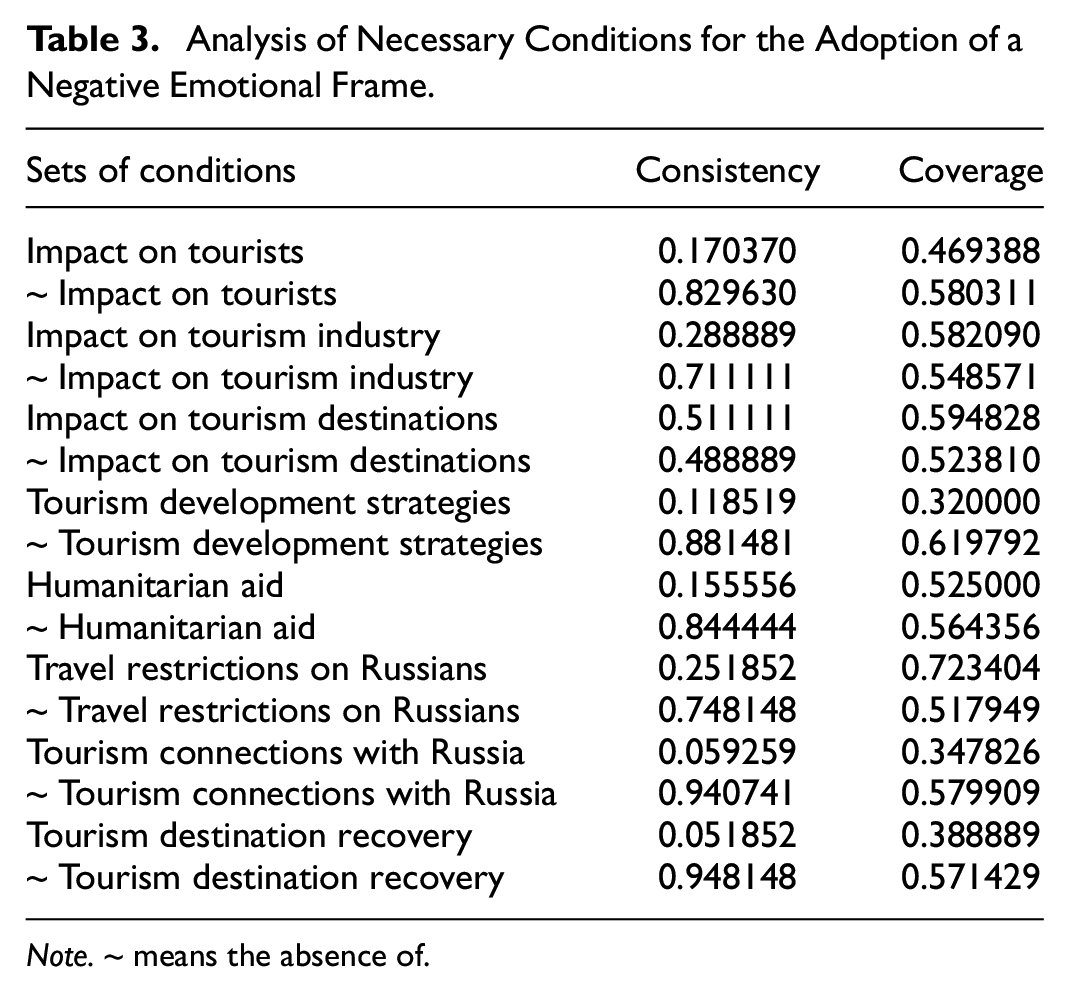
Note. ~ means the absence of.
Findings (Configuration)
In this study, the fsqca4.1 software was employed to identify the informational frame configurations within news articles that adopted a negative emotional frame, based on a truth table analysis. Following established research standards and considering the overall characteristics of the sample, a consistency level of 0.7 was set, with a case frequency threshold of 1. As depicted in Table 4, nine informational frame configurations (C1-C9) met this criterion, each having a consistency above the recommended threshold of 0.75 (Schneider & Wagemann, 2012). The overall solution’s consistency reached 0.794, indicating that the majority of news articles featuring these nine configurations are inclined to present a negative emotional frame. The coverage value, standing at 0.63, implies that these identified configurations represent approximately 63% of the articles with a negative emotional tone, thereby accounting for a significant portion of the negative framing observed in the dataset.
Specific Issue Frames Configurations for News Articles Using Negative Emotional Frame.
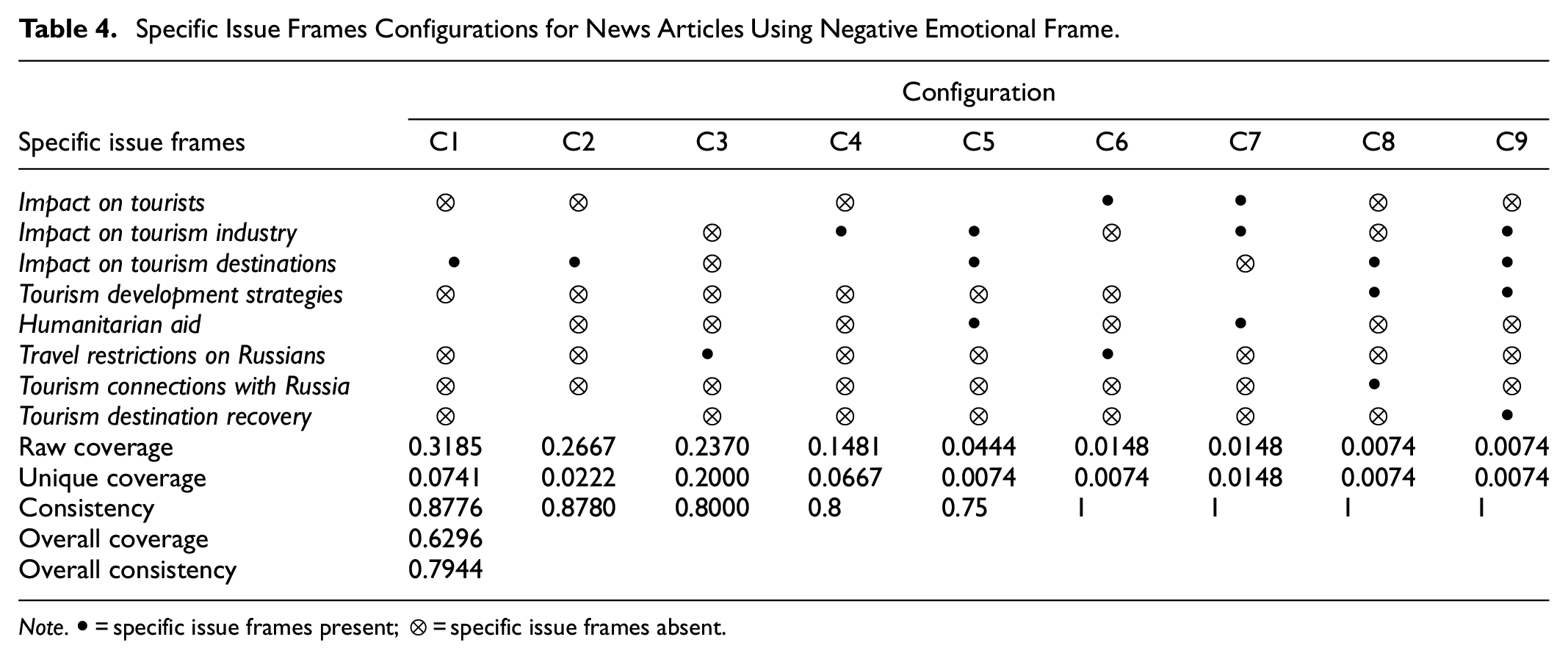
Note. •= specific issue frames present; ⊗ = specific issue frames absent.
Configurations 1, 2, 3, 4, and 5 are the main configurations for news articles presented a negative emotional frame (see Table 4). “Impact on tourism destinations” is the core condition in configuration 1, 2, and 5, “travel restrictions on Russians” is the core condition in configuration 3 and “impact on tourism industry” is the core condition in configuration 4 and 5. Configuration 1 reflects a combination of the presence of “impacts on tourism destinations” and the absence of “impact on tourists,” “tourism development strategies,” “travel restrictions on Russians,” “tourism connections with Russia” and “tourism destination recovery.” Configuration 2 combines the absence of “impacts on tourism destinations,” presence of “impact on tourists,” “tourism development strategies,” “humanitarian aid,” “travel restrictions on Russians” and “tourism connections with Russia.” For Configuration 3, the narrative is framed around the singular presence of “travel restrictions on Russians,” with no reference to “impacts on tourism destinations,” “impact on tourism industry,” “humanitarian aid,” “tourism development strategies,” “travel restrictions on Russians,” “tourism connections with Russia” and “tourism destination recovery.” Configuration 4 is characterized by the presence of “impact on tourism industry” and the absence of “impact on tourists,” “humanitarian aid,” “tourism development strategies,” “travel restrictions on Russians,” “tourism connections with Russia” and “tourism destination recovery.” Lastly, configuration 5 integrates the presence of “impacts on tourism destinations” with an absence of “impact on tourists,” “tourism development strategies,” “travel restrictions on Russians,” “tourism connections with Russia” and “tourism destination recovery.”
Configurations 6, 7, 8, and 9 are special configurations. Their high consistency indicates a strong association between these configurations and the manifestation of a negative emotional frame in news articles. However, the low coverage for these configurations indicate they are less prevalent, representing unique or less common instances of frame combinations within the analyzed news articles. This distinction underscores the configurations’ specificity, suggesting they are representing particular cases or contexts within the news discourse on war and tourism.
Discussion
Phase 1 reveals that the news narratives on the tourism and Russia-Ukraine war were structured around three main frames (“Impact,” “Response,” and “Status”) and eight specific issue frames: impact on tourists, impact on the tourism industry, impact on tourism destinations, tourism development strategies, humanitarian aid, travel restrictions on Russians, tourism connections with Russia, and tourism destination recovery.
Firstly, the extensive impact of the Russia-Ukraine war on global tourism was framed in an extremely detailed and focused manner. In the initial 2 months, media outlets predominantly reported the direct consequences of the war, which encompassed the predicaments faced by Russian and Ukrainian tourists; the impact of rising oil prices and sanctions on tourism entities; and the reduction of international tourism businesses in destinations reliant on the Russia and/or Ukraine and those surrounding the Russia and Ukraine, primarily in Europe, Asia, Africa, and the Middle East. Later, the media shifted its focus toward the potential long-term effects of the war, such as change in tourist demand and preferences, and the influx of refugees and Russians into specific tourism destinations.
While the news articles have narrated the multifaceted impacts of the war on tourism, the focus is largely on its impact on tourism destinations. Specifically, the war is generally framed as one of many external challenges faced by tourism destinations. Such external challenge, intertwined with other issues that destinations confront, such as pandemics and/or inflation, collectively shape the destinations’ tourism industry. This can be attributed to the close affiliations between mainstream news media and their respective locales (cities or countries) (Lacy et al., 2011), thereby enhancing their sense of responsibility toward local circumstances.
Secondly, media coverage provides a real-time, expansive view on the responses of tourism stakeholders to the war. Approximately 20.66% (50) of news articles reported that destinations’ governments are taking or plan to take various strategies to mitigate the negative impact of Russia-Ukraine war. Government policies are important in fostering the business confidence and environment needed for industry investment (Altinay & Bowen, 2006). Reporting these strategies can signal the resilience of the tourism destinations and increase the hope for the tourism destination’s future, which is critical to the public confidence and recovery of the tourism destination. However, news articles rarely cover the strategies taken by tourism businesses and organizations, instead conveying their calls and requests for government support. This reporting tendency can possibly result in public perception that the responsibility for tourism recovery primarily lies with the government, thereby potentially reducing the tourism businesses’ motivation or perceived need to take independent action.
Sixty-three (26.03%) news articles related to countries’ tourism related policies toward Russia, which underlines the role of tourism in international diplomacy and national foreign policy agendas. European Union countries utilize tourism to express their political stances, imposing varying travel restrictions on Russian citizens. In contrast, some countries, which prioritize the economic benefits of tourism, take a pragmatic approach, maintaining or re-establishing tourism connections with Russia. By framing countries’ attitudes toward Russia, economic and political trade-offs, and macro-strategic orientations, the media are shaping public perceptions of the relationship between international relations and tourism, guiding public opinion about the war. It can further influence individuals’ travel decisions, for example, people may choose travel destinations that aligns with their political beliefs.
The humanitarian aid provided by tourism stakeholders to refugees and stranded tourists was highlighted in 40 news articles (16.5%), which underscores the significant role and potential impact of tourism in promoting community solidarity and enhancing individual well-being (Cheng, 2023; Dolnicar & McCabe, 2022), challenging the simplistic view that tourism offers only economic benefits. However, with the ongoing refugee issue, the media has begun to emphasize the negative repercussions of refugee assistance on the tourism sector and the industry’s call for governments to strike a balance between aiding refugees and sustained tourism development.
Thirdly, several news articles have depicted how Ukrainian cities strive to maintain their tourism activities. This highlights that tourism businesses did not shut down entirely due to the conflict but gradually resumed operations after overcoming various challenges (Tomej et al., 2023). Additionally, the media captured certain tourism destinations progressively recovering from the war, even showing signs of growth in tourism. This growth has been interpreted as a result of the tourism promotion strategies adopted by the destinations and/or their openness to Russian tourists. These news articles add evidence to the adaptability and resilience of the tourism sector during the war (Dahles & Susilowati, 2015). Concurrently, as previously mentioned, such coverage not only reinforces a positive perception among the public toward specific tourism destinations but also instills confidence in the future tourism development.
Based on the findings of Phase 2, three influential patterns of narratives have been identified—Pattern 1: dashed hopes in tourism destinations; Pattern 2: debates over travel bans versus human rights principles, and Pattern 3: pessimism and uncertainty in the industry. We have excluded configurations 6, 7, 8, and 9 as the high consistency and low coverage of these configurations suggest that they represent only specific cases. Pattern 1 corresponds to Configuration 1, 2, and 5. This pattern focuses on “impact on tourism destinations” and excludes discussion of the issues of “tourism development strategies,” “travel restrictions on Russians,” “tourism connections with Russia” and “tourism destination recovery.” This narrative portrays the dramatic transition from prosperity and optimism to disillusionment in tourism destinations caused by war. It focuses on the tourists and revenue losses of tourism destinations, how this loss has shattered the region’s expectations of tourism economic recovery and prosperity, and how this shift affects the long-term planning of the local tourism economy. This narrative is multifaceted, primarily based on the immediate, destructive impact of war on the economic and social fabric of tourism destinations (Nazli, 2023) and the vulnerability of the tourism destinations’ heavy reliance on specific markets (Duro et al., 2021). This narrative is likely to prompt policymakers and the tourism professionals to re-assess their expectations and strategies for the post-war tourism market.
Pattern 2 corresponds to Configuration 3. The narrative in this pattern focused on “travel restrictions on Russians” and excluded the issues regarding “impact on tourism destinations,” “impact on tourism industry,” “tourism development strategies,” “humanitarian aid,” “tourism connections with Russia” and “tourism destination recovery.” This pattern highlights the intense debate on the restriction of Russian tourists by considering the ethical and legal principles behind these restrictions, particularly toward how to balance individuals’ human rights and the right to free movement while opposing the war. Travel restrictions, as a policy response to diplomatic or security challenges (Neumayer, 2010), often symbolize international political conflicts, inherently carrying a negative connotation. Such coverage reflects the pivotal role of news media in shaping the public agenda and guiding international political dialog (McCombs & Shaw, 1993), potentially directing how the international community handles relations with Russia, as well as encouraging public participation and scrutiny of foreign policy. Specifically, this narrative has the potential to shape the international perception of Russia and its citizens, as well as subsequent travel-related decisions and behaviors (Josiassen et al., 2023). Moreover, it is likely to spark discussion on the relationship between human rights and international obligations, particularly concerning the issue of freedom of travel.
Pattern 3, which corresponds to Configuration 4, centers on the discussion regarding “impact on tourism industry,” excluding issues such as “impact on tourists,” “tourism development strategies,” “humanitarian aid,” “travel restrictions on Russians,” “tourism connections with Russia,” and “tourism destination recovery.” The narrative provides an in-depth view of the impact on tourism industry at a micro level, focusing on how the sub-sector has been affected and the uncertainty and pessimism among businesses and practitioners. It not only captures the stark reality of economic losses but also discusses the future of tourism business and the need for policy support. This pattern’s narrative is linked to the tourism industry’s acute vulnerability to external conflicts. The unease felt by industry players is due to the direct result from the conflict and its flow-on effects, which include a drop in international tourism demand, inflation, supply chain disruptions, and financial pressure (Lim et al., 2022; Tomej et al., 2023). The narrative does not only mirror the sector’s present circumstances but also seeks to garner attention and empathy for those affected—especially individuals and communities reliant on tourism for their livelihoods. This sustained pessimistic narrative is likely to reduce the confidence of tourism industry practitioners and businesses.
Implications and Conclusion
This article employs a sequential research design that integrates frame analysis and Qualitative Comparative Analysis (QCA) to explore how mainstream news media construct narratives surrounding war and tourism. In Phase 1 (frame analysis), three main frames and eight specific issue frames were identified. It was found that 56% of news articles adopt a negative emotional frame. QCA further identified nine configurations of informational frames that form a negative emotional frame (comprising five main configurations and four special configurations). Building on these configurations, three influential narrative patterns have been revealed: Pattern 1: dashed hopes in tourism destinations; Pattern 2: debates over travel bans versus human rights principles, and Pattern 3: pessimism and uncertainty in the industry. These findings not only demonstrate how news media construct narratives through specific combinations of informational and emotional frames but also deepen our understanding of the complex interplay between war and tourism.
Theoretically, by unpacking the news representations of war and tourism, this research moves from the narrow behavioral conceptualization of the linear relationship between war and tourism to its interconnected relationship. This interconnectedness allowed for the interpretative entanglement of key views of war and tourism, such as stakeholders, causes and impacts that would not otherwise be possible through conventional empirical attitudes and behavioral focused studies. Most importantly, the interconnected perspectives overcome the limitations imposed by the dominance of “impact narrative” of war and tourism to pursue the multi-perspective imperative that prioritizes varied, inclusive and dynamic views. For example, as shown in our study, tourism businesses are not merely victims of the war but also resilient agents actively mitigating the war’s destructive impacts.
This study offers a novel perspective on the application of frame theory in tourism. Unlike previous tourism research that largely examined news frames from an informational perspective (Schweinsberg et al., 2017; Solnet et al., 2022), our study reveals how informational and emotional frames are intertwined in constructing the narratives of war and tourism. Specifically, this research not only identified specific issue (informational) frames by analyzing informational content in media narratives, but also identified nine configurations of informational frames that correspond with the use of negative emotional frames in news articles. This integrative approach enables the discovery of specific issues emphasized by the media that might not be at the center of public attention. This analytical approach not only deepens our understanding of media narratives in war and tourism, but also serves as a reference for future frame analysis research in tourism using both informational and emotional frames.
The findings of this study provide important insights for tourism stakeholders. As shown in the study, there are three influential narratives: dashed hopes in tourism destinations, debates over travel bans versus human rights principles, and pessimism and uncertainty in the industry. Such narratives can amplify the perceptions of vulnerability in tourism destinations and tourism industry, potentially undermining the confidence of tourism practitioners and raising concerns among investors and potential tourists. This erosion of confidence can exacerbate economic pressures on tourism, leading to an increasingly cautious or even pessimistic outlook for the future. In addition, media narratives mainly frame the impacts and reactions at the destination level and tourism subsector level, with little coverage concerning the enterprise level, particularly small and medium tourism enterprises. The overlook may marginalize the role and needs of small and medium tourism enterprises, leading to government recovery policies that are more favorable to large tour operators and developers at the expense of small operators in the informal sector (Buultjens et al., 2016). As such, different voices that can be raised in the media would be helpful to ensure that the public receives more balanced information, thereby bolstering public confidence in tourism destinations and the tourism industry.
This study is not without limitations. First, the influence of media professionals in producing these narratives on war and tourism need to be acknowledged, as media professionals’ selection of news stories is a result of their perceived significance and appeal (Koopmans, 2004). This tendentious selection process is indicative of social construction. Second, future research that includes social media would offer additional insights into public’s responses beyond traditional media coverage (Cheng, 2024). Third, cross-country or regional comparative studies would offer additional insights into the heterogeneity of media coverage in different geographical and cultural contexts.
Footnotes
Declaration of Conflicting Interests
The author(s) declared no potential conflicts of interest with respect to the research, authorship, and/or publication of this article.
Funding
The author(s) received no financial support for the research, authorship, and/or publication of this article.
