




Abstract
Evaluating whether sustainability indicator schemes contribute to better sustainable destination management has proven challenging. We adopt a systems thinking approach to shed light on the elusive impacts of sustainable tourism indicator schemes. We conduct online participatory workshops with 19 experts in sustainable tourism monitoring, to produce a causal loop diagram that illustrates how destination systems behave when indicator schemes are implemented. The results show that until now, these schemes have been expected to follow utopian, evidence-based, policy pathways to change, but we now understand that this linear-thinking approach fails to recognize the complex interplay of factors that occur during implementation. We find that indicator schemes can spark a rich, yet unappreciated, series of conceptual, instrumental, and structural dynamics. We conclude that the hidden power of these schemes lies in their ability to foster dialog, stimulate learning, incentivize network development, challenge stakeholder worldviews, and steer systems change toward sustainable destination management.
Keywords
Introduction
Consistent with the popular quote by Peter Drucker that “if you can’t measure it, you can’t manage it,” some scholars have suggested that a lack of tourism data is the reason for poor sustainable destination management (McLoughlin & Hanrahan, 2023). Sustainable tourism indicator schemes are defined as instruments that can help tourism practitioners operationalize the concept of sustainability, assisting them to define their objectives, choose between alternatives, and make evidence-based policy choices (Miller & Twining-Ward, 2005). As a result, in the last decades a plethora of destination sustainable tourism indicator schemes have been introduced across the world (Niavis et al., 2019). Yet, despite this experience, we still know little about whether, or how, the schemes contribute to better sustainable destination management (Font et al., 2023; Gasparini & Mariotti, 2023). We argue that this lack of evidence stems, in part, from looking in the wrong places to establish the impacts of sustainable tourism indicator schemes.
Tourism research to date has focused mainly on the technicalities of sustainable tourism indicator development and validation (Asmelash & Kumar, 2019; Mendola & Volo, 2017; Torres-Delgado et al., 2023). The research has failed to acknowledge that both tourism policymaking (Geyer & Rihani, 2010) and sustainability change (Abson et al., 2017) are extremely complex processes, influenced by multiple factors. Some non-tourism scholars have considered the role of sustainability indicators in influencing policy, but few case studies have shown evidence of positive impacts (Bauler, 2012; Bell & Morse, 2011; Hezri, 2004; Rinne et al., 2012). We argue that this lack of evidence, and the gaps in our knowledge, exist because sustainability indicators have only been evaluated, to our knowledge, using linear and mechanistic, evidence-based policy approaches (Louth, 2011). As such, sustainable tourism indicators are perceived as positivist instruments that are assumed to lead directly to policy change toward enhanced sustainability. However, taking a linear, rational approach as the main pathway to change ignores the many complexities of social interaction that affect any policy instrument or intervention (Beritelli, 2011). Thus, a more nuanced understanding of how sustainable tourism indicator schemes work, which considers a broader range of dynamics, can help shed light of the hidden power of these schemes in influencing policy and sustainability change.
The aim of this study is to explore the mechanisms activated by sustainable tourism indicator schemes toward sustainable destination management. We do this by using a systems thinking approach, which is a framework of analysis used to understand the behaviors that arise from the interaction of a system’s components over time (Arnold & Wade, 2015). Following this approach, we produce a Causal Loop Diagram to capture the system behavior resulting from implementing sustainable tourism indicator schemes in destinations. We base our analysis on a series of online workshops with 19 experts in the design and implementation of sustainable tourism indicator schemes across Europe. Our analysis shows that these schemes can be both precursors to instrumental change and, in the long term, a source of system change.
Literature Review
The Role of Sustainable Tourism Indicator Schemes in Enabling Sustainable Destination Development
Sustainability indicators can be defined as “the collection of specific, measurable characteristics of society that address social, economic and environmental quality” (Reed et al., 2006, p. 406). They can help to conceptualize current and future problems by capturing changes in time and space, and, in so doing, can assist policymakers to define their objectives, assess alternatives, and make policy choices (Lehtonen, 2017; Turnpenny et al., 2015). Interest in sustainable tourism indicators began, arguably, in 1996 when the World Tourism Organization published its first set of indicators and urged local and national governments to assess and monitor progress in sustainable tourism development (World Tourism Organisation, 1996). Since then, significant progress has been made, with numerous scholars contributing to both the theory and practice (Ivars-Baidal et al., 2023; Miller & Twining-Ward, 2005; Rasoolimanesh et al., 2023; Tanguay et al., 2010; Torres-Delgado & Palomeque, 2014).
Porter (1995) argues that the use of quantification and measurements in business and government is widely encouraged to compensate for a lack of expertise and trust in the arguments being made. In the late 1990s, this encouragement resulted in sustainability programs, typified by the collection of data on sustainability and a belief that sustainability could be measured. Porter (1995), p. 19) also said that the process of measurement strives toward a “…language of descriptionalism” in which striving for objectivity allows for a value-neutral presentation of information and supports a desire not to offend or to offer a subjective opinion. Over time, acceptance of the notion of data-driven decision-making led to a belief that sustainability data in general, and indicators in particular, could provide clear-cut answers for policymakers (Miller & Torres-Delgado, 2023). Hence, the challenge became to measure sustainability accurately rather than question the contexts in which policies were made and the data employed (Bertocchi et al., 2023; Blancas et al., 2010; Blázquez-Salom et al., 2023; Li et al., 2018; Mendola & Volo, 2017; Miller & Twining-Ward, 2005; Schianetz & Kavanagh, 2008).
Research has continued to pursue improved ways of measuring sustainability and has created systems specifically for measuring sustainability in tourism. However, critical questions have been asked about the efficacy of these systems. We might think of these questions as a search for understanding the instrumental role of sustainable tourism indicators, and it has proven to be a difficult search (Bauler, 2012; Bell & Morse, 2011; Font et al., 2023; Gasparini & Mariotti, 2023; Hezri, 2004; Rinne et al., 2012). On the surface, the research findings over the last 20 years lead us to conclude that sustainable tourism indicator schemes have minimal impact on driving policy and sustainability change. Yet, the instrumental role of sustainable tourism indicators reflects the principles of evidence-based policy, in that the evidence produced by the indicators has a linear and rational function in the policymaking process: indicators are collected, problems are identified, solutions are conceived, policy is changed, and sustainability is improved. This understanding of the policy process dates back to one of the first policy theorists (Lasswell, 1956), but it has been overtaken by the findings of later policy scientists, who increasingly found that the approach was not sufficient to explain the complex relationship between evidence and policymaking (Cairney, 2016; Parkhurst, 2017). Nevertheless, the linear approach is still widely used to evaluate the impacts of sustainable tourism indicator schemes (Font et al., 2023; Gasparini & Mariotti, 2023), despite the fact that it runs the risk of setting unrealistic expectations, with the consequence that sustainable tourism indicator schemes are deemed to fail as policy interventions (Pinfield, 1996).
To move beyond a search for instrumental impact, we can posit that indicators also have a conceptual role, which is understood as the ability to foster enlightenment and shape stakeholder conceptual models by influencing stakeholder values and ways of looking at the world (Bauler, 2012; Miller & Twining-Ward, 2005; Rinne et al., 2012). This conceptual role emerges because indicator schemes bring together stakeholders from different backgrounds to discuss topics that were previously examined separately (Rinne et al., 2012). Sometimes, the conceptual role is also referred to as a “process-related role” because it is the result of all the activities involved in indicator construction and implementation, in which the stakeholders maintain a dialog and create a shared understanding of the sustainability issues (Bauler, 2012).
The conceptual role of indicator schemes usually does not lead to any direct action in policy, but instead has a more indirect and subtle impact than the instrumental role (Sebastien et al., 2010). For this reason, the conceptual role is more difficult to detect (Bell & Morse, 2011; Rinne et al., 2012) and its fruits may only be visible in the long term (Rosenström, 2009). The authors are not aware of research that has previously focused on identifying the mechanisms involved in the conceptual role of sustainable tourism indicator schemes and how these dynamics may contribute to policy and sustainability change. In particular, the literature has not considered whether, or how, such mechanisms could lead to even more radical changes, that could alter the status quo by transforming the function or structure of a specific system (Foster-Fishman et al., 2007).
We regard this potential process of deeper, radical, and systemic change as the structural role of sustainable tourism indicator schemes. The structural role is apparent in paradigm shifts in how tourism is governed (Meadows, 2008); these shifts are increasingly demanded to replace capitalist governance approaches related to tourism growth (Dwyer, 2018; Higham et al., 2022). The structural role of sustainable tourism indicator schemes requires a radical change in people’s worldviews, and in the organizational structures that support the tourism system operating according to the growth paradigm (Foster-Fishman et al., 2007). According to Hall (2011), the manifesting of the structural role would be a third-order change, as it occurs when a certain intervention leads to a shift in policy beliefs. Therefore, by acknowledging that sustainable tourism indicator schemes initiate mechanisms that challenge stakeholders’ mental models, we are interested in exploring whether these schemes can enable a gradual process of long-term change. This long-term change, or paradigm shift, would start with a first-order change (where stakeholder knowledge of sustainability is broadened), evolve with a second-order change (where micro-adjustments in policy are made), and conclude with a third-order change (where a fundamental system restructuring is achieved) (Hall, 2011).
To explore whether this gradual process of change exists, research needs to extend beyond the linear models seen in previous studies. Policy scholars are moving toward relational and systems thinking approaches, with the former focusing on studying the interactions between people who produce and use evidence (Beritelli, 2011; Head, 2008; Lejano, 2021) and the latter, building on the former approach, focusing on understanding the overall Interrelationships between system components (Ansell & Geyer, 2016; Best & Holmes, 2010; Sanderson, 2009). We argue it is through systems thinking that we can advance knowledge on whether, and how, sustainable tourism indicator schemes facilitate policy and sustainability change (Gallopin, 2018; Miller & Twining-Ward, 2005; Schianetz & Kavanagh, 2008).
A Systems Thinking Approach
Systems thinking is defined as a holistic framework of analysis that focuses on understanding the behavior arising from the interaction of a system’s components over time (Arnold & Wade, 2015). Systems thinking originates from systems theory and focuses on the study of systems, where a system is defined as a configuration of interdependent parts connected through a web of relationships, which together form a whole greater than the sum of the parts (Holland, 1999; Meadows, 2008). This framework of analysis has been widely used in various disciplines (Mingers & White, 2010) and has proved particularly useful in tackling sustainability issues, such as in transformational sustainability research to guide the transition toward a regenerative economy (Abson et al., 2017).
Systems thinking requires us to consider wholes rather than parts. In contrast, linear thinking focuses on understanding the specific individual parts of a system, and is characterized by the delivery of solutions based on linear “cause and effect” analysis. As shown in Figure 1, in linear thinking, the relationship between a complex intervention and its outcome is seen as predictable, unidirectional, and sequential (Foster-Fishman et al., 2007). Systems scholars consider the linear thinking approach to be inadequate when studying the effects of complex interventions as it neglects the nonlinear dynamics and feedback that characterize complex systems (Baggio, 2008; Suno Wu et al., 2021). As shown in Figure 2, a systems thinking approach allows us to study complex interventions as part of a web of interdependent parts (Foster-Fishman et al., 2007). While the application of systems thinking to tourism has recently increased, its use remains limited (Sedarati et al., 2019). The few contributors that have adopted the approach have done so, either, to study the impact of current tourism management practices on destination sustainability (Mai & Smith, 2015; Woodside, 2009), or to address issues such as the effects of climate change on tourism destinations (Dawson et al., 2007; Loehr & Becken, 2023).

Linear thinking perception of change.
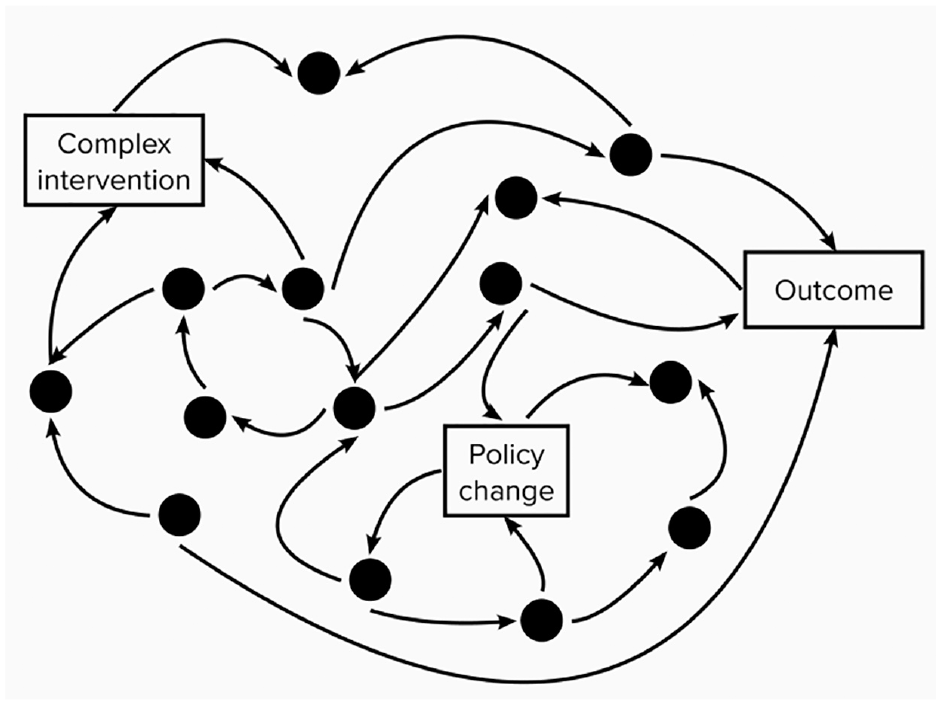
Systems thinking perception of change.
In summary, acknowledging the complexity in the policy making process frees us to research the multiple, non-linear ways in which data can inform destination sustainability efforts. Adopting a systems thinking approach allows us to identify the hidden impacts of sustainable tourism indicator schemes on destinations, and debunk the negative perceptions created around sustainable tourism indicator schemes by simplistic, linear-thinking models of change. In future, we will need more nuanced methodologies if we are to look beyond the instrumental role of data in the form of indicators. Such methodologies will require us to consider longer timespans and more complex stakeholder relationships. Doing so will afford us the opportunity not to dismiss sustainability indicators for failing to deliver immediate positive impact, but to consider how the impacts of the three roles (instrumental, structural, and conceptual) combine to mutually reinforce one another, if enough time and attention is given to the process.
Methodology
Data Collection
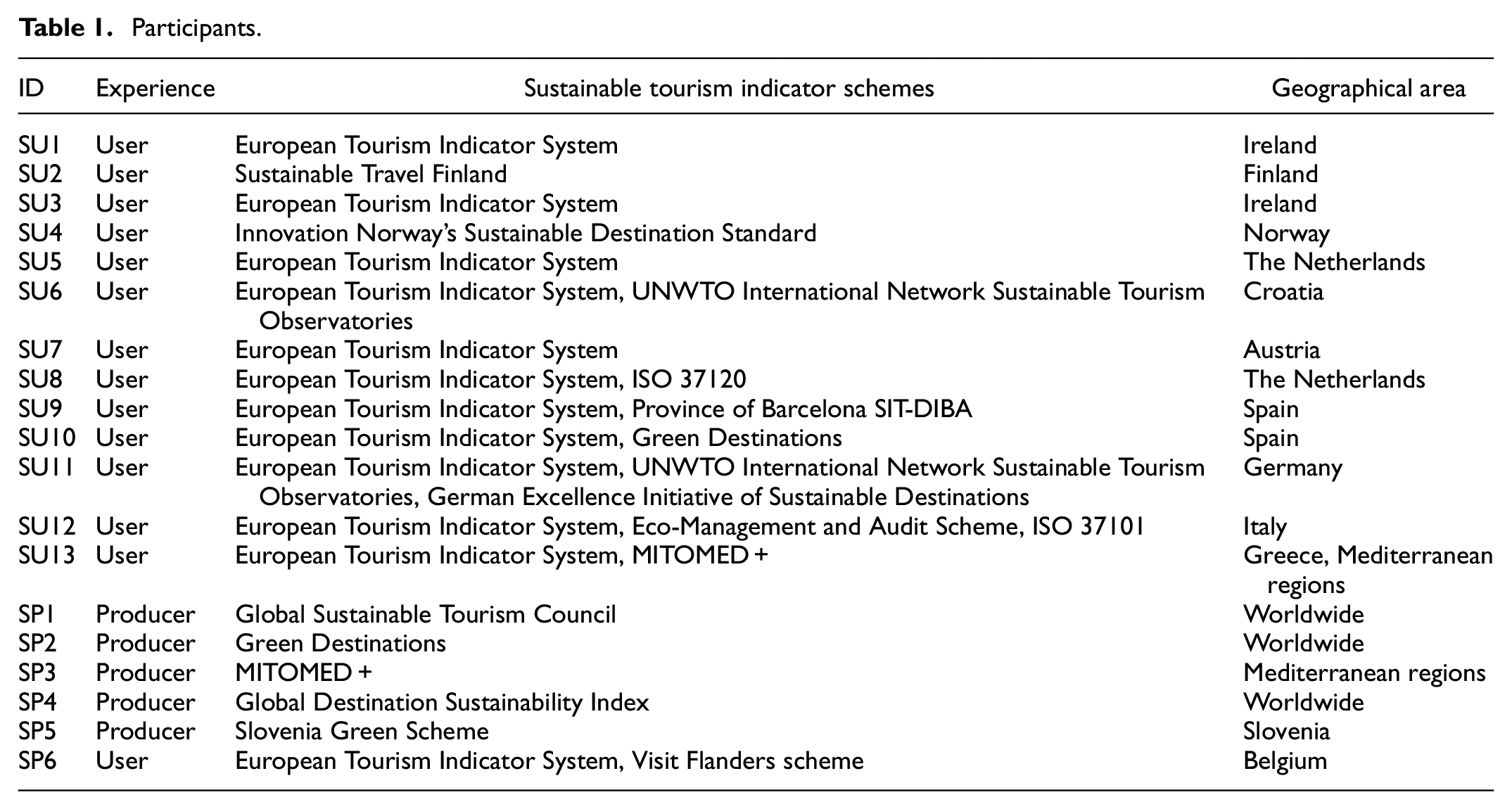
In this study, online workshops were chosen as the data collection method. Workshops are considered the most appropriate method for group brainstorming and problem solving among participants who share a common agenda (Orngreen & Levinsen, 2017). Two series of online workshops were conducted with senior experts in sustainable tourism indicator schemes. Participants shared the common interest of identifying ways in which sustainable tourism indicator schemes can become more impactful in enabling better sustainable destination management. Study participants were identified based on their experience in designing and/or implementing sustainable tourism indicator schemes in destinations; also, as being representatives of a variety of European geographical areas. Of the 32 senior experts contacted, 19 kindly agreed to participate; 6 had experience in designing sustainable tourism indicator schemes and 13 in implementing these schemes (see Table 1). A comparison of the schemes under analysis is provided as additional material in the Supplemental Appendix.
Participants.
The two workshops were designed and conducted using MURAL (Tippin et al., 2018), an online interactive whiteboard that has been shown to enhance participation and engagement across participants (Shamsuddin et al., 2021). As shown in Figure 3, each workshop was conducted in three phases; each phase consisted of pre-work and an online session (Sessions 1 and 2, each with a duration of 120 min, and Session 3, of 90 min), which were conducted over the course of 1 week. In line with a key feature of workshops as a research method (Orngreen & Levinsen, 2017), each session was designed to achieve a specific aim, with Sessions 2 and 3 building on the findings of the earlier session(s). In Session 1, the experts discussed the positive and negative mechanisms that result from implementing sustainable tourism indicator schemes; in Session 2, they brainstormed ways in which sustainable tourism indicator schemes could become more impactful; in Session 3, they discussed the key outputs from the previous two sessions with a view to reaching consensus on the outputs of Session 2.
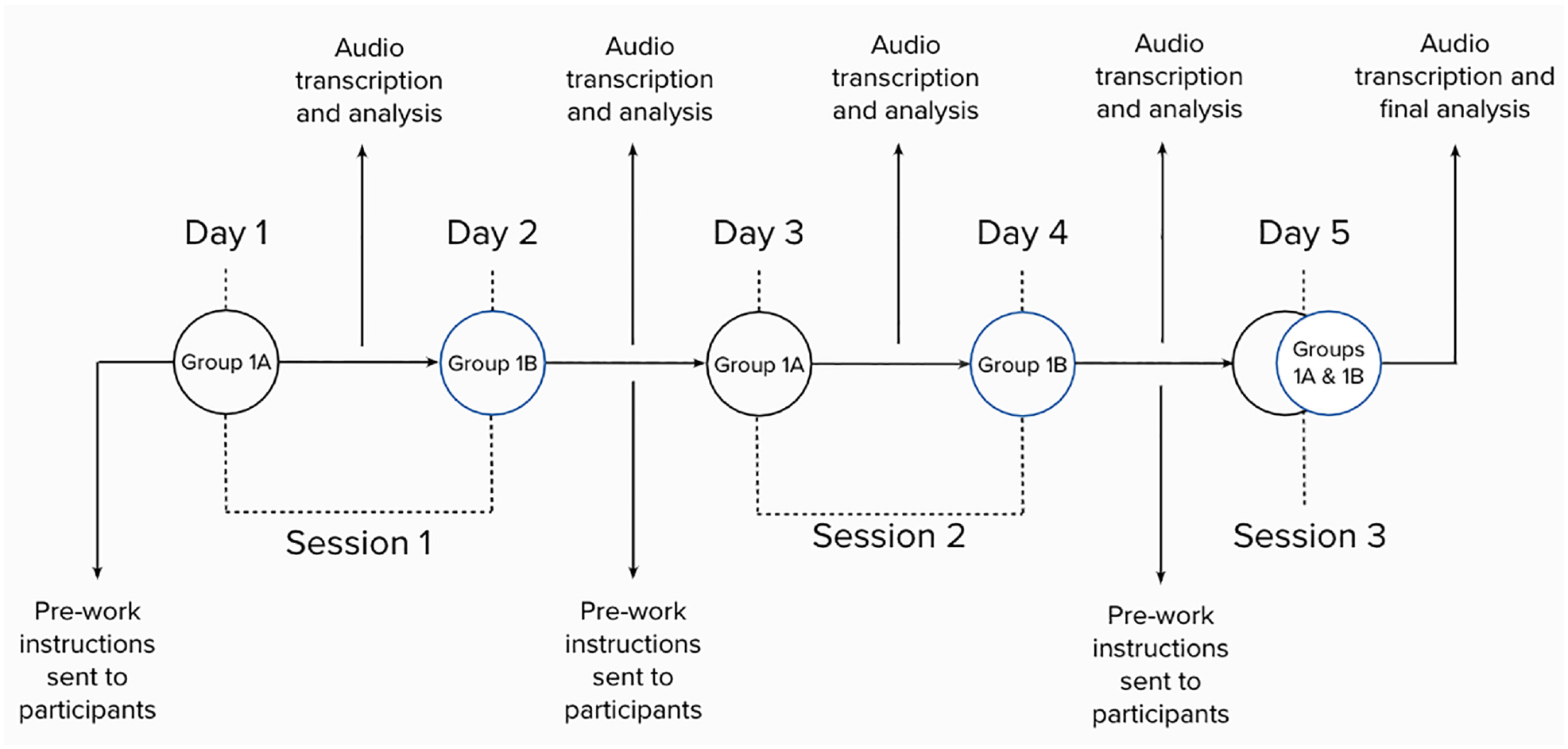
Workshop structure.
Asynchronous activities (the pre-work) were used to ensure participants’ full preparation, enabling immediate and in-depth engagement during the online sessions (Tippin et al., 2018). To this end, the pre-work aimed to familiarize the participants with the online platforms and to encourage them to reflect on their experience with sustainable tourism indicator schemes. The pre-work instructions, sent out 2 weeks before the start of Session 1, comprised a 30-min recorded video by the lead author providing background information about the problem under analysis and explaining how to use the online platforms; along with a link to the MURAL whiteboard containing Session 1 discussion questions. Participants were invited to insert virtual sticky notes and images on the whiteboard before the start of the session, to describe their experiences in relation to the questions being asked. This pre-work activity of revealing, and preparing answers to, the questions in advance was repeated for Sessions 2 and 3.
According to Orngreen and Levinsen (2017), to ensure active engagement and constant attention, it is important to keep participant group sizes small. Therefore, for sessions 1 and 2, which required in-depth thinking and active discussion, we chose to have groups that did not exceed five participants. In contrast, for Session 3, which only required participants to review the outputs of the previous sessions with the aim of reaching agreement, we brought together the full group of nine or ten people. The two workshops were conducted over 2 weeks in Spring 2020, with 19 hr of synchronous time in total. The 19 hr of synchronous activity, together with the written contributions from the asynchronous activities (pre-work), provided a critical mass of evidence, which resulted in data redundancy between the two workshops and ensured data saturation (Saunders et al., 2018).
Each online session was recorded with the explicit permission of the participants, and was transcribed verbatim by the first author soon after each session. The transcripts of each session were used to frame, and adjust, the formats of the subsequent sessions. By conducting the sessions online, any budget concerns or pandemic-related travel constraints were eliminated, allowing participants to easily and flexibly engage in the workshop activities from home (Shamsuddin et al., 2021). The online format also provided flexibility to the lead researcher, who had more time to reflect and adapt the format based on emerging findings than would have been possible in a series of face-to-face workshops.
Data Analysis
The textual data resulting from the transcripts were analyzed to develop a Causal Loop Diagram, following the steps of: (1) open coding, (2) axial coding, (3) causality coding, and (4) causality mapping included in Crabolu et al. (2023). Causal Loop Diagrams are the basis for a complexity-informed method used to model complex systems (Sterman, 2000); they highlight the core components, their relationships, and how they influence each other and form feedback loops. These feedback loops are the elements that create the complex dynamics of a system. Causal Loop Diagrams allow us to understand how a system behaves when complex interventions such as sustainable tourism indicator schemes are introduced in the system. For this reason, Causal Loop Diagrams are often used in policy analysis as they provide a rich understanding of the impacts and issues around specific policy interventions (Suno Wu et al., 2021). In this study, we built a Causal Loop Diagram using Kumu (http://kumu.io), a system map website for developing interactive causal maps. The causal relationships between factors are indicated with arrows showing either: (1) the symbol ‘+’ and colored in blue in the case of a positive causal link (as factor A increases, so does factor B); or (2) they symbol “-” and colored in red for a negative causal link (as factor A increases, factor B decreases). In addition, if the relationship is affected by an important time lag, a “//” is included in the middle of the arrow.
Special attention was taken in the development of the Causal Loop Diagram to ensure its trustworthiness (Decrop, 2004). Following the criteria used in Causal Loop Diagram development, a compromise was made between four factors: system map simplicity (the extent to which the model can be understood and communicated); formality (the level of specificity of all components within the model); generality (how many settings the model can be applied to); and validity (the extent to which the model represents the reality being observed) (Edmonds & Gershenson, 2015). A compromise between simplicity and formality was achieved during the map drawing process, in which the research team undertook numerous iterations to combine factors with similar meaning and remove or redraw overlapping arrows. A compromise in generality was achieved, at the outset, through the sampling criteria used to ensure that the study participants were representative of a variety of destinations and sustainable tourism indicator schemes across Europe. The use of informant triangulation ensured that a broad range of participants were included across the two workshops, and their views compared (Decrop, 2004). Finally, validity was ensured through a thorough auditing process where the rest of the research team reviewed the MURAL outputs of the two workshops and the analytical procedure followed by the lead researcher in the Causal Loop Diagram development. The various changes in the workshop design and map development were documented to provide access to the way data were interpreted.
A final note on the trustworthiness of this study addresses the researchers’ positionality through a reflexivity approach (Berger, 2015). The principal researcher, who conducted both phases of data collection and analysis, was a PhD scholar at the time. To minimize her personal bias gained through the literature, she took an observant, facilitator role during both workshops. The other two authors specialize in sustainable tourism research and have extensive experience in the topic of sustainability monitoring as consultants. Given their positions, the latter two decided not to participate in the online workshops to avoid any kind of engagement with study participants.
Results
The Causal Loop Diagram (illustrated in Figure 4) provides an overview of how a system behaves when sustainable tourism indicator schemes are implemented at a destination. We find that sustainable tourism indicator schemes help create sustainability change at the conceptual, instrumental, and structural levels. While the conceptual and instrumental roles have already been identified in the past literature on sustainability indicators, the structural role that emerges from the empirical evidence of our study is novel. The sequence of these three roles is deliberate and responds to the data. Initially, sustainable tourism indicator schemes create mechanisms that bring stakeholders together in a dialog to learn about their sustainability issues, through which they gradually challenge their worldviews (conceptual role). Only when the conceptual role is continuously maintained over time, does the instrumental role come into play, with a higher number of sustainability indicators being used in policymaking. Finally, in the long term, sustainable tourism indicator schemes create mechanisms in which a structural role is possible; this occurs when sustainable tourism indicator schemes are institutionalized, which contributes to changing the infrastructure of how tourism is governed.
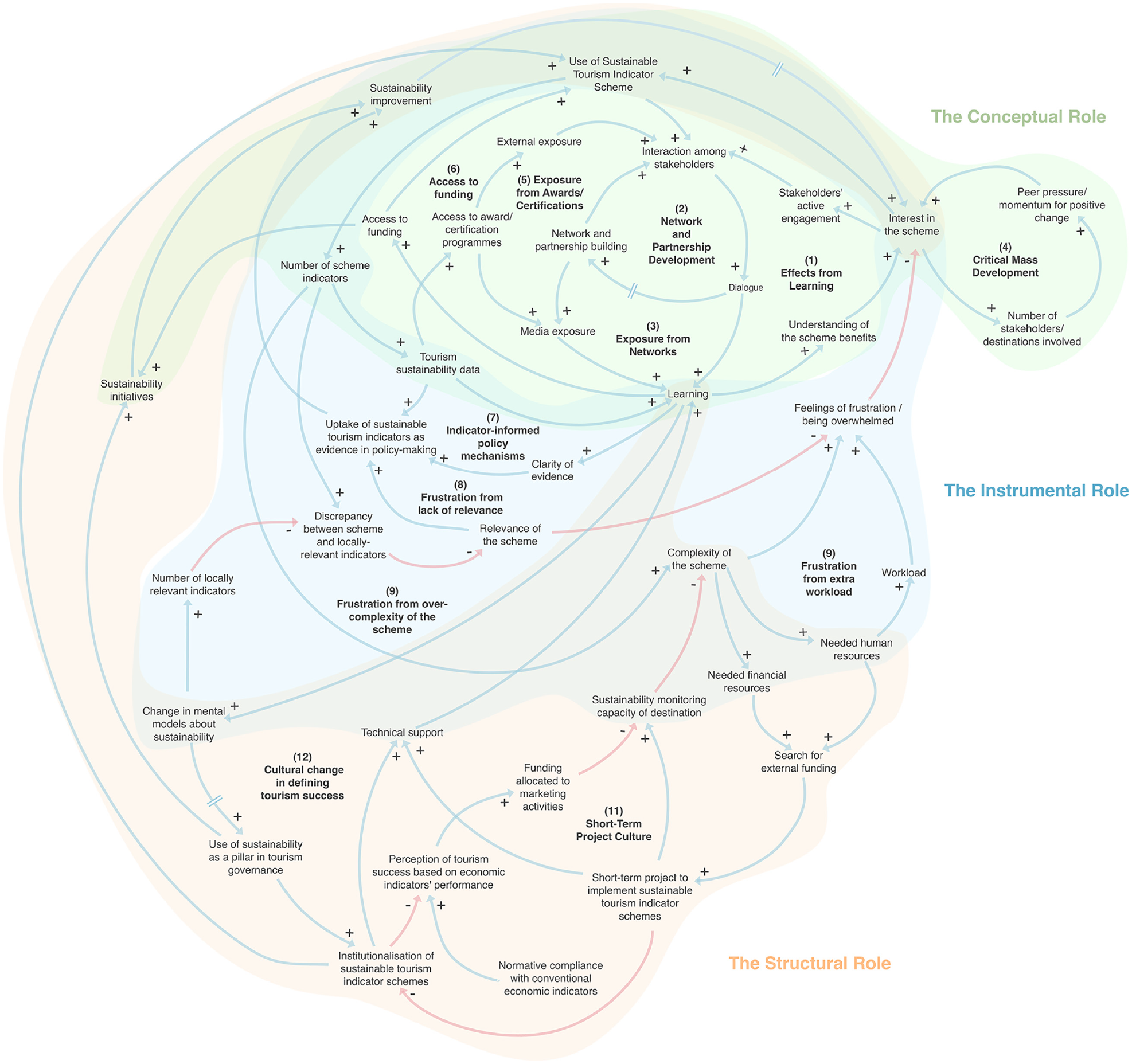
Causal Loop Diagram of the complex mechanisms that arise when implementing sustainable tourism indicator schemes at system level.
The Causal Loop Diagram map is explored according to the three roles identified. Feedback loops are numbered from (1) to (13) to provide a sequential order to the thematic storyline being created. Accordingly, the Causal Loop Diagram is read from the “use of sustainable tourism indicator scheme” factor and explored by following the factors that it influences and the feedback loops that it creates.
The Conceptual Role Dynamics of Sustainable Tourism Indicator Schemes
The section of the Causal Loop Diagram map shown in Figure 5 illustrates the conceptual role dynamics that arise from implementing sustainable tourism indicator schemes. Thanks to the use of sustainable tourism indicator scheme, stakeholders meet (interaction among stakeholders); either because of the implementation steps included in the scheme (e.g., the European Tourism Indicator System includes a step that requires the destination to form a stakeholder working group) or because the destination is required to fulfill criteria to qualify for a certification program. The “interaction among stakeholders” process ignites a positive dialog that increases their learning about sustainability concepts, the complexities of tourism management, and the interrelatedness between tourism and other sectors. For example, SP2, from Green Destinations, states: “We have some criteria that require destinations to have certain types of collaborations among stakeholders within the destination. So, thanks to these criteria, destination stakeholders initiate a process of collaboration that was not present before. Initially, they are a bit reluctant and say, ‘Why should I, from the tourism department, contact this other guy?’ But then, once they start, they realize it’s really an eye-opener and start seeing the benefits.” Therefore, the stakeholders’understanding of the scheme benefits increases, with a positive effect on their interest in the scheme and on their active engagement in the implementation process. Ultimately, Loop 1 (Effects from Learning) closes with the active engagement factor feeding back to the interaction among stakeholders.
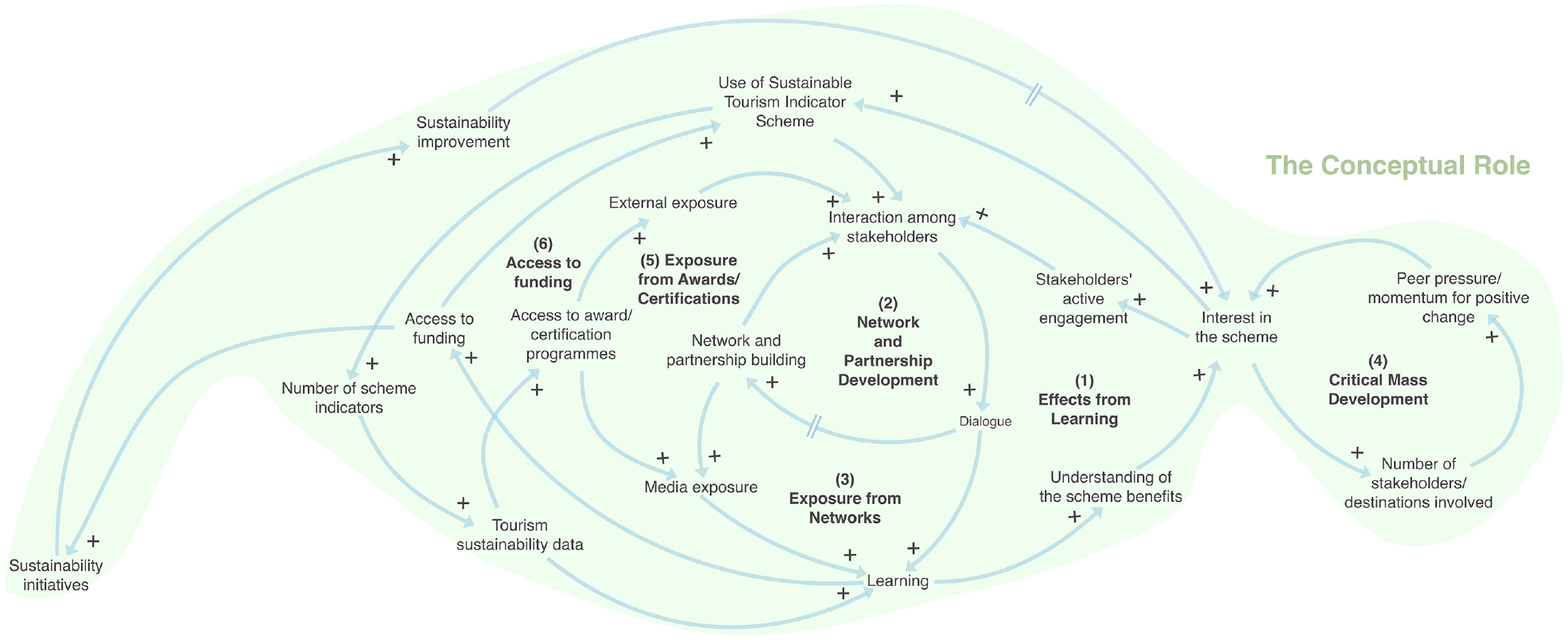
Section of the Causal Loop Diagram with the conceptual role dynamics of sustainable tourism indicator schemes.
Dialogue also leads to the forming of new networks (network and partnership building), which facilitate greater interaction among stakeholders, thus creating another loop (Loop 2—Network and Partnership Development). This dynamic is the result of either: (a) executing the steps or fulfilling criteria included in the scheme; or (b) from the natural process of bonding between stakeholders that results from the dynamics in Loop 1. In the former case, the forming of networks is immediate, while in the latter it only occurs after a longer period. This difference explains the delay in the causal relationship between dialogue and the network and partnership-building factors. In line with case (a) above, SP4 explained how their scheme in Norway included a step to create a sustainable destination partnership in which different tourism stakeholders participate. In line with case (b) above, SU11 noted how, in Germany, “many destinations started, three to five years ago, dealing with sustainability monitoring. Now there is already a critical mass that is ready at a certain level and is seeking cooperation and networking. There is now a German initiative called ‘the excellence initiative of sustainable destinations’ (…) where all the destinations that are dealing with sustainability monitoring are coming together.”
Once partnerships and networks are created (network and partnership building), media reaction is triggered by, for instance, issuing press releases (media exposure), raising awareness of the scheme and its benefits among the public (learning). In this way, Loop 3 (Exposure from Networks) connects with and reinforces Loop 1 (Effects from Learning), thus leading to an even higher level of interest in sustainable tourism indicator schemes among stakeholders. As a result, more stakeholders start to become involved (number of stakeholders/destinations involved), both within the destination itself and, externally, within neighboring destinations that initiate the same sustainable tourism indicator scheme. This effect creates peer pressure and positive momentum, which sparks a reinforcing cycle that creates more interest in the scheme and an even higher number of stakeholders/destinations involved (Loop 4 – Critical Mass Development). As a result, the scheme continues to be used by destinations (use of sustainable tourism indicator scheme). For example, SP5 shared that the Slovenia Green scheme experienced the above positive dynamics, starting in 2015 with only a few members and growing, by 2022, to include 53 destinations and 46 accommodation providers.
The dynamics from Loops 1, 2, 3, and 4 are recreated and reinforced by Loop 5 (Exposure from Awards/Certifications). This loop occurs when destinations start to measure the indicators from the scheme so that they can participate in awards or certification programs. Use of sustainable tourism indicator schemes leads to the collection of several scheme indicators and the production of tourism sustainability data. These data are used to give access to awards or certification programs. The participation in these programs means that destinations promote their sustainability practices externally to other destinations and organizations (external exposure). These programs create opportunities for destinations, to benchmark their sustainability performance, and to share and exchange experiences about their common challenges and best practices with other destinations. SU12, when referring to Green Destinations Days—an international annual event to celebrate awards and certification achievements—shared their wish to organize this kind of event more often, stating that “it is very difficult for smaller destinations like us to access knowledge on how others are managing sustainability, engaging local stakeholders, and so on.”
Awards or certification programs result in Loop 1 dynamics (Effects from Learning) being repeated outside the boundaries of the destination because these events spark interaction and dialog among stakeholders from multiple destinations. They also result in new networks and partnerships being formed, this time at a national or international level (Loop 2—Network and Partnership Development), with a focus on sustainable development of the tourism industry as a whole. Examples include: at the national level, the Excellence Initiative Sustainable Destinations in Germany; and, at the international level, the Mediterranean Sustainable Tourism Community. As a result, media exposure is again triggered (Loop 3—Exposure from Networks), and peer pressure and momentum for positive change are ignited, with further reinforcement of Loop 4 at the macro-level (Critical Mass Development).
Finally, these positive dynamics result in destinations having greater access to funding opportunities (Loop 6—Access to Funding). Two main factors contribute to this mechanism: (1) learning from the collection of tourism sustainability data and (2) learning from the dialog and interaction arising from the external exposure. The learning from the collection of specific tourism sustainability data is used to: (a) demonstrate the destination’s commitment to sustainability improvement for accessing specific funding streams; and (b) lobby for governmental financial support in addressing specific sustainability issues. In line with demonstrating commitment to sustainability improvement, SU13 explained how the Catalan government decided to prioritize destinations that had implemented MITOMED+ indicators when distributing funding for tourism investment. In line with resolving specific sustainability issues, SU12 acknowledged that “indicators have shown that the nature and quality of the environment were the main contributors for attracting tourists to our destination. This has helped us receive funding toward the protection of land from development.”
The learning that arises from the external exposure stems from destinations learning from their peer organizations, for example, about funding streams that were previously unknown to them. For some destinations, learning from external exposure has allowed them to continue their sustainability monitoring journey, for example, by participating in EU-funded projects such as those included in the INTERREG Mediterranean program. Overall, these dynamics lead to destination stakeholders participating in sustainability initiatives that go beyond measuring and monitoring, and, ultimately, contribute to the sustainability improvement of the destination.
The Instrumental Role Dynamics of Sustainable Tourism Indicator Schemes
Figure 6 illustrates the instrumental role dynamics of sustainable tourism indicator schemes. It shows the dynamics involved in making indicator-informed policies (Loop 7) and how these dynamics can be negatively affected by the ways in which sustainable tourism indicator schemes are currently implemented (Loop 8—Frustration from lack of relevance, Loop 9—Frustration from over-complexity of the scheme, Loop 10—Frustration from extra workload). From the use of the chosen scheme (use of sustainable tourism indicator scheme), several indicators are collected (number of scheme indicators), each producing evidence that is then made available to policymakers (tourism sustainability data). While this initial process represents the basis for making indicator-informed policies (uptake of sustainable tourism indicators as evidence in policymaking), its occurrence is also influenced by the level of clarity of the evidence provided (clarity of evidence) and by the extent to which the evidence produced is considered relevant to stakeholders (relevance of the scheme).
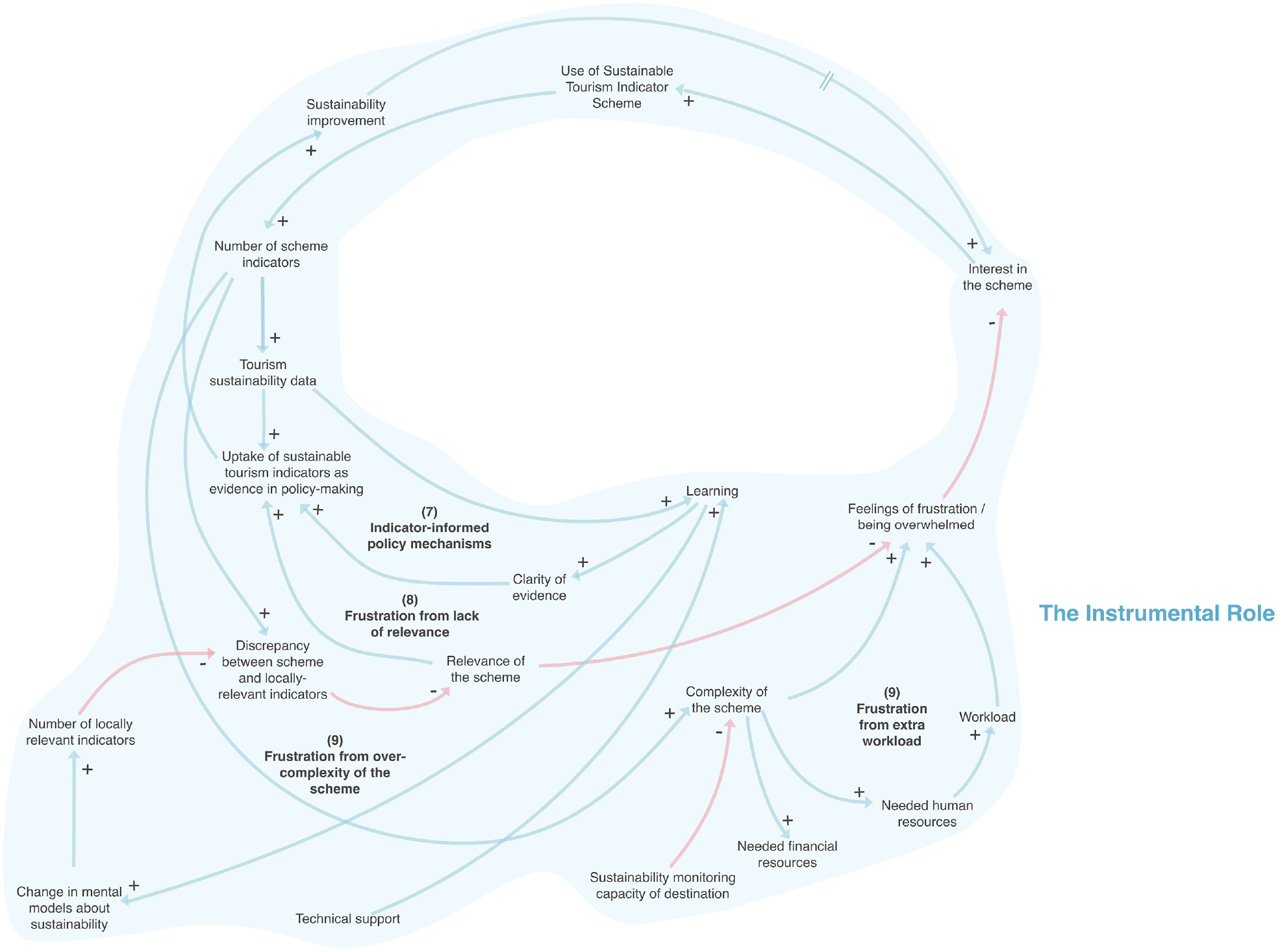
Section of the Causal Loop Diagram with the instrumental role dynamics of sustainable tourism indicator schemes.
In this study, the workshop participants explained how indicators that are vague or difficult to interpret (clarity of the evidence) do not spark interest among stakeholders, which reduces the likelihood of the evidence produced by those indicators being used to inform policy. SU14 noted that “many destinations experienced problems with interpreting the data they collected. For example, they couldn’t come to an agreement on what they meant with low, medium, and high values of indicators.” Clarity can be increased by the level of learning involved in the implementation of the scheme, with learning being increased by, first, the level of technical support received and, second, the level of dialog among stakeholders. Considering Technical support first—this is usually provided by supraorganizations (represented by universities, regional or national bodies, or scheme producers) that help destination stakeholders to interpret the data being collected. SU10 found that “when there is an external institution making effort and helping them in the implementation process, destinations advance better and start introducing sustainability in their work.”Technical support is a factor that drives scientific advancement in the use of innovative methodologies for data collection and interpretation, as it helps destination stakeholders to delve into the complexity of their sustainability issues. Moving on, the level and quality of dialog in the implementation process is also significant because it increases the clarity of evidence, (1) among local stakeholders who need to interpret the collected data based on the destination’s contextual characteristics, and (2) among external stakeholders from different destinations through their participation at events where issues around methodology and interpretation are discussed. In line with the above, SP5 shared that “when destinations come up with good ideas on interpretation or solutions, we create opportunities to share them between them, so that they can learn from each other.”
The relevance of the scheme is also crucial in influencing the occurrence of indicator-informed policies. Workshop participants highlighted how, in instances where indicators are not deemed important, stakeholders discard them; hence, the indicators have minimal impact on the destination’s policy process (Loop 7—Indicator-informed policy mechanism). For example, SU6 shared their experience when collecting indicators on cruise-tourism development in Dubrovnik in 2007: “We informed stakeholders with suggestions on what to do, but they didn’t listen at the time. It is only when you have a problem at the destination that stakeholders start to collaborate with you. In Dubrovnik, they started perceiving the problem of over-crowding from cruise ships a few years ago. It was only then that all stakeholders started to listen to the data and collaborate to solve the problem.”
In some instances, the participants explained how lack of relevance can result in stakeholders experiencing feelings of frustration with the process (Loop 8—Frustration from lack of relevance). These feelings of frustration occur when the number of scheme indicators is chosen by the scheme producer, usually by delegating the task to a team of experts. This approach often results in a long list of indicators that provide a comprehensive blueprint for all aspects of sustainability. However, such a list is often incompatible with the much smaller number of indicators that are considered relevant to the destination’s stakeholders (number of locally relevant indicators). This difference creates a discrepancy between the scheme and locally relevant indicators, which, based on its scale, can result in the scheme being deemed not relevant and hence not worth investing in (relevance of the scheme). Negative feelings among local stakeholders arise (feelings of frustration and overwhelmingness), which negatively impact their overall interest in the scheme and end up hindering the whole process of positive dynamics that had been created through the conceptual role. SU1 shared their frustration in this regard, stating: “If we think about small towns around Europe, you may think that they all have similar problems and issues (…): too many holiday homes, too many businesses, seasonality, shortage of water, and so on. The reality is that, even in this case, the issues are not the same. For example, water may be an issue in some Greek islands but not at all here in Ireland. There needs to be some contextual understanding.” The same issue was shared by SP6, who said: “We presented a list of indicators to different destinations in Belgium that we thought as experts we could get data from. Their [destination’s] task was to rank them according to importance and come up with a shortlist. We were surprised to see the results were quite different in each destination.”
These negative impacts are reinforced by Loops 9 and 10, which focus on the level of complexity involved in the implementation of sustainable tourism indicator schemes. Loop 9—Frustration from the over-complexity of the scheme, illustrates that when collecting a significant number of scheme indicators, the complexity of the scheme increases, thus requiring additional finances (needed financial resources) and more human resources (needed human resources). The additional resources required depend on the level of sustainability monitoring capacity of the destination: the lower the capacity, the higher the perceived complexity of the scheme at the destination level. Consequently, when destinations are not ready to embrace a certain level of complexity, negative feelings arise (feelings of frustration and overwhelmingness), ultimately leading to a further decrease in interest in the scheme. In line with these dynamics, SP4 argued that: “Many of the monitoring schemes are too complicated to start with (…). If you present them with this big tool to start, they will never start. (…) So many destinations are just starting their sustainability journey and they don’t need all this data.”
The negative feelings that are triggered are explained in more detail by Loop 10—Frustration from extra workload. Unless extra staff are employed, the additional human resources requirements effectively equate to an increased workload for the current staff. In this case, it is important to note that existing staff are normally skilled in tourism marketing or other specialties that differ entirely from sustainability monitoring; thus, the complexity of the schemes results in clear human capacity shortages. Therefore, the frustration generated among staff is attributed not only to the extra workload that the schemes create but also to having to conduct work that is not in line with their regular skills and responsibilities. This frustration leads to a further decrease in interest in the scheme, thus generating negative links throughout the Causal Loop Diagram and shifting the conceptual role loops from virtuous to vicious cycles. Workshop participants explained how ripple effects such as this can, in some instances, reach a tipping point at which the schemes are no longer implemented (use of sustainable tourism indicator schemes). SU9 shared their experience of collaborating with destinations in the Barcelona province: “When we asked each of these destinations why they are no longer interested in indicators, they said that they do not have time in their everyday work and do not have human resources. The problem is that they are used to using only economic information and not sustainability data. So, if you ask them to incorporate this new information in their daily routine, it means they have to change, entirely, their working patterns.”
The discrepancies between the scheme and locally relevant indicators are much more common in destinations that are just starting their sustainability journey (since their stakeholder worldviews and knowledge have not yet been challenged and their tourism infrastructure is limited). Workshop participants with experience in this type of destination shared positive experiences of what happens when fewer indicators are taken on initially. They explained how the act of implementing sustainable tourism indicator schemes sparks all the positive, conceptual role dynamics mentioned earlier that are not, in this case, hindered by the negative feelings of frustration that result from implementing complex or irrelevant schemes. The learning process initiated (learning) expands the stakeholder knowledge and understanding of sustainability and contributes to challenging their initial worldviews (change in mental models about sustainability). With these dynamics in place, participating stakeholders start to expand their views on what they deem relevant to measure, to include sustainability areas that were previously ignored or controversial, leading over time to a gradual increase in the number of locally relevant indicators and a reduction in the discrepancy between scheme and contextually relevant sustainable tourism indicators.
Ultimately, the act of adopting fewer indicators initially results in greater uptake of indicator evidence in policymaking, and, subsequently, greater sustainability improvement at the destination. In the long term, fewer indicators lead to raised levels of interest in the scheme and more continuous use of sustainable tourism indicator schemes. For example, based on experience in Norway, SP4 explained that: “Our approach is to divide things into chunks and say ‘ok we start here and then we will progress there’ and so on. (…) It is about trying to identify simple things that they can do to make them change very quickly. Maybe it’s about updating something in their website with three new data points that they have collected, so that then they go: ‘Look we have made a change, look what we have done’. It is about giving them a validation point where they can show the value of indicators so that they value themselves and can show this value to the stakeholders.”
The Structural Role Dynamics of Sustainable Tourism Indicator Schemes
Figure 7 depicts the dynamics that positively and negatively influence the attainment of the structural role, through the ability of sustainable tourism indicator schemes to influence current tourism management paradigms. Workshop participants agreed that capitalist worldviews are still dominant in tourism management. These worldviews influence how destinations function, creating an over-reliance on externally funded, short-term projects to implement sustainability improvement programs, such as sustainable tourism indicator schemes (Loop 11—Short-term project culture). Consequently, in the current system structure, the success of tourism is determined based on the performance of a few economic indicators (perception of tourism success based on economic indicator performance). This structure is reinforced by the existing tourism statistical frameworks that require destinations to collect only economic data (normative compliance with conventional economic indicators). As a result, most efforts are targeted at increasing the value of such indicators, with tourism funding being mostly (if not all) allocated to marketing activities (funding allocated to marketing activities). Often, little remains to fund sustainability initiatives, such as implementing sustainable tourism indicator schemes (sustainability monitoring capacity of destination).
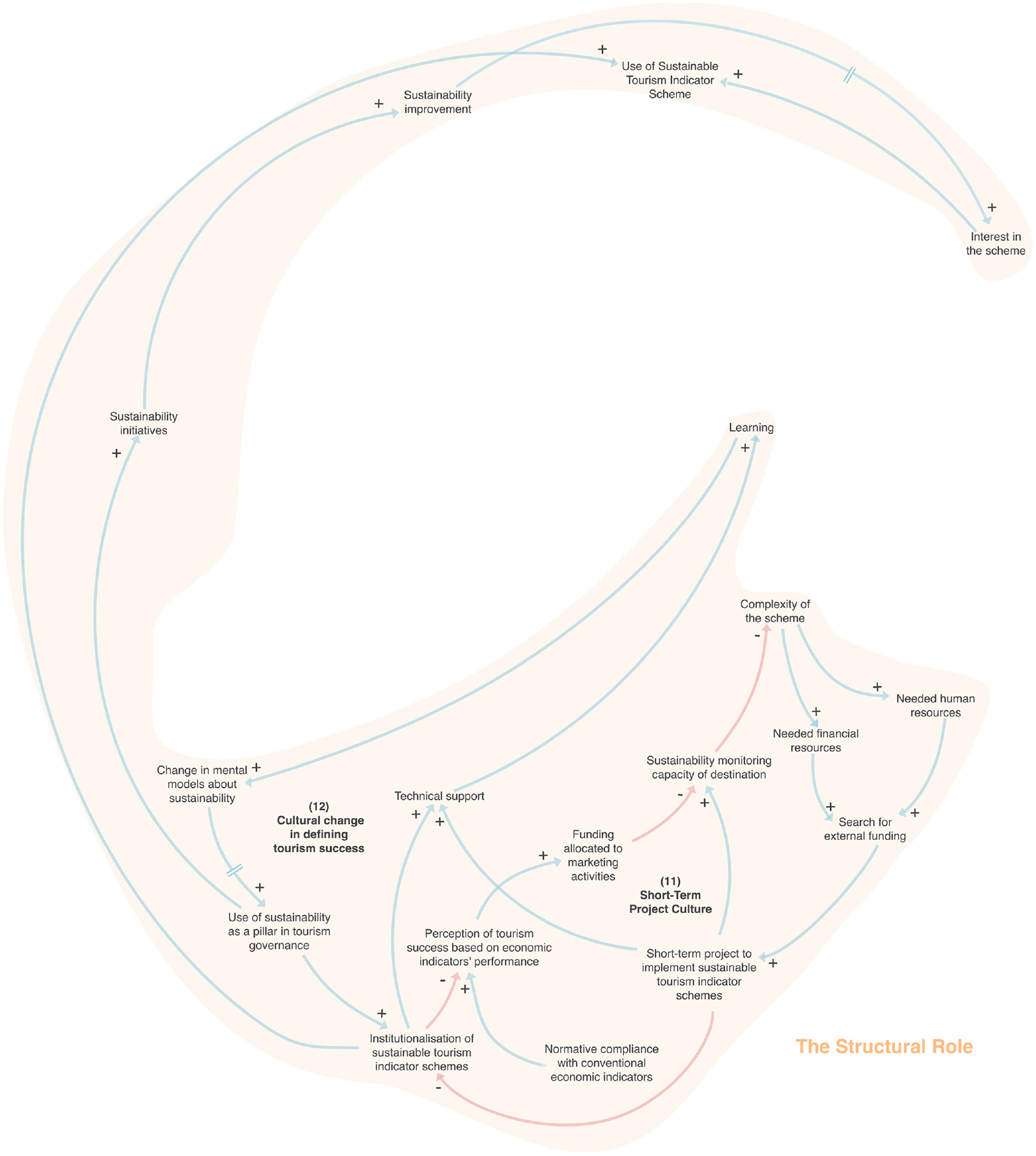
Section of the Causal Loop Diagram with the structural role dynamics of sustainable tourism indicator schemes.
The limited sustainability monitoring capacity of destinations is insufficient to deal with the complexity of the scheme, creating needs for additional finance (needed financial resources) and more human resources (needed human resources). These needs lead destinations to search for external funding to finance short-term projects to implement sustainable tourism indicator schemes. This dynamic creates a reliance on short-term funding that, ultimately, hinders the possible institutionalization of sustainable tourism indicator schemes because, as the project ends (short-term project to implement sustainable tourism indicator schemes), technical support also ceases, together with the learning and networking processes that had been initiated. This is especially true when these projects are designed to cover only activities related to the gathering, analyzing, and disseminating of sustainability data, while neglecting activities that are needed to deliver evidence-informed policy interventions. Accordingly, SU4 reflected that “Destinations get funds to hire a consultant to do the measurement of these criteria. But what then? What happens once the consultant has done their work?” Similarly, SU11 stated that in the German program, “The staff hired for sustainability monitoring projects cannot have a payroll in the DMO, because sustainability is not in line with the DMO’s core duties. This is why we see most of these people being paid by external funds or programs. It is a big challenge, because when this person is gone, it is a big loss not only for sustainability but also for the networking ability.”
However, while short-term projects hinder the institutionalization of sustainable tourism indicator schemes, they are still necessary to create a series of positive dynamics that challenge, and can possibly change, a system’s existing structure. SU5 said that “While DMOs have the perceptions that somebody else should be doing the activities of sustainability monitoring, I can see how implementing the schemes still create positive impacts in steering the process.” In reality, short-term projects empower destinations to increase their internal sustainability monitoring capacity and to obtain initial technical support. The increased sustainability monitoring capacity of the destination contributes to reducing the perceived complexity of the scheme, which has a weakening effect on the negative loops discussed in the instrumental role. Moreover, technical support contributes to strengthening stakeholder learning, which creates positive ripple effects on the other loops. For example, technical support contributes to widening stakeholder perspectives of what they consider relevant to measure, thus, challenging their mental models (change in mental models about sustainability), with positive effects on indicator-informed policy mechanisms. In destinations where sustainable tourism indicator schemes are continuously implemented, thanks to repeatedly securing external funding, workshop participants described a progressive paradigm change in how tourism is governed (Loop 12—Cultural change in defining tourism success).
In the long term, the process of continually challenging stakeholder mental models, by way of repetitive sustainable tourism indicator scheme implementations, leads to a clear cultural shift, where sustainability moves from being a concept that is vague and difficult to operationalize, to being a cornerstone of management (use of sustainability as a pillar of tourism governance). Sustainable tourism initiatives such as sustainable tourism indicator schemes are no longer considered to be niche activities within tourism management organizations but are a priority within government agendas; on occasions, these indicators are used instrumentally to inform tourism strategies and action points. This shift toward the use of sustainability as a pillar of tourism governance leads to organizational adjustments and, subsequently, to the institutionalization of sustainable tourism indicator schemes, thus, guaranteeing the continuous use of sustainable tourism indicator schemes. Several destinations acknowledged the structural role of sustainable tourism indicators. Across Europe, some examples are seen in the establishment of national schemes such as the Slovenia Green Scheme, Innovation Norway, and Sustainable Travel Finland, whose representatives participated in the workshops. For example, SP5 explained that “The destinations that joined the Slovenia Green Scheme now account for 80% of all nights [tourist overnight stays] in Slovenia. This means that at both local and national levels we have a picture of what our key challenges are. Based on this, we can work with the national tourism board to develop different tools that destinations can use.”
Ultimately, this shift negatively impacts the perception of tourism success based on economic indicator performance. As a result, funding is reallocated to reflect the new objectives (funding allocated to marketing activities). Destinations become better equipped through a skilled workforce and dedicated budget for sustainability monitoring, thus increasing the sustainability monitoring capacity of the destination. For instance, SU4 said that “Since we started joining Innovation Norway, our sustainability mindset has changed enormously. We went from having one project manager responsible for sustainability within a staff of ten, to having sustainability on top of the mind of all ten people in the team. So, it is a mindset development, which is fascinating.” The cultural shift is further reinforced by the continuous provision of technical support by the institutionalized sustainable tourism indicator scheme organization. At this point, short-term projects are no longer used to implement indicator schemes but are focused on innovation and methodological advancements that provide greater clarity of the evidence produced (Bell et al., 2011). This change can be extremely slow and difficult to achieve (Meadows, 2008) and only occurs after several years of tourism sustainability monitoring. When such a change happens, the number of sustainability initiatives implemented at the destination increases exponentially, leading to continuous sustainability improvement.
Discussion
Adopting a complexity-informed methodology enables us to identify the numerous interactions of factors and feedback loops that occur during the implementation of sustainable tourism indicator schemes, including those that hinder and enable a continuous sustainable destination management. This interplay of factors shows a complex picture that goes beyond the established linear and rational function of sustainable tourism indicator schemes in influencing policy and sustainability change, which is based on evidence-based policy principles (Geyer & Rihani, 2010; Parkhurst, 2017). Exploring the conceptual, instrumental, and structural role dynamics of sustainable tourism indicator schemes helps us to identify the non-linear complexities of how such changes really happen.
The conceptual role dynamics of sustainable tourism indicator schemes demonstrate how sustainability can be improved through indirect mechanisms aimed at fostering dialog, stimulating a process of continuous learning, creating connections among stakeholders, creating and developing stronger networks, and bringing destinations into previously unfamiliar funding streams. While these dynamics do not bring any paradigmatic change in the short term (Hall, 2011), they may be considered a pre-condition for the other roles to occur. These dynamics are seen to initiate positive mechanisms that extend beyond the schemes’ initial scopes, which reinforces the argument that sustainable tourism indicators seldom lead to changes in their targeted policy but can instead bring about changes in environments outside of their policy areas (Lehtonen, 2017; Sébastien et al., 2014). Recognizing and communicating how sustainability is improved (directly and indirectly) through the implementation of these schemes is crucial to maintaining high levels of interest in those schemes (Termeer & Dewulf, 2019), which is what ultimately contributes to their continued use. Stakeholders may not recognize immediately that a sustainable tourism indicator scheme has contributed to sustainability improvements at their destination. Therefore, it is important to acknowledge the conceptual role, and related dynamics, and to show how they contribute to the improvement of a destination’s sustainability.
Exploring the dynamics of the instrumental role of sustainable tourism indicator schemes sheds light on the reasons why the schemes are expected to demonstrate direct sustainability improvements by way of a policy change route. These expectations stem from applying a linear-thinking approach to implementing sustainable tourism indicator schemes (Louth, 2011). A linear-thinking approach implies that the instrumental role occurs through evidence-based policy, where policy change is expected only through the availability of, in our case, sustainability evidence (Parkhurst, 2017). This approach also assumes that all destinations behave similarly and in equilibrium, therefore, they all follow the same pathway to sustainability improvement. This assumption has created a habit in which sustainable tourism indicator schemes are designed to provide a comprehensive blueprint for all aspects of sustainability, often resulting in a standardized approach that contains a long list of indicators for all destinations, despite significant differences between the destinations (Mendola & Volo, 2017; Tanguay et al., 2010; Torres-Delgado & Palomeque, 2014). In seeking to enable comparisons between destinations, employing uniform sets of indicators underplays the importance and complexity of local characteristics. While this tension has been acknowledged previously, this study is the first to shed light on the consequences of not recognizing the importance, and complexity, of local contexts when evaluating policy interventions (Baggio, 2008; McDonald, 2009).
When the design of sustainable tourism indicator schemes does not reflect local complexities, the schemes become difficult to apply and interpret (McLoughlin & Hanrahan, 2023; Rio & Nunes, 2012). Furthermore, when the schemes do not reflect the immediate needs of stakeholders, it is difficult to get local buy-in and commitment (Agyeiwaah et al., 2017; Tanguay et al., 2013). As a result, such schemes can be perceived as inflexible and unrealistic, with the result that their evidence is ignored and discarded. Alternatively, when schemes adopt indicators that are clear, relevant and feasible to collect, then, indicator-informed decisions become more likely (Stacey, 2007). Understanding the context of a destination, in which a sustainable tourism indicator scheme is to be introduced, ought to be considered essential (Miller & Twining-Ward, 2005; Schianetz & Kavanagh, 2008; Zekan et al., 2022) and embedded in all scheme design phases. Sustainable tourism indicator schemes ought to focus on issues of shared concern, implementing tailored approaches in which scheme indicators reflect the needs and goals of local stakeholders (Bauler, 2012; Bell & Morse, 2011; Cassar et al., 2013; Rinne et al., 2012).
These latter findings suggest the use of participatory approaches in the selection of sustainable tourism indicators and their implementation (Diedrich et al., 2010; Miller & Twining-Ward, 2005; Rasoolimanesh et al., 2023; Zekan et al., 2022). Some sustainable tourism indicator schemes are moving in this direction, such as the UNWTO International Network of Sustainable Tourism Observatories (INSTO). INSTO recently included the use of participatory processes in the operation and management of observatories (UNWTO, 2021), clearly outlining the importance of multi-stakeholder participation in the making of indicator-informed policies. The same suggestion applies to the interpretation of sustainable tourism indicator results, where a tendency to apply indexes (Torres-Delgado & López Palomeque, 2018) or develop standardized thresholds (Jovicic & Ilic, 2010) may oversimplify a complex system that responds according to a destination’s contextual characteristics. Instead, participatory interpretation of sustainable tourism indicators should be promoted, in which local stakeholders are given the opportunity to interpret the sustainable tourism indicator results (Lyytimäki et al., 2013). Finally, it is important to note that the type of participatory approach utilized can vary substantially, and, because of this, can produce different outcomes (Diedrich et al., 2010). While Kristjánsdóttir et al. (2018) show that 29% of their analyzed studies used participatory approaches in the implementation of sustainable tourism indicators, it remains unclear how such approaches were conducted and what dynamics they created. In this study, we did not investigate this phenomenon in depth as we expected, and our findings highlight the need for further research. The field of participatory design is becoming prominent in tourism (Scuttari et al., 2021). We argue that there is wide scope for experimentation in the context of sustainable tourism indicator schemes in the future.
Moving to the structural role, this study has demonstrated how sustainable tourism indicator schemes have the potential to catalyze systems change (Hall, 2011; Loehr & Becken, 2023) when certain mechanisms are introduced. Destination sustainability is improved through new forms of tourism governance, where sustainable tourism indicator schemes become an integral part of a destination’s organizational routine and policies move from being purely informed by capitalist interests to being informed by interests that include those pushing for environmental and social justice (Dredge & Jenkins, 2007). This change is by no means guaranteed; it can be extremely slow and difficult to achieve (Meadows, 2008), only becoming visible after several years of tourism sustainability monitoring. Moreover, change only becomes possible when negative dynamics are avoided or weakened, and positive dynamics are encouraged and maintained throughout the whole implementation process (Sterman, 2000). Negative dynamics prosper in environments with a culture of short-term funding of sustainable tourism indicator schemes, because such environments: first, create a fragile structure that focuses primarily on producing new, but subsequently underused, sustainability evidence; and, second, hinder the destinations from endeavoring to pursue long-term management approaches (Rinne et al., 2012). In this way, destination managers can associate sustainable tourism indicator schemes with a mere project tick box exercise rather than a real opportunity that could revolutionize their management of sustainable tourism (Gasparini & Mariotti, 2023).
Conclusion
Theoretical Contributions
This study makes significant theoretical contributions to the underexplored topic of sustainable tourism indicator schemes and their ability to enable policy and sustainability change. The study addresses calls from various scholars to investigate sustainable tourism monitoring from a systems perspective (Gallopin, 2018; Miller & Twining-Ward, 2005; Schianetz & Kavanagh, 2008) and the need to pay greater attention to the complex mechanisms created by sustainable tourism indicators (Font et al., 2023). From the literature, we understood that sustainability indicators rarely play an instrumental role (Bell & Morse, 2011; Cassar et al., 2013; Gasparini & Mariotti, 2023). This narrative might lead some to think that sustainable tourism indicator schemes have failed (Ansell & Geyer, 2016), or that they result in collective disappointment that leads to harmful dynamics in which destination stakeholders disregard their use altogether. This study contributes to a change in this narrative. It does so by departing from the linear-thinking view that more evidence leads directly to policy and sustainability change (McLoughlin & Hanrahan, 2023), instead applying a systems-thinking lens to identify the interactions and relationships between the factors created by sustainable tourism indicator schemes in destination systems (Foster-Fishman et al., 2007). By deepening our analysis of the conceptual, instrumental, and structural roles of sustainable tourism indicator schemes, we now understand that sustainable tourism indicator schemes do contribute effectively to improving sustainability at destinations, via various dynamic pathways.
In line with previous research (Gasparini & Mariotti, 2023; Sébastien et al., 2014), this study confirms that, in the short term, sustainable tourism indicator schemes, through their conceptual role, initiate a first-order change—the expansion of stakeholder knowledge of sustainability. This change results from stakeholders reviewing the evidence collected, and through the process of meeting and talking with other stakeholders. Unlike previous studies, our findings demonstrate that, over time, when certain dynamics are put in place, sustainable tourism indicator schemes facilitate a second-order change (Hall, 2011) through their instrumental role. In this change, stakeholder mental models continue to be challenged to the point where they expand the pool of issues initially deemed to be relevant and gain clarity on indicator interpretation. It is at this stage, that the sustainable tourism indicators previously deemed to be controversial or ignored start to inform and change policies. Consequently, this study provides an alternative narrative that shows the dynamics behind the apparent inability of sustainable tourism indicators to change policy (Cassar et al., 2013; Rosenström, 2009), along with a clear pathway for this instrumental role to be attained. Furthermore, this study demonstrates that over a significantly long time, sustainable tourism indicator schemes have the ability to enable a third-order change (Hall, 2011), or systems change (Foster-Fishman et al., 2007), through their structural role; through this change, stakeholder mental models are challenged to the point where sustainable tourism indicator schemes become an integral part of a destination’s organizational routine, changing the way in which tourism is governed.
Practical Implications
Our findings have clear implications for policy, as they provide valuable managerial information for sustainable tourism indicator scheme producers and users. This study has already informed the Impulse paper from the European Commission on policy recommendations for how to mainstream sustainable tourism indicator schemes across Europe (Font et al., 2020). It is now clear that a linear worldview of designing sustainable tourism indicator schemes creates negative dynamics that impede positive change. While we accept that designing a standardized, complex scheme offers the opportunity for an in-depth understanding of a destination’s sustainability performance, this study has demonstrated that this approach hinders the attainment of the sustainable tourism indicator scheme’s instrumental and structural roles. Instead, embracing a pragmatic approach that focuses on “what is possible” (Ansell & Geyer, 2016) potentially allows greater instrumental and structural benefits to be achieved. A pragmatic approach requires sustainable tourism indicator scheme producers to design schemes that focus, initially, on implementing relevant and easy-to-implement indicators that allow the initial conceptual and instrumental dynamics to occur. Then, destinations are given enough time to absorb, shape, and expand their sustainability monitoring systems as their monitoring capacity improves and their sustainability priorities change. By adopting a continuous incremental approach, sustainable tourism indicator schemes generate the radical paradigm shift typical of the structural role.
The findings suggest that scholars and practitioners need to work together to change the unrealistic expectations that are often associated with sustainable tourism indicator schemes today. Future discourse should not be framed to suggest that sustainable tourism indicator schemes are ineffective tools for evidence-based policy (Bauler, 2012; Cassar et al., 2013; Sébastien et al., 2014), but should instead focus on highlighting the reductionist reality we have constructed around them, which, as we now know, tends not to reflect the complexities of tourism governance. Instead of being perceived as mere data generator tools for making evidence-influenced policies (Parkhurst, 2017), sustainable tourism indicator schemes should be promoted as tools for incentivizing dialog, stimulating processes of continuous learning, creating connections and networking opportunities, bringing destinations into previously unfamiliar funding stream opportunities, and challenging current stakeholder worldviews. In the long term, sustainable tourism indicator schemes should be seen as contributing to a process of culture change toward defining tourism success, where sustainability is used as a pillar of tourism governance and data is regularly collected to inform policy decisions.
Limitations and Future Research
The first limitation of this study relates to the sample design. Systems scholars suggest observing a phenomenon from multiple scales, including perspectives from both zoom-in and zoom-out lenses (Burns, 2014; Dattée & Barlow, 2010). Our workshop participants were selected to represent a varied pool of destinations and sustainable tourism indicator schemes across Europe. While this provided a wide-ranging spectrum of European perspectives, the study would have benefited from an additional workshop with stakeholders from a single destination. In addition, the system behavior presented in this study is based on Eurocentric experiences, showing the need for a larger study that embeds views, for example, from the Global South.
Another limitation stems from not being able to engage the study participants in discussion about the full Causal Loop Diagram due to time and logistics constraints of both the researcher and the participants. The study would have gained from this additional testing and validation, and it would have raised awareness among the practitioners about the benefits of using a systems-thinking approach. We recommend this extension be considered for future research.
Finally, data were collected during May and June of 2020, and while the experts interviewed were confident that their contributions were not affected by the start of the pandemic, subsequent studies to analyze how destination governance models have changed since the pandemic would contextualize the results.
Supplemental Material
sj-docx-1-jtr-10.1177_00472875231195736 – Supplemental material for The Hidden Power of Sustainable Tourism Indicator Schemes: Have We Been Measuring Their Effectiveness All Wrong?
Supplemental material, sj-docx-1-jtr-10.1177_00472875231195736 for The Hidden Power of Sustainable Tourism Indicator Schemes: Have We Been Measuring Their Effectiveness All Wrong? by Gloria Crabolu, Xavier Font and Graham Miller in Journal of Travel Research
Footnotes
Declaration of Conflicting Interests
The author(s) declared no potential conflicts of interest with respect to the research, authorship, and/or publication of this article.
Funding
The author(s) received no financial support for the research, authorship, and/or publication of this article.

Supplemental Material
Supplemental material for this article is available online.
Author Biographies
References
Supplementary Material
Please find the following supplemental material available below.
For Open Access articles published under a Creative Commons License, all supplemental material carries the same license as the article it is associated with.
For non-Open Access articles published, all supplemental material carries a non-exclusive license, and permission requests for re-use of supplemental material or any part of supplemental material shall be sent directly to the copyright owner as specified in the copyright notice associated with the article.
