




Abstract
This study considers cultural adaptation through tourism, focusing on language-travelers: hybrid education-tourism consumers whose voices remain relatively silent in tourism studies. Qualitative, semi-structured interviews were undertaken with students, teachers, and managers in Australian English language schools to understand what language-travelers expect from their Australian experiences and the implications for language schools. The findings propose that sojourners’ experiences are framed by pre-visit imaginaries of object authenticity, wherein the “object” is both Australian culture and the wider Anglophone “West.” Such imaginaries are found to be validated by language schools, which face pressure to balance letting students glimpse the “backstage” and staging out-group imagined “authenticities,” such as by hiring fun, approachable, and above all White teachers. We identify opportunities for language centers to understand their role within tourism as cultural mediators and suggest ways forward in promoting and inculcating critical intercultural competence among language-traveler sojourners.
Keywords
Introduction
Recent data shows that the global youth travel market generates US$333 billion in tourism receipts, accounting for 20% of the total global travel market (SYTA, 2022) whilst growing at an average annual rate of 3%. Related to youth tourism, but distinct, is the international education sector. The USA is students’ top choice in this market, although Australia’s per-capita receipts from international education are higher: Australia’s Department of Education and Training counted some 693,750 international student visa holders immediately pre-pandemic, in 2018, a presence worth $34.9 billion in export revenue (International Education Association of Australia, 2022). Additionally, international students—like tourist-visa “Working Holiday Makers” in the youth tourism sector—stay longer (on average 136 nights), spending more than leisure and business tourists (some $20,015 per trip, compared to just $2,352 for all other visitor types; International Education Association of Australia, 2022).
This paper is timely, not least in terms of post-COVID recovery. We conceptualize “language-travelers” as a both/either hybridity: part of youth travel but also the international education sector. Such arrivals to Australia—that is, those attending English language schools—were at record levels immediately before the pandemic (Professionals in International Education PIE (PIE), 2020a), and the sector is now recovering so rapidly that demand outstrips supply, (English Australia, 2022); Further, the Australian government has, to date, spent AUD$18 billion (approximately 12.1 billion Euros) supporting the sector (PIE, 2022), a sum reflective of the substantial export value to Australia of this hybrid tourism-education product and indicative of the government’s hope that the sector will recover quickly (PIE, 2020a). There is currently a window of opportunity, then, for the sector to build back better, perhaps as a silver lining to the COVID-19 cloud.
The primary source countries for student-visa sojourners in Australia—including all sectors and bearing in mind that Higher Education dominates—are, in order: China, Japan, Brazil, Colombia, South Korea, Thailand, India, Taiwan, Spain, and Vietnam (PIE, 2020a). This differs from those on Working Holiday Maker visas, where the top source countries (excluding those for whom English is already likely a first language) are, in order: Taiwan, Germany, South Korea, France, Italy, Japan, Chile, Argentina, Thailand, Spain, and Argentina (Parliament of Australia, 2016). Although both sojourner types have been recognized in terms of their economic significance, their experiences have not been adequately examined. This is therefore the focus of the current paper.
This paper will be of interest to the language-school sector as well as to tourism scholarship more broadly, not least as we propose a conceptual contribution to sit alongside our practical proposal. In particular, we challenge language schools—as vehicles of cultural interpretation—to review their strategies when it comes to nurturing intercultural competence amongst language-travelers, who represent a particular type of high-value tourist with the power to influence others (through VFR tourism; i.e., Visiting Friends and Relatives; Bakri et al., 2022). The context is a high-value, under studied tourism-education hybrid that does not easily segment by visa type: young-adult, English-language-school student-tourists, who (in this study) are nationals of countries in East Asia, Southeast Asia, South America, and Europe. While some are “students” per their visa and others are technically “tourists,” all are studying English in Australia, immersing themselves culturally, undertaking sightseeing-type tourist activities, and making friends. For this reason, we propose the term language-travelers to capture their hybridity and also the complexity of the product on offer by the language schools (see also Kennett, 2002). This is a relatively untouched subject in the tourism literature, with most research in this space appearing in Education or Applied Linguistics; see, for example, Litzenberg (2021), Lowe and Pinner (2016), Ramjattan (2019), and Slaughter and Cross (2021). Furthermore, relatively few studies focus on language schools as opposed to higher education and/or longer-term migration. This paper, in contrast, contributes to discussions within tourism.
The paper’s conceptual contribution is to the literature on cultural adaptation in/through tourism, and on guest-host relations, including out-group (i.e., visitor) notions of object authenticity as applied to imaginaries of (host) national culture/s. The hosts, in this case, are language schools and, organized under their auspices, homestay families, teachers, and school managers; the host nation/culture is Australia. The guests are young adults visiting Australia for periods of up to a year. The average duration for those on student visas is 13.6 weeks (2019 figure; PIE, 2020b). While motivations and emphasis vary between those on student-visas versus those on tourist-visas, participants on both visa types planned to undertake backpacker-type sojourns after studying English. Language-travelers also immerse themselves culturally while they are engaged in formal studies, and most stay with local families and engage in social and tourism activities. These are organized by the language schools as a parallel to classroom teaching. Thus, while such sojourners are “students” from the perspective of language-school hosts, they are also “tourists” from the perspective of much of their activity in Australia.
In the tourism literature, the notion of object authenticity has hitherto been applied mainly to heritage buildings and other objects (e.g., Morgan & Pritchard, 2005) and to historical events and associated placemaking (e.g., Walby & Piché, 2015). Object authenticity has been less often theorized in relation to cultures more broadly, whether conceptualized nationally or supra-nationally. Addressing this gap, the present paper examines tourists’ racialized authenticity discourses as these apply to the Anglophone, globalized “West” and, metonymically, to urban Australia.
The present paper therefore extends theorizing on object authenticity by exploring contested, power-imbued discourses of: linguacultural ownership, ethnicity, normative behaviors and perspectives, insiderness, and intercultural competence. We consider a circular model of negotiation in which tourists project social imaginaries onto cultural “others,” including Australian hosts/interlocutors but also peers from other parts of the world. Where experiences do not match imaginaries, a complex contestation takes place in which the “other” is rejected, reframed, or conditionally accepted. Of particular interest is the role of the language school in mediating this process. Under pressure from language-travelers’ framing expectations, language-school staff take up positions from “staging” authenticity to reframing and challenging normative out-group imaginaries. But theirs is a complex task, not least as language schools are for-profit businesses, and challenging deep-seated expectations may conflict with keeping customers happily ignorant. How, then, are language schools to walk this line? We propose an overt model of critical cultural awareness raising as a key component of the post-pandemic language-school product.
It is the “marked” status of English—proxy for and enabler of (sometimes vague notions of) “globalization”—that makes language-travelers’ perceptions of object authenticity so important. While such tourists are physically in Australia, the imaginaries that inform their presence go far beyond discourses about Australia. This is because of the postcolonial meanings of English as a global language and its relationship with the Anglophone “West” (e.g., Holliday, 2022; Thomas-Maude et al., 2021). It is no accident, therefore, that the sojourners are learning English as opposed to, say, Farsi, and it is no accident that they are doing so in “inner-circle” Australia as opposed to, say, “outer-circle” Kenya (Kachru, 1985). Australia and the Anglophone “West” may thus be mutually metonymic. Powerful imaginaries—projected cultural, economic, social, and symbolic capital, accreting to individuals—imbue English-language proficiency and Anglophone-“West” cultural fluency with perceived cachet that goes well beyond Australia-specific tourism destination imaginaries. In terms of our contribution to tourism, we extend the application of trust transfer theory (Kim & Kim, 2020) by identifying language centers and teachers as stakeholders in authenticity trust-formulation in tourism contexts. There are implications for destinations seeking to successfully attract young-adult visitors over the long term.
The paper begins by locating the theoretical discussion to which we contribute before reviewing related areas of literature. We then discuss the qualitative approach undertaken and the specifics of how the study was carried out. The findings and discussion which follow highlight our contribution. The study is framed by the following research questions: What do language-travelers expect and want from their Australian experiences? Are these demands met? And what are the effects of these demands on language centers, staff, and tourism more broadly?
Literature Review
Theoretical Background
Our theoretical contribution is positioned around the tourism-authenticity research gap noted by Richards (2018), and specifically the tendency of research to focus on individual cultural consumers rather than social groups and the dynamic that exists between them. We have also taken orientation from Rickly’s (2022) critique of authenticity studies in tourism, firstly by recognizing the abundance of tourism-authenticity studies that exist, and second by attempting to come up with a distinct critical approach that sheds light on how object authenticity plays a part in the selective interpretation of destinations. Through this research, we address what Richards refers to as the significant challenge in understanding how the increasing mix and mobility of different cultural and social groups impacts on the production and consumption of culture by tourists. Given that the social groups in question are language-traveler tourists and language-school staff (including teachers, marketing specialists, school managers, teacher educators, and others), we draw upon literature from the fields of language education, applied linguistics, and intercultural studies as well as tourism. While tourism is foregrounded throughout, the reach into adjacent literatures provides a systematic baseline context for the analysis that follows. Where previous studies have looked at tourism demand and behavior amongst international students in Australia (Min-En, 2006), the present study theorizes in a new direction by identifying destination image perceptions of Australia within the discursive conditions of language learning and imaginaries of the broader Anglophone “West.”
We begin by examining authenticity, focusing on the front- versus back-“stages” of tourism performances and staged authenticity that is aligned to out-group social imaginaries of racialized Others. We then turn to the purposes of language-travelers undertaking English courses in Australia, positing that they do so at least in part because of the opportunities associated with improving their English and acclimating to the Anglophone “West.” We then discuss the contrast between what is intended versus what actually occurs in the space of language-travelers’ intercultural awareness development.
Authenticity
Dating back to early Christian theology (Umbach & Humphrey, 2018), authenticity has since marched through the disciplines, drawing in/on the crisis of representation, Marxist challenges to the naturalness of human/non-human “nature,” and postmodern readings of simulation and hyper-reality (Baudrillard, 1981). In tourism, discussions of authenticity date from Boorstin’s (1961), MacCannell’s (1976), and Cohen’s (1988) influential works. Even now, authenticity remains startlingly current as a focus for philosophical inquiry at a time when blockchain-mediated Non-Fungible Tokens—artworks provably “authenticated” in their uniqueness—sell for tens of millions of dollars. The notion of authenticity, then, is simultaneously very old and very current, and it remains very interesting.
Etymologically, authenticity derives from auto—the self—and hentes—the doer—, such that to be authentic is to lay claim to the real: an unadulterated selfhood (Umbach & Humphrey, 2018, pp. 1–2). But what happens when tourists’ construction of an object via their own culture’s social imaginaries differs from that “same” thing as they experience it in a different context (including the very context from which that thing putatively originates)? This is particularly problematic where the object in question is a contested, socially mediated construct: the Anglophone “West.” This is an object that is “(re)made in China,” and everywhere else, and always differently: [T]he West does not denote a geographic region but rather a field of meanings. Local and global media. . .form the main basis on which Chinese conceptions of the West are based. These raw cultural materials are refined into complex concepts. The final product is only tangentially related to the raw materials themselves. Thus, the process is better described as the creative use of foreign cultural products rather than the direct impact of Western culture on Chinese society. Although the starting point is the unrefined foreign materials, they only acquire meaning through the reception-production process. In this sense, the West is “(re)made in China.” (Zheng, 2006, p. 168).
This problem is exemplified by J. H.Park (2018, pp. 153–154), who found that US-American student-tourists in Cameroon judged putative local authenticity through a lens of their own imaginaries of “Africa,” conceived homogenously and reductively: If students regarded Barmenda (urban, civilized, not poor, and hostile) as a corrupted, inauthentic Africa, they found Nkuv (rural, primitive, poor, innocent, and friendly) as authentic Africa. . . .students perceived Nkuv as an authentic back region because it offered precisely the experience they had anticipated. They felt a great sense of authenticity because what signifies the authenticity of the Third World includes poverty, perceived isolation, friendliness of the locals, and the lack of things modern.
Similarly, Maddox (2015) found that US-American visitors to an Indian yoga center brought their own normative imaginaries of what India “should” be like, and these served as templates against which local authenticities were evaluated. Indeed, beyond simply evaluating, such constructions may result in tourists complaining about putative cultural inauthenticity. For example, de Bernardi (2019) describes visitors to Sámi Indigenous places in Scandinavia that resulted in complaints about Sámi people’s mobile phone use on a nature reserve: this was criticized as damaging to “environmental integrity”—but, as De Bernardi shows, at issue was tourists’ own imaginings of cultural—“integrity” (p. 252).
This is to ask: if tourists imagine Australia (or the Anglophone “West” more broadly, or any other place) to be “X” and then, on arrival there, they find it to be “Y,” which version is “correct”? Is the problem the tourists’ own flawed and localized constructions? Is the problem perhaps one of an adulterated tourist-oriented object; a fake? Or, indeed, is the problem neither of these things; is the issue more that there is no uncontested “reality” at the heart of what a place “is,” and that—in imagining anything as complex as “a” culture or a nation—we are always, necessarily, dealing with a simulacrum (Baudrillard, 1981), and/or an “imagined community” (Anderson, 1983)? If authenticity is about unadulterated selfhood, and if object authenticity is applied to complex, socially mediated constructs including culture, how are we (or indeed, tourists themselves) to judge object authenticity?
And yet tourists—and tourism scholars—do, often, concern themselves with questions of cultural authenticity, which has served as conceptual lens in settings as diverse as heritage tourism (Wood, 2020); gastronomy (Özdemir & Seyitoğlu, 2017), prison tourism (Walby & Piché, 2015), homestays (Mura, 2015), home-based cooking lessons (Bell, 2015), and inter-/intra-tourist experiences within, for example, Northern Lights tourism (Heimtun, 2016). In addition, authenticity has been considered as a mediating variable of destination loyalty (Fu, 2019) and tourist satisfaction (Domínguez-Quintero et al., 2020). Authenticity is thus a big idea. Some tidying up is provided by conceptual models, the most influential of which is Wang’s (1999), which distinguishes object(ivist), construct(ivist), and existential(ist) authenticity. The focus of the present paper is object authenticity, wherein the contested “object” is an entire national/supranational culture. Like all strands of authenticity, though, the object(ivist) is necessarily co-imbricated. So, in a discussion about the affective materiality of backpackers’ souvenirs, for instance, Morgan and Pritchard (2005) found that the handicrafts served as authenticity tokens in an object/ivist sense—evoking spatial remoteness and cultural exotica—but also a subject/ivist sense, in prov(id)ing existential authenticity for the tourists themselves. Thus, it may be difficult to conceptually tease apart purely “object” authenticity.
Staged Authenticity
One arena in which object authenticity has been extensively discussed is the question of staged authenticity (Walby & Piché, 2015), which refers to the selective curation and display of cultural objects contrived to seem like a “back stage,” that is, a putatively authentic part of another world, such as visitors being—experientially—locked up in the dark in penal heritage sites (Walby & Piché, 2015). Bruner (2005), for example, describes Masai dance performances staged for tourists in Kenya, and Crang (1997, p. 148) discusses tourism workers engaged in “the deep acting of emotional labor.” This includes compulsorily smiling airline staff and bubbly, chatty, and flirty resort bar staff. He suggests that such “employees’ selves become part of the product. . .their personhood is commodified” (Crang, 1997, p. 153).
But staged authenticity is not the opposite of object authenticity, and/as staged authenticity need not be wholly confected. MacCannell (1976, p. 101) proposes a continuum of “stages” in tourism. These are, first, the most obviously “front stage” (e.g., a tourist restaurant; arguably wholly inauthentic in a local sense, but perfectly authentic for what it is); second, a front stage that shows some of the back-stage (such as a restaurant with an open kitchen); third, a front stage arranged to resemble a back stage area (e.g., a replica of a famous person’s home); fourth, a former back stage now set up for visitors (e.g., a former prison); fifth, a back stage only occasionally open to outsiders (such as the homes of those offering home-based cooking lessons; Bell, 2015, p. 90); and sixth, a true backstage, in which outsiders are not welcome. Within this continuum, tourists pursuing object authenticity have been found to greatly value access to the backstage, as this appears to be an unmediated, unfiltered peek into the “real” destination, where they get to “experience somebody else’s culture” (E.Park et al., 2019), in which object authenticity may be glimpsed (e.g., Bell, 2015; Mura, 2015). Further, the backstage is not just a physical place. Part of pursuing object authenticity is getting to know local people. For example, in a study of Cuban jintero/as (“tourist riders” i.e., hustlers seeking to profit from tourists), Simoni (2014) recounts a “tourist” versus “human being” binary, reflecting “on the perceived limitations of the tourist role and the ensuing drive to reach beyond it in order to access something of value” (p. 281). Implicit is the pursuit of object authenticity wherein the object is another culture; the goal is to see into someone else’s world.
Intercultural Learning of/Through English: Postcolonial Power Relations
If language-travelers’ goal is to see into someone else’s world, we might usefully ask: who is the “someone else” whose “world” matters to them? Clearly, if the language-travelers’ are in Australia, we might expect their focus to be on Australian culture/s. However, an extended Australian sojourn in particular necessitates engagement with broader imaginaries of English and the Anglophone “West,” and there has been extended discussion in applied linguistics and education about the extent to which any Anglophone Western destination serves as a proxy for this. This has been discussed in relation to identity and the learning of English (e.g., Norton, 2013), the contested “ownership” of English and the thorny issue of “nativeness” (e.g., Holliday, 2022), Whiteness/racism and English language teaching (e.g., Kubota, 2020), the global power and prestige of English (e.g., Pennycook & Makoni, 2019), and the postcolonial meanings and inequities of access to (Anglophone, Western) Englishes and of native/non-native speakerhood (e.g., Phillipson, 2008; Thomas-Maude et al., 2021).
Within this context, critical cultural engagement can be conceptualized as savoir s’engager, the ability to engage. This is defined as “an ability to evaluate critically and on the basis of explicit criteria, perspectives, practices and products in one’s own and other cultures and countries” Byram (2009, pp. 322–323). While most language-travelers that took part in this study stated that their primary purpose in Australia was to improve their English and enjoy touristic experiences, most contextualized their English-improvement goals against extrinsic motivations rooted in imagined globalized futures and the fostering of transnational identities, with such imaginaries necessarily centering notions of the Anglophone “West” and its cultures.
Indeed, the practice of teaching “culture” alongside language is not new, and scholars have noted the importance of developing intercultural competence as a goal of language education (e.g., Kramsch & Uryu, 2020). However, where out-group imaginaries are not problematized—indeed, may actually be reified—by border-crossing experiences, intercultural awareness may not develop as anticipated. Young et al. (2009) analyze the superficial use of culture as context rather than content in language education, concluding that “culture is not approached in the classroom in a principled, active and engaged manner and. . .this lack of engagement may have a detrimental effect on learning” (p. 149). This seems very wasteful of the opportunities presented by tourism blended with language learning.
But the teaching of “culture” is heavily contextualized by applied linguistics conversations in which the development of globalized identities through English is steeped in postcolonial power. For example, Thomas-Maude et al. (2021), in the context of Peruvians learning English, notes the “perceived value of a generalized impression of ‘Western’ culture, but also a European phenotype, providing a powerful example of how [over-valuing British teachers] can reflect underlying colonial legacies of race and class-based status and power” (p. 7). Stanley’s (2013) research among Chinese learners similarly centers Whiteness as a marker of imagined authenticity in an English teacher. One participant, for example, felt that, to be accepted as authentically Canadian –despite his Chinese ethnicity– he had to perform an exaggerated version of “Westernness” as imagined in Chinese out-group social imaginaries, namely fun, outgoing, loud, confident, non-serious, and non-expert (pp. 155–156). Ahn (2017) makes a similar finding, noting that there is a preference among Korean learners for White teachers of English (ideally from the USA), despite the now more prevalent use of English in lingua franca contexts, that is, as a shared language, with no “native speaker” present. Korean learners nevertheless defaulted to understandings of English as belonging to so-called “inner circle” countries of its use, and thus to White people. As a result, American English was seen as the “superpower English” (p. 128) in Korea, and therefore the only variety worth learning.
Intercultural Learning in Australian English Language Schools
Whereas the three studies cited (Ahn, 2017; Stanley, 2013; Thomas-Maude et al., 2021) focused on “Western” teachers of English in students’ home countries (Korea, China, and Peru, respectively), such studies are nevertheless useful as conceptually comparable background to language-travelers’ experiences in Australian language schools, about which much less has been written. Education scholarship has extensively covered university-level study in Anglophone countries (e.g., Bedenlier et al., 2018), including study abroad and/as study-based pathways to migration (e.g., Jackson, 2010). However, much less attention has been paid to shorter-term, non-migrant learners who combine language-school study with tourism. The language-travelers that are the focus of this study are partly tourists and partly young people engaged in a bigger project that Ibarra and Petriglieri (2010, p. 10) call “identity play,” defined as “engagement in provisional but active trial of possible future selves.” In the pursuit of improving their English—thereby becoming more “global” in outlook and identities— they aim to develop intercultural competence not least through exposure to extra-national perspectives.
But this does not always go smoothly. In one of very few studies of Australian English language centers—although the focus is on teachers rather than students— Senior (2006) notes that intercultural conflict often arises. For example, she describes a group of Korean and Japanese learners whose English lesson, on an August 6th, had been planned to commemorate the anniversary of the atom bomb attack in Hiroshima. While the (Australian) teacher had intended “to end the lesson with one minute’s silence in which the class would collectively remember all the Japanese civilians who died at Hiroshima” (p. 137), the Koreans noisily protested, noting that many Koreans—relocated as forced labor to Japan—had also died in the attack. “[E]motions in the class were running high,” Senior (2006) notes, writing that part of the teacher role is to smooth out such intercultural tensions. In this way, a language-travel sojourn is about so much more than either tourism or language; it is also about learning to get along with the different people and cultures that are encountered along the way.
Culture here refers to the unique, defining characteristics of groups or populations in terms of, for example, social norms, narratives, values, language, artifacts, cuisine, religion, music, and the arts (Anantamongkolkul et al., 2019). Acculturation studies often suggest that stabilized adjustment to new or unfamiliar environments only occur after an initial phase of culture shock involving novelty, excitement, and anxiousness, and, as such, acculturation is almost always unique to long-stay tourists (Rasmi et al., 2014). This is reflected in the literature, in studies such as Zhang et al.’s (2018) analysis of the role of residential tourist visits to historic towns in Korea and Anantamongkolkul et al.’s (2019) study of intercultural behavioral patterns amongst visitors to Thailand. Comparably, Fan et al. (2022) define intercultural competence as the ability of tourists to efficiently and successfully interact with people across different cultures to develop positive cultural exchange experiences. This resonates with Kennett’s (2002) observations about the centrality of discovery with language learner tourism, and particularly the idea of “finding comfort” in another culture through language acquisition. In a similar conceptual space, Hottola (2004) analyzed intercultural awareness in backpacker tourism, finding that, in studies of host-guest interactions, the focus tends to be on host experiences and that the cultural adaptation of tourists themselves remains rather more under-researched. The present study thus addresses the shortage of fieldwork in the area of tourists’ own cultural adaptation, shifting the focus away from long-stay, leisure-based tourism to long-stay language-traveler tourism. Our approach to gathering and interpreting data for that purpose is set out below.
Materials and Methods
Data Collection
Qualitative, semi-structured interviews were undertaken with language-travelers, teachers, and managers at 11 language centers located in three Australian cities: Sydney, Brisbane, and Cairns. The language centers varied by type, comprising four independent schools, four international “chain” schools (i.e., branches or franchises of multinational corporations), and three centers situated within universities. It had initially been supposed that contextual differences—locations and types of language center—might matter to the findings, but very similar themes emerged across the data set. Much more relevant—although by no means structurally deterministic—were language-travelers’ nationalities, not least as some powerful “us-and-them” discourses emerged. For this reason, participants’ nationalities are noted alongside their pseudonyms. Similarly, among language center staff, professional roles appeared to relate most strongly (again, though, not deterministically) to perspectives recorded, and these are therefore noted. A large archive of data was gathered in the form of professionally transcribed interview texts, which ran to around 200,000 words.
The work of gathering and iteratively analyzing the data was undertaken between 2012 and 2019 by Phiona Stanley, who is a White, Scottish-Australian scholar and who was then working on a theorization of how intercultural competence develops in contact settings (see, e.g., Stanley, 2015, 2017, 2019; Stanley & Vass, 2018). Since 2019, however, Phiona’s reading, thinking, and theorizing have moved toward critical studies of tourism (e.g., Stanley, 2018, 2020, 2021, 2022; Wight & Stanley, 2022). The transcripts from the original study were thus re-analyzed—in 2020 to 2023—to produce the present paper. This project brings Phiona’s work together with her colleague Craig Wight’s disciplinary and theoretical expertise in the critical studies of tourism (see e.g., Wight, 2008, 2016; Wight & Lennon, 2007).
Some 70 participants were interviewed, including 37 students, 11 teachers (of whom four were non-native users of English; this proportion paralleled teacher demographics more broadly at the institutions, although see the literature reviewed on the complex politics and identity work of “nativeness”), 13 managers (of whom five were non-native users of English; this slightly over-represented the broader proportion of non-native managers), and seven teacher trainers (of whom three were non-native English users; this proportion was representative of teacher trainers more broadly). All the language-travelers were in their early 20s, and included people from Colombia, Mexico, Belgium, Switzerland, Germany, Korea, Japan, Italy, Thailand, France, and Slovakia. Most of the teachers and managers interviewed were Australian, either through birth or naturalization. All interviews were audio-recorded with the consent of participants, and all audio recordings were transcribed and analyzed inductively.
The language-travelers were mainly interviewed in small groups, and mostly in English with a few elementary-level English learners preferring to use their native Spanish (Phiona’s Spanish is proficient: Council of Europe level C2). The average interview lasted around an hour. A few language-travelers and most of the teachers and language-school staff were interviewed individually. The decision to undertake group or individual interviews was based on participants’ preferences and the expediency of their availability. As Guest et al. (2017) have demonstrated, though, while each interview type produces a similar amount of data, different types of data are produced through each method: whereas individual interviews produce a broader range of findings, “some sensitive themes only occurred in the focus group context” (p. 693). This insight aligns with the findings in the present study: the group interviews led to exceptionally rich data, with participants teasing out issues among themselves. Some longer excepts are included in this paper (in tabular form, for readability), to preserve this depth. The interview schedules varied for each type of participant and, as the interviews were conceptualized as conversations, participants spoke more, or less, about areas of particular interest to them. This study thus adopts onto-epistemological positions of relativism (i.e., “reality” is regarded as conditional and positioned) and subjectivity (i.e., what and how we know depends on how we are positioned; Mills et al., 2006).
Authors’ Positionality
The result is a conceptualization of researcher-as-author as opposed to researcher-as-authority. Data produced is necessarily only a sample: what that person chooses to say in a given setting, to a given person, at a given moment. For transparency, then, we explore how positionality, necessarily, influenced the research. Phiona writes: It feels like a relief to spend time in language schools again, because this is a sector I worked in—in Australia but also in some of the students’ home countries—before becoming an academic. In language schools, being approachable is part of the job, and I go into this research knowing that connecting matters. But this kind of knowing is a double-edged sword, and I’m careful to listen hard: to hear what people are telling me, rather than what I already “know.” The participants do most of the talking. On the recordings, I hear myself making encouraging noises, “Uh huh, mmm, yeah.” Sometimes, though, I jump in. So, for instance, when Marie says she wants to “have the real Australian thing,” she clearly has something in mind: what Australianness is. This is self-evident to her, but it isn’t to me. So, I prompt her, “What’s the real Australian thing?” My follow-up question is not scripted, but it allows for deeper digging. How does she see the “real Australian thing”?
This kind of research is highly positioned. Different researchers, building rapport differently with different participants—even in the same settings and with the same semi-structured questions—would likely notice, prompt for, and ultimately elicit different information and would then write about different phenomena with different interpretations, even before different disciplinary silos and theorizations are brought to bear on the process. This does not invalidate this (or any other) qualitative study but instead forces us to question what qualitative work is for. We contend that its purpose is not to represent from sample to population in the pursuit of positivistic “truth.” Instead, the purpose is to illuminate the field, to explore nuance and detail, to build theory as to how things operate, and to suggest how they might be otherwise.
Constructivist Grounded Theory
The initial study was undertaken using Charmaz’s (2006) model of Constructivist Grounded Theory, in which theorization is inductively and iteratively built throughout data construction, a process that can be conceptualized as conical: data is constructed and analyzed “upwards,” through open, axial, and selective coding, tightening into an ever-smaller circle toward the point of data saturation and inductive theorization. Explaining the beginnings of this, Phiona continues: I prompt Marie, asking, “What’s the real Australian thing?” She answers, “I think that’s the hard thing about Australia. You don’t really have your own culture. Your culture is too multicultural.” Your culture. Too multicultural. (Not very, but too; like it’s a bad thing.) I make a two-word memo on my notepad: your, too. Later, I expand on these notes, thinking with Marie’s wording and her worlding: “Marie takes me for Australian. She’s just described her host family as Fijian, although they’re migrants in Australia, exactly like me. But I’m White, my accent is British, and so is Australia “my” culture, and not ‘theirs’?”
In this way, analysis begins even as the data is created. We take this analysis further in the present paper, though, by re-analyzing the data as well as the original findings through an interdisciplinary lens; this was undertaken after the Charmazian “point” of theorization. We began this process by asking questions of the original data set and its interpretations; the study started as a piece about critical intercultural competence: what is it and how is it acquired? This was the pre-existing theoretical base on which the study began. From these questions came others: Are the language-travelers even aiming to acquire intercultural competence, and if not, what do they hope for in/from Australia? What are the effects of these hopes on language centers? On teachers? On the learners themselves? Are they happy customers? These questions came, variously, from our different disciplinary perspectives and our lived experiences. Eventually, the questions narrowed and coalesced as our theoretical focus fell on object authenticity, a construct with which Craig had worked extensively (e.g., Wight, 2008, 2016; Wight & Lennon, 2007). Thus, the original data and its interpretations are reinterpreted here in light of critical studies of tourism, and specifically the literature on object authenticity. This builds on, and complements—rather than contradicting—our earlier theorizing of critical intercultural competence (see Stanley, 2017).
As suggested in the previous vignette, researcher positionality regarding ethnicity was particularly salient, not least as many of the European language-travelers’ comments suggested anti-Asian and anti-Pasifika sentiments, and it is unlikely that such comments would have been made quite so freely in front of a researcher who, themselves, were Asian or Pasifika. But all researchers are necessarily positioned—ethnicity being just one node of identity—and all interview data is necessarily a co-constructed conversation in which participants curate and perform versions of themselves (e.g., Brinkmann, 2020), tailoring their statements to their audience. And, as shown in the vignettes above, the audience-tailoring that is part of telling stories can be rather more telling than just the stories themselves.
Rigor and Trustworthiness
The rigor criteria that guided us come from Guba and Lincoln (1994, p. 104), who describe as “suspect” those positivism-parallel evaluative criteria that are so often misapplied to constructivist research—i.e., trustworthiness (paralleling internal validity), transferability (external validity), dependability (reliability), and confirmability (objectivity). Instead, they propose that constructivist qualitative research, such as this, be held to authenticity-related standards of: fairness, ontological authenticity, educative authenticity (i.e., resulting in improved understandings of the constructions of others), catalytic authenticity (i.e., spurring action), and tactical authenticity (empowering change). These are the objectives that frame the present paper. We meet these criteria through ongoing critical reflection on research processes (e.g., see vignettes above) and by writing the present paper, which focuses on righting intercultural misunderstandings and which seeks to influence both the academic debate and industry practice, thus effecting action and change.
Findings and Discussion: Imagining and Experiencing Australia
Having centered a core theoretical challenge—object authenticity, wherein the “object” is an entire national culture—and having attended to framing literature and questions of methodological process and rationale, we now turn to the presentation of data excerpts and their analyses. The present “findings and discussion” sections are organized thematically as follows: participants’ imaginaries and experiences of Australia, the question of the backstage and the staging of imagined authenticity, and the question of race. We then turn to discursive resistance and a concrete proposal for change.
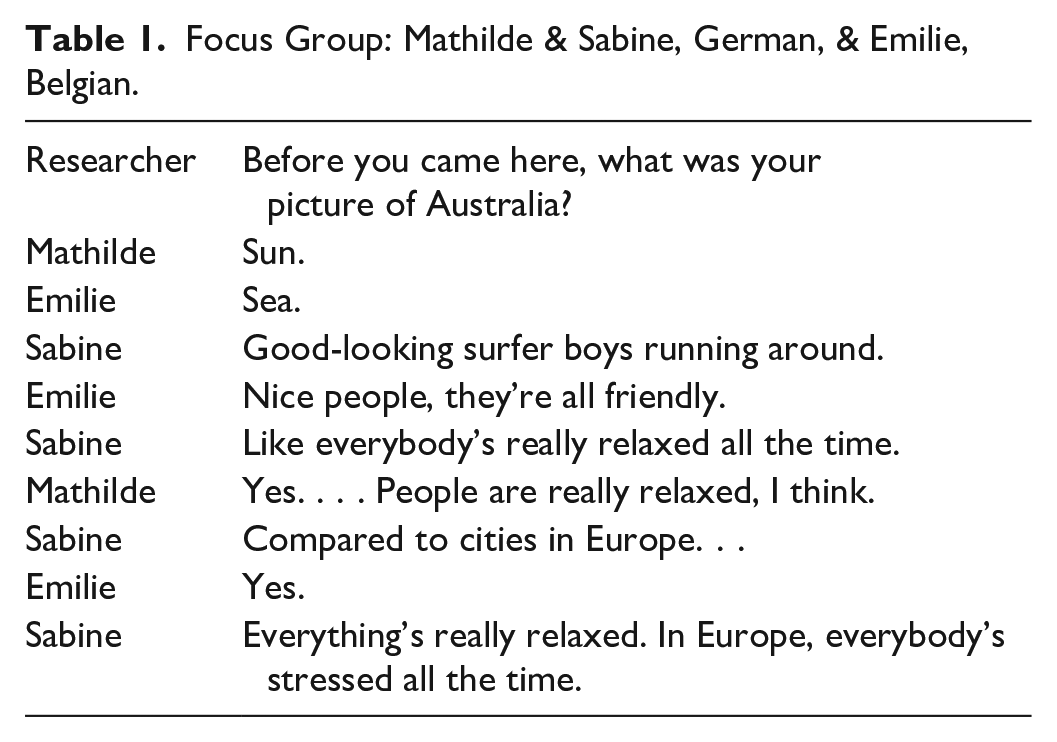
The following extract (see Table 1) from one of the language-traveler focus groups exposes some common stereotypes held about Australia. This excerpt chimes well with broader pre-arrival imaginaries recorded among the language-travelers: most voiced expectations that things would be “different” and “brighter” compared to home, and that people would be “outgoing,” “bright,” and “bubbly.” Some also mentioned hopes that they might become “friends with [their] teacher” and that they would have “teachers who empathize.” These are keywords from the data, emerging variously and repeatedly.
Focus Group: Mathilde & Sabine, German, & Emilie, Belgian.
Where do such expectations come from? Social imaginaries may stem in part from destination marketing, as one center manager suggests: The [Tourism Australia] advertising campaign, which is the selling of Australia overseas, is full of the blonde, blue eyed, bronzed people who are on surf boards with big smiles. (Julia, Director of Studies)
But while Tourism Australia advertisements do rely on such sun-sea-surf images, this is not the whole story. As Mathilde and Sabine note, the expectation of a national “relaxedness” contrasts with “cities in Europe.” A key framing device, then, seems to be cultural difference. But whereas Australia/Australians may be constructed as more relaxed than urban Europe, difference plays out differently for non-Europeans: Before I arrived here, I thought that this country was like United States, like a big city, busy city. All the people may be stressful, maybe angry. But when I arrived here, I saw that all the people was very organised, all the things was just very organised. . . .Here people maybe thinking of you if you have a problem, [people ask] “are you okay?” Friendly. (Andrés, Colombian)
Again, difference is key, although in this case, there seems to be a pre-arrival conflation of the Anglophone “West” more broadly, with comparison made to this more amorphous notion of places—exemplified by the USA—as “busy,” “stressful,” and “angry.” This may help to explain classroom expectations: First of all, I thought, I just wish[ed] that all the teachers [here] have special way to teach English correctly. So, once I had a question to my teacher but she can’t answer to me. So, I’m really disappointed, because I didn’t expect that situation. So, yes, that was a bit different. . . .In Korea, [the teachers] are strict, so they always made us to study. But here. . . .I don’t think it’s strict enough. (Hye Jun, Korean)
Key here are the ideas of correctness, a “special” way to teach English, teachers’ capacity to answer any/all questions, and the contrast with Korean classrooms over the issue of strictness. Again, the key is difference, although the focus has now shifted to English and its teaching. As discussed in the applied linguistics literature, language-travelers may bring with them an imaginary of the Anglophone “West” as the “owners” of English, and this perspective seems to inform Hye Jun’s expectations.
How well are such expectations met? While some language-travelers reported on their realization that such constructions are stereotypes, others struggled with the fact that urban Australia is rather more multicultural and much less White than they had imagined. The following excerpts, including the discussion in Table 2, tease out the issues:
I know Australia is really multicultural and stuff, I know. But on the other hand, my [host] family’s from Fiji. It’s like: I’m not in Fiji; I want to have the real Australian thing.
What’s the real Australian thing?
I think that’s the hard thing about Australia. You don’t really have your own culture. Your culture is too multicultural.
(Marie, Belgian)
We often have issues with students who say, “I’m staying with a Sri Lankan family,” [or], “they’re Indian.”. . .“Indians aren’t English speakers.” You know, we’re in Australia, which is supposedly a multicultural country, and these are people who speak excellent English. . .but they’re not White. The students are stressed by the fact that they’re not with a White [family]. You know, their ideal of what it is to be in an Anglo culture. (Julia, Director of Studies)
Focus Group: Mathilde & Sabine, German, & Emilie, Belgian.
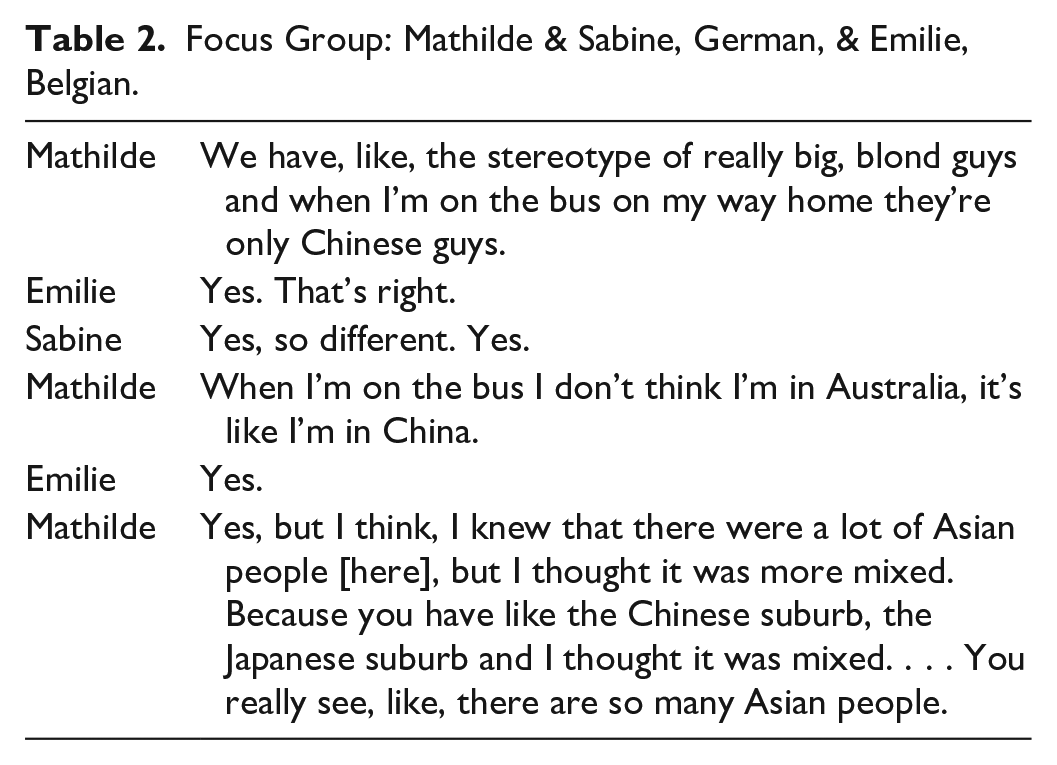
These excerpts describe complex negotiations between an imagined “Australia”—White, Anglophone, and overlaid with blond-surfer stereotypes—and lived experiences of urban Australian multiculturalism. This disjuncture can be understood as slippage between constructs of the Anglophone “West,” Whiteness, and English. Thus, Mathilde’s “It’s like I’m in China” and Marie’s “I’m not in Fiji,” are problematizations of object authenticity. Whilst tourism marketers shape destination image, representations and associated imaginaries are then reinforced through the practices of visitors and tourism providers.
Findings and Discussion: Authenticity and the Backstage
Another commonly expressed pre-arrival hope was that, by studying English in Australia, language-travelers would be able to meet and make connections with “real” Australians, not least their teachers. The following excerpts speak to this desire: In my country it’s almost impossible to be a friend with a teacher, [as a student], because of my culture. But unlike my culture, it’s different here. I think it’s better because they empathize with us. I can easily [talk] about my problem. (Hyori, Korean) My favorite teacher is my morning class teacher. . . . He tries to make conversation with many classmates and he talk about his private story, it makes me closer. (Emiko, Japanese)
Such hopes reflect a desire to access the cultural backstage, conceptualized as part of the quest for object authenticity. However, a necessary conflict that emerges is this: how are teachers to walk the line between sharing and “exposing” Australian “insider” realities while maintaining object authenticity as students imagine it? While language-travelers seek a cultural entry point, they do not necessarily seek to have their own certainties disrupted in the process. The following excerpts, including the discussion presented in Table 3, speak to this complexity, in which teachers are expected to share something of their worlds while doing so in an informatively fun and friendly way: [In class, some of the most successful teachers] just talk about, say, why Australians like meat pies so much. Or what their dad used to do when he was living around here. . . . I think most of [the students] actually do go for it, if they’ve got the personality to carry it. That’s the thing, is that if you’re that kind of charismatic person and you can make a story a yarn, spin a yarn, and make it entertaining. I think the students . . . feel like they’re learning some aspect of Australian culture. (Mark, Director of Studies)
Focus Group: Ulrike, German & Marta, Slovak.
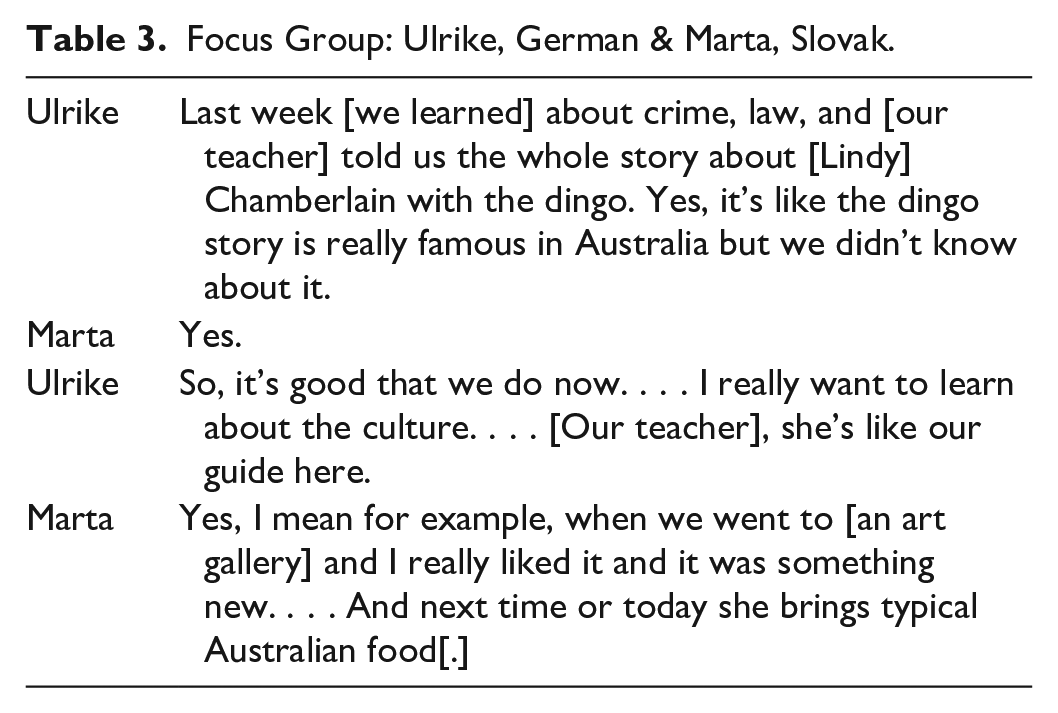
The teacher role, then, comprises elements of storyteller, guide, insider, and friend. To succeed, teachers must be “that kind of charismatic person,” as Mark puts it. This speaks to what Crang (1997, p. 148) called the “the deep acting of emotional labor” through which “employees” selves become part of the product. . .their personhood is commodified’ (p. 153). It also resonates with MacCannell’s (1984) conceptualization of the “museumized group”; when group members of an ethnic attraction become frozen in an image of themselves.
But the commodification of personhood goes beyond deep acting and emotional labor. In the descriptions of some center managers, we can see the staging of authenticity taking place: We started instituting these leaving surveys [and we improved our satisfaction rate]. . . . So, I’m really happy about that. But, in a way, part of me died in the process. Because the way that you really keep students happy has not been to institute a rigorous academic curriculum with clear objectives .. . . It’s really to think much more carefully about what customers want and their expectations. Trying to hire teachers who really have that personality. That personality for teaching, their personality carries the class and keeps the people on board. (Mark, Director of Studies) [One of our teachers, Manny]’s got that coolness. He’s a soccer player. . . . He’s hunky looking. The girls love him. He’s married, so it’s all safe . . . But that just makes all the girls go goo-goo over him. The boys hang out the front [of the building] and he plays basketball with them. . . . So, he’s, for me, a dream type of teacher, where the students love him. . . . [The students say] “Manny is the most wonderful teacher ever.” When it comes to photos, when they’re leaving, it’s, “Manny, Manny. Every student that’s had him [wants a photo with him] . . . If Manny was small and nerdy and wore glasses, would the reaction be the same? . . . I think probably not.” (Amy, Director of Studies)
As Mark and Amy attest, their hiring decisions are based not mainly on teachers’ ability to teach. Instead, they hire those who “have that personality” and who are “cool.” Also important is that they be “hunky looking” rather than “small and nerdy.” As Mark suggests, this is not his preferred course of action. But he bows to the pressure to provide what customers demand.
Findings and Discussion: Race and the Imagined Anglophone “West”
The commodification of personhood goes further than appearance and demeanor, however. Research in applied linguistics has long problematized “nativeness,” and much work in that space speaks to the difficulties faced by non-native teachers (e.g., Kubota, 2020; Phillipson, 2008). Our finding is different, as these are hybrid tourism-education settings in which out-group imaginaries frame object authenticity. Thus, the bigger issue is teachers’ race, and their passive, “museumized” ethnic status. This is exemplified by the much-loved teacher Manny, a Brazilian man—and native user of Portuguese—who is nevertheless in great demand. Indeed, Manny was one of many non-native teachers in the study: In my [teaching] staff at the moment, I’ve got . . . two Brazilians, one Scottish, one English, one Irish, a South African and two from New Zealand. I also had Canadian, Finnish, Norwegian. . .[and] Dutch. … Would it work the same if I had an Asian teacher. . . and Japanese students? I don’t think it would. I think [Japanese students] they’re a bit harder to sell to in their expectations. I think they’ve come all this way and their expectation is to have someone who looks completely different [from them]. Yeah, if you looked at Manny, I mean he could be Brazilian, Italian. . . He’s European looking. I don’t think it would work if I had a Korean looking or Japanese looking [teacher]. [The students are buying] an image. Just a Western image. (Amy, Director of Studies)
Some of the center managers made a conscious effort to resist on this, such as Martin (himself a German man, a non-native English user, and a former teacher of English): [One of our teachers,] Su Ming [a teacher of color], gosh I don’t know where [her family] is from, but she’s grown up in Australia. So, if they’re not aware about [how multicultural Australia is], they learn pretty quickly. . . . All our marketing material and all our brochures and all our orientations, all point to the fact that they’re in Australia, which is multicultural. It’s definitely not what they expect, but that’s to be expected. (Martin, Director of Studies)
Martin’s efforts are laudable. But he is fighting powerful imaginaries, not least as a great deal of conflation of “Australianness” and Anglophone “Westernness” with “Whiteness” remains unchallenged.
The racism does not stop with imaginaries of teachers. For some language-travelers, putative authenticity also produced anti-Asian racism toward their peers: We’ve got European students who will say to me, “oh there’s quite a lot of Asians,” and they’ll do the slitty-eyed gesture. I’ll say, “yeah, that’s interesting; my wife’s Japanese.” They’ll go, “Oh right, yeah, sorry.” (Mark, Director of Studies) Europeans, some of them we’ve had, refused to go into their class because there were too many Asians. . . . They’ll make a slant-y eye gesture. They’ll actually do that. I’ve had quite long and quite difficult discussions about needing to be culturally accepting. . . . Teaching [them] that they are going to have to get to know people with an Asian background. . . . But to what extent is that the fault of the marketing? If you look at our brochure . . .the faces are predominantly European and nice-looking South Americans, all young people. So that expectation, I think, is partly the company’s fault. If everything that you’re shown shows 95 per cent of White faces and young people having a good time in Australia, then you get here and your class . . . 10 out of 15 people [are] . . . Chinese, Japanese, Indonesian, Thai. But they can’t even distinguish between [different Asian identities]. They just look “Chinese” [to the Europeans]. (Amy, Director of Studies)
That the Europeans apologize to Mark suggests that they know all too well that their behavior is problematic. However, these excerpts are the logical end point of a quest for object authenticity of the Anglophone “West” as framed by out-group imaginaries in which there is substantial slippage between Australia, Whiteness, English, and globalization. As Amy notes, advertising materials that center Whiteness do not help, although these are doubtless designed to appeal to markets where such conceptual slippages prevail. The result is a problematic circle of certainty emanating from language-travelers themselves, perpetuated by language center staff under pressure to stage authenticity, and further hindered by media, marketing, and other tourism discourses. How, then, might we unravel this damning Mobius strip that constantly reinforces itself even as it twists and turns?
Proposal: Breaking the Circle of Certainty
Encouragingly, we did find some discursive resistance, beginning with a questioning of the purpose of language-travelers coming to Australia at all: One of the reasons why they’re coming here is globalization. You know, meeting people, networking from different counties . . . [In] this global world, you’re going to need international experience. When I go to . . . the farewell ceremonies, where our director will come and speak, one thing [he says] is, “you’ll be able to put this on your CV as you’ve had an international experience, and that may make the difference when you are applying for a job back in Japan or back somewhere else.” (Anna, Teacher) If you’re going to study with a class full of your own nationality, then why come here? Why not just do it in your own country? So, you come here for more than what you can get back home. A part of that is a mixture of nationalities, where the common language is English. . . . [The students want] the internationalization of themselves. (Lisa, Director of Studies)
These quotes speak to the language-travelers’ motivations and overarching purpose. In most cases, this is at least partially about the development of a “global” identity and outlook, not least with a view to acquiring the cultural and symbolic capital that an Anglophone “Western” sojourn may confer in their home countries.
We propose, therefore, that change might best be initiated through the overt teaching of anti-racism as part of the language/tourism product. As discussed, extant models of teaching “culture” are often rather flimsy, focusing on “food and festivals” and culture as context. This, paradoxically, reinforces discourses of essentialism, determinism, and, above all, difference, all of which are discourses that come through strongly in the language-travelers’ preferences for unthreatening storytelling and backstage access via their “safe,” White teacher/“guide.”
Given that many language-travelers’ aim to “internationalize themselves,” we suggest that classroom teaching and/orientation-type activities might consider engaging sojourners in text analyses of this kind of conversation, shown in Table 4, as a starting point for negotiating these issues.
Focus Group: Mathilde & Sabine, German, & Emilie, Belgian.
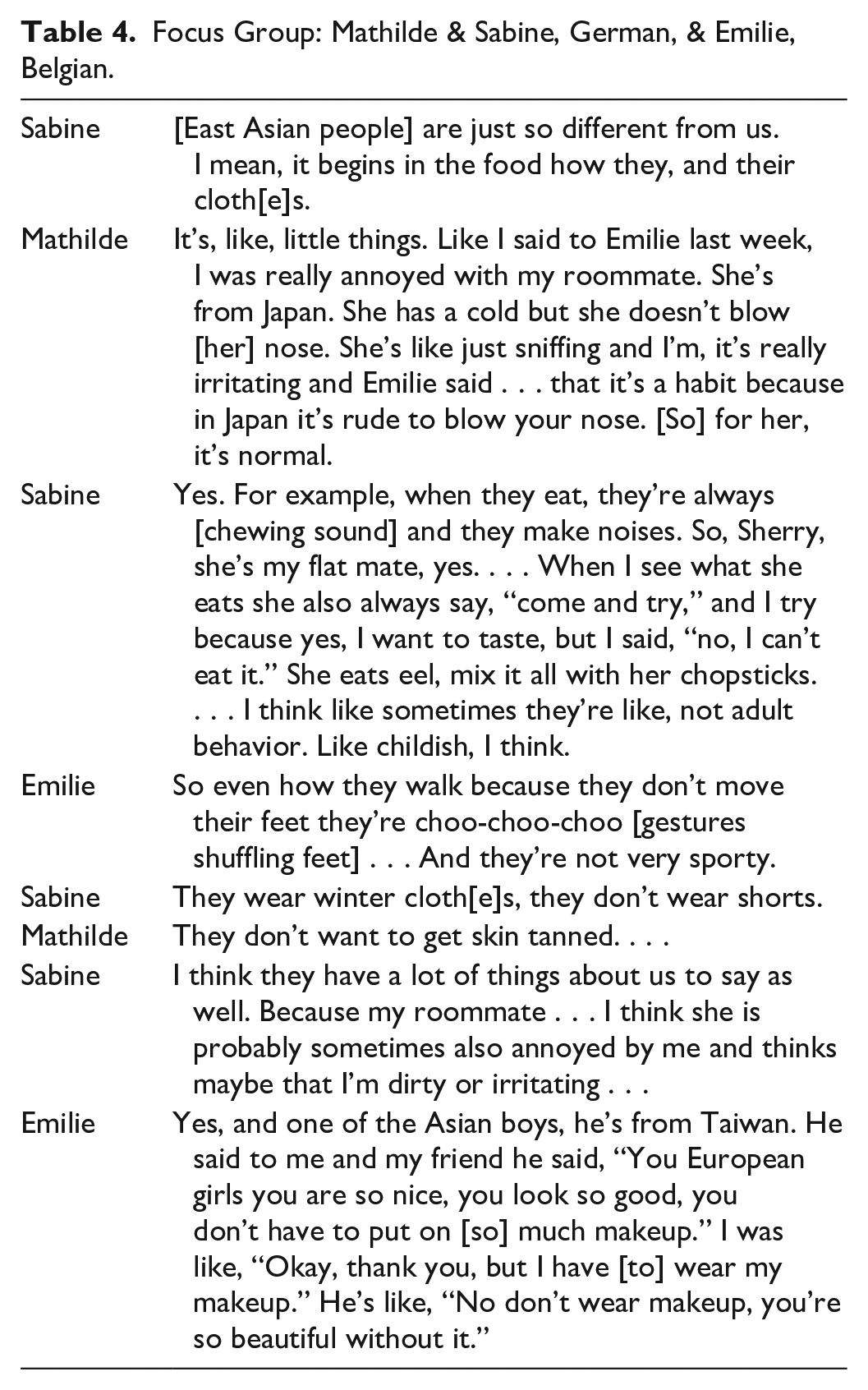
Here we find the negotiation of surface-level markers of cultural difference: food, clothing, make up, manners, hobbies, ways of walking, and notions of cleanliness. Interestingly, as well as being able to delineate the “ways” of the “other” (problematically homogenized as “Asian”), these European participants also identified some of their own “cultural” behaviors that their peers might find troubling or confusing: they, themselves, may seem dirty, irritating or overly made up. Implicitly, here, too, there is an understanding of possible different meanings of outward symbolic interaction, and awareness of culture-specific politeness norms.
We suggest that this sort of text, as shown in Table 4, could be teased apart as the very focus for developing intercultural awareness. Such an approach would make excellent use of the great resource of international peers. To some extent, this may already be happening, albeit to date primarily as an unintended “by-product”.
[The students] are becoming more international, but I don’t think there are many who actually trying to do that. I think that’s just a by-product of what we do … They’re looking for English, and to hold a koala, and all that stuff … And they just haven’t considered [anything else]. The Saudi with a Japanese friend. It just has not clicked ever in their existence … Next thing you know, [a student tells me] “I think I’m going to move to Japan and study … ”[There are] quite a few multicultural romances here, and [when they go home] I find that they’re dating someone from a different culture in their home country. Whereas before they wouldn’t have considered it. It’s that exposure. (James, Teacher)
An overt program aimed at intercultural awareness and competence development may allow for such “by-products” to become a core part of language-travelers’ Australian experiences.
Conclusion
As we note in our introduction, Rickly (2022) suggests that there may already be too many approaches to authenticity afoot, and it is important to produce distinct contributions that address not what authenticity is in tourism, but how it is used, and what it “does,” and for whom. This study therefore proposes a novel theoretical contribution: object authenticity may be applied to constructs much larger and more amorphous than the usual touristic objects (e.g. heritage buildings, souvenirs, and so on). Thinking with interdisciplinary work from applied linguistics, education, and interculturality, we propose that national and supranational cultural imaginaries of Australia, Whiteness, and the Anglophone “West” —as well as individuals’ acquisition of the symbolic/cultural/social capital of a “globalized” personal identity — operate metonymically. Thus, what language-travelers seek from their Australian sojourn is a complex hybrid: part tourism, part acquisition of capital, part learning, and also part reification of comfortable (albeit erroneous) certainties. As a result, language schools as tourism providers are under pressure to stage authenticity twice: by allowing access to the putative backstage —by having teachers share their personal stories, thereby (seemingly) offering access into their private lives—and by not disrupting postcolonial imaginaries that conflate the Anglophone “West” (and globalized power more broadly) with Whiteness.
This contribution is distinct in at least three ways. First, per Rickly (2022), authenticity is most often interpreted as a positive concept or feeling that relates to making connections with places through artifacts and experiences. Yet scholars (e.g., Kirillova et al., 2017) have begun to explore anxiety, avoidance and estrangement in relation to authenticity. So-called “negative authenticity” describes host communities forgetting problematic destination histories as a form of “creative destruction.” Our participants imagine one Australia (of sunshine and surfing; necessarily White) then encounter another Australia altogether (a complex, multi-cultural, multiracial, socially stratified culture, with a convict history and Indigenous blood on its hands). As hosts, language schools face pressure to effect a complex balance between simultaneously mediating and disrupting the experience. Theoretically, the paper adds to Yu and Liu’s (2023) analysis of the contribution of tourism to existential authenticity, and specifically the idea of younger tourists being taken “out of their comfort zone” in order to access authentic experiences. We identify language schools as potential conduits in the process of challenging social norms and expectations linked to tourism that these authors describe, while meeting a key challenge set by these authors: to carry out research into young people’s perceptions of tourism authenticity in more diverse settings. We also draw a metaphorical comparison to Chhabra’s (2005) work on the role of vendors as producers and determinants of perceptions of authenticity, thereby extending her analysis of the “producers” of authenticity away from merchandise vendors in the direction of language schools as experiential vendors. Finally, our study extends the application of trust transfer theory as described by Kim and Kim (2020) by foregrounding language learning centers, and teachers as key drivers of authenticity trust-formulation in the context of tourism which can shape successful outcomes for destinations seeking to attract young travelers. We identify language schools as stakeholders in what Wong (2015) refers to as the process of cultural heritage transmission. Whilst that analysis focuses on documentary films which use relevant content to hail (per Althusser) young visitors, we note in this paper the centrality of language schools in fostering the transmission of cultural heritage information to provide a reference point to interpret destinations.
Second, our paper contributes empirical evidence obtained through fieldwork in the area of long-stay language-traveler tourism, a segment whose voices are relatively quiet in contemporary tourism studies. As Bakri et al. (2022) note, sojourners are critical influencers of tourism, particularly influencing Visiting Friends and Family (VFR) tourism, which is immune to many traditional marketing approaches. Sojourners’ experiences matter since they represent a sustainable tourism segment which has shown resilience during economic downturns and an ability to negate the complications of seasonality. Through our fieldwork and analysis, we have been able to deepen understanding of language-traveler tourists’ motives. We have also set out a proposal for a more critical approach to teaching culture in such a way as to question taken-for-granted imaginaries and promote intercultural awareness and anti-racism by problematizing stereotypes and encouraging critical engagement with discourses of putative destination/object authenticity and the postcolonial power relations therein.
Limitations and Future Research
Given that the focus of the research is geographically limited to three cities, two in Queensland and one in New South Wales, the views of the participants in the study cannot be viewed as representative of all language-learner sojourners in Australia or in the wider Anglophone “West.” We also acknowledge that this research was undertaken at a fixed point in time, prior to the Covid-19 pandemic. It will be useful to monitor changing demographic patterns over time, and the subsequent implications for language-travelers’ expectations and experiences of host countries. There is therefore scope to revisit this research in the years to come with a view to accessing a more diverse sample population.
Second, our sample population is limited to language-travelers in their early 20s studying English in language schools (including language centers within universities). We have not therefore captured data that is representative of more mature language-travelers or children/teenagers studying English abroad; these are substantial tourism/educational hybrid markets, too. Similarly, we have considered the bundled tourism/educational product that is language schools, and the general (as opposed to academic) English offerings within these. This means that we have not considered the intercultural experiences of study tour visitors (i.e., cohesive groups from schools or universities in their home countries who visit Australia for a few weeks or longer as closed groups and undertake classes together). Nor do we consider sojourners studying more “academic” English courses, such as university preparation course or access courses; these, too, would likely offer rich pickings for studies of sojourners’ intercultural development.
Our research methods were also purely qualitative, however this is an approach that was viewed as wholly appropriate, given the nature of the research questions, which called for rich description and in-depth understanding of the issues. There is, however, a place for quantitative work in this area to make arms-length observations about the motives and expectations of language-travelers, and reactions to these initial findings amongst a larger population of language teachers.
Based on our findings, future research should be carried out to test the idea of mediating language-travelers’ cultural experiences of host countries. The present study is restricted to the context of Australia in the immediate pre-COVID era, and it would make sense to contrast the results with a similar study undertaken in the USA and/or the UK, which lead the way (by value, if not by per capita representation in the host countries) in the English language-travel markets. It would also be valuable to revisit these same Australian contexts in the post-COVID era to examine the extent to which the pandemic has provided the “reset” that is hoped for by sector stakeholders (PIE, 2020b) and the extent to which such a reset might have improved this aspect of the complex, hybrid, bundled product that is language-school tourism.
Finally, and from a theoretical point of view, issues around anxiety, avoidance and estrangement in relation to authenticity could be further tested by scholars in other research settings. One such research context with potential in this regard is dark tourism. Issues around the authentic interpretation of taboo histories where the mediators are heritage sites and tour guides rather than language schools could be explored focusing on the youth visitor markets. Closer to the context of this paper, other mediators of destination authenticity which would make suitable units of analysis in future include youth hostels, tour operators, and backpacker social spaces.
Footnotes
Declaration of Conflicting Interests
The author(s) declared no potential conflicts of interest with respect to the research, authorship, and/or publication of this article.
Funding
The author(s) received no financial support for the research, authorship, and/or publication of this article.
