




Abstract
The complex relationship between religion and markets deserves nuanced scholarly reflection and observation. The continuing explosion of online or digital expressions of religion invites researchers to consider the authenticity of virtual pilgrimage experience, for which it is situated at the intersections between religious and marketing studies that allows various dimensions of authenticity to take place. The key contribution of this conceptual paper lies in its development and application of a ‘Hybrid authenticity’ framework which helps explain the consumer-congregants’ development of perceived authenticity of virtual pilgrimage. This framework invites a shift in focus towards the prioritization of iconic-authenticity cues that facilitates a much more ‘liquid’ attachment to object-based authenticity. It also emphasizes the importance of place as an element of constructive authenticity in interpreting pilgrims’ experience and the vital contribution of integrating both interpersonal and intrapersonal authenticity. We suggest the mechanism of this hybrid framework is defined by the interdependence between its elements. We also discuss the two underlying conditions for the mechanism; technology working as an embodied site of interaction and consumer (re)negotiation of authenticity. Viewing virtual pilgrimage as part of a broader social and cultural transformation, we propose the framework also has applicability to other marketing and post-postmodern consumption studies.
Keywords
Authenticity in the virtual age – A common concern of marketing and religious studies
It is sometimes argued that the rising interest in religion within marketing and consumption literature is only recent and remains sporadic (Yip and Ainsworth, 2020). However, critical reflection on religion in the context of marketing is far from novel, and dates back, at least, to Weber (1930), who explores the ways in which religious commitments shape actions and outcomes in the business world as well as the private and personal. A more specific focus on religion in the marketing context has been evident since the 1980s, in a range of studies on the negative association between religiosity and materialism, trendiness, and hedonism (McDaniel and Burnett, 1990; Sood and Nasu, 1995); religion, the self, and identity (Belk et al., 1989; Hirschman, 1983); and the shaping of consumer behaviour by religious affiliation or along faith-based principles (Delener, 1990). Emerging insight here then invited further studies on the intersections between religious and marketing studies (Haddorff, 2000; Karatas and Sandikci, 2013; Sandicki and Ger, 2010; Sandicki and Jafari, 2013; Townley, 1998), including in paradoxical (Jafari and Süerdem, 2012; Rinallo et al., 2016) and complementary ways (Appau, 2021; Appau and Bonsu, 2020; Schmidt, 1995).
Prominent among the complementary interests of marketing and religious studies today, however, is their shared concern for authenticity in the virtual age (Kratochvíl, 2021). In its broadest sense, authenticity is concerned with what is real and what is fake (Andriotis, 2009), in which the aspect of ‘realness’ is approached in terms of both the physical world and the self, arguing that being true to oneself is important (Handler and Saxton, 1988). In marketing, authenticity is argued to be essential for improving receptivity of core messaging across all organizations, profit or non-profit (Labrecque et al., 2011) and in enhancing their perceived quality and prestige (Moulard et al., 2016), to name but a few of its attributes. The growth of technology in the virtual age, however, has put authenticity at risk (Audrezet et al., 2020). As Lagerkvist (2017) observed, technology can alienate people from their selves as human beings, to the detriment of their sense of purpose, experience, and identity. Technology can also make people undermine their sense of significance, engagement, and authenticity (cf. Dreyfus, 2011; Han, 2013). In religious studies, concerns over the authenticity of technologically mediated religious expression have been evident since the Reformation and have increased exponentially in the digital age (Santana et al., 2022). Key studies here include Helland’s (2005) seminal work, which highlighted doubt over the capability of the Internet to facilitate authentic religious and spiritual experiences. In a similar vein, Wagner (2013, p.204) pointed to the ways in which new media, such as mobile apps, are challenging ‘the existing modes of religious authority, and calling into question traditional means of determining religious authenticity’.
Wider reflections on the spiritual impact of the pilgrimage experience have continuously invited debate over authenticity (c.f. Cohen and Cohen, 2012; Reisinger and Steiner, 2006; Shepherd, 2015) and the emergence of virtual pilgrimage only fuelled this discussion further. In religious studies, a pilgrimage is a journey to a holy or religiously significant place undertaken in pursuit of spiritual enlightenment (Husemann et al., 2016; Van Laer and Izberk-Bilgin, 2019), characterized by a commitment to creating focussed time and space for religious reflection which is set apart from ordinary life. Pilgrims aim to visit sacred centres to experience God’s presence through which they can find personal spiritual meanings (Collins-Kreiner, 2016; Huang and Lin, 2023). But in today’s world, what does it mean to go on pilgrimage? Why travel to Walshingham when you can simply view the shrine’s website, or walk the Santiago de Compostela when you can share the journey in a television show instead? The benefits of virtual pilgrimage are not universally agreed upon. Technological advances have enabled the growth of virtual pilgrimage to offer pastoral benefits, such as easier access for the sick and the elderly who may find physical travelling or attendance at a church building problematic (Campbell et al., 2014; Przywara et al., 2021). Further, the coronavirus pandemic in 2020 further accelerated the trend towards virtualization, making pilgrimage accessible to global audiences in unprecedented numbers, which invites researchers to consider the authenticity of virtual pilgrimage experiences (Bailey, 2022). However, the digital pursuit of the goals of a journey is sometimes met with scepticism and questions as to its authenticity, in the absence of the physical transition, effort, and hardship (Hill-Smith, 2009) and the distinctive interactions that real-world pilgrimage requires (Rauf, 2022). It can be argued that virtual interaction becomes too ‘easy’ to be considered an act of spiritual commitment, and lacks the sense of shared endeavour and communal affliction, thus undermining the authenticity of the religious experience.
To contribute to the debate of the authenticity in online religion, as part of this special issue of Marketing Theory on ‘Theoretical Advances on the Contemporary Consumption of Religion’, this conceptual paper proposes a ‘hybrid authenticity’ framework to understand the complex debate around consumers’ perception of virtual pilgrimage experiences. We contextualize our discussion around virtual pilgrimage, since it represents the intersections both between religion and tourism consumption, and between the sacred and the profane, which then allows an interplay of the various dimensions of authenticity to take place (Higgins and Hamilton, 2011; Reader, 2014). By developing the hybrid framework and proposing its application in the context of virtual pilgrimage, we support key studies that suggest the distinction between the authentic and inauthentic is unnecessarily binary (Hietanen et al., 2019; Olsen, 2002) and that authenticity should be seen as a fluid concept with porous boundaries (Goulding and Derbaix, 2019). Our study supports the potential for authentic experience in virtual pilgrimage, rather than discriminating against the online environment as a less ‘real’ sphere compared to face-to-face participation (Scardigno and Mininni, 2020).
To structure this paper, we begin by reviewing the multiple dimensions of authenticity to introduce key elements of the hybrid framework. The next section addresses several perspectives on how consumer-congregants develop their perceptions of authenticity in terms of object-based, constructive-based, inter-personal and intra-personal authenticity. Throughout the discussion, we introduce distinctive characteristics of virtual pilgrimage, including its progressive (Kratochvil, 2021), projective (Park et al., 2019), collective (Fleischer, 2000), and inclusive (Xiarhos, 2016) components. This discussion motivates our shifting focus towards iconic authenticity and liquid attachment in object-based authenticity, highlighting place as key element of constructive authenticity, and the way in which consumer’s perceived intra-personal authenticity is gained through engaging in interpersonal activities. We propose that the mechanism of the hybrid authenticity framework is characterized by the interdependence between its elements. In addition, this mechanism can function with two underlying conditions: technology as an embodied site of interaction and consumer (re)negotiation of authenticity. To wrap up this conceptual paper, we suggest how the hybrid framework has applicability to other marketing and post-postmodern consumption studies.
Building a hybrid authenticity framework: From multiplicity to hybridity
Marketing scholars have extensively sought to refine and clarify perceptions of authenticity and its implications. Key studies have fleshed out the multi-dimensionality of authenticity. For example, it can be conceptualized as object-related or experience-related (Beverland and Farrelly, 2010; Reisinger and Steiner, 2006; Reisinger and Steiner, 2006, 2006).
Studies on authenticity have primarily placed a strong focus on its object-based dimension (e.g. Carsana and Jolibert, 2018; Ewing et al., 2012; Fritz et al., 2017; Grayson and Martinec, 2004; Riefler, 2020). Objective authenticity is concerned with verifying the historical truth of an object (or place) (Cohen, 1988), and is inherent in an object or culture (Chhabra, 2008). Grayson and Martinec’s study (2004) further developed this object-based approach by proposing a distinction between indexical and iconic authenticity cues. This was later developed by Beverland et al. (2008) to suggest that authenticity can be examined and distinguished through the use of different cues. Accordingly, consumers can use indexical cues as fact-based reality cues (such as proof of origin, an original) and iconic cues as stylized versions of reality cues (such as a resemblance, a copy or second version of an original product) to determine the extent to which an entity is authentic (Grayson and Martinec, 2004; Kerviler et al., 2022; Morhart et al., 2015; Newman and Smith, 2016).
However, the object-based dimension is not the only way of viewing authenticity. The concept of authenticity can be approached from a subjective aspect of authenticity (Nam et al., 2023). This approach attends to individuals’ dreams, images, expectations, preferences, and beliefs, the existence of which may not rely on an objectively authentic object (Wang, 1999). Alternative models include constructive authenticity (Zhou et al., 2023), wherein an individual’s projection, imagination, and expectations are considered foundational (Park et al., 2019); and existential authenticity which assists consumers in uncovering their true selves, creating meaning, and achieving a certain personal and subjective state of being (e.g. Beverland and Farrelly, 2010; Morhart et al., 2015; Newman and Smith, 2016). Conceptualizations of existential authenticity shift their focus from ‘object’ to ‘experience’ and from ‘universal’ to ‘personal’ (Jurdi et al., 2021), which is different from object-based narrations of authenticity that are mainly concerned with verifying attributes of objects. Furthermore, Wang’s seminal study (1999) on authenticity distinguished between the intrapersonal and interpersonal dimensions of existential authenticity. Intrapersonal authenticity is characterized as a concept related to ‘self-making’ (Kim and Jamal, 2007), looking inwards to bodily feelings, both sensually and symbolically, and acknowledging how the body becomes a display of personal identity including health, fitness, and classes. In contrast, interpersonal authenticity relates to cultural exchange and the formation of shared experience, such as a sense of touristic communitas, which may take place in the contact zone of participating groups.
The aspiration of integrating these many different models has shifted thinking towards the construction of a hybrid authenticity (Jurdi et al., 2021), which builds upon the strengths of both object and existential models, as Chhabra (2008) proposes. Rickly-Boyd (2012) highlights a potential holistic approach to authenticity that requires representation, experience, and feeling, in which she suggests that object, site, and experience all need to be acknowledged. Studies on the cross-section between consumption and religion too have turned to hybrid approaches to understanding authenticity in the complex context of pilgrimages. For example, Moufahim and Lichrou’s (2019) notion of the spiritual authenticity of pilgrimage proposes a hybrid form of existential, ideological, and objective authenticity, which enables the transformation of the self into a spiritual authentic self through participation in the pilgrimage. Indeed, the central elements of hybrid framework for authenticity have resonance in the field of religious studies (Huang and Lin, 2023), as explained below.
Objective authenticity
The role of objective authenticity in religious and spiritual consumption has received widespread interest from researchers, including studies of the object-based aspect of authenticity including the movement of objects within a religious context (Scaraboto and Figueiredo, 2017), the relationship between authenticity and rituals (Moufahim and Lichrou, 2019), the sacred or profane nature of objects (Rinallo et al., 2012), or the materialization of the spiritual with the facilitation of marketplace (Kedzior, 2012).
Constructive authenticity
This element follows from object-based authenticity, presenting the object’s status as ‘what individuals deem it to be’ (Huang and Lin, 2023: 2), and reflecting the individual’s imagination or projection (Carreira et al., 2022). There are ongoing debates around the roles of constructive authenticity in an online environment. Extant research suggests that constructive cues cannot be generated without original objects (Zhou et al., 2023), thus, it is hard to achieve constructive authenticity when physical ceremonies and activities are cancelled, such as during the COVID-19 pandemic (Huang and Lin, 2023).
Intra-personal authenticity
Moufahim and Lichrou’s notion of the spiritual authentic self (2019) shares similar characteristics with Wang’s conceptualization of intra-personal authenticity (1999), in that both emphasize a sense of authenticity that is built ‘on the personal investment that is tied to one’s identity’ (Leigh et al., 2006: 491). Intra-personal authenticity in religion acknowledges the importance of being true to oneself and of being real, driving focus to self-identity construction and expressive individualism as key component in congregants’ perceived religious experience (Taylor, 2007).
Inter-personal authenticity
Inter-personal authenticity prioritizes connection with the divine and other pilgrims instead of getting too attached to the notion of a physical place (Appau, 2021; Hill-Smith, 2011). In online religion, inter-personal authenticity is perhaps the seminal dimension that distinguishes one religious observance from others (Wang, 1999), as each virtual pilgrimage offers unique religious practices and a variety of possibility of online participation for its members (Hill-Smith, 2011; Siuda, 2021; Tan, 2019; Young, 2004). Studies on inter-personal authenticity prioritize following groups of people, observing their shared activities, routes, and events (KTOTV 2020), and emphasizing the ‘absolutely central’ role of community in the formation of religious experience (Kratochvil, 2021).
Applying a hybrid authenticity framework in the context of virtual pilgrimage
The previous discussion highlighted the nature of a hybrid, integrated approach to authenticity in religion. It is then worth considering whether this hybrid framework is still viable when the pilgrimage site becomes de-materialized, moving from physical space to a virtual space where the physical locations and objects have now all become digital content. As Turner and Turner (2011) suggested, transformation of self is key to the pilgrimage experience and can be gained by pilgrims through three phases: removing themselves from their ordinary; experiencing the possibilities of transcendence (liminality); and reintegrating in the community. However, bodily pilgrimage is deemed to have advantages in offering congregants the opportunity of physical movement away from normality and the immersive nature of the pilgrimage experience, compared to its virtual counterpart (Xiarhos, 2016). In contrast, offline pilgrimage does not guarantee a mental break from the profane world (MacWilliams, 2002; Xiarhos, 2016), while virtual pilgrimage has shown potential to be a much more inclusive experience than a bodily pilgrimage. Virtual pilgrimages offer the possibility of going on a transformative but non-physical journey that would be beneficial for people incapable of physically leaving for an extended period of time, such as ones experiencing health issues, finance problems, professional concerns, or familial obligations (Xiarhos, 2016). Virtual pilgrims can also be members of the LGBTQ + community whose religious and spiritual identities might not be so well accepted in all physical settings (Smith, 2022). Thus, the authenticity of virtual pilgrimages seems to be an important test case, which potentially could have immensely positive practical impact upon religious adherents (Dunn-Hensley, 2020), if this virtual experience can truly deliver a much more inclusive experience than a bodily pilgrimage (Xiarhos, 2016).
Extant studies have examined dimensions of perceived authenticity in pilgrimage (Park et al., 2019). However, as Huang and Lin (2023) identified, further studies are required to understand the influence of pilgrims’ objective, constructive and existential understandings of authenticity, including both inter-and intra-personal elements of the pilgrimage experience, and with special attention given to the virtual pilgrimage experience. To contribute to this debate, the next few sections of the paper will revisit key elements of the framework (object-based authenticity, constructive authenticity, inter-personal authenticity, and intra-personal authenticity) to investigate the ways in which a hybrid authenticity framework can be applied and adapted to study the development of perceived authenticity among virtual pilgrims. In each section, we will offer a closer look into distinctive nature of virtual pilgrimage to justify our proposed shift in focus and concepts within the framework. Examples from religion-related case studies will be introduced to illuminate and assist our discussion.
Revisiting object-based authenticity
Grayson and Martinec (2004) make an important distinction between indexical and iconic authenticity cues. Not all material cues in physical pilgrimages can be integrated and transformed into a virtual context, such as relics, healing water, or blessed souvenirs. The absence of corporeality and indexical cues is appropriated due to different understanding of the meaning of pilgrimage. Kratochvil (2021) distinguished two ideal types of pilgrimage. The first is ‘predominantly politically conservative’ focussing on objects and materiality, including human bodies or sacred sites. The second type is called ‘progressive pilgrimage’, viewing pilgrimage as a journey and body movement instead of the bodies themselves. Virtual pilgrimage fits in the approach of progressive type, which focusses upon transition and transformation and prioritizes cues that support such movement, rather than disseminating the non-materialistic aspect of virtual context. Thus, studies on virtual pilgrimage should further look into the types of object-based authenticity cues that can be used to underpin the religious experience of virtual pilgrims. Further, it is worth examining how the shift of focus may influence customers’ attachment to sacred objects in virtual pilgrimage. To address these questions, we propose some fresh approaches to look into iconic authenticity as detailed below:
A shift in object-based authenticity: Towards iconic authenticity
In the context of virtual pilgrimage, it can be suggested that the objects in online religion are iconic in nature, even though objects in physical pilgrimage sites are commonly classified into the indexical category due to the uniqueness of their existence. In virtual environments, objects are items of digital content that are subjected to mass reproduction and dissemination. Religious artefacts in virtual pilgrimage can come under the form of digital artworks, photography, posts, websites, or videos (Campbell and Lovheim, 2011). Such reproduced works have been proved to be able to evoke a proximity to the sacred to an extent (Benjamin, 1968). In an online religion context, these reproductions simulate the encounter with the divine to support congregants’ engagement with ritual events in a virtual sphere (Gralczyk, 2020). Videos, livestreams, or films can ‘forge an audio-visual experience’ for virtual pilgrims, and online posts and website content offer content, imagery, and religious instruction that are seen as a form of “soft”, informal form of ‘authoritative religious texts that instruct users to ways of piety’ (Golan and Martini, 2018: 41).
The shift towards iconic authenticity, however, requires consumer validation for authenticity to come into being (Dueholm and Smed, 2014), as iconic authenticity highlights the ways in which recognition and personal experience underline authentication. Hill-Smith (2009) described one online experience where congregants entered the virtual sacred space through an image of shoes on sunlit tiles, symbolizing a transition of physical space, and were invited to perform occasional tasks such as positioning virtual candles on an altar through following the links on the website. Visitors attended the ritual under a ‘cyberguide’ that directs the ‘pilgrim’, offering psychospiritual guidance and citing scriptural passages through an electronic-sounding female voice. MacMillen (2011) observed how online pilgrims leave virtual roses and post prayers when visiting the virtual site (website) of the Our Lady of Guadalupe shrine. Images of removing one’s shoes, virtual candles, and digital roses are iconic authentic cues that represent distinctive characters and rituals for different pilgrimages.
The development of liquid attachment to object-based authenticity
A shifting approach to authentic objects in online religion leads to next point of discussion, which are the changes in relationship and attachment between the consumer-congregants and the sacred objects. In a traditional pilgrimage, religious rituals are replete with sacred objects to assist the aim of achieving material results, such as healing (Turner and Turner, 2011). Through building up meaningful and enduring relationships with objects, consumers identify a need to ‘possess’ the objects, viewing them as sacred and believing in their capacity to shape and reflect the consumers’ identities (Belk, 1988; Ferreira and Scaraboto, 2016). Studies on consumer-object relationships have begun to conceive of attachment as varying along a spectrum between solid and liquid (Santana and Botelho, 2019). Attachments to material possession (Kleine and Baker, 2004) such as those seem in physical pilgrimage have been defined as ‘solid consumption’ (Bardhi and Eckhardt, 2017), which refers to the ownership-based, tangible and enduring nature of person-object interactions. Liquid attachment is characterized as access-based, dematerialized, and ephemeral (Bardhi and Eckhardt, 2017).
The nature of mass reproduction, mass distribution, and de-materialism of digital content (Castells, 2000) in online religion thus suggests a form of liquid relationship with possessions among online congregants, enabling a more flexible manner and approach for consumers to engage with the divine. Fluidity in forms of relating and interacting with objects has been proved to be necessary in liquid times (Arcuri and Veludo-de-Oliveira, 2018; Atasoy and Morewedge, 2018; Husemann and Eckhardt, 2019). Such flexibility in consumer-object relationship has become especially important in disruptive periods such as the COVID pandemic, during which physical interaction and gatherings were impossible. Also, consumer-object liquid attachments are not less special than solid ones (Masset and Decrop, 2016; Santana and Botelho, 2019). It should be noticed that, while the fluidity of interaction in online religion well aligns with the logic of liquid consumption, the aspect of ephemeral attachment to digital consumption in the original study by Bardhi and Eckhardt (2017) should be treated with caution. Ephemeral attachment should be only understood in the context of the access-based nature of online religion, in which consumers put less importance on material objects, rather than being interpreted as a merely cursory, superficial engagement with religion. At the same time, liquid attachment should not be seen as a replacement of the traditional religious rituals which aims at using sacred objects to help congregants achieve their spiritual goals (Turner and Turner, 2011).
Constructive authenticity: Challenges of physicality of place
Studies acknowledging the crucial roles of constructive authenticity in the formation of perceived authenticity have highlighted the importance of constructive authenticity in interpreting pilgrims’ experiences (Zhou et al., 2023). This finding aligns with Park et al.’s research (2019), which explains how constructive authenticity is based on the individual’s projection, imagination, and expectations. Indeed, in a sense, the constructive model of authenticity invites recognition that virtual pilgrimage is anything but new, since the word ‘virtual’ originally comes from the medieval Latin ‘virtualis’, interpreted as ‘something that exists potentially rather than actually’ in scholastic philosophy (MacWilliams, 2002: 317). Even the traditional pilgrimage itself, therefore, exhibits this sense of the ‘virtual’, given the fact that ‘it operates as a metaphorical reminder of the Christian journey to Heaven’ (Dunn-Hensley, 2020: 125).
Furthermore, studies on online religion have observed consumer congregants’ construction of authenticity when they are unable to receive the bread and the wine of the Eucharist – symbolic of the body and blood of Jesus (Dowson, 2020). In some traditions of Christianity at least, the consecrated bread and wine are often consumed in online rituals by the priest alone, while the congregants sitting at home use their devices to connect with the rituals, break and receive their own bread and wine as unconsecrated substitutes in a virtual communion (Irlenborn, 2023; Tran and Davies, 2023).
We propose that studies on constructive authenticity can be expanded by furthering our understanding of consumer’s construction of place in virtual pilgrimage for many reasons. Religious sacrality and the importance of ritual events are inextricably attached and linked to the impact that the sacred status of the place has upon its visitors, given the fact that place ‘inspires the pilgrims ideologically and arouses them emotionally’ (Moufahim and Lichrou, 2019: 329). Pilgrimages are strongly associated with place, particularly holy places and sacred centres where pilgrims expect to experience God’s presence, through which find personal spiritual meanings (Collins-Kreiner, 2016; Huang and Lin 2023). While online spaces are capable of offering highly interactive, participatory, and flexible, enabling places of worship to be digitally presented in dynamic ways (Helland, 2005, 2007), extant studies still question the notion of authenticity of the pursuit of the journey’s goal due to the absence of any physical transition (Hill-Smith, 2009).
Future research can offer new insights into the aspects of space and place as perceived physicality though investigating the cues and artefacts that support consumers’ construction of sacred space and place. For instance, light can be among the cues and artefacts that future research can focus on to gain an understanding of consumer-congregants’ perceived authenticity. Mansour (2019) found that light, with its capacity to represent and symbolize the Divine presence, can influence a congregant’s perception and spirituality, in either virtual or physical contexts. In pilgrimage, light is closely related to the journey since different light conditions and intensities vary across geographical locations, building designs, and different points of times as encountered by the pilgrim. Historically, the absence of light overnight placed limits upon the possibility of movement and as such framed the cadence of the pilgrims’ daily journeying. Light is also seen as an important feature in sacred architecture, for which light is deemed as the “holy” light to be integrated as part of the church design (Coriden et al., 1985). In virtual sacred architecture, websites – as virtual churches – with low brightness triggered fear (Mansour, 2019), while ones with more light evoke joy, contributing to congregants’ spiritual experience, and uplift their soul (Geva, 2011; Geva and Garst, 2005; Plummer, 2009). The perceived effect of lights on constructing virtual congregants’ authentic experience also explains why the act of lighting candles (Hill-Smith, 2009, 2011) becomes an iconic authenticity cue that is well received in virtual pilgrimage.
Inter-personal authenticity: The central role of community building
It is undeniable that place is a key factor in constructing pilgrimage experience, in both actual and virtual contexts. However, pilgrimage is more than just a place. It is characterized by, and firmly rooted in, building communities rather than community’s (physical) buildings. In Wang’s study, the experience a group of pilgrim shares forms interpersonal existential authenticity on their journey (1999), making the pilgrimage a collective activity (Campo, 1998; Fleischer, 2000). Early studies observed that it is the sense of connection, including a connection with the mythos of the place, that defines pilgrimage (Hill-Smith, 2011), and a pilgrimage is deemed to happen best when it is shared with many people (Turner and Turner, 2011).
Pilgrimage is a communal, collective activity (Belhassen et al., 2008; Campo, 1998; Fleischer, 2000), and this does not change in the virtual world. As Scardigno and Mininni (2020) suggest, there should be no separation between the offline (lived) and online (mediated) life and experiences in the religious realm. The Internet can act as an extended environment of offline religion, an extension of the lived religion by offering new types of interactions and alternative form of community, which assists the existing offline religious communities (Campbell, 2005; Helland, 2005; Siuda, 2021; Campbell, 2022). When the online-offline boundaries become porous, virtual pilgrimages invite new adaptations of religious activities, practices, and various possibility of online participation. This includes the discursive co-construction of contents and social interactions in a virtual environment, which both embrace the origins and traditions and offer new generative forms of lived religion (Orsi, 2003) through online visual, auditory, and textual descriptions (Tzanelli, 2020).
Further empirical research can expand this research direction through offering a closer look into the forms of community connection and interaction in virtual pilgrimage as well as the platforms that virtual pilgrims use to connect and interact with the divine and the community. Some examples from religion-related case studies below can be used as the starting point for future discussions.
Forms of community connection and interaction
Studies on forms of connection and interaction can look into a wide range of innovative virtual pilgrimage experiences. Along with conversations on the journey which allow pilgrims to share experiences or exchange impressions, group singing is often a crucial component of any pilgrim’s journey and also serves effectively to convey emotions and translate them into a shared expressive code (Caruso, 2022). Music performance thus becomes a topic worth discovering, among various forms of community interaction. As articulated by Regula Qureshi, bonds of shared responses can be formed through music (2000, p.810–811): “The physical sensation of sound not only activates feeling, it also activates links with others who feel. In an instant, the sound of music can create bonds of shared responses that are as deep and intimate as they are broad and universal…the experience becomes public, shared, and exterior. Such a recitation of feeling and sensation, in turn, endows musical sound with a social existence coded as identity (“our” music) and with shared associations and connotations coded as aesthetics (art)”
Importantly, the ephemeral bond of a sonic event is not solely bounded through just physical contact (Qureshi, 2000), which enables music to become a form of community connection and interaction in virtual pilgrimage. In Caruso’s study (2022) on the use of social Media to assist virtual pilgrimage to the Holy Trinity of Vallepietra (Central Italy), music performance was highlighted as the core of the ritual that needed to be reproduced and maintained during the lockdown in 2020 for any encounter to be considered authentic, and music was used as a means to evoke interaction between congregants. The interaction was initiated by the mayor of Vallepietra and the rector of the sanctuary, through a simple act of informing people of the use of virtual platforms to compensate for the absence of the traditional pilgrimage. To respond to their announcement that was posted on Facebook pages of the three main institutions revolving around the sanctuary of Vallepietra, congregants participated by posting on Facebook videos of women singing the Canzonetta, the final part of the Pianto-delle-zitelle. Since this song is a lament about the death of Christ sung only by the women of Vallepietra at the shrine on the Sunday of the Holy Trinity feast, it can be seen that congregants in Vallepietra partook in the virtual pilgrimage with an already consolidated musical repertoire. These Facebook posts of pieces of music and videos of the songs of the shrine offered new ways to perform the traditional songs of the pilgrimage. It can be seen, therefore, that a key attraction of virtual pilgrimage lies in the ways in which the online environment creates community and that allows consumer-congregants to communicate, practice, participate, and engage with spiritual experience in dynamic ways (Siuda, 2021). The wide variety of activities which can generate inter-personal authenticity further strengthens the notion of progressive pilgrimage, which views pilgrimage as a movement, a journey, rather than merely a destination, bounded by the concept of place.
Platforms for connection and interaction
The possibility of fluid access to physical place does not mean that online tools detach pilgrims from offline religious expression. On the contrary, research has shown particular interest in examining various types of online tools and the way in which they are used by the online congregant communities to enable offline rituals.
The inter-personal authenticity of online religion relies heavily on the modalities and tools available on the digital platforms. Platforms adopted range from websites to prayer apps to live-streams, pre-recorded YouTube videos, and multiple uses of social media (Ohman et al., 2019). This flexibility of mediated religion thus allows congregants to engage together in ‘new social and discursive opportunities’ (Scardigno and Mininni 2020: 213) in a way that offline religion cannot afford, such as tweeting their prayers, synchronously participating in ritual events from around the world, discussing shared beliefs, and building their own prayer communities (Siuda, 2021). More recently, would-be pilgrims have been noted to consult reviews and participate in online platforms in planning their trip (Husemann and Eckhardt, 2019). For instance, Van Laer and Izberk-Bilgin (2019) looked into reviews of one pilgrimage journey shared on the Trip Advisor platform, which sheds light on how online reviews helped intending pilgrims to understand the feelings of the traveller-reviewer writing them and get to know essential practices for the journey. This online context offers important insights into the construction of inter-personal authenticity, as it shows how the power of sharing and influencing the community lies in the members within it instead of ‘a handful of elite reviewers’. Other platforms assisting interaction in virtual pilgrimage include Zoom, MS Teams, and Facebook that stream a pilgrimage directly to viewers (Raj and Griffin, 2020), interactive website that allows pilgrims to post prayers and light candles electronically using digital devices (Bailey, 2022). Webcam technology also introduces new concept of ‘TV’, through which viewers are taken virtually to the grotto (Bailey, 2022) or the church site (Tran and Davies, 2023), and some of virtual tours also treat congregants to live music (Luxmoore, 2020). The interaction and connection with the divine from within the community has been made possible and enriched through connective technologies (Scardigno and Mininni, 2020) enabling virtual pilgrims to escape the profane and enter into a sacred atmosphere of divine presence.
Intra-personal authenticity: The authentic virtual self
A key challenge for intra-personal authenticity, in both virtual and actual pilgrimage, lies in the construction of the authentic spiritual self (Leigh et al., 2006; Moufahim and Lichrou, 2019). Existing research further highlighted how participants’ emotion, experience, and self-transformation are key in pilgrimage (i.e.: Andriotis, 2009; Buzinde et al., 2014; in Higgins and Hamilton, 2020). When placed in an online environment with virtual engagement with the divine and the congregant communities, online consumer-congregants need to consider ‘whether online bodily experiences can be judged to be as authentic as offline experiences’, and ask themselves how to best define the relationship between the offline and online body (Radde-Antweiler, 2013: 93). Further, since the idea of undertaking a religiously or spiritually motivated journey via the Internet has often proven controversial, future research should look into how pilgrims can obtain this transformative experience. Future studies can focus on explaining the process through which virtual pilgrims learn to construct their authentic virtual selves and adhere to the core values of a religion. The sections below will offer some examples to illustrate the learning processes of virtual pilgrims.
Constructing the authentic virtual self
Extant religious studies record a number of ways in which consumers can create the virtual self while connect with actual pilgrimage experience. Hill-Smith (2011) noted that pilgrims on at least one virtual expression of Hajj can create avatars in traditional pilgrim clothing. These avatars can experience pilgrimage activities together, including conversing, praying, fasting, and encouraging each other, all of which are deemed as valid online as through any physical pilgrimage experience (Xiarhos, 2016). With the new movement of media, the digital human is viewed as ‘exist-er’ – an ‘embodied, relational, mortal creature’ that is as passionate in searching for meaning as the human in an offline environment (Lagerkvist, 2017). Noticeably, these exist-ers are no less embodied than the offline human. They use such tools of existence as digital media – which have become environmental forces in the world (Floridi, 2015) – to move through the existential terrain of connectivity to develop dynamic relationships of mutuality, ambivalence, and change (cf. Mitchell and Hansen, 2010).
Virtual pilgrims can also find their true selves through connection with the divine, with tradition and religious rituals, as well as with other (virtual) pilgrims. In another word, intra-personal authenticity in virtual pilgrimage is enhanced through inter-personal authenticity activities. This approach has been discussed in Tran and Davies’s study (2023), which illustrated how one London megachurch offered a range of virtual, dynamic forms of interaction during the pandemic, including workshops, conferences, celebrations that help pilgrims to seek an authentic life and authentic self. Those events and activities are built upon the theological tradition known as ‘the prosperity gospel’ of the Pentecostal megachurch, further attenuated and anglicised by the church to promote aspiration and individual empowerment (Cartledge and Davies, 2014) and offer its adherents the prospect of both wealth and health (Bowler, 2013). The triadic relationship between authenticity, personal experience, and group inclusion is often recognized in extant research. For instance, Kernis and Goldman (2006) suggest that a group’s encouragement to its members to remain true to themselves and be confident enough to be different from (or similar to) other members as they choose is, in itself, a significant commitment to authenticity. Ultimately, committed encounter with the other (be that the divine or human other) is fundamental to the authentic expression of religious experience. The state of ‘being oneself’ in virtual pilgrimage is constructed in the interaction of object, place and experience (De Andrade-Matos et al., 2022; Zhou et al., 2023). Advances of technology and virtualization are required in supporting pilgrims to interpret their authentic experience which relies on happiness, self-discovery, and feelings of connectedness to the world and other people (Fu, 2019).
Adherence to core values
Besides prioritizing the personal constructions of participants, virtual pilgrimage places its focus on pilgrims’ adherence to the core values of the new culture of online religion (Williams and Copes, 2005). Virtual pilgrimage sites enable people to ‘journey’ together in pilgrimage garb through their avatars, urging congregants to undertake ritual-reflecting activities at home (Hill-Smith, 2011). Virtual sites also offer chat-windows for virtual pilgrims to discuss personal experiences, motivations, thoughts, and problems with other pilgrims. As Hill-Smith emphasizes, this incitement to physicalization aims at generating a real, actual relationship through activities being undertaken virtually.
Support from virtual sites, however, does not automatically equate with pilgrim’s adherence to religious rituals in an online environment. Consumer-congregants are required to develop their autonomy and tackle challenges of virtual environment, such as distractions from the profane world and a lack of having likeminded people around them to help maintain the focus needed in pilgrimage (Xiarhos, 2016). One example of self-adherence challenge is the music performance during pilgrimage, a core component of many rituals (Caruso, 2022). During virtual pilgrimage, congregants are invited (perhaps even expected) to sing along at home. Even though their physical bodies are almost certainly not in any place of worship, their pilgrimage experience is still real since their singing is co-located, both with other pilgrims singing along in their homes and with the church-based congregation. While the pilgrimage sites are designed to transmit live hymn music, virtual pilgrims are not among the physical throng of singers (Hill-Smith, 2011). The act of singing along thus entirely relies on the worshippers’ focus and persistence in practicing and maintaining their rituals.
The mechanism of hybrid authenticity framework in the context of virtual pilgrimage
Distinctive characteristics of virtual pilgrimage, including progressive (Kratochvil, 2021), projective (Park et al., 2019), collective (Fleischer, 2000), and inclusive (Xiarhos, 2016) have suggested a shifting focus in elements of the hybrid authenticity framework. Building upon the previous discussion of the application of the hybrid authenticity in virtual pilgrimage context, this section explains the mechanism of the framework, characterized by the interdependence and interaction of elements (Figure 1). We will also discuss the two underlying conditions for this mechanism; technology working as an embodied site of interaction and consumer (re)negotiation of authenticity. The mechanism of interaction between elements of virtual pilgrimage’s hybrid authenticity framework. Source: The authors.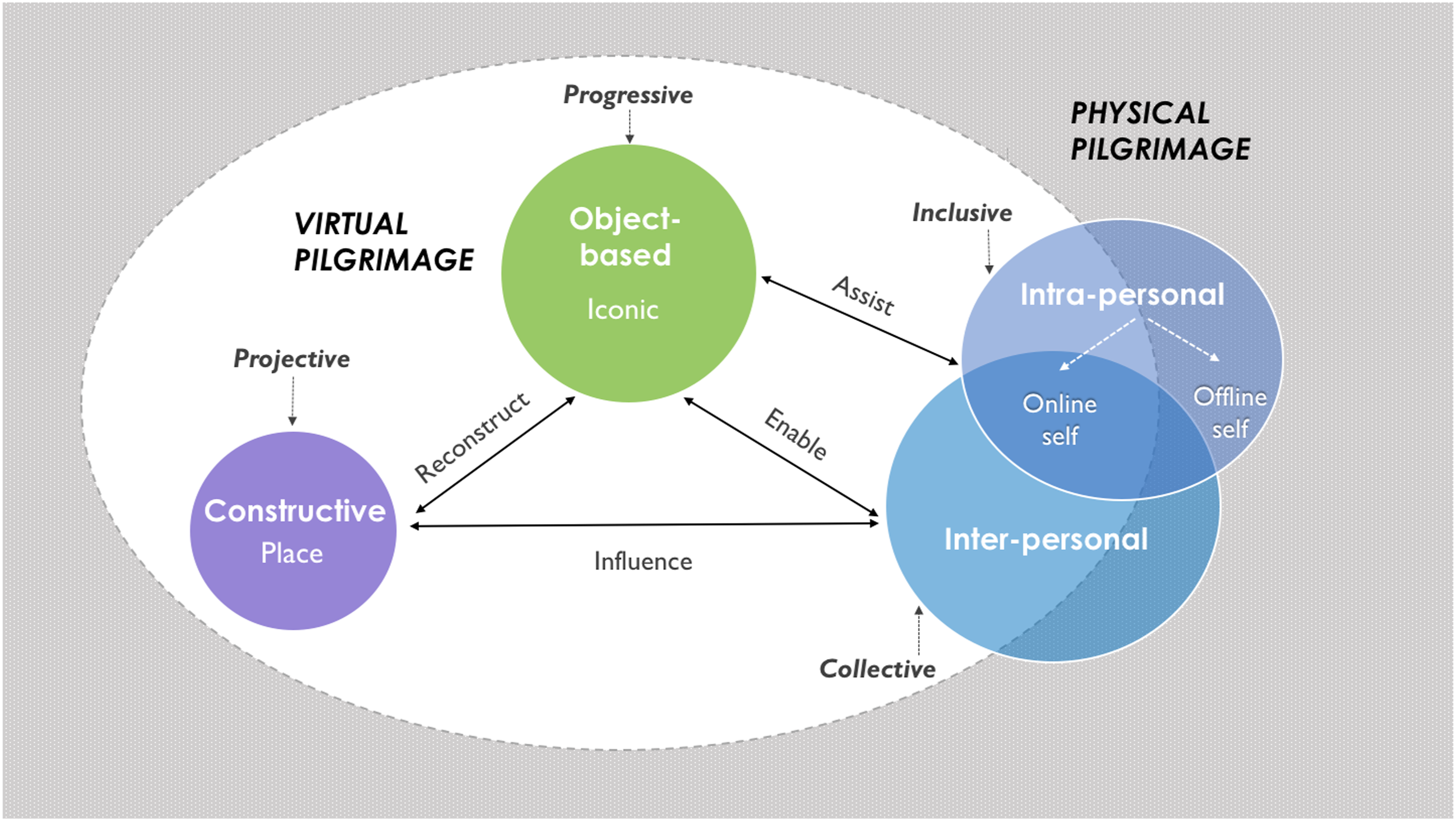
The inter-relationship between intra and interpersonal authenticity
In virtual pilgrimage, the intra- and inter-personal authenticity dimensions – which together form the existential authenticity – are commonly intertwined and inter-related, and this characterizes the importance of social inclusion for religion. Our proposed framework suggested virtual pilgrims can find and construct their actual selves in an online environment through engaging in inter-personal authenticity activities and developing connection with the divine, tradition and religious rituals, as well as other (virtual) pilgrims. To argue for a broader understanding of the relationship between the intra- and inter-personal dimensions of authenticity, we bring into focus the relation between self-growth (intra-personal) and social inclusion (inter-personal authenticity). This shift in direction derives from previous studies which explained how inclusion can help enhance self-esteem (Leary and Baumeister, 2000; Tajfel and Turner, 1986), validate self-belief (Hogg and Abrams, 1993), strengthen a sense of distinctiveness and acceptance (Brewer, 1991), and indeed demonstrate that inclusion in groups is essential to humans (Correll and Park, 2005).
The interaction between objective and existential authenticity
While the hybrid authenticity framework acknowledges the significant influence of object-based authenticity on pilgrims’ experience, it further suggests authenticity should be considered in its complexity in which object must be linked with experience and ideological dimension (Lugosi 2016) to enable the shared religious narratives (Belhassen et al., 2008). As Kelner (2001) asserted, these shared narratives connect experiences of particular places, objects, and actors, and have important implications for the development of congregants’ perception of authenticity. The hybrid framework particularly highlights two key implications:
At the intra-personal authenticity level, the shared narratives enable consumers to learn how iconic authenticity can become the dominant factor in object-based authenticity, replacing the role of indexical cues often seen in the offline context. It is important to note that not all iconic authentic cues are able to offer the same experience of the holiness of the central religious place, given the fact that each cue is only able to simulate a certain aspect of a physical religious experience. Iconic cues, such as posts of Facebook, or photos and videos of pilgrims approaching the sanctuary, can assist consumer-congregants in obtaining a religious experience through reactivating the memories that are held from their previous visit to the sacred place (Caruso, 2022). In turns, consumer-congregants need to see the potential of online and offline co-existence of pilgrimage and be willing to learn and utilize online tools to enhance their experience in order to obtain religious experiences.
At the inter-personal level, such narratives encourage consumer-congregants to participate in communal interactions and shared experiences (Leigh et al., 2006). Virtual pilgrimage is characterized by, and firmly rooted in, building communities rather than community’s (physical) buildings, which makes the emphasis upon the de-materialization of objects and an access-based approach all the more appropriate. The concept of liquid attachment in object-based authenticity is helpful and relevant in assisting knowledge contribution and diffusion within a community. Also, it maintains some existing offline communities through online interactions (Campbell and Vitullo, 2016; Siuda, 2021), rather than replacing the entire ritual aims that physical religion offers. To achieve a state of authenticity in virtual pilgrimage, the fluidity in interaction also enquires congregants to familiarize with the discursive sphere and online social dynamics, as well as new practices, including building ‘discursive efforts to guarantee anchorage to religious traditions’ (Scardigno and Mininni, 2020: 226).
The inter-dependence between objective and constructive authenticity
In the pilgrimage experience, of course, the goal is, most often, an artefact of fixed location and indeed the location itself. Studies such as Waitt (2000) have argued that pilgrims rely heavily upon the objective, with Belhassen et al. (2008) suggesting that any sense of a shared, socially constructed meaning is lost if the destination place or object is dismissed or overlooked. However, extant studies suggest the importance of viewing object-based authenticity as ‘configurations of knowledge, which can involve places, people, objects, actions, sensations and experiences’ (Lugosi 2016: 101), rather than one which is bounded in the form of physical items or associated with physical place. Kruger and Shannon (2000) also proclaimed that a (sacred) place is constructed through the way in which humans integrate their experiences of the environment with meaning-creation and physical settings. It can be said that a shift towards iconic authenticity enables a more fluid approach to people’s reconstruction of ‘place’. In turn, the consumer-congregants’ projection in new meaning construction has enabled further possibilities for iconic cues to be perceived as authentic in virtual pilgrimage.
Bridging constructive and existential authenticity through place
As explained previously, the contribution which place makes to meaning-making is understood as a social construction process, in which the meaningfulness of a place is influenced by people’s experience in that environment (Brandenburg and Carroll, 1995; Eisenhaue et al.; Tuan, 1977) and thus can be shared among people. Belhassen et al. (2008) further explains that authenticity connects with both ‘the act of touring a destination’ and people’s experiences, which further highlights the importance of integration the physical environment into an existential authenticity approach in shaping one’s perception of authenticity.
We thus suggest that place, action (movement towards and encounter with), and belief (the ideological framework for highlighting the significance of the place or the object which makes the place so important) combine to form the authenticity of the pilgrim’s experience. Given the reciprocal action between and within spheres which forms the authenticity of virtual pilgrimage, consumers need to be able to view pilgrimage as a relational and social phenomenon (Higgins and Hamilton, 2020), dependent not on a particular site but rather on ‘the interactions that emerge between people, places, times and imaginaries’ (Bajc et al., 2007: 328). This approach also challenges the bounded perspective on pilgrimage which ‘overlooks the symbiotic relationship’ between the pilgrimage site and the ordinary environment (Higgins and Hamilton, 2020: 3). Our hybrid framework also challenges previous studies rejecting the possible influence of constructive authenticity on existential authenticity (Huang and Lin, 2023).
Technology as embodied site for the interactive mechanism
The interaction between the key elements of the framework explains how authenticity emerges through networks of relations (Lugosi, 2016) and also acknowledges the power of different actors and factors in shaping the qualification of authenticity. Different actors are able to make claims about the qualities of experiences, spaces, and artefacts to create such assertions of authenticity. This interaction is essential in enabling and enhancing the connection between the offline and online spheres through supporting religious organizations and traditions in adapting to the online environment (Gralczyk, 2020; Siuda, 2021). This discussion is further expanded in Rahimi and Amin’s study (2020: 82) in which digital technologies serve as an embodied site of interaction ‘in shaping shared experiences based on networked sociability’. Their study embraces the relationship between religion and technology, in line with Hoover’s view (2002: 2) that see this relationship as both ‘transforming and being transformed’. This transformation, in turn, is found to be key in enabling ritual traditions to attain ‘a distinct authenticity to evoke meaning based on unique forms of connectivity on the perceptual level’ (Rahimi and Amin, 2020: 104).
Consumer negotiation and learning process in establishing the mechanism
Putting the hybrid framework into practice requires consumers to (re)negotiate, cope with, and learn the perception of authenticity. As Rose and Wood (2005) describe it, authenticity is a process that encompasses the negotiation of its inherent paradoxes. Corciolani’s work (2014) further expand the discussion of an authenticity as a dialectical process, acknowledging how various subjects strive to negotiate their different views and perspectives on authenticity. Through negotiating their conflicting views, consumers develop significantly coping, resolution, or creative approaches to overcome such paradoxes and new ways to perceive authenticity (Canavan, 2021).
Concluding remarks
Our conceptual paper responds to recent studies’ calls for research on consumers’ development of perception of objective, constructive, and existential authenticity (both inter- and intrapersonal) (Canavan, 2021; Huang and Lin 2023). While acknowledging authenticity is a polysemous and multi-layered concept (Akbar and Wymer, 2017), our proposed hybrid framework offers a holistic approach to the notion of authenticity and offer a possible way to approach the complexity of authenticity and virtual pilgrimage. Our proposed focus on iconic cues and its liquid attachment in object-based authenticity in the context of virtual pilgrimage acknowledges the unique character of digital technology that are able to shape religious practice and beliefs. We see place as a key factor in constructive authenticity, and no matter how the notion place is defined or negotiated, virtual pilgrimage experience is still authentic religious experience and still promotes ritual solidarity. By explaining the contribution of place in meaning-making as a social construction process, we are able to challenge previous research that rejects the capability of constructive authenticity in influencing existential authenticity (Huang and Lin, 2023). In discussing the importance of inter-personal authenticity, we highlight how its interactive characteristic does not change whether pilgrimage takes place in an actual or virtual world. Consequently, consumer-congregants can connect their online and offline selves and construct perceived intra-personal authenticity through engaging in interpersonal activities. The interdependence between the hybrid framework’s elements, technology as an embodied site of interaction, and consumer (re)negotiation of authenticity act as underlying conditions that establish a hybrid authentic regime for virtual pilgrimage.
In discussing the application of the hybrid framework, we touched on several concepts and arguments that open new avenues of research. Future studies could benefit from developing a closer look to place as the meeting point of object-based, constructive, and existential authenticity. Studies of virtual pilgrimage and online religion can offer more empirical data to illuminate the construction of extraordinary experience, furthering our understanding of how the liminal state (Turner and Turner, 2011) actually emerges in a virtual environment, and what differences digital space creates when compared to experiences in traditional pilgrimage. In addition, the co-existence between online and offline sites, the actual and virtual pilgrimages can be further explored. These include the impact of virtual reality on consumers’ perception and assessment of authenticity (Nam et al., 2023), and the possibilities for artificial intelligence, virtual and augmented reality entrance in enhancing consumer-congregants’ experience.
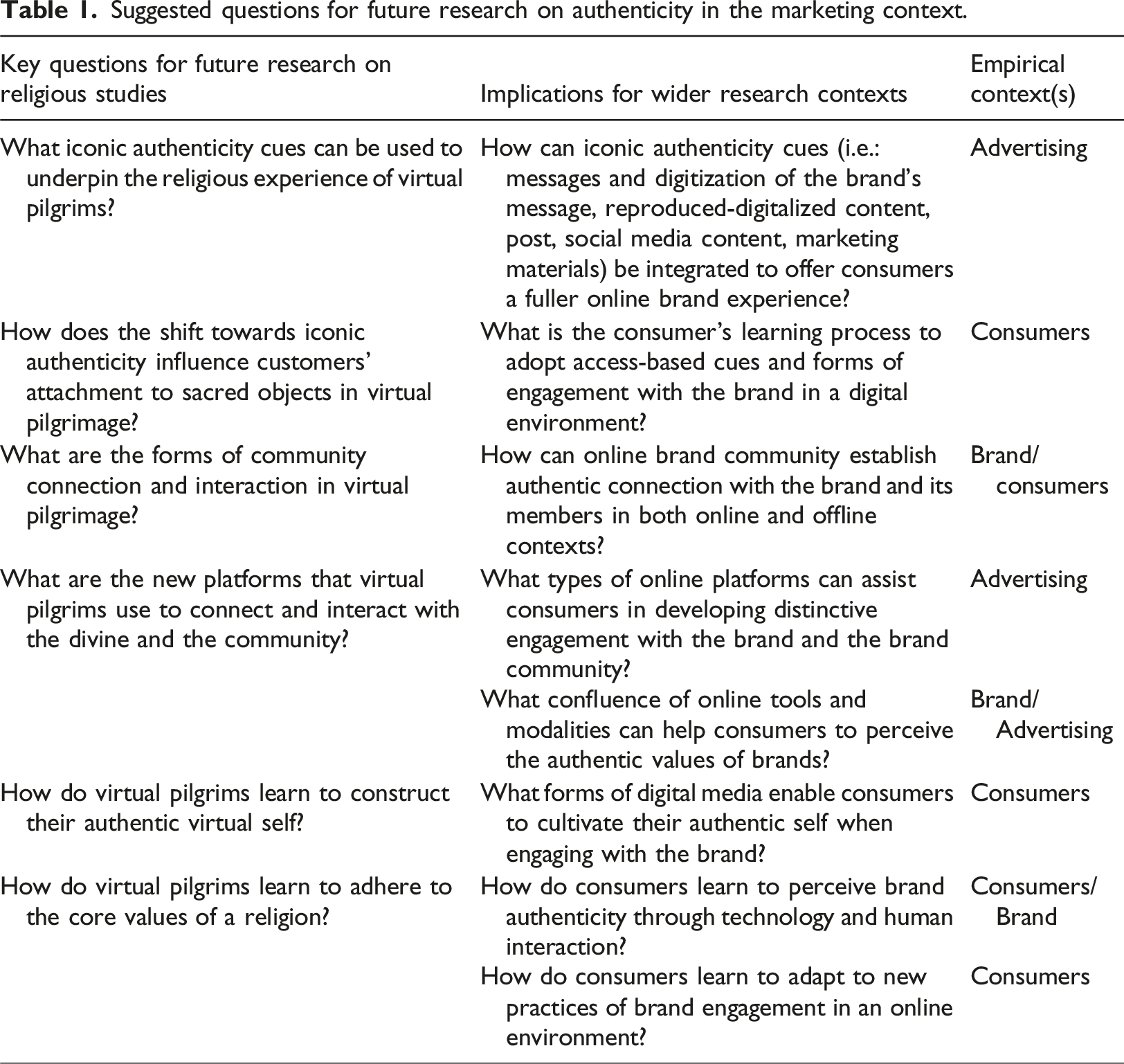
Suggested questions for future research on authenticity in the marketing context.
Footnotes
Declaration of conflicting interests
The author(s) declared no potential conflicts of interest with respect to the research, authorship, and/or publication of this article.
Funding
The author(s) received no financial support for the research, authorship, and/or publication of this article.
