




Abstract
Grounded in conservation of resources (COR) theory, this study identifies the effect of leadership behaviors on the resilience of tourism firms and employees in Sri Lanka during the early stages of the COVID-19 crisis. The developed conceptual model links the resilient leadership behaviors of vision sharing, leadership of tasks, and management of change with employee resilience (cognitive, behavioral, and contextual) and organizational resilience (planned and adaptive). The findings highlight that resilient leadership behaviors in the early stages of the pandemic enhanced both employee and organizational resilience. The contextual and behavioral dimensions of employee resilience mediated the effect of resilient leadership behaviors on organizational resilience. The study offers suggestions for the development of organizational resilience and the specific support that may facilitate the recovery of the tourism sector from the COVID-19 crisis.
Keywords
Introduction
Despite being recognized as highly vulnerable, the tourism industry can adapt to both unexpected and continual changes in the environment (Hall et al., 2018; Luthe & Wyss, 2014), thus has the capacity to recover from various crises and disasters (Berbekova et al., 2021; Novelli et al., 2018). Nevertheless, the effects of the global COVID-19 crisis on the tourism industry have been profound and ongoing (Ntounis et al., 2022; Sigala, 2020). According to Hall et al. (2020), COVID-19 may transform tourism, with some destinations moving to more local and sustainable forms of tourism and others returning to business-as-usual.
One way for the tourism industry to survive the negative impacts of COVID-19 is through resilience building (Berbekova et al., 2021; Hall et al., 2020; Lew et al., 2020; Ntounis et al., 2022; Prayag, 2020; Sigala, 2020). Resilience theory argues that change is fundamental and the only constant (Butler, 2017; Cheer & Lew, 2017); thus, organizations must prepare for and adapt to continual and unexpected changes (Hall et al., 2018). The ability of tourism firms to reduce their vulnerability and ensure their continuity during the COVID-19 pandemic (Prayag, 2020; Sigala, 2020) depends not only on developing and maintaining resilience but also on external resources such as government and industry support (Hall et al., 2020; Ntounis et al., 2022; Price et al., 2022).
The tourism industry and tourism firms have the capacity to adapt and change quickly in response to crises and disasters (Berbekova et al., 2021; Cheer & Lew, 2017; Hall et al., 2018; Jiang et al., 2021b; Ntounis et al., 2022; Orchiston et al., 2016) but can also fail. A research strand has, therefore, examined tourism organizational resilience linked to crises and disasters (see Biggs et al., 2012; Jiang et al., 2019; Orchiston et al., 2016; Prayag et al., 2020; Ritchie & Jiang, 2019). Definitions of organizational resilience vary (Hillmann, 2021; Jia et al., 2020). For this research, we define organizational resilience as an organization’s ability to face and bounce back from disturbances based on both preparedness and adaptiveness (Orchiston et al., 2016; Prayag et al., 2020; Sobaih et al., 2021). Therefore, organizational resilience refers to progressive organizational evolution involving risk management, vulnerability, and adaptability to cope with both constant and sudden changes (Bhamra et al., 2011; Jiang et al., 2021b).
The crisis management literature highlights that the tourism industry is vulnerable and prone to the negative impacts of crises and disasters due to the complex structure of the industry, including its high level of mutual dependence and interconnections between stakeholders (Berbekova et al., 2021; Mair et al., 2016; Novelli et al., 2018; Pforr & Hosie, 2008). While vulnerability and adaptability remain a central theme of past research endeavors in the crisis management literature (Berbekova et al., 2021; Calgaro et al., 2014; Mair et al., 2016; Novelli et al., 2018; Ritchie & Jiang, 2019), in the context of resilience, vulnerability highlights the need for organizations to have plans (preparedness) in place to manage crises and disasters but also adaptive capacity to cope and recover from disruptive events (Chowdhury et al., 2019; Hall et al., 2018). Beyond examining preparedness and adaptiveness, which are facets of organizational resilience (A. V. Lee et al., 2013), existing studies have also considered the determinants of organizational resilience through evaluations of individual (e.g., psychological capital) and organizational resources (e.g., social capital, innovation, and creativity) that strengthen resilience and reduce vulnerability (Bhaskara & Filimonau, 2021; Biggs et al., 2012; Chowdhury et al., 2019; Dahles & Susilowati, 2015; Fang et al., 2020). Others have suggested that dynamic capabilities (Jiang et al., 2019, 2021a, 2021b) through knowledge based, human-related, relational, and slack resources can have positive consequences on tourism firms through enhancing their adaptive capacity and, thus, resilience to crises and disasters.
Leadership is critical to organizational resilience, enabling organizations to bounce back, recover, and restore their performance following various crises and disasters (Bhaskara & Filimonau, 2021; Hall et al., 2018; Jiang et al., 2021a; Orchiston et al., 2016). Resilient leaders boost organizational resilience (Teo et al., 2017) by sharing their organizational vision, initiating and managing change, and directing complex and contradictory tasks (Morales et al., 2019).
Surprisingly, studies on how leadership behaviors can strengthen employee resilience in the tourism industry are scarce (Ngoc Su et al., 2021; Senbeto & Hon, 2021). Despite the acknowledged importance of human capital (e.g., employees) in responding to organizational change (Nyaupane et al., 2021) following crises and disasters (Biggs et al., 2012; Jiang et al., 2021a; Pforr & Hosie, 2008), the research on the contribution of employee resilience to organizational resilience is surprisingly sparse (Liang & Cao, 2021; Prayag et al., 2020; Senbeto & Hon, 2020).
The main objective of this study is to evaluate the role of resilient leadership with respect to the resilience of tourism organizations and employees during the early stages of COVID-19. Grounded in conservation of resources (COR) theory (Hobfoll, 1989), this research posits that leadership is an organizational resource that can be conserved and enhanced to foster employee and organizational resilience. On these grounds, we developed and tested a conceptual model for tourism firms in Sri Lanka. With this objective and a focus on the relationship between leadership behaviors and organizational and employee resilience, this study addresses two gaps in the tourism resilience literature: (i) the lack of a conceptual understanding of the leadership behaviors needed to build planned and adaptive resilience and (ii) the use of a single item to measure leadership behaviors (e.g., Prayag et al., 2020), which assumes that all aspects of leadership behaviors can be summarized by one overall behavioral measure. While resilience can also be studied at the tourism system level in terms of coping with crises (Folke et al., 2010), this research focuses on the organizational level, specifically during the early stages of the COVID-19 pandemic.
The contributions of this study to the tourism literature are threefold: First, we extend the organizational resilience literature by revealing the specific leadership behaviors that may enhance planned and adaptive resilience. Despite the professed importance of leadership in shaping the response and recovery strategies of tourism businesses following disasters, existing tourism studies have not examined resilient leadership as a determinant of organizational resilience (Jiang et al., 2021a; Orchiston et al., 2016).
Second, we demonstrate the relevance of theorizing employee resilience as a multidimensional concept (Lengnick-Hall et al., 2011) and reveal the diverse effects that the various dimensions have on organizational resilience. Existing studies have tested the effect of a single measure of employee resilience on organizational resilience (Prayag et al., 2020; Tonkin et al., 2018) or have equated employees’ psychological resilience with their resilience in the workplace (Senbeto & Hon, 2020).
Third, an integrative review of the COVID-19 and tourism literature (Zopiatis et al., 2021) identified resilience and leadership as key issues that should be investigated further. In another review, Yang et al. (2021) identified resilience, including that of tourism organizations (Sobaih et al., 2021), and effective leadership as key areas of research, but none of the studies in the review identified employee resilience as a key factor linking leadership behaviors to organizational resilience. Therefore, we extend the antecedents and outcomes of employee resilience in the tourism literature and embed the concepts in the COR theoretical framework.
Conservation of Resources Theory and Resilience
According to COR theory, “people strive to retain, protect, and build resources and that what is threatening to them is the potential or actual loss of these valued resources” (Hobfoll, 1989, p. 513). COR theory is a resource-oriented theory and explains workplace resilience in adverse circumstances (Holmgreen et al., 2017). COR theory has two central tenets: (i) under conditions of resource constraints, resource loss is disproportionately more salient that resource gain, and (ii) organizations must invest resources to protect against and recover from resource loss and to gain new resources (Hobfoll, 1989). Thus, adaptive or growth-related behaviors following adversity signify individuals’ resilience capacity (Bardoel & Drago, 2021).
More recently, it has been argued that organizations can manage the supportive, proactive, and adaptive behaviors of employees, contributing to their resilience and well-being (Tonkin et al., 2018). However, these positive effects depend on how organizations invest resources to support employee resilience (Kuntz et al., 2017). COR theory may be used to explain the organizational resources needed to build employee resilience. One such resource is leadership, which plays a key role in developing and enhancing employee resilience (Nguyen et al., 2016). During a crisis, the workplace can be enriching, sustaining, or depleting for employees (Hobfoll, 2012), and different leadership styles can affect employee behaviors (Shelton et al., 2022). In particular, a resilience-enabling leadership style promotes positive process behaviors such as cooperation and receptiveness rather than static behaviors in employees (Shelton et al., 2022).
Employee resilience is highly influenced by leadership style (Kakkar, 2019). Transformational leadership has been shown to strengthen employee resilience (Nguyen et al., 2016). For example, leaders who provide support by making resources available, a central tenet of COR theory, and maintain clear communication can help employees to be more resilient (Kakkar, 2019). In the crisis management literature, Mair et al. (2016) highlight that poor leadership and human resource management (HRM) practices can represent internal organizational weaknesses that negatively affect how organizations respond to crises and disasters. Strategies to deal with different crises will vary depending on time pressures, the level of control, and the magnitude of the incident, but leadership remains a critical aspect of the response (Ritchie, 2004).
In sum, this research draws on COR theory to reveal how organizational resources (leadership in this case) can support both the development and maintenance of employee and organizational resilience during disasters. In the management literature, COR theory has mostly been applied from a psychological resilience perspective (Hobfoll et al., 2015) rather than a broader management and organizational perspective, which is the focus of this research. In tourism research, COR theory has been used to understand employee behaviors, organizational outcomes (Zhou et al., 2018), and tourist experiences (Chen et al., 2016). More recently, Mao et al. (2021) evaluated how organizations’ COVID-19 responses affected the psychological capital of employees to explain employees’ loss orientation and psychological resilience. Therefore, previous tourism studies applying COR have examined individual rather than organizational behavior and resilient leadership. Thus, this study aims to extend prior studies by conceptualizing leadership as a resource supporting the development of both employee and organizational resilience during crises.
Leadership and Organizational Resilience
Leadership is the ability to influence others to achieve a common goal (Northouse, 2007). Leadership is a key enabler of organizational resilience. In times of difficulty, disruption, or failure, leaders need to contextualize and adapt their behaviors (Probert & Turnbull James, 2011; Sommer et al., 2016). However, the enablers of organizational resilience are still unclear (Jia et al., 2020; Rodríguez-Sánchez et al., 2021), with leadership behaviors often purported as being the only thing needed for crisis and disaster management (Jiang et al., 2021a; Mair et al., 2016; Orchiston et al., 2016). In particular, the crisis management literature notes that leadership style is a critical aspect of strategy implementation when coping with the immediate and short-term effects of crises and disasters (Ritchie, 2004).
Nevertheless, the factors underlying effective leadership in the present COVID-19 crisis remain unclear (Bartsch et al., 2020). It is evident that leaders must be both reactive to immediately respond to disruptions and proactive to plan for future disruptions (A. V. Lee et al., 2013). Different leadership styles and traits have been proposed as being critical in managing different types of crises and disasters (Ritchie, 2004). Some scholars suggest that participative and task-centered styles are essential when decisions have to be made quickly to achieve organizational outcomes (Bartsch et al., 2020; Van Wart & Kapucu, 2011). Others emphasize the necessity of leadership traits such as calmness, tenacity, clear mindedness, risk taking, openness, and flexibility for disaster management (Jiang et al., 2021a). Thus, there is no consensus on the type of leadership style required during crises. However, leadership styles are not mutually exclusive, with leaders often adopting one or more dominant styles (Azadegan et al., 2021; Devitt & Borodzicz, 2008). During the COVID-19 crisis, decisive, participative, and task-oriented leadership styles have enabled organizations to respond to multiple waves of the crisis (Azadegan et al., 2021; Bartsch et al., 2020). However, resilient leadership and its effect on organizational resilience remains to be assessed.
Resilient leadership refers to vision sharing, initiating and managing change, and directing complex and contradictory tasks during crises (Morales et al., 2019). This type of leadership is oriented toward both performance and change because it focuses on fulfilling organizational goals while initiating and managing organizational change to meet both internal and external environmental challenges (Dartey-Baah, 2015). Resilient leadership can be seen as an integration of transformational and transactional leadership. To facilitate organizational resilience, leaders must promote changes in the whole organization in response to disruptive external environments (i.e., transformational leadership). Resilient leadership also requires the rapid implementation and adjustment of operational activities to maintain performance during disruptions (Dartey-Baah, 2015) (i.e., transactional leadership). Thus, a resilient leadership style includes strategic thinking, a proactive mindset, an orientation toward adaptation, and emotional intelligence (Dartey-Baah, 2015; Faustenhammer & Gössler, 2011), behaviors that support both employees and organizations to become more resilient.
Despite the demonstrated importance of leadership in facilitating organizational resilience (Orchiston et al., 2016; Prayag et al., 2020), tourism studies have contributed little to advancing the understanding of the necessary leadership styles and behaviors for managing crises and disasters (Lombardi et al., 2021; Ritchie, 2004). Existing studies have been criticized for offering an overly generalized view on leadership and operationalizing the construct too broadly, such as by using a single survey item (Prayag et al., 2020) or focusing on only a few leadership traits (Jiang et al., 2021a). Others show that tourism organizations must manage their dynamic capabilities (Jiang et al., 2019, 2021a) to cope with disruptions but place little emphasis on how individual capabilities can improve organizational resilience.
We argue that human resources are essential for any planned changes in the organization and to increase the dynamism and agility of organizational capabilities (Pitelis & Wagner, 2019; Probert & Turnbull James, 2011; Rodríguez-Sánchez et al., 2021). Therefore, to contribute positively to organizational outcomes, leaders must empower, motivate, and nurture employees (Barasa et al., 2018). Characterized by (i) initiating and managing change, (ii) vision sharing, and (iii) overseeing organizational ambidexterity and contradictory tasks (Morales et al., 2019), resilient leadership has been shown to positively influence organizational resilience.
The initiation and management of change is a key leadership practice for achieving organizational resilience (Gracey, 2020; A. V. Lee et al., 2013; Lengnick-Hall et al., 2011). Leadership is the key to mobilizing resources toward change (Battilana et al., 2010). During times of crisis, shifting between rational and empathic behaviors, stability and flexibility, and the present and future are some of the challenges leaders face (Dartey-Baah, 2015; Giustiniano et al., 2020). To initiate and implement change, resilient leaders need to convey confidence that recovery strategies will be effective and honesty about the implications of change. They also need to improve employees’ skills during times of change (Morales et al., 2019). Adaptive responses to disruptions are based on immediate actions, enabling organizations to return quickly to their normal business operations (Dartey-Baah, 2015; Faustenhammer & Gössler, 2011; Morales et al., 2019). Leaders can play a critical role in building resilience, especially when initiating change through a dynamic combination of improvisation and clear direction setting (Giustiniano et al., 2020; Morales et al., 2019).
Vision sharing with employees has been shown to be another key element in successful resilience leadership. Studies suggest that leaders will be more successful in boosting organizational resilience if they display confidence and positivity when sharing their vision with employees (Eliot, 2020). Vision sharing and inspiring followers is often associated with the transformational leadership style, which occurs “when leaders broaden and elevate the interests of their employees, when they generate awareness and acceptance of the purposes and mission of the group” (Bass, 1990, p. 21). Existing studies confirm that resilient leadership practices include empowering employees, articulating a positive vision, acting opportunistically when responding to crises, and building a collaborative organizational culture (Barasa et al., 2018; McManus et al., 2008; Ritchie, 2004). Resilient leaders who articulated their vision for recovery from the COVID-19 crisis were better able to direct recovery activities (Ngoc Su et al., 2021). Further, clear goal-setting and being approachable and open to discussion are effective leadership behaviors during crises. Providing clear information and feedback about how employees can change their behaviors and offering guidance on ethical issues can assist organizations to become more resilient (Ngoc Su et al., 2021).
To boost organizational resilience, leaders must oversee ambidextrous and contradictory tasks to respond effectively to disruptive events and anticipate and plan for future disruptions. Therefore, leaders must envision how to develop organizational resilience and combine this with potentially contradictory tasks and practices in the immediate response to disruption (A. V. Lee et al., 2013). To enhance both planned and adaptive resilience, leaders must navigate the ambidextrous activities required for the organization to mitigate and bounce back from a crisis. As suggested above, leaders need to assume both transactional and transformative leadership styles in times of high uncertainty (Dartey-Baah, 2015; Giustiniano et al., 2020), helping employees respond to disruptions by encouraging task-oriented activities and communicating clear and precise expectations to boost the adaptive capacity of the organization (Morales et al., 2019). To plan ahead strategically and actively and adopt a processual view of organizational resilience (Williams et al., 2017), strategic practices that demonstrate certainty of the company’s excellence and commitment to the organization’s long-term planning and goals are needed.
Therefore, effective leaders are essential to the diffusion of resilience because they enable the process of “learning to unlearn and learn” (Giustiniano et al., 2020; Morales et al., 2019). Teo et al. (2017) suggest that resilient leadership involves not only activating relationships in the organization to respond and adapt to a rapidly changing environment but also using the knowledge embedded within those relationships to achieve organizational resilience. This implies that leaders can extract the benefits of relationships and knowledge to achieve resilience if they have the necessary leadership style. For example, effective resilient leadership involves capturing and transforming organizational learning when responding directly to disruptions for the purpose of implementing long-term planning preparedness for the next potential crisis (G. K. Lee et al., 2020). Thus, we propose the following hypothesis:
H1: Resilient leadership has a positive effect on organizational resilience.
Leadership and Employee Resilience
According to Kuntz et al. (2017), employee resilience refers to “not only the ability to recover from adversity but also the capacity to utilize and proactively develop personal and workplace resources” (p. 225). Therefore, resilience can be developed through effective HRM practices (Wang et al., 2014). Employee resilience differs from psychological resilience in that it is operationalized as workplace behaviors rather than a set of traits or beliefs about one’s ability to cope with adversity (Tonkin et al., 2018). These behaviors include effectively collaborating in the workplace to deal with challenges and learn from mistakes, requiring organizations to provide resources for employees to thrive under conditions of adversity (Kuntz et al., 2017; Tonkin et al., 2018).
Both unidimensional (Tonkin et al., 2018) and multidimensional (Lengnick-Hall et al., 2011; Wang et al., 2014) operationalizations of employee resilience have emerged in the HRM literature. In this study, we operationalize employee resilience as a multidimensional concept that includes cognitive, behavioral, and contextual dimensions (Lengnick-Hall et al., 2011; Santoro et al., 2021). We argue that leadership style can positively influence each of these dimensions of employee resilience as follows. First, leaders can boost cognitive resilience through the HRM principle of developing partnerships with employees and providing them with decision-making power (Lengnick-Hall et al., 2011). To cope with ambiguity, disruption, and stress, employees must be able to comprehend, process, and convert external negative information into positive outcomes (Beasley et al., 2003; Choudhury et al., 2021). Despite uncertainty, employees also need to use their expertise, creativity, and decision-making capacity to think of innovative solutions (Lengnick-Hall et al., 2011; Santoro et al., 2021). The capacity for employees to develop and use their cognitive abilities in times of crisis is influenced by leadership style. Harland et al. (2005) found that transformation and transactional leadership styles positively influence employee resilience, while Cooke et al. (2021) suggest that leaders’ vision, determination, and interactions with employees can nurture employee resilience.
Second, leaders can boost employees’behavioral resilience (Santoro et al., 2021). The behavioral dimension relies on the HRM principles of developing an ambidextrous organizational culture and creating a climate of open communication and collaboration (Lengnick-Hall et al., 2011). For example, immediately following a crisis, effective leadership behaviors include proactively responding to shocks in unconventional ways (Santoro et al., 2021), stimulating employees to take different courses of action and think outside of the box (Lengnick-Hall et al., 2011). To promote resilience among employees, leaders should create an environment in which employees feel psychologically safe and are encouraged to contribute creative ideas that challenge the status quo and traditional organizational values (Agarwal & Farndale, 2017; Avey et al., 2009). Employee resilience is also linked to employee polychronicity or multitasking (i.e., simultaneously engaging in multiple activities) to achieve immediate disaster mitigation and long-term strategic outcomes (Hecht & Allen, 2005). To achieve polychronicity, leaders can encourage employees to perform multiple tasks to prepare for, manage, and adapt to disruptions. Fang et al. (2020) note that leaders are successful when conveying realistic optimism, problem-focused practices, and situational awareness. A. V. Lee et al. (2013) further state that employees should be empowered and equipped to solve problems and effectively to a sudden crisis, activities that require strong leadership.
Third, for employees to become more resilient, leaders must consider the contextual dimension by supporting relationships within and outside of the organization to facilitate effective responses to environmental complexities (Lengnick-Hall et al., 2011). This implies that HRM practices should focus on encouraging social interactions both inside and outside of the organization and nurture a climate of reciprocal trust and interdependence between leaders and employees (Lengnick-Hall et al., 2011). During a crisis, while immediate action needs to be taken to minimize the negative impacts on the organization, employees can use their social capital and networks to facilitate organizational responses. This requires employees to give up their potential sources of power and share their knowledge with managers and staff (Santoro et al., 2021). Leaders should encourage employees to use their interpersonal connections and resource supply lines to enable immediate and rapid responses through the sharing of power and accountability (Lengnick-Hall et al., 2011).
Despite leadership being a critical factor affecting organizational recovery post disaster (Jiang et al., 2021a), the research on its effect on employee resilience in the tourism industry is sparse. An exception is a study by Senbeto and Hon (2021), who revealed that leadership efficacy during crises can moderate the relationship between technological turbulence and employee resilience. However, the study focuses on leader self-efficacy and, unlike the current study, uses a unidimensional measure of employee resilience rather than evaluating leadership style and focusing on the contextual, behavioral, and cognitive dimensions of employee resilience. Nonetheless, tourism studies assert the need for leaders to support frontline employees when building organizational resilience (Al-Hawari et al., 2020; Schuckert et al., 2018). Al-Hawari et al. (2020) observed that in the services and hospitality context, frontline employee resilience and leadership practices are the most important factors in ongoing business performance. Leadership behaviors such as clarifying goals and expectations, fostering employee growth and participation, and providing support for work and nonwork demands contribute to employee resilience (Bardoel et al., 2014; Nguyen et al., 2016).
In particular, an empowering leadership style has been shown to have a positive influence on employee resilience (Nguyen et al., 2016); however, to date, resilient leadership has not been linked to employee resilience. We argue that vision sharing, leadership of organizational resilience, and management of change (Morales et al., 2019) will positively influence the cognitive, behavioral, and contextual dimensions of employee resilience. This is because believing in the leader’s vision during periods of adversity gives employees the confidence to follow directives and engenders respect and pride among employees, facilitating organizational resilience-building initiatives (Harland et al., 2005). Through fostering relational rather than transactional relationships with employees, leaders can manage change more easily in a turbulent external environment (Lengnick-Hall et al., 2011). By recognizing and valuing employees’ individual differences, leaders can develop autonomy in employees and encourage them to stretch their goals, thus contributing to their learning, adaptability, and networking skills (Nguyen et al., 2016). By creating a climate of open communication, leaders can nurture trust and reciprocity in employer–employee relationships that are conducive to change management (Lengnick-Hall et al., 2011). Thus, we propose the following hypotheses:
H2: Resilient leadership has a positive effect on employees’ cognitive resilience.
H3: Resilient leadership has a positive effect on employees’ behavioral resilience.
H4: Resilient leadership has a positive effect on employees’ contextual resilience.
Organizational Resilience and Tourism
Diverse definitions of organizational resilience exist (Hillmann, 2021; Jia et al., 2020), with tourism studies commonly focusing on two interdependent dimensions—planned and adaptive resilience (Orchiston et al., 2016; Prayag et al., 2018, 2020; Sobaih et al., 2021). Resilient organizations both prepare for and effectively respond to disruptions (Ngoc Su et al., 2021; Orchiston et al., 2016).
Effective crisis and disaster management hinges on planning and preparing before the event (Ritchie, 2009). Grounded in business continuity management, resilience planning involves both organizations and destinations preparing for crises and disasters and is vital for reducing the impacts of and improving recovery from disasters (A. V. Lee et al., 2013; Mair et al., 2016; Nilakant et al., 2014). Therefore, developing organizational strategies can help both organizations and destinations to avoid or limit the severity of rapid change induced by crises or disasters (Ritchie, 2004).
Although organizations can develop precrisis strategies to help with crisis management, they are often unable to prevent a crisis from occurring; thus, their adaptive capacity and ability to implement coping strategies to limit damage become critical (Ritchie, 2004). Adaptive resilience refers to the need for coping strategies to deal with negative impacts in the short term and engage in successful recovery activities in the medium to longer term. Therefore, adaptive resilience is the ability to respond effectively, recover quickly, and renew successfully following an adverse event (Nilakant et al., 2014).
Adaptive Organizational Resilience and Tourism
The existing research on adaptive organizational resilience typically takes an event-centered perspective by focusing on sudden events that threaten organizations in disruptive and surprising ways (Williams et al., 2017). The responses and adaptations to the COVID-19 crisis in the past 2 years have largely been based on the event-centered perspective (e.g., Kim et al., 2021; Okafor et al., 2022; Wieczorek-Kosmala, 2022). Tourism studies on adaptive organizational resilience typically focus on the effectiveness of organizational speed (Chowdhury et al., 2019; Orchiston et al., 2016) or responsiveness to a current or recent crisis (Gabriel-Campos et al., 2021; Mair et al., 2016; Wieczorek-Kosmala, 2022). For example, Wieczorek-Kosmala (2022) investigated tourism organizations’ responses to disruptions arising from COVID-19 in Central European countries, finding that firms with greater cash-driven resilience adapted more successfully. Similarly, Kim et al. (2021) investigated the response of small restaurants to the severe financial impacts arising from the COVID-19 crisis in China, showing that resilience varied between regions and types of restaurants.
Planned Organizational Resilience and Tourism
Few tourism studies focus on forward-looking strategies, which transcend the event-centered perspective in building planned organizational resilience (A. V. Lee et al., 2013; Prayag et al., 2020; Sobaih et al., 2021). Williams et al. (2017) argue that firms should assume that disruptions or crises will be ongoing and develop strategies to best respond to any stage of adversity. In contrast, most tourism firms take a reactive approach, doing little to actively prepare for future disruptions (Hall et al., 2018; Mair et al., 2016). Tourism scholars have examined how tourism organizations can proactively and strategically plan for potential disruptions (Bhaskara & Filimonau, 2021; Ritchie, 2004; Ritchie & Jiang, 2021). Muskat et al. (2014) explain that responding to a crisis in both the short and long term is a transformational cycle, beginning with the immediate response to the emergency before transitioning to planned preparedness and learning.
Therefore, an understanding of what organizations can do to prepare and how to proactively bounce back after disasters and crises is important to advance the organizational resilience literature. However, while the tourism-related research on adaptive organizational resilience is abundant, Ritchie and Jiang’s (2021) recent literature review shows that the research on planned resilience and strategic preparedness remains scarce. Perhaps one reason for this lack of research is that it must be conducted over a long period, and long-term effects are difficult to measure (Mair et al., 2016; Ortiz-de-Mandojana & Bansal, 2016).
In sum, while it is clear that both planned and adaptive resilience and their respective practices are critical to achieving organizational resilience, only a few scholars (Fang et al., 2020; Prayag et al., 2018) have ascertained a link between them. The study by Chowdhury et al. (2019) was limited to the effect of adaptive resilience on tourism organization performance in the earthquake recovery phase, while Li et al. (2021) analyzed the relationship between emergency and recovery responses to COVID-19 and firms’ planned and adaptive resilience.
Employee and Organizational Resilience
Scholars have acknowledged the importance of HRM practices in developing organizational resilience in terms of long-term planning and adopting an operational perspective (Lengnick-Hall et al., 2011). However, there is little understanding of the individual and contextual factors fostering organizational resilience (Nguyen et al., 2016). Malik and Garg (2020) observe that employee resilience is the key to engaged employees and creating a learning organization that builds organizational resilience. This implies that employees play a central role in organizational resilience. By responding positively to adversity and maintaining their performance, despite the stressful experience in the workplace (Bardoel et al., 2014; Liang & Cao, 2021; Santoro et al., 2021), employees can strengthen organizational resilience.
However, the way in which employees strengthen organizational resilience has long been a black box (Liang & Cao, 2021). For example, a study on organizational readiness for change, employee resilience, and market turbulence (Senbeto & Hon, 2020) shows that employee resilience mediates the relationship between market turbulence and service innovation in hotels. Prayag et al. (2020) found that in the post-disaster recovery of tourism organizations, both employee and psychological resilience play a role in strengthening organizational resilience. Teng-Calleja et al. (2020) argue that resilience-building initiatives in the workplace improve employee resilience, thus contributing to organizational resilience. Liang and Cao (2021) identified an indirect relationship between employee and organizational resilience through employee coping mechanisms. Thus, the existing evidence on the relationship between employee and organizational resilience is somewhat lacking.
Similarly, empirical evidence on how the cognitive, behavioral, and contextual dimensions of employee resilience affect organizational resilience is sparse (Santoro et al., 2021). Given that employee behaviors are embedded in each dimension, we argue that a stronger understanding of resilience behaviors can enhance organizational resilience. For example, employees with a stronger sense of purpose and belief in the organization’s vision can more effectively engage in problem-solving and creativity, boosting the organization’s capacity to adapt to potential threats (Santoro et al., 2021). Cognitive resilience refers to employees having a positive view of adversity in the workplace (Lengnick-Hall et al., 2011; Santoro et al., 2021). To foster this, organizations should encourage employees to be decisive despite uncertainty, recognize opportunities in the business environment, question fundamental assumptions about conducting business in uncertain times, and use creativity to identify novel solutions to complex problems (Lengnick-Hall et al., 2011).
Therefore, employees who demonstrate these resilience behaviors can contribute to building organizational resilience. Boosting such employee behaviors requires a reinforcing of the organization’s core values and culture to instill a strong sense of purpose among employees in using their expertise to navigate challenging environments (Santoro et al., 2021). Resilience can be enhanced by encouraging creativity and innovation among employees (Nilakant et al., 2014) and the organization’s learning capabilities (Muskat et al., 2021). Further, organizations need to be restructured to provide employees with more decision-making power, with leaders publicly endorsing such decisions. Such actions can reinforce the strategic vision and expected outcomes in turbulent times in a way that improves organizational resilience (A. V. Lee et al., 2013). Thus, organizational and leadership practices that strengthen the cognitive dimension of employee resilience during adversity may improve organizational resilience.
Resourcefulness and counterintuitive agility, juxtaposed with useful habits and behavioral preparedness, are the key characteristics of the behavioral dimension of employee resilience. These behaviors are critical for improving organizational resilience and can be fostered by creating a climate of open communication and collaboration (e.g., where managers reward employees for knowledge sharing) (Lengnick-Hall et al., 2011). Employees who share knowledge, ideas, and information with others for creative action and the improvement of products and processes can strengthen organizational resilience (Lengnick-Hall et al., 2011). Moreover, encouraging psychological resilience and reflective practices in the workplace can improve employee resilience (Kuntz et al., 2017), helping organizations to adapt to adversity. Further, the use of repetitive and overlearned routines can facilitate employees’ responses to unexpected threats (Lengnick-Hall et al., 2011). Thus, behaviors that reflect the behavioral dimension of employee resilience may strengthen organizational resilience.
The ability of employees to rely on and leverage relationships within and outside of the organization in difficult times is a key aspect of the contextual dimension of employee resilience (Santoro et al., 2021). The stronger the external organizational relationships, the easier it is for employees to access resources, knowledge, and information that support mitigation and response strategies following disruptive events (Chowdhury et al., 2019). The contextual conditions for organizations to reap the benefits from such relationships include psychological safety, deep social capital, diffuse power and accountability within relationships, and broad resource networks across the organization (Lengnick-Hall & Beck, 2005). These contextual conditions depend on organizational practices that facilitate, support, and enhance employees’ capacity to collaborate with others. For example, a climate of psychological safety is established when the work environment is conducive to employees taking interpersonal risks. However, the work environment may also act as a barrier to employees asking for help, admitting mistakes, and experimenting (Lengnick-Hall et al., 2011). Therefore, both internal and external relationships are stronger in an environment of psychological safety. External relationships built on honesty, reciprocity, and trust have been shown to enhance organizational resilience among tourism firms (Chowdhury et al., 2019). Thus, the more that employees leverage relationships to access information, knowledge, and resources, the more they can contribute to strengthening organizational resilience. Thus, we propose the following hypotheses:
H5: Cognitive employee resilience has a positive effect on organizational resilience.
H6: Behavioral employee resilience has a positive effect on organizational resilience.
H7: Contextual employee resilience has a positive effect on organizational resilience.
In summary, the literature reveals that leadership, whether transformational or resilient, is critical in developing and nurturing employee capabilities (Giustiniano et al., 2020; Santoro et al., 2021). However, little is known about how leadership can strengthen employee resilience in the tourism sector, especially given the industry’s unique characteristics such as small firm size, the prominent role of the owner–manager, and the salient role and challenges of frontline employees. Ngoc Su et al. (2021) found that in the lockdown period immediately following the outbreak of COVID-19, practices aimed at increasing social interaction, empowerment, and employee training were most beneficial for employee resilience. While leadership practices are often aimed at business survival in the short term, they need to also focus on the longer term. In the subsequent recovery phase, clear communication from leaders regarding the organization’s vision and long-term strategies for recovery contribute significantly to resilience building. Ngoc Su et al. (2021) clearly draw attention to the need for an ambidextrous perspective of organizational resilience and show that HRM and leadership practices must change to be effective. However, in most of the extant tourism literature, organizational resilience is mostly discussed from the perspective of adaptive resilience (Chowdhury et al., 2019; Mair et al., 2016; Wieczorek-Kosmala, 2022). Moreover, the employee resilience–organizational resilience nexus remains underexplored.
Figure 1 encapsulates the concepts and hypotheses proposed in this study, showing how resilient leadership influences both employee and organizational resilience.
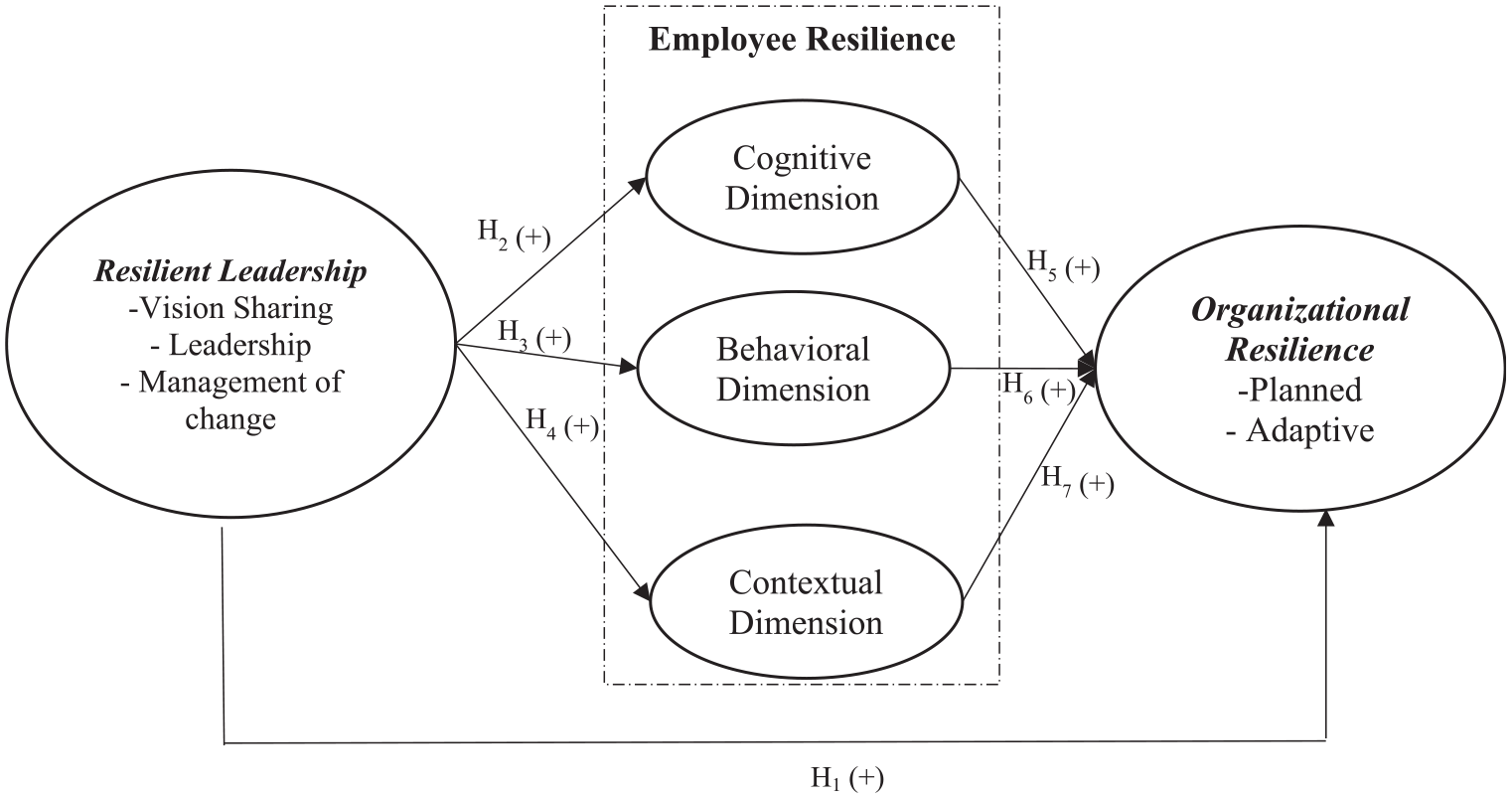
Conceptual model.
Method
Research Context
The COVID-19 pandemic has severely constrained the tourism industry in Sri Lanka (Roshana et al., 2020; United Nations Development Programme [UNDP], 2021). Travel restrictions, the closure of international airports, compulsory COVID-19 testing, the closure of hotels and travel agencies, and the negative attitude of the general public toward foreign visitors have all contributed to the poor performance of the Sri Lankan tourism industry (Jayawardena, 2022). The resilience of the entire industry has been weakened by financial difficulties resulting from the inability to make loan repayments or lease installments and the cessation of private investments in tourism. Tourism sector employees and freelance workers have also lost their livelihoods (Jayawardena, 2022; Karunarathne et al., 2021; UNDP, 2021). The Sri Lankan government has implemented strategies to rebuild the resilience of the tourism sector, including extending the moratorium on debt payments, expanding financial facilities, providing financial assistance to employees and relief to hotels to help with electricity and lease payments, and introducing insurance schemes for tourism firms (Jayawardena, 2022).
Survey Instrument Design
An online survey comprising various sections was designed for data collection and administered via Qualtrics. The first section captured the characteristics of both the respondent (age, gender, and education level) and the organization (size, tourism industry sector, and duration of operation). The remaining sections captured information on the three constructs—resilient leadership, employee resilience, and organizational resilience—using 7-point scales adapted from previous studies (1 = strongly disagree; 7 = strongly agree). Resilient leadership was measured using a multidimensional scale comprising 11 items (α = .94) adapted from Morales et al. (2019). Of these 11 items, three measured vision sharing, four measured leadership, and four measured management of change. Employee resilience was measured using a multidimensional scale comprising 14 items (α = .84) adapted from Santoro et al. (2021). Of the 14 items, six measured the cognitive dimension, five measured the behavioral dimension, and three measured the contextual dimension of employee resilience. We also captured leadership behaviors and perceptions at the top, senior, and middle management levels with respect to employee resilience. Items for both leadership behaviors and employee resilience were framed as follows: “As a manager with responsibility for staff, to what extent do you believe that you need to do the following for the business to recover from COVID-19?”
Organizational resilience was measured using 13 items (α = .92) adapted from Orchiston et al. (2016) and Prayag et al. (2020), representing the two dimensions of planned and adaptive resilience (A. V. Lee et al., 2013). Respondents’ perceptions of the impact of COVID-19 on business performance was captured using a 5-point Likert scale (1 = not at all; 5 = very much) using an overall perception assessment adapted from Prayag et al. (2018) and Sigala (2020). The questionnaire was pretested on three resilience experts in the fields of disaster management and employee psychology, resulting in minor changes to the wording of some items. For respondent convenience, the survey was written in English, then translated to Sinhalese, the main language spoken in Sri Lanka. Brislin’s (1970) backtranslation method was used to ascertain the accuracy of the translated version. Respondents had the option to complete the survey either Sinhalese or English.
Sampling and Data Collection
The study sample comprised all tourism organizations operating in Sri Lanka in 2020, irrespective of size or sector of operation. According to the Sri Lanka Tourism Development Authority (2019), the tourism sector comprises approximately 4,378 establishments (3,158 hotels and restaurants, 994 travel agencies and tour operators, and 226 airlines, recreational facilities, tourist stores, and national and public sector tourist organizations).
The unit of analysis in this study is the organization. Individuals with leadership responsibilities included owner-managers, CEOs (i.e., top managers), department heads and group managers (i.e., senior managers), and supervisors of customer-facing staff (i.e., middle managers). Adopting a purposive sampling technique to identify organizations, a filtering question “Are you from the tourism business field in Sri Lanka?” was included at the start of the survey. Potential respondents had also to work in one of the abovementioned positions to qualify for the survey. Table 1 shows the organizational structure in the Sri Lankan hospitality and tourism sector by summarizing typical job titles and their related roles and responsibilities.
Organizational Structure and Role-Related Leadership Responsibility in Selected Sample From the Sri Lankan Hospitality Sector.

Data collection commenced at the beginning of the second week of May 2020 and lasted for 2 months. Only one respondent from each organization was permitted to complete the survey. The survey link was distributed through the Facebook and WhatsApp groups of the main tourism associations in Sri Lanka (e.g., Sri Lanka Institute of Tourism and Hotel Management, Kandy Hoteliers’ Association, Sri Lanka Small and Medium Hotel Association, All Island Hotel Employee Association, Sri Lanka Hoteliers, Restaurants Sri Lanka, Ceylon Travel Official, Hotel Staff Association, Tourism Service Providers’ Association, and Sri Lanka Travel Agents and Tour Operators). Prior to posting the survey link, consent was sought from the administrators of each of the social media groups targeted. By the end of May 2020, after two reminders had been posted on the social media groups, 275 usable responses had been received.
To increase the survey responses, a field study was undertaken in five popular tourist destinations in Sri Lanka (Kandy, Kithulgala, Hikkaduwa, Mahiyanganaya, and Ella). These destinations were chosen for their wide range of tourism firms reflecting the diversity of Sri Lankan tourism, including beaches, mountains, adventure activities, scenic beauty, and Indigenous culture. A convenience sampling method was adopted in which research assistants administered hard copies of the questionnaire to the identified tourism businesses and collected them after 1 week. In total, 183 completed questionnaires were obtained.
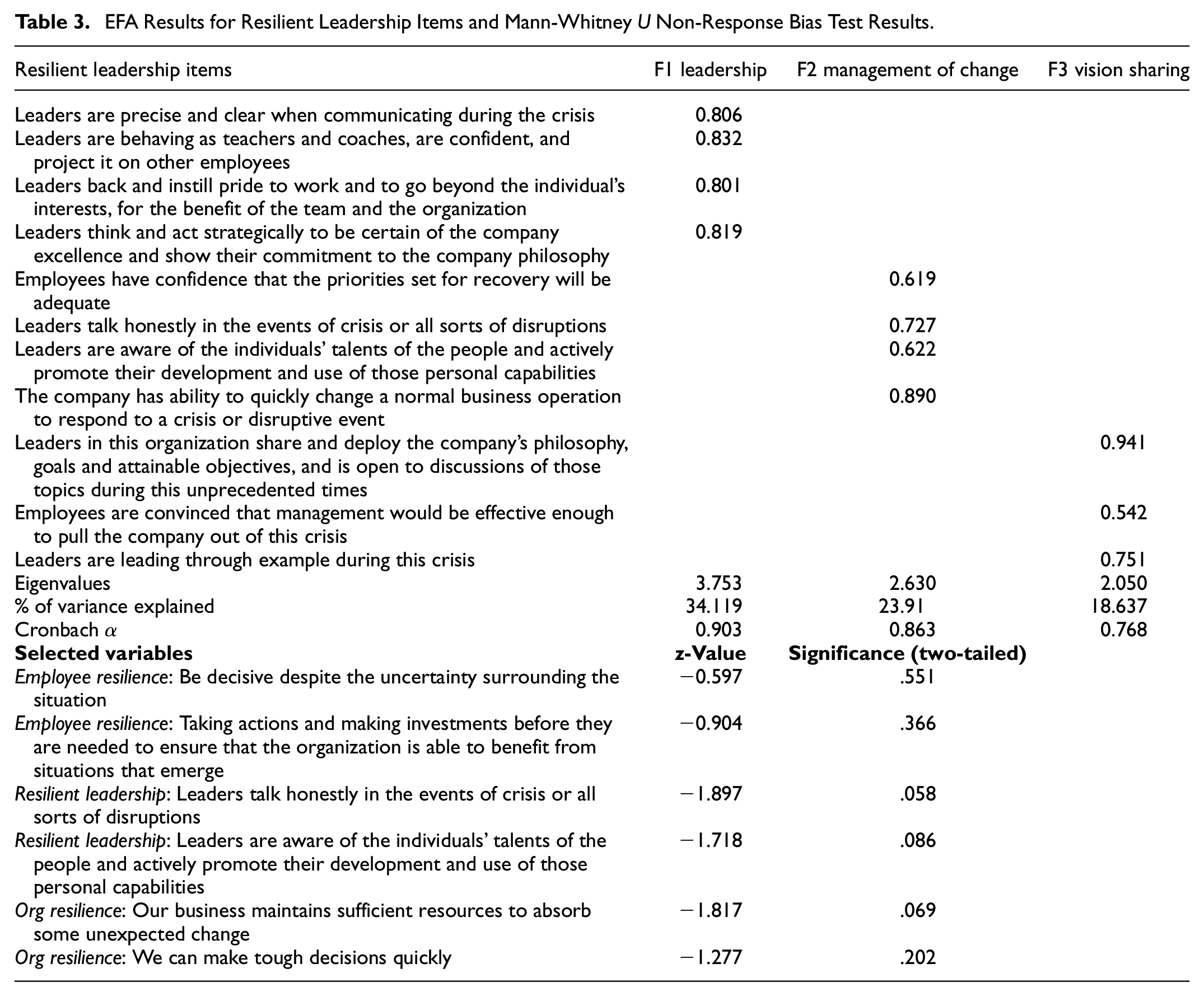
By the end of data collection in June 2020, 458 usable responses (275 online surveys and 183 paper-based surveys) had been received and were used for data analysis. The final sample size of 458 exceeded the minimum of 176 required for partial least squares structural equation modeling (PLS-SEM), based on the highest number of path arrows pointing to any exogenous or endogenous variable (n = 3), a significance level of 5% and a desired minimum R 2 of .1 to achieve a statistical power of 80% (Hair et al., 2017). To check for nonresponse bias, we conducted a Mann–Whitney U test to identify any significant differences between early and late responses based on the assumption that the opinions of late respondents were similar to those of nonrespondents (Armstrong & Overton, 1977). There were no significant differences between early and late responses to the selected variables, implying that nonresponse bias was not a significant concern (see Table 3).
Common method bias, which can arise from any self-reported data, was assessed following the guidelines of Podsakoff et al. (2003). Informant anonymity was assured, and both dependent and independent variables were measured separately in the survey instrument. Further, Harman’s one-factor test was used. Using unrotated exploratory factor analysis (EFA), we identified seven factors with eigenvalues greater than 1, explaining 63.87% of total variance, with the first factor accounting for only 35.76% of the total explained variance (<50% is the suggested value). Therefore, common method bias was not a concern in this study.
Data Analysis
PLS-SEM was used to evaluate the conceptual model for several reasons. First, it can generate robust findings for data with both normal and non-normal distributions (Hair et al., 2017). To test normality, we utilized skewness and kurtosis scores (with adequate values between −3 and +3) (Mardia, 1970), finding that the assumption of normality was violated for several survey items (Hair et al., 2017). Second, PLS-SEM is appropriate when the research model has a large number of indicators, including second-order constructs. Third, PLS-SEM is appropriate for theory building and examining constructs that have yet to receive significant empirical attention (Hair et al., 2017) such as organizational responses to COVID-19. SmartPLS 3.3.3 (using 5,000 resamples) was used to test both the measurement (outer) and structural (inner) models.
Findings
Organizational and Respondent Characteristics
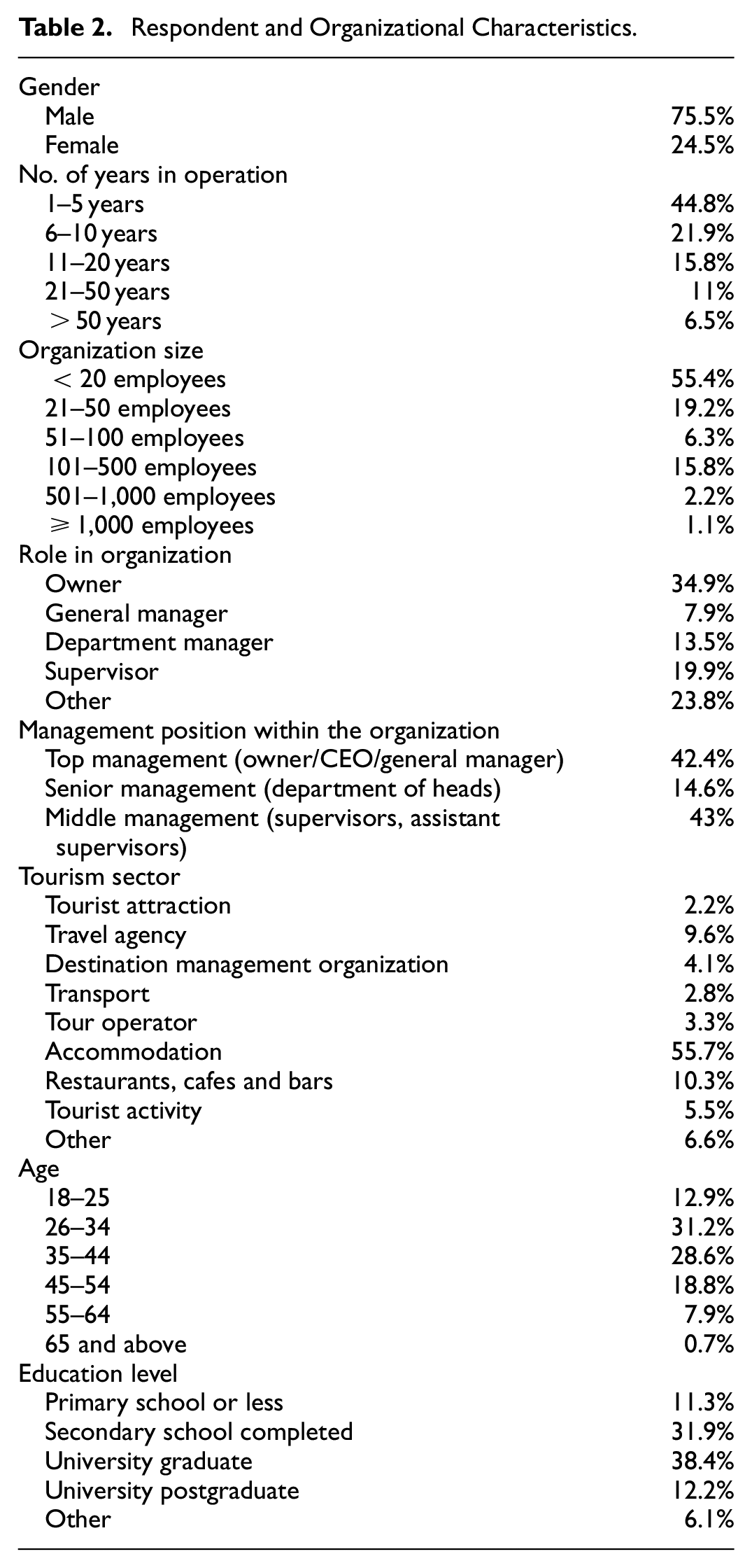
Table 2 summarizes the characteristics of the 458 respondents and their respective organizations. Of the organizations, 44.8% had been in operation for 5 years, 55.4% had fewer than 20 employees, 34.9% were owner operators, and 55.7% were in the accommodation sector. In terms of respondents’ demographic information, 75.5% were male, 38.4% had a university degree (38.4%), and 31.2% were aged 26 to 34 years. In terms of respondents’ managerial roles, 42.4% were top managers (owners, CEOs, directors, or general managers), 14.6% were senior managers (heads of department), and the remaining 43% were middle managers (e.g., supervisors, assistant supervisors, executives, tour leaders and managers, project managers, and communication managers).
Respondent and Organizational Characteristics.
Exploratory Factor Analysis
Given that the resilient leadership scale developed by Morales et al. (2019) had not been adopted in any other study, EFA was used to explore the scale’s dimensionality before specifying the dimensions in the measurement model. The Kaiser–Meyer–Olkin measure of sampling adequacy (0.946) and Bartlett’s test of sphericity (χ2 = 3,431.30, p < .001) ensured that the data had sufficient inherent correlations to perform EFA. Using principal component analysis and varimax rotation, three factors were extracted that explained 76.67% of the total variance in the resilient leadership items. Items with eigenvalues greater than 1 and factor loadings of more than 0.4 on one factor and less than 0.3 on other factors were retained for interpretation (Hair et al., 2009). Table 3 shows that the three factors can be named as described in Morales et al. (2019). Cronbach’s alpha of all three factors exceeded the .7 requirement for internal consistency (Hair et al., 2009).
EFA Results for Resilient Leadership Items and Mann-Whitney U Non-Response Bias Test Results.
Outer (Measurement) Model Evaluation
The psychometric properties of the three scales (resilient leadership, employee resilience, and organizational resilience) were assessed using several criteria, including Cronbach’s alpha, composite reliability (CR), and average variance extracted (AVE). We deleted two items related to the behavioral dimension of employee resilience and one item related to adaptive resilience to satisfy the requirements for the psychometric properties of the various constructs. All remaining items had standardized loadings of 0.7, apart from three with loadings of 0.5 and above (Nunnally, 1994). Items with loadings of less than 0.7 should be removed only if they negatively affect the psychometric properties of the construct (Rasoolimanesh et al., 2017). Given that the Cronbach’s alpha and CR of all constructs were above the minimum threshold of .7, indicating internal consistency (see Table 4), and all AVEs were 0.5 and above (Fornell & Larcker, 1981), indicating convergent validity, these items were retained for further analysis.
Constructs/Underlying Items and Reliability Test.
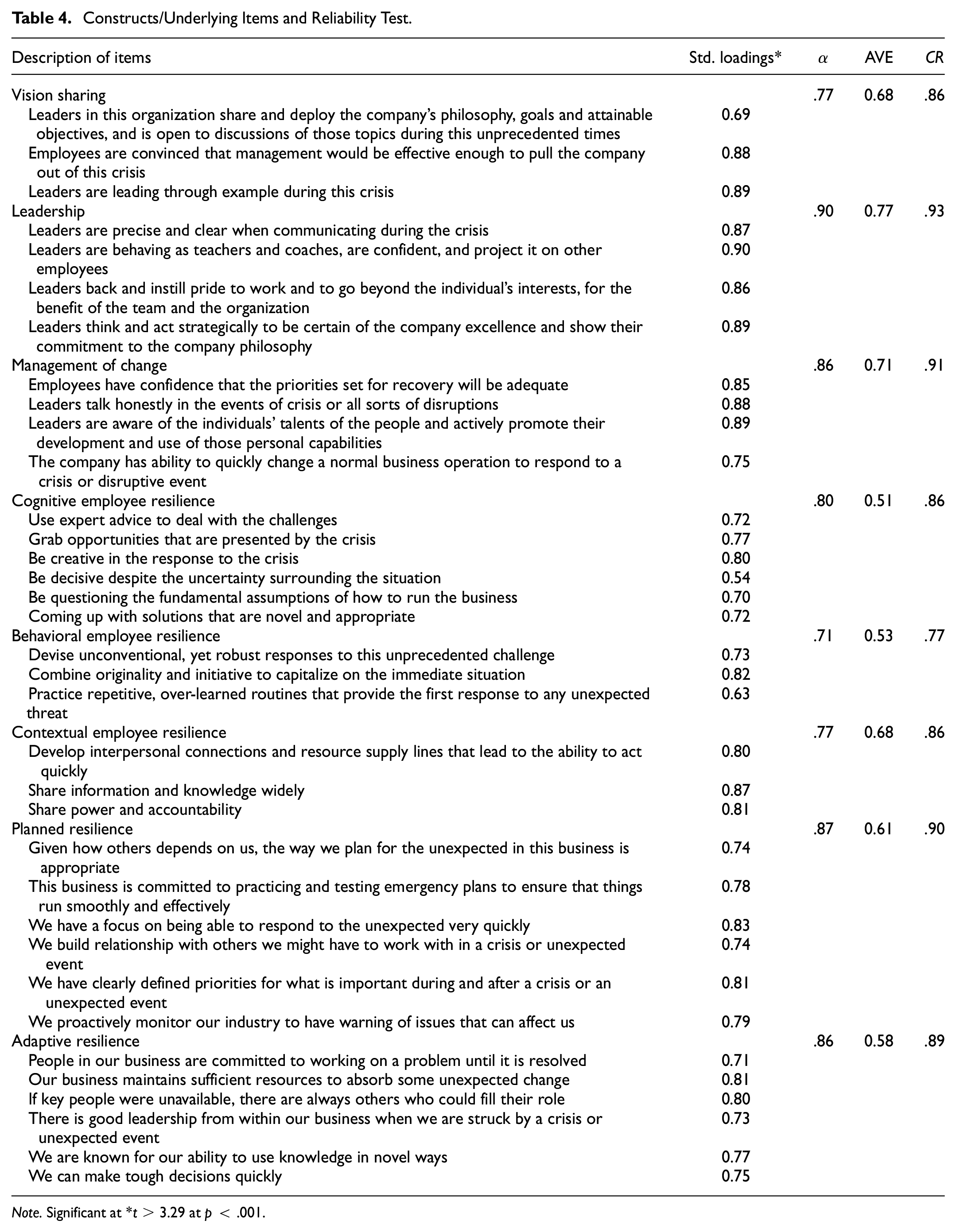
Note. Significant at *t > 3.29 at p < .001.
Discriminant validity was tested by ensuring that the square root of the AVE of each construct was greater than the correlations between each pair of constructs (Fornell & Larcker, 1981) (see Table 5). Discriminant validity was also tested using the heterotrait–monotrait (HTMT) ratio of correlations, which is considered superior to Fornell and Larcker’s method (Henseler et al., 2015). All HTMT ratios were less than the threshold value of 0.90 (Henseler et al., 2015), further establishing discriminant validity of the constructs (see Table 5).
Correlation Matrix and HTMT Ratios.
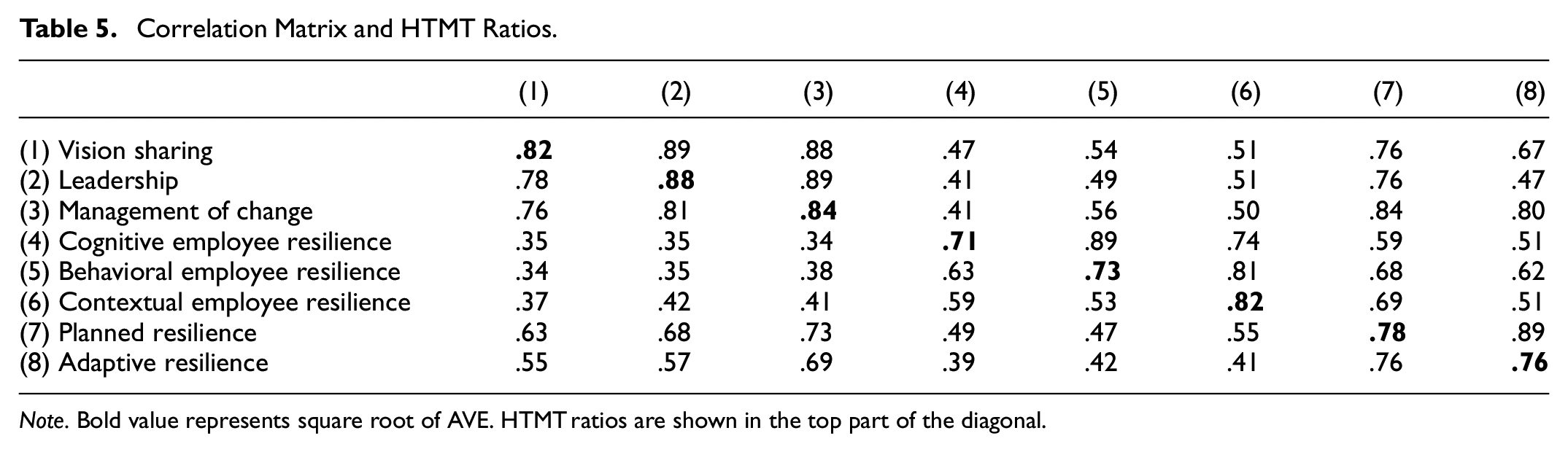
Note. Bold value represents square root of AVE. HTMT ratios are shown in the top part of the diagonal.
Using Sarstedt et al.’s (2019) two-stage approach, resilient leadership (Morales et al., 2019) and organizational resilience (Prayag, 2018; Prayag et al., 2020) were modeled as second-order constructs. The latent scores derived from the first stage of the modeling process were used to model resilient leadership and organizational resilience as reflective–reflective second-order constructs (Sarstedt et al., 2019). Reliability, convergent validity, and discriminant validity of the two second-order constructs were assessed. The results showed that both second-order constructs were internally consistent and achieved convergent validity (resilient leadership: CR = 0.968, AVE = 0.91; organizational resilience: CR = 0.946, AVE = 0.897). Discriminant validity was also achieved using both Fornell and Larcker’s (1981) method and HTMT ratios (see Table 6). All Q2 values were above zero (see Table 6), suggesting that all endogenous constructs in the model had predictive relevance (Hair et al., 2017).
Correlation Matrix and HTMT Ratios for Reflective-Reflective Construct.
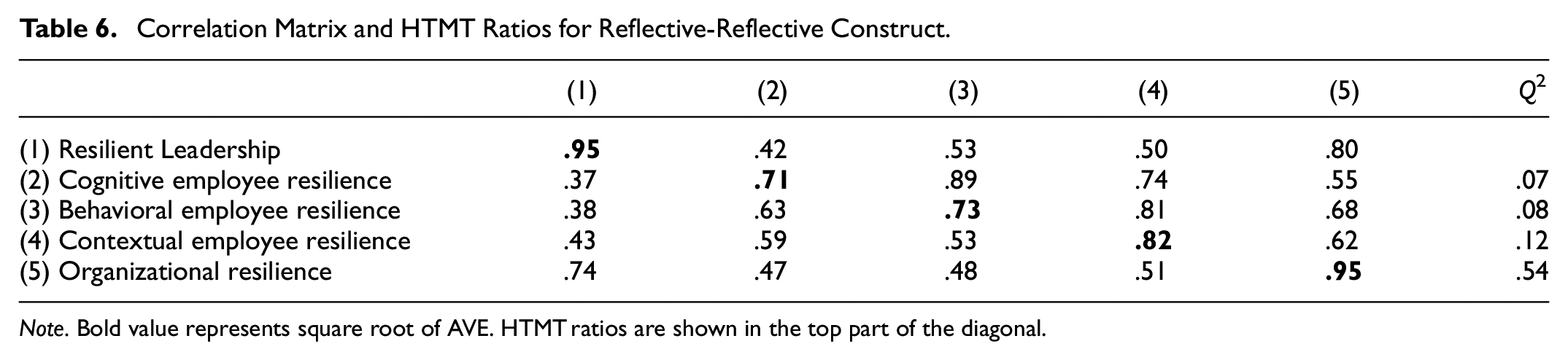
Note. Bold value represents square root of AVE. HTMT ratios are shown in the top part of the diagonal.
Inner (Structural) Model Evaluation
The R 2 values showed that resilient leadership explained 14%, 15%, and 18.3% of the variance in the cognitive, behavioral, and contextual dimensions of employee resilience, respectively. Both resilient leadership and the three dimensions of employee resilience explained 61.5% of the variance in organizational resilience. The bootstrapped path coefficients (see Table 7) showed that resilient leadership was significantly and positively correlated with the cognitive (β = .370, p < .001), behavioral (β = .387, p < .001), and contextual (β = .428, p < .001) dimensions of employee resilience, supporting H1, H2, and H3, respectively. The cognitive (β = .100, p < .05), behavioral (β = .105, p < .05), and contextual (β = .138, p < .05) dimensions of employee resilience were significantly and positively correlated with organizational resilience, supporting H4, H5, and H6, respectively. Resilient leadership was significantly and positively correlated with organizational resilience (β = .605, p < .001), supporting H7. Table 7 shows that effect size (f 2) (Hair et al., 2017) was small (0.02 < f 2 < 0.15) or medium (0.15 < f 2 < 0.35), with the exception of one large effect size for H7. Using an omission distance of seven, a blindfolding procedure was used to estimate the predictive relevance of the model (Hair et al., 2017).
Direct Paths and Hypothesis Testing Results.
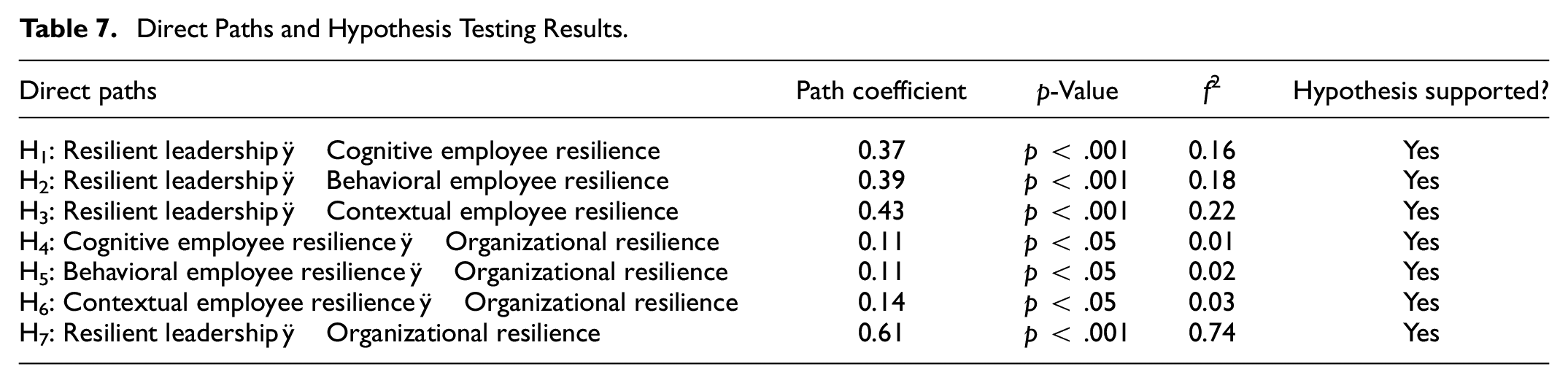
In addition, we investigated the indirect mediation effects. If the bootstrapped indirect effect is significant and the confidence interval does not include zero, mediation is supported (Zhao et al., 2010). Both the contextual (BCa CI [0.016, 0.104], p = .009) and the behavioral (BCa CI [0.004, 0.081], p = .036) dimensions of employee resilience partially mediated the effect of resilient leadership on organizational resilience. In the model, the effects of two control variables—firm size (based on number of employees) and years of operation—were assessed based on previous studies (Chowdhury et al., 2019; Prayag et al., 2020). A third control variable adapted from previous studies in other disaster contexts (Jia et al., 2020) was added to measure the overall impact of the pandemic on business performance. None of these variables had any effect on organizational resilience.
We also sought to investigate the influence of management level (top, senior, and middle management) on the structural pathways using multigroup analysis (MGA). Prior to conducting MGA, we ran measurement invariance of composite models to establish configural, compositional, and composite equality invariance (Hair et al., 2017). Table 8 shows that only configural invariance, not compositional invariance, was achieved. Hence, MGA could not be used to determine differences in the strengths of the structural paths based on management level. Rather, analysis of variance (ANOVA) with Scheffé post hoc tests were used to test differences on resilient leadership and employee resilience based on management level. The results revealed a significant difference between management levels on organizational resilience (p = .014), with top management having, on average, lower agreement (M = 5.06) than senior (M = 5.29) and middle (M = 5.21) management that their organization is resilient. With respect to vision sharing and management of change, there were no significant differences in agreement levels arising from management level.
MICOM Results for Management Levels.
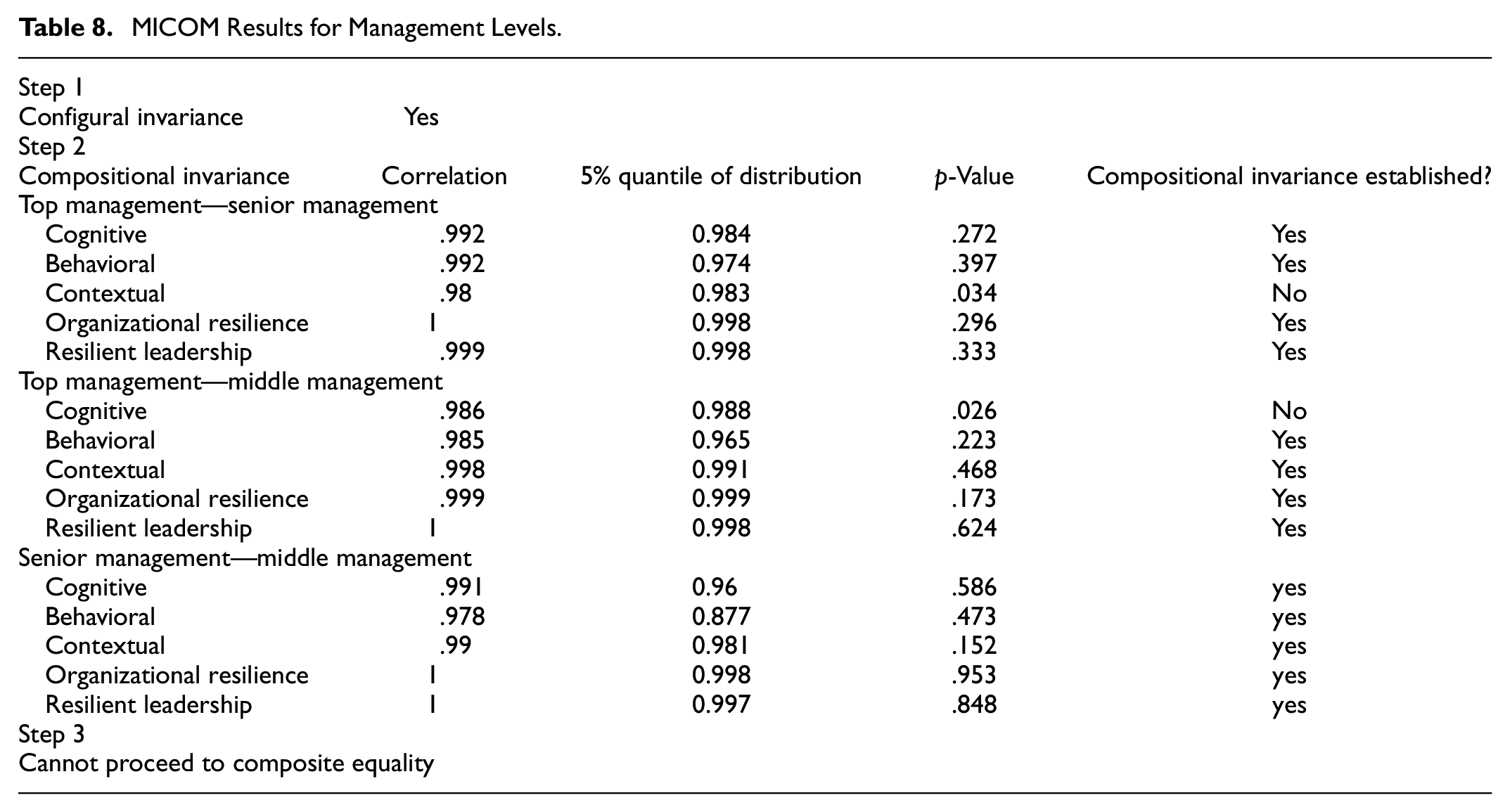
However, there was a significant difference (F = 4.86, p < .01) between the top and middle management levels, with the former (M = 5.55) having, on average, stronger agreement than the latter (M = 5.16) on resilient leadership being displayed in the organization. Middle management had stronger agreement levels than top management on organizations displaying all three dimensions of employee resilience. Specifically, middle management (M = 5.82, M = 5.43, and M = 5.94, respectively) had stronger agreement than top management (M = 5.55, M = 5.11, and M = 5.55, respectively) with the respect to the organization displaying cognitive (F = 5.00, p < .01), behavioral (F = 4.67, p < .05), and contextual (F = 7.28, p < .001) employee resilience.
Discussion and Implications
We aimed to evaluate the role and influence of resilient leadership on the resilience of tourism employees and organizations during the early stages of the COVID-19 pandemic. In particular, the behaviors and actions of top, senior, and middle managers were evaluated to show how organizations can improve their resilience via leadership behaviors and employee resilience. The results indicate that resilient leadership behaviors can enhance various aspects of employee resilience, with positive consequences for organizational resilience. These findings have both theoretical and managerial implications.
Theoretical Implications
Overall, this study identified the resilient leadership behaviors affecting the resilience of employees and the dimensions of employee resilience (cognitive, behavioral, and contextual) that enhance the planned and adaptive resilience of tourism organizations. The existing tourism literature mainly focuses on understanding the factors affecting tourism system resilience (Hall et al., 2018; Luthe & Wyss, 2014); therefore, to fill this gap, we examined individual-level employee behaviors and organizational HRM practices that can strengthen the resilience of tourism businesses. In this regard, our findings enhance the understanding of how leadership in tourism businesses can boost employee resilience, offering important insights on developing human capital in such a way that it strengthens the resilience of tourism organizations (Prayag et al., 2020) and possibly that of the wider tourism sector (Luthe & Wyss, 2014).
The findings also extend the crisis management literature (Berbekova et al., 2021; Mair et al., 2016; Novelli et al., 2018; Pforr & Hosie, 2008; Ritchie, 2004) by showing that leadership plays a central role in organizational recovery, which may also have positive implications for the recovery of destinations. A key concept emerging from this study is the need for organizations to depart from reactive, ad hoc responses and engage in resilience planning. By engaging in forward planning through reduction and readiness strategies (Ritchie, 2009), organizations can bolster their capacity to cope with crises and disasters.
From a COR perspective (Hobfoll, 1989), tourism managers are essential for supporting employees to achieve organizational goals during crises through vision sharing, managing change, and making resources available. The results show that workplace behaviors outside of psychological resilience, which has been the focus of existing studies on COR in the workplace (Holmgreen et al., 2017), can strengthen organizational resilience, supporting H1. Thus, leaders’ process behaviors rather than their static traits were highly relevant in improving the resilience capacity of tourism businesses in the early stages of the pandemic. Our results suggest that such behaviors can be developed and managed to facilitate recovery for tourism businesses, supporting previous studies in other organizational contexts (Kakkar, 2019; Kuntz et al., 2017).
We show that resilient leadership in tourism firms was effective during the early stages of COVID-19. The diffusion of resilience in an organization can be facilitated by leaders initiating and managing change (Gracey, 2020; A. V. Lee et al., 2013), learning to unlearn (Giustiniano et al., 2020; Morales et al., 2019), and uniting employees around a single vision. Our results align with the processual view of organizational resilience to crises and disasters based on human capital development (Jiang et al., 2021a), supporting previous studies confirming the importance of human capital for tourism businesses to recover following disasters (Biggs et al., 2012; Nyaupane et al., 2021; Pforr & Hosie, 2008) and the development of long-term organizational resilience.
Leaders need to empower, motivate, and nurture employees (Barasa et al., 2018). The results suggest that resilient leadership behaviors can strengthen cognitive employee resilience (H2). By adopting collaborative practices that nurture and empower employees (Lengnick-Hall et al., 2011), leaders had a positive effect on cognitive employee resilience during the early stages of the pandemic. Thus, employees were better able to cope with and bounce back from disruptions. In addition, as suggested in previous studies (Beasley et al., 2003), resilient leadership behaviors enabled employees to convert conflicting and negative external information into positive organizational outcomes during COVID-19, supporting H3.
Strengthening behavioral employee resilience relies on clear communication from leaders, which not only encourages employees to think outside of the box (Santoro et al., 2021) but also provides a psychological space for employees to experiment with novel ideas (Avey et al., 2009). By developing employees’ multitasking abilities, leaders can respond quickly to mitigate the impact of crises (Hecht & Allen, 2005). The results suggest that resilient leadership behaviors can strengthen contextual employee resilience, supporting H4. Thus, in uncertain times such as COVID-19, the ability of employees to leverage their external collaborations and networks is critical for effective organizational responses; however, this cannot be achieved without supportive leadership behaviors. Therefore, we expand on previous tourism studies that have examined social capital as an antecedent of organizational resilience during crises and disasters (Chowdhury et al., 2019) by highlighting that leadership plays a critical role in the development of social capital in tourism organizations.
The results show that the specific resilience behaviors of employees can strengthen organizational resilience, supporting H5, H6, and H7. Specifically, cognitive employee resilience strengthens both planned and adaptive resilience. This implies that fostering a more positive orientation toward adversity (Lengnick-Hall et al., 2011) among employees in tourism organizations in the early phases of the pandemic may have enhanced their problem-solving abilities, decisiveness, and engagement levels, enhancing organizational resilience. These behaviors are key indicators of adaptive resilience (A. V. Lee et al., 2013) and appear to reside in developing or strengthening the learning ability among employees during the early stage of COVID-19.
Further, our findings suggest that employees with a greater capacity to locate and extract the benefits from external relationships can better contribute to strengthening organizational resilience. Thus, contextual employee resilience can improve organizational resilience. However, for these strategies to be effective, employees need to develop the skills to identify valuable external information and embed it in organizational processes and routines when responding to adversity. The contextual conditions that support the development of employee resilience may enable this knowledge transfer to occur in building organizational resilience. However, as the results demonstrate, organizational resilience was not contingent upon firm size or duration of business operation. This may have been because of the global nature and magnitude of the pandemic, which affected organizations irrespective of their size or experience. The border closures and ensuing economic hardship in Sri Lanka, with its tourism-dependent economy, have created challenges for the organizations in this study to be fully resilient.
While the tourism businesses in this study showed both employee and organizational resilience to some extent, partly because data were collected in the early stages of the pandemic, more recent studies have highlighted that employee layoffs have weakened the resilience of the entire sector (Jayawardena, 2022; Karunarathne et al., 2021). However, government and financial institutions in Sri Lanka have not only financially supported the tourism sector but have also deployed short- and long-term strategies for tourism recovery. For example, the development of digital communication technologies to access and retain markets is a priority (Sri Lanka Tourism Development Authority, 2022). To achieve this aim, training and development schemes have been created to support tourism employees and businesses in transitioning to the use of digital technologies for tourism promotion and tourist retention. At the institutional level, the strengthening of tourism value chains using a multisector approach that includes the integration and support of vulnerable groups (such as youth and women) in the tourism industry has been advocated (UNDP, 2021).
Key targets in the economic and institutional recovery of the tourism sector include the marketing and financing of tourism products and enterprises, improving governance in tourism institutions, and building a resilient workforce (UNDP, 2021). Scholars have also recommended the development of new niche markets (e.g., wellness tourism, rural tourism, and agritourism) as a way to boost the resilience of tourism firms and the entire sector (Jayawardena, 2022; Roshana et al., 2020). Foreign investment is another vital aspect of post-COVID-19 tourism development in Sri Lanka. The SLTDA has established an Investment Relations Unit to expedite the formalities of foreign investment in tourism. Between March 2020 and June 2021, the Sri Lankan tourism attracted over $950 million in foreign investment (Sri Lanka Tourism Development Authority, 2021). These measures highlight the need to not only economic and financial resilience but also take an integrative approach to boosting the resilience of the tourism sector by strengthening the resilience of tourism firms, employees, and the supply chain.
Managerial Implications
The findings imply that tourism organizations should encourage transformational and transactional leadership styles among their managers. This requires a balance between focusing on immediate tasks, which is critical in a crisis, and inspiring employees during disruptions by sharing the mission of the organization and encouraging them to look beyond their own self-interests for the collective good (Bass, 1990). Therefore, we recommend implementing managerial practices that include (i) clearly communicating expectations, (ii) being aware of the emotional needs of employees, and (iii) coaching and mentoring to stimulate problem-solving, innovation, creativity, and higher employee engagement. Further, creating routines for employees to visualize coping well and gain perspective (Farrar, 2017) may enable them to better cope with job requirements during a crisis.
To build cognitive employee resilience, we recommend HRM practices that focus on ongoing employee development and fluid teamwork to respond to crises. This includes working across different functions to reduce the silo mentality within the organization. Organizational resilience is enhanced when employees and teams can be rapidly substituted with other employees and teams, a capability that was critical for organizations during COVID-19 when team members became unwell. Group-based incentives (Lengnick-Hall et al., 2011) can assist managers to decentralize decision-making power to teams of employees.
To build behavioral employee resilience, managers should implement initiatives to improve employee well-being and work–life balance. These initiatives should have both face-to-face and online components because employees are increasingly working from home since the COVID-19 outbreak. Tourism firms had to navigate uncharted territory during the early stages of COVID-19; thus, reflective practices may enable the rapid identification of ineffective learning from change and boost organizational resilience (A. V. Lee et al., 2013).
To build contextual employee resilience, we recommend the implementation of transparent, adaptable communication systems aligned with organizational values. Encouraging employees to share information and knowledge via user-friendly, accessible, and integrated information systems can boost both employee and organizational resilience (Lengnick-Hall et al., 2011).
Conclusion, Limitations, and Areas of Future Research
In conclusion, this study contributes to the burgeoning literature on organizational resilience in the tourism sector during the early stages of COVID-19 by highlighting the role of both leadership behaviors and employee resilience. Adopting a multidimensional view of employee resilience, the study extends the existing tourism literature, which has either equated employee resilience with psychological resilience or adopted a unidimensional measure of employee resilience.
Nevertheless, this study has limitations that should be addressed in future studies. Our resilient leadership scale (Morales et al., 2019) was not based on conventional scale development, thus may not have captured all aspects of resilient leadership. Therefore, future researchers could create a rigorous scale using a well-established scale development procedure. Further, we surveyed employees and managers that were employed at the time of data collection. Future researchers could include employees and managers who have been laid off to investigate how layoffs affect employee and organizational resilience and whether external resources (e.g., government interventions and support packages) change perceptions of organizational resilience.
Given the convenience sampling method adopted, the results of this study pertain only to the sample used. Thus, the results cannot be generalized to the broader Sri Lankan tourism industry or all of the sectors within this industry. To provide a more nuanced understanding of potential within-country differences, future scholars may wish to examine regional and sectoral differences to advance the understanding of the impacts of COVID-19 on the entire tourism industry.
Finally, this study was aimed at improving the resilience capacity of tourism organizations in the early stages of the pandemic. To further understand the different stages of recovery, researchers could undertake a comprehensive investigation of the different phases of crises and the development of organizational resilience over time using longitudinal methods. Moreover, longitudinal ethnographic research could add new insights into how leadership interventions may strengthen the resilience of different employees over time.
Footnotes
Declaration of Conflicting Interests
The author(s) declared no potential conflicts of interest with respect to the research, authorship, and/or publication of this article.
Funding
The author(s) received no financial support for the research, authorship, and/or publication of this article.
