




Abstract
Fragmented guidance and unbalanced climate adaptation efforts for tangible and intangible cultural heritage are challenging the long-term sustainability of coastal tourism destinations. Conceptualizing and quantifying adaptation paradigms that optimize cultural heritage preservation from multi-faceted perspectives under fiscal constraints is highly prioritized by coastal tourism destinations. Informed by the Modern Portfolio Theory, this study developed, tested, and evaluated four adaptation paradigms using machine-learning approaches to optimize the historical significance, tangible, and intangible values of multi-type cultural heritage in Gulf Island National Seashore across a 30-year planning horizon under varying fiscal constraints. Results indicated that adaptation paradigms can provide transformative and flexible preservation portfolios to preserve tangible and intangible uses when facing degradation or loss from inadequate funding and intensifying climate threats. The mixed-paradigm framework optimizes preservation efforts between tangible and intangible cultural heritage quantitatively and can be generalized to coastal tourism destinations globally as a sustainable climate adaptation decision support tool.
Keywords
Introduction
Cultural heritage assets, such as historical structures, archeological sites, fortifications, and monuments, represent diverse legacies that communicate past, current, and future stories to tourists and local residents (Cassar & Briner, 2009). The complex interactions among cultural heritage, environment, and human activities are vulnerable to the changing climate, particularly for cultural landscapes in coastal tourism destinations (Borrelli & Beavers, 2008; Rockman & Hritz, 2020). Climate-driven natural hazards, such as sea-level rise and storm-related flooding, erosion, and inundation, threaten the integrity, significance, and use of cultural heritage assets in coastal tourism destinations (Rockman et al., 2016). Yet, the uncertainties related to the timing and severity of projected sea-level rise and stochastic storm events make adaptation planning essential for tourism destinations to respond strategically and sustainably to these climatic stressors. The need for sustainable adaptation planning of cultural heritage involves multi-scale cooperative engagement and partnership, including local, regional, and national preservation and conservation efforts, which inevitably face trade-offs among climate adaptation actions (Li et al., 2022; National Park Service, 2010). Therefore, conceptualizing frameworks and paradigms to evaluate these trade-offs and elicit optimized climate adaptation practices for diverse, sustainable tourism planning goals has been highlighted as priorities by coastal tourism destination management agencies (National Park Service, 2014).
Cultural heritage contains both tangible and intangible values. It often serves as the landscapes and landmarks to communicate, interpret, and narrate history and stories of past and present local communities to tourists that form cultural identities and embed place connections (Bird, 2002). The tangible cultural heritage-material, physical heritage (e.g., tangible monuments, architectures, historic buildings, and collections of objects) and intangible cultural heritage (e.g., immaterial, dynamic, and narrative) are intertwined closely and collectively representing the essential elements of cultural tourism at local, regional, and international scopes (Radosavljević & Kuletin Ćulafić, 2019). However, the intangible values of heritage assets are often neglected or compromised in climate adaptation planning (Fatorić & Seekamp, 2018; Henderson & Seekamp, 2018). An integrated approach that addresses the adaptation needs of tangible and intangible values of cultural heritage has been prioritized by conservation agencies. The intertwined and dynamic value of tangible and intangible cultural heritage highlight the need to conceptualize the paradigm of climate adaptation optimization for coastal heritage to achieve the Sustainable Development Goals (SDGs) and climate-resilient conservation pathways.
Extensive efforts on climate change adaptation frameworks and approaches have been focused on natural resources (Thomas et al., 2004), biodiversity (Keith et al., 2008), and socio-ecological systems (Aplet & McKinley, 2017; Wintle et al., 2011). Yet, conceptualizing and optimizing climate adaptation planning for cultural resources is still in a notably nascent stage (Fatorić & Seekamp, 2017a; Rockman & Hritz, 2020; Xiao et al., 2019). The coupled heritage-environment system necessitates an integrated, dynamic, and transformative adaptation paradigm to respond to climate change (Seekamp & Jo, 2020). Coastal tourism destinations function with multi-layer sectors. Sustainable adaptation planning needs to incorporate various environmental, social, and economic considerations as three pillars of sustainability to underpin the SDGs (Lapointe et al., 2021). Although earlier research efforts on climate change adaptation planning for natural resources have integrated multi-faceted factors (e.g., ecological and economic) into adaptation frameworks to evaluate the trade-offs and leverage adaptation actions (Wintle et al., 2011), limited approaches exist to systematically inform sustainable adaptation planning for cultural heritage in tourism destinations from the perspectives of three pillars of sustainability (i.e., environmental, social, and economic).
These limitations challenge the adaptive capacity of coastal cultural heritage. For example, when funding for climate adaptation planning is insufficient, destination management organizations (DMOs) may face preservation dilemmas. In many cases, the DMOs are struggling with maintaining the historical integrity of structures by applying basic maintenance or documenting the structures to continuously narrate and interpret the stories of the cultural heritage, particularly when the loss is inevitable. These decisions—made at the intersection of preservation and adaptation—often yield different outcomes and impacts on cultural heritage. Climate adaptation planning for cultural heritage needs to integrate multi-dimensional paradigms to evaluate the tradeoffs of these decisions. A singular preservation paradigm or a fragmented climate adaptation framework has limited capacity to provide optimized decisions for cultural heritage preservation and adaptation (i.e., transformative decisions addressing the long-term sustainability of cultural heritage assets in coastal tourism destinations).
To address these research gaps, this study aims to develop a sustainable, transformative, and transferable adaptation planning paradigm for coastal cultural heritage to respond to climate change across a 30-year planning horizon. Specifically, we aim to (a) conceptualize and test four adaptation paradigms (single-criterion decision metric, dynamic decision metric, transformative decision metric, and intensive preservation decision metric) involving optimized preservation and conservation practices for cultural heritage; (b) identify optimized adaptation plans for each of these paradigms under varying budget scenarios; (c) evaluate the effectiveness of funding allocation and adaptation usage for the different paradigms; (d) identify the strategies to enhance the overall resilience of cultural heritage under limited budgets. Specifically, we will analyze and discuss the trade-offs among adaptation actions under each adaptation planning paradigm.
Findings from this study have important theoretical, methodological, and practical implications for tourism and climate researchers, practitioners, and stakeholders. Theoretically, this study develops a climate adaptation planning framework to provide transformative, multi-objective, and long-term adaptation actions for cultural heritage assets, which advances the normative theory of decision and structured decision-making approach while incorporating the three pillars of sustainability (economic, social, and environmental) in the adaptation planning of coastal tourism destinations. The adaptation framework provides transparent and transformative outcomes to optimize diverse sustainable adaptation planning goals for cultural heritage by comparing different adaptation paradigms. Methodologically, the climate adaptation paradigm developed in our study by mixed-methodology combines focus-group meetings and discussions, post-workshop surveys, and machine learning optimization. This approach, which quantifies the trade-offs among adaptation decisions, overcomes the limitations of the traditional prescriptive adaptation framework and integrates the adaptation costs into the decision modeling. Practically, the optimized decisions by different adaptation paradigms can assist coastal tourism destination managers to make more informed and sustainable decisions for vulnerable cultural heritage assets under limited budgets. The sustainable adaptation approach in our study can strategically and systematically preserve the long-term integrity and use potential of both tangible and intangible cultural values under financial and institutional challenges.
Literature Review
Climate Change Impacts on Cultural Heritage
Climate change impacts on natural resources and biodiversity are well documented (Barnett et al., 2016; Bonan, 2008; Lockwood et al., 2010). However, limited research efforts have been focused on climate change impacts on cultural heritage, in particular from the perspective of tourism destinations (Fatorić & Seekamp, 2017a). Climate change impacts on cultural resources are primarily assessed through three pipelines: (1) coastal cultural heritage assets exposed to climate extremes and climate-driven hazards (Borrelli & Beavers, 2008); (2) cultural heritage exposed to changing outside environment (Laurenzi et al., 2013); and (3) interiors of cultural heritage and their collections (Bertolin et al., 2015; Leissner et al., 2015).
Globally, the projected sea-level rise is threatening the cultural heritage along the coastline: nearly 20% of UNESCO-designated sites are predicted to be inundated if the temporary global warming scenario remains sustainedly unchanged in the next two millennia (Marzeion & Levermann, 2014). From the regional scale, 1-m sea-level rise may yield the loss of more than 13,000 archeological sites on the Gulf and Atlantic coasts of the southern US (Anderson et al., 2017). From the site-specific scale, Peek et al. (2017) assess the vulnerability of cultural heritage in 40 coastal units managed by the US National Park Service and indicate that nearly 40% of coastal parks have high exposure to sea-level rise and storm events under 1-m sea level rise projection. This research pipeline on climate-driven impacts on coastal cultural heritage highlights the need for systematic and value-based approaches to coastal heritage adaptation planning at site-specific, regional, and global scales (Borrelli & Beavers, 2008).
The second research pipeline focuses on the outdoor environment of cultural heritage, including changing cultural landscape (Davis, 2018), cultural values connected with local communities (Seekamp & Jo, 2020), and changing travel demands to culture-oriented tourism destinations due to climate change (Woosnam & Kim, 2014). The changing climate conditions can also affect tourists’ behaviors in coastal tourism destinations through spatial (Seekamp et al., 2019) and temporal substitutions (Xiao et al., 2020). Moreover, undesirable climate conditions in tourism destinations may also yield displacement behaviors among tourists (Perry et al., 2021).
The third research pipeline focused on climate change impacts on the interiors and indoor conditions of cultural heritages. The expected increasing temperature and humidity may have damage potential to the collections and indoor conditions of museums, historic buildings, and archeological sites. For example, Huijbregts et al. (2012) assessed the climate-induced impacts on the indoor environment of museums in the Netherlands and Belgium and suggested that rising humidity can lead to the damage potential of museum objectives.
It is important to note that all three research pipelines are focused on tangible heritage assets. Yet, researchers are beginning to document that the heritage values embedded in these assets can transform into intangible heritage values associated with the broader cultural landscape (Henderson & Seekamp, 2018; Seekamp & Jo, 2020). The connections between the intangible value of cultural heritage and community members imply the necessary transition from tangible resources to intangible value in the context of climate change (Henderson & Seekamp, 2018).
Climate Adaptation Planning for Cultural Heritage
Substantial efforts have been focused on climate adaptation planning on natural resources, biodiversity, and socio-ecological systems (Aplet & McKinley, 2017; Fatorić & Seekamp, 2017a; Keith et al., 2008; Wintle et al., 2011). Yet, limited approaches to cultural heritage have been developed to systematically guide adaptation decisions from economic, environmental, and social perspectives. The existing studies on climate adaptation planning for cultural heritage are predominantly focused on the early stages of adaptation planning, such as framing the adaptation objectives, identifying constraints, and assessing the vulnerability (Fatorić & Seekamp, 2017b). The barriers to cultural heritage climate adaptation planning are also identified in the existing literature (Fatorić & Seekamp, 2017c), such as the financial and staffing resources to address the climate adaptation needs of cultural heritage (Casey & Becker, 2019). Additionally, limited approaches for integrating site significance and funding allocation decisions within adaptation planning frameworks create structural barriers to climate adaptation planning for archeology in the US (Rockman & Hritz, 2020).
Value-based analytic adaptation planning frameworks are emerging to address the disadvantages of prescriptive climate adaptation frameworks for cultural heritage. For example, Carmichael et al. (2018) applied the value-based approach to prioritize adaptation planning for 120 historical sites located in Kakadu National Park and the Djelk Indigenous Protected Areas combining the assessment of cultural value and vulnerability of historical sites. Fatorić and Seekamp (2018) developed a value-based adaptation framework for assessing the relative significance of historic buildings in Cape Lookout National Seashore. That work was expanded into a decision support framework that designated historical significance, use potential, and vulnerability as primary criteria for adaptation planning, quantified the resource values for sets of historic buildings, and assessed the optimal adaptation actions under an annual budget constraint (Xiao et al., 2019). That value-based analytic approach provides a transparent framework to prioritize adaptation decisions for coastal cultural heritage. Its transferability has been tested at the Gulf Islands National Seashore (Xiao et al., 2021) and expanded to consider diverse management objectives (Li et al., 2022). These latter efforts with an explicit integration of adaptation costs begin to address the feasibility and cost-effectiveness of adaptation decisions but are still limited in their ability to support sustainable and transformative climate adaptation planning for cultural heritage.
Theoretical Background and Conceptual Framework
To support sustainable and transformative climate adaptation planning for cultural heritage, we develop an adaptation framework using Modern Portfolio Theory (MPT) coupled with three-pillar sustainable tourism planning principles to optimize climate adaptation actions for cultural heritage assets. The MPT is an economic theory that estimates the expected benefits by a portfolio of assets based on its estimated composite benefits and by the covariances of each asset in the portfolio as the market positions fluctuate (Markowitz, 1952). The MPT can overcome the limitations of the traditional prescriptive approach by using the information about the dependency structure of a portfolio over simple diversification strategies based on individual asset performance (Ando & Mallory, 2012). Informed by the MPT, decision-makers can evaluate trade-offs between maximizing benefits for a given level of risks (Eaton et al., 2019). Climate adaptation planning for cultural heritage faces numerous trade-offs. It manifested in diverse forms, such as direct competition between different resources (e.g., applying adaptation actions to a few resources that are more vulnerable to climate change than relatively climate-resilient ones) and between overall benefits and financial constraints (e.g., enhancing visitor access vs. fencing resources for interpretive use, or improving resource conditions vs. relocating the resources to less vulnerable zones). Considerable research has applied the MPT to climate change adaptation planning for natural resources (Post van der Burg et al., 2014). The quantitative metrics developed by MPT to evaluate various trade-offs can offer transparent and optimized information about adaptation actions to achieve diverse goals (e.g., habitation protection, biodiversity, etc.) for long-term planning purposes (Eaton et al., 2019; Westphal et al., 2007; Wintle et al., 2011).
Guided by the normative theory, the structured decision making (SDM) model is often used to evaluate the trade-offs through the decision-making process (Gregory et al., 2012). SDM involves different phases to identify the planning objective, evaluate the alternatives, outputs, and trade-offs, and make optimized decisions to achieve proposed objectives (Gregory et al., 2012). This informative and transformative process enables decision-makers to compare and quantify diverse planning objectives and trade-offs and has been used for cultural heritage preservation and adaptation planning in a few pilot studies (Fatorić & Seekamp, 2017b; Li et al., 2022; Xiao et al., 2019).
Sustainable tourism planning considers the three-pillar (economic, environmental, and social) perspectives to achieve the long-term SDGs. Earlier studies on climate-driven culture heritage adaptation planning often fail to integrate all three perspectives quantitatively into the planning paradigm. Adaptation decisions involve complicated evaluation processes and multiple criteria (e.g., adaptation costs, resource condition, historical significance, visitor use, interpretive use, etc.). Decision analysis should be operated at the asset level to produce a composite benefit reflecting decision-makers’ preferences (Eaton et al., 2019). To bridge these gaps in climate adaptation planning for cultural heritage, Xiao et al. (2019) applied the MPT encompassing multi-criteria analysis to the decision-support framework, the Optimal Preservation (OptiPres) Model, which optimized adaptation planning decisions to maximize the accumulated resource value of a collection of historic buildings over a 30-year planning horizon. Further research efforts extended this adaptation framework to multiple types of cultural heritage (e.g., historic buildings, fortifications, batteries, towers, etc.) (Xiao et al., 2021) and multiple adaptation planning objectives (e.g., minimize vulnerability and maximize cost-efficiency) (Li et al., 2022). However, these efforts have yet to quantify the dynamics of diverse use potential (e.g., operational use, visitor use, third-party use, interpretive use, and scientific use) or evaluate the trade-offs among preservation actions (e.g., maintain the historical integrity) and adaptation actions (e.g., enhancing the resilience and use potential). Therefore, further work is needed to develop transformative, multi-objective, and transferable climate adaptation frameworks that systematically quantify the trade-offs between tangible and intangible cultural heritage values in tourism destinations.
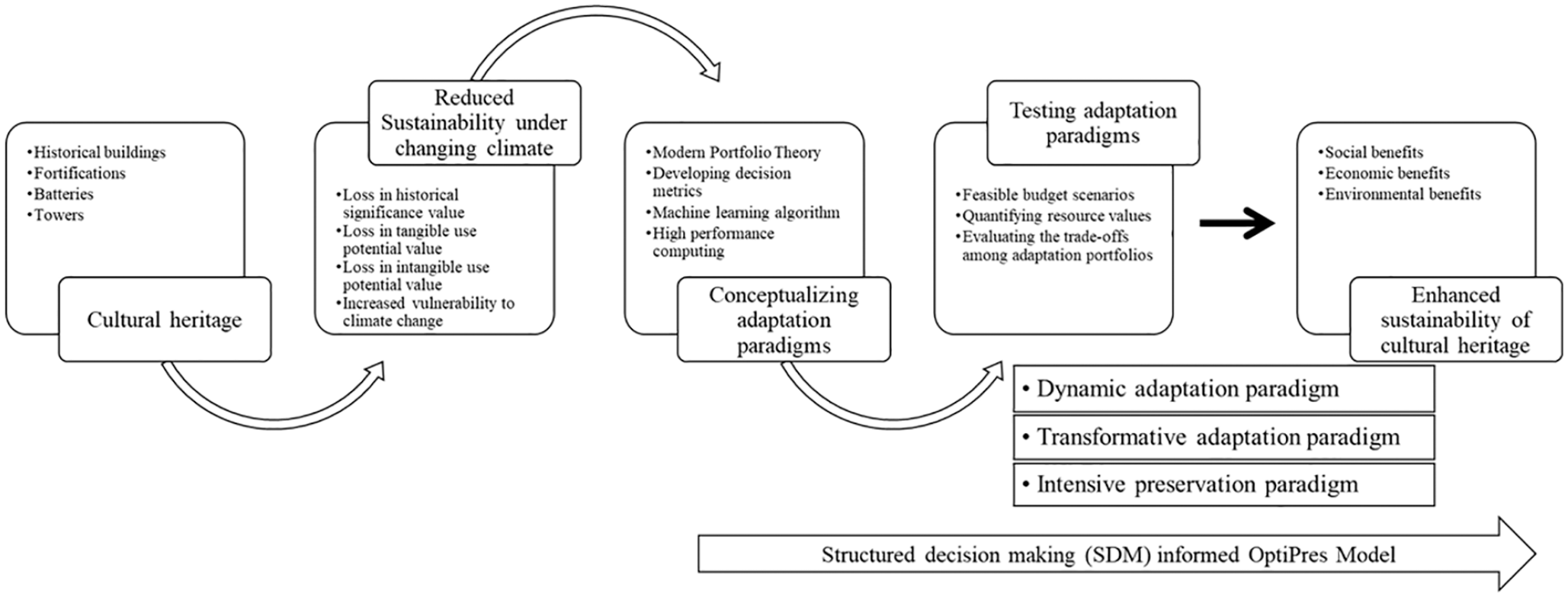
To achieve these research objectives, our study integrates the MPT with an SDM process for multi-criteria decision analysis under the umbrella of the three-pillar sustainable tourism principles to a climate adaptation planning framework for cultural heritage over a 30-year planning horizon (Figure 1). In the conceptual framework, the reduced sustainability of multiple types of cultural heritage (e.g., historical buildings, fortifications, batteries, and towers) is manifested in the loss of historical significance, tangible use potential, intangible use potential, and increased vulnerability to climate change (Fatorić & Seekamp, 2017b). The adaptation paradigms were conceptualized by MPT with an SDM process (i.e., problem, objectives, alternatives, consequences, tradeoffs, and decision) for multi-criteria decision analysis, where decision metrics of each paradigm fill up the gaps in sustainable adaptation planning of cultural heritage in previous studies (e.g., dynamic values reflect the tangible use and intangible use change of cultural heritage under changing climate, transformative decision metrics to balance the tradeoffs between tangible use and intangible use of cultural heritage, and intensive preservation paradigm to minimize the climate impacts on historical values and use potental when management institutions have the capacity to implement more adaptation actions within the planning horizon) (Seekamp & Jo, 2020; Xiao et al., 2021). By testing the adaptation paradigms with feasible budget scenarios, quantifying the resource values of cultural heritage asset, and evaluating trade-offs among adaptation portfolios under varying paradigms, the long-term sustainability of cultural heritage might be achieved from three perspectives: (1) the economic sustainability is quantified by adaptation costs and annual budgets for planning; (2) the environmental sustainability is measured by vulnerability, resource conditions, and historical significance 1 ; and (3) social sustainability is measured by resource use potential (tangible and intangible use potential). Often, the climate adaptation frameworks for cultural heritage are only conceptualized at earlier stages (i.e., climate impacts on cultural heritage and adaptation strategies without measurable costs and values). The frameworks that balance the benefits of economic, environmental, and social sustainability of adaptation decisions by varying paradigms addressing diverse and time-sensitive preservation needs of cultural heritage have not been conceptualized and tested in previous studies. This conceptual framework enables transparent decision-making processes by optimized actions for the assets in the portfolio (multiple types of cultural heritage) under varying paradigms, where the long-term SDGs of coastal tourism destinations can be achieved by evaluating the trade-offs systematically.
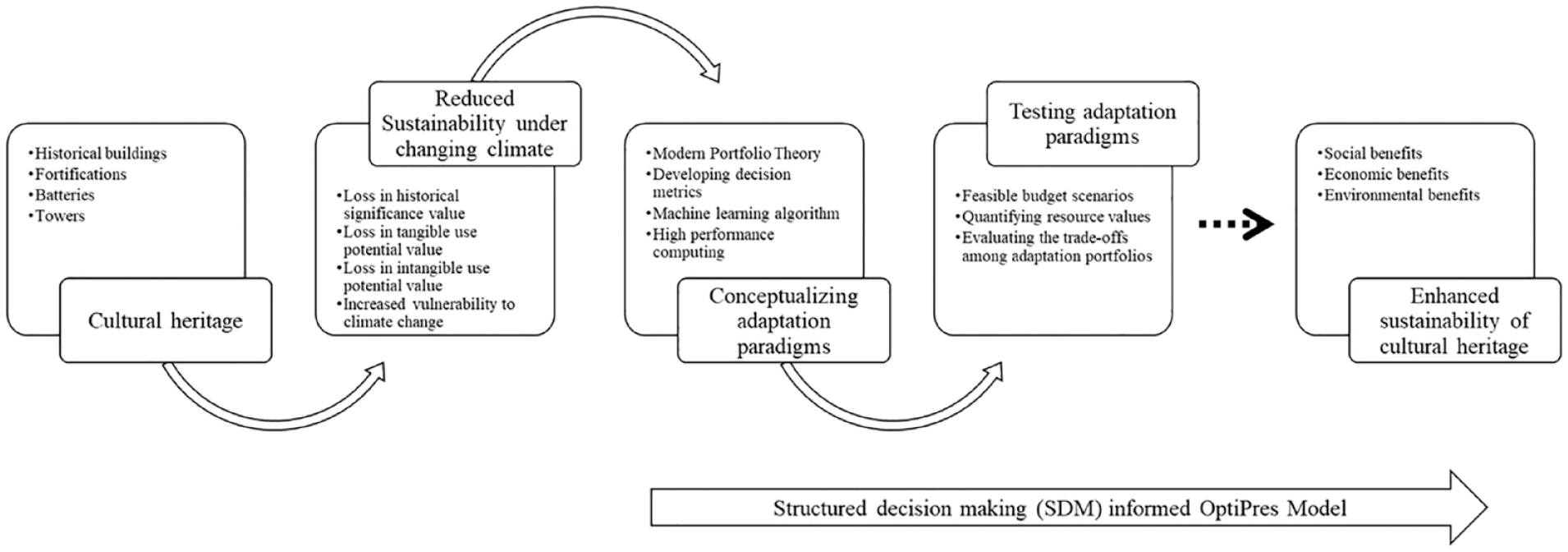
Conceptualized framework of adaptation planning paradigms.
Methods
Study site
The Gulf Island National Seashore (GUIS) is an NPS-managed coastal tourism destination, which includes two administrative units of 139,175 acres in Florida and Mississippi. The cultural heritage assets at GUIS are multi-type historical structures, including coastal fortifications, batteries, historic buildings (wooden and concrete buildings), and towers. Fortifications are essential resources for GUIS and are key tourism attractors. The cultural heritage assets are vulnerable to climate-driven impacts and natural hazards. In addition, climate change has intensified the decay rates of historical significance and restricted the use potential of cultural heritage at GUIS. Informed by the GUIS staff, we selected 28 representative historical structures located within the Pensacola Harbor Defense Project Historic District on Santa Rosa Island in this study, including wooden historic buildings (11 structures), masonry historic buildings (3 structures), concrete historic buildings (3 structures), concrete batteries (9 structures), metal tower (1 structure), and fort (1 structure) for the sustainable adaptation planning goals of multiple types of cultural heritage responding to climate change (Figure 2).
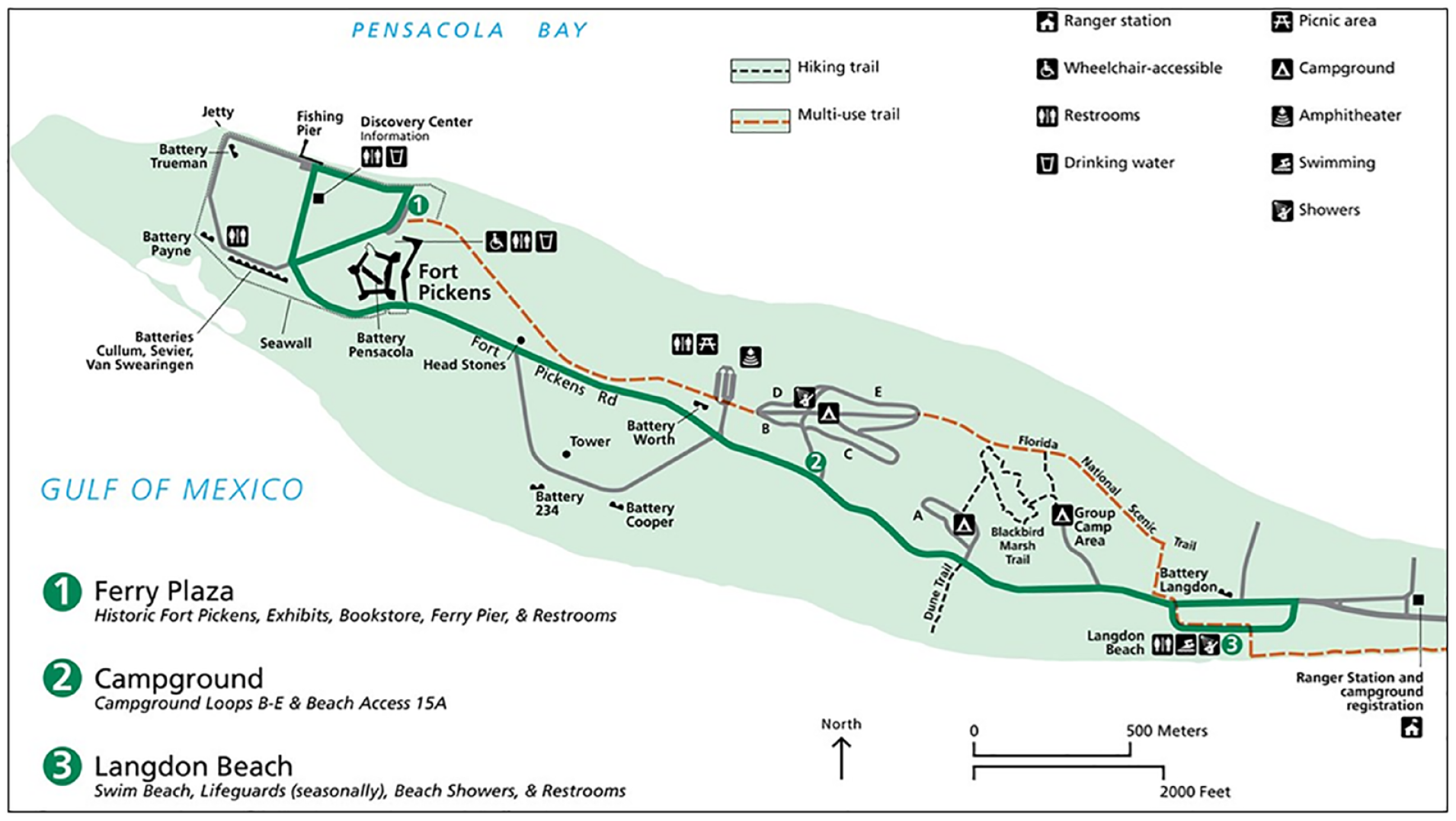
A map of Fort Pickens and the Pensacola area (Source: US National Park Service).
Optimization Preservation Model for Cultural Heritage
The OptiPres Model is a decision-analytic model guided by the SDM approach. The OptiPres Model provides quantitative and optimized decisions to achieve the desired objective by a machine-learning algorithm (simulated annealing algorithm). The OptiPres Model was first developed and tested by Xiao et al. (2019) for climate adaptation planning of historical buildings at Cape Lookout National Seashore (CALO). The initial optimization objective was to maximize the accumulated resource value of cultural heritage assets over a 30-year planning horizon. The management objective was defined during a week-long deliberate workshop with stakeholders of cultural heritage preservation, including NPS programmatic and administrative staff, North Carolina State Historic Preservation Office staff, and other regional stakeholders. The value-based decision metrics were developed during the workshop and refined during iterative meetings with a subset of stakeholders, where accumulated resource value was determined by historical significance (sub-attributes: association to fundamental purpose, condition of building, character, and national register), use potential (sub-attributes: operational use, visitor use, third-party use, interpretive use, and scientific use), and vulnerability (sub-attributes: exposure and sensitivity). During the workshop, the stakeholders also determined the multi-criteria of adaptation decisions (e.g., only one significant preservation action can be applied to the building over the 30-year planning horizon). Details of model metrics can be found in Xiao et al. (2019).
Extensions of the pilot OptiPres Model aim to incorporate sustainable tourism adaptation planning criteria and the capacity to transfer climate adaptation planning to broader tourism destinations globally. Our study developed an updated OptiPres Model for GUIS to achieve the model extension, including the subsequent efforts of data collection:
(a) A two-day workshop with GUIS staff to introduce the purposes and dynamics of the OptiPres Model and explain the data needs for model updates for cultural heritage at GUIS. The available adaptation actions for cultural heritage at GUIS were also determined during the workshop.
(b) A post-workshop online survey with GUIS staff and cultural heritage preservation stakeholders at NPS to elicit the weights for historical significance, use potential, and their sub-attributes for cultural heritage at GUIS.
(c) Two virtual meetings with GUIS staff to determine the annual decay rates of historical values and dynamics of adaptation actions for different types of cultural heritage at GUIS.
(d) A post-workshop survey for GUIS staff to assess the current values of historical significance and use potential for each historical structure using ArcGIS Survey 123.
The climate adaptation actions for the cultural heritage were adopted by Xiao et al. (2019), considering the appropriateness of adaptation actions for the cultural heritage structure types and the feasibility of preservation and adaptation costs determined by GUIS staff. The preservation action included core & shell preservation, and adaptation actions for cultural heritage at GUIS were: (1) document & monitor, (2) active removal, and (3) elevate. The adaption cost for each structure was estimated by regional NPS staff (for more details, see Xiao et al., 2021). The original OptiPres Model designated that preservation and adaptation actions could only be applied to each structure for one time over the 30-year planning horizon. The OptiPres Model also added annual maintenance and no action as alternative actions to enable the model to allocate funds to other structures for cost-intensive maintenance and adaptation actions.
Besides the data collection efforts, our study updates the dynamics of the OptiPres Model (Xiao et al., 2019) by implementing the following (Supplemental Appendix A): (1) the decision metrics for use potential were updated from static to dynamic; (2) the weights for intangible use and tangible use potential were updated from static to dynamic depending on the structure condition; (3) the adaptation approach was updated from a single-objective to transformative; (4) the decision metrics for core & shell preservation (high-cost maintenance action) were updated to one time every 10-year to align with cultural heritage preservation needs under fiscal constraints, and (5) the targeted cultural heritage assets was updated from single-type structure to multi-type structures. It is important to note that we differentiated tangible use potential (i.e., visitor access, park operations, and third-party uses, such as concessionaire use) from intangible use potential (i.e., interpretive use, scientific use), and considered this to be the best available proxy to differentiate between tangible and intangible heritage values and better accounted for the transformations when tangible assets are lost to climate change impacts.
OptiPres Model Objective Function and Machine Learning Algorithm
The objective function of the OptiPres models was to maximize the accumulated total resource value of coastal cultural heritage assets in the study area. The objective function involves three main dimensions: (1) historical significance; (2) use potential (tangible and intangible use potential); and (3) vulnerability of coastal cultural heritage under a 1-meter sea-level rise climate change projection. The sub-attributes of the three dimensions: historical significance (association to fundamental purpose, condition of building, character, and national register), use potential (operational use, visitor use, third-party use, interpretive use, and scientific use), and vulnerability (exposure and sensitivity) were conceptualized and elicited by the five deliberate workshops with stakeholders of cultural heritage preservation. In specific, vulnerability assessment projects sea-level rise under a high (RCP 8.5) emission scenario by 2050, and quantifies multiple coastal hazards and climate change impacts (e.g., erosion, storms, sea-level rise, etc.) on cultural heritage sites within 40 US NPS coastal parks (Peek et al., 2017), which aligns with the planning horizon of the OptiPres Model. The objective function of the OptiPres Model is:
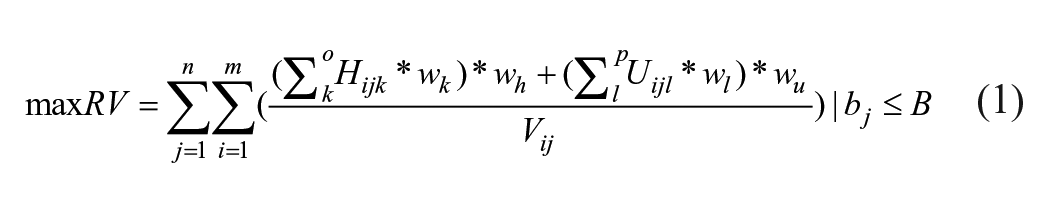
where RV is the total resource value of all i coastal heritage structures over all j time steps; H represents the performance of each of the k historical significance attributes; wk represents the weight of the historical significance sub-attributes; U represents each of the l attributes for use potential; wl represents the weight of the use potential sub-attributes; wh and wu represent the weights given to the total values of H and U, respectively; Vij represents the vulnerability of structure i in the year j, b represents budget expenditure over year j, and B represents the annual budget constraint.
The constraints of the OptiPres Model are multi-dimensional: (1) the total costs of proposed adaptation actions for each structure cannot exceed the annual budget; (2) the annual maintenance action and “no action” can be applied multiple times, while only one intensive preservation action (document & monitor, active removal, core & shell preservation, and elevate) can be applied to each structure with the planning horizon; and (3) the condition, historical value, tangible and intangible use potential are subject to different yearly degrading rates when “no action” was applied to the structure.
Guided by the MPT, the objective function of the OptiPres Model will propose available climate adaptation actions for each cultural heritage structure, check all constraints of the model (described in the previous paragraph), quantify the proposed portfolio resource values of the cultural heritage assets, and elicit the optimized portfolio after evaluating all possible combinations of adaptation actions for cultural heritage assets across the 30-year planning horizon. Ideally, the number of proposed portfolios of adaptation actions will be higher than 6840 (6 to the power of 840) under each budget scenario, which is highly beyond the calculation capacity of the human brain. Therefore, the OptiPres Model uses a stochastic search algorithm: simulated annealing to identify the optimized decisions for the targeted objectives. The simulated annealing algorithm randomly proposes initial solutions to each structure. It replaces the initial solutions if the new solution improves the value for the objective functions with a probability metric determined by an exponential function of temperature (for more details, see Xiao et al., 2019). The simulated annealing algorithm has been applied to ecological conservation planning to identify the optimized decisions for long-term conservation objectives (Westphal et al., 2007; Wintle et al., 2011). However, the simulated algorithm has rarely been applied in cultural heritage conservation planning except for the previous applications of the OptiPres Model (Li et al., 2022; Xiao et al., 2019, 2021). The simulated annealing algorithm is an efficient search method for identifying the globally optimized solution by occasionally accepting neighborhood solutions to prevent the algorithm from being trapped in a local optimized solution (Post van der Burg et al., 2014). A local computer run for the OptiPres Model has 107 solutions to elicit the optimum solution. To enhance the computing efficiency and accuracy of the optimization algorithm, we use the parallel computing function of the High-Performance Computing (HPC) system and submit the C++ code for objective functions 100 times per run to nodes of the HPC system (there are 100 million times per run for accuracy). We then elicit the solution with the highest value among the 100 million optimized solutions as the final solution of the objective function.
Four adaptation paradigms are proposed in this study (Supplemental Appendix A):
(1) Single-criterion adaptation paradigm, where only tangible use changes when a structure condition decays to the poor class;
(2) Dynamic adaptation paradigm, where both tangible and intangible use changes when a structure condition changes or adaptation actions are applied;
(3) Transformative adaptation paradigm, where tangible and intangible use changes with transformative weights when a structure condition changes, when preservation or adaption actions are applied, or both.; and
(4) Intensive preservation paradigm, lifting the threshold of core & shell preservation of transformative adaptation paradigm from once per 30-year to once per 10-year.
Additionally, we applied four scenarios to assess the trade-offs:
(1) Scenario a: $50,000 annual allocation (low budget scenario);
(2) Scenario b: $400,000 annual allocation (typical budget scenario);
(3) Scenario c: $50,000 annual allocation with an additional $400,000 allocation every 5 years (low budget + periodic pulse scenario);
(4) Scenario d: $400,000 annual allocation with an additional $400,000 allocation every 5 years (typical budget + period pulse scenario).
The four budget scenarios were proposed under the guidance of GUIS staff during the two-day workshop. The rationales for the four budget scenarios involve the factors of feasibility and adaptation costs of the cultural heritage assets in the study area. Specifically, scenario a presents the low budget allocation for historical preservation where the budget is only affordable for annual maintenance of 40% of historical buildings; scenario b represents the typical budget scenario (higher than the total cost of annual maintenance for 90% of historical buildings) where GUIS often receives for historical preservation. Scenario c represents the low annual budget allocation for historical preservation with a periodical surge of funding every 5 years, where a few cultural heritage structures might be preserved under a limited annual budget and the majority of the cultural heritage might be intensively maintained every 5 years. Scenario d represents the typical annual budget allocation with a periodical surge of funding every 5 years, where the majority of the cultural heritage structures can be maintained yearly with additional adaptation actions to be applied every 5 years. These four budget scenarios represent a wide spectrum of budget allocation scenarios that GUIS may encounter across the 30-year planning horizon based on the historical funding allocation realities for cultural heritage preservation.
Results
Single-criteria Adaptation Paradigm and Dynamic Adaptation Paradigm
To compare the portfolio of adaptation actions and resource values by varying adaptation paradigms, we examined outcomes for all four budget scenarios (scenarios a-d). Under the single-criterion adaptation paradigm, the actions for the set of cultural heritage are limited to annual maintenance and core & shell preservation or no adaptation actions due to insufficient budget. Specifically, annual maintenance was applied to 27%, 33%, and 33% of wooden buildings, concrete buildings, and masonry buildings across the majority of the time horizon under scenario a by the single-criterion adaptation paradigm (Figure 3). Core & shell preservation was applied to 54% and 67% of wooden buildings and concrete buildings. While no core & shell preservation action was affordable to be applied to the masonry buildings due to the limited budget under scenario a., Fort Pickens, batteries, and towers could not be maintained due to relatively high costs under scenario a. In the typical budget scenario (scenario b) and periodical funding increase scenarios (scenarios c & d), the frequencies and number of structures receiving annual maintenance and core & shell preservation are largely increased from scenario a, particularly for wooden buildings, concrete buildings, masonry buildings, and the tower. Annual maintenance is applied to all wooden buildings, two-thirds of concrete buildings and masonry buildings, and the tower across the majority of the planning horizon, respectively. All wooden buildings, concrete buildings, masonry buildings, and the tower are elicited for core & shell preservation. Temporally, core & shell preservation is applied to the tower in the first 5-year horizon, followed by a mix of wooden, concrete, and masonry buildings from year-6 to year-10, and predominantly wooden and concrete buildings from year 10 to 20. Notably, core & shell preservation is not applied to any structure over the last 10 years. The rationale for applying the core & shell preservation in the early and middle periods of the time horizon is to postpone the time of structure conditions decaying to the poor class, which would make the structures not capable of visitor use, operational use, and third-party use.
Percentage of historical structures receiving intensive preservation actions under the single-criterion adaptation paradigm.
The single-criterion adaptation paradigm yields minimal changes in the intangible use potential (interpretive use and scientific use) values for concrete and masonry buildings under all budget scenarios (Supplemental Appendix B). The tangible use potential values (visitor use, operational use, and third-party use) of wooden buildings, however, decay about 65%, 18%, 55%, and 32% at the end of the planning horizon under scenarios a, b, c, and d, respectively. The intangible use values stay consistent under varying budget scenarios among all types of cultural heritage. These results highlight that the tangible and intangible use potential of cultural heritage are both important factors that need to be considered in climate adaptation planning; however, the single-criterion use potential decision metric may not be capable of simultaneously reflecting realistic changes in tangible and intangible use potential of cultural heritage.
Compared to the single-criterion adaptation paradigm, the dynamic adaptation paradigm diversifies the types of adaptation actions applied to cultural heritage (Figure 4). Instead of only applying preservation actions (i.e., annual maintenance or core & shell preservation) actions to cultural heritage, the dynamic adaptation paradigm makes a few wooden buildings eligible to receive document & monitor adaptation actions, which highly enhances the intangible use potential value of wooden buildings. Since the cost of document & monitor is often higher than core & shell preservation, the number of historical structures receiving the document & monitor actions is much lower than core & shell preservation. The OptiPres Model generally elicits the structures eligible to receive core & shell preservation, postpones the timeline for structure conditions decaying to the poor class by applying annual maintenance, and fences the historical structures to implement intensive documentation and monitoring at the end of the planning horizon. The rationale to apply document & monitor action at the end of the planning horizon is that by fencing the structure for document & monitor, no action can be applied across the rest of the planning horizon, and the tangible use potential (visitor use, operational use, and third-party use) will be downgraded to the lowest level. Hence, document & monitor is often applied at the later planning horizon when a historical structure’s condition decays to the poor class and has minimal tangible use potential. Among the four budget scenarios, scenario c is the only scenario where document & monitor is applied to wooden structures (9%) because the periodical funding provides additional funds ($400,000) to annually allocated funds ($50,000/year), making a few wooden structures eligible to be documented and monitored but insufficient for full implementation of core & shell preservation (as shown in scenario d).
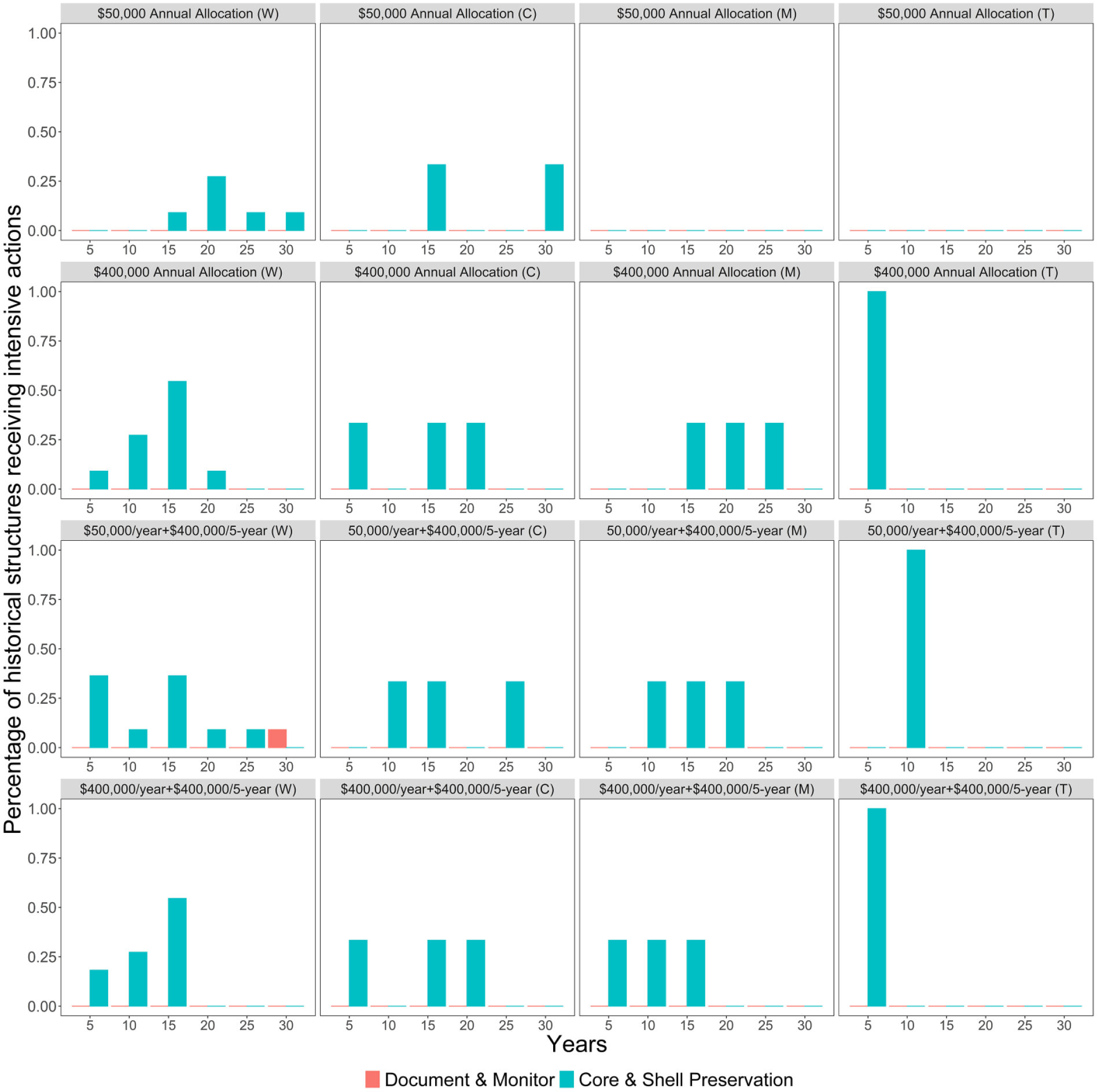
Percentage of historical structures receiving intensive preservation actions under the dynamic adaptation paradigm.
The dynamic adaptation paradigm yields more fluctuated resource values for all four budget scenarios than the single-criterion use potential metric (Appendix C). Specifically, the tangible use potential values decay dramatically for wooden buildings, concrete buildings, masonry buildings, and the tower under scenarios a and c across the planning horizon, due to consistent yearly loss of visitor use, operational use, and third-party use potential, with a few exceptional years when core & shell preservation actions are applied. Notably, Fort Pickens and batteries’ tangible use potential values decay to the lowest level over the first 5-year due to their consecutively unmanaged status under limited budget allocations among all four budget scenarios. The tangible use potential values stay relatively steady for wooden buildings, concrete buildings, masonry buildings, and the tower under scenarios b and d across the planning horizon due to consistent annual maintenance, except for a few years when the conditions decay to the poor classes. The intangible use potential values decrease for all six types of cultural heritage across the time horizon under all four budget scenarios, except for a few years when core & shell preservation or document & monitor were applied to the wooden structures. The fluctuated values of the four tested budget scenarios represent simultaneous changes in tangible and intangible values of cultural heritage compared to the single-criterion adaptation paradigm.
Dynamic Adaptation Paradigm With Transformative Planning Guidance
Although the dynamic adaptation paradigm simultaneously integrated the climate change impacts on both tangible and intangible use potential values, the weights for tangible and intangible use potential are static. They may not be able to make transformative decisions on preserving the use potential of cultural heritage. To identify an optimized, dynamic, and transformative use potential metric and investigate how it might affect the management portfolio of cultural heritage, we tested the transformative paradigm of the OptiPres Model under the four budget scenarios. Compared to the single-criterion and dynamic adaptation paradigms, the transformative adaptation paradigm makes more types of cultural heritage eligible to be documented and monitored (Figure 5). Specifically, document & monitor was applied to at least one type of cultural heritage under all four budget scenarios. Under scenario a, 9% and 36% of wooden buildings were maintained by document & monitor and core & shell preservation actions, respectively, in the transformative adaptation paradigm. In contrast, no wooden structure was projected to receive document & monitor in the dynamic adaptation paradigm. Under scenarios b & c & d, all wooden buildings, concrete buildings, masonry buildings, and the tower were receiving core & shell preservation, similar to the core & shell preservation portfolio in the dynamic adaptation paradigm. However, the transformative paradigm intensified the frequencies of document & monitor to be applied to wooden buildings, concrete buildings, masonry buildings, and the tower, which were concentrated in the middle to late planning horizon. Notably, 36%, 33%, and 33% of wooden buildings, concrete buildings, and masonry buildings, respectively, were projected to be documented and monitored under scenario c, where the document & monitor were generally applied in years 15, 20, 25, and 30 when the additional funds were allocated.
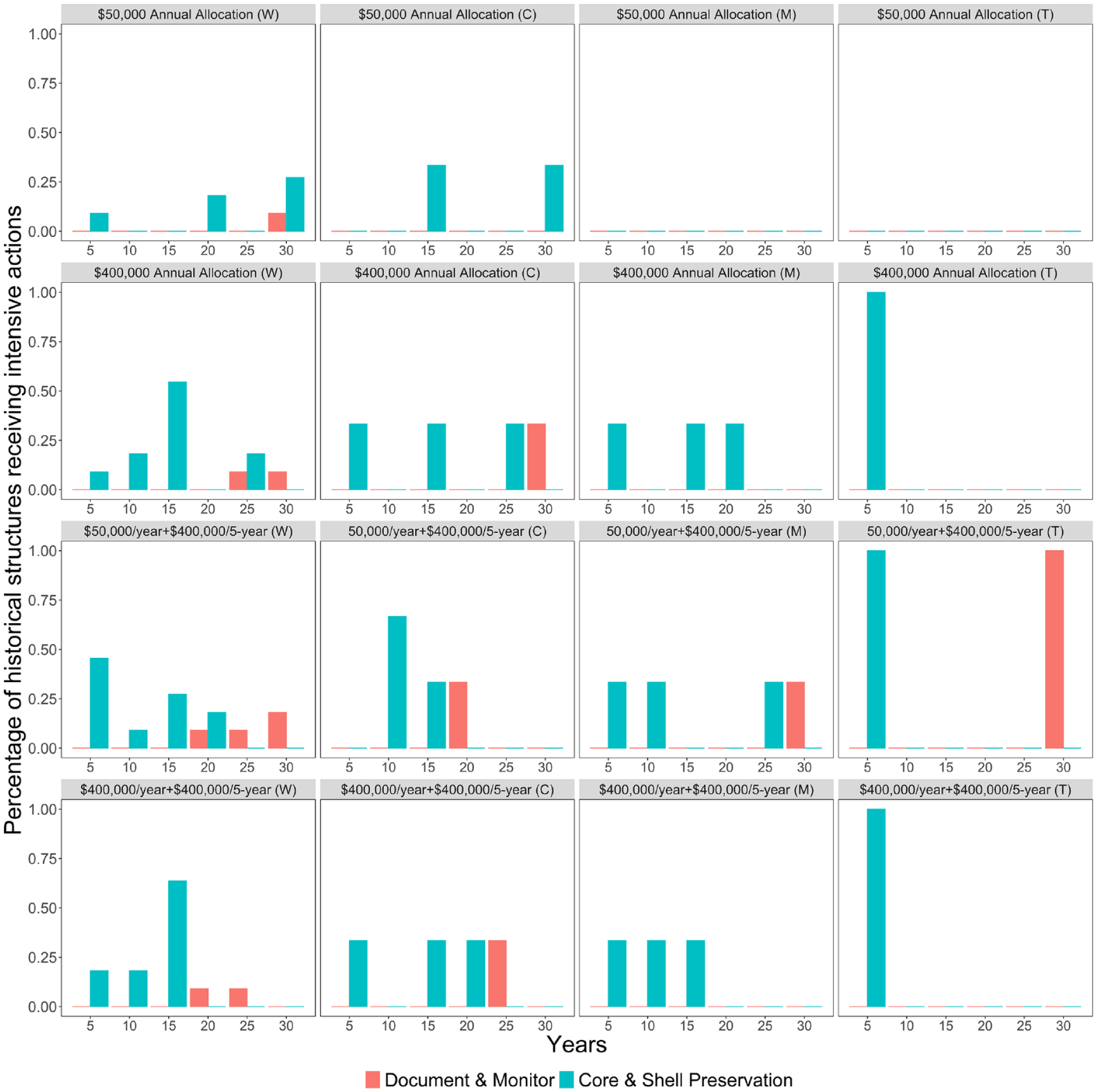
Percentage of historical structures receiving intensive preservation actions under the transformative adaptation paradigm.
Compared to the dynamic adaptation paradigm, the transformative adaptation paradigm offers adaptive weights for tangible and intangible use potential, yielding more fluctuated values for intangible use potential (Supplemental Appendix D). In addition, the increased frequencies of document & monitor actions enhance the intangible use potential value for wooden buildings, concrete buildings, masonry buildings, and the tower at the end of the planning horizon. Interestingly, the intangible use of Fort Pickens and the batteries become the dominant components of use potential under all four budget scenarios because of the fiscal constraints (i.e., no action). These results imply that the long-term unmanaged structures might be transformed to interpretive use or scientific use predominantly under the impacts of climate change.
Intensive Preservation Paradigm
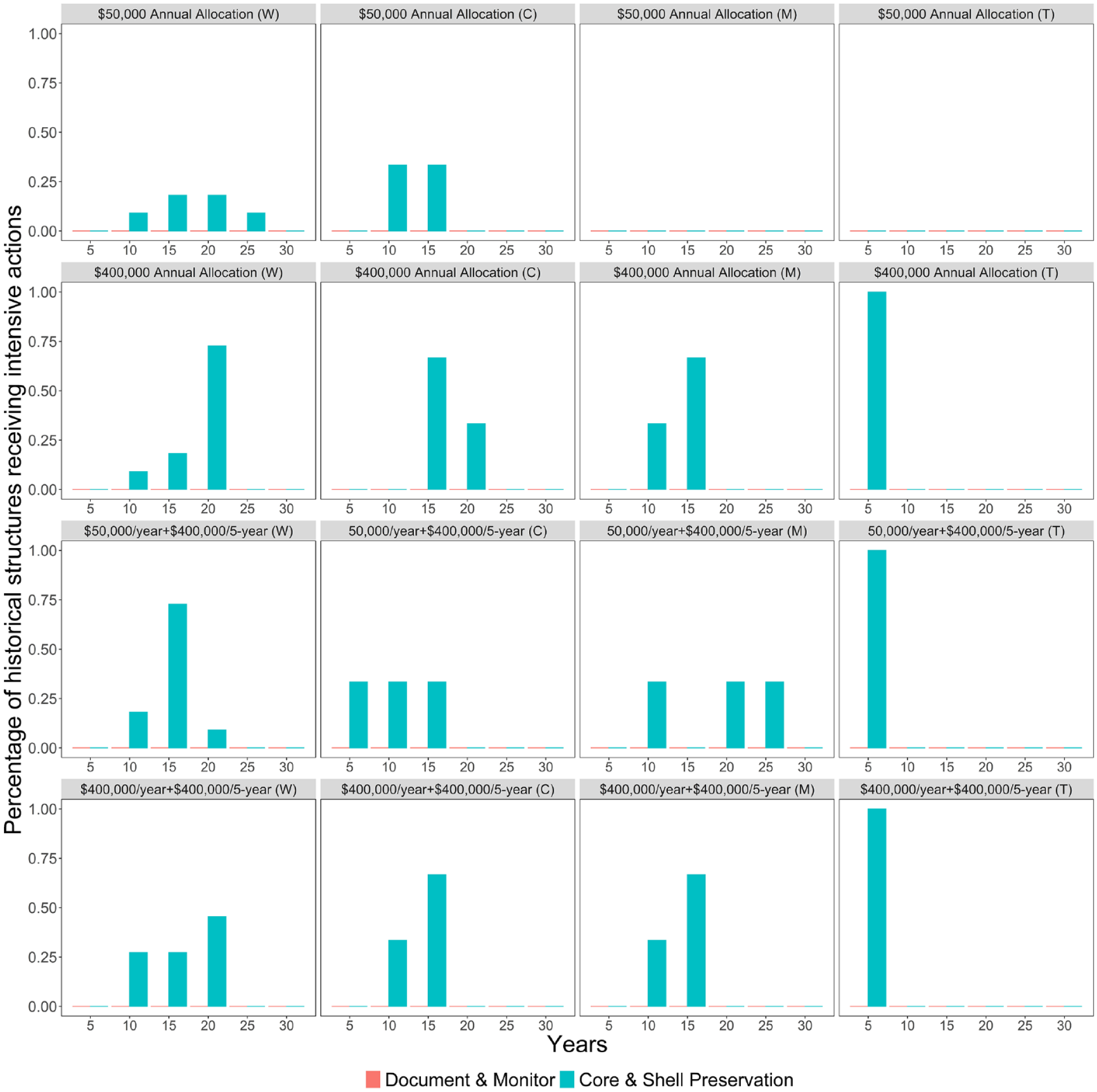
Since the typical budget scenario is much lower than the cost of climate-focused adaptation action (elevate) at GUIS, most cultural heritage assets’ conditions decay to the poor class. We investigated an intensive preservation paradigm, which lifts the threshold of core & shell preservation from one-time per 30-year to one-time per 10-year and combines it with the transformative use potential metric. We tested this intensive preservation paradigm against all four budget scenarios. The intensive adaptation paradigm largely increased the frequencies of core & shell preservation actions for wooden buildings, concrete buildings, masonry buildings, and the tower, while slightly reducing the frequencies of document & monitor compared to the transformative adaptation paradigm (Figure 6). Consequently, the conditions of wooden buildings, concrete buildings, masonry buildings, and towers were greatly enhanced from earlier decision metrics, which slowed down the decay rates of tangible and intangible use potential values of these structures. Notably, under scenario d, core & shell preservation actions were applied three times to wooden buildings, concrete buildings, masonry buildings, and the tower, which largely maintained the conditions and tangible use potential of these structures. However, document & monitor actions were applied to 33% of concrete buildings to enhance the intangible use potential even when the buildings were not in poor conditions.
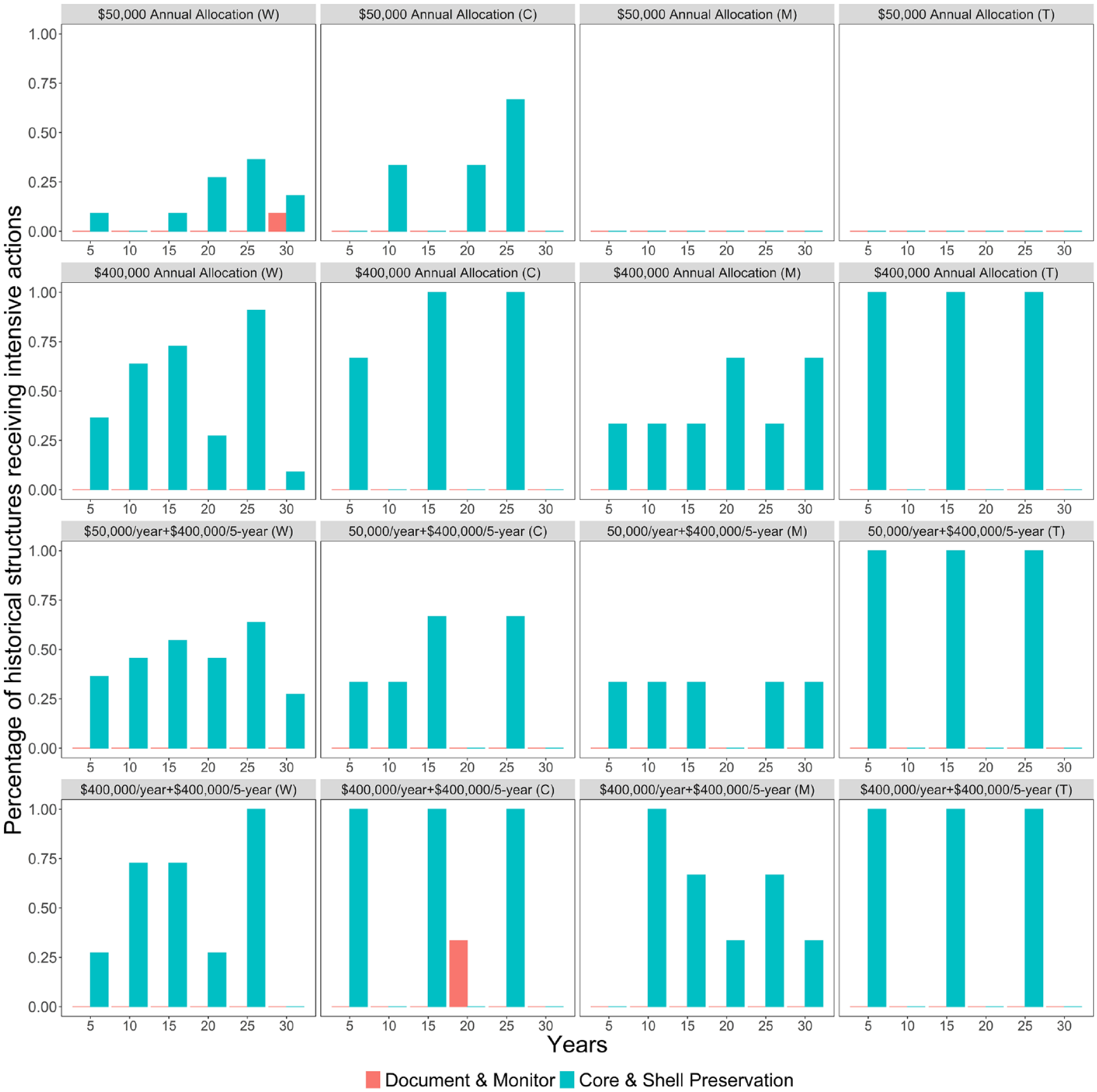
Percentage of historical structures receiving intensive preservation actions under the intensive preservation paradigm.
Compared to the transformative adaptation paradigm, the intensive preservation paradigm offered more opportunities to apply core & shell preservation to historical structures, yielding higher values of condition and tangible use potential, particularly for wooden, concrete, and masonry buildings (Appendix E). Since Fort Pickens and batteries were still not affordable for annual and intensive maintenance, tangible and intangible use potential values stayed the same as the values under the transformative adaptation paradigm.
The Effectiveness of Funding Allocation Under Varying Adaptation Planning Paradigms
To better explore the economic factors of sustainable tourism planning, we calculated the effectiveness of funding allocation by adaptive planning paradigms under scenarios a, b, c, and d. The effectiveness of funding allocation was calculated as the ratio of total adaptation cost dividing the total allocated funding. Overall, the OptiPres Model achieves relatively high effectiveness in funding allocation: all of the four tested budgets under the single-criterion, dynamic, transformative, and intensive preservation adaptation paradigms achieve the effectiveness of 90% or higher (Figure 7). However, when considering the social factors of sustainable tourism planning, the effectiveness of funding allocation varies among different adaptation paradigms. Specifically, the adaptation planning portfolios by the dynamic and transformative adaptation paradigms achieve higher effectiveness to use allocated funding for adaptation actions under scenarios b and c, particularly in the later planning horizon compared to the single-criterion adaptation paradigm. The higher effectiveness of funding usage by the dynamic and transformative adaptation paradigms is primarily driven by the application of document & monitor to wooden buildings, concrete buildings, and masonry buildings. However, the intensive preservation paradigm achieves a higher level of effectiveness under scenario d, where the effectiveness ratio is 96.4%. Moreover, when considering the significance aspect of the environmental factors, the shorter threshold of the core & shell preservation application timeline enhances the frequencies of core & shell preservation, making more funding eligible to be allocated to core & shell preservation. Notably, although the funding allocation effectiveness of the intensive preservation paradigm under scenario a is lower than the dynamic and transformative metric, the resource value of the intensive preservation paradigm is higher than the resource values of the other two paradigms. This is driven by the fact that core & shell preservation can improve the use potential and enhance the historical significance. The intensive preservation paradigm’s enhanced frequencies of core & shell preservation improve the resource value more effectively when compared with the other two decision paradigms.
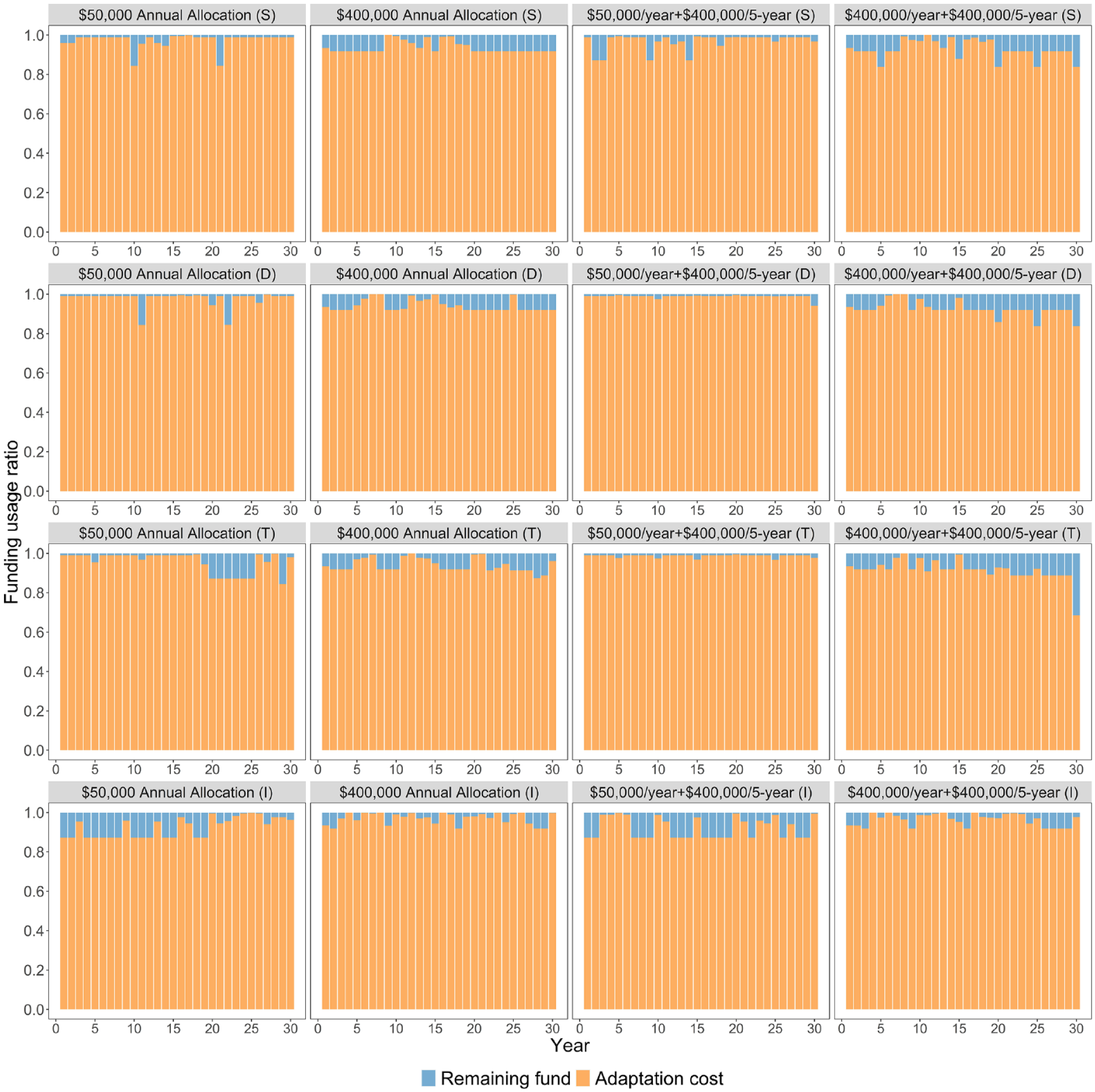
The effectiveness of funding allocation under varying adaptation planning paradigms.
Discussion
This study analyzes the portfolios of climate adaptation planning actions under different adaptation paradigms and evaluates the trade-offs of preservation, adaptation, and transformative paradigms for cultural heritage assets. Guided by the three-pillar sustainable tourism planning perspectives, our study develops and tests the OptiPres Models, which provide multi-faceted, quantitative, and optimized decisions to address the dilemma of unbalanced preservation for tangible and intangible use potential values in traditional cultural heritage planning approaches. By testing four budget scenarios representing a wide range of the funding allocation realities in cultural heritage preservation in coastal national parks (low to typical; constant to periodical funding increase), our study findings advance sustainable adaptation planning of cultural heritage under the changing climate from both theoretical and management perspectives.
Theoretical Implications
Theoretically, our study advances modern portfolio theory (MPT) applications in sustainable climate adaptation planning for cultural heritage. When considering the social, economic, and environmental components of sustainable tourism planning, traditional prescriptive planning approaches may limit the resilience of planning decisions facing varying climate and budget scenarios. The MPT, however, evaluates the composite benefits by the covariance of each asset (historical structure) in the portfolio (selected cultural heritage assets in GUIS) to optimize the benefits of the portfolio (total resource value, use potential, climate risk, etc.) as a whole. As indicated in the OptiPres Model, the social, economic, and environmental facets of cultural heritage planning need to be integrated into a systematic adaptation planning analysis (Figure 8). More importantly, the OptiPres Model enables multiple simultaneous considerations that are typically evaluated discretely, yielding a coherent decision portfolio that preserves the long-term sustainability of the cultural heritage asset under limited financial budgets. Specifically, the coherence of the three-pillar sustainability is represented in scattered preservation efforts in wooden and concrete buildings under low budget scenarios, relatively even preservation efforts among three types of historic buildings under the typical budget scenarios, and frequent preservation efforts for historic buildings and tower by the addition of an intensive preservation metric.
A systematic framework of optimized paradigms for cultural heritage climate adaptation planning.
The MPT-based sustainable and coherent decision portfolios in our study yield at least three benefits for the cultural heritage asset: (1) postponing the timeline of condition degradation to extend the possibility of visitor use, operational use, and third-party use (social & environmental factors) under changing climate conditions; (2) preserving the historical value and improving the conditions for structures that are affordable within the budget cap (economic & environmental factors), and (3) predicting the budget usage status to allocate climate response funding wisely (economic factor) (Figure 8). However, results from the OptiPres Model imply the threat that cultural heritage adaptation planning is highly dependent on financial resources, where insufficient funding allocations could yield value loss or inundation of iconic cultural heritage sites (i.e., Fort Pickens in our study case).
Our study highlights that the transformative and adaptive decision-making processes can diversify the long-term sustainability planning goals for cultural heritage preservation. The OptiPres Model extension applied in this study provides the first attempt to integrate adaptive weights for tangible and intangible use potential, making the transformative decision-making approach feasible for the multi-facets of cultural heritage adaptation planning. As implied in the findings, the transformative adaptation paradigm diversifies the preservation decisions by providing a path to accommodate the loss of cultural heritage assets through the dynamic consideration of tangible and intangible uses. In specific, the condition of cultural heritage assets greatly decays to the status where the tangible use potential is minimal under the changing climate. Yet, the intangible use potential (interpretive use and scientific use) of cultural heritage can be preserved by applying document & monitor in the middle or late planning period under the guidance of the OptiPres Model. More importantly, the OptiPres Model indicates that the preservation practices for cost-intensive and iconic cultural heritage under long-term unmanaged status might be transformed into intangible use-focused actions. Guided by the concept of transformative continuity to accommodate climate-driven losses to cultural heritage assets (Seekamp & Jo, 2020), the transformative paradigm provides generalizable and transparent solutions for the dilemma of unbalanced conservation between tangible and intangible use in cultural heritage planning.
From the perspective of sustainable tourism planning decisions, the normative theory embedded SDM approach enables decision-makers to evaluate, compare, and elicit the desirable planning goals and forecast the decision portfolio and composite values of cultural heritage (historical significance, tangible use potential, and intangible use potential). For instance, our test of the OptiPres Models using single-criterion, dynamic, and transformative adaptation paradigms yield different temporal patterns of intensive preservation actions under varying budget scenarios. Driven by different management goals, the OptiPres Model can evaluate alternative decision portfolios and optimize long-term, cost-effective management decisions for cultural heritage assets threatened by climate change. For instance, when the cultural heritage asset’s preservation goal emphasizes interpretive use and scientific use, applying document & monitoring more frequently in the late planning period can be the optimized solution. Alternatively, to maximize historical significance, tangible use potential, and intangible use potential as a whole, lifting the threshold of timeline for core & shell preservation from one time per 30-year to one time per 10-time can be an effective approach to meet the desirable management goal. The SDM advances the traditional prescriptive planning approach by identifying optimal decisions based on adaptive learning of the consequences of a proposed plan and quantifying the trade-offs using the machine learning algorithm. These advances can greatly prevent the loss of unwise decisions for cultural heritage and guide decision managers to spatially and temporally apply the most appropriate actions to multiple types of cultural heritage.
Practical Implications
The OptiPres Model developed in our study also makes meaningful, practical implications for managers, stakeholders, and planners of cultural heritage assets in tourism destinations. First, the OptiPres Models explore diverse adaptation paradigms that predict the temporal patterns of preservation and adaptation actions to be applied to different types of historic structures and forecast the changes in the condition and uses (both tangible and intangible) of each asset. The trade-off analyses (outputs) offer feasible, time-specific, and transparent insights for cultural heritage management and identify important preservation challenges across a long-term planning horizon. Cultural heritage managers often face the challenges of applying unequal preservation efforts among a collection of heritage assets, and selecting unbalanced conservation efforts between tangible and intangible uses. The OptiPres Model can estimate the percentages of historic structures receiving adaptation actions under varying budget scenarios (Figures 3–6). The gaps in preservation goals can be identified (e.g., Fort Pickens and batteries having insufficient funding for both preservation and adaptation). Informed by the OptiPres Model outputs, alternative strategies for unmanaged assets, such as targeted fundraising, could be proposed more effectively.
Second, the transformative planning paradigm optimizes the temporal patterns of adaptation actions and elicits the idealized time to apply actions that enhance intangible use values of cultural heritage when loss appears inevitable. For example, this study demonstrates that when facing with the degradation from climate exposures and limited fiscal resources to preserve or adapt a heritage asset, it is more optimal to allocate fiscal resources to fully document and fence the historic structure to provide social values (e.g., interpretive and scientific uses). Notably, the transformative planning paradigm with adaptive weights for tangible and intangible use potential can be generalized to other coastal tourism destinations, facilitating more flexible, adaptive, and feasible preservation decision portfolios to achieve the SDGs for cultural heritage in coastal tourism destinations.
Third, our study results also highlight that the OptiPres Model can estimate the effectiveness of funding allocation by different adaptation paradigms. The results indicate that small portions of allocated funding cannot be used for adaptation actions due to the constraints of the model (e.g., the threshold to apply intensive preservation actions within the 10-year or 30-year planning horizons) and the inadequacy of remaining funds for annual maintenance. The projected effectiveness of funding allocation calculated by the OptiPres Model can inform the managers about the yearly funding usage ratio and devise strategies to allocate the remaining funds to meet other management goals. Alternatively, the ratios of unspent annual budget allocations could be used to convince policy-makers to roll over any remaining annual budgets to enable the application of larger cost preservation and adaptation actions.
Limitations
Although our research findings have theoretical and practical implications for sustainable adaptation planning for cultural heritage in coastal tourism destinations, several limitations of our study exist. First, the OptiPres Model in this study has not integrated the impacts of stochastic storm events into cultural heritage planning. Any actions applied later in the planning period are less reliable compared with the starting stage of planning given the probabilities of storm-related impacts on the cultural heritage assets. Future studies would estimate the impacts of storminess based on historical weather data and future climate projections to identify adaptation decision portfolios that enhance the resilience of cultural heritage under the impacts of stochastic storm events. Second, the weights for the parameters in the OptiPres Model were primarily assessed by GUIS staff through onsite workshops about OptiPres Model and post-workshop surveys. In future studies, the OptiPres Model might integrate international experts’ inputs to the weight validation process to enhance the transferability of the OptiPres Model to the international scope of climate adaptation planning for cultural heritage.
Conclusion
This study advances sustainable climate adaptation planning for diverse cultural heritage assets in coastal tourism destinations by examining the trade-offs of single-criterion, dynamic, transformative, and intensive adaptation paradigms under varying budget scenarios. In particular, the updated OptiPres Model dynamics enable quantitative evaluations of the trade-offs among the social, economic, and environmental perspectives of sustainable cultural heritage adaptation planning. Additionally, the optimized, multi-faceted, and transformative decision portfolios visualized in the model’s outputs enhance outcomes’ transparency for different preservation and adaptation paradigms. The outputs suggest that the transformative adaptation paradigm can provide flexible, transparent, and objective-driven preservation portfolios to preserve both tangible and intangible uses when facing degradation or loss from inadequate funding and intensified threats from changing climatic conditions. Yet, our results also highlight the necessity to integrate the storm impacts to future modeling efforts to enhance decision-makers’ abilities to better understand the additional fiscal constraints they will face when addressing post-storm recovery and the risks associated with delaying preservation and adaptation decisions. Ultimately, cultural heritage adaptation planning guidance and decision support frameworks—particularly ones that account for transformation—are critical given the inevitability of losing tangible cultural heritage assets in vulnerable coastal tourism destinations.
Supplemental Material
sj-docx-1-jtr-10.1177_00472875221143479 – Supplemental material for Sustainable Adaptation Planning for Cultural Heritage in Coastal Tourism Destinations Under Climate Change: A Mixed-Paradigm of Preservation and Conservation Optimization
Supplemental material, sj-docx-1-jtr-10.1177_00472875221143479 for Sustainable Adaptation Planning for Cultural Heritage in Coastal Tourism Destinations Under Climate Change: A Mixed-Paradigm of Preservation and Conservation Optimization by Xiao Xiao, Peizhe Li and Erin Seekamp in Journal of Travel Research
Footnotes
Declaration of Conflicting Interests
The author(s) declared no potential conflicts of interest with respect to the research, authorship, and/or publication of this article.
Funding
The author(s) disclosed receipt of the following financial support for the research, authorship, and/or publication of this article: The project described in this publication was supported by Grant or Cooperative Agreement No. [G22ACOO273] (project title: Examining Diverse Management Objectives and Broadening Stakeholder Engagement for Climate Adaptation Planning of Historic Structures within the National Park System) from the United States Geological Survey. Its contents are solely the responsibility of the authors and do not necessarily represent the views of the USGS Southeast Climate Adaptation Science Center or the USGS. This manuscript is submitted for publication with the understanding that the United States Government is authorized to reproduce and distribute reprints for Governmental purposes.”
Additional funding for model development was provided by National Park Service Climate Change Response Program through U.S. Department of Interior Inter-Agency Agreement P17AC00794 (project title: Assessing the transferability of a historic resources decision support model for optimized budget allocation and adaptation planning).
Supplemental Material
Supplemental material for this article is available online.
1.
It is important to note that historical significance could also be considered a social factor, given the social values embedded in the term. Here, we categorize historical significance as an environmental factor as the attributes of historical significance, as conceptualized by  , reflect elements of structures present in a historic district listed on the National Register of Historic Places. We categorize historical significance as an element of the broader environment (i.e., cultural landscape).
Author Biographies
References
Supplementary Material
Please find the following supplemental material available below.
For Open Access articles published under a Creative Commons License, all supplemental material carries the same license as the article it is associated with.
For non-Open Access articles published, all supplemental material carries a non-exclusive license, and permission requests for re-use of supplemental material or any part of supplemental material shall be sent directly to the copyright owner as specified in the copyright notice associated with the article.
