



Abstract
As the first goal of the United Nations Sustainable Development Goals (SDGs), poverty (SDG 1) is increasingly experienced as a polycrisis, wherein interconnected crises compound and amplify one another. Income shortfalls, in particular, intersect with digital exclusion, food insecurity, housing instability, health shocks, and learning loss, producing reinforcing disadvantages that standard, siloed interventions rarely interrupt. This commentary advances a macromarketing argument that phygital solutions, defined as the deliberate integration of physical and digital resources to deliver solutions that function across systems, can help address poverty's polycrisis when design priorities shift from adoption to inclusion. The commentary proceeds in four parts. First, the discussion clarifies the distinctive value of commentary as a genre in a field where empirical and review formats often lag fast-moving contextual disruptions. Second, the discussion situates poverty's polycrisis using current global evidence across digital access, education, employment, food, health, and housing while foregrounding the rise of urban poverty alongside the persistence of rural poverty. Third, the discussion consolidates contemporary phygital scholarship and develops a macromarketing model of inclusive phygital solutions to alleviate poverty polycrisis. Fourth, the discussion synthesizes the argument and offers action-oriented directions for policy, practice, and research.
Keywords
Introduction: why a Commentary and why now
Commentary articles occupy a distinct space in marketing scholarship. Empirical articles usually test claims through data (Hubbard & Lindsay, 2002) while review articles usually consolidate extant work (Lim, 2025). Commentary articles can do different work—they can surface a contextual problem that has outpaced standard article categories and advance a conceptual argument or idea that reframes how marketing scholars and practitioners should respond.
Poverty qualifies as that kind of problem. Many marketing conversations still treat poverty as a background variable (Ashik et al., 2025), a segment descriptor (Santos & Laczniak, 2009), or an externality addressed through corporate social responsibility (Jebarajakirthy et al., 2016; Jose et al., 2015). Such framings inadvertently misread poverty's role in shaping the conditions of exchange, including who can access education and healthcare, who can earn income with dignity, who can secure stable housing, and who can participate in digital markets without exploitation. Market inclusion, in other words, is not only a matter of preference and persuasion, but also a matter of infrastructure (e.g., bank accounts, broadband, transport links), governance (e.g., eligibility rules, grievance channels, privacy safeguards), and power (e.g., ability to contest exclusion, demand accountability, negotiate terms of exchange). 1
Polycrisis language sharpens the diagnosis as it names the interaction effects that siloed framings tend to miss. In essence, a polycrisis refers to multiple crises that interact, amplify one another, and generate consequences greater than the sum of each crisis alone (Lawrence et al., 2024). Poverty rarely arrives as one crisis but as an interacting set of deprivations, vulnerabilities, and exclusions that cascade across schools, labor markets, and infrastructure systems, including food, health, and housing systems (Ashik et al., 2025). Climate change and urbanization further intensify these interactions (Adam & Rena, 2024) while digitalization reshapes how people access services and rights (Berthon et al., 2026). Under these conditions, treating poverty as a single-variable outcome becomes analytically weak and normatively risky.
Treating poverty as a polycrisis also clarifies why action on Sustainable Development Goal 1 (SDG 1) matters beyond poverty reduction alone, as progress on poverty, in practice, often requires progress on hunger (SDG 2), good health and wellbeing (SDG 3), quality education (SDG 4), gender equality (SDG 5), decent work and economic growth (SDG 8), innovation and infrastructure (SDG 9), reduced inequalities (SDG 10), sustainable cities and communities (SDG 11), and, more recently, climate action (SDG 13), 2 since these domains (primarily) function as poverty's pathways rather than (mere) downstream consequences. In essence, stabilizing access to food reduces hunger while protecting learning and health, protecting households from catastrophic health spending preserves work capacity and reduces the risk that a health shock cascades into schooling disruption or housing precarity, and keeping children connected to schooling during disruption protects learning and later earning potential while limiting intergenerational poverty transmission under climate volatility. Reducing digital exclusion and transport burdens, in turn, strengthens the infrastructure of participation, expanding access to work, care, and entitlements while also lowering gendered and classed barriers to safe mobility, usable services, and fair treatment, which shape inclusive urban development rather than exclusionary growth.
Phygital scholarship offers a timely conceptual resource for responding to that reality. Managerial discourse often uses phygital as a branding device (Hyun et al., 2024), a retail tactic (Testa & Slaton, 2026), or a channel integration strategy (Corinaldesi, 2025). A macromarketing lens supports a different reading. Hybrid physical-digital systems can organize access to essential services, including banking, education, employment, healthcare, transportation, and social protection. A poverty agenda, therefore, requires attention to how physical and digital infrastructures interact to shape opportunities in a dignified, capability-expanding, and distributively fair manner.
Human-centricity anchors the macromarketing case for the phygital. 3 In essence, phygital (macro)marketing treats hybrid physical-digital design as a strategic (macro)marketing paradigm where human needs and human flourishing inform decision-making (Batat, 2024b, 2026). 4 In this regard, design choices become human-centered when they protect agency, dignity, and wellbeing at the point of use, including under disability constraints, fear of automated exclusion, low literacy, or unstable work—conditions that the poverty polycrisis renders common rather than exceptional. Inclusive phygital solutions, in turn, respond to that reality by asking whether a hybrid system reduces burden, preserves choice, and provides usable help and recourse when technology or rules fail.
Three aims guide this article. First, the article sets the scene on poverty as a polycrisis using recent global evidence. Second, the article consolidates key phygital scholarship, with attention to recent and relevant works in well-regarded outlets. Third, the article develops a conceptual case to illustrate how phygital systems can address poverty's polycrisis while specifying boundary conditions that determine whether hybrid systems reduce or reproduce deprivation.
Setting the Scene: Poverty as a Polycrisis
Poverty has Outgrown a Single Income Line
Income poverty remains severe and progress has slowed. Global monitoring of poverty estimates that 808 million people will live in extreme poverty in 2025, up from the previous estimate of 677 million people in 2022, representing close to 10% of the world's population, or one in 10 people worldwide (United Nations Department of Economic and Social Affairs Statistics Division, 2025a). Vulnerability extends beyond the official poverty headcount, as populations just above poverty thresholds can fall back into poverty after even small shocks (Hu et al., 2026).
Multidimensional evidence reinforces the argument. Recent reporting on acute multidimensional poverty estimates that 1.1 billion people live in acute multidimensional poverty and children account for more than half (United Nations Development Programme, 2025). Common deprivations include housing, sanitation, nutrition, electricity, and school attendance. Such patterns suggest poverty reflects constrained and unreliable access to essential market and public systems, not only a shortage of money. Rural contexts often face distance and service scarcity, whereas urban contexts often face high living costs and precarious work, yet both settings reveal how access failures compound deprivation.
Polycrisis framing clarifies the reinforcing pathways that link these deprivations. Income shocks can spill into health debt, housing instability, and schooling interruption, whereas health shocks can reduce work capacity, deplete savings, and deepen food insecurity while climate shocks can damage housing, disrupt work, raise prices, and interrupt schooling. Thus, poverty operates as both a condition and a multiplier, increasing both the likelihood and the harm of shocks, which, in turn, push more people into poverty.
Macromarketing theory aligns with this framing: marketing systems distribute wellbeing through availability, accessibility, affordability, information, and power (Batat, 2023b; Figueiredo et al., 2015; Kennedy, 2016, 2017; Lim & Weissmann, 2023; Wooliscroft, 2021). More specifically, marketing systems can widen deprivation when essential goods become unaffordable, services require costly travel, information remains inaccessible, or intermediaries extract value without accountability, whereas the same systems can also narrow deprivation when access costs fall, reliability rises, and voice strengthens through enforceable rights and credible redress. 5 Poverty thus becomes a systemic outcome of how markets and institutions are organized, not simply an individual outcome of low income.
Rural Poverty Remains Central, yet Urban Poverty has Become Unavoidable
Rural deprivation remains central at the most extreme end of global poverty. World Bank (2024) analysis using recent microdata reports that more than three-quarters of the global extreme poor lived in rural areas in 2022 (Baah et al., 2024). That distribution makes rural poverty a core priority, especially where agricultural livelihoods face climate stress and where basic services remain physically distant. Thus, a strategy that under-weights rural constraints risks missing the largest share of extreme deprivation.
Urban poverty also warrants serious attention. The same World Bank (2024) analysis reports that, at the $6.85 poverty line that is more relevant for many middle-income contexts, around a third of the global poor live in urban areas (Baah et al., 2024), signaling a distinct poverty profile in which fragile earnings meet high monetized costs such as fees for care and schooling, energy, rent, and transport, turning income volatility into arrears, eviction risk, and service dropout (Satterthwaite, 1997). City labor markets also generate precarity, defined as insecure work marked by unstable hours, unstable income, and weak social protection, spanning informal service work and platform-mediated work that can expand opportunities while shifting risk onto workers (Yasih, 2024).
Urbanization dynamics raise the stakes further. World Bank (2025c) notes that more than half of the world's population, over four billion people, lives in cities, and the urban population is expected to more than double by 2050, with nearly seven in 10 people living in cities. That trajectory means poverty outcomes will increasingly hinge on city housing markets, transport systems, service coverage, and governance quality. Poverty thus demands treatment as an urban governance issue as much as a rural development issue, since policy failure in cities scales faster and harms larger populations.
Education in the Poverty Polycrisis: Schooling Access, Learning Loss, and Climate Disruption
Education can function as a pathway out of poverty, yet education can also operate as a mechanism through which poverty reproduces. Global education monitoring estimates that, as of 2023, 272 million children and youth were out of school, and reductions since 2015 have been minimal (United Nations Educational, Scientific, and Cultural Organization, 2025). School attendance does not guarantee learning. Learning poverty, defined as the inability to read and understand a simple text by about age 10, is estimated at 70% among children in low- and middle-income countries (World Bank, 2022). Weak learning thus turns schooling into a fragile route out of poverty, since time in school can fail to translate into capabilities that expand opportunity.
Climate instability compounds the education crisis. United Nations Children's Fund (2025) estimates that at least 242 million students in 85 countries had schooling disrupted by extreme climate events in 2024. Climate-related disruption concentrates harm on poor households that lack buffers, such as stable home learning conditions, paid tutoring, and safe transport, and prior system disruptions have been associated with larger learning losses among disadvantaged groups (World Bank, 2022). This pattern, in turn, implies that poverty reproduces through education when access is fragile, learning is weak, and shocks repeatedly interrupt schooling.
Education disruptions, therefore, extend beyond SDG 4. Poverty can make schooling fragile through unstable transport, limited home learning conditions, and weak capacity to absorb repeated disruption while persistent learning loss can later narrow employment options and earnings, reinforcing deprivation central to SDG 1. Climate-related interruption also connects education to SDG 13, as school closures and displacement can transmit climate shocks into intergenerational disadvantage.
Employment in the Poverty Polycrisis: Informality, Precarity, and Youth Exclusion
Livelihood insecurity forms another core strand of the poverty polycrisis. Informal employment remains widespread. For many workers, informal employment serves as a last-resort livelihood rather than a preference. The International Labour Organization (2024b) estimates that almost 2.03 billion workers were in informal employment in 2024. Such scale indicates that large shares of workers earn livelihoods outside formal protections.
Youth labor market outcomes sharpen the urgency. Global reporting estimates that 64.9 million young people aged 15 to 24 were unemployed in 2023 (International Labour Organization, 2024a). Unemployment, however, captures only those actively seeking work, which can understate exclusion when young people opt out of job search or upskilling. In 2025, around 262 million young people aged 15 to 24 were neither in employment nor in education or training (NEET), amounting to roughly one in four (International Labour Organization, 2025a). Such detachment early in working life can lead to lasting disadvantage that extends beyond a single year, including wage losses that can endure for a decade or more, with wider downstream consequences (International Labour Organization, 2025b).
Labor market insecurity, therefore, extends beyond SDG 8. Poverty can push households toward informality and precarious work with weak protection while unstable earnings can trigger food, housing, and health trade-offs that deepen deprivation central to SDG 1. These dynamics also widen gaps captured in SDG 10, as unequal access to stable work reduces buffer-building and intensifies poverty polycrisis spillovers.
Food Insecurity in the Poverty Polycrisis: Chronic Pressure Plus Acute Shocks
Food insecurity is a pathway through which conflict, extreme weather, and food price inflation deepen poverty. Recent global monitoring estimates that 673 million people experienced hunger in 2024 and that 2.3 billion people experienced moderate or severe food insecurity (World Health Organization, 2025a). Two mechanisms link food insecurity to poverty persistence. First, malnutrition can suppress cognitive development and raise susceptibility to illness, weakening school performance and raising health risk (World Health Organization, 2024). Second, food insecurity can push households into coping strategies that protect short-term survival by sacrificing future capability, including high-cost borrowing or reducing school participation, which can deepen debt exposure and limit later earning capacity.
Climate hazards add acute shocks on top of that chronic baseline. The 2025 Global Multidimensional Poverty Index reports that 887 million of the 1.1 billion people living in multidimensional poverty live in subnational regions exposed to at least one of four climate hazards, namely air pollution, drought, floods, or high heat (United Nations Development Programme, 2025). Such overlap signals compounding exposure, where households facing deprivation also face hazard-prone environments that disrupt livelihoods and raise the cost of living. Food insecurity will thus remain difficult to reduce without buffers that stabilize access to food under climate-driven disruptions and price spikes.
Food insecurity, therefore, extends beyond SDG 2. Poverty can convert price spikes into hunger and malnutrition, weakening health (SDG 3) and learning (SDG 4), reinforcing deprivation central to SDG 1. Climate volatility also links food insecurity to SDG 13, as droughts, floods, and heat can intensify supply disruption and price instability, increasing exposure to acute shocks among households with limited buffers.
Health in the Poverty Polycrisis: Access Gaps, Financial Hardship, and Poverty Deepening
Health shocks can turn vulnerability into deprivation while financial barriers to care represent a major channel through which poverty persists. World Health Organization (2025b, 2025c) universal health coverage monitoring estimates that in 2023, about 4.6 billion people were not fully covered by essential health services and, in 2022, about 2.1 billion people faced financial hardship from out-of-pocket health spending, including 1.6 billion people living in poverty or pushed deeper into poverty by those expenses. The same monitoring reports improving service coverage over time, yet financial hardship remains widespread and concentrated among poorer households. Coverage gains thus can coexist with unaffordable care while expanded coverage does not automatically deliver financial protection.
A reinforcing poverty-health cycle follows. More specifically, poverty can raise illness risk through hazardous work, limited preventive care, and overcrowded housing, and illness, in turn, can deepen poverty through lost wages, debt-financed treatment, and caregiver burdens. While marketing systems for medicines, insurance, and service delivery mediate access to care, these systems can protect households through affordable pricing and transparent information, or deepen hardship through cost shifting, exclusionary contracting, and opaque terms. Health policy and poverty policy thus require joint treatment, since separation leaves the poverty-health cycle intact and normalizes avoidable hardship.
Health-related impoverishment, therefore, extends beyond SDG 3. Poverty can raise exposure to illness and delay care while out-of-pocket spending or foregone treatment can reduce work capacity and destabilize housing and food security, deepening deprivation central to SDG 1. These pathways also widen inequality captured in SDG 10, as health shocks and financial hardship concentrate among disadvantaged groups.
Housing in the Poverty Polycrisis: Spatial Production of Disadvantage
Housing insecurity anchors poverty's urban expression. United Nations monitoring of cities and communities estimates that 1.12 billion people lived in slums or slum-like conditions in urban areas in 2022 and projections suggest an additional two billion people will live in such conditions over the next 30 years (United Nations Department of Economic and Social Affairs Statistics Division, 2025b). Such magnitude makes housing deprivation a structural condition shaping who can access city life without persistent exposure to risk.
Housing deprivation extends beyond slums. United Nations Human Settlements Programme (2024) highlights a widening housing gap, estimating that 2.8 billion people lack access to adequate housing, including over 1.1 billion people living in informal settlements. Those figures position housing markets and land governance as central drivers of poverty dynamics, not downstream symptoms left for later remediation after income support.
Yet, housing deprivation rarely occurs alone. Poor housing often co-occurs with deficits in clean water, energy, sanitation, and transport while spatial location shapes access to healthcare, jobs, and schools through connectivity and distance (Mahendra et al., 2021). For instance, households located far from opportunity face higher time and money costs for routine interactions, turning transport into a poverty tax. Spatial exclusion thus becomes market exclusion, since participation in exchange increasingly depends on where households can afford to live and how reliably households can move.
Housing insecurity, therefore, extends beyond SDG 11. Poverty often confines households to overcrowded or unsafe shelter while gaps in water, sanitation, and energy access link housing deprivation to SDG 6 and SDG 7 while reinforcing deprivation central to SDG 1. Housing instability can also disrupt schooling (SDG 4) and raise health risk (SDG 3), intensifying poverty polycrisis dynamics.
Digital Exclusion as a Compounding Constraint in the Poverty Polycrisis
Digital access now sits inside the poverty polycrisis rather than outside it. International Telecommunication Union (2025) estimates that around six billion people are using the internet in 2025, yet 2.2 billion people remain offline. Similarly, mobile broadband coverage is now extensive, yet usage gaps remain vast. Global System for Mobile Communications Association (2024) reports that 3.45 billion people still did not use mobile internet as of 2024 despite most of these people living within mobile broadband coverage, which may imply that affordability, skills, and relevant content remain binding constraints even when network coverage exists.
Digital exclusion thus translates into service exclusion as public and private actors digitize frontline interactions. International Telecommunication Union (2025) frames digital technologies as essential to daily life, and thus, being offline increasingly restricts access to work, learning, health information, financial services, and civic participation. Digital-only poverty strategies, therefore, risk building exclusion into delivery unless offline channels and human support remain available—a position consistent with digital public infrastructure guidance that calls for accessible design and viable non-digital options (Kużelewska et al., 2025).
Yet, digital inclusion also introduces risk. World Bank (2025b) notes that digital transformation introduces risks ranging from cyber threats to data misuse. Guidance by World Bank (2025a) on digital public infrastructure warns that concentrated identity and transaction data can enable surveillance when safeguards are weak. Automated decision-making in public services can also reproduce inequality through algorithmic bias and opaque rules when accountability and contestability are absent (Organisation for Economic Co-operation and Development, 2025). A poverty strategy thus needs digital inclusion with protections, not digital inclusion as a slogan.
Digital exclusion, therefore, extends beyond SDG 9. Poverty can constrain device access, affordable data, and digital skills while limited safe connectivity can restrict learning, work, finance, and access to entitlements, deepening deprivation central to SDG 1 and widening gaps relevant to SDG 10. Opaque automation and weak safeguards can also erode trust relevant to SDG 16 when digital systems become mandatory gateways for rights and services.
Reflections on the State of the Poverty Polycrisis
The evidence presented above supports a structural conclusion that standard poverty responses often sidestep. Poverty persists less as a single deficit than as an interacting system of access burdens, service gaps, and shock exposure that compounds across education, employment, food, health, housing, and connectivity. Such compounding creates a design problem, since fragmented interventions can relieve one constraint yet create another, shifting coordination costs onto households living with poverty. Households then pay for fragmentation through administrative failure, avoidable risk, missed opportunities, and time loss. A defensible response thus requires service systems that reduce total burden rather than relocating burden across agencies, channels, or procedures. Such a requirement motivates a phygital framing grounded in inclusion, going beyond adoption. Digital capabilities, in particular, can scale coordination and continuity while physical access points, in contrast, preserve reach, trust, and dignity.
Interdependence across these domains also clarifies why addressing the poverty polycrisis advances more than SDG 1, whereby progress on education, decent work, food security, health, housing, and inclusive connectivity links SDG 1 to SDG 4, SDG 8, SDG 2, SDG 3, SDG 11, and SDG 9, with further links to the other SDGs, particularly SDG 10, which functions as the distributional test of whether gains are shared rather than concentrated, and thus, setbacks in any one domain can erode progress in the others through spillovers. Such linkage, in turn, strengthens the case for inclusive phygital systems that are evaluated through capability and dignity rather than through novelty and adoption alone. The next section develops this argument and specifies mechanisms and boundary conditions that determine whether phygital systems reduce or reproduce deprivation.
Phygital Solutions as a Response to the Polycrisis of Poverty
Conceptualization and Operationalization of Phygital
Phygital scholarship has matured beyond omnichannel thinking and recent work has pushed that shift with clear conceptual guardrails. Batat (2022) clarifies that phygital warrants reading beyond the channel lens that dominates multi-channel, cross-channel, and omnichannel conversations. Batat (2024b) then establishes phygital as a holistic and integrative ecosystem that starts from the customer standpoint and integrates human, physical, digital, and media elements, enabling value to move coherently from digital to physical and back. Berthon et al. (2026) and Lim (2026a) align with that position, framing phygital as more than sequencing across touchpoints and, instead, as a hybrid consumption ecosystem where physical and digital worlds converge and value is produced through a coherent continuum across settings. Yet, channel integration can still leave experience fragmented, exclusionary, or ethically brittle. In this regard, phygital, as Batat (2026) positions the concept, shifts the evaluative question from where interaction occurs to what the system delivers for people.
Operationalization follows from that conceptual stance. Experiential research methodology treats phygital settings as contexts where studying human behavior requires methods that capture lived experience, rather than treating digital interaction as frictionless background (Batat, 2023a). The phygital research paradigm then formalizes the philosophical stance, positioning phygital as a hybrid environment where experiences transition across settings and where multimethod inquiry and subjectivity represent requirements, not optional add-ons (Batat, 2024a). That foundation limits surface-level claims of innovation and, importantly, raises the evidentiary and normative bar, since governance, meaning, and value become central questions once phygital is treated as an ecosystem (Batat, 2026; Del Vecchio et al., 2023).
Contextualization of Poverty: Repositioning Phygital from Experience Design to Inclusion Design
Mainstream marketing conversations often frame phygital as an experience upgrade for customers who already possess access, confidence, and choice (Batat, 2026; Lim, 2026a). Poverty contexts expose limits of that framing. People living with poverty rarely need a more immersive experience in a narrow sense. People living with poverty need fewer access burdens, fewer avoidable risks, more predictable service, and greater power to claim basic entitlements across education, employment, food, health, housing, and related domains. A macromarketing lens, therefore, calls for repositioning phygital from experience design toward inclusion design (Kotler et al., 2006).
Phygital matters in poverty contexts for governance, not novelty. Physical-digital configurations shape who gets served, how quickly, at what cost, with what dignity, and with what recourse when systems fail. Digital portals, automated eligibility checks, platform-based work allocation, remote health consultations, digital payments, and data-driven targeting operate inside everyday poverty dynamics, either as routes into inclusion or as new gates of exclusion. Removing a front desk and replacing service with an application process, however, does not modernize delivery, rather, such a decision reallocates effort, time, and error risk onto those least able to absorb them. Adding a human help point alongside digital tools can, nevertheless, reverse that allocation by shifting complexity back onto institutions with authority, responsibility, and resources. Phygital design for poverty, therefore, centers on fair access, accountable decisions, and credible recourse when failures occur.
Defining Phygital for Poverty Contexts
A poverty lens shifts phygital from experience design (e.g., Barile et al., 2025; Lim, 2026a) to infrastructure design. Phygital systems in poverty contexts are defined in this article as service systems that deliberately integrate physical touchpoints and digital capabilities, enabling people facing deprivation to expand real freedoms to learn, earn, stay healthy, secure shelter, and participate in civic and market life with dignity, without being filtered out by physical distance or digital gates. Notably, capability expansion provides the organizing idea, since poverty reflects not only low income, but also constrained substantive freedom to achieve valued functionings, including education, decent work, health, and secure living conditions. Three implications follow from this definition.
First, phygital in this article concerns service systems rather than channels. Schools, clinics, job-matching services, food assistance, public housing administration, community finance, mobility networks, and benefit programs represent service systems that structure how people learn, stay healthy, earn, eat, live, finance, move, and secure support. In this regard, channels represent only one part of service systems, and thus, channel-focused phygital framings can fall into the trap of celebrating integration while ignoring whether people can access the integrated system at all.
Second, evaluation should follow capability expansion rather than adoption metrics. Adoption counts can rise while exclusion deepens, particularly under digital-only rules that coerce participation and shift the work of compliance onto users. A program can thus record success through higher registration or app usage while leaving households unable to complete enrolment, resolve errors, maintain eligibility, or secure timely service when connectivity, documentation, literacy, or time are constrained. Capability expansion avoids that misreading by treating outcomes as the relevant unit of evaluation, namely what people can actually do, sustain, and claim after phygital redesign, including reliable access, predictable continuity, and credible recourse when failures occur.
Third, phygital for poverty contexts requires separation from adjacent concepts such as smart cities, where success is often narrated as optimization and residents are treated as data streams. Efficiency can support inclusion when efficiency lowers access costs and improves service reliability, yet efficiency becomes exclusionary when efficiency removes human support, shifts compliance work onto users, and normalizes surveillance as a substitute for accountability and care (Sharma & Kanwal, 2025). Therefore, phygital for poverty should be judged by distributive outcomes and lived experience, not technology deployment counts or dashboard metrics.
Why Phygital and why now
Poverty reduction now unfolds under tighter fiscal budgets, climate volatility, conflict spillovers, and uneven growth, 6 which means interventions are being asked to reach more people under more fragile conditions (e.g., Ruja et al., 2024). Single-mode programs can scale fast, then fail fast, since small disruptions can translate into exclusion at the point of access. For instance, a benefits application shifted to an online-only portal can become unusable when connectivity drops or when one-time-password verification depends on stable mobile coverage and an active SIM. Under poverty polycrisis conditions, design weaknesses in one domain can cascade across others, as missed benefits can trigger food insecurity, treatment delay, rent arrears, or school interruption.
Phygital systems offer a response when design priorities shift from adoption to inclusion. Digital components can scale information, coordination, targeting, and continuity. Physical components can preserve trust, safety, and usability for households facing constraints that digital systems often assume away. A clinic appointment and entitlement system illustrates the logic. Digital registration and triage can be paired with in-person navigators at clinics or community centers who support enrolment, identity verification, error resolution, and service access when devices, literacy, or connectivity are limiting.
Digital-only strategies repeatedly fail on predictable constraints, including device access, electricity, connectivity, skills, and confidence in digital systems, with gaps converting welfare entitlements into non-claims. Physical-only strategies face limits as well, including long travel times, administrative bottlenecks, uneven service coverage, and high transaction costs. Hybrid design can address both sets of constraints through complementary strengths, provided that governance prevents cost shifting onto users, preserves viable offline pathways, and guarantees enforceable rights and credible redress when systems misclassify, malfunction, or exclude.
Policy discourse has begun to articulate hybrid logic, although the dominant rationale often prioritizes efficiency over inclusion. A World Economic Forum discussion frames phygital infrastructure as integration of physical and digital elements to create smart solutions and highlights streamlining, resource optimization, and transaction-cost reduction (Chopra & Gupta, 2024). A poverty lens reframes the evaluative standard, since lower costs for governments and firms do not automatically translate into lower burdens for poor households, and design and governance determine who benefits, who absorbs error risk, and who gains credible recourse when delivery fails.
A Macromarketing Model of Inclusive Phygital Solutions to Alleviate Poverty Polycrisis
This article treats poverty as a polycrisis since deprivation rarely remains confined to one domain (Table 1). A health setback can reduce work capacity. Reduced work capacity can trigger rent arrears. Rent arrears can destabilize schooling. Spillovers then propagate across domains, which explains why piecemeal fixes often disappoint. A systems response thus requires a systems unit of analysis. Marketing systems provide that unit, since marketing systems organize access to essential goods and services through recurring flows of information, money, service provision, and decision authority (Layton, 2007, 2019; White, 1981). Poverty, in this regard, can persist when those flows assign higher costs and higher risk to some groups than to others (Figueiredo et al., 2015; Kotler et al., 2006; Redmond, 2018).
Overview of the Poverty Polycrisis and Macromarketing Implications for Inclusive Phygital Solutions.
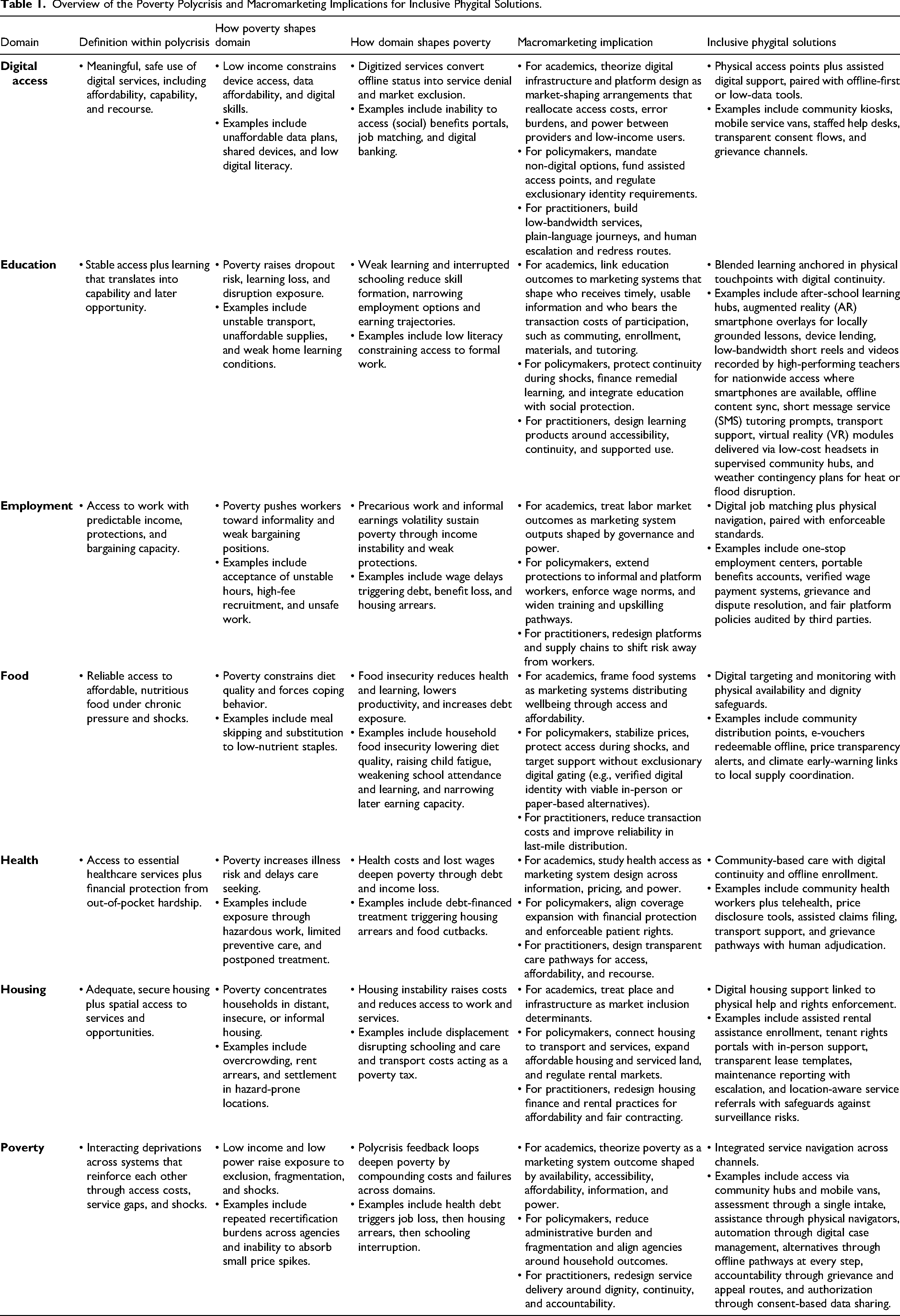
Capability expansion serves as the organizing idea, since capability links systems design to lived outcomes. Capability refers to practical freedom to do and sustain what matters (Ubels et al., 2022), including learning reliably, earning reliably, staying healthy without financial collapse, and keeping stable shelter. Income remains important, yet income does not capture whether a household can claim services that protect wellbeing. Nominal entitlements can fail to translate into receipt when access requires time, transport, documentation, and digital navigation that households may not reliably supply. In this regard, human flourishing functions as the normative endpoint (Batat, 2025), wherein flourishing in poverty contexts depends on maintaining basic roles and relationships over time, including being a consistent learner, a dependable worker, a reliable caregiver, and a patient who can seek care without financial collapse. Those roles, however, become fragile when service journeys impose repeated burdens, unpredictable rules, and unchallengeable decisions. Capability expansion, therefore, provides a practical bridge between marketing system design and flourishing, since capability captures whether people can reliably claim opportunities and protections across shocks rather than losing them at the first or subsequent points of friction.
Comparative reasoning clarifies why capability belongs at the center of the model. A household with stable wages, flexible time, private transport, reliable internet, and savings can absorb service frictions. For instance, missed appointments can be rescheduled, forms can be completed after work, documents can be printed quickly, and short illness can be managed without job loss. Yet, a household living with poverty often lacks those buffers, as the same frictions can trigger missed wages, penalties, denied services, and cascading loss across domains. Capability, therefore, functions as the mechanism through which marketing systems either protect households against polycrisis spillovers or amplify those spillovers.
Inclusive phygital solutions are relevant under the above logic, since physical and digital resources solve different problems and poverty creates binding constraints in both. In essence, the notion of inclusive phygital solutions is grounded in a paradigm where human needs take priority over (technological) novelty (Batat, 2024b, 2026). A poverty-facing specification of human-centered phygital design fits this paradigm, since it demands clarity on what inclusion requires when exclusion from essential systems is the central problem. Such a paradigm is not intended to displace the experience lens, but to extend the phygital conversation to situations where the most basic needs concern access, safety, and fair treatment. Under the poverty polycrisis, the evaluative question, therefore, shifts from how to enhance experience to how to enable participation, where enabling means lowering access burden, protecting dignity, and sustaining agency across the physical-digital continuum. The marketplace, in turn, remains central to this agenda, as finance, healthcare, retail, telecommunications, and transportation, among others, often function as everyday infrastructure through which people participate in markets and secure wellbeing.
This section proposes a macromarketing model of inclusive phygital solutions to alleviate poverty polycrisis (Figure 1). In this model, inclusive phygital design functions as the upstream feature of the marketing system. Total access burden functions as the first downstream consequence experienced by households. Capability expansion functions as the pathway through which burden reduction translates into poverty reduction across domains. Four boundary conditions then shape whether this pathway holds, namely governance and recourse, effective use conditions, material infrastructure readiness, and power and value capture. This chain of mechanisms, in turn, makes human-centricity evident. Lower total access burden protects agency, freeing time and attention for learning, work, and care rather than having them consumed by bureaucratic hurdles and administrative burden. Capability expansion links those gains to dignity, since people can sustain valued roles instead of being pushed into repeated cycles of coping and recovery. Governance and recourse protect personhood, since decisions remain contestable and errors remain correctable. Effective use conditions and infrastructure readiness protect inclusion, since access stays usable under real constraints. Power and value distribution protect wellbeing, since inclusion should not become a new route for extraction. The sections that follow explain why each link should exist, each accompanied by a proposition (Pi) that encapsulates its effect. 7
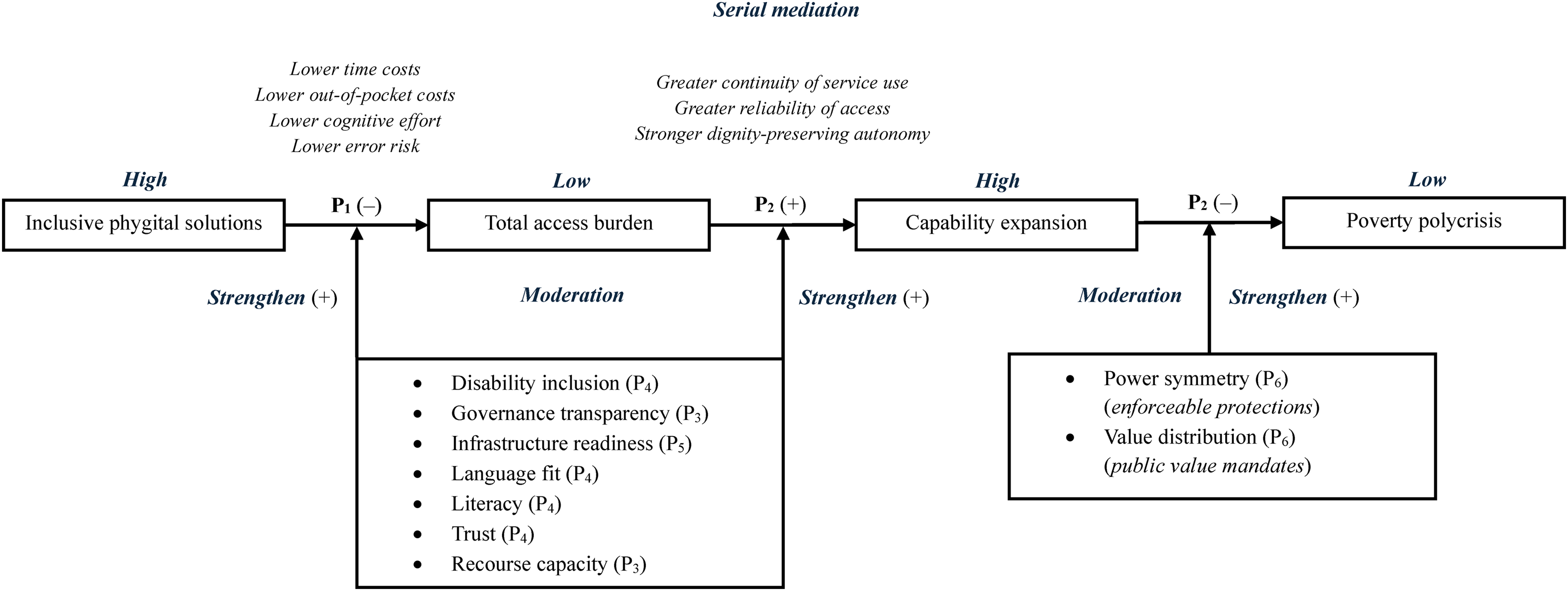
A Macromarketing Model of Inclusive Phygital Solutions to Alleviate Poverty Polycrisis.
Inclusive Phygital Design may Reduce the Total Burden of Access
Many poverty-relevant services fail less due to absence and more due to access burdens that households living with poverty cannot reliably pay. Access burden includes time costs, travel costs, waiting costs, repeated documentation, confusing interfaces, unstable connectivity, language mismatch, stigma at the counter, and unpaid time off work. Such burdens act as a regressive tax, since households with resources can purchase relief. For instance, private transport reduces travel risk, flexible work reduces wage penalties from appointments, paid assistance reduces documentation effort, and reliable devices and connectivity reduce the likelihood of digital failure. Households living with poverty, however, often cannot buy such relief. The same system design, therefore, extracts more time, more money, and more risk from those least able to absorb them.
Inclusive phygital design can reduce total burden when physical and digital components complement one another rather than replace one another. Digital steps can remove avoidable friction, including repeated re-entry of the same information, redundant visits to multiple offices, and uncertainty about whether a trip will be wasted. Physical support points can prevent digital steps from functioning as gates, especially when a person lacks a device, cannot read an interface confidently, or expects automated decisions to be final even when wrong. A simple comparison clarifies the mechanism. An online-only application for childcare support may be manageable for a professional household with a laptop, stable internet, and a quiet space to complete forms. The same application may be functionally inaccessible for an hourly worker relying on a shared phone, prepaid data, and unpredictable shifts. A phygital arrangement that adds assisted completion, walk-in help, and rapid error correction shifts complexity back onto institutions, which matters since institutions hold mandate and capacity to carry complexity.
Administrative efficiency, however, is not the same as reduced household burden, or in other words, lower institutional cost does not guarantee lower household burden. For instance, digitizing a front desk can reduce staffing costs while increasing error risk and time costs for users. Hence, poverty reduction requires an evaluative criterion grounded in total access burden borne by disadvantaged users, not administrative efficiency alone. This logic leads to the first proposition.
Lower Access Burden may Expand Capability and Interrupt Polycrisis Spillovers
Access burden matters since repeated burdens rarely remain isolated. More specifically, repeated burdens erode capability over time and can trigger a cascade across domains. For instance, high time costs can force missed work, missed work can weaken income stability, weaker income stability can raise reliance on high-cost borrowing, high-cost borrowing can increase the likelihood of rent arrears, and rent arrears can destabilize health management and schooling. A polycrisis pattern thus follows when households with limited resources are required to manage multiple systems under shifting constraints.
Capability expansion provides the most plausible pathway from access redesign to poverty outcomes. Three forms clarify how households experience system performance, namely continuity, reliability, and dignity-preserving autonomy. Continuity concerns whether people remain connected to services when life conditions change, such as a health shock, a job change, a move, or new caregiving responsibilities. Noteworthily, households living with poverty often face such discontinuities (e.g., García Guerrero et al., 2021; Zhao et al., 2025). Hence, systems that require re-enrolment and repeated proof, for instance, can punish vulnerability rather than protect against vulnerability. Reliability concerns whether access is predictable enough to support planning. For instance, a household with savings can treat uncertainty as inconvenience, whereas a household living with poverty can experience the same uncertainty as threat, since one missed deadline or one wasted trip can carry immediate financial penalties. Dignity-preserving autonomy concerns whether people can access support without humiliation, coercion, or fear of surveillance, since shame and fear can suppress uptake, turning rights into nominal claims rather than usable support.
Comparative reasoning strengthens the mediation claim. For instance, a brief illness in a non-poor household can remain primarily a health event, since insurance, paid leave, and savings can limit spillovers, yet the same illness in a poor household can escalate into a livelihood crisis, a housing crisis, and a schooling disruption when health access requires complex navigation, repeated visits, or unaffordable payments. While lower burden and stronger continuity cannot eliminate vulnerability in its entirety, they can reduce the probability that a shock spreads across domains. This logic supports a mediated pathway rather than a direct claim that inclusive phygital design automatically reduces poverty.
Governance and Recourse may Determine Whether Inclusion Holds
Phygital systems redesign access and redistribute power. Digital identification requirements, automated eligibility rules, platform visibility controls, and data-driven targeting can concentrate authority in institutions and intermediaries while weakening user agency. Poverty contexts raise the stakes, since consequences of error are rarely symmetrical. For instance, a mistaken denial of benefits or housing eligibility can trigger immediate harm for a household living with poverty, whereas a non-poor household often has resources and time to contest the decision.
Recourse, therefore, anchors inclusion. Without accessible recourse, errors function as punishment rather than correctable failure. Without transparency, exclusion becomes deniable through claims of neutral system output. Without contestability, automated decisions can harden into final outcomes even when rules are wrong, data are wrong, or context is exceptional. Administrative control then expands without accountability, with exclusion persisting behind the rhetoric of efficiency.
A phygital system can reduce such risk when governance is designed as part of the service journey. Digital traceability can reduce leakage and arbitrary discretion, yet traceability alone does not protect users without usable pathways to challenge decisions. Physical grievance points matter when disadvantaged users lack time, literacy, or safety to navigate formal appeals. Community intermediaries matter when authority to solve problems is real rather than symbolic. Automation thus warrants differentiated judgment. Some automation can strengthen fairness and consistency. Poverty contexts, however, require a higher standard of accountability, since harms from wrong decisions are higher and capacity to contest is lower.
Effective use may Depend on Literacy, Language fit, Disability Inclusion, and Trust
Access and use are not the same. A system can be technically available yet practically unusable for disadvantaged groups, thus, effective use may depend on literacy demands, language fit, disability inclusion, and trust that engagement will not expose users to harm. Literacy in this context includes digital literacy, defined as the ability to navigate digital tasks required by the service journey (Fisk et al., 2023), which may depend on schooling quality, exposure to safe digital environments, and prior experience with institutions. Language fit shapes comprehension of instructions, consent, and obligations, especially when interfaces rely on bureaucratic phrasing or monolingual defaults. Disability inclusion shapes whether authentication, form completion, and help functions remain usable for people with visual, hearing, cognitive, or mobility constraints. Trust shapes whether households engage at all, since fear of data misuse, fraud, and surveillance can render digital self-service risky rather than empowering.
Comparative examples clarify why layered access matters. A middle-class household can often recover from a mistaken submission, a missed message, or a fraud attempt through savings, customer service access, and social networks, yet a household living with poverty may not recover so easily, especially under strict deadlines and delay penalties. Therefore, designs that assume confident self-service risk converting a right into a test that only some people can pass.
Inclusive phygital systems can address this problem through layered access that treats human support as a permanent feature rather than a temporary accommodation. For instance, digital interfaces can be designed for low bandwidth and low literacy, reducing cognitive burden rather than adding cognitive burden, whereas physical support points can provide guided completion, translation help, disability accommodations, and reassurance while trust requires visible limits on data use, clear explanations in ordinary language, and credible consequences for misuse. Without such safeguards, nominal access can still produce practical exclusion.
Material Infrastructure may Remain a Binding Constraint
Digital capability depends on material foundations. Affordable connectivity, device access, electricity reliability, and safe physical spaces remain binding constraints in many environments. In this regard, digital tools can fail when these foundations fail. Similarly, physical systems can also fail when facilities are distant, transport is unsafe, or service points become stigmatizing and threatening. Therefore, hybrid design succeeds only when service journeys tolerate real constraints rather than assuming ideal conditions.
A comparative example clarifies the stakes. A household with affordable data and stable electricity can treat digital tools as reliable coordination, yet a household facing costly data and intermittent electricity can face repeated disconnections that raise error risk and trigger missed deadlines. Designs built for continuous connectivity will, therefore, work better for the non-poor and worse for households living with poverty, even when need is higher. The danger, in turn, is to misread that pattern as low motivation, when structural mismatch between design assumptions and lived conditions, in reality, drives failure.
Inclusive phygital design can reduce mismatch through offline-capable functions, asynchronous updates, and community access points that reduce dependence on constant connectivity. Reachable physical touchpoints can reduce repeated travel and provide stable places for resolution when digital steps fail. Therefore, the mechanism concerns design realism and constraint-tolerant delivery, not technology adoption for its own sake.
Power and Value Capture may Decide Whether Gains Persist or are Extracted
Lower access burden and higher capability do not guarantee durable distributive gains, since hybrid systems may be built and governed by actors with incentives to remain extractive, where value flows away from users through data appropriation, opaque fees, risk shifting, or weak recourse. Poverty heightens extraction risk, since urgent need and limited alternatives weaken bargaining power. Thus, people facing deprivation may accept unfavorable terms, tolerate surveillance, or accept unstable platform work, since the alternative can be loss of income, denial of service, or exclusion from essential support.
Macromarketing scholarship treats institutional power and market structure as central to the distribution of wellbeing (Patsiaouras et al., 2015; Zainuddin et al., 2026), which positions value capture as a boundary condition rather than a peripheral normative issue. For instance, non-poor households can often opt out, pay for alternatives, or seek legal remedy, yet households living with poverty can face lock-in through debt and lack of substitutes. Inclusion narratives can, therefore, mask transfers of value away from disadvantaged users unless governance includes credible oversight and enforceable protections.
Inclusive phygital solutions are more likely to reduce deprivation when value distribution is designed intentionally. A layered safeguard set can limit extraction, where fair contracting and transparent pricing can curb fee extraction, data minimization can reduce surveillance and data appropriation, community governance and public value mandates can align system incentives with inclusion goals, and enforceable anti-discrimination protections can prevent exclusionary screening and unequal treatment. The logic is straightforward: a system can expand access while extracting disproportionate value, leaving disadvantaged users better connected yet worse off over time.
Conclusion and Ways Forward: Turning a Macromarketing Model into Actionable Design Priorities
The model proposed above is deliberately parsimonious, which makes its implications hard to avoid. Inclusive phygital design operates as an upstream feature of the marketing system, total access burden forms the first downstream consequence experienced by households, capability expansion defines the pathway linking burden reduction to poverty polycrisis outcomes, and poverty polycrisis outcomes represent the end point that warrants attention (P1–P2). This chain also clarifies why inclusion cannot be inferred from digitization or adoption metrics. Digital tools can be added while total burden rises, especially when hybrid design relocates compliance work, error risk, and time costs onto disadvantaged households. Comparative experience explains the asymmetry. A stable, well-resourced household can convert digital tools into convenience, since connectivity, devices, literacy, and time function as cushions, yet a household facing poverty can experience the same tools as additional points of failure when data costs, low trust, rigid deadlines, and unstable electricity convert minor errors into major consequences. In this regard, boundary conditions warrant treatment as design-critical, including governance and recourse (P3), effective use conditions (P4), material infrastructure readiness (P5), and power and value capture (P6).
While commentary format limits empirical claims in the present article, polycrisis conditions and service redesign move faster than standard empirical cycles, which elevates the value of specifying mechanisms and boundary conditions that later work can measure and test. In line with Lim (2026b), the article herein progresses from problematizing a polycrisis gap, to establishing theoretical foundations through marketing systems and capability expansion, to advancing a model theory via linked propositions (Figure 1), then translating theoretical implications into actionable design priorities (Table 1).
In practice, these priorities surface in default design choices about where effort sits, who absorbs failure risk, and what recourse remains available when things go wrong. A strategy that defaults to digital self-service can lower operating costs while increasing the burden carried by customers with limited connectivity, limited literacy, limited time, and limited trust. Inclusive phygital design reframes physical presence, human assistance, and recourse as part of the value proposition rather than as overhead. Organizations serving low-income communities can treat these elements as investments that strengthen trust, reduce dropout and churn, and expand sustained participation, since customers who can complete a service journey reliably can also maintain a stable relationship with a provider (Siebert et al., 2020). To illustrate, consider the case of a telecommunications provider. Connectivity functions as a prerequisite for participation in digital work, learning platforms, financial services, and public services. An inclusive phygital strategy would, therefore, combine affordability and pricing clarity with capability-building touchpoints, including in-person onboarding, device and account support, and accessible grievance processes in physical centers or community partner locations. Digital channels can still scale service, yet continuity between physical and digital matters, meaning that a person can start in a center, continue on a phone, and return to a human touchpoint without losing progress, information, or dignity. Similar logic can guide financial institutions, healthcare providers, and retailers that serve disadvantaged communities. A contrasting strategy digitizes without support and uses data to screen, upcharge, or surveil vulnerable users, which can expand access on paper while deepening exclusion in practice—a poverty polycrisis dynamic that inclusive phygital design is intended to reduce rather than reproduce.
Ways forward follow from converting each boundary condition into a concrete design question that can guide policy, practice, and research without technological optimism. Governance and recourse ask who can challenge decisions, how quickly errors are corrected, and whether exclusion remains contestable rather than final (P3). Effective use conditions ask whether a person can complete each step with literacy and language fit, disability inclusion, and trust in data protections, without humiliation, coercion, or dependence on predatory intermediaries (P4). Material infrastructure readiness asks how service journeys function when connectivity drops, devices are shared, electricity fails, or travel is unsafe, since many households require options that remain usable under disruption (P5). Power and value capture ask who gains from the system and who pays, since poverty reduction stalls when lower access burdens coincide with new extraction through fees, surveillance, or one-sided contracting (P6).
Footnotes
Acknowledgments
This commentary was invited for the Special Issue “Phygital Marketing for Human-Centric Business Models: Prioritizing Humans over Technology for Positive Impact – A Macromarketing Lens” in the Journal of Macromarketing in conjunction with the American Phygital Association Summit 2025, organized by the American Institute of Business Experience Design (AIBXD) – New York. The commentary was not funded and there are no conflicts of interest to declare. We sincerely appreciate the valuable feedback provided on earlier versions of our work.
Associate Editor
Wided Batat
Funding
The authors received no financial support for the research, authorship, and/or publication of this article.
Declaration of Conflicting Interests
The authors declared no potential conflicts of interest with respect to the research, authorship, and/or publication of this article.
Author Contributions
Weng Marc Lim
Notes
Author biographies
 .
.