



Abstract
The research seeks to delve into and comprehend the attitudes of university students regarding artificial intelligence (AI) and to identify potential factors influencing these attitudes. The research employs a descriptive research design with a quantitative approach. A sample of 240 university students, including both males and females, was selected using simple random sampling. The AI Attitude scale (AIAS-4) developed by Grassini in 2023 was used to collect the data. Statistical techniques, such as “descriptive analysis,” “independent sample t-test,” “one-way ANOVA,” and “post hoc” test were used to analyze the data. The findings indicate that there was no statistically significant difference in attitudes toward AI between male and female university students. Furthermore, our research has substantiated a significant difference in attitudes toward AI among university students specializing in the fields of arts, science, and commerce. The findings of this study suggest that science students displayed a significantly more positive attitude toward AI when compared to their counterparts in the Arts and Commerce streams. Moreover, we examined the impact of educational level on AI attitudes and found no significant difference in attitudes across different educational levels among university students.
Overview
John McCarthy is credited with being the first person to use the term “artificial intelligence” (AI) in 1956. He defined AI as, “the science and engineering of making intelligent machines, especially intelligent computer programs. It is related to the similar task of using computers to understand human intelligence, but AI does not have to confine itself to methods that are biologically observable.” The inception of this technology can be traced back to the 1940s and 1950s when the initial breakthroughs took place. Nevertheless, it was only with the advent of the twenty-first century that this particular technology reached its pinnacle in terms of its capabilities. Particularly, from the 2010s onwards, there has been a remarkable surge in both processing capacity and widespread use of this technology, exhibiting exponential development (Almaraz-López et al., 2023). Contemporary interpretations characterize AI as a fusion of technologies that integrate data, algorithms, and computational capabilities (European Commission, 2020). It refers to the “ability of machines to perform cognitive tasks like thinking, perceiving, learning, problem-solving and decision making” (NITI Aayog, 2018). In simpler terms, AI can be described as the creation of computer systems and programs that imitate human intelligence. This enables them to learn from experiences, adapt to novel information, and perform tasks with an element of autonomy.
The significance and impact of AI are steadily growing throughout several spheres of human existence. The ubiquity and ongoing advancement of AI render its avoidance nearly impracticable. The majority of the devices, systems, and technologies that are commonly employed in our daily lives are reliant on AI (Reinhart, 2018; Schepman & Rodway, 2020). In light of the extensive use and ubiquity of artificial AI, it has become significant to examine the prevailing attitudes held by individuals toward this transformative technology. Attitudes have been shown to have an impact on individuals’ acceptance and adoption of new tools, as well as the extent to which these tools are disseminated throughout society. Hence, AI's pervasive influence on our reality is undeniable. It is crucial to recognize that our attitudes toward AI play a vital role in shaping the trajectory of its development, implementation, and overall acceptability. These attitudes have a direct impact on the successful integration of innovative solutions that harness the power of AI (Schepman & Rodway, 2020). The attitudes toward AI exhibit a wide range of perspectives (Neudert et al., 2020). There has been considerable scrutiny surrounding the security of programs and applications leveraging AI technology. It is not uncommon for concerns to arise regarding the potential implications of AI, including the apprehension that AI may supplant human labor. These concerns have even extended to the notion that AI could potentially dominate human civilizations and the human workforce and extend to the notion that AI could be taking over human civilizations (Johnson & Verdicchio, 2017; Sanders and Schneier, 2023). Simultaneously, the vast potential of AI captivates individuals and sparks an innate sense of inquisitiveness (Rhee & Rhee, 2019). Gaining a deeper understanding of various attitudes toward AI can result in the more effective implementation and utilization of these technologies (Schepman & Rodway, 2022).
In the realm of technological advancement, it is a widely held belief that individuals are bestowed with the remarkable power to discern and select the most suitable solutions to embrace. Moreover, the integration of AI into the daily routines of individuals can be facilitated through the discerning choices made by governmental bodies or prominent corporate entities. As a consequence, it is important to note that the end user may not always possess the complete autonomy to exercise their freedom of choice in the realm of integrating AI into their everyday lives (Jones et al., 2018; Kelly et al., 2023; Schepman & Rodway, 2020).
The disruptive force of AI has a profound impact on higher education institutions, necessitating their adaptation to the transformative changes in administrative and instructional processes. These institutions must embrace the potential of this technology and incorporate comprehensive AI training into their curricula, extending beyond the confines of computer science-focused degrees. By doing so, they can equip students with the necessary skills to effectively navigate the demands of the labor market in their future professional endeavors (Almaraz-Menéndez et al., 2022).
Researchers have examined the factors that impact attitudes toward AI from various perspectives. Numerous studies have revealed that males tend to have more positive attitudes toward AI compared to their female counterparts (Schepman & Rodway, 2022; Sindermann et al., 2022). In relation to age and attitudes toward AI, it has been extensively researched in the literature that younger individuals tend to exhibit more positive attitudes toward AI (Schepman & Rodway, 2022). In the realm of academic disciplines, students studying management and business administration had a more positive attitude toward AI compared to their counterparts in education (Almaraz-López et al., 2023). Hussain (2020) illustrated that both university students and instructors held a positive attitude toward AI and its role in the realm of instruction.
Significance of the Study
The current study holds remarkable significance due to the absence of investigations into the attitudes of university students toward AI, particularly considering the distinct variables of their academic streams and educational levels. This research is poised to provide unprecedented insights into how students across various disciplines and academic stages perceive AI, filling a critical void in our understanding. By discerning the differing attitudes between streams and educational levels, this study can inform educational institutions, curriculum developers, and policymakers about potential variations in AI readiness, awareness, and concerns. Moreover, these findings can assist in shaping targeted educational interventions, fostering interdisciplinary collaborations, and tailoring AI-related content to cater to the specific needs of diverse student groups. By addressing this research gap, the study not only enhances our comprehension of students’ attitudes toward AI but also offers practical implications for educational strategies, workforce development, and technological integration, ensuring a holistic and informed approach to AI adoption and integration across the educational spectrum.
Objectives
To find the level of attitude of university students toward AI.
To compare the mean scores of the attitude of male and female university students toward AI.
To compare the mean scores of attitudes of arts, science, and commerce students toward AI.
To compare the mean scores of the attitude of undergraduate, postgraduate, and Ph.D. students toward AI.
Hypotheses
There exists no significant difference among the mean scores of university students in relation to their gender.
There exists no significant difference among the mean scores of university students in relation to their stream.
There exists no significant difference among the mean scores of university students in relation to their educational level.
Research Design
The current investigation has employed a descriptive research design, which is primarily quantitative in nature.
Sample
The current investigation was carried out on a sample of 240 university students, comprising 129 females and 111 males. The sample participants were selected through simple random sampling.
Procedure
The questionnaire was distributed using Google Forms. Proactive communication was undertaken with the target respondents before providing the link to the questionnaire. This measure was implemented to make sure that the participants were adequately informed about the purpose and significance of the study. The questionnaire link was subsequently disseminated through appropriate communication channels, allowing for easy accessibility and completion of the survey by the participants. The comprehensive approach, which involved pre-communication and the utilization of Google Forms, facilitated the acceleration of the data collection process.
Tools Used
The AI Attitude scale (AIAS-4) developed by Grassini (2023) was utilized for data extraction. The scale consists of 04 items.
Statistical Techniques
A descriptive analysis was conducted to determine the attitudes of students toward AI. To investigate whether the attitude of students toward AI is influenced by gender, an “independent sample t-test” was employed. Additionally, to determine the differences between and among the groups based on their stream background, a “one-way analysis of variance” (ANOVA) was utilized.
Data Analysis
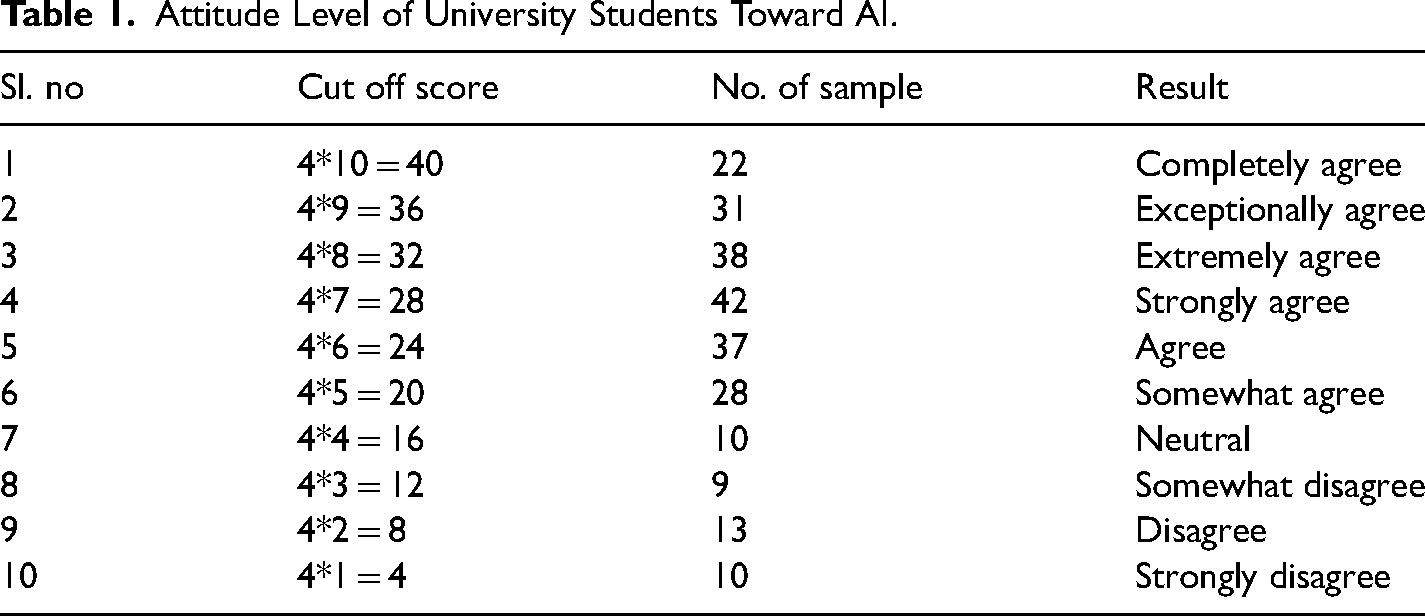
Table 1 provides a breakdown of participants’ scores and their corresponding attitudes toward AI. In the table, we observe various score ranges and the number of participants falling into each category. To illustrate: Participants in the score range of 37–40, totaling 22 individuals, expressed a “completely agree” attitude. Moving to the score range of 33–36, we observed that 31 students exhibited exceptionally positive attitudes, all indicating “agree” in response to AI. Between the score range of 29 and 32, an impressive 38 students conveyed an “extremely agree” response toward AI. Furthermore, 42 students were situated in the score range of 25–28, signifying a “strongly agree” attitude. In the score ranges of 21–24 and 17–20, 37 and 28 students, respectively, held “agree” and “somewhat agree” attitudes toward AI. Remarkably, 10 students in the score range of 13–16 displayed a neutral attitude regarding AI. Within the range of scores from 9 to 12, 9 students expressed a “somewhat disagree” attitude toward AI. In the score range of 5–8, 13 students exhibited a “disagree” attitude toward AI. Additionally, there were 10 students in the score range between 1 and 4. Scores exceeding the highest cutoff point were interpreted as indicative of a strongly positive attitude, while low scores indicated a negative attitude toward AI.
Attitude Level of University Students Toward AI.
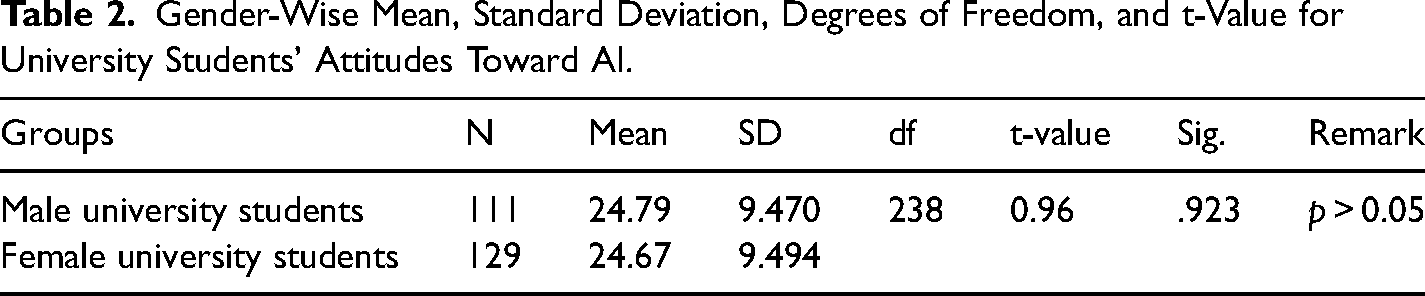
An independent t-test was calculated to study the difference in attitude between male and female university students toward AI. As seen in Table 2, Levine's test for equality of variances was found to be .862 (p > 0.05) which indicates that the distribution of both groups have equal variances. The mean of male students (24.79) was slightly higher than the mean of female students (24.67). The mean difference between both groups was .118. However, it was found that there is no significant difference (t = .096, df = 238, p > .05) between male and female university students’ attitudes toward AI. Therefore, the first null hypothesis, which stated that “There exists no significant difference among the mean scores of university students in relation to their gender” was accepted at 0.05 significance level.
Gender-Wise Mean, Standard Deviation, Degrees of Freedom, and t-Value for University Students’ Attitudes Toward AI.
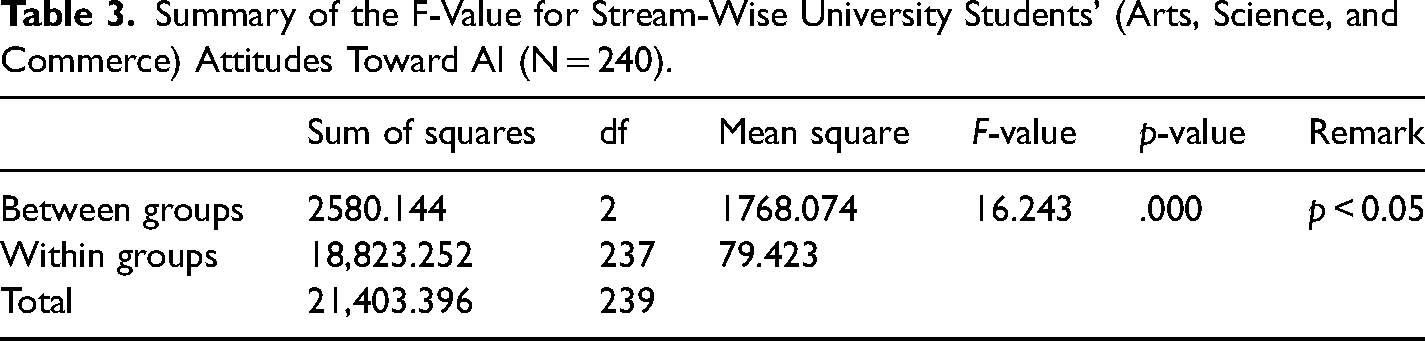
As depicted in Table 3 the analysis indicated a statistically significant difference in the mean score of attitude toward AI among university students majoring in arts, science, and commerce (F = 16.243, df = 239, p < 0.05). Therefore, the second null hypothesis was rejected at 0.05 significance level, indicating that there is indeed a significant difference in the attitude of arts, science, and commerce university students toward AI.
Summary of the F-Value for Stream-Wise University Students’ (Arts, Science, and Commerce) Attitudes Toward AI (N = 240).
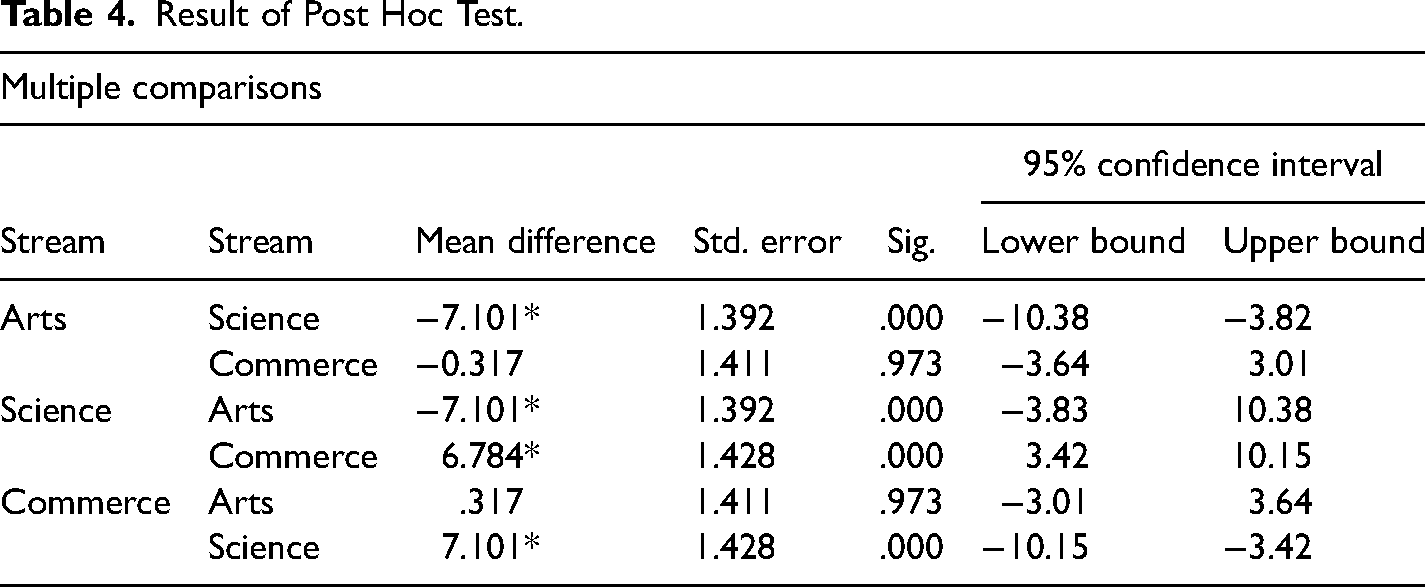
After obtaining a significant result in the one-way ANOVA, we conducted a post hoc test using the Tukey HSD to delve deeper into which specific group exhibited a more favorable attitude toward AI. This allowed us to perform a systematic comparison among the different streams to identify any difference in their attitude toward AI.
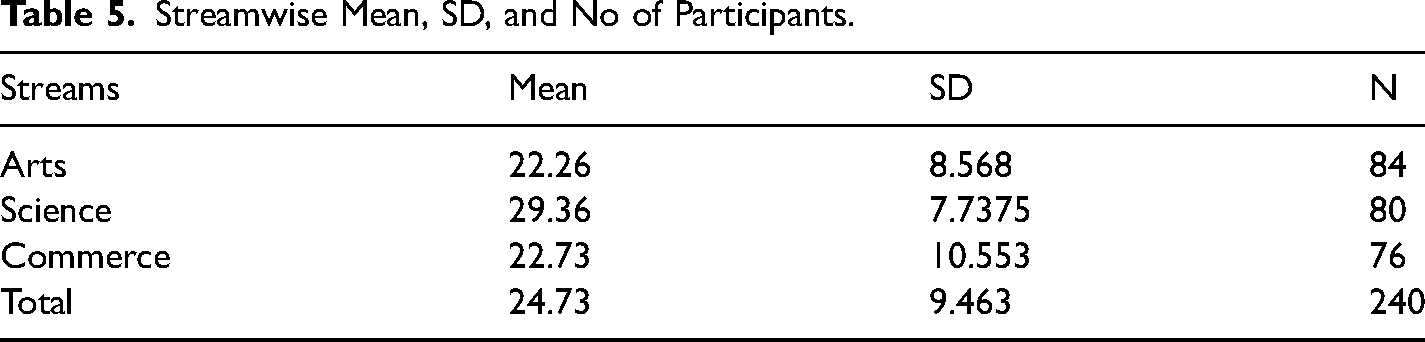
The Tukey HSD test results provide insights into multiple comparisons regarding the attitudes of university students in the Arts, Science, and Commerce streams. With three education streams, we conducted three sets of comparisons: “Arts vs. Science,” “Arts vs. Commerce,” and “Science vs. Commerce.” Examining Table 4, it is evident that the mean difference in attitude between Arts and Science students is −7.101, and this difference is statistically significant (p < 0.05). Similarly, the mean difference between “Arts and Commerce” students is −.317, which is not statistically significant (p > 0.05). Therefore, we can conclude that the attitudes of Arts and Science students differ significantly, whereas “Arts and Commerce” students found no significant difference. However, the mean difference in attitude between “Science and Commerce” students is 6.784, and this difference is statistically significant (p < 0.05). This suggests a significant difference in attitude among “Science and Commerce” students toward AI. As depicted in Table 5, the mean attitude score of science students toward artificial intelligence, which was 29.36, is significantly higher than that of arts and commerce students, whose mean scores were 22.26 and 22.73, respectively. In conclusion, students from the science stream exhibit a more positive attitude towards artificial intelligence compared to students from the Commerce and Arts streams.
Result of Post Hoc Test.
Streamwise Mean, SD, and No of Participants.
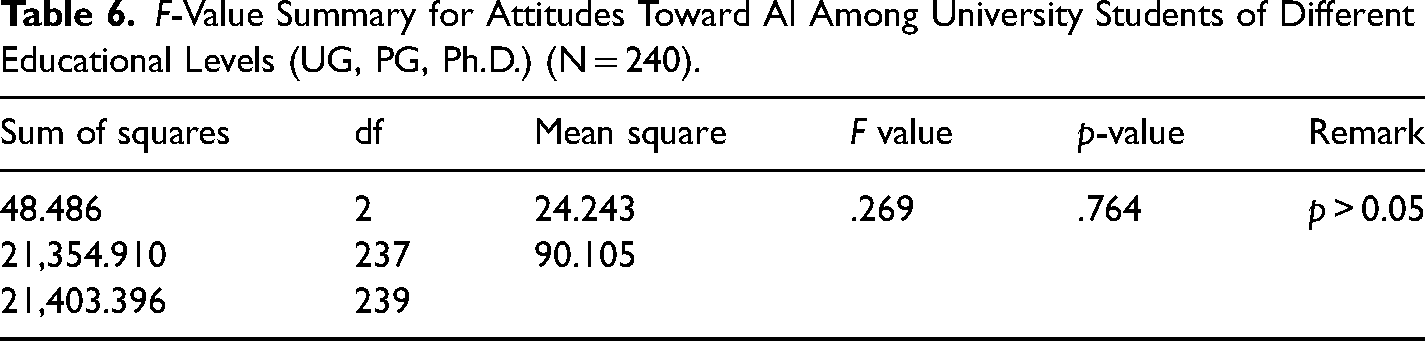
From Table 6, it can be seen that the one-way ANOVA analysis yielded a p-value of .764, which exceeds our predetermined significance level of 0.05. This result suggests that attitudes toward AI among university students do not vary significantly based on their level of education, as evidenced by the statistical analysis (F = 0.269, df = 237, p > 0.05). Consequently, we accept the null hypothesis, which states that “There exists no significant difference among the mean scores of university students in relation to their educational level.” The findings indicate that, on average, university students from various levels of education share similar attitudes regarding AI.
F-Value Summary for Attitudes Toward AI Among University Students of Different Educational Levels (UG, PG, Ph.D.) (N = 240).
Educational Implications
Educators and career counselors can utilize the findings of this study to guide students regarding AI-related career paths. This will assist students in comprehending the increasing need for AI expertise and motivate them to acquire the necessary skills.
Positive attitudes toward AI may serve as a catalyst for generating interest in research pertaining to AI applications and advancements. Educational institutions possess the capacity to furnish students with a plethora of resources and avenues to engage in research projects pertaining to AI.
According to the attitudes revealed in the study, educators have the opportunity to modify teaching methods to better engage students. For instance, if students are enthusiastic about AI, educators can utilize AI tools and platforms in their teaching to augment learning experiences.
The study's implications can potentially lead to efforts aimed at enhancing students’ technological literacy. This would ensure that they are adequately familiar with AI tools and technologies, which are progressively gaining prominence in numerous industries.
The study's findings provide valuable insights for policymakers in the education sector, enabling them to craft policies pertaining to AI education, allocation of funds for AI-related programs, and the development of initiatives aimed at fostering AI literacy.
Discussion and Conclusion
In this research, we explored various factors that influence university students’ attitudes toward AI. Our findings shed light on significant insights, contributing to the existing corpus of knowledge in this particular field. Firstly, we examined gender differences and discovered that there was no statistically significant difference in attitudes toward AI between male and female university students. This finding is consistent with the previous research conducted by Schepman and Rodway (2022) and Sindermann et al. (2022). The findings of these studies suggest that gender does not play a significant role in determining attitudes toward AI among students. Furthermore, our research has substantiated a significant difference in attitudes toward AI among university students specializing in the fields of arts, science, and commerce. The findings of this study suggest that science students displayed a significantly more positive attitude toward AI when compared to their counterparts in the Arts and Commerce streams. This insight highlights the significance of taking into account the academic stream during the design of AI-related educational programs and interventions. Moreover, we examined the impact of educational level on AI attitudes and found no significant difference in attitudes across different educational levels among university students. This implies that AI education and awareness efforts can be effective regardless of students’ academic year or level of study. It is noteworthy to acknowledge that the comprehensive examination of existing literature did not uncover any prior research endeavors that have specifically investigated the intricate relationship between attitudes toward AI and the variables of academic stream and educational level. Therefore, the present study underscores the imperative for additional investigation in these underexplored domains to acquire a more all-encompassing comprehension of how these variables influence the attitudes toward AI within the demographic of university students. Future research endeavors have the potential to yield valuable insights into the complex dynamics of attitudes toward AI among students. This could ultimately contribute to the development of more customized and effective educational strategies within the field of AI.
Footnotes
Declaration of Conflicting Interests
The authors declared no potential conflicts of interest with respect to the research, authorship, and/or publication of this article.
Funding
The authors received no financial support for the research, authorship, and/or publication of this article.
