



Abstract
In this paper we analyse a situation wherein the political establishments of Russia and the United Kingdom, in the face of ontological insecurity, use narratives with messianic overtones in their foreign policies. Although these narratives do not feature prominently in the official discourse, they are nevertheless noticeable and provide a valuable insight into dynamics of national identity. We call them ‘mission narratives’ and interpret their (re)appearance in foreign policy as a reaction to a ‘critical situation’ which undermines the stability of the autobiographical narrative of both countries. Although different in scope and nature, the fall of the USSR and the Brexit referendum both resulted in the status and identity of the two states being questioned. Both countries reacted by emphasising their special role in the world. Referring to mission in foreign policy strengthens a coherent autobiographic narrative which soothes ontological uncertainties.
In this paper we analyse a situation wherein the political establishments of Russia and the United Kingdom, in the face of ontological insecurity, have come up with narratives in their foreign policies which have messianic overtones and which we call ‘mission narratives’. We demonstrate that mission narrative is one of possible reactions a state might have to a ‘critical situation’ in which the core concepts of national identity are questioned.
For both Russia and the UK one central motif of their respective autobiographical narratives is that they became world powers in the past, that they maintain this status today and wish to preserve it in the future. This self-image is rooted in the imperial past of both countries. This imperial legacy has also nourished (in European/Western cultural sphere) the understanding of a major power as a country which pursues a mission in the world. 1 This persists today as an underlying feature of both countries’ contemporary elites.
This observation has two further consequences. Firstly, talking about mission is part of status seeking behaviour. Mission narrative is thus relevant for status games. The position of a country in the international hierarchy influences the content of this narrative. Secondly, for countries where major power status is part of their identity, mission narrative plays a role in sustaining or restoring ontological security (OS).
The contribution of this paper is in three areas. Firstly, it offers an original understanding of political messianism, of which mission narrative is a component. This phenomenon is the starting point for our analysis. We demonstrate that referring to mission in foreign policy, is not merely part of expansionist rhetoric or a rallying cry – it is a mechanism of status seeking behaviour and ontological self-help. Secondly, our analysis provides arguments on some divisive points of OS theory and strengths the integrative path laid out by Filip Ejdus and Tanya Narozhna. In this paper we discuss a case where OS concerns a particular aspect of identity, that is, status. Focusing on this issue shows synergy between society (particularly the elite) and the state as a social actor. It also sheds light on the dynamics of shame and anxiety avoidance behind OS seeking behaviour. The third contribution is empirical. The paper provides readers with a comparative analysis of two messianic traditions, which are still relevant for the self-image of Russia and the UK.
Academic literature about messianism in contemporary politics is not extensive and mostly concerns Russia. 2 The topic received more attention after the annexation of Crimea in 2014. 3 In most cases it is interpreted as an imperial practice rooted in the Russian tradition and a propaganda tool for mobilising society in a non-democratic state. We think that this view is reductive and inaccurate. To show that the mission narrative as an ontological self-help mechanism and a component of status seeking behaviour is not specific to Russia we used a comparative perspective. To investigate the link between mission narrative and status we chose another former European empire which treasures major power status as a central component of its autobiographical narrative. We looked among this particular group of countries because these two factors, that is, (1) the imperial past and (2) Judeo-Christian tradition entangled in the legacy of the Roman Empire provide fertile ground for a mission to appear in contemporary foreign policy. Historically speaking, mission narrative was characteristic chiefly for European empires, today’s Western major powers. 4
The choice of the UK is perhaps unintuitive, but logically coherent. 5 Both Russia and the UK are geographically on the edges of continental Europe, which historically played the role of the Significant Other in the self-identification process of the two countries. They both have recently faced a ‘critical situation’ which put into question the crucial component of their identity and lowered their OS. For Russia this situation was the fall of the USSR in 1991, while for the UK – although less traumatic – the Brexit referendum of 2016. Both events highlighted the challenges to their status (and identity) as major powers. Russia is increasingly labelled as a declining power, 6 while the post Brexit UK is back to redefining the position of residual power. 7 The criterion of a ‘critical situation’ was decisive for choosing the UK as a comparative case and leaving aside other potential candidates – the US or France. It is true that after 1945 the US has experienced several difficult moments, including military defeats, but none of them seriously questioned the crucial component of its national identity – the leader of the free world. The event which might seem most relevant for the post-Cold War US – the attack on 9/11, did raise anxiety among Americans and brought messianic tones in foreign policy. However, it did not shake but rather reassured the American self-image of the world crusader for Freedom. 8 As for France, it does share with the UK the experience of coming to terms with ‘residual power’ status after WWII. However, the insecurities caused by the diminishing of its status and redefining of the post-imperial identity were soothed by its leading role in European integration. There has been no critical event after 1945 which would call the core of French national identity into question and could activate mission narrative. 9 The UK as a comparative case helps highlight two important differences between it and Russia. Firstly, in terms of moral authority the UK occupies a different position in the international hierarchy than Russia. While it is true that the West’s normative hegemony has noticeably weakened, the Western countries, including the UK, still form the core of the ‘established’ actors (Zarakol’s term) which together wield more symbolic power than anyone else in international affairs. Russia, though, is often called a norm-violator intent on breaking the West’s monopoly on the global normative order. 10 Juxtaposing an ‘established’ power with an ‘outsider’ (‘aspiring’ power) helps explain the differences in the content of mission narrative. Secondly, the comparison reveals that references to mission in foreign policy are not exclusive to authoritarian regimes.
We have used existing literature to compare the British and Russian messianic traditions. The historical overview shows how mission narrative has become a mechanism of restoring OS. In order to reconstruct the contemporary mission narrative we analysed different kinds of public statements (e.g. press conference transcripts, interviews, articles) by officials responsible for shaping the official discourse on foreign policy. The relevant time frames for this analysis are different for each country (Russia: from 1991 to 2018, the UK: 2016 to 2018). We reconstructed Russian mission narrative from 1991 to 2013 using the existing literature on discourse and foreign policy. For the overlapping comparative periods (Russia: after the annexation of Crimea (2014–2018), the UK: post-Brexit period (2016–2018)), we performed a detailed analysis of the source materials available for both countries. We focused on the actors who are most influential in producing the official discourse on foreign policy. For Russia this was President Vladimir Putin and representatives of the Ministry of Foreign Affairs (available on www.kremlin.ru, www.mid.ru). For the UK, we examined sources published by the relevant parts of the UK government (gov.uk). We tried to answer these questions: What types of missions do Russia’s and Britain’s political elites currently ascribe to their respective states? Are these missions oriented towards bringing about a change in international affairs or towards preventing it (progressive/restitutive mission)? What is the function of the mission-narrative? What status is envisioned in these narratives for Russia and the UK? Owing to length constraints we have omitted quoting statements in full and instead substantiate our description of the mission narrative with relevant sources in footnotes while providing just a few examples in the text.
We start with presenting how a sense of mission manifests itself in a contemporary political narrative and how it links to status and OS. Next we provide an overview of the British and Russian historic messianic traditions and their connection to imperialism. This is followed by a description of messianic motifs in the official discourse on foreign policy in both countries. Finally, we compare the two mission narratives and explain the differences by referring to status and OS theory.
Mission narrative as a status and ontological security seeking mechanism
We argue that messianic overtones in the contemporary foreign policy of Russia and the UK should be interpreted as a mechanism of ontological self-help when facing a critical situation which undermined their autobiographical narrative. This hypothesis thus combines concepts of messianism, status and OS. These three aspects are discussed below.
Simplifying, messianism is a set of ideas which assume that the history of humankind is heading towards the realisation of a certain Ideal in accordance with Providence’s plan. In this plan the ‘chosen one’ (individual or collective) has a special role to play (mission). There were numerous attempts at defining and differentiating messianism and missionism, or religious and secular messianism. 11 In this myriad of terminological approaches three core components of messianism can be discerned from the relevant literature: (1) a vision of history as a linear, teleological process, (2) universalism, (3) mission. 12
Mission, which expresses the imperative to transform the world according to the messianic Idea, is the most relevant for foreign policy. This category is therefore central to our research. We define mission as the conviction that a certain community (state/nation) is exceptional and that this exceptionality manifests itself in its special destiny. There are three distinctive, but interconnected, features of ‘mission’: (1) the conviction of having a special destiny, (2) a sense of moral superiority, (3) the conviction that the state’s activity is motivated not only by its own national interest but also by a higher cause important for a broader (regional, global etc.) community. ‘Mission narrative’ is a narrative with direct references to mission or to any of its three features mentioned above. This conceptual approach to the sense of mission enabled us to identify messianic motifs in the highly regulated, secular language of modern diplomacy.
Talking about mission is part of exceptionalist rhetoric. However, national exceptionalism is not synonymous with mission. While the latter is always a manifestation of the uniqueness of the ‘chosen one’, the former can be expressed also without mentioning the pursuit of mission in the world. The Czech Republic and China are examples. 13 Formulating foreign policy in terms of implementing a mission is characteristic for former European empires, today’s major powers. 14 It is partly a result of the dynamics of their identity-building process. Established historians have convincingly shown that a sense of mission functions as a meta-idea which provides the multiethnic and multireligious population of an empire with a sense of common purpose. 15 Mission often becomes the crucial piece of the self-image of an ‘empire-builder’ nation, which is, or only recently was, the case of both the UK and Russia. 16 In empires, the mission narrative arises from domestic debates as well as relations with the external environment. Even if talking about a special mission in the world is primarily addressed to the people of the empire (to integrate or mobilise them), it is nevertheless expressed in foreign policy discourse and, possibly, in concrete state actions undertaken in the international arena. Pursuing a mission has become one of the attributes of a major power. 17 Naturally, also smaller countries, such as Poland or Serbia, can talk about their mission. 18 Then, however, a mission narrative appears in different context and with different functions. Therefore, we have intentionally avoided discussing the case of smaller countries, since the focus is on former empires – today’s major powers.
Now we turn to status. Literature on status in international relations (IR) grows from the sociological take on status as a hierarchy of social groups ranked in terms of social values. 19 Belonging to a social group shapes people’s identity. Therefore, they want their group to be different and also better than others. People appreciate belonging to a higher-status group because it increases collective self-esteem. The phenomenon of vicarious identification with broader communities can be observed, for instance, when people identify with their country and take pride in its success. 20 Social reality is structured by the mechanisms of comparing and stratification, which is also true for relations between large and complex social collectives – states. 21 In IR, status is understood as ‘collective beliefs about a given state’s ranking on valued attributes’. 22 It is a socio-relational phenomenon which has a material base and subjective dimension since it depends on how the state sees its own position and how other actors rank it. The dissonance between a country’s status aspirations and the standing attributed to it by others may result in ontological insecurity. 23 With states status manifests in two ways, that is, as (1) standing among other actors in the international hierarchy and (2) identity. 24 Both are relevant for our study.
Among sovereign states the major powers, 25 which are the main object of our analysis, belong to the ‘exclusive’ club. They occupy the top positions in the international hierarchy. But even within this club there is a hierarchy and social differentiation between, as Ayşe Zarakol put it, the ‘established powers’ and the ‘outsiders’ seeking recognition from the ‘established’ ones. 26 Referring to Erving Goffman’s and Norbert Elias’s findings, Zarakol shows the significance of the ideational underpinnings of the hierarchy existing among states for explaining their foreign policy. Countries are ranked not only on the basis of the differences in their material capabilities but also their moral authority, and this partly depends on their impact on shaping the regional or global normative order. 27 The ‘established’ powers have considerable symbolic power which allows them to define and sanction binding norms. They also grant or withdraw recognition to the ‘outsiders’. In the international order dominated by their norms, they decide who is a major power and who merely a parvenu.
Drawing on Zarakol’s differentiation between ‘established’ and ‘outsiders’, we argue that the position a country occupies in the international hierarchy influences the types of mission a nation ascribes to itself. Furthermore, we believe that not only the type but also the function of the mission narrative in politics is related to status. The ‘established’ countries refer to mission in order to legitimate their dominance. ‘Outsiders’, aspiring to equal the ‘established’ ones, talk about their mission for two reasons. Firstly, the messianic claim helps compensate for the backwardness of the ‘outsiders’ relative to the ‘established’ ones. Scholars examining messianic motifs in modern politics often interpret them as a compensatory mechanism. 28 However, this assessment ignores fact that, by referring to mission, the ‘outsiders’ are also emulating the behaviour of ‘established’ ones. The ‘outsiders’ emulate those they wish to be their peers. This emulation is the second reason why they refer to mission. This is an important observation since it elucidates that mission narrative is not shaped only by domestic factors, but also – especially when it comes to foreign policy – through a country’s relations with the external world.
Our analysis of mission narrative shows that this relational influence is especially visible in status seeking behaviour. We argue that status can explain the difference in the content of the narrative between the UK, which is ‘established’, and Russia, the transgressing ‘outsider’. Finally, in the case of both countries status is not just a position in a hierarchy but a deeply rooted component of national identity 29 and thus of the autobiographical narrative. 30 Russia and the UK do not have the status of major powers, they simply are major powers. The critical situations which we analyse in regard to both countries have put in question their status – the core element of national identity. Satisfying the need of belonging to the club of leading powers requires recognition from the club’s members. Mission narrative reveals the dynamic between self-image and the roles attributed to a state by others. The sense of mission as we frame it is a Wendtian role-identity which forms under the influence of both internal and external factors. 31 A state has a certain understanding of what it is and what roles it wants to play in a world shaped in accordance with national tradition and past experience. Role-identity is not merely a function of the position a state keeps in the international structure. It is rather a result of a mutually constitutive interaction between the state and other international actors. 32 The difference between a country’s self-image/role expectations and the roles the international community is ready to cast it might cause dissonance which, in turn, lowers OS. 33
Ontological security, a notion coined by R.D. Laing and elaborated by Anthony Giddens, refers to the need of individuals and social collectives to maintain a coherent narrative about the Self. In Jenifer Mitzen’s words, it is ‘the need to experience oneself as a whole, continuous person in time rather than constantly changing’. 34 It is ‘security as being’ not ‘security as survival’. 35 Applying OS reveals a connection between mission in foreign policy, status and national identity. Mission narrative is a mechanism of ontological self-help (Ejdus’ term) in the face of a critical situation undermining the core concept of national identity connected to major power status. A ‘critical situation’ refers to circumstances whose key aspect, according to Ejdus, ‘is the inability of collective actors to bracket out. . . fundamental questions about the unreliability of the international order, the finitude of polities, impermanence of relationships and inconsistency of collective autobiographies’. 36 Facing a critical situation, actors strive to restore the coherent self. They can, as indicated by Christopher S. Browning, apply the mechanisms of a coherent autobiographical narrative, routines, shame avoidance, vicarious identification, refracting anxiety onto tangible objects or cultivating a particular place representing ‘home’. 37 Against this background mission narrative should be understood as a narrative routine which allows a coherent national autobiography to be kept. Dmitry Chernobrov points out also to the defensive mechanism of narcissism ‘being a celebration of self in response to anxiety’. 38 Because of its emphasis on exceptionalism, mission narrative can function as narcissistic self-defence in situations that undermine an actor’s ‘good self’ (Chernobrov’s term). Linus Hagström also analyses narcissism as a phenomenon which offers an explanation of the paradox of great powers’ fixation on their greatness always being accompanied by their fear of weakness. 39 It is reflected in four types of autobiographical narratives: that of shame, pride, denial and insult. The first entails plans for national recovery; the second is about a positive celebration of national exceptionalism; the third functions as a defensive mechanism which rejects any notions of national weakness; the fourth consists in taking any indication of one’s own weakness as an insult and therefore compels an actor to prove their own greatness beyond any doubt and may result in aggressive behaviour. References to mission can feature in any of these narratives depending on socio-political context and international dynamics.
The core of mission narrative’s potential for self-help is its ability to provide a coherent story about the past, present and the future of former empires. It restores the sense of temporal continuity and purpose. 40 This highlights the importance of the connection between mission and status. The pursuit of a mission has become part of understanding what a true empire is and what it does, at least in Western/European culture. Today this association is projected onto major powers – countries of a particular standing. In contemporary Russia and the UK, major power status provides a crucial link between their present and their glorious imperial past. Preserving this particular position in the international hierarchy has eased the trauma of losing an empire and helped sustain the conviction that the standing of Russia/the UK in the world remains unchanged. Talking about mission in the foreign policy of former European empires is a reminiscence of their past but also one of the means to express major power ambitions in the present. It is an example of a ‘compelling narrative of group continuity over historical time. . .’. 41 Acting like a major power and being recognised as such constitutes a component of the autobiographical narratives of Russia and the UK. For both, keeping this status is crucial for maintaining a self-image of an unchangeable, eternal entity. Mission narrative allows the restoration of a coherent ‘good self’ in the face of a critical situation which questions precisely this particular component of identity – status. Mission narrative as a mechanism of ontological self-help is connected to Russia’s and Britain’s self-image as major powers. This interrelation is in turn a result of a historical process and has its origins in the two states’ imperial pasts.
The imperial legacy of Europe’s peripheries: British crusader versus Russian shield bearer
The United Kingdom and Russia are geographically on the edges of the ‘Old Continent’. Consequently, in their historical self-identification process, Europe played the role of the ‘Other’. Both countries formed their Self-Image by practices of ‘othering’ Europe, while at the same time cultivating a sense of a shared civilisational background. 42 Furthermore, England (later the United Kingdom) and Russia developed a sense of national exceptionalism by emphasising their own moral superiority in comparison to ‘sinful Europe’. 43 In both cases national exceptionalism is expressed in part by messianic claims in foreign policy. 44
According to Anthony Pagden the elites of all the European empires created between the 16th and 17th centuries referred to their unique destiny and a special role bestowed to them by Divine Providence. 45 Also England, initially, legitimated its colonial project with the need to convert pagans and only later adopted a ‘civilisational mission’. 46 David Armitage points to three main factors shaping exceptionalism within British imperialism: (1) the Ideal of the Imperium Romanum as a polity pursuing a mission and the conviction that its legacy, including mission, was continued by England, (2) competition with the Spanish Empire and (3) the process of creating a composite monarchy by conquering Scotland, Wales and especially Ireland. 47 This enumeration shows that mission narrative developed to a significant extent under the influence of the country’s relations with the external environment, as a part of socialisation and ‘othering’ processes. In the race against the Spanish Crown for new territories, England presented itself as the complete opposition of its rival. Since Spaniards were spreading Catholicism and preferred a mode of colonisation which involved establishing permanent settlements, English wanted to secure freedom for Protestants, opted for limited trading posts and made free navigation their priority. 48 The sense of English exceptionalism had another source, that is, the process of creating a composite British monarchy. As Armitage shows, it was in the 16th century when the narrative characteristic for British imperialism emerged. In this context Armitage names: (1) the idea of racial supremacy, (2) a crusader’s identity and (3) the ideology of conquest. 49 In the 19th century, in the heyday of European imperialism, the British Empire positioned itself as a benevolent power promoting freedom and progress in the world. 50
Britain’s crusader’s spirit is a distinctive feature of its mission narrative. It means that pursuing mission requires venturing into the world and turning it into its own image. Also Freedom as the central Ideal of the British messianic tradition often meant changing ‘liberated’ peoples into the British image. The British sense of mission has a progressive character. It is about bringing modern achievements to backward societies. As its special mission and moral duty Britain claimed, for instance, the creation of a modern administration in the colonies and the struggle against slavery. 51 This progressivism and the zeal to transform the world into its own image is characteristic for the ‘established’ countries, which decide about the normative order. Mission helps to legitimise their superiority.
Emphasising the connection between English nationalism, its sense of mission and the empire, Krishan Kumar coined the notion of ‘missionary imperialism’. He described the empire-building nations (imperial nations), which identify with the imperial project the most, thus: ‘Beyond the sense of their own uniqueness lies the conviction of a global purpose that prompts them to play down mere national pride or the cultivation of national culture. More is at stake than the making of a nation state’. 52 This description also pertains to the self-identification process of ethnic Russians. There is, however, an important difference between the British sense of mission and Russia’s historic understanding of its messianic destiny. The ‘civilisational mission’ most commonly associated with European imperialism appears in the Russian narrative almost exclusively in the context of Russia’s expansionism in Asia. 53 This particular mission appears when Russia acts from the position of a dominant power or the ‘established one’ in the region. Only in relation to its neighbours did the Russian Empire claim the messianic obligation to turn them into its own image. In this particular context Russia, like Britain, presented itself as a benevolent power bringing progress. This behaviour of Russia in the 19th century was mostly an emulation of the practices of other contemporary European empires. Russia copied the narratives of the ‘established ones’ in order to obtain their recognition. 54 ‘Civilisational mission’ presents one of three cases wherein we can observe the similarities between the British and Russian historical mission narrative. The second is connected to the claim that each of the two countries has been entrusted with a mission to preserve the true essence of European civilisation when continental Europe has lost its true Self. 55 Finally, like the British Empire, Russia developed its own mission narrative not only as a result of domestic discussions (e.g. the myth of Moscow the Third Rome) but also under the influence of contacts with its Significant Others, above all Britain, France and Germany.
Among the several types of mission ascribed to the Russian Empire by its elite in the 19th century, most of them portrayed Russia as an actor guarding peace and stability and protecting the European order from chaos. 56 These missions are not progressive but restitutive and have a counter-hegemonic connotation. Russia’s mission is about restoring order and justice. In the Russian messianic tradition, Justice plays a role comparable to the Ideal of Freedom in British exceptionalism. 57 Furthermore, the Cold War consolidated the sense of mission connected to promoting Freedom in the Western camp, and the sense of bringing Justice in the socialist camp. The USSR retained mission narrative. Obvious changes (e.g. replacing defending ‘true Christian faith’ with ‘true communism’) aside, most missions characteristic for the tradition of the Romanovs’ monarchy (e.g. ‘guardian of Justice’, ‘shield’, ‘balance provider’) featured in the official discourse on the foreign policy of the USSR. 58 The Russian mission narrative, unlike the British, does not picture Russia as a ‘crusader’ but rather as a ‘shield bearer’, or simply a ‘shield’. 59 ‘Crusader’ versus the ‘shield bearer’ reflects the difference in the British and Russian Empires’ positions among the leading powers of the 19th century. The Russian Empire, suffering from a lack of recognition from the Western European countries and acknowledging its own backwardness, 60 was in a different place than the UK, despite formal similarities (both being empires).
The impact of Russia’s ‘outsider’ status under pressure from the ‘established’ ones is also evident in the idea that, in order to fulfil Providence’s plan, Russia should first save itself. We call such situations – in which the pursuer of the mission is simultaneously its object – ‘auto-missions’. They are characteristic when countries fear their identity is vulnerable to external influence. Such insecurities are rare for countries at the top of the international hierarchy with full recognition and deciding about the criteria of recognising other actors. Unsurprisingly, the period in Russian history where the references to ‘auto-missions’ were marginal coincides with the strong messianic zeal to change the world into its own image. This happened in the 1960–70s, when the USSR gained the status of one of two superpowers. 61 This recognition stabilised its OS. The top position in the Cold War era made the USSR refer in its foreign policy to missions characteristic for ‘established’ countries.
British people witnessed a gradual dismantling of their empire throughout the Cold War. Russians, though, experienced a shock, when the USSR suddenly fell apart. Steven Kotkin, while criticising the strong messianic inclinations of Russia’s foreign policy, suggested that Russians could learn from how the British parted with harmful imperial nostalgia. 62 This assessment could be questioned in the wake of the post-Brexit rhetoric. Although different in nature and scope, the fall of the USSR and the Brexit referendum turned out to be critical situations which have undermined the stability of narratives constitutive for, respectively, Russian and British identities.
Contemporary mission narratives in the official foreign policy discourse of the UK and Russia: the main characteristics
Mission narrative does not presently feature very prominently in official Russian or British discourse on foreign policy. However, it provides an insight into the dynamics of national identity and highlights the relevance of the imperial past. In Russia, mission narrative appears rarely, but persistently, especially in specific contexts, for example, in references to WWII, the Russian Empire’s civilisational achievements or when presenting Russia as an Orthodox civilisation. Although the need for a global foreign policy is regularly mentioned in the documents of the UK government since the 1990s, ‘Global Britain’ is a recent development promoted by part of the political elite. 63 Within the UK’s government, the Global Britain narrative is being shaped mainly by the Prime Minister’s Office, the Treasury, the Ministry of Defence, the Foreign and Commonwealth Office (including embassies) and by the Foreign, Commonwealth & Development Office (in 2016: the Departments for International Development and International Trade). In the Russian Federation, among the mission narrative entrepreneurs the president sets the tone but the contribution of diplomats (including Sergei Lavrov) and senior advisors is equally noticeable.
Both mission narratives emphasise major power status as an indispensable component of national identity and invoke the glorious past. Both countries’ elites are convinced that pursuing a mission is an attribute of a major power and they must preserve this status or lose their true identity. This thinking is well illustrated by Sergei Karaganov, head of the Council on Foreign and Defence Policy. He writes: ‘The world is full of the graves and corpses of major powers which have lost their sense of mission. . .’. 64 Karaganov explains that ‘one of the foundations of a world power, and obviously Russia can’t be anything else, is the pursuit of a grand Idea. For its own sake and for the sake of others’. 65 Moreover, he argues that pursuing a mission in foreign policy helps fulfil the basic need of the Russian mentality. UK Foreign Secretary Jeremy Hunt echoed this: ‘Britain’s hand in designing and defending the world order in the last century surely reveals our mission for the next: not a superpower but as a global power, binding together democracies who share our values and playing a decisive role in making the world safer, healthier and wealthier. A role that predates Brexit and will long outlive it. Our sense of national purpose has always been defined by more than narrow self-interest’. 66 For Hunt pursuing a mission in the world is what major powers do and what defines true British identity. Linking major power status with pursuing exceptional roles for the benefit of the broader community demonstrates that mission narrative is about status seeking and stable identity narrative. Below we provide an overview of the content of the narratives of the two states.
Russia
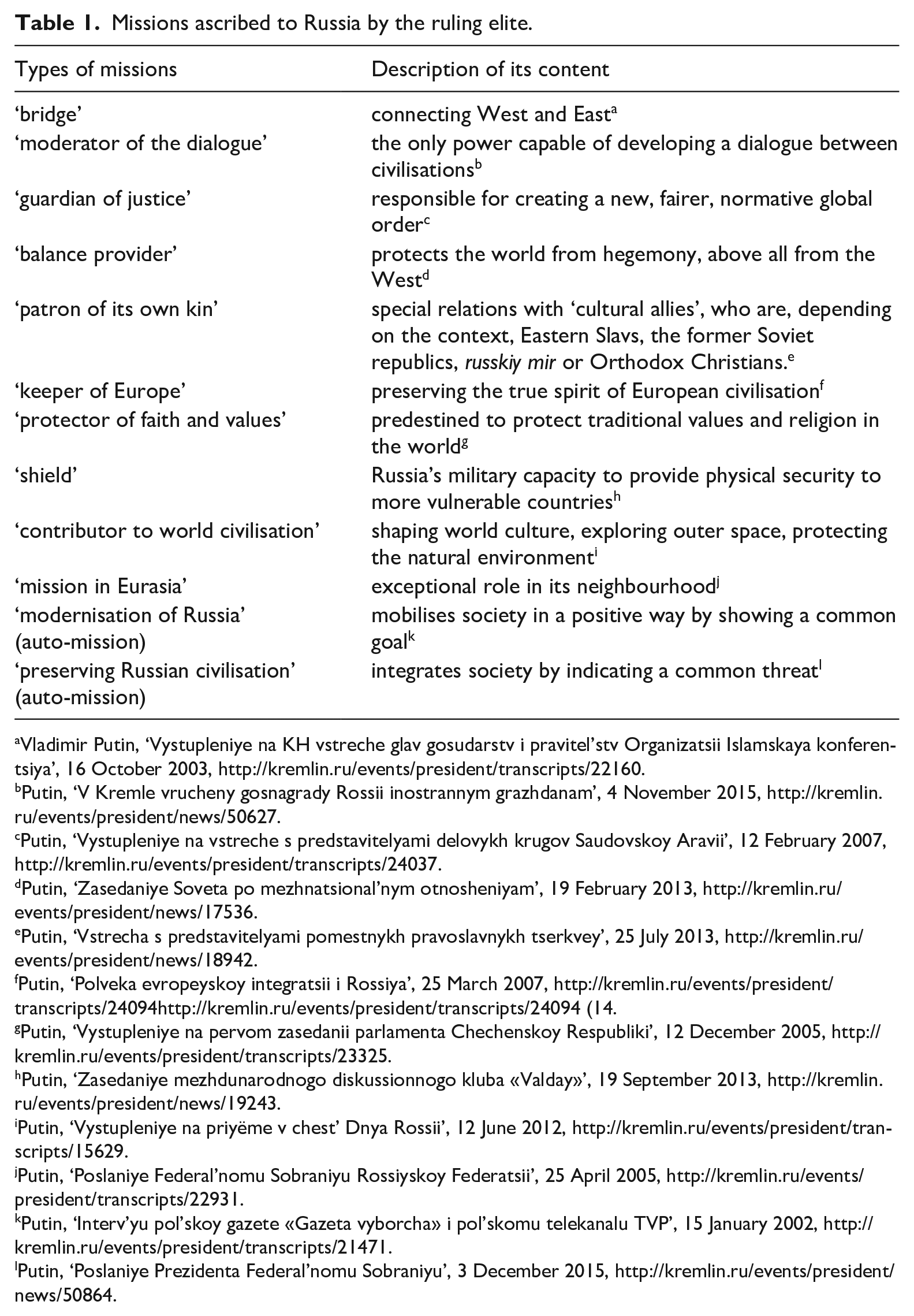
From the materials we analysed, 67 we have reconstructed 12 types of missions attributed to Russian by its government and diplomats. According to our definition of mission, they denote Russia’s exceptionalism, moral superiority and/or emphasises that pursuing mission benefits the broader community (Table 1).
Missions ascribed to Russia by the ruling elite.
Vladimir Putin, ‘Vystupleniye na KH vstreche glav gosudarstv i pravitel’stv Organizatsii Islamskaya konferentsiya’, 16 October 2003, http://kremlin.ru/events/president/transcripts/22160.
Putin, ‘V Kremle vrucheny gosnagrady Rossii inostrannym grazhdanam’, 4 November 2015, http://kremlin.ru/events/president/news/50627.
Putin, ‘Vystupleniye na vstreche s predstavitelyami delovykh krugov Saudovskoy Aravii’, 12 February 2007, http://kremlin.ru/events/president/transcripts/24037.
Putin, ‘Zasedaniye Soveta po mezhnatsional’nym otnosheniyam’, 19 February 2013, http://kremlin.ru/events/president/news/17536.
Putin, ‘Vstrecha s predstavitelyami pomestnykh pravoslavnykh tserkvey’, 25 July 2013, http://kremlin.ru/events/president/news/18942.
Putin, ‘Polveka evropeyskoy integratsii i Rossiya’, 25 March 2007, http://kremlin.ru/events/president/transcripts/24094 http://kremlin.ru/events/president/transcripts/24094 (14.
Putin, ‘Vystupleniye na pervom zasedanii parlamenta Chechenskoy Respubliki’, 12 December 2005, http://kremlin.ru/events/president/transcripts/23325.
Putin, ‘Zasedaniye mezhdunarodnogo diskussionnogo kluba «Valday»’, 19 September 2013, http://kremlin.ru/events/president/news/19243.
Putin, ‘Vystupleniye na priyëme v chest’ Dnya Rossii’, 12 June 2012, http://kremlin.ru/events/president/transcripts/15629.
Putin, ‘Poslaniye Federal’nomu Sobraniyu Rossiyskoy Federatsii’, 25 April 2005, http://kremlin.ru/events/president/transcripts/22931.
Putin, ‘Interv’yu pol’skoy gazete «Gazeta vyborcha» i pol’skomu telekanalu TVP’, 15 January 2002, http://kremlin.ru/events/president/transcripts/21471.
Putin, ‘Poslaniye Prezidenta Federal’nomu Sobraniyu’, 3 December 2015, http://kremlin.ru/events/president/news/50864.
Vladimir Putin, invoking Nikolay Berdyaev, said: ‘Generally, he spoke about Russia’s mission as a strong, independent country which defends truth and justice, works for harmony and the spirit of partnership between countries, between people of different traditions and different cultures. Understanding this historical role lies at the foundations of our nation’s self-awareness and to a largely defines our ideals, views, convictions. It defines our present and, to an even greater degree, our future’. 68 This statement indicates Russian exceptionalism, major power status and universal mission (the guardian of justice and the moderator of the dialogue) as mutually connected. It illustrates how mission narrative provides a sense of historic continuity presenting Russia as country which pursued mission in the past, today and must do so in the future in order to preserve its true Self. Fulfilling mission in the world is what makes a strong country a true major power and Russia cannot be anything but a major power. The coherent Self anchored in temporality is the core principle of OS.
The Permanent Representative to the United Nations Office in Geneva, Aleksei Borodavkin pictured his country as the ‘eternal shield’: ‘Russia, which the civilised Europe saw as something foreign and dangerous, frequently saved Europe from existential threats. . . This was the case in 1242, when Batu Khan ‘after having washed the hoofs of his horses in the Mediterranean Sea’ was forced to retreat to his capital due to being threatened by Rus. This was also the case in 1814, when the Russian army liberated Europe from Napoleon’s aggression. And also in 1877–78, when Russia saved the Balkan nations from Ottoman slavery. And finally, in 1945, when the Red Army broke the neck of the Nazi monster and saved numerous nations of Europe from annihilation’. 69 The ‘Shield’ thus encapsulates Russia’s historic continuity through moments of military glory. It depicts a strong, victorious country constant in its commitment to save the world. It praises the moral superiority of a Russia ready for self-sacrifice and standing up even for its opponents. Mission narrative strengthens the coherence of Russia’s autobiography by emphasising its historic continuity and narcissistic celebration of Self. Talking about mission in foreign policy is also status signalling behaviour. This is well captured by Sergei Lavrov for whom mission legitimates Russia’s status as a major power. He said, ‘Our country is historically entitled to the role of one of the leading centres of the contemporary world, a country providing values, security and stability’. 70 Post-Soviet Russia’s claim for major power status is based on the imperial past and uninterrupted fulfilling of its historic calling.
Today Russia’s missions resemble those that the contemporary elites ascribed to the Russian (and partly the Soviet) Empire. The historical stability of mission narrative allows it to function as a mechanism of ontological self-help. It fosters a coherent autobiographical narrative about Russia as an ‘eternal’ major power pursuing mission in the world which, in turn, is vital for sustaining OS. The majority of missions are coherent with Russia’s image as the ‘shield bearer’ – ‘protector’, ‘guardian’, ‘keeper’ and ‘shield’. They have a counter-hegemonic, anti-Western character as they signal Russia’s resistance to the Western liberal agenda. For instance, by pursuing mission of protector of faith and values Russia stands up to aggressive Western secularism and reinforces traditional values. As Lavrov declared: ‘The true common moral foundation for international relations should be. . . based on common a spiritual-moral denominator. . . The rejection of traditional values. . . the absolutisation of an individual’s rights and liberties – this is a recipe for losing any direction both in domestic as well as foreign policy’. 71
The presence of auto-missions (see Table 1) in the official discourse illustrates Russia’s place in the international hierarchy. In the beginning of the 21st century, Russia has again found itself in the position of an ‘outsider’ seeking recognition from the ‘established’ West. The mission narrative is clearly connected to status. It usually features references to Russia as a leading global power and respected member of international society. With Russia, the mission narrative helps to compensate the lack of the desired recognition, but it is also an act of emulating the ‘established’ US, whose political elite does not shy away from emphasising American exceptionalism. 72 Referring to a special mission in the world should be, therefore, understood as status seeking behaviour. Since mission is an attribute of a true major power, Russia has a mission in the world because this is what major powers do and Russia wants to be recognised as such. 73
United Kingdom
The UK’s (then) foreign minister Boris Johnson said in 2017, ‘the phrase Global Britain makes sense because if you said Global China or Global Russia or even alas Global America it would not have quite the same flavour’. 74 As explained by the British Foreign and Commonwealth Office, ‘the concept of ‘Global Britain’ is shorthand for our determination. . . to continue to be a successful global foreign policy player, and to resist any sense that Britain will be less engaged in the world. . . It is intended. . . and resolute in boosting our international standing and influence. . .’ 75 The Conservative Manifesto from 2017 makes it even more explicit: ‘the United Kingdom is a global nation. Our history is a global history; our future must be global too’. 76
Global Britain is clearly fuelled by a sense of mission and exceptionalism. Britain is ‘the game changer nation. What other nation has so much to offer to so many? We are strong because we are capable and we are relevant. Global Britain is the margin of victory in delivering the Global Goals and a more peaceful, prosperous and secure world’. 77 For Britain being global is reminiscent of ‘the golden age’ of its truly global empire upon which the sun never sets. It highlights mission narrative’s role as a mechanism of restoring OS by providing a sense of historic continuity and a coherent Self. Global Britain is universal in its nature. It aspires to promote universal and essentially good British values, thus shaping the world in its ‘own image and likeness’. Its mission is to make the world a better place for all. This aim should be achieved through bringing progress to humankind while simultaneously promoting sustainable development. Finally, the strong conviction about the rectitude of one’s own values also indicates a sense of moral superiority.
The post-Brexit Global Britain is most frequently described as modern, bold, open, inclusive and meritocratic. 78 As Lord Chancellor Elizabeth Truss explained, Global Britain is ‘the latest chapter in our history as an outward-looking, forward-thinking, trading nation’. 79 In this vision Brexit is not about uncertainties and isolation – it brings new opportunities. The image projected by Global Britain is that of a strong, independent and well-governed state run by a proud, progressive, business-oriented seafaring nation. As with Russia, exceptionalism, major power status and mission are mutually connected. Mission narrative expresses a vision of a successful nation, pride in one’s own country’s standing and international activity. Global Britain provides reassurance that Brexit has not changed the core of British identity. It provides a coherent autobiography of a major power committed to its values and mission for the benefit of other nations. The anxiety about the uncertain future caused by Brexit has been addressed with identity narrative expressing the uninterrupted historic continuity (the glory of seafaring nation) and a coherent Self anchored in major power status legitimated by pursuing mission in the world. Finally, defining Global Britain’s new policies as a unique mission confirms the UK’s status aspirations and is part of status seeking behaviour.
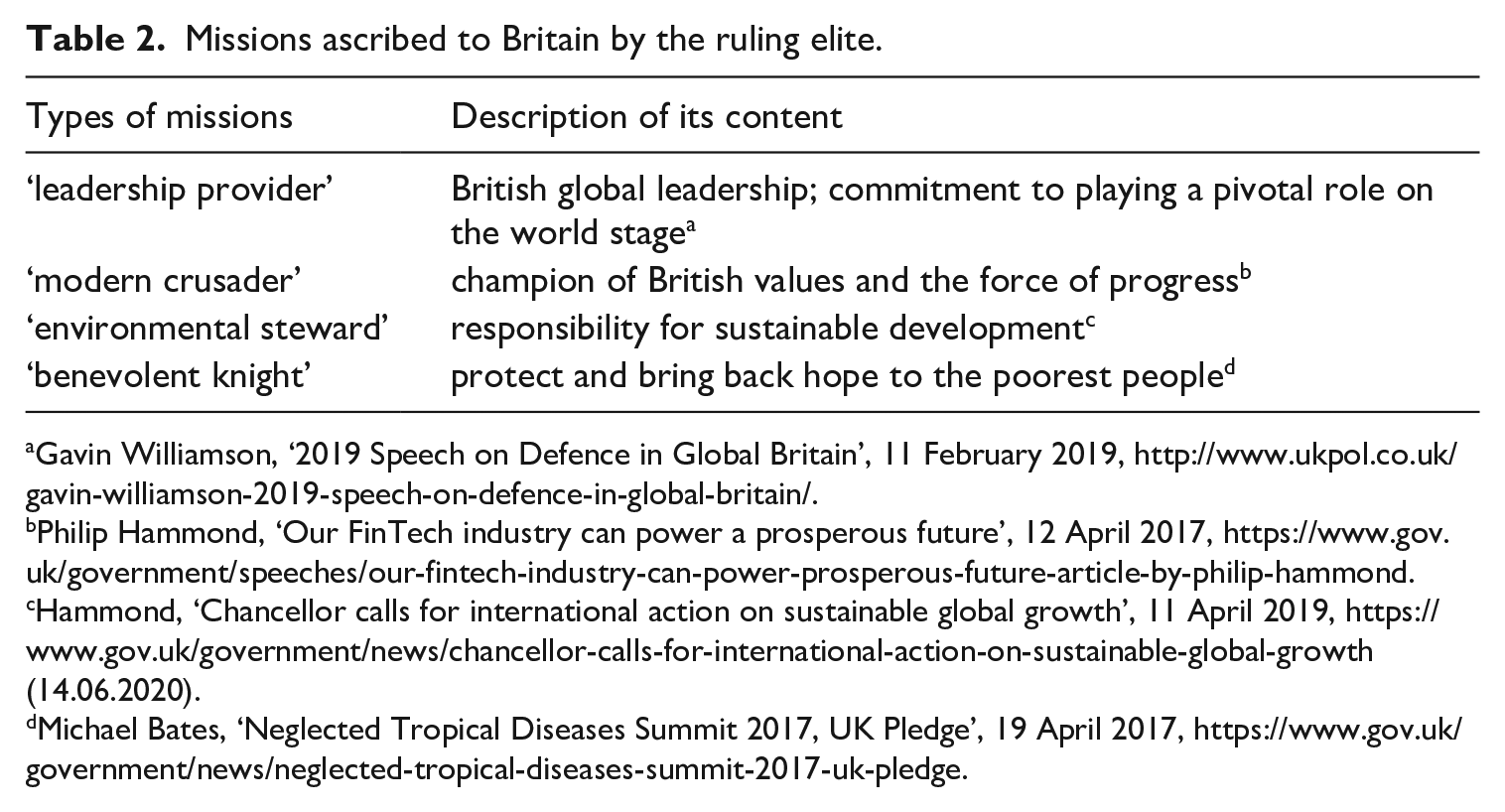
Analysis of the government’s narrative allowed us to identify four main missions. Not considering some minor adaptations to the contemporary discourse (e.g. the ecological agenda), these missions are in line with the British tradition (Table 2).
Missions ascribed to Britain by the ruling elite.
Gavin Williamson, ‘2019 Speech on Defence in Global Britain’, 11 February 2019, http://www.ukpol.co.uk/gavin-williamson-2019-speech-on-defence-in-global-britain/.
Philip Hammond, ‘Our FinTech industry can power a prosperous future’, 12 April 2017, https://www.gov.uk/government/speeches/our-fintech-industry-can-power-prosperous-future-article-by-philip-hammond.
Hammond, ‘Chancellor calls for international action on sustainable global growth’, 11 April 2019, https://www.gov.uk/government/news/chancellor-calls-for-international-action-on-sustainable-global-growth (14.06.2020).
Michael Bates, ‘Neglected Tropical Diseases Summit 2017, UK Pledge’, 19 April 2017, https://www.gov.uk/government/news/neglected-tropical-diseases-summit-2017-uk-pledge.
The British political elite rejects ‘insularity’ – a passive ad exemplum style of leadership (akin to the American ‘city upon the hill’ metaphor). On the contrary, London offers proactive leadership. For Global Britain ‘it’s not enough to lead, we need to make sure we’re taking everyone along with us’. 80 British leadership is presented in moral categories, rejecting the perspective limited to national interests. As Daniel Pruce, British Ambassador to the Philippines stated: ‘That is not just in the interests of British citizens, but in the interests of all peoples around the world. . .’ 81 Global Britain is thus ‘a force for good in the world’, which uses its ‘unique voice – humane, compassionate, principled – to do good around the world’. 82 The ‘modern crusader’ mission fits well into the British habitus and echoes imperial times. 83 As it is stated in the Conservative and Unionist Party Manifesto 2017: ‘We will continue to champion British values around the globe: freedom, democracy, tolerance and the rule of law’. 84 Once again, championing British values globally is strongly linked to the belief that these values are universal. 85 Therefore Global Britain claims the role of the protector of human rights and the rules-based international order. Moreover, Global Britain sees itself as a progressive power – in both the social and economic dimension. 86 On the one hand, it advocates gender equality and social justice. On the other, it helps developing countries by providing them with British expertise and technical knowledge as well as creating the conditions for free trade and prosperity across the world (making globalisation work for all). 87 Penny Mordaunt summarised it by saying that ‘Global Britain is a protector, it’s a wealth bringer, it’s a problem solver, a life saver and a peace broker’. 88
Comparative perspective
While comparing Russian and British mission narratives, it is impossible to overlook the historical stability of their content and function. Minor adaptations to modern realities (e.g. ecology or space exploration) do not change the fact that both help to sustain coherent autobiographical narratives about Russia/the UK as two ‘eternal’ major powers pursuing a mission for the benefit of all humankind. Furthermore, the differences in the two narratives are also stable despite changes in international circumstances.
The missions ascribed today to Russia by its elite have a counter-hegemonic character. They are also restitutive, that is, they aim not at changing the world but at restoring the order. Additionally, in the Russian mission narrative there is reference to ‘auto-missions’ which prioritise protecting Russia from external influence. In the long term they could strengthen tendencies for isolationism. In the Global Britain narrative, although a slight majority of the electorate voted for Brexit and at least part of the Leave camp thus expressed an inclination for isolationism/antiglobalism 89 there is no reference to ‘auto-missions’. On the contrary, the British elite (at least in part) claim a progressive mission of a hegemonic type for their country, that is, go into the world and encourage other nations to follow the UK. From this perspective we can notice that the British traditional attachment to spreading Freedom has a hegemonic dimension (liberation often meant changing others into their own image), while Russia’s dedication to justice has a counter-hegemonic edge (restoring justice means today curtailing the West’s influence). The specific nature of the British mission narrative is symbolised by the ‘crusader’ figure, while the Russian sense of mission is symbolised by the ‘shield bearer’. The difference in these images reflects the difference in their position in the international hierarchy. While in the beginning of the 21st century Britain’s place among the ‘established’ powers is safe, Russia is struggling with the stigma of being an ‘outsider’.
Comparing the missions of Russia and Britain in the light of the ontological security theory
Our first point is that both contemporary mission narratives are a reaction to a critical situation. The fall of the USSR and the Brexit referendum are definitely events which have undermined the role and place in the world of the countries discussed. Nevertheless, there are also some important differences. The referendum was a single and recent event which was organised in response to the ongoing public debate in the UK. The fall of the Soviet Union happened almost three decades ago. It was sudden and unexpected for the majority of its population. The signing of the Belovezha Accords in December 1991 was just the symbolic beginning of a new phase of many years of identity searching for all the post-Soviet nations. In the case of Russia, 1991 was like an earthquake which was followed by several aftershocks which further undermined its status (NATO’s expansion or the ‘colour revolutions’ in former Soviet republics).
The thesis about mission narrative as a reaction to a critical situation is confirmed by the chronological correlation. The Global Britain narrative with its messianic overtones had not appeared in the official discourse prior to the Brexit referendum. This is the first critical situation experienced by the UK in the post-Cold War era. This reality is characterised by a shift in the global balance of power (in which the EU and US hold decreasing relative weight) and the development of a new narrative in international society, where the formerly central role of ideology has been now occupied by identity issues. The decision to leave the EU and Donald Trump’s victory have questioned both pillars of the ‘Macmillan line’ in British foreign policy – the aspiration to anchor the UK in the European integration process and to develop a ‘special relationship’ with the US. This post-Cold War dynamic can be seen as a reason why the Global Britain narrative with its distinctive sense of mission emerged in 2016 and not in response to earlier critical situations, like the Suez crisis (1956) or the Falklands War (1982). As David McCourt accurately notes, the failed intervention in the Middle East in 1956 terminated the UK’s imperial ambitions but did not undermine the Bevanite consensus which assumes that ‘Britain remained a power of the first rank in international affairs and must retain the capabilities commensurate with the status’. 90 During the Cold War, this goal was achieved by a strategic alliance with one of the superpowers (the US) and joining the European integration process. 91 These two means of preserving the UK’s status of a major power after WWII lost its foundation with the Brexit referendum. As Browning recapitulates it: ‘. . .the US special relationship no longer offers the safe haven of belonging and community, and the sense of vicariously appropriated status and self-esteem, it once did. Similarly, ideas of reclaiming a leadership role in the Commonwealth are also largely politely declined by members of that club. Brexit, therefore, only appears to have reaffirmed Dean Acheson’s quip way back in 1962 that, having lost an empire, Britain has still to find a role’. 92 The Brexit referendum can therefore be pointed to as a single event which activated the mission narrative.
Russia’s case is different. The analysis of its official foreign policy discourse shows a gradual resurfacing of mission argument triggered mainly by tensions with the West. Mission narrative becomes more visible in the official discourse in 1999 (the bombardment of Serbia, NATO enlargement), 2004 (the American invasion of Iraq, the ‘colour revolutions’), 2008 (the reactions after the Russo-Georgian war) and after 2013 (following the annexation of Crimea). The fact that these events were correlated with mission narrative shows that the narrative is stimulated by the country’s relations with the international environment. Using Hagström’s framework we can describe the transformation of mission narrative in Russia from being a part of the narrative of pride to becoming an element of the narrative of insult. This change took place somewhere between 2004 (the ‘Orange Revolution’) and 2007 (Munich Speech) and can be explained by Moscow’s growing frustration with not being recognised by the West as a ‘peer’. In the case of the UK, references to national mission feature the narrative of pride and tend to celebrate the positive aspects of British exceptionalism. It seems that ‘established’ actors with significant symbolic capital could be more inclined to the pride narrative, while ‘outsiders’ are more at risk of developing a sense of being offended.
In the UK and Russia the ruling elite plays a vital role as a mission narrative entrepreneur. This is understandable since this segment of society shapes official foreign policy discourse. The impact of the elite on the official discourse depends, however, on the type of the political system. In the UK, there are various competing narrative entrepreneurs with a slight advantage for the political establishment. In Russia, the ruling elite established under Vladimir Putin has monopolised the identity narrative not only in the official but also in public discourse as a whole. 93 As a result, in Russia the narrative is formed by the elite, while in the UK it is initiated by the elite but discussed by representatives of civil society. Interestingly, the elites in both countries justify referring to mission with the needs of ordinary people who, in the opinion of the power-holders, find it comforting. 94 The elite thus considers providing OS for society to be its responsibility. Whether the elite views mission narrative merely as ‘cheap talk’ requires analysis beyond the scope of this article. However, even assuming that the elite instrumentalises mission narrative, the choice of this particular instrument over others expresses something important about the elite. Russian sociologists concluded that although all social strata derive their sense of self-esteem and pride from major power status (the mechanism of vicarious identification), the national elite was much more responsive to mission narrative than ordinary people. 95 This might be due to their stronger identification with the state as an international actor. As the agent representing the collective in the international arena the elite is inclined to ‘more directly merging their own sense of identity and self-esteem with its (the state’s – AC) perceived reputation’. 96 The elite refers to mission as they assume that this is what representatives of major powers do. Here the influence of the imperial legacy and national tradition of self-identification are visible.
We can also see how OS brings the elite, society and the state together. All three are necessary to soothe social anxieties connected to a country’s status. The analysis of mission narrative shows benefits of the integrative approach adopted by Tanya Narozhna. She writes: ‘The state and society. . . structure each other in fundamental ways through the mutual interactions of individuals acting from their structural positions as agents of various state and societal institutions and organisations’. 97 Russians and the British are imperial nations. They are comforted because their country is a major power and this strengthens their sense of OS. 98 Preserving top status in the international arena is thus a need of the people. However, it can only be satisfied in foreign policy which, in turn, is the domain of the ruling elite. Moreover, satisfying this particular need involves the state as a social actor interacting with others in order to secure adequate recognition. 99
Comparing both elites’ performance as narrative entrepreneurs reveals another significant difference. Right after the fall of the USSR the authorities of Russia used the critical situation to change certain aspects of the autobiographical narrative and to legitimate the pro-Western policy represented by the minister of foreign affairs, Andrei Kozyrev. According to the new interpretation, renouncing hegemonic ambitions and embracing the Western model would guarantee Russia an equal place among the ‘established ones’. In 1991–1992/1993, there was no mention of Russia’s unique mission in the world. 100 This provides additional evidence for Jelena Subotić’s argument that when facing a critical situation the elite can use the new circumstances to change the dominant identity narrative. 101 However, the withdrawal from a privileged position in the post-Soviet area was highly unpopular among Russian citizens who saw it as abandoning Russia’s status as a major power – its true identity. The lack of ‘discursive fit’ between the population and the government’s agenda cost Boris Yeltsin’s team public trust. 102 With the return of the master narrative, ‘Russia as a sovereign major power’, mission narrative has also slowly resurfaced. It is important to emphasise that this was due to a process, not the Kremlin’s calculated manipulation.
The Russian ruling elite officially rejects messianism because pursuing a global mission at its own expense is seen as one of the reasons for the fall of the USSR. 103 However, Russian diplomats continue to talk about their country’s mission in the world. This is a ritualised narrative which is often referred to almost unconsciously and is strictly connected to imagining Russia as a major power – an observation which confirms Browning’s point about the role of subconscious routines. 104 As he explains, OS seeking is ‘to some extent an un/subconscious activity reliant upon activating already established understandings, codes and practices within society on a largely instinctive and intuitive basis’. 105 Routines strengthen narcissism and thereby a coherent autobiographical narrative about Russia as a major power when the Significant Other (the West) denies it adequate recognition. The Global Britain narrative is more straightforward – an ideological project initiated and promoted by part of the ruling elite as narcissistic self-defence aimed at restoring the ‘good self’. It provides a firm identity narrative in the face of post-Brexit anxiety. The Global Britain vision is therefore arguably more of a strategic manipulation and using the glorious past to boost collective self-esteem than the Russian mission narrative, which is rather about, to some extent subconscious, sticking to narrative routines.
Finally, our analysis enriches the debate’s empirical basis over what generates ontological insecurity. Is it a sudden change of a country’s relations with its Significant Other(s) (the mechanism of ‘anxiety avoidance’ supported by Mitzen) or rather the inability of a country to synchronise its past or current activities with its autobiographical narrative (‘shame avoidance’, advanced by Steele)? 106 Our research confirms Ejdus’ observation that both are of importance. Referring to mission in foreign policy serves maintaining a coherent autobiographical narrative about a country as a major power. At the same time the coherence of this narrative is conditioned by relations with other countries, especially with other major powers which – as ‘peers’ – can grant adequate recognition. The mission narrative as a mechanism of ontological self-help is thus a mixture of shame and anxiety avoidance. However, in the case of the UK and Russia this mixture comes in different proportions. One way to explain this difference is to consider the extent to which the particular critical situation is caused by internal and external factors. After the fall of the USSR, Russia had to redefine its relations with the West and the former Soviet republics. However, the pro-Western turn in foreign policy was interpreted by a significant part of the population as denying the true Russian identity as a major power, sovereign in her decisions and respected by others. The change of tone in foreign policy around 1993 could be interpreted as a symbolic moment when shame avoidance gained the upper hand over anxiety avoidance in Russia’s OS seeking behaviour. 107 In the UK the social divisions over its relation to the EU preceded the referendum and could be characterised as motivated by shame avoidance, especially for Brexiters who believed that EU membership prevented their country from being a sovereign major player. 108 Once the referendum took place, it redirected the domestic debate into rearranging relations with other international actors, mainly Europe and the US. 109 We acknowledge that this observation about the dynamics between shame and anxiety avoidance is preliminary and needs further investigation.
Closing remarks
The attempt to compare post-Soviet Russia with post-Brexit Britain might seem surprising and counter-intuitive. The specific comparison in this article reveals the overlooked connection between the sense of mission, status and OS. In the case of Russia and the UK, talking about mission in foreign policy is part of the imperial legacy. The contemporary mission narrative is a particular phantom routine. Phantom, because the empire is gone but the practices from that lost time linger. Neither states aspires to or fits the classic definition of an empire. 110 They are major powers whose identity narrative is permeated with imperial legacy. Today’s elite relies on these old narrative routines while dealing with ontological insecurity. Phantom messianism reveals the influence of these deep structures and their relevance for contemporary socio-political processes. 111 Uncovering other phantom practices of imperial origin is an important topic for future research. Russia’s invasion of Ukraine legitimated with imperial discourse is a radical manifestation of just how urgent these issues are.
Although different in scope and nature, the fall of the USSR and the Brexit referendum both resulted in questioning the status and identity of the two respective states. And both countries reacted by emphasising their special role in the world. Referring to mission in foreign policy helps to restore a coherent autobiographical narrative which soothes the ontological uncertainties.
The most intriguing observation from our research is the tenacity of the mission narrative. For many political scientists this is a phenomenon of the past of almost no relevance for contemporary analysis, at least as regards European states. It is true that with Russia, especially after the annexation of Crimea, some experts talked about the return of new Russian messianism. But even here opinions were divided. Nobody, to our knowledge, has pointed to messianism in reference to Global Britain. Meanwhile, it is the mission narrative which today brings together two former empires and reveals the significance of their messianic traditions. In the face of ontological insecurity, elites have referred to historically established self-images. Although the international order at the beginning of the 21st century is in many ways different from that of the 19th century, Russia is back to being the ‘shield bearer’, and the UK longs to be the ‘crusader’. The resurfacing of the mission narrative in the foreign policy of these two nations confirms that the question of identities is of strategic importance.
Footnotes
Acknowledgements
I would like to express my gratitude to the editors and anonymous reviewers for their insightful comments.
Funding
The author(s) disclosed receipt of the following financial support for the research, authorship, and/or publication of this article: The research was conducted as part of the SONATA project no. 2015/19/D/HS5/03149, financed by the National Science Centre, Poland. Part of the research for the article was conducted during the stay of Alicja Curanović as a Fulbright visiting fellow at the Davis Center, Harvard University.
