




Abstract
The Russian invasion of Ukraine in 2022 has put significant pressure on the European Union’s (EU) role conceptions, challenging its self-perception as a normative and civilian power. This article explores the impact of the invasion on EU role conceptions through the lens of ontological security theory. We differentiate between ontological insecurity and crisis, elucidating the EU’s responses to acute shocks that disrupt the connection between its self-image and social roles. Drawing on role theory, we examine how the invasion has prompted the EU to reconsider its roles. We identify adjustment, adaptation, innovation, and abandonment as key types of role change, exploring how these responses vary across individual roles within the EU’s role set. By combining qualitative and quantitative content analysis of EU documents, we empirically investigate changes in EU role conceptions pre- and post-invasion. Our analysis contributes to a deeper understanding of role theory’s application to international organizations (IOs), bridging gaps between foreign policy analysis and IO research. In addition, we advance methodological approaches to studying role changes, offering insights into the complex interplay between external events, institutional identity formation, and ontological security in the context of geopolitical crises.
Introduction
After the Russian invasion of Ukraine on 24 February 2022, European Commission President Ursula von der Leyen called the act “a watershed moment” for the European Union (EU), indicating that “this crisis is changing Europe” (Von der Leyen, 2022). She also noted that the Russian attack on a neighboring country in Europe not only marks a violation of international law but also challenges the European “self”: “What is at stake is the stability of Europe and the whole international order, our peace order” (Von der Leyen, 2022).
International Relations (IR) scholars have come to a similar assessment, describing the war “as a turning point for European politics, security, and economy” (Fiott, 2023; Genschel et al., 2023; Siddi, 2022). Bosse (2022), for instance, argues that unity among EU member states to enforce sanctions against Russia as well as protect Ukrainian refugees migrating to Europe was strongly influenced by a moral obligation based on rights-based norms that have been linked closely to values-based norms pertaining to EU solidarity, identity, and ethical responsibilities. Others have noted that the war marks a systemic change to a multi-order world in which the EU has to (re-)define its role (Flockhart and Korosteleva, 2022; Orenstein, 2023).
The war against Ukraine has posed a significant challenge to the EU’s efforts to balance its historically derived self-image as a normative and civilian power, which had been stabilized via various social roles vis-à-vis Russia since the end of the Cold War (Nitoiu and Pasatoiu, 2023; Stivachtis, 2016). These include roles such as contributor to European peace, economic integrator, mediator, regional leader, bilateral partner, and public diplomacy actor (Bengtsson and Elgström, 2012; Chaban and Elgström, 2021). While the EU has aimed to economically integrate Russia into a European order, as outlined in the Maastricht Treaty (Bengtsson and Elgström, 2012: 100), through instruments like the 1997 Partnership and Cooperation Agreement, it has also been compelled to defend liberal democratic values and human rights in Eastern and Central Europe via the European Neighborhood Policy (ENP) (Giusti, 2020). This has led to tensions with Russia, especially following the shift in Russian domestic politics under Putin (Stent, 2008), culminating in a diplomatic conflict after the annexation of Crimea in 2014 (Casier, 2016). Despite these tensions, the EU has continued to stabilize its self-image as a normative and civilian power through the Lisbon Treaty and the EU Global Strategy 2016, casting Russia into the role as ambivalent partner (Casier, 2019; Lynch, 2004; Tocci, 2020).
In this article, we investigate how and to what degree the Russian attack on Ukraine has led to changes in the EU’s role conceptions. We argue that the EU’s foreign policy roles vis-à-vis Russia have historically been driven by the desire to achieve ontological security and stabilize its self-image as a normative and civilian power (Della Sala, 2023). Ontological security describes the need of individuals (and collectives) to establish and stabilize the “self” in order to develop agency (Mitzen, 2006). It can explain how and why actors in international politics “reflexively construct their selves through narratives and routinized behaviors in relation to other actors, and how this then affects and can explain political outcomes” (von Essen and Danielson, 2023: 5). Social roles are a crucial link between actorness, addressing physical security challenges, and preserving ontological security by providing continuity, a sense of routine, and social identification (Klose, 2020; Subotić, 2016). The EU has sought to establish self-awareness, social interaction, and routine development within a European and international order through the conception and enactment of social roles vis-à-vis Russia, forming and stabilizing its self-image as a normative and civilian power (Aggestam, 2018; Cerutti and Lucarelli, 2008; Hebel and Lenz, 2016; Mitzen, 2013).
However, social actors may need to re-conceive their roles when facing ontological insecurity from external shocks or trauma, where existing self-narratives, social routines, and role relationships no longer provide stabilization and confirmation (Cash, 2020; Ejdus, 2020). Whereas ontological insecurity is often referred to as a general sense of unease in one’s understanding of reality and self (Steele, 2008), ontological security crises (OSCs) are more acute and comprehensive disruptions to one’s sense of self, “capable of generating multiple insecurities at once, with potentially contradictory implications for state policy” (Tsintsadze-Maass, 2024). OSCs involve the complete discontinuation of existing routines and relations, posing “radical disjunctions that challenge the ability of collective actors to ‘go on’” (Ejdus, 2018). This can lead to a disconnect between an actor’s self-image and their roles, as the certainty and stability of actors’ self-expectations and others’ expectations is challenged (von Essen and Danielson, 2023: 11).
Actors respond to OSCs by changing role conceptions to re-establish ontological security, either by cultivating new self-awareness or by emphasizing new social interactions and routines (Eberle and Handl, 2020; Subotić, 2016). We argue that these responses can range from role adaptation and adjustment to more profound transformations, such as innovating new roles or abandoning existing ones. In sum, role changes in response to OSCs can affect individual roles to varying degrees as well as the composition of an actor’s role set, shaping how the actor’s self-image is socially embedded and reassured (Neumann, 1996).
We explore several ways in which the Russian invasion of Ukraine threatens the stability of the EU’s self-image as a civilian and normative power: First, the war and Russia’s transition from an ambivalent partner to an aggressor disrupt the established diplomatic and economic roles between the EU and Russia (Cardwell and Moret, 2023; Strycharz, 2022). This disruption is particularly evident in the impact of EU sanctions on Russia, leading to a significant reduction in trade. Second, Russia’s attack on Ukraine forces the EU to contemplate new, unfamiliar roles, such as assuming the role of a military security provider for Ukraine (Rabinovych and Pintsch, 2024). This shift challenges the EU’s traditional self-image as a civilian power. Third, Russia’s role change creates tensions within the EU, particularly among member states. These new roles, potentially, conflict with existing ones in the EU’s role set, creating tensions and challenging the coherence between the EU’s self-image and its associated roles (Costa and Barbé, 2023).
Against this backdrop, we focus on identifying which EU role conceptions have changed and how these changes relate to the EU’s self-image as a normative and civilian power. We begin by situating role theory within EU studies and foreign policy scholarship, highlighting the evolution of the EU’s role conceptions amid its increasing global engagement. We then present a theoretical framework to understand how an OSC prompts the EU to re-conceptualize its roles, aiming to re-align its social environment with its self-image to minimize uncertainty. We differentiate between four types of role change—adjustment, adaptation, innovation, and abandonment—and assume that an OSC affects both individual roles (in terms of functions, purpose, and significant others) and the composition of the role set (the hierarchy of roles). We combine qualitative and quantitative content analysis to then empirically investigate changes in the EU’s role conceptions pre- and post-Russian full-scale invasion of Ukraine and analyze 15 European Council Conclusions and 235 press releases from the European Commission between 15 February 2015 and 31 July 2023.
Our analysis contributes to role theory and its application to international organizations (IOs), in particularly EU foreign policy. While IR scholarship has often emphasized the influential role of IOs in shaping IR (Chapman and Wolford, 2010; Eilstrup-Sangiovanni and Hofmann, 2020), role theory has received little attention in understanding these actors’ role play and their role conceptions (Holsti, 1970; Thies, 2013). By examining the EU’s role conceptions, that is, how an IO defines its interests as a collective; how it perceives international structures and its place in it; and which external others co-constitute its “self” (Breuning, 2018, 2024), we contribute to a better understanding of IO actorness and self-definition (Oelsner, 2013; Von Billerbeck, 2020). This way, role theory can help bridging gaps between foreign policy analysis and IO research (Kille, 2024).
Furthermore, our analysis deepens the understanding of role change, focusing on OSC as a key driver (Thies and Nieman, 2017). As actors’ ontological security is tied to and stabilized through the taking and making of roles, an OSC can not only facilitate a disconnect between an actor’s self-image and social role play (Klose, 2020), but also threatens to cause a full circle discontinuation of roles, relations, and social structure where the actor questions who she is (Anghel and Jones, 2023; Tsintsadze-Maass, 2024). Whereas previous application of ontological security to the study of roles assumed that states either manage or fail to achieve self-stability, we focus on OSC as a vantage point where we can explore variance of role conception change across individual roles as well as how these changes impact the role set composition in relation to the EU’s self-image. Finally, we advance existing methodological approaches to the study of roles and role set. For the purpose of this article, we developed a coding scheme that allows us to track role changes in terms of instruments, goals, and significant others. Using the MAXQDA, we identify roles in written documents and produce replicable results (see digital data appendix).
EU foreign policy roles toward Russia
Since the end of the Cold War, the EU has developed a set of roles vis-à-vis Russia to achieve ontological security of its self-image as a normative and civilian power (Kinnvall et al., 2018). Despite an inherent contradiction in its self-image (Manners, 2002, 2023; Risse, 2012), balancing economic and physical integration with the promotion of liberal values, the EU has formulated and enacted roles to create a coherent self-narrative and establish routines in its relationship with Russia (Della Sala, 2017; Klose, 2020).
The EU’s self-image as a normative and civilian power has shaped its foreign policy choices, emphasizing engagement through dialogue, diplomacy, and economic incentives to encourage states to adopt its values (Aggestam and Johansson, 2017; Whitman, 2011). This has been evident in the neighborhood policy and accession processes, where the EU promises closer ties and potential membership to states aligned with its values (Johansson-Nogués, 2018). The establishment of the ENP in 2004 institutionalized various roles, casting others into partner roles in areas such as counter-terrorism (Monar, 2015), migration (Mitzen, 2018), energy security (Tichý, 2020), and security (Browning, 2018). In addition, the EU has enacted liberal norm promoter and democracy promoter roles, offering market access and foreign aid to neighboring states in exchange for a commitment to the rule of law and human rights (Sasse, 2008).
Moreover, the EU institutionalized roles through the Lisbon Treaty of 2009 include diplomatic actor, development assistant provider, and conflict resolver (Aggestam and Johansson, 2017; Missiroli, 2010). This is evident in the EU’s involvement in facilitating negotiations in the Iran nuclear deal, active participation in the Middle East peace process, and engagement in conflict resolution and peacebuilding missions in regions like the Western Balkans and the Sahel Region (Dodt et al., 2018; Hill and Vanhoonacker-Kormoss, 2023).
It has also been evident in the EU’s engagement with Ukraine and Russia to reflect its normative and civilian power image and ensure regional stability. It transitions between roles such as cooperator, partner, and protector, having supported Ukraine’s democratic reforms through initiatives like the Eastern Partnership (Cadier, 2014; Tsybulenko and Pakhomenko, 2016). Cooperative efforts with Russia, like the Partnership and Cooperation Agreement, showcase the EU’s commitment to building mutually beneficial partnerships. In crises, the EU has acted as a coordinator and mediator, facilitating diplomatic efforts and negotiations, as seen in the Minsk agreements (Åtland, 2020). In addition, the EU has promoted democratic values during events like the Euromaidan protests and imposed sanctions against Russia, particularly after the annexation of Crimea (Kuzio, 2016; Sjursen and Rosén, 2017). In addition, the EU has acted as a provider and supporter, extending financial and humanitarian aid to Ukraine and fostering people-to-people connections to reinforce shared values. The role of a facilitator is evident in initiatives like the Association Agreement and the EU-Ukraine Deep and Comprehensive Free Trade Area (DCFTA), demonstrating the EU’s commitment to economic integration and societal transformations in Ukraine (Vošta et al., 2016).
The Russian attack on Ukraine in February 2022 has severely challenged the EU’s self-image as a normative and civilian power. The inherent role ambivalence within the EU vis-à-vis Russia, balancing roles like economic integrator and mediator with roles like liberal norm promoter and democracy promoter, has intensified in the face of Russia’s actions. Despite efforts to economically integrate Russia, the shift in Russian domestic politics and the annexation of Crimea in 2014 brought the EU’s self-image into direct conflict with Russia’s political trajectory. The Lisbon Treaty in 2009 and the EU Global Strategy of 2016 signal the EU’s self-conception as a normative and civilian power, aiming for a strategic partnership with Russia. However, divergent interests and values, particularly regarding democracy and human rights, pose significant challenges to realizing this partnership.
In the subsequent sections of this article, we leverage role theory to theorize how an OSC can instigate role conception changes. We focus on OSC as a particular kind of external shock and explore how and to what degree EU role conceptions have changed following the Russian invasion of Ukraine.
Ontological security crises and role conception change
The notion that states, besides striving for physical security, seek ontological security was first introduced by Mitzen (2006) based on the work of Giddens (1991). Accordingly, “ontological security refers to the need to experience oneself as a whole, continuous person in time—as being rather than constantly changing—to realize a sense of agency” (Mitzen, 2006: 342). All social actors, including individuals, societies, or even states, “need to feel secure in who they are, as identities or selves” (Mitzen, 2006: 342). This sense of security allows actors to understand themselves, predict outcomes, relate ends to means, and how to pursue them. Consequently, individuals and states are driven to establish routines that create cognitive and behavioral certainty. Ontological security is also maintained through stable social relationships, as actors routinize interactions with significant others to confirm their self-image (Mitzen, 2006: 342).
While the concept of ontological security emphasizes the importance of self-stability, it is the formation of self-images that provides the foundation for actors to conceive and enact social roles. Self-images, which can be understood as an actor’s internalized understanding of its self in relation to the world, emerge from a combination of historical narratives, discourses, and the expectations projected by significant others (Elgström, 2000; Wehner, 2023). In the context of role theory, self-images inform role conception by providing actors with a mental framework that shapes how they interpret their position vis-à-vis others. Actors perform their roles in ways that align with how they see themselves and how they want to be perceived by others. This is particularly important in the pursuit of ontological security, as stable role enactment reinforces the self-image and provides a sense of continuity and agency in an unpredictable environment.
We argue that conceptualizing and enacting social roles is key to actors’ pursuit of ontological security (Bachleitner, 2023; Beasley et al., 2021; Klose, 2020). Social roles are defined as “social positions (as well as a socially recognized category of actors) that are constituted by ego and alter expectations regarding the purpose of an actor in an organized group” (Harnisch, 2011b; Thies, 2010). By enacting these roles, actors learn to perceive themselves through others’ perspectives. Role conceptions, defined as “an actor’s perception of his or her position vis-à-vis others and the perception of the role expectations of others as signaled through language and action” (Harnisch, 2011b) embody routines and self-narratives, and convey information about how an actor’s self aligns with functions, purposes, and relationships. They provide actors with confident expectations about the means–ends relationships that govern her social life, and, eventually, provide ontological security as “the individual will know how to act and therefore how to be herself” (Greve, 2018; Mitzen, 2006: 343).
Our framework is inspired by the interactionist stream within role theory, particularly George Herbert Mead’s concepts of dialogue and emergence. Similar to an individual, an international actor develops its “self” through a dialogue between its “I” (spontaneity and creativity) and “me” (self-perception through others’ eyes) (Harnisch, 2011a). This self-emergence occurs through the creation and enactment of social roles, leading to self-awareness and stability in social interactions (Klose, 2020). An actor’s self-awareness is shaped by its ability to adopt social roles and cast others into corresponding roles, projecting its self-image. Importantly, the stability of an actor’s self is contingent on commensurate counter-roles by significant others. This process results in routines where the actor regularly meets societal and significant others’ expectations, reinforcing social structures (Wendt, 1999).
External shocks or trauma can cause ontological insecurity by disrupting established practices and narratives that help actors understand their world (Ejdus and Rečević, 2021; Mitzen, 2006: 348), most often when existing roles do not fit the new reality (e.g. war) or because significant others have changed their roles. These disruptions replace familiar structures with uncertainty (Rumelili, 2015). In response, actors may enter a “catatonic state,” clinging to pre-existing roles despite environmental changes, potentially causing incommensurability of roles others (Mitzen, 2006: 349–350).
Ontological security studies have shown that severe forms of insecurity, or ontological crises, can create multiple, often contradictory insecurities (Tsintsadze-Maass, 2024). We thereby think of crises as “social constructions produced in the very process of interpretation” of “unpredictable events that affect a large number of individuals, catch state agents off-guard and disrupt their self-identities” (Chernobrov, 2016; Steele, 2008: 8). A “profound ontological crisis” disrupts a state’s autobiographical narrative, causing “ontological dissonance” where various aspects of the self are threatened and solutions are contradictory (Lupovici, 2012; Subotić, 2016). As an OSC involve not only the self-narrative but also the relations to others, they constitute severe ruptures to an actor’s trust system regarding the self, others, and the outside world (Ejdus, 2018; von Essen and Danielson, 2023: 11).
Thies and Wehner (2023) suggest that existential and acute political shocks can lead to role changes by questioning a state’s status or disrupting its roles. When external shocks or crises occur, disrupting the actor’s ontological security, it is often the self-image that anchors the actor’s response. In situations of OSC, actors are forced to reconcile shifts in external expectations with their internal self-image. Actors might adjust their roles, adapting or even abandoning those that no longer align with their self-image or that fail to meet the changing expectations of significant others (Wehner and Thies, 2014). As Eberle and Handl (2020) have shown, actors may respond to crises with adjustments that maintain continuity on some levels while enabling change on others. Changes in role conception across an actor’s role set may vary based on their significance to the actor’s self-image, external expectations, or the social context of the role.
We develop a heuristic to assess different types of role conception changes in response to an OSC (see Table 1). Harnisch (2011b) adapted Hermann’s (1990) scheme to analyze foreign policy changes through role theory, creating a typology: role adaptation (instrumental changes with stable roles), role learning (changes in goals), and role transformation (changes in identity). However, further conceptual refinement is needed due to inconsistencies in terminology and the lack of conceptualization for adding and abandoning roles. Harnisch et al. (Harnisch, 2011b) suggest that “role adaptation” involves changes in strategies and instruments, akin to the first three levels of foreign policy change in Hermann’s typology. However, Hermann’s third level already includes changes in goals, which Harnisch (Harnisch et al., 2011) labels as “role learning.” Our coding scheme distinguishes between changes in instruments and changes in goals, addressing this inconsistency. Moreover, Harnisch’s delineation between the first two degrees of change is fluid, as actors may adapt both instruments and goals within the same role (Strycharz, 2022). Hence, a comprehensive typology should accommodate clear distinctions between these changes and their fluidity. In addition, there is a need for conceptualizations regarding the addition and abandonment of roles in an actor’s set of role conceptions.
Heuristic model for role conception change.
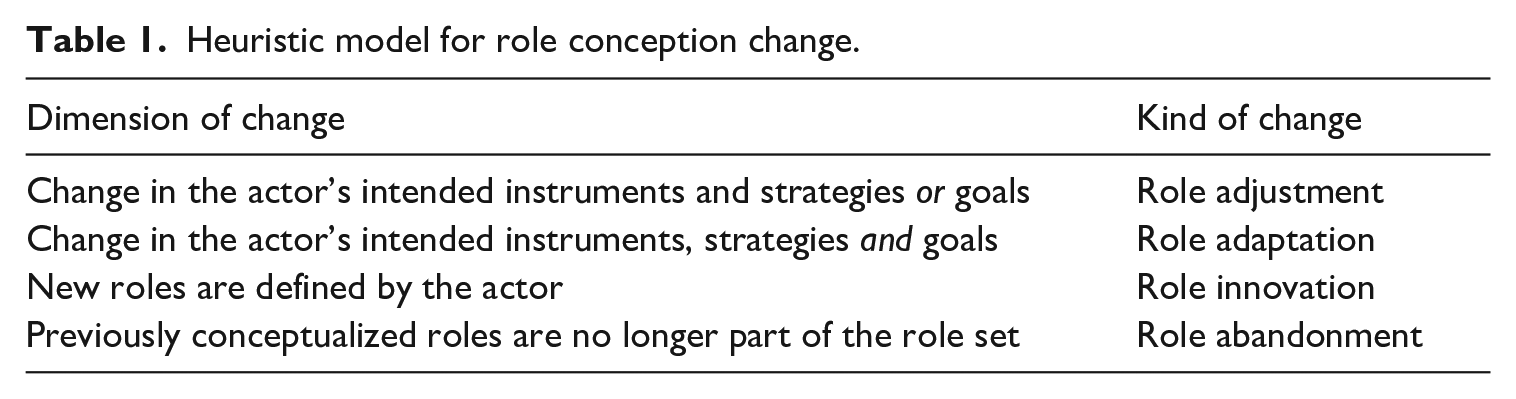
In furtherance of this scholarship, we conceptualize four kinds of role conception change. First, we speak of role adjustment whenever the actor’s intended instruments, strategies, or goals change. Role adjustment involves minor tweaks and refinements to the actor’s current role, for example, in some cases, the fundamental goals and overarching strategies remain largely unchanged, but the specific instruments employed are fine-tuned to enhance role performance. Second, we refer to the change of the actor’s intended instruments, strategies, and goals as role adaptation. Unlike role adjustment, role adaptation entails more substantial changes that are often necessary to better suit a new or evolving environment. This form of change is more profound, involving a re-evaluation and possible overhaul of the actor’s core objectives and methods. Overall, we understand adjustment to represent minor tweaks and refinements, while adaptation refers to more substantial changes to better suit a new environment. In each case, we can nevertheless clearly delineate the individual components—goals and instruments of this kind of change. Third, role innovation involves the creation of entirely new roles to address emerging challenges or capitalize on opportunities in a changing environment. Finally, whenever previously conceptualized roles are no longer part of the role set, we speak of role abandonment (Wehner and Thies, 2014). Following Chafetz et al. (1996: 736), we argue that instead of abandoning roles outright, actors “slowly downgrade their centrality” within their role set depending on the salience of the role. However, we argue that roles can be abandoned from role sets that are directed at specific contexts (e.g. context of the Russia–Ukraine conflict).
Moreover, an OSC can influence the hierarchy of role conceptions within an actor’s role set, affecting which roles are prioritized. Combined, variant role conceptions changes across roles and shifts in the hierarchy of roles within an actor’s role set can reveal how an OSC can jeopardize the actor’s self-image. The changes in roles are ultimately tied to how an actor perceives itself and its place in the world. Thus, the theoretical nexus between images and roles highlights the ways in which actors use their self-images to interpret their environment, define their roles, and enact strategies that preserve their sense of ontological security.
Data collection and analysis: assessing EU role conception change
Identifying and mapping roles in role theory remains challenging due to its theoretical richness and methodological limitations (Walker, 1987). We follow existing studies that suggest ontological (in)security should be studied as perceived by actors and expressed discursively, recognizing that the same events can trigger different levels and forms of insecurity for different actors. Russia’s invasion of Ukraine in particular posed diverse challenges to other states based on their unique identities and connections to the conflict (Tsintsadze-Maass, 2024).
We understand role conceptions to consist of (1) how the role should be performed, that is, instruments and strategies, (2) the purpose of the actor in the group, that is, the goals the role helps to achieve, and (3) the significant other(s) vis-à-vis the role is conceived. 1 Instruments and strategies are operationalized as written descriptions of means the EU uses or intends to use to achieve a goal. In texts, they can be found in verbs describing actions of the EU (e.g. support, promote, coordinate), in references to official names of EU instruments, or pre-established types of instruments. Goals are operationalized as written descriptions of the objectives and the use of instruments they are supposed to achieve. They can be found in texts after structures like “to” or “because.” Significant others are operationalized as written references to states, their governments, people, or (non-)governmental organizations. A role is only measured if these three elements are found. The hierarchy of roles within a role conception is measured by how many times they are mentioned relative to the total number of roles identified within a time frame.
We focus on the European Council and the European Commission in our analysis. Since the European Council defines the EU’s overall political direction and priorities and discusses security and defense dimensions of the EU’s policies, it should provide ample reference to the EU’s role conceptions in the conflict. We also included the European Commission as it allows us to dissect a wide array of context-specific role conceptions to the conflict and to incorporate the supranational dimension of the EU. Focusing on the European External Action Service would have risked excluding roles that are related to the conflict (e.g. supporter of member states) but not foreign policy roles. Since the Commission is a decisive actor in conceptualizing the EU’s role in many policy fields as the supranational and the sole body that may propose legislation (Aggestam and Johansson, 2017; Bengtsson, 2022), we argue its inclusion is warranted for our research. At the same time and on top of analyzing data by the European Council, the chosen documents for the Commission (see below) ensure that foreign policy perspectives, specifically those of the High Representative / Vice President (HR/VP) are included.
The selected time frames are 15 February 2015, until 23 February 2022, and 24 February 2022, until 31 July 2023. 2 For the European Council, we analyzed all Council Conclusions that explicitly mentioned EU behavior in response to the conflict, which resulted in 15 documents (7 from before, 8 from after the invasion). For the European Commission, press releases were chosen because “they provide a consistent, a quite comprehensible and easily accessible . . . source for the EU’s self-perception” (Bergner, 2021: 3). Different “EU document types . . . [have] an informative character . . . [making] references to the EU’s role conception less likely” and speeches and statements are “mostly integrated into EU press releases” (Bergner, 2021: 3).
Specifically, speeches by various EU commissioners including HR/VP Joseph Borrel are repeatedly included in the data ensuring that we are also able to dissect foreign policy roles. Press releases from the European Commission’s press corner were selected based on the inclusion of the words “Russia” or “Ukraine” in the title and whether they were published in the mentioned time frames. Of the resulting list of documents, only those that explicitly mentioned EU behavior in response to the conflict were included in the analysis. Subsequently, 47 documents from the period before the Russian invasion and 188 documents from the period since the invasion were analyzed.
We employ quantitative and qualitative content analysis of primary documents. Using the software program MAXQDA, our qualitative analysis dissects the EU’s role conceptions, ensuring reproducibility through a systematic, theory-guided inductive approach based on Mayring (1995; Mayring, 2015) and Mayring and Fenzl (2014). To ensure consistency, we employ a coding scheme based on a category system aligned with our definition of role conceptions, encompassing instruments and strategies, goals, and significant others. 3
Results: EU role conception change in the wake of the Russian invasion of Ukraine
Role adjustment
The EU as a cooperator/partner: addition of new goals
The cooperator/partner role underwent role adjustment following the Russian invasion of Ukraine as the EU expanded the goals it intends to achieve with this role. Before the invasion, the EU aimed to achieve energy security, humanitarian relief, and the protection of values through this role. Post-invasion, additional goals included EU accession, justice, public health, reconstruction, sanction effectiveness, ending the war, and achieving peace.
Before the invasion, the primary goal was humanitarian relief, with key partners being humanitarian organizations and Ukraine. The EU channeled aid through these organizations, exemplified by the statement, “the assistance is being delivered through the Commission’s humanitarian partner organizations” (IP-15-5289-EN: 1). The EU also positioned itself as “a reliable partner” (IP-19-3812-EN: 1) to Ukraine. Other goals included energy security and protecting European values, with internal cooperation highlighted to defend these values against Russia (IP-21-3010-EN: 1). The EU also mentioned “selective engagement” with Russia to address climate, health, and security issues (ST-7-2021-INIT_en). The cooperator/partner role was relatively low in the hierarchy of the role set before the invasion, appearing 11 times (8.03%).
After the invasion, the focus shifted to sanction effectiveness/efficiency and justice, with significant partners being international entities like the USA and ICC, and Ukraine. For instance, the EU emphasized that “cooperation . . . is essential to guarantee the efficiency of the sanctions taken on both sides of the Atlantic” (IP-22-1828-EN: 1). To promote justice, Eurojust was empowered to “share . . . evidence with the International Criminal Court” (IP-22-2549-EN: 1). The EU also sought peace through cooperation with China (IP-22-2214-EN: 1) and aimed to “stop funding the Kremlin’s war machine” with the help of the United States (IP-22-2373-EN: 1). Cooperation with Ukraine targeted public health, reconstruction, and EU accession: “The EU will walk every step of the way with Ukraine . . . on its path to the EU” (IP-22-5428-EN: 1). Energy security and humanitarian relief remained goals, with partnerships for humanitarian aid in Ukraine and international collaboration for energy security (IP-22-2142-EN; IP-22-3131-EN: 1). These latter two goals reflect some role continuity, as the EU continues to envisage a cooperator/partner role for humanitarian relief and energy security after the invasion. Despite the expanded goals, the hierarchy of this role increased only slightly (up by 1% to 8.92%).
The EU as a coordinator: addition of new goals
The coordinator role was adjusted following the invasion as the EU intends to achieve multiple new goals with the role. Before the invasion, coordination is referenced once (0.85%) to achieve humanitarian relief in Ukraine in February 2022: “The European Commission is coordinating the delivery of essential supplies to support the civilian population” (IP-22-1222-EN: 1), whereby EU member states provide the supplies.
In comparison, the coordinator role climbs within the hierarchy of the EU’s role set in the Russia–Ukraine conflict after the invasion, found 30 times (7.04%). Moreover, coordination is now linked to various goals, including humanitarian relief, energy, food and border security, integration and protection of refugees, justice, reconstruction, sanction implementation, public health, economic recovery, and economic stability. Humanitarian relief is intended to be achieved by “coordinating the delivery of material assistance . . . to Ukraine” (IP-22-1462-EN: 1). While coordination is used to support Ukraine, the main significant others of this role are the member states and the private sector (e.g. IP-22-2142-EN: 1).
The EU also aims to coordinate market players and international partners for global food security (e.g. IP-22-3002-EN: 1, similar in ST-21-2022-INIT_en). The EU’s objective to protect or integrate Ukrainian refugees in the EU is demonstrated by the coordination of a platform where “Member States can exchange information about reception capacity” (IP-22-1610-EN: 1). Finally, the EU intends to “enhance . . . coordination in the enforcement of these restrictive measures” (IP-22-3264-EN: 2) and wants to organize an “international coordination platform” for Ukraine’s reconstruction (IP-22-3121-EN: 1, ST-1-2023-INIT_en). Here, the significant others are the member states and international partners. Overall, the coordinator role was adapted following the invasion as the EU intends to achieve multiple new goals with the role.
The EU as a provider: addition of new goals
Before the invasion, the provider role, coded when financial support is mentioned as the intended instrument, was mainly aimed at achieving humanitarian relief (e.g. IP-19-3810-EN: 1; IP-21-2681-EN: 1) and some form of economic stimulus. The form of financial instrument either remained unspecified (e.g. IP-16-3948-EN: 2) or explicitly mentioned grants (e.g. IP-15-4890-EN: 1) or loans (e.g. IP-17-643-EN: 1). For instance, financial support of €70 million was described as “a response to the urgent need to support recovery and economic development” (IP-15-4868-EN: 1) or intended to “boost Ukraine’s economy” (IP-22-2671-EN: 1). Additional goals for the provider role included implementing the Minsk agreements, a green transition, and peace. Specifically, financial support for the “OSCE Special Monitoring Mission” was mentioned three times with the aim of the “full implementation of the Minsk Agreements” (IP-18-4390-EN: 2). Another program supported Ukraine “towards a climate neutral, clean and resource-efficient economy” (IP-20-1802-EN: 1). Peacebuilding was also a goal, as shown by a €10 million allocation for peacebuilding in eastern Ukraine (IP-15-6263-EN: 1). Overall, the provider role was relatively high in the hierarchy of the role set (25.55%, third highest).
After the invasion, the goals of the provider role expanded. While humanitarian relief, economic stimulus, and green transition continued (reflecting role continuity), new goals included energy security, border security, justice, refugee integration, public services, food security, public health, infrastructure restoration, and reconstruction. The EU continued using unspecified financial support, grants, or loans, such as a “€7.5 million project” (IP-22-2549-EN: 2). Humanitarian relief, for instance, was provided to Ukrainian refugees in Moldova or Ukraine (e.g. IP-22-1462-EN: 1; IP-22-1610-EN: 1), and refugee integration was supported through “fellowships for doctoral candidates and post-doctoral researchers to continue their work” (IP-22-2943-EN: 1).
Beyond these goals, the EU envisioned its provider role to achieve Ukrainian economic development and stability (ST-34-2022-INIT_en). Post-invasion, it also aimed for Ukrainian reconstruction (IP-22-5792-EN: 1) and infrastructure restoration (IP-22-6123-EN: 1). In terms of security, the EU conceptualized the provider role to support energy security for Ukraine (IP-22-6123-EN: 1), food security for African, Caribbean, and Pacific countries (IP-22-3889-EN: 1), and border security for Moldova (IP-22-2152-EN: 1; ST-34-2022-INIT_en). Finally, the EU aimed to achieve justice for war crimes by financially supporting Ukrainian investigations, as seen in a “€7.5 million project to support the investigations” (IP-22-2549-EN: 2). In terms of the role set composition, the position of the provider role shifted after the invasion, representing 18.31 percent (down by 7%) of the roles, yet it remained the second highest in the role set.
In sum, pre-invasion, the EU’s cooperator/partner role focused on energy security, humanitarian relief, and values protection. Post-invasion, it expanded to include EU accession, justice, public health, reconstruction, and peace, with a minor increase in prominence. The coordinator role, initially underused, shifted to include broader goals like energy and food security, refugee integration, justice, and reconstruction. Similarly, the provider role broadened from humanitarian relief, economic stimulus, and peace to encompass energy security, border security, justice, refugee integration, public services, food security, public health, infrastructure restoration, and reconstruction, with a slight decrease in relative importance despite expanded goals.
Role adaptation
The EU as a facilitator: change in instruments and goals
Following the Russian invasion, the facilitator role within the EU underwent significant adaptation, leading to changes in both its instruments and objectives. Initially, guidance served as a key instrument, with the EU providing assistance in visa application handling for residents of Ukraine’s Donetsk and Luhansk regions (IP-19-5975-EN). This function aligned with the facilitator’s role in enhancing EU border security. However, the role’s definition was not solely based on its instruments but also on its intended goals and relationships.
While trilateral talks were traditionally associated with mediating agreements, they also played a crucial role in facilitating energy security agreements between Ukraine and Russia, expanding the facilitator’s scope to include energy security for both nations (IP-16-4347-EN, IP-20-2259-EN). Hence, in using trilateral talks to achieve energy security, the EU conceives the role of facilitator of both Ukrainian and EU energy security. Within the role set composition, the facilitator role holds a relatively low position representing 4.38 percent of the roles.
However, post-invasion, trilateral talks diminished in significance as other instruments and goals took precedence. After the invasion, some role continuity exists, but instruments and goals also change. Guidance continues to be referenced to achieve EU border security by providing the member states with “guidelines for external border management” (IP-22-1727-EN: 2), to achieve energy security (IP-22-3131-EN: 1), and to “[prevent] threats to EU security and public order from Russian and Belarusian investments” (IP-22-2332-EN: 2). However, the role is adapted following the invasion as the instruments and goals change. For example, the protection and integration of refugees is now also linked to the instrument of guidance (IP-22-2296-EN: 1). Guidance is always envisaged to be employed vis-à-vis the member states. A new instrument the EU describes that can be linked to its facilitator role is diplomatic efforts, as the EU is “[seeking] to mobilize [various entities] to direct funding to support humanitarian efforts in Ukraine” (IP-22-2112-EN: 1). Accounting for the significant other the EU relates its role to, using financial support vis-à-vis its member states was also deduced as a facilitator role since the EU’s financial abilities rely on the member states. It was found that the EU aims to use financial support to achieve the integration or protection of Ukrainian refugees in the EU (e.g. IP-22-2832-EN: 1, ST-1-2023-INIT_en).
Overall, trilateral talks seize to be an instrument conceptualized for this role. At the same time, financial support, an import duty suspension (IP-22-4235-EN: 1), and diplomatic efforts are introduced as new instruments for this role. In addition, multiple new goals are added, ranging from food security (e.g. IP-23-3059-EN: 1), protection of refugees, integration of refugees, humanitarian relief, public security (e.g. IP-22-2332-EN), economic development, sanction implementation (e.g. IP-22-4507-EN), sanction effectiveness (e.g. IP-22-4548-EN), green transition (e.g. IP-22-6097-EN: 1), public health (e.g. IP-22-7370-EN: 1), and economic stability. Overall, the facilitator climbs in the hierarchy of the role set as it now represents 9.39 percent (up by 5%, fourth position) of the roles.
The EU as a promoter: reduction of instruments and goals
The promoter role has also undergone adaptation, streamlining its instruments and goals. Initially, the EU envisages leveraging financial support with conditionality and diplomatic efforts to promote reforms, as articulated by then-European Commission President Jean-Claude Juncker’s statement: “You keep reforming, and we will keep supporting” (IP-15-4890-EN, IP-15-5215-EN). Conditionality, tied to financial aid, serves as a mechanism to incentivize reforms in Ukraine. Diplomatic efforts, such as expressions like “[t]he European Union expects,” also play a role in promoting human rights and implementing international agreements like the Minsk accords (IP-18-4390-EN, IP-21-3010-EN, IP-19-6831-EN, IP-17-1989-EN). The EU envisages a promoter role for itself by relying on diplomatic efforts to implement the Minsk agreements (IP-19-6831-EN: 1, ST-7-2021-INIT_en) and to signal its non-recognition of the annexation of Crimea (IP-17-1989-EN: 2, ST-11-2015-INIT_en).
Post-invasion, the promoter role is adapted as one instrument (diplomatic efforts) and multiple goals (human rights, non-recognition of annexation, and peace) are no longer mentioned. Diplomatic efforts and goals related to human rights, non-recognition of annexation, and peace are no longer emphasized. Instead, the focus narrows to the linkage between financial support and conditionality, with reforms as the primary objective. For instance, a commitment of €50 billion is cited to support Ukraine in implementing key reforms (IP-23-3350-EN, ST-7-2023-INIT_en). This adaptation is reflected in the promoter role’s diminished prominence within the hierarchy, now representing only 2.58 percent (down from 22.63%) of the roles. Despite this decrease, the promoter role still contributes to the continuity of normative roles before and after the invasion, albeit with a more streamlined focus on financial support-conditionality dynamics and reform implementation.
The EU as a sanctioner: change in instruments and goals
The sanctioner role undergoes adaptation, marked by changes in both instruments and goals. Pre-invasion, the EU’s sanctions were tied to Minsk agreement implementation and non-recognition of Crimea’s annexation, employing economic measures contingent on these objectives (IP-16-3988-EN, IP-19-3810-EN). Before the invasion, the EU, for example, explains that “the duration of economic sanctions on the Russian Federation remains linked to the complete implementation of the Minsk agreements” (IP-16-3988-EN: 2) and aims “to implement its non-recognition policy for the illegal annexation of Crimea and Sevastopol by the Russian Federation, including through restrictive measures” (IP-19-3810-EN: 2).
Post-invasion, the focus shifts, with sanctions now aimed at responding directly to Russia’s aggression in Ukraine (IP-22-3131-EN). Objectives include draining resources used in Putin’s war efforts and crippling Russia’s capacity to finance its invasion (IP-22-2832-EN, IP-22-1761-EN). Sanctions are explicitly aimed at halting Russia’s aggression, as stated by HR/VP Borrel (IP-22-2214-EN, IP-22-4746-EN). Moreover, sanctions are extended to Belarus and Iran, with the goal of enhancing their effectiveness (IP-22-2802-EN, ST-7-2023-INIT_en). Significantly, the nature of sanctions evolves, characterized by the introduction of “unprecedented packages of measures” (IP-22-1649-EN). This underscores a shift toward more robust and diverse sanctions strategies. Overall, these adaptations elevate the sanctioner role within the EU’s conceptualization of the Russia–Ukraine conflict, representing 11.97 percent (up from 3.65%) of roles and occupying the third position in the hierarchy.
The EU as a supporter: addition of new instruments and change in goals
The supporter role was adapted following the Russian invasion as the instrument repertoire widened and the goals changed. Before the invasion, the role is mainly envisaged to achieve Ukraine’s territorial integrity (e.g. IP-17-3045-EN: 1, ST-1-2019-INIT_en) with the instrument of political support, coded from utterances of support without specifying it by calling it, for example, operational, material, or financial. The EU also envisages a supporter role to achieve peace in Ukraine via the diplomatic efforts of others. Namely, the EU “will support the continued international diplomatic efforts within the Normandy Format and the Trilateral Contact Group” (IP-16-3988-EN: 2) to “find a lasting peaceful solution to the conflict in eastern Ukraine” (IP-16-4344-EN: 2, ST-22-2021-INIT_en). In addition, political support is envisaged to “[strengthen] Ukraine’s integration with the European Union” (IP-21-5460-EN: 1). Finally, the EU aims to achieve the implementation of the Minsk agreements vis-à-vis Russia and Ukraine with the supporter role (IP-21-5203-EN: 1).
After the invasion, the supporter role stays in the first position of the role set and even presents more roles within it (34.51% up from 30.66%). Political support stays the main instrument and in around half of the instances the role is linked to the goal of economic stability of different member states. The Commission, for example, approves various state aid schemes of member states to support their economy “in the context of Russia’s invasion of Ukraine” (e.g. IP-22-3065-EN: 1; IP-22-3084-EN: 1). However, political support is no longer the only non-financial support the EU relies on in its supporter role conception; instead, material and operational support are added to the repertoire. It, for example, intends to operationally support EU border security via “the rapid deployment of Frontex teams to Moldova” (IP-22-2152-EN: 1), and material support is supposed to achieve humanitarian relief in Moldova (IP-22-2396-EN, IP-22-2396-EN) and the member states (IP-22-1610-EN). Overall, all goals from before the invasion are no longer mentioned. Instead, a multitude of new goals is envisaged to be achieved with the supporter role: economic stability, humanitarian relief, protection of refugees, integration of refugees, food security, energy security, border security, public health, EU accession, justice, reconstruction, green transition, and the protection of values. The safety of refugees and their integration in the EU and countries associated with Horizon Europe is supposed to be achieved by providing political and operational support (e.g. IP-22-2843-EN: 1) and the EU politically “[supports] Member States . . . phasing out of their reliance on fossil fuels” (IP-22-1867-EN: 1). Interestingly, while the EU intended to support Ukrainian integration with the EU before the invasion, following the invasion, it expressed that it “will continue to support Ukraine . . . on its path to EU accession” (IP-22-6336-EN: 1).
In sum, following the Russian invasion, the EU adapts certain roles, shifting strategies and goals. The facilitator role moves to diplomatic efforts and financial support, aiming for refugee integration, humanitarian relief, and economic stability. The promoter role expands to include economic stability, refugee protection, and green transition. The sanctioner role shifts focus to halting Russian aggression and war financing, while the supporter role broadens to include economic stability, humanitarian relief, and refugee integration.
Role innovation
The EU as a protector
Being found only in the data from after the invasion, the protector role represents an instance of role innovation for the EU. The instruments of suspension of cooperation and financial support and sanctions are connected to the protection of EU values: Commissioner Vestager, for example, is cited saying “Russia’s heinous military aggression against Ukraine is an attack against those same values. It is therefore time to put an end to our research cooperation with Russia” (IP-22-1544-EN: 1). Similarly, the end of simplified EU citizenship schemes for Russian nationals is justified as “European values are not for sale” (IP-22-1731-EN: 1). In addition, after the invasion, the EU also envisages a protective role for itself in offering a legal status to Ukrainian refugees for their protection (e.g. IP-22-1469-EN: 1). Overall, the protector role is derived based on the goals it is supposed to achieve (protection of refugees and values) in connection with a significant other from whom protection is deemed necessary (Russia). Overall, this role has a relatively low position in the role set (only 4.95% of the roles). Although this is an example of role innovation, the normative dimension of the role contributes the findings that the EU conceives normative roles both before and after the invasion.
The EU as a military security provider
Another role that it is only found in the data from after the invasion is the military security provider role, which we deduced from 10 instances (2.36%) where military support or military training are mentioned as instruments. Although this role also indirectly relies on financial support as an instrument, as member states are mainly (exception: joint procurement) reimbursed for sending their military equipment, we distinguished it from the mere provider role. This coding decision was taken to reflect the profound change which a military dimension in the EU’s role set represents. Each time the role is envisaged vis-à-vis Ukraine for its defense. For example, “military assistance measures” (IP-22-3121-EN) or military equipment are intended “to help meet Ukraine’s pressing military and defence needs” (ST-4-2023-INIT_en) or “to help Ukraine defend itself in the long term [and] deter acts of aggression” (ST-7-2023-INIT_en). Overall, we found the EU to have newly defined the protector and military security provider roles following the full-scale invasion in 2022.
In sum, the EU demonstrates role innovation in response to the Russian invasion, introducing the protector role primarily through instruments like suspension of cooperation and financial support, aimed at safeguarding EU values and offering legal status to Ukrainian refugees. Despite its emergence post-invasion, the protector role holds a relatively low position in the role set, focusing on goals related to protecting refugees and values, particularly in the face of Russian aggression. Similarly, the EU innovates a military security provider role by providing military assistance and training to Ukraine for defense purposes.
Role abandonment
The EU as a mediator
Before the invasion, the mediator role was deduced six times (4.38%) from mentioning the instrument of trilateral talks to achieve agreement. The tripartite negotiations are conducted between the European Commission, Russia, and Ukraine, and it is, for example, described that “[t]he objective is to agree on a follow-up agreement trilaterally” (IP-15-5292-EN: 1). The significant others here are Russia and Ukraine. In comparison, this role was not found after the invasion, as neither the instrument of trilateral talks nor agreement as a goal are referenced in the data since February 2022. In sum, we found the EU to abandon the mediator role from its role set for the Russia–Ukraine conflict.
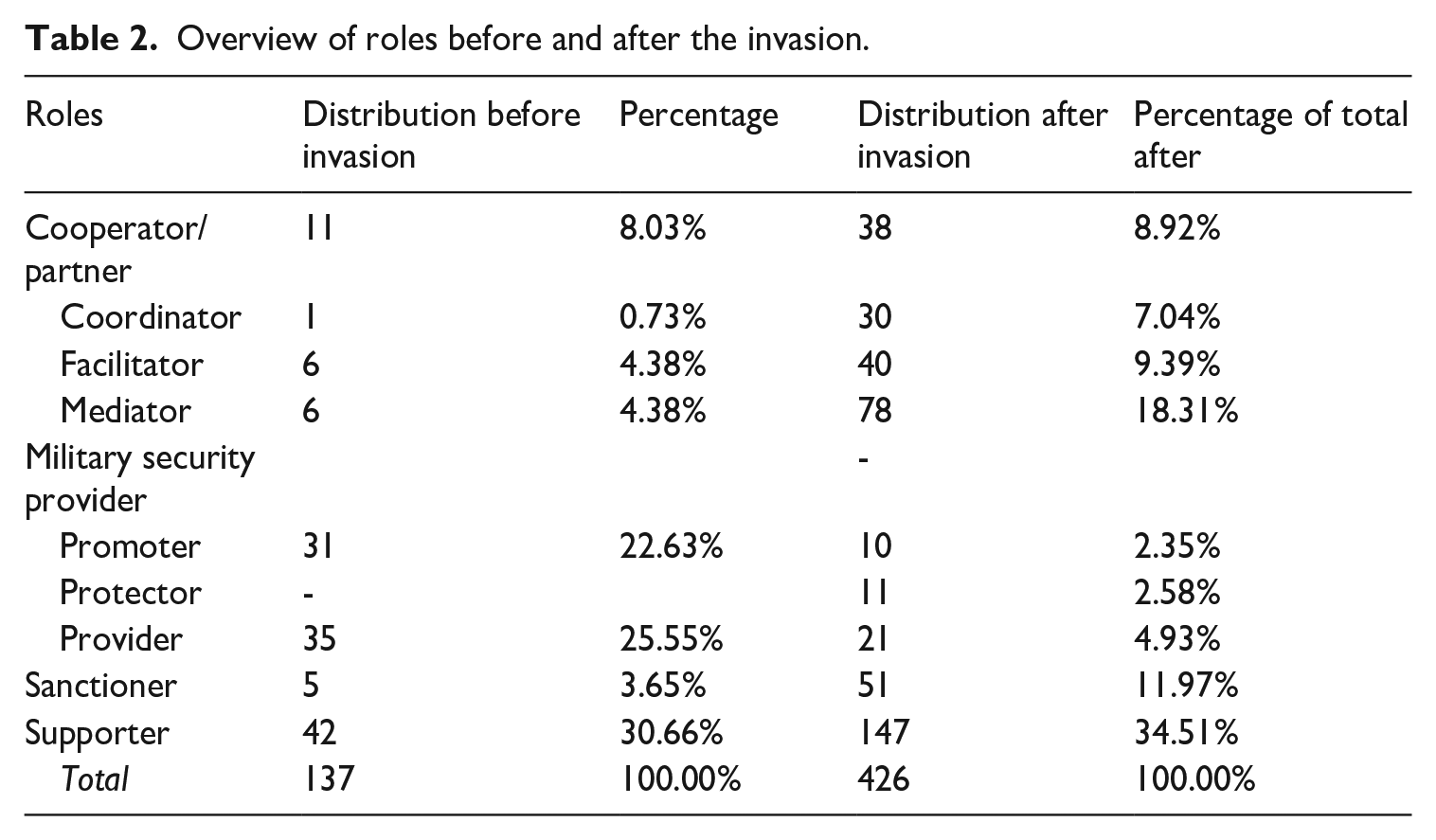
As these results reveal, the EU’s role conception in the Russia–Ukraine conflict changed insofar that the cooperator/partner, coordinator, and provider roles were adjusted, the facilitator, promoter, sanctioner, and supporter roles were adapted, the protector and military security provider roles were innovated, and the mediator role was abandoned. Table 2 summarizes these findings, including the absolute numbers and their percentage of the total roles found in each time frame which reflects how the composition of (i.e. hierarchies) the role set changed.
Overview of roles before and after the invasion.
Change in significant others
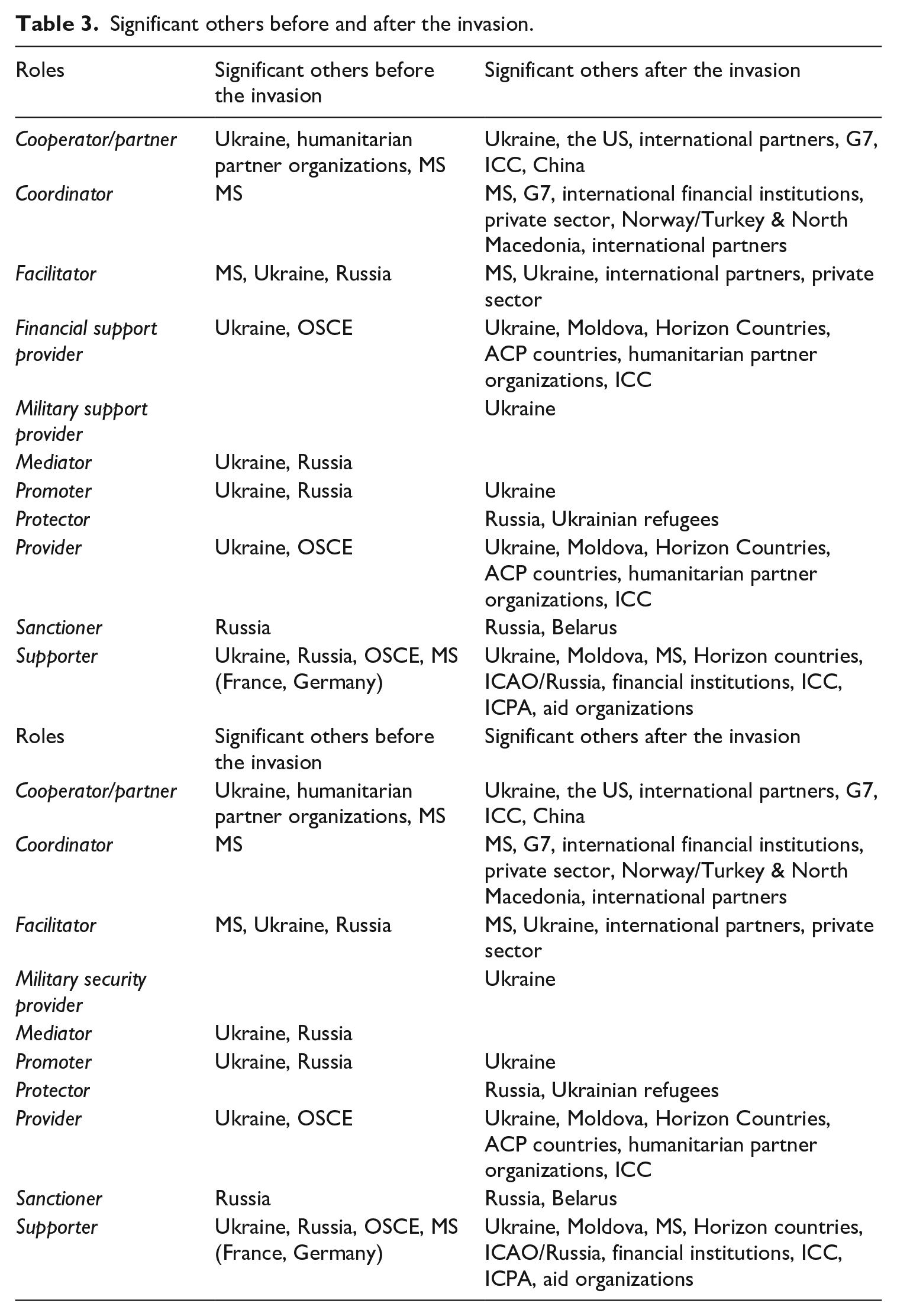
In addition, the results also reveal a change in the significant others the EU relates its roles to in the Russia–Ukraine conflict. First, the main significant other shifts from Ukraine to the member states. While 55.47 percent of roles are envisaged vis-à-vis Ukraine before the invasion, only 30.75 percent are related to Ukraine after the invasion. Instead, the EU member states became the main significant other for the EU after the invasion, with 36.15 percent of roles being conceived vis-à-vis them. However, it may be mentioned that of those 154 roles, 34 (20.08% of the 36.15%) are also related to Ukrainian people seeking refuge in the EU. Second, the EU’s list of significant others of its roles in the Russia–Ukraine conflict expands, with more countries and other institutions (e.g. ICC) being mentioned. Table 3 also summarizes significant other changes for each role, showcasing that the list of significant others in the conflict increases and diversifies.
Significant others before and after the invasion.
Discussion and conclusion
This study explored changes to the EU’s role conceptions in the Russia–Ukraine conflict. Framing the conflict as an OSC, we argued that it disrupts the EU’s self-image as a normative and civilian power, leading to changes in its social roles vis-à-vis Russia. We propose a theoretical framework encompassing four types of role change: adaptation, transformation, innovation, and abandonment. Our analysis of European Council Conclusions and European Commission press releases 4 from 15 February 2015 to 31 July 2023 reveals various changes in role conceptions, influencing the hierarchy within the EU’s role set and its self-image.
Our research indicates adjustments in EU role conceptions such as cooperator/partner, coordinator, and provider, alongside adaptations in facilitator, promoter, and supporter roles. The emergence of new roles like (norm) protector and military security provider suggests role innovation, while the mediator role was abandoned. These findings align with our theory that an OSC prompts diverse role changes due to its complexity. We observe that role adjustment and adaptation, involving changes in instruments and goals, serve as strategies to maintain ontological security. The shift in instruments highlights the EU’s adaptability in role execution, evident even pre-invasion with diverse instruments for implementing the Minsk agreements. However, we note that any adaptation in instruments is accompanied by changes in goals, underscoring the interconnectedness of these elements in role conception changes.
Furthermore, these changes in role conceptions and the fact that the hierarchy of roles shifted results in a change of the composition of the EU’s role set vis-á-vis the Russia–Ukraine conflict. The shift in the hierarchy of multiple roles following the invasion toward a more balanced composition of the role set could be interpreted as an attempt by the EU to diversify how it (re-)achieves ontological security. Before the invasion, the promoter, provider, and supporter roles are the most dominant representing almost 80 percent of the roles (see Table 2). After the invasion, the hierarchy between roles is more equally distributed, although the supporter role remains dominant. Coupled with the abandonment of the mediator role, this could be interpreted as a response to the unsuccessful alter-casting of Russia into a fitting counter-role for the EU. In response, the EU conceptualizes multiple roles to achieve its roles. Nevertheless, the more equal distribution of roles could also hint toward potential tension, as slightly diverging roles, like cooperator/partner and coordinator compete for their position in the role set.
Our findings about the changes in the composition of the role set also interact with the shift of significant others. We found the EU to diversify its significant others and to shift its main significant other from Ukraine to member states. The diversification of the significant others can be interpreted as the EU’s attempt to re-establish ontological security by emphasizing new social relations. The shift in the EU’s main significant other from Ukraine to member states following the invasion is explained by the evolving conflict’s consequences for member states, including energy concerns, economic destabilization, and the influx of Ukrainian refugees. Whereas states would turn away from international action if they turned inwards following a crisis, IOs, and their supranational bodies present a mid-level between member states and external actors in foreign policy. Hence, when turning inwards, international action can remain part of their repertoire of instruments.
Moreover, our analysis suggests that the EU has attempted to re-connect its self-image as normative and civilian power with role conception changes post-invasion. The normative self-image persists, with the (norm) promoter role remaining in the role set after the invasion and the EU adding even protection of its values and norms, exemplified by the innovation of the norm protector role. Newly relating its roles in the Russia–Ukraine conflict to significant entities representing the international rules-based order, such as the International Criminal Court, also underscores the EU’s emphasis on the normative dimension of its role set. Similarly, conceptualizing a provider role to African Caribbean Pacific countries reflects the EU’s sense of a normative responsibility for the global implication of the war, specifically regarding food (in)security. The EU continues to envisage roles which reflect its civilian power self-image, such as sanctioner and provider which rely on the EU’s economic status and financial resources. Before the invasion all, and after the invasion almost all (97.65%) envisaged roles rely on non-military means. Moreover, the finding that the EU relates the roles that specifically rely on civilian means (coordinator, facilitator, provider) to more significant others (e.g. international partners and humanitarian organizations) reflects its attempt to re-connect its roles with its civilian power self-image. These roles contribute to the constitutive nature of the EU’s normative power and civilian power self-image after the invasion aligning with our theoretical assumption that actors respond to OSCs with role conception changes that stabilize their self-image.
However, our findings also suggest that the EU’s self-image is now stabilized more heterogeneously as we see the beginning of a shift toward a military power. This shift is represented by the role innovation of the military security provider role. Although quantitatively still not dominant (representing only 2.35% of all roles after the invasion), this echoes debates about the fundamental shifts the EU has undergone since the Russian war, including sending weapons to a foreign country at war for the first time (De La Baume and Barigazzi, 2022). However, we did not find the EU to relate any roles to NATO. We interpret this finding against the backdrop that we fixed the context to the Russia–Ukraine conflict and only analyzed documents that mention EU behavior in response to it. To avoid risking an escalation of the conflict, the EU might prefer to refrain from relating its response to NATO. However, this reluctance to position its roles vis-à-vis NATO could also be interpreted as the EU’s persistent unease with a military power self-image. As our analysis is fixed to the specific context of the Russia–Ukraine conflict, it remains to be seen if these shifts in the EU’s self-image will be visible in other contexts. The end of the Danish opt-out of the Common Security and Defense Policy and the institutionalization of certain defense instruments like the European Peace Facility and joint procurement are developments that are not as easily reversible and might thus indicate a more fundamental shift toward a self-image as a military power. However, whether this is supported by all actors within the EU and whether it will be accepted by other actors (Russia, NATO, the United States) remains to be seen.
Against the background of the findings in this study, we see promising avenues for future research. As it remains open to what extent the EU truly views the Russian invasion of Ukraine in February 2022 as “a watershed moment” (Von der Leyen, 2022), future research could explore to what extent the EU’s pattern of role conception change translates into role enactment. In addition, the roles and counter-roles taken by significant others, particularly the United States, and the role contestation by EU member states warrant further investigation to understand how these dynamics influence the EU’s role set. Moreover, testing the theoretical connection between OSCs and role change in other instances, especially within other IOs, could provide a broader understanding of how such crises impact role conceptions and enactments across different contexts. This research could deepen our insights into the mechanisms of role stability and transformation under pressure, contributing to a more nuanced comprehension of roles during times of severe international crises.
Supplemental Material
sj-docx-1-ejt-10.1177_13540661241304533 – Supplemental material for Ontological security crisis and role conception change: the impact of the Russian invasion of Ukraine on the European Union’s role conceptions
Supplemental material, sj-docx-1-ejt-10.1177_13540661241304533 for Ontological security crisis and role conception change: the impact of the Russian invasion of Ukraine on the European Union’s role conceptions by Gordon M. Friedrichs and Jule Sommer in European Journal of International Relations
Supplemental Material
sj-pdf-2-ejt-10.1177_13540661241304533 – Supplemental material for Ontological security crisis and role conception change: the impact of the Russian invasion of Ukraine on the European Union’s role conceptions
Supplemental material, sj-pdf-2-ejt-10.1177_13540661241304533 for Ontological security crisis and role conception change: the impact of the Russian invasion of Ukraine on the European Union’s role conceptions by Gordon M. Friedrichs and Jule Sommer in European Journal of International Relations
Footnotes
Funding
The author(s) received no financial support for the research, authorship, and/or publication of this article.

Supplemental material
Supplemental material for this article is available online.
Notes
Author biographies
References
Supplementary Material
Please find the following supplemental material available below.
For Open Access articles published under a Creative Commons License, all supplemental material carries the same license as the article it is associated with.
For non-Open Access articles published, all supplemental material carries a non-exclusive license, and permission requests for re-use of supplemental material or any part of supplemental material shall be sent directly to the copyright owner as specified in the copyright notice associated with the article.
