




Abstract
With Russia’s invasion of Ukraine in February 2022, vicarious identification (VI) with the Ukrainian fight swept across the West becoming the de facto and normatively prescribed response and a source of status, self-esteem and jouissance for all those vicariously participating. For their part, and with some success, the Ukrainians encouraged such a response through carefully curated acts of vicarious identity promotion. Mobilising the British context as an example, this article reflects on the temptations and limiting politics of vicarious war, highlighting three points. First, that VI with the Ukrainian fight was tempting, in part because it enabled a nostalgic appropriation that helped flesh out post-Brexit notions of ‘Global Britain’, but that in doing so made this increasingly a war more about ‘us’ than ‘them’. Second, that humour has played a particularly central role in these processes. Third, that VI-derived support is inherently unstable, something evident whenever news from the battlefield has turned grim, threatening to diminish the ontological satisfaction previously derived.
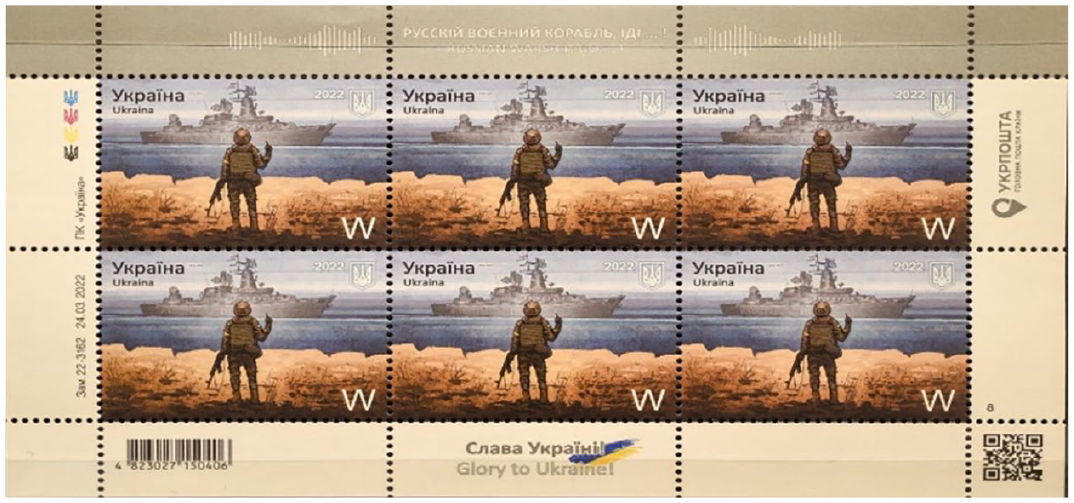
National Maritime Museum, Greenwich, London.
Commemorative Ukrainian postage stamps, entitled ‘Russian Warship, go fuck yourself’, designed by Boris Groh and acquired by the National Maritime Museum, UK.
Introduction
The one-year anniversary of the war in Ukraine in February 2023 was met with an affective outpouring that closely paralleled the initial period of conflict. This was particularly apparent in the UK where an intriguing sentiment prevailed: a mix of commemoration and even ‘celebration’. Sombre documentaries aired, commemorative services were held, buildings were lit in Ukrainian colours. In London, the prankster group Led By Donkeys paused from exposing Tory scandals and Brexit hypocrisy to paint the road outside the Russian Embassy blue and yellow to highlight Ukraine’s ‘right to self-determination’ (BBC News, 2023). Political leaders were also enthusiastic with the prime minister and leader of the opposition making separate trips to Kyiv to recommit Britain to the Ukrainian cause. Other Western leaders did likewise, notably President Biden, whose keynote speech in Poland had all the trappings of a pop concert with cheering fans and Coldplay soundtrack.
Arguably, there was something unusual about these events. Were the anniversaries of other recent conflicts similarly marked – Afghanistan, Syria and Yemen? The buildup to the anniversary seemed to entail a sense of national pride, arguably paralleling the increasingly festive nature of ‘remembrance season’ in the UK (Haigh, 2020). As noted, though, the conflict’s beginning had elicited similar sentiments across Western societies. Ukrainian flags had proliferated on public buildings, shops and across social media, with a concomitant mood swing against Russia. In the name of solidarity, businesses, universities and councils actively severed ties with Russia, often beyond the requirements of official sanctions. Indeed, such actions extended to calling off Russian classical music and ballet performances, as well as ejecting Russia from the Eurovision Song Contest (Khomami, 2022). In the English Premier League, that bastion of global ethics, the (then) Russian-owned Chelsea was booed by fans, while the government actively facilitated Roman Abramovich’s sale of the club. Russia itself was cancelled.
Such outpourings of sympathy with Ukraine and outrage at Russia’s aggression were understandable. Arguably though, notions of sympathy and outrage do not fully capture the generalised mood of emotional investment and angst, but also the sense of projective consummation, status and self-esteem enhancement invested in Ukraine. Vicarious identification (VI) with the Ukrainian fight swept across the West, becoming the de facto and normatively prescribed response. For their part, and with some success, the Ukrainians actively encouraged this response through carefully curated acts of vicarious identity promotion, with President Zelensky becoming a regular honoured guest at Western parliaments and corporate events. Yet, the speed and pervasiveness of this turn to vicarious war is somewhat curious. It drew together facets of everyday and popular culture, not least the role of social media, with larger geopolitical dynamics of global supply chains, human migration and military warfare. In this sense, the circulation of hashtags and memes, the robust virtue signalling of corporate actors, and the mediatised nature of conflict served to politicise and depoliticise in ambiguous ways that require critical scrutiny.
Mobilising the British context, this article reflects on the temptation and (potentially) limiting politics of vicarious war. On the one hand, we foreground how the conflict’s early stages were marked by an explosion of humour and joking, from the globally trending hashtag #WorldWar3 to the widespread circulation of videos and memes celebrating Ukrainian tractors stealing Russian tanks. While the everyday comfort of laughter arguably provided some light relief from the anxieties of war, the combination of pluck, irony and irreverence so celebrated in the Ukrainian tractor brigade marked the beginnings of an intriguing mutual admiration between the UK and Ukraine. On the other hand, with the onset of vicarious war, a series of limitations and contradictions began to emerge. For all that humour provided a quick injection of affective excitement during the conflict’s early stages, the repetitive nature of joking, especially via social media memes, can also form part of a stultifying routine. We discern in this both a waning of enthusiasm for war as new affective currents emerge and, more problematically, a certain discomfort in conflict humour itself. Jokes about death and de-humanising references to Russian soldiers as orcs, for example, presumably diminish the ontological comfort previously derived from humour.
Combining these points, our central argument is that Western (and especially British) official and public support for Ukraine has been characterised by notable practices of VI. In this regard, a variety of Ukrainian qualities, from its stalwart defence to a demonstrable ironic sensibility and sense of humour, as well as the prospect of an ultimate Ukrainian victory, have provided for a sense of British/Western reflected glory and ontological security. While a sense of vicarious war has been experienced in other Western countries, we highlight certain elements unique to the UK. Specifically, VI with the Ukrainian fight has enabled a heroic appropriation that has helped bolster post-Brexit notions of ‘Global Britain’, responding to a sense of drift and status decline that has pervaded British foreign policy. In exploring this appropriative sense of vicarious war, we also highlight the creative role played by Ukrainian actors (political leaders, soldiers and general public) in fostering practices of ‘vicarious identity promotion’. The (strategically) mobilising use of humour and memes helped to construct and securitise an ironic liberal West of which Ukraine became framed as an embodiment.
Ultimately, however, the VI with Ukraine and the sense of vicarious war has not been constant. Between the waves of attention and affective attachment to Ukraine evident in the war’s opening weeks and months and once more around the anniversary, there have also been periods of drift, with the conflict slipping into the background of everyday British life, no longer the anchor news story, and sometimes not mentioned at all, especially once the war between Israel and Hamas broke out in October 2023. VI with Ukraine has therefore been episodic, fraught with its own anxieties that speak to the (geopolitical) limits of this vicarious war.
This argument is developed over four sections. Section 1 ‘Vicarious identity, ontological security and humour’ establishes VI’s role in practices of ontological (in)security management, arguing that humour can contribute a set of everyday qualities: speed, playfulness, virality. Section 2 ‘Vicarious war’ explores how the Ukrainian conflict can be understood as a vicarious war, where humour along with courage, Western identity and sheer bloody mindedness have been important signifiers of what it means to be British/Ukrainian. Section 3 ‘Humour and vicarious war’ draws out humour’s specific role in driving this emergent vicarious relationship between the UK and Ukraine, focusing on the role of memes used by both everyday and official actors. Section 4 ‘From VI to proxy war’ deals with the breakdown of VI, how the excitement of humour ebbed somewhat as the nature of conflict, death, refugees, and the dilemmas of ‘proxy war’ became clearer. A concluding section reflects on the geopolitical limits of this intense but ultimately somewhat fleeting period of VI through humour.
Vicarious identity, ontological security and humour
Recently, IR scholars have begun to connect the literature on vicarious identity, ontological security and humour. In this section, we first outline the connections established before pointing to how our case analysis of humour can help extend this theorisation, particularly in respect of vicarious identity’s strengths/weaknesses. We return to this in the conclusion.
Vicarious identities can be said to exist whenever a subject gains a sense of self-identity, purpose, status, and self-esteem by ‘living through’ and appropriating the experiences and achievements of others as if they happened to them (Goldstein and Cialdini, 2007; Norrick, 2013). Such practices are particularly common among individuals, as when parents live through and draw reflected pride from their children’s achievements. However, people often do likewise with respect to collective actors and groups, something central to the allure of nationalism. This is evident whenever citizens experience personal pride or status enhancement because of the actions of national representatives, be they political leaders, sports teams or, quintessentially, the nation’s armed forces (Browning et al., 2021: 55–67; Browning and Haigh, 2022; Krolikowski, 2008; Marlow, 2002). Whenever individual citizens proclaim a sentiment of ‘we’ in these contexts, thereby taking appropriative credit for something of which they were not part, some form of VI is operating.
Importantly, practices of VI can also exist between collective subjects, as evident in the US-UK ‘special relationship’ or whenever nations draw reflected legitimacy and status from the heritage of European, Western or Classical civilisation (Browning et al., 2021: 71–77, ch.4). When claims to vicarious identity are successful, subjects can experience a deep sense of ontological satisfaction; being recognised as socially legitimate and valued. VI can therefore be tempting for subjects keen to establish a sense of ontological security.
The ontological security literature is broadly concerned with how subjects live in circumstances of profound existential doubt. How do we, in a sense, go on with our everyday lives? This might seem a particularly apposite question in the context of a conflict like Ukraine with the potential for nuclear escalation. Yet, a subject’s need for ontological security is also bound up with a wide range of doubts and uncertainties associated with human existence. Importantly, Tillich (2014) distinguishes between anxieties connected to death, meaning and moral being. Subjects may seek to manage such anxieties through various mechanisms, from the maintenance of daily routines to the nurturing of biographical narratives that locate the subject in space and time. As noted, VI is another strategy available to subjects, but one that has distinctive temptations, dynamics and limitations. This is because practices of VI rely on or seek to establish some form of relationship. For example, VI can help subjects cope with anxieties associated with death and non-being by establishing the illusion of immortality by proxy, of living on through one’s offspring or the collective subject (Browning et al., 2021: 10–17). Yet, it can also help with anxieties connected to the subject’s sense of meaning and moral purpose and can be especially attractive in situations where a subject feels (increasingly) inadequate.
Thus, VI might be particularly tempting in situations where (1) the subject perceives that it is falling short in its claims to selfhood, especially in terms of credibility or confidence, but also where (2) the target of VI is viewed as embodying attributes and master signifiers to which the subject is attached and understands as central to its sense of being (Browning et al., 2021; Browning and Haigh, 2022). Consider, for instance, how notions of ‘youth’ and ‘potential’ may support parents’ VI with their children. Or for collective actors, we could usefully foreground signifiers like ‘courage’, ‘resilience’, ‘freedom’, ‘democracy’ and so on. In Lacanian terms, targets of VI may appeal because of their potential to resolve a developing sense of lack at the heart of self-identity; appearing as a fantasised idealisation of becoming (Eberle, 2019; Epstein, 2011). 1 In turn, this also indicates how VI often entails a temporal aspect, the sense that something lost can be recaptured through vicariously investing in another.
However, although reflected pride or legitimacy may be attractive or comforting and might in some cases be normatively (re)invigorating, encouraging subjects to step up and actively reclaim their sense of self through channelling the inspirational deeds of the vicarious other – something that can be identified on the part of some actors (especially in Eastern Europe) with respect to the war in Ukraine – processes of VI also entail risks and sometimes may become ontologically destabilising. Pointing to the potentials and limitations of vicarious identity is therefore not to make a normative judgement about it but simply to analyse its variegated (de)mobilising potentials. 2 One risk inherent to vicarious identity is that the claim may be deemed illegitimate by salient audiences and recognition denied, thus generating feelings of embarrassment or shame. Consider, for example, the backlash and public shaming of individuals deemed to have illegitimately identified with another group’s racial identity, history and experiences, who find themselves accused of ‘racism’, ‘passing’ and ‘cultural appropriation’. Subjects whose VI is ‘called out’ may find themselves subject to social alienation and humiliation (e.g. see Dolezal, 2017). Given such risks, we should recognise the high political stakes of VI.
A second risk is that VI entails potential vulnerabilities with respect to the target. For instance, the subject is more likely to become vulnerable to the target’s desires and liable to be more easily influenced by them, concerned that otherwise the target may deny recognition of the vicarious relationship and seek to expose it through (tacit) threats of public stigmatisation and shaming (Browning et al., 2021: 33–35). However, targets may also actively engage in practices of ‘vicarious identity promotion’, the practice of encouraging others to ‘live through’ their actions and experiences. This is because they may perceive benefits of a material and/or psychological nature from such a relationship. Vicarious relationships, therefore, are rarely unidirectional, even if desires for them, and their power dynamics, are often unevenly distributed as per the US-UK ‘special relationship’. Indeed, in this respect, another vulnerability is that the target may ultimately prove disappointing or engage in behaviours that may potentially blowback on and sully the subject.
Given the risky and unstable nature of vicarious relationships, it is important to understand some of the mechanisms through which they are stabilised and maintained. Central to generating acceptance for a vicarious relationship is establishing a close sense of communal being that blurs the self-other distinction. This can be done in different ways, but for collective subjects, it typically entails establishing and cultivating narratives of shared experience and familial or communal belonging that are designed to establish appropriative ‘telling rights’ (Browning et al., 2021: 31–38). In the US-UK context, for instance, this is often evident though the mobilisation of familial metaphors of ‘cousins’, or in claims about both countries being leaders of the ‘free world’. Typically, however, VIs can be seen in the use of personal pronouns, where an appropriative ‘we’, ‘us’ or ‘our’ is used to describe actions or experiences that otherwise might be understood as having happened to ‘them’ (Browning et al., 2021: 12–13). While much of this may sound inherently strategic, it is important to recognise that vicarious relationships inevitably require the establishment of shared emotional communities of being. Beyond these mechanisms, though, and speaking directly to this emotional component, we draw particular attention to humour’s role in practices of ontological security seeking and VI, more specifically.
At a basic level, humour can be a mode of VI, not least when it elicits the shared pleasure of laughter. Indeed, laughter’s affective qualities are an important element in humour’s ability to relieve tension or anxiety in terms that make it particularly relevant to discussions of ontological security (Steele, 2021). The potential for routinisation in joking and especially memes, is an important everyday mechanism for coping with existential anxieties, enabling people to ‘go on’ with their lives despite the apparent chaos unfolding around them. Humour, though, is also a creative component in biographical narratives of self-identity that locate the subject in time and space. Such narratives provide an ordering device through which everyday events, experiences and relationships can be understood and processed, helping to establish expectations for the self and others about appropriate modes of behaviour (Giddens, 1991: 39, 54; Kinnvall, 2004: 746; Steele, 2008: 10–12). Consider, for example, the description of the British as ‘ironic’ or Queen Elizabeth II’s participation in humorous skits with James Bond and Paddington Bear to signal her recognition of irony as an important element in national identity. Humour, therefore, typically depends on the existence of shared cultural knowledge, with joking a central mechanism for testing out ‘what it means to say “us”’ (Berlant and Ngai, 2017: 235). Each joke can thus be thought of as entailing possibilities for VI: can we share this joke; can we laugh together?
At the collective level, then, humour is an important mechanism for building community and (re)producing collectively held biographical narratives of self-identity through routinised humorous tropes. In turn, there is a certain ambivalence in jokes that can sometimes function to distinguish between (positively vs negatively valued) in-groups and out-groups. For example, during the Danish Cartoon Crisis, humour was explicitly invoked as an element in values of free speech, re-described as a civilisational marker of ‘freedom’, a claim about the satirical essence of Danish (and European) identity, and the constructed basis for ‘othering’ the (securitised) Muslim community ignorant of irony (Kuipers, 2011). This also points to humour’s ability to unsettle, destabilise and activate others’ ontological anxieties, not least when humour is deployed to shame and stigmatise. As a shaming tactic, humour can function as a method of social control operating, as Durkheim put it, as a humiliating corrective for those targeted (Billig, 2001; Elias, 2017: 298). To recall, a significant risk of VI is the denial of the claim to vicarious identity, a social dynamic often marked by being laughed at.
Drawing these points together, humour can be an important mode and mechanism for establishing, nurturing, and also destabilising claims to vicarious identity and wider ontological security-seeking strategies. Its lightness and everyday qualities mean that humour is readily used to identify with an admired other that is seen to embody master signifiers central to conceptions of self-identity. Jokes, here, may perform a community-building function closing the self-other gap and potentially enabling a vicariously appropriative relationship to emerge. Moreover, the very circulation of jokes means that opportunities also exist to establish a vicarious relationship by identifying with a target’s particular form of humour (as opposed to the theme of the joke). Thus, an elision may occur whereby the target’s humorous sensibilities are seen to match with one’s own thereby enabling new communities of being to emerge – something evident, for example, in the various meme-ed ‘wars’ over Brexit (#remoaners), Trump (#resistance), and covid (#covidiots). In the subsequent sections, we explore how the embrace of Ukrainian wartime irony and satire has elicited a playful form of humour that the British associate with and recognise. Likewise, it is important to recognise that joke-tellers may use humour to engage in acts of vicarious identity promotion. Indeed, humour may be strategically efficacious for this due to its everyday qualities, something light and throwaway, which can flatter and amuse without the stymieing effects of serious discourse or (diplomatic) formality.
The attempt to build a vicarious relationship through humour is of course unstable. While it may succeed in bracketing out anxiety for a period, it may also sometimes fall flat or fail entirely. VIs can fail to secure recognition from salient audiences and jokes can miss the mark, or lose their animating edge, perhaps through repetition. One element explored below is therefore how jokes about war, no matter how relieving in terms of the initial anxieties of conflict, must inevitably confront the ongoing grind of military violence. More critically, we wonder about the emergent qualities of humour within a newly established vicarious relationship. What happens when a form of humour that was once quite useful for VI becomes a tacit vocabulary for negotiating disagreements within the ensuing vicarious relationship? Humour and vicarious identity may therefore be particularly instructive in drawing attention to temporal issues and the role of mood in ontological security dynamics (Rumelili, 2023).
To underline, the varying nature of British VI with Ukraine discussed later may include insights that are generalisable for other countries, but which may also depend on other factors such as geographical proximity and particular historical experiences. Specifically, Eastern and Northern European countries closer to Russia’s borders, with similar histories of Russian/Soviet occupation, and where anti-Russian discourses are perhaps more historically constitutive of national identity, will likely have experienced Russia’s invasion of Ukraine more intensely, at least compared with the UK where Russophobic narratives are less ingrained and the threat of Russian invasion not seriously entertained. Given this, the UK case may resonate more closely with experiences in other Western European countries and North America, and where the various distances entailed (geographical, historical, experiential) may highlight more clearly VIs’ potential vulnerabilities. Either way, the temptation of VI lies in how it can foster biographical continuity and operate as a mechanism for status and self-esteem enhancement in contexts in which the subject may feel it is somehow lacking. What this highlights, of course, is that biographical narratives are often subject to unravelling – hence, the need for VI to prop them up.
Vicarious war
With Russia’s invasion of Ukraine, various anxieties were unleashed across the West. Some were strategic and related to debates about the nature of international agreements, Western promises and whether NATO and the EU should have expanded more quickly (or not at all) into the eastern borderlands. Were ‘we’ in some sense culpable? How? And what would that mean in determining an appropriate response? Strategic anxieties also blurred into anxieties of self-image. For instance, what did the EU’s collective importing of vast quantities of Russian gas and oil say about its ethical or political being? And while the UK crowed about being less dependent on Russian fossil fuels, comparable issues of Russian money and oligarchs in ‘Londongrad’ caused some discomfort. Dramatic images of Russian power pricked bubbles of complacency about the European peace project, while discussion about that ultimate anxiety machine, nuclear war, moved from the hypothetical to the disconcertingly possible.
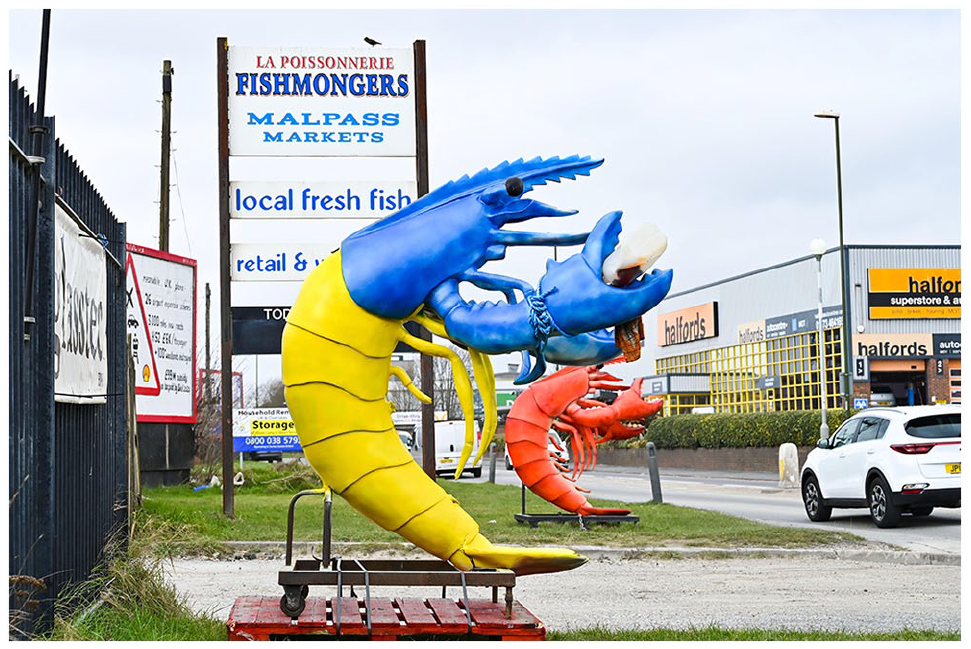
One response to the threat of protracted war was to hope that it might be over quickly. The news media emphasised the power of a Russian army that it confidently predicted would quickly take Ukraine. Yet, Ukraine’s strong resistance soon suggested this would not be the case and the media instead began circulating stories of heroism, related to Zelensky, Ukrainian fighters and mythical figures such as the ‘ghost of Kyiv’ and the defenders of Snake Island. In this context of enhanced and generalised anxiety, various ontological security-seeking strategies were activated. Probably, the most pronounced theme expressed around the war’s outset, though, was VI with Ukraine. This was evident in multiple contexts. On social media people put the Ukrainian flag on their avatars, politicians began wearing Ukrainian lapel pins, while in the UK, the supermarket chain Tesco’s began collecting funds for Ukraine at checkouts. We all seemed to ‘stand with Ukraine’, Slava Ukraini. One enthusiastic fishmonger in Shoreham repainted a shrimp statue outside its gates blue and yellow, placing a Molotov cocktail in its pincers in an everyday act of solidarity that was warmly received on social media. 3
There have clearly been different drivers of Western/British support for Ukraine. Already at its commencement, some commentators suggested the West might perceive a strategic interest in sucking Russia into a quagmire, depleting its military resources and sapping its morale. Emotionally, there was also evidently an understandable amount of outrage at Russia’s aggressive action, sympathy with Ukraine as the victim, and fear of the possible consequences. Beyond this, though, Ukraine became a focal point of desires of self-becoming and fulfilment. Thus, beyond simply identifying and sympathising with Ukraine, an appropriative sense of living through them and of internalising their experiences as our own also emerged. A good example was provided by UK Defence Secretary, Ben Wallace, only one day after Russia’s invasion. Filmed talking to soldiers, Wallace stated: ‘We should send the Gurkhas in. We should send the Scots Guards, kicked the backside of Tsar Nicholas I in 1853 in Crimea – we can always do it again’ (quoted in ITV News, 2022).
Much might be said about this. For instance, we might consider why he singled out the Gurkhas, who while mythologised in British military folklore are actually a foreign contingent in the British military, many ex-service personnel of which have struggled to secure British citizenship. However, we might also note the ‘boys own’ jingoism of ‘going over there and giving Putin a jolly good hiding’. The point, of course, and what makes this statement wholly vicarious, is that the British government, like other Western governments, have throughout sought to avoid any direct confrontation with Russia and rejected placing national service personnel in harm’s way. The ongoing rejection, for instance, of Ukrainian calls for a NATO-imposed ‘no-fly zone’ have merely emphasised that we are not going to go over there. Consequently, Wallace was left invoking two inherently VIs, first with a historic British military campaign over a century ago, and second, with the Ukrainians actually fighting (for us) right now. Similar examples from official circles include the faintly comical intervention of Conservative Party Chairman Oliver Dowden, who in a radio interview delightedly reported that Ukrainian fighters were now proclaiming ‘God Save the Queen’ whenever they fired a British-donated bazooka (The National, 2022). Or when Prime Minister Boris Johnson boasted about British forces training Ukrainian soldiers in Poland, only to be reprimanded by a former head of the Polish army for revealing military secrets and potentially imperilling the soldiers involved (Sabbagh, 2022). In such statements, it is hard not to detect elements of vicarious enjoyment and reflected pride at play.
Why did the UK/West identify with Ukraine so strongly? It is important to remember that a close relationship was not straightforward or obvious when the conflict began. Indeed, rather than being considered one of ‘us’, since the Cold War’s end, European and Western discourse on Ukraine has often emphasised its difference. While understood as undergoing transition to European/Western forms of governance, the country was generally characterised as suffering from widespread corruption and falling short of European and Western standards. Rather than being actively embraced, its appeals for membership in Western institutions were assigned time horizons of decades. 4 Meanwhile, following Russia’s earlier military aggression against Ukraine in 2014, including Crimea’s annexation, luminaries of Western strategic thinking, like Henry Kissinger (2014) and Zbigniew Brzezinski (2014), argued that geostrategically the best option for Ukraine (and West-Russia relations) would be for Ukraine to be recognised as a geopolitical buffer and for Ukraine to adopt a policy of Finlandisation, something also suggested by President Macron in early 2022 (Engelbrecht, 2022).
The change in framing with Russia’s invasion is therefore remarkable, with the conflict’s initial days characterised by Western journalists ‘discovering’ Ukrainian cities hitherto unknown ‘European’ ambience, including racialised observations that their residents look just ‘like us’ (Bayoumi, 2022). Cognitively, Ukraine was swiftly repositioned from being on Europe’s margins to being emblematic of European civilisation, even at the ‘heart of Europe’, something later affirmed by the Ukrainian entry’s overwhelming victory at the Eurovision Song Contest, with the European public giving Ukraine 439 votes (with Spain second with 239). 5 The effect of this ‘European’ framing was to foster a sentiment that Ukraine was not only deserving of sympathy and support, but that its fight was also a fight for ‘us’, and in a sense also ‘our’ fight. Presented as an embodiment of ‘us’, if Ukraine was under attack, so were we. This resulted in a considerable affective and empathetic atmosphere of solidarity, evident not least in the flying of flags. Moreover, all this proved to be a considerable boon to the ontological security of the British state and British citizens, who through such actions could now feel like they were actively participating in European history (again), subjects demonstrating moral fortitude. Particularly notable was how the plight of Ukrainian refugees was mobilised by the British government and commentators in practices of vicarious identity promotion, with direct parallels drawn with the evacuation of British cities during WWII (The Independent, 2022a).
For its part, the Ukrainian government has actively encouraged others to invest emotionally in their fight. During the initial weeks, President Zelensky was highly active in addressing Western parliaments and publics, addressing them in their own terms, invoking their national mythologies, thereby inviting participation with the Ukrainian fight at an emotional and psychological level. No doubt, the aim was to secure military support, but initially that issue was kept in the background, thereby enabling supporters to obfuscate the moral quandary/dilemma at the heart of Western and European responses: how much military support should there be? Zelensky addressed the British parliament twice, once online on 8 March 2022 and in person on 8 February 2023. On both occasions he received standing ovations and was treated like a hero by politicians from across the British political spectrum. Both speeches also elicited clear strategies of vicarious identity promotion. For instance, the first in March 2022 directly referenced the culturally resonant British fight against the Nazis and invoked Churchillian rhetoric of fighting at sea, on the land, in the air, whatever the cost, and not surrendering (The Guardian, 2022). The February 2023 speech hit similar mnemonics and themes. This included relaying how during his first presidential visit to London in 2020 he was shown the cabinet war rooms from whence Churchill had conducted wartime operations and had accepted the invitation to sit in Churchill’s armchair. The guide, he noted, had asked him if he had felt anything: And I said that I certainly felt something. But it is only now that I know what the feeling was. And all Ukrainians know it perfectly well, too. It is the feeling of how bravery takes-you-through the most unimaginable hardships – to finally reward you with Victory. (Zelensky, 2023)
Having invoked Churchill’s spirit, Zelensky thanked the listening British parliament (and hence the government and nation) ‘for your bravery’. The ensuing applause he dedicated to his British audience. From opening the speech by discussing the Ukrainians’ brave fight and sacrifices, this shift to invoking British bravery may appear strange. Ultimately, it is not the British suffering daily bombardment and actually fighting, yet Zelensky further elided this (not so minor) detail by mobilising the military metaphor of the UK ‘marching’ alongside the Ukrainians (Zelensky, 2023). The flattery, the massaging of British self-esteem and the manipulation of mythic narratives of British fortitude and leadership in the fight for ‘freedom’ against ‘evil’ entailed in this move fostered a sense of VI with Ukraine, collapsing the distinction between the countries to build a sense of common identity, selfhood and purpose by appealing to master signifiers and mythic narratives of British self-identity.
Of course, the invocation of British bravery and fortitude and the massaging of (hubristic) pride is also double-edged. The subtext is that of the shame and potential loss of status and self-esteem, of a sense of Britishness and the debt owed to the nation’s heroic forefathers, were Britain to stop being quite so ‘brave’. As noted, being a target of VI may grant certain powers of recognition. Inviting the British/British parliamentarians to vicariously live through the Ukrainian fight therefore not only offers both an avenue for bolstering British ontological security but also places that ontological security in question.
Humour and vicarious war
Vicarious war’s affective currents were not restricted to official circles or presidential speeches and were particularly evident in the everyday proliferation of humour across social media. Indeed, the conflict’s early stages witnessed an explosion of hashtags, memes and TikToks. Some of the most memorable referenced the ‘Ukrainian tractor brigade’ and depicted Ukrainian farmers stealing Russian tanks with their tractors, one with a rather slapstick image of a Russian soldier chasing after the tractor on foot (The Independent, 2022b). The Ukrainian authorities supported this humorous form of VI, with the National Agency for the Protection against Corruption declaring in March 2022 that seized Russian tanks and armoured personnel carriers would not need to be ‘declared’ for tax purposes. Instead, referencing a common British meme, they encouraged Ukrainians to ‘Keep calm and continue to defend the motherland!’ (Michael, 2022). One video showed a Ukrainian man driving past a stranded Russian tank and stopping to ask if he could tow them to a petrol station. Another, invoking a darker form of humour, showed an elderly woman gifting Russian soldiers seeds and remarking it was to ensure something good might sprout from their death.
Such memes no doubt performed an anxiety relieving function, for both Ukrainians and Western publics, not least by undermining narratives Russia’s military might. However, such humour was also an important driver of VI (and vicarious identity promotion) between ‘Western’ publics, politicians and Ukraine; at times, working to foster moral communities via a biographical narrative of ‘the allies’ who will always defend master narratives of freedom and democracy. The tone of such memes and short videos typically concerned the Ukrainians’ pluck and admirable chutzpah, people brave enough to defiantly ‘take the piss’. They were perceived by Western publics (and certainly in the UK) as funny, but they also actively appealed to and fostered a shared ironic sensibility that helped close the gap between us and them. Thus, it was not simply that such humour helped familiarise Western publics with Ukrainians, but that it touched on deeper ontological desires, not least the desire to recognise ourselves and our own claimed attributes of self-identity in this humour, to believe (hope) that we would have responded likewise. Laughing about and sharing jokes therefore became self-affirming, a knowing way of vicariously claiming something about ‘us’.
In the UK, the British began to actively revel in the vicarious links between Ukrainian bravery and their/our sense of humour. In one instance, the Independent ran a puff piece about Zelensky that celebrated his former incarnation as a comedian, while noting that he was the voice of Paddington Bear in the Ukrainian dubbed version of the film (Harrison, 2022). Meanwhile, Ukraine has used humour to both signal and consolidate its own claims to European/Western identity. In the specifically British context, much of this (early) Ukrainian humour, with its emphasis on stealing tanks for fun, resonated with archetypes of the British ‘bulldog spirit’, the ‘Keep Calm and Carry On’ sentiment that despite being at war, life goes on. In these terms, we might also note the prevalence of dancing soldiers on TikTok, the way Ukrainian soldiers have engaged in rock concerts with Bono, the soldiers playing on children’s playground equipment and so on. In this vein, the official government twitter account of Ukraine released a film of Boris Johnson and Zelensky freely walking around Kyiv, headlined: ‘because they bloody can’ (Ukraine Government, 2022).
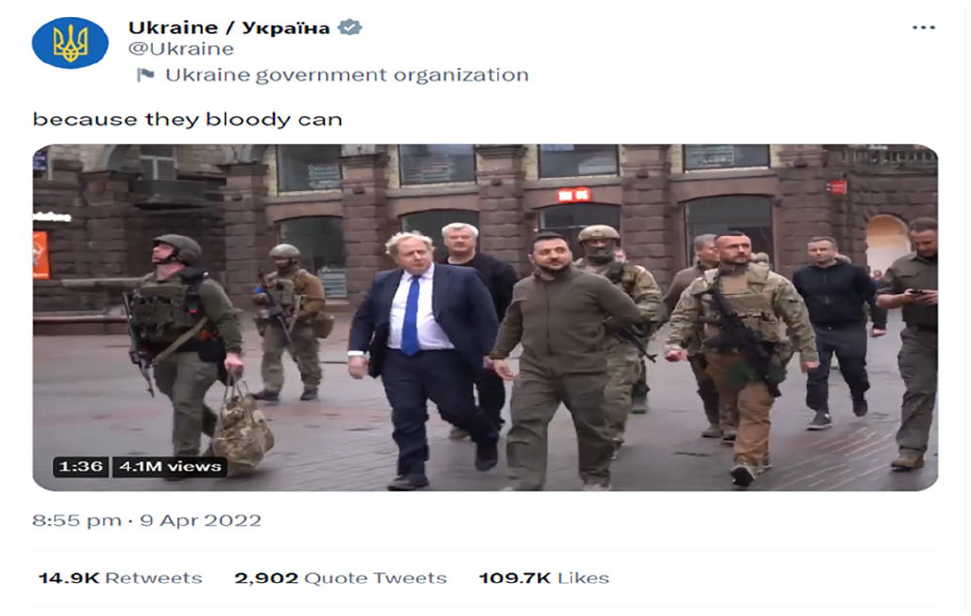
Much to the confusion of his critics, Boris Johnson became a particular target of Ukrainian efforts at vicarious identity promotion, with Ukrainian streets renamed after him, and also a pastry (Sullivan, 2022). It is therefore possible to see the emergence of a vicarious relationship that worked in both directions.
Quintessentially, evidence of the Ukrainians’ resolve was marked through humour and deep irreverence towards the might of the Russian navy at Snake Island. Specifically, in response to a demand from the Russian cruiser, the Moskva, to surrender a Ukrainian soldier radioed in reply: ‘Russian warship, go fuck yourself!’ The recording went viral partly for the humour and partly because it was unclear if the soldier survived (they did). The line and the warship became a regular focus of humorous depictions of the war, indeed a subject of vicarious identity promotion. Zelensky himself directly referenced this image of ironic irreverence by presenting UK Defence Secretary Ben Wallace with a signed and framed version of a commemorative Ukrainian stamp, released in March 2022, that depicted a Ukrainian soldier giving a Russian warship the finger. Intriguingly, a set of these stamps are now on display at the National Maritime Museum in Greenwich, London (Royal Museums Greenwich, n.d.), a formal VI with Ukrainian military history. 6
If humour can serve as a pervasive mode of VI, this begs the question of what humour ‘does’ to the nature of vicarious war. We identify three concerns that might frame critical reflection. First, VI and the playfulness of much of the earlier humour has arguably detracted from the conflict’s politics and (contestable) history. Framed as a social media event, nuance was an early casualty of war. Responsibility for the war was simply assigned to Russia and all things Russian. Hence, the cancelling of Russian music, artists, authors, athletes and so on. This has also meant that an open public discussion of the nature of Western responsibility, strategy and the possible end game has been muted at best. Indeed, attempts to open a broader discussion have been commonly ridiculed in the public sphere, humorously derided as conspiracists with ‘tin foil hats’. In a context in which all that is required is (demonstrative) support for Ukraine, raising such questions has been seen as problematic and even as indicative of supporting Putin. To challenge the hegemonic script has therefore been to risk personal anxieties of belonging and ontological insecurity. On this view, humour may diminish the public sphere’s reflexive qualities it does so much to animate and excite (Malmvig, 2023).
Second, the mechanisms of VI deployed also arguably detracted from the very nature of war, fostering instead a surreal spectator sport form of public Western engagement that made it easier to avoid directly confronting much of the human suffering (Baudrillard, 1995; McInness, 1999). This was particularly so early on where the juxtaposition between light-hearted and humorous memes about the Ukrainian tractor brigade’s exploits and torn limbs was most evident. Linked to this, though, was how many memes also fostered militarisation through the (hilarious?) techno-fetishisation of Western weaponry, in particular munitions like the Javelin anti-tank missile system that were seen as offering a surgical response to the problem of Russian tanks. This weapon went viral via the ‘St. Javelin’ meme that depicted the Virgin Mary cradling the weapon instead of the baby Jesus (Barghouty, 2022). While our bombs are funny and virtuous, contrasting social media coverage of Russian ‘Satan II’ nuclear missiles suggest a cartoonish dichotomy between good and evil.
Third, VI with Ukraine has also been central to a rediscovery and reconstitution of ‘the West’ as a political subject and actor. Notably, when the conflict began this ‘return’ was met with widespread and almost euphoric surprise, a strange self-recognition that perhaps the West exists after all. Thus, the West – and NATO more particularly – has found both itself and a role via the Ukrainian cause. Specifically, Western subjectivity has been framed in terms of defending freedom and liberty against a Russian autocrat and dictator, a constitutive discourse of the Russian ‘enemy’ with a notable historical legacy (Neumann, 2017). The role of humour in this has been particularly notable. Perhaps most obviously seen in the proliferation of jokes painting Putin as an out of touch, mentally unstable, somewhat peculiar figure.
Much of this began with reference to the strangely long table that he used for diplomatic meetings, with several memes filling the space with incongruent items: ice skaters, a tennis court, Trump’s burgers and so on. Here, the idea of him being slightly mad was embellished with regular images of the two Russian generals he would berate in public briefings. Particularly consistent has been the satirical account ‘Darth Putin’, with its recurring thread ‘Day x of 3 day war’, as in: ‘Day 102 of my 3 day war. My army has strategically shifted to rearward advance at city of Sievierodonetsk. I remain a master strategist’ (https://twitter.com/DarthPutinKGB). While such humour connects with memes about Ukrainian tactors dominating Russian tanks to show pluckiness, it also clearly mocks the Russian leader who had previously carried a reputation as a ‘master strategist’ or ‘player of 4D chess’. Such mockery has also been central to almost everything published on social media under the NAFO hashtag, where NAFO references the North Atlantic Fellas Organization, a play on NATO that encourages vicarious participation of global civil society in the Ukrainian war effort via ‘shitposting’ in response to official Russian social media posts or anything posted deemed in some sense pro-Russian. Other jokes entailed a celebration of Russian failures (and deaths), not least in connection to the Moskva’s later sinking. Indeed, in January 2023 the Lviv Science Museum reanimated the incident by posting a video of a new exhibit enabling visitors to sink a model Moskva by pressing a button, a video notably retweeted by the US Naval Institute. 7
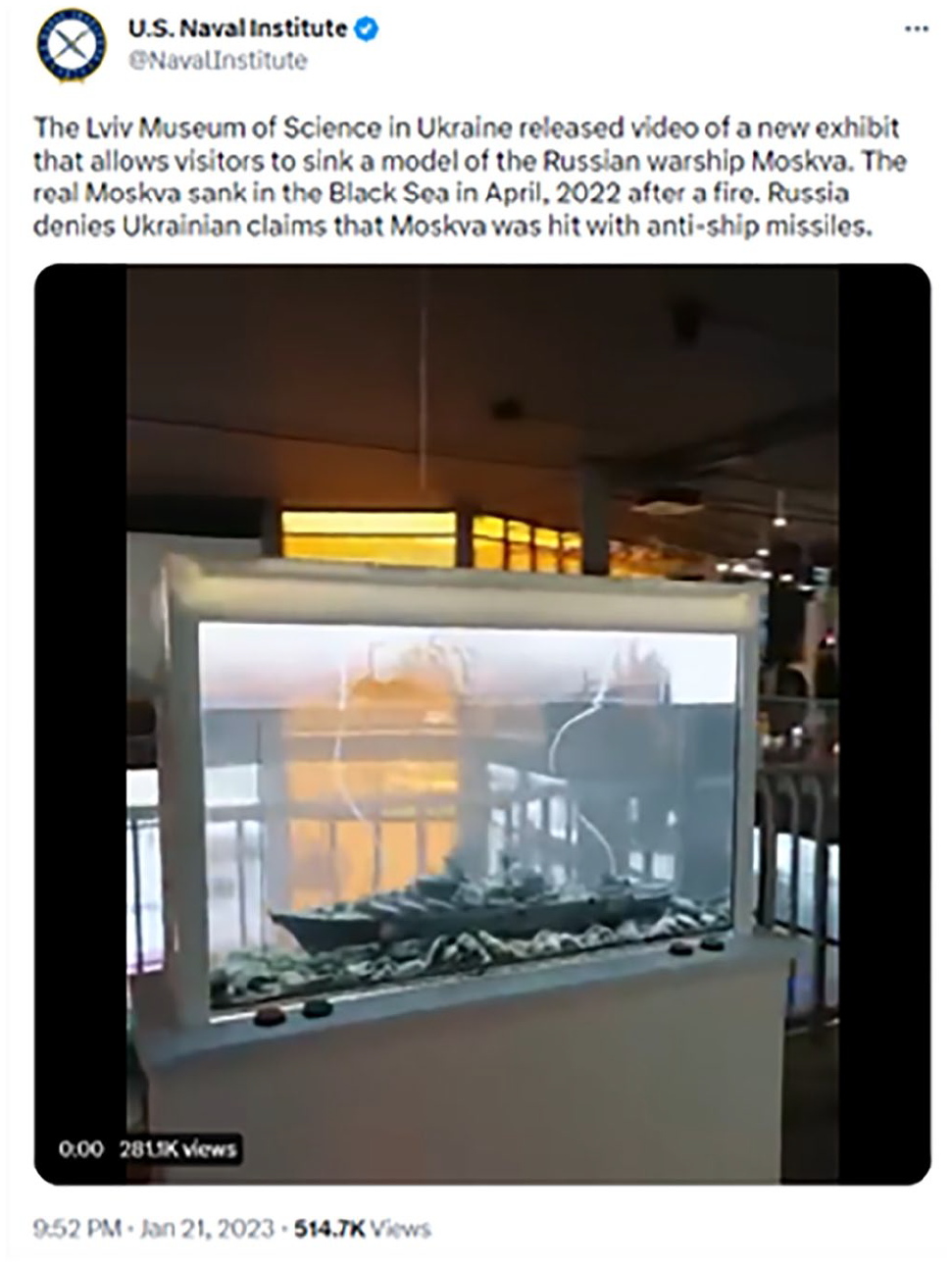
Such memes arguably go beyond the anxiety relieving function, not simply undermining narratives of Russian power but actively mocking the dead. For all that humour has established moral communities via a biographical narrative of ‘the allies’ defending master narratives of freedom and democracy, humour’s role in this vicarious war has been to securitise subjectivities of the ironic liberal West, of the plucky Ukrainian farmer/nation, as well as the ‘other’ in the form of the ‘unstable’, relic autocrat, Vladimir Putin (with his big table) and his army or ‘orcs’. As such, an apparently critical set of humorous – and generally light-hearted – responses to the anxiety of war must be read in line with a relatively straightforward emergent Cold War imaginary of geopolitics, of ‘us/the West’ and ‘them/the East’.
From VI to proxy war
Without discounting that there are many earnest people who remain sincerely engaged, especially along Russia’s borders, the inherently vicarious nature of much Western/British support for Ukraine has manifested certain vulnerabilities and limitations that raise questions about the robustness of vicarious identity and strategies of vicarious identity promotion, especially during war. This is especially so in Britain, a country distant from the front line, not generally perceived as at threat of direct attack, and where national identity is largely framed outside of distinctly anti-Russian constitutive discourses. Three points are worth highlighting that are particularly pertinent to the UK context concerning (1) Ukrainian practices of vicarious identity promotion, (2) the episodic and arguably diminishing nature of VI over time and (3) anxieties that VI with Ukraine has ultimately activated in the UK (and broader West).
First, for Ukraine, adopting a strategy of vicarious identity promotion has performed several functions. At the conflict’s beginning, vicarious identity promotion helped draw attention to the Ukrainians’ plight, helped assign the Russian attack a sense of geopolitical significance and eventness the West could not ignore, and not least, it arguably also helped relieve Ukrainian anxieties of otherwise standing alone. It may therefore have emboldened the defensive spirit by locating Ukraine as a standard bearer of civilisation and ‘the good’. The problem of this strategy for Ukraine, though, became quickly apparent. While it has proved successful in cultivating Western moral support, occasionally this has worn thin given that material military support has been more rationed. Indeed, after several weeks Zelensky’s efforts at vicarious identity promotion began to acquire a more accusatory tone, questioning, for instance, the West’s continuing trade with Russia (particularly in oil and gas), the slow imposition of sanctions, and limited (and too slowly increasing) levels of material military support, even accusing the West of ‘cowardice’ (Associated Press, 2022; BBC News, 2022). He also questioned whether the West might be sacrificing Ukraine for its own ends. Rather than supporting a swift Ukrainian victory, perhaps the West preferred drawing Russia into a quagmire (news.com.au, 2022). The accusation, therefore, was that any sense of vicarious joy was being experienced on the back of Ukrainian suffering. In the UK, this view was later referenced by Zelensky’s wife. When interviewed by the BBC about the rising cost of utilities for UK homeowners, she quipped, ‘While British people count the pennies, Ukrainian families count the bodies’ (Corp, 2022).
In ontological security terms, the tonal shift – though not complete – was significant since vicarious identity promotion became paired with tactics of shaming and stigmatisation designed to expose Western hypocrisy and thereby activate anxieties of guilt and condemnation. Indeed, the shift that emerged towards exposing Russian war crimes arguably served a similar function, not just seeking to sully Russia’s reputation with the global community, but implicitly operating as an accusation of the West’s prevarication and hesitancy.
Second, it is not just that Western VI with Ukraine is insufficient but that it has also waned over time. Several reasons might be identified. One is that diminishing VI is a consequence of a contemporary hyper-mediatised world in which attention spans are declining. Over time, for many in the Western public – particularly those less geographically proximate to it – the war became less interesting, particularly once the conflict had settled into something of a grinding routine. In short, the war no longer generated a mood of excitement and expectation, becoming increasingly boring, with Western (online) publics craving ‘the next thing’, even if that was Will Smith slapping Chris Rock at the Oscars or taking sides and vicariously identifying with either of the protagonists in the Johnny Depp vs Amber Heard trial, or, in a British context, vicariously identifying with all things royal following the Queen’s passing. With the outbreak of the Israel-Hamas war in October 2023, Ukraine dropped out of the headlines. Insofar as it was mentioned, mainly it was to point this absence out. Indeed, public practices of VI in the UK shifted away from Ukraine almost entirely towards a much more polarising debate – and expectation – that UK citizens should ‘pick a side’ to support – Israel or Palestine – in this latest war for ‘Western values’. In short, Ukraine has sometimes been pushed aside by other now more desirable, immediate and virtue enhancing targets of VI.
The war’s changing nature and broader impacts have also been important. Two elements stand out. The first is that Western publics have not just become tired of the war but in some quarters empathy with Ukraine has even been replaced with some resentment, with the conflict (and support for Ukraine) blamed for various problems: inflation, energy rationing and food shortages. Occasionally, this has taken a very personalised and human form. For example, in the UK tabloid press stories about British hospitality to Ukrainian refugees were, by summer 2022, competing with an ongoing (and often front page and somewhat emotionally more ambiguous) story about a marriage breakdown after the British husband ran off with their Ukrainian hostee (Carr and Warren, 2022).
More officially, and concerningly for the Ukrainian government, at the July 2023 NATO summit Ben Wallace, the British defence secretary, accused the Ukrainian government of showing insufficient gratitude, of treating him like Amazon with their insatiable desire for ever more equipment, and failing to recognise the sacrifices donor countries were making (Harding, 2023). The Ukrainian government responded by adopting a more conciliatory tone (Sabbagh, 2023). By contrast, Ukrainian social media lit up with memes mocking Wallace (Harding, 2023). Memorably, one depicted Mel Gibson admonishing a bloodied Jesus of Nazareth with the caption (in Ukrainian): ‘Ben Wallace tells the Ukrainians that they don’t show enough gratitude for the weapons provided’. 8 If vicarious identity relies on obfuscating the distinction between self and other, these ‘shaming’ interventions (on both sides) only seem to have reopened it and may even have pushed the relationship onto a more strategic and less emotional (and vicarious) plane. Thus, while humour can establish a vicarious relationship, it is also a powerful vernacular for shaming any subject perceived to have fallen short of the values expected.
The second has been that any humour in VI with Ukraine has become more difficult as the war’s brutal realities have become more visible: the widespread destruction, the slaughter, the evident war crimes. Can we really claim this is ‘us’? The point is that vicarious war arguably relies on a (nostalgic) romanticism of heroism, but this becomes harder to see in images of executed civilians. It is notable, therefore, that after a few months the initial stories and myths of heroic warriors – the Ghost of Kyiv, Snake Island etc. – largely disappeared. Indeed, VI has also become harder as the cultivated sanitised image of Ukraine has itself been challenged. Be it continuing stories about claimed Ukrainian ‘neo-Nazi’ sympathies (e.g. within the Azov battalion), some documentation of Ukrainian war crimes, and growing evidence of corruption – including within the government and military’s upper echelons – it has become harder for some among the Western public to position Ukraine as the golden vicarious representation of ‘us’ that it was initially championed to be. The danger of VI here concerns the contamination of one’s own self-image and concepts by association.
Relatedly, the ability of humour to foster a playful form of VI with Ukraine has also diminished. While memes like that of the Ukrainian tractor brigade were able to hold attention for some weeks, and while this was clearly a good joke/meme, most jokes stop being funny with their constant retelling, and therefore lose their ability to draw people in. New jokes and memes may be required, but as the war has become increasingly attritional it is unsurprising that playful humour has become less evident. More problematically, much of the online humour has become considerably darker and increasingly dehumanising of the Russian enemy, routinely referred to as ‘Orcs’ and ‘fertiliser’, with a notable celebratory tone connected to numerous videos showing drones dropping grenades on – presumably terrified and desperate – Russian soldiers (Mirovalev, 2022). While such schadenfreudic forms may still appeal to some the ability of such humour to uphold VI with Ukraine among Western audiences has arguably declined and may even have the opposite effect, at least insofar as it has the potential to elicit feelings of disgust (Laboratory of the Future, 2022; Shaw, 2022; Zverko, 2022). For instance, across Western media the emergence in May 2022 of an image showing a performative ‘joke’/war crime in which corpses of Russian soldiers were positioned in a ‘Z’ formation, the shape of Russia’s invasion insignia, was described as ‘horrifying’ and ‘gruesome’ (Davis, 2022; Steinbuch, 2022). Similar sentiments were also evident regarding the early emergent practice of Ukrainian soldiers using the phones of dead Russian soldiers to inform their parents/wives of their demise often laughing while doing so. At the very least, such humour does not go viral in quite the same way as tractors.
VI has also diminished as space for critical discussion of aspects of the conflict has slowly emerged. The issues are varied but include: (1) questions about the contested nature and goals of Western actions towards Russia over the last 30 years (e.g. the pros and cons of NATO enlargement); (2) questions about the 2013–2014 Euromaidan revolution (how much of a popular revolution, the role of neo-Nazi elements, Western interference); and (3) questions concerning the conflict itself, with these including the timeliness and amount of Western assistance, ambiguities as to who destroyed the Nordstream II pipeline, to what the end game might be (e.g. is the total defeat of Putin/Russia desirable and/or feasible and what might a negotiated resolution look like?). At the time of writing, debates over these issues remain at the margins, but insofar as they penetrate public discussion they have a complicating function, disrupting the hegemonic narrative of good and evil, and as such are liable to undermine any simplistic embrace of VI and its ontological security enhancing effects.
Interestingly, humour and satirists have also played an important (if somewhat marginal) role in disrupting the narratives of vicarious war. For instance, popular comedy podcasters like Joe Rogan and Russell Brand have developed notable followings with (often satirical) critiques of hegemonic narratives, including with respect to the Ukraine war. Western vicarious enjoyment of the war has also been actively called out. One joke included a picture of Canadian Prime Minister, Justin Trudeau, meeting Zelensky, with Trudeau captioned saying: ‘Thank you. . . this is one of the most enjoyable wars we’ve ever attended’. Similarly, and no doubt more problematically, the conservative ‘I Support the Current Thing’ meme has been applied to the conflict, a meme that ridicules the contemporary (and for those using the meme, mindless) tendency for people to generate a vicarious (and virtuous) sense of self by swiftly aligning with the latest affective wave (Ghostofchristo1, 2022), a tendency also referenced in comedian Ryan Long’s posting of an autobiographical parody titled: ‘When supporting Ukraine is Your New Identity’ (Long, 2022).
Evident in the above is how VI is always liable to be episodic and connected to changing moods and affective waves. As a strategy of ontological security enhancement, it is therefore potentially unstable/unreliable. One consequence of the decline in strength of VI with Ukraine, therefore, has been a shift in how many Western audiences have experienced the war, away from an emotionalised vicarious war to increasingly perceiving it in less emotional terms, as a strategic and calculative proxy war.
A final point is that while VI with Ukraine has been shown to be tempting for its ability to offer a sense of ontological fulfilment by proxy, there is also a sense in which in doing so it has only masked anxieties prevalent in the West that still lurk in the background threatening to break through. Again, the UK – and Zelensky’s February 2023 visit more particularly – provides a good example. As noted, in his speech to the UK parliament, Zelensky praised Britain’s ‘bravery’ and ‘support’. He also stated: ‘Your leadership in protecting [the] international legal order through sanctions against a terrorist state – cannot be questioned’ (Zelensky, 2023). Except it could. Indeed, following the speech Zelensky and Prime Minister Sunak gave a press conference, with a Ukrainian journalist confronting Sunak with a rather pointed question: ‘What are your steps to clear the reputation of London as a city that is still laundering Russian money’ (Sky News, 2023: at 22 minutes, 30 seconds).
The visit also highlighted a significant point of tension between the parties. Zelensky’s parting message was to request combat aircraft, what he termed ‘Wings – for freedom!’ (Zelensky, 2023). But Sunak would only commit to training Ukrainian fighter pilots, there would be no planes (Prime Minister’s Office, 2023). Indeed, government spokespersons and ministers later justified this by claiming that providing planes would be impractical, would risk British lives, while also arguing that Britain had the wrong sort of fighter jets (Stacey et al., 2023; The Guardian, 2023). Britain, however, did commit to sending 14 Challenger 2 tanks. The reason for emphasising these points is because ‘leading on Ukraine’ has become one of the few (largely performative) areas for claiming status for post-Brexit ‘Global Britain’.
Throughout the conflict, the UK government has sought political capital by claiming a leadership role through its demonstrations of support for Ukraine. Early on this was evident in Boris Johnson’s (2022) (largely appropriated) ‘six-point plan’ and his recurrent visits to Kyiv. Following Zelensky’s visit, it entailed crowing about the training of Ukrainian fighter pilots and the decision on Challenger 2 tanks while using this as an opportunity to encourage others to do likewise. Germany has been a particular target of such pressure, with its ability to activate hundreds of Leopard tanks. Yet exposed in this are two things. First, an unwillingness to give all the support it could. Second, exposure of how the UK now lacks the capacity to become engaged in the way it encourages others to. Indeed, the country’s military capabilities gap is frequently referenced by defence officials, yet those officials have also reacted defensively to France and Germany questioning both the UK’s depleted armed forces but also its ability to take over the running of NATO’s rapid reaction force from Germany (Wilcock, 2023). Such questioning hits at notable sensitivities regarding key elements of British national identity and pride and coming from France and Germany is experienced as particularly shaming and humiliating. In this respect, the British government’s rhetoric of military global leadership is always at risk of parody, and insofar as it exists as reliant on wholly vicarious attachments and engagements. 9 What this also means, though, is that insofar as post-Brexit narratives of Global Britain have been militarised and framed in geopolitical terms, it has also become increasingly beholden to riding along with (and vicariously appropriating) the military actions (e.g. Ukraine) and geostrategic ambitions (e.g. the US in the Pacific via the UK’s – essentially symbolic – naval deployments) of those on which it depends.
Conclusion: the temptations and limits of vicarious war
Practices of VI with Ukraine have been an important facilitator of Western support, helping to reaffirm biographical narratives of self-identity, reinforcing ontological security, status, and self-esteem. In relational terms, there have been important practices of vicarious identity promotion by Ukraine itself, designed to gather and maintain support for the war effort. Across these dynamics, we have argued that humour is an important mode of VI and a driver of ontological security dynamics. Humour has therefore played an important – if sometimes limiting – role in meaning making, historical myth construction, and popular geopolitical imagination.
While such processes have been evident across Western states – though arguably with varying intensity and endurance depending on geographical, historical and ideational factors – this article mobilised UK examples to consider why engagement with Ukraine has been so intense and society-wide, even though this would hardly have been predicted before the Russian invasion. Here, VI with Ukraine has helped in articulating a significant role for the UK and bolstered post-Brexit proclamations of Global Britain. 10 VI with Ukraine has offered an element of redemption for suppressed shame at aspects of the country’s own recent military engagements (Iraq, Afghanistan, Libya, Syria) and their failure to deliver the fulfilment of military ‘victory’ or moral affirmation desired. Rendered thus, vicarious war is as much about ‘us’ as it is about ‘them’.
For subjects engaged in VI, the obverse of any promised sense of appropriated fulfilment is the unease that can be activated when the vicarious nature of the relationship is exposed. Any lack in terms of capabilities, commitment and will, means that vicarious relationships are vulnerable to shame dynamics. For the UK, this has come from three sources, the Ukrainian government (the target of VI), Ukrainian civil society through its mocking of British officials, but also from allies due to how the UK government has cast levels of support and leadership as a competitive status dynamic. Put differently, once identified (and exposed), VI reveals something about the subject’s own ontological anxieties and (in)stability. In the UK case, it simultaneously covers and reveals the lack at the heart of British status anxiety – a country claiming to be a global power and trading on its past, but which increasingly appears diminished, with insufficient (military) capabilities, and perhaps also lacking the will, or desire, to do more?
Conversely, while cultivating vicarious attachments can bring the target benefits in terms of (material and moral) support, and even some empowerment vis-à-vis admirers increasingly dependent on the target, targets are also vulnerable. This is particularly so since the intensity of vicarious relationships is rarely constant and suffers from the vagaries of declining attention and changing public moods. The significance for Ukraine is that while the VI of neighbouring states has perhaps been more constant given anxieties of shared vulnerability, similar experiences and constitutive narratives about Russia, and prevalent fears that ‘we could be next’, this has been less so for more distant countries like the UK (and US, France, Canada) whose geographical distance, different historical relationship with Russia, and reduced sense of existential threat means that the strength of VI is likely to be less robust and more easily diverted.
Targets who see benefits in maintaining vicarious relationships and wish to avoid supporters shifting mindsets towards a more instrumentalist proxy war footing, therefore need to keep subjects of VI interested and invested in the relationship to ensure it remains ontologically affirming, offering the fulfilment desired. One obvious reason for this would be to maintain the pressure vicariously investing foreign publics are likely to exert on their governments, while governments so inclined will also likely be more amenable to themselves sacrificing more. Such considerations may therefore help to explain the attention given to the much trailed and promised Ukrainian 2023 ‘spring offensive’ once the 2022 ‘fighting season’ ground to a stalemate with winter’s onset. While it is, in general, poor tactics to forewarn the enemy of one’s intentions, given the Ukrainian government’s need to maintain Western support such flagging arguably made sense. Promises of a dramatic Spring Counter-Offensive therefore operated as another form of vicarious identity promotion offering the excitement and sense of vicarious adventure, meaning and purpose Western publics (and governments) are presumed to desire. Ultimately, the anticipated counter-offensive never quite delivered and proved anti-climactic, absent as it was of a dramatic Ukrainian advance and breakthrough. The lack of attention-grabbing spectacle, arguably fed a growing mood of drift (even disengagement and disinterest) among (a growing) part of the British/Western public.
What this emphasises is that, ultimately, VI is episodic and inherently bound up with changing public moods. As noted, with the one-year anniversary a notable uptick in official and institutional practices of VI/vicarious identity promotion became evident. Most notably, Zelensky went ‘on tour’ while various world leaders visited Kyiv and delivered speeches, all emphasising the continued – even enhanced – commitment to sitting foursquare behind – but notably not alongside – Ukraine. These speeches contained no notion of compromise or peace, except beyond fighting Russia, defeating it, and claiming victory. Be it from Western political leaders or as framed in television documentaries released around the time, the message of continued support was clear, as were attempts to reactivate the Western public’s emotional engagement and VI with Ukraine.
Just a few months later, though, the lasting effect of such practices on Western and European publics was evidently less certain. For instance, if the Eurovision Song Contest can occasionally emerge as a barometer of European public opinion and affective investment, as happened in 2022 when the Ukrainian entry was the runaway winner, then in 2023 the effect of such efforts at vicarious identity promotion were evidently diminished as Eurovision regained its more normal vibe, despite Ukraine co-hosting with the UK and in the spotlight once more. Indeed, whereas, in 2022, the UK public gave 12 votes to Ukraine, in 2023, it gave 4, with Ukraine placing sixth overall. Meanwhile, come the Israel-Hamas war, British public engagement and VI with Ukraine was notable only by its absence. In critical terms, however, such a drop off may itself present other opportunities. While this article avoids considering the normative merits or otherwise of vicarious war it does seem that insofar as it takes hold, ‘vicarious war’ may reduce the options available for ending conflict since, in becoming invested with notions of ontological significance, ‘vicarious wars’ are likely to reaffirm categorical moral geographies that mitigate against diplomacy and a negotiated settlement. While ontologically enhancing (to a point), they may also be politically restricting.
Footnotes
Funding
The author(s) received no financial support for the research, authorship and/or publication of this article.
