



Abstract
European non-governmental development organisations (NGDOs) have used naming and shaming extensively in their advocacy to push the EU and member state governments to implement international norms on foreign aid. The paper analyses the contents of NGDO advocacy publications, with the goal of gaining insight into how and why these organisations engage in naming and shaming. The exercise reveals that NGDOs are highly selective in the norms they promote through naming and shaming: they shame governments heavily for not implementing norms on aid quantity, but are less vocal on norms related to aid effectiveness. The paper shows that NGDOs strategically select norms in their naming shaming activities which have higher resonance with the public and are less costly to monitor, criteria which aid quantity norms fulfil. There is also some evidence that NGDOs promote increasing the quantity of aid because it would enhance their own access to donor funding.
Introduction
‘Naming and shaming’ has become a highly visible tool in the advocacy arsenal of non-governmental organisations (NGOs) in recent years, involving the use of reports, analyses and press releases to bring negative publicity for governments not complying with their commitments. A substantial literature examining such naming and shaming strategies has emerged in the past decade, focusing primarily on the area of human rights, where organisations like Amnesty International or Human Rights Watch have been instrumental in highlighting government abuses. 1 Naming and shaming strategies of NGOs in other areas however have received rather limited attention, and so have the motivations which determine how exactly NGOs engage in naming and shaming. The usage of these strategies in international development by non-governmental development organisations (NGDOs), for example, has received almost no scholarly interest. Aid donor governments and multilateral organisations have made commitments following the turn of the Millennium in terms of increasing the volume and effectiveness of their aid, and these commitments have had a substantial impact on the norms of the international development system. 2 Adherence to these norms however has been mixed at best, 3 and European NGDOs have done significant efforts to promote change by identifying and publicising non-compliance.
This paper represents one of the first efforts to investigate the usage of naming and shaming strategies by the European NGDO community. Specifically, it analyses the drivers and interests behind the naming and shaming practices of these NGDOs, both towards the European Commission (EC), and member state governments. By using a novel framework to make sense of NGDO interests and identifying the international development norms the NGDO community promotes and the ones it places less emphasis on, the paper offers a glimpse into the motivations and strategic decisions driving the advocacy work of these organisations. NGDOs face a conflict of interest in their advocacy work: on the one hand, they have strong moral motivations, and drive for more and better aid which can in turn lead to the reduction of global poverty. On the other hand, many of them are participants in the global aid business, and greater volumes of aid benefit them directly, while certain measures aimed at improving the effectiveness of aid can harm their access to funding. How this conflict, and others, influences the naming and shaming actions and norm advocacy of NGDOs is unclear.
The paper uses two qualitative sources of data. First, it analyses the AidWatch Reports published between 2006 and 2015 by the European NGO Confederation for Relief and Development (CONCORD), the main pan-European NGDO advocacy umbrella group. The AidWatch Reports 4 provide an in-depth scrutiny of the international development policies of each European Union (EU) member state and the EC, calling attention to weak performance and formulating demands and recommendations. These reports receive significant attention in the international development profession, including EU member state governments and a wide range of other stakeholders, and can be seen as tools used to name and shame the donors who do not meet their commitments. Second, a number of qualitative semi-structured interviews were carried out with officials working at CONCORD’s secretariat in Brussels, as well as experts at CONCORD’s members who have been involved with the reports.
Based on the qualitative analysis of this data, the paper concludes that NGDOs are indeed selective in the norms which they shame non-performing donors on. They put a large emphasis on shaming donors for not meeting their commitments on aid volumes and the way they report their aid figures, while they are less vocal on norms related to aid effectiveness. The paper proposes three, complementary explanations for this selectivity: NGDO funding concerns, norm resonance, and monitoring costs. The empirical evidence provides strong support for the latter two: shaming donors on norms which resonate with the public, as well as on norms which can be monitored at relatively low costs are indeed key drivers for NGDOs. We also find some support for NGDOs being driven by funding concerns in their advocacy behaviour, although the evidence is weaker than in the other two cases.
Our findings show that NGDOs are highly strategic in their naming and shaming behaviour. Beyond shedding light on the motivations of NGDOs specifically, the paper contributes to the broader literature on naming and shaming and international norm advocacy in two ways. First, it extends the naming and shaming literature to the field of international development advocacy, an area that has been largely neglected. Second, the paper deepens understanding of the motivations of NGOs engaging in naming and shaming and how they decide what practices of countries to name and shame. Most of the research on naming shaming has focused on the effectiveness of these practices in bringing about change, and there are relatively few contributions which scrutinise the motivations of the ‘namers and shamers’ themselves. 5
The paper is structured as follows. The second section formulates hypotheses on the motivations of NGDOs, which is followed in the third section by a discussion of the data and methods used in the paper. Section four analyses the naming and shaming practices of NGDOs, while the final section provides concluding remarks.
How and why NGDOs engage in naming and shaming
Investigating how norms spread in the international arena has long been a preoccupation for scholars of international relations. 6 In the past decade, a significant literature has emerged on the role NGOs play in these processes through their naming and shaming practices. Contributions to this literature have investigated the effectiveness of these strategies in bringing about change in targeted countries, 7 or at least imposing reputational costs on these countries, 8 and have also provided insights into understanding how NGOs make strategic choices on who to shame. 9
The literature has also touched upon the motivations of NGOs. While generally seen to be driven by normative concerns, 10 NGOs are also rational and strategic actors, motivated by political, economic, or other interests, such as access to funding and their reputation in the media. 11 For example, they can have incentives to inflate allegations of human rights abuses in order to raise their profile, which in turn can lead to more private donations. However, at least in the case of human rights NGOs, these interests cannot become too dominant, as a key aspect of their effectiveness is their perceived credibility. 12
The literature on naming and shaming by NGOs has however two significant shortcomings. First, an overwhelming majority of papers focuses on human rights, with only a few addressing other areas, such as the environment. 13 Second, the literature is predominantly quantitative. Quantitative research can provide insights on the broad factors which influence the effectiveness of naming and shaming, however, many aspects are missed due to the nature of large N research, including details on the motivations of NGOs which are the focus of this article.
The dependent variable of the paper is the specific development norms NGDOs promote through their naming and shaming activities. There are strong reasons to expect that naming and shaming strategies of NGOs in general can be selective in terms of the norms they promote, especially outside the realm of human rights. In some areas, norms might be more contentious, because they relate to the distribution of financial resources, or promote certain policy models over others. NGOs may also have a lesser need to maintain credibility in other areas and embrace a clearly political or ideological position.
We propose three independent variables to explain why NGOs in the field of international development may promote certain norms through their naming and shaming activities over others: funding concerns (based on the conceptualisation of NGOs as self-interested, rational agents); norm resonance (based on the literature on norm entrepreneurs); and monitoring costs (based on an asymmetry of information between the NGOs and the donor countries). All three of these variables link to the motivations of NGOs. The literature has generally tended to provide rather one-sided explanations of NGO motivations, and neglected the fact that NGOs, just like any other organisations, face a whole range of incentives that may shape their behaviour. The three proposed variables are able to capture a wide range of these incentives, while also keeping the analytical framework concise.
Funding concerns
Given how NGDOs employ highly professional staff and have no access to sustained streams of resources, considerations on funding are important. These funding concerns can have an impact on their behaviour and advocacy work. Schmid et al. 14 argue that reliance on government funding incentivises NGOs to refrain from strong criticism. According to Mosley, 15 in such situations advocacy will concentrate on ensuring organisational survival, and the promotion of policies which benefit the clients of NGOs will become secondary. Mosley also argues that dependency on the government does not necessarily mean less advocacy, but rather NGOs will advocate for a better match between their interests and government priorities. The need to ensure access to funding means that NGOs can be seen as self-interested actors ‘playing politics’. 16
Such trade-off between access to funding and advocacy are clearly present in the specific case of NGDOs. A significant portion of funding for NGDO projects implemented in developing countries comes from small individual donations, but many Northern NGDOs also actively seek funding from their national governments and multilateral aid agencies. 17 While large NGDOs have been able to develop diversified funding streams and thus need to rely less on official grants, smaller NGDOs, with less capacities to engage in public fundraising, are much more reliant on government funding. 18 Edwards and Hulme 19 argue that a large reliance on official funding alters NGDO priorities and erodes their legitimacy. NGDOs face an increasingly competitive funding environment, which has been exacerbated by the austerity politics of European governments after the 2008 economic crisis. Cooley and Ron 20 argued that the increasing number of NGDOs and greater donor reliance on them for project implementation fosters an environment characterised by competition and uncertainty. Donors increasingly use competitive bidding to award funding to NGDOs, and this marketisation tends to create ‘incentives that produce dysfunctional outcomes’. Contracts are often short term, and so renewing them or securing new ones becomes a key activity for NGDOs, altering the ways in which they behave. NGDOs may become more risk averse and more likely to hide project failure which may jeopardise contract renewal. In competitive situations, NGOs need to make strategic decisions about how to access funding, 21 and will act in a ‘rational and rent-seeking way’, with material incentives potentially overriding normative goals. 22
Therefore, it can be argued that the need to ensure access to official funding impacts the naming and shaming behaviour of NGDOs in the following way:
H1: When NGDOs name and shame governments that do not observe development norms, they are more likely to promote the norms which improve their own access to funding.
The norms most likely to enhance NGDO access to funding are ones relating to the volume of aid and the competition NGDOs face while bidding for funds. In general, larger official aid budgets are likely to translate into increased absolute sums channelled through NGDOs. Although to varying degrees, all donors fund NGDOs directly, and NGDOs also act as implementers of donor-funded projects as contractors. Larger official aid budgets are therefore likely to mean more direct NGDO funding and more projects which NGDOs can bid for. Data on official bilateral aid budgets and donor funding to NGDOs provides strong support for this claim: in 2010, total bilateral official aid flows from OECD member countries were $90 billion, from which NGDOs received $17.3 billion in total. By 2017, total bilateral flows have increased to $105 billion, with the share channelled through NGDO’s increasing to $20 billion which represents a more or less proportional increase. 23
Therefore, we expect NGDOs to name and shame donors who do not meet norms related to aid target commitments. NGDOs are also likely to promote norms which not only ‘increase the pot of available money’, but also enhance their own access to it: even if aid budgets remain the same, governments could channel more of the existing resources through NGDOs. NGDOs may thus call on governments to implement norms which would allow their greater involvement in the planning and implementation of aid, or spend more aid on projects in which NGDOs are perceived to have comparative advantages compared to other actors (such as education or healthcare). Certain norms however may harm NGDO access to funding, and therefore it is expected that these will receive less emphasis in advocacy. For example, norms calling for a greater involvement of for-profit businesses in foreign aid are likely to be contested by NGDOs, as they increase competition for resources. European NGDOs may also resist norms which aim to transfer the control of aid spending to recipient governments.
Norm resonance
While NGOs have strong incentives to ensure their organisational survival, they are also driven by normative goals which they hold as appropriate or ‘right’. 24 Normative agents are motivated by ‘values rather than material concerns.’ 25 If NGOs promote a relatively new norm that has not been institutionalised or internalised, or if they promote a specific interpretation of a norm that differs from the mainstream interpretation, they act as norm entrepreneurs. In this perspective, naming and shaming is one of the strategies that NGOs can use to raise public awareness and ‘persuade’ political elites to implement the norms they believe in. 26 The selectivity of promoting certain norms as opposed to others can be explained as a consequence of this strategy. A key concept is norm resonance, referring to whether the promoted norms ‘resonate with [. . .] widely held domestic understandings, beliefs, and obligations.’ 27 In other words, norms resonate with the public ‘if they fit well with existing ideas and ideologies in a particular historical setting.’ 28 In cases where this resonance is present, people do not have to be convinced about the validity of the specific norm, as it is already generally accepted as a ‘good thing’. Therefore, if the norms which NGOs promote resonate with the public, decision-makers are more likely to be persuaded to implement them. Thus, NGOs have incentives to select norms for promotion which have greater public resonance, or to frame the norms they promote in a way which increases their resonance. 29
There are arguments in the literature that NGDOs are indeed driven by normative, humanitarian concerns, 30 and also examples of research which conceptualises NGDOs as norm entrepreneurs, including Elgström, 31 who examined their role in the construction of EU norms regarding gender and development; and Timofejevs Henriksson, 32 who analysed their activities in persuading member state governments of the appropriateness of various EU-level development norms. Based on these considerations, the second hypothesis can thus be formulated as follows:
H2: When NGDOs name and shame governments that do not observe development norms, they are more likely to promote norms which resonate with the public.
In order to determine which development norms resonate with the public, the Eurobarometer surveys on development aid provide the only available pan-European account of the topic. Three key patterns emerge from these. First, support for development aid has been consistently high in the EU, with 83 to 89 per cent of people usually saying that the topic is very important or fairly important between 2009 and 2015. 33 In 2009, despite the economic crisis, 65 per cent of respondents were in favour of increasing aid. 34 Second, Europeans prefer using aid to reduce poverty, with 64 per cent agreeing that this should be the main goal of EU development policy. 35 Third, aid effectiveness figures less prominently among the concerns of citizens. Many aid effectiveness norms, such as reducing the administrative costs for recipient countries or untying aid from donor country procurement are not seen as priorities by the public, with only 22 and 21 per cent of respondents saying that these measures should be prioritised by the EU. 36 Support for better coordination between donors and budget support are also relatively low at 25 and 24 per cent. 37
Based on what emerges from the Eurobarometer surveys, norms related to increasing aid volumes and using aid for poverty reduction resonate with the European public, while norms related to aid effectiveness have lower resonance. We therefore expect NGDOs to promote increasing aid volumes and poverty-focused aid in their naming and shaming, and place less emphasis on aid effectiveness.
Monitoring costs
The third explanation for selecting specific norms for naming and shaming is based on the principal-agent model, specifically focusing on information asymmetry between the government and the wider public, as well as the costs of holding the government accountable. The principal-agent model posits that the government (agent), due to its central position in policy-making processes, has an informational advantage on policy implementation over the public (principal). The principal-agent model has been widely used to study the relationship between donor governments and NGDOs. 38 In our approach, we conceptualise NGDOs as supervisors who monitor the government (the agent) on behalf of the principles (the public), 39 and name and shame the agent if it fails to live up to its commitments. For their supervision to be credible, NGDOs need to have access to data on the actual performance of the agent. 40
Accessing data however incurs costs for NGDOs. Credible information may be especially hard to come by in case of highly technical or vaguely defined norms, 41 and NGOs will need to invest funds to track government activities. Given their limited resources however, NGOs may optimise and monitor compliance only with norms where costs of obtaining information are lower. In the field of international development, some data may be more readily accessible than others. Data on the quantity of aid provided by donors is easily accessible, as donors regularly report these to the OECD’s Development Assistance Committee (DAC). The DAC cross-checks and publishes this data through its Creditor Reporting System (CRS), a free to access online database, which provides detailed breakdowns of aid flows by donor, recipient and sector, as well as some qualitative characteristics of aid, including the degree to which aid is tied. This makes access to data for NGDOs on aid quantity and allocation virtually costless.
However, not all data required to monitor donors may be regularly reported, or even collected. Many donors are less transparent in other areas, such as the conditions attached to their aid, specific details of individual aid projects, or how they work with other actors in the field. The data coverage of inter-governmental efforts aimed at monitoring the commitments of donors in terms of aid effectiveness, such the Global Partnership for Effective Development Cooperation, is far from comprehensive. 42 NGDOs will therefore need to invest staff time into gathering data on aid quality through requests for information from aid agencies and often several line-ministries. The data provided by different actors may not be comparable due to different methods of working and definitions used, and NGDOs may also need to invest capacities into analysing it. In some cases, government actors may not even collect the data NGDOs would require to monitor their behaviour, or could be unwilling to provide it.
The third hypothesis is therefore as follows:
H3: When NGDOs name and shame governments that do not observe development norms, they are more likely to promote the norms which involve lower monitoring costs.
Based on the considerations above, we expect NGDOs to shame donors in terms of the quantity of aid they provide, but also in how they allocate that aid in terms of countries and sectors. Shaming related to aid effectiveness should be less visible, given how comparable cross-country data is more difficult to compile.
Summing up this section, it is expected that when NGDOs name and shame governments, they will promote norms which enhance their access to official funding, have a high degree of resonance with the public, or where their monitoring costs are lower. All three of these hypotheses point towards a greater emphasis on norms related to aid quantity and a relative neglect of norms on aid quality in NGDO naming and shaming. The three hypotheses should therefore be seen as complementary, and we expect NGDOs to shame donors most strongly in cases of development norms where considerations relating to funding, resonance and monitoring costs are all present.
Data and methods
In order to examine the three hypotheses, the paper analyses the extent to which the norms promoted by European NGDOs are compatible with the wider norm structure of the international development system, and how these norms impact NGDOs funding, resonate with the public, and what costs are involved in monitoring them.
The norms of international development
The norms of the international development system are not codified into international law, and some are relatively contentious. The norms have also been rather fluid and have changed much since the end of the Second World War. 43 The turn of the Millennium, and the acceptance of the Millennium Development Goals (2000, MDGs) is seen to have represented a clear turning point in the norm structure of the international development system. 44 Therefore, we only focus on norms that meet two criteria: (1) there is a strong political consensus around them; and (2) this consensus has been established (or re-established) after the turn of the Millennium. A strong political consensus around a norm means that it has received high profile endorsement from a large number of states through an international declaration, or, in case of the EU, has been endorsed by the Council of the EU. The most important such declarations following the turn of the Millennium, include (but are not limited to) the MDGs, the Monterrey Consensus (2002), the Paris Declaration (2005), the Accra Agenda for Action (2008), the Busan Partnership (2011) and the Sustainable Development Goals (2015, SDGs). In case of the EU, the European Consensus (2006) and the Operational Framework on Aid Effectiveness (2011) were the most important sources during the timeframe of the research. 45
The body of norms in these documents has two key aims: (1) increase the amount of aid to developing countries; (2) increase the effectiveness of aid in terms of reducing poverty; as well as a number of other goals related to aid allocation and issues beyond aid. Donors are required to spend at least 0.7 per cent of their Gross National Income (GNI) on aid, focus on sustainable poverty reduction, increase aid given to the poorest countries, align their aid with the priorities of recipients, coordinate their assistance with other donors, and be transparent and predictable. There are also a number of norms relating to decreasing the transaction costs of aid (such as untying aid or using partner country procurement and financial systems for aid delivery instead of those of the donors, etc. 46 ).
There is strong rhetorical support for these norms. All members of the United Nations have accepted both the MDGs and the SDGs. A total of 138 countries, as well as 28 international organisations have expressed their adherence to the Paris Declaration and the Accra Agenda. 47 Many donors have also made explicit references to these norms in their aid policies and strategies. 48 The EU has transposed most of the globally accepted development norms into its own body of soft law, and has even gone beyond them in several aspects. In 2006, the EU accepted a policy statement entitled the European Consensus, which included a commitment for member states to reach 0.7 per cent aid spending by 2015; change their geographical allocation of aid to devote more resources to Africa and least developed countries; engage in better coordination, and untie aid. Other EU soft law calls for member states to increase the coherence of all their policies with the goals of development 49 ; engage in joint actions with other donors 50 ; reduce the number of countries and sectors supported in order to avoid fragmentation, or make increased use of the budget support modality, which refers to channelling aid directly into the budget of the recipient country and thus giving it large discretion in using it. 51
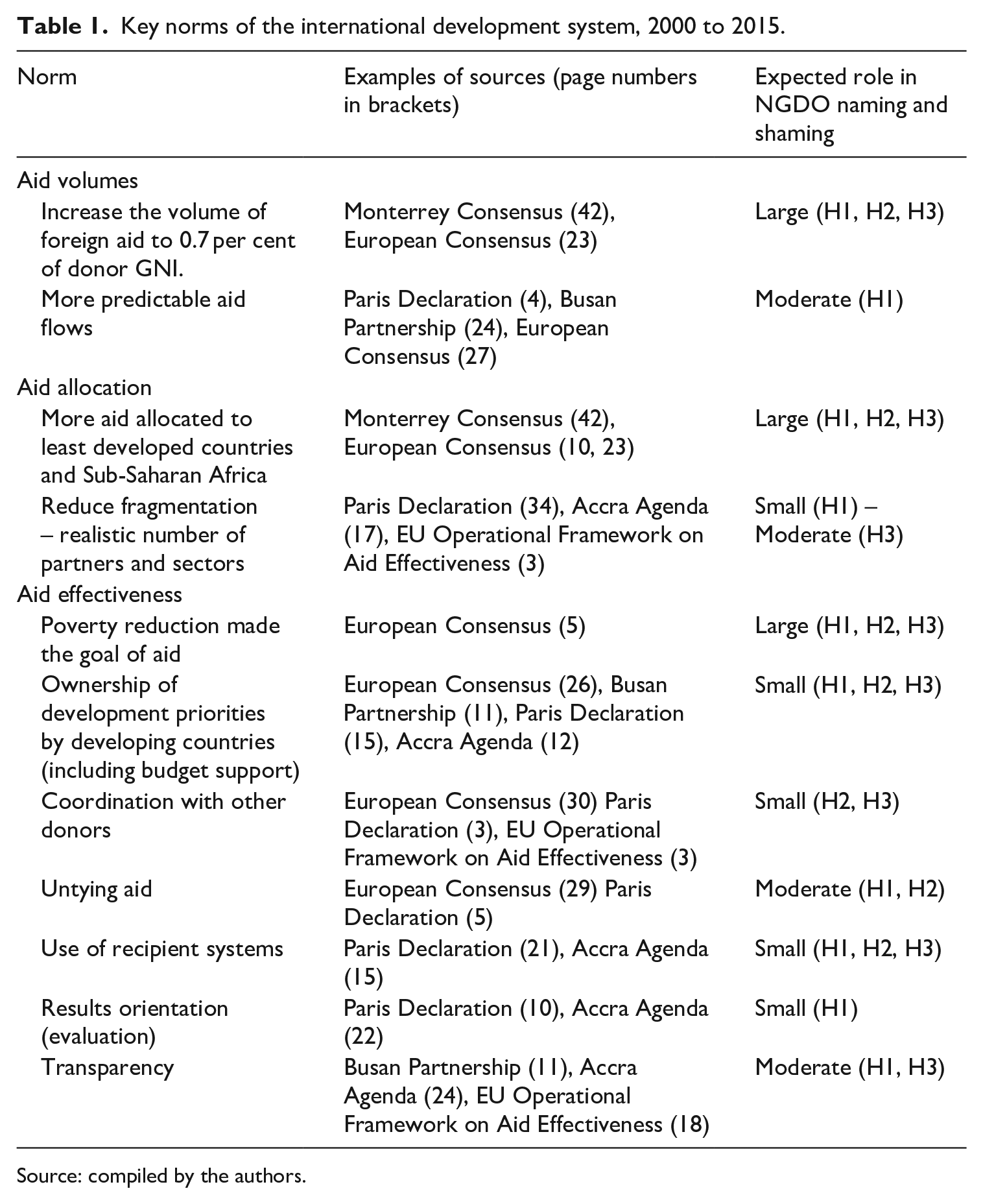
Table 1 provides an overview of the most widely mentioned foreign aid norms, and also includes expectations on NGDO shaming behaviour based on the three hypotheses. For example, shaming donors in not meeting the 0.7 per cent aid target is expected to play a large role in naming and shaming behaviour, as it is consistent with all three hypotheses. Many of the norms related to aid quality, however, such as budget support, greater donor coordination, untying aid, or using recipient country systems are expected to figure much less prominently, as these can hurt access to funding, have lower public resonance and may be costly to monitor.
Key norms of the international development system, 2000 to 2015.
Source: compiled by the authors.
Identifying the norms promoted by European NGDOs
The paper uses CONCORD’s annual AidWatch Reports between 2006 and 2015 as the main source of data to identify the norms actually promoted by European NGDOs through naming and shaming. These reports have emerged as the most important advocacy reports of the European NGDO community. Each year, AidWatch provides an in-depth scrutiny of the international development policies of EU member states and the EC, calling attention to weak performance and formulating demands and recommendations. The naming and shaming of weak performance in the Reports can create reputational costs for the governments and offer ammunition to the opposition parties and other actors willing to criticise the government for inaction. The Reports are representative of the NGDO community’s views: CONCORD, which according to its website is made up of ‘28 national associations, 20 international networks and 3 associate members that represent over 2,600 NGOs’, is the central advocacy organisation of the community. AidWatch is a pan-European collective exercise: CONCORD’s national level members all take part in drafting the report, making it a bottom-up process which channels the concerns of European NGDOs into a single flagship publication. While there are a number of other, more specialist networks publishing aid advocacy reports, CONCORD’s AidWatch represents a pan-European ‘common denominator’ view on the topic.
In order to complement the data from the AidWatch Reports, semi-structured qualitative interviews were also carried out in two rounds, between January and July 2013 and March and April 2017 with experts at CONCORD’s secretariat in Brussels, as well as experts working at CONCORD’s members who have been involved with the reports. The total pool of potential interviewees was relatively small: each national NGDO association would generally have a single person working on AidWatch, with a small team at CONCORD coordinating and leading these efforts. We contacted the AidWatch leads at all 28 national NGDO associations using their publically available email addresses, as well as the main coordinator at CONCORD. Due to non-response and other difficulties, 13 interviews were carried out in the end. This is a good coverage of the total population, and the sample reflects the variation among CONCORD members well: respondents from both Western and Eastern member states, as well as traditionally relatively large donor countries (e.g. Germany, the UK and Sweden) and smaller donors (e.g. Austria, Czechia and Poland) were all represented. Interviews were carried out over the phone, and interviewees were asked open questions about their advocacy priorities, funding concerns, and their perceptions of how the AidWatch Reports are drafted (see the Appendix for the interview guide). All interviews were recorded and later transcribed. Further details on the interviews are listed at the end of the paper, but the respondents remain anonymous due to reasons of confidentiality.
The resulting dataset of AidWatch Reports and interviews was analysed using qualitative text analysis, with the aim of identifying how the data relates to the norms in Table 1. In each text, mentions of the specific norms in the three groups of aid quantity, allocation and effectiveness were identified, with the view of establishing how NGDOs relate to these. Each mention was then coded based on how much emphasis is placed on it within the text, how much detail or discussion was provided on it, and what context it was mentioned in. We also looked at the wording NGDOs used for each mention of a norm. This approach allowed us to identify which norms NGDOs have been the most active in promoting and the ones they have been less vocal on. The following section presents the results of this exercise, and examines the evidence it provides for the three hypotheses.
Selective norm promotion?
Themes in the AidWatch Reports
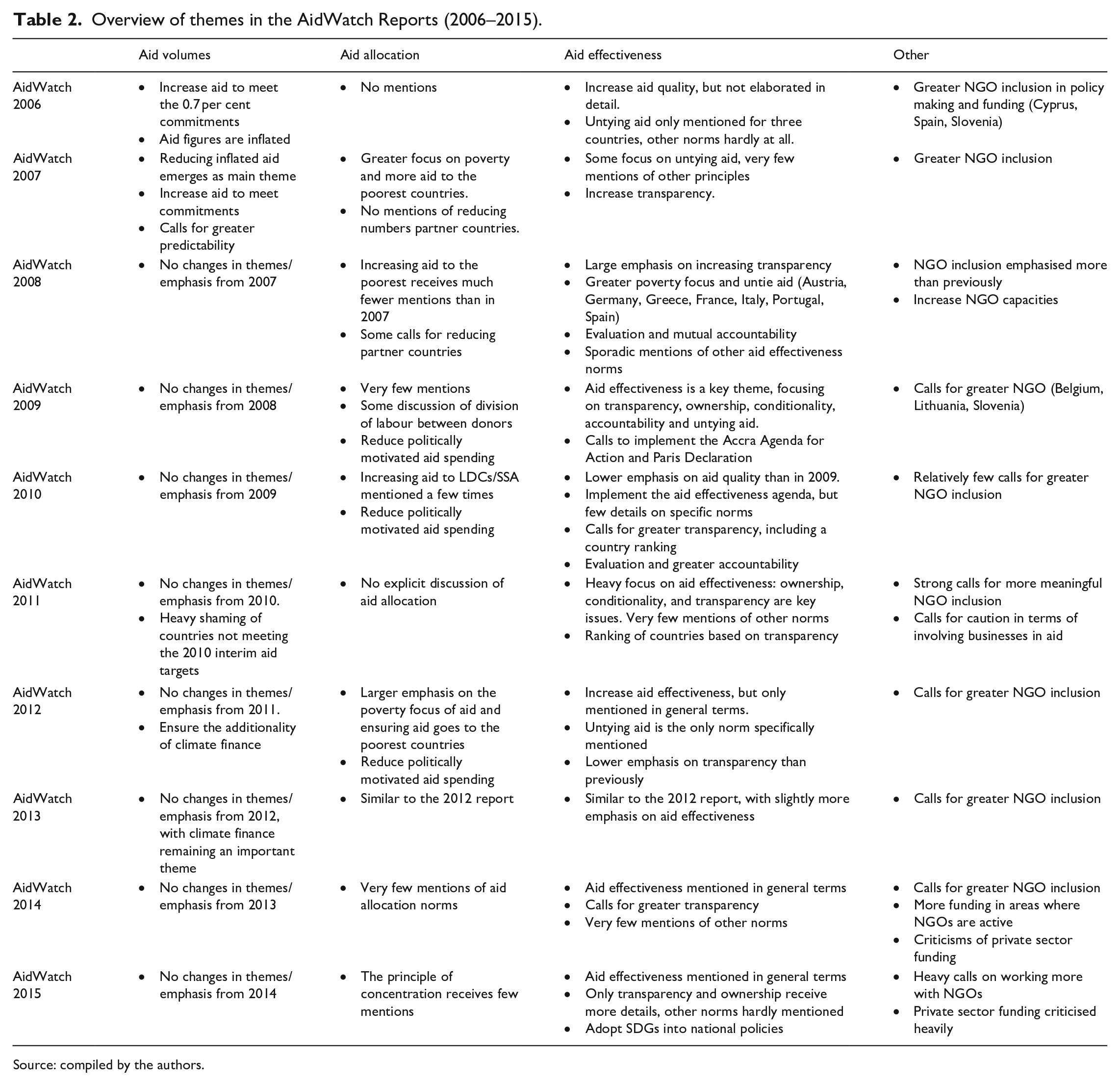
The results of the analysis of the AidWatch Reports are summarised in Table 2.
Overview of themes in the AidWatch Reports (2006–2015).
Source: compiled by the authors.
Aid volumes figure very prominently in all AidWatch Reports throughout the 2006 to 2015 period. All reports include very detailed follow-ups on how member states are progressing towards implementing their commitments. Countries failing to show progress are named and shamed. For instance, in 2007, Greece, Italy, Portugal and Spain were singled out as having missed the 2006 interim target of allocating at least 0.39 per cent of their GNI to aid. In 2008, Hungary was shamed as ‘the worst performer’ in regard to its obligation to increase aid. Similar critical assessments were present in later reports, although the rhetoric was scaled down in intensity. Not even the better performing countries (such as Denmark, Ireland, Luxembourg, or Sweden) were spared, as the NGDOs called on these countries to increase aid volumes even more ambitiously. The 2015 AidWatch Report 52 concluded that the EU’s inability to reach the target has ‘eroded the EU’s credibility’. A major reason behind the shortfall in donor spending was the global economic crisis, and European NGDOs acknowledged this. As the crisis hit the EU, the AidWatch Reports turned their attention to the predictability of aid flows, which was couched in language calling on EU governments to adopt either a strict timetable for aid increases, or a law binding them to provide aid above a certain level of GNI. 53
The AidWatch Reports also show that NGDOs contested the way donors report their aid figures. The reports argue that the OECD DAC’s framework on what items can be included in its statistical definition of aid, official development assistance (ODA), is problematic. The 2006 AidWatch Report 54 argued that expenditures related to hosting refugees, debt relief, scholarships to students from developing countries, and security and climate change related expenses should not be counted as ODA, as none of these items contributed directly to poverty reduction in developing countries. Moreover, many of these expenditures stay in the donor country and never reach developing countries. 55 NGDOs insisted that ‘genuine’ aid should be delivered to developing countries and called for a ‘clean up in aid reporting to ensure that the only aid that is counted is aid that saves lives and not simply that which saves face’. 56 The language used to shame the individual member states was at times rather harsh, for instance, Austria, Germany, Greece, Italy, Portugal, and Spain were warned that they will face a ‘serious embarrassment’ if they do not stop inflating aid. 57 The shaming of countries relating to counting expenditure on supposedly non-developmental items remained a continuous feature of the reports, and has gained even more ground during the European refugee crisis, when many donors diverted parts of their to financing refugee costs. 58
Aid allocation norms rarely figured prominently in the AidWatch Reports. There were sporadic calls on donors for greater focus on poverty and more aid to the poorest countries. Reducing the number of countries and sectors that a donor supports, and thus reducing the fragmentation of scarce aid resources, also received relatively few mentions and were never elaborated in detail. Greater calls for focusing aid to poor countries really only began to emerge after 2010. The central theme of the 2010 report for example was the need to focus on poverty reduction and argued that member states need to increase aid to reach the poverty target of the MDGs. 59 Countries which were perceived to have a low poverty focus were regularly shamed in the reports, 60 and many countries were charged with what NGDOs termed as ‘politically motivated aid spending’, that is, using aid for security purposes or to reduce migration.
Norms related to overall aid effectiveness were also clearly a concern for NGDOs, especially the ones formulated by the Paris Declaration, the Accra Agenda for Action and the Busan Partnership. The issue of aid effectiveness was present in most AidWatch Reports, their treatment however seemed at times rather sketchy. In fact, the 2006 and 2007 reports hardly dealt with the topic, and it emerged as a subject only in 2008, but even then the focus was mainly on transparency and the existence of impact evaluations. 61 Later reports, especially the ones in 2009 and 2011, often called on EU members to increase the effectiveness of their aid, but were rather vague on the details, and rarely examined member state performance in a systematic way. The norms which were most prominent included transparency, ownership, accountability and untying aid. Transparency figured especially strongly in a number of reports, and uniquely among the aid effectiveness norms, received rather systematic treatment, including cross-national comparison. 62
However, NGDOs were relatively silent on a number of other aid effectiveness norms: (1) the usage of budget support, (2) coordination between donors, and (3) alignment with recipient country systems. Budget support was only marginally voiced as a demand in case of one or two countries each year at best. Coordination between donors again featured only very marginally in the reports. Some national NGDO platforms, such as the Czech and the German ones, voiced it as demands towards their own governments on some occasions, 63 but it was never featured as an overarching theme. Using country systems was again only mentioned sporadically.
The reports also featured calls for policy changes not covered by the norms listed in Table 1. While there is no strong international norm stipulating that Northern NGDOs have to be involved in aid policy making or delivery, the members of CONCORD did not shy away from demanding a greater role in these processes, and greater amounts of resources channelled through them. These demands came close to advocating for corporatist arrangements in relations between NGDOs and governments, and the language used at times appeared to be self-serving. In the earlier reports, only the new member states were criticised for not sufficiently involving NGDOs, but later Portugal, Finland, Ireland and Luxembourg were also called on to ensure greater NGDO involvement. Also, while calling on greater participation for themselves, NGDOs were advising caution towards giving a greater role to corporate actors in international development, especially in the AidWatch Reports from 2011 on. The reports argued that involving these actors should follow clear rules to ensure they are accountable and also a follow a logic of poverty reduction.
Funding, resonance or monitoring costs?
The results presented in Table 2 are consistent with all three hypotheses: NGDOs placed an overwhelming emphasis on aid volumes, which received highly detailed and structured discussions in almost all AidWatch Reports, while the treatment of norms related to aid allocation and aid effectiveness was non-systematic and often lacked details. Beyond this general trend, further details compatible with the individual hypotheses have emerged from the analysis, which we discuss in this section, together with the evidence from the interviews.
As discussed, greater aid volumes are likely to translate into more funds channelled through NGDOs. Hypothesis 1 is also supported by calls for more ‘genuine’ aid: typically, NGDOs do not benefit from inflated aid items such as student costs or debt forgiveness. Calling on donors to increase their ‘genuine’ aid, the amounts actually spent in developing partner countries, would increase the available pot of money for NGDOs. There were also many instances in the AidWatch Reports where NGDOs called for their own greater inclusion in policy making and implementation. A stronger role in planning would mean NGDOs could have an influence on the types of projects funded by the donors, and push for projects where they have a comparative advantage (such as awareness raising, education and healthcare). A stronger role in implementation would imply more funds channelled through NGDOs. The emphasis on the norm of predictability in the Reports also links to NGDO funding: unless aid flows, especially those that are channelled through NGDOs, are predictable, NGDOs will face difficulties in sustaining their activities. NGDOs were also highly vocal against donors involving other actors, such as private companies, in aid implementation, which can increase the competition for funding and thus have an adverse impact on NGDO finances.
While these observations all provide evidence for Hypothesis 1, the interview data only offer partial support. While it is clear that NGDO representatives would be reluctant to admit that their advocacy, couched in altruistic terms of supporting the poor, is actually driven by their own funding concerns and organisational survival, some evidence for this did emerge. Many respondents have expressed their frustration regarding the funding landscape, and how governments are not providing enough resources for NGDOs, or have cut back their NGDO funding facilities following the financial crisis. 64 But only one interviewee stated explicitly that demands for more aid are driven by NGDO funding concerns. 65 Some respondents argued that the larger NGDOs, who are also the most vocal in advocacy, have diversified funding streams and rely less on government funding, 66 thus the size of their country’s aid budget is not a chief concern for their survival. Another interviewee argued that smaller government aid budgets should actually be welcome, as they would force NGDOs to engage more with their grassroots. 67
There is also an emerging divide between NGDOs from Western and Eastern member states. Untying aid, or implementing other development effectiveness reforms are seen to have a lower impact on Western NGDOs, who are highly competitive and can access funds even if there is greater competition. 68 Eastern NGDOs on the other hand are much more dependent on government funding, 69 and have even lobbied the EC extensively to guarantee that a part of the EU’s aid budget will be allocated to them. 70 Calls for untying aid, joint programming, or budget support, all of which would harm NGDO access to funding, are very rare demands from Eastern NGDOs in the AidWatch Report, while calls for greater NGDO inclusion in aid implementation are more common. In the 2015 AidWatch Report, for example, calls for greater NGDO involvement almost exclusively came from Eastern (Bulgaria, Estonia, Hungary, Poland, and Romania), and to a lesser degree Southern member states. 71 Furthermore, as stated by a representative of CONCORD, EU-12 NGOs are less critical in the AidWatch Reports so as not to alienate their governments and ensure funding is available. 72
Hypothesis 2 argued that NGDOs are more likely to promote norms which have higher public resonance, such as increasing aid volumes. The AidWatch Reports also advocate very strongly for aid to be focused on poverty reduction as opposed to other goals, which, as discussed, also has strong public resonance in Europe. Many of the reports provided data to illustrate what living in poverty actually means in developing countries, 73 and by providing real life examples, it makes the necessity of poverty reduction resonate better with readers. The overall vague calls for increasing aid effectiveness and the lack of discussion on norms like budget support are also in line with what is expected based on the Eurobarometer surveys and Hypothesis 2. Many aid effectiveness norms are technical, and it thus may be more difficult to get the message across to the public. For example, the benefits for reducing poverty from using recipient public procurement systems are more difficult to communicate than those from giving more aid. Some aid effectiveness norms, like budget support, may also raise unwanted associations with corruption, which clearly do not resonate with the public’s view on aid.
Interviews provide further evidence that resonance is a concern for NGDOs when engaging in naming and shaming. Interviewees argued that keeping AidWatch relatively simple is a key concern, and while jargon cannot be avoided, they do not go into too technical issues. 74 The Paris/Accra/Busan aid effectiveness architecture has become very technical, 75 and it does not read well in advocacy terms. Donor coordination simply does not catch the eye of the readers, and so discussion on it is kept to a minimum. 76 One interviewee suggested that most readers are interested in comparative tables with numbers. 77 Such tables make it obvious why some countries are branded ‘best-performers’ and others are shamed as ‘worst-performers’. Readers are interested in how their country compares to others, look at the tables, and skip the narrative part. Numbers however are only available for aid quantity, and not for quality. In fact, it seems that aid effectiveness does not have strong resonance even within the NGDO community itself: many NGDOs are not interested in the topic, 78 and national platforms find it difficult to get them on board with effectiveness related advocacy. As stated by a Dutch interview: ‘Aid effectiveness is not really a topic in the Dutch policy debates. The Netherlands does well in the field, so NGOs don’t really bug the government on this issue.’ 79
Hypothesis 3, arguing that NGDOs promote norms which are less costly to monitor, is also supported by the themes emerging from the AidWatch Reports. Data on aid quantity is virtually costless for NGDOs to access, and this is indeed the main theme in all the reports. Detailed and systematic comparisons of aid effectiveness issues is only present for transparency, where CONCORD received ready to use data from Publish What You Fund, an international initiative aimed at increasing the transparency of aid. 80 As shown in Table 2, all other aid effectiveness norms, for which comparable, cross-country data is not available, received much sketchier treatment.
Interviews provide strong support for the monitoring costs hypothesis, with many interviewees stating that the reason that aid volumes receive much more attention is because data on them are readily accessible. Aid quality would require more detailed follow-up, and the national NGDO associations that are members of CONCORD do not have the necessary capacities for this.
81
One interviewee argued that the information does not exist centrally within the national aid agencies, and they would need to contact several different officials to be able to collect and compile the data.
82
It would also be very difficult to compare and succinctly present the different types of aid modalities, conditions attached, and individual project characteristics, all of which have an impact on aid effectiveness. Another interviewee stated that
AidWatch is the only CONCORD activity where all national platforms work together. Extending it to go beyond numbers and look into more qualitative issues would make it difficult for many platforms to participate, as they do not have the capacities to engage in detailed qualitative analysis.
83
This implies that the success of the AidWatch is enabled by the relative simplicity of the data it uses. Going into more detailed qualitative analysis of aid effectiveness is not seen as feasible for many national platforms. However, many NGDO respondents, especially ones from the newer member states, also argued that greater government transparency is essential, as they have trouble accessing the data they need for their advocacy. 84 This theme was emphasised in the 2009 and 2010 AidWatch Reports as well, which provided comparative tables detailing the shortcomings of member states in ensuring transparency, naming and shaming less-transparent donors, for instance, Italy, Luxembourg, Bulgaria, Slovakia and Slovenia. Transparency remained a major theme in later reports as well. 85
Conclusion
The paper aimed at providing a deeper understanding of the motivations and strategic drivers of NGOs engaged in naming and shaming activities, by focusing on organisations in the field of international development. The paper examined the naming and shaming practices of European NGDOs towards the European Commission and national governments, by empirically focusing on CONCORD’s AidWatch Reports and comparing the norms promoted by the NGDOs in these to the body of norms generally seen as accepted in the international development system. European NGDOs have been rather selective in their norm promotion through their naming and shaming practices: the most visible imbalance is the overwhelming emphasis on increasing the volume of aid and a relative lack of discussion on aid effectiveness. NGDOs have also contested the OECD’s definition of aid, have called for greater predictability and transparency, as well as for their own greater involvement in international development. On the other hand, they were rather silent on a number of aid effectiveness norms, such as budget support, coordination between donors, alignment with recipient country systems, and reducing fragmentation.
Using a broader conceptualisation of NGDO interests than has been the case in the literature, the paper put forward three hypotheses to explain these phenomena. The first hypothesis argued that NGDOs promote development norms through naming and shaming which are more likely to improve their access to funding. The data from AidWatch was clearly consistent with this, with the overarching emphasis on increasing aid, especially genuine aid which actually reaches the partner countries. Calls to include the NGDO community to a greater degree in aid planning and delivery also supported this hypothesis; casual evidence from interviews, was, however, limited. Also, NGDOs from Eastern EU member states seem to have been driven much more strongly by funding concerns than Western ones. The second hypothesis stated that NGDOs promote development norms through their naming and shaming activities which resonate with the public. There was strong evidence for this, given the correlation between European public opinion on development and the contents of the AidWatch Reports. Interviews revealed that ensuring resonance was indeed a high priority for NGDOs in their naming and shaming, and they consciously avoided placing too much emphasis on topics which were perceived as having low public resonance. The final hypothesis argued that NGDOs promote norms which have lower monitoring costs. Transparency and access to data were important themes in the reports, and NGDOs have generally been more vocal on issues on which internationally comparable and publically available data exists.
The three hypotheses are not mutually exclusive, and should be seen as complementary. Promoting an increase in aid volumes is consistent with all three, and this is indeed the single most visible topic in European NGDO naming and shaming. The complementary nature of the three hypotheses also means that one needs to be careful when making individual judgements about them. While evidence from the interviews for the second and third hypotheses are stronger, even more detailed research would be required to establish the relative influence of each NGDO motivation on their approaches to advocacy.
What are the consequences of this behaviour of NGDOs, and what lessons do these findings hold for understanding the drivers of NGO naming and shaming practices in other areas? Three points emerge. First, all three explanations above paint a picture of NGDOs acting as rational actors making strategic choices. We do not question the moral considerations which drive NGDO behaviour, but these are clearly moderated by a number of strategic decisions, pointing to the fact that the drivers of these organisations can be complex. These findings are consistent with research looking into the motivations of other types of NGOs, such as in the area of human rights. 86 Second, this complex set of drivers might lead to norm advocacy calling for policy change which may actually be suboptimal for the global poor, the very constituency European NGDOs are aiming to support. There is considerable academic literature arguing that too much aid does more harm than good, 87 and donors should rather concentrate on enhancing the effectiveness of existing aid flows. Finally, our findings provide evidence that the present system of funding European civil society to implement development projects in the South is flawed, offering perverse incentives to NGDOs to compete with each other and other actors, which resonates with the findings of Cooley and Ron. 88 Future research would therefore need to focus on how these funding regimes could be redesigned to remove these incentives.
Footnotes
Appendix: interview schedule
Acknowledgements
The authors are grateful to Faradj Koliev, Jonas Tallberg, Magnus Lundgren, Uwe Wunderlich, Sarah Delputte and Paul Hoebink for comments on earlier drafts. Any remaining errors in the paper remain our own.
List of Interviews
INT#01: Representative of an NGDO from Western member state, 20/04/2017.
INT#02: Representative of an NGDO from Western member state, 03/04/2017.
INT#03: Representative of an NGDO from Western member state, 03/03/2017.
INT#04: Representative of an NGDO from Western member state, 15/03/2017.
INT#05: Representative of an NGDO from Western member state, 06/03/2017.
INT#06: Representative of an NGDO from Western member state, 06/03/2017.
INT#07: Representative of an NGDO from Western member state, 06/03/2017.
INT#08: Representative of an EU-wide advocacy network, 03/03/2017.
INT#09: Representative of an EU-wide advocacy network, 23/01/2013.
INT#10: Representative of an NGDO from Western member state, 03/03/2017.
INT#11: Representative of an NGDO from Eastern member state, 04/03/2013.
INT#12: Representative of an NGDO from Eastern member state, 05/07/2013.
INT#13: Representative of an EU-wide advocacy network, 06/06/2017.
Funding
The author(s) received no financial support for the research, authorship, and/or publication of this article.
