



Abstract
The COVID-19 pandemic catalyzed sustained online learning integration. This shift has disrupted adolescents’ social ecosystems and heightened mental health risks. This study examines loneliness as a mediator between perceived social support and psychological resilience among Chinese junior high school students engaged in ongoing online learning, and explores variations across gender and developmental stages. Using data from 583 adolescents recruited from a public junior high school in Zhuhai, China, this study employed structural equation modeling (SEM) to test the hypothesized mediation model. Validated scales were used to measure perceived social support, psychological resilience, and loneliness. Loneliness served as a significant partial mediator, accounting for 17.9% of the total effect. Social support showed a strong direct effect on resilience (β = .738), though contextual factors appear to filter these benefits. High family support (M = 5.33) co-occurred with sustained loneliness (M = 2.03) among 16-year-olds, potentially reflecting culturally specific patterns where academic oversight may overshadow emotional validation. Loneliness peaked at age 14 (M = 2.63), coinciding with developmental vulnerability. Digital communication constraints (eg, lack of nonverbal cues) were associated with reduced relational depth among students with low social support (r = –.477). Boys reported higher resilience (M = 3.71, d = 0.3), while girls reported greater loneliness (M = 2.39, d = −0.21). These findings highlight the need for tailored interventions that enhance digital support systems and enable timely identification of at-risk students. This study proposes a Digital Resilience Framework contextualizing the mediation effect within cultural, developmental, and digital dimensions, with implications for supporting adolescent well-being in post-pandemic education.
Keywords
Highlights
This study empirically investigates the relationship between perceived social support and psychological resilience among Chinese junior high school students using structural equation modeling (SEM).
A theoretical mediation model is constructed, identifying loneliness as a significant partial mediator in the relationship.
Key contextual factors including cultural pressures, developmental stages, and gendered coping styles are identified, shaping the psychological outcomes in online learning environments.
Introduction
The White Paper on Smart Education released by China’s Ministry of Education 1 establishes the COVID-19 pandemic as a catalytic threshold for digital education, driven by persistent social distancing requirements, 2 and prolonged remote adaptation. 3 These transformations have become a new normal marked by sustained online learning integration, creating lasting disruptions in adolescents’ social ecosystems during critical developmental transitions. 4 Public health measures, with mandated online schooling as a primary catalyst, exacerbate mental health risks through 3 synergistic pathways: (1) social fragmentation through isolation and reduced prosocial opportunities, 5 (2) Restricted access to communal leisure activities, and (3) the systematic absence of nonverbal cues (facial expressions, vocal tones, and gestural signals) essential for emotional communication in digital platforms. 6 This structural limitation compromises relational depth, which may increase risks of loneliness and anxiety among adolescents. 7
Therefore, the shift to online learning has paradoxically intensified adolescents’ mental health vulnerabilities. Loneliness, or perceived social isolation, 8 is particularly consequential during middle school years when students navigate academic, social, and biological transitions. 9 Neurodevelopmental research indicates that Early-to-middle adolescence (ages 14-16) represents a period of neurodevelopmental sensitivity. 10 This sensitivity peaks around age 14, as large-scale longitudinal studies demonstrate that cortical thinning within key “social brain” regions reaches its fastest rate at this age. 11 These regions include the medial prefrontal cortex (mPFC) and temporo-parietal junction (TPJ). 12 This neurostructural maturation coincides with heightened sensitivity to peer evaluation, making adolescents exceptionally dependent on quality social interactions. When pandemic lockdowns deprived them of essential offline connections during this sensitive period, loneliness may have surged, diminishing sense of belonging and elevating risks of anxiety and depression. 13 Understanding how loneliness functions within digital learning contexts is therefore critical for supporting adolescent adjustment in the post-pandemic era.
Within this challenging context, Perceived social support defined as subjective satisfaction with environmental respect, understanding, and assistance, serves as a critical protective factor for adolescent well-being. 14 According to the buffering hypothesis, 15 social support alleviates stress and promotes well-being, a mechanism that was put to the ultimate test during the isolation periods of the COVID-19 pandemic. Psychological resilience, the capacity to adapt to and recover from adversity, 16 correlates positively with perceived support. 17 However, the unique stressors of pandemic-era online learning, characterized by prolonged confinement and cues-filtered-out context, have complicated this direct relationship.
We propose that loneliness is a key psychological mechanism explaining this altered pathway. Loneliness inversely impacts resilience by exacerbating depressive symptoms and diminishing well-being, 18 establishing a triadic interplay among support, loneliness, and resilience. Emerging evidence suggests social support may indirectly influence resilience through reduced loneliness, 19 particularly during enforced remote learning. This mediating role is consistent with loneliness’s nature as an internal emotional state directly shaped by the social environment, which in turn impacts adaptive capacity. 20 As established in mediation theory, 21 this positions loneliness as the psychological process through which diminished support depletes resilience resources.
More importantly, this mediating pathway is not universal but is filtered through intersecting contextual layers specific to post-pandemic China. Grounded in Confucian values, Chinese parenting is often characterized by the concept of guan, which encompasses both caring love and strict governance, blurring the line between emotional support and academic supervision. 22 Similarly, the dual nature of Chinese parenting, where high control coexists with strong affection, 23 may lead to discrepancies between objective support and subjective emotional fulfillment. Consequently, well-intentioned parental involvement can be experienced by adolescents as performance-oriented surveillance, 24 potentially explaining why high familial support may coexist with sustained loneliness. Concurrently, 16-year-olds face acute pressure from the high-stakes entrance examination for senior high school, amplifying familial support-performance anxiety tensions. 25 Furthermore, gendered coping repertoires may shape these responses. Theoretical models suggest differential patterns, with males often employing instrumental problem-solving and females relational preservation. 26 The condition of cues-filtered-out in online learning may differentially impact these strategies, though such gendered coping styles are theorized and not directly measured in this study.
To address this gap, the present study investigates the relationship between perceived social support and psychological resilience among Chinese junior high school students who continue to experience online learning, explicitly testing loneliness as a mediator. We further explore how this relationship varies across developmental stages (ages 14-16) and between genders, thereby situating the core analysis within the salient contextual frameworks discussed. By doing so, this study aims not only to test a mediation model but to illuminate how this mechanism is shaped by the confluence of cultural pressures, developmental vulnerabilities, and digital communication constraints. The following hypotheses are proposed:
To address the gaps identified above, the present study employs structural equation modeling to test the hypothesized mediation model using data from Chinese junior high school students. The study aims to: (1) evaluate the mediating role of loneliness in the relationship between perceived social support and psychological resilience; and (2) examine group differences in key variables across gender (

The proposed structural equation model.
Literature Review
The Introduction established that adolescent mental health in post-pandemic digital learning is shaped by a complex interplay of social support, loneliness, and resilience, further filtered by cultural, developmental, and digital contexts. This literature review builds that conceptual model in 3 steps. First, it examines how perceived social support is uniquely constructed and constrained within Chinese cultural scripts and digital communication. Second, it details how loneliness arises from the confluence of adolescent neuro-developmental vulnerability and the relational deficits of online platforms. Third, it conceptualizes psychological resilience as a dynamic outcome that is both scaffolded and tested through these digitally-mediated relationships. Synthesizing these strands, the final section proposes an integrated mediation model, positioning loneliness as the critical mechanism linking support to resilience within this multifaceted context.
Perceived Social Support in Digital and Cultural Context
Perceived social support, often understood as an individual’s subjective appraisal of available relational resources, is a cornerstone of adolescent well-being. 27 Its predictive power often surpasses that of objectively received support, highlighting the critical role of personal interpretation. 28 This interpretation, however, is not neutral. It is first filtered through culturally-specific scripts. In societies influenced by Confucianism, such as China. 29 The concept of guan, which blends caring love with strict governance. In practice, parental support often manifests as deep involvement in academic monitoring. While well-intentioned, such support may be perceived by adolescents as surveillance rather than emotional validation, 30 creating a paradox where high tangible support coexists with emotional neglect and latent vulnerability to loneliness. 31
This culturally-shaped perception subsequently undergoes a second, critical filtration through the medium of digital communication. This process is explained by cues-filtered-out theories, 32 which posit that computer-mediated communication inherently strips away nonverbal and paralinguistic cues (eg, facial expressions, tone of voice, gesture), thereby hindering the socioemotional functions these cues serve. Contemporary research confirms that digital interaction under cues-filtered-out conditions leads to systematically lower perceptions of empathy and relational quality compared to face-to-face encounters. 6
The buffering hypothesis posits that social support promotes adaptation by mitigating stress. 33 However, in the context of online learning, the stressor itself is frequently relational, such as the feelings of isolation and disconnection that are common in this environment. 5 For social support to effectively buffer this stress, it must respond meaningfully to these socio-emotional needs. When support is perceived through a cultural lens as a mechanism of surveillance, or when it is provided digitally devoid of emotional presence, its efficacy in mitigating relational stress can be considerably diminished. Students who still perceive strong support under these conditions show notable resilience and coping skills, highlighting the crucial role of personal interpretation. Thus, perceived social support is better understood not as a fixed resource, but as a dynamic result of cultural and digital mediation. This outcome in turn shapes the emotional and adaptive experiences of adolescents in digital learning.
Loneliness in Adolescent Development and Digital Learning
Loneliness, a distressing state arising from perceived gaps between desired and actual social connections, 8 is particularly prevalent during adolescence, a life stage marked by significant social reorientation. 9 Early-to-middle adolescence (ages 14-16) represents a peak vulnerability period amplified by neurodevelopmental forces. Key social brain regions, including the medial prefrontal cortex and temporo-parietal junction, undergo significant structural maturation during this phase. Large-scale longitudinal studies demonstrate that cortical thinning within these regions reaches its fastest rate around age 14, 12 heightening adolescents’ sensitivity to peer evaluation and rendering them exceptionally vulnerable to social disconnection. 10
The post-pandemic shift to sustained online learning creates an environment that systematically exploits this developmental vulnerability. Digital educational platforms operate under fundamentally cues-filtered-out parameters. They strip away the non verbal cues such as facial expressions, gaze, tone of voice, and gestural synchrony that are foundational for conveying empathy, understanding, and relational warmth. 6 This impoverishment of communication channels leads to a phenomenon of emotional flattening in interactions. Consequently, communication intended as supportive or engaging can be perceived as impersonal, ambiguous, or even cold, which increases the risk of misinterpretation and leaves adolescents feeling relationally unseen. The structured and often asynchronous nature of virtual classrooms further compounds this issue by drastically reducing opportunities for the spontaneous, informal interactions that are crucial for building and maintaining friendships, thereby weakening the very fabric of peer support. 34
Within the Chinese cultural context, these digital relational challenges are compounded by intense, systemically enforced academic pressures. In an ecosystem where academic achievement is intensely prioritized, students may interpret the reduction in personalized, immediate teacher feedback within large online classes as a sign of personal failure or neglect, intensifying feelings of isolation. 35 The high stakes examination pressure, particularly for 16 year olds facing the Zhongkao, frames a significant portion of parent adolescent interaction around academic performance and monitoring. Adolescents may thus occupy a crowded digital space that is high in academic traffic but low in authentic emotional connection, leading to a specific form of academically framed loneliness. This entails feeling isolated amidst pervasive academic surveillance and pressure, a dynamic where familial involvement may not alleviate but paradoxically sustain loneliness.36,37
Thus, loneliness in the context of this study is not merely a function of social isolation. It is better conceptualized as a state of perceived relational deprivation that is developmentally primed by the maturing adolescent social brain, structurally induced by the cue-filtered-out architecture of digital learning platforms, and culturally nuanced by an ecosystem that often conflates academic involvement with emotional support. This multifaceted understanding positions loneliness not as a peripheral outcome, but as a central and potent affective experience. It is this experience that is likely to directly deplete the cognitive and emotional resources necessary for resilient adaptation, thereby forming a critical mediating pathway between social support and psychological resilience.
Psychological Resilience
Psychological resilience, the capacity to adapt to adversity and recover from stress, 38 is a critical protective factor for adolescents navigating developmental challenges. 39 Rather than a static trait, resilience is a dynamic process emerging from continuous transactions between individuals and their environments. 40 The context of prolonged online learning gives rise to the related construct of digital resilience, encompassing specific skills needed to persist and adapt within digital environments, such as troubleshooting technical issues and self-regulating attention. 41
Resilience development is scaffolded by supportive social relationships. The buffering hypothesis posits that social support mitigates stress by providing emotional, informational, and instrumental resources. 42 For adolescents in online learning, perceived support from family, peers, and teachers can help reframe challenges, such as technical failures and feelings of isolation, as manageable setbacks rather than insurmountable obstacles. 43 Empirically, family support through co-created study routines reduces academic overwhelm, while peer support via virtual study groups fosters collaborative problem-solving. 44
However, the relational foundations necessary for building resilience are systematically strained within digital learning environments. The cue-filtered-out nature of online communication impedes transmission of emotional warmth and understanding, core components of authentic psychosocial support. 6 When support is delivered through such constrained channels, its potential to be perceived as genuinely connected is weakened. As a result, the efficacy of social support in promoting resilience becomes contingent on a fragile perception of emotional connection that is difficult to establish and maintain in digital spaces.
Cultural context further shapes this dynamic. Within Chinese collectivist societies, family cohesion and filial responsibility serve as culturally-embedded resources fostering perseverance and duty. 45 Yet this cultural strength can intersect paradoxically with digital educational environments. When familial involvement is experienced as academic monitoring rather than emotional connection, the resilience-building function of family support may be compromised. 46 Resilience, then, is not merely an individual accomplishment but a psychosocial outcome dependent on the quality and subjective perception of digitally-mediated relationships.
Therefore, psychological resilience in post-pandemic digital learning is a multifaceted adaptive outcome, dynamically built through social connections yet simultaneously tested by the digital medium that filters those connections. Resilience can thus be seen as a key outcome influenced through dual pathways: directly by perceived social support, and indirectly through the reduction of loneliness that effective support facilitates.
Integrating the Pathways: The Mediating Role of Loneliness
While the distinct influences of digital, developmental, and cultural contexts on social support, loneliness, and resilience are established, how these factors converge to shape the pathways between them remains unanswered. We propose a mediation model in which loneliness serves as the pivotal mechanism through which perceived social support influences psychological resilience in post-pandemic digital learning.
This model refines the traditional buffering hypothesis by accounting for the relational nature of digital learning stress. While the buffering hypothesis posits that social support facilitates adaptation primarily by alleviating external stressors, the context of sustained online learning presents a distinct dynamic. Here, the predominant stressors are fundamentally relational, arising from experiences of isolation, social disconnection, and impoverished peer interaction. For support to effectively buffer this stress, it must be perceived as meeting adolescents’ core socio-emotional needs for connection and belonging.
However, the pathway through which support is perceived is obstructed by dual filtration. First, culturally-shaped scripts may lead familial support (eg, guan) to be perceived as academic surveillance rather than emotional sustenance. Second, the cue-filtered-out digital medium strips communication of nonverbal cues essential for conveying empathy and warmth. When support is perceived through these combined filters, its capacity to satisfy relational needs and buffer relational stress is compromised.
Theoretically, loneliness represents the most direct manifestation of unmet relational needs. Defined as the affective experience stemming from perceived deficits in social relationships, loneliness operates in online learning not as a mere correlated outcome but as the key explanatory mechanism linking deficient perceptions of support to diminished resilience. It functions as an affective bridge connecting support systems perceived as failing to provide relational nourishment to the consequent erosion of adaptive capacity.
This resultant loneliness depletes cognitive and emotional resources (including problem-solving focus, self-efficacy, and optimism) that are foundational for resilient adaptation. We therefore posit that the pathway from perceived social support to psychological resilience is significantly mediated through loneliness (
Subjects and Methods
Participants
The survey was conducted from March to April 2024 in a public junior high school in Zhuhai, China. A stratified random sampling procedure was employed to recruit participants. The sampling frame was stratified by grade level (Grades 7, 8, and 9), with each grade constituting 1 stratum. Within each stratum, approximately 200 students were randomly selected from the complete student roster using a computer-generated random number sequence, ensuring that every student within a grade had an equal probability of selection. All participants had experienced at least 2 years of online learning during the COVID-19 pandemic (2020-2022) and continued to receive Supplemental Online instruction in the post-pandemic era. With approval from the school administration, data collection was conducted in classroom settings. The survey was delivered and data were collected using the Questionnaire Star platform, a widely adopted online survey tool in educational research. Of the initial 600 responses collected, 17 were excluded based on failed attention checks (n = 11) or incomplete entries (n = 6), resulting in 583 valid questionnaires (retention rate: 97.2%). This exclusion rate is consistent with typical online survey quality control standards. The final sample included 301 males (51.6%) and 282 females (48.4%), aged 14 to 16 years (M = 15.07, SD = 0.82).
Instruments
Perceived Social Support
Perceived social support was measured by the Perceived Social Support Scale. 47 This research utilizes the Chinese-adapted version of the Perceived Social Support Scale (PSSS), which was modified based on Jiang Qian Jin’s translation and adaptation of the original Zimet’s the Perceived social support scale. 48 The scale consists of 12 items and focuses on the individual’s self-understanding and feelings of social support, and identifies the individual’s support from various aspects. It contains 3 sources, family (eg, “My family can help me practically and concretely”), friends (eg, “My friends can share happiness and sadness with me”), and others (eg, “I can share happiness and sadness with some people (such as teachers, relatives, classmates)”). Rated on a 7-point response scale (1 = not at all disagree, 7 = very agree), higher total scores indicate a higher level of perceived social support. This scale showed good reliability and validity in Chinese populations. 49 with good fitting: χ2 = 91.056, df = 51, χ2/df = 1.785 (< 3), NFI = 0.983 (>0.9), IFI = 0.993 (>0.9), TLI = 0.990 (>0.9), CFI = 0.993 (>0.9), GFI = 0.975 (>0.9), RMSEA = 0.0037 (<0.050). The Cronbach’s α = .903.
Psychological Resilience
Psychological resilience was operationalized using the Adversity Quotient (AQ), which measures an individual’s capacity to persist through adversity. The AQ framework comprises 4 core dimensions: control, ownership, reach, and endurance. In this study, the AQ was selected over more general resilience measures, such as the Connor-Davidson Resilience Scale (CD-RISC), because it specifically assesses an individual’s patterned response to adversity. 50 Rather than employing a general resilience measure like the CD-RISC, this study selected the AQ because it specifically captures an individual’s patterned response to adversity. This focus aligns closely with our aim of examining adaptation to the specific challenges of online learning. We employed a Chinese version of the AQ that has been cross-culturally adapted and validated for use with adolescent populations. 51 To enhance the scale’s applicability, we refined the wording of several items to better reflect the context of online learning. The final instrument comprised 36 items (9 per dimension), rated on a 5-point Likert scale from 1 (strongly disagree) to 5 (strongly agree). A confirmatory factor analysis conducted on our sample confirmed the good fit of the 4-factor model: χ2 = 834.387, df = 588, χ2/df = 1.419 (<3), NFI = 0.934 (>0.9), IFI = 0.980 (>0.9), TLI = 0.978 (>0.9), CFI = 0.979 (>0.9), GFI = 0.930 (>0.9), and RMSEA = 0.027 (<0.05). The scale showed good reliability (Cronbach’s α = .941).
Loneliness
The UCLA Loneliness Scale (Version 3; Russell 52 ) was used to assess adolescents’ subjective sense of social isolation. 53 The Chinese version of this scale has demonstrated good reliability and validity in previous studies. To enhance response sensitivity and better capture gradations in loneliness intensity within our adolescent sample, we adapted the original 4-point Likert scale to a 5-point format (1 = almost never to 5 = almost always). The adapted scale consists of 20 items, including 11 positively worded items reflecting loneliness and 9 reverse-scored items indicating non-loneliness. To validate the factor structure of this adapted version, we conducted a confirmatory factor analysis (CFA). The results indicated excellent model fit: χ2 = 208.762, df = 170, χ2/df = 1.228 (<3), NFI = 0.973 (>0.9), IFI = 0.995 (>0.9), TLI = 0.994 (>0.9), CFI = 0.995 (>0.9), GFI = 0.967 (>0.9), and RMSEA = 0.020 (<0.05). The internal consistency for the current sample was great (Cronbach’s α = .961).
Procedure
The study implemented a standardized 3-phase procedure in compliance with the Declaration of Helsinki ethical guidelines. Data collection was conducted in person during regular class periods (maximum duration: 45 min) to preserve ecological validity. Under the supervision of trained research assistants, participants accessed and completed the survey digitally using the Questionnaire Star platform on their personal devices (eg, smartphones or tablets) within the classroom setting. Trained research assistants supervised the process using scripted neutral instructions to minimize experimenter bias. To ensure response quality, 3 attention-check items (eg, “Select the fourth option from the right”) were embedded to screen invalid responses. A double-blind protocol was maintained where neither participants nor administrators were informed of the research hypotheses, coupled with randomized item sequencing to mitigate order effects and social desirability bias.
Statistical Analysis
Analyses progressed through 4 sequential stages using SPSS 26.0 and AMOS 23.0. Initial data screening employed Mahalanobis distance (critical χ2 = 20.52, P < .001) to detect multivariate outliers, combined with consistency indices (Cronbach’s α < .40 threshold), resulting in 583 valid responses (97.2% retention rate). Measurement validation confirmed scale reliability (composite reliability > 0.70) and validity through convergent (average variance extracted > 0.50) and discriminant criteria (heterotrait-monotrait ratio < 0.85). After verifying multivariate normality via Mardia’s test (normalized estimate = 4.83), preliminary analyses included independent samples t-tests with Welch’s correction for gender comparisons and heteroscedasticity-robust ANOVA for grade-level differences. Structural equation modeling tested the hypothesized mediation pathway using Bollen-Stine bootstrapping (5000 resamples) to address non-normality. Model selection followed rigorous fit criteria (RMSEA < 0.06, CFI > 0.95, SRMR < 0.08), with mediation effects reported via bias-corrected 95% confidence intervals.
Results
Demographic Characteristics
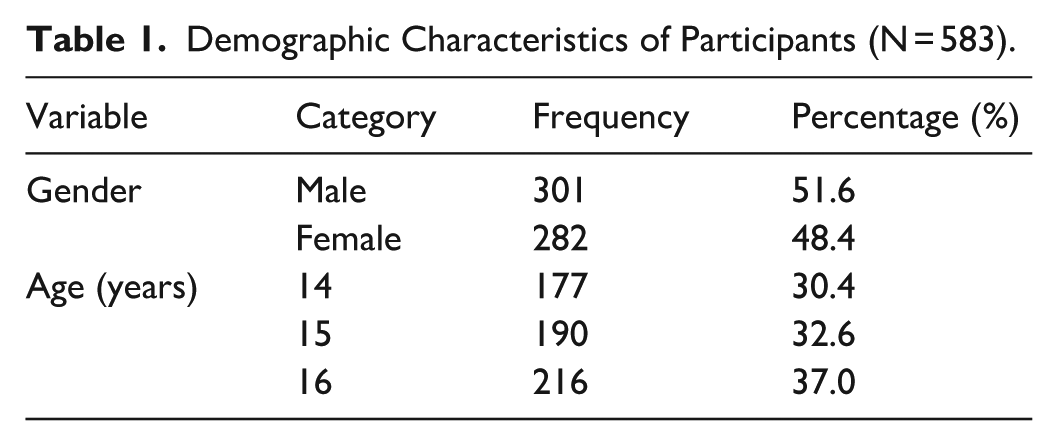
The sample comprised 301 males (51.6%) and 282 females (48.4%). Regarding age, 177 participants were aged 14 years (30.4%), 190 were aged 15 years (32.6%), and 216 were aged 16 years (37.0%), with an average age of 15.07 (see Table 1).
Demographic Characteristics of Participants (N = 583).
Differential Analyses of Gender Factors
The results of the independent samples t-test conducted using SPSS indicated that there were no significant differences between male and female samples in terms of perceived social support, family support, and friend support dimensions (P > .05). However, significant differences were observed in the scores for psychological resilience, Control, Ownership, Reach, Endurance, and loneliness (P < .05). The magnitude of these significant differences, as indicated by Cohen’s d, ranged from small to medium (see Table 2). Specifically, the male samples scored significantly higher than the female samples in psychological resilience (d = 0.3, a small effect), Control, Ownership, Reach, and Endurance, while their loneliness scores were significantly lower than those of the female samples (d = −0.21, a small effect), supporting
Gender Differences in Key Variables.

Analysis of Differences in Age
The results of the one-way ANOVA indicate that there are significant differences among samples from different grades in terms of perceived social support, family support, friend support, psychological resilience, control, ownership, reach, endurance, and loneliness (P < .05). These effects, as measured by partial eta squared (ηp2), were of medium to large size (see Table 3), with psychological resilience showing the largest effect (ηp2 = 0.152, a large effect), followed by perceived social support (ηp2 = 0.085, a medium effect) and loneliness (ηp2 = 0.066, a medium effect). Specifically, the samples from students aged 16 scored the highest in perceived social support, family support, friend support, psychological resilience, control, ownership and responsibility, reach and endurance, while their scores in loneliness were the lowest, supporting
Age Differences in Key Variables (ANOVA).
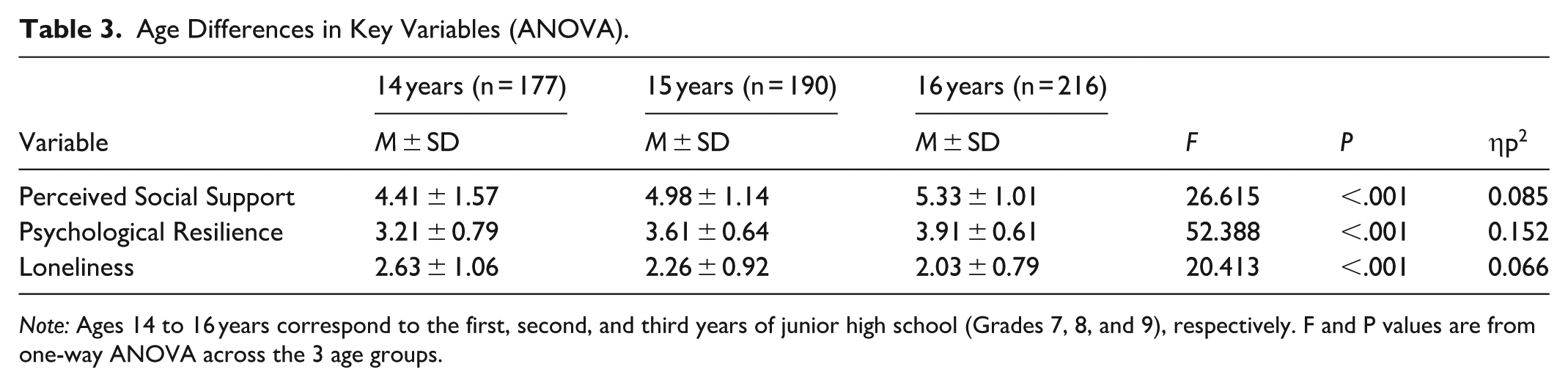
Note: Ages 14 to 16 years correspond to the first, second, and third years of junior high school (Grades 7, 8, and 9), respectively. F and P values are from one-way ANOVA across the 3 age groups.
Correlation Among Perceived Social Support, Psychological Resilience, and Loneliness
Table 4 shows the result of Pearson’s correlation analysis for perceived social support, psychological resilience and loneliness respectively. Significant correlations were found among perceived social support, psychological resilience and loneliness. Specifically, there was a significant negative correlation between perceived social support and loneliness (r = −.477, P < .05), a significant positive correlation between perceived social support and psychological resilience (r = .618, P < .05), and a significant negative correlation between loneliness and endurance (r = −.599, P < .05).
Correlations Between Key Variables.

**P < .01.
Structural Equation Model Analysis
We established a structural equation model to better demonstrate the correlation among perceived social support, psychological resilience and loneliness. As shown in Table 5, the model was acceptable: χ2 = 23.176, df = 18, χ2/df = 1.288 < 3, NFI = 0.981 > 0.9, IFI = 0.996 > 0.9, TLI = 0.993 > 0.9, CFI = 0.996 > 0.9, GFI = 0.990 > 0.9, RMSEA = 0.023 < 0.050. Table 6 portrayed that perceived social support was negatively related to loneliness (β = −.582, P < .05), which supported
Structural Equation Model Fit Indices.

Note. All indices meet or exceed the recommended thresholds.
Standardized Path Coefficients.

Note. β = standardized regression coefficient; SE = standard error.
All paths are significant at P < .001 (two-tailed).
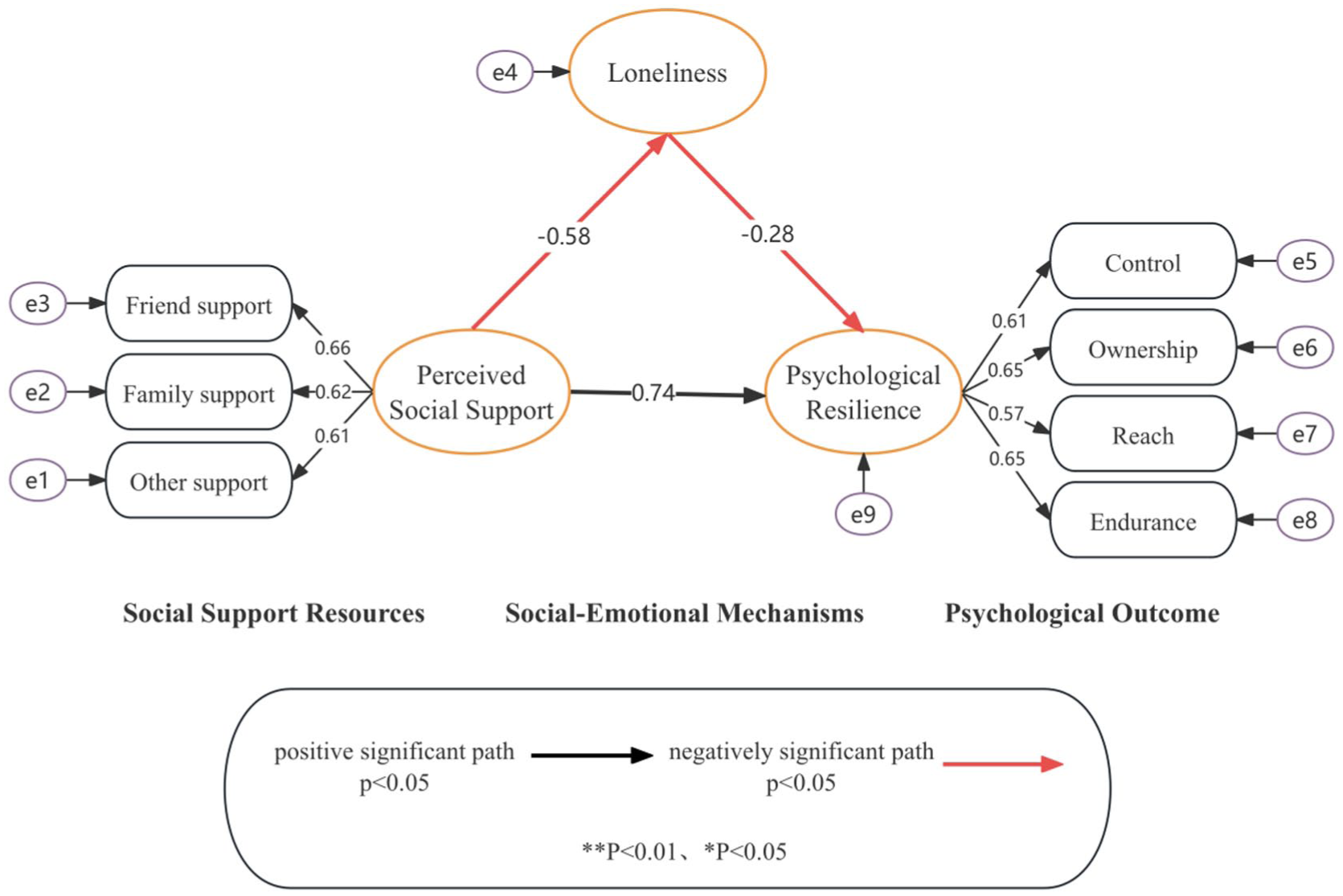
Structural equation model for perceived social support, loneliness, and psychological resilience.
Mediating Role of Loneliness
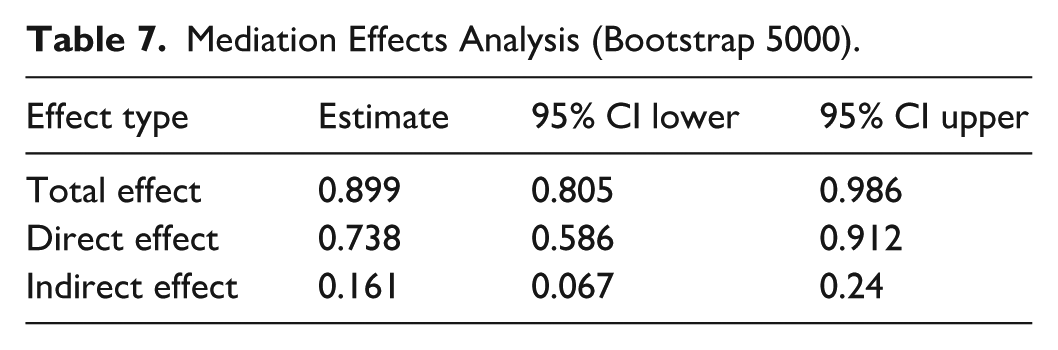
We utilized the bias-corrected bootstrap procedure (5000 random samples) to test the mediating effect of loneliness. Table 7 showed the result. The indirect effect of the model was 0.161, with a corresponding Bootstrap confidence interval of 0.067, 0.240, which did not contain 0. At the same time, the direct effect of the model was 0.738, with a corresponding Bootstrap confidence interval of 0.586, 0.912, which also did not contain 0. Loneliness thus served as a significant partial mediator. The indirect effect (0.161) accounted for 17.9% of the total effect (0.899), calculated as indirect effect/total effect = 0.161/0.899. While perceived social support exerts a substantial direct influence on psychological resilience, a meaningful portion of this relationship operates through the reduction of loneliness, supporting
Mediation Effects Analysis (Bootstrap 5000).
Discussion
Overview of Key Findings
The present study examined loneliness as a mediator between perceived social support and psychological resilience among Chinese junior high school students in post-pandemic online learning contexts. Our findings confirm that loneliness partially mediates this relationship, accounting for 17.9% of the total effect. While perceived social support exerts a strong direct effect on resilience (β = .738), a significant indirect pathway operates through reduced loneliness (indirect effect = 0.161). Additionally, we observed notable gender differences, with boys reporting higher resilience (M = 3.71) and lower loneliness (M = 2.19) compared to girls, and age-related patterns with loneliness peaking at age 14 (M = 2.63). These findings should be read in the post-pandemic context. Although data were collected in 2024, participants’ psychological responses are shaped by their lived experience of prolonged remote learning during 2020 to 2022 and ongoing adaptation to hybrid learning. 54 Our findings thus capture the enduring legacy of pandemic-era educational disruptions rather than acute crisis responses, challenging universalist applications of the traditional buffering hypothesis. 55
Recontextualizing the Buffering Hypothesis in Digital Learning Environments
The traditional buffering hypothesis posits that social support directly protects individuals from adversity through emotional and practical resources. 56 Our analysis demonstrates a fragmented pathway wherein perceived social support maintains direct effects on resilience while simultaneously operating through indirect mediation via reduced loneliness. This fragmentation stems from 2 core disruptions. First, digital platforms strip away critical non-verbal cues (eye contact, gestures, and vocal tone) essential for conveying emotional warmth. 57 This transforms emotionally nuanced interactions into transactional exchanges, 34 fundamentally altering how support is given and received. Second, asynchronous communication 58 decouples support provision from situational immediacy 59 ; delayed responses were frequently perceived as neglect, widening the gap between support intention and reception.
This fragmentation demonstrates cultural specificity within Chinese contexts. The guanxi system, traditionally rooted in reciprocal relationships, undergoes distinctive distortion when digitized. 60 Familial academic support often devolves into transactional “study surveillance” via messaging applications. 61 Our findings suggest that this digitization of care, despite high support intentions, may inadvertently exacerbate loneliness among Chinese adolescents, revealing a mismatch between cultural expectations of support and digital platform affordances. 62 Consequently, we argue for reconceptualizing the buffering hypothesis as a conditional pathway activation model, in which digital architectures selectively filter which dimensions of support effectively promote resilience.
The Mediating Role of Loneliness: Cultural, Developmental, and Digital Dimensions
Loneliness mediates the relationship between perceived social support and psychological resilience through 3 interconnected contextual filters. Culturally, our findings suggest the paradoxical nature of familial support in China’s collectivist context. 63 While family support generally mitigates loneliness, its protective effect may erode under academic pressure, creating the “Zhongkao paradox.” We interpret this through parental psychological control, wherein well-intentioned involvement transforms into performance monitoring during high-stakes examination preparation. 64 This reflects the tension in the traditional Confucian concept of guan, where the pandemic amplified these tensions, turning familial support into performance pressure that heightened isolation. 65
Regarding the developmental dimension, the peak in loneliness at age 14 may reflect neurodevelopmental sensitivities during early adolescence. Large-scale longitudinal studies demonstrate that cortical thinning in social brain regions reaches its fastest rate around age 14, rendering adolescents exceptionally vulnerable to social disconnection. The pandemic-driven transition to online learning might have disrupted essential offline social rituals, 66 which include spontaneous conflict resolution and the exchange of non-verbal feedback, typically play a key role in building resilience competencies. This deprivation of “social rehearsals” intensified perceived isolation 67 and potentially impaired social-emotional skill development. Regarding the digital dimension, text-dominant platforms may amplify loneliness among students with low perceived support (r = −0.477) by stripping interactions of emotional nuance. 68 This elevates emotional misinterpretation risks, 69 forcing students into greater interpretive effort. Together, these filters reconfigure mediation into a conditional process where cultural expectations govern support internalization, developmental stages modulate emotional responsiveness, and digital constraints amplify relational deficits. 70
Gender Differences: Empirical Findings and Theoretical Propositions
This study did not directly measure coping styles; the following interpretation is a theoretical proposition grounded in existing literature to explain observed patterns and generate hypotheses for future research. Current literature highlights female vulnerability to loneliness 71 while under-exploring underlying coping mechanisms. We suggest that male adolescents may employ more instrumental, problem-solving strategies aligning with the transactional architecture of digital platforms, 72 while female adolescents might utilize relational approaches prioritizing emotional connection. 73
The cue-filtered nature of online learning may systematically disadvantage relational coping; lacking non-verbal cues could chronically fail to meet relational needs, exacerbating isolation among those relying on such strategies. 74 Text-based feedback ambiguity might lead young women to perceive it as personal rejection, while young men interpret identical feedback as task-oriented efficiency. 75 These patterns reflect sociocultural conditioning rather than biological determinism. 76 The theoretical implication is a shift beyond cataloging disparities toward examining how gendered coping strategies interact with technological affordances, 77 revealing that the core issue may lie in digital learning infrastructures failing to accommodate gendered dimensions of social support.
Toward a Digital Resilience Framework
We propose a Digital Resilience Framework (DRF) as a conceptual model requiring empirical validation. The DRF posits that digital resilience requires alignment across 3 domains: technology platforms should integrate affective computing capabilities, including emotion-aware features such as real-time visualizations of peer engagement 78 and sentiment analysis algorithms alerting educators to unexpressed student distress 79 ; institutional policies should address relational risks by limiting parental surveillance software during critical assessment periods 80 and mandating regular in-person interactions for early adolescents at peak neurodevelopmental vulnerability 81 ; and pedagogical training could adopt gender-responsive practices, scaffolding boys’ instrumental needs through structured problem-solving tasks 82 while creating emotional co-regulation spaces addressing girls’ relational validation needs. 83
Digital resilience stems from ecological synergy rather than isolated interventions. 84 Our findings converge with prior research on similar triadic relationships. Hou et al 85 found loneliness mediates between social support and depressive symptoms among Chinese adolescents during COVID-19. Research on university students identified parallel patterns linking internet use, loneliness, and psychological resilience,86,87 suggesting these dynamics persist into emerging adulthood. These convergent findings strengthen the theoretical foundation for our framework as a starting point for transforming digital learning environments from vulnerability amplifiers into contexts supporting adolescent resilience.
Limitations
Several limitations warrant consideration. First, the cross-sectional design precludes causal inference; observed relationships may reflect alternative causal orderings, necessitating longitudinal designs. Second, data collected in 2024 using present-tense measures capture current states rather than retrospective pandemic assessments, reflecting post-pandemic adaptation patterns. Third, all variables were self-reported in a single session; although Harman’s single-factor test suggested common method bias was not severe (first factor: 28.6% of variance), multi-informant data would strengthen future studies. Fourth, participants from a single Zhuhai school may limit generalizability to other regions and school types. Fifth, gender-age interaction effects were not tested, and gendered coping strategies were theorized rather than measured, remaining hypotheses requiring empirical validation.
Implications for Practice
Embedding Emotional Monitoring in Educational Technology Platforms
The significant mediating role of loneliness (17.9% of total effect) points to the value of early identification of at-risk students. Educational technology platforms should integrate emotional monitoring capabilities, leveraging sentiment analysis to identify linguistic markers of psychological distress.79,88 When analyzed together, patterns of platform logins, assignment submissions, and course participation yield a more holistic proxy for psychological states than any single metric could provide. 89 Such systems could detect loneliness or disengagement, triggering alerts for proactive outreach before isolation undermines resilience. 90 Implementation should include screening protocols calibrated to developmental vulnerability thresholds 91 while functioning as supportive tools rather than surveillance mechanisms with clear ethical guidelines governing data use and privacy.
Equipping Educators to Cultivate Relational Presence in Digital Spaces
The constraints of cue-filtered digital communication call for targeted teacher professional development extending beyond technical proficiency toward approaches combating social isolation. 92 Educators should be trained to decode digital behavioral proxies for distress (unusual response latencies, declining participation, or communication tone shifts) as early warnings of rising loneliness.93,94 Training should equip teachers with strategies to convey warmth within digital constraints: personalized audio/video feedback restoring nonverbal immediacy, 95 collaborative tasks necessitating genuine peer interaction, 96 and inclusive language validating student emotions. Training must also address gendered support-seeking nuances, enabling educators to scaffold instrumental problem-solving for some students while creating emotional co-regulation spaces for others. 97
Guiding Families Toward Autonomy-Supportive Scaffolding
Our finding that high family support (M = 5.33) coexisted with sustained loneliness (M = 2.03) among 16-year-olds suggests guiding parents from performance monitoring toward autonomy-supportive involvement. 98 Evidence-based workshops should equip caregivers with strategies grounded in self-determination theory, emphasizing support for adolescents’ autonomy and relatedness needs. 99 Central approaches include co-creating study plans incorporating adolescent input, providing process-focused feedback praising effort rather than outcomes, 100 and maintaining open communication about socioemotional challenges during high-stakes examination periods. 101 This shift from surveillance to scaffolding addresses the “Zhongkao paradox,” transforming familial support from performance stress into a psychological resource strengthening parent-child bonds and promoting resilience. 84
Conclusions
This study establishes loneliness as a significant partial mediator between perceived social support and psychological resilience among Chinese junior high school students in post-pandemic online learning contexts, accounting for 17.9% of the total effect. Three key findings emerged: (1) the support-resilience relationship is partially channeled through loneliness, suggesting support mechanisms failing to address relational needs may have attenuated protective effects; (2) loneliness peaked at age 14 while resilience increased with age, highlighting early adolescence as a critical intervention window; and (3) gender differences in resilience and loneliness point to potential divergences in how students experience digital learning environments. This study refines the buffering hypothesis theoretically by demonstrating its conditional nature in digital contexts, proposing that digital environments selectively filter which support dimensions effectively promote resilience.
The proposed Digital Resilience Framework offers a conceptual model integrating technology, policy, and pedagogy. In practice, our findings highlight needs for educational technology platforms enabling early identification of at-risk students, teacher training developing relational presence in digital spaces, and family guidance promoting autonomy-supportive involvement over performance surveillance. Future research should employ longitudinal designs to establish causal pathways, directly measure coping strategies to test gendered mechanism hypotheses, and conduct multi-site studies examining generalizability. Fostering adolescent resilience in digital learning environments requires moving beyond individual-level interventions to co-construct supportive educational ecosystems addressing cultural, developmental, and digital dimensions of adolescent experience.
Footnotes
Acknowledgements
The authors extend their sincere gratitude to the students, teachers, and school administrators in Zhuhai, China, for their participation and cooperation in this study. We also thank our research assistants for their diligent work in data collection and management.

Ethical Considerations
The study was conducted in accordance with the Declaration of Helsinki, and the relevant research approved by the Ethical Committee of the City University of Macau (Reference No.2025-RE-18).
Consent to Participate
Written informed consent was obtained from all individual participants included in the study and from their parents or legal guardians. Participants were informed about the study’s purpose, procedures, potential risks, and benefits. They were assured of the confidentiality of their data and their right to withdraw from the study at any time without any negative consequences.
Author Contributions
Yi Dai: investigation, writing - review & editing, and supervision. Chen Ni: conceptualization, writing - original draft. Jingjing Luo: data curation, formal analysis.
Funding
The authors disclosed receipt of the following financial support for the research, authorship, and/or publication of this article: The research was funded by the Macao Science and Technology Development Fund (FDCT) (Grant number 0071/2023/RIB3), the Joint Research Funding Program between the Macau Science and Technology Development Fund and the Department of Science and Technology of Guangdong Province (FDCT-GDST) (Grant number 0003-2024-AGJ), the Macao Science and Technology Development Fund (FDCT) (Grant number 0065/2024/RIB2), and the Macao Foundation (Project Code MF2409).
Declaration of Conflicting Interests
The authors declared no potential conflicts of interest with respect to the research, authorship, and/or publication of this article.
Data Availability Statement
The original contributions presented in the study are included in the article. Further inquiries can be directed to the corresponding author.
Guarantor
Yi Dai is the guarantor of this work. As such, he had full access to all the data in the study and takes responsibility for the integrity of the data and the accuracy of the data analysis.