




Abstract
Job satisfaction encompasses the degree to which an individual’s essential needs, including health, security, sustenance, affiliation, and esteem, are fulfilled through their occupation. Pharmacists play a vital role in healthcare by providing crucial services that address patients’ medication requirements and improve adherence. This study sought to evaluate job satisfaction and the factors influencing it among pharmacy professionals in Nepal. A descriptive, cross-sectional study was conducted from May to September 2024 using a self-administered semi-structured questionnaire to assess pharmacists’ job satisfaction. Statistical analyses were performed using SPSS version 25. The prevalence of job satisfaction was reported to be 42.3%. Statistically significant predictors after adjustment included a positive impact on time spent with patients/customers/students (aOR 0.409, P = .017), motivation to work (aOR 0.291, P = .003), and mental/emotional health (aOR 0.272, P = .003). Agreement that the organization has a significant meaning (aOR 0.235, P = .001) and that salary is appropriate (aOR 0.209, P = .001) also significantly influenced satisfaction. A willingness to choose the pharmacy profession again was associated with higher satisfaction (aOR 0.294, P = .014). The study revealed substantial job dissatisfaction among pharmacy professionals in Nepal, with only 35.2% reporting overall satisfaction. Addressing the primary factors that influence job satisfaction could enhance retention and stability in the pharmacy sector. Healthcare institutions and policymakers must prioritize the creation of a supportive work environment that meets the expectations and requirements of this critical workforce.
● This nationwide cross-sectional study highlights substantial job dissatisfaction among pharmacy professionals in Nepal, with only 42.3% reporting overall satisfaction. Key factors positively associated with job satisfaction included workplace motivation, good mental and emotional health, adequate salary, meaningful organizational affiliation, and sufficient time spent with patients, customers, or students. More than half of respondents had previously left jobs, primarily due to low pay and limited career advancement opportunities. Despite these challenges, over half indicated they would choose the pharmacy profession again, reflecting strong professional commitment. The findings underscore an urgent need for policy reforms, improved remuneration, and supportive work environments to enhance retention and stability within Nepal’s pharmacy workforce.
Introduction
Pharmacists are crucial in the healthcare industry, offering vital pharmaceutical services to meet patients’ medication requirements and enhance their adherence to treatment plans. 1 Job satisfaction encompasses the degree to which an individual’s essential needs, including health, security, sustenance, affiliation, and esteem, are fulfilled through their occupation or outcomes. Newstrom and Davis characterize job satisfaction as “a collection of positive or negative sentiments with which employees regard their work.” Likewise, Furnham portrays job satisfaction as positive or favorable emotions experienced by one’s work or workplace. 2 Conversely, job dissatisfaction may result in decreased productivity, increased employee turnover, and deterioration of the quality of patient care. 3 Although job satisfaction is affected by multiple factors, an individual may find certain aspects of their career gratifying while simultaneously being discontented with others. 4 The extent of professionals’ job satisfaction is a quality service indicator frequently employed to assess the process aspect. In a study conducted by Poudel et al among government health workers in Chitwan, Nepal, it was reported that 76.3% of the respondents were satisfied with their jobs. The authors attributed this high level of satisfaction to factors such as a supportive work environment, effective supervision, and opportunities for career development, which collectively contributed to improved job satisfaction among the participants. 5 Similarly another study done among the health workforce in medical colleges also shows higher job satisfaction level which is associated with the service they are providing to the patients. 6 Therefore, as no previous study has specifically focused on job satisfaction among pharmacy professionals in Nepal, assessing their level of job satisfaction is essential to gain valuable insights into the overall quality of pharmaceutical care in the country. 7
Globally, the pharmacist workforce density averages about 9.6 pharmacists per 10 000 populations, according to the International Pharmaceutical Federation (FIP). High-income countries typically maintain ratios exceeding 10 pharmacists per 10 000 population, whereas low-income nations often report fewer than 4 pharmacists per 10 000. In contrast, Nepal’s pharmacist density remains significantly lower. The MTaPS Technical Report (2024) estimated approximately 1.65 pharmacists per 10 000 population. 8 According to the Nepal Pharmacy Council (2025), there are currently 7430 registered pharmacists and 14 507 registered pharmacy assistant’s nationwide—figures that, relative to the national population, still fall short of global standards. The Nepal Pharmacy Council serves as a regulatory authority for the pharmacy profession. This organization has several key responsibilities, including the registration of pharmacists and their assistants, improving the quality of pharmacy education, and monitoring the standards of pharmacy-related academic institutions at both college and university levels. 9
Additionally, for fiscal year 2024/25, the Medical Education Commission of Nepal allocated 705 pharmacy student seats across 25 colleges whereas, data from the Council for Technical Education and Vocational Training (CTEVT) indicate that approximately 2200 students were admitted to pharmacy programs taught by 55 colleges across the country.10,11 Upon completing their education, certain students aim to continue their academic journey by pursuing advanced degrees, whereas others opt to join the workforce or establish their own enterprises. At present, the government-approved pay scale for assistant pharmacists is US $246 at the fifth level, whereas pharmacists receive US $325 at the seventh level. 12 The salaries and job stability offered by government positions appeal to many professionals, including those in the pharmacy field. Nevertheless, the scarcity of openings in the Public Service Commission exam often compels applicants to explore other career options. 13 Similarly, the current hospital pharmacy guideline in Nepal does not adequately address the needs of all hospital types, particularly tertiary care hospitals offering multi-specialty services. It recommends an insufficient number of clinical pharmacists and pharmacist for hospitals with over 100 beds and allows only assistant pharmacists in smaller facilities, which undermines effective clinical pharmacy practice and less job opportunities to the skilled pharmacist in country. 14 This scenario, combined with lower salaries in the private sector, leads to a substantial exodus of talent, which has a significant effect on the pharmacy field.15,16 This considerable workforce gap underscores the need for stronger policies to expand and equitably distribute the pharmacy workforce in Nepal.
Methods
Study Design
This descriptive cross-sectional study was conducted from May to September 2024 to evaluate job satisfaction among pharmacists in Nepal (Online supplemental file 1). The study included professionals working in diverse sectors such as hospitals, community pharmacies, wholesale and retail businesses, academic institutions, research facilities, industries, and marketing departments, encompassing both private and government organizations. An anonymous online survey was utilized to gather data, which enabled researchers to score and interpret participants’ levels of job satisfaction.
Sampling and Data Collection Procedures
The study population consisted of pharmacists registered with the Nepal Pharmacy Council who were actively employed in Nepal. Cochran’s formula for proportion estimation (n = z2pq/d2) was utilized to determine the sample size. Drawing from a previous study by Khanal et al 17 that reported 73% job satisfaction among pharmacists, the calculated sample size was 303, allowing for a 5% margin of error and 95% confidence interval. To account for potential nonresponses, the final sample size was increased to 333 pharmacists. All registered pharmacists in Nepal were considered the target population. A list of registered pharmacists was obtained through Nepal Pharmaceutical Association. The survey invitation was sent to 333 eligible pharmacists for voluntary participation through email and professional social media platforms. The exclusion criteria were unregistered pharmacists, newly hired professionals with less than 6 months of experience, those not currently working; individuals who declined to complete the questionnaire, and cases of incomplete questionnaires.
Data Collection Tools
A self-administered semi-structured questionnaire adapted from previous related research was used to evaluate job satisfaction levels among pharmacy professionals. This survey instrument was designed to gather data on the participants’ workplace contentment.18-20 The survey instrument was divided into 8 parts—demographic information, work status and environment, job content, perceptions of workload, stress indicators, dedication to the organization, rewards and acknowledgment, and professional dedication—with the aim of assessing pharmacists’ job satisfaction. The questions were rated using a 3—point Likert scale ranging from 1 (strongly disagree/disagree), 2 (neutral), and 3 (agree/strongly agree). Additional closed-ended inquiries gage pharmacy professionals’ satisfaction levels. The questionnaire, written in straightforward English for ease of understanding, underwent pre-testing and modification prior to the actual data-gathering process. 19
Study Procedure
The survey link was disseminated concurrently via email, WhatsApp, and Facebook. The periodic reminders were dispatched overnight. Pharmacists were restricted to submitting an online questionnaire only once.
Statistical Analysis
Data analysis was conducted using SPSS version 25. Participant characteristics were summarized using descriptive statistics, including means, standard deviations, frequencies, and percentages. Continuous variables were presented as mean ± SD. The internal consistency of 6 scales—measuring job satisfaction, workload perception, work stress, organizational commitment, incentive and recognition, and professional commitment—each using a three-point Likert scale, was assessed using Cronbach’s alpha. The reliability coefficients were .710, .883, .747, .848, .790, and .818, respectively.20,21
Comparisons of satisfaction rates among pharmacists across different sectors were made using analysis of variance (ANOVA). Chi-square tests were applied to examine associations between categorical variables, with statistical significance determined at P < .05. Variables that demonstrated significant associations (P < .05) in the chi-square analysis were subsequently entered into a binary logistic regression model to estimate adjusted odds ratios (aORs). For the purpose of regression analysis, the overall job satisfaction variable, initially measured on a three-point Likert scale, was dichotomized by combining “Dissatisfied” and “Neutral” responses as Not satisfied 0 and retaining “Satisfied” responses as Satisfied. 22
Ethical Clearance
The study was conducted with the approval of the Institutional Review Committee at Madan Bhandari Academy of Health Sciences, Nepal (approval number: IRC-047-080, dated 2nd April 2024). The researchers assured participants that their involvement was completely voluntary, and all survey responses were anonymized during data collection.
Results
Socio-demographic Characteristics of the Participants
Of the 333 participants invited, 310 consented and completed the survey, yielding a response rate of 93.1%. Among the respondents, 54.2% were male, with a mean age of 28.36 years, and the majorities were unmarried (55.5%). Participants belonging to the Brahmin/Chhetri ethnic group constituted 55.2% of the sample, while those from other ethnic groups—including Dalits, Newar, Janajati, Muslim, and Madhesi communities—accounted for 55.5% of the respondents. Most of the respondents (36.5%) had completed their studies under the Purbanchal University affiliation, Nepal making it the most common educational background among participants. Hospital pharmacies employed 40.6% of the respondents, with 71.3% working in the Bagmati Province, Nepal. The predominant monthly income range was $150-$300 (40.6%) and 85.2% held a single full-time position. Bachelor’s degree holders comprised 61.0% of the respondents. Most of the respondents worked away from home (56.5%) and resided in rented accommodations (52.3%). The private sector employed 65.8% of the participants, with 52.6% working morning/day shifts and 79.0% in non-managerial roles. On average, respondents had 4.87 ± 4.3 years of work experience, worked 47.73 ± 17.24 h weekly, and had spent 3.3 ± 3.4 years in their current position (Table 1).
Socio-Demographic Characteristics of Pharmacy Professionals Working in Nepal (N = 310).

Job Satisfaction Among Pharmacy Professionals at Current Job
Among the survey participants, reported being 42.3% (131 individuals) satisfied with their current job, whereas 32.9% (102 individuals) expressed overall dissatisfaction. The main factors contributing to job satisfaction were the perception of career progress (35.8%) and the belief that supervisors provided effective guidance (38.4%). Additionally, 55.5% of respondents had left their previous full-time positions due to dissatisfaction, primarily in pursuit of a better salary (45.8%) and a higher position (25.0%). In terms of income, 50.3% (156) of the respondents reported dissatisfaction in their current job while 42.3% (131 respondents) felt that their jobs did not align with their initial expectations upon joining. The results are presented in Table 2.
Job Satisfaction Among Pharmacy Professionals at Current Job.

Regarding the search for new employment, 53.9% (167 respondents) found it extremely difficult to quickly obtain a new job, 25.2% (78 respondents) were neutral, and 21.0% (65 respondents) experienced ease finding alternative work.
Workload Perceptions of the Individuals
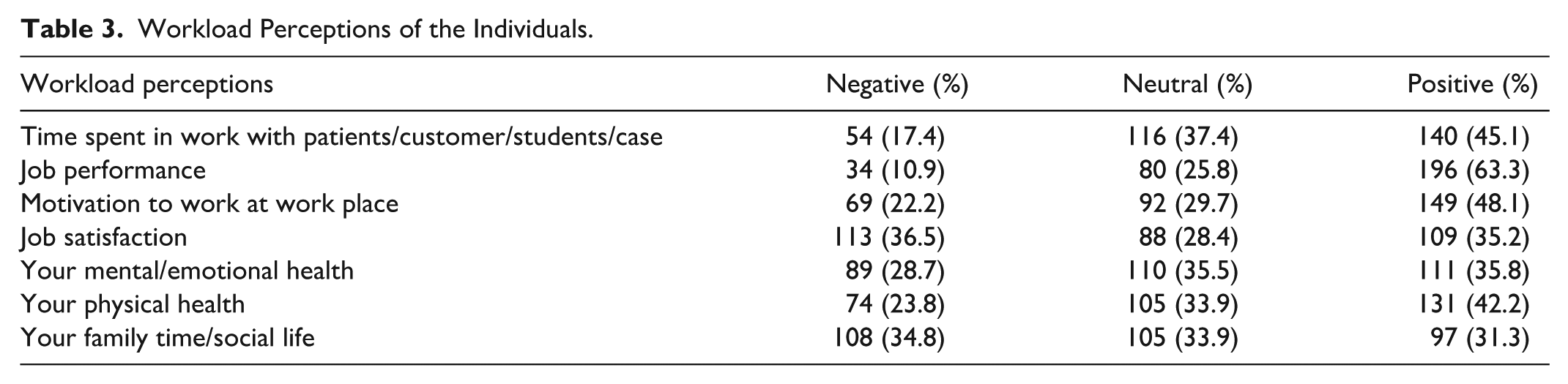
Regarding workload perceptions, the survey revealed that 45.1% of participants viewed their overall work experience positively, while 63.3% believed they demonstrated good job performance and 48.1% felt motivated in their roles. However, only 35.2% expressed satisfaction with their workload. Additionally, 35.8% reported having strong mental health, and 42.2% indicated positive physical well-being. Notably, 34.8% of respondents stated that their workload limited their ability to spend sufficient time with family and maintain a social life, as represented in detail in Table 3.
Workload Perceptions of the Individuals.
Stress Level at Work
As shown in Table 4, a substantial portion of the survey participants experienced considerable workplace stress and difficulties. The data revealed that 83.2% found working under staff shortages extremely stressful, whereas 86.2% encountered significant challenges in their interactions with management. Additionally, 73.3% of respondents faced obstacles when dealing with patients and 74.5% reported difficulties in their relationships with colleagues. Furthermore, 68.7% of participants perceived a high risk of infection in their work environment.
Stress Level in Work.

Organizational Commitment and Recognition Factors
Furthermore, 44.2% of those surveyed experienced a sense of belonging to their organizations. However, 51% were unhappy with their current pay, and 45.5% expressed reluctance to remain in their current job. Concerning professional dedication, 54.8% of the respondents would opt for the same career if given another opportunity, and 62% of the participants considered pharmacy to be the ideal lifelong profession, as illustrated in Table 5.
Organizational Commitment and Recognition Factors.

Association of Job Satisfaction With Other Job Related Factors
The research revealed notable correlations between job satisfaction and various elements, including demographic factors such as gender (P = .012), monthly earnings (P = .026), and the perceived availability of alternative job opportunities (P = .004). Workplace conditions, specifically workload assessment (P = .011) and duration spent with each client, patient, or case (P = .011) also played a significant role. Job performance (P = .001), workplace motivation (P = .001), mental and emotional well-being (P = .001), physical health (P = .001), and family time (P = .001) were crucial. Organizational culture aspects, such as feeling a sense of belonging (P = .001), perceiving the organization as meaningful (P = .001), and confidence in leadership (P = .001), contributed to satisfaction levels. Adequate compensation (P = .001), full utilization of skills (P = .001), and sensation of time passing quickly at work (P = .001) were associated with job contentment. Career dedication was evident, with many participants expressing a willingness to choose pharmacy again (P = .001) and viewing it as their ideal career (P = .001). These results, presented in, demonstrate the intricate interaction of individual, professional, and organizational factors in determining job satisfaction in the pharmacy field (Table 6).
Association of Job Satisfaction with Other Job Related Factors (n = 310).

Significance at P < .05.
Factor Associated With Job Satisfaction
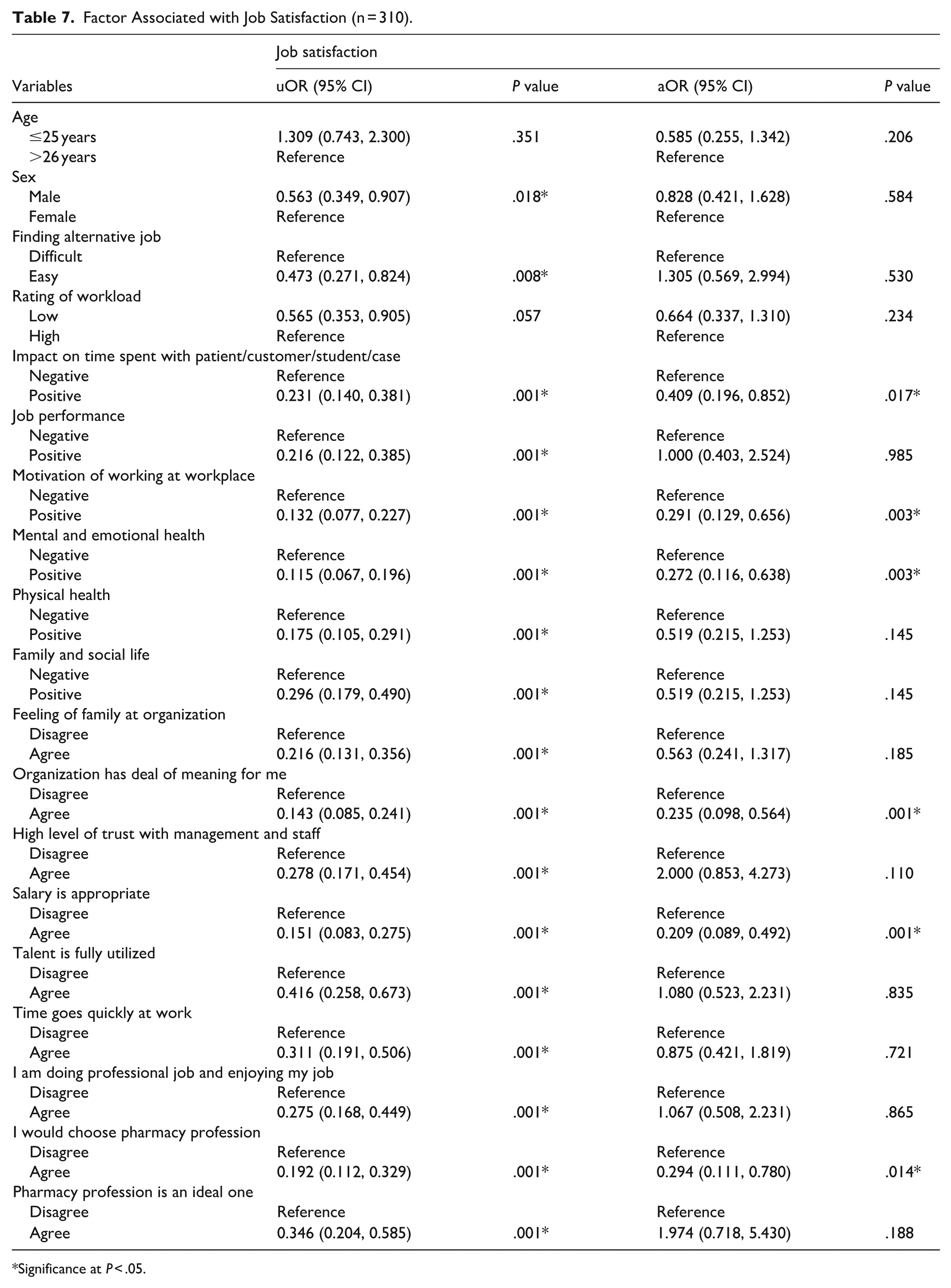
The study analyzed factors influencing job satisfaction using unadjusted (uOR) and adjusted odds ratios (aOR). Statistically significant predictors after adjustment included a positive impact on time spent with patients/customers/students (aOR 0.409, P = .017), motivation to work (aOR 0.291, P = .003), and mental/emotional health (aOR 0.272, P = .003). Agreement that the organization has a significant meaning (aOR 0.235, P = .001) and that salary is appropriate (aOR 0.209, P = .001) also significantly influenced satisfaction. A willingness to choose the pharmacy profession again was associated with higher satisfaction (aOR 0.294, P = .014).
Factors like age, sex, ease of finding alternative jobs, workload rating, physical health, family/social life, and high trust with management were not significantly associated with job satisfaction in adjusted models. The findings highlight the importance of intrinsic motivation, positive work environments, and adequate remuneration in enhancing job satisfaction among participants as shown in Table 7.
Factor Associated with Job Satisfaction (n = 310).
Significance at P < .05.
Discussion
Job satisfaction plays a crucial role in shaping employees’ motivation and productivity. This study attempted to assess job satisfaction of pharmacy professional working in various job sectors in Nepal. Recently, there has been increasing apprehension regarding health professionals in Nepal, including pharmacists, abandoning their role in pursuing opportunities elsewhere or seeking alternative income sources. The critical shortage of healthcare professionals, particularly pharmacists, presents a significant challenge owing to their essential role in ensuring safe and effective healthcare delivery. Multiple factors influence the capacity of healthcare institutions to recruit and retain this vital workforce. 23
This research sought to assess overall job satisfaction and its contributing factors among pharmacy professionals employed in Nepal. The results indicated that only 42.3% of the professionals expressed satisfaction with their jobs, which is consistent with comparable studies conducted in Nigeria and Ethiopia.24,25 Nevertheless, research findings are mixed, with some studies indicating job satisfaction 17 and others suggesting that pharmacists experience symptoms of burnout. 26 Another study conducted among hospital pharmacist by Berassa et al (2021) nearly 53% of the pharmacist were satisfied with their job also revealed that a substantial portion (83.8%) of participants reported experiencing a heavy workload. However, our study found that only 17.4% of participants were unhappy with the time they spent with customers, students, or patients. 27 Also, our study found that 42.3% of participants felt their current job did not meet their expectations, which aligns with the concept of roles misaligned with aspirations described by Forsyth et al. 28
The research findings showed that 55.5% of participants were dissatisfied with their previous job due to low salary. This finding implies that workplace dissatisfaction is a key contributor to employee turnover. In line with current research, job dissatisfaction has been associated with several elements, such as restricted professional advancement opportunities, insufficient pay, and challenges in maintaining work-life equilibrium. 29 A significant issue was dissatisfaction with earnings, as 50.3% of the participants reported being unhappy with their current income. This result aligns with earlier research that identified pay as a crucial factor that influences job satisfaction.30,31 This finding is similar to a study by Abdullahi et al, which reported that 54% of pharmacists working in public health facilities were dissatisfied with their current pay. 24 Leadership and management quality appears to be a crucial factor in employee contentment. A mere 38.4% of those surveyed expressed satisfaction with their supervisors’ approaches to management, suggesting possible deficiencies in effective leadership. Existing research underscores the significance of supportive management practices in enhancing job satisfaction and decreasing employee turnover rates. 32 Additionally, 42.3% of the survey participants indicated that their employment did not align with their initial expectations, highlighting the importance of transparent communication and accurate job previews during the hiring process. The mismatch between anticipated and actual job conditions has been recognized as a significant factor contributing to employee dissatisfaction and increased turnover rates. 33
A significant number of survey respondents (45.1%) expressed contentment with their work hours, indicating that almost half of those surveyed considered their workload reasonable. However, these data also suggest that the majority of participants may have either neutral or unfavorable opinions about their work demands. This could point to potential issues such as overwork, insufficient personnel, or occupation-related pressure on the workforce. 34 Research has shown that healthcare professionals, including pharmacists, may experience decreased job satisfaction and burnout owing to overwhelming workloads and demanding job requirements. These factors have been identified as significant contributors to occupational stress in the healthcare sector. 26 The study revealed that 48.1% of respondents experienced motivation in their positions. This indicated a moderate level of motivation, suggesting the potential to enhance the work environment to better inspire and encourage pharmacy professionals. Although there were moderate levels of motivation and a sense of organizational unity, 45.5% of the participants expressed a desire to leave their current job. High intention to quit is frequently associated with factors such as job dissatisfaction, restricted opportunities for career advancement, and a perceived lack of organizational support. 35 The results concerning professional dedication were positive, with 54.8% of participants indicating they would opt for the pharmacy field again if given the opportunity. This level of commitment suggests a strong correlation between career expectations and actual professional experience, even when faced with difficulties. 36 Thus, the government has a crucial role to play in shaping the mindset of pharmacists and policymakers should consider revising the national health policy to fully integrate pharmaceutical services into the country’s healthcare system for the overall benefit of public health. 17
While this research provides valuable insights into the current status of pharmacy professionals toward their jobs, it is not without limitations. Although the study achieved a very high response rate (93.1%), the use of convenience sampling through an online platform restricts the generalizability of the findings. This method may have introduced selection bias, as participation was limited to pharmacists with internet access and a willingness to respond online. As a result, the views and experiences of pharmacists who did not participate may not be adequately represented.
Conclusion
In conclusion, studies indicate widespread job dissatisfaction among pharmacy professionals in Nepal, with only 42.3% expressing contentment. Major factors contributing to high turnover rates include subpar working environments, inadequate compensation, and restricted professional advancement opportunities, which hinder workforce retention. Nevertheless, over 50% of the surveyed individuals demonstrated commitment to their profession, stating that they would choose pharmacy career again, underscoring the field’s inherent value. Addressing fundamental issues, such as insufficient pay, ineffective management, and unmet job expectations, is crucial. Enhancing remuneration, improving leadership, and setting realistic job expectations are vital for maintaining and stabilizing the pharmacy workforce. To tackle the shortage of healthcare professionals, pharmacists, policymakers, and healthcare organizations must foster a supportive work environment.
Supplemental Material
sj-docx-1-inq-10.1177_00469580251406450 – Supplemental material for Job Satisfaction and Associated Factors Among Pharmacy Professionals in Nepal: A Cross-Sectional Study
Supplemental material, sj-docx-1-inq-10.1177_00469580251406450 for Job Satisfaction and Associated Factors Among Pharmacy Professionals in Nepal: A Cross-Sectional Study by Biswash Sapkota, Keshav Dhakal, Bipindra Pandey, Sailendra Chaudhary, Bibechana Sapkota, Bijay Aryal and Kanchan Bashyal in INQUIRY: The Journal of Health Care Organization, Provision, and Financing
Footnotes
Acknowledgements
We would like to acknowledge all the pharmacist, assistant pharmacist and owner of pharmacy who actively took part in our research.

Ethics Considerations
All procedures were performed in accordance with the ethical standards of the institutional research committee and with the Declaration of Helsinki in 1964 and its subsequent amendments or comparable ethical standards. The study was conducted with the approval of the Institutional Review Committee at Madan Bhandari Academy of Health Sciences in Hetauda, Nepal (approval number: IRC-047-080, dated 2nd April 2024).
Author’s Contributions
BS and KD recruited participants and collected data. BP analyzed and interpreted the data. BS and KB wrote the first draft of the article. BA, AB and BP reviewed the manuscript. All authors had unrestricted access to the data and participated in data interpretation. All authors contributed to subsequent versions and agreed to submit the article for publication.
Funding
The authors disclosed receipt of the following financial support for the research, authorship, and/or publication of this article: The project was funded by Madan Bhandari Academy of Health Sciences, Research Center, Hetauda, Nepal.
Declaration of Conflicting Interests
The authors declared no potential conflicts of interest with respect to the research, authorship, and/or publication of this article.
Data Availability Statement
Upon the request corresponding author will provide
Grant Number
080/81-RC-16
Trial Registration Number/Date
NA.
Other Journal Specific Statements as Applicable
NA.
Supplemental Material
Supplemental material for this article is available online.
References
Supplementary Material
Please find the following supplemental material available below.
For Open Access articles published under a Creative Commons License, all supplemental material carries the same license as the article it is associated with.
For non-Open Access articles published, all supplemental material carries a non-exclusive license, and permission requests for re-use of supplemental material or any part of supplemental material shall be sent directly to the copyright owner as specified in the copyright notice associated with the article.
