



Abstract
The number of empty-nest elderly in China is steadily increasing, and this empty-nest family structure may influence their mental health. With the rapid advancement of information technology, the internet has profoundly reshaped lifestyles and is playing an increasingly important role among the elderly. This study aims to examine the association between internet use and mental health among empty-nest elderly. Data were drawn from the 2020 China Health and Retirement Longitudinal Study (CHARLS), including 4159 empty-nest elderly. Mental health was assessed with the short form of the Center for Epidemiologic Studies Depression Scale (CES-D). Ordinary least squares regression, propensity score matching, instrumental variable analysis, and mediation analysis were conducted to examine the associations, test robustness, and explore potential mechanisms. Internet use was significantly associated with lower levels of depression, and mediation analysis indicated that social participation and intergenerational support partially mediated this relationship. These findings highlight the crucial role of internet use in enhancing the mental health of empty-nest elderly and underscore the importance of promoting internet access and digital literacy to foster active aging.
1. Empty-nest elderly, as a vulnerable population, deserve particular attention to their mental health.
2. Internet use is significantly associated with lower levels of depression among empty-nest elderly.
3. Social participation and intergenerational support partially mediate the relationship between internet use and mental health.
4. The findings contribute to the promotion of active aging among empty-nest elderly.
Introduction
Empty-nest elderly refers to older adults who have no children or whose children have already left home, and who live either alone or only with a spouse.1,2 According to statistics from the China National Committee on Aging, the number of empty-nest elderly reached 118 million in 2020, and it is projected that by 2030, 90% of households will become empty-nest households, with the number of empty-nest elderly exceeding 200 million. 3 Compared with their non-empty-nest counterparts, empty-nest elderly have lower levels of health in general health, role physical, bodily pain, role emotional, and vitality dimensions. 4 As a vulnerable group, 5 empty-nest elderly not only undergo the transition in their personal life course from middle age to old age, but also experience the transformation in the family life cycle, shifting from a nuclear or stem family to an empty-nest family. This dual transition has been associated with increased vulnerability to various adverse circumstances and aging-related issues.6,7 Therefore, their mental health requires special attention.
Among the numerous mental health issues affecting older adults, depression is a common psychiatric disorder. An increasing number of studies have reported a high likelihood of depressive symptoms in the elderly population,8-10 making it an important public health concern. 11 Depressive symptoms in older adults have been associated with poorer mental health and lower quality of life, increased burdens on families and society,12,13 and a higher risk of suicide. 14 Furthermore, depression is often associated with an elevated risk of other illnesses and higher mortality in older adults.15,16
Although effective treatments for mental disorders are available, more than 75% of individuals in countries with low and middle income levels do not receive care. 17 In terms of depression prevalence, Asia ranks second among all continents, and many patients may not receive adequate treatment. 18 In China, mental health human resources are insufficient and unevenly distributed across regions, 19 limiting access to professional mental health services. 20 Given these severe barriers to obtaining mental health support, internet-based digital technologies offer promising opportunities to address this gap. 21
With the continuous development of information technology, the use of the internet in daily life has become increasingly widespread. As a multifunctional tool, the internet can be utilized for a variety of purposes, including information searching, online banking, telemedicine consultations, e-commerce, social interaction, and entertainment,22-24 effectively enhancing people’s quality of life. 25 Meanwhile, the number of older adults using the internet has also increased.26,27 However, significant differences exist in internet usage rates across countries, ranging from 5.56% in China and 39.37% in Mexico to 58.01% in the United States, 72.35% in the United Kingdom, and 83.46% in Denmark, 28 indicating that developed countries have higher internet penetration rates than developing countries.
Numerous studies have examined the association between internet use and the health of older adults. Internet use has been associated with better self-rated health, 29 higher levels of well-being,30,31 and healthier lifestyles, such as more frequent physical activity and less smoking and alcohol consumption. 32 At the same time, internet use has also been associated with potential disparities in health outcomes. 33 For example, greater internet use has been linked to less frequent communication with household members, smaller social networks, and differences in mental health outcomes.34,35 Moreover, as a common medium for internet use, social media use has also been associated with negative emotional experiences related to frequent social comparison and privacy concerns. 36
Although numerous studies have examined the relationship between internet use and mental health in older adults, research specifically focusing on empty-nest elderly remains relatively limited. Compared with their non-empty-nest counterparts, empty-nest elderly are at a higher risk of depressive symptoms,37-39 and the association between their internet use and mental health may differ from that observed in other older adult populations. Furthermore, China is currently experiencing a dual transformation characterized by population aging and digitalization. While the population is entering a stage of advanced aging, digital technologies are increasingly integrated into daily life. In this context, understanding the association between internet use and the mental health of empty-nest elderly is of critical importance.
The main contributions of this study are as follows. First, it examines the association between internet use and the mental health of empty-nest elderly in China. Compared with previous studies focusing on non-empty-nest elderly,40,41 this study not only targets this specific group, which is particularly vulnerable to mental health risks, but also identifies a significant association between internet use and their mental health, providing empirical evidence for understanding the psychological well-being of this population. Second, considering China’s unique social and family cultural context, this study explores the potential mediating roles of social participation and intergenerational support in the relationship between internet use and the mental health of empty-nest elderly, thereby further enriching existing research on this topic. Finally, based on the latest large-scale database of older adults, this study objectively reflects the current status of internet use and mental health among empty-nest elderly in China. Drawing on these findings, it proposes targeted policy recommendations, providing a reference for government agencies to develop effective interventions and preventive strategies.
The structure of this paper is as follows: Section 2 presents the research hypotheses. Section 3 introduces the data and methodology. Section 4 reports the empirical results. Section 5 provides the discussion. Finally, the last section presents the conclusions and policy recommendations.
Research Hypotheses
The internet is a convenient and effective tool for maintaining existing social connections or establishing new ones.
42
Its use has been associated with enhanced social network support for older adults, enabling them to expand their social circles and increase the frequency of social interactions through various online channels.
40
Internet use is also an important factor linked to the mental health of older adults.
43
Previous studies have reported that internet use is associated with better mental health among older adults, particularly lower depressive symptoms.41,44 Due to the lack of children’s companionship, empty-nest elderly may face difficulties in meeting their social and emotional needs, which is often linked to poorer mental health. Internet use may be associated with greater satisfaction of social interaction needs, increased social engagement, and higher participation in community activities, which in turn are linked to enhanced social capital and better mental health outcomes. Based on this, Research
According to social support theory, social support refers to the information and resources that individuals obtain through social interactions, which enable them to feel cared for, accepted, and respected, and help establish mutually supportive social connections.
45
As a protective factor for mental health, social support is associated with better psychological well-being in the context of stressors such as illness, loneliness, and financial difficulties.
46
Among its various forms, social participation, as an active way for individuals to integrate into social networks, serves as a key means of obtaining social support. Previous studies have shown that social participation mediates the relationship between internet use and mental health among older adults,
47
with internet use being associated with better mental health by enhancing social participation.
48
For empty-nest elderly, internet use may be associated with multidimensional support, including greater social participation, stronger social connectedness, and lower levels of negative mental health outcomes linked to prolonged absence of children and other life stressors. For example, internet use is associated with participating in online interest groups or community activities, and accessing information and resources related to daily living and emotional well-being. These activities may be associated with a greater sense of belonging, lower levels of loneliness, and better coping with life stressors, all of which may be linked to mental health outcomes. Based on this, Research
According to the Socioemotional Selectivity Theory, as individuals age, they increasingly prioritize emotional satisfaction and tend to maintain and invest in close relationships.
49
Driven by this emotional orientation, older adults have a greater need for intergenerational support from their children. This phenomenon is particularly pronounced in the context of Chinese traditional family culture, which emphasizes filial piety.
50
Previous studies have shown that intergenerational support, including both emotional and financial support, is associated with better physical and mental health among parents.
51
In contrast, empty-nest elderly with limited contact with their children are often found to have lower levels of mental health over time.7,52 The internet, with its capacity for communication across time and space, is associated with interactions between empty-nest elderly and their children, which may relate to intergenerational support. Within older adults’ social networks, family relationships are the most central, characterized by strong ties and high interaction density.
53
Internet use may help empty-nest elderly maintain close intergenerational relationships, which is associated with higher levels of subjective well-being.
31
Frequent intergenerational interactions facilitated through the internet are significantly negatively associated with depressive symptoms among older adults.
54
Taken together, these findings indicate that internet use is associated with intergenerational interactions among empty-nest elderly, which are closely related to their mental health. Therefore, when examining the relationship between internet use and the mental health of empty-nest elderly, it is important to take into account the role of intergenerational support from children. Based on this, Research
According to the above research hypotheses, the conceptual framework for this study is constructed as shown in Figure 1.

Conceptual framework of the study.
Data and Methods
Data Source
This study draws on data from the fifth wave (2020) of the China Health and Retirement Longitudinal Study (CHARLS). The CHARLS sample is drawn from 450 villages across 150 counties in 28 provinces throughout China. The survey was designed with reference to a series of international aging studies, including the Health and Retirement Study (HRS), the English Longitudinal Study of Ageing (ELSA), and the Survey of Health, Ageing and Retirement in Europe (SHARE), and employed a multistage stratified probability-proportional-to-size (PPS) sampling method. The CHARLS questionnaire collects detailed information on households, health status and functioning, work and retirement, pensions, and other aspects of individual circumstances, providing comprehensive micro-level data on middle-aged and older adults in China. 55 In this study, all analyses were conducted using CHARLS data already adjusted for survey weights and the complex sampling design, with no additional weighting, clustering, or stratification applied.
We chose to use the 2020 wave of CHARLS, which was the most recently released data in 2023, for 2 main reasons. First, the 2020 data were primarily collected during the COVID-19 pandemic, and compared with earlier waves, some variables and data in the 2020 CHARLS were not surveyed or had missing values, making it difficult to ensure consistency in variable definitions and measurements. Therefore, earlier waves were not used. Second, using the latest CHARLS data allows for a more accurate reflection of the current mental health status of empty-nest elderly in China and their internet usage rate.
The definition of empty-nest elderly was based on previous studies.1,2 In this study, we determined empty-nest status using the CHARLS question on the amount of time children lived with their parents in the past year. Participants were classified as non-empty-nest if at least one child co-resided with them (co-residence time > 0 days), and as empty-nest if none of their children co-resided. We verified the matching between children and household members in the survey data before processing. In the CHARLS dataset, missing values were coded as “Refused,” “Not applicable,” or “Unknown,” and these responses were treated as missing in our analyses.
Our study focused on empty-nest elderly aged 60 years and above. After screening variables and cleaning the data by removing missing values, samples not meeting the age criteria, and non-empty-nest participants, a total of 4159 empty-nest elderly were included, comprising 2150 males and 2009 females. The sample selection process is illustrated in Figure 2.
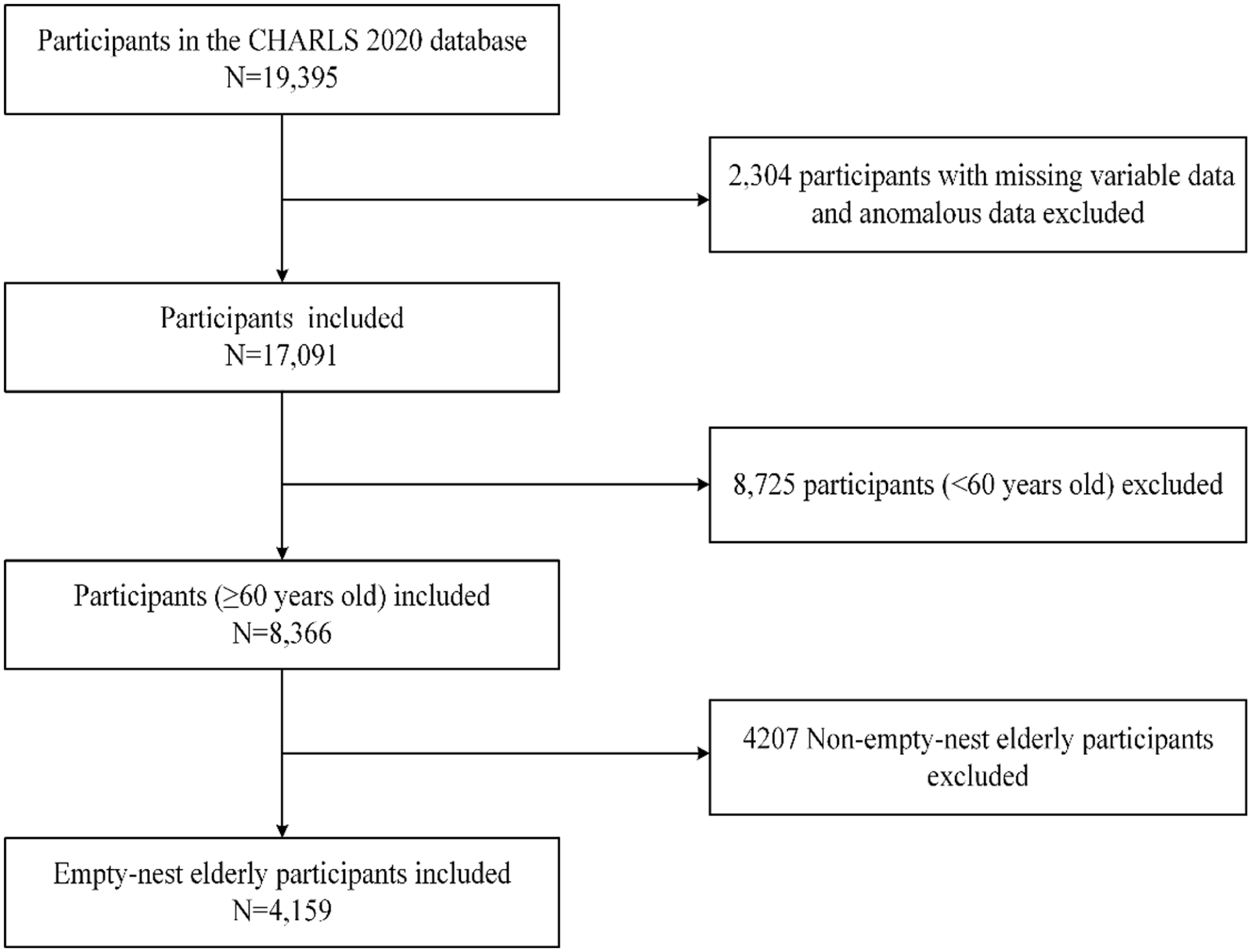
Selection of study participants.
Variable Description
Dependent Variable
The dependent variable in this study is mental health, measured by the level of depression among empty-nest elderly. Depression symptoms were assessed using the short form of the Center for Epidemiological Studies Depression Scale (CES-D), 56 which has been validated in older Chinese respondents using CHARLS data, 57 demonstrating good reliability and validity. According to the Chinese version of the CES-D, each item is scored on a 4-point scale: “<1 day,” “1-2 days,” “3-4 days,” and “5-7 days,” coded as 0, 1, 2, and 3, respectively. Two positively worded items (“I felt hopeful about the future” and “I was happy”) are reverse-scored. The total score ranges from 0 to 30, with higher scores indicating more severe depressive symptoms. In this study, the CES-D scale demonstrated a Cronbach’s alpha of .7928.
Independent Variable
The core independent variable in this study is internet use, measured by the CHARLS survey question: “Have you used the internet in the past month?” Participants who used the internet were coded as 1, and those who did not were coded as 0.
Mediating Variables
The mediating variables in this study include social participation and intergenerational support from children. Social participation was measured based on the CHARLS question: “Have you engaged in any of the following social activities in the past month?” The 8 activities included: visiting neighbors or friends; playing mahjong, chess, or cards, or going to a community activity room; providing help to relatives, friends, or neighbors not living with the respondent; dancing, exercising, or practicing qigong; participating in community or organizational activities; engaging in volunteer work, charitable activities, or caring for non-cohabiting patients or disabled individuals; attending school or training courses; and other social activities. Participation in each activity was scored as 1 point, with a cumulative score ranging from 0 to 8 (0 indicating no participation), reflecting the respondent’s level of social engagement.
Intergenerational support from children was divided into financial support and emotional support. Financial support was measured by the CHARLS question: “In the past year, how much financial support have you received from your children who do not live with you?” Emotional support was measured by the question: “For children who do not live with you, how often do you communicate with them via phone, text message, WeChat, letters, or email?” Responses were coded sequentially from “almost never” to “almost every day.” For respondents with multiple children, the highest frequency of contact was used.
Control Variables
Based on previous studies on risk factors for depression among empty-nest elderly,37,38 several control variables were included in the analysis. Individual characteristics consisted of gender (0 = female, 1 = male), age, marital status (0 = without spouse, 1 = with spouse), and education level (1 = illiterate, 2 = junior high school or below, 3 = senior high school or above). Socioeconomic variables included place of residence (0 = rural, 1 = urban) and household economic status (0 = non-impoverished, 1 = impoverished).
Health-related variables comprised daily functional ability (0 = difficulty, 1 = no difficulty), chronic disease (0 = yes, 1 = no), exercise (0 = no, 1 = yes), and physical pain (0 = yes, 1 = no). In addition, the number of living children was also controlled for. These variables have been widely applied and well-validated in the literature on the health and depressive symptoms of empty-nest elderly.
Model Specification
To examine the relationship between internet use and the mental health of empty-nest elderly, we construct the following baseline regression model:

Where Depressioni represents the depression level of individual i among the empty-nest elderly, α0 is the intercept term, α1 is the coefficient of the key independent variable, Interneti denotes the internet use status of individual i, γ is the coefficient vector of the control variables, Controli represents the control variables, including all controlled individual characteristics or other relevant factors, and εi is the error term.
We mainly adopt a stepwise regression approach to construct the mediation effect models, examining the mechanisms through which internet use affects the mental health of empty-nest elderly from the perspectives of social participation and intergenerational support. The models are specified as follows:


Where Mi represents the mediator, taking the value of social participation in one model and intergenerational support in the other model. β1 denotes the effect of internet use on the mediator, α1 represents the direct effect of internet use, and α2 represents the effect of the mediator.
Statistical Analysis
All statistical analyses were conducted using Stata 18.0. First, descriptive statistics were performed for the variables, and t-tests and F-tests were conducted. Second, regression analysis was employed to examine the effect of internet use on the mental health of empty-nest elderly. Third, robustness checks were carried out by altering the measurement of the dependent variable and applying propensity score matching (PSM). Additionally, an instrumental variable (IV) method was used to address potential endogeneity. Finally, the mediating effects of social participation and intergenerational support were tested using the stepwise regression approach, 58 supplemented with bootstrap methods. A p-value of less than 0.05 was considered statistically significant.
Results
Participant Characteristics
Among the 4159 empty-nest elderly in China, the mean CES-D depression score was 9.08 ± 6.60. Female empty-nest elderly reported a higher mean score (10.36 ± 6.83) compared to their male counterparts (7.88 ± 6.13). The mean depression score of non-internet users was 9.74 ± 6.67, which was higher than that of internet users (7.05 ± 5.92). The overall internet use rate among the sample was 24.67%. Univariate analysis indicated that depressive symptoms among the empty-nest elderly differed significantly by gender, internet use, marital status, education level, place of residence, household economic status, daily functional ability, chronic disease, exercise, and physical pain (P < .05). Additional descriptive characteristics of depressive symptoms among the empty-nest elderly are presented in Table 1.
Characteristics of Depressive Symptoms in Empty-Nest Elderly.

Regression Analysis
We employed ordinary least squares (OLS) regression to examine the effect of internet use on the mental health of empty-nest elderly, with the results presented in Table 2. Model 1 reports the regression results without control variables, while Model 2 incorporates control variables. Model 2 shows that internet use is significantly negatively associated with depression scores among empty-nest elderly (β = −1.140, P < .01). On average, internet users score 1.14 points lower than non-users, indicating a potential protective effect of internet use on their mental health, thereby supporting
Baseline Regression and Robustness Tests.

, **, and ***denote significance at 10%, 5%, and 1% levels, respectively.
Robustness Tests
To further assess the robustness of the findings, we first replaced the measurement of the dependent variable. Following established criteria for determining depression,56,59 CES-D scores ≥ 10 were defined as indicating depressive symptoms. We then applied a Logit regression model to examine the effect of internet use on the mental health of empty-nest elderly. As shown in Model 3 of Table 2, internet use was again found to be significantly negatively associated with depressive symptoms (β = −.374, P < .01), consistent with the baseline regression results.
Moreover, considering that internet use among empty-nest elderly may not occur randomly in reality and could be subject to self-selection bias, we conducted a robustness check using PSM, with the results presented in Table 3. Specifically, nearest neighbor matching was primarily employed, supplemented by kernel matching and caliper matching as additional robustness checks. After matching, the standardized biases of all covariates were controlled within 10%, and no significant differences were observed between the treatment and control groups on any covariates, indicating that the matched sample passed the balance test. Figure 3 shows the balance of covariates before and after PSM. The average treatment effects on the treated (ATT) obtained under different matching methods were consistent in direction, all indicating that internet use is negatively associated with depressive symptoms among empty-nest elderly. Detailed results are shown in Table 4.
Results of the Balance Test.
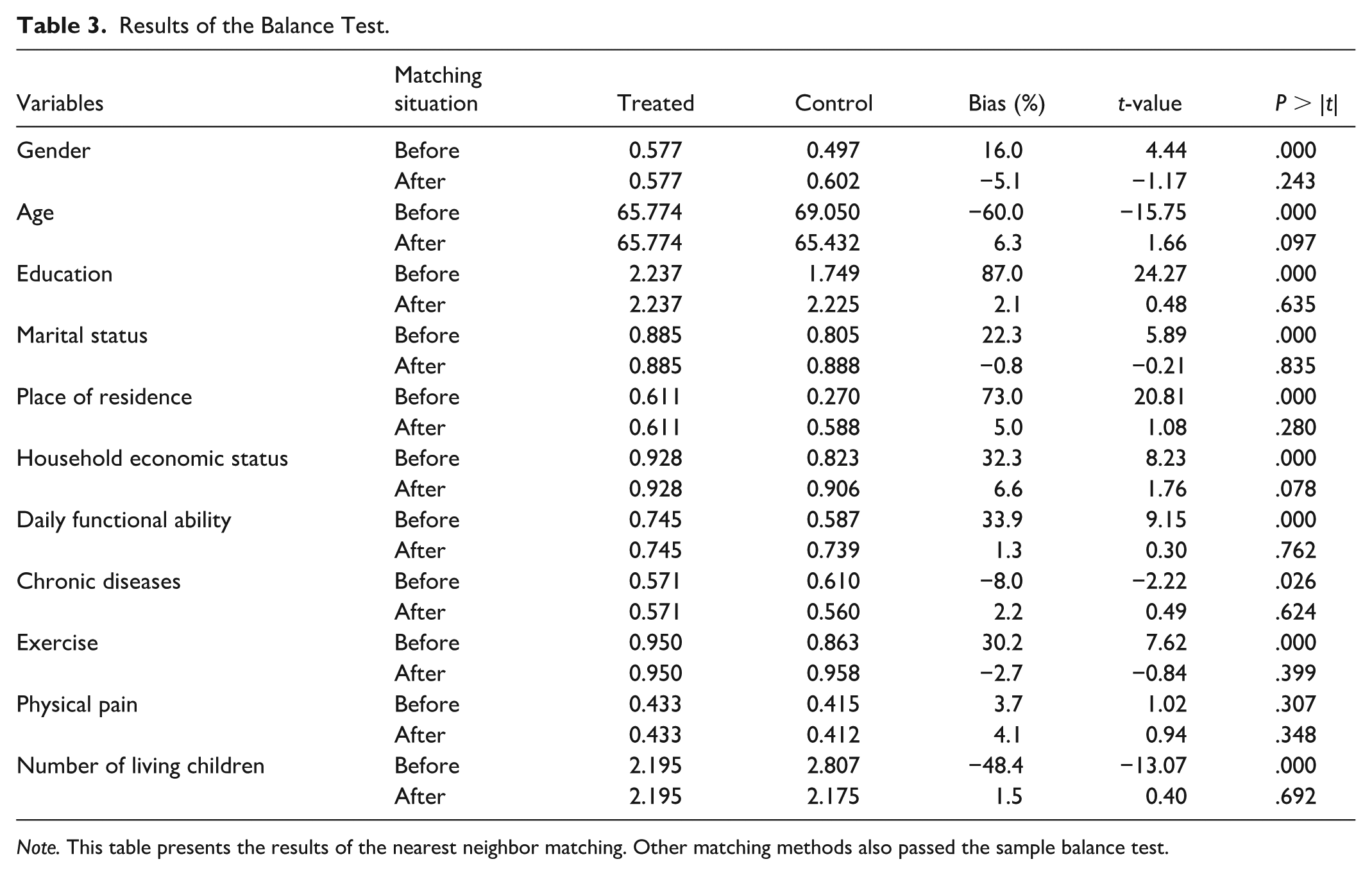
Note. This table presents the results of the nearest neighbor matching. Other matching methods also passed the sample balance test.

Standardized Bias plot.
Matching Results of Propensity Score.
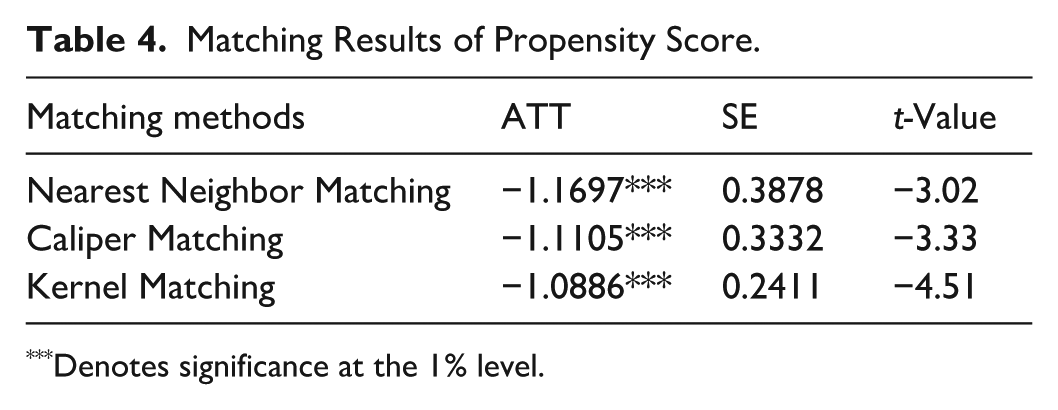
Denotes significance at the 1% level.
Endogeneity Analysis
Internet use may face potential endogeneity in its relationship with the mental health of empty-nest elderly. Specifically, an individual’s mental health status could influence their likelihood of using the Internet, indicating that the model may be subject to endogeneity arising from reverse causality. To address this issue, we employ the IV method. Following previous research, 60 we use the availability of broadband internet at the respondent’s residence as the instrument. This variable effectively reflects external internet infrastructure conditions and is not directly related to individual mental health, thus satisfying the relevance and exogeneity requirements. Specifically, we measure it using the CHARLS questionnaire item “Is broadband internet available at your current residence?,” coded as 1 for yes and 0 for no.
Table 5 presents the regression results obtained using the IV method. The first-stage results show that the IV has a significant positive effect on internet use among empty-nest elderly, demonstrating sufficient correlation and satisfying the relevance condition. In addition, the F-value, which exceeds the threshold value of 10 for the weak instrument test, indicates the absence of a weak IV problem. Furthermore, the second-stage regression results indicate that internet use remains significantly negatively associated with the mental health of empty-nest elderly, consistent with the baseline regression results.
Instrumental Variable Method.
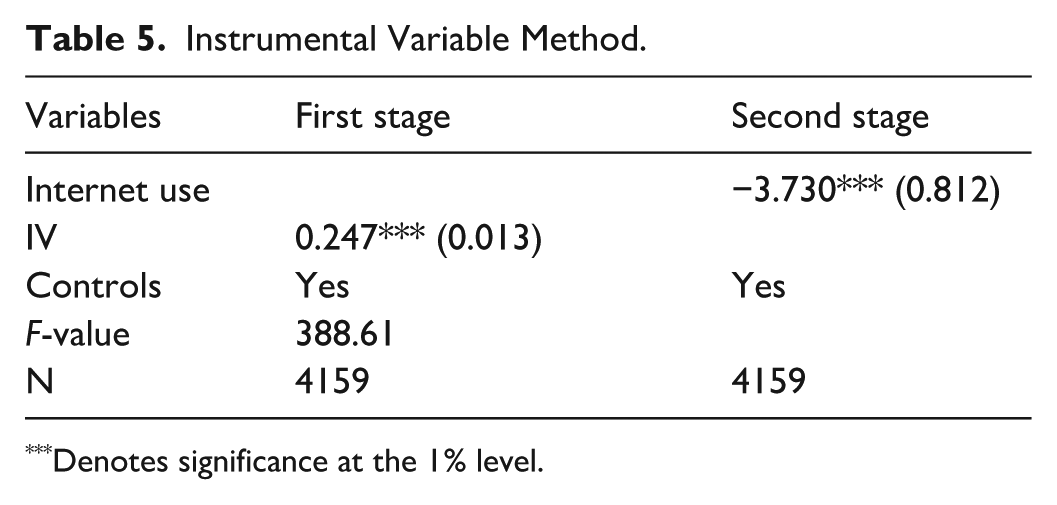
Denotes significance at the 1% level.
Mediation Analysis and Testing
To further explore the mechanisms through which internet use affects the mental health of empty-nest elderly, this study employed the stepwise regression approach to examine the mediating effects of 3 variables: social participation, children’s financial support, and children’s emotional support. Bootstrap methods were applied to test the significance of the mediation effects. A mediating effect was considered significant if the 95% confidence interval (CI) did not include zero. 61 Detailed results are presented in Table 6.
Results of Mediation Analysis.

The results indicate that social participation partially mediates the relationship between internet use and depression levels (β = −.097, P < .05), accounting for 8.5% of the total effect, supporting
Discussion
This study utilized nationally representative survey data to examine the association between internet use and the mental health of empty-nest elderly in China. Our findings indicate that internet use is significantly negatively associated with depression levels among empty-nest elderly, consistent with previous studies on non-empty-nest elderly.41,62 Several factors may explain this effect. Internet use enables older adults to access a wider range of health-related information and knowledge, which is associated with better mental well-being. 63 It also strengthens social network support by allowing older adults to expand their social circles and increase the frequency of social interactions through various online channels.40,64 Additionally, it facilitates efficient and diverse interactions with geographically dispersed children,30,54 which is associated with lower levels of loneliness, higher self-efficacy, and greater life satisfaction.62,65 In summary, internet use plays an important associative role in the mental health of empty-nest elderly. However, we also acknowledge the likelihood of a bidirectional relationship between internet use and depressive symptoms. That is, internet use may not only be associated with mental health, but individuals with fewer depressive symptoms may also be more motivated or better able to engage with technology. Previous research has provided evidence of a bidirectional relationship between computer use and well-being, 66 suggesting that this reciprocal effect should be taken into account when examining the association between internet use and the mental health of empty-nest elderly.
In this study, the mean CES-D score for empty-nest elderly was 9.08 ± 6.60, which was significantly higher than that of non-empty-nest elderly (8.44 ± 6.31). 67 This difference may be attributed to factors such as the lack of children’s companionship and family support, greater feelings of loneliness, and a weaker social support network among empty-nest elderly. It may also reflect the influence of subjective perceptions of depressive symptoms and the sociodemographic characteristics of the respondents.
Social participation act as a mediator between internet use and the mental health of empty-nest elderly, consistent with findings from studies on non-empty-nest elderly.47,48 For empty-nest elderly, who often have weaker social ties due to the absence of their children, the internet provides a new avenue for social engagement. It enables them to participate in various online social activities, such as social networking platforms, online communities, and interest-based virtual groups, which helps to expand their social networks and enhance their sense of social connectedness. In addition, empty-nest elderly may use the internet to access information about community events, cultural and recreational activities, interest-based training, volunteer services, and health lectures, which could encourage a transition from online interaction to offline participation. Active engagement in social activities has been found to be associated with better health outcomes. 68 For example, participation in leisure-oriented social activities is associated with lower levels of depression, 69 and engaging in multiple social activities with higher frequency is related to more positive health outcomes among elderly individuals. 70 Therefore, it may be beneficial to fully leverage the connective potential of the internet by integrating online and offline social activities, which may be associated with enhanced social participation among empty-nest elderly and better mental health.
Intergenerational support acts as a mediating variable between internet use and the mental health of empty-nest elderly, suggesting that internet use is associated with stronger connections with their children and greater receipt of financial support, which in turn is linked to better mental health. On one hand, the internet enables children to provide economic support to empty-nest elderly more conveniently, while older adults can more easily receive and utilize such support, alleviating life stress. On the other hand, the internet breaks temporal and spatial barriers, shortening the distance between empty-nest elderly and their children, increasing contact frequency and interaction quality, and helping maintain familial bonds.
Cultural context exerts differentiated influences on parents’ loneliness and well-being during the empty-nest period. Previous studies indicate that while some parents experience reduced well-being due to role loss, others benefit from the relief of role strain and increased social engagement, with cultural differences in familial roles, gender roles, social expectations regarding nest-leaving, and social participation patterns moderating these mechanisms. 71 In Asian countries such as China, filial piety and family relationships are highly valued. 72 Parents often closely associate their emotional well-being with their relationships with their children. When adult children leave home, this separation can trigger stronger feelings of loneliness, which has been identified as an important risk factor associated with depression among older adults.73,74 In such contexts, internet use may serve as a culturally contingent tool that helps maintain intergenerational closeness. Studies have shown that internet use is positively associated with more frequent contact between older adults and their children, stronger parent–child relationships, and higher levels of subjective well-being among older adults. 31 By contrast, in more individualistic cultural contexts, parents tend to view the empty-nest stage as a natural or even positive life transition. They often seek new opportunities for self-development and social engagement, potentially mitigating the negative effects of role loss. 71 For them, internet use is primarily instrumental, functioning as a means of obtaining information, entertainment, or self-actualization rather than maintaining intergenerational emotional bonds. Consequently, the psychological benefits of internet use among empty-nest elderly may vary depending on cultural context.
The rate of internet use among empty-nest elderly remains relatively low, which is largely attributable to barriers associated with the digital divide. As one of the most enduringly affected groups, older adults face potential deprivation of the benefits offered by the information society. 75 The digital divide is associated with poorer physical and mental health, lower social participation, reduced overall quality of life, and challenges to the realization of active aging among older adults. 76 This issue is particularly pronounced for disadvantaged empty-nest elderly, who encounter greater difficulties in accessing internet-enabled devices and receiving training in internet use, making them more vulnerable to the negative effects of the digital divide. Meanwhile, individuals with higher socioeconomic status not only exhibit fewer depressive symptoms but are also more likely to access health information online. 77 Conversely, providing disadvantaged older adults with internet access and usage training is associated with higher self-efficacy, greater social connectedness, and better subjective well-being. 78 Therefore, it is essential to strengthen support for internet access and digital literacy among empty-nest elderly, which may be associated with bridging the digital divide. In summary, the internet serves not only as an effective channel for enhancing individual health investment, 32 but also as a critical tool for addressing long-standing health inequalities. 33
It is worth noting that the benefits of internet use are not limited to mental health but also extend to other areas. For example, with the continuous development of the digital economy, e-commerce has become deeply integrated into people’s daily lives. Studies have shown that the development of e-commerce is associated with a narrowing of rural household income inequality, particularly among rural households with higher levels of digital usage and human capital. 79 In addition, research has found that digital finance is significantly positively associated with better physical health outcomes among older adults. 80 Overall, internet-based digital applications play an important role in promoting healthy and active aging.
Limitations and Future Research: First, this study used cross-sectional data, which allows for examination of the association between internet use and depression levels among empty-nest elderly but does not permit causal inference. Second, the study did not differentiate the frequency, purposes, or platforms of internet use among empty-nest elderly, making it difficult to fully assess the heterogeneous effects of these factors on mental health. Future research could employ more detailed indicators of internet use to explore its influence on the mental health of empty-nest elderly in greater depth. Third, we acknowledge the potential existence of other important mediating pathways, such as cognitive function, life satisfaction, or economic status. Future studies may further investigate these mechanisms to gain a more comprehensive understanding of how internet use relates to the mental health of empty-nest elderly. Finally, since this study is based on secondary cross-sectional data, t-tests and F-tests were conducted prior to the regression analyses. However, no formal power analysis was performed because the sample size was determined by the existing dataset, which may limit the statistical power of the results.
Conclusion
With the deepening of population aging in China, the number of empty-nest elderly experiencing depression is likely to increase further, placing additional pressure and challenges on families and society. It is essential to prioritize empty-nest elderly as a key population for depression prevention and intervention. This study provides empirical evidence for the association between internet use and the mental health of empty-nest elderly in China and proposes several recommendations.
First, increase the prevalence of internet use among empty-nest elderly. The proportion of empty-nest elderly using the internet remains low, primarily due to the digital divide and various barriers, such as lack of basic internet knowledge, insufficient operational skills, and low confidence in using technology. Governments and community organizations should provide targeted education and training programs to help older adults overcome these barriers, enhance their digital skills, promote social participation, and support better mental health outcomes. Additionally, due to limited media literacy, older adults are often vulnerable to misinformation, online scams, and phishing attacks. One effective strategy to address these threats is to strengthen digital media literacy education, enhancing their ability to critically evaluate information and increasing awareness of online security. 81
Second, strengthen internet infrastructure. In China, large-scale internal population mobility often leads to geographic separation between older adults, especially those in rural areas, and their children. Access to reliable internet service is therefore a prerequisite for empty-nest elderly to benefit from online resources. The government should enhance internet infrastructure in rural and underdeveloped regions, ensuring that empty-nest elderly can connect to the internet smoothly and enjoy stable and reliable network conditions. Improved infrastructure not only helps narrow the urban–rural digital divide but also provides older adults with channels to maintain online contact with family and friends, thereby alleviating loneliness and supporting better mental health.
Finally, utilize intergenerational support from children. Given that community service networks and various elderly care institutions in China are not yet fully developed, empty-nest elderly still rely heavily on their children for daily support, making intergenerational support crucial. Children should be encouraged to engage with their parents in various online activities through internet platforms. This not only strengthens family bonds and emotional interaction but also increases the interest, trust, and willingness of older adults to use digital technologies. During these interactions, guidance and assistance from children can effectively mitigate technological barriers, enhancing digital skills and adaptability. Furthermore, strong intergenerational relationships provide an important source of emotional support. Families should be encouraged to maintain regular contact with empty-nest elderly, fostering understanding, support, and close interaction, which in turn facilitates their integration into the digital society and is associated with positive mental health.
Footnotes
Acknowledgements
The authors sincerely thank the China Health and Retirement Longitudinal Study team for providing the research dataset.

Ethical Considerations
No animal studies are presented in this manuscript. No potentially identifiable human images or data are presented in this study. Ethical approval for all the waves of the China Health and Retirement Longitudinal Study (CHARLS) was granted by the Institutional Review Board at Peking University. The IRB approval number is IRB00001052-11015.
Consent to Participate
All the participants signed written informed consent forms prior to participating in the study.
Consent for Publications
All authors are aware of and agree to the publication.
Author Contributions
DL: conceptualization, methodology, formal analysis, writing-original draft, funding acquisition, visualization. TC: resources, supervision, writing-review and editing, project administration.
Funding
The authors disclosed receipt of the following financial support for the research, authorship, and/or publication of this article: This study was funded by the Postgraduate Scientific Research Innovation Project of Hunan Province (Grant No. CX20240632).
Declaration of Conflicting Interests
The authors declared no potential conflicts of interest with respect to the research, authorship, and/or publication of this article.
Data Availability Statement
The datasets generated and/or analyzed during this study are available from the corresponding author upon reasonable request.