




Abstract
This cross-sectional study examines the levels of depression and anxiety experienced by seafarers working in countries bordering the Black Sea in the post-COVID-19 period; it also evaluates the effects of these mental conditions on socio-demographic variables, problems encountered in ship and port environments during the pandemic, and career planning. Analyzes were conducted using the Beck Depression Inventory-II (BDI-II) and Generalized Anxiety Disorder-7 (GAD-7) scales. Additionally, a Gaussian Graphical Model (GGM) was used to analyze the interaction between psychological outcomes and working conditions and career planning. Findings reveal that, compared to pre-pandemic levels, depression and anxiety levels remain high. According to the results, 38.8% of participants show signs of depression, and 56.7% exhibit symptoms of anxiety. Anxiety levels are higher among officers and those with less maritime experience. GGM analysis shows that while the direct effects of COVID-19 have diminished, interactions between shipboard and port-related challenges persist. Strong relationships were observed between stressful working conditions on board, excessive alcohol consumption, and pressure from superiors. Port-related issues such as feeling isolated at port and pressure from port authorities emerged as key bridging variables in the network. Ship-related issues have a greater impact on seafarers’ well-being in the working conditions compared to port-related issues; however, port-related issues should also be addressed through appropriate interventions. A weak association was also found between the intention to discontinue working on board and the level of anxiety. Based on these findings, it is recommended to systematically address workplace tension due to work pressure, implement onboard psychological monitoring, provide targeted support for junior officers, integrate mental health training in maritime academies, improve leadership and workload balance, and include psychosocial indicators in post-contract evaluations.
Highlights
● This study reveals that seafarers’ depression and anxiety levels remained high in the post-Covid-19 period.
● GGM shows ship-related factors strongly affect mental health; port-related stressors worsen it indirectly.
● Findings call for holistic policies addressing both ship and port factors.
Introduction
The COVID-19 pandemic, first reported in late 2019, caused major disruptions in all areas of life on a global scale, and the maritime industry was significantly affected.1,2 Measures such as travel restrictions, quarantine protocols, and limitations on crew changes led to substantial changes in seafarers’ daily lives and work routines.3,4 During this period, prolonged isolation, uncertainty, and contract extensions became widespread, posing serious risks to mental health. 5 Mental health is defined not merely as the absence of mental illness, but as a broader state of well-being that includes an individual’s ability to cope with stress and fulfill social and functional roles.6,7 Common mental health conditions such as depression, anxiety, and stress are shaped by a wide range of individual, social, and environmental factors.8 -11 Therefore, assessing the mental health of seafarers requires not only focusing on clinical symptoms but also addressing the social and environmental dimensions of their working conditions. Moreover, the mental health of seafarers is a critical issue not only in terms of individual well-being but also for the safety of maritime operations. Human error remains one of the leading causes of marine accidents, and seafarers experiencing psychological distress may suffer impairments in attention, decision-making, and crisis management skills.12,13
To better understand the psychological impact of COVID-19 on seafarers, it is important to also consider the pre-pandemic context. Research conducted before the pandemic revealed that seafarers already experienced higher levels of depression (10%-37%) and anxiety (17%-30%) compared to the general population.14 -16 For instance, Lefkowitz and Slade 15 reported that 25% of international seafarers exhibited symptoms of depression, 17% showed signs of anxiety, and 20% reported suicidal ideation. Zamora et al. 16 found that prolonged exposure to social media was associated with depression and anxiety, particularly among less experienced seafarers. Similarly, Andruskiene et al. 14 reported that poor sleep quality was a significant predictor of psychological symptoms among maritime students. These findings suggest that even before the pandemic, seafarers represented a vulnerable group in terms of mental health due to the unique challenges of their profession.
Studies conducted since the onset of the pandemic have shown that seafarers, as essential workers responsible for approximately 80% of global trade, have been operating under extreme stress and pressure.17,18 Challenges such as lack of shore leave, limited communication with families, fear of infection, and increased workloads have led to significant rises in depression, anxiety, and stress among seafarers.19,20 According to the International Seafarers’ Welfare and Assistance Network (ISWAN), calls for help involving suicidal thoughts doubled during the pandemic, while overall helpline contacts tripled compared to pre-pandemic levels. 21 Even in the following year, issues such as stress, anxiety, and isolation remained the most frequently reported mental health concerns among seafarers. 22 Data from the Seafarers Happiness Index for the same period also indicated a significant decline in seafarers’ happiness levels in the first quarter of 2022. 23
During the pandemic, this vulnerability deepened further. Several studies reported that over 40% of seafarers exhibited symptoms of depression, and more than 50% showed signs of anxiety.24 -27 Country-specific research has revealed that mental health problems among seafarers have become widespread, associated with factors such as sleep disturbances, financial difficulties, contract extensions, separation from family, and social isolation on board.28 -32 Coping strategies including social support, efforts to maintain positivity, and communication among crew members have emerged as key factors supporting psychological well-being. Large-scale data confirm that strong safety culture and clear employer communication during crises have protective effects on seafarers’ mental health. 33
Findings increasingly indicate that the negative impacts of COVID-19 on seafarers’ mental health have persisted immediately after the pandemic. Svetina et al. 34 and Zhao et al. 35 emphasized that stress, anxiety, and isolation among seafarers did not decrease in the post-pandemic period, and the need for psychological support continued. This situation is related not only to the traumas experienced during the pandemic but also to the persistence of structural issues within the industry.36,37 The findings suggest that mental health support should not be limited to crisis periods but transformed into long-term strategies.
This study aims to examine whether the stressors faced by seafarers during the COVID-19 pandemic continue to affect their psychological well-being in the post-pandemic period. Focusing on seafarers from Black Sea countries, the study assesses depression and anxiety levels in relation to sociodemographic factors, ship and port related issues, and career planning. A Gaussian Graphical Model (GGM) approach is used to uncover how these variables interact within a network structure and to identify potential targets for intervention. This regional perspective contributes to the growing body of research on seafarers’ mental health and provides insights for both national and international maritime policy.
Literature Review
During the COVID-19 pandemic, numerous studies highlighted the serious mental health challenges faced by seafarers, emphasizing the psychological burden caused by prolonged isolation, contract extensions, and limited access to support systems. Baygi et al. 38 found a 44.8% prevalence of psychosocial distress and significant associations between time spent on board and levels of depression and stress. Also, in a study by Baygi et al., 26 conducted with 439 multinational seafarers working on international ships, 14.1% of the participants exhibited depressive symptoms and 12.4% reported anxiety symptoms. The study also found that longer service duration onboard was associated with a higher risk of depression and intrusion symptoms, while officers showed significantly higher levels of anxiety and depression than non-officers. Qin et al. 25 in a study conducted with 441 seafarers in China during the pandemic, found that 40.12% of participants exhibited depression symptoms using the Self-Rating Depression Scale (SDS). The negative effects of extended time on ships were associated with reduced exercise time and poor sleep quality. Pauksztat et al. 39 conducted a large-scale international study involving seafarers from over 40 countries and concluded that pandemic-specific stressors such as extended duty periods and increased working hours were significantly associated with symptoms of anxiety and depression. However, the presence of peer support and internet access appeared to buffer some of these effects. In a large-scale study including over 17 000 seafarers, Hayes-Mejia and Stafström 33 found that delays in crew changes and unclear communication by employers during the pandemic had a negative impact on seafarers’ mental health, while strong safety culture and clear crisis communication were associated with better psychological outcomes.
Numerous studies conducted during the pandemic have emphasized stress as a key factor affecting seafarers’ mental health.10,23,40 The existing literature reveals that factors such as the nature of the job itself, company policies, planning activities, and the lack of socialization opportunities were responsible for the increased stress levels among seafarers during the pandemic. 23 Regional studies conducted in Thailand, India, China, Turkey, and the Philippines have demonstrated elevated levels of depression, anxiety, and stress among seafarers throughout the pandemic.28 -32,41 These adverse mental health outcomes have been linked to factors such as sleep disturbances, financial difficulties, contract uncertainties, and separation from family. On the other hand, coping strategies including social support, positive thinking efforts, and effective communication have been found to support seafarers’ psychological well-being. Large-scale studies confirm that a safe working environment and clear, transparent employer communication during crisis periods have protective effects on seafarers’ mental health.
Despite the overwhelming evidence of COVID-19′s psychological toll on seafarers, concerns remain that the pandemic’s shadow continues to loom over their mental well-being in the post-COVID-19 era. In a recent study, Svetina et al. 34 examined seafarers’ mental health across 12 countries and identified 3 groups of stressors associated with adverse mental health outcomes: Environmental conditions (eg, vibration), social factors (eg, bullying, homesickness, working alone), and health-related problems (eg, physical injuries and illness). The study also found that both stress exposure and psychological symptoms were linked to seafarers’ motivation and their considerations about leaving the maritime profession. In a post-COVID-19 study conducted by Sharma, 42 the mental health of 109 Indian seafarers was assessed between March and April 2023. The findings revealed mild levels of depression (Mean = 13.54), moderate anxiety (Mean = 10.81), and moderate burnout, with average disengagement and exhaustion scores of 20.03 and 20.43, respectively. A moderate positive correlation was observed between depression, anxiety, stress, and burnout scores, highlighting the ongoing psychological burden among seafarers in the aftermath of the pandemic. In a post-COVID-19 comparative study, Zhao et al. 35 found that seafarers reported even higher levels of fatigue after the pandemic than during it. Although initially unexpected, in-depth interviews revealed that increased regulatory inspections and updated shipboard protocols following the pandemic significantly intensified the workload. In a post-pandemic cross-sectional study, Strukcinskiene et al. 43 identified key occupational stressors among Lithuanian seafarers, including workplace changes, interpersonal relationships, lack of peer support, and insufficient management backing. The study further revealed that junior seafarers and those with fewer years of service reported significantly higher stress levels, emphasizing the need for tailored stress management interventions across varying experience levels. These findings underscore the need for effective fatigue risk management practices to safeguard the well-being of seafarers in the evolving regulatory landscape.
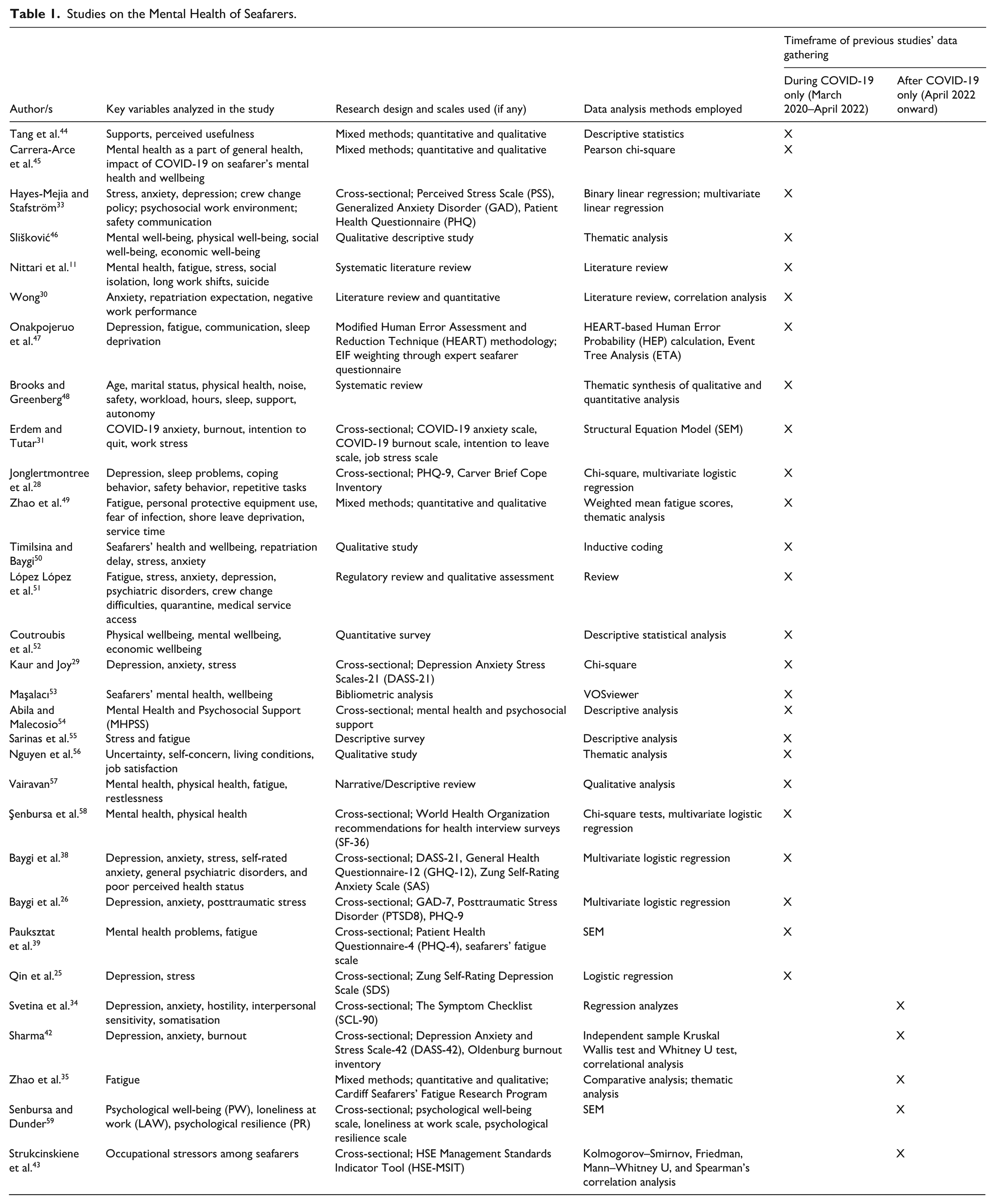
A comprehensive compilation of studies focusing on the mental health of seafarers during and after the COVID-19 period is presented in Table 1, classified according to the data collection timeframe of each study. As shown in Table 1, while numerous studies have explored the mental health of seafarers during the COVID-19 period, research focusing on the post-pandemic context remains considerably limited. This study aims to evaluate whether the challenges faced by seafarers during the COVID-19 pandemic continue to have an impact on their mental health even in the post-COVID-19 period. Factors such as the isolation and complex interpersonal relationships associated with working in a maritime environment, difficulties encountered during port operations, and uncertainties in career planning have been identified and analyzed based on the seafarers’ own accounts. In this context, the main question of the study is whether the issues caused by COVID-19 have temporary, long-term, or chronic effects. If these issues prove to be chronic, the study aims to propose solutions to eliminate them. In the literature, it is observed that most mental health research of this nature is limited to traditional statistical analyses. However, in this study, to reveal the complex relationships between key mental health indicators such as depression and anxiety and the issues faced, a comprehensive network analysis model was applied, going beyond traditional methods. In this study, the GGM method was employed, which is rarely used in maritime research. Unlike linear regression and structural equation modeling approaches, GGM presents the conditional dependencies among variables in a multivariate structure through a network format. This method allows for a more holistic and interactive analysis of systemic stress factors in shipboard life. In this respect, the study offers an innovative contribution to the maritime mental health literature, both analytically and visually. Network analysis offers an innovative approach for visualizing the interrelationships between variables and assessing potential causalities. Moreover, by focusing on seafarers working in countries bordering the Black Sea, the study not only provides a regional mental health profile but also allows for comparisons of these findings with the global maritime sector. In this way, it contributes to understanding region-specific psychosocial dynamics and creates a scientific foundation for industry intervention strategies.
Studies on the Mental Health of Seafarers.
Materials and Methods
In this study, the depression and anxiety levels of seafarers from countries bordering the Black Sea in the post-COVID-19 period were assessed, and the relationships between their mental health and socio-demographic characteristics were analyzed. The depression levels of seafarers were assessed using the Beck Depression Inventory-II (BDI-II), while their anxiety levels were evaluated using the Generalized Anxiety Disorder-7 (GAD-7) scale. Furthermore, the connections between their mental health and the issues identified through interviews under the themes of ship-related issues, port-related issues, and career planning were examined using the innovative method of the GGM. A comprehensive workflow diagram of the study is presented in Figure 1.

Workflow diagram of the study.
Sample Size, Study Design and Period
For sample size analysis, the population of seafarers from the Black Sea region was first estimated. According to the 2021 Seafarer Workforce Report, there are 198 123 Russian and 76 442 Ukrainian seafarers globally. 60 The 2019 data from the Turkish Ministry of Transport and Infrastructure reports 101 277 active Turkish seafarers. 61 Although no exact data are available for Georgia, Romania, and Bulgaria, based on Russia’s global share of 10.5%, 60 the total number of seafarers from these countries was estimated at 100 000. Thus, the study population was approximated as 475 000.
In calculating the required sample, population proportion was also considered. 62 This refers to the percentage of individuals with specific characteristics and is key in medical sample estimations. 63 Depression and anxiety prevalence among seafarers is estimated at 20%.15,64 Based on this, the minimum sample was calculated as 246 (95% CI, 5% margin).
Data were collected from 368 seafarers in Türkiye, Romania, Bulgaria, Ukraine, Russia, and Georgia. After excluding 13 ineligible participants, data from 355 individuals were analyzed exceeding the required sample by 40%.
In this study, a cross-sectional study design was chosen for use. A cross-sectional study allows for inferences about trends, attitudes, and opinions regarding the broader population based on the perspectives of a sample group selected from a specific population. 65 In the study conducted within this design, a survey method was used as the data collection tool. The surveys were conducted with participants using 2 different methods: Online and face-to-face. In accordance with the scope and methods of the study, participants were selected from individuals who were either currently working on ships or had recently signed off from vessels. The data for the research were collected between April 2022 and November 2022, a period that can be defined as the post-COVID-19 phase. In addition, this study followed the STROBE (Strengthening the Reporting of Observational Studies in Epidemiology) guidelines for cross-sectional studies. 66
Scales
Beck Depression Inventory-II
In this study, BDI-II was used to assess depression levels. The beck depression inventory scale was initially developed by Beck and colleagues in 1961 to measure individuals’ depression symptoms. After undergoing several revisions, the scale was updated in 1996 by Beck and colleagues, and following validity and reliability analyses, it was transformed into the 21-item BDI-II form. The BDI-II demonstrated excellent internal consistency (Cronbach’s α = .91), strong test-retest reliability (r = .93), and solid convergent validity with established depression and anxiety measures (eg, r = .71 with the Hamilton depression scale), supporting its reliability and construct validity for clinical use.67 -69 The method, in which each question is rated by participants on a scale from 0 to 3, assesses individuals’ depression levels across 4 stages: Minimal, mild, moderate and severe depression, based on the total score obtained. Participants with total scores between 0 and 13 are classified as having minimal, scores between 14 and 19 as very mild, scores between 20 and 28 as moderate and scores between 29 and 63 as severe depression.68,70 In the present study, the Cronbach’s alpha coefficient for the BDI-II scale was found to be .91. The Kaiser-Meyer-Olkin (KMO) value was 0.93, and the results of Bartlett’s test of sphericity were observed to be χ² = 2625.537; P < .001.
Generalized Anxiety Disorder-7
In this study, GAD-7 scale was used to measure participants’ anxiety levels. Developed in 2006 by Spitzer et al, the GAD-7 is a psychometric scale designed to assess and rate individuals’ levels of anxiety. 71 The scale underwent rigorous validity and reliability analyses to ensure its measurement accuracy and consistency. The GAD-7 demonstrated excellent internal consistency (Cronbach’s α = .92), strong test-retest reliability (ICC = 0.83), high criterion validity (AUC = 0.906), and solid construct validity through significant correlations with functional impairment and other anxiety measures. The GAD-7 consists of a total of 7 questions that evaluate the participants’ anxiety symptoms.71,72 Participants rate how frequently they have experienced anxiety-related symptoms in the past 2 weeks, with a scale ranging from 0 “Not at all” to 3 “Nearly every day.” The results are classified into 4 categories based on the total score, with anxiety levels ranging from minimal to severe. Individuals scoring between 0 and 4 are considered to have minimal, those with scores between 5 and 9 are classified as having very mild, those scoring between 10 and 14 have moderate and those with scores between 15 and 21 are considered to have severe anxiety symptoms.71,73,74 In the present study, the Cronbach’s alpha coefficient for the GAD-7 scale was found to be .87. The KMO value was 0.88, and the results of Bartlett’s test of sphericity were observed to be χ² = 989.198; P < .001.
Working Condition and Demographic Structure
A demographic structure questionnaire consisting of 7 questions was created to collect demographic data from seafarers. These socio-demographic variables were selected from those frequently discussed in the literature, with their effects on individuals’ mental health being addressed in various studies. In addition, various statements were formulated to assess whether the professional issues encountered by seafarers during their time on board during the COVID-19 period continue to have an impact on depression and anxiety levels in the post-COVID-19 period. The statements were identified through face-to-face and online interviews conducted with seafarers working on ships during the COVID-19 period. The identified statements were grouped under 3 main themes: ship-related issues, port-related issues and career planning. The section consists of a total of 13 statements, including 5-point Likert scale items (SRI1-6, PRI1-4, and CP1) and multiple-choice items (PRI5 and PRI6). The study received approval from the relevant ethics committee. Participants were informed that the study had received ethics approval, and informed consent was obtained from all participants. To minimize potential response bias, participants were informed at the beginning of the survey that all responses would remain anonymous and would be used strictly for scientific research purposes. They were encouraged to respond sincerely to ensure the reliability and integrity of the findings.
Statistical Analysis
Examination of the Relationships Between Socio-Demographic Data and Depression and Anxiety
The relationships between socio-demographic data (categorical variables) and the levels of depression and anxiety among seafarers were analyzed using the IBM SPSS 26 statistical software. 75 To examine significant differences between 2 distinct groups within the scale, an independent samples t-test was applied. While the t-test analyzes the differences between the groups, Cohen’s effect size (d) was calculated to measure the magnitude of this difference. A Cohen’s d coefficient of .20 indicates a small effect size, .50 indicates a medium effect size, and .80 indicates a large effect size.76 -78
One-Way Analysis of Variance (ANOVA) was used to examine the differences among 3 or more groups within the scale. ANOVA identifies the differences between groups; however, Post Hoc tests are applied to determine which specific groups show significant differences.79,80 In this study, since it was determined that the groups were homogeneously distributed but their frequency distributions were not equal, Hochberg’s GT2 analysis was preferred. 81 Following the ANOVA analyses, effect size was assessed using Eta Squared analysis. Eta Squared can be defined as the proportion of variance associated with each interaction and error, or explained by them. 82 Eta Squared values range from 0 to 1, where values close to 0.01 indicate a small effect size, values close to 0.06 indicate a medium effect size, and values close to or greater than 0.14 indicate a large effect size.76,83
Gaussian Graphical Model
The relationships between occupational difficulties and depression and anxiety variables were examined using the GGM. The GGM network structure was created using the R programing language (versions 3.6.0 and later) and RStudio Version 2024.12.0+467. 84
GGM is an undirected graphical model commonly used for multivariate normal distribution-based scenarios. This model constructs the network structure based on conditional independence relationships between variables under the assumption of normality.85,86 Unlike directed graphical models such as Bayesian networks, GGM generates undirected networks. 87 This characteristic makes it preferred in psychological and biological research, where no single node independently influences the entire system, and there are no independent nodes in the outcome. Statistically, undirected edges in GGM represent conditional independence relationships. The absence of an edge between 2 nodes indicates that these nodes are conditionally independent given other variables. 88 The network structure of GGM is constructed by leveraging patterns from the correlation matrices between variables.87,89 GGM has been used in various fields of literature to assess individuals’ mental states.90 -93 However, this study represents the first application of the GGM model on the well-being of seafarers. In this regard, it will make a significant contribution to the literature on seafarers’ well-being as an introduction to the model.
In the analysis of the data, skewness and kurtosis coefficients were examined to assess the normal distribution. If the skewness and kurtosis coefficients fall between −2 and +2, the variables are considered to follow a normal distribution. 94 The skewness and kurtosis values for the variables are presented in Figure 2.

GGM nodes skewness and kurtosis coefficients.
It is recommended to use regularized estimators for network structures created with small sample groups. 95 One of the most used models among regularized estimators is the Extended Bayesian Information Criterion with graphical Lasso (EBICglasso) approach. EBICglasso, developed by Chen and Chen, is a method used to control model complexity and identify significant variables. 96 By applying penalty parameters, this method removes unnecessary connections, thereby enhancing the interpretability of the network. In this study, the GGM network structure was constructed using the EBICglasso method.
The qgraph package was used for visualizing the network structure, and the variables were categorized into 5 thematic groups: Depression, anxiety, ship-related issues, port-related issues, and career planning. The qgraph package for R visualizes data through network models, where variables are nodes and correlations are edges, with edge width representing the strength of correlations. 97 To assess the significant connections within the network, node centrality (Expected Influence, EI) and the identification of critical inter-group connections were calculated using the Bridge Expected Influence (BEI) measurements with the help of the network tools package. 98 The EI value represents the measure used to determine the most influential node within the network, and it is calculated as the sum of all edges connected to the node. 99 The BEI value, on the other hand, is a metric used to identify nodes that may serve as bridges between groups within the network, calculated by summing the absolute weights of the edges between a node and other nodes across groups. 100
Different analyses based on the bootstrapping method were used to assess network stability. Bootstrapping is a resampling technique that evaluates the reliability of statistical estimates by repeatedly drawing random subsamples. 101 In this study, widely accepted methods were employed to test network accuracy and stability. First, bootstrap edge weight accuracy analysis was performed using the bootnet package to visualize the confidence intervals and assess the reliability of edge weights. 102 Additionally, bootstrapped difference tests were applied to examine statistically significant differences in node strengths and edge weights. 103 The edge weight accuracy analysis revealed wide confidence intervals for several edges, indicating that low-weight edges should be interpreted with caution and validated by future studies (Figure 3). In this figure, each line represents a specific edge ordered by weight; red lines show original sample values, gray areas show confidence intervals, and black dots indicate the bootstrapped means. These plots are auto-generated by standard packages (bootnet and qgraph) and follow conventions established in the literature. Rather than focusing on axes, the width of the gray areas provides a visual cue for edge weight reliability, as suggested by Epskamp et al. 103 The bootstrapped difference tests also showed that nodes with higher centrality values were significantly different from others (Figure 4). In the plot, gray boxes denote non-significant differences, black boxes indicate significant ones, and white boxes with values display the strength centrality of each node.

Bootstrap edge weight accuracy analysis.
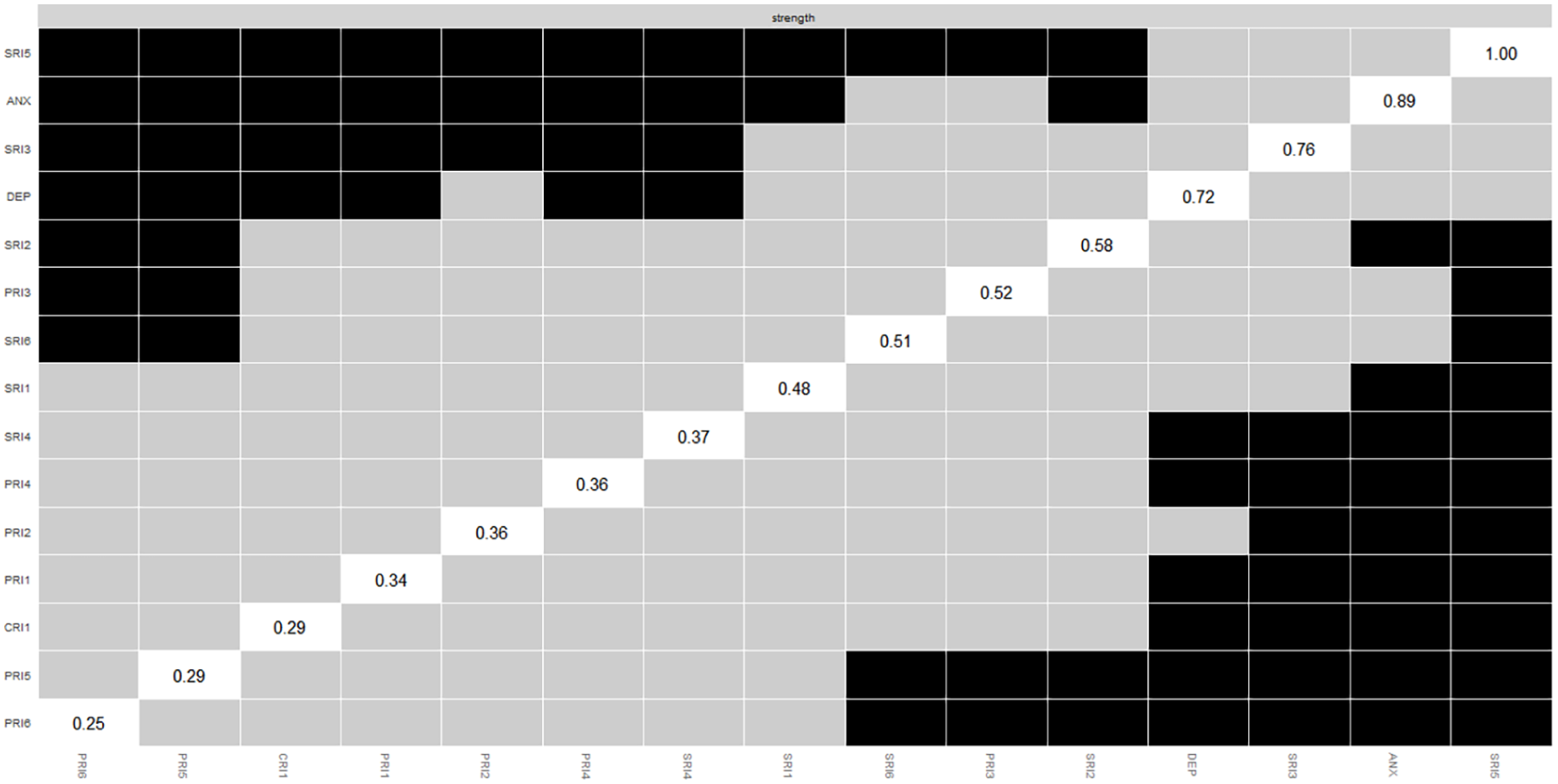
Bootstrapped difference tests.
To assess the stability of centrality measures, a case-dropping subset bootstrap analysis was conducted, and the correlation stability coefficient (CS-coefficient) was calculated. This coefficient reflects how reliable node centrality estimates are under sampling variability. Values above 0.25 (preferably > 0.50) indicate acceptable stability. 103 In this study, the CS-coefficient was 0.400, suggesting moderate stability while underlining the need for future validation with larger samples. Figure 5 displays the average correlations between centrality indices from subset samples and the original network. The shaded areas represent 95% confidence intervals, ranging from the 2.5th to the 97.5th percentiles of these correlations.

Case-dropping subset bootstrap analysis.
Results
This section of the study presents the findings related to the sociodemographic characteristics of the participants, descriptive statistics on depression and anxiety levels, and the key relationships identified through GGM analysis. A total of 355 seafarers participated in the study. The majority of the participants were male (92.7%), while 7.3% were female. Regarding age, 53.5% were between 18 and 30 years old, and 46.5% were 31 years or older. In terms of nationality, 62.3% were from Türkiye and 37.7% were from other Black Sea countries. When categorized by rank, 30.2% were deck officers, 23.6% were cadets, 12.0% were masters, 11.1% were deck crew, 9.1% were engineers, 7.7% were chief engineers, and 6.3% were engine crew (Table 2).
Analysis of the Difference in Depression and Anxiety Mean Scores Based on Seafarers’ Socio-Demographic Characteristics.
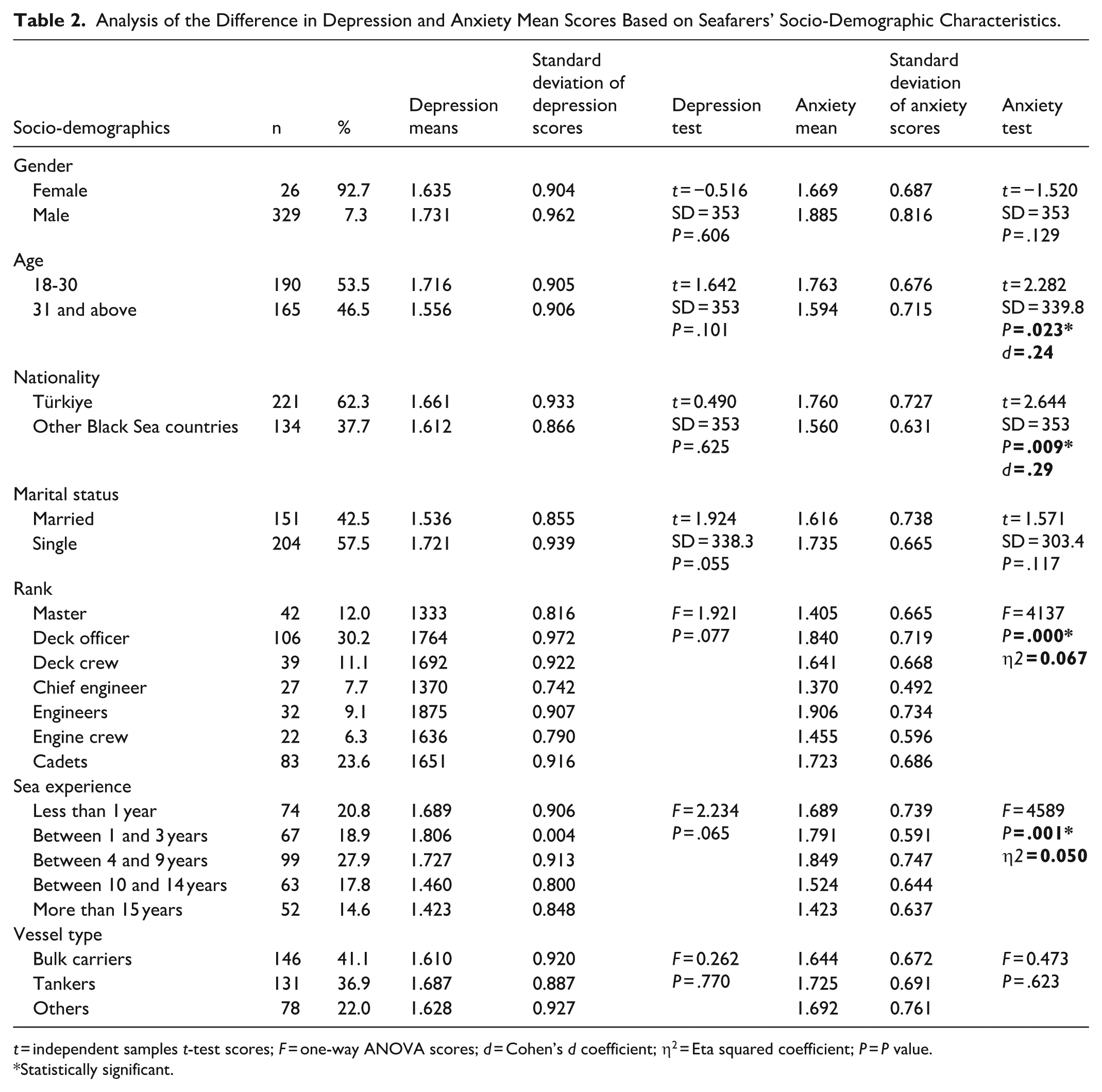
t = independent samples t-test scores; F = one-way ANOVA scores; d = Cohen’s d coefficient; η2 = Eta squared coefficient; P = P value.
Statistically significant.
When examining the relationship between the socio-demographic characteristics of seafarers and their levels of depression and anxiety, no significant relationship was found between depression levels, while a moderate, statistically significant relationship was observed between anxiety levels and the rank and sea experience (Table 2). In Table 2, the t-value and ANOVA F-value indicate between-group differences, with P-values < .05 considered statistically significant. 104 Effect sizes are interpreted using Cohen’s d and eta squared (η²), as described in the “Materials and Methods” section. A statistically significant relationship was observed between anxiety levels and 4 socio-demographic variables: Age, nationality, rank, and sea experience. Seafarers aged 18 to 30 reported significantly higher anxiety levels compared to those aged 31 and above (t = 2.282, df = 339.8, P = .023), with a small effect size (Cohen’s d = .24). Similarly, Turkish seafarers had higher anxiety scores than those from other Black Sea countries (t = 2.644, df = 353, P = .009), also with a small effect size (d = .29).
An analysis of variance showed a statistically significant difference in anxiety levels across different ranks (F = 4.137, P < .001), with a medium effect size (η² = 0.067). Post-hoc comparisons revealed that deck officers and engineers exhibited higher anxiety than masters and chief engineers. Furthermore, anxiety levels were significantly associated with sea experience (F = 4.589, P = .001, η² = 0.050), indicating higher anxiety among less experienced seafarers. These findings suggest that younger age, Turkish nationality, lower rank, and limited sea experience may be contributing factors to elevated anxiety symptoms among seafarers in the post-COVID-19 context.
According to the BDI-II results, 38.8% of seafarers exhibited symptoms of depression, with 17.7% reporting mild, 16.9% moderate, and 4.2% severe levels of depression (Figure 6). Similarly, based on the GAD-7 scale, 56.7% of seafarers showed symptoms of anxiety, with 46.5% experiencing mild, 8.5% moderate, and 1.7% severe anxiety (Figure 6).

Seafarers BDI-II and GAD-7 results.
The GGM network structure created to examine the relationships between seafarers’ depression, anxiety levels, ship-related issues, port-related issues, and career planning themes is shown in Figure 7. Thick edges in the network represent strong relationships. Green edges indicate positive relationships, while red edges denote negative relationships. Each theme is represented by different color codes. Additionally, the obtained EI and BEI results and edge weights are presented in Table 3.
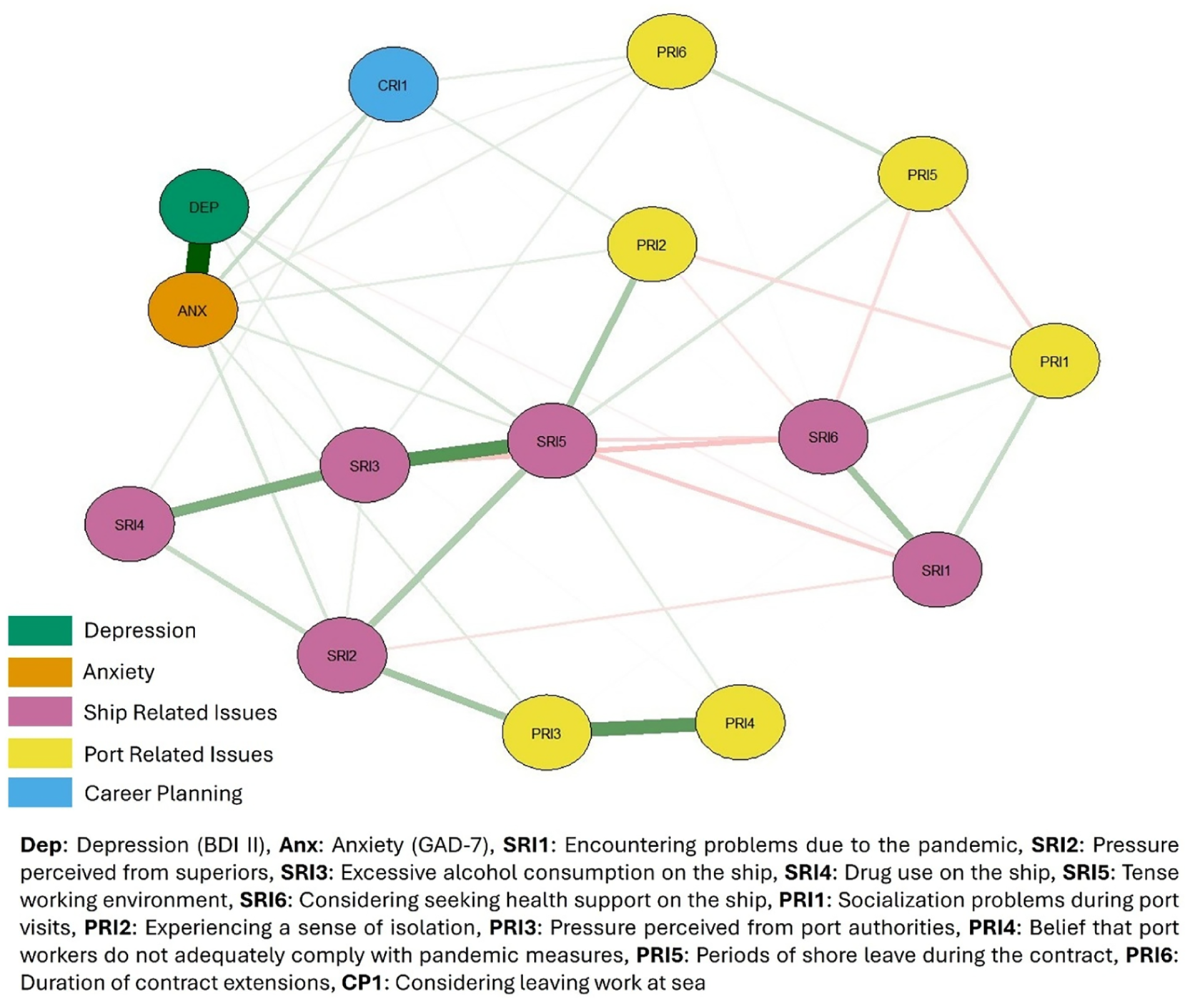
GGM network.
EI and BEI results and edge weights.

EI = expected influence; BEI = bridge expected influence.
According to the results of the GGM analysis, the variables with the highest EI values were Anxiety (EI = 0.886) and Depression (EI = 0.664), indicating their central role in the overall network structure. Within the “Ship-related issues” category, the node representing a tense working environment (SRI5) exhibited a high EI value of 0.683, followed by excessive alcohol consumption on board (SRI3; EI = 0.554) and pressure from superiors (SRI2; EI = 0.468). In contrast, the node concerning health support on board (SRI6) had the lowest EI score (EI = −0.007), reflecting minimal influence.
In the “Port-related issues” theme, pressure from port authorities (PRI3) stood out with an EI of 0.495, whereas other nodes in this group had relatively lower influence. The career planning item (CP1), referring to thoughts of quitting sea work, had a modest EI of 0.271.
In terms of BEI, Anxiety (0.886) and Depression (0.719) again emerged as key bridging variables. Among the ship-related items, the tense working environment (SRI5) served as the strongest bridge (BEI = 0.399), while in the port-related category, feeling of isolated (PRI2; BEI = 0.298) and pressure from port authorities (PRI3; BEI = 0.214) held moderate bridge roles. The career planning item (CP1) had a BEI of 0.287, indicating its potential as a connector across domains, albeit weaker than SRI5.
Discussion
In the current study, 38.8% of seafarers were found to exhibit symptoms of depression, including mild (17.7%), moderate (16.9%), and severe (4.2%) levels as measured by the BDI-II scale. In a study conducted with the BDI scale during the early stages of COVID-19, this rate was reported as 41.7%. 25 Research conducted prior to the COVID-19 period reported depression rates among seafarers ranging from 10% to 37%.14 -16 The study findings indicate that seafarers’ levels of depression remain higher than in the pre-pandemic period, with only limited improvement observed compared to the early stages of the pandemic.
Similarly, the GAD-7 results show that 56.7% of the participants experienced symptoms of anxiety. Studies conducted before the COVID-19 period reported anxiety rates among seafarers as 17% and 30% respectively.15,16 Research conducted during the pandemic indicates that, like depression levels, anxiety levels also showed a significant increase compared to the pre-pandemic period.5,41 Although the results of this study pertain to the post-pandemic period, they demonstrate that the effects on seafarers’ mental health persist, and, like depression, anxiety levels have not yet returned to normal levels. In addition, Sharma 42 reported moderate levels of burnout alongside depression and anxiety symptoms among Indian seafarers in the post-COVID era, suggesting a continued psychosocial burden.
Even before the pandemic, research had identified seafaring as a high-risk occupation for mental health. Factors such as chronic sleep deprivation, long voyages, social isolation, limited communication with family, and perceived job insecurity were frequently associated with depression, anxiety, and even suicidal ideation.14 -16 Zamora et al. 16 also reported that social media use was linked to anxiety and depression, while Lefkowitz and Slade 15 found that over 20% of seafarers experienced suicidal thoughts.
A study by Baygi et al. 26 revealed that during the COVID-19 period, officers experienced higher levels of psychological issues compared to the crew members. Additionally, Şenbursa et al. 58 using data collected during the COVID-19 period, found that cadets had 2.8 times worse mental health compared to masters and chief engineers. In this study, the anxiety levels of officers and engineers were found to be higher than those of ratings, although the difference was not statistically significant. Post-hoc analyses indicated that officers and engineers experienced more anxiety than masters and chief engineers, and that personnel with less seafaring experience reported higher anxiety levels than those with more experience. This may be due to the role of experience in enhancing psychological resilience or the heavier workload and pressure associated with officer and engineer ranks.105 -107
When examining the network structure, EI values reveal the relative impact of each variable within the network and how these effects shape the interrelations among variables. In the network analysis, depression (EI = 0.664) and anxiety (EI = 0.886) emerged as central nodes, exerting significant influence on the overall network structure. This finding supports the hypothesis, frequently emphasized in literature, that depression and anxiety are strongly interrelated.108,109 Therefore, the results suggest that intervention approaches targeting both variables simultaneously may be more effective.
In the theme of ship-related issues, the SRI5 (tense working environment) node emerged as the strongest bridge element across groups (BEI = 0.399). This finding aligns with previous studies, indicating that workplace changes, lack of managerial support, and peer relationship difficulties increase occupational stress among seafarers. 43 The strong connection between SRI5 and PRI2 (feeling of alienation), a port-related issue (edge weight = 0.1494), suggests that port experiences are closely linked to stress levels on board. This relationship also resonates with prior findings emphasizing the stress-relieving effects of shore leave.110,111 Furthermore, SRI5 showed strong intra-group connections with SRI3 (excessive alcohol use on the ship) and SRI2 (pressure from superiors), indicating that a tense working environment on board is closely associated with alcohol use and hierarchical pressure, in line with existing literature.112,113 In this context, interventions targeting SRI5 (tense working environment) may serve as a bridge, potentially triggering improvements or deteriorations in related clusters. Zhao et al. 35 found that post-pandemic intensification of inspection regimes and administrative duties increased seafarers’ fatigue and psychological burden, possibly contributing to the perception of a tense working environment captured by SRI5. This aligns with the broader trend of heightened regulatory pressure in the post-pandemic period, which exacerbated pre-existing stressors such as social isolation and workload, thereby intensifying the tense ship environment (SRI5).
In the theme of port-related issues, the nodes PRI2 (feeling of alienation) and PRI3 (perceived pressure from port authorities) appear to function as potential bridge elements (BEI = 0.298 and 0.214, respectively; see Table 3). However, these values are lower than the BEI of SRI5 (tense working environment) at 0.399, indicating that although these nodes are meaningful, their overall influence on the network is more limited. Edge weights reveal a strong connection between PRI3 and PRI4 (belief that port workers are not adequately following pandemic measures), suggesting that in ports with more authoritarian management, perceived compliance with rules tends to be weaker. While the literature remains divided on the effect of authoritarian leadership on safety behavior.114,115 Our findings suggest that oppressive attitudes in port environments may negatively influence seafarers’ perceptions of safety. Nonetheless, the relatively low BEI values imply that improvements in these nodes may not substantially alter the overall network structure. While port-related issues statistically show weaker effects than onboard factors, their indirect impact on ship operations and the psychosocial environment is significant. These issues increase workplace tension and symptoms of depression and anxiety, reinforcing a detrimental cycle in psychological well-being. Consequently, interventions and policy recommendations addressing port-related problems are as important as those targeting onboard issues and should be approached holistically.
In the theme of “career planning,” the thought of leaving the job at sea (CP1) emerged as a single prominent node, with a BEI value calculated at 0.287 (Table 3). This level of influence is lower when compared to “tense working environment” (SRI5, BEI = 0.399). Indeed, CP1 appears more as an outcome variable within the network structure and, by its nature, has limited potential as a direct target for intervention. Edge weight analyses revealed that CP1 had its strongest connection with the anxiety variable (0.0943), suggesting that high levels of anxiety may trigger thoughts of leaving the seafaring profession. In the literature, seafarers’ intention to quit has been linked to factors such as social isolation, intense work pace, physical exhaustion, unfair contracts, and prolonged absence from land.34,116 Notably, Svetina et al. 34 highlighted that social isolation and bullying were key determinants among seafarers considering career withdrawal. While our findings also suggest a possible link between anxiety and career planning, the wide confidence interval (Figure 3) limits the certainty of this relationship. Therefore, further research is needed to confirm this result and to better understand the nature of the relationship.
Based on these findings, several practical and policy-level recommendations can be made: Streamline inspections: Collaborate across stakeholders (port states, flag states, terminals) to develop integrated inspection models, reducing redundant audits (eg, SIRE (Ship Inspection Report Program), CDI (Chemical Distribution Institute)) that exacerbate stress. Strengthen alcohol controls: Enforce stricter entry-point checks for shore personnel and crew during port calls to uphold zero-tolerance policies. Onboard mental health systems: Integrate periodic assessments, confidential counseling, and support lines into Safety Management Systems (SMS). Support junior officers: Implement peer mentoring and resilience training to address higher anxiety levels among less experienced seafarers. Curriculum reform: Maritime academies should incorporate mental health modules (coping strategies, distress identification). Leadership interventions: Target tense work environments through improved communication, workload balance, and leadership training. Expand post-contract evaluations: Include psychosocial indicators (eg, pressure from superiors, alcohol use) alongside operational metrics.
This study was conducted during a specific time window and focused on seafarers from Black Sea countries, which may limit the generalizability of findings. Mental health indicators were measured using self-report scales (BDI-II and GAD-7), which are subject to individual bias. Future research should include longitudinal designs, qualitative interviews, and larger, more diverse international samples to further investigate how post-pandemic stressors continue to affect maritime mental health globally.
Conclusion
This study assessed depression and anxiety levels among seafarers from Black Sea countries in the post-COVID-19 period and examined their associations with socio-demographics, shipboard conditions, port-related issues, and career planning. Based on BDI-II and GAD-7 scales, 38.8% of seafarers reported depressive symptoms and 56.7% showed anxiety figures notably higher than pre-pandemic levels. Anxiety was more pronounced among officers and less-experienced seafarers.
Although the direct psychological effects of COVID-19 appear to have declined, network analysis revealed persistent onboard stressors. A tense working environment (SRI5) emerged as the most influential node, bridging symptoms of both depression and anxiety. Strong links also connect tense conditions with alcohol use and pressure from superiors, indicating systemic stress. Port-related factors, though less central, such as perceived authority pressure and isolation, also posed mental health risks.
In conclusion, post-pandemic seafarers still face embedded stressors. Addressing these through integrated policy, company-level interventions, and continued research is vital for promoting long-term mental well-being in maritime contexts.
Supplemental Material
sj-docx-1-inq-10.1177_00469580251371386 – Supplemental material for Mapping Mental Health of Seafarers Post-COVID-19: A Gaussian Graphical Model of Depression, Anxiety, and Maritime Working Conditions
Supplemental material, sj-docx-1-inq-10.1177_00469580251371386 for Mapping Mental Health of Seafarers Post-COVID-19: A Gaussian Graphical Model of Depression, Anxiety, and Maritime Working Conditions by Fırat Sivri, Özkan Uğurlu, Eduardo Blanco-Davis, Nihan Şenbursa and Jin Wang in INQUIRY: The Journal of Health Care Organization, Provision, and Financing
Supplemental Material
sj-docx-2-inq-10.1177_00469580251371386 – Supplemental material for Mapping Mental Health of Seafarers Post-COVID-19: A Gaussian Graphical Model of Depression, Anxiety, and Maritime Working Conditions
Supplemental material, sj-docx-2-inq-10.1177_00469580251371386 for Mapping Mental Health of Seafarers Post-COVID-19: A Gaussian Graphical Model of Depression, Anxiety, and Maritime Working Conditions by Fırat Sivri, Özkan Uğurlu, Eduardo Blanco-Davis, Nihan Şenbursa and Jin Wang in INQUIRY: The Journal of Health Care Organization, Provision, and Financing
Footnotes

Ethical Considerations
The study was approved by the Ethics Committee for Social and Human Sciences Research at Ordu University (Ethical Clearance Reference Number: 2022-34) on March 22, 2022.
Consent to Participate
Participants were informed that the study had received ethical approval, that all collected data would be kept confidential and used solely for scientific purposes, and verbal or written informed consent was obtained from all participants before starting the survey. Even when verbal consent was obtained, participants still completed the written “Voluntary Participation Form” approved by the Ethics Committee, as required by the ethical protocol.
Author Contributions
Fırat Sivri: Conceptualization, Methodology, Formal Analysis, Software, Visualization, Writing – Original Draft, Writing – Review and Editing, Supervision, Data Curation. Özkan Uğurlu: Methodology, Validation, Formal Analysis, Writing – Review and Editing, Investigation. Eduardo Blanco-Davis: Methodology, Writing – Review and Editing, Resources, Investigation. Nihan Şenbursa: Methodology, Writing – Review and Editing, Investigation, Data Curation. Jin Wang: Methodology, Writing – Review and Editing, Resources, Investigation, Validation.
Funding
The author(s) received no financial support for the research, authorship, and/or publication of this article.
Declaration of Conflicting Interests
The author(s) declared no potential conflicts of interest with respect to the research, authorship, and/or publication of this article.
Data Availability Statement
The datasets utilized and/or analyzed during this study are accessible from the corresponding author upon request.
Supplemental Material
Supplemental material for this article is available online.
References
Supplementary Material
Please find the following supplemental material available below.
For Open Access articles published under a Creative Commons License, all supplemental material carries the same license as the article it is associated with.
For non-Open Access articles published, all supplemental material carries a non-exclusive license, and permission requests for re-use of supplemental material or any part of supplemental material shall be sent directly to the copyright owner as specified in the copyright notice associated with the article.
