



Abstract
Community violence interventions (CVI) encompass a range of strategies aimed at reducing community firearm violence among those most affected. While CVI is an umbrella term, specific CVI approaches across the United States differ markedly in their underlying theoretical frameworks, specific program activities, and populations served. These different CVI approaches have not been well defined or uniformly understood. Given unprecedented financial support for CVI from local, state, and federal sources in recent years, increased research attention to understanding the implementation and impacts of these programs, and growing efforts by policymakers, practitioners, and community leaders to enact CVI programs, it is important to understand how CVI is defined and characterized in applied discourse (eg, among CVI practitioners, funders, and scholars). This grey literature review aimed to synthesize how CVI practitioners, funders, and scholars commonly characterize CVI approaches and how those approaches relate to previously identified CVI theoretical frameworks. Following processes similar to a scoping review, we conducted a grey literature search to locate and synthesize information from webpages (eg, from community groups and academic organizations) and (non-peer reviewed) reports from web sources discussing CVI approaches. We identified nine main CVI approaches commonly mentioned in applied CVI discourse: 1. Violence interruption/street outreach; 2. Group violence interventions (GVI)/focused deterrence/group violence reduction strategy (GVRS); 3. Hospital-based violence intervention programs (HVIP); 4. Built environment/place-based/Crime Prevention Through Environmental Design (CPTED); 5. Behavioral science interventions/cognitive behavioral interventions; 6. Victim/trauma/survivor programs/resources; 7. Mentoring/fellowship programs; 8. School-based/related youth interventions; and 9. Diversion/deflection programs. These approaches operated at multiple intervention levels and drew on various theoretical frameworks. Findings from this scoping review provide a timely summary of how CVI is characterized in applied discourse, which can support the field in operating from a shared understanding of what constitutes CVI and, in turn, inform CVI research, practice, and policy-making.
Keywords
Highlights
● Community violence interventions (CVI) is an umbrella term encompassing a range of strategies aimed at reducing community firearm violence among those most affected.
● We identified nine main CVI approaches commonly mentioned in applied CVI discourse.
● Many CVI approaches are undergirded by criminal justice, public health, systems, and community mobilization theories.
● The most common approach identified through this public domain review was street outreach/violence interruption, followed by (GVI)/focused deterrence/group violence reduction strategy (GVRS) and hospital-based violence intervention programs (HVIP).
● CVI approaches are often deployed in practice as part of a larger ecosystem, and implemented through specific programs and activities.
● Findings from this review support a more widespread understanding of the main CVI approaches currently discussed in applied settings, which can inform future CVI implementation and evaluation.
Introduction
Community firearm violence is a form of interpersonal firearm violence that occurs in public places between non-intimately related individuals. 1 It makes up most firearm homicides in the United States (US) and is often highly concentrated in specific neighborhoods and enacted by a small number of individuals.2,3 Reflecting intentional disinvestment driven by racist policies and other structural inequities, community firearm violence disproportionately impacts Black and Hispanic/Latinx individuals.1,2,4,5
Community violence intervention (CVI) encompasses a range of strategies aimed at reducing community firearm violence among those at highest risk. It is broadly characterized as an approach that seeks to reduce potential violence through multi-strategy, community-centered initiatives. These strategies engage with individuals and groups at high risk of violence perpetration and/or victimization to disrupt violence and retribution. 6 CVI originated through Black and Brown leaders forging grassroots efforts within neighborhoods, utilizing various community-centered strategies to engage and heal their communities.4,7 Over time CVI arose as a subset of social interventions designed as an alternative to punitive policing and incarceration,6 -9 often coordinating with local social services. Today, CVI programs typically include a combination of a set of trusted individuals (eg, credible messengers) and partnering local organizations (eg, law enforcement, hospitals, nonprofits) charged with intervention delivery (eg, mediation, delivering services, building coalitions) to disrupt cycles of community violence among specific communities and individuals within those communities believed to be at greatest risk.6 -9
Many CVI approaches employ similar activities, such as mentorship, wrap-around case management, and cognitive behavioral interventions. Yet, there remains confusion about what constitutes CVI, and there is no well-defined or delineated account of different CVI approaches. Because specific CVI approaches across the US vary in their underlying theoretical frameworks, specific program activities, and populations served, it is difficult to synthesize the academic literature on CVI program implementation and effectiveness (which has shown varied program results10 -14). Heightened research attention to this field underscores the importance of clearly defining various CVI approaches for rigorous evaluation and synthesis of evidence. Additionally, there has been increased funding for CVI in recent years, and ambiguity about what constitutes CVI can complicate financial allocations, with funds potentially going to interventions that some consider outside the bounds of CVI. Larger-scale efforts to implement CVI approaches without a well-defined programmatic landscape can complicate intervention options and avenues for funders.
This paper describes CVI approaches commonly discussed in applied settings (eg, among CVI practitioners, funders, and scholars). There are varying viewpoints of how community violence intervention is defined and claimed by practitioners, and this paper is simply reviewing what is out in the public domain as grey literature; it does not constitute a consensus or fully accepted definitions. For example, many practitioners and networks working within public health frameworks explicitly reject law enforcement-led strategies as part of CVI.
By outlining available information on the main approaches’ key strategies, hypothesized theories of change, and population(s) of focus, a broader picture of the current CVI landscape emerges. Our first aim is to synthesize information on main CVI approaches. Our second aim is to frame these approaches within 2 existing frameworks of CVI approaches—one that combines public health and criminal justice framing1,15 and a second that highlights the public, systems, and community mobilization frameworks. 16 This exercise can help engender a shared understanding of CVI approaches; support researchers, funders, and community organizations to identify the diversity of CVI approaches, their processes, and intended outcomes; and inform evaluation strategies and theoretically-driven synthesis of CVI evidence. 17 As such, this review is responsive to the call from the recently released Community Violence Intervention Action Plan: Mapping Transformation for the Field —which was informed by a multi-year effort of over 300 CVI leaders across the US—to standardize essential CVI elements (eg, definitions, performance management) and create more robust and equity-oriented CVI research, evaluation, and impact analyses frameworks. 6
Method
To the authors’ knowledge, there is not a sister method to the PRISMA format for reviews of grey literature, so this review followed processes similar to that of a scoping review, with a focus on grey literature and flexibility needed as inherent to the process.18,19 This review does not meet the requirements for human subjects research and thus was not subject to Rutgers University Institutional Review Board review.
Search Process
To ensure our review is directly relevant to and informed by current policy and practice, we focused on CVI approaches referenced in grey literature from applied settings (eg, CVI practitioners, funders, and public scholars). A search was conducted to locate webpages and (non-peer reviewed) reports from webpages discussing CVI approaches. Key words “community violence intervention” OR “community violence intervention prevention” OR “CVI” or “CVI ” + “approaches” OR “approach” OR “strategy” OR “strategies”’’ were searched via Google. The search was supplemented by reviewing references in identified webpages, other organizations mentioned in webpages, and a list of current or former CDC-funded injury centers. The search returned thousands of hits; thus, we employed the qualitative content analysis method of saturation to identify when to stop searching for additional approaches, that is, once no “new” CVI approaches were mentioned. 20 The search occurred from February 2024 to June 2024.
Selection Process
The search produced webpages published worldwide, but we only included sources that referenced US contexts and were published in English. We did not impose a date restriction on publication. Due to sheer volume, news reports and other media articles were not included. Also due to volume, only federal government webpages, and not city, county, tribal, and/or state government webpages, were included (Table 1).
Review Inclusion & Exclusion Criteria.
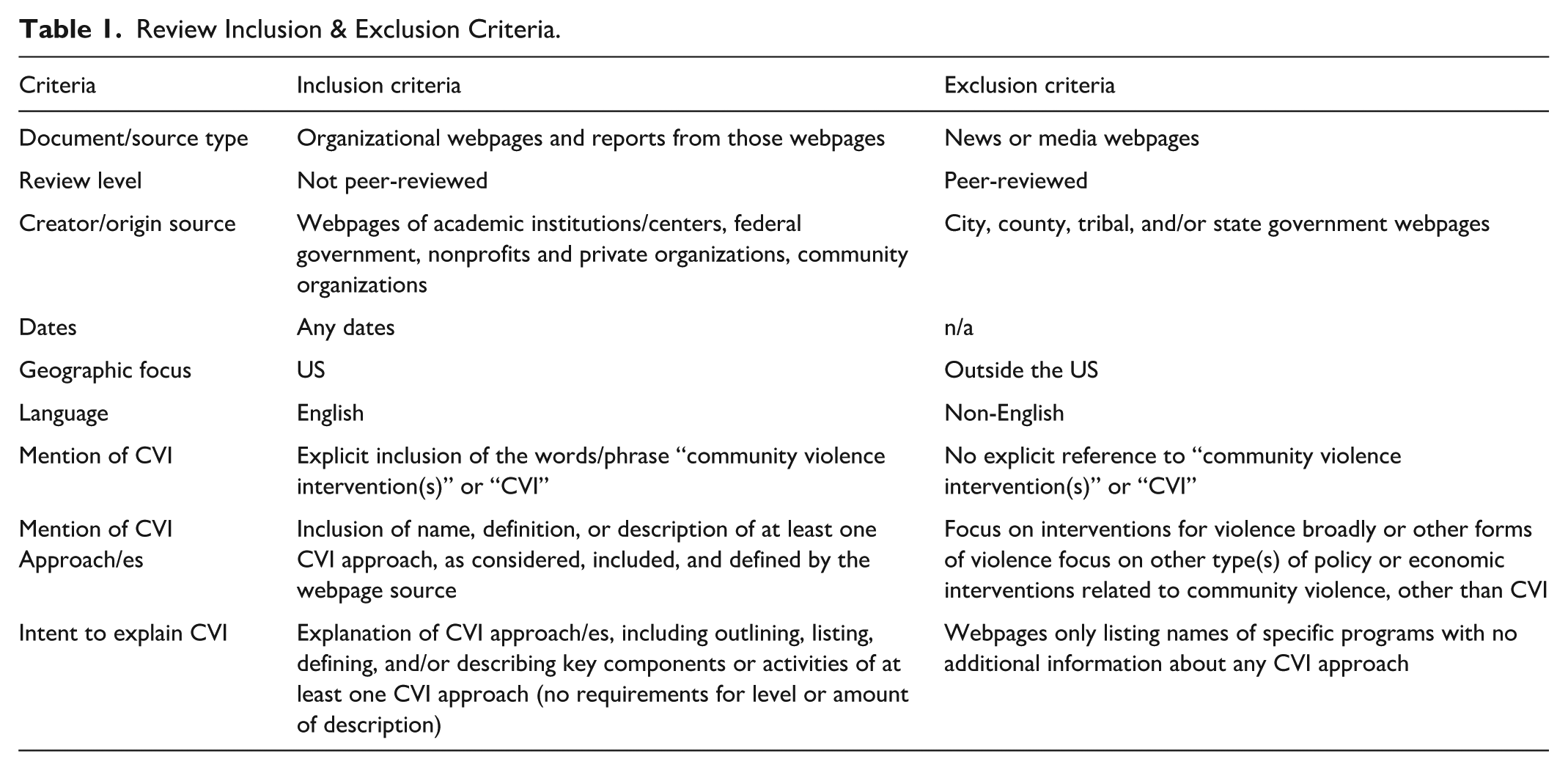
We excluded sources that discussed approaches to address overall violence or forms of violence other than community firearm violence. To be included, we required that sources (1) explicitly use the words/phrase “community violence intervention(s)” or “CVI” and (2) include descriptive information (eg, name, definition, or activities) of at least 1 CVI approach. We included and coded CVI approaches if they were defined by the source as such (ie, we did not impose our own definition of CVI). There were no requirements for the level of description of CVI approaches. Many sources listed different types of CVI approaches (eg, street outreach), program names (eg, Cure Violence, Advance Peace), and activities (eg, community events). Many CVI approaches described overlapping activities (eg, group healing circles, grief counseling) and specific CVI programs that employ multiple approaches (we coded each approach separately).
Sources that merely listed names of specific programs (eg, Healing Ground) without describing a CVI approach were not included in this review, as our aim was not to focus on the names of dozens of programs and categorize them, but to describe CVI approaches. Further, for the many sites that listed a program name without mentioning what type of program it was (eg, naming a purported approach), we deemed it inappropriate to try to categorize those programs into an approach without additional information, as explained by the web source. We also excluded other types of policy or economic actions to address community violence (eg, specific policies or funding streams) that were not explicitly described as CVI.
Tracking Process
The analytic process for the review involved summarizing (1) CVI approaches mentioned and approach definitions (as available, and as considered, included, and defined by the webpage), (2) any examples of programs (as available), and (3) additional supporting information (as available).18,19 Information was tracked through an Excel spreadsheet. Categories in the sheet included type of organization, name of organization, the source document/weblink, and as available and provided by sources, examples of program names and locations, population of focus, approach description, and theoretical or conceptual underpinning. We documented information for each category, where available, and left fields blank where not available. After reviewing all web sources, supporting information was tallied and grouped by approach. The approaches were then further categorized by hypothesized community violence intervention frameworks (described below) through inferences based on available information. A combination of count and content analysis was used to assess the main approaches. A CVI approach had to be mentioned more than one time across the sources to be categorized as an approach. One author (DZ) conducted the screening and extraction.
Findings
A total of 101 organizational websites were reviewed (Supplemental File 1). The types of organizations included academic institutions and centers (57; 9 currently CDC funded injury research centers; 10 formerly funded; 38 known university-affiliated violence prevention centers, 18 of which specifically involve the study of firearms), federal agencies (3), funding agencies (including foundations and philanthropic organizations) (4), health organizations and hospitals (4), and public or private organizations (nonprofits and community-based organizations) (33). A plurality (33) of organizations were public or private organizations.
Multiple (17) organizations provided basic definitions of CVI (as shown in Supplemental File 2). The definitions collectively described CVI as aiming to mitigate or prevent community firearm violence, with key tenets of collaboration between organizational entities, a focus on being in and working with the community to achieve reductions in violence, and an emphasis on populations who may be likely to be affected by community violence.
CVI Approaches
Twenty-seven of the 101 organizational sources mentioned the phrase CVI and at least 1 CVI approach and thus were included in this review. The number of approaches mentioned per source ranged from 1 to 7. The most discussed CVI approaches, each of which included a range of specific and potentially overlapping activities, fell into 9 categories, with the number of times the approach was mentioned in parentheses:
Violence interruption/street outreach/crisis intervention (28)
Hospital-based violence intervention programs (HVIP) (21)
Group violence interventions (GVI)/focused deterrence/group violence reduction strategy (GVRS) (14)
Behavioral science interventions/cognitive-behavioral interventions (11)
Built environment/place-based interventions, Crime Prevention Through Environmental Design (CPTED) (10)
Victim/trauma/survivor programs/resources (including wraparound services) (6)
Mentoring/fellowship programs (5)
School-based/related youth (≤18 years old) interventions (eg, safe passage and school-based interventions) (3)
Diversion/deflection programs (eg, stationhouse adjustments) (3)
The most common approach was Violence interruption/street outreach (28), followed by hospital-based violence intervention programs (HVIPs) (21), and then group violence intervention strategies (GVI) (14). The most frequently mentioned programs were Cure Violence for street outreach, and (Operation) Ceasefire for GVI. Table 2 outlines the CVI approaches, with additional information supplemented through source descriptions and inferred from information available from sources. Additional approaches with only 1 mention and thus not included in the main 9 approaches included Homicide review teams/violence reduction councils, substance use programs, and Offices of Neighborhood Safety/Violence Prevention.
CVI Approaches.

The Violence interruption/street outreach approach broadly discussed the use of credible messengers from local communities to engage with individuals at the highest risk of violence perpetration and/or victimization through preventative techniques geared toward community norm change (eg, group sessions, community events), mediation strategies, and connections to social services.
Group violence interventions (GVI)/focused deterrence/group violence reduction strategy (GVRS) was 1 of only 2 approaches to involve law enforcement and the criminal legal system directly. This approach was described as targeting affiliates of certain groups known or presumed to be affiliated with violence and using small group meetings and/or individualized custom notifications (eg, text messages and one-on-one meetings) to partly replace enforcement with deterrence. Due to its law enforcement involvement and the mistrust of and harm from law enforcement within communities generated over decades of racist policies and unjust policing, some CVI stakeholders see GVI as an approach outside of the CVI ecosystem.6,29 These conversations remain in process as the CVI field continues to codify itself. 6
The Hospital-based intervention approach (HVIPs) discussed providing resources for people who have been violently injured. HVIPs aim to reduce the potential for retaliation and connect survivors (and sometimes their families) to resources.
Crime Prevention Through Environmental Design (CPTED)/built environment approaches focused on modifying environments to deter crime. For example, these programs aim to create a sense of security and care within a local community by creating green spaces, rehabilitating vacant lots, or installing lighting.
Behavioral science/cognitive behavioral approaches were often operationalized through tailored cognitive or dialectical behavioral therapy interventions that encourage participants to shift framing, specifically around managing emotions, responding to conflict, and coping with prior traumas.
The Victim/Survivor-focused approach was described as providing resources and support to people who have experienced a direct or indirect injury or exposure to firearm violence, including families and friends of homicide victims. This approach connects individuals to social services and basic needs and often focuses on grieving and healing.
The mentorship/fellowship approach was discussed as intensive mentoring and peer fellowship programs that institute a mentor-mentee relationship. These programs often involve job/internship components and offer participants opportunities to identify and focus on specific goals to increase self-efficacy and confidence.
The school-based/youth-related (≤18 years old) approach focuses on programs that occur at schools and/or are related to school activities. These approaches were described as focusing on positive connections for youth and aimed to provide a sense of safety and community for youth at school and via school-related activities.
Finally, the diversion/deflection approach was the second of the 9 approaches to operationally include the criminal legal system. This approach was described as encompassing a wide range of firearm diversion programs and stationhouse adjustments. Stationhouse adjustments are alternate avenues through which law enforcement can direct first-time offenders who have committed minor offenses. They often include community service and aim to avoid formally charging youth and young adults with a crime. This approach aims to reduce the harmful effects of engagement with the criminal legal justice system and reroute individuals toward positive alternatives.
While many CVI definitions directly referenced the CVI target population as individuals at a high risk of perpetration and/or victimization of violence 6 (see Supplemental File 2), not all the CVI approaches described their target population this way. Some of the 17 CVI definitions we identified included broader conceptualizations of the CVI population, such as individuals most heavily impacted by firearm violence and individuals in communities who need resources most. Other definitions framed CVI approaches not toward the individual but toward addressing the root causes of violence.
CVI Ecosystem
The CVI approaches were separated into 9 types to highlight the range and frequency of these approaches used/mentioned in applied discourse; however, in practice, it is common that approaches work in tandem with one another as part of a CVI ecosystem. 29 As defined by the Health Alliance for Violence Intervention (HAVI), the National Institute for Criminal Justice Reform (NICJR), the Community-Based Public Safety (CBPS) Collective, and Cities United, a CVI ecosystem links community violence resources and infrastructures across nonprofit, government, faith-based, and at times for-profit entities, to implement a comprehensive set of approaches to address community firearm violence. 29 Specifically, a CVI ecosystem may employ the following approaches simultaneously: street outreach/intervention, fellowships, GVI, trauma-informed care, and HVIPs. 29 Similarly, the Community Violence Intervention Action Plan notes multiple approaches supporting a CVI ecosystem: violence interruption mediation; street outreach; life coaching/intensive intervention; hospital response (HVIP); and fellowships. 6
Regardless of the specific approaches used to support a CVI ecosystem, our review also highlighted how CVI approaches are often multi-pronged collaborations between multiple institutions that implement a range of programs and activities. For example, HVIPs are a distinct CVI approach occurring at or in partnership with hospitals and often offer multiple activities, such as wrap-around case management and connection to resources, cognitive behavioral therapy, meditation sessions, and a survivor support group.
As noted in the methods section, many webpages mentioned specific CVI programs in their approach descriptions, and some programs (eg, Advance Peace), were described by sources as falling under multiple approaches (eg, street outreach, mentoring). In the same way that programs may fall under multiple approaches, overlapping program activities likely occur across multiple CVI approaches. Due to the broad nature of this review and limited information available in the sources searched, it was not possible to characterize the full scope of the specific activities employed by each CVI approach; however, a future project collating specific activities associated with CVI approaches would be useful.
Understanding Current CVI Approaches and Theoretical Frameworks
Limited information was available about the theoretical bases for the CVI approaches; however, from the descriptions and the level of intervention (individual, community, and society level intervention), we posited the theoretical backing of these approaches using 2 guiding outlines from prior research.1,15,16
Abt’s framework combined criminology and public health theory to define community violence (people, places, and behaviors) and identify strategies to address it (through public health-framed prevention or criminal justice-framed suppression and rehabilitation).1,15 Abt defines the public health framework as organizing anti-violence efforts into primary, secondary, and tertiary prevention.1,15 Abt identifies primary prevention as focused on risk factors within the general population, secondary prevention as focused on small sub-populations with high risk factors, and tertiary prevention as focused on individuals already involved in community violence/violent behavior.1,15
Abt defines the criminal justice framework as a combination of existing theories, such as rational choice and routine activities theory, both of which posit that people are rational decision-makers who weigh the costs and benefits of their actions and that crime occurs when people happen upon opportunities without supervision that would impede criminal opportunity.1,15 Abt describes the criminal justice framework as generally relying on approaches that suppress and deter criminal actions by people through incapacitation and incarceration (suppression) and provide alternative avenues for opportunities to engage in society (rehabilitation).1,15 It is important to reiterate that the inclusion of criminal justice-related CVI approaches (eg, GVI/focused deterrence) is not universally accepted by practitioners, but rather reflects ongoing tensions about the role of policing in community-based violence reduction.
Richardson conducted a literature review of community-based firearm violence interventions and initiatives to understand the theories to support these interventions, finding 3 main theoretical frameworks: public health, systems, and community mobilization. 16 Richardson described the public health framework as defining violence as an infectious disease and applying interventions to redirect or prevent the spread of gun violence in communities. 16 Richardson characterized the systems framework as highlighting risk and intervention through overlapping environments, often organized in terms of the socio-ecological model, with people nested in environments or systems. The final framework identified by Richardson was the community mobilization framework. This framework placed community-driven and community-led strategies at the forefront of the development, intervention, and evaluation of CVI initiatives, emphasizing the role of collective efficacy, social cohesion, and prosocial relationships. 16
We used Abt’s and Richardson’s frameworks to help categorize the 9 CVI approaches from our review. Many CVI approaches rely on multiple supporting frameworks and were assigned into more than 1 framework as needed.
Eight of the 9 CVI approaches fell under Abt’s public health framework of primary, secondary, or tertiary prevention. GVI was the only approach to fall under Abt’s criminal justice suppression framework, and diversion/deflection was the only approach under Abt’s rehabilitation framework.1,15 The 7 CVI approaches undergirded by Abt’s definition of public health framing generally also fell under both secondary and tertiary prevention (eg, HVIPs, CBI, mentoring, violence interruption/street outreach) because these approaches target small groups of individuals who are at high risk of becoming (or are already) involved in community firearm violence. These same 7 approaches were categorized as falling under Richardson’s public health framework. 16 Four of the 9 CVI approaches (HVIPs, CPTED, victim-survivor resources, school-based/youth interventions) fell under Richardson’s systems framework, namely because these approaches involve multiple infrastructures and organizations to support them. Additionally, the systems framework accounts for specific considerations around environments and contextual factors (eg, school-based approaches that consider the environment at school and in transit to and from school). Richardson’s community mobilization framework applied to 4 CVI approaches (Violence interruption/street outreach, HVIPs, mentoring/fellowship programs, and school-based/related youth interventions). These CVI approaches often include community-led programs and focus on asset-based programing and prosocial bonds within the community as part of their violence reduction and prevention efforts. Categorizing the 9 CVI approaches according to these frameworks can help illuminate their underlying theories of change and support future work refining implementation and evaluation metrics (Table 3).
CVI Hypothesized Theories.

Individual-level interventions target one-on-one engagements to shift behaviors, skills, or practices. Community-level interventions target issues at the community level, involving shifts to physical or social environments and local norm change. Society-level interventions target shifts with a broader population, often involving infrastructure, policies, and service delivery.
Discussion
This paper characterized main CVI approaches discussed and described in applied discourse (eg, by CVI practitioners, funders, and public scholars). While there are varying viewpoints of how community violence intervention is described by practitioners, the most common approach identified through this public domain review was street outreach/violence interruption, followed by GVI and HVIPs. CVI approaches are often deployed in practice as part of a larger ecosystem (ie, implemented and sustained in tandem with other approaches), and implemented through specific programs (eg, Becoming A Man, a school-based group counseling program) and activities (eg, goal setting, role-playing). While combinations of CVI approaches are applied differently to meet local contexts, there are unifying aspects across various CVI approaches, and this synthesis of the most commonly referenced approaches helps advance the field. Findings from this review support a more widespread understanding of the main CVI approaches currently discussed in applied settings, which can inform future CVI implementation and evaluation. Indeed, the recent Community Violence Intervention Action Plan: Mapping Transformation for the Field released a set of priorities, and the first priority, “Develop Shared Terminology,” calls for the field to have a shared definition of CVI and consensus around CVI approaches. 6 This paper directly supports this priority. Working from shared definitions can help further shape and illuminate theories of change undergirding approaches, identify common activities and establish best practices for program practice and research and evaluation.6,29
Outlining the theories that underlie these approaches also helps clarify each approach’s main goals and focal areas and serves as a starting point to more formally assess the role of the community in CVI approaches. This review inferred that CVI approaches are often undergirded by people-based primary, secondary, and tertiary public health approaches, with some approaches (HVIPs, street outreach, mentoring/fellowships, and school-based CVI approaches) also employing a community mobilization approach.1,14,15,30,31 None of the CVI approaches identified in our review fall into the criminal justice theory of suppression (eg, through hot spots policing or firearms enforcement).
It will be important in future work to unpack the CVI approaches that align with community mobilization frameworks further, as these approaches can help the field continue to center community in the pursuit of equitable CVI work. This is particularly important as CVIs purport to have meaningful involvement with community members and organizations as local decision-makers.7,9 Other scholars have referred to grassroots CVI programs as Community Violence Intervention at the Roots (CVI-R), a related but distinct subset of CVI interventions that highlight the existing strengths within a community to leverage programing and support.32 -34 Relatedly, it is critical to situate CVI research and evaluation locally and in ways that uplift the knowledge and expertise of CVI practitioners and community members. Recent work with community-based youth gun violence intervention programs in Washington State, for example, described theory of change co-development through community-academic partnership (with many elements in the theory of change reflective of some of the main approaches in this review) and highlighted the importance of grounding program evaluation in goals that are community-driven and focused. 17 Community-engaged and community-led implementation and research should also be supported by equitable compensation for CVI program staff and leaders, many of whom are not affiliated with well-resourced institutions. Funding and structural resources, such as credentialing for community CVI leaders and additional training opportunities, can be embedded to support all CVI approaches.35,36
Limitations to this research include difficulty synthesizing information given the heterogeneity in how CVI (initiative, programs, intervention) was conceptualized and defined across programs, organizations, and institutions. While we tried to capture a broad overview, it is possible that other CVI approaches were missed. We also did not review all internet sources due to our team’s capacity and the large volume of information. Thus, more organizations were likely not captured by this web search. Likewise, while our goal was to summarize CVI in applied discourse, and so we did not include peer-reviewed academic literature, a future review of academic publications could expand and enhance our understanding of CVI approach descriptions, specific programs, and main activities. Despite these limitations, work to bridge the research-to-practice gap must consider sources and expertise beyond academic literature and publications. Even with the limited scope of this project and humble goal to help identify main CVI approaches, this effort provides practical information.
Conclusion
This paper aimed to outline main CVI approaches discussed in applied settings, identify underlying theoretical frameworks, and posit ways to promote community centering in CVI implementation and evaluation. Findings from this review will support future research and more in-depth analysis of CVI approaches and activities.
Supplemental Material
sj-docx-1-inq-10.1177_00469580251368725 – Supplemental material for Identifying Community Violence Intervention (CVI) Approaches: A Grey Literature Scoping Review
Supplemental material, sj-docx-1-inq-10.1177_00469580251368725 for Identifying Community Violence Intervention (CVI) Approaches: A Grey Literature Scoping Review by Devon Ziminski, Julia P. Schleimer and Meron Girma in INQUIRY: The Journal of Health Care Organization, Provision, and Financing
Supplemental Material
sj-docx-2-inq-10.1177_00469580251368725 – Supplemental material for Identifying Community Violence Intervention (CVI) Approaches: A Grey Literature Scoping Review
Supplemental material, sj-docx-2-inq-10.1177_00469580251368725 for Identifying Community Violence Intervention (CVI) Approaches: A Grey Literature Scoping Review by Devon Ziminski, Julia P. Schleimer and Meron Girma in INQUIRY: The Journal of Health Care Organization, Provision, and Financing
Footnotes

Ethical Considerations
An ethics statement is not applicable because this study is based exclusively on publicly available information.
Author Contributions
D.Z., J.S., and M.G. were working on separate projects related to CVI program identification and decided to collaborate. DZ outlined the main conceptual ideas and the paper. DZ engaged in searching and coding web sources. J.S. and M.G. provided critical insights, reviews, and edits to all draft stages. D.Z. drafted the manuscript, and J.S. drafted additional sections and provided edits across all rounds.
Funding
The author(s) received no financial support for the research, authorship, and/or publication of this article.
Declaration of Conflicting Interests
The author(s) declared no potential conflicts of interest with respect to the research, authorship, and/or publication of this article.
Data Availability Statement
The data used in this review consists of publicly available information identified through Google searches. Other literature is cited within the manuscript and can be accessed through the reference list. If further information regarding the data extraction process or searching is required, please contact the corresponding author.
Supplemental Material
Supplemental material for this article is available online.
References
Supplementary Material
Please find the following supplemental material available below.
For Open Access articles published under a Creative Commons License, all supplemental material carries the same license as the article it is associated with.
For non-Open Access articles published, all supplemental material carries a non-exclusive license, and permission requests for re-use of supplemental material or any part of supplemental material shall be sent directly to the copyright owner as specified in the copyright notice associated with the article.
