




Abstract
Community violence intervention (CVI) is a promising strategy to reduce community violence, but research on CVI programs remains underdeveloped. While prior reviews have examined the effectiveness of certain CVI models, we lack a comprehensive synthesis of how CVI research is done and what measures are used. We conducted a scoping review of CVI evaluation measures and methods in the United States, reviewing both peer-reviewed and gray literature from 1996 through 2023. We summarized characteristics of CVI program evaluations, including evaluation measures used, units of analysis, and involvement of external partners—including community members—in the evaluation. Of 1763 articles screened, 149 were included. A plurality of studies examined both outcome and process measures (38.9%), and use of process measures increased over time. Most outcome evaluations used only deficit-based measures (76.4%), with variation across CVI model/approach. Authors of studies included in this review reported that CVI practitioners contributed to evaluations in various ways, but only 10.7% of evaluations included CVI practitioners as authors. Process measures were most often collected at the individual level (84.2%), while outcome measures were collected relatively equally at the individual (56.6%) and community level (53.8%) though with notable variation across CVI models/approaches. Community partners working in CVI were part of our authorship team and offered critical insights into interpreting the findings from this scoping review. Findings underscore the need for a more comprehensive approach to CVI evaluation. By including process and outcome measures, including community-level units of analysis in addition to the typical individual-level ones, employing asset-based frameworks, and actively involving community voices, future research can more effectively assess the implementation and impacts of CVI programs.
Keywords
Highlights
Many CVI evaluations focused on individual-level outcomes, with wide variation across CVI models/approaches.
Over 75% of outcome evaluations relied solely on deficit-based measures (e.g., arrest rates, injury recidivism), with few incorporating strengths-based or protective factors.
While process evaluations increased over time, only 38.9% of studies combined process and outcome measures, limiting holistic program understanding.
Though 42.3% of evaluations involved CVI practitioners, only 10.7% credited them as authors, highlighting a disconnect between community knowledge and published scholarship.
Introduction
In 2022, 24 849 people died from homicide in the United States (US). 1 Most homicides nationally involve firearms (79% in 2022), 1 and most firearm homicides take the form of community violence, or “intentional acts of interpersonal violence committed in public areas by individuals who are not intimately related to the victim.” 2 Community violence has significant and wide-ranging consequences for individuals directly and indirectly affected, including physical disability and death, mental distress, substance use, retaliatory cycles of violence, fear for safety, weakened social cohesion, and economic harms. 3 Black and Brown communities bear a disproportionate burden of community violence, 4 reflecting the embodiment of systemic oppression and structural violence, that is, the social systems, structures, and institutions that harm people and prevent them from meeting their needs and potential. 5
In the past several years, community violence intervention (CVI) has especially gained attention as a central tool to reduce community violence and foster community healing, safety, and well-being. 6 While grassroots CVI programs have existed for decades,7,8 CVI only recently received meaningful government investment, when the Biden administration and many state and local governments committed billions of dollars to CVI beginning in 2021 to 2022.7,9,10 CVI programs support individuals at highest risk of community violence involvement via individualized support, connection to resources, and trauma-informed, healing-centered relationships with credible messengers, that is, individuals with similar lived experiences to those they serve. 11 Notwithstanding these core tenets, specific CVI programs differ markedly in their specific approaches, activities, populations served, and settings (eg, hospital-based or community-based). 12
Despite the increasing prominence and promise of CVI, research on these programs remains underdeveloped, and results of CVI outcome evaluations focused on violence-related outcomes have varied over place, time, and population. Studies of CVI programs, such as Advance Peace, 13 Cure Violence, 14 and READI Chicago, 15 for example, have found that they are associated with reductions in interpersonal violence. Other studies have found CVI programs to be associated with increases, decreases, or no change in homicide and non-fatal shootings, depending on location, or with reductions in firearm assault and homicide but increases in non-firearm homicide deaths and assault-related hospital visits.16,17 Reasons for such variation are understudied but could include differences in program implementation, populations, contextual influences, confounding, and evaluation methods and measures.
While researchers have previously synthesized what we know about the effectiveness of certain CVI models,18,19 no studies, to our knowledge, have comprehensively synthesized how CVI research is done and what evaluation measures are used. This is a critical gap, given the complexities of CVI evaluation. Rigorous CVI evaluation requires careful consideration of the level of intervention and analysis, measurement constructs and their alignment with program theories of change, timing of measurement, local and cultural relevance of measures, and program implementation and dose, among other factors. For example, an important consideration is whether and when to measure outcomes at the individual-level versus the community/neighborhood-level, and how community/neighborhood is defined. These decisions and a priori hypotheses may depend in part on the CVI model/approach, as several models focus primarily on individual behavior change (but may aim to eventually shape community-level outcomes indirectly by engaging influential individuals), whereas other models intervene more directly at the level of neighborhoods and communities.20,21
Critically appraising evaluation methods and measures used in CVI research is especially important given the social, political, and cultural context of the US. Specifically, funders, policy makers, and others often want to know whether CVI reduces violence, with the answer tied to continued funding. 7 While questions about whether and by how much CVI reduces violence are important, this narrow focus on whether CVI “works” becomes complicated and potentially problematic when considering that many factors drive rates of violence at the population level, many CVI programs have long been under-funded and under-resourced, and the production and interpretation of evidence intersects with value judgments and systems of power. 7 For example, power hierarchies rooted in White supremacy influence our collective perceptions of expertise and what types of evidence “count,” often sidelining the voices of community practitioners who are essential experts in the field. 22 It is therefore important to consider who defines success and how success is defined and measured, as these decisions influence narratives of and have material consequences for CVI programs and the communities they serve.
We conducted a scoping review of CVI evaluation measures and methods in the US. We summarized characteristics of CVI programs being evaluated (eg, model/approach, populations served), evaluation measures used (eg, process and outcome, asset and deficit-based, source of data on measures), unit of analysis, and reported involvement of external partners—including community members—in the evaluation. Specifically, we examined community and individual-level measures in relation to CVI models/approaches, including those that focus primarily on individual-level behavior change versus those that incorporate community-centered and community-resourced strategies. Results will help characterize how CVI research is being done and identify opportunities for conducting more impactful, community-centered, and equitable research.
Methods
This scoping review followed the Preferred Reporting Items for Systematic reviews and Meta-Analyses Extension for Scoping Reviews (
Search Strategy
This scoping review included systematic searches of academic databases and targeted searches of gray literature. Search terms were developed by the research team with input from a University of Washington Health Sciences Librarian and included reproducible searches of free text terms related to CVI (including hospital-based violence intervention programs [HVIPs]) within title and abstracts (tiab), using Boolean search algorithms (see study protocol in the Supplemental Appendix). We searched for original research articles in the following databases: PubMed, Web of Science, Criminal Justice Abstracts, Embase (Elsevier), and CINAHL Complete. The database search was supplemented by reviewing references of included articles and articles known to the research team, including published reviews.18,19,24-28 For gray literature, we searched specialized databases including National Technical Reports Library, Union of International Associations, and Government Documents Round Table. We also explored websites for relevant organizations, institutions, and non-governmental organizations involved in CVI (Supplemental Appendix). The searches were conducted from May 2023 to January 2024.
Inclusion and Exclusion Criteria
We included studies that evaluated CVI, defined as “a person-focused approach. . . [that] . . . incorporates peer support, harm reduction, and resource offerings to help meet the immediate and longer-term needs of those individuals at the highest risk of violence involvement.” 12 Studies could focus on any CVI model/approach and examine qualitative or quantitative process or outcome measures. Process measures assess whether and how an intervention was implemented, and outcome measures assess whether an intervention affected its intended outcomes. 29 We limited our search to English language articles and evaluations of US-based interventions. There were no restrictions on the time of study or publication, authorship, or publication type (eg, peer-reviewed or non-peer-reviewed). We excluded review articles, non-empirical articles, commentaries, evaluations of universal violence prevention programs (eg, programs for all students in a school district), conference abstracts, and empirical articles that solely characterized the priority population for CVI without assessing a CVI program(s).
Screening Procedure
Search results were downloaded, de-duplicated with EndNote 30 or Zotero 31 (Takats, 2023) and uploaded to Rayyan 32 for screening. Using Rayyan, 3 authors (MG, JS, and OM) independently screened titles and abstracts of deduplicated articles. Decisions were blinded. In this phase, articles were included for further review if they met our inclusion/exclusion criteria. Those meeting criteria underwent independent full-text review in Covidence 33 by the same authors who conducted the screening. The authors met to discuss and resolve discrepancies after each review phase.
Data Items and Chartin
Three authors (MG, JS, and OM) independently extracted data from included studies, with one author extracting and another author checking the data. Data elements extracted were CVI model/approach, population served, study period, use of process and outcome measures, and level and type of involvement of external partners, including community members. Because we hypothesized that involvement of external partners would be infrequently documented (eg, due to scholarly norms, word count restrictions), we fielded a survey to corresponding authors of each included paper (Supplemental Appendix). Survey responses were used for papers whose corresponding author responded (n = 51, 34.2%) and, otherwise, we used information reported in the papers. The survey asked about involvement of police departments or officers, government agencies or officials, hospitals or health professionals, practitioners of CVI programs, participants of CVI programs, other community members (other than CVI practitioners or participants) in the evaluation. We reported results for all but were particularly interested in involvement of CVI practitioners, participants of CVI programs, and other community members (collectively hereafter “community members”) as they are most likely to have expertise regarding the local context and populations being served.
Program model/approach was broadly classified a priori based on defining characteristics as: behavioral science interventions (eg, ROCA), enforcement strategies (eg, focused deterrence), fellowship (eg, Advance Peace), victim services (eg, HVIPs), violence interruption (eg, Cure Violence), and other programs that did not fall in these pre-defined categories. We also extracted, for both process and outcome measures as appropriate, unit of analysis, specific measures, and method/source of data collection. We further classified outcome measures as to whether they were primarily asset-based or deficit-based. Asset-based measures focus on the strengths, resources and positive qualities of individuals, communities, or organizations. Deficit-based measures focus on weaknesses, challenges, or deficiencies within individuals, communities or organizations.
Community Input
A unique aspect of our scoping review methodology involved input from community partners who work in CVI in Washington state in the interpretation of results. Specifically, via a workshop and individual meetings, we gathered insights on (1) use of asset and deficit measures, (2) reported involement of community members in evaluations, (3) use of process and outcome measures, and (4) use of individual and community-level measures for the unit of analysis. The workshop (February 26, 2024) convened representatives from 8 community-based organizations participating in a larger CVI evaluation project. A portion of the workshop was dedicated to gathering reflections on preliminary scoping review findings. Following the presentation of findings, community partners engaged in small and large group discussions to share their thoughts and expertise, following guiding questions, for example, “What do you think the evaluation would look like with more community involvement?,” “What are the pros and cons of using individual versus community level measures?” (Supplemental Appendix). Throughout this activity, academic partners took notes to capture the interactions and reflections in detail. During additional individual meetings, MG and JS facilitated discussion with individual community partners and took notes. We explicitly summarized community input throughout the results section and drew on this input when contextualizing and considering the implications of our findings in the discussion section. All participants were invited to be co-authors on this paper based on their substantial contribution to the interpretation of results. Those who agreed to meet all other authorship criteria 34 were included as authors.
Data Synthesis
Descriptive statistics were tabulated using R version 4.2.1 (R Foundation for Statistical Computing, Vienna, Austria). 35 Results were organized by the 4 key findings for which community partners provided insight (the intersections of which are shown in Supplemental eFigure1).
Results
Search Results
The initial search identified 1763 articles, including 1298 from database searches and 465 from supplemental searching and gray literature sources. After removing duplicates and conducting title/abstract and full text reviews, 149 articles were included (Figure 1). Table 1 includes a general description of all articles, stratified by CVI model/approach. Tables 2 and 3 describe characteristics of process and outcome evaluations, respectively, overall and by CVI model/approach.

Study Flow Chart.
Description of Included Studies by CVI Model/Approach.

Programs that did not fall into the other pre-defined categories.
Thirteen studies did not specify the study period.
When specific ages were specified, we defined youth as people up to and including age 18; young adults as people over 18 and up to and including age 25; and adults as people over 18 with no upper age limit. When specific ages were not specified, we classified studies based on the language they used, for example, “youth.”
Description of Process Evaluations by CVI Model/Approach.
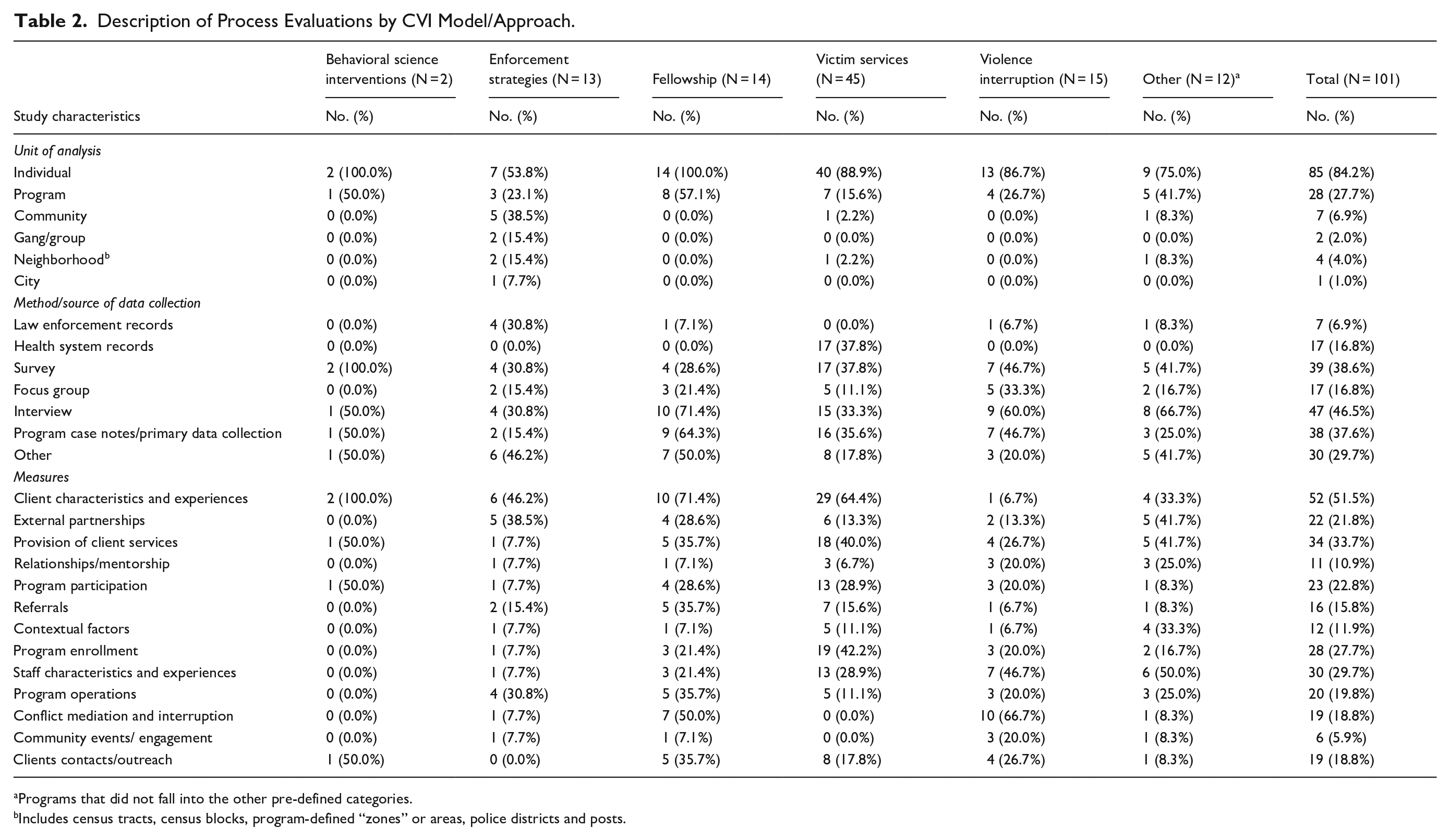
Programs that did not fall into the other pre-defined categories.
Includes census tracts, census blocks, program-defined “zones” or areas, police districts and posts.
Description of Outcome Evaluations by Program Model/Approach.

Programs that did not fall into the other pre-defined categories.
Includes census tracts, census blocks, program-defined “zones” or areas, police districts and posts.
Includes 1 county-level assessment.
Summary of Included Studies
Included papers were published between 1996 and 2023 (mean 2016), with half of all articles published between 2013 and 2021 (Table 1). Median (first quartile-third quartile) years under study was 2010 (2004-2015), and median length of follow-up per study was 6 years (3-11 years). Approximately 35% of papers evaluated victim services CVI programs (n = 53), followed by CVI programs using enforcement strategies (n = 39), violence interruption (n = 24), and fellowship models (n = 17). Programs described serving violently injured patients/survivors (36.2%), individuals with high risk of/exposure to violence (28.9%), those involved in/at risk of involvement in gangs or groups (28.2%), and those involved in the criminal legal system (12.1%).
There was a diverse array of data collection sources used in CVI evaluations. Among studies examining process measures (Table 2), interviews (46.5%), surveys (38.6%), and program case notes/primary data collection (37.6%) were most common, and health system records (16.8%), focus groups (16.8%), and law enforcement records (6.9%) were less common. Among studies examining outcome measures (Table 3), law enforcement records were the most common source of data (62.3%), followed by surveys (32.1%) and health system records (23.6%). Program case notes/primary data collection (12.3%), interviews (11.3%), focus groups (4.7%), and school records (2.8%) were the least common sources.
Process Versus Outcome Measures
A plurality of studies examined both outcome and process measures (38.9%), followed by only outcome measures (32.2%), and only process measures (28.9%) (Table 1).
Figure 2 illustrates trends in the number of studies published from 1996 to 2023, categorized by use of process measures, outcome measures, or both. The number of studies using only outcome measures or both process and outcome measures was higher than the number of studies using only process measures until 2020, when this pattern reversed.
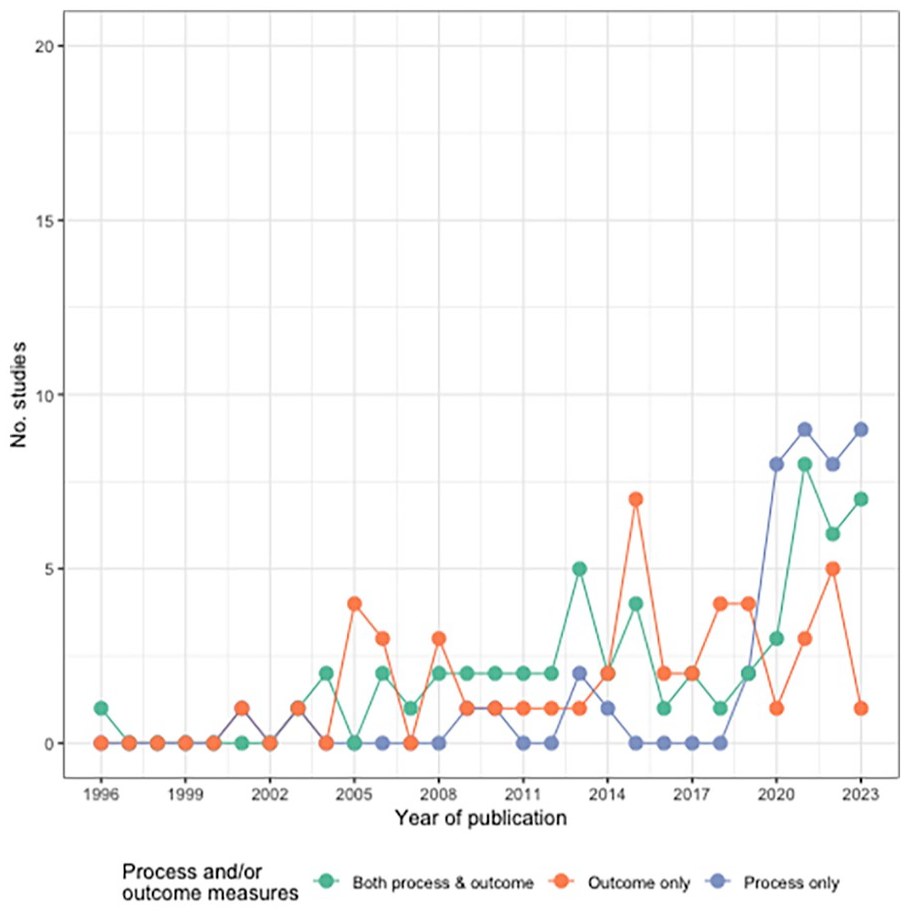
Number of studies examining process and/or outcome measures, by publication year.
Table 2 and Supplemental eFigure 2 describe the use of process and outcome measures across different CVI models/approaches. The use of outcome-only measures was common in studies of several models, especially enforcement strategies. Use of process-only measures was relatively common in studies of victim service strategies, violence interruption, and other strategies.
Community partners provided critical insights on the use of process and outcome measures for evaluating CVI programs. They emphasized that evaluations focused exclusively on outcomes may miss the incremental progress and smaller achievements that occur along the way. While evaluations of outcomes offer important perspectives, they can fail to capture the full narrative of program development and implementation, which often takes time and intentional investment and is critical for sustaining and scaling interventions. One community partner stressed the importance of establishing process goals “to create a detailed roadmap from initial implementation (‘Point A’) to desired outcomes (‘Point B’), which are essential for effectively setting and achieving long-term goals.” The need for clear communication with funding sources was also mentioned: “There is a need to establish proper expectations with funding sources in terms of what is actually achievable and meaningful.”
Asset- Versus Deficit-Based Outcome Measures
Most outcome evaluations used only deficit-based measures (76.4%) (eg, gun homicide) and few used only asset-based outcomes (2.8%) (eg, goal attainment; Table 3). Specific deficit- and asset-based measures are shown in Table 3.
Figure 3 illustrates the trends in the number of studies published from 1996 to 2023, categorized by asset-based outcomes, deficit-based outcomes, or both. Over time, there were very few papers with only asset-based measures. The number of papers using both measures grew slightly since 2020, while studies using only deficit-based outcomes were consistently highest and increased over time, reaching a peak in 2015.

Number of studies examining asset and/or deficit outcome measures, by publication year.
Table 3 and Supplemental eFigure 3 describe use of asset- and deficit-based outcome measures across different CVI models/approaches. Of studies examining outcomes in relation to fellowships programs, 46.7% used both asset and deficit measures and 53.3% used deficit-only measures. In contrast, 100% and 87.5% of studies examining outcomes of enforcement and violence interruption strategies, respectively, used deficit-only measures.
Community partners emphasized the need to use asset measures to complement deficit measures. They suggested that while deficit measures are common, such measures can overshadow the positive aspects that CVI programs aim to foster. One partner noted, “we need to use asset measures to support and fill in the gaps of deficit measures.” The focus on deficit measures was further critiqued for potentially contributing to a sense of hopelessness and bias. Community partners observed that an excessive emphasis on deficits can lead to negative biases and impact morale. One partner observed, “Deficit measures compound hopelessness, and the community has seen it for a long time; it becomes normalized and contributes to hopelessness.” This sentiment was echoed by others who cautioned that an overemphasis on deficits might demotivate program participants, staff, and stakeholders.
Further, community partners noted that while asset measures are often used with contextual understanding, deficit measures frequently lack this depth and are taken at face value with uncritical interpretations. Conversely, some community partners acknowledged that deficit measures—despite their limitations—could also be motivational if used constructively. The idea was presented that turning negative outcomes into opportunities for growth could be beneficial, as reflected in the comment, “Take bad outcomes and turn them into something good–deficit measures can also be motivating sometimes.”
Involvement of External Partners, Including Community Members, in Evaluations
Among all studies, authors most often reported that their evaluations involved contributions from CVI practitioners (63/149, 42.3%), followed by police (27/149, 18.1%), hospitals and health professionals (27/149, 18.1%), and participants of CVI programs (25/149, 16.8%, Supplemental eTable 1). However, there was variation across program models/approaches, for example, police were more often reported to be involved in evaluations of enforcement strategies (41.0%) than other strategies (0-21.4%). Types of involvement also varied for different partners and across models/approaches but tended to include data collection and interpretation. CVI practitioners most often contributed to data interpretation (23.5%) and data collection (20.8%) followed by recruitment (18.1%) and evaluation design (16.8%). Despite these contributions, only 10.7% of evaluations included CVI practitioners as authors.
Figure 4 shows trends in reported involvement of community members in evaluations over time—focusing specifically on involvement of community members, including use of a community advisory board/group. Such involvement increased notably over time, and, in 2021, the number of papers reporting involvement of community members exceed those not reporting any such involvement (Figure 4).
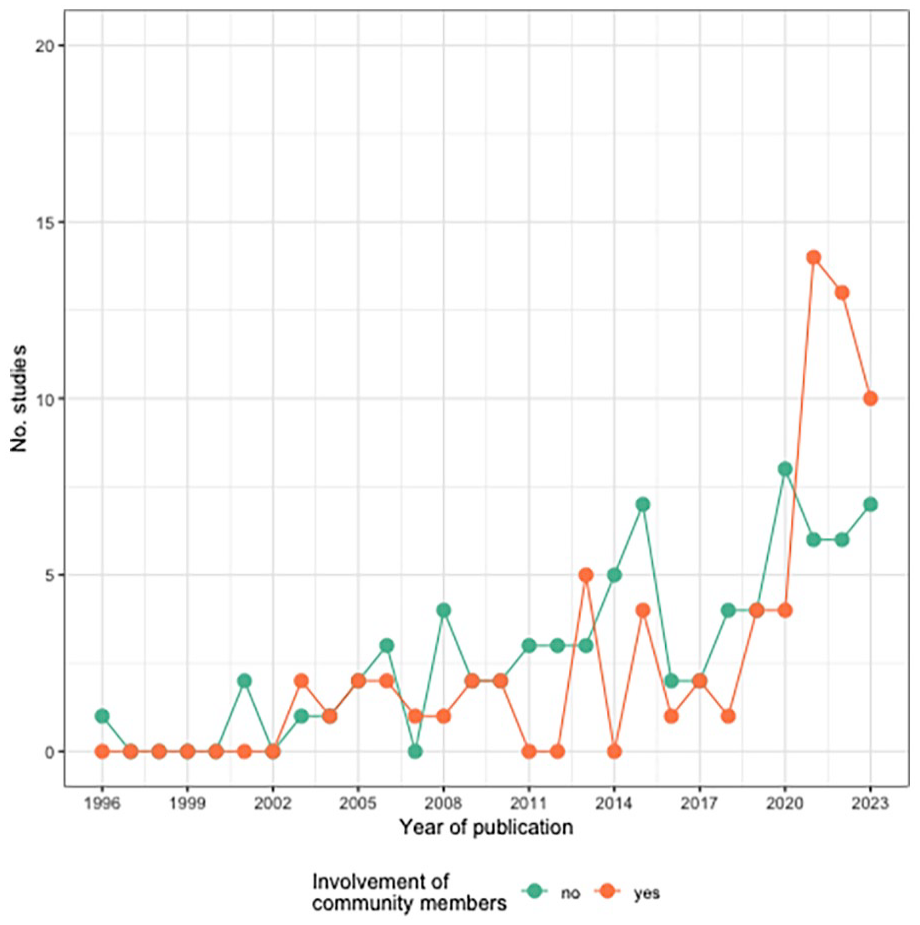
Number of studies that reported involvement of community membersa in evaluation, by publication year.
Figure 4 and Supplemental eTable 1 describe involvement of community members in evaluations by program model/approach. Evaluations of enforcement strategies reported relatively low community involvement, while evaluations of violence interruption programs, fellowship programs, and victim services more often reported involving community members than not.
Community partners raised concerns about limited community involvement in CVI evaluations. A key issue was the power imbalance, with many community partners feeling their voices and knowledge are excluded. This imbalance can lead to biased evaluations; for example, one community partner noted that academics without local knowledge of community dynamics can incorrectly define “neighborhood” or “community,” leading to inaccurate or diluted estimates. Additionally, evaluation measures need to be refined to better reflect community experiences, but this can only happen with the expertise and knowledge from community members. Community partners also expressed frustration with the time-consuming nature of data collection and evaluation, which they felt diverted attention from direct engagement, but recognized the value of collaborative efforts between community organizations and evaluators. Indeed, they emphasized that, without community involvement, evaluations risk failing to drive meaningful change.
Unit of Analysis: Individual Versus Community Level Measures
Individual-level measures were most common among process (84.2%, Table 2) and outcome evaluations (56.6%, Table 3). Outcome evaluations also commonly examined community-level measures (53.8%), including the neighborhood-level (29.2%) and city-level (25.5%).
While use of individual-level process measures increased notably over time, especially from 2019 to 2023, use of community-level process measures remained uncommon (Figure 5A). Use of individual-level outcomes measures likewise increased more over recent years than did use of community-level outcome measures (Figure 5B).

Number of studies examining individual and community-level measures, by publication year. (A) Process measures. (B) Outcome measures.
Tables 2-3 and Supplemental eFigure 5 describe units of analysis for process and outcome evaluations by program model/approach. There were clear patterns across models/approaches. For example, outcome evaluations of enforcement (91.7%) and violence interruption strategies (87.5%) often used community-level measures only, whereas outcome evaluations of victim services overwhelmingly used individual-level measures only (96.7%).
Community input on the unit of analysis highlighted the challenges and importance of balancing individual and community-level measures. While individual-level outcomes can be easier to define and measure, especially for programs with direct participant interaction, community partners noted the pressure to demonstrate community-level changes. One community partner said, “Certain stakeholders want to see these large community changes but it’s not realistic and does not reflect accurate measures of change.” Measuring changes at the community level takes time, and focusing solely on community-level outcomes may overlook important incremental or individual changes. Despite these challenges, community partners agreed that both individual and community-level measures are necessary and provide complementary information—individual-level measures provide information about implementation, individual-level behavioral change, and potential mediators of community-level effects, while community-level measures are essential for understanding long-term and collective impacts.
Discussion
This scoping review provides a comprehensive overview of the methods and measures used in CVI evaluations in the US, revealing specific patterns, a great deal of valuable existing information, and important gaps with significant implications for future research and evaluation. We had several key findings, including that several CVI evaluations focused on deficit-based outcomes, examined individual-level measures, and lacked meaningful involvement of community members. An important finding of this review was that as the number of studies evaluating CVI programs increased over time, there remained an emphasis on deficit-based outcomes, but involvement of community members grew, as did use of process measures.
Process measures are key for understanding program implementation, progress, and mechanisms. For example, process measures are needed to explain the potential effects (or lack thereof) of CVI programs on outcomes such as violence because they can provide information on whether, by how much, and to whom the intervention was delivered. They can also illuminate barriers to implementation or areas for improvement, ensuring that programs remain responsive to community needs. Many process evaluations in our review used interviews (46.5%) or focus groups (16.8%), which may be particularly suited to uncovering nuance and context of program implementation. 36
The use of individual and community-level units of outcome analysis has methodological, public health, and policy implications. Methodologically, community-level outcome measures can dilute program effects if the community includes many people who are not—and might not be expected to be—affected by the CVI program. In contrast, individual-level analyses can guard against this attenuation and offer improved control over confounding factors, that is, shared causes of exposure to the intervention and outcomes under study (a well-recognized limitation of ecological studies). 37 Effects for individuals versus communities might also occur at different time scales and depend on specific CVI models/approaches employed. For example, Cure Violence (a violence interruption model) explicitly incorporates neighborhood-level intervention, 20 and we found that most outcome evaluations of violence interruption programs were at the neighborhood level (81.2%). In contrast, many HVIPs (a victim services model) work mostly at the individual-level, and outcomes for victim service programs were overwhelming measured at that level (96.8%). This highlights the importance of correspondence between the unit of intervention and analysis according to the program theory of change. There are also data considerations; for example, community organizations may be hesitant to collect, or link identified individual-level data or have limited capacity to do so.
Notwithstanding methodological considerations, it is often ultimately of public health and policy interest to know if a CVI program affects outcomes at a community level. This interest can, however, translate into political pressure for CVI programs to demonstrate population-level changes. 7 While methodological challenges for causal inference are not the focus of the current review, we note that such population-level change can be difficult to demonstrate, especially when other factors that profoundly influence community violence (eg, socio-economic conditions, access to resources, and social networks) are not appropriately considered, comparison groups are inadequate to approximate counterfactual outcomes of the communities receiving the intervention, short-term community-level effects are not consistent with a program’s theory of change (thus requiring longer-term follow-up to estimate effects), and community members (who may have critical knowledge of community dynamics and local context needed for strong research design and interpretation) are not involved in the evaluation design and interpretation of results. 12 Community partners highlighted that it can be a high bar to attribute their work to changes at the community level, and having data on outcomes at the individual level can be valuable and help secure sustained support and resources, ensuring time to demonstrate impact. They further noted that over-emphasizing community-level outcomes can foster narratives that blame entire communities for violence and discredit CVI, rather than recognizing systemic factors contributing to the violence problem.
Nevertheless, community partners also acknowledged that community-level measures are essential, as community-level change is often a fundamental goal. Indeed, there are important outstanding questions about whether individualized intervention with those at highest risk is enough to drive desired community-level change, or whether community-centered and resourced strategies that intervene on the social conditions of a community are also needed. Unless we explicitly plan for the collection of such community-level measures, we will miss measuring, documenting, and learning about the causes of potential population health benefits.
The overwhelming use of deficit-based outcome measures in CVI evaluations highlights a critical issue in current evaluation practices. This may be explained in part by the relatively limited involvement in evaluation design of CVI practitioners, participants of CVI programs, and other community members, who often have deep understanding of their community and may have important insight into the impacts of different measurement approaches. For example, in interpreting findings of our review, community partners emphasized that, while deficit-based measures are essential for identifying and addressing problems, over-emphasis on these measures may contribute to negative narratives that adversely affect program morale and community and societal perceptions. Community partners identified the need for a more nuanced approach to CVI evaluation that incorporates asset-based measures and offers a more comprehensive and optimistic view of CVI program impacts, potentially improving collective engagement and support. This demonstrates how incorporating insights from community members can enhance the relevance and responsiveness of evaluations.
Common use of deficit-based measures may also reflect data availability. Law enforcement data (used in 62.3% of outcome evaluations) are often relatively feasible to obtain, likely reflecting the fact that law enforcement has, for decades, received significant government investment. In contrast, because CVI has not had the same level of investment, CVI programs may lack robust data infrastructure that could allow for collection of asset-based measures, underscoring the importance of investing in CVI programs’ data collection systems and capacity. Nevertheless, administrative data are useful for causal inference because they can be used to measure outcomes among people without the need to follow and collect data from them over time (potentially reducing selection bias from loss to follow up). This highlights the need to invest in and increase researcher accessibility to and awareness of individually-linked administrative data systems that include more asset focused measures such as employment, housing, and education.
Limitations
Results of this review should be considered in light of several limitations. First, despite our multifaceted search strategy, it is possible we missed CVI evaluation papers or reports, particularly in the gray literature. Additionally, over half of authors we contacted to inquire about involvement of external partners did not respond/complete our survey. While we used information documented in papers in the case of author non-response, involvement of community members may be underestimated. It is also possible that some authors who did respond reported involvement of external partners in the intervention implementation, rather than the evaluation. We characterized CVI programs broadly into models/approaches; there is, to our knowledge, no standard CVI typology, and the definitions and boundaries between models/approaches can be blurry. Relatedly, the definition of CVI itself is still being refined; we adopted a relatively broad definition.
Conclusion
Findings from this review underscore the urgent need for a more comprehensive approach to CVI evaluation. By integrating both process and outcome measures and individual- and community-level units of analysis, employing asset-based frameworks, and actively involving community voices, future research can more effectively assess the multifaceted nature of community violence and the diverse impacts of CVI programs. Moreover, it is critical to use measures that align with program theories of change, including to understand whether, how, and at what time scales approaches that rely on individual-level behavioral change mechanisms or intervene more broadly at the level of neighborhoods and communities ultimately impact community-level rates of violence. These considerations are essential for improving evaluation rigor and fostering community engagement, contributing to more effective and sustainable violence reduction strategies.
Supplemental Material
sj-docx-1-inq-10.1177_00469580251361742 – Supplemental material for Evaluating Community Violence Intervention Programs: A Scoping Review Synthesizing Methods and Measures
Supplemental material, sj-docx-1-inq-10.1177_00469580251361742 for Evaluating Community Violence Intervention Programs: A Scoping Review Synthesizing Methods and Measures by Meron Girma, Julia Schleimer, Astrid Aveledo, Ayah Mustafa, Camerin Rencken, Carolyn Thurston, Deepika Nehra, Kris Torset, Kristian Jones, Laura Johnson, Lauren Polansky, Olivia McCollum, Orlando Ames, Rachel Ross, Sam Decker, Stephanie Taylor, Tarrell Harrison, Vivian Lyons, Zaheed Lynch and Ali Rowhani-Rahbar in INQUIRY: The Journal of Health Care Organization, Provision, and Financing
Supplemental Material
sj-docx-3-inq-10.1177_00469580251361742 – Supplemental material for Evaluating Community Violence Intervention Programs: A Scoping Review Synthesizing Methods and Measures
Supplemental material, sj-docx-3-inq-10.1177_00469580251361742 for Evaluating Community Violence Intervention Programs: A Scoping Review Synthesizing Methods and Measures by Meron Girma, Julia Schleimer, Astrid Aveledo, Ayah Mustafa, Camerin Rencken, Carolyn Thurston, Deepika Nehra, Kris Torset, Kristian Jones, Laura Johnson, Lauren Polansky, Olivia McCollum, Orlando Ames, Rachel Ross, Sam Decker, Stephanie Taylor, Tarrell Harrison, Vivian Lyons, Zaheed Lynch and Ali Rowhani-Rahbar in INQUIRY: The Journal of Health Care Organization, Provision, and Financing
Supplemental Material
sj-docx-4-inq-10.1177_00469580251361742 – Supplemental material for Evaluating Community Violence Intervention Programs: A Scoping Review Synthesizing Methods and Measures
Supplemental material, sj-docx-4-inq-10.1177_00469580251361742 for Evaluating Community Violence Intervention Programs: A Scoping Review Synthesizing Methods and Measures by Meron Girma, Julia Schleimer, Astrid Aveledo, Ayah Mustafa, Camerin Rencken, Carolyn Thurston, Deepika Nehra, Kris Torset, Kristian Jones, Laura Johnson, Lauren Polansky, Olivia McCollum, Orlando Ames, Rachel Ross, Sam Decker, Stephanie Taylor, Tarrell Harrison, Vivian Lyons, Zaheed Lynch and Ali Rowhani-Rahbar in INQUIRY: The Journal of Health Care Organization, Provision, and Financing
Supplemental Material
sj-docx-5-inq-10.1177_00469580251361742 – Supplemental material for Evaluating Community Violence Intervention Programs: A Scoping Review Synthesizing Methods and Measures
Supplemental material, sj-docx-5-inq-10.1177_00469580251361742 for Evaluating Community Violence Intervention Programs: A Scoping Review Synthesizing Methods and Measures by Meron Girma, Julia Schleimer, Astrid Aveledo, Ayah Mustafa, Camerin Rencken, Carolyn Thurston, Deepika Nehra, Kris Torset, Kristian Jones, Laura Johnson, Lauren Polansky, Olivia McCollum, Orlando Ames, Rachel Ross, Sam Decker, Stephanie Taylor, Tarrell Harrison, Vivian Lyons, Zaheed Lynch and Ali Rowhani-Rahbar in INQUIRY: The Journal of Health Care Organization, Provision, and Financing
Supplemental Material
sj-docx-6-inq-10.1177_00469580251361742 – Supplemental material for Evaluating Community Violence Intervention Programs: A Scoping Review Synthesizing Methods and Measures
Supplemental material, sj-docx-6-inq-10.1177_00469580251361742 for Evaluating Community Violence Intervention Programs: A Scoping Review Synthesizing Methods and Measures by Meron Girma, Julia Schleimer, Astrid Aveledo, Ayah Mustafa, Camerin Rencken, Carolyn Thurston, Deepika Nehra, Kris Torset, Kristian Jones, Laura Johnson, Lauren Polansky, Olivia McCollum, Orlando Ames, Rachel Ross, Sam Decker, Stephanie Taylor, Tarrell Harrison, Vivian Lyons, Zaheed Lynch and Ali Rowhani-Rahbar in INQUIRY: The Journal of Health Care Organization, Provision, and Financing
Supplemental Material
sj-xlsx-2-inq-10.1177_00469580251361742 – Supplemental material for Evaluating Community Violence Intervention Programs: A Scoping Review Synthesizing Methods and Measures
Supplemental material, sj-xlsx-2-inq-10.1177_00469580251361742 for Evaluating Community Violence Intervention Programs: A Scoping Review Synthesizing Methods and Measures by Meron Girma, Julia Schleimer, Astrid Aveledo, Ayah Mustafa, Camerin Rencken, Carolyn Thurston, Deepika Nehra, Kris Torset, Kristian Jones, Laura Johnson, Lauren Polansky, Olivia McCollum, Orlando Ames, Rachel Ross, Sam Decker, Stephanie Taylor, Tarrell Harrison, Vivian Lyons, Zaheed Lynch and Ali Rowhani-Rahbar in INQUIRY: The Journal of Health Care Organization, Provision, and Financing
Footnotes
Acknowledgements
The authors thank all community members who provided insight into findings.

Ethical Considerations
This review is considered not human subjects research by the University of Washington Institutional Review Board.
Author Contributions
Meron Girma: Conceptualization, Methodology, Formal analysis, Investigation, Data curation, Writing—original draft, Writing—review & editing, Project administration, Visualization, Validation. Julia Schleimer: Conceptualization, Methodology, Formal analysis, Investigation, Data curation, Writing—original draft, Writing—review & editing, Project administration, Visualization, Validation. Astrid Aveledo: Formal analysis, Writing—review & editing. Ayah Mustafa: Methodology, Data curation, Writing— review & editing. Camerin Rencken: Methodology, Data curation, Writing—review & editing. Carolyn Thurston: Formal analysis, Writing—review & editing. Deepika Nehra: Formal analysis, Writing—review & editing. Kris Torset: Formal analysis, Writing—review & editing. Kristian Jones: Methodology, Data curation, Writing—review & editing. Laura Johnson: Formal analysis, Writing—review & editing. Lauren Polansky: Formal analysis, Writing—review & editing. Olivia McCollum- Data curation, Formal analysis, Writing—review & editing. Orlando Ames: Formal analysis, Writing—review & editing. Rachel Ross- Methodology, Data curation, Writing—review & editing. Sam Decker: Formal analysis, Writing—review & editing. Stephanie Taylor: Formal analysis, Writing—review & editing. Tarrell Harrison: Formal analysis, Writing—review & editing. Vivian Lyons: Conceptualization, Methodology, Writing—review & editing, Supervision, Visualization. Zaheed Lynch: Formal analysis, Writing—review & editing. Ali Rowhani-Rahbar: Conceptualization, Methodology, Funding Acquisition, Writing—review & editing, Supervision.
Funding
The author(s) disclosed receipt of the following financial support for the research, authorship, and/or publication of this article: This work was supported by the Washington State Department of Commerce Office of Firearm Safety and Violence Prevention.
Declaration of Conflicting Interests
The author(s) declared no potential conflicts of interest with respect to the research, authorship, and/or publication of this article.
Data Availability Statement
Data is made available as Supplemental Material.
Supplemental Material
Supplemental material for this article is available online.
References
Supplementary Material
Please find the following supplemental material available below.
For Open Access articles published under a Creative Commons License, all supplemental material carries the same license as the article it is associated with.
For non-Open Access articles published, all supplemental material carries a non-exclusive license, and permission requests for re-use of supplemental material or any part of supplemental material shall be sent directly to the copyright owner as specified in the copyright notice associated with the article.
